White Rose Research Online URL for this paper:
http://eprints.whiterose.ac.uk/79141/
Version: Accepted Version
Proceedings Paper:
Peng, G.C. and Nunes, J.M.B. (2010) Interrelated Barriers and Risks Affecting ERP
Post-Implementation in China. In: 43rd Hawaii International Conference on System
Sciences (HICSS). 43rd Hawaii International Conference on System Sciences, 5th - 8th
January 2010, Honolulu, HI. IEEE , 4219 - 4228.
https://doi.org/10.1109/HICSS.2010.240
Reuse
Unless indicated otherwise, fulltext items are protected by copyright with all rights reserved. The copyright exception in section 29 of the Copyright, Designs and Patents Act 1988 allows the making of a single copy solely for the purpose of non-commercial research or private study within the limits of fair dealing. The publisher or other rights-holder may allow further reproduction and re-use of this version - refer to the White Rose Research Online record for this item. Where records identify the publisher as the copyright holder, users can verify any specific terms of use on the publisher’s website.
Takedown
If you consider content in White Rose Research Online to be in breach of UK law, please notify us by
Universities of Leeds, Sheffield and York
http://eprints.whiterose.ac.uk/
This is an author produced version of a paper published in 43rd Hawaii
International Conference on System Sciences (HICSS).
White Rose Research Online URL for this paper:
http://eprints.whiterose.ac.uk/79141
Published paper
Peng, G.C. and Nunes, J.M.B. (2010) Interrelated Barriers and Risks Affecting
ERP Post-Implementation in China. In: 43rd Hawaii International Conference on
System Sciences (HICSS). 43rd Hawaii International Conference on System
Sciences, 5th - 8th January 2010, Honolulu, HI. IEEE , 4219 - 4228.
Interrelated Barriers and Risks Affecting ERP Post-Implementation in China
Guo Chao Peng University of Sheffield
Miguel Baptista Nunes University of Sheffield
Abstract
The research reported in this paper aimed to identify and explore potential barriers and risks that can affect successful exploitation of Enterprise Resource Planning (ERP) systems in Chinese companies. A barrier and risk ontology was established from a critical literature review process. In order to examine this theoretical model, the study employed a deductive research design based on a cross-sectional questionnaire survey. The survey received 84 responses from 42 Chinese firms. The findings identified that organizational barriers are often the main triggers of other ERP barriers and risks, including the system ones. The study thus concluded and suggested that Chinese companies need to pay substantial attention to the organizational barriers identified, since properly managing this type of obstacle may potentially help them to mitigate and remove other ERP challenges and risks and thus ensuring long-term success in ERP post-adoption.
1. Introduction
Enterprise Resource Planning (ERP) systems, which are widely perceived as the most important development in the corporate use of information technology (IT) in the 1990s [1], have nowadays been
adopted by thousands of modern companies
worldwide. However, it is commonly perceived in the information systems (IS) community [2, 3, 4, 5] that, successful implementation of the system is only an important first step toward achieving ERP success. In truth, long-term viability and success of ERP depend on its continued operation, usage, maintenance and enhancement during the system post-implementation or exploitation phase [3, 4, 6, 7].
Nevertheless, it is expected that a wide range of barriers embedded in the organizational context (e.g. lack of top management support) and the system itself (e.g. deficient system design) may affect long-term success in ERP utilization. Moreover, the existence of
these barriers may in turn lead to the occurrence of a variety of risks (e.g. staff are resistant to use the
implemented system) during ERP
post-implementation. Disregarding these barriers and risks may turn initial ERP success into a failure, and thus contributing to critical business disasters.
Although many researchers recognize the
importance of ERP post-adoption and even stress it is the direction of the second wave ERP research [2], current studies on ERPs focused mostly on system implementation and project management aspects [8, 9, 10]. In contrast, research studies on ERP post-implementation have only begun to appear in mainstream IS journals until recently. One of the significant examples, Gattiker and Goodhue’s study [11] about how interdependence and differentiation among sub-units of an organization can affect ERP post-implementation performance, appeared in MIS Quarterly in 2005. Later on, Chou and Chang [12] drew upon this study of Gattiker and Goodhue to explore further how customization and organizational mechanism can affect ERP benefits and performance in the post-adoption phase. Nevertheless, as recognized by Chou and Chang [12], these prior studies emphasized on a very limited number of variables and factors to study ERP exploitation. In truth, no intensive and comprehensive studies or model on ERP post-implementation barriers and/or risks were identified from the literature reviewed.
organised as follows. The next section presents the theoretical ERP barrier and risk ontology. This is followed by a discussion of the research methodology. Finally, the results of the study are interpreted and the implications of these findings are discussed, with conclusions drawn.
2. Theoretical foundation
In order to construct adequate theoretical foundation to base the study on, a critical literature review was conducted. This section presents the results of this extensive review.
2.1. Potential barriers to ERP exploitation
The concept of barrier is defined differently in the literature as shown in the two examples below:
“A barrier is, generally speaking, an obstacle, an obstruction, or a hindrance that may…prevent an event from taking place …” [13].
“[From the business perspective,] barrier is an obstacle within the business context that prevents business objectives from being realized” [14].
These two definitions point out that a barrier is an existing obstacle that prevents an action or event from being carried out successfully. For the purpose of this paper, a barrier to ERP exploitation is defined as follows:
“Any obstacle or factor that is inherent to the business context or the system itself; and can prevent companies from efficiently using, maintaining and improving the implemented ERP system.”
It was identified from the critical review that, IS researchers have continued to stress a variety of organizational and system factors and barriers that can prevent user companies from achieving long-term IS success.
For instance, Rucks and Ginter [15] and Reich and Benbasat [16] argue that potential benefits associated with the use of MIS may not be achieved, due to issues such as inappropriate organizational structure, poor internal communication, and inefficient strategic planning. Other IS researchers [17, 18, 19, 20] reinforce that user satisfaction and acceptance toward the implemented system can be reduced, owing to barriers including insufficient user training, deficient system design, lack of top management commitment, low data quality, and poor integration of systems. Moreover, the studies of Boyton et al. [21], Raymond et al. [22] and Desai et al. [23] identified a further set
of organizational and technical barriers to successful IS innovation, such as lack of efficient IS planning, inappropriate system upgrade, high ERP enhancement cost, etc.
Apart from organizational and technical barriers, the Chinese culture can also raise additional obstacles for IS usage and exploitation, e.g. power centralization of Chinese managers, lack of trust in system data, and unwilling to disclose problems in order to preserve personal image, etc [24, 25, 26, 27].
Consequently, by systematically reviewing and synthesizing these prior IS studies, the researchers established and proposed a set of 25 barriers that may affect successful exploitation of ERP systems in the Chinese context. These ERP barriers consisted of seven cultural barriers, nine organizational barriers and nine system barriers. Subsequently, a barrier ontology was developed to highlight the established ERP exploitation barriers, as presented in Figure 1
This ontology consists of two hierarchical levels
ranging from general barrier categories (e.g.
organizational barrier) to specific barrier items (e.g. power centralization of top managers). Moreover, it emerged from the critical review that, an ERP barrier may often be the cause or consequence of other barriers. For instance, “lack of ERP exploitation plan”, which can be a result of “short-term thinking of top managers”, may lead to “insufficient ERP fund”. The barrier ontology thus also highlights a number of potential ERP barrier relationships emerged from the literature review. Detailed discussion of each barrier item and relationship involved in this ontology can be seen in our forthcoming journal article [6].
2.2. Potential risks to ERP exploitation
For the purpose of this study, the researchers slightly modified the above definition given by Kleim and Ludin, and defined an ERP post-adoption risk as:
“The occurrence of an event that has consequences or impacts on the use, maintenance and enhancement of the implemented ERP system.”
Organisational Barriers (OB)
System Barriers (SB)
ERP Post-Implementation
barriers
Cultural Barriers (CB)
CB3 High contex t and im plicit for m of com m unication CB2 Unwilling to disclose pr oblem s, faults and failur es
due to pr eser v ation of 'face'
CB1 Power centr alisation of top m anagem ent
CB4 I nsufficient use of cr itical think ing of em ploy ees CB5 Less inclined to use sy stem atic pr ocedur es and
ex plicit infor m ation to tailor for ecasts and plans
CB6 Tr ust per sonal com m on sense r ather than sy stem
data to m ak e decisions
CB7 Building inter - or ganisational r elationships based on
per sonal guanx i
OB1 I nefficient collabor ation and com m unication
between functional depar tm ents
OB2 Fear of loss of power and loss of j ob OB3 Shor t- ter m behav iour of top m anager s OB4 Lack of ex plicit and detailed ERP ex ploitation plan OB5 Lack of top m anagem ent suppor t
OB6 I nsufficient post- im plem entation funds & r esour ces OB7 Lack of in- house I T ex per ts
OB8 Low user inv olv em ent
SB1 I nsufficient suppor ts fr om sy stem v endor s SB2 I nex per ienced sy stem consultants SB3 Sy stem inflex ibility
SB4 Sy stem incom patibility
SB5 High cost for add- on & fur ther sy stem dev elopm ent SB6 Deficient design of the sy stem
SB7 Slow sy stem r esponse tim e
SB8 Misfits between sy stem functions and com pany
r equir em ents
SB9 Poor data quality OB9 Low- sk illed and ill- tr ained user s Le v e l 0
Le v e l 1
Le v e l 2
SB9
OB4, OB5 Ca use d by Re sult in Pot e nt ia l re la t ionships be t w e e n ERP ba rrie rs
OB3 OB4, OB6 OB3,OB5,OB7 OB6
OB4, SB9 OB4, OB5 SB8, SB1 OB8
OB8 OB2, OB9 SB9
OB7,OB8,SB4 SB7 SB3 SB9 SB4, SB5
SB3 SB8
OB6, SB5 OB6
CB4
CB4
CB1 SB6
Figure 1. Theoretical ontology of the 25 established ERP barriers
Given the size and complexity of an ERP system, identification of risk in ERP post-implementation was a very time-consuming and complicated task. In order to frame the study and generate meaningful outcomes, the researchers particularly looked at ERP risks in four main categories:
− Operational risk (OR). ERP systems are mainly
designed to integrate and automate transaction processing activities of companies [31, 32]. Operational risks refer to risks that may occur as operational staff use ERP systems to perform daily business activities.
− Analytical risk (AR). ERP systems are also
embedded with a set of analytical tools to facilitate planning and forecasting (e.g. production plans,
sales forecasts, financial budgets, etc) [33, 34]. Analytical risks refer to risks that may occur as managers and business analysts use ERPs to carry out analytical tasks.
− Organization-wide risk (OWR). When using and
maintaining ERPs in the post-implementation stage, companies may encounter a set of risk events in relation to various internal (e.g. system users, in-house IT experts) and external factors (e.g. system vendor, system consultants). Such risks may have impact on the entire company [35], and thus are referred to as organization-wide risks.
− Technical risk (TR). A set of technical (e.g.
from meeting its intended functions and performance requirements [36]. These risk events are identified as technical risks.
Furthermore, it was considered that operational and analytical risks occur in different functional areas and processes in a company, and are therefore very different in nature [37, 38]. Their study needs to take into account diverse aspects and sometimes very disparate triggers. Therefore, apart from general operational and analytical risks, the researchers specifically selected and focused on three essential business areas for identification of operational and analytical risks, namely sales and marketing area, production and purchasing area, and financial and accounting area. Subsequently, a large amount of studies regarding IS and ERP usage in these specific business areas [32, 39, 40, 41] were reviewed and analyzed in order to identify possible ERP risks.
On the other hand, there is a very rich amount of literature on risks associated with IS and ERP implementation. As some of the significant examples, the studies of Huang et al. [42], Scott and Vessey [43], Sumner [44] and Barki et al. [45] identify a wide range of organization-wide risks that can affect ERP adoption, e.g. top managers do not provide sufficient support to ERP, lose qualified IT experts, and cannot receive sufficient support from system vendors, etc. It was expected that such organization-wide risks might
also occur during ERP post-implementation.
Moreover, IS researchers [46, 47] also point out a number of common technical risks that can occur during the use of IT systems, e.g. hardware and software crash, invalid data of the system is not properly managed, and system is not continually modified to meet new business requirements, etc.
Consequently, by critically analyzing and
synthesizing these IS and ERP studies, the researchers identified a comprehensive set of 40 risk events that may occur during ERP exploitation, including nine operational risks, eight analytical risks, sixteen organization-wide risks and seven technical risks. Subsequently, a risk ontology (Figure 2) was developed to highlight these 40 established ERP risks. As shown in Figure 2, this risk ontology consists of three hierarchical levels ranging from general risk categories (e.g. operational risks) to specific risk items (e.g. ERP contains incomplete bills of materials). In addition, the critical literature review also pinpointed a number of potential relationships between the established ERP risk events. For instance, it was identified that ERP systems need to use three types of inputs (i.e. bill of materials, inventory records and
master production schedule) to calculate net
requirement plans of materials as outputs [34, 48]. Therefore, if ERP contains “incomplete bills of
materials”, “inaccurate inventory record” or
“inappropriate master production schedule”, the system may also “fail to generate proper material net
requirement plans”. These potential causal
relationships between the proposed ERP risks were also highlighted in the risk ontology. Further discussion of this risk ontology can be found in our other publications [49].
2.3. Potential correlations between ERP
barriers and risks
Finally, it emerged from the above definitions that a barrier existing in the organizational context may lead to the occurrence of a set of undesirable risk events. Our review and synthesis of prior IS and ERP literature suggested that this would be particularly true for ERP post-implementation. For instance, power centralization of top managers, which is a prevalent phenomenon in the Chinese context, is a barrier to MIS adoption and usage in China’s companies [24]. This barrier may result in the risk that Chinese leaders may make centralized decisions on important IS issues without collecting and considering alternative ideas from a wider group of people, e.g. IT experts and/or system users [24, 26]. Therefore, based on results of the critical review, Figure 3 summaries and highlights a set of potential causal relationships between the identified ERP barriers and risks.
3. Research methodology
Analytical Risks(AR) Organisation -Wide Risks (OWR) Technical Risks (TR) ERP Post-implementation Risk Operational Risks (OR)
OR1 . 1 Op e r a tio n al sta ff a r e r e lucta n t to use th e sy ste m
OR3 . 2 Sy ste m co n ta in s ina ccu r a te o r in co m p le te b ill of
m a te r ia ls OR2
Sales & marketing risks
OR3
Production & purchasing risks
OR1
Generic risks
OR4
Financial & accounting risks
OWR1
Top management risks
OWR2
IS/ERP planning ris ks
OWR3
In-hous e specialists ris ks
OWR4
Sys tem users ris ks
OWR5
Sys tem vendors and consultants risks
TR3
System maintenance and revision ris ks
TR1
System integration risks
TR2
System failure ris ks
OR1 . 2 Op e r a tio n al sta ff in p u t in co r r ect d a ta t o th e sy st e m OR2 . 1 Sa le s sta f f a r e n o t a b le to o b ta in ne e d e d d a ta a n d
inf o r m a t io n f r o m t h e sy ste m
OR2 . 2 Fa il to m a in ta in u p - to - d a te an d co m p r e h e n siv e
cu st o m e r in f o f ile s
OR3 . 1 Sy ste m co n ta in s ina ccu r a te su p p lie r r e co r d s
OR3 . 3 Sy ste m co n ta in s ina ccu r a te inv e n to r y r e co r d s OR4 . 1 Accou n tin g st a ff a r e u n w illin g t o r ele a se a cco u n tin g
r e sp o n sibilit y / p o w e r to n o n - a cco u n t sta ffs
OR4 . 2 No n - a cco u n ting sta ff a r e u n w illin g o r in ca pa b le to
ta k e u p a ccou n tin g r e sp o n sib ilities
A R1 . 1 Fr on t - lin e m a n age r s r e fu se to u se t h e sy ste m
A R3 . 1 Sy ste m fa ils to g e n er a te a p p r o p r ia te m a ste r
p r od u ctio n sch e d u le AR2
Sales & marketing risks
AR3
Production & purchasing risks
AR1
Generic risks
AR4
Financial & accounting risks
A R1 . 2 Ma n a g e r s can n o t r e tr ie v e r ele v a n t a n d n e e d ed
inf o r m a t io n f r o m t h e sy ste m
A R2 . 1 Fa il to use th e sy ste m to g e n e r a te a ccur a te sa le s
fo r e ca sts
A R2 . 2 Fa il to ut ilise th e sy ste m t o p r e d ict de m a n d s o f
n e w p r od u cts
A R3 . 2 Sy ste m fa ils to g e n er a te a p p r o p r ia te m a t er ia l n et
r e qu ir e m e n t p lan
A R4 . 1 Fa il to use th e sy ste m to g e n e r a te a p p r o p r ia te
fin a ncia l b u d g e ts
A R2 . 3 Sy ste m fa ils to su p p o r t sa le s p e r so n n e l to p r o v id e
sp e cia l sa le s o ffe r & p r o m o tio n t o e x istin g cu sto m e r
OW R1 . 1 To p m a n a g e r s m a k e im p o r ta n t I T d e cisio ns
w ith o ut co n su ltin g I T e x p e r ts a n d sy ste m u se r s
OW R1 . 2 Su b sta n tia l p er son n e l ch a n g e in th e to p
m a n a g em en t te a m
OW R1 . 3 To p m a n a g e r s d o n o t p r o v ide su f f icie n t su p p o r t to
ERP p o st - im p le m e n ta tion
OW R2 . 1 I S/ ERP p o st- im p le m e n ta tio n d e v e lo p m e n t p la n is
ill- d ef in e d o r m isfit w ith bu sin e ss st r a te g y
OW R2 . 2 D ir e ctio n f o r fu r th e r ERP im p r o v e m e nt a n d
d e v elo p m e n t is u n cle a r
OW R2 . 3 Bu d g et a n d fu n d a ssig n e d to ERP p
im p le m e n ta tio n is in su f f icie n t
OW R3 . 1 Fa il to fo r m a n e fficie n t cr o ss- f u nctio na l te a m to
co n tin u o usly r e v ie w th e ERP sy ste m
OW R3 . 2 Lo se q u a lifie d I T/ ERP e x p er ts OW R3 . 3 Lo se ERP- r e la t ed k n o w - h o w a n d e x p er tise
a ccu m u la te d o v e r tim e
OW R4 . 1 Use r s ( b o th sta ff a n d m a n a g e r s) d o n o t r e ce iv e
su f f icie n t a n d co nt in u o u s t r a in ing
OW R4 . 2 Use r s a r e u n co m f or ta b le to u se th e ERP sy ste m
in th e ir d a ily j o b s
OW R4 . 3 ERP- r e la te d p r ob le m s ar e n o t r e p o r te d p r o m p tly
b y sy st e m u se r s
OW R4 . 4 D a t a a cce ss r ig h t is a u th o r ise d t o in a p p r o p r ia te
u se r s
OW R4 . 5 C o n f id e n tia l d a ta is a cce sse d b y u n a ut h or ise d
p e o ple
OW R5 . 1 C a n n o t r e ce iv e su f f icie n t te ch n ica l su p p or t fr o m
sy st e m v e n do r s
OW R5 . 2 C a n n o t r e ce iv e su f f icie n t an d p r o p e r co n su ltin g
a d v ice fr o m sy st e m co n su lta n ts
T R1 .1 D if fe r en t m o d u le s o f th e ERP sy ste m a r e n o t
se a m le ssly in te g r a te d
T R1 .2 Le g a cy sy ste m s ar e n o t co m p a tible w ith th e n e w
ERP sy ste m s
T R2 .1 I nv a lid d at a is n o t a u to m a tica lly d et e cte d w h e n
g e ttin g in to th e sy st em
T R2 .2 Ha r d w a r e or so ftw a r e cr a sh
T R3 .2 Ou td a te d a n d d u plica te d d a ta is no t p r o p e r ly
m a n a ge d
T R3 .3 Sy st e m is n o t p r o p e r ly m o d ifie d to m e e t n e w
b u sine ss r e q u ir e m e n ts
T R3 .1 Te ch n ica l b u g s o f th e sy ste m a r e n o t o v e r co m e
sp e e d ily
Ca u se d b y Re s u lt in Po t e n t ia l re la t io n s h ip s b e t w e e n ERP risks
AR2 . 1 AR3. 2 OWR4 . 1
OWR4 . 1 OWR4 . 1 OWR4 . 1
AR3 . 1 AR3 . 2 AR2 . 3
AR3 . 2
OR2 . 2
OR3 . 2 , OR3 . 3 , AR3 . 1
OWR1 . 3
OWR1 . 2 OWR2 . 1 , OWR2 . 3 , OWR3 . 1
OWR1 . 3 OWR2 . 2 , OWR2 . 3
OWR2 . 1
OWR1 . 3 , OWR2 . 1
OWR4 . 1, TR3 . 1 , TR3 . 3
OWR1 . 3 TR3 . 3
OWR2 . 3 OR1 . 1 , OR1. 2 , OR2 . 1, AR1 . 1 , OWR4 . 2 OWR4 . 1
OWR4 . 5
OWR4 . 4
TR3 . 1
OWR2. 3 , OWR4. 3 , OWR5 . 1
OWR2. 3 , OWR3. 1 , OWR5 . 2
TR3 . 3 TR3 . 1
Le v e l 0
Le v e l 1
Le v e l 2 Le v e l 3
OWR4 . 3 OWR1 . 1 OWR3 . 1 A R1 . 1 A R1 . 1 OR1 . 1 , A R1 . 1 OWR1 . 3 , OW R2 . 1 OWR2 . 2 , OW R2 . 3 OW R2 . 1 , TR3 . 3
TR1 . 2 OWR4 . 2 OWR4 . 2 , OR1 . 1
OR1 . 1 , A R1 . 1
BA RRI ER
I D o f RI SK EV EN T ( S)
cau se
CB5 Le s s i n cl i n e d t o u s e s y s t e m a t i c p r o ce d u r e s a n d e x p l i ci t i n f o r m a t i o n t o t a i l o r f o re ca s t s a n d p l a n s CB2 Un w illin g t o dis clo s e p r o bl em s, f a u lt s a n d f a ilu r e s du e t o pr e s e r v a t i o n o f ' f a c e '
CB6 Tr u st p e r so n al c o m m o n s e n s e r a t h e r t h a n s y s t e m d a t a t o m a k e d e cis io n s
OB4 La ck o f ERP e x p lo it a t io n pl a n
SB9 Po o r d a t a qu a lit y SB7 S lo w s y st e m r e sp o n se t im e SB6 D e f ic ie n t de s ign o f t h e sy st e m SB4 S y st e m in co m p a t i bi lit y OB7 La ck o f i n - h o u se I T sp e cia li st s OB3 S h o r t - t e r m b e h a v io u r o f t o p m a n a g e r s OB2 Fe a r o f lo ss o f p o w e r a n d lo ss o f j o b CB4 La c k o f cr i t ic a l t h in k i n g o f e m p lo y e e s CB3 Po w e r ce n t r a lis a t io n o f t o p m a n a g e r s
OR1 . 1 , A R1 . 1
OB9 Lo w - s k i lle d a n d ill - t r a in e d u se r s
Figure 3. Potential relationships between ERP barriers and risks
Furthermore, the initial temptation of the researchers was to conduct a national survey of the whole of China. This however soon proved to be very difficult and virtually impossible. This difficulty does not only follow from China’s large size and number of potential respondents [50], but more importantly is attributed to the fact that IT and IS utilization in China vary significantly between different regions, types of companies, and industrial sectors [51, 52]. It is therefore infeasible for a single study to cover all these variances and complexities [51]. Faced with the need of focusing the research, the researchers adopted a Political, Economic, Social and Technological (PEST) analysis, to narrow the scope of the study, as well as to identify a type of firm, an industry sector, and a region in China to base the study on [51].
This PEST analysis resulted in three major conclusions. First, it was identified that Guangdong is one of the most important and representative economic regions in China. Its local GDP has always been the highest among the 31 regions in mainland China. Second, it was realized that China’s stated-owned enterprises (SOEs) currently hold more than 50% of the country’s total industrial assets. This type of company thus proves to be extremely crucial to the national economy. Third, it was found that China’s electronic and telecommunication manufacturing sector is a core segment of the country’s industry. More importantly, companies in this sector generally have achieved high level of IS and ERP utilisation. Based on these conclusions of the PEST analysis, the researchers selected SOEs in the electronic and telecommunication manufacturing sector in the Guangdong region, as a suitable set of Chinese companies to conduct the survey.
According to statistics provided by the Guangdong Statistical Bureau, there are 118 SOEs operating in the local electronic and telecommunication sector. The two designed questionnaires were thus mailed to the operational managers and IT managers of these 118
Chinese firms. In order to increase the response rate, a web-based version of the questionnaires was also developed. Respondents could thus either fill in the questionnaire and return it by using the pre-paid envelope, or complete the online version and submit it electronically.
4. Data analysis
84 respondents from 42 companies completed and returned the questionnaire, which representing a response rate of 35.6%. As shown in Figure 4, the majority of the 42 respondents of Questionnaire A (which covered business-related barriers and risks) held managerial positions in the company. On the other side, most respondents of Questionnaire B (which contained technical items) held IT-related positions in the firm. These respondents thus prove to be suitable stakeholders to participate in the survey. Moreover, 73.8% of the respondent companies have been using ERP for 2 to 6 years. This result further confirms that, a research on ERP exploitation risk in China is not just timely but also highly meaningful.
Figure 4. Positions of respondents
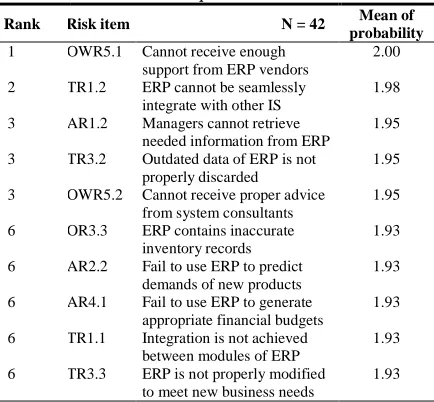
top ten risk events, which were found to be most likely to occur in Chinese firms, are given in Table 2.
Table 1. Top ten ERP barriers
Rank Barrier N = 42 Mean
1 SB1 Insufficient vendor support 2.95 2 SB4 System incompatibility 2.86 3 SB7 Slow system response time 2.81 3 SB3 System inflexibility 2.81 5 SB6 Deficient design of the system 2.76 6 SB2 Inexperienced system consultants 2.69 7 CB1 Power centralisation of top managers 2.55 8 OB7 Lack of in-house specialists 2.50 8 SB5 High cost for ERP add-ons 2.50 10 SB8 Misfits between ERP and user needs 2.36 CB = Cultural Barriers; OB = Organizational Barriers;
[image:9.595.71.288.302.503.2]SB = System Barriers
Table 1. Ten frequent ERP risk events
Rank Risk item N = 42 probability Mean of
1 OWR5.1 Cannot receive enough support from ERP vendors
2.00
2 TR1.2 ERP cannot be seamlessly integrate with other IS
1.98
3 AR1.2 Managers cannot retrieve needed information from ERP
1.95
3 TR3.2 Outdated data of ERP is not properly discarded
1.95
3 OWR5.2 Cannot receive proper advice from system consultants
1.95
6 OR3.3 ERP contains inaccurate inventory records
1.93
6 AR2.2 Fail to use ERP to predict demands of new products
1.93
6 AR4.1 Fail to use ERP to generate appropriate financial budgets
1.93
6 TR1.1 Integration is not achieved between modules of ERP
1.93
6 TR3.3 ERP is not properly modified to meet new business needs
1.93
OR = Operational Risk; AR = Analytical Risk; OWR = Organization-Wide Risk; TR = Technical Risk
Subsequently, in order to explore potential correlations between the identified ERP barriers and risks, a bivariate analysis was conducted. The use of Likert scales in the survey means that data variables generated were ordinal in nature. Therefore,
Spearman’s rho (rs) was adopted as the most
appropriate technique for measuring bivariate
correlations between these ordinal variables [54, 53]. Moreover, one-tailed test was used to test the statistical significance (P value) of each directional correlation proposed in the theoretical ontologies [54]. By following this approach, the researchers identified 19 statistically significant correlations between the ERP barriers and risks. Figure 5 presents a conceptual map to summarise and represent these correlations. A full description of each of these correlations is presented in Table 3.
OB3: Short-term behaviour
OWR1.3: Top managers fail to
provide s ufficient s upport
CB3: P ower cent ralisat ion of t op management
OWR1.1: T op managers make import ant IT decisions
wit hout consult ing IT expert s
OB4: Lack of ERP
plan OWR2.2:
Unclear direction for further ERP
enhancement
OWR2.5: Fail to as sign sufficient fund to ERP
exploitation TR3.3:
ERP is not properly modified to meed emergent user needs
OB7: Lack of in-house
IT expert s
OWR2.1: ERP plan is ill-defined or inappropriat e OB2: Low-skilled and ill-trained users OR1.1: Operat ional st aff are reluct ant t o use ERP
AR1.1: Managers refuse t o
use ERP SB7:
Slow syst em speed
R1 = .445 (**)
R2 = .381 (**)
R7 =
.419 (**) R8 = .327 (*)
R12 = .303 (*)
R17 = .320 (*)
R19 = .310 (*)
R15 = .385 (**) R5 = .373 (**)
R6 = .402 (**)
R9 = .710 (**) R4 = .348 (*)
OB8: Low user involvement
SB9: P oor dat a
qualit y
R3 = .446 (**)
R11 = .507 (**)
R18 = .542 (**) R16 = .384 (**)
R14 = .400 (**)
R13 = .396 (**)
OWR2.2: Unclear direct ion
for furt her ERP enhancement
R10 = .795 (**)
Barrier Risk
CB = Cult ural Barrier; OB = Organisat ional Barrier; SB = Syst em Barrier.
OR = Operat ional Risk; AR = Analyt ical Risk; OWR = Organisat ion-Wide Risk; T R = T echnical Risk
Figure 5. Conceptual map of correlations
Table 3: Description of correlations identified
Correlation rs
R1 Higher extent of power centralization can lead to higher chance for top managers to make centralized IS decisions
.445 (**) R2 The greater the extent of short-term thinking, the higher
the probability to lack top management support for ERP .381 (**) R3 Short-term behaviour of top managers can have negative
effect on the establishment of long-term ERP plan
.446 (**) R4 The higher the possibility to have insufficient ERP fund,
the greater the chance for ERP to be poorly enhanced .348
(*) R5 The higher the chance to lack top management support,
the higher the chance to have insufficient ERP fund.
.373 (**) R6 The higher the chance to lack top management support,
the higher the chance to have ill-defined ERP plan
.402 (**) R7 Lack of ERP exploitation plan can result in unclear
direction for long-term ERP development
.419 (**) R8 Lack of ERP plan can increase the probability for the
firm to assign insufficient fund to ERP exploitation
.327 (*) R9 The higher the chance to have ill-defined ERP plan, the
greater the possibility to have insufficient ERP fund
.710 (**) R10 A firm that is likely to have an ill-defined ERP plan, will
also be likely to have unclear ERP exploitation direction .795 (**) R11 Lack of IT experts can have negative impact on the
establishment of ERP plan
.507 (**) R12 Lack of IT experts can increase the probability for the
firm to have inappropriate ERP plan
.303 (*) R13 Lack of in-house IT experts can negatively affect the
quality of system data`
.396 (**) R14 When data quality of ERP is poor, speed of the ERP
system will be correspondingly slow
.400 (**) R15 Slow system speed can increase the probability for
having user resistance
.385 (**) R16 Low user involvement can negatively affect the quality
of system data
.384 (**) R17 Staff are more likely to be resistant to use ERP, when
they have low skill levels and insufficient training
.320 (*) R18 Users with low skill levels and insufficient training will
have low involvement in ERP-related activities
.542 (**) R19 Managers, who have lower skill levels and insufficient
training, are more likely to be reluctant to use ERP
.310 (*) * Correlation is significant at the 0.05 level (1-tailed);
[image:9.595.309.530.338.710.2]5. Discussion
It emerged from Table 1 that eight of the top ten ERP barriers are related to system aspects. Therefore, the respondents seemed to perceive system barriers to be particularly crucial to their firms, when organizational and cultural issues were considered to be less important. However, the results of the bivariate analysis proved that these respondents had in fact underestimated the critical impacts associated with organizational barriers and problems.
In particular, the above conceptual map clearly shows that many identified ERP barriers and risks are interwoven and closely correlated with each other. Further investigation of this conceptual map and the list of significant correlations identified that, organizational barriers (e.g. lack of in-house IT experts), which are mainly located at the center of the map, can originate a number of other ERP barriers, including the system ones (e.g. poor data quality). Moreover, the existence of these organizational obstacles can also increase the probability of occurrence of a wide range of ERP risks (e.g. ERP plan is ill-defined or inadequately developed). In contrast, system barriers, which were perceived as crucial by the respondents, do not prove to be the main triggers of other ERP barriers and risks. As a consequence, it became apparent that organizational barriers should in reality be more dangerous than system ones, although the significance of these organizational issues seems to be overlooked by the Chinese respondents.
In truth, despite their importance, organizational factors and issues have traditionally been understated by practitioners, probably due to a lack of understanding and awareness of the existence and influence of these barriers [54]. In China, this
underestimation may also be caused by an
unwillingness of Chinese managers to talk about their
organizational and management shortcomings.
Specifically, many researchers [6, 27, 55] stress that, Chinese managers are traditionally less willing to disclose problems and failures to external bodies, in order to preserve their own and/or their firms’ images.
In addition, under the hitherto bureaucratic
environment in the firm, Chinese managers may often be reluctant to address problems embedded in their organizational and management mechanism in order to avoid potential personal risks (e.g. job loss). These attitudes however may blind Chinese practitioners to the complexity and importance of organizational barriers, which might be less obvious but proved in this study to be more difficult to resolve and more critical to long-term ERP success in the Chinese context.
6. Implications
The results of this study have important implications for both practice and research. In terms of practice, the barrier and risk ontologies are useful checklists to help Chinese practitioners to identify, prevent and manage ERP post-implementation barriers and risks in their workplaces. The exploration and identification of a set of barrier and risk correlations also allow Chinese managers to gain deeper insights into possible triggers of the ERP problems that they are facing. More importantly, it is hoped that the findings of this study can make practitioners in Chinese firms become more aware of the importance and critical impacts of organizational barriers, and thus preventing them from potential ERP failure. In addition, it is important to note that, our findings may also be applicable to Western companies, considering that many ERP barriers and risks were initially grounded from Western IS literature as discussed above.
On the other hand, and in terms of research, the study added to the knowledge of ERP in general, and contributed to the research gap of ERP post-implementation barriers and risks in the Chinese context in particular. It represented a first attempt in producing a comprehensive study in its research area. The process of literature search could not return any other such studies. Therefore, the established barrier and risk ontologies can also be used as a starting point for researchers to carry out further research in this increasingly important research area.
7. Conclusions
This study identified and explored empirically a wide range of ERP exploitation barriers and risks in the Chinese context. Our findings have led to three major conclusions. Firstly, it was confirmed that successful implementation of the ERP system is not the end of the story. In fact, user companies can often experience a
large number of barriers and risks during
organizational exploitation of ERPs. Secondly, it was found that many ERP barriers and risks are interrelated with each other. These ERP issues thus prove to be very difficult to manage and mitigate. Thirdly, and most importantly, the findings identified that the complicated network of ERP barriers and risks is
actually originated by organizational barriers.
issues, as well as to take proper actions to address these critical ERP obstacles.
A noticeable limitation of this study is related to the small sample size. Indeed, the use of the PEST analysis to narrow the research context and select a specific set of Chinese company to base the study on, can limit the generalizability of the findings [52]. This limitation is attempted to be addressed in the next phase survey, in which a larger sample (e.g. involving Chinese SOEs and private companies in selected inland and coastal regions in diverse industrial sectors) will be used.
8. References
[1] T.H. Davenport, “Putting the enterprise into the enterprise system”. Harvard Business Review, 76(4), 1998, pp.121-131.
[2] C.S. Yu, “Causes influencing the effectiveness of the post-implementation ERP system”, Industrial Management
& Data systems, 105 (1), 2005, pp. 115-132.
[3] T. H. Willis and A. H. Willis-Brown, “Extending the value of ERP”, Industrial Management & Data Systems, 102 (1), 2002, pp. 35-38.
[4] A. Bhattacherjee, “Understanding information systems continuance: an expectation-confirmation model”, MIS
Quarterly, 25 (3), 2001, pp. 351-370.
[5] G.C. Peng and J.M.B Nunes, “Identification and assessment of risks associated with ERP post-implementation in China”, Journal of Enterprise Information Management, 22 (5), 2009.
[6] G.C. Peng and J.M.B Nunes, “Barriers to the successful exploitation of ERP systems in Chinese State-Owned Enterprises”, International Journal of Business and Systems
Research, forthcoming.
[7] M.L. Markus, S. Axline, D. Petrie and C. Tanis, “Learning from adopters’ experiences with ERP: problems encountered and success achieved”, Journal of Information
Technology, 15, 2000, pp. 245-265.
[8] D. Avison and J. Malaurent, “Impact of cultural differences: A case study of ERP introduction in China”,
International Journal of Information Management, 27, 2007,
pp. 368-374.
[9] E. Umble, R. Haft and M.M. Umble, "Enterprise Resource Planning: Implementation procedures and Critical Success Factors", European Journal of Operational
Research, 146, 2003, pp. 246-257.
[10] A. Al-Mudimigh, M. Zairi and M. Al-Mashari, “ERP software implementation: an integrative framework”,
European Journal of Information Systems, 10, 2001, pp.
216–226.
[11] T.F. Gattiker and D.L. Goodhue, “What happens after ERP implementation: understanding the impact of
interdependence and differentiation on plant-level outcomes”, MIS Quarterly, 29 (3), 2005, pp. 559-585.
[12] S.W. Chou and Y.C. Chang, “The implementation factors that influence the ERP (enterprise resource planning) benefits”, Decision Support Systems, 46, 2008, pp. 149-157.
[13] E. Hollnagel, Barriers and accident prevention, Hampshire: Ashgate Publishing, 2004.
[14] I. Polikoff, R. Coyne and R. Hodgson, Capability cases:
a solution envisioning approach, California: Wesley, 2005.
[15] A. Rucks and P. Ginter, “Strategic MIS: promises unfulfilled”, Journal of Systems Management, 8, 1982, pp. 16-19.
[16] B.H. Reich and I. Benbasat, “Factors that influence the social dimension of alignment between business and information technology objectives”, MIS Quarterly, 24 (1), 2000, pp. 81-113
[17] L. Raymond, “Organizational characteristics and MIS success in the context of small business”, MIS Quarterly, 9 (1), 1985, pp. 37-52.
[18] W.H. DeLone, “Determinants of success for computer usage in small business”, MIS Quarterly, 12 (1), 1988, pp. 51-61
[19] E. Karahanna, D.W. Straub and N.L. Chervany, “Information technology adoption across time: a cross-sectional comparison of pre-adoption and post-adoption beliefs”, MIS Quarterly, 23 (2), 1999, pp. 183-213.
[20] R. Roepke, R. Agarwal and T.W. Ferratt, “Aligning the IT human resource with business vision: the leadership initiative at 3M”, MIS Quarterly, 24 (2), 2000, pp. 327-353.
[21] A.C. Boyton, R.W. Zmud and G.C. Jacobs, “The influence of IT management practice on IT use in large organizations”, MIS Quarterly, 18 (3), 1994, pp. 299-318.
[22] L. Raymond, G. Pare and F. Bergeron, “Matching information technology and organizational structure: an empirical study with implications for performance”,
European Journal of Information Systems, 4, 1995, pp. 3-16.
[23] C. Desai, G. Wright and K. Fletcher, “Barriers to successful implementation of database marketing: a cross-industry study”, International Journal of Information
Management, 18 (4), 1998, pp. 265-276.
[24] M.G. Martinsons and R.I. Westwood, “Management information system in the Chinese business culture: an explanatory theory”, Information & Management, 32, 1997, pp. 215-228.
[25] M.G. Martinsons and P.S. Hempel, “Chinese business process re-engineering”, International Journal of Information
Management, 18 (6), 1998, pp. 393-407.
[26] K. Reimers, “Implementing ERP systems in China”, in
Proceedings of the 35th Annual Hawaii International Conference on System Sciences, Hawaii, USA, 2002.
implications for ERP vendors”, International Journal of
Production Economic, 97 (3), 2005, pp. 279-295.
[28] R. L. Kleim and I. S. Ludin, Reducing project risks, Hampshire: Gower Publishing Ltd, 2000.
[29] The Alaska Department of Natural Resources, “RAPS feasibility study – technical assessment”, downloaded on 21 Feb 2007 from: http://www.dnr.state.ak.us/lup/Technical _Assessment_5.2.pdf, 2003.
[30] E. Söderlind and S. Kidby, “Cross cultural cooperation – a field study about India and Sweden”, downloaded on 21 Feb 2007 from http://www.diva-portal.org/sh/abstract.xs ql?dbid=300, 2005.
[31] D.C. Chou, H.B. Tripuramallu and A.Y. Chou, “BI and ERP integration”, Information Management & Computer
Security, 13 (5), 2005, pp. 340-349.
[32] R.W. Scapens and M. Jazayeri, “ERP systems and management accounting change: opportunities or impacts? A research note”, European Accounting Review, 12 (1), 2003, pp. 201-233.
[33] C. Marnewick and L. Labuschagne, “A conceptual model for enterprise resource planning (ERP)”, Information
Management & Computer Security, 13(2), 2005, pp.144-155.
[34] Y. Zhou, B. Liu and Q. Zhou, ERP and enterprise
management: theories, methods and systems, Beijing:
Tsinghua University Press, 2005 (in Chinese).
[35] B.P. Lientz and L. Larssen, Risk management for IT
projects: how to deal with 150 issues and risks, Oxford:
Butterworth-Heinemann Ltd, 2006.
[36] C. Chittister and Y.Y. Haimes, “Risk Associated with Software Development: A Holistic Framework for Assessment and Management”, IEEE Transactions on
Systems, Man, and Cybernetics, 23 (3), 1993, pp. 710-723.
[37] R. Kühn and P. Neu, “Functional correlation approach to operational risk in banking organizations”, Physica A:
Statistical Mechanics and its Applications, 322, 2003, pp.
650-666.
[38] S. Wold, J. Cheney, N. Kettaneh and C. McCready, “The chemometric analysis of point and dynamic data in pharmaceutical and biotech production (PAT) – some objectives and approaches”, Chemometrics and Intelligent
Laboratory Systems, 84 (1-2), 2006, pp. 159-163.
[39] J. Vosburg and A. Kumar, “Managing dirty data in organizations using ERP: lessons from a case study”,
Industrial Management & Data Systems, 101 (1), 2001, pp.
21-31.
[40] G. Wright and B. Donaldson, “Sales information systems in the UK financial services industry: an analysis of sophistication of use and perceived barriers to adoption”,
International Journal of Information Management, 22, 2002,
pp. 405-419.
[41] A. Caglio, “Enterprise resource planning systems and accountants: towards hybridization?”, European Accounting
Review, 12 (1), 2003, pp. 123-153.
[42] S. Huang, I. Chang, S. Li and M. Lin, “Assessing risk in ERP projects: identify and prioritize the factors”, Industrial
Management & Data Systems, 104 (8), 2004, pp. 681-688.
[43] J.E. Scott and I. Vessey, “Managing risks in enterprise systems implementations”, Communication of the ACM, 45 (4), 2002, pp. 74-81.
[44] M. Sumner, “Risk factors in enterprise-wide/ERP projects”, Journal of Information Technology, 15, 2000, pp. 317-327.
[45] H. Barki, S. Rivard and J. Talbot, “Toward an assessment of software development risk”, Journal of
Management Information Systems, 10 (2), 1993, pp. 203-25.
[46] S.A. Sherer, “Managing risk beyond the control of IS managers: the role of business management”, in Proceedings
of the 37th Hawaii International Conference on System Sciences, 5-8 Jan 2004, Hawaii, USA.
[47] T.C. Loh and S.C.L. Koh, “Critical elements for a successful enterprise resource planning implementation in small-and medium-sized enterprises”, International Journal
of Production Research, 42 (17), 2004, pp. 3433-3455.
[48] S.C.L. Koh, M.H. Jones, S.M. Saad, A. Arunachalam and A. Gunasekaran, “Measuring uncertainties in MRP environments”, Journal of Logistics Information Management, 13 (3), 2000, pp. 177-183.
[49] G.C. Peng and J.M.B Nunes, “Surfacing ERP exploitation risks through a risk ontology”, Industrial
Management & Data Systems, 109 (7), 2009, pp. 926–942.
[50] A. Roy, P.G.P. Walters and S.T.K. Luk, “Chinese puzzles and paradoxes conducting business research in China”, Journal of Business Research, 52, 2001, pp.203-210.
[51] G.C. Peng and J.M.B. Nunes, “Using PEST Analysis as a Tool for Refining and Focusing Contexts for Information Systems Research”, in Proceedings of the 6th European
Conference on Research Methodology for Business and Management Studies, Lisbon, Portugal, pp. 229-237, 2007.
[52] G.C. Peng and J.M.B. Nunes, “Issues and difficulties in doing participative research in China: lessons learned from a survey in information systems research”, in Proceedings of
the 7th European Conference on Research Methodology for Business and Management Studies, London, UK, pp.
245-252, 2008.
[53] A. Bryman and D. Cramer, Quantitative data analysis
with SPSS 12 and 13: a guide for social scientists, East
Sussex: Routledge, 2005.
[54] K. Fletcher and G. Wright, “Organizational, strategic and technical barriers to successful implementation of database marketing”, International Journal of Information
Management, 15 (2), 1995, pp. 115-126.
[55] J.L. Graham and N.M. Lam, “The Chinese negotiation”, in Harvard Business School (eds), Harvard business review
on doing business in China, pp. 31-56, Boston: Harvard