‘A survey on willingness for early detection of prostatic cancer
and assessment of validity of digital rectal examination and
‘A survey on willingness for early detection of prostatic cancer
and assessment of validity of digital rectal examination and
prostate specific antigen’
A dissertation submitted to The Tamil Nadu Dr. M.G.R.
Medical University, in partial fulfillment of the requirements for
M.Ch. Branch-IV (Genitourinary surgery) examination to be
CERTIFICATE
This is to certify that this dissertation entitled ‘A survey on willingness
for early detection of prostatic cancer and assessment of validity of
digital rectal examination and prostate specific antigen’ is bonafide
work done by
Dr.Karthikeyan. A
in partial fulfillment of the rules and
regulation for M.Ch. Br. IV (Genitourinary Surgery) examination of the
Tamil Nadu Dr. M.G.R. Medical University, Chennai, to be held in
February 2007
.
Dr.Ganesh Gopalakrishnan,M.S.,M.Ch., F.R.C.P.(Edin),F.A.M.S.,
Professor & Head,
Dept. of Urology,
CONTENTS
1.
Introduction
1
2. Background
3
3. Objectives of the study
4
4.
Review
of
literature
5-28
Digital rectal examination
5
Serum
prostate
specific
antigen
6
Prostate
specific
antigen
density 8
Age specific prostate specific antigen range
10
Prostate specific antigen
velocity 12
Percentage free prostate specific antigen
14
Diagnostic
limitations
of
prostate specific antigen
16
Is early detection of prostate cancer justified?
17
Different
types
of
surveys
25
5. Materials and methods
29-31
6. Results
32-41
7.
Discussion
42-48
8.
Conclusions
49
9.
Limitations
50-51
10.
Bibliography 52-63
11.
Appendix
64-86
Introduction
Background
Objectives
1. Patient’s perspective on early detection of prostate cancer after an informed consent.
2. To determine whether informed consent was obtained for PSA testing by their physicians prior to the test.
Review of literature
Digital rectal examination:
Serum prostate-specific antigen test:
be further restricted with the advent of newer forms of PSA testing that rely on monoclonal measurement of the concentration of free and complexed serum PSA.
PSA density:
PSA density, the initial refinement of the PSA test, is an index calculated by dividing total serum PSA by the volume of the prostate, measured ultrasonically by TRUS. In the absence of cancer, prostatic volume is directly proportional to circulating serum PSA.18 Benign prostatic hyperplasia is associated with, on average, only 0.26 ng/mL PSA per gram of tissue, whereas cancer results in a density 10-fold higher.19 Any PSA value greater than that predicted by gland volume should raise a suspicion of prostate cancer.
Age-specific PSA ranges:
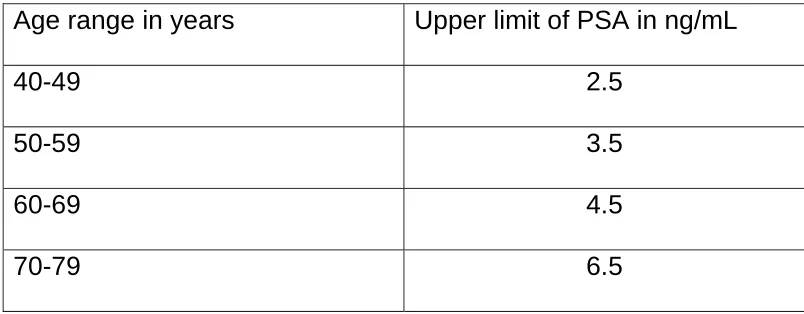
[image:14.612.104.506.369.526.2]Age-specific PSA ranges, which rely on age instead of TRUS volumetry, are based on the assumption that older men have larger prostates and, therefore, may have higher serum PSA levels not associated with carcinoma. More specifically, the introduction of age specific PSA ranges was aimed at increasing the sensitivity of PSA testing in younger men and increasing the specificity of such testing in older men.25 The reference ranges are given in Table 1.
Table 1: Reference ranges for age specific PSA levels
Age range in years Upper limit of PSA in ng/mL
40-49 2.5 50-59 3.5 60-69 4.5 70-79 6.5
PSA velocity:
Percentage of free PSA:
Diagnostic limitations of PSA testing and its enhanced forms:
Is early detection of prostate cancer justified?
survey, 87% of family physicians and 98% of urologists reported using the test to detect early prostate cancer.35
The general population harbors predominantly latent prostate tumors of doubtful clinical significance. Such tumors are indolent, they advance slowly and the individual generally succumbs to other diseases. Patients die with, rather than from, the disease. Autopsy studies of men over age 50 who lived their entire lives without prostatic symptoms demonstrate that about 30% harbor pathologic evidence of prostate cancer 36. Most of these tumors would go unrecognized if not investigated. There is some evidence that PSA detected tumors are of greater clinical significance than those detected on autopsy. 37
(watchful waiting) appears to differ little from outcomes with surgery or radiation. A widely cited study 39 of 223 conservatively treated Swedish men reported 10- and 15-year disease-specific survival rates of 85% and 81%, respectively. A study in Connecticut, also reported that conservative treatment resulted in survival rates resembling those of the general population.40 Counselling all men over age 50 for early detection of prostate cancer would expose a large population to potential harm of unwarranted biopsy. Most persons who experience these adverse effects will not have cancer. These men will ultimately not benefit from early detection. They undergo an unpleasant experience of learning that their PSA test is abnormal, undergo a repeat PSA testing, ultrasound, or biopsy; and anxiously waiting to know whether they have cancer. No data quantify the morbidity of this experience or whether the upset for some patients is off set by the reassurance that others experience by receiving normal results. About 20% of screened population undergo needle biopsy,41 for which there is a low probability of local infection (0.35%), sepsis (0.6%), and bleeding (0.1%).42-44
complication rates are lower, studies suggest that they remain high in the community. For example, a survey of Medicare patients who underwent prostatectomy reported that over 30% wore pads or clamps for incontinence, over 60% were impotent, and 15% required treatment for sexual dysfunction.45 Complications affecting sexual, urinary, and bowel function have a substantial impact on these aspects of quality of life.46 Although some patients are willing to risk these complications of treatment, others do not feel the risks are justified. In one study, 26% of patients (mean age 66 years) indicated a preference for expectant management over surgery, even if the latter would extend life by 10 years.47
Individual Patient Counselling:
those preferences match their own. Neither presumption is justified; studies show that physicians are poor judges of their patient’s preferences. It is unethical for physicians to impose choices that reflect their own feelings about benefits and harms rather than those of the patient. Accordingly, instead of routinely performing or discouraging early detection of prostate cancer, most groups now recommend some form of shared decision making, in which clinicians (1) review with patients the facts about the benefits and harms of PSA testing, their likelihood, and the scientific uncertainty around the estimates; (2) help patients assess personal feelings and preferences about potential outcomes; and (3) help determine which choice is best. Although many patients ultimately turn to the physician for advice, a sizable minority appreciate the opportunity to make their own choice, as is their ethical right. A consensus on the need for this approach has emerged in recent guidelines. The American College of Physicians
48
recommends that physicians describe the potential benefits and known harms of PSA testing, listen to the patient’s concerns, and then individualize the decision to screen.
these tests and should be given the option to participate in screening. Yet shared decision making is uncommon in practice. Patients often undergo PSA screening without receiving information about the consequences and sometimes without even being told they received the test. In one study, over 50% of men who had undergone PSA screening two weeks earlier said they had not heard of the test and were unaware that they had received it.49
videodisks for shared decision making present the options in a factual, balanced format.51 Clinicians can reconcile time demands by relying on other office staff to help present options and by inviting patients to review print and audiovisual materials at home. These tools do affect patient’s choices. Several studies have shown that giving patients information about benefits and harms and an opportunity to make their own choice decreases PSA testing by as much as 50%.52-53
Different types of survey:
Surveys can be divided into two broad categories: the questionnaire and the interview. Questionnaires are usually paper-and-pencil instruments that the respondent completes. Interviews are completed by the interviewer based on the respondents answer. Interviews are a far more personal form of research than questionnaire. Questionnaire almost always are short closed-ended, while interviews almost always are broad open-ended. But questionnaires can be open-ended (although they do tend to be shorter than in interviews) and there could be a series of closed-ended questions in an interview. There are different types of questionnaires.
Mailed questionnaire:
Group questionnaire:
A sample of respondents are brought together and asked to respond to a structured sequence of questions. Traditionally, questionnaires were administered in group settings for convenience. The researcher could give the questionnaire to those who were present and be fairly sure that there would be a high response rate. If the respondents were unclear about the meaning of a question they could ask for clarification. The same could be used in an individual setting instead of a group. Validated questionnaires will give better results.
Household questionnaire:
about the study and get clarification on what is to be done. Generally, this would be expected to increase the percent of people who are willing to respond.
Interviews
Personal interview:
The interviewer works directly with the respondent. Unlike mail surveys, the interviewer has the opportunity to probe or ask follow-up questions. Interviews can be very time consuming and they are resource intensive. The interviewer is considered a part of the measurement instrument and interviewers have to be well trained in how to respond to any contingency.
Telephone interview:
Materials & Methods
end format (appendix 2), and if they could’nt give a definitive answer they were given the privilege to answer ‘I am not sure’. Participants were given the freedom to express their opinion in addition to the choices mentioned in the questionnaire and they can make more than one choice. Men who had their PSA tested elsewhere earlier, were enquired about their opinion as to whether they would have undergone the test had they known the facts about early detection of prostate cancer. All men with LUTS had DRE. Men with normal DRE were included in this survey. They were enquired regarding their willingness for PSA testing. It was decided to survey three different groups of men; the reasons for it are 1. Is there a difference in their willingness to undergo tests for early detection in those with and without symptoms? 2. Will an informed consent alter their decision to undergo tests for early detection? Men in group 1 were asymptomatic. Men in group 2 had LUTS and normal DRE. None of the patients in group 2 had PSA testing in the past. Men in group 3 had LUTS and normal DRE, but had PSA testing in the past. There were thirty men in each group.
lesions on TRUS during evaluation for hematospermia. Study period was between January 2002 and December 2005. Serum PSA was assayed using the Immulite 2000 kit. PSA more than 4 ng./ml. was considered as abnormal for this analysis. Free PSA were done in all patients after March 2003. DRE was performed by an attending urologist or resident. For analytical purpose DRE was coded as normal or abnormal. A systematic TRUS guided sextant biopsy was performed by the radiologist with an 18 gauge biopsy needle using the biopty gun. Additional biopsy of hypoechoic areas detected incidentally during TRUS was also biopsied.
Results
Survey analysis:
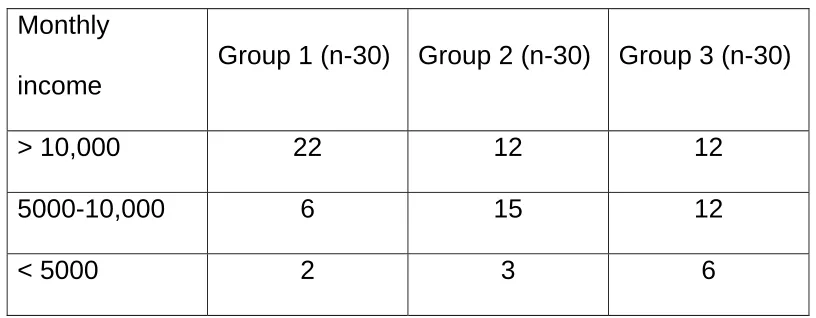
[image:36.612.102.510.280.439.2]Mean age of the participants in group1, group 2 and group 3 were 60, 59, 59 years respectively. Monthly income of men in three groups is shown in table 2.
Table: 2 Monthly income Monthly
income
Group 1 (n-30) Group 2 (n-30) Group 3 (n-30)
> 10,000 22 12 12
5000-10,000 6 15 12
< 5000 2 3 6
an intention to detect early cancer of the prostate after an informed consent by their physician. Of the 30 men in group 3, benefits and risks relating to PSA testing was discussed by their physician in 30 % of patients. 70 % of the patients had their PSA tested without an informed consent. Of the 70 % who had a PSA without an informed consent 38% felt that they would not have undergone the test if the risks and benefits were explained to them prior to the test and 14 % were ‘not sure’ whether they would have undergone the test.
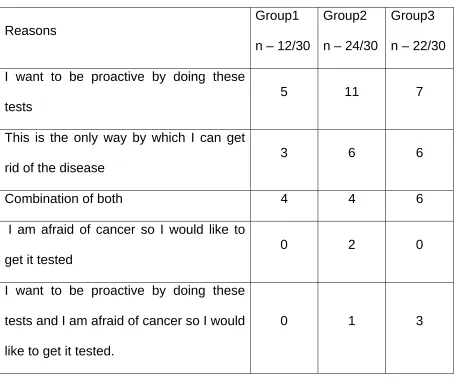
Table 3: Reason for willingness to undergo tests
Reasons
Group1 n – 12/30
Group2 n – 24/30
Group3 n – 22/30 I want to be proactive by doing these
tests
5 11 7
This is the only way by which I can get rid of the disease
3 6 6
Combination of both 4 4 6
I am afraid of cancer so I would like to get it tested
0 2 0
I want to be proactive by doing these tests and I am afraid of cancer so I would like to get it tested.
0 1 3
Table 4: Reason for unwillingness to undergo tests
Reasons Group 1 Group 2 Group 3
Complications associated with treatment
7 3 2
Early detection is not a guarantee that cancer will be cured
5 0 0
Treatment may not be beneficial because many men will die from other causes
3 0 0
Early detection is not a guarantee that cancer will be cured and due to financial reasons
2 0 0
Early detection is not a guarantee that cancer will be cured and treatment may not be beneficial because many men will die from other causes
1 3 3
Early detection is not a guarantee that cancer will be cured and the complications associated with the treatment
Of those not willing for early detection 17%, 50% and 75% in groups 1, 2 and 3 respectively had more than one reason for their unwillingness (table.4). Financial constraint was only a part of the reason for their unwillingness in two patients.
Validity of PSA and DRE:
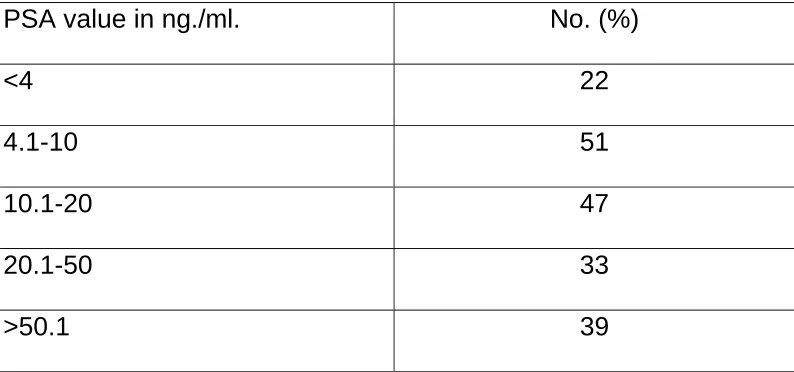
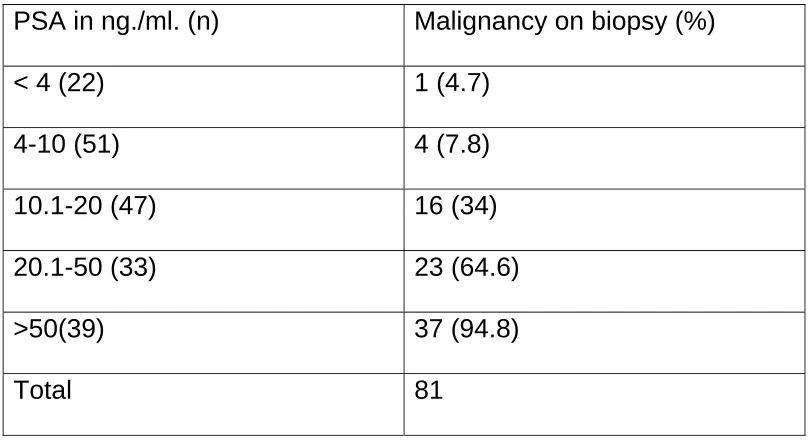
In order to assess the validity of PSA and DRE, 192 men who had TRUS guided prostatic biopsies were analysed retrospectively. Mean age was 65 years (range 40- 93). 94 % had lower urinary tract symptoms. The distribution of digital rectal examination results and PSA values are shown in tables 5 and 6.
Table 5: DRE results in 192 patients
DRE No. (%)
Normal 63 (32.8)
Table 6: PSA results in 192 patients
PSA value in ng./ml. No. (%)
<4 22 4.1-10 51 10.1-20 47 20.1-50 33 >50.1 39
Table 7: PSA range and biopsy result
PSA in ng./ml. (n) Malignancy on biopsy (%)
< 4 (22) 1 (4.7)
4-10 (51) 4 (7.8)
10.1-20 (47) 16 (34)
20.1-50 (33) 23 (64.6)
>50(39) 37 (94.8)
Total 81
Table 8: Percentage of men with malignancy with 1 or 2 positive tests and 1 or 2 negative tests
PSA in ng./ml.
DRE Biopsy
Benign(%) Malignant (%)
Total
> 4 Normal 53(88.3%) 7(11.7%) 60 Abnormal 37(33.6%) 73(66.4%) 110 < 4 Normal 3(100%) 0 3
Abnormal 18(94.7%) 1(5.3%) 19
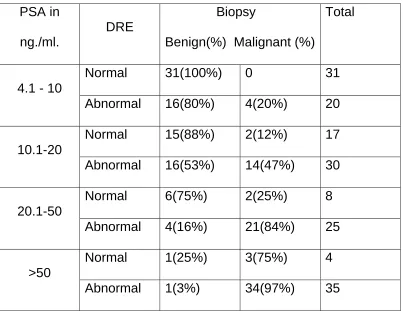
Table. 9 Malignancy in men with normal or abnormal DRE and abnormal PSA
PSA in ng./ml.
DRE
Biopsy
Benign(%) Malignant (%)
Total
4.1 - 10
Normal 31(100%) 0 31
Abnormal 16(80%) 4(20%) 20
10.1-20
Normal 15(88%) 2(12%) 17
Abnormal 16(53%) 14(47%) 30
20.1-50
Normal 6(75%) 2(25%) 8 Abnormal 4(16%) 21(84%) 25
>50
Normal 1(25%) 3(75%) 4 Abnormal 1(3%) 34(97%) 35
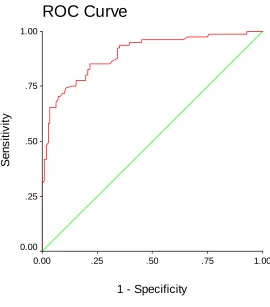
Fig. 1 : Receiver operating characteristic curve for PSA.
ROC Curve
1 - Specificity
1.00 .75
.50 .25
0.00
S
e
n
s
itiv
it
y
1.00
.75
.50
.25
Discussion
Survey analysis
examinations such as master health checkup is unacceptable ethically.
Validity of PSA and DRE:
Conclusion
Limitations
Survey analysis
Validated information regarding what patients should know prior to PSA testing is not available in the literature. The information contained in the brochure is similar to the information provided by other investigators but it was tailored according to the needs of our patients. The questionnaire provided to men in the western world cannot be used in our setting, because of the increased awareness about screening for prostate cancer among men in the western world. Validated questionnaire to suit our patients is not available, so this questionnaire was designed according to the needs of our patients. Patient interest in PSA screening was used as a surrogate marker for actual screening behavior. We cannot predict with certainty how patient interests would translate into his decision to have the test done, though it seems likely that those who expressed a desire would choose to be tested. This survey was done in a select group of educated men, so it cannot be generalized to the community setting.
Validity of PSA and DRE
Bibliography
1. Catalona WJ. Screening for early detection of prostate cancer [letter]. Lancet. 1996;347:1629.
2. Gohagan JK, Prorok PC, Kramer BS, Cornett JE. Prostate cancer screening in the prostate, lung, colorectal and ovarian cancer screening trial of the National Cancer Institute. J Urol. 1994;152:1905-9.
3. Wilt TJ, Brawer MK. The prostate cancer intervention versus observation trial: a randomized trial comparing radical prostatectomy versus expectant management for the treatment of clinically localized prostate cancer. J Urol. 1994;152:1910-4.
4. Partin AW, Kattan MW, Subong enp, et al. Combination of PSA, clinical stage and Gleason score to predict pathological stage of localized prostate cancer: A multi-institutional update. JAMA 1997;277(18):1445-51
5. Coley CM, Barry MJ, Fleming C, et al. Early detection of prostate cancer. Part 1: prior probability and effectiveness of tests. Ann Intern Med 1997;126:394–406.
7. Aprikian AG, Bazinet M, Plante M, Meshref A, Trudel C, Aronson S, et al. Family history and the risk of prostatic carcinoma in a high risk group of urological patients. J Urol. 1995;154:404-6. 8. Smith DS, Catalona WJ. Interexaminer variability of digital rectal examination in detecting prostate cancer. Urology. 1995;45:70-4. 9. Carvalhal GF, Smith DS, Mager DE, et al: Digital rectal examination for detecting prostate cancer at prostate specific antigen levels of 4 ng/ml or less. J Urol 1999;161:835
10. Bazinet M, Karakiewicz PI, Aprikian AG, Trudel C, Aronson S, Nachabe M, et al. Value of systematic transition zone biopsies in the early detection of prostate cancer. J Urol. 1996;155:605-6. 11. Goldenberg SL, Klotz LH, Srigley J, Jewett MA, Mador D, Fradet Y, et al. Randomized, prospective, controlled study comparing radical prostatectomy alone and neoadjuvant androgen withdrawal in the treatment of localized prostate cancer. Canadian Urologic Oncology Group. J Urol. 1996;156:873-7.
12. Bostwick DG. Prostate specific antigen: current role in diagnostic pathology of prostate cancer. Am J Clin Pathol. 1994;102(4 Suppl 1):S31-7.
specific antigen concentration. Urol Clin North Am. 1997;24:283-91.
14. Guess HA, Gormley GJ, Stoner E, Oesterling JE. The effect of finasteride on prostate specific antigen: review of available data. J Urol. 1996;155:3-9.
15. Terris MK, Stamey TA. Utilization of polyclonal serum prostate specific antigen levels in screening for prostate cancer: a comparison with corresponding monoclonal values. Br J Urol. 1994;73:61-4.
16. Partin AW, Oesterling JE. The clinical usefulness of prostate specific antigen: update 1994. J Urol. 1994;152:1358-68.
17. Karakiewicz PI, Bazinet M, Aprikian AG, Trudel C, Aronson S, Nachab M, et al. Outcome of sextant biopsy according to gland volume. Urology. 1997;49: 55-9.
18. Benson MC, Whang IS, Pantuck A, Ring K, Kaplan SA, Olsson CA, et al. Prostate specific antigen density: a means of distinguishing benign prostatic hypertrophy and prostate cancer. J Urol. 1992;147:815-9.
20. Bazinet M, Meshref AW, Trudel C, Aronson S, Peloquin F, NachabeM, et al. Prospective evaluation of prostate-specific antigen density and systematic biopsies for early detection of prostatic carcinoma. Urology. 1994;43:44-51.
21. Bazinet M, Karakiewicz PI, Aprikian AG, Trudel C, Aronson S, NachabeM, et al. Reassessment of non-planimetric transrectal ultrasound prostate volume estimates. Urology. 1996;47:857-62. 22. Karakiewicz PI, Bazinet M, Aprikian AG, Trudel C, Aronson S, Peloquin F, et al. Analysis of gland volume effect on the performance of PSA density in early detection of non-palpable, isoechoic prostate cancer. Can J Urol. 1996;3:212-20.
23. Karakiewicz PI, Aprikian AG, Meshref AW, Bazinet M. Computer-assisted comparative analysis of four and six sector biopsies of the prostate. Urology. 1996;48:747-50.
24. Levine MA, Ittman M, Melamed J, Lepor H. Two consecutive sets of transrectal ultrasound guided sextant biopsies of the prostate for the detection of prostate cancer. J Urol. 1998;159:471-6.
26. Carter HB, Pearson JD, Metter EJ, Brant LJ, Chan DW, Andres R, et al. Longitudinal evaluation of prostate specific antigen levels in men with and without prostate cancer. JAMA. 1992;267:2215-7. 27. Catalona WJ, Smith DS, Ratliff TL. Value of measurement of the rate of change of serum PSA levels in prostate cancer screening [abstract 348]. J Urol 1993;149:300A.
28. Prestigiacomo AF, Stamey TA. Physiological variation of prostate specific antigen in the 4.0 to 10.0 ng/mL range in male volunteers. J Urol. 1996;155:1977-80.
29. Nixon RG, Wener MH, Smith KM, Parson RE, Strobel SA, Brawer MK. Biological variation of prostate specific antigen levels in serum: an evaluation of day-to-day physiological fluctuations in a well-defined cohort of 24 patients. J Urol. 1997;157:2183-90. 30. Brawer MK, Beattie J, Wener MH, Vessella RL, Preston SD, Lange PH. Screening for prostatic carcinoma with prostate specific antigen: results of the second year. J Urol. 1993;150:106-11.
31. Carter HB, Morrel CH, Pearson JD, Brant LJ, Plato CC, Metter EJ, et al. Estimation of prostatic growth using serial prostate specific antigen measurement in men with and without prostate cancer. Cancer Res. 1992;52:3323-6.
with negative and positive systematic ultrasound guided prostate biopsies? J Urol. 1997;157:189-94.
33. Catalona WJ, Partin AW, Slawin KM, Brawer MK, Patel A, Flanigan RC, et al. A multicenter trial evaluation of free PSA in the differentiation of prostate cancer from benign disease. J Urol. 1997;157:434A.
34. Catalona WJ, Smith DS, Ornstein DK. Prostate cancer detection in men with serum PSA concentrations of 2.6 to 4.0 ng/mL and benign prostate examination. Enhancement of specificity with free PSA measurement. JAMA. 1997; 277:1475-6. 35. McKnight JT, Tietze PH, Adcock BB, et al. Screening for prostate cancer: a comparison of urologists and primary care physicians. So Med J. 1996;89:885-8.
36. Woolf SH and Rothemich SF. Screening for prostate cancer: the roles of science, policy, and opinion in determining what is best for patients. Annu Rev Med. 1999;50:207-21.
38. Bill-Axelson, Holmberg L, Ruttu M et al. Radical prostatectomy versus watchful waiting in early prostate cancer. 2005;352:1977-84.
39. Johansson JE, Holmberg L, Johansson S, et al. Fifteen-year survival in prostate
cancer: a prospective, population based study in Sweden. JAMA. 1997; 277: 467-71.
40. Albertsen PC, Fryback DG, Storer BE, et al. Long-term survival among men with conservatively treated localized prostate cancer. JAMA. 1995; 274:626-31.
41. Babaian R, Mettlin C, Kane R, et al. The relationship of prostate-specific antigen to digital rectal examination and transrectal ultrasonography. Cancer.1992;69:1195-1200
42. Desmond PM, Clark J, Thompson IM, et al. Morbidity with contemporary prostate biopsy. J Urol. 1993;150:1425-26.
43. Aus G, Hermansson CG, Hugosson J, et al. Transrectal ultrasound examination of the prostate: complications and acceptance by patients. Br J Urol. 1993;71:457-59.
prostatectomy: the national Medicare experience (1988-1990). Urology 1993;42:622-28.
46. Litwin MS, Hays RD, Fink A, et al. Quality-of-life outcomes in men treated for localized prostate cancer. JAMA. 1995;273:129-35.
47. Mazur DJ, Merz JF. How older patient’s treatment preferences are influenced by disclosures about therapeutic uncertainty: surgery versus expectant management for localized prostate cancer. J Am Geriatr Soc. 1996;44:934-37.
48. American College of Physicians. Screening for prostate cancer.Ann. Intern Med 1997;126:480-84.
49. Diefenbach PN, Ganz PA, Pawlow AJ, Guthrie D. 1996. Screening by the prostate-specific antigen test: what do the patients know? J Cancer Educ. 1996;11:39-44.
50. Austin OJ, Valente S, Hasse LA, Kues JR. 1997. Determinants of prostate-specific antigen test use in prostate cancer screening by primary care physicians. Arch. Fam. Med. 1996;6:453-58.
51. Woolf SH. Shared decision making: the case for letting patients decide which choice is best. J Fam Pract. 1997;45:205-8.
53. Wolf AMD, Nasser JF, Wolf AM, Schorling JB. The impact of informed consent on patient interest in prostate specific antigen screening. Arch Intern Med. 1996;156:1333-36.
54. Barry MJ, Roberts RG, Oesterling JE, et al. Differences in how primary care physicians and urologists approach early detection of prostate cancer. J Gen Intern Med. 1996;11(Suppl):62 (Abstr.) 55. Gee WF, Holtgrewe HL, Albertsen PC, et al. Practice trends in the diagnosis and management of prostate cancer in the United States. J Urol. 1995;154:207-8.
56. Woolf SH. Screening for prostate cancer with prostate specific antigen. An examination of evidence. N Engl J Med. 1995;333:1401-5.
57. Screening for prostate cancer. American College of Physicians. Ann Intern Med. 1997;126:480-4.
58. Wilt JT, Paul J, Murdoch M, Nelson D, Nugent S, Rubins HB. Educating men about prostate cancer screening. A randomized trial of mailed pamphlet. Eff Clin Pract. 2001;4:112-120.
60.Wahnefried WD, Strigo T, Catoe K, Conaway M, Brunetti M, Rimer BK, Robertson CN. Knowledge, beliefs and screening behavior among blacks and whites reporting for prostate cancer screening. Urology. 1995;46:346-51.
61. Volk RJ, Spann SJ, Cass AR etal. Patient education for informed decision making about prostate cancer screening: a randomized controlled trial with 1-year follow-up. Ann Fam Med.2003;1:22-28.
62. Federman DG, Goyal S, Kamina A, Peduzzi P, Concato J. Informed consent for PSA screening does it happen? Effec Clin Prac. 1999;2:152-57.
63. Hammerer P, Huland H. Systematic sextant biopsies in 651 patients referred for prostate evaluation. J Urol. 1994;151:99-102. 64. Ellis WJ, Chetner MP, Preston SD, Brawer MK. Diagnosis of prostatic carcinoma: The yield of serum prostate specific antigen, digital rectal examination and transrectal ultrasonography.J Urol. 1994;152:1520-25.
66. Catalona WJ, Hudson MA, Scardino PT et al. Selection of optimal prostate specific antigen cutoffs for early detection of prostate cancer: Receiver operating characteristic curves. J Urol. 1994a; 152:2037.
67. Brawer MK, Lange PH. Prostatic specific antigen: its role in early detection, staging and monitoring of prostatic carcinoma. J Endourol. 1989;3: 227.
68. Schroder FH, Van der Mass P, Beemsterboer P et al. Evaluation of the digital rectal examination as a screening test for prostate cancer. Rotterdam section of the European Randomized Study of Screening for Prostate Cancer. J Natl Cancer Inst. 1998;90:1817.
69. Catalona WJ, Richie JP, Ahmann FR et al. Comparison of digital rectal examination and serum prostate specific antigen in the early detection of prostate cancer: Results of a multicenter clinical trial of 6,630 men. J Urol. 1994b;151:1283-90.
70. Thompson IM, Pauler DK, Goodman PJ, Tangen CM, Lucia SM, Parnes HL et al.
Prevalence of prostate cancer among men with a prostate specific antigen level < 4 ng./ml. N Eng J Med. 2004;350:2239-46.
country with low incidence of prostate cancer. Urology 1998; 51 (Suppl .5A): 125–30
Appendix -1
Dear participant,
The department of Urology is interested in assessing the willingness of the people in the community regarding early detection of prostatic cancer. There are only few cancers that can be detected at an early stage and prostate cancer is one of them. One of the early indicators of the disease is elevated PSA (blood test). Another method of diagnosis is to do an examination of the prostate by passing a finger into the rectum.
This study specifically aims to assess the willingness of the participants in the age group of 50 – 69 years to undergo the above tests. If any one of the test is found to be abnormal, biopsy test of the prostate should be done to exclude cancer. Those willing to undergo these tests need to understand the merits and demerits of these tests.
Where is the prostate gland situated?
Prostate gland is situated just below the urinary Bladder.
What is the function of the gland?
It is a secondary sex gland and plays a role in the formation of semen. It also produces an enzyme called PSA.
What conditions produces an elevation in PSA?
Infection, benign (noncancerous) tumors and cancer.
At what age does cancer begins to occur in this gland?
Usually cancer occurs after the age of fifty. This is also the age where noncancerous enlargement of the prostate occurs. Non cancerous enlargement is much more common than cancerous enlargement.
What are the symptoms of cancer?
can produce obstruction to urinary passage resulting in the above symptoms and also symptoms due to spread of the disease.
What is the risk of getting cancer during a person’s lifetime?
Western data states that out of hundred men, thirteen men are at risk of developing cancer during their lifetime.
How many of them will die of prostatic cancer?
Two to three men will die of prostatic cancer; the rest of the men will have the cancer but will die of other diseases, as this is a slow growing cancer.
How can this cancer be detected at an early stage?
Beyond which level is PSA considered to be abnormal?
Value greater than 4 ng./ml. is generally considered as abnormal. Chance of cancer increases with increasing PSA.
If the tests are abnormal does it mean that there is cancer?
The answer is no. PSA might be elevated in various conditions like infection, benign (non cancerous) enlargement of the prostate etc. Of the patients with PSA level between 4-10 ng/ml only 25% will have cancer. If the finger testing is abnormal less than 50 % will have cancer.
Will PSA be elevated in all men with cancer of the prostate?
What should be done if any one of them is abnormal?
If the PSA is elevated or if the finger test is abnormal then the person should undergo biopsy of the prostate to rule out cancer.
Is it advisable to do any one of these tests?
No, the recommendation is to do both the tests as the detection rate of cancer increases if both the tests are combined together.
How is prostatic biopsy done?
Biopsy is done through the rectum (motion passage) under ultrasound guidance.
Does biopsy produce pain or any other complication?
Is one time testing with PSA & finger testing of the prostate sufficient to detect cancer?
The answer is no. Periodic testing should be done at least once in a year. One time testing may not be sufficient to detect early cancer of the prostate, even though it may be negative during the earlier testing.
What should be done if the PSA is elevated but the biopsy is negative?
The patient should be followed up with repeat PSA testing at 6 months and repeat biopsy later if necessary.
What are the treatment options for the early stage cancer?
1. Regular followup with PSA testing and further treatment if the PSA levels increase rapidly
2. Surgery 3. Radiation.
The treating doctor may recommend any one of the treatment options.
What is the problem with regular follow-up with PSA testing?
It produces anxiety in some patient, as he knows that he has cancer and nothing is being done.
What are the complications of surgery?
Decreased penile erections (70%), urinary leak (2-5%) and the risk associated with surgery and anesthesia.
What are the complications of radiation?
There may be some urinary and rectal symptoms like increased frequency of urination and defecation, pain in the urinary and motion passage. These symptoms gradually subside over a period of 6-8 weeks. The risk of severe rectal and urinary complication is about 3% each.
Has it been proved beyond doubt that early detection and treatment reduces the risk of death from cancer?
Is prostatic cancer a common disease in India?
The answer is yes. It is the fifth most common cancer among men in Chennai, Bangalore and Bombay. In America prostate cancer is the second most common cancer in men.
What will be the approximate cost for testing?
The cost of the PSA test is Rs 500.There is no additional charge for finger testing of the prostate, as it is part of clinical examination. The cost for performing biopsy if the above tests are abnormal is Rs 1475.
What will be the additional duration of stay?
PSA and finger testing doesn’t require additional duration of stay, if biopsy is required additional duration of stay will be by 1 week. Why should it be done (PSA testing and finger testing)
¾ Advanced prostate cancer is not curable.
¾ In the absence of early testing, only a few men will be diagnosed with early curable prostate cancer.
¾ Improves early detection of prostate cancer
Why it should not be done (PSA testing and finger testing)
¾ No study has been done to prove that early detection reduces the death rate from prostatic cancer
¾ Many men will die from other causes before suffering from advanced disease
¾ Current treatment in the form of operation and radiation may cause complication in some men
¾ Improving early detection is not a guarantee that cancer deaths will be prevented
¾ PSA will be elevated in only 75 % of men with prostate cancer
I hereby consent to participate further in the study and I am willing to answer the questionnaire in the subsequent part of the study.
Appendix - 2
Proforma
1. Name: 2.Age:
3. Level of education: (Tick any one of the choices)
1. Below 5th class
2. Between 6th and 12th class 3. Graduate
4. Profession: (Mention your profession) 1.
5. Monthly income: (Tick any one of the choices)
6. Purpose of visit to CMC: (Tick any one of the choices)
1. As a patient to Urology department 2. As a relative of a patient
7. Do you have any urinary problem? (Tick any one of the choices) 1. Yes 2. No
8. If yes: Please fill the symptom score in the last page (IPSS score)
9. Do you know that there is a blood test, which can detect early cancer of the prostate before participating in the study? (Tick any one of the choices)
1. Yes 2. No 3. I am not sure
10. Are you willing to undergo the blood test and finger testing of the prostate through the rectum for early detection of prostate cancer? Both the tests should be done for early detection of cancer?
(Tick any one of the choices)
11. If the blood test shows elevated PSA, or the finger test is abnormal you need to consult an urologist and you will be advised to undergo biopsy of the prostate; are you willing for this? (Tick any one of the choices)
1.Yes 2. No 3. Iam not sure
12.Has PSA testing been done earlier? (Tick any one of the choices)
1.Yes 2.No
13.If PSA has been tested earlier have you been explained about the merits and demerits of testing (applicable only if you tick yes to question no 12)
1. Yes 2.No
14.If the merits and demerits have been explained to you at the time of testing what would have been your response (applicable only if you tick yes to question no 12)
15. If you want to undergo early detection of prostate cancer what is the reason for it?
(You can tick one or more reasons, if you tick the fourth choice kindly mention the reason)
1. I want to be proactive by doing these
tests
2. I am afraid of cancer, so I would like to
get it tested
3. This is the only way by which I can get
rid of the disease
4. Any other reason (if so please mention
below)
16. Are you willing for yearly PSA testing and finger testing (Tick any one of the choices)
17. If you don’t want it tested what is the reason?
(You can tick one or more choices, if you choose the sixth choice kindly mention the reason.)
1. Early detection is not a guarantee that
cancer will be cured
2. Complications associated with the
treatment
3. Treatment may not be beneficial
because many men will die from other causes before suffering from advanced cancer
4. Financial problems
5. Fear of being diagnosed to have cancer 6. Any other reason (if so please mention
below)
THANK YOU FOR TAKING THE TIME TO ANSWER THIS QUESTIONNAIRE. IF YOU HAVE ANY FURTHER QUESTIONS PLEASE FEEL FREE TO ASK.
Appendix 3
roc psa by biop_r (1)/ plot = curve(reference) / print = se coordinates.
Case Processing Summary
BIOP_R Valid N (listwise)
Positive(a) 81
Negative 111
Larger values of the test result variable(s) indicate stronger evidence for a positive actual state.
a The positive actual state is Malignant.
Area Under the Curve Test Result Variable(s): PSA
Area
Std. Error(a)
Asymptotic Sig.(b)
Asymptotic 95% Confidence Interval
Lower Bound Upper Bound
The test result variable(s): PSA has at least one tie between the positive actual state group and the negative actual state group. Statistics may be biased.
a Under the nonparametric assumption
b Null hypothesis: true area = 0.5
Coordinates of the Curve Test Result Variable(s): PSA
Positive if Greater Than or Equal To(a)
Sensitivity 1 – Specificity
-.950 1.000 1.000
.225 1.000 .991
.410 1.000 .982
.510 1.000 .973
.625 1.000 .964
.755 1.000 .955
.930 1.000 .946
1.080 1.000 .937
1.450 .988 .928
1.530 .988 .919
1.780 .988 .910
2.080 .988 .901
2.255 .988 .892
2.475 .988 .883
2.700 .988 .865
2.950 .988 .856
3.300 .988 .847
3.600 .988 .838
3.800 .988 .820
4.050 .988 .811
4.250 .988 .793
4.550 .988 .784
4.900 .988 .775
5.150 .988 .766
5.350 .988 .757
5.600 .975 .721
5.800 .975 .712
6.045 .975 .703
6.205 .975 .694
6.260 .975 .685
6.400 .975 .667
6.550 .975 .658
6.650 .963 .640
6.800 .963 .631
6.950 .963 .622
7.050 .963 .613
7.190 .963 .595
7.290 .963 .586
7.305 .963 .577
7.330 .963 .568
7.475 .963 .559
7.700 .963 .532
7.950 .963 .505
8.300 .963 .477
8.650 .963 .468
8.750 .963 .459
8.900 .963 .450
9.150 .951 .450
9.330 .951 .441
9.430 .951 .432
9.600 .951 .423
9.750 .951 .396
9.850 .938 .396
10.000 .938 .387
10.150 .938 .378
10.250 .938 .369
10.400 .938 .360
10.550 .938 .351
10.700 .926 .351
11.150 .889 .342
11.350 .877 .342
11.600 .864 .315
11.900 .852 .306
12.100 .852 .261
12.450 .852 .252
12.900 .852 .243
13.200 .852 .234
13.500 .852 .225
13.850 .852 .216
14.300 .827 .216
14.800 .827 .207
15.100 .815 .207
15.400 .802 .207
16.300 .802 .198
17.250 .790 .198
17.550 .778 .198
18.250 .778 .162
18.600 .778 .153
18.850 .753 .153
19.500 .753 .135
20.500 .741 .108
21.450 .716 .099
21.950 .716 .090
22.800 .704 .081
23.700 .704 .072
23.900 .691 .072
24.200 .679 .063
25.050 .667 .063
25.850 .654 .063
26.850 .654 .054
27.850 .654 .045
28.500 .654 .036
29.150 .630 .036
30.050 .605 .036
30.650 .593 .036
30.900 .580 .036
31.350 .580 .027
32.750 .556 .027
35.100 .543 .027
38.550 .531 .027
41.350 .519 .027
42.400 .506 .027
44.400 .494 .027
46.350 .481 .018
47.300 .469 .018
49.950 .457 .018
54.000 .432 .018
58.000 .420 .018
61.500 .420 .009
63.450 .407 .009
70.000 .383 .009
71.250 .370 .009
75.750 .358 .009
83.800 .346 .009
87.800 .333 .009
90.000 .321 .009
95.500 .309 .000
100.500 .296 .000
110.500 .284 .000
134.500 .272 .000
175.000 .049 .000
201.000 .000 .000
The test result variable(s): PSA has at least one tie between the positive actual state group and the negative actual state group.
Age educat ion Monthly income LUT S Awaren ess on PSA Willingn ess for PSA &DRE Willingn ess for biopsy PSA tested earlier if so consent before PSA
If consent has been obtained before PSA, you would have agreed or refused Reason for willingness reason for unwillin gness Willing for yearly PSA &DRE
64 3 3 2 2 2 2 2 0 0 0 2 2
65 3 3 2 1 1 1 1 1 1 1,3 0 1
64 3 3 2 2 2 2 2 0 0 0 2 2
64 3 2 2 2 1 1 2 0 0 1 0 2
58 3 3 2 1 2 2 2 0 0 0 1,4 2
54 3 1 2 1 1 1 2 0 0 1,3 0 1
68 3 2 2 2 1 1 2 0 0 3 0 1
67 3 3 2 2 2 2 2 0 0 0 1 2
58 3 3 2 2 2 2 2 0 0 0 3 2
52 3 3 2 2 2 2 2 0 0 0 2 2
58 3 2 2 2 2 2 2 0 0 0 2 2
62 3 3 2 2 1 1 2 0 0 3 0 1
68 3 3 2 2 2 2 2 0 0 0 2 2
58 3 2 2 1 1 1 1 1 1 1,3 0 1
88
64 3 1 2 2 2 2 2 0 0 0 3 2
55 3 3 2 1 2 2 2 0 0 0 1,3 2
57 3 3 2 1 1 1 2 0 0 1 0 1
68 3 3 2 2 2 2 2 0 0 0 1 2
51 3 2 2 2 2 2 2 0 0 0 3 2
59 3 3 2 1 1 1 1 1 1 1 0 1
61 3 3 2 2 2 2 2 0 0 0 2 2
53 3 2 2 2 1 1 2 0 0 3 0 1
66 3 3 2 1 1 1 2 0 0 1 0 1
63 3 3 2 2 2 2 2 0 0 0 2 2
52 3 3 2 2 2 2 2 0 0 0 1 2
67 3 3 2 1 2 2 2 0 0 0 1,4 2
62 3 3 2 2 1 1 2 0 0 1,3 0 2
55 3 3 2 2 2 2 2 0 0 0 1 2
64 3 3 2 2 1 1 2 0 0 1 0 2
58 3 3 1 2 1 1 2 0 0 1,2 0 1
51 3 3 1 2 2 2 2 0 0 0 2 2
64 3 1 1 1 1 1 2 0 0 1,3 0 1
53 3 3 1 1 1 1 2 0 0 1 0 2
62 3 2 1 2 1 1 2 0 0 3 0 1
65 3 2 1 2 1 1 2 0 0 3 0 1
65 3 2 1 2 1 1 2 0 0 1 0 3
65 3 2 1 2 1 1 2 0 0 1 0 1
89
60 3 2 1 2 2 2 2 0 0 0 1,3 2
52 3 2 1 2 1 1 2 0 0 3 0 1
65 3 2 1 1 1 1 2 0 0 1 0 1
63 3 1 1 2 1 1 2 0 0 1,3 0 1
61 3 3 1 2 1 1 2 0 0 3 0 1
59 3 2 1 2 2 2 2 0 0 0 1,3 2
58 3 1 1 2 1 1 2 0 0 1 0 2
50 3 2 1 2 2 2 2 0 0 0 1,3 2
53 3 2 1 2 1 1 2 0 0 1 0 1
68 3 3 1 2 2 2 2 0 0 0 2 2
52 3 2 1 2 1 1 2 0 0 1 0 1
59 3 3 1 2 2 2 2 0 0 0 2 2
68 3 2 1 2 1 1 2 0 0 2 0 1
55 3 3 1 1 1 1 2 0 0 1 0 1
61 3 2 1 1 1 1 2 0 0 1 0 3
66 3 3 1 2 1 1 2 0 0 2 0 1
54 3 2 1 2 1 1 2 0 0 1 0 1
57 3 3 1 2 1 1 2 0 0 3 0 1
63 3 3 1 2 1 1 2 0 0 1 0 3
52 3 3 1 1 1 1 2 0 0 1,3 0 3
54 3 2 1 2 1 1 2 0 0 3 0 1
53 3 2 1 2 1 1 1 1 1 1,3 0 1
54 3 2 1 2 1 1 1 2 3 3 0 1
90
54 3 3 1 2 2 2 1 2 2 0 1,3 2
58 3 3 1 2 1 1 1 1 1 1 0 1
64 3 2 1 2 1 1 1 2 1 1 0 1
65 3 1 1 2 2 2 1 2 2 0 1,2 2
62 3 3 1 1 1 1 1 2 1 1,2 0 2
60 3 3 1 1 1 1 1 1 1 1,3 0 1
63 3 2 1 2 2 2 1 2 2 0 2 2
60 3 2 1 2 1 1 1 2 3 3 0 1
66 3 1 1 2 2 2 1 2 2 0 1,3 2
64 3 1 1 2 1 1 1 2 3 3 0 2
62 3 2 1 2 2 2 1 2 2 0 1,3 2
54 3 2 1 2 1 1 1 1 1 1,3 0 1
60 3 3 1 1 1 1 1 2 1 1,2 0 1
58 3 2 1 2 1 1 1 1 1 1,3 0 1
52 3 3 1 2 1 1 1 1 1 1 0 1
61 3 3 1 2 2 2 1 2 2 0 1,2 2
53 3 2 1 2 1 1 1 2 1 1 0 1
50 3 2 1 2 1 1 1 2 1 3 0 1
65 3 3 1 2 1 1 1 2 1 1 0 1
63 3 2 1 2 2 2 1 2 2 0 1,2 2
57 3 3 1 1 1 1 1 1 1 1,3 0 1
57 3 1 1 2 2 2 1 2 2 0 2 2
59 3 3 1 2 1 1 1 2 1 3 0 1
91
62 3 1 1 2 1 1 1 2 1 1 0 1
55 3 3 1 1 1 1 1 1 1 1,3 0 1
54 3 2 1 2 1 1 1 1 1 1 0 1
1. Education (Below 5th class-1, class 6 to 12 - 2, Graduate - 3)
2. Monthly income (< 5000 - 1, 5000 to 10000 - 2, >10000 - 3)
3. LUTS (Yes-1, No-2)
4. Awareness about PSA (Yes-1, No-2)
5. Willingness for PSA and DRE (Yes-1, N0-2)
6. Willingness for biopsy (Yes-1, N0- 2)
7. Past history of PSA testing (Yes-1, No-2)
92
9. If informed consent has been obtained -you would have agreed for PSA testing (Yes -1, No- 2, not sure - 3, not applicable - 0)
10. If willing for early detection what is the reason (I want to be proactive by doing these tests- 1; This is the only way by which I can get rid of the disease – 3; Combination of both -1, 3; I am afraid of cancer so I would like to get it tested -2; I want to be proactive by doing these tests and I am afraid of cancer so I would like to get it tested -1, 2; not applicable - 0)
11. If not willing for early detection what is the reason ( Early detection is not a guarantee that cancer will be cured -1; Complications associated with treatment – 2; Treatment may not be beneficial because many men will die from other causes – 3; Early detection is not a guarantee that cancer will be cured and due to financial reasons- 1,4; Early detection is not a guarantee that cancer will be cured and treatment may not be beneficial because many men will die from other causes 1,3; Early detection is not a guarantee that cancer will be cured and the complications associated with the treatment-1,2; not applicable -0.)
Marter chart - 2
Hospital
no Age LUTS PSA
Free PSA DRE Minimum no of cores Biopsy report
228884C 48 1 5.5 NA 2 6 1
141426B 65 1 12 NA 1 6 1
235493C 79 1 0.42 NA 2 6 1
234771C 67 1 7.28 NA 1 6 1
829860A 53 1 14.6 NA 2 6 1
222289C 67 1 22 NA 1 6 1
146856(O) 70 1 69 NA 2 6 2
682132B 71 1 11 NA 2 6 2
173314C 93 1 63 NA 2 6 2
167277C 58 1 200 NA 2 6 2
086023C 78 1 47.9 NA 2 6 2
166092C 85 1 200 NA 2 5 2
589411(O) 68 1 12 NA 1 6 1
628207A 77 2 200 NA 2 6 2
245789A 65 1 13.3 NA 1 6 1
718698A 65 1 10.3 NA 2 6 1
843198B 71 1 24 NA 2 6 1
710163A 63 1 30.8 NA 2 6 2
205533C 58 1 17 NA 2 6 2
197995C 58 1 18.5 NA 1 6 1
195289C 69 1 19 NA 2 6 1
183875C 66 1 7.31 NA 1 6 1
180118C 58 1 6.22 NA 1 6 1
166283C 65 1 6.3 NA 2 6 1
095463C 75 1 5.9 NA 1 6 1
163323C 67 1 200 NA 2 6 2
145826C 75 1 13.1 NA 2 6 1
137589C 71 1 7.8 NA 2 6 1
252005C 67 1 12 NA 1 6 1
233257C 74 1 56 NA 1 6 2
834213A 70 1 18 1.2 2 6 1
286651C 75 1 11.4 2.7 2 6 2
294039C 61 1 29 1.2 2 6 2
295020C 86 1 6.9 1.4 2 6 1
302759C 60 1 150 25 2 6 2
064126C 65 1 1 0.12 2 6 1
179322A 71 1 8 1.2 1 6 1
338253C 74 1 11 1 2 6 2
336010C 40 1 2 0.18 2 6 1
341742C 67 1 2.6 0.6 2 6 1
349104C 82 1 19 0.7 1 6 1
361964C 41 1 10.8 1.3 2 6 1
105209B 66 1 5.4 1.8 2 6 1
825480B 61 1 20 3.4 1 6 1
366937C 70 1 0.05 0.05 2 6 1
376922C 53 1 21.9 4.5 1 6 1
135516C 62 1 7.6 0.66 2 6 1
391382C 73 1 24 14.7 2 6 2
390823C 58 1 5 1.2 1 6 1
396637C 52 1 5.5 0.7 1 6 1
377821C 68 1 8.6 1.3 1 6 1
373618C 67 1 150 25 2 6 2
390783B 67 2 119 4.7 2 6 2
761684B 71 1 15 3.2 2 6 2
349492C 65 1 9.7 0.6 1 6 1
338875C 58 1 3.5 0.8 1 6 1
307471B 54 1 33.8 1.3 2 6 2
334991C 78 2 150 25 1 6 2
327992C 64 1 2.8 0.28 2 6 1
322038C 63 1 40.7 1.6 2 6 2
258007C 72 1 9.5 2.1 2 6 1
313961C 67 1 7.9 1.3 1 6 1
295920C 42 1 6.7 2 2 6 1
299341C 64 1 11.8 1.4 2 6 1
759247B 56 1 20 1.8 2 6 2
256103C 66 1 22 1.9 2 6 2
285310C 57 1 150 25 2 6 2
281616C 70 1 92 4.6 2 6 2
277025C 61 1 20 2.7 2 6 1
847140A 76 1 20 3.4 2 6 1
050862B 66 1 26 2.4 1 6 1
243970C 66 1 150 25 2 6 2
264964C 82 1 102 4.2 2 6 2
259412C 60 1 4.3 0.3 1 6 1
463980B 73 2 8 0.9 1 6 1
200149C 71 1 14 1.2 2 6 2
254834C 60 1 24.4 5.4 2 6 2
566423C 63 1 21 2.1 2 6 2
550729C 70 1 12 2.7 2 6 1
559730c 64 1 3.1 0.73 2 6 1
553366c 61 1 5.7 1.9 2 6 1
541639c 70 1 3.9 0.7 2 6 1
533446c 66 1 150 25 2 6 2
522328c 67 1 12.2 3 2 6 1
383155c 80 1 7.6 2.2 1 6 1
510966c 70 1 10.1 2.7 2 6 1
013298b 65 1 28 1 1 6 1
487962c 63 1 3.7 1 2 6 1
714759b 70 1 52 8.9 2 6 2
477615c 53 1 0.4 0.05 2 6 1
469879c 77 1 23.8 2.1 2 6 2
137077c 62 2 8.8 0.9 1 6 1
460333c 47 1 92 2.9 2 6 1
446457c 58 1 10.2 0.2 1 6 1
382892c 77 1 4.8 1.2 2 6 1
427913c 62 1 150 25 2 6 2
426612c 65 1 150 25 2 6 2
443542b 79 1 18 3.6 2 6 1
420590c 70 1 12 1.6 2 6 1
284147c 66 2 150 25 2 6 2
565255c 60 1 60 1.15 1 6 1
559023c 48 1 15.6 1.8 1 6 1
555987c 75 1 46.7 3.7 2 6 2
555081c 70 1 3.7 0.58 2 6 1
552763c 56 1 17.6 2 1 6 1
538932c 57 1 6.6 0.6 1 6 1
813575b 64 1 11 0.97 1 6 2
532342c 56 1 0.65 0.18 2 6 1
518617c 64 1 71 2.5 2 6 2
704112b 63 1 21 3.5 1 6 1
476998c 69 1 0.6 0.1 1 6 1
058037b 81 1 9.9 1.8 1 6 1
420590c 72 1 11.4 1.6 2 6 1
303863b 72 1 1.16 0.16 2 6 1
505491c 82 1 11.8 5.1 2 6 2
508171c 55 1 30.5 2.1 2 6 2
205246c 60 2 8 1.2 1 6 1
675313b 59 1 11.4 0.6 1 6 1
494432c 52 1 7.1 0.4 1 6 1
495069c 75 1 2.6 0.5 2 6 1
546666a 40 1 7.3 0.67 1 6 1
491082c 81 1 150 22 1 6 2
413098a 68 1 18 5.1 1 6 1
244416c 67 1 12.7 5.1 1 6 1
489081c 64 1 6.6 1.6 2 6 2
484743c 77 1 9.3 3.1 1 6 1
065109c 75 1 5.5 3.2 2 6 1
407588b 75 1 31 3.6 2 6 1
463843c 56 1 6.3 0.8 2 6 1
461008c 50 1 80 3.7 2 6 2
453001c 64 1 5.3 0.5 1 6 1
443277c 63 1 150 25 2 6 2
437641c 67 1 21 0.76 1 6 2
433900c 67 1 23.6 2.7 1 6 1
418157c 62 1 9.7 1.1 2 6 1
411839c 59 1 13.7 2.5 2 6 1
674906c 70 1 46 14 2 6 2
668357c 62 1 18.7 2.35 2 6 2
659388c 70 1 36.4 19.6 2 6 2
649277c 67 1 6.5 0.6 1 6 1
649559c 81 1 150 25 2 6 2
646229c 61 1 42 1.4 2 6 2
633060c 63 1 15.2 0.56 2 6 2
638627c 50 1 2.16 1.1 2 6 1
634580c 66 1 99 6.9 2 6 2
631975c 63 1 10.6 0.8 2 6 2
634316c 73 1 71.5 9.2 2 6 2
628106c 70 1 7.6 1.2 2 6 1
182838c 54 1 6.6 0.7 1 6 1
619770c 58 1 17.5 7.1 2 6 2
611823c 65 1 9.7 1 1 6 1
606051c 65 1 7.1 1.5 1 6 1
607009c 53 1 4.2 0.8 1 6 1
603636c 62 1 8.7 2.2 1 6 1
245824c 70 1 9 0.36 2 6 2
266461c 66 1 1.4 0.3 2 6 2
586305c 70 1 9.8 0.6 2 6 2
675313b 58 2 11.4 0.6 1 6 1
744521c 60 1 14 2.3 1 6 2
748443c 65 1 9.36 1.29 1 6 1
734154c 52 1 7.35 0.48 1 6 1
732662c 60 1 7.8 0.16 1 6 1
736191c 60 1 25.7 7.6 1 6 2
716357c 71 1 31.7 10.5 2 6 2
533605b 53 1 11.3 2 2 6 2
697044c 70 1 7 1.6 2 6 1
675718c 57 1 4.2 0.73 1 6 1
671839c 56 1 6.19 0.3 2 6 1
655747c 50 1 29.3 48 2 6 2
555079c 74 1 87.6 23.4 2 6 2
629851c 68 1 10.5 1.3 1 6 1
622023c 69 1 5.4 0.63 2 6 2
627973c 68 1 150 25 2 6 2
606580c 61 1 2.35 0.6 2 6 1
593830c 73 1 42.8 3.2 2 6 2
597858c 73 1 18.7 2.2 2 6 2
593966c 76 1 63.9 21.5 2 6 2
580602c 80 1 150 25 2 6 2
572104c 46 2 0.86 0.13 1 6 1
734797c 61 1 150 25 2 6 2
726898c 68 1 1.56 0.51 2 6 1
067949c 81 1 31.7 13.6 2 6 2
712441c 82 1 27.7 4.4 2 6 1
689723c 71 1 29 7.9 2 6 2
702524c 60 1 1.5 0.05 2 6 1
366290c 61 2 29.6 3.5 2 6 2
495963c 68 1 150 25 2 6 2
501969a 59 2 46 11.2 2 6 1
1. LUTS (Present -1, Absent -2)
2. NA - Not available
3. DRE (Normal -1, abnormal -2)