doi:10.4236/oju.2011.14014 Published Online November 2011 (http://www.SciRP.org/journal/oju)
The Performance of Abnormal Digital Rectal
Examination for the Detection of Prostate
Cancer at Stratified Prostate Specific Antigen Levels
Guven Aslan1*, Bora Irer1, Sertac Cimen1, Yigit Goktay2, Ilhan Celebi1, Burcin Tuna3, Kutsal Yorukoglu3 1
Dokuz Eylul University School of Medicine Department of Urology,Izmir, Turkey
2
Dokuz Eylul University School of Medicine Department of Radiology,Izmir, Turkey
3
Dokuz Eylul University School of Medicine Department of Pathology,Izmir, Turkey E-mail:*[email protected]
Received April 27, 2011; revise May 30,2011; accepted June 10, 2011
Abstract
Objective: Our aim was to determine the performance of abnormal digital rectal examination (DRE) in prostate cancer detection at different PSA levels. Methods: A total of 1612 patients having abnormal DRE and/or elevated PSA whom underwent TRUS guided prostate biopsies were included in the study. Any pal-pable induration or nodularity was accepted as abnormal DRE findings. Pathologic features of biopsy speci-mens were compared within groups according to DRE findings and serum PSA level groups of 2.5 - 4, 4 - 10 and >10 ng/ml. Results: Abnormal DRE was detected in 339 patients; of whom 48.7% were determined to have cancer. Cancer detection rates of patients having abnormal DRE were found to be 20%, 31.5% and 68% at PSA ranges 2.5 - 4, 4 - 10 and >10 ng/ml, respectively. Significantly higher grade cancers were detected by abnormal DRE at each PSA group. The positive and negative predictive values of abnormal DRE accord-ing to groups of PSA 2.5 - 4, 4 - 10 and >10 ng/ml were 20% and 84.1%, 31.5% and 80.6%, 68% and 66.6%, respectively. Conclusion: At each PSA group DRE resulted in detecting significantly more cancers with Gleason score > 7. Although predictive value of abnormal DRE diminishes with concomitantly decreasing PSA levels, significance of DRE in the diagnosis of prostate cancer cannot be ignored.
Keywords:Prostate, Prostate Cancer, Prostate Specific Antigen, Digital Rectal Examination, Predictive Value
1. Introduction
Prostate cancer is one of the major causes of cancer-re- lated mortality in the world [1]. Early diagnosis is of paramount importance given its considerable role in de- clining the cancer specific deaths. The diagnostic invest- tigation, which primarily aims at identifying the prostate cancer patients in the potentially curable stages is mainly based on two consecutive steps: digital rectal examina- tion (DRE) and serum prostate specific antigen level (PSA) [2,3]. The optimal usages of these diagnostic tools which bring up the indication of prostate biopsy are sub- jected to controversies [4]. These controversies are tar- geted on the predictivity of abnormal DRE findings (in- duration, asymmetry or irregularity) in the screening of prostate cancer regardless of the serum PSA level and the
cut-off levels of serum PSA level for cancer detection regardless of the DRE findings [4]. Because these tests are complementary, we evaluated the predictive value and diagnostic performance of DRE in prostate cancer detection at different serum PSA level groups (PSA 2.5 - 4, 4 - 10 and > 10 ng/ml).
2. Patient and Methods
reten-tion and or any urethral instrumentareten-tion within 3 months were excluded from the study. No patient with acute uri- nary retention is included in the study. All subjects un- derwent urine analysis and culture to differentiate urinary infection. Those suggestive of urinary infection or known prostatitis were excluded from the study. Be- tween January 2006 and December 2009, 1612 eligible patients with complete data for the analysis were in- cluded in the study. When a patient underwent re-biopsy, final pathology was recorded in the data evaluation of patients. Regardless of the admission purpose, digital rectal examination and PSA testing were both performed in all patients over 50 years old age and they underwent TRUS guided prostate needle biopsy with the indication of either abnormal DRE findings or elevated serum PSA level (PSA ≥ 2.5 ng/mL). The digital rectal examinations were performed by the staff urologists. Any palpable induration, irregularity or nodularity were accepted as “abnormal DRE findings” and therefore consisted an in- dication for biopsy. In the serum PSA measurement Tan- dem-E immunoenzymatic assay was used. Transrectal ultrasonography guided prostate biopsy was performed by the same author, using a 7 MHz. transrectal trans- ducer and an automatic biopsy gun fitted with an 18 gauge Tru-Cut needle and 10-core biopsies were obtained as described in the literature [5].
Patients were grouped according to the findings of DRE as normal or abnormal. Thereafter patients were divided into three groups according to serum PSA levels;
2.5 ng/ml - 4 ng/ml, 4 ng/ml - 10 ng/ml, and > 10 ng/ml. According to pathology results of biopsy specimens which show the presence or absence of cancer, positive and negative predictive values, sensitivity and specificity of abnormal digital rectal examination in detecting pros- tate cancer were determined within PSA level groups.
The areas under the receiver operator characteristic (ROC) area under the curve (AUC) as well as sensitivity and specificity were calculated to assess the diagnostic performances in PCa detection of the various assays. Any differences were judged as statistically significant at
p < 0.05 using Student’s t-test for continuous parametric
variables, and the chi-square test for categorical vari- ables.
3. Results
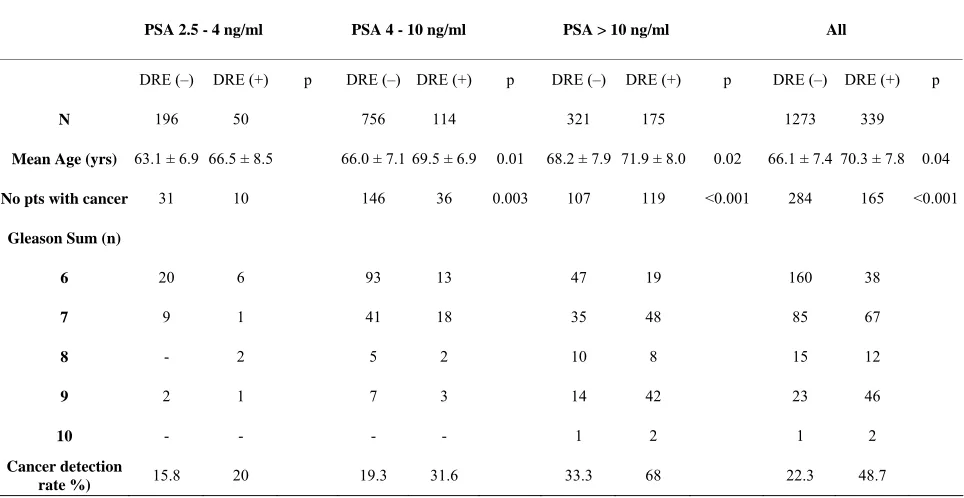
[image:2.595.57.539.462.711.2]All subjects were Caucasian. Mean age of the patients was 67 ± 7.8 years and the mean serum PSA level of the patients was 19.4 ± 43.5 ng/ml. Overall cancer was de-tected in 449 (27.8%) of the men who underwent biopsy. Pathologic features of subjects with abnormal or normal DRE findings according to the PSA levels are shown in
Table 1. Abnormal DRE findings were detected in 339
patients; of whom 48.7% were determined to have cancer. Higher serum PSA levels were significantly associated with increased cancer detection rate. Significantly higher grade cancers were detected by abnormal DRE at each PSA level group (Table 1).
Table 1. Demographic and pathologic features of patients stratified by DRE findings and PSA range.
PSA 2.5 - 4 ng/ml PSA 4 - 10 ng/ml PSA > 10 ng/ml All
DRE (–) DRE (+) p DRE (–) DRE (+) p DRE (–) DRE (+) p DRE (–) DRE (+) p
N 196 50 756 114 321 175 1273 339
Mean Age (yrs) 63.1 ± 6.9 66.5 ± 8.5 66.0 ± 7.1 69.5 ± 6.9 0.01 68.2 ± 7.9 71.9 ± 8.0 0.02 66.1 ± 7.4 70.3 ± 7.8 0.04
No pts with cancer 31 10 146 36 0.003 107 119 <0.001 284 165 <0.001
Gleason Sum (n)
6 20 6 93 13 47 19 160 38
7 9 1 41 18 35 48 85 67
8 - 2 5 2 10 8 15 12
9 2 1 7 3 14 42 23 46
10 - - - - 1 2 1 2
Cancer detection
rate %) 15.8 20 19.3 31.6 33.3 68 22.3 48.7
69
TRUS guided prostate biopsy was performed in 50 pa-tients with abnormal digital rectal examination and a serum PSA level of less than 4 ng/ml. Prostate cancer was determined in only 10 (20%) of these patients. Seven of 10 patients underwent radical prostatectomy, and their pathologic analysis was consistent with pT2 in 6 and pT3a in one with surgical margin negativity at all.
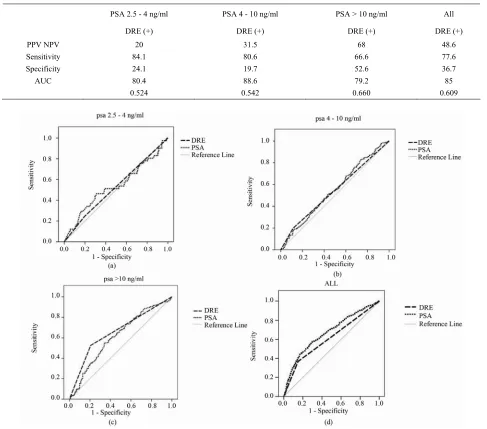
The positive and negative predictive values of abnor- mal digital rectal examination according to the serum PSA level were 20% and 84.1% for PSA 2.5 ng/ml - 4 ng/ml, 31.5% and 80.6% for PSA 4 ng/ml - 10 ng/ml and 68% and 66.6% for PSA > 10 ng/ml , respectively ( Ta-ble 2). Sensitivity and specificity results for each PSA
group are given in Table 2. As might be expected
sensi-tivity of DRE were low in psa 2.5 ng/ml - 10 ng/ml range. The sensitivity significantly increased at PSA over 10 ng/ml.
We then analyzed the receiver operating characteristic (ROC) curves in patients with different PSA values to evaluate the diagnostic performance of PSA and DRE for the detection of prostate cancer (Figure 1). Area Under
[image:3.595.56.543.278.707.2]Curve (AUC) were 0.524 and 0.535 for abnormal DRE and PSA in PSA range of 2.5 ng/ml - 4 ng/ml, 0.542 and 0.546 in range of 4 ng/ml - 10 ng/ml and 0.660 and 0.614 in PSA range of >10 ng/ml, respectively. ROC curve performance for DRE was similar to those for PSA alone for the discrimination between prostate cancer and be-nign disease in each PSA range (Figure 1).
Table 2. Statistical performance of abnormal DRE in the detection of prostate cancer stratified by PSA ranges.
PSA 2.5 - 4 ng/ml PSA 4 - 10 ng/ml PSA > 10 ng/ml All
DRE (+) DRE (+) DRE (+) DRE (+)
PPV NPV 20 31.5 68 48.6
Sensitivity 84.1 80.6 66.6 77.6
Specificity 24.1 19.7 52.6 36.7
AUC 80.4 88.6 79.2 85
0.524 0.542 0.660 0.609
4. Discussion
Digital rectal examination and serum PSA testing are both essential in the diagnostic work-up of prostate can-cer [2,3,6]. These consecutive steps are carried out be-fore making the decision of a TRUS guided prostate bi-opsy. Because TRUS guided prostate biopsy is an un-pleasant experience for the patient and relatively invasive diagnostic procedure, the circumstances under which it is warranted have to be determined precisely. This obliga-tion which aims at declining the number of unnecessary biopsies, gives rise to debates pertaining to the indica-tions of this procedure. On one hand, predictive value of abnormal or suspicious digital rectal examination in prostate cancer regardless of the serum PSA level is tried to be pointed out, and on the other hand the most appro-priate serum PSA threshold levels are tried to be deter-mined [7-10]. Today at low PSA levels in daily practice it is not possible to draw one straight-forward conclusion in using DRE or a low PSA cut-off value.
Several authors report that DRE is not a good screen-ing tool and therefore the value of digital rectal examina-tion DRE as a screening test for prostate cancer remains controversial currently [11,12]. A recent study have shown that after 8 years; men with a benign prostate bi-opsy and an initially abnormal DRE were not at higher risk for the detection of significant prostate cancer in the following years compared to same group of men with initially normal DRE [13]. Due to its poor performance, especially at low PSA levels, DRE has been omitted from the screening trials [12,14]. Despite the limitations of DRE as a screening test, there remain a significant proportion of prostate cancers that are diagnosed by DRE alone. Furthermore, we and other recent studies have shown that DRE is still important in diagnosing clini-cally important prostate cancer and continues to provide important prognostic information [15]. Regardless of PSA an abnormal DRE was consistent with cancer in almost 50% of our patients.
In the present study the PPV of a suspicious DRE, in conjunction with an elevated PSA level, to detect PC was 48.7% compared to 22.3% for men with a normal DRE. At each PSA level group the chance of having cancer at biopsy was higher in men with a suspicious DRE com-pared to men with a normal DRE. Although both predic-tive values decreased in low PSA, the chance for finding prostate cancer remained higher in men with abnormal DRE in all level groups. Overall, 20% positive predictive value of abnormal DRE for finding cancer on prostate biopsy with a PSA level between 2.5 and 4.0 ng/mL is lower, but still substantial, compared with the value of approximately 31.6% to 68% for a PSA level greater than 4.0 ng/mL. Our overall PPV values are very close to
those at ERSPC study at which PSA cutoff was 3 ng/ml [16].
In our study we have determined that approximately 50% of the cancers detected at a PSA level less than 4.0 ng/mL had aggressive features (Gleason grade 7 or greater with Gleason 4 to 5 components). At each PSA level group DRE resulted in detecting significantly more PCs with Gleason score > 7. Our results have shown that there is considerable additional value of an abnormal DRE in the selection of more hazardous prostate cancers. Thus we may speculate DRE may be useful in more se-lective screening procedures to determine high risk pros-tate cancers.
Catalona et al., in their multicenter study comprising
6630 patients, determined the overall positive predictive value of the abnormal DRE as 21%, and they calculated the positive predictive value of suspicious digital rectal examination as 10%, 40.8%, and 69.1% in the patient groups with serum PSA level of <4 ng/ml, 4.1 - 9.9, and > 10 ng/ml, respectively [10]. The stratification model of Catalona et al. which is very close to ours revealed that
the positive predictive value of the abnormal digital rec-tal examination increases in parallel with increasing PSA ranges [10]. In our study the positive predictive values of the digital rectal examination was found to be 20%, 31,6% and 68% in the PSA ranges of 2.5 - 4, 4 - 10 and >10 ng/ml, respectively. The positive predictive value determined in our study is higher than the Catalona et al.’s report for low PSA range, but the difference be-
tween the prostate needle biopsy protocols should be considered [10]. While Catalona et al. performed quadrant
biopsies, 10-core biopsy was chosen as a standard pro- tocol in our study and probably higher core number in- creased the cancer detection rate.
Although interobserver variability and lower predict- tive values of DRE at low PSA are main diasvantages, we are yet unable to strictly recommend “DRE-inde- pendent lowest PSA threshold value” for waiving biopsy in spite of suspicious digital rectal examination findings. The significance of DRE in the diagnosis of prostate cancer cannot be ignored, when as many as 15.2% of men with low PSA (PSA ≤ 4 ng/ml) had prostate cancer was considered [17]. Moreover, an abnormal DRE was associated with a significantly increased risk of high- grade disease, indicating that it provides useful addi- tional prognostic information.
71
a precise digital rectal examination even in low serum PSA levels.
5. References
[1] S. H. Landis, T. Murray, S. Bolden and P. A. Wingo, “Can- cer Statistics,” CA: A Cancer Journal for Clinicians, Vol. 48, No. 1, 1998, pp. 6-29. doi:10.3322/canjclin.48.1.6
[2] S. J. Jacobsen, S. K. Katusic, E. J. Bergstralh, et al., “In-cidence of Prostate Cancer Diagnosis in the Eras before and after Prostate-Specific Antigen Testing,” The Journal of the American Medical Association, Vol. 274, No. 18, 1995, pp. 1445-1449. doi:10.1001/jama.274.18.1445
[3] D. S. Smith, P. A. Humphrey and W. J. Catalona, “The Early Detection of Prostate Carcinoma with Prostate Spe-cific Antigen: The Washington University Experience,” Cancer, Vol. 80, No. 9, 1997, pp. 1852-1856.
doi:10.1002/(SICI)1097-0142(19971101)80:9<1852::AI D-CNCR25>3.3.CO;2-H
[4] G. F. Carvalhal, D. S. Smith, D. E. Mager, C. Ramos and W. J. Catalona, “Digital Rectal Examination for detecting Prostate Cancer at Prostate Specific Antigen Levels of 4 ng/ml or Less,” Journal of Urology, Vol. 161, No. 3, 1999, pp. 835-839. doi:10.1016/S0022-5347(01)61785-3
[5] J. L. Gore, S. F. Shariat, B. J. Miles, D. Kadmon, N. Ji-ang, T. M. Wheeler and K. M. Slawin, “Optimal Combi-nations of Systemic Sextant and Laterally Directed Biop-sies for the Detection of Prostate Cancer,” Journal of Urology, Vol. 165, No. 5, 2001, pp. 1554-1559.
doi:10.1016/S0022-5347(05)66347-1
[6] K. Mistry and G. Cable, “Meta-Analysis of Prostate-Spe- cific Antigen and Digital Rectal Examination as Screen-ing Tests for Prostate Carcinoma,” The Journal of the American Board of Family Medicine, Vol. 16, 2003, No. 2, pp. 95-101. doi:10.3122/jabfm.16.2.95
[7] R. O. Roberts, E. J. Bergstralh, M. M. Lieber and S. J. Jacobsen, “Digital Rectal Examination and Prostate-Spe- cific Antigen Abnormalities at the Time of Prostate Bi-opsy and BiBi-opsy Outcomes, 1980 to 1997,” Urology, Vol. 56, No. 5, 2000, pp. 817-822.
doi:10.1016/S0090-4295(00)00790-1
[8] T. Yamamoto, K. Ito, M. Ohi, et al., “Diagnostic Signifi-cance of Digital Rectal Examination and Transrectal Ul-trasonography in Men with Prostate-Specific Antigen Levels of 4 ng/ml or Less,” Urology, Vol. 58, No. 6, 2001, pp. 994-998. doi:10.1016/S0090-4295(01)01409-1
[9] J. E. Fowler, S. A. Bigler, P. B. Farabaugh and S. S. Wil-son, “Prostate Cancer Detection in Black and White Men with Abnormal Digital Rectal Examination and Prostate
Specific Antigen Less than 4 ng/ml,” Journal of Urology, Vol. 164, No. 6, 2000, pp. 1961-1963.
doi:10.1016/S0022-5347(05)66928-5
[10] W. J. Catalona, J. P. Richie, F. R. Ahmann, et al., “Com-parison of Digital Rectal Examination and Serum Prostate Specific Antigen in the Early Detection of Prostate Can-cer: Results of a Multicenter Clinical Trial of 6630 Men,” Journal of Urology, Vol. 151, No. 5, 1994, pp. 1283-1290. [11] C. Gosselaar, M. J. Roobol, S. Roemeling, T. H. van der
Kwast and F. H. Schröder, “Screening for Prostate Can-cer at Low PSA Range: The Impact of Digital Rectal Examination on Tumor Incidence and Tumor Character-istics,” The Prostate, Vol. 67, No. 2, 2007, pp. 154-161.
doi:10.1002/pros.20501
[12] F. H. Schröder, M. Roobol-Bouts, A. N. Vis, T. van der Kwast and R. Kranse, “Prostate-Specific Antigen-Based Early Detection of Prostate Cancer-Validation of Screen-ing without Rectal Examination,” Urology, Vol. 57, No. 1, 2001, pp. 83-90.
[13] C. Gosselaar, M. J. Roobol, R. van den Bergh, T. Wolters and F. H. Schroder, “Digital Rectal Examination and the Diagnosis of Prostate Cancer—A Study Based on 8 Years and Three Screenings within the European Randomized Study of Screening for Prostate Cancer (ERSPC), Rot-terdam,” European Urology, Vol. 55, No. 1, 2009, pp. 139-147. doi:10.1016/j.eururo.2008.03.079
[14] P. M. Beemsterboer, R. Kranse, H. J. de Koning, J. D. Habbema and F. H. Schroder, “Changing Role of 3 Screen- ing Modalities in the European Randomized Study of Screening for Prostate Cancer (Rotterdam),” International Journal of Cancer, Vol. 84, No. 4, 1999, pp. 437-441.
doi:10.1002/(SICI)1097-0215(19990820)84:4<437::AID-IJC19>3.0.CO;2-S
[15] O. T. Okotie, A. K. Roehl, M. Han, S. Loeb, S. N. Gashti and W. J. Catalona, “Characteristics of Prostate Cancer Detected by Digital Rectal Examination Only,” Urology, Vol. 70, No. 6, 2007, pp. 1117-1120.
doi:10.1016/j.urology.2007.07.019
[16] C. Gosselaar, M. J. Roobol, S. Roemeling and F. H. Schroder, “The Role of the Digital Rectal examination in Subsequent Screening Visits in the European Random-ized Study of Screening for Prostate Cancer (ERSPC), Rotterdam,” European Urology, Vol. 54, No. 3, 2008, pp. 581-588. doi:10.1016/j.eururo.2008.03.104