Effectiv
Cri
Sub PROveness of
itical Thin
and
bmitted to T
D
G
C.S.I. Je
F. DR.A. C
C.S
Mind Ma
nking Ski
d the Attit
in select
The Tamil N for th
Doctor of
G. JAYA T
eyaraj Anna
Un
CHARLES.I. Jeyaraj
apped Ca
ill on pati
tude amon
ted Nursin
A The Nadu Dr. M.
e award of
f Philosop
By THANGA Profes apackiam C
nder the Gu
S STEPHResearch Annapackia Madu
are Plans (
ient care i
ng nursin
ng Institu
esis
G.R Medica f the Degree
ophy in N
y
SELVI, M ssor
College of N
Effectiveness of Mind Mapped Care Plans (MMCP) in evaluating
Critical Thinking Skill on patient care in Nursing practice
and the Attitude among nursing students
in selected Nursing Institutions
Signature of the Guide: _____________________________________
PROF.DR.A. CHARLES STEPHEN RAJASINGH, M.S.,M.Ch., RESEARCH GUIDE
C.S.I . JEYARAJ ANNAPACKIAM COLLEGE OF NURSING
MADURAI
A Thesis
Submitted to The Tamil Nadu Dr. M.G.R Medical University, Chennai,
for the award of the Degree of
Doctor of Philosophy in Nursing
Effectiveness of Mind Mapped Care Plans (MMCP) in evaluating
Critical Thinking Skill on patient care in Nursing practice
and the Attitude among nursing students
in selected Nursing Institutions
Signature of the Guide: _____________________________________
PROF.DR.A. CHARLES STEPHEN RAJASINGH, M.S.,M.Ch., RESEARCH GUIDE
C.S.I . JEYARAJ ANNAPACKIAM COLLEGE OF NURSING
MADURAI
Signature of the Co- Guide: ____________________________________ PROF.DR.C. JOTHI SOPHIA, M.Sc.(N).,Ph.D., RESEARCH CO-GUIDE
C.S.I. JEYARAJ ANNAPACKIAM COLLEGE OF NURSING
MADURAI
A Thesis
Submitted to The Tamil Nadu Dr. M.G.R Medical University, Chennai,
for the award of the Degree of
Doctor of Philosophy in Nursing
CERTIFICATE BY GUIDE
This is to certify that the thesis entitled “Effectiveness of Mind
Mapped Care Plans (MMCP) in evaluating Critical Thinking Skill on
patient care in Nursing practice and the Attitude among nursing students
in selected Nursing Institutions”, submitted by G. JAYA THANGA SELVI,
who registered for Ph.D in 2009 is a bonafide record of the research done by
her during the period of study under my supervision and guidance and that it is
not formed on any basis for the award of any other Degree, or Diploma,
Associateship, Fellowship or any other similar title or any other Universities.
I also certify that this thesis is her original independent work. I
recommend this thesis should be placed before the examiners for the award of
Ph. D degree.
---
PROF.DR.A. CHARLES STEPHEN RAJASINGH, M.S., M.Ch., RESEARCH GUIDEC.S.I. JEYARAJ ANNAPACKIAM COLLEGE OF NURSING MADURAI
CERTIFICATE BY CO- GUIDE
This is to certify that the work embodied in the thesis entitled
“
Effectiveness of Mind Mapped Care Plans (MMCP) in evaluating
Critical Thinking Skill on patient care in Nursing practice and the
Attitude among nursing students in selected Nursing Institutions
”
submitted by
G. JAYA THANGA SELVI, for the award of the Degree ofDoctor of Philosophy in Nursing is a bonafide record of research done by her during
the period of study under my supervision and guidance that it has not formed the basis
for the award of any Degree, Diploma, Associateship, Fellowship or other similar title
in this university or any other university or institution of higher learning.
I also certify that this thesis is her original independent work. I recommend
this thesis should be placed before the examiners for the award of Ph. D degree.
--- PROF.DR.C. JOTHI SOPHIA, M.Sc (N).,Ph.D.,
RESEARCH CO- GUIDE
C.S.I JEYARAJ ANNAPACKIAM COLLEGE OF NURSING
DECLARATION
BY THE CANDIDATE
I hereby declare that this thesis entitled
“Effectiveness of MindMapped Care Plans (MMCP) in evaluating Critical Thinking Skill on
patient care in Nursing practice and the Attitude among nursing students
in selected Nursing Institutions,”
is an original work done by me under the
guidance of
Prof.Dr.A.Charles Stephen Rajasingh, M.S., M.Ch.,
and
has not been submitted elsewhere, either partially or fully for the award
of any other Degree, or Diploma, Associateship, Fellowship or any other
similar title.
---
G. JAYA THANGA SELVI, M.Sc (N).,
Professor
C.S.I. Jeyaraj Annapackiam College of Nursing,
Madurai.
ACKNOWLEDGEMENT
“The lord will fulfil what he has planned for me”
First and foremost, my utmost gratitude to the omnipresent God for his
abundant grace enabling me to complete this thesis successfully.
“Gratitude is not only the memory but also the
respect of heart rendered to the person for his / her guidance”
Throughout my research in the doctoral programme, there have been many
wonderful relevant people who have provided support and helpful assistance in the
preparation and completion of this thesis.
I began my journey with Prof. Dr. C. Jothi Sophia, M.Sc (N)., Ph.D.,
Principal, C.S.I. Jeyaraj Annapackiam College of Nursing, who nurtured my
professional growth, for having given me an opportunity to upgrade my profession in
this esteemed institution. I am also profusely thankful to her, for constructive
suggestions and constant encouragement during the period of study, as my Research
Co-guide, which enabled me to accomplish this study into a good shape.
My thesis would not have been possible without my great Research Guide
Prof. Dr. A. Charles Stephen Rajasingh, MS., M.Ch., who has been instrument in my research journey. I also wish to express my immense thanks to my Guide for his
continuous support, critical eye, provocative questions, endless patience to listen and
proper guidance, which gave me great enthusiasm throughout my study period .
Dr. Gabriel Jeyachandran, M.Sc.,M.Ed.,M.Phil.,Ph.D., deserves my heartfelt thanks for his scholarly guidance, research insights he has shared, helpful
advice during tough times and guiding me in the right direction throughout the period
of my research.
I am bound to express a special word of appreciation to panel of experts for their enlightening suggestions, necessary corrections, valuable judgements and
recommendations while validating the content of the tool.
I owe my thanks to Mrs.Merline Jeyapal,M.Sc.(N)., Vice Principal and all the faculty members of C.S.I. Jeyaraj Annapackiam College of Nursing, for their suggestions and guidance that contributed the growth of this thesis.
I wish to express my special heartfelt thanks to all ethical committee members, C.S.I. Jeyaraj Annapackiam College of Nursing, for providing me an opportunity to undertake this study.
I convey my special thanks to all the Heads of Institutions and Principals, for permitting me to conduct this study in their esteemed institutions. I also offer them
my sincere thanks for their services and co-operation during my data collection
period.
I am extremely grateful to my sister Prof. Mrs.Jasmine Andrew, M.A., M.Phil., Ph.D., for helping me with her brilliant editorial skills in shaping this thesis.
I extend my sincere thanks to Mr. Manivel Samy,M.Sc.,MPhil., Bio-Statistician, Aravind Eye Hospital, Madurai, who offered valuable assistance in
statistical analysis of this study.
And lastly I would like to thank the study subjects of my study for the time they have sacrificed, their co-operative participation and the suggestions they offered
to improve my tool, without whose co-operation the study would not have been
completed.
This thesis is dedicated to my lovable husband Mr.Basil Paul Kirubakaran Grubb, in the progress of my highly demanding academic ventures. I express my deepest sense of love to my ever loving daughter baby Suvitha Olivia Grubb and son master Davidson Grubb, who have always stood by me and dealt with all of my absence from many family occasions with a smile.
I am indebted to my lovable parents Mr.M.Gnanakkan and Mrs. G.Soundravalli, who have played a major role in writing my thesis, in my
career and in my life by their prayer and steadfast encouragement.
I express my affectionate and deepest love to my mother-in-laws,
Mrs. Felcia Grubb and Mrs. Hilda Rajan, who have been the source of inspiration bytheir love and prayer.I am thankful to my sisters and my in-laws family for their prayers and noble encouragements.
Finally, I owe my deepest gratitude to Mrs. R. Shyla Kamalakumari and
Mrs.R.Jancy Rachel Daisy, Co-PhD scholars and my friends for their prayer, love, support, selfish guidance, motivation and for their input in various aspects of the
study.
Once again, I humbly acknowledge my sincere gratitude and appreciation to
all who have directly and indirectly contributed to this study.
With a thankful heart
ABSTRACT
A study was done to evaluate the Effectiveness of Mind Mapped Care Plans
(MMCP) in evaluating Critical thinking skill on patient care and the Attitude towards
care plan among nursing students in the selected institution of Tamil Nadu for the
award of the degree of Doctor of Philosophy in Nursing to The Tamil Nadu
Dr. M.G.R. Medical University, Chennai during the year 2012.
INTRODUCTION
“Intuitive mind is a sacred gift and the rational mind is a faithful servant”
- Albert Einstein
As nurses’ roles change in response to the dynamics of managed care and an
increase in use of biotechnology in health care, more is expected of them both in
terms of psychomotor and cognitive skills. Critical thinking skill is currently a highly
valued educational outcome throughout the educational spectrum, especially in
relation to higher and professional education. Nursing education worldwide is also
embracing the construct critical thinking skill as a desirable educational outcome and
realizes the importance of eliciting the evidence of critical thinking in nurse's
reasoning process. Creating an environment that engages students in the learning
journey to promote critical thinking skill is not always easy. Mind mapping in nursing is a brilliant way for all nursing students to understand their lessons better and absorb difficult medical concepts easily. Therefore, mind maps are developed to provide a
visual description of the thinking process.
objectives of this study were to: (1) determine the effectiveness of MMCP on critical
thinking skill of nursing students (2) find out the relationship between critical thinking
skill of nursing students and their attitude towards care plan. The adapted conceptual
framework in this study was on Daniel L. Stufflebeam (1971) CIPP (Context, Input,
Process and Product) model.
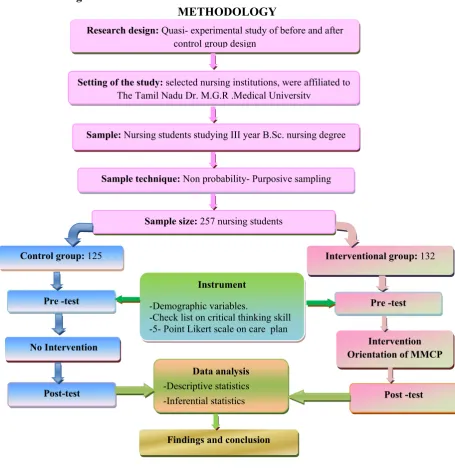
METHODS: The study used a quasi- experimental study of before and after control group design. A total of 257-III year B.Sc. nursing degree students from six nursing
institutions were included as interventional group (n=132) and control group (n=125)
through purposive sampling technique. The orientation of this new approach was 4
weeks. On the first week, following the pre- assessment, the interventional group was
given an introductory lecture on how to prepare Mind Mapped Care Plan (MMCP) as
an innovative instructional approach. Followed by, this new approach was reviewed
for remaining 3 consecutive weeks where the participants were given a same case
study scenario every week to prepare nursing care plans using mind map. Finally,
both the groups were again assessed for the critical thinking skills at three points of
time. Data collection tools included a (1) demographic variables,(2) check list on
critical thinking skill based on nursing process, (3) 5- Point Likert scale on attitude of
nursing students towards nursing care plan and (4) Teaching module on “Mind
Mapped Care Plan”.
RESULTS: The scores of critical thinking skill were compared between the two groups by unpaired‘t’ test. The findings revealed a significant difference between
control 3rd - post and interventional 1st, 2nd, 3rd post-test critical thinking skill scores
with the obtained overall ‘t’ value 39.73 was greater than statistical table value and
had higher score as compared to the control group. These findings proved that there is
a significant increase in the level of critical thinking skill among students in the
MMCP group than those who did not participate. With regard to post- test correlation
score, this study had an unexpected finding. The result shows that the obtained
coefficient correlation value in the control (r = 0.074) and the interventional(r = 0.03)
group indicate that there was possibly no correlation between critical thinking skill
and attitude, since the value was not statistically significant at P < 0.001 level.
This study concluded that MMCP might be an effective approach compared to
a traditional care plan approach for educating nursing students in terms of improving
critical thinking skill in the clinical settings.
RECOMMENDATIONS
The study recommended the following: (1) As for the result of this study, it is
recommended that the MMCP can be encouraged to utilize in clinical settings as a
TABLE OF CONTENTS
CHAPTER CONTENTS PAGE NO
CHAPTER I INTRODUCTION
1.1. Background of the study 1
1.2. Significance and need for the study 24
1.3. Statement of the problem 31
1.4.Aim 31
1.5. Objectives of the study 32
1.6. Hypotheses 32
1.7. Operational definitions 33
1.8. Assumptions 35
1.9.Delimitations of the study 36
1.10. Projected outcome 37
CHAPTER II REVIEW OF LITERATURE
2.1. Review of Literature 38
2.1.a)Review related to Mind Map 39
2.1.b)Review related to critical thinking skill 47 2.1.c)Review related to critical thinking skill and
traditional nursing care plans
57
2.1.d)Review related to Mind Map and critical thinking skill
62
2.1.e)Review related to attitude of nurses towards care plan / nursing process
67
2.2. Conceptual Frame Work 70
CHAPTER III MATERIALS AND METHODS
3.1. Research approach 76
3.2. Research design 76
3.3.Variables 77
3.4. Setting of the study 77
3.5. Population 78
3.6. Sample 78
3.8. Sampling technique 79
3.9. Sampling criteria 80
3.10. Description of the tool 81
3.10.a) Scoring and interpretation 85
3.10.b)Validity and Reliability 85
3.11. Pilot study 87
3.12. Method of Data collection 88
3.13. Plan for data analysis 94
3.14. Ethical considerations 95
CHAPTER IV RESULTS AND INTERPRETATION 97
CHAPTER V DISCUSSION
5.1. Development of Instrument 158
5.2. Distribution of sample according to their demographic variables
160
5.3. Effectiveness of Mind Mapped Care Plans on critical thinking skill and attitude of nursing students
164
5.3.a).Distribution of the subjects based on their critical thinking skill level before and after Mind Mapped Care plans
164
5.3.b) Distribution of the subjects based on their attitude level before and after Mind Mapped Care plans
165
5.3 .c) Area wise distribution of pre and post-test critical thinking skill mean scores among nursing students in the control and interventional groups
166
5.3.d) Area wise distribution of pre and post-test attitude mean scores among nursing students in the control and interventional groups
169
5.3.e)Item wise comparison for the subscale scores in critical thinking skill of nursing students in the control and interventional groups
170
5.3.f)Item wise comparison for the subscale scores in attitude towards care plan among nursing students in the control and interventional groups
172
5.3 .g) Comparison of differences in pre and post-test scores on critical thinking skill as well as attitude within the control and interventional group
174
5.3.h) Comparison of differences in pre and post-test scores on critical thinking skill as well as attitude of nursing students between the control and interventional groups
177
5.3 .i) Comparison of differences in pre and post-test scores on critical thinking skill of nursing students between the control and interventional groups at three different points of time
180
5.4. Relationship between critical thinking skill and attitude of nursing students
181
5.4.a) Correlation between critical thinking skill and their attitude of nursing students towards care plan
181
5.4.b) Relationship of critical thinking skill and attitude of nursing students with their demographic variables during the pre-test and post-test
184
5.5 Association of critical thinking skill and attitude of nursing students in the control and interventional groups with their demographic variables during the pre-test and post-test
185
5.5.a) Associate the critical thinking skill of nursing students in the control and interventional groups with their demographic variables
185
5.5.b) Associate the attitude of nursing students in the control and interventional groups with their demographic variables
186
CHAPTER VI SUMMARY, CONCLUSION AND RECOMMENDATIONS
6.1. Summary 187
6.1.a) Summary of the study 187
6.1.b) Summary of the findings 189
6.2.Limitations 195
6.3.Impact of the study 196
6.4. Implications of the study 197
6.4.a) Nursing Practice 197
6.4.b) Nursing Education 198
6.4.c) Nursing Administration 199
6.4.d) Nursing Research 200
6.5. Conclusion 201
6.6. Recommendations 202
LIST OF TABLES
TABLE NO TABLES PAGE NO
1.1.1 Concept Map VSs Mind Map 21
1.1.2 Mind Mapped Care Plan VSs Traditional care plan 23
2.2.1 Four aspects in CIPP 72
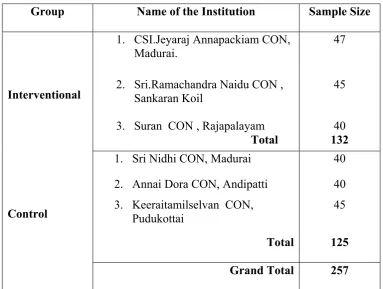
3.8.1 Name of the Institution 80
3.12.1 Data collection process 89
4.1.1 Distribution of nursing students according to their personal profile
102
4.1.2 Distribution of nursing students according to their institutional profile
108
4.2.1 Distribution of the subjects based on their critical thinking skill level
115
4.2.2 Distribution of the subjects based on their pre-test and post-test attitude level towards care plan
116
4.2.3 Area wise distribution of pre and 3rd post-test critical thinking skill mean scores among nursing students in the control group
117
4.2.4 Area wise distribution of pre and 3rdpost-test critical thinking skill mean scores among nursing students in the interventional group
118
4.2.5 Area wise distribution of control3rdpost-test and interventional 3rdpost-test critical thinking skill mean scores among nursing students
119
4.2.6 Area wise distribution of pre and post-test attitude mean scores among nursing students in the control group
120
4.2.7 Area wise distribution of pre and post-test attitude mean scores among nursing students in the interventional group
121
4.2.8 Area wise distribution of pre and post-test attitude mean scores among nursing students in the control group
122
4.2.9 Item wise comparison between pre and 3rd post-test critical thinking skill scores in the subscale of “Analysis” among nursing students in both the groups
123
4.2.10 Item wise comparison between pre and 3rd post-test critical thinking skill scores in the subscale of “Interpretation” among nursing students of both the groups
124
4.2.11 Item wise comparison between pre and 3rd post-test critical thinking skill scores in the subscale of “Inference making (diagnosis)” among nursing students in both the groups
125
4.2.12 Item wise comparison between pre and 3rdpost-test critical thinking skill scores in the subscale of “Inference making (Goal and outcome)”among nursing students in both the groups
126
4.2.13 Item wise comparison between pre and 3rdpost-test
critical thinking skill scores in the subscale of “Inference making (planning)” among nursing students in both the groups
127
4.2.14 Item wise comparison between pre and 3rdpost-test critical thinking skill scores in the subscale of “Explanation” among nursing students of both the groups
128
4.2.15 Item wise comparison between pre and 3rdpost-test critical thinking skill scores in the subscale of “Evaluation and Self regulation” among nursing students of both the groups
129
4.2.16 Item wise comparison between control post-test and interventional post-test attitude scores in the subscale of “Cognitive competencies” among nursing students in both the groups
130
4.2.17 Item wise comparison between control post-test and interventional post-test attitude scores in the subscale of “Affective competencies” among nursing students of both the groups
131
4.2.18 Item wise comparison between control post-test and interventional post-test attitude scores in the subscale of “technical competencies” among nursing students in both the groups
132
4.2.19 Item wise comparison between control post-test and interventional post-test attitude scores in the subscale of “interpersonal competencies” among nursing students in both the groups
133
4.2.20 Paired ‘t’-test for the comparison between control pre-test and 3rdpost-test critical thinking skill scores of nursing students
134
4.2.21 Paired ‘t’-test for the comparison between interventional pre-test and interventional 1st ,2nd,3rd post -test critical thinking skill scores of nursing students
135
4.2.22 Paired ‘t’-test for the comparison between control pre-test and post-test attitude scores of nursing
students towards care plan
136
4.2.23 Paired ‘t’-test for comparison between
interventional pre and post-test attitude scores of nursing students towards care plan
137
4.2.24 Unpaired ‘t’-test for the comparison between the control- pre and interventional1st ,2nd,3rd post-test for critical thinking skill scores of nursing students
138
4.2.25 Unpaired ‘t’-test for comparison between control 3rd post and interventional 1st ,2nd, 3rd post-test critical
thinking skill scores of nursing students
139
4.2.26 Unpaired ‘t’-test for comparison between control-pre and interventional post-test attitude scores of nursing students
140
4.2.27 Unpaired ‘t’-test for comparison between control- post and interventional- post-test attitude score of nursing students
141
4.2.28 One way Repeated measures Analysis of variance ( RM-ANOVA) in evaluating effectiveness of Mind Mapped Care Plans (MMCP) on critical thinking skill of nursing students between the control and interventional groups
142
4.3.1 Correlation between critical thinking skill and attitude of nursing students in the control and interventional groups
143
4.3.2 Multiple regression of control 3rd post-test between critical thinking skill and demographic variables of nursing students
144
4.3.3 Multiple regression of interventional-3rd post-test
between critical thinking skill and demographic variables of nursing students
145
4.3.4 Multiple regression of control -3rd post-test between attitude and demographic variables of nursing
students
146
4.3.5 Multiple regression of interventional -3rd post-test between attitude and demographic variables of nursing students
147
4.4.1 Association between pre-test critical thinking skill scores and selected demographic variables of nursing students in the control group
148
4.4.2 Association between 3rd post-test critical thinking
skill scores and selected demographic variables of nursing students in the control group
149
4.4.3 Association between pre-test critical thinking skill scores and selected demographic variables of nursing students in the interventional group.
150
4.4.4 Association between 3rd post-test critical thinking skill scores and selected demographic variables of nursing students in the interventional group
151
4.4.5 Association between pre-test attitude scores and selected demographic variables of nursing students in the control group
152
4.4.6 Association between pre-test attitude scores and selected demographic variables of nursing students in the interventional group
153
4.4.7 Association between post-test attitude scores and selected demographic variables of nursing students in the interventional group
LIST OF FIGURES
FIGURE NO FIGURES PAGE NO
1.1.1 Components of critical thinking skill 8
1.1.2 Mind Map- diagram 18
1.1.3 Mind-Mapping Guidelines 19
2.2.1 Core concepts of CIPP model 17
2.2.2 Conceptual Framework -
3.2.1 Schematic representation of research methodology 75
3.2.2 Research design 76
4.1.1 Distribution of nursing students based on their age 103
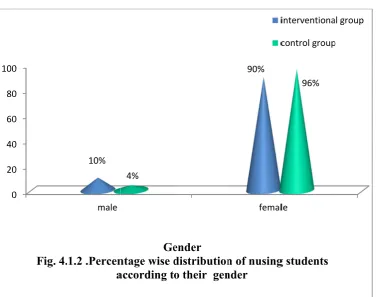
4.1.2 Distribution of nursing students based on their gender 104
4.1.3 Distribution of nursing students based on their selection of profession
105
4.1.4 Distribution of nursing students based on their aim of selecting profession
106
4.1.5 Distribution of nursing students based on their area of preference after course completion
107
4.1.6 Distribution of nursing students based on the courses offered in their institutions
109
4.1.7 Distribution of nursing students based onobtained clinical exposure their institutions
110
4.1.8 Distribution of nursing students based ontheir locality of the institution
111
4.1.9 Distribution of nursing students based on the duration of institution was started
112
4.1.10 Distribution of nursing students based on the type of institution
LIST OF APPENDICES
APPENDIX TITLE
A Copy of Letter seeking experts opinion with content validity
certificate
B Copy of Letter seeking permission for data collection
C Institutional Ethical clearance certificate
D List of experts
E Instrument ( Part I, II, III and IV)
F Criteria check list for validation of the tool
CHAPTER - I
INTRODUCTION
1.1. BACKGROUND OF THE STUDY
“Intuitive mind is a sacred gift and the rational mind is a faithful servant”
- Albert Einstein
The preceding quote denotes that nurse educators and students are to be
triggered by critical thinking skills to improve the quality of rational thoughts.
Thinking without doing is an academic exercise on fatality. Doing without thinking is
downright dangerous. Thus, critical thinking is an essential learning tool in
professional education.1
In the world of healthcare, nursing has long struggled to establish itself as a
profession. Throughout the history of nursing, unfavourable stereotypes (as
subservient and dependent on the medical profession) have negatively affected the
view of nursing as an independent entity. In its early developmental years, nursing did
not seek or have the means to control its own practice. Florence Nightingale, in
discussing the nature of nursing in 1859, observed that “Nursing has been limited to
signify little more than the administration of medicines and the application of
poultices.” As nursing research continues to work in establishing the profession as
independent in its own right, the value of nursing goals is understood and the
difference between nursing and other professions is being delineated. Nursing is now
recognized as both a science and an art concerned with the physical, psychological,
sociological, cultural, and spiritual concerns of the individual. The science of nursing
American Nurses Association (ANA) developed their first Social Policy Statement in
1980, defining Nursing as “the diagnosis and treatment of human responses to actual
or potential health problems.” Hence,the role of the nurse has shifted from one of the
“hand maiden” to one of an autonomous partner in health care delivery. Health care
organizations have made dramatic advances and transformations during the last few
decades, resulting in rapid growth of technology and theory. The need for critical
thinking in nursing has been accentuated in response to the rapidly changing health
care environment.2- 3
Nurses work in many different roles and settingseither directly or indirectly
related to patient care. Health care delivery has however changed with advances in
technology, disease treatment and prevention. So nurses need to become skilled in
higher-level thinking in order to effectively manage the complexchanges resulting
from the increasing demands andgreater accountability required of the profession.4
As nurses’ roles change in response to the dynamics of managed care and an increase
in use of biotechnology in health care, more is expected of them both in terms of
psychomotor and cognitive skills. The American Association for colleges of nursing
requires that critical thinking be reflected within academic nursing programs as a core
competency for programme accreditation.5
According to Russel6 nursing education has changed dramatically since
Florence Nightingale asserted the importance of education and moral standards to
fulfil the nurse’s role. In the years of Nightingale’s system, nursing education was
taken as hospital- based. However, it was transferred into the higher education sector
in the late of 20th century.6-7 According to Hart8 this transfer was influenced by the
society followed by economic efficiency, political reasons and the need for trained
staff.
Findings from a survey of 2000 nursing school faculties and administrators
sponsored by the National League of Nursing (NLN) reasoned that nursing education
is straggling behind in the world of technology.9 Brandon and All 10 emphasized that
the role of nursing is constantly changing. Professional nursing requires a
commitment to lifelong learning. A nurse needs to be self-directed, have an ability to
synthesize information, link concepts, and think critically. Simpson11 argues that
nursing’s future rests on nursing education’s response to a rapidly changing
technological environment.
Furthermore, Adams12 states that nursing education has to develop a student’s
ability to make decisions and solve problems which are necessary in providing high
quality nursing care which is safe and promotes wellness. These skills are rooted in
critical thinking which builds skills in making decisions and solving problems.
While nursing students are capable of critical thinking, the focus in
preparation programs has traditionally been on mastering content rather than applying
critical thinking to situations Nursing educators need to continue to develop and refine
educational strategies that promote the development of critical thinking and clinical
judgment skills that meet the learning needs of nursing students as well as the health
Critical thinking skill
"Not everything that can be counted counts,
and not everything that counts can be counted."
- Albert Einstein
Albert Einstein14 has beautifully explained that critical thinking is analyzing
and evaluating a situation logically in order to find out the correct result or
conclusion. This demands the brain to come out of its usual framework and think
about a situation or a problem from all possible aspects, before giving judgment. This
skill is essential for every individual, be it an adult or a child.
The South Carolina Higher Education Assessment Network developed the most
inclusive definition of critical thinking. This definition is:
“Critical thinking is a reflective, systematic, rational, and sceptical
use of cognitive representations, processes, and strategies to make
decisions about beliefs, problems, and or courses of action.”15
Etymology
The concept 'critical thinking' is derived from its roots in ancient Greek.
According to Paul, Elder and Bartell 23 the word 'critical' derives etymologically from
two Greek roots: 'kriticos', meaning discerning judgment, and 'kriterion', meaning
standards. Etymologically, the word implies the development of discerning judgment
based on standards.
Reilly and Oermann16 stated that critical thinking is a thought process
regarding patient care based upon clinical judgments. Historically, Thorndike17
alluded to critical thinking as a predominantly mental discipline, as “an increase of a
Alfaro-LeFevre18 describes that critical thinking in the nursing field including
outcome-directed, purposeful thinking; promote nurses to not focus on assumption but
make a decision based on evidence.
Critical thinking is the cognitive engine that drives the processes of knowledge
development and critical judgment in nursing.19
Van der Wal20 outlines two types of critical thinking one of which applies to
practical situations such as nursing practice emphasising the importance of skills that
support the identification of appropriate strategies and the decision making necessary
for effective problem solving. Critical thinking in nursing care is thus the ability to
analyse problems through inferential reasoning and reflection on past situations that
share similar clinical indicators. Such reasoning is necessary for effective decision
making in the delivery of complex patient management.
Oermann24 a renowned nurse author in critical thinking, stated that clinical
nursing education occurs in a dynamic, complex and challenging situation where
nurses are expected to use critical thinking as a fundamental principle to guide their
rational decision-making process and clinical judgment logically in a systematic
manner.
According to Bandman and Bandman25 critical thinking is the rational
examination of ideas, inferences, assumptions, principles, arguments, conclusions,
issues, statements, beliefs and actions.
According to Yıldırım32 critical thinking is “the process of searching,
obtaining, evaluating, analyzing, synthesizing and conceptualizing information as a
guide for developing one’s thinking with self-awareness, and the ability to use this
Alfaro-LeFevre18 asserts that critical thinking belongs in nursing because
nursing is concerned with purposeful goal-directed thinking, with the primary aim of
making judgements grounded on factual evidence rather than conjecture.
Colucciello21 proclaims the use of critical thinking is vital in examining simple
and complex situations in nurses’ day-to-day responsibilities. It is an essential means
of establishing whether the information or assessment obtained has been accurately
captured in order to articulate specifically and distinctly what the information
conveys.
While the definition of critical thinking is broad and diverse in the literature
there is general agreement that it is purposeful, reasonable and goal-directed
thinking.20
Morrison and Walsh-Free29 asserted that critical thinking incorporates
assessment and multi-logical thinking as a key requirement for nurses to be able to
relate and apply concepts to clinical situations.
Critical thinking is not a single way of thinking, but is a complex,
multidimensional cognitive process dependent on reflective thought and tolerance for
ambiguity essential for decision making in nursing practice.45
`Prior to the Delphi Report22 there was no clear definition of critical thinking.
The final definition of critical thinking within this Delphi report is as follows:
“Critical thinking to be purposeful, self-regulatory judgement which results in
interpretation, analysis, evaluation and inference as well as explanation of the
evidential conceptual, methodological, criteriological or contextual considerations
upon which that judgement was based. Critical thinking is essential as a tool of
inquiry. Critical thinking is a pervasive and self-rectifying human phenomenon. The
personal biases, prudent in making judgements, willing to consider, clear about issues,
orderly in complex matters, diligent in seeking relevant information, reasonable in
selection of criteria, focused in inquiry and persistent in seeking results which are as
precise as the subject and the circumstances of inquiry permit”.
Critical thinking is gaining much popularity in nursing. Critical thinking has
come to the forefront in nursing following the mandate by the National League of
Nursing (USA),28 which stated that nursing programs must measure critical thinking
as an outcome criterion for accreditation. According to Raines.30 Nurses are
challenged to "think on their feet" in the multiple, complex, fast-moving
environments of today's nursing practice. The literature repeatedly stresses that nurse
must be able to think critically in order to process complex data and make sound
clinical judgments in the planning, managing and evaluating of the health care of their
patients. Even though the definition of critical thinking is diverse, there is no doubt
that this skill is essential in nursing education.
Critical Thinking in the Profession of Nursing is consistent with the Delphi
definitions and supportive of Kataoka, Yahiro and Saylor's31 definition of critical
thinking in nursing as "the critical thinking process is reflective and reasonable
thinking about nursing problems without a single solution and is focused on deciding
what to believe and do". This definition broadens the concept of critical thinking in
nursing to include reflection of thoughts and recognition that there can be various
solutions to problems.
Kataoka, Yahiro and Saylor31 felt that to make good nursing judgments,
critical thinking must be used. They have identified five components of critical
thinking competencies, (4) Attitude or Paul's "traits of the mind" and (5) standards
(intellectual and professional).
“Education knits together critical thinking…with the fabric of students’.
Learning and thinking are interrelated lifelong processes. The above assertion
incorporates the concepts of critical thinking, life-long adult learning and the
professional mandates that nurses will practice.90
In nursing, critical thinking is the ability to think in a systematic and logical
manner with openness to question and reflect on the reasoning process which is used
to ensure safe nursing practice and quality care. Critical thinking when developed in
the practitioner includes adherence to intellectual standards, proficiency in using
reasoning, a commitment to develop and maintain intellectual traits of the mind and
habits of thought and the competent use of thinking skills which will develop the
abilities for sound clinical judgments and safe decision-making.133
Critical thinking skill
Facione, Facione and Sanchez26 state that having the requisite cognitive
critical thinking skills is essential to being a good critical thinker.
1 INTERPRETATION: interpreting problems as well as objective and
subjective data from common information sources, related to the care of the
patient.
2 ANALYSIS: examining ideas in problems, objective and subjective data and
possible courses of action related to the care of the patient;
3 INFERENCE: reaching conclusions which are appropriate to the care of the
patient.
4 EXPLANATION: clearly explaining and defending the reasoning in which an
individual arrives at specific decisions in the context of the health care of the
patient
5 EVALUATION: evaluating information relevance to particular patient care
situations; and
6 SELF-REGULATION: constantly monitoring one’s own thinking using
universal criteria.
These skills are employed interactively in the reflective reasoning process of
making a judgement of what to believe or do.
Daly27 states that the concept of critical thinking has only been recently
addressed in nursing literature related to the following issues:
-- The increasing interest in critical thinking in education;
-- Instructional methods to develop critical thinking in nursing education; and
Edwards131 proposes two phases in critical thinking skills. Those phases are
divided into some steps.
First phase: There are 5 steps in the first phases follows:
1st step: Interpret and organize the information is the first step, which will be done
along with assessment in nursing process, nurses are expected to gather
data and make the mind map about the situation.
2nd step: The second step is hidden assumption. In this step, nurses are trying to
define other aspects like value and belief. They are expected to become
open-minded, especially with the opposite value and belief.
3rd step: The third step is engaging nursing knowledge. It is related to nursing theory
and perspectives.
4th step: The next step is to breakdown the information to make it easier for
analyzing.
5th step: Considering the other’s perspectives will be the next step. After considering
all aspects including analyzing the possible conflicts, finally the decision has
to be made.
Second phase: Furthermore, there are 4 steps in the second phase.
1st step: The first one is defending the decision. Nurses reconsider and rethink about
the decision that has been made.
2ndstep: After that, they need to be responsible and making the judgments on the
decision.
3rdstep: The next step is evaluating the process. It will include critical reflection,
correcting one self, learning from the process as well as planning for the
She believes that by applying these phases, nurses can be more independent
for doing long life learning
Critical thinking is currently a highly valued educational outcome throughout
the educational spectrum, especially in relation to higher and professional education.
Nursing education worldwide also embraces the construct critical thinking as a
desirable educational outcome and realizes the importance of eliciting the evidence of
critical thinking in nurses’ reasoning process.39
The term critical thinking has been used to describe fundamental skills used by
nurses for over a decade and yet a common understanding of the term and what it
exactly means has yet to be achieved.85-86 Even so, critical thinking is thought to be
the hallmark of the effective practitioner and the graduate nurse.87
Critical thinking skill and Nursing Process
Throughout any given day, a nurse uses thinking in a variety of situations.
Thinking is a process and is not necessarily linear in form. Costa51 identified traits
that are to be found in thinking as: - remembering, repeating, reasoning, reorganizing,
relating, and reflecting. Critical thinking differs from general thinking in that the
nurse now applies reason or logic to the situation to question the circumstances, seek
additional evidence, and to evaluate the outcomes or process.
Wilkinson33 proclaims that critical thinking cannot be facilitated or assessed in
a vacuum for it is used to apply basic core knowledge and skills to situation. Critical
thinking is inherent to the nursing process. Thus, the nursing process is a powerful
scientific vehicle which facilitates critical thinking. Varcoe 34 notes that the nursing
process is an analytical thinking process used to guide systematic and rational
Traditionally, nursing care was primarily based on the patient's medical
condition and prescriptive medical orders .35-36 In the 1960's, the combined effect of a
rapidly changing health care system and increasing demands on health care services
led to the introduction of defined roles for health care professionals.37
To establish the professional role of the nurse and develop nursing as a
separate discipline within the health care system, there was a deliberate move in
nursing. As part of this process, in 1967 a group of academics at Catholic University
in Washington, explicated an organisational framework called the nursing process.38
The nursing process comprised four stages as it was originally developed.
These stages were: assessment, planning, implementation and evaluation. During the
first decade of its use, several nurse scholars claimed there was a missing link in this
four stage nursing process.41-43 In 1980, the American Nurses Association endorsed
the diagnosis stage of the nursing process by defining nursing as “the diagnosis and
treatment of human responses to actual or potential health problems”.44
Logan 40 believed that the scientific process was akin to the critical thinking
process because both processes involve analysis, synthesis, deduction, and inference.
Jones and Brown 45defined critical thinking as reflective of the nursing
process, which consists of five steps, namely, assessment, diagnosis, planning,
implementation, and evaluation provides the basis for critical thinking skills in
nursing.
Sedlak and Ludwick 46stated that the nursing process and critical thinking
should not be seen as separate from each other. Students' cognitive development can
be facilitated using critical thinking in the nursing process. Tucker and Flannery 47also
described a nursing care plan that provides students with a learning experience that
responsibility of nurse educators to integrate high level critical thinking skills into the
nursing process in the clinical setting.
Alfaro-LeFevre18 states “the nursing process is a systematic method of giving
humanistic care that focuses on achieving desired outcomes in a cost-effective
fashion”. It's systematic in that is consists of five steps.
According to Reilly and Oermann16 “nursing process is the methodology of
nursing practice”.
The characteristics of the nursing process as defined by Wilkinson33are:
dynamic and cyclic; client centred; planned and goal-directed; universally applicable;
problem-oriented; and a cognitive process. It is recognized as the foundation for
professional nursing practice, and provides the professional nurse with a framework
for decision making and problem solving in everyday practice and situations. This
process consists of five phases namely: assessment, diagnosis, planning,
implementation and evaluation.
Pesut and Herman48 assert that the nursing process should connect to nursing
practice. Due to increased technology and information, changes in the health care
system and a shift to a learning-centred focus, nurse educators need to enhance the
thinking strategies of students. Using critical and reflective thinking skills in the
nursing process is thought to improve contemporary nursing practice.
The nursing process serves as a useful conceptual framework for critical
thinking. Each component of the nursing process parallels the scientific method. We
can measure patient outcomes and the testing of hypotheses. Critical thinking is
inherent in making sound clinical reasoning.50
Alfaro-LeFevre18 insisted that nurse educators need to implement teaching and
high level of critical thinking and be prepared to provide nursing care in the 21 st
century. Active learning strategies have been identified as facilitating the
development of critical thinking, clinical reasoning, problem solving, and decision
making in nursing students who, in turn, can more readily apply that knowledge in the
clinical setting. He also states that in the context of clinical nursing education, critical
thinking skills of nurse learners are to be infused within the broad nursing process
framework. Clinical nursing education is a dynamic, constantly changing, real-life
environment in which theoretical knowledge is integrated with practice. The
facilitator is responsible for creating an environment that is conducive to the
development of critical thinking, while learners take the responsibility for
constructing their own knowledge and skills through active interaction to promote
critical thinking skills.
Oermann24 explains that "textbook characteristics" which were taught in the
classroom situation leave the nurse unsure about what nursing intervention to use in a
real-life, authentic situation where unstructured problems should be addressed. He
suggests that one way to curb this problem is to apply cognitive critical thinking skills
within the broad framework of the nursing process. The educator can ask
thought-provoking questions that are unique to the patient's problems and train the learners to
apply cognitive thinking skills within the framework of nursing process related to the
patient's problems.
Varcoe's34 stated that in spite of the benefits of the nursing process in
facilitating critical thinking, nurse educators seem unable to implement and manage
the approach. The nursing process and its administrative implementation are heavily
criticised as time-consuming for nurses. It is argued that the role of nurses is to
involved with the nursing process. His argument is that there is confusion between the
theoretical critique of the nursing process and the critique of the administrative
implementation such as documentation.
Higginbotham, Masso and Prideaux52-54 state that although these theoretical
ideals have a prior support about the nursing process, some nurse clinicians continue
to display negative attitudes towards its use in practice. These clinicians believe that
due to work based issues and the complex nature of nursing; it is an inappropriate
framework for clinical use.
Karola55 mentioned that the critical thinking cannot be facilitated when the
nursing process is used in a robotic and dogmatic way, where nurses are mechanically
efficient as evidenced by focusing on routine, mass production, assembly-line,
task-orientated methods to provide efficient patient care.
Marshall49 who did a study on the use of problem solving methods for teaching
critical thinking in connection with the nursing process. In addition, this study
supported the usefulness of the nursing process for increasing knowledge and
understanding, application, and integration of nursing concepts. Moreover, it was
suggested that faculty need to examine their own perceptions about the nursing
process, define educational objectives in relation to critical thinking, and identify the
best strategies for promoting critical thinking in view of changing methods in clinical
practice. Nurse educators must focus on how to use critical thinking in the nursing
process in clinical settings to promote students' critical-thinking.
As per the views of Bell56 nurse educators have to create an appropriate
curriculum and develop innovative teaching strategies to facilitate the student’s
critical thinking skills in the learning process.
Toth57 examined various instructional strategies for developing critical
thinking abilities in 75 freshman nursing students using the California critical thinking
skills Test as the pre -test instrument in the first week and the post -test instrument in
the tenth week. Teaching strategies included case studies, large group discussion,
small group interaction, role playing, and questioning.
According to Koehler58 the educator's role in the nursing process is to have
the student develop critical thinking skills, that is, assess the patient, gather
information from the literature, select relevant points, relate all of this information to
the care of the patient, and illustrate the information graphically. This helps the
student establish priorities, seek relationships among information, and build on
previous knowledge. The nursing process provides a systematic guide or method to
assist students and novices in developing a style of thinking that leads to appropriate
clinical judgments.
A traditional teaching-learning environment tends to produce shallow, surface
thinkers who primarily rely on rote memory rather than careful understanding of the
content.59
It has been argued that outcomes of didactic learning fail to exhibit a
patient-oriented; critically thinking nurse capable of adequate decision making in practice, as
lecturing principally provides basic knowledge and theory.60
The other difficulties in promoting critical thinking skill are found by
Girot.61His study reveals two problems. First, the student’s abilities to encourage
cognitive skills are more emphasized in the academic field rather than clinical
practice. Secondly, in actual practice, the student’s critical thinking ability is assessed
Moreover, Billings and Halstead62 acknowledge that mostly faculty use
traditional model in teaching which is mainly dominated by the teacher. They claim
that this model does not encourage critical thinking. The use of teacher-centred
learning has produced students who are passive in learning process, whereas, the
ability to think critically will be growth when students engage actively in the
learning process. It is one of challenges for nurse educators to create strategies that
bring students into active learning style.
Mind Map
“Mind maps as the external mirror of one’s own
radiant thinking which allows us to implement the thinking potential”.
Being a nurse is not an easy job and he or she will have hundreds of tasks to
accomplish in one single day. Also, this is one profession in which even a silly
mistake can take a person’s life away.
To err and forget is human nature and even nurses are humans. So how does
one make sure that they are always right and they never forget anything? Typically it
is a difficult thing for nurses to imagine a patient who has myriad problems and try to
interconnect those problems. Nurses, who use the mind mapping concept, show that
they perform their job much better and more efficiently. Nursing students can use
mind mapping tools to remember their lessons and also do well in examinations. Mind
mapping is a useful technique that can be used to achieve several things that need
memory and brain power in your day to day life. Mind mapping helps the brain to use
the cortical part of the brain and also you start being more creative using the
techniques.64
used to represent words, ideas, tasks, or other items linked to and arranged around a
central key word or idea. Tony Buzan66 first proposed mind-map as a fast critical
thinking technique. He was knighted for his contributions to our understanding of
how the brain functions. Buzan traces the development of mind mapping to research
performed in the 1950s. That research found that one side of the brain, the left side,
was the home of rational and linear thinking, of language and numbers. The right side
was home to holistic, associative, artistic thinking of pictures and music and colour.
Buzan reasoned that mind maps would optimize the brain’s ability to create, to learn,
to remember by combining elements that appeal to each side of the brain.
Mind mapping is a learning technique which uses a non-linear approach to
learning that forces the learner to think and explore concepts using visual-spatial
relationships flowing from a central theme to peripheral branches which can be inter-
related.68
A mind-map is a sketchily structured visual representation of one’s thoughts
which may lead to a train of related ideas. It is based on radiant thinking, a concept
which describes how the human brain processes ideas and information, whereby
different ideas are associated to each other through relationship hooks. A mind map
consists of a central idea or theme and related ideas branch out, connected together
via “relationship hooks”. Subsequent ideas are linked together, forming a hierarchical
Mind-Mapping Guidelines:
Tony Buzan65 suggests using the following guidelines for creating mind maps
and explained as follows:
1. Start in the centre with an image of the topic, using at least 3 colours or
multiple colours.
(Fig. 1.1.3)
2. Then you can just start entering ideas (Main Topics) that come to you when
you think of the Main Idea. You can just enter them or jot them down in the
order they come to you.
(Fig. 1.1.3)
3. Now you can go one step further, and break down each idea into its
component parts (Subtopics). Once you have a lot of ideas written down,
4. Use images, symbols, codes, and dimensions throughout your mind map.
5. Select key words and print using upper or lower case letters.
6. Each word/image is best alone and sitting on its own line.
7. The lines should be connected, starting from the central image. The central
lines are thicker and thinner as they radiate out from the centre.
8. Make the lines the same length as the word/image they support.
9. Develop your own personal style of mind mapping.
10. Use emphasis and show associations in your mind map.
11. Keep the mind map clear by using radial hierarchy, numerical order or
outlines to embrace your branches.
Wycoff 67stated that each brain hemisphere has specific traits and the
mind-mapping strategy encourages both right-brained and left-brained thinking. He further
explained that left-brained thinking includes language, logic, numbers, sequence,
focus on details, linear, symbolic representation, and judgment, while right-brained
thinking is nonjudgmental and includes images, rhythm, music, imagination, colour,
consideration of the whole, patterns, and emotions.
The predominant technique used by students to learn is a linear approach,
whereby the student outlines information into categories in a superior-to-inferior and
left-to-right spatial pattern. The mind map learning technique is an example of a
non-linear approach to learning that forces the learner to think radially using visuospatial
relationships.70- 71
Mind maps are multi-sensory tools that use visuospatial orientation to integrate
information and therefore help students organize and retain information.72
conceptual understanding of the fundamental principles of a huge amount of
information and enable one to assemble and integrate many concepts together and
promote active learning.73
Comparison of Concept Maps and Mind Maps
Mind maps are different than concept maps. The latter are flow charts that use
branch-like architecture, usually in a superior-to-inferior orientation, to organize
information. In addition, concept maps are devoid of pictures and colour.79 This is
explained in the following table:
Parameter Concept Map Mind Map
Hierarchical structure
Top to bottom Central to peripheral
Colour Unicolour Multicolour
Pictures None Multiple
Purpose Promotes critical
thinking by establishing
nonlinear relationships between concepts
Promotes critical thinking by establishing non-linear
relationships between concepts and enhances recall of
information through the use of dynamic colours and pictures.
Model It is a Medical model, in which
the disease as the central focus.
It is a Nursing model in which the client as the central focus.
Nursing
Process
Steps of Nursing Process to explore a disease and its ramifications, and require major ideas to be subsumed under one another
Steps of Nursing process are not “subsumed” under one another, but rather “coexist on an equal playing field”.
Mind Mapped Care Plan
The components of the nursing process are fundamental to thinking through
and meeting patient needs and preventing patient problems. But whole-brain thinking
is inhibited by the columnar care plans pervasively used to teach students to use and
record the components of the nursing process as they begin to plan and direct patient
care. The traditional format requires the completion of lines of thought in a very
limited, linear manner. This structure, while practical in theory, becomes problematic
when one looks at how nurses in practice truly think. As nurses care for patients, they
create in their mind's eye a whole patient picture that is comprised of a myriad of
interconnections between data sets associated with identified patient problems. Each
nurse has her or his own unique way of making these interconnections. A linear care
plan does not permit students to visually illustrate this higher level, interconnected,
whole-brain thinking. Joining mind mapping with care planning is the strategy we
used to achieve this goal.76
Traditional nursing care plans are linear-that is, they are designed in columns.
They speak almost exclusively to the left brain. The traditional nursing care plan is
organized according to the nursing process, which guides us in problem-solving the
nursing care we give. However, the linear nature of the traditional plan does not
facilitate interconnecting data from one “row” to another or between parts in a
column. Mind mapping allows us to show the interconnections between various client
symptoms, interventions or problems as they impact each other. Joining mind
mapping and care planning enables you to create a whole picture of a client with all
the interconnections identified. To begin mapping a client plan of care, you must
begin with the central topic-the client. Now, you are thinking like a nurse. Create a
hand just can’t start at the centre, then put the shape at the top. This will help you
keep in mind that the client is the focus of your plan, not the medical diagnosis or
condition. All other pieces of the map will be connected in some manner to the client.
Many different pieces of information about the client can be connected directly to the
[image:46.595.124.496.247.487.2]client.69 This is explained in the following table:
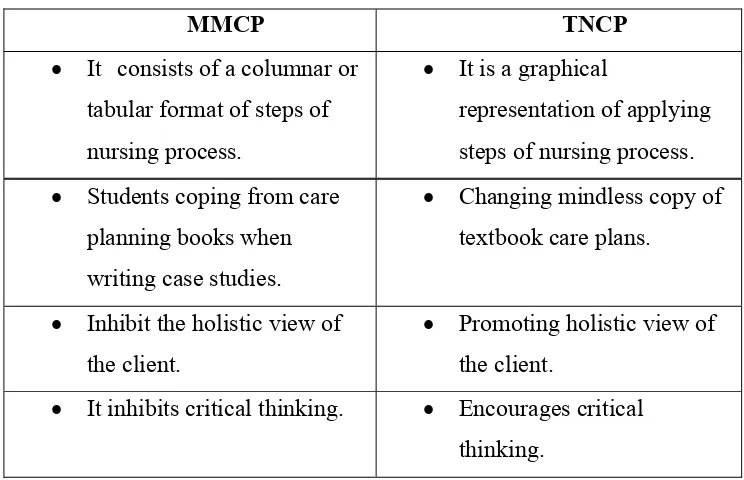
Table 1.1.2. Mind Mapped Care Plan VSs Traditional care plan
MMCP TNCP
It consists of a columnar or
tabular format of steps of nursing process.
It is a graphical
representation of applying steps of nursing process. Students coping from care
planning books when writing case studies.
Changing mindless copy of textbook care plans.
Inhibit the holistic view of the client.
Promoting holistic view of the client.
It inhibits critical thinking. Encourages critical thinking.
Billings and Halstead62 define mind mapping as learning complex phenomenon
by diagramming the concepts and sub concepts.
King and Shell63 illustrate the process of mind mapping. For example, in
clinical practice the reason for seeking help´ is arranged as the centre of map. Then
other important data such as nursing diagnoses, sign and symptoms, nursing
intervention and other patient’s needs are clustered and linked to the centre. With the
identification of concept and diagram, students start to analyze the case and try to find
other information and relationships between components in the diagram and concept.
Mueller, Johnston and Bligh76 discuss the use of mind-mapped care plan by
nursing students to enhance their critical thinking. Integrating mind-maps into their
care plan encourages the student nurse’s critical thinking and links information such
as patient data and diagnoses together.
Clinical nursing education is an integral part of nursing education. So where
the learner is able to link the theoretical component of nursing process approach with
Mind Map to frame Mind Mapped Care Plan will facilitate critical thinking skill and
give us an opportunity to change the concept of the nursing process.
1.2. SIGNIFICACE AND NEED FOR THE STUDY
The goal of nursing education is to prepare students for safe clinical nursing
practice. Nurses use the nursing process to systematically collect and scientifically
analyze the client’s unique data to identify nursing problems or diagnoses, plan and
implement nursing interventions, and evaluate the client’s responses to those nursing
interventions. Nurse educators have traditionally taught students the nursing process
through the use of a nursing care plan that uses a linear columnar format. This style of
care planning may not foster critical thinking as many students draw information
directly from a care plan book without relating it to the client’s specific needs. Also,
these care plans are often completed retrospectively. Some argue that care plans are
obsolete in nursing practice and that thorough, accurate documentation reflects the
nursing process better than a document that requires continuous manual updating that
lends little to effective nursing practice. Yet there is still an important role in nursing
education for nursing care plans, as these are the basis for students learning how to
think like a nurse. More exploration of this issue is needed to determine if there are
meaningful manner, and apply important theoretical principles in the clinical setting.
Traditionally, nursing education has been based on a behaviourism model that has not
been conducive to advancing education practices It has been teacher-and
teaching-centred, using primarily lecture, rote memorization, and multiple- choice questions as
teaching strategies. This type of model is not exclusive to nursing education
curriculums. The National League for Nursing instituted accreditation criteria in 1990
requiring nursing programs to demonstrate the development of student critical
thinking skills consisting of “analysis, reasoning, decision making, and independent
judgment”. An active learning strategy is one in which the student learns by actively
participating in the learning process and thinking about what he/she is doing. An
innovative tool that can provide a meaningful learning experience for students by
acknowledging and building on prior knowledge, and making connections of
important client care concerns is a mind map.135
Mueller, Johnston and Bligh76 combined the Mind Map with the nursing care
plan as a way to teach the nursing students to view each plan as a whole picture and to
understand the relationships between the factors that affect the client. He also
identified three central issues that inhibit critical thinking when using a linear format
nursing care plan; 1. Linear nature, 2.Copying from care plan books, 3.Inhibits
holistic view of the client.
Mind maps are multi-sensory tools that use visuospatial orientation to
integrate information and therefore help students organize and retain information and
they provide an opportunity to effectively use b