A semi-analytic model for the
co-evolution of galaxies, black
holes and active galactic nuclei
The Harvard community has made this
article openly available.
Please share
how
this access benefits you. Your story matters
Citation
Somerville, Rachel S., Philip F. Hopkins, Thomas J. Cox, Brant E.
Robertson, and Lars Hernquist. 2008. “A Semi-Analytic Model for the
Co-Evolution of Galaxies, Black Holes and Active Galactic Nuclei.”
Monthly Notices of the Royal Astronomical Society 391 (2): 481–506.
https://doi.org/10.1111/j.1365-2966.2008.13805.x.
Citable link
http://nrs.harvard.edu/urn-3:HUL.InstRepos:41381725
arXiv:0808.1227v1 [astro-ph] 8 Aug 2008
A Semi-Analytic Model for the Co-evolution of
Galaxies, Black Holes, and Active Galactic Nuclei
Rachel S. Somerville
1,
⋆Philip F. Hopkins
2, Thomas J. Cox
2, Brant E.
Robertson
3,4,5, Lars Hernquist
21 Max-Planck-Institut f¨ur Astronomie, K¨onigstuhl 17, Heidelberg D-69117 Germany
2 Harvard-Smithsonian Center for Astrophysics, 60 Garden Street, Cambridge, MA 02138
3 Kavli Institute for Cosmological Physics, and the Department of Astronomy and Astrophysics, University of Chicago,
933 East 56th Street, Chicago, IL, 60637, USA
4 Enrico Fermi Institute, 5640 South Ellis Avenue, Chicago, IL, 60637, USA
5 Spitzer Fellow
24 October 2018
ABSTRACT
We present a new semi-analytic model that self-consistently traces the growth of supermassive black holes (BH) and their host galaxies within the context of the ΛCDM cosmological framework. In our model, the energy emitted by accreting black holes regulates the growth of the black holes themselves, drives galactic scale winds that can remove cold gas from galaxies, and produces powerful jets that heat the hot gas atmospheres surrounding groups and clusters. We present a comprehensive comparison of our model predictions with observational mea-surements of key physical properties of low-redshift galaxies, such as cold gas fractions, stellar metallicities and ages, and specific star formation rates. We find that our new models successfully reproduce the exponential cutoff in the stellar mass function and the stellar and cold gas mass densities atz ∼0, and
predict that star formation should be largely, but not entirely, quenched in mas-sive galaxies at the present day. We also find that our model of self-regulated BH growth naturally reproduces the observed relation between BH mass and bulge mass. We explore the global formation history of galaxies in our models, present-ing predictions for the cosmic histories of star formation, stellar mass assembly, cold gas, and metals. We find that models assuming the “concordance” ΛCDM cosmology overproduce star formation and stellar mass at high redshift (z∼>2).
A model with less small-scale power predicts less star formation at high redshift, and excellent agreement with the observed stellar mass assembly history, but may have difficulty accounting for the cold gas in quasar absorption systems at high redshift (z∼3–4).
Key words: galaxies: evolution — galaxies: formation — cosmology: theory
1 INTRODUCTION
It is now well-established that the Cold Dark Mat-ter paradigm for structure formation (Blumenthal et al. 1984), in its modern, dark energy-dominated (ΛCDM) incarnation, provides a remarkably successful paradigm for interpreting a wide variety of observations, from the cosmic microwave background fluctuations at z ∼1000 (Spergel et al. 2003, 2007), to the large-scale clustering
⋆ E-mail: [email protected]
of galaxies atz∼0 (Percival et al. 2002; Tegmark et al. 2004; Eisenstein et al. 2005). Other successful predictions of the ΛCDM paradigm include the cosmic shear field as measured by weak gravitational lensing (Heymans et al. 2005; Bacon et al. 2005; Hoekstra et al. 2006), the small-scale power spectrum as probed by the Lyman-alpha forest (Desjacques & Nusser 2005; Jena et al. 2005), and the number densities of (Borgani et al. 2001), and baryon fractions within, galaxy clusters (Allen et al. 2004; White et al. 1993).
sim-ulating galaxy formation has had more mixed success. In this picture, as originally proposed by White & Rees (1978) and Blumenthal et al. (1984), galaxies form when gas cools and condenses at the centers of dark-matter dominated potential wells, or “halos”. More detailed calculations, using semi-analytic and numerical sim-ulations of galaxy formation, have shown that this framework does provide a promising qualitative under-standing of many features of galaxies and their evo-lution (e.g., Kauffmann et al. 1993; Cole et al. 1994; Somerville & Primack 1999; Kauffmann et al. 1998; Cole et al. 2000; Somerville et al. 2001; Baugh 2006). However, it has been clear for at least a decade now that there is a fundamental tension between certain basic pre-dictions of the ΛCDM-based galaxy formation paradigm and some of the most fundamental observable proper-ties of galaxies. In this paper we focus on two intercon-nected, but possibly distinct, problems: 1) the “overcool-ing” or “massive galaxy” problem and 2) the star forma-tion “quenching” problem.
The first problem is manifested by the fact that both semi-analytic and numerical simulations predict that a large fraction of the available baryons in the Universe rapidly cools and condenses, in conflict with observations which indicate that only about∼5–10 % of the baryons are in the form of cold gas and stars (Bell et al. 2003a; Fukugita & Peebles 2004). This is due to the fact that gas at the densities and temperatures characteristic of dark matter halos is expected to cool rapidly, and is related to the classical “cooling flow” problem (Fabian & Nulsen 1977; Cowie & Binney 1977; Mathews & Bregman 1978). Direct observations of the X-ray properties of hot gas in clusters similarly imply that this gas should have short cooling times, particularly near the center of the clus-ter, but the condensations of stars and cold gas at the centers of these clusters are much smaller than would be expected if the hot gas had been cooling so efficiently over the lifetime of the cluster (for reviews see Fabian 1994; Peterson & Fabian 2006). Moreover, X-ray spectroscopy shows that very little gas is cooling below a temperature of about one-third of the virial temperature of the cluster (Peterson et al. 2003).
A further difficulty is that there is a fundamen-tal mismatch between the shape of the dark matter halo mass function and that of the observed mass func-tion of cold baryons (cold gas and stars) in galaxies (Somerville & Primack 1999; Benson et al. 2003). The galaxy mass function has a sharp exponential cutoff above a mass of about a few times 1010M
⊙, while the halo
mass function has a shallower, power-law cutoff at much higher mass (∼few×1013M
⊙). There is also a mismatch
at the small-mass end, as the mass function of dark mat-ter halos is much steeper than that of galaxies. If we are to assume that each dark matter halo hosts a galaxy, this then implies that the ratio between the luminosity or stel-lar mass of a galaxy and the mass of its dark matter halo varies strongly and non-monotonically with halo mass (Kravtsov et al. 2004a; Conroy et al. 2006; Wang et al. 2006; Moster et al. 2008), such that “galaxy formation” is much more inefficient in both small mass and large mass halos, with a peak in efficiency close to the mass of our own Galaxy, ∼1012M
⊙. On very small mass scales
(below halo velocities of ∼ 30−50 km s−1), the
col-lapse and cooling of baryons may be suppressed by the presence of a photoionizing background (Efstathiou 1992; Thoul & Weinberg 1996; Quinn et al. 1996). For larger mass halos (up toVvir≃150−200 km s−1), the standard
assumption is that winds driven by massive stars and su-pernovae are able to heat and expell gas, resulting in low baryon fractions in small mass halos (White & Rees 1978; Dekel & Silk 1986; White & Frenk 1991). However, stel-lar feedback probably cannot provide a viable solution to the overcooling problem in massive halos (Benson et al. 2003): stars do not produce enough energy to expell gas from these large potential wells; and the massive, early type galaxies in which the energy source is needed have predominantly old stellar populations and little or no ongoing or recent star formation. Other solutions, like thermal conduction, have been explored, but prob-ably do not provide a full solution (Benson et al. 2003; Voigt & Fabian 2004).
The second problem is related to the correlation of galaxy structural properties (morphology) and spec-trophotometric properties (stellar populations) with stel-lar mass. The presence of such a correlation has long been known, in the sense that more massive galaxies tend to be predominantly spheroid-dominated, with red colors, old stellar populations, low gas fractions, and little recent star formation, while low-mass galaxies tend to be disk-dominated and gas-rich, with blue colors and ongoing star formation (e.g. Roberts & Haynes 1994). More recently, with the advent of large galaxy surveys such as the Sloan Digital Sky Survey (SDSS), we have learned that the galaxy color distribution (and that of other related prop-erties) is stronglybimodal (e.g. Baldry et al. 2004), and that the transition in galaxy properties from star-forming disks to “dead” spheroids occurs rather sharply, at a char-acteristic stellar mass of∼3×10¹⁰M
⊙(Kauffmann et al.
2003a; Brinchmann et al. 2004). In contrast, the “stan-dard” ΛCDM-based galaxy formation models predict that massive halos have been assembled relatively re-cently, and should contain an ample supply of new fuel for star formation. These models predict aninverted color-mass and morphology-color-mass relation (color-massive galaxies tend to be blue and disk dominated, rather than red and spheroid dominated) and no sharp transition or strong bimodality. Thus, the standard paradigm of galaxy for-mation does not provide a physical explanation for the “special” mass scale (a halo mass of∼1012M
⊙, or a
stel-lar mass of∼3×10¹⁰M
⊙) which marks both the peak of
galaxy formation efficiency and the transition in galaxy properties seen in observations.
massive galaxies, where quenching is observed to be the most efficient, host the largest black holes, and there-fore the available energy budget is greatest in precisely the systems where it is needed, in contrast to the case of stellar feedback. The integrated energy released over the lifetime of a SMBH (≃ 1060−1062 erg) is clearly very significant compared with galaxy binding energies (Silk & Rees 1998). In view of these facts, it seems al-most inconceivable that AGN feedback isnot important in shaping galaxy properties.
However, in order to build a complete, self-consistent machinery to describe the formation and growth of black holes within the framework of a cosmological galaxy for-mation model, and to attempt to treat the impact of the energy feedback from black holes in this context, we need to address several basic questions: 1) When, where, and with what masses do seed black holes form? 2) What trig-gers black hole accretion, what determines the efficiency of this accretion, and what shuts it off? 3) In what form is the energy produced by the black hole released, and how does this energy couple with the host galaxy and its surroundings? In order to address some of these ques-tions, we first identify two modes of AGN activity which have different observational manifestations, probably cor-respond to different accretion mechanisms, and have dif-ferent physical channels of interaction with galaxies.
1.1 The Bright Mode of Black Hole Growth
Classical luminous quasars and their less powerful cousins, optical or X-ray bright AGN, radiate at a signifi-cant fraction of their Eddington limit (L∼(0.1−1)LEdd;
Vestergaard 2004; Kollmeier et al. 2006), and are be-lieved to be fed by optically thick, geometrically thin ac-cretion disks (Shakura & Syunyaev 1973). We will refer to this mode of accretion as the “bright mode” because of its relatively high radiative efficiency (with a fraction
ηrad ∼0.1−0.3 of the accreted mass converted to
radi-ation). The observed space density of these quasars and AGN is low compared to that of galaxies, implying that if most galaxies indeed host a SMBH, this “bright mode” of accretion is only “on” a relatively small fraction of the time. Constraints from quasar clustering and vari-ability imply that quasar lifetimes must be <
∼108.5 yr
(Martini & Weinberg 2001; Martini & Schneider 2003). These short timescales combined with the large observed luminosities immediately imply that fueling these objects requires funneling a quantity of gas comparable to the en-tire supply of a large galaxy (∼109−1010M
⊙) into the
central regions on a timescale of order the dynamical time (∼few×107−108 yr).
These considerations alone lead one to consider galaxy-galaxy mergers as a promising mechanism for triggering this efficient accretion onto nuclear black holes. The observational association of mergers with enhanced star formation, particularly with the most violent observed episodes of star formation exhibited by Ultra Luminous Infrared Galaxies (ULIRGS), is well-established (Sanders & Mirabel 1996; Farrah et al. 2001; Colina et al. 2001; Barton et al. 2000; Woods et al. 2006; Woods & Geller 2007; Barton et al. 2007; Lin et al.
2007; Li et al. 2007). Moreover, numerical simulations have shown that tidal torques during galaxy mergers can drive the rapid inflows of gas that are needed to fuel both the intense starbursts and rapid black hole accretion associated with ULIRGS and quasars (Hernquist 1989; Barnes 1992; Barnes & Hernquist 1996; Mihos & Hernquist 1994, 1996; Springel et al. 2005b; Di Matteo et al. 2005). As well, it seems that if one can probe sufficiently deep to study the SED be-neath the glare of the quasar, one always uncovers ev-idence of young stellar populations indicative of a recent starburst (Brotherton et al. 1999; Canalizo & Stockton 2001; Kauffmann et al. 2003b; Jahnke et al. 2004; S´anchez et al. 2004; Vanden Berk et al. 2006). Near-equal mass (major) mergers also have the attractive fea-ture that they scramble stars from circular to random or-bits, leading to morphological transformation from disk to spheroid (Toomre & Toomre 1972; Barnes 1988, 1992; Hernquist 1992, 1993). If spheroids and black holes both arise from violent mergers, this provides a possible ex-planation for why black hole properties always seem to be closely associated with the spheroidal components of galaxies.
What impact does the energy associated with this rapid, bright mode growth have on the galaxy and on the growth of the black hole itself? Long thought to be associated only with a small subset of objects (e.g. Broad Absorption Line (BAL) quasars), high-velocity winds have been detected in a variety of different types of quasar systems (de Kool et al. 2001; Pounds et al. 2003; Chartas et al. 2003; Pounds & Page 2006), and are now believed to be quite ubiquitous (Ganguly & Brotherton 2008). However, their impact on the host galaxy remains unclear, as the mass outflow rates of these winds are dif-ficult to constrain (though see Steenbrugge et al. 2005; Chartas et al. 2007; Krongold et al. 2007). Recently, nu-merical simulations of galaxy mergers including black hole growth found that depositing even a small fraction (∼5 %) of the energy radiated by the BH into the ISM can not only halt the accretion onto the BH, but can drive large-scale winds (Di Matteo et al. 2005). These winds sweep the galaxy nearly clean of cold gas and halt fur-ther star formation, leaving behind a rapidly reddening, spheroidal remnant (Springel et al. 2005a).
To study how the interplay between feedback from supermassive black hole accretion and supernovae, galaxy structure, orbital configuration, and gas dissipation com-bine to determine the properties of spheroidal galax-ies formed through mergers, hundreds of hydrodynam-ical simulations were performed by Robertson et al. (2006b; 2006c; 2006a) and Cox et al. (2006b; 2006a) using the methodology presented by Di Matteo et al. (2005) and Springel et al. (2005b). Robertson et al. and Cox et al. analyzed the merger remnants to study the red-shift evolution of the BH mass-σ relation, the Funda-mental Plane, phase-space density, and kinematic prop-erties. This extensive suite has been supplemented by additional simulations of minor mergers from Cox et al. (2008). Throughout the rest of this paper, when we refer to “the merger simulations”, we refer to this suite.
se-quence from galaxy-galaxy merger, to dust-enshrouded starburst and buried AGN, blow-out of the dust and ISM by the quasar- and starburst-driven winds, to clas-sical (unobscured) quasar, post-starburst galaxy, and fi-nally “dead” elliptical. Hopkins et al. (2007b) find that in the merger simulations, the accretion onto the BH is eventually halted by a pressure-driven outflow. Be-cause the depth of the spheroid’s potential well deter-mines the amount of momentum necessary to entrain the infalling gas, Hopkins et al. (2007b) find that this leads to a “Black Hole Fundamental Plane”, a corre-lation between the final black hole mass and sets of spheroid structural/dynamical properties (mass, size, ve-locity dispersion) similar to the one seen in observations (Hopkins et al. 2007c; Marconi & Hunt 2003).
Furthermore, Hopkins et al. (2005d; 2005a; 2005b) have shown that the self-regulated nature of black hole growth in these simulations leads to a characteristic form for quasar lightcurves. As the galaxies near their final coalescence, the accretion rises to approximately the Ed-dington rate. After the critical black hole mass is reached and the outflow phase begins, the accretion rate enters a power-law decline phase. Although most of their growth occurs in the near-Eddington phase, quasars spend much of their time in the decline phase, and this implies that many observed low-luminosity quasars are actually rela-tively massive black holes in the last stages of their slow decline. Hopkins et al. (2006d) found that when these lightcurves are convolved with the observed mass func-tion of merging galaxies, the predicted AGN luminosity function is consistent with observations. Moreover, Hop-kins et al. (2005b; 2005c; 2006a; 2006c) have shown that this picture reproduces many quasar and galaxy observ-ables that are difficult to account for with more simpli-fied assumptions about QSO lightcurves, such as differ-ences in the quasar luminosity function in different bands and redshifts, Eddington ratio and column density distri-butions, the X-ray background spectrum, and relic red, early type galaxy population colors and distributions.
1.2 The Radio Mode
The second mode of AGN activity is much more com-mon, and in general less dramatic. A fairly large frac-tion of massive galaxies (particularly galaxies near the centers of groups and clusters) are detected at radio wavelengths (Best et al. 2005, 2007). Most of these radio sources do not have emission lines characteristic of clas-sical optical or X-ray bright quasars (Best et al. 2005; Kauffmann et al. 2007), and their accretion rates are believed to be a small fraction of the Eddington rate (Rafferty et al. 2006). They are extremely radiatively in-efficient (Bˆırzan et al. 2004), and thought to be fuelled by optically thin, geometrically thick accretion as expected in ADAF and ADIOS models such as those proposed by Narayan & Yi (1994) and Blandford & Begelman (1999). Because these objects are generally identified via their radio emission, we refer to this mode of accretion and BH growth as the “radio mode” (following Croton et al. 2006).
Although these black holes seem to be inefficient at
producing radiation, they can apparently be quite ef-ficient at producing kinetic energy in the form of rel-ativistic jets. Intriguingly, the majority of cooling flow clusters host these active radio galaxies at their centers (Dunn & Fabian 2006, 2008), and X-ray maps reveal that the radio lobes are often spatially coincident with cavi-ties, thought to be bubbles filled with relativistic plasma and inflated by the jets (McNamara & Nulsen 2007, and references therein). The observations of these bubbles can be used to estimate the work required to inflate them against the pressure of the hot medium (Bˆırzan et al. 2004; Rafferty et al. 2006; Allen et al. 2006), and hence obtain lower limits on the jet power.
While the idea that radio jets provide a heat source that could counteract cooling flows has been discussed for many years (e.g. Binney & Tabor 1995; Churazov et al. 2002; Fabian et al. 2003; Omma et al. 2004; Binney 2004), these observations now make it pos-sible to investigate more quantitatively whether the heat-ing rates are sufficient to offset the coolheat-ing rates in groups and clusters. Several studies conclude that in the majority of the systems studied, the AGN heat-ing traced by the power in the X-ray cavities alone is comparable to or in excess of the energy being radiated by the cooling gas (McNamara et al. 2006; Rafferty et al. 2006; Fabian et al. 2006; Best et al. 2006; McNamara & Nulsen 2007; Dunn & Fabian 2008). More-over, the net cooling rate is correlated with the observed star formation rate in the central cD galaxy, indicating that there may be a self-regulating cycle of heating and cooling (Rafferty et al. 2006).
Several other physical processes that could sup-press cooling in large mass halos have been sug-gested and explored, such as thermal conduction (Benson et al. 2003; Voigt & Fabian 2004), multi-phase cooling (Maller & Bullock 2004), or heating by sub-structure or clumpy accretion (Khochfar & Ostriker 2007; Naab et al. 2007; Dekel & Birnboim 2008). While some or all of these processes may well be important, in this paper we will investigate whether it is plausible that “radio mode” heating alone can do the job.
1.3 A Unified Model for Black Hole Activity and AGN Feedback
All of this begs the question: what determines whether a black hole accretes in the “bright mode” or “radio mode” state? An interesting possible answer comes from an analogy with X-ray binaries (Jester 2005; K¨ording et al. 2006). Observers can watch X-ray binaries in real time as they transition between two states: the “low/hard” state, in which a steady radio jet is present and a hard X-ray spectrum is observed, and the “high/soft” state, in which the jet dissapears and the X-ray spectrum has a soft, thermal component (Maccarone et al. 2003; Fender et al. 2004). The transition between the two states is thought to be connected to the accretion rate itself: the “high/soft” state is associated with accretion rates of >
∼(0.01–0.02)
˙
mEddand the existence of a classical thin accretion disk,
ac-cretion rates and radiatively inefficient ADAF/ADIOS accretion (Fender et al. 2004).
Recently, Sijacki et al. (2007) have applied this idea in cosmological hydrodynamic simulations, by assuming that when the accretion rate exceeds a critical value, “bright mode” feedback occurs (AGN-driven winds), while when the accretion rate is lower, “radio mode” (me-chanical bubble feedback) is implemented. The results of their simulations appear promising — they produced black hole and stellar mass densities in broad agreement with observations. In addition, they found that their implementation of AGN feedback was able to suppress strong cooling flows and produce shallower entropy pro-files in clusters, and to quench star formation in massive galaxies. However, the very large dynamic range required to treat the growth of black holes and galaxies in a cos-mological context — from the sub-pc scales of the BH ac-cretion disk to the super-Mpc scales of large scale struc-ture — means that numerical techniques such as these will likely need to be supplemented by semi-analytic or sub-grid methods for some time to come.
Our approach is in many respects very similar in spirit to that of Sijacki et al. (2007), although of course we are forced to implement both modes of AGN feedback in an even more schematic manner because we are using a semi-analytic model rather than a numerical simulation. We adopt fairly standard semi-analytic treatments of the growth of dark matter halos via accretion and mergers, radiative cooling of gas, star formation, supernova feed-back, and chemical evolution. We then adopt the picture of self-regulated black hole growth and bright mode feed-back in mergers discussed in §1.1, and implement these processes in our model using the results extracted from the merger simulations described above. We assume that the radio mode is fueled instead by hot gas in quasi-hydrostatic halos, and that the accretion rate is described by Bondi accretion from an isothermal cooling flow as proposed by Nulsen & Fabian (2000, NF00). We calibrate the heating efficiency of the associated radio jets against direct observations of bubble energetics in clusters.
A number of authors have previously explored the formation of black holes and AGN in the context of CDM-based semi-analytic models of varying complex-ity (Efstathiou & Rees 1988; Kauffmann & Haehnelt 2000; Wyithe & Loeb 2002; Bromley et al. 2004; Scannapieco & Oh 2004; Volonteri et al. 2003; Volonteri & Rees 2005), and recently several studies have also investigated the impact of AGN feedback on galaxy formation using such models (Cattaneo et al. 2006; Croton et al. 2006; Bower et al. 2006; Menci et al. 2006; Schawinski et al. 2006; Kang et al. 2006; Monaco et al. 2007). The models that we present here differ from previ-ous studies of which we are aware, in two main respects: 1) we implement detailed modelling of self-regulated black hole growth and bright mode feedback based on an extensive suite of numerical simulations of galaxy mergers and 2) we adopt a simple but physical model for radio mode accretion and heating, and calibrate our model against direct observations of accretion rates and radio jet heating efficiencies. We present a broader and more detailed comparison with observations than previous works, and highlight some remaining problems
that have not previously been emphasized. As well, unlike most previous studies, we calibrate our models and make our comparisons in terms of “physical” galaxy properties such as stellar mass and star formation rate, which can be estimated from observations, rather than casting our results in terms of observable properties such as luminosities and colors. Our results are therefore less sensitive to the details of dust and stellar population modelling, and easier to interpret in physical terms.
The goals of this paper are to present our new models in detail, and to test and document the extent to which they reproduce basic galaxy observations atz = 0 and the global cosmic histories of the main baryonic compo-nents of the Universe. The structure of the rest of this paper is as follows. In§2, we describe the ingredients of our models and provide a table of all of the model pa-rameters. In§3, we present predictions for key properties of galaxies at z ∼ 0 and for the global history of the main baryonic components of the Universe: star forma-tion, evolved stars, cold gas, metals, and black holes. We conclude in§4.
2 MODEL
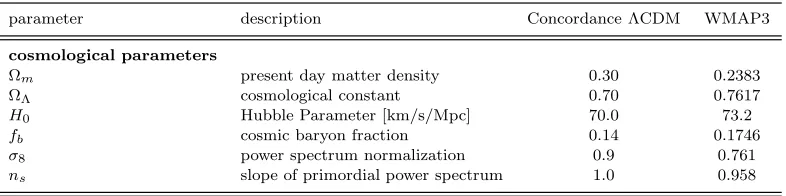
Our model is based on the semi-analytic galaxy formation code described in Somerville & Primack (1999, SP99) and Somerville et al. (2001, SPF01), with several major updates and important new ingredients, which we de-scribe in detail here. Unless specified otherwise, we adopt the “Concordance” ΛCDM model (C-ΛCDM), with the parameters given in Table 1, which has been used in many recent semi-analytic studies of galaxy formation. In §3.5, we also consider a model that uses the set of parameters obtained from the three year results of the Wilkinson Microwave Anisotropy Probe by Spergel et al. (2007), which are also specified in Table 1. We refer to this as the “WMAP3” model. We assume a universal Chabrier stellar initial mass function (IMF; Chabrier 2003), and where necessary we convert all observations used in our comparisons to be consistent with this IMF.
2.1 Dark Matter Halos, Merger Trees and Substructure
We compute the number of “root” dark matter (DM) ha-los as a function of mass at a desired output redshift us-ing the model of Sheth & Tormen (1999), which has been shown to agree well with numerical simulations. Then, for each “root” halo of a given massM0and at a given output
redshift, we construct a realization of the merger history based on the method described in Somerville & Kolatt (1999, SK99). We have introduced a modification to the SK99 algorithm, which we find leads to better agreement with N-body simulations. We choose the timestep ∆tby requiring that theaverage number of progenitors ¯Np be
close to two, by inverting the equation forNprog(M0,∆t)
(see SK99). We then select progenitors as described in SK99, but do not allow the number of progenitors to ex-ceed ¯Np+
p¯
Np+ 1. We follow halo merging histories
down to a minimum progenitor mass of 1010M
⊙, and
our smallest “root” halos have a mass of 1011M
Table 1.Summary of Cosmological Parameters
parameter description Concordance ΛCDM WMAP3
cosmological parameters
Ωm present day matter density 0.30 0.2383
ΩΛ cosmological constant 0.70 0.7617
H0 Hubble Parameter [km/s/Mpc] 70.0 73.2
fb cosmic baryon fraction 0.14 0.1746
σ8 power spectrum normalization 0.9 0.761
ns slope of primordial power spectrum 1.0 0.958
Table 2.Summary of the galaxy formation parameters in our “fiducial” model. We also specify the section in the paper where a more detailed definition of each set of parameters can be found, and whether the parameter is considered to be fixed based on direct observations or numerical simulations (F), or adjusted to match observations (A).
parameter description fiducial value fixed/adjusted
photoionization squelching (§2.3)
zoverlap,zreionize redshift of overlap/reionization 11, 10 F
quiescent star formation (§2.5.1)
AKenn normalization of Kennicutt Law [M⊙yr−1 kpc−2] 8.33×10⁻⁵ A
NK power law index in Kennicutt Law 1.4 F
χgas scale radius of gas disk, relative to stellar disk 1.5 A Σcrit critical surface density for star formation [M⊙pc−2] 6.0 A
burst star formation (§2.5.2)
µcrit critical mass ratio for burst activity 0.1 F
eburst,0 burst efficiency for 1:1 merger eqn. 9 F
γburst dependence of burst efficiency on mass ratio eqn. 8 F
τburst burst timescale eqn. 10 F
merger remnants & morphology (§2.6)
fsph fraction of stars in spheroidal remnant eqn. 11 A
fscatter fraction of scattered satellite stars 0.4 A
supernova feedback (§2.7)
ǫ0
SN normalization of reheating function 1.3 A
αrh power law slope of reheating function 2.0 A
Veject velocity scale for ejection of reheated gas [km/s] 120 A
χreinfall timescale for re-infall of ejected gas 0.1 A
chemical evolution (§2.8)
y chemical yield (solar units) 1.5 A
R recycled fraction 0.43 F
black hole growth (§2.9)
ηrad efficiency of conversion of rest mass to radiation 0.1 F
Mseed mass of seed BH [M⊙] 100 F
fBH,final scaling factor for mass of BH at end of merger 2.0 A
fBH,crit scaling factor for “critical mass” of BH 0.4 F
AGN-driven winds (§2.10)
ǫwind effective coupling factor for AGN driven winds 0.5 F
radio mode feedback (§2.11)
κradio normalization of “radio mode” BH accretion rate 3.5×10⁻³ A
κheat coupling efficiency of radio jets with hot gas 1.0 F
have also implemented our models within N-body based merger trees, and do not find any significant changes to our results.
We assign two basic properties to every dark mat-ter halo in each of our merger trees: the angular momen-tum or spin parameter, and the concentration parameter,
which describes the matter density profile. We express the angular momentum in terms of the dimensionless spin parameter λ ≡ Jh|Eh|1/2G−1Mvir−5/2 (Peebles 1969),
whereEhis the total energy of the halo andMviris the
[image:7.612.72.575.236.649.2]concentration (Bullock et al. 2001a; Macci`o et al. 2007) and does not evolve with redshift. The distribution ofλ
is log-normal, with mean ¯λ = 0.05 and width σλ= 0.5
(Bullock et al. 2001a). We assign each top-level halo a value ofλby selecting values randomly from this distri-bution, assuming that it is not correlated with any other halo properties or with redshift. The halo at the next stage of the merger tree inherits the spin parameter of its largest progenitor.
We assume that the initial density profile of each halo is described by the Navarro-Frenk-White (NFW) form (Navarro et al. 1997), and compute the character-istic concentration parameter cNFW for the appropriate
mass and redshift using a fitting formula based on nu-merical simulations (Bullock et al. 2001b). We adopt the updated normalization ofcNFW(Mvir) from Macci`o et al.
(2007). We neglect the scatter in cNFW at fixed mass,
as well as the known correlation betweencNFW and halo
merger history (Wechsler et al. 2002).
At each stage in the merging hierarchy, one or more halos merge together to form a new, virialized dark mat-ter halo. The merged halos (hereafmat-ter referred to as “sub-halos”) and their galaxies, however, can survive and con-tinue to orbit within the potential well of the parent DM halo for some time. The time it takes for the satel-lite to lose all of its angular momentum due to dynam-ical friction and merge with the central galaxy is typi-cally modelled with some variant of the Chandrasekhar formula (see e.g. §2.8 of Somerville & Primack 1999). Here, we use an updated version of this formula from Boylan-Kolchin et al. (2008), which accounts for the tidal mass loss of sub-halos as they orbit within the host halo, as well as the dependence on the energy and angular mo-mentum of the orbit. Because the merger time is pro-portional to Mhost/Msat, accounting for this mass loss
increases the time it takes for small mass satellites to merge.
These satellites may eventually lose so much of their mass that they become tidally disrupted. Based on the results of Taylor & Babul (2004) and Zentner & Bullock (2003), we assume that satellites lose∼30−40 percent of their mass per orbital period, and that when the mass has been stripped down to the mass within the NFW scale radius rs ≡ rvir/cNFW, we consider the satellite to be
tidally destroyed. Sub-halos that survive until they reach the center of the parent halo are assumed to merge with the central object. Subhalos that are tidally destroyed be-fore they can merge are assumed to contribute their stars to a “diffuse stellar component” (DSC), which may be as-sociated with the stellar halo or the Intra-Cluster Light. We have verified that our model reproduces the condi-tional multiplicity function of sub-halos over the relevant range of host halo masses. Details and tests of our new algorithm for the treatment of sub-structure will be pre-sented in Maulbetsch et al. (in prep).
2.2 Cooling
The rate of gas condensation via atomic cooling is computed based on the model originally proposed by White & Frenk (1991), and utilized in various forms in
virtually all semi-analytic models. Here we use a slightly different implementation of the cooling model than that used in SP99 and subsequent papers, which we find is nu-merically better behaved. We first compute the “cooling time”, which is the time required for the gas to radiate away all of its energy, assuming that it all starts out at the virial temperature:
tcool= 3 2µmpkT
ρg(r)Λ(T, Zh)
. (1)
Here, µmp is the mean molecular mass, T is the virial
temperature Tvir = 35.9(Vvir/(km/s))2 K, ρg(r) is the
radial density profile of the gas, Λ(T, Zh) is the
tem-perature and metallicity dependent cooling function (Sutherland & Dopita 1993), and Zh is the metallicity
of the hot halo gas. We assume that the gas density pro-file is described by that of a singular isothermal sphere:
ρg(r) =mhot/(4πrvirr2). Substituting this expression for
ρg(r), we can solve for the cooling radiusrcool, which is
the radius within which all of the gas can cool within a timetcool. Writing the expression for the mass within
rcool, and differentiating, we obtain the rate at which gas
can cool:
dmcool
dt =
1 2mhot
rcool
rvir
1
tcool
. (2)
There are various possible choices for the cooling time tcool. Some early works used the Hubble time,
tcool = tH (e.g. Kauffmann et al. 1993). In our earlier
models (e.g. SP99), we used the time since the last halo major mergertmrg, defined as a merger in which the halo
grows in mass by at least a factor of two. Here, we fol-low Springel et al. (2001) and Croton et al. (2006) and assume that the cooling time is equal to the halo dy-namical time, tcool = tdyn = rvir/Vvir. Note that
be-cause in general tdyn< tmrg < tH, and the cooling rate
dmcool/dt ∝tcool−1/2, the choice tcool =tdyn results in
higher cooling rates than assumingtcool=tH, while using
tcool=tmrg produces intermediate results.
It can occur that rcool > rvir, indicating that the
cooling time is shorter than the dynamical time. In this case, we assume that the cooling rate is given by the rate at which gas can fall into the halo, which is governed by the mass accretion history.
We note that there are several rather arbitrary choices that must be made in any semi-analytic cool-ing model — for example, the profile of the hot gas and whether it is “reset”, and the time to which the cool-ing time is compared (see above) — and different groups tend to make slightly different choices for these ingredi-ents. Changing these ingredients in reasonable ways leads to overall variations in the cooling rates (changes in the redshift and halo mass dependence tend to be small) of at most a factor of two to three. These differences are then typically compensated by adjusting the supernova feedback and/or AGN feedback parameters.
simulations (Yoshida et al. 2002) without star formation, SN feedback, or chemical enrichment. We have also com-pared our results with the cooling rates presented by Kereˇs et al. (2005), and find good agreement.
Recently, studies based on 1D and 3D hydrody-namic simulations (Birnboim & Dekel 2003; Kereˇs et al. 2005) have highlighted a distinction between gas which is accreted in a “cold flow” mode, in which the gas particles are never heated much above ∼ 104 K, and
a “hot flow” mode in which gas is first shock heated to close to the virial temperature of the halo, forming a quasi-hydrostatic halo, and then cools in a manner similar to a classical cooling flow. The possible impor-tance of distinguishing between gas flows occuring in the regime tcool < tff vs. tcool > tff (where tff is the
free-fall time) has been highlighted many times in the lit-erature (Silk 1977; Binney 1977; Rees & Ostriker 1977; White & Frenk 1991). Although other criteria have been proposed (see Croton et al. 2006), we will identify gas cooling which occurs in timesteps in whichrcool> rviras
“cold mode” and the reverse (rcool< rvir) as “hot mode”.
This distinction will be relevant later, when we begin to consider the impact of heating by AGN-driven radio jets. As in most semi-analytic models, we assume that all new cold gas is accreted by the central galaxy in the halo. Because of this, satellite galaxies tend to consume their gas and become red, non-starforming, and gas poor. Re-alistically, satellite galaxies can probably retain their hot gas halos, and thus receive new cold gas, for some time after they merge with another halo. This aspect of the modelling should be improved; however, for the moment, we simply keep this problem in mind, and in some cases restrict our analysis to central galaxies.
2.3 Photo-ionization Squelching
Photoionization heating may “squelch” or suppress the collapse of gas into small mass halos (Efstathiou 1992; Thoul & Weinberg 1996; Quinn et al. 1996). This mecha-nism may play an important role in reconciling the (large) number of small-mass satellite halos predicted by CDM with the observed number of satellite galaxies in the Lo-cal Group (Somerville 2002; Benson et al. 2002). Gnedin (2000, G00) showed that the fraction of baryons that can collapse into halos of a given mass in the presence of a photo-ionizing background can be described in terms of the “filtering mass” MF. Halos less massive than MF
contain fewer baryons than the universal average. G00 parameterized the collapsed baryon fraction as a func-tion of redshift and halo mass with the expression:
fb,coll(z, Mvir) =
fb
[1 + 0.26MF(z)/Mvir]3
, (3) wherefbis the universal baryon fraction andMviris the
halo virial mass.
The filtering mass is a function of redshift, and this function depends on the reionization history of the uni-verse. Kravtsov et al. (2004b) provide fitting formulae for the filtering mass in the simulations of G00, pa-rameterized according to the redshift at which the first
HII regions begin to overlap (zoverlap) and the redshift
at which most of the medium is reionized (zreion). In
the simulations of G00, reionization occurs fairly late (zoverlap= 8,zreion= 7). Recent results from the WMAP
satellite, however, suggest an earlier epoch of reioniza-tion, zreion>∼10 (Spergel et al. 2007). We make use of
the fitting functions (B2) and (B3) from Appendix B of Kravtsov et al. (2004b) to compute the initial fraction of baryons that can collapse as a function of halo mass and redshift, withzoverlap= 11 andzoverlap= 10.
As shown by Somerville (2002) using a similar treat-ment of photo-ionization squelching, we find that our model reproduces the luminosity function of satellite galaxies in the Local Group (Macci`o et al. in prep).
2.4 Disk Sizes
When gas cools, it is assumed to initially settle into a thin exponential disk, supported by its angular momentum. We assume that the gas has aquired angular momentum before its collapse, along with the dark matter, via tidal torques (Peebles 1969). Given the halo’s concentration parameter cNFW, spin parameter λ and the fraction of
baryons in the diskfdisk, we can use angular momentum
conservation arguments to compute the scale radius of the exponential disk after collapse. We include the “adi-abatic contraction” of the halo due to the gravitational force of the collapsing baryons. Our approach is based on work by Blumenthal et al. (1986), Flores et al. (1993), and Mo et al. (1998, MMW98), and is described in detail in Somerville et al. (2008, S08). In S08, we showed that this model produces good agreement with the observed radial sizes of disks as a function of stellar mass both locally and out toz∼2.
2.5 Star Formation
2.5.1 Quiescent Star Formation
During the ‘quiescent’ phase of galaxy evolution (i.e. in undisturbed disks) we adopt a star formation recipe based on the empirical Schmidt-Kennicutt law (Kennicutt 1989, 1998). The star formation rate density (per unit area) is given by:
˙
ΣSFR=AKennΣgasNK, (4)
where AKenn = 1.67×10⁻⁴, NK = 1.4, Σgas is
the surface density of cold gas in the disk (in units of M⊙pc−2), and ΣSFR has units of M⊙yr−1 kpc−2. The
normalization quoted above is appropriate for a Chabrier IMF, and has been converted from the value given in Kennicutt (1998), which was based on a Salpeter IMF.
We assume that the gas profile is also an exponential disk, with a scale length proportional to the scale-length of the stellar disk: rgas = χgasrdisk, where the stellar
scalelength rdisk is determined as described in§2.4. We
adoptχgas= 1.5, which yields average gas surface
densi-ties in the range∼4−60 M⊙pc−2, consistent with the
observations of Kennicutt (1998). This value is also con-sistent with observations of the radial extent of HIgas in
spiral galaxies (Broeils & Rhee 1997).
We further adopt a critical surface density threshold Σcrit, and assume that only gas lying at surface densities
then compute the radius within which the gas density exceeds the critical value:
rcrit=−ln »
Σcrit
Σ0 –
rgas (5)
where Σ0≡mcold/(2πr2gas). The fraction of the total gas
supply that is eligible for star formation is then:
fgas(r < rcrit) = 1−(1 +rcrit/rgas)
Σcrit
Σ0
(6) and the total star formation rate is:
˙
m∗ =
Z rcrit
0
˙
ΣSFR2πrdr
= 2πAKΣ0
NKr2
gas N2 K × » 1− „
1 +NKrcrit
rgas «
exp(−NKrcrit/rgas) –
Schaye (2004) investigated star formation thresholds in models of isolated self-gravitating disks embedded in dark matter halos, containing metals and dust, and ex-posed to a UV background. They found that the gas was able to form a cold interstellar phase only above a criti-cal surface density threshold of Σcrit∼3−10 M⊙pc−2,
which is consistent with observations of SF thresholds in spiral galaxies (Martin & Kennicutt 2001). We find that adopting a value of Σcrit = 6 M⊙ pc−2 produces good
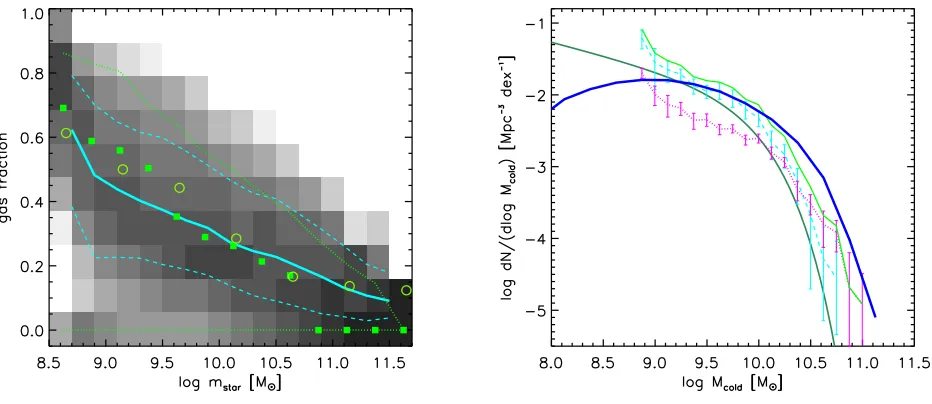
agreement with the observations of global SFR vs. gas density of Kennicutt (1998), and also with observed gas fractions as a function of stellar mass.
We allow the normalization of the star formation law
AKenn to be adjusted as a free parameter. We find that
using a value of AKenn = 8.33×10⁻⁵, a factor of two
lower than the one measured by Kennicutt (1998) gives good agreement with observed star formation rates and gas fractions as a function of stellar mass. We adopt the observed value for the slope of the SFR law,NK= 1.4.
We account for the mass loss from stars (recycled gas) using the instantaneous recyling approximation. Thus, for an instantaneous star formation rate ˙m, we form a mass dm∗= (1−R) ˙m dtof long-lived stars in a
timestep dt. We adopt a recycled fractionR= 0.43, ap-propriate for a Chabrier IMF (Bruzual & Charlot 2003).
2.5.2 Merger-Driven Starbursts
As in SPF01, we parameterize the efficiency of star for-mation in a merger-triggered “burst” mode as a function of the mass ratio of the merging pair. This is supported both by observations of star formation enhancement in galaxy pairs (Woods & Geller 2007) and by numerical simulations of galaxy mergers (Cox et al. 2008). How-ever, first, an important question arises: which quantity should we use for the mass ratio? Many previous works have either used the ratio of the virial masses of the two dark matter halos, or else the baryonic masses of the two galaxies. Because the ratio of baryons to dark matter can vary by several orders of magnitude across halos of dif-ferent masses, and moreover is a systematic function of halo mass (see§3.1), we find that our results can depend quite sensitively on this choice. Moreover, the baryonic
mass ratio is sensitive to the modelling of supernova and AGN feedback.
When we consider that the simulation results clearly indicate that the efficiency of the starburst is mainly de-termined by the strength of the torques during the later stages of the merger, it is clear that what should be rel-evant is thetotalmass (baryons and dark matter) in the
centralparts of the galaxies. Therefore we definemcore=
MDM(r < 2rs), i.e., the dark matter mass within twice
the characteristic NFW scale radiusrs≡rvir/cNFW,
as-suming that the dark matter follows an NFW profile. For a Milky Way sized halo (Mvir ∼ 2×10¹²M⊙), rs ∼27
kpc and so 2rs corresponds to about 60 kpc, close to the
scale that we expect to be relevant. We then define the mass ratioµ≡(mcore,1+mbar,1)/(mcore,2+mbar,2), i.e.
as the ratio of the dark matter “core” plus the total bary-onic mass (stars plus cold gas) of the smaller to the larger galaxy.
Now definingeburst as the fraction of the total cold
gas reservoir in the galaxy that is consumed by the burst, we parameterize the burst efficiency via:
eburst=eburst,0µγburst. (7)
This functional form has been shown to describe well the scaling of burst efficiency with merger mass ratio in hydrodynamic simulations of galaxy mergers (Cox et al. 2008, C08). Again based on C08, we assume that mergers with mass ratios below 1:10 do not produce bursts, i.e.
eburst= 0 forµ <0.1.
Numerical studies (Mihos & Hernquist 1994; Cox et al. 2008) have furthermore shown that the burst efficiency in minor mergers (µ<
∼0.25) depends on the
bulge-to-total ratio of the progenitor galaxies, because the presence of a bulge stablizes the galaxy and reduces the efficiency of the burst. To reflect the joint dependence on merger mass ratio and bulge fraction, we adopt the results of C08:
γburst= 8 > <
> :
0.61 B/T ≤0.085 0.74 0.085< B/T ≤0.25 1.02 B/T >0.25
(8) where B/T is the ratio of the stellar mass in the spheroidal component to the total stellar mass (disk plus spheroid) in the larger progenitor galaxy at the beginning of the merger.
We have studied the burst efficiency eburst,0 and
burst timescale τburst in equal mass mergers in a large
suite of numerical simulations containing stellar feedback as well as feedback from energy released by accretion onto a central black hole (Robertson et al. 2006b). We find that the burst efficiency can be fit by:
eburst,0= 0.60(Vvir/(km/s))0.07(1 +qEOS)−0.17
×(1 +fg)0.07(1 +z)0.04 (9)
with a scatter of 4.9 percent, and the burst timescale (as-suming a double exponential form for the star formation rate peak) is fit by:
τburst= 191 Gyr (Vvir/(km/s))−1.88(1 +qEOS)2.58
with a logarithmic scatter of 0.36. Here,Vvir is the virial
velocity of the progenitor galaxies, qEOS is the effective
equation of state of the gas (see Robertson et al. 2006b),
fg≡mcold/(mcold+mstar) is the cold gas fraction in the
disk, andz is the redshift for which the progenitor disk models were constructed. It is important to note that the simulations used to obtain these fitting functions span the rangeVvir= 60 – 500 km/s,qEOS= 0.25–1,fg=0.01–0.8,
and z = 0–6. The results of the fitting formulae should be used with caution outside of this range of values for the input parameters.
The parameterqEOScan be thought of as
parameter-izing the multi-phase nature of the Interstellar Medium (ISM), such that qEOS = 0 corresponds to an
isother-mal gas, and qEOS = 1 corresponds to the fully
pres-surized multiphase ISM. IncreasingqEOS (or adopting a
“stiffer” equation of state) increases the dynamical stabil-ity of the gas, and suppresses the starburst. Thus larger values of qEOS give smaller values ofeburst,0 and larger
values of τburst(because the burst is more extended). In
this work we adopt a value corresponding to a stiff equa-tion of state,qEOS= 1.
For the burst efficiency, we can see that the only sig-nificant dependence on these parameters is on the equa-tion of stateqEOS. The burst timescale is more sensitive
to other parameters (as also found by C08), and in par-ticular has quite a strong dependence on Vvir. For our
adopted fiducial value of qEOS = 1, the typical value of
the burst efficiency iseburst∼0.8, and the burst timescale
(exponential decline time) for a Milky Way sized galaxy (Vvir∼130 km/s) isτburst∼100 Myr.
We now parameterize the “burst” mode of star for-mation as ˙m∗ = mburst/τburst. At the beginning of the
merger, we allocate a reservoir of “burst fuel”mburst=
eburstmcold, where mcold is the combined cold gas from
both of the progenitor galaxies. The burst continues until this fuel is exhausted, and in the absence of new sources of fuel, the burst SFR will decline exponentially, with exponential decline timeτburst. However, particularly in
the early universe, it can frequently happen that a new merger occurs while a burst from an earlier merger is still going on. In this case, we add the new burst fuel to the reservoir, and assign a new burst timescale based on the updated galaxy properties. Note that the “quies-cent” mode of star formation still goes on as before (the burst efficiencies computed from the simulations have the quiescent star formation subtracted out).
2.6 Merger Remnants and Morphology
2.6.1 Spheroid Formation
Numerical simulations of mergers of galaxy disks have also shown that major mergers µ > 0.25 leave behind a spheroidal remnant, while smaller mass ratio minor mergers (µ < 0.25) tend to just thicken the disk, per-haps driving minor growth of a spheroid via bar instabil-ities. Most previous semi-analytic models have assumed a sharp threshold in merger mass ratio (e.g.µ > fellip≃
0.25−0.3) for determining whether the stars after a merger are placed in a “spheroidal” component or not. However, in reality there will be a continuum, whereby
larger mass ratios result in more heating and a transfer of more material to a dynamically hot spheroidal compo-nent. To represent this continuum, we define the function
fsph = 1− "
1 +
„ µ
fellip «8#−1
(11) which determines the fraction of the disk stars that is transferred to the “spheroid” or bulge component follow-ing a merger (as with bursts, we assume that mergers with mass ratioµ <0.1 have no effect).
Thus, consider a merger of two galaxies with bulge massesB1andB2, and disk massesD1andD2. The mass
of the new bulge will beBnew=B1+B2+fsph(D1+D2),
and the mass of the surviving disk will beDnew = (1−
fsph)(D1+D2). All new stars formed in the burst mode
are also deposited in the spheroid component.
In this paper, we assume that all spheroid growth is connected with mergers. That is, we do not consider formation of spheroids via disk instabilities. We have ex-perimented with including spheroid formation via disk instabilities, and find that it has only a minor impact on the results presented here.
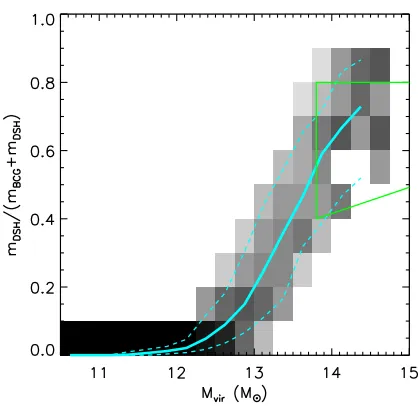
2.6.2 Formation of Diffuse Stellar Halos
There is now considerable observational evidence for spa-tially extended stellar components surrounding bright-est group and cluster galaxies (e.g. Zibetti et al. 2005; Gonzalez et al. 2005). It is now thought that these “diffuse stellar halos” (DSH) originated from tidally disrupted merging satellites and/or scattering of stars during major mergers (Murante et al. 2004; Monaco et al. 2006; Conroy et al. 2007; Murante et al. 2007; Purcell et al. 2007). In our models, the stars from all satellites that are deemed to be tidally destroyed be-fore they merge (according to the criteria described in
§2.1), are deposited in a DSH component. In addition, when two galaxies merge, we assume that a fraction
fscatter of the stars from the satellite may be scattered
into the DSH (thus the galaxy’s mass following a merger increases by (1−fscatter)mstar,sat, where mstar,sat is the
stellar mass of the merging satellite).
2.7 Supernova Feedback
Cold gas may be ejected from the galaxy by winds driven by supernova feedback. The rate of reheating of cold gas is given by:
˙
mrh=ǫSN0 „
Vdisk
200 km/s
«αrh
˙
m∗ (12)
whereǫSN0 andαrh are free parameters (we expectαrh≃
2 for “energy driven” winds; see e.g. Kauffmann et al. 1993). We take the circular velocity of the diskVdisk to
be equal to the maximum rotation velocity of the DM halo,Vmax.
Intergalactic Medium (IGM). The fraction of reheated gas that is ejected from the halo is given by:
feject(Vvir) = [1.0 + (Vvir/Veject)αeject]−1, (13)
where αeject = 6 and Veject is a free parameter in the
range≃100 –150 km/s.
We keep track of this ejected gas in a “diffuse gas reservoir”, which recollapses into the halo in later timesteps and once again becomes available for cool-ing. Following Springel et al. (2001) and De Lucia et al. (2004), we model the rate of reinfall of ejected gas by:
˙
mreinfall=χreinfall „
meject
tdyn «
(14) where χreinfall is a free parameter,meject is the mass of
ejected gas in the “diffuse reservoir”, andtdyn=rvir/Vvir
is the dynamical time of the halo.
Varying χreinfall is degenerate with variations in
the other supernova feedback parameters,ǫSN
0 ,αrh, and
Veject. For larger values of χreinfall, the ejected gas is
reincorporated in the halo more quickly and tends to cool rapidly, so the supernova feedback must be made more efficient in order to retain good agreement with the abundance of low-mass galaxies. On the other hand, if
χreinfall = 0 (ejected gas is never reaccreted), then the
baryon fractions in clusters are too low. We have chosen to adopt the minimal value of χreinfall that allows us to
fit the cluster baryon fractions and the mass function of low-mass galaxies simultaneously.
2.8 Chemical Evolution
We track the production of metals using a simple ap-proach that is commonly adopted in semi-analytic mod-els (see e.g. Somerville & Primack 1999; Cole et al. 2000; De Lucia et al. 2004). In a given timestep, where we cre-ate a parcel of new stars dm∗, we also create a mass of
metals dMZ =ydm∗, which we assume to be
instanta-neously mixed with the cold gas in the disk. The yield
yis assumed to be constant, and is treated as a free pa-rameter in our model. We track the mean metallicity of the cold gas Zcold, and when we create a new parcel of
stars they are assumed to have the same metallicity as the mean metallicity of the cold gas in that timestep. Su-pernova feedback ejects metals from the disk, along with cold gas. These metals are either mixed with the hot gas in the halo, or ejected from the halo into the “diffuse” Intergalactic Medium (IGM), in the same proportion as the reheated cold gas. The ejected metals in the “diffuse gas” reservoir are also reaccreted into the halo in the same manner as the gas (see§2.7).
Throughout this paper, the yield y and all metal-licities are given in solar units, which we take to be
Z⊙ = 0.02. Although this formally represents the total
metallicity, we note that as we track only the enrichment associated with Type II supernovae, our metallicity es-timates probably correspond more closely with α-type elements.
2.9 The Growth of Supermassive Black Holes
We assume that every top-level halo in our merger tree contains a seed black hole with mass Mseed. Typically,
we assume Mseed ≃ 100M⊙, however, we have checked
that the results presented here are not sensitive to this choice for a range of valuesMseed∼100−104M⊙. Black
holes of approximately this mass could be left behind as remnants of massive Pop III stars (e.g. Abel et al. 2002), or could form via direct core-collapse. In our models, all “bright mode” accretion onto supermassive black holes is triggered by galaxy-galaxy mergers, and we assume that this mode of BH accretion is regu-lated, and eventually halted, by feedback from the BH itself. Our treatment of BH growth and AGN activity is closely based on an analysis of a large suite of numeri-cal hydrodynamic simulations including BH growth and feedback (Robertson et al. 2006b,c,a; Cox et al. 2006b; Hopkins et al. 2007b), which utilize the methodology de-veloped in Di Matteo et al. (2005) and Springel et al. (2005b). We now briefly summarize the results of those simulations and the manner in which we implement them in our semi-analytic model.
In the merger simulations, as the galaxies near their final coalescence, the accretion onto the BH rises to approximately the Eddington rate. This rapid accre-tion continues until the energy being deposited into the ISM in the central region of the galaxy is sufficient to significantly offset and eventually halt accretion via a pressure-driven outflow. Di Matteo et al. (2005) and Robertson et al. (2006c) found that the merger simula-tions naturally produced black holes and spheroidal rem-nants that obeyed the observed BH mass vs. spheroid mass relationship. The normalization of the relationship depends on the fraction of the AGN’s energy that is coupled to the ISM, and was chosen to reproduce the normalization of the observed relation. Based on fur-ther analysis of these simulations, Hopkins et al. (2007b) suggested that the BH mass is largely determined by the depth of the potential well in the central regions of the galaxy. As shown by Robertson et al. (2006b) and Cox et al. (2006b), mergers of progenitor galaxies with higher gas fractions suffer more dissipation, and produce more compact remnants than those with less gas. There-fore, mergers with high gas fractions will produce a rem-nant with a deeper potential well and a larger BH mass to spheroid mass ratio than gas-poor mergers. This pic-ture predicts that there should be a “Black Hole Fun-damental Plane”, whereby galaxies with smaller effective radius for their mass host larger mass black holes; there is observational evidence for the existence of such a BH fundamental plane in nearby dormant BH host galaxies (Marconi & Hunt 2003; Hopkins et al. 2007c).
Hopkins et al. (2007b) find that the relationship be-tween progenitor gas fraction and the final BH mass to spheroid stellar mass ratio at the end of the merger ob-tained in their simulations can be parameterized as:
log(MBH/Msph) =−3.27 + 0.36 erf[(fgas−0.4)/0.28]
In our semi-analytic model, at the beginning of each merger above a critical mass ratio (µcrit ∼ 0.1), we
compute the expected mass of the spheroid that will be left behind at the end of the merger, where we as-sume that all of the new stars formed in the burst mode will end up in the spheroid, along with the ‘heated’ disk stars specified by eqn. 11. We then use eqn. 15, above, to computemBH,final, the BH mass at the end of
the merger, based on the initial “effective” gas fraction
fgas,eff = (mcold,1+mcold,2)/(mbar,1+mbar,2) (i.e., the
sum of the cold gas masses in both galaxies, divided by the sum of their baryonic masses). We allow the value of
mBH,finalgiven by Eqn. 15 to be scaled by an adjustable
free parameterfBH,final.
We assume that the BH in the two progenitor galaxies merge rapidly to form a new BH, and that mass is conserved in the BH merger. We allow the BH to grow at the Eddington rate until it reaches a mass MBH,crit, whereupon it enters the “blowout”
phase and begins a power-law decline in the accretion rate, according to the family of lightcurves defined by Hopkins et al. (2006b). From the simulations,MBH,crit=
fBH,crit1.07`MBH,final/109M⊙
´1.1
, where we introduce the adjustable parameterfBH,peak, which determines how
much of the BH growth occurs in the Eddington-limited vs. power-law decline (“blow-out”) phases. When the BH reaches the mass MBH,final, “bright mode” accretion is
switched off. If the pre-existing BH is more massive than
MBH,crit, it goes straight into the “blowout” mode until it
reachesMBH,final. If the pre-existing BH is more massive
thanMBH,final, the BH does not grow at all, and there is
no AGN activity.
2.10 AGN-driven galactic scale winds
In the numerical merger simulations, the energy be-ing released durbe-ing the rapid growth of the BH also drives powerful galactic-scale winds (Di Matteo et al. 2005; Springel et al. 2005a). We again make use of the simulations to parameterize this process in our semi-analytic model. We start by equating the momentum as-sociated with the radiative energy from the accreting BH with the momentum of the outflowing wind:
ǫwindEBH
c =MoutflowVesc, (16)
where ǫwind is the effective coupling efficiency, EBH =
ηradmaccc2, Moutflow is the mass of the ejected gas, and
Vesc is the escape velocity of the galaxy. We then obtain
the following expression for the mass outflow rate due to the AGN driven wind:
dMout
dt =ǫwindηrad c Vesc
˙
macc. (17)
[image:13.612.334.539.65.258.2]We find that this simple formula provides quite a good description of the outflow rates in the simulations, as shown in Fig. 1. We see that Eqn. 17 provides a much better description of the simulation results than simply assuming ˙Moutflow∝m˙BH.
Figure 1.Mass ejected in an outflow as a function of the final BH mass, from the numerical merger simulations. The dashed line shows the scaling predicted by the momentum conserva-tion argument (Eqn. 17), with ǫwind = 0.5. The dotted line shows a simple scaling of ejected mass with BH mass, which does not fit the simulation results as well.
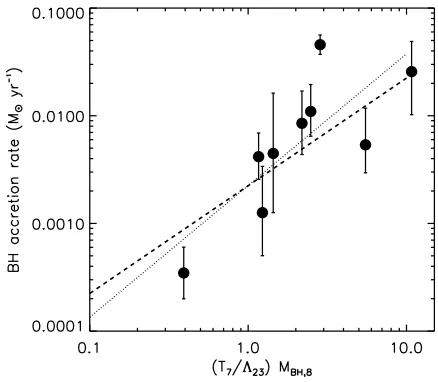
Figure 2. Black hole accretion rate as a function of ζ ≡ (T7/Λ23)(mBH,8), from the observational analysis of Allen et al. (2006) (filled circles). The dashed line shows the scaling predicted by the NF00 “isothermal cooling flow” model (see text), while the dotted line shows a linear fit to the data points.
2.11 Radio Mode Feedback
[image:13.612.319.538.365.556.2]assumption that the “radio mode” is fueled by Bondi-Hoyle accretion (Bondi 1952):
˙
mBondi=π(GMBH)2ρ0c−s3, (18)
where ρ0 ≡ρ(rA) is the density of the gas at the
accre-tion radiusrA,cs is the sound speed of the gas, and we
have assumed an adiabatic index of γ1 = 5/3 for the
gas. We adopt the isothermal cooling flow solution of Nulsen & Fabian (2000, NF00), in which thermal insta-bilities act to maintain the density such that the sound crossing time is of order the local cooling time:
rA
cs
=K3
2
µmpkT
ρ(rA)Λ(T, Zh)
. (19) Here,rA≡2GMBH/c2sis the Bondi accretion radius, K is
a dimensionless constant which depends on the details of the flow,kT is the temperature of the gas, and Λ(T, Zh)
is the cooling function. Solving for the density ρ0 and
substituting into eqn. 18, we obtain: ˙
mradio=κradio „
kT
Λ(T, Zh)
« „
MBH
108M
⊙
«
(20) where we have subsumed all constants into the factor
κradio. A similar model has also been considered by
Churazov et al. (2005) and Croton et al. (2006). We can test the validity of this model using recent observations of the central density and temperature of hot X-ray emitting gas in nine nearby elliptical galax-ies by Allen et al. (2006, A06). Deep Chandra observa-tions allowed A06 to obtain measurements or reliable extrapolations of the gas properties within one order of magnitude of the Bondi radius for eight of the sys-tems. Each system also has a measured velocity disper-sion, which allows an estimate of the BH mass using the relation of Tremaine et al. (2002). In Fig. 2, we com-pare the Bondi accretion rates with the quantity ζ ≡
(T7/Λ23)(mBH,8), where we defineT7 ≡T /107K, Λ23≡
Λ(T)/(10−23erg cm3s−1), and m
BH,8 ≡ MBH/108M⊙.
We use the published values of gas density and temper-ature and the BH mass estimates from A06, and assume that the hot gas has a metallicity of one-third solar. A formal fit gives a slope of 1.23 inζ, but we see that the NF00 isothermal cooling flow model is quite consistent with the data. In terms of the scaled quantitiesT7, Λ23,
andmBH,8,κradio= 2.25×10⁻³ provides the best fit to
the data.
In our fiducial semi-analytic model, we assume that whenever “hot mode” gas is present in the halo, the cen-tral BH accretes at the rate given by eqn. 18, but we allowκradioto be adjusted as a free parameter. We then
assume that the energy that effectively couples to and heats the hot gas is given by Lheat =κheatηradm˙radioc2.
Assuming that all the hot gas is at the virial temperature of the haloTvir, the mass of gas that can be heated per
unit time is then ˙
mheat= 3 Lheat 2kT /(µmp)
= L3heat
4V 2 vir
, (21) usingkT /(µmp) = 12V
2
vir. The net cooling rate is then the
usual cooling rate ˙mcoolminus this heating rate ˙mheat. If
the heating rate exceeds the cooling rate, the cooling rate is set to zero.
We apply this heating term only for timesteps in which the halos are cooling in the “hot mode” (see§2.2). That is, ifrcool> rvirin a given timestep, we assume that
the gas is not susceptible to the heating by radio jets, so it cools at the normal rate.
3 RESULTS
3.1 Properties of nearby galaxies
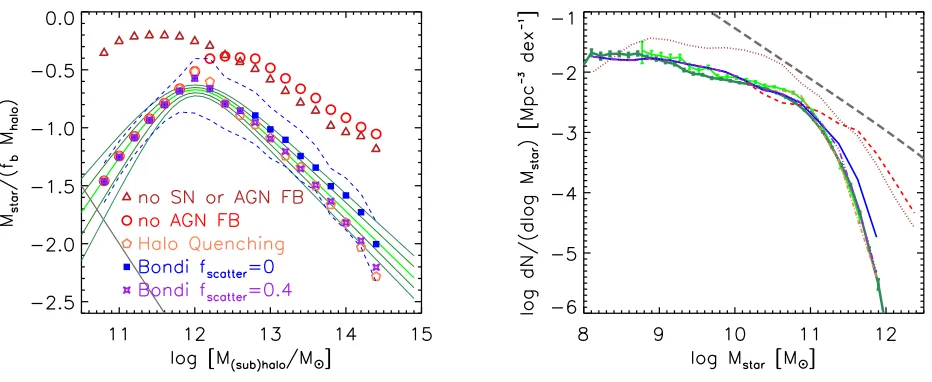
If we adopt a specific set of values for the cosmological parameters, it is relatively straightforward to answer the following question: how must dark matter halo mass and galaxy mass (or luminosity) be related in order to rec-oncile CDM with observations? Numerical N-body simu-lations can now accurately predict the multiplicity func-tion of dark matter halos and sub-halos (i.e., the num-ber density of halos of a given mass), and it is then straightforward to adopt a parametric or non-parametric model relating halo properties to galaxy properties, and to adjust the model to fit the observed stellar mass func-tion or luminosity funcfunc-tion of galaxies. This exercise has been carried out in terms of luminosity by Kravtsov et al. (e.g. 2004a), and in terms of stellar mass by Wang et al. (2006) and Moster et al. (2008, M08). It has been shown that if galaxies and halos are related in this way, one then also reproduces the observed correlation functions of galaxies as a function of stellar mass (Wang et al. 2006; Moster et al. 2008). We show the function fstar(Mhalo)
derived by M08 in Fig. 3. This quantity is defined as
fstar(Mhalo) ≡ mstar/(fbMhalo), or the galaxy’s stellar
mass divided by the universal baryon fraction times the halo mass. For central galaxies, Mhalo is the virial mass
of the halo. For non-central galaxies, Mhalo is the virial
mass of the halo just before it became subsumed in a larger halo.
Just by comparing the halo mass function with the observed stellar mass function (see Fig. 3 right panel), we see that in order to reconcile the DM halo mass function predicted by CDM with the observed galaxy stellar mass function, star formation must not only be inefficient over-all (fstar∼0.2–0.3 at its peak), but the function must be
a strong function of halo mass. Apparently, the conver-sion of baryons into stars is highly inefficient both in small mass halos and in large ones, and this efficiency peaks in halos with mass∼1012M⊙. The interesting question that
then arises, of course, is which physical processes are re-sponsible for shaping this highly variable efficiency, and for setting the characteristic halo mass scale∼1012M
⊙?
The semi-analytic models can give us some insights into this question. We note that our adopted halo mass resolution (1011M
⊙for host halos, 1010M⊙for sub-halos)
means that our simulations should be reliable and com-plete for galaxies with stellar masses greater than ∼
109M⊙. Below this mass, we cannot accurately resolve
a galaxy’s formation history. If we switch off both AGN feedback and SN feedback1, f