
This is a repository copy of
Autonomous detection and tracking under illumination
changes, occlusions and moving camera
.
White Rose Research Online URL for this paper:
http://eprints.whiterose.ac.uk/87526/
Version: Accepted Version
Article:
Bhaskar, H., Dwivedi, K., Dogra, D. et al. (2 more authors) (2015) Autonomous detection
and tracking under illumination changes, occlusions and moving camera. Signal
Processing, 117. pp. 343-354. ISSN 1872-7557
https://doi.org/10.1016/j.sigpro.2015.06.003
[email protected] Reuse
Unless indicated otherwise, fulltext items are protected by copyright with all rights reserved. The copyright exception in section 29 of the Copyright, Designs and Patents Act 1988 allows the making of a single copy solely for the purpose of non-commercial research or private study within the limits of fair dealing. The publisher or other rights-holder may allow further reproduction and re-use of this version - refer to the White Rose Research Online record for this item. Where records identify the publisher as the copyright holder, users can verify any specific terms of use on the publisher’s website.
Takedown
If you consider content in White Rose Research Online to be in breach of UK law, please notify us by
Autonomous Detection and Tracking under
Illumination Changes, Occlusions and Moving Camera.
Harish Bhaskara,b, Kartik Dwivedic, Debi Prosad Dograd, Mohammed
Al-Muallaa, Lyudmila Mihaylovae
a
Khalifa University of Science, Technology and Research (KUSTAR), P.O.Box 127788, Abu Dhabi, U.A.E.
b
Merchant Venturers’ Building, Woodland Road, Clifton, Bristol BS8 1UB, U.K.
c
Indian Institute of Technology, Guwahati
d
Indian Institute of Technology, Bhubaneswar
e
Department of Automatic Control and Systems Engineering, University of Sheffield, Sheffield, S1 3JD
Abstract
In this paper, an autonomous multiple target detection and tracking technique
for dynamic scenes that are influenced by illumination variations, occlusions
and camera instability is proposed. The framework combines a novel Dynamic
Reverse Analysis (DRA) approach with an Enhanced Rao-Blackwellized
Parti-cle filter (E-RBPF) for multiple target detection and tracking respectively. The
DRA method, in addition to providing accurate target localization, presents the
E-RBPF scheme with costs associated with the differences in intensity caused
by illumination variations between consecutive frame pairs in any video of a
dynamic scene. The E-RBPF inherently models these costs, thus allowing the
framework to a) adapt learning parameters, b) distinguish between
camera-motion and object-camera-motion, c) deal with sample degeneracy, d) provide
appro-priate appearance compensation during likelihood measurement and e) handle
occlusion. The proposed detect-and-track method when compared against other
competing baseline techniques has demonstrated superior performance both in
accuracy and robustness on challenging videos from publicly available datasets.
∗Corresponding author
Email addresses: [email protected](Harish Bhaskar),
[email protected](Harish Bhaskar),[email protected](Kartik Dwivedi),
Keywords: Target Detection, Tracking, Illumination Variations, Occlusion,
Camera Movements, Reverse Analysis, Rao-Blackwellized Particle Filter,
Likelihood Model
2014 MSC: 00-01, 99-00
1. Introduction & Related Work
Detection and tracking are challenging research problems, particularly in
un-constrained surveillance scenarios. Much research efforts have been spent in
de-veloping state-of-the-art detection and tracking methodologies including
detect-and-track [1], track-before-detect [2, 3], Probability Hypothesis Density (PHD)
filter based multiple target tracking techniques [4, 5], among many others.
De-spite advances, detection and tracking are still challenged by the presence of
illumination variations [4], occlusions [6, 7], and camera movements [8].
Al-though many approaches have been proposed that address these issues in a
mutually exclusive manner, the joint problem is still far from being solved.
The concept of illumination invariance during target detection and tracking has
been addressed in different ways which can be categorized into feature-based [9]
and appearance-based methods [10]. A good example of the feature-based
de-tection technique can be found in [9], where a sparse set of salient illumination
invariant features are considered. Similarly, in the work of [11, 12], the
bi-parametrization of different combinations of color spaces have been studied for
dynamic target tracking. However, such methods have failed to adequately
discriminate targets against the background, during detection. A
comprehen-sive overview of the recent efforts in background modelling based detection
approaches can be found in [13, 14]. From a tracking point-of-view, some initial
work has been done in joint target localization and estimation of illumination
variations as in [15, 16]. Similarly, a method for coping with appearance changes
of targets during tracking has been proposed in [17]. Although such methods are
illumi-nation changes continues to be highly complex. This can mainly be attributed
to factors such as: a) non-linearity of illumination changes in real-scenarios, b)
ambiguity in the interpretation of the differences in intensity variations caused
by the motion of targets as against due to illumination changes, and c)
disre-garding certain pertinent visual information to provide illumination invariance
that can cause difficulties in handling occlusion and related challenges.
Occlusion detection during tracking is considered a hard problem in most
general-purpose tracking algorithms [18]. The primary challenge in handling occlusion is
to accumulate sufficient evidence from observations so that reliable data
associ-ation becomes possible. Research indicates that performing occlusion handling
within tracking is limited only to analysing pixel variations using multi-modal
distributions in order to encompass statistical properties of occluders to
dis-tinguish it from the target(s)-of-interest [19]. However, most assumptions of
feature-level similarity become invalid when considering real-world scenarios.
In the study by [19], it has been shown that the contextual content which
en-capsulates motion information is also capable of handling occlusion. In another
example, the problem of target initiation and termination has been shown to be
handled using a hierarchical particle filtering framework [20]. Further, the use
of spatio-temporal modelling has been proposed for human silhouette extraction
from noisy and occluded data [7]. Though attempts have been made to tackle
occlusion issues during tracking, the following complexities continue to remain:
a) localization of the targets when occlusion is unknown, b) updating target
descriptors during appearance changes, c) robustness against noise and clutter,
and d) coping with disappearances and re-appearances of targets.
Motion in the background, target deformation and changes in the camera
posi-tion during jitter all present similar effect on the spatio-appearance of targets
during detection and tracking. In order to model spatio-temporal appearance
changes of targets in the joint space, the use higher order distributions has
Alpha-stable [21] and Cauchy [22] distributions to model pixel intensity variations
caused by camera shake during detection. Further, the generation of
spatio-temporal methods for handling camera movements within a background
mod-elling framework has also been recently proposed in [23]. However, the
robust-ness of such models for dynamic scenes have not been fully explored.
This brief survey of the literature has clearly highlighted that the treatment
of these challenges in a mutually exclusive manner cannot facilitate robust
de-tection and tracking in real-world scenarios. On the other hand, incorporating
different adaptations into a singular model may not always help solving all
prob-lems jointly. Therefore, in this paper, a tight integration of the constituent
pro-cesses into a unified framework for the detection and tracking of dynamic scenes
is proposed. It is hypothesized that an integrated detect-and-track technique
capable of generating sufficient statistics of illumination variations during the
accurate localization, when tunnelled across to an enhanced RBPF framework
shall provide robust tracking of multiple targets within a dynamic scene.
2. Novelty & Contributions
One key novelty of the proposed framework is the use of DRA within background
modelling for accurately detecting (or spatially localizing) multiple moving
tar-gets under changing illumination conditions. Furthermore, such a detection
pro-cedure allows extracting sufficient statistics that are indicative of the temporal
location, type and extent of the illumination variations in the dynamic scene.
Another important novelty is the tight integration of the qualitative and
quan-titative outputs from the DRA-based target detection method together with
the E-RBPF tracking algorithm for adaptation against dynamic illumination
and camera movements. Finally, a loose integration of the E-RBPF framework
with appropriate noise models and likelihood measurements have allowed the
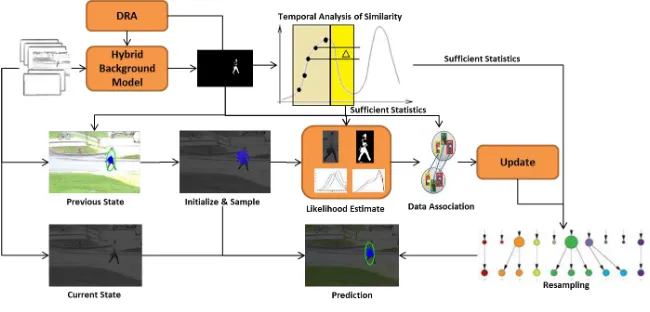
Figure 1: Functional block diagram of the proposed framework.
The rest of the paper is organized as follows. In Section 3, a detailed
descrip-tion of the proposed detect-and-track framework is presented. Following this,
performance evaluation and comparison of the proposed detection and tracking
methodologies against the state-of-the-art is described in Section 4. Section 5
concludes.
3. Proposed Methodology
The proposed framework for multiple target tracking is a modularized yet
cou-pled approach. The method tightly integrates a) a hybrid background modelling
scheme for accurate target detection with b) an enhanced particle filtering
frame-work for robust target tracking. An illustration of the proposed frameframe-work is
presented in Figure 1.
The proposed hybrid background modelling method combines conventional
back-ground initialization and maintenance processes with a reverse analysis scheme
for accurate target detection. The DRA technique exploits deviations in the
foreground detection procedure between forward and reverse directions to
ex-tract sufficient statistics on the changes in illumination conditions to determine
a b c
[image:7.612.186.430.123.269.2]d e f
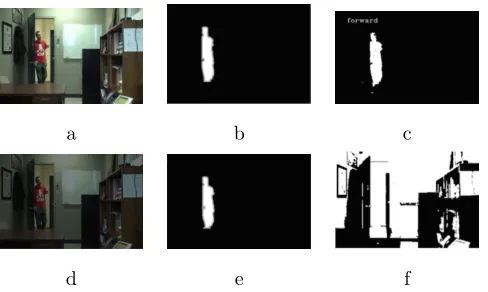
Figure 2: Illustration to demonstrate the impact of illuminations changes on background modelling. Results of background modelling on the original frame (a) and illumination changed frame (d) are presented in (c) and (f) respectively with the corresponding ground truth in (b) and (e).
model and b) control of adaptation parameters for coping with dynamic changes.
In contrast to the rigorous detection process, tracking is developed as an
en-hancement to the Rao-Blackwellized particle filter (E-RBPF) comprising of a
data association and likelihood models by incorporating detection prior along
with an advanced re-sampling scheme and spatio-temporal appearance
sepa-rated noise model. The use of the detection prior within the likelihood model
allows coping with occlusion and improving tracking accuracy while its use with
the re-sampling method help solving the degeneracy problem.
3.1. DRA-based Background Modelling for Target Detection
Foreground (target) detection using background subtraction is based on the
principle of updating an online statistical background model. Each pixel in a
new image is classified as background if it fits the stochastic statistical
back-ground model, otherwise labelled foreback-ground. During the process of building a
statistical background model, the intensity variation of pixels over a history of
im-a b c
d e f
[image:8.612.184.428.120.359.2]g h i
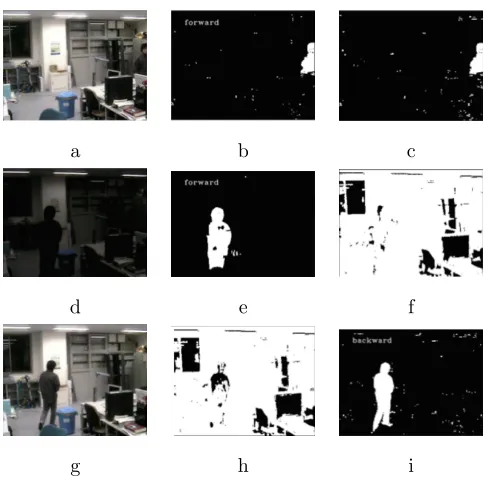
Figure 3: Results of forward background modelling in (b), (e) and (h) and backward back-ground modelling (c), (f) and (i) on frames undergoing illumination changes as in (a), (d) and (g).
pact the correct classification of background pixels but also helps the background
model adaptation during the maintenance phase. Therefore, a judicious
selec-tion of image frames for initializing the background model is key to achieving
good detection accuracy, particularly under changing illumination conditions.
Consider the example shown in Figure 2(a), acquired at constant illumination
conditions and its corresponding labelled ground truth detection in Figure 2(b).
When, a conventional adaptive background modelling technique, such as [24] is
used for detection, it produces an output as in Figure 2(c). However, in the
event of a sudden change in the illumination condition as in Figure 2(d) or
Figure 2(g), it can be noticed that the foreground detection fails until further
adaptation e.g. Figure 2(f) or Figure 2(i).
Reverse-time correlation (RTC) analysis is a popular method of tuning
motivate the use of DRA in background modelling, Figure 3 is considered.
The original images at different illumination conditions are displayed in
Fig-ure 3(a),FigFig-ure 3(d) and FigFig-ure 3(g), respectively. The results of foreground
detection using a history of frames from the forward direction are presented in
in Figure 3(b), Figure 3(e) and Figure 3(h). Similarly, the foreground prediction
results using future frames in the reverse directions is as shown in Figure 3(c),
Figure 3(f) and Figure 3(i). The disagreements in these results between the
forward and reverse directions indicate changes in the illumination conditions
of the environment.
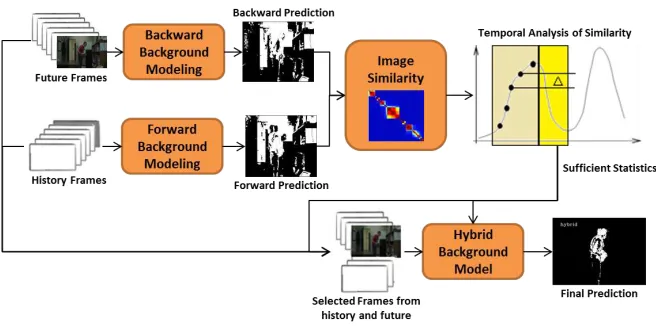
In this paper, the disagreements between the forward and reverse prediction
analysis of frames in foreground detection is the underlying motivation for the
proposed DRA-based hybrid background modelling technique that is illustrated
in Figure 4. The method works in two phases. In the first phase, a history of
frames from the forward direction and future frames from the reverse direction
are used independently to make their predictions of the current frame (frame
4 in Figure 4). A measure of similarity between the predictions of the forward
and reverse directions is made and continued temporally. Further, a temporal
analysis of the intensity variation allows extracting sufficient statistics of the
illumination changes. These statistics enable determining the appropriate
num-ber of frames from the forward and reverse directions to be chosen to build an
accurate hybrid background model to be used in the second phase. In addition,
the adaptation (or learning) parameters of model are also updated using these
statistics online during background maintenance.
A mathematical formulation of the DRA-based hybrid background modelling
using GMM is described as follows. Here, each pixel is characterized by its
intensity in a chosen color space (usually RGB color space). The posterior
probability of observing the current pixel is formulated as:
P(Xt) =P(Xt|M(
ξt1
Figure 4: A process flow illustration of the proposed DRA-based Hybrid Background Mod-elling framework.
where Xt represents the intensity of pixels at time t, M represents a model
of the background learnt from a selected subset of ξt1
−−→image frames from the forward direction and ψt2
←−−from the reverse direction.
P(Xt|M(
ξt1
−−→,←−−ψt2 )= K
X
j=1
wtjN(X(t, ξt1 −−→, ψt2
←−−), µ,Σ) (2)
where wtj is the weight of the jth Gaussian at time t. After initializing the
mean (µ) and estimation of the covariance matrix (Σ) using an EM algorithm,
foreground detection is performed. Next, the parameters are updated in order
to maintain the background model. Once theKGaussian variables are ordered
appropriately, the firstBGaussian distributions which exceed certain threshold
T1 are retained for a background distribution:
B= argmin
b b
X
i=1
(wjt > T1) (3)
The other distributions are considered to represent the foreground (target).
When a new image frame arrives at time instantt+ 1, the pixels are matched
using a distance metric (usually Mahalanobis distance) to determine the
back-ground. When a match is found to one of theK Gaussian variables, for the
component matched, update is performed as:
wjt+1= (1−α)wjt+α
µjt+1= (1−ρ)µ j
t+ρX(t+ 1, ξt1 −−→, ψt2
←−−)
σt2+1,j = (1−ρ)σ 2,j t +ρ(X
j
t+1−µjt+1).(Xtj+1−µjt+1)′ (4)
where α and ρ are constant learning rates, conventionally referred to as the
adaptation control parameter and convergence control parameter, respectively.
In lieu of above description of the problem, the main contributions of this paper
are detailed below:
• determining the optimal composition of ξt1
−−→frames in the forward direc-tion and ψt2
←−−frames in the reverse directions to be considered in building the modelM of the pixel intensity variationX over time using a mixture
ofK Gaussian variables.
• adaptively estimating the values of the control parameters for adaptation αand convergenceρby appropriately modelling the temporal changes in
the illumination conditions.
The process of dynamic reverse analysis involves building directional foreground
predictive models using the conventional GMM-based method using the
poste-rior probability framework as below:
Pf(Xt) =P(Xt|M(
ǫt−1 −−−→))
Pb(Xt) =P(Xt|M(
ǫt+1
←−−−)) (5)
where,Pf(Xt) andPb(Xt) represent the posterior probabilities measured using
the model M(−−−→ǫt−1 ) in forward and M(←−−−ǫt+1) in backward directions,
Further, a metric to evaluate the extent of similarityχbetween foreground
(tar-get) predictions of the directional models is proposed. This similarity criteria
χ consists of a weighted combination of: a) the difference between the
fore-ground detected outputs of the current image frameItand a selected history of
previous outputs It−k:t for some constant k and b) the normalized amount of
the foreground classified pixels in the current frameIft, whereϑandυ are the
weights.
χ(Pf(.), Pb(.)) =ϑ(d(It−It−k:t)) +υ(I f
t) (6)
Finally, a temporal distribution of the similarity is modelled as χt(.) . The
peaks of this temporal distribution of similarity between the directional models
is estimated using:
ζn = argmax(χt> T2) (7)
where, thenpeaksζnof this temporal distribution are analysed and landmarked
to represent the points of change in the illumination conditions and T2 is a
predefined threshold. Sufficient statistics are estimated using such analysis to
determine the class (type) of the illumination change, rate of change, between
consecutive points by modelling the pixel intensity variations as the function
that distinguishes this illumination change from the foreground (target) motion.
κn =φ(Xn, Xn+1|ζn) (8)
Furthermore, a self-adaptive learning mechanism that parametrizes
illumina-tion changes usingφto model the pixel intensity variations producingκ. This
parametrization process is used to approximate the composition of frames from
both the forward and reverse directions through a localization functionℓ.
The localization function ℓ in conjunction with the mapping function κ and
the location of the current frame with respect ton, allows computing
approx-imate estapprox-imates forξand ψtogether with the duration of illumination change
measured as a distance, e.g. δn =d(ζn, ζn+1) to allow building the hybrid
back-ground model and controlling the adaptation parametersαandρrespectively,
wheredis any distance function, typically Euclidean distance.
3.2. E-RBPF based Target Tracking
In order to track multiple targets using the proposed E-RBPF technique, the
tar-get representation model is first chosen. In this paper, an 8-D ellipse model (10)
is used to describe the dynamics of the target:
{x,∆x, y,∆y, H,∆H, W,∆W} (10)
where (x, y) represents the centroid of the elliptical model, (∆x,∆y)
repre-sents the velocity, (H, W) denotes the scale parameters - horizontal and vertical
half lengths of the elliptical axes, and (∆H,∆W) are the corresponding scale
changes. This chosen model is standard and has been adopted in a manner
similar to the work of [26]. The main use of the 8-D elliptical model is that
it facilitates the splitting of the state space of the filter between root variables
(R) containing motion information and leaf variables (L) consisting of the scale
parameters. In general, the RBPF framework allows the propagation of the root
variables one step ahead using (11).
Rt=
⊤Rt−1+ηr,t−1 (11)
where ⊤ represents the transition matrix and ηr is random noise. Given its
conditional dependence on the root variables, the leaf variables form a
linear-Gaussian substructure that is optimally estimated using a typical Kalman filter.
where Φ encodes the relationship between the leaf variable L and the root
variablesRfromt−1 tot,εis Gaussian random noise andAdenotes a constant
matrix. The image observations combining both the linear and non-linear states
is represented asZtas given in (13).
Zt= Υ(Rt, Lt, ηo,t) (13)
whereηorepresents observation noise, Υ is a non-linear functional mapping and
the auxiliary observations corresponding to the leaf variables that share a linear
relationship is modelled using (14).
Ot=CLt+ςt (14)
whereOtis the set of observations for the leaf at time instant t, ς is Gaussian
random noise andC represents a constant matrix.
The functionality of the RBPF is similar to a generic particle filter, where the
posterior density is represented by a set of weighted particles,St={sit, ωit|1≤
i≤N}. Each represents a particle fromp(Rt|Zt) and p(Lt|Rit, Zt). Therefore
each particle is represented bysi
t =< Rit, µit, σti >. The RBPF algorithm will
approximate the non-linear component involving the root variables using a
par-ticle filter, while apply Kalman filter to estimate the scale parameters which are
conditional on the root variables. The proposed enhancements in the RBPF
framework is presented through detailed description of the individual models in
the following sections.
3.2.1. Motion Model
In general, particles are propagated at each time step using (11). The target
motion is modelled using the Bayesian expansion given in (15).
After this step, an a-priori estimate of the variables<∩Ri
t,∗,∗>is produced.
In conventional particle filtering, the observation model is applied directly after
this step to estimate likelihood. However, in the RBPF framework, a Kalman
prediction for the leaf variables is initiated according to (16).
p(Lt |Tt
m, Rmt−1, Ltm−1, Zt) (16)
The state of the Kalman filter is propagated using (12). The estimates of the
Kalman filter is performed in a manner similar to [26] and is described in (17),
ˆ Hi
t = Hti−1+β(ˆyti−y1i−1)/γ (17)
ˆ Wi
t =
ˆ Hi
t
Hi t−1
Wi t−1
ˆ
σti = Aσti−1A′+P
ˆ Oi
t = Cµˆit
where the parametersβ and γcontrol the scale change rate of the ellipse with
respect to the motion of the target.
3.2.2. Observation Model
The next step in the E-RBPF algorithm is the application of the observation
model to measure likelihood. One main novelty of our E-RBPF framework is
the tight integration of results of the proposed detection technique and tracking
likelihood to model the observations. The concept of the observation model is
to evaluate for each particle is given in (18).
ωit=p(Zt|Rti, µit, Z1:t) (18)
In order to compute the weights (ωi
t), three main component information are
combined: a) tracker confidence, b) detector confidence and c) tracker-detector
deviation. The representation of the combination is as follows (19),
where (̟1, ̟2, ̟3) are constants, componentG∗h.G∗grepresents the tracker
con-fidence,p(ℜ−℧) is detector confidence, andp(ℑ−ℜ) represents tracker-detector
deviation.
Tracker Confidence: The tracker confidence term estimates the likelihood of
each particle using color histogram and gradient features. This component of
the weights is independent of the other weights as used in conventional tracking
algorithms.
a) Similarity between color histograms of the particle and the target regions
is estimated using (20),
G∗
h=
1
√
2πσc
exp(−1−ρ[s i Γ, r]2
2σ2 c
) (20)
whereρ[Γi, r] measures the similarity (Kullback-Leibler Divergence) between the
color histogram Γ for each particlei (ellipse) characterised by (xi
t, yit, Hti, Wti)
using (21),
Γi=fXk {||(x
i
t, yti)−θi||
a }δ
∗[h(θi)
−u] (21)
whereδ∗ is the Kronecker delta function andh(θ
n) is a bin-assignment function
at each location characterised byθn and coloru. kweights the pixels closer to
the center higher than others.
b) The second sub-component of the tracker confidence consists of measuring
the gradient difference between the particles and the target. The weight from
the gradient component is considered as given in (22).
G∗
g=
1
√
2πσg
exp(−1−g(Γ
i)2
2σ2 g
) (22)
Detector Confidence: In order to compute the detector confidence, a trained
model based method as in [27] is evaluated on the image patch defined at the
location of the particle with the corresponding size. Such an evaluation produces
detection using the proposed algorithmℜand the model-based detector output
℧is estimated as the detector confidencep(ℜ −℧). This confidence term uses
color and gradient information as aforementioned to assess the detection process
against a model-specific method.
Tracker-Detector Deviation: The final factor evaluates the (dis)agreement
between the output of the detector and the tracker at the location specified by
the particle with the corresponding size. This computes the distance between the
particle prediction of the target denoted asℑ, and the detection (ℜ) using the
proposed algorithm. Such a factor enables the robust guiding of particles. This
is attained by associating one detection to each target and implemented using a
matching score metric for each pair (ℑ,ℜ∗). The maximum score is iteratively
selected and only the associated detections with matching score higher than a
pre-defined threshold are used for association. A detailed description of the
matching score matrix is presented in 3.2.6.
3.2.3. Re-Sampling
Re-sampling of particles is performed to create a new particle set such that
mismatches can be corrected and also to avoid degeneracy of particles. One
common approach is through replacement by weighing particles and re-sampling
according to those weights. The resulting particle set indeed approximates the
target distribution. Such a re-sampling technique can be represented using (23).
p(< Rit, µit−, σit− >=< R j−
t , µ j−
t , σ j−
t >)∝̟ j
t (23)
The prediction PDF is modified using the newest measurements for the root
as well as leaf variables. Following this step, the new samples are of the form
si
t=< Rit, µit−, σti−>.
The re-sampling mechanism proposed in this paper is based on the replacement
of particles with low weights with particles regenerated based on the location of
targets as detected by the detector nearest to the current location of the target
3.2.4. Update
Kalman update is accomplished using (24),
Ki t=σ
i−
t C ′
(Cσi−
t C ′
+Q)−1
µi
t=µit−+Kti(Ot−1−Cµit−)
σti=σti−−KtiCσti− (24)
whereKi
t is the Kalman gain that aims to minimize the posterior error
covari-ance. Here, the samples are updated into the formsi
t=< Rti, µit, σit>. Further,
the mean state is computed by averaging the state particles in the manner
mentioned in (25).
E[St] =
PN
i=1sit
N (25)
3.2.5. Noise Model
The choice of the noise model can play a crucial role in the accurate localization
and tracking of targets, particularly in the presence of clutter. This paper
pro-poses the distinguished choice of noise models for the location and appearance
components of the target. That is, Gaussian noise is modelled for both location
and appearance; assuming independence between the two. Mathematically, it
can be represented using (26).
p(x|z,⊘L,⊘A) =p(xL|zL,⊘L).p(xA|zA,⊘A) (26)
A Gaussian noise with zero mean and scalar covariance is considered for both
the location and appearance parameters of the target in the form given in (27),
p(xL|zL)N(0,ΣL=σL.I)
using parameters ⊘= (σL, σA). Therefore the conditional probability can be
reduced to (28).
p(x|z,⊘) = 1 2πσ2
L
e−
||xL−zL||2 2σL2 . 1
2πσ2 A
e−
||xA−zA||2
2σA2 (28)
This produces two main parameters σL and σA that require estimation. Due
to the independence assumed between location and appearance, each of these
parameters can be separately estimated using a Maximum Likelihood
formula-tion. Parameter estimation is carried out such that the convergence guarantees
an increase of the likelihood.
3.2.6. Data Association
With the presence of noisy measurements and multiple targets, it is important
to associate one detection to at most one target, and thereby solve the data
association problem. The association algorithm computes a matching score
matrix for each pair (τ∗, ̺∗), whereτ∗represents all tracked targets and̺∗refers
to detector outputs. The matching function estimates the distance between
particles of tracked target (T) at various detections (̺∗) as given in (29),
~(ℑ∗,ℜ∗) =ℵ(ℑ∗,ℜ∗).p(ℑ − ℜ∗) (29)
where ℵ(ℑ∗,ℜ∗) is the gating function andp(ℑ − ℜ∗) is the same component
that measures the tracker-detector deviation mentioned earlier. Note that, the
tracker-detector deviation is measured for each tracked target only once and
used for both the likelihood computation and data association.
Gating Function: In addition to the distance between the detection and
tracker, the gating function assesses each detection based on its location with
respect to the velocity and direction of the target. The probabilistic gating
function can be represented using (30).
4. Experiments & Analysis
In this section of the paper, experimental details evaluating the proposed model
and comparing it against competing baseline techniques are presented. Two
types of experiments are conducted: 1) that evaluates the detection and
track-ing in a mutually exclusive manner and 2) in an integrated fashion. Further, all
the methods are validated on a wide range of both real and synthetic datasets
using standard performance metrics. For experimental evaluation, 12 real scenes
and 24 synthetic sequences have been chosen from a variety of publicly available
datasets. The real scenes include sequences from the PETS 2001, PETS 2004,
and PETS 2006 datasets [28] captured both in indoor and outdoor environments.
The scenario depicted in these sequences demonstrate dynamic illumination that
have been categorized into 5 distinct levels of difficulty: a) normal (N)
consist-ing of no dominant illumination changes, b) difficulty level 1 (D1) includconsist-ing
gradual changes in the illumination, either increasing or decreasing, c) difficulty
level 2 (D2) involving abrupt changes in the illumination introduced in a
pe-riodic manner, d) difficulty level 3 (D3) with a combination of short, gradual,
and abrupt changes in the illumination introduced in an irregular manner and
e) difficulty level 4 (D4) containing randomly introduced illumination changes
against dynamic backgrounds. From a tracking perspective, these videos are
chosen to contain moving targets, mostly people and vehicles, encompassing a
range of tracking complexities including occlusion, camera shake/jitter, false
alarms, motion dynamics, etc. All datasets contain ground truth annotation for
both target detection and tracking.
Experimental validation is performed through both on qualitative and
quanti-tative evaluations. For qualiquanti-tative evaluation, results of detection and tracking
are presented as output frames to be verified through visual inspection. On the
other hand, in order to quantitatively evaluate and benchmark our detection
These measures are described in Equations (31-34),
P recision= T P
T P +F P (31)
Recall= T P
T P+F N (32)
F−M easure= 2. P recision.Recall
P recision+Recall (33)
P SN R= 10.log10(
M AX2 I
M SE ) (34)
where TP (true positives), FP (false positives) and FN (false negatives) denote
those number of pixels correctly detected, detected incorrectly, and undetected
but incorrectly, respectively. The F-measure is a metric to determine the
accu-racy of the tests that is derived quantitatively as a balance between precision
and recall, wherein, a higher value indicates better accuracy. PSNR is measured
as the ratio between the maximum possible power of a signal and the power of
corrupting noise that affects the fidelity of its representation. Here,M AXI is
the maximum possible pixel value of the image andM SE denotes the Mean
Squared Error.
In order to benchmark the tracking procedure through quantitative
evalua-tion, the use of two popular performance metrics from the tracking domain [29]
namely: Multiple object tracking precision (MOTP) and b) Multiple object
tracking accuracy (MOTA) is proposed. These estimates are based on
deter-mining the distancedτ
t between the targetτ and its corresponding hypothesis
at each instant of timet. The MOTP and MOTA measures are described in
Equations (35-36),
M OT P =
P
t,τdτt
P
tcτt
M OT A= 1−
P
t(mτtP+ftτ+hτt)
tqtτ
(36)
where ctτ represents the number of matches found at each instant of time t,
mτ
t,ftτ andhτt represent the misses, false positives and mismatches, respectively,
andqτ
t represents the number of targets present at time instant t.
In addition to these measurements, the following metrics inspired by the work
of [30] are also computed. a) Mostly Tracked (MT)%: Percentage of the ground
truth trajectories which are covered by the tracker output for more than 80% in
length, b) Mostly Lost (ML)%: Percentage of ground truth trajectories which
are covered by the tracker output for less than 20% in length (smaller the better),
c) Fragments (Fr): The total number of times that a ground truth trajectory is
interrupted by the tracker (smaller the better), d) ID Switches (IDS): The total
number of times that a tracker trajectory changes its matched ground truth
identity (smaller the better) and f) Root Mean Squared Error (RMSE) error:
The difference between the target and ground truth trajectories on the (MT)
trajectories.
A selection of 3 baseline methods are chosen to benchmark the proposed
DRA-base hybrid target detection framework. These include: the famous adaptive
background modelling of [31], a spatially adaptive illumination modelling
tech-nique for background subtraction proposed by [32] and the background
mod-elling technique based on bi-directional analysis as in [33]. The proposed method
can be distinguished from these baselines in the manner as follows: a) the
pro-posed technique is based on the reverse analysis of frames for building robust
background models as against analysing pixel changes only in forward direction
as shown in [31], [32] b) the proposed technique does not only perform reverse
analysis to pick the best of the two (forward and backward) results as in [33],
however, builds a hybrid model using a selected composition of frames from
autonomously detecting the number of frames required from the forward and
reverse directions to build the hybrid model, the proposed method also provides
a mechanism of self-adaptation through implicitly learning the changes in
illu-mination conditions that is not feasible with the baseline techniques proposed
in [31], [32] and [33] and d) the proposed method also makes fewer assumptions
on the nature of illumination changes and hence is more generic to the changes
in the real-world scenarios.
The proposed E-RBPF model is compared to 4 state-of-the-art tracking
tech-niques including: a) Generic RBPF tracker (G-RBPF) for multiple target
track-ing [34], b) a Probabilistic Data Association particle Filtertrack-ing (PDAF) technique
for multiple object tracking proposed in [35], c) an extended version of the
con-text tracking (CT) algorithm proposed in [36] and c) the locally orderless
track-ing (LOT) from [37]. The relevance of these baseline trackers to the proposed
E-RBPF model can be described as follows. In comparison to the G-RBRF and
PDAF trackers, the usefulness of integrating the extended detect-track
likeli-hood model, data association and noise models into a unified joint E-RBPF
framework are demonstrated. Further, the differences in the use of similar noise
models in comparison against the Locally Orderless Tracker (LOT) are also
demonstrated.
4.1. Detection Results
In Figure 5, the results of target detection on one frame of a D3 category
se-quence (in row 1) and two frames of a D4 category sese-quence (in row 2 and row 3)
are compared. As it can be observed, the results of the proposed hybrid
detec-tion technique in Figure 5(c), Figure 5(g) and Figure 5(k) resemble the ground
truth in Figure 5(b), Figure 5(f) and 5(j) more closely than the adaptive
back-ground modelling of [31] counterpart in Figure 5(d), Figure 5(h) and Figure 5(l).
The superiority in the performance of the proposed method can be attributed
to the selective composition of frames from the forward and reverse directions
a b c d
e f g h
i j k l
Figure 5: Comparative results of the proposed DRA-based hybrid background modelling method (dubbed as hybrid) (c&g&k) against the adaptive background modelling method of [31] (d&h&l) and the corresponding ground truth (b&f&j) on one original frame (a) of a D3 category sequence and two original frames (e&i) of a D4 category sequence.
comparison to the baseline method of [31] that has demonstrated poorer
seg-mentation with respect to the ground truth and the proposed hybrid method.
For quantitative evaluation, the proposed hybrid detection method is
bench-marked against baselines on different frames using Recall and Precision in
Ta-ble 1, and using F-measure and PSNR in TaTa-ble 2 on selected frames of the
same D4 category sequence as used in Figure 5. The comparative evaluation on
recall and precision from Table 1 shows consistent superiority of the proposed
algorithm against competing baselines on a majority of the frames. A similar
trend in performance can also be noted using the F-measure and the PSNR,
wherein, the proposed method outperforms its competing baselines in Table 2.
[image:24.612.143.470.122.355.2]Frame Recall Precision
[image:25.612.177.436.123.180.2]Hybrid [31] [33] [32] Hybrid [31] [33] [32] 50 0.632 0.595 0.615 0.598 0.579 0.513 0.551 0.565 75 0.767 0.760 0.762 0.760 0.635 0.556 0.603 0.598 100 0.720 0.644 0.707 0.679 0.730 0.519 0.716 0.676 125 0.685 0.671 0.680 0.683 0.670 0.548 0.665 0.587
Table 1: Comparison of quantitative performance of the proposed detection technique (dubbed as Hybrid) against state-of-the-art methods ([31], [33] & [32]) using the Precision and Recall metrics on selected frames (50,75,100,125) of the D4 category sequence used in Figure 5.
Frame F-Measure PSNR
[image:25.612.175.435.249.304.2]Hybrid [31] [33] [32] Hybrid [31] [33] [32] 50 0.604 0.551 0.581 0.581 30.60 16.17 27.65 26.51 75 0.695 0.643 0.673 0.669 31.49 22.40 29.63 25.38 100 0.725 0.575 0.711 0.677 37.10 15.66 33.12 30.76 125 0.677 0.603 0.603 0.631 35.16 24.40 34.06 31.82
Table 2: Comparison of quantitative performance of the proposed detection technique (dubbed as Hybrid) against state-of-the-art methods ([31], [33] & [32]) using the F-measure and PSNR metrics on selected frames (50,75,100,125) of the D4 category sequence used in Figure 5.
consisting of sequences at various levels of difficulty. The comparative results
of the proposed and baseline techniques using the Recall and Precision metrics
are presented in Table 3 and using the F-measure and PSNR are presented in
Table 4. As one would anticipate, the performance of all the models deteriorate
with increasing difficulty. However, in comparison to the state-of-the-art
meth-ods, the proposed technique is capable of producing more accurate and robust
detection particularly with the D2, D3 and D4 category sequences.
Level Recall Precision
Hybrid [31] [33] [32] Hybrid [31] [33] [32] N 0.752 0.755 0.754 0.753 0.876 0.878 0.875 0.876 D1 0.646 0.649 0.647 0.647 0.857 0.866 0.860 0.866
D2 0.610 0.594 0.598 0.603 0.619 0.533 0.582 0.567 D3 0.597 0.576 0.583 0.578 0.593 0.520 0.551 0.548 D4 0.603 0.576 0.579 0.591 0.568 0.519 0.536 0.534
[image:25.612.174.436.534.599.2]Level F-Measure PSNR
[image:26.612.175.436.123.189.2]Hybrid [31] [33] [32] Hybrid [31] [33] [32] N 0.809 0.812 0.810 0.810 29.44 29.50 29.00 29.26 D1 0.737 0.742 0.738 0.740 28.07 28.22 28.30 28.24 D2 0.615 0.562 0.590 0.584 23.02 13.54 20.62 19.85 D3 0.595 0.547 0.566 0.562 21.92 9.07 18.16 12.56 D4 0.585 0.547 0.557 0.561 19.50 8.14 12.58 10.75
Table 4: Comparison of quantitative performance of the proposed detection technique (dubbed as Hybrid) against state-of-the-art methods ([31], [33] & [32]) using the F-measure and PSNR metrics averaged on all frames of the various categories of sequences with increasing complexity from N to D4.
Difficulty Forward Backward Hybrid
N 91% 8% 1%
D1 76% 12% 12%
D2 65% 16% 19%
D3 23% 28% 49%
[image:26.612.229.381.269.326.2]D4 13% 16% 71%
Table 5: Comparison of the percentage number of time that the forward, background and hy-brid models are being built by the proposed detection technique against increasing complexity of video sequences through from N to D4.
As indicated earlier, one key novelty of the proposed detection technique is in
building a hybrid background model using a selected composition of frames from
the forward and backward directions. During experimentation, as observed in
Table 3 and Table 4, with increasing complexity in illumination conditions, the
hybrid background model is built more frequently than the models in either
the forward or backward directions. In Table 5, the percentage frequency of
each type of background model being built against increasing complexity of
video sequences is presented. It can be proven beyond doubt that the role of
hybrid background model becomes apparent with increasing complexity of the
sequences. In particular, for the D4 category video sequence, in order to
guaran-tee better detection results, frames from both forward and reverse directions are
hybridized at times nearly 50% more often than in either directions individually.
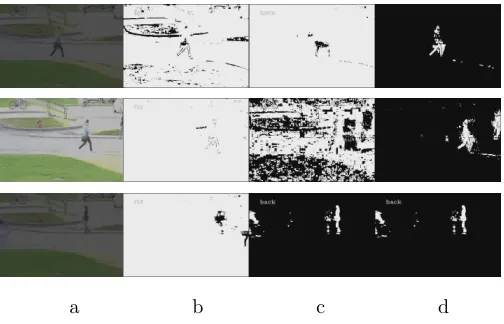
The improved target detection as depicted in Figure 6, solicits all previous
claims of the hybrid model being more effective in representing the dynamic
a b c d
Figure 6: Results of the proposed target detection technique demonstrating the capacity of the hybrid model (column d) against forward (column b) and backward (column c) directional models on selected original frames (357,463&647) (column a) of a D4 category sequence.
4.2. Tracking Results
In this section, results comparing the proposed E-RBPF tracker against baseline
trackers are presented. In Figure 7, the qualitative tracking results comparing
the E-RBPF framework against the baseline methods: G-RBPF, PDAF, CT and
LOT are illustrated. The results in Figure 7 shows tracker outputs on selected
frames (represented as columns) of video sequences with increasing levels of
dif-ficulty through from D2 to D4 (across different rows). The results in Figure 7
clearly demonstrate the superiority of the proposed E-RBPF tracker against
other baselines. TheCT andLOT trackers produce more comparable results to
the proposed method as against theG−RBP F and theP DAF trackers. With
increasing levels of difficulty, the baseline methods, particularly theG−RBP F
and the P DAF trackers are more susceptible to drift than the other trackers.
The E-RBPF framework has proven to remain accurate in target localization
despite abrupt changes to illumination conditions, occlusion and clutter.
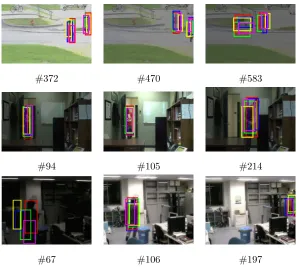
bound-#372 #470 #583
#94 #105 #214
[image:28.612.157.456.225.492.2]#67 #106 #197
Figure 8: Target tracking results of the E-RBPF method (red bounding box) on multiple frame samples from the PETS database [28].
ing box) on example frames from video sequences consisting of multiple moving
targets (both humans and vehicles) captured at various perspectives and scales,
under varying real-world illumination conditions from PETS 2001, PETS 2004,
and PETS 2006 sequences can be found in Figure 8. A quick visual inspection
of these results reveals the superior accuracy and robustness of the proposed
E-RBPF tracker.
In addition to qualitative comparison, the trackers are benchmarked against
each other using quantitative evaluation metrics which are summarized in
Ta-ble 6.
It is important to note that the success of the trackers as outline above can be
mainly attributed to the accurate localization of targets during the detection
phase. In order to quantify the influence of the hybrid detection strategy on
Method MOTA MOTP MT ML IDS FR ERBPF 73.2% 84.98% 53.73% 27.61% 9 312
[image:30.612.190.418.124.181.2]G-RBPF 55.61% 73.52% 33.41% 29.43% 23 427 PDAF 56.19% 71.56% 31.53% 33.69% 27 468 CT 61.58% 77.88% 42.12% 32.06% 18 394 LOT 60.36% 79.91% 47.92% 35.85% 19 409
Table 6: Quantitative evaluation comparing the proposed E-RBPF tracker against the baseline trackers (all initialized using the proposed hybrid detector) using various performance metrics averaged on all frames of the different categories of video sequences.
Method MOTA MOTP MT ML IDS FR ERBPF 59.87% 66.34% 37.62% 57.61% 15 402
[image:30.612.193.418.237.295.2]G-RBPF 36.12% 41.79% 17.93% 66.87% 27 519 PDAF 39.83% 44.27% 18.18% 69.98% 36 527 CT 41.69% 51.38% 27.51% 66.17% 23 486 LOT 43.55% 54.62% 24.47% 71.28% 26 491
Table 7: Quantitative evaluation comparing the proposed E-RBPF tracker against the base-line trackers (all initialized using the basebase-line detection technique of [33]) using various per-formance metrics averaged on all frames of the different categories of video sequences.
the tracker with the baseline detection method of [33]. The differences in the
results of tracking are presented in Table 7 and is itself indicative of the power
of the proposed detection framework.
In Table 8, the RMSE error between the tracked targets and the ground truth
MT trajectories are detailed. This measure is indicative of the deviation of the
target trajectory from the ground truth.
Finally, with regards to the comparison of computational demand of the
pro-posed hybrid detection strategy against its uni-directional counterpart,
intu-Method D1 D2 D3 D4 ERBPF 38 42 17 36
G-RBPF 128 143 109 227 PDAF 134 150 127 186 CT 112 138 126 107 LOT 64 97 73 59
[image:30.612.242.368.551.610.2]itively nearly 3 times overhead is expected. However, with an optimized circular
buffer implementation for processing the learning frames, it has been possible
to reduce the computational overhead to approximately 1.5 times existing
uni-directional background modelling schemes. At this point, a judicious decision on
the trade-off between the accuracy of detection to the computational demands
requires to be made. In the context of the detector having to initialize the
tracking algorithm (as proposed), little such compromise can be made on the
accurate detection of the targets. However, a more relaxed detection may suffice
the needs of the likelihood measurement step during tracking. During tracking,
comparable computational requirements between the proposed E-RBPF and the
G-RBPF could be observed assuming a-priori detection. Tests indicate that the
the tracking procedure in its unoptimized MATLAB implementation with 1000
particles and 100 iterative cycles can converge to 2 fps of tracked output in
real-time.
5. Conclusion
In this paper, a method that seamlessly integrates a DRA-based background
modelling mechanism for target detection with a E-RBPF tracking framework
for accurate target localization under the presence of illumination changes,
oc-clusion and camera shake is proposed. The results of comparing the proposed
model against baselines has shown significant improvements both quantitatively
and qualitatively. The future of this research is to extend the model for tracking
large number of targets in crowded scenes and across multiple cameras.
References
[1] M. Han, A.Sethi, W. Hua, Y. Gong, A detection-based multiple object
tracking method, in: In the Proc. of International Conference on Image
Processing (ICIP), Vol. 5, 2004, pp. 3065–3068.
for several track-before-detect algorithms, in: In the Proc. of International
Conference on Information Fusion (ICIF), 2008, pp. 1–8.
[3] Y.Boers, H.Driessen, J.Torstensson, M.Trieb, R.Karlsson, F.Gustafsson,
Track-before-detect algorithm for tracking extended targets, In the Proc.
of IEE Radar, Sonar and Navigation 153 (4) (2006) 345–351.
[4] J. Wu, S. Hu, Y. Wang, Adaptive multifeature visual tracking in
a probability-hypothesis-density filtering framework, Signal Processing
93 (11) (2013) 2915–2926.
[5] R. E. Bethel, B. Shapo, C. M. Kreucher,{PDF}target detection and
track-ing, Signal Processing 90 (7) (2010) 2164 – 2176.
[6] Y. Li, H. Xiao, Z. Song, R. Hu, H. Fan, A new multiple extended target
tracking algorithm using {PHD} filter, Signal Processing 93 (12) (2013)
3578–3588, special Issue on Advances in Sensor Array Processing in
Mem-ory of Alex B. Gershman.
[7] X. Zhou, X. Li, Dynamic spatio-temporal modeling for example-based
hu-man silhouette recovery, Signal Processing 110 (0) (2015) 27–36.
[8] A. Yilmaz, O. Javed, M. Shah, Object tracking: A survey, ACM Computing
Surveys 38 (4).
[9] S. Das, N.Vaswani, Particle filtered modified compressive sensing
(pafi-mocs) for tracking signal sequences, in: In the Proc. of Asilomar Conference
on Signals, Systems and Computers (ASILOMAR), 2010, pp. 354–358.
[10] G. Yu, H. Lu, Illumination invariant object tracking with incremental
sub-space learning, in: In the Proc. of International Conference on Image and
Graphics (ICIG), 2009, pp. 131–136.
[11] P. Prez, C. Hue, J. Vermaak, M. Gangnet, Color-based probabilistic
track-ing, in: In the Proc. of European Conference on Computer Vision (ECCV),
[12] F.Moreno-Noguer, A. Sanfeliu, D.Samaras, A target dependent colorspace
for robust tracking, in: In the Proc. of International Conference on Pattern
Recognition (ICPR), Vol. 3, 2006, pp. 43–46.
[13] M. Cristani, M. Farenzena, D. Bloisi, V. Murino, Background
subtrac-tion for automated multisensor surveillance: A comprehensive review,
EURASIP Journal of Advanced Signal Processing 2010 (2010) 43:1–43:24.
[14] T. Bouwmans, Traditional and recent approaches in background modeling
for foreground detection: An overview, Computer Science Review II (I2).
[15] H. Veeraraghavan, P. Schrater, N. Papanikolopoulos, Robust target
de-tection and tracking through integration of motion, color, and geometry,
Computer Vision and Image Understanding 103 (2) (2006) 121 – 138.
[16] G. Silveira, E.Malis, Real-time visual tracking under arbitrary illumination
changes, in: In the Proc. of IEEE Conference on Computer Vision and
Pattern Recognition (CVPR), 2007, pp. 1–6.
[17] Z. Khan, T. Balch, F. Dellaert, A rao-blackwellized particle filter for
eigen-tracking, in: In the Proc. of IEEE Conference on Computer Vision and
Pattern Recognition (CVPR), Vol. 2, 2004, pp. 980–986.
[18] X. Xu, B. Li, Rao-blackwellised particle filter for tracking with application
in visual surveillance, in: In the Proc. of IEEE International Workshop on
Visual Surveillance and Performance Evaluation of Tracking and
Surveil-lance, 2005, pp. 17–24.
[19] J. Pan, B. Hu, J. Q. Zhang, Robust and accurate object tracking under
various types of occlusions, IEEE Transactions on Circuits and Systems
for Video Technology 18 (2) (2008) 223–236.
[20] P. Chavali, A. Nehorai, Hierarchical particle filtering for multi-modal data
fusion with application to multiple-target tracking, Signal Processing 97 (0)
[21] H.Bhaskar, L.Mihaylova, A.Achim, Video foreground detection based on
symmetric alpha-stable mixture models, IEEE Transactions on Circuits
and Systems for Video Technology 20 (8) (2010) 1133–1138.
[22] J.Batista, P.Peixoto, C.Fernandes, M.Ribeiro, A dual-stage robust vehicle
detection and tracking for real-time traffic monitoring, in: In the Proc. of
Intelligent Transportation Systems Conference (ITSC), 2006, pp. 528–535.
[23] A. Romanoni, M. Matteucci, D. G.Sorrenti, Background subtraction by
combining temporal and spatio-temporal histograms in the presence of
cam-era movement, Machine Vision and Applications 25 (6) (2014) 1573–1584.
[24] A.Mittal, N.Paragios, Motion-based background subtraction using adaptive
kernel density estimation, in: In the Proc. of IEEE Conference on Computer
Vision and Pattern Recognition (CVPR), Vol. 2, 2004, pp. 302–309.
[25] G. Kovai, L. Tao, D. Cai, Michael.J.Shelley, Theoretical analysis of
reverse-time correlation for idealized orientation tuning dynamics, Journal of
Com-putational Neuroscience 25 (3) (2008) 401–438.
[26] X. Xu, B. Li, Adaptive raoblackwellized particle filter and its evaluation
for tracking in surveillance, IEEE Transactions on Image Processing 16 (3)
(2007) 838–849.
[27] F.Han, Y.Shan, R.Cekander, H.Sawhney, R.Kumar, A two-stage approach
to people and vehicle detection with hog-based svm, in: In the Proc. of
IEEE International Workshop on Performance Metrics for Intelligent
Sys-tems, 2006.
[28] Dataset - pets: Performance evaluation of tracking and surveillance
(2000-2014).
URLhttp://www.cvg.rdg.ac.uk/slides/pets.html
[29] K. Bernardin, R. Stiefelhagen, Evaluating multiple object tracking
per-formance:the clear mot metrics, EURASIP Journal on Image and Video
[30] Y. Li, C. Huang, R. Nevatia, Learning to associate: Hybridboosted
multi-target tracker for crowded scene, in: In the Proc. of IEEE Conference on
Computer Vision and Pattern Recognition (CVPR), 2009, pp. 2953–2960.
[31] C. Stauffer, W. E. L. Grimson, Adaptive Background Mixture Models for
Real-Time Tracking, in: Computer Vision and Pattern Recognition, Vol. 2,
1999, pp. 2246–2252.
[32] J.K.Paruchuri, E.P.Sathiyamoorthy, S.S.Cheung, C.-H. Chen, Spatially
adaptive illumination modeling for background subtraction, in: In the Proc.
of IEEE International Conference on Computer Vision Workshops (ICCV),
2011, pp. 1745–1752.
[33] A.Shimada, H.Nagahara, R.I.Taniguchi, Background modeling based on
bidirectional analysis, in: In the Proc. of IEEE Conference on Computer
Vision and Pattern Recognition (CVPR), 2013, pp. 1979–1986.
[34] S. Srkk, A. Vehtari, J. Lampinen, Rao-blackwellized particle filter for
mul-tiple target tracking, Information Fusion Journal 8 (2005) 2007.
[35] M.Ekman, Particle filters and data association for multi-target tracking,
in: In the Proc. of International Conference on Information Fusion (ICIF),
2008, pp. 1–8.
[36] T. B. Dinh, N. Vo, G. Medioni, Context tracker: Exploring supporters
and distracters in unconstrained environments, in: In the Proc. of IEEE
Conference on Computer Vision and Pattern Recognition (CVPR), 2011,
pp. 1177–1184.
[37] S. Oron, Locally orderless tracking, in: In the Proc. of IEEE Conference on
![Figure 5:Comparative results of the proposed DRA-based hybrid background modellingmethod (dubbed as hybrid) (c&g&k) against the adaptive background modelling methodof [31] (d&h&l) and the corresponding ground truth (b&f&j) on one original frame (a) of aD3 category sequence and two original frames (e&i) of a D4 category sequence.](https://thumb-us.123doks.com/thumbv2/123dok_us/7870233.181849/24.612.143.470.122.355/comparative-background-modellingmethod-background-modelling-corresponding-original-category.webp)
![Table 1: Comparison of quantitative performance of the proposed detection technique (dubbedas Hybrid) against state-of-the-art methods ([31], [33] & [32]) using the Precision and Recallmetrics on selected frames (50,75,100,125) of the D4 category sequence used in Figure 5.](https://thumb-us.123doks.com/thumbv2/123dok_us/7870233.181849/25.612.177.436.123.180/comparison-quantitative-performance-detection-technique-precision-recallmetrics-selected.webp)
![Table 4: Comparison of quantitative performance of the proposed detection technique (dubbedas Hybrid) against state-of-the-art methods ([31], [33] & [32]) using the F-measure and PSNRmetrics averaged on all frames of the various categories of sequences with increasing complexityfrom N to D4.](https://thumb-us.123doks.com/thumbv2/123dok_us/7870233.181849/26.612.175.436.123.189/comparison-quantitative-performance-detection-psnrmetrics-categories-increasing-complexityfrom.webp)
![Figure 8: Target tracking results of the E-RBPF method (red bounding box) on multipleframe samples from the PETS database [28].](https://thumb-us.123doks.com/thumbv2/123dok_us/7870233.181849/29.612.158.454.118.347/figure-target-tracking-results-bounding-multipleframe-samples-database.webp)
