This is a repository copy of Security Testing: A Survey.
White Rose Research Online URL for this paper:
http://eprints.whiterose.ac.uk/95628/
Version: Submitted Version
Book Section:
Felderer, M., Büchlein, M., Johns, M. et al. (3 more authors) (2015) Security Testing: A
Survey. In: Memon, A., (ed.) Advances in Computers, Volume 101. Elsevier , Cambridge,
MA, USA , pp. 1-51. ISBN 9780128051580
https://doi.org/10.1016/bs.adcom.2015.11.003
[email protected] https://eprints.whiterose.ac.uk/ Reuse
This article is distributed under the terms of the Creative Commons Attribution-NonCommercial-NoDerivs (CC BY-NC-ND) licence. This licence only allows you to download this work and share it with others as long as you credit the authors, but you can’t change the article in any way or use it commercially. More
information and the full terms of the licence here: https://creativecommons.org/licenses/
Takedown
If you consider content in White Rose Research Online to be in breach of UK law, please notify us by
c 2 0 1 6 E ls ev ie r. T h is is th e a u th o r’ s v er si o n o f th e w o rk . It is p o st ed a t h t t p : / / w w w . b r u c k e r . c h / b i b l i o g r a p h y / a b s t r a c t / f e l d e r e r . e a -s e c u r i t y -t e s t i n g -2 0 1 6 b y p er m is si o n o f E ls ev ie r fo r y o u r p er so n a l u se . N o t fo r re d is -tr ib u ti o n . T h e d efi n it iv e v er si o n w a s p u b li sh ed in A d v a n ce s in C o m p ut e rs , V o lum e 1 0 1 , p p . 1 – 4 3 , 2 0 1 6 , d o i: 1 0 .1 0 1 6 / b s. a d co m .2 0 1 5 .1 1 .0 0 3 .
Security Testing: A Survey
Michael Felderer, Matthias B¨
uchler, Martin Johns,
Achim D. Brucker, Ruth Breu, Alexander Pretschner
Abstract
Identifying vulnerabilities and ensuring security functionality by security testing is a widely applied measure to evaluate and improve the security of software. Due to the openness of modern software-based systems, applying appropriate security testing techniques is of growing importance and essential to perform effective and efficient se-curity testing. Therefore, an overview of actual sese-curity testing techniques is of high value both for researchers to evaluate and refine the techniques and for practitioners to apply and disseminate them. This chapter fulfills this need and provides an overview of recent security testing techniques. For this purpose, it first summarize the required background of testing and security engineering. Then, basics and recent developments of security testing techniques applied during the secure software development lifecycle, i.e., model-based security testing, code-based testing and static analysis, penetration testing and dynamic analysis, as well as security regression testing are discussed. Fi-nally, the security testing techniques are illustrated by adopting them for an example three-tiered web-based business application.
1
Introduction
Modern IT systems based on concepts like cloud computing, location-based services or social networking are permanently connected to other systems and handle sensitive data. These interconnected systems are subject to security attacks that may result in security incidents with high severity affecting the technical infrastructure or its environment. Exploited security vulnerabilities can cause drastic costs, e.g., due to downtimes or the modification of data. A high proportion of all software security incidents is caused by attackers who exploit known vulnerabilities [115]. An important, effective and widely applied measure to improve the security of software are security testing techniques which identify vulnerabilities and ensure security functionality.
security testing directly targets the above security properties, as opposed to taking the detour of functional tests of security mechanisms. This view is supported by the ISO/IEC 25010 [68] standard that revises ISO/IEC 9126 and introduces Security as a new quality characteristic which is not included in the characteristic functionality any more.
Web application security vulnerabilities such as Cross-Site Scripting or SQL In-jection, which can adequately be addressed by security testing techniques, are ac-knowledged problems [11] with thousands of vulnerabilities reported each year [91]. Furthermore, surveys as published by the National Institute of Standards and Tech-nology [96] show high cost of insecure software due to inadequate testing even on an economic level. Therefore, support for security testing, which is still often considered as a “black art”, is essential to increase its effectiveness and efficiency in practice. This chapter intends to contribute to the growing need for information on security testing techniques by providing an overview of actual security testing techniques. This is of high value both for researchers to evaluate and refine existing techniques and prac-titioners to apply and disseminate them. In this chapter, security testing techniques are classified (and also the discussion thereof) according to their test basis within the secure software development lifecycle into four different types: (1)model-based security testing is grounded on requirements and design models created during the analysis and design phase, (2)code-based testing and static analysis on source and byte code created during development, (3)penetration testing and dynamic analysis on running systems, either in a test or production environment, as well as (4) security regression testing
performed during maintenance.
This chapter provides provides a comprehensive survey on security testing and is structured as follows. Section 2 provides an overview of the underlying concepts on software testing. Section 3 discusses the basic concepts of security engineering and the secure software development lifecycle. Section 4 provides an overview of security testing and its integration in the secure software development lifecycle. Section 5 discusses the security testing techniques model-based security testing, code-based testing and static analysis, penetration testing and dynamic analysis as well as security regression testing in detail. Section 6 discusses the application of security testing techniques to three tiered business applications. Finally, Section 7 summarizes this chapter.
2
Software Testing
testing, especially in the context of security. For security testing, the general notion of testing comprising static and dynamic testing is therefore frequently applied [99, 121, 9], and thus also in this chapter testing comprises static and dynamic testing.
After running a test case, the observed and intended behaviors of a SUT are com-pared with each other, which then results in a verdict. Verdicts can be either of
pass (behaviors conform),fail (behaviors don’t conform), andinconclusive(not known whether behaviors conform) [65]. Atest oracle is a mechanism for determining the ver-dict. The observed behavior may be checked against user or customer needs (commonly referred to as testing forvalidation), against a specification (testing forverification), A
failure is an undesired behavior. Failures are typically observed (by resulting in verdict fail) during the execution of the system being tested. Afault is the cause of the failure. It is a static defect in the software, usually caused by human error in the specification, design, or coding process. During testing, it is the execution of faults in the software that causes failures. Differing from active execution of test cases, passive testing only monitors running systems without interaction.
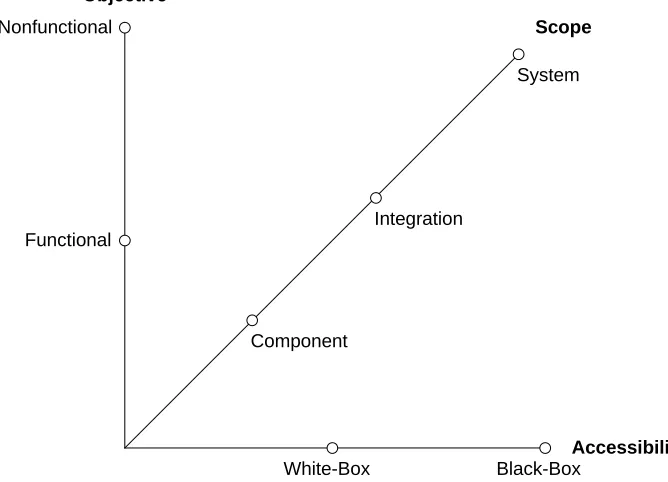
Testing can be classified utilizing the three dimensions objective, scope, and acces-sibility [125, 141] shown in Figure 1.
Scope
Component
Integration
System
Accessibility Objective
White-Box Black-Box
[image:4.612.135.469.329.570.2]Functional Nonfunctional
Figure 1: Testing Dimensions Objective, Scope, and Accessibility
Test objectives are reason or purpose for designing and executing a test. The reason is either to check the functional behavior of the system or its nonfunctional properties. Functional testing is concerned with assessing the functional behavior of an SUT, whereas nonfunctional testing aims at assessing nonfunctional requirements with regard to quality characteristics like security, safety, reliability or performance.
the smallest testable component (e.g., a class in an object-oriented implementation or a single electronic control unit) in isolation. Integration testing combines components with each other and tests those as a subsystem, that is, not yet a complete system.
System testing checks the complete system, including all subsystems. A specific type of system testing is acceptance testing where it is checked whether a solution works for the user of a system. Regression testing is a selective retesting to verify that modifications have not caused side effects and that the SUT still complies with the specified requirements [107].
In terms of accessibility of test design artifacts we can classifying testing methods into white-box and black-box testing. Inwhite-box testing, test cases are derived based on information about how the software has been designed or coded [17]. In black-box testing, test cases rely only on the input/output behavior of the software. This classification is especially relevant for security testing, as black-box testing, where no or only basic information about the system under test is provided, enables to mimic external attacks from hackers. In classical software testing, a related classification of test design techniques [64] distinguishes betweenstructure-based testing techniques(i.e., deriving test cases from internal descriptions like implementation code), specification-based testing techniques (i.e., deriving test cases from external descriptions of software like specifications), and experience-based testing techniques (i.e., deriving test cases based on knowledge, skills, and background of testers).
The process of testing comprises the core activities test planning, design, implemen-tation, execution, and evaluation [69]. According to [63] and [69], test planning is the activity of establishing or updating a test plan. A test plan includes the test objectives, test scope, and test methods as well as the resources, and schedule of intended test activities. It identifies, amongst others, features to be tested and exit criteria defining conditions for when to stop testing. Coverage criteria aligned with the tested feature types and the applied test design techniques are typical exit criteria. Once the test plan has been established, test control begins. It is an ongoing activity in which the actual progress is compared against the plan which often results in concrete measures. During thetest design phase the general testing objectives defined in the test plan are transformed into tangible test conditions and abstract test cases. For test derivation, specific test design techniques can be applied, which can according to ISO/IEC/IEEE 29119 [64] be classified into specification-based, structure-based and experience-based techniques. Test implementation comprises tasks to make the abstract test cases ex-ecutable. This includes tasks like preparing test harnesses and test data, providing logging support or writing test scripts which are necessary to enable the automated execution of test cases. In the test execution phase, the test cases are then executed and all relevant details of the execution are logged and monitored. In manual test execution, testing is guided by a human, and in automated testing by a specialized application. Finally, in the test evaluation phase the exit criteria are evaluated and the logged test results are summarized in a test report.
3
Security Engineering
In this section, we cover basic concepts of security engineering as well as an overview of the secure software development lifecycle.
3.1
Basic Concepts
Security testing validates software system requirements related to security properties of assets that include confidentiality, integrity, availability, authentication, authorization and non-repudiation. These security properties can be defined as follows [27]:
• Confidentiality is the assurance that information is not disclosed to unauthorized individuals, processes, or devices.
• Integrity is provided when data is unchanged from its source and has not been accidentally or maliciously modified, altered, or destroyed.
• Availability guarantees timely, reliable access to data and information services for authorized users.
• Authenticationis a security measure designed to establish the validity of a trans-mission, message, or originator, or a means of verifying an individual’s authoriza-tion to receive specific categories of informaauthoriza-tion.
• Authorization provides access privileges granted to a user, program, or process.
• Non-repudiationis the assurance that none of the partners taking part in a trans-action can later deny of having participated.
Security requirements can be formulated as positive requirements, explicitly defin-ing the expected security functionality of a security mechanism, or asnegative require-ments, specifying what the application should not do [99]. For instance, for the security property authorization as positive requirements could be “User accounts are disabled after three unsuccessful login attempts.”, whereas a negative requirement could be for-mulated as “The application should not be compromised or misused for unauthorized financial transactions by a malicious user.” The positive, functional view on security requirements is aligned with the software quality standard ISO/IEC 9126 [66] defining security as functional quality characteristic. The negative, non-functional view is sup-ported by the ISO/IEC 25010 [68] standard that revises ISO/IEC 9126 and introduces Security as a new quality characteristic which is not included in the characteristic Functionality any more.
An asset is a data item, or a system component that has to be protected. In the security context, such an asset has one or multiple security properties assigned that have to hold for that asset.
Afaultis a textual representation of what goes wrong in a behavioral description. It is the incorrect part of a behavioral description that needs to be replaced to get a correct description. Since faults can occur in dead code — code that is never executed —, and because faults can be masked by further faults, a fault does not necessarily lead to an error. At the other side, an error is always produced by a fault. A fault is not necessarily related to security properties but is the cause of errors and failures in general.
their corresponding security properties. An exploitation of a vulnerability attacks an asset by violating the associated security property. Since vulnerabilities are always as-sociated with the protection of an asset, the security relevant fault is usually correlated with a mechanism that protects the asset. A vulnerability either means that (1) the responsible security mechanism is completely missing, or (2) the security mechanism is in place but is implemented in a faulty way.
An exploit is a concrete malicious input that makes use of the vulnerability in the system under test (SUT) and violates the property of an asset. Vulnerabilities can often be exploited in different ways. One concrete exploit selects a specific asset and a specific property, and makes use of the vulnerability to violate the property for the selected asset.
A threat is the potential cause of an unwanted incident that harms or reduces the value of an asset. For instance, a threat may be a hacker, power outages, or malicious insiders. An attack is defined by the steps a malicious or inadvertently incorrectly behaving entity performs to the end of turning a threat into an actual corruption of an asset’s properties. This is usually done by exploiting a vulnerability.
Security aspects can be considered on the network, operating system and application level. Each level has its own security threats and corresponding security requirements to deal with them. Typical threats on the network level are distributed denial-of-service or network intrusion. On the operating system level, all types of malware cause threats. Finally, on the application level threats typical threats are related to access control or are application type specific like Cross-Site Scripting in case of web applications. All levels of security can be subject to tests.
Security testing simulates attacks and employs other kinds of penetration testing
attempting to compromise the security of a system by playing the role of a hacker trying to attack the system and exploit its vulnerabilities [7]. Security testing requires specific expertise which makes it difficult and hard to automate [102]. By identifying risks in the system and creating tests driven by those risks, security vulnerability testing can focus on parts of a system implementation in which an attack is likely to succeed.
Risks are often used as a guiding factor to define security test processes. For in-stance, Potter and McGraw [102] consider the process steps creating security misuse cases, listing normative security requirements, performing architectural risk analysis, building risk-based security test plans, wielding static analysis tools, performing se-curity tests, performing penetration testing in the final environment, and cleaning up after security breaches. Also the Open Source Security Testing Methodology Manual (OSSTMM) [56] and the OWASP Testing Guide [99] take risks into account for their proposed security testing activities.
3.2
Secure Software Development Lifecycle
model considering testing as an orthogonal dimension comprises the phases analysis, design, development, deployment, and maintenance [99]. Each phase delivers specific artifacts, i.e., the analysis phase results in requirements, design provides design models, development delivers code, deployment results in a running system, and finally all artifacts are maintained.
A secure software development lifecycle takes security aspects into account in each phase of software development. A crucial concept within the secure software devel-opment lifecycle is risk. A risk is the likelihood of an unwanted incident and its consequence for a specific asset [84]. Taking into account the negative nature of many security requirements, the concept of risk can be employed to direct the selection or ap-plication of security counter-measures like testing [84, 102]. In all phases of the secure software development process, but especially at the design level [127], risk analyses provide effective means to guide security testing and thus detect faults and vulnerabil-ities.
Major security development processes are the Security Development Lifecycle (SDL) [57] from Microsoft and the Open Software Assurance Maturity Model (Open-SAMM) [97] from OWASP.
Microsofts SDL is an established security lifecycle for software development projects pursuing the following major principles [57]:
• Secure by Design: Security is a built-in quality attribute affecting the whole software lifecycle.
• Security by Default: Software systems are constructed in a way that potential harm caused by attackers is minimized, e.g. software is deployed with least nec-essary privilege.
• Secure in Deployment: software deployment is accompanied by tools and guidance supporting users and/or administrators.
• Communications: software developers are prepared for occurring threats commu-nicating openly and timely with users and/or administrators.
The SDL is composed of security practices attached with the major activities of a software lifecycle, i.e., requirements, design, implementation, verification and deploy-ment in case of SDL, which are extended by the two activities training and response. For instance, the security practice “establish security requirements” is attached to re-quirements analysis, “use threat modeling” to design, “perform static analysis” to im-plementation, “perform fuzz testing” to verification, and “certify release and archive” to release.
Similar to the SDL, OpenSAMM attaches security practices to core activities, i.e., governance, construction, verification, and deployment in case of OpenSAMM, within the software development lifecycle. For instance, verification includes the security practices design review, code review, as well as (dynamic) security testing.
In particular, OpenSAMM attaches each security practice with three maturity levels and a starting point of zero:
• Level 0: Implicit starting point representing the activities in the practice being unfulfilled
• Level 2: Increase efficiency and/or effectiveness of the security practice
• Level 3: Comprehensive mastery of the security practice at scale
For each security practice and maturity level, OpenSAMM does not only define the objectives and activities, but also gives support to achieve this particular level. This comprises assessment questions, success metrics, costs and personnel needed to achieve the targeted maturity level.
4
Security Testing
In this section, we cover basic concepts of security testing and the integration of security testing in the secure software development lifecycle.
4.1
Basic Concepts
Security testing is testing of security requirements related to security properties like confidentiality, integrity, availability, authentication, authorization, and non-repudiation.
Security testing identifies whether the specified or intended security properties are, for a given set of assets of interests, correctly implemented. This can be done by try-ing to show conformance with the security properties, similar to requirements-based testing; or by trying to address known vulnerabilities, which is similar to traditional fault-based, or destructive, testing. Intuitively, conformance testing considers well-defined, expected inputs. It tests if the system satisfies the security properties with respect to these well-defined expected inputs. In contrast, addressing known vulner-abilities means using malicious, non-expected input data that is likely to exploit the considered vulnerabilities.
As mentioned in the previous section, security requirements can be positive and functional, explicitly defining the expected security functionality of a security mecha-nism, or negative and non-functional, specifying what the application should not do. This classification of security requirements also impacts security testing. For positive security requirements classical testing techniques can be applied applied, whereas for
negative security requirements (a combination of) additional measures like risk analy-ses, penetration testing, or vulnerability knowledgebases are essential. This classifica-tion is also reflected in by classificaclassifica-tion in the literature as provided by Tian-yang et al. [121] as well as by Potter and McGraw [103].
According to Tian-yang et al. [121] two principal approaches can be distinguished, i.e., security functional testing and security vulnerability testing. Security functional testing validates whether the specified security requirements are implemented correctly, both in terms of security properties and security mechanisms. Security vulnerability testing addresses the identification of unintended system vulnerabilities. Security vul-nerability testing uses the simulation of attacks and other kinds of penetration testing
vulnerability testing can focus on parts of a system implementation in which an attack is likely to succeed.
Potter and McGraw [103] distinguish betweentesting security mechanismsto ensure that their functionality is properly implemented, and performing risk-based security testing motivated by understanding and simulating the attacker’s approach. Testing security mechanisms can be performed by standard test organizations with classical functional test techniques, whereas risk-based security testing requires specific expertise and sophisticated analysis [103].
For security vulnerability testing approaches, Shahriar and Zulkernine [118], i.e.,
vulnerability coverage, source of test cases, test case generation method, testing level,
test case granularity,tool automation as well as target applications. Tool automation is further refined into the criteria test case generation, oracle generation, and test case execution. The authors classify 20 informally collected approaches according to these criteria. The main aim of the criteria is support for security practitioners to select an appropriate approach for their needs. Therefore Shahriar and Zulkernine blend abstract criteria like source of test cases or test case generation method with technological criteria like tool automation or target applications.
Differing from classical software testing, where black-box and white-box test de-sign are nowadays considered very similar, i.e., in both cases testing proceeds from abstract models [4], the distinction is essential for security testing. White-box testing performs testing based on information about how the software has been designed or coded, and thus enables testing from an internal software producer point of view. [17]. Black-box testing relies only on the input/output behavior of the software, and thus enables to mimic external attacks from hackers. The classification into white- and black-box testing is also pointed out by Bachmann and Brucker [9], who additionally classify security testing techniques due to execution (dynamic vs. static testing) and automation (manual vs. automated testing).
In addition, due to the critical role of negative security requirements, classical test-ing which focuses on testtest-ing functional requirements and security testtest-ing differ. It seems desirable that security testing directly targets security properties, as opposed to taking the detour of functional tests of security mechanisms. As the former kind of (non-functional) security properties describe all executions of a system, testing them is intrinsically hard. Because testing cannot show the absence of faults, an imme-diately useful perspective directly considers the violation of these properties. This has resulted in the development of specific testing techniques like penetration testing that simulates attacks to exploit vulnerabilities. Penetration tests are difficult to craft because tests often do not directly cause observable security exploits, and because the testers must think like an attacker [103], which requires specific expertise. Dur-ing penetration testDur-ing, testers build a mental model of security properties, security mechanisms, and possible attacks against the system and its environment. Specifying security test models in an explicit and processable way, results in a model-based secu-rity testing approach. In such an approach, security test models provide guidance for the systematic specification and documentation of security test objectives and security test cases, as well as for their automated generation and evaluation.
behaviors that ship with a software. Figure 2 illustrates this side effect nature of most software vulnerabilities that security testing has to cope with [120].
Intended Specified System Functionality
System
as Implemented
Missing or Incorrect Functionality: most Security Mechanisms are here
Unintended Side-effect Behvior: most
[image:11.612.145.450.117.385.2]Vulnerabilities are here
Figure 2: Most faults in security mechanisms are related to missing or incorrect functionality, most vulnerabilities are related to unintended side-effect behavior (adapted from Thomp-son [120])
The circle represents an application’s intended functionality including security mechanisms, which is usually defined by the requirements specification. The amor-phous shape superimposed on the circle represents the application’s actual, imple-mented functionality. In an ideal system, the coded application would completely overlap with its specification, but in practice, this is hardly ever the case. The areas of the circle that the coded application does not cover represents typical functional faults (i.e., behavior that was implemented incorrectly and does not conform to the specification), especially also in security mechanisms. Areas that fall outside of the cir-cular region represent unindented and potentially dangerous functionality, where most security vulnerabilities lay. The mismatch between specification and implementation shown in Figure 2 leading to faults in security mechanisms and vulnerabilities can be reduced by taking security and especially security testing aspects into account early and in all phases of the software development lifecycle as discussed in Section 4.2.
4.2
Security Testing in the Secure Software Development
Lifecycle
and the resulting broad range of subordinate requirements, also testing activities cover a broad range of scopes and employed methods. In keeping with research and expe-rience, it is essential to take testing into account in all phases of the secure software development lifecycle, i.e., analysis, design, development, deployment, as well as main-tenance. Thus, security testing must be holistic covering the whole secure software development lifecycle [9]. In concrete terms, Figure 3 shows a recommended distri-bution of static and dynamic testing efforts among the phases of the secure software development lifecycle according to [99]. It shows that security testing should be bal-anced over all phases, with a focus on the early phases, i.e., analysis, design, and implementation.
10 35%
15 35%
15 35% 10 15%
10 15%
Analysis
Design
Development
Deployment
[image:12.612.212.458.227.394.2]Maintenance
Figure 3: Proportion of Test Effort in Secure Software Development Lifecycle according to [99]
To provide support for the integration of security testing into all phases of the secure software development process, major security development processes (see Section 3.2), consider the integration of testing. In the Security Development Lifecycle (SDL) [57] from Microsoft practices with strong interference with testing efforts are the following:
• SDL Practice #2 (Requirements): Establish Security and Privacy Requirements
• SDL Practice #4 (Requirements): Perform Security and Privacy Risk Assess-ments
• SDL Practice #5 (Design): Establish Design Requirements
• SDL Practice #7 (Design): Use Threat Modeling
• SDL Practice #10 (Implementation): Perform Static Analysis
• SDL Practice #11 (Verification): Perform Dynamic Analysis
• SDL Practice #12 (Verification): Perform Fuzz Testing
• SDL Practice #13: Conduct Attack Surface Review
• SDL Practice #15: Conduct Final Security Review
The OWASP Testing Guide [99] and the OWASP Code Review Guide [98] provide a detailed overview of the variety of testing activities of web application security. While the Testing Guide has a focus on black-box testing, the Code Review Guide is a white-box approach focusing on manual code review. Overall, the Testing Guide distinguishes 91 different testing activities split into 11 sub-categories (i.e., information gathering, configuration and deployment management testing, identity management testing, au-thentication testing, authorization testing, session management testing, data validation testing, error handling, cryptography, business logic testing, as well as client side test-ing). Applying security testing techniques to web applications is covered in Section 6.
The OWASP testing framework workflow, which is also contained in the OWASP Testing Guide, contains checks and reviews of respective artifacts in all secure soft-ware development phases, creation of UML and threat models in the analysis and de-sign phases, unit and system testing during development and deployment, penetration testing during deployment, as well as regression testing during maintenance. Proper security testing requires a mix of techniques as there is no single testing technique that can be performed to effectively cover all security testing and their application within testing activities at unit, integration, and system level. Nevertheless, many companies adopt only one security testing approach, for instance penetration testing [99].
Figure 4 abstracts from concrete security testing techniques mentioned before, and classifies them according to their test basis within the secure software development lifecycle.
Requirements Design Models Code Running System
Analysis Design Development Deployment Maintenance
Penetration Testing and Dynamic Analysis Code Based Testing
and Static Analysis
Security Regression Testing Model Based
[image:13.612.91.525.387.462.2]Security Testing
Figure 4: Security Testing Techniques in the Secure Software Development Lifecycle
Model-based security testing is grounded on requirements and design models created during the analysis and design phase. Code-based testing and static analysis is based on source and byte code created during development. Penetration testing and dynamic analysis is based on running systems, either in a test or production environment. Finally,security regression testingis performed during maintenance. We also apply this classification to structure the discussion of security testing techniques in the following section.
5
Security Testing Techniques
5.1
Model-Based Security Testing
In model-based testing (MBT) manually selected algorithms automatically and sys-tematically generate test cases from a set of models of the system under test or its environment [114]. MBT is an active area of research [31, 126] and offers big potential to improve test processes in industry [125, 114, 49]. Its prospective benefits include early and explicit specification and review of system behavior, better test case docu-mentation, the ability to automatically generate useful (regression) tests and control test coverage, improved maintenance of test cases as well as shorter schedules and lower costs [114].
Process. The process of MBT consists of three main steps integrated into the overall process of test design, execution, and evaluation. (1) A model of the SUT and/or its environment is built from informal requirements, existing specification documents, or a SUT. The resulting model of the SUT dedicated to test generation is often called
test model. (2) If they are executable, one execution trace of such a model acts as a test case: input and expected output for an SUT. Because there are usually infinitely many and infinitely long execution traces, models can therefore be used to generate an infinite number of tests. To cut down their number and length,test selection criteria
are applied. These guide the generation of tests. (3) Once the test model and the test selection criteria are defined, a set of test cases is generated from the test model as determined by the chosen test selection criteria. Test generation is typically performed automatically. The generated test cases are traces of the model and thus in general at a higher level than the events or actions of an SUT. Therefore, the generated test cases are further refined to a more concrete level or adapted to the SUT to support their automated execution.
Model-based security testing. Model-based security testing (MBST) is an MBT approach that validates software system requirements related to security proper-ties. It combines security properties like confidentiality, integrity, availability, authen-tication, authorization and non-repudiation with a model of the SUT and identifies whether the specified or intended security features hold in the model.
Both MBT and MBST have in common, that the input artifact is a model and not the SUT. Therefore the abstraction gap between the model and the SUT has to be addressed. In particular, an identified (security) issue at the model level does not automatically confirm an (security) issue at the SUT. Therefore an additional step is needed to map an abstract test case to an executable test case that can be executed on the SUT.
Selection criteria: “Good” test cases. Arguably, “good” test cases detect potential, rather than actual, defects with good cost effectiveness [104]. Potential defects need to be described by defect hypotheses. In order to turn these hypotheses into operational adequacy criteria [145], they need to be captured by some form of explicit defect model [93, 105, 104]. One form of defect is a fault, understood as the root cause of an incorrect system state (error) or incorrect system output (failure). As we show below, vulnerabilities can be understood as faults.
for test selection: properties, vulnerabilities, and attackers. Models of an attacker
encode an attacker’s behavior: the data they need, the different steps they take, the way they craft exploits. Attacker models can be seen as models of the environment of a system under test, and knowledge about a targeted vulnerability usually is left implicit. In contrast,models of vulnerabilities explicitly encode weaknesses in a system or a model of the system. In this sense, they can be seen as faults that are used for the generation of “good” test case generation (see above). Finally,properties describe desired characteristics of a model, or an implementation, and they include confiden-tiality, availability, integrity, and so on. Models of properties are needed to describe the properties of an asset that are supposed not to be violated: they describe what exactly the security tester targets, and what an exploit is supposed to exploit.
It is noteworthy that all forms of security testing, model-based or not, always work with an implicit or explicit hypothesis about a potential vulnerability.
Vulnerabilities as faults. Frequently, as a reaction to known relevant threats, assets are protected by explicit security mechanisms. Mechanisms include input sani-tization, Address Space Layout Randomization (ASLR), encryption of password files, but also intrusion detection systems and access control components. Mechanisms are components of a system and can always be syntactically recognized: there is a piece of code (the mechanism) that is supposed to protect the asset; or there is no such piece of code. A vulnerability is a special kind of fault with security implications. It is defined as the absence of a correctly functioning mechanism. This can mean both (1) that there is no mechanism at all (e.g., no input sanitization takes place which can lead to buffer overflows or SQL Injections) and (2) that the mechanism does not work correctly, i.e., is partially or incorrectly implemented, for instance, if an access control policy is faulty.
Security testing can then be understood in three seemingly different ways: (1) to test if specific security properties of an asset can be violated (properties and prop-erty models); (2) to test the functionality of amechanism (attacker models); and (3) to directly try to exploit a vulnerability (vulnerability models). The boundaries are blurred, however: With the above definition of vulnerabilities as the absence of effec-tively working defense mechanisms, and the observation that attacker models always involve implicit or explicit hypotheses on vulnerabilities, activities (2) and (3) are close to identical. In practice, they only differ in terms of the perspective that the tester takes: the mechanism or the vulnerability. Because the above definition also binds vul-nerabilities to—possibly unspecified—assets, the goal of activities (2) and (3) always is activity (1). It hence seems hard to provide a crisp conceptual distinction between the three activities of (1) testing security properties, (2) testing security mechanisms, and (3) testing for vulnerabilities.
vulner-ability models. Architectural and functional models of the SUT are concerned with security requirements and their implementation. They focus on the expected system behavior. Threat, fault and risk models focus on what can go wrong, and concentrate on causes and consequences of system failures, weaknesses or vulnerabilities. Weakness and vulnerability models describe weaknesses or vulnerabilities by themselves.
In the following, we exemplary describe selected approaches, that make use of different models according to the classification of Schieferdecker et al.
5.1.1 A Model-based Security Testing Approach for Web
Applica-tions
An approach that makes use of functional, fault, and vulnerability models according to Schieferdecker et al. is presented by B¨uchler et al. [23]. They published a semi-automatic security testing approach for web applications from a secure model. The authors assume there is a formal model M for the specification of the System under Test (SUT). This model is secure as it does not violate any of the specified security goals (e.g., confidentiality, authenticity). Thus, a model-checker will reportM |=ϕfor
all security properties ϕ defining the security goals of the model. The model is built
using abstract messages that are defined by the modeler. These messages represent common actions a user of the web application can perform. The idea is that these abstract messages are sent to the server to tell it which actions the client wants to perform, e.g., log in to the web application, view profiles of different users, delete profiles, update profiles, and so on. Thus, the modeler does not care about details at the browser/protocol level but only about abstract messages that represent web application actions.
To make use of such a secure model, B¨uchler et al. [23] define semantic mutation operators that represent common, well-known vulnerabilities at source code level. Se-mantic mutation operators are an abstraction that these vulnerabilities so that they can be injected into the model. After having applied a mutation operator to an original model, the model-checker may provide a trace from this mutated model that violates a security property. This trace is called anattack trace because it shows which sequence of abstract messages have to be exchanged in order to lead the system to a state where the security property is violated. Since abstract attack traces are at the same level of abstraction as the input model, they need to be instantiated to turn them opera-tional. The approach proposes a multi-step instantiation since web applications are usually accessed via a browser. In the first step, abstract messages are translated into abstract browser actions. The second step is a mapping from these browser actions to executable API calls to make them operational in a browser. Finally, a test execution engine executes the operationalized test cases on the SUT to verify, if the implementa-tion of the model suffers from the same vulnerability as reported by the model checker at the abstract level.
5.1.2 A Model-Based Framework for Security Policy Specification,
Deployment and Testing
approach starts with a generic security meta-model of the application. It captures the high level access control policy implemented by the application and is expressed in a dedicated domain-specific language. Before such a model is further used, the model is verified to check the soundness and adequacy of the model with respect to the requirements. Afterwards the model is automatically transformed to policy decision points (PDP). Since such PDPs are usually not generated from scratch but are based on existing frameworks, the output of the transformation is, for instance, an XACML (Extended Access Control Markup Language) file that captures the security policy. This transformation step is essential in MBT since an identified security issue at model level does not automatically imply the same issue at implementation level, nor does a model without security issues automatically imply the same on the implementation. Mouelhi et al. make use of mutations at the model level to ensure that the imple-mentation conforms to the initial security model. An existing test suite is executed on an implementation generated from a mutated security model. If such mutants are not detected by the existing test suite, it will be adapted to cover the mutated part of the security model as well. Finally the test objective is to check that the implementation (security policy) is synchronized with the security model.
5.1.3 Risk-Based Security Testing
In the following, we consider approaches that are based on risk models. Risk-based test-ing in general is a type of software testtest-ing that explicitly considers risks of the software system as the guiding factor to solve decision problems in all phases of the test process, i.e., test planning, design, implementation, execution and evaluation [46, 115, 38]. It is based on the intuitive idea to focus testing activities on those areas that trigger the most critical situations for a software system [135]. The precise understanding of risks as well as their focused treatment by risk-based testing has become one of the corner-stones for critical decisions within complex software development projects and recently gained much attention [38]. Lately, the international standard ISO/IEC/IEEE 29119 Software Testing [64] on testing techniques, processes and documentation even explic-itly considers risks as an integral part of the test planning process. In the following, we describe three risk-based approaches to security testing in more detail.
Grossmann et al. [51] present an approach called Risk-Based Security Testing that combines risk analysis and risk-based test design activities based on formalized security test patterns. The involved security test patterns are formalized by using a minimal test design strategies language framework which is represented as a UML profile. Such a (semi-)formal security test pattern is then used as the input for a test generator accompanied by the test design model out of which the test cases are generated. The approach is based on the CORAS method [84] for risk analysis activities. Finally, a tool prototype is presented which shows how to combine the CORAS-based risk analysis with pattern-based test generation.
test purpose language. It is used to formalize security test patterns in order to make them usable for test generators. Risk-Based Vulnerability Testing is applied to security testing of a web application.
Zech et al. [143, 142] propose a new method for generating negative security tests for non-functional security testing of web applications by logic programming and knowl-edge engineering. Based on a declarative model of the system under test, a risk analysis is performed and used for derivation of test cases.
5.2
Code-Based Testing and Static Analysis
Many vulnerabilities can only be detected by looking at the code. While traditionally not understood as a testing technique,static analysis of the program code is an impor-tant part of any security development process, as it allows to detect vulnerabilities at early stages of the development lifecycle where fixing of vulnerabilities is comparatively cheap [43]. In Microsoft’s SDL [57], SAST is part of theimplementation phase to high-light that this technique should be applied as soon as the first line of code is written. Note that in this section, we only discuss purely static approaches, i.e., approaches that do not require an executable test system. Thus, we discuss hybrid approaches, i.e., approaches that combine static analysis with dynamic testing (such as concolic testing) in Section 5.3.
Code reviews can either be done manually or automated. The latter is often called static code analysis (SCA) or Static Application Security Testing (SAST). Moreover, we can either analyze the source code (i.e., the code that was written by a developer) of the program or the compiled source code (i.e., binaries or byte-code). As they are closely related, we discuss them not separately. From a software vendor’s perspective who is aiming at building secure software, the analysis on the source code is preferred over a binary analysis, as the source code analysis is more precise and can provide detailed recommendations to developers on how to fix a vulnerability on the source code level.
5.2.1 Manual Code Review
5.2.2 Static Application Security Testing
Automatedstatic program analysis for finding security vulnerabilities, also calledStatic Application Security Testing(SAST) [26], is an attempt to automated code reviews: in principle, a SAST tool analyses the program code of a software component (e.g., an ap-plication or a library) automatically and reports potential security problems (potential vulnerabilities). This limits the manual effort to reviewing the reported problems and, thus, increases the scalability (i.e., the amount of program code that can be analyzed in a certain amount of time) significantly. Moreover, on the one hand, SAST tools “encapsulate” most of the required security expertise and, thus, they can (and should) be used by developers that are not necessarily security experts. On the other hand, SAST tools only report vulnerabilities they are looking for and, thus, there is still a need for a small team of experts that configures the SAST tools correctly [14, 21].
For computing the set of potential security problems in a program, a SAST tool mainly employs two different types of analysis:
1. Syntactic checks such as calling insecure API functions or using insecure config-uration options. An example of this class would be an analysis of Java programs for calls tojava.util.random(which does not provide a cryptographically secure random generator).
2. Semantic checks that require an understanding of the program semantics such as the data flow or control flow of a program. An example of this class would be an analysis checking for direct (not sanitized) data-flows from an program input to a SQL statement (indicating a potential SQL Injection vulnerability).
As SAST tools work on over-approximations of the actual program code as well as apply heuristics checks, the output of a SAST tool is a list ofpotentialsecurity vulnerabilities. Thus, or each finding, an human expert is necessary to decide:
• If the finding represents a vulnerability, i.e, a weakness that can be exploited by an attacker (true positive), and, thus, needs to be fixed.
• If the finding cannot be exploited by an attacker (false positive) and, thus, does not need to be fixed.
Similarly, if an SAST tool does not report security issues, this can have two reasons:
• The source code is secure (true negative)
• The source code has security vulnerability but due to limitations of the tool, the tool does not report a problem (false negative).
There are SAST tools available for most of the widely used programming language, e.g., FindBugs [8] that is able to analyzes Java byte code and, thus, can analyze various languages running on the Java Virtual Machine. There are also specializes techniques for Java programs (e.g., [83]), or C/C++ (e.g., [33]) as well as approaches that work on multiple languages (e.g., [25]). For a survey on static analysis methods, we refer the reader elsewhere [101, 26]. Moreover, we discuss further static analysis techniques in the context of a small case study in Section 6.
Reporting
Attack Discovery
Planning
Additional Discovery
>
>
>
[image:20.612.123.491.75.230.2]>
Figure 5: Phases of a penetration test [113]
SAST tools achieve, compared to dynamic test approaches, a significant higher cov-erage of the program under test and, thus, produce a significant lower false negative rate. Thus, SAST is a very effective method [112] for detecting programming related vulnerabilities early in the software development lifecycle.
5.3
Penetration Testing and Dynamic Analysis
In contrast to white-box security testing techniques (see Section 5.2), black-box security testing does not require access to the source code or other development artifacts of the application under test. Instead, the security test is conducted via interaction with the running software.
5.3.1 Penetration testing
A well known form of black-box security testing isPenetration Testing. In a penetration test, an application or system is tested from the outside in a setup that is comparable to an actual attack from a malicious third party. This means, in most settings the entity that is conducting the test has potentially only limited information about the system under test and is only able to interact with the system’s public interfaces. Hence, a mandatory prerequisite for this approach is a (near) productive application, that is feature complete and sufficiently filled with data, so that all implemented workflows can be executed during the test. Penetration tests are commonly done for applications that are open for networked communication.
The NIST Technical Guide To Information Security Testing And Assessment [113] partitions the penetration testing process in four distinct phases (see Fig. 5):
1. Planning: No actual testing occurs in this phase. Instead, important side con-ditions and boundaries for the test are defined and documented. For instance, the relevant components of the applications that are subject of the test are de-termined and the nature/scope of the to be conducted tests and their level of invasiveness.
set of interfaces constitutes the system’s initial attack surface. The second part of the discovery phase is vulnerability analysis, in which the applicable vulner-ability classes that match the interface are identified (e.g., Cross-Site Scripting for HTTP services or SQL Injection for applications with database backend). In a commercial penetration test, this phase also includes the check if any of the found components is susceptible to publicly documented vulnerabilities which is contained in precompiled vulnerability databases.
3. Attack: Finally, the identified interfaces are tested through a series of attack at-tempts. In these attacks, the testers actively attempts to compromise the system via sending attack payloads. In case of success, the found security vulnerabilities are exploited in order to gain further information about the system, widen the access privileges of the tester and find further system components, which might expose additional interfaces. This expanded attack surface is fed back into the discovery phase, for further processing.
4. Reporting: The reporting phase occurs simultaneously with the other three phases of the penetration test and documents all findings along with their estimated severeness.
5.3.2 Vulnerability scanning
In general penetration tests are a combination of manual testing through security experts and the usage of black-box vulnerability scanners. Black-box web vulnerability scanners are a class of tools that can be used to identify security issues in applications through various techniques. The scanner queries the application’s interfaces with a set of predefined attack payloads and analyses the application’s responses for indicators if the attack was successful and, if this is not the case, hints how to alter the attack in the subsequent tries. Bau et al. [11] as well as Adam et al. [3] provide overviews of recent commercial and academic black-box vulnerability scanners.
5.3.3 Dynamic taint analysis
An important variant of black-box testing is an analysis technique calledtaint analysis. A significant portion of today’s security vulnerabilities are string-based code injection vulnerabilities [71], which enable the attacker to inject syntactic content into dynami-cally executed programming statements, which — in the majority of all cases — leads to full compromise of the vulnerable execution context. Examples for such vulnerabilities include SQL Injection [52] and Cross-Site Scripting [50]. Such injection vulnerabilities can be regarded as information flow problems, in which unsanitized data paths from untrusted sources to security sensitive sinks have to be found. To achieve this, a well established approach is(dynamic) data tainting. Untrusted data is outfitted withtaint
application under test is executed. For this, the execution environment, e.g., the lan-guage runtime, has to be made taint aware, so that the attached taint information of the untrusted data is maintained through the course of program execution, so that it can reliably be detected when tainted data ends up in security sensitive sinks.
5.3.4 Fuzzing
Fuzzing or fuzz testing is a dynamic testing technique that is based on the idea of feeding random data to a program “until it crashes.” It was pioneered in the late 1980ies by Barton Miller at the University of Wisconsin [89]. Since then, fuzz testing has been proven to be an effective technique for finding vulnerabilities in software. While the first fuzz testing approaches where purely based on randomly generated test data (random fuzzing), advances in symbolic computation, model-based testing, as well as dynamic test case generation have lead to more advanced fuzzing techniques such as mutation-based fuzzing, generation-based fuzzing, or gray-box fuzzing.
Random fuzzing is the simplest and oldest fuzz testing technique: a stream of random input data is, in a black-box scenario, send to the program under test. The input data can, e.g., be send as command line options, events, or protocol packets. This type of fuzzing in, in particular, useful for test how a program reacts on large or invalid input data. While random fuzzing can find already severe vulnerabilities, modern fuzzers do have a detailed understanding of the input format that is expected by the program under test.
Mutation-based fuzzing is one type of fuzzing in which the fuzzer has some knowledge about the input format of the program under test: based on existing data samples, a mutation-based fuzzing tools generated new variants (mutants), based on a heuristics, that it uses for fuzzing. there are a wide range of mutation based fuzzing approaches available for different domains. We refer the interested reader elsewhere for details [108, 32].
Generation-based fuzzing used a model (of the input data or the vulnerabilities) for generating test data from this model or specification. Compared to pure random-based fuzzing, generation-based fuzzing achieves usually a higher coverage of the program under test, in particular if the expected input format is rather complex. Again, for details we refer the interested reader elsewhere [138, 144].
Advanced fuzzing techniques combine several of the previously mentioned ap-proaches, e.g., use a combination of mutation-based and generation-based techniques as well as observe the program under test and use these observations for constructing new test data. This turns fuzzing into a gray-box testing technique that also utilizes symbolic computation that is usually understood as a technique used for static program analysis. Probably the first and also most successful application of gray-box fuzzing is SAGE from Microsoft [47, 48], which combines symbolic execution (a static source code analysis technique) and dynamic testing. This combination is today known as concolic testing and inspired several advanced security testing e.g., [12, 1], as well as functional test approaches.
5.4
Security Regression Testing
less satisfactory [80]. This makes it especially challenging to keep software systems per-manently secure as changes either in the system itself or in its environment may cause new threats and vulnerabilities [37]. A combination of regression and security testing called security regression testing, which ensures that changes made to a system do not harm its security, are therefore of high significance and the interest in such approaches has steadily increased [36]. Regression testing techniques ensure that changes made to existing software do not cause unintended effects on unchanged parts and changed parts of the software behave as intended [82]. As requirements, design models, code or even the running system can be changed, regression testing techniques are orthogonal to the security testing techniques discussed in the previous sections.
Yoo and Harman [139] classify regression testing techniques into three categories: test suite minimization, test case prioritization and test case selection.
Test suite minimization seeks to reduce the size of a test suite by eliminating redundant test cases from the test suite.
Test case prioritization aims at ordering the execution of test cases in the regression test suite based on a criterion, for instance, on the basis of history, coverage, or require-ments, which is expected to lead to the early detection of faults or the maximization of some other desirable properties.
Test case selection deals with the problem of selecting a subset of test cases that will be used to test changed parts of software. It requires to select a subset of the tests from the previous version, which are likely to detect faults, based on different strategies. Most reported regression testing techniques focus on this regression testing technique [139]. The usual strategy is to focus on the identification of modified parts of the SUT and to select test cases relevant to them. For instance, theretest-all technique is one naive type of regression test selection by re-executing all tests from the previous version on the new version of the system. It is often used in industry due to its simple and quick implementation. However, its capacity in terms of fault detection is limited [41]. Therefore, considerable amount of work is related to the development of effective and scalable selective techniques.
In the following, we discuss available security testing approaches according to the categories minimization, prioritization, and selection. The selected approaches are based on a systematic classification of security regression testing approaches by Felderer and Fourneret [36].
5.4.1 Test Suite Minimization
Test suite minimization seeks to reduce the size of a test suite by eliminating test cases from the test suite based on a given criterion. Current approaches on minimization [122, 55, 45] address vulnerabilities.
Toth et al. [122] propose an approach that applies automated security testing for detection of vulnerabilities by exploring application faults that may lead to known malware, such as viruses or worms. The approach considers only failed tests from the previous version revealing faults for re-run in a new system version after fault fixing.
Finally, Garvin et al. [45] propose testing of self-adaptive system for already known failures. The authors avoid reproducing already known failures by considering only those tests for execution that exercise the known failures in previous versions.
5.4.2 Test Case Prioritization
Test case prioritization is concerned with right ordering of test cases that maximizes desirable properties, such as early fault detection. Also, current approaches to priori-tization [59, 140, 129] address only vulnerabilities.
Huang et al. [59] propose a prioritization technique for security regression testing. Their technique gathers historical records, whose most effective execution order is determined by a genetic algorithm.
Yu et al. [140] propose fault-based prioritization of test cases, which directly utilizes the knowledge of their capability to detect faults.
Finally, Viennot et al. [129] propose a mutable record-replay system, which allows a recorded execution of an application to be replayed with a modified version of the application. Their execution is prioritized by defining a so called d-optimal mutable replay based on a cost function measuring the difference between the original execution and the mutable replay.
5.4.3 Test Case Selection
Test case selection approaches choose a subset or all test cases to test changed parts of software. As for classical regression testing [139], also for security regression testing most approaches fall into this category [36]. These approaches test both, security mechanisms and vulnerabilities. Several subset-based approaches [34, 75, 5, 58, 62] and retest-all approaches [128, 22, 78, 106] have been proposed.
Felderer et al. [34] provide a UML-based approach for regression testing of se-curity requirements of type authentication, confidentiality, availability, authorization, and integrity. Tests, represented as sequence diagrams, are selected based on test requirements changes. Kassab et al. [75] propose an approach to improve regression testing based on non-functional requirements ontologies. Tests are selected based on change and impact analysis of non-functional requirements, such as security, safety, performance, or reliability. Each test linked to a changed or modified requirement is selected for regression testing. Anisetti et al. [5] propose an approach for providing test evidence for incremental certification of security requirements of services. This approach is based on change detection in the service test model, which will determine if new test cases need to be generated, or existing ones to be selected for re-execution on the evolved service. Huang et al. [58] address security regression testing of access control policies. This approach selects tests if they cover changed elements in the pol-icy. Finally, Hwang et al. [62] propose three safe coverage-based selection techniques for testing evolution of security policies, each of which includes a sequence of rules to specify which subjects are permitted or denied to access which resources under which conditions. The three techniques are based on two coverage criteria, i.e., (1) coverage of changed rules in the policy, and (2) coverage of different program decisions for the evolved and the original policy.
require-0 200 400 600 800 1000 1200
2001 2002 2003 2004 2005 2006 2007 2008 2009 2010 2011 2012 2013 2014
[image:25.612.126.486.71.199.2]#Cross-Site Scripting #Buffer Errors #Cross-Site Request Forgery #SQL Injection #Information Leak / Disclosure
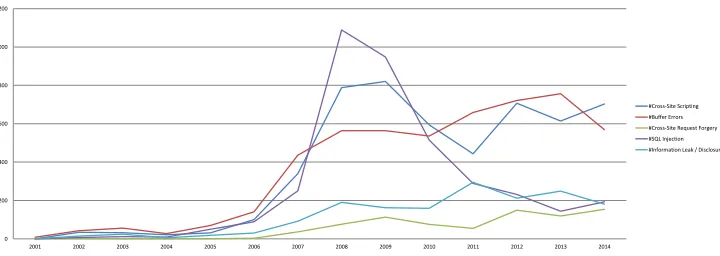
Figure 6: Number of entires in the Common Vulnerabilities and Exposures (CVE) index by category
ments are created manually and represented as sequence diagrams. In case of a change, new tests are written if necessary and then all tests are executed on the new version. Bruno et al. [22] propose an approach for testing security requirements of web ser-vice releases. The serser-vice user can periodically re-execute the test suite against the service in order to verify whether the service still exhibits the functional and non-functional requirements. Kongsli [78] proposes the use of so called misuse stories in agile methodologies (for instance, extreme programming) to express vulnerabilities re-lated to features and/or functionality of the system in order to be able to perform security regression testing. The author suggests that test execution is ideal for agile methodologies and continuous integration. Finally, Qi et al. [106] propose an approach for regression fault-localization in web-applications. Based on two programs, a refer-ence program and a modified program, as well as input failing on the modified program, their approach uses symbolic execution to automatically synthesize a new input that is very similar to the failing input and does not fail. On this basis, the potential cause(s) of failure are found by comparing control flow behavior of the passing and failing inputs and identifying code fragments where the control flows diverge.
6
Application of Security Testing Techniques
changes of the system under test, which is addressed by suitable (security) regression testing approaches (as discussed in Section 5.4).
6.1
Selection Criteria for Security Testing Approaches
When selecting a specific security testing method and tool, many aspects need to be taken into account, e.g.:
• Attack surface: different security testing methods find different attack and vul-nerability types. Many techniques are complementary so it is advisable to use multiple security testing methods together to efficiently detect a range of vulner-abilities as wide as possible.
• Application type: different security testing methods perform differently when ap-plied to different application types. For example, a method that performs well against a mobile application may not be able to perform as well against three-tier client-server applications.
• Performance and resource utilization: different tools and methods require differ-ent computing power and differdiffer-ent manual efforts.
• Costs for licenses, maintenance and support: to use security testing tools effi-ciently in a large enterprise, they need to be integrated into, e.g., bug-tracking or reporting solutions—often they provide their own server applications for this. Thus, buying a security testing tool is usually not a one-time effort—it requires regular maintenance and support.
• Quality of results: different tools that implement the same security testing tech-nique provide a different quality level (e.g., in terms of fix recommendations or false positives rates).
• Supported technologies: security testing tools usually only support a limited num-ber of technologies (e.g., programming languages, interfaces, or build systems). If these tools support multiple technologies, they do not necessary support all of them with the same quality. For example, a source analysis tool that supports Java and C might work well for Java but not as well for C.
In the following, we focus on the first two aspects: the attack surface and the application type. These two aspects are, from a security perspective the first ones to consider for selecting the best combinations of security testing approaches for a specific application type (product). In a subsequent step, the other factors need to be considered for selecting a specific tool that fits the needs of the actual development as well as the resource and time constraints.
6.2
A Three-tiered Business Application
In this chapter, we use a simple multi-tiered business application, e.g., for booking business travels, as a running example. This architecture is, on the first hand, very common for larger applications and, on the other hand, covers a wide variety of security testing challenges.
R
Database Rich Web Client
(e.g. using AngularJS, JQuery)
Business Application (e.g., Java Servlets hosted
[image:27.612.174.440.70.154.2]in Tomcat)
Figure 7: Architecture of Example Application
• First tier: A front-end that is implemented as rich-client using modern web de-velopment techniques, i.e., HTML5 and JavaScript, e.g., using frameworks such as AngularJS or JQuery.
• Second tier: A typical middle-tier implemented in Java (e.g., using Java Servlets hosted in an application server such as Apache Tomcat).
• Third tier: A third-party database that provides persistency for the business data that is processed in the second tier.
Figure 7 illustrates this example architecture where the dotted vertical lines mark the trust boundaries of the application.
6.2.1 The First Tier: Web Applications
Web applications are predominantly affected by code injection vulnerabilities, such as SQL Injection [52] or Cross-Site Scripting (XSS) [50]. This is shown in Figure 6: as it can be seen, besides buffer overflows (and similar memory corruption vulnerabilities), which in general do not occur in Web applications, injection vulnerabilities represent the vast majority of reported issues.
In consequence, security testing approaches for Web applications are primarily con-cerned with detection of such code injection vulnerabilities. In the remainder of this section, we utilize the field of Web applications as a case study in security testing and comprehensively list academic approaches in this area.
Code-Based Testing and Static Analysis. As introduced in Section 5.2, static analysis of source code is a powerful tool to detect vulnerabilities in source code. Static analysis allows to analyze the code of a given application without actually executing it. To detect injection vulnerabilities with such an approach, in most cases the static analysis attempts to approximate the data flows within the examined source code. This way, data flows fromsourcesthat can be controlled by the attacker (e.g., the incoming HTTP request) into security sensitivesinks(e.g, APIs that create the HTTP response of send SQL to the database).
![Figure 2: Most faults in security mechanisms are related to missing or incorrect functionality,most vulnerabilities are related to unintended side-effect behavior (adapted from Thomp-son [120])](https://thumb-us.123doks.com/thumbv2/123dok_us/7880452.183968/11.612.145.450.117.385/security-mechanisms-incorrect-functionality-vulnerabilities-unintended-behavior-adapted.webp)
![Figure 3: Proportion of Test Effort in Secure Software Development Lifecycle accordingto [99]](https://thumb-us.123doks.com/thumbv2/123dok_us/7880452.183968/12.612.212.458.227.394/figure-proportion-eort-secure-software-development-lifecycle-accordingto.webp)

![Figure 5: Phases of a penetration test [113]](https://thumb-us.123doks.com/thumbv2/123dok_us/7880452.183968/20.612.123.491.75.230/figure-phases-of-a-penetration-test.webp)