JANE LOUISE HODGE
A thesis submitted in partial fu lfilm e n t of the
requirements for the degree of
Master of Clinical Psychology
of The Australian National University
I declare th a t th is th e sis re p o rts my o rig in a l work, and th a t no p a rt of i t has been previou sly accepted or presented fo r the award of a degree or diplom a by any u n ive rsity. To the best of my knowledge no m a te ria l previou sly published or w r itte n by another person is included except where due acknowledgment is given.
ACKNOWLEDGMENTS
This study would not have been possible without the willingness of its respondents to participate. For many it must have been a painful task and all my thanks and appreciation is extended to them. It is my hope that the study w ill contribute to a greater understanding of trauma consequences and individual vulnerability.
I would also like to thank my family, friends and work colleagues who have made sacrifices and given me enormous support and encouragement. In particular, my son Stuart for his untiring and patient assistance w ith my nemesis 'the word processor'.
ABSTRACT
Human beings are usually distressed when exposed to
traumatic events but post trauma psychological consequences are not uniformly experienced. Some individuals develop post
traumatic stress disorder and others do not. The present investigation is in response to a perceived need for 'across trauma' studies directed at explaining individual differences in psychological response to trauma. The study aimed to investigate these differences, regardless of trauma experience, in terms of eleven generic predictors isolated by previous, mainly single trauma, investigations. Four trauma groups, consisting of 20 respondents in each, were selected for study. Victims of crime, a naval disaster, an airline disaster, and an earthquake disaster were surveyed and it was hypothesized that, consistent w ith the classic paradigm for stress related disorders, post traumatic stress disorder would be additively dependent on the number of generic predictors experienced. The hypotheses were only partially confirmed, the experience of prolonged physical stress, bereavement, and a shattering of the individual's assumptive world were found to be significantly and additively predictive of post traumatic stress disorder symptomatology. These predictors were discussed in terms of their cognitive impact on the
individual. It was asserted that, regardless of the traumatic event or the magnitude of the stressor, an individual's
TABLE OF CONTENTS
INTRODUCTION t
I . POST TRAUMATIC STRESS DISORDER: 3
A LITERATURE REVIEW
L I AN HISTORICAL PERSPECTIVE 3
1.2 POST TRAUMATIC STRESS DISORDER: CURRENT STATUS 5
1.3 THEORETICAL EXPLANATIONS 9
1.4 TREATMENT 15
1.5 FUTURE DIRECTIONS 15
1.6 SUMMARY AND IMPLICATIONS 2 7
2 PREDICTORS OF PSYCHOLOGICAL DISTRESS: 2 9
ACCORDING TO THE DISASTER LITERATURE
2.1 TRAUMA RELATED PREDICTOR VARIABLES 3 1
2 .2 DEMOGRAPHIC PREDICTOR VARIABLES 3 8
2.3 CONCLUSIONS AND IMPLICATIONS 3 9
3. RESEARCH RATIONALE AND ETHICS 4 0
3.1 RESEARCH RATIONALE 4 0
3 .2 ETHICS 4 4
4. METHOD 4 6
4.1 SAMPLING AND PROCEDURE 4 6
4 .2 THE SURVEYED EVENTS 4 9
4.2.1 V ic t im s o f C rim e 4 9
4 .2 .2 N aval d is a s te r 51
4.2.3 A ir lin e d is a s te r 53
4 .3 THE RESEARCH INSTRUMENT 5 5
4 4 THE MEASURES 5 8
4 4 1 Im p a c t o f E ve n ts S ca le
4 4 2 P o s t T ra u m a tic S tre s s D is o rd e r In v e n to ry 6 0
4 4 3 S o c ia l F u n c tio n in g S ca le 6 2
5. RESULTS 64
5 . 1 RESPONSE RATE 6 4
5 .2 DESCRIPTION OF Q U ALITATIVE D A TA 6 5
5 .3 DEMOGRAPHIC CHARACTERISTICS OF THE SAMPLE 6 8
5 .4 SCALE ANALYSIS 7 0
5 .4 1 PTSD in v e n to ry 7 0
5 . 4 2 lES In v e n to ry 7 2
5 4 3 SFS In v e n to ry 7 4
5 .5 HYPOTHESIS TESTING 76
5 .6 FURTHER EXPLORATORY ANALYSIS 8 6
5 .7 INTERSCALE RELATIONSHIPS 9 9
5 .8 SUMMARY OF RESULTS 103
6. DISCUSSION 105
6.1 THE FINDINGS ACCORDING TO THE HYPOTHESES 105
6 .2 ADDITIONAL FINDINGS OF INTEREST 1 12
6 .3 CONCLUDING REMARKS 116
REFERENCES 118
APPENDIX A 133
APPENDIX B 134
APPENDIX C 135
Figure 5.5a:
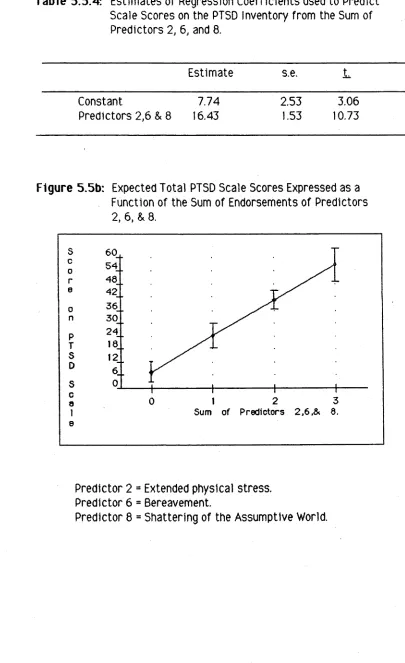
Figure 5.5b:
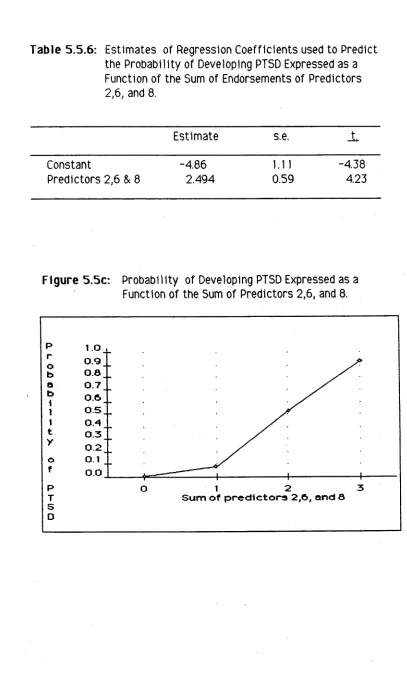
Figure 5.5c:
LIST OF FIGURES
PTSD Frequency by Trauma Group (p. 77).
Expected to ta l PTSD Scale Scores Expressed as a Function of the Sum of Endorsements of Predictors 2, 6, & 8 (p. 82).
L IS T OF TABLES
T a b le 1 L ite ra tu re Review of D isaster Research (p. 29).
T a b le 5 .3 .1 Im portant Demographic V ariables fo r each Trauma Group (p. 69).
T a b le 5 .4 .1 Factor A nalysis - Loadings and R e lia b ilitie s fo r the PTSD Inventory (p. 71).
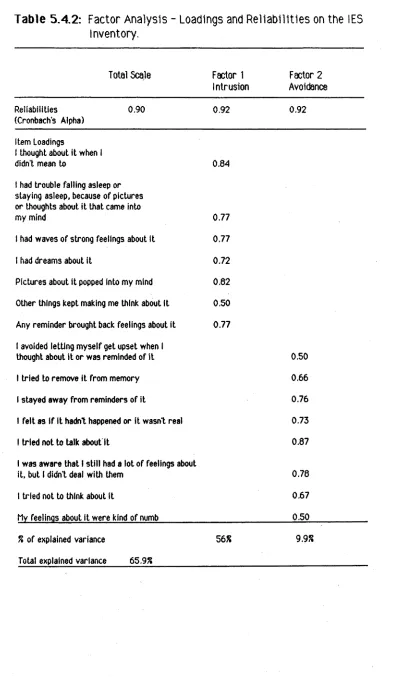
T a b le 5 .4 .2 Factor A nalysis - Loadings and R e lia b ilitie s on the IES Inventory (p. 73).
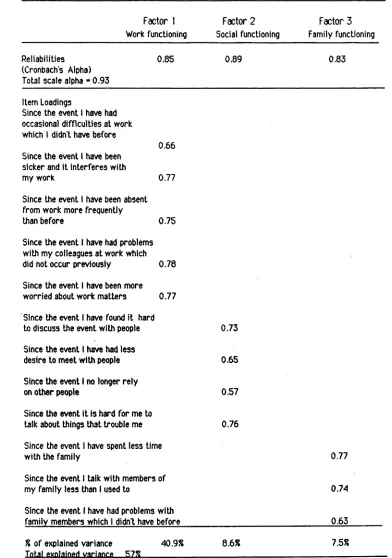
T a b le 5 .4 .3 Factor A nalysis - Loadings and R e lia b ilitie s on the SFS inventory (p. 75).
T a b le 5 .5 .1 A nalysis of Variance of Mean Scale Scores on the PTSD Inventory fo r the Naval, Crime, & A irlin e Respondents (p. 78).
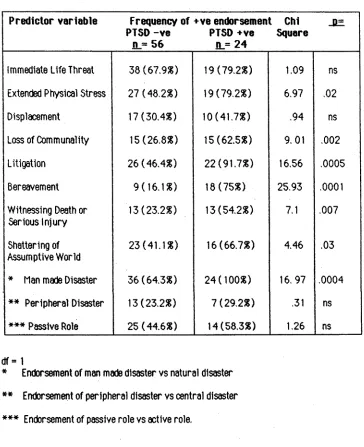
T a b le 5 .5 .2 P o sitive Endorsement o f P re d icto r Variables (1 - 11) by PTSD (presence or absence) (p. 80).
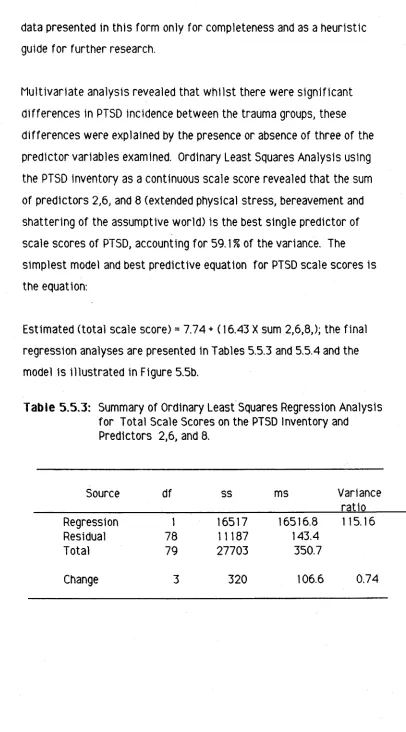
T a b le 5 .5 .3 Summary of Ordinary Least Squares Regression A nalysis fo r Total Scale Scores on the PTSD Inventory and
P redictors 2, 6, and 8 (p. 81).
T a b le 5 .5 .4 E stim ates of Regression C o e ffic ie n ts used to Predict Scale Scores on the PTSD Inventory from the Sum of P redictors
2, 6, and 8 (p. 82).
T a b le 5 .5 .5 Summary of L o g is tic Regression A nalysis of PTSD Diagnosis (p. 83).
[image:8.548.57.489.65.805.2]Table 5.6.1 Mean s c o re s , S ta n d a rd D e v ia tio n s , and T T e s ts o f Sex D iffe r e n c e s on th e SFS In v e n to ry f o r th e PTSD +ve Group (p. 87).
Table 5 .6 .2 Chi S quare C om po nents f o r P o s itiv e (v s N e g a tiv e )
E n d o rs e m e n ts o f each E m o tio n by th e P resence o r A b sence o f PTSD (p. 89).
Table 5.6.3 Mean S tr e s s L e v e ls and S ta n d a rd D e v ia tio n s f o r th e PTSD - v e and PTSD +ve G roups and T T e s ts o f D iffe r e n c e s b e tw e e n G roups (p. 91).
Table 5 .6 .4 C o r r e la tio n a l A n a ly s is o f IES and SFS S ca le , and
R e p o rte d S tr e s s L e v e ls (p. 9 2 ).
Table 5 .6 .5 A n a ly s is o f V a ria n c e o f Mean S tre s s L e v e ls a t th e T im e o f th e Event by T ra u m a G roup (p. 93).
Table 5 .6 .6 A n a ly s is o f V a ria n c e o f C u rre n t Mean S tre s s L e v e ls f o r M em ory o f th e Event by T ra u m a Group (p. 94).
Table 5 .6 .7 Mean S co re s and S ta n d a rd D e v ia tio n s on th e PTSD
In v e n to ry by A s s ig n a tio n o f B la m e to O th e rs and T T e s ts o f D iffe r e n c e s (p. 96).
Table 5 .6 .8 Mean S c o re s and S ta n d a rd D e v ia tio n s on th e PTSD
In v e n to ry by A s s ig n a tio n o f B la m e by O th e rs and T T e s ts o f D iffe r e n c e s (p. 97).
Table 5.7.1 D ependent M easures: In te r s c a le C o rr e la tio n s (p. 100).
Table 5 .7 .2 Mean S c o re s and S ta n d a rd D e v ia tio n s f o r a ll S c a le s and S u b s c a le s by PTSD D e s ig n a tio n and T T e s ts o f
INTRODUCTION
Human beings frequently suffer consequences as a result of being exposed to a traumatic event. They can suffer m aterially (as might be expected in the event of a disaster such as an earthquake); they can suffer physically (again as a consequence of a natural disaster or a man made event such as violent crime or combat exposure); and they can suffer psychologically.
It is the psychological consequences of trauma which are of interest in this report.
What distinguishes a traumatic event from a life event or an everyday experience is not unequivocally defined in the research literature or in diagnostic manuals such as DSM 111R. Suffice it to say that most researchers and clinicians working w ith the psychological consequences of trauma would identify w ith the assertion that "Things can be so bad
that to be sane is insane" ( Nietzsche ). Some events would impose such a burden on the psychological resources of almost any human being that consequences are inevitable. Suffering can be relatively minor or severe; acute or chronic; immediate or delayed; continuous or interm ittent. Suffering is individually defined and experienced; it does not appear to take a unitary course to an inevitable conclusion and individuals experiencing the same traumatic event do not appear to respond
identically. Psychological responses to a traumatic event can vary from no obvious reaction through mild distress to depression, anxiety, panic disorder, agoraphobia and post traumatic stress disorder.
in recent years there has been increasing research and clinical interest into the diagnostic category of post traumatic stress disorder.
event, why do some Individuals suffer from the disorder w hilst others do not?
This cross sectional study addresses this important question by examining the influence of specific experiences (such as threat to life ,
bereavement, exposure to the grotesque) which commonly occur during a traumatic event. The study examines these experiences across four different trauma groups in order to assess their impact on the development of post traumatic stress disorder. The purpose of the investigation is to add to the body of scie n tific knowledge in this area by isolating some trauma related, but non trauma specific, experiences which may be predictive of post traumatic stress disorder. Isolation of these experiences could then provide guidelines for the identification of individuals at risk. This would in turn have implications for the efficacious implementation of post trauma intervention to reduce the vulnerability of those individuals.
CHAPTER I
POST TRAUMATIC STRESS DISORDER: A LITERATURE REVIEW.
Post traumatic stress disorder is a relatively new diagnostic category the va lid ity of which is s till debated in the literature. Its
distinctiveness from other psychological diagnoses such as
generalized anxiety disorder and adjustment disorder is questioned. The appropriateness of the diagnostic c rite ria is under continuing review and the definition of what constitutes an 'event outside the range of usual human experience' (DSM 111R 1987) is s till unclear. However, there is little argument that some sort of post trauma psychological syndrome has been documented since the dawn of recorded history. Robinowitz (1987) notes that the lingering psychological effects of war were described in Homer's epic poem "Odyssey’ which has been dated to as early as 800 B.C.
1.1 AN HISTORICAL PERSPECTIVE:
Post trauma distress has been described in popular literature for centuries. Samuel Pepys gave a graphic account of both his own
of the development of post traumatic stress disorder as it is defined today. Charles Dickens described his feelings after being involved in a train accident; the lethargy and weakness he suffered was, he
asserted, mental rather than physical (Mendelson, 1987). Physicians fir s t became acutely aware of post trauma reactions as a consequence of combat experience, the American Civil War, Crimean War and World War 11 all produced their share of psychologically traumatized
combatants.
However, it was not until the 1940‘s that serious scien tific interest was directed towards the psychological sequelae of trauma. Van der Kolk (1988) comments that Kardiner was the fir s t to describe a 'post traumatic stress disorder like’ syndrome in 1941. Chamberlain (1980) cites several studies carried out in the mid 1940‘s into the
psychological consequences of a disaster (the Boston Cocoanut Grove nightclub fire). Quarantelli (1985) claims that scientific interest was aroused by the legacy of World War II. Even then there tended to be an emphasis on human resilience and adjustment rather than on
pathology. There was a m ilieu which suggested that post trauma d iffic u ltie s were more to do w ith a 'lack of moral fibre' or
alternatively, more aligned to malingering and litigatio n than to true pathology - the term compensation neurosis was coined (Trimble,
1985). Mendelson ( 1987) is more generous to the times as he
plight of concentration camp survivors, prisoners of war and nuclear holocaust survivors as being the impetus which eventually resulted in the acceptance of a unique psychological post trauma syndrome. Today the syndrome is w ell documented as a response to a number of
traum atic events including disasters, acts of crime, and most
commonly, combat (the Vietnam War being the most frequently studied traum atic event producing quite undeniable post trauma psychological consequences).
Over the years this syndrome has been given many labels including gross stress reaction, shell shock and traum atic neurosis. The
American Psychiatric Association f ir s t included ’gross stress reaction’ when it produced its diagnostic manual DSM 1 in 1952. DSM 11 deleted th is reaction but replaced it w ith 'transient situational disturbance in adult life '. The disturbance was described as a se lf lim itin g disorder except in those cases where a severe premorbid personality
disturbance was present. In 1980 DSM 111 was published and
described the syndrome as post traum atic stress disorder. Symptoms of the disorder were specified and the emphasis was changed from acute only, to acute and chronic reactions; allowance was made for the presence of premorbid and concurrent pathology.
1.2 POST TRAUMATIC STRESS DISORDER (PTSD): CURRENT STATUS.
The most recent edition of the Diagnostic and S ta tis tic a l Manual of Mental Disorders (DSM 111R, 1987) has refined the diagnostic c rite ria fo r the disorder by fu rth e r defining the generic factors which
three distin ct categories. The disorder has been designated as an anxiety disorder and thus, in common w ith other anxiety disorders, it is seen to be characterized by symptoms of psychophysiological arousal and avoidance behaviours. It is now generally agreed that PTSD possesses three phenomenological/symptomatological constituents subsequent to an individual's exposure to some
traumatogenic stimulus outside the usual realm of human experience: (1) Intrusive psychological reexperiencing of the traumatic event; (2) Psychological numbing to, or reduced involvement with, the external environment; (3) Autonomic nervous system hyperactivity and/or hyperfunction (Everly, 1990).
Symptoms of the disorder include traumatic nightmares, reliving events, detachment, numbness of responses to the external world, sleep disturbance, poor concentration, hypervigilance, exaggerated startle response, and uncontrollable rage. To be diagnosed w ith the disorder the individual is not required to suffer from all the possible symptoms but he or she must experience a specified number of symptoms from each of the three components. Specific diagnostic c rite ria for the disorder, as defined by DSM 111R, are fu lly described in Appendix A of this report.
The disorder has been described as a normal reaction to an abnormal situation (Figley, 1985a). Whilst one cannot argue w ith this
contention it is important to understand that the disorder is
disparity between the view that the reaction is normal and the notion that it is pathological; the following analogy provides clarification: an individual may fa ll off a roof and sustain a broken leg - the broken leg is a normal consequence of the fa ll, the broken leg is nevertheless disabling.
Prevalence figures for the disorder are seldom reported in the
literature apart from trauma specific prevalence as opposed to general population statistics. This may well be due to the relatively recent acceptance of PTSD as a unitary disorder and/or it may be due to under reporting of the condition as would be expected from its clinical characteristic of avoidance. It may also reflect measurement and methodological d iffic u ltie s and inconsistencies such as, a confounding w ith other clinical syndromes, the need for longitudinal studies and the long follow up period given the latency of PT5D (McFarlane, 1986a).
McFarlane (1986a) comments that the nature and prevalence of psychological consequences from natural disasters are varied and contradictory ranging from common and long lasting to rare, nonexistent or transient. In his study of firefighters in the Ash Wednesday bushfires in South Australia he reports a 21% incidence of symptoms of intrusive imagery and lifestyle interference 29 months after the event (1986b). Kinston and Rosser (1974) estimate that, of a population of disaster victim s w ith psychiatric sequelae, 10% may be so acutely disturbed as to require psychiatric intervention.
Chamberlain (1980) states that most authors believe that 45% to 55% of a population subjected to significant environmental stress can be expected to show psychiatric symptoms as a part of the disaster sequelae. These figures are estimates only and inconsistencies
probably re flect the variety of measures used to assess a vast range of psychological sequelae and the different interpretations of what constitutes a sequelae. Most importantly they do not necessarily reflect post traumatic stress disorder incidence.
In a review of combat related prevalence rates for post traumatic stress disorder (Sutker, 1990) concludes that 15% of Vietnam
veterans generally and 36% of those exposed to a high level of combat experience suffer from PTSD. Heizer, Robins & McEvoy (1987),
Some general population figures have been supplied by Heizer et al (1987) in a large scale epidemiological study in St Louis U.S.A.
(N=2493). The report states that PTSD was diagnosed in 5 men and 13 women per 1000 population. In addition, 15% of men and 16% of women suffered from some PTSD symptoms but not sufficiently to be so diagnosed. The report concludes w ith the finding that PTSD prevalence is between 1% and 2% of the general population and 3.5% in civilians exposed to violent attack.
Consistent w ith Heizer et al s findings Keane (1989) quotes prevalence rates for PTSD in the adult population as 1% to 2%. These rates are, according to Keane, comparable w ith the prevalence of schizophrenia in the same population. He concludes that "This disorder, then,
represents a significant concern to public health in this country and thus warrants increased research and clinical attention" (p. 149).
1.3 THEORETICAL EXPLANATIONS:
The study to be reported in this paper has a fundamentally applied orientation which renders superfluous an exhaustive theoretical review. Nevertheless a brief selective review is considered essential for coherence and completeness.
some sort of re exposure to the traumatic event.
Psychodynamic theories: There is no single psychodynamic explanation for PTSD but rather several complementary explanations. All of which endorse Freud's basic belief that traumatic neurosis results when external stim uli exceed the ego's 'stimulus barrier’ - a blow to the ego. The ego's defensive functions are activitated and when these fa ll short of mastery and assimilation then anxiety follows. If mastery
continues to elude the ego then a more serious regression to prim itive defences occurs leading to acute traumatic reaction (Fairbank &
Nicholson, 1987; Ramsay, 1990). Essentially, psychodynamic theories embrace a concept of energy overload and the symptoms of PTSD are explained in terms of defensive undercontrol (intrusion) and defensive overcontrol (avoidance). Intrusion has also been explained in terms of repetition compulsion brought about by the individual’s attempts at mastery (Rundell, Ursano, Holloway & Silberman, 1989).
Neurobiological/Neurochemical models: These models are based on the evident physiological hyperarousal found to be present as a symptom of PTSD. Paige, Reid, Allen Newton, (1990) have demonstrated
amygdalar-hippocampel complexes.
Krystal, Kosten, Southwick, Mason, Perry & Giller (1989) have
summarized and reviewed the literature pertaining to this theoretical explanation and conclude that there is evidence to support a long lasting post traumatic dysregulation of noradrenergic and H.P.A. systems. The psychophysiological studies also provide evidence of learned alarm responses that become inappropriately displayed in 'safe' environments. The learned responses and intrusive recollections in PTSD also indicate disturbance in memory regulation.
Behavioural models: PTSD symptomatology can be explained by a conditioning model based on Mowrer's two factor learning theory and emphasizing the importance of both classical and instrumental
conditioning in the development of psychopathology. The development of PTSD is seen to follow the acquisition of classically conditioned physiological and behavioural fear responses demonstrated in animals.
Instrumental conditioning predicts that individuals w ill avoid or escape from exposure to conditioned and unconditioned aversive stim uli. Avoidance behaviour is negatively reinforced by arousal reduction and is therefore maintained. Higher order conditioning and stimulus generalization provides explanations as to why many PTSD sufferers avoid an increasing array of conditioned cues that e lic it memories of the traumatic event. In short the formulation is
Foa et al (1989) argue that traditional learning theory does not go far enough in explaining all the symptoms of PTSD. They suggest the need to incorporate the concept of ’meaning’ to explain, for instance, the finding that perceived threat is a better predictor for the development of PTSD symptoms than actual threat (Sales, Baum & Shore, 1984; Creamer, Burgess, Buchingham & Pattison, 1989).
Cognitive/Information Processing models: Cognitive models of post traumatic stress disorder are currently popular and varied. Their theoretical orientations are more relevant to this present study and w ill therefore be described in greater detail.
Horowitz (1975, 1986 ) explains the post traumatic stress syndrome in the cognitive information processing terms of completion tendency. According to this model the mind continues to process important new information until the situation or the cognitive models change and reality and models reach accord. Until a traumatic event can be successfully integrated into the existing self structure, the
Horowitz's model is consistent w ith the large and well regarded literature describing stress reactions in general, as opposed to PTSD in particular, in terms of cognitive processing. Coyne and Lazarus (1980) describe cognitive processing as the assessment of meaning, interpretation, and implications of incoming information and the planning and assessment of available coping resources. Cohen (1986) also emphasizes the need to have an understanding of the meaning of the event to the individual as a primary determinant of subsequent distress or pathology. "There i s ... enough evidence to suggest that we w ill not be able to predict the impact of intense environmental
conditions consistently without taking the meaning of the stressor and the setting into account” (p. 74). Pearl in, Menaghan, Lieberman & Mullan (1981), in a comprehensive report on the stress process, describe the significance of coping, mastery and self esteem in an individual’s response to stress. Tennant, Smith, Bebbington & Hurry (1979), in reviewing the life event literature, also emphasize the importance of individual perception of threat and Henderson, Byrne and Duncan Jones (1981) apply cognitive models to their extensive
investigation of the causes of neurosis in the individual’s social environment.
In short, a cognitive approach has been extensively used in stress response research and findings support the view that stress is not a necessary or automatic response to trauma or environmental challenge. There is empirical support for the belief that cognitions play a major role between event and response. Whilst stress has been
becomes harmful both physically and psychologically (NcCafferty, Godot redo &McCafferty, 1990; Green et al., 1985).
A cognitive explanatory model for the development of PTSD which is particularly appealing and relevant to this study is the assertion by Janoff-Bulman & Frieze (1983) and Janoff-Bulman ( 1985) that there is a common psychological and cognitively oriented experience shared by a wide variety of trauma survivors. This experience is described as a 'shattering of the assumptive world'. The assumptive world is defined by Caplan (1990) as the individual's intrapsychic maps of external reality and the internal guidance system for defining his/her aims in
1.4 TREATMENT:
The historical and theoretical development of post traumatic stress disorder has been reviewed in this chapter. Current status and prevalence rates have been described but a large section of the
literature has been excluded; namely treatment. Treatment strategies and implications have an extensive literature of their own some of which has been reviewed in preparation for this study ( Barlow, 1988, Boehnlein, 1987; Everly, 1990; Ewalt & Crawford, 1981; Fairbank & Nicholson, 1987; Grunert, Malloub, Sanger & Yousif, 1990; Keane et al.,
1989; Ochberg, 1988; Scurfield, 1985 and Warner, 1984). The
exclusion of treatment related issues does not reflect their perceived importance. However, w hilst this study does have implications for treatment in terms of identification of individuals at risk, treatment strategies themselves are not highly relevant to the investigation and their exclusion from this review reflects this fact only.
1.5 FUTURE DIRECTIONS:
The existence of a post trauma psychological disorder is supported by historical and literary description, has attracted considerable
(a) Unitary nature: Post traumatic stress disorder has been criticized for a lack of evidence that supports its existence as a diagnosis
distinct from already existing categories; for example depression, generalized anxiety, adjustment disorder ( Keane, Wolfe & Taylor,
1987). There are a plethora of clinical reports and empirical studies which describe a clinical phenomenology consistent w ith the
diagnostic crite ria for PTSD and these studies cover a wide range of traumatic experiences such as combat (Chemtob, Bauer, Neller, Hamada, Glisson & Stevens, 1990; Foy, Carroll & Donahoe,1987; Hamilton De Vance & Wilson, 1987; Solomon, 1988 ; & Wilson, 1987), man made disasters (Green, Grace, Lindy, Titchener & Lindy, 1983), natural disasters (Madakasira & O'Brien, 1987; McFarlane, 1988a; Titchener & Kapp, 1976; ), accidents (Burnstein, 1989; Grunert et al.,
1990), rape (Burgess & Holmstrom, 1974 & 1976; Kilpatrick, Veronen, et al., 1985), violent crime (Kilpatrick, Saunders, Amick-McMullan, Best, Veronen & Resnick, 1989), and physical injury such as burns (Crompton, Raphael & Pegg, 1990).
The ongoing debate does not dispute these findings but argues that: (1) There may be subtypes of PTSD relevant to specific traumatic events or to individual differences in responsiveness. In particular, the intrusion and avoidance crite ria have received some equivocal attention. Some researchers suggest that these symptom complexes are, in fact, subtypes of PTSD; that an individual may suffer from one but not necessarily from the other. Horowitz (1975), Horowitz, Weiss & Marmar (1987), Kinzie et al (1984) and Woodfold & Grady (1988), all support the view that intrusion and avoidance symptomatology
(Shore, Vollmer & Tatum 1989; Solomon &Canino, 1990) or avoidance (Burnstein, 1989). From their study of Vietnam veterans, Läufer, Brett & Gallops (1985) conclude that different traumatic stressors such as exposure to combat and participation in abusive violence appear to result in different patterns of stress symptoms "...it appears that a model of disorder which focuses on the distinction between the dimensions of reexperiencing and denial potentially provides a more meaningful model than the comprehensive model proposed by DSM 111" (p. 1309). In addition to the debate w ith respect to intrusion and avoidance, Kühne, Baraga & Csekala (1988) argue that the diagnostic c rite ria should be modified to include only the intrusion and avoidance complexes and not the hyperarousal. It is clear that there is no absolute consensus. But, the debate raises important questions which reflect a serious concern that gross underdiagnosis may be occurring and w ill continue to occur if the crite ria insist upon the presence of all symptom complexes for diagnosis of the disorder (Shore et al.,
1989).
(2) The comorbidity, which is common in PTSD sufferers, implies that PTSD is not a unitary disorder. It is also suggested that the diagnostic c rite ria require modification to include some additional symptoms. Heizer et al (1987) in their epidemiological study found that sufferers of PTSD were twice as likely to have some other psychiatric disorder such as obsessive compulsive disorder, dysthymia or manic depressive disorder; alcohol and drug abuse were commonly reported as
associated symptoms. In addition, disorders such as phobic anxiety, psychosis, generalized anxiety, adjustment disorder, anti social personality and panic disorder have been frequently reported as
Smith, 1990; Hryvniak & Rosse, 1989; McFarlane, 1988a, 1988b; Runden et al., 1989; Sierles, Chen, McFarland & Taylor, 1983; and Solomon, 1989a&b). Mendelson’s (1987) review discusses the frequency of other psychiatric illnesses being diagnosed in patients w ith PTSD and asks whether this is due to the tendency for concurrent diagnosis of more than one disorder on Axis 1 of DSM 111, or whether presence of one disorder predisposes to the development of another. Sierles et al (1983) conclude that comorbidity continues to raise the question as to whether PTSD is secondary to other psychiatric disorders or, conversely, that they are secondary to the stress disorder.
All these perspectives have important implications for diagnosis and treatment of post traumatic stress disorder and therefore deserve a continuing research commitment. However, for the purposes of this present study the concept of a unitary disorder is assumed based on a literature review reported by Keane, Wolfe & Taylor (1987). Keane et al conclude that the available data do support the existence of a relatively homogeneous syndrome of psychological symptoms that seem to follow traumatic events. In addition, they argue that
"laboratory studies that discriminate PTSD from other psychological disorders comprise the bulk of the available evidence" (p. 36).
(b) Measurement: The literature reveals a vast array of assessment instruments which have been used to either measure post trauma psychiatric disability generally or PTSD in particular. It is also apparent that there has been a tendency to infer PTSD from
instruments not specifically designed to identify the disorder. This may be due to the fact that PTSD specific instruments have only been relatively recently devised and have yet to be fu lly psychometrically validated. In addition, there are few such instruments available, possibly because they are particularly d iffic u lt to develop given the requirement to associate the crite ria for diagnosis w ith a traumatic event. Inventories have therefore tended to be trauma specific and/or designed for a particular study, for example The Mississippi Scale for Combat-Related PTSD (cited in Denney, Robinowitz & Penk, 1987); Vietnam Era Nurses Adjustment Survey (cited in Stretch,Vail & Maloney, 1985); as such they are lim ited in their applicability.
Instruments from which PTSD has been inferred are: The Symptom 90 checklist (SCL90); Mental Status Index; General Health Questionnaire (GHQ); and The Schedule of Recent Events. The Impact of Events Scale (IES) which, s tric tly speaking, was only designed to measure two of the three symptom complexes for post traumatic stress disorder, has also been extensively used to infer the disorder. However, studies have demonstrated high levels of concurrent validity between the IES and measures of PTSD (Weisenberg, Solomon Schwarzwald &
Mikulincer, 1987).
PTSD specific measures have tended to be of the structured interview style such as the PTSD supplement to the Diagnostic Interview
and Kinzie et al (1984), or The Structured Interview for DSM-111 (SCID) cited in Denney et a] (1987) and Scurfield (1985). These
measures are not viable for large scale surveys without requiring large amounts of funding and few time constraints and, in addition,
anonymity cannot be assured. A self report inventory has been developed to assess specifically for PTSD, the PTSD subscale of the MMP! ( Keane, Malloy & Fairbank, 1984), but its appropriateness for diagnostic purposes has been questioned by some researchers (Foy, Sipprelle, Rueger & Carroll, 1984) but not by others (Keane et al.,
1987).
The review of measures has suggested to this researcher a need for the development of short, valid, and generic self report indexes of PTSD. Other researchers (Denny et al., 1987), argue for more highly developed but trauma specific measures which may identify hypothesized
subtypes of PTSD. Denney et al also perceive a need for measures which allow for an assessment of the impact of pre existing traumatic events and which better assess dispositional and demographic
characteristics of trauma victims. In addition, they argue for PTSD measures which identify pre-existing and concurrent diagnoses; measures to ascertain the stage of development of PTSD
symptomatology; and measures which assess secondary gain and readiness for treatment.
Whilst it is evident that research instruments s till require
refinement, it is also apparent that there is a need for more varied and comprehensive research designs which w ill allow for valid
exceptions such as Card (1987), Creamer,et al (1989), McFarlane (1988b), Powell & Penick (1983), Solomon ( 1989a &b), and Speed, Engdahl, Schwatrz & Eberly (1989). Consistent w ith most
psychological research, prospective studies are rare. Prospective investigations are particularly d iffic u lt in this area due to the need to measure and then w ait for, or manipulate, a traumatic event; obvious ethical constraints apply. Across trauma cross sectional studies are particularly rarely reported; Wilson, Smith & Johnson (1985) report a study which examined 9 trauma groups including Vietnam Veterans, rape victim s and an assortment of serious life event experiences. Davidson et al (1990) note that "...although many studies have compared the clinical phenomena of PTSD w ith reference to various control groups, few studies have compared clinical phenomenology between different PTSD subgroups" (p. 162). However Davidson et al restricted their 'across trauma' study to veterans of the Vietnam War and World War II; both traumatic events based on combat experience. Solomon & Canino (1990) report an 'across trauma' study but again, though their
investigation focuses on two separate events; both events were floods.
(c) Etiology: Few researchers or clinicians would argue w ith an interactionist or m ultiplideterm inistic explanation for the
Kasl & Mueller, 1986; Holloway &Ursano, 1984; Stretch et al.,1985). There is ongoing debate however, w ith respect to pre trauma versus trauma based explanations of etiology.
Several researchers have reported findings supportive of pre trauma factors as primary determinants of post traumatic stress
symptomatology. McFarlane (1989) w h ilst postulating a trauma based etiology in his study of bushfire fighters in Australia, reported
findings which at least partially discontinued his hypotheses and drew him to the following conclusion ” while extreme adversity plays a central precipitating role in the onset of post-traumatic morbidity, this study raises questions about the hypothesized aetiological process in PTSD, because the data at no stage demonstrated that the event had a greater formative effect than predisposing pre-morbid characteristics" (p. 227). In another Australian study focusing on Cyclone Tracy in Darwin, Milne (1977) sim ilarly concludes that disasters may act as triggers for already psychologically vulnerable individuals. Likewise, Shore, Tatum & Vollmer (1986), in their study of victim s of the Mt St Helens volcano, found increased post trauma symptomatology in women w ith a prior depression or generalized anxiety disorder. In Heizer et al's (1987) epidemiological study pre trauma behavioural problems prior to the age of IS (such as lying, stealing, vandalism etc) were predictive of PTSD. Powell & Penick (1983); and Smith, North, McCool & Shea (1990); report sim ilar findings which, in essence, support a stress evaporation model of etiology; assuming that PTSD is an exacerbation of behaviours present before the trauma.
lim ited in their impact because of their generally retrospective nature. In addition, Green, Grace, Lindy, Gleser & Leonard (1990) make the pertinent point that pre-existing pathological conditions have been demonstrated to be influential in the development of most psychiatric disorders.
There are some studies which do not rely on the individual's
retrospective recollection of their own pre trauma history. These have tended to come from m ilita ry or service related studies where more objective pre trauma psychological information is often accessible. The studies have provided quite compelling support for the alternative model of post traumatic stress disorder etiology; the residual stress model which postulates that emotional problems caused by trauma may persist for many years even in persons w ith normal pre traumatic adjustment (Figley, 1985a, 1985b). Hoiberg &McCaughey (1984) in a study of naval personnel involved in an accident during manoeuvres, strongly support the view that post traumatic stress disorder is prim arily determined by trauma related experiences. Solomon & Mikulincer (1987) report sim ilar findings from their study of Israeli combat soldiers and conclude that combat can Impair functioning regardless of one's pre morbid disposition. An older study of a marine explosion accident reported by Leopold & Dillon (1963) is also
prospective and compelling in its findings. Despite having little or no contact w ith each other after the event, the men described such a consistent post trauma symptomatology that "the conclusion is almost inescapable that the common factor here is the accident itse lf"
(p. 919).
support for the residual stress model of etiology. In rape victim s Kilpatrick, Veronen et al (1985) could report no significant links between PT5D and pre trauma factors; Speed et al (1989) and Sutker (1990) reported some pre trauma associations w ith PTSD but suggest that, in prisoners of war, the primary determining factor is once again the traumatic exposure itself. " In the face of overwhelming trauma, the m ajority w ill become symptomatic regardless of their pre service psychological status" (Speed et al., 1989, p. 151). Foy et al (1984) conclude their study of PTSD in Vietnam veterans by supporting the etiological primacy of trauma exposure. Similarly, Titchener & Kapp (1976) in their study of the Buffalo Creek floods found ”... a defineable clinical entity characterized by a well-delineated group of clinical syndromes and changes in character and life style that were related to clear-cut psychopathogenic factors precipitated by the disaster" (p. 299). Burgess Watson (1987); Chemtob et al (1990); Clayer, Bookless-Pratz & Harris (1985); all provide added support for the residual stress model of etiology.
Whilst the influence of pre existing factors cannot be denied, this review of the literature finds compelling support for the notion that pre existing illness or symptoms are neither necessary nor sufficient to the diagnosis of post traumatic stress disorder. This view is consistent w ith Scurfield’s (1985) who reports that, taken in its entirety, the literature to date seems to support a primary role of trauma in the etiology of PTSD. Such a conclusion then places considerable importance on the traumatic event or stressor as the primary determinant of post traumatic stress disorder.
stressor beyond the scope of normal human experiences and assumes that, given extreme adversity, almost anyone could succumb to the disorder. Green et al (1985) note that “ in general, PT5D, is an anomaly in DSM111 in that it is one of a few disorders that focus on etiology. The symptoms without the presence of a highly stressful event are not seen to constitute the disorder, yet the definition of a recognizable stressor is not yet agreed upon" (p. 407).
The reliance on an 'extreme stressor' for diagnosis of the disorder has inspired debate in the literature as to its appropriateness and, by implication, the va lidity of the diagnostic category, as it is presently defined, is questioned. Solomon & Canino (1990) argue th a tM... keeping the stressor as a part of the diagnosis builds in a confound that makes it impossible to empirically assess PT5D as a response...researchers are forced to define their results apriori, instead of allowing them to emerge from the data" (p. 235). Everly (1990) comments that, despite the requirement for an 'extreme stressor’ there exists theoretical and empirical evidence that PT5D can be engendered by toxins, stimulants and chronic stressor exposure.
In their study of Vietnam veterans Breslau & Davis (1987a) demonstrate that extreme stressors are uniquely linked w ith the characteristic cluster of symptoms of PTSD, but they question whether it is the stressor its e lf that produces the symptoms or rather,
individual interpretations of the meaning of the stressor. Baun, Gatchel & Schaeffer (1983), in their study of a nuclear accident, pose the same question.
argue that, as yet, there is insufficient empirical evidence to show that the set of symptoms characteristic of PTSD is associated strongly, uniquely, and only w ith extraordinary stressors. Their review makes the distinction between two distinct paradigms for the classification of stressors, the classic paradigm and the psychological -clinica l paradigm. The classic paradigm defines stressors
objectively (externally) in terms of their intensity or magnitude; a position adopted by DSM 111R. According to Breslau and Davis, life events research relies heavily on this paradigm. It employs a rationale which adds up a wide variety of life events occurring over a specified period according to a quantitative principle that equates the
cumulative value of several ordinary events w ith the impact of a single but extraordinary trauma. By comparison, the psychological -clinica l (cognitive) paradigm emphasizes the subjective meaning of experience and the interpersonal and developmental context in which it occurs. Breslau & Davis argue that it is not the magnitude of the stressor but the ’meaning' attached to it that is the fundamental determinant of response. As is supported by cognitive theories of stress then, any event, depending on its cognitive associations, could produce PTSD symptomatology.
the results suggest that the definition of trauma as 'outside the range of usual human experience' is inappropriate. "Since there are many, more common, events that also 'would be markedly distressing to almost anyone'..., it seems arbitrary to exclude these events from the diagnosis. It is more logical to assume that stressors form a continuum; some people may be more vulnerable to less extreme events, and yet s till have full-blow n PTSD" (p. 234).
Whilst it is clear that few researchers dispute the phenomenology of PTSD as a symptom complex which follows a traumatic event, it is equally clear that there are strong arguments in favour of a
reconceptualization of the requirement for an 'extreme stressor'. Certainly there can be no doubt of the need to more clearly operationalize the stressor.
1.6 SUMMARY AND IMPLICATIONS:
Despite the general acceptance of PTSD as a clinical entity the
literature is replete w ith equivocal findings. The unitary nature of the disorder is not universally accepted, measurement requires
refinement, etiology has not been established, and the criterion requirement for an extreme stressor is debated.
Two obvious research directions are seen to be essential, fir s t studies need to be designed whereby PT5D symptomatology is assessed
independent of pre existing trauma. The presence or absence of trauma can be established subsequent to, rather than prior to, symptom
description thus allowing for an objective assessment of the stressor criterion requirement for the disorder.
Secondly, if we accept that the primary determinant of outcome In post trauma reaction is the nature and/or intensity of the external threat then systematic studies need to be devised to determine the role of personal and environmental factors and their interaction in the manifestation of PTSD. host especially, the stressor needs to be operationalized. What are the types of experiences that qualify for the A criterion of the PTSD diagnosis? Is it necessary that these
experiences be ’extreme' ? Is it the objective and cumulative amount of experience or the subjective impact on the individual which
CHAPTER 2
PREDICTORS OF PSYCHOLOGICAL DISTRESS:
ACCORDING TO THE DISASTER LITERATURE
Operationalizing the stressor criterion requires the identification of factors which render it so noxious to the individual that it can be predictive of psychological morbidity such as PTSD. To define the stressor as 'an event outside the range of normal human experience' does not explain how that stressor produces individual differences in terms of psychological responsiveness. There is a requirement to isolate generic factors, which are not necessarily trauma specific; which occur to some individuals during and as a consequence of exposure to a traumatic event; which may be shown to render the event particularly noxious to that individual; and thus predict post trauma psychological morbidity generally and post traumatic stress disorder in particular.
TABLE 1: Literature Review of Disaster Research.
Type of Disaster Reference
Natural disasters:
Bushfires McFarlane, 1984, 1985, 1986a,1986b, 1987,
1988a, 1988b, 1988c, 1989;
McFarlane & Raphael, 1984; Raphael, 1984.
Cyclones Milne, 1977; Parker, 1977.
Earthquakes Ahearn, 1981 ;
Janney, Masuda & Holmes, 1977.
Floods Powell & Penick, 1983;
Price, 1978.
Volcanos Adams & Adams, 1984;
Shore e ta l., 1986.
Man made disasters:
Accidents ( Motor vehicle) ( Nuclear) ( B u rn s ) ( Dams)
( W o rk ) ( T r a in ) ( Hotel ) ( Fires )
Burnstein, 1989.
Chisholm e ta l., 1986; Baunetal., 1983. Crompton e ta l., 1990.
Erikson, 1976; Oleser,Oreen& Winget, 1981; Rangell, 1976; TitchenerÄ. Kapp, 1976. G ru n e rte ta l., 1990.
Raphael, 1977; Singh & Raphael, 1981. W ilkinson, 1983.
Green e ta l 1983.
A irc ra ft accidents Medley, Harrison, Lee & Fowler-Dixon, 1990; Smith e ta l., 1990.
Naval disasters Hamilton De Vance & Wilson, 1987;
Hoiberg & McCaughey, 1984; Leopold & Dillon, 1963.
Rape and violent crim e Burgess & Holmstrom, 1 9 7 4 ,1 9 7 6 ;
Creamer e ta l., 1989; Davis &. Friedman, 1985; K ilp a tric k , Best, Veronen, Amick, Villeponteaux & Ruff, 1985; K ilp a trick,Y e ro n e n e ta l., 1985; K ilp a trick e ta l., 1989; Metzer, 1976; Notman&Nadelson, 1976; Ochberg, 1988; Rich & Burgess, 1986; Rynearson, 1988.
[image:39.548.89.484.87.810.2]The impact of disasters on the mental health of adults and children remains a controversial issue, w ith some studies suggesting little or no negative effects (Quarantelli & Dynes, 1977; Taylor, 1977) but by far the m ajority of studies report post trauma psychological morbidity in at least some trauma victims. Raphael (1986) defines disasters as "....usually overwhelming events and circumstances that test the adaptational responses of community or individual beyond their capability, and lead, at least temporarily, to massive disruption of function for community or individual” (p. 5). What factors, relative to the traumatic event and the individual experiencing that event, change this temporary dysfunction to more long term psychological distress? The task of isolating factors, which have been consistently shown to predict post trauma psychological morbidity across diverse traumatic events, was particularly d iffic u lt given the large number of studies using different measures and methodologies to assess a diverse range of post trauma psychological consequences. Nevertheless, several common factors have been consistently reported as pathogens over a wide range of disaster studies. Post traumatic stress disorder has not always been specifically implicated or measured but w ill be assessed in this present study.
2.1: TRAUMA RELATED PREDICTOR VARIABLES:
(1) Threat to Life: This variable has been shown to have two distinct components; perceived life threat and actual life threat. There is some support for increased psychological morbidity in response to
positive associations between threat to life and post trauma psychological consequences ( Davidson et al., 1990; Gleser et al.,
1981; Green et al., 1983; Green et al., 1990; Kilpatrick et al., 1989; Trimble, 1985; Wilson et al., 1985).
(2) Prolonged Physical Stress: This factor has some strong supportive findings. Studies of prisoners of war have provided particularly
compelling evidence for this factor as a determinant of post trauma psychopathology. Speed et al (1989) and Sutker (1990) both report that the experience of extended physical stress was predictive of persistent PTSD symptoms. The particular value of these studies is the use of an objectifiable measure of physical stress, namely weight loss, in addition, PTSD was specifically measured and time elapsed since the event was conducive to a valid identification of the disorder. The factor has also received considerable support from Scurfield's (1985) review of the literature and other disaster studies (Davidson et al., 1990; Gleser et al., 1981; Green et al., 1983; Kilpatrick et al.,
1989; Sutker et al., 1990).
(3) Exposure to the Grotesque (Witnessing): Raphael (1986)
graphically describes the impact on the individual of being exposed to the death or m utilation of others "A person's encounter w ith the deaths of others is distressing and evocative - the sights, sounds, and smells, especially the bodily mutilation, the children” (p. 85).
Davidson et al (1990) in their study of Vietnam and World War 11
veterans report that Vietnam veterans in particular, recalled brutality, mutilated bodies and death of children as the worst experiences;
Vietnam veterans also exhibited the highest levels of PTSD
(1990); all report consistent findings for this factor.
It is interesting to note that Raphael (1986) in her book ’When Disaster Strikes’ incorporates these three factors in her chapter on death and survival. It is apparent that she too has isolated them as particularly important to the development of post traumatic morbidity.
(4) Bereavement: This factor has perhaps received the greatest degree of empirical support as a predeterminant of distress and post trauma morbidity. McFarlane (1984) asserts that on the basis of his study of bush fire victim s there is, at the absolute minimum, an 11% chance of the bereaved developing a psychiatric disorder as against for example, a 2% chance as a consequence of severe property loss. Bereavement has been cited as an important etiological determinant by Clayer et al (1985); Davidson et al (1990); G leseretal (1981); Green et al
(1983); Shore et al (1986); and Wilson et al (1985). Raphael (1986) describes the dynamics associated w ith trauma related bereavement in terms of its unexpectedness and untimeliness; its often violent and/or m utilating nature; the lack of opportunity to say goodbye; subsequent legalities; possible uncertainty as to whether a loved one is dead or alive; attribution of blame; and the often public bereavement w ith its expectations of ’appropriate’ bereavement behaviour.
(5) Loss of Communality: This factor reflects the notion that a disaster may result in a collective blow to the tissues of social life that damages the bonds linking people together and impairs the
Integrative and regenerated forces (Milne, 1977; Taylor, 1977). Several studies have shown that when those community bonds are broken, by implication by the disaster its e lf, psychiatric morbidity is increased. Ramsay (1990) cites a study by Patrick and Patrick which demonstrated that in a recent cyclone in Sri Lanka, group cohesiveness and feelings of community tended to delay the manifestation of
symptoms. Sim ilarly, Taylor (1977) in reporting a study of a tornado in Ohio describes the mediating influence of a sense of communality which had not been broken by the event. Milne (1977) in a study of Cyclone Tracy in Darwin reports that it was the non returned evacuees who suffered the greatest post cyclone psychological consequences. Of course it could be argued that those individuals who stayed in Darwin rather than evacuated, may have had better pre trauma psychological resources.
A particularly compelling finding in support of this factor is reported by Hoiberg & McCaughey (1984) who describe the consequences of a collision at sea and conclude" ...for the injured, being returned to the ship after medical treatment resulted in fewer subsequent psychiatric hospitalizations or board appearances. The category w ith the highest percentage of psychiatric incidents was the group of uninjured men who were evacuated, returned to the ship and then flown to the United States” (p. 72). Psychiatric morbidity was apparently exacerbated by the loss of communality for men not remaining w ith the ship and its crew. Erickson (1976) in a study of the Buffalo Creek disaster coined the phrase "the threads of the social fabric had snapped" (p. 303) and apathy and depression followed this loss of connectedness'.
level, displacement refers to loss of one's home. Raphael (1986) describes this factor in terms of a loss of sanctuary and the destruction of important social symbols, photographs for instance. McFarlane (1986) suggests th a t"... the risk of developing a psychiatric disorder following a disaster is influenced by the extent of personal and property loss" (p. 10). Boyd (1981); Clayer et al (1985); Gleser et al (1981) Powell et al (1983); Price (1978); and Shore et al (1986 &
1989); all report sim ilar findings.
(7) Shattering of the individual’s assumptive world: This concept has been described previously in this report and has been empirically tested in several disaster studies (Hendin, Pollinger, Singer & Ulman,
1981; Janoff-Bulman, 1985; Parker, 1977; Titchener et al., 1976; and Trimble, 1985). Hendin et al (1981) in a study of the meanings of combat, describes the threat to the protective/adaptive mechanism developed to cope w ith danger and the implications of that threat to psychopathology. Parker (1977) comments that "disaster recipients who perceive the disaster as a salient threat to their m ortality are more likely to show immediate psychological dysfunction" (p. 554). Titchener et al (1976) discusses the loss of a sense of personal
invulnerability as a significant predictor of morbidity. Raphael (1986) describes psychological losses in terms of "...the loss of belief in oneself, in the safety of the world, and in the trust of others" (p. 119). Such losses, she asserts, may be resolved or may turn into chronic distress and dysfunction.
Once again Raphael (1986) has devoted some attention to these factors (numbers 4,5,6 and 7) in describing the trauma related consequences of
(8) Peripherally vs centrality: This factor is reported by several researchers but there appears to be no consensus as to its implications for psychological health or ill health. The notion refers to the
distinction between a peripheral or individual traumatic event ( rape for example), and a collective trauma ( an earthquake). Taylor (1977) asserts that centrality mediates against psychopathology. Burgess Watson (1986) on the other hand, suggests that central or more diffuse disasters are more likely to be the most complex in their range of consequences. Logic would suggest that peripheral disasters allow for the continuation of normal social supports and networks which could act as mediators. On the other hand peripherality would tend to promote a sense of aloneness in adversity. Whilst the concept is sim ilar to that described as 'communality' it refers, not necessarily to a loss, but to a magnitude.
(9) Litigation: Legal action can often follow trauma most especially if blame can be attributed as is frequently the case for victim s of crime. Cohen (1987) notes that the process of litigatio n might serve to perpetuate symptoms by continually making the victim defend his/her position. The precise effect of litigatio n on PT5D remains unclear but there is very little evidence to support a contention that the m ajority of claimants are malingerers, or that recovery is inevitable once litig a tio n is settled (Cohen, 1987; Burgess Watson,
1987). The exacerbation of psychiatric disorders has also been posited by Burnstein (1989); and Titchener et al (1976).
complete absence of shame and guilt in a natural disaster. Madakasira and O’Brien (1987) suggest that the greater the degree of perceived controlla bility by 'man' the greater the likelihood of PT5D in survivors. ” Every disaster places man at the mercy of forces beyond his control. The feeling of being a pawn of fate is dehumanizing - people feel without appeal, beyond empathy and cannot be persuaded or assuaged. When the catastrophe is man made, dehumanization is magnified" (Titchener et al., 1976, p. 299).
(11) Active vs passive role: The opportunity to take an active role at the time of a disaster has been found to be an important etiological factor w ith most studies suggesting that an active role mediates in the development of post trauma psychological d iffic u ltie s (Taylor,
1977; Mikulincer & Solomon, 1988). Wilkinson (1983) does not support this view describing increased psychiatric symptomatology in individuals who had taken an active role in providing assistance in the collapse of the Hyatt Regency Hotel skywalks. However, factors other than their active role may have been responsible for this findings.
The trauma variables described above represent the most consistently posited factors influencing the development of post trauma
2.2 DEMOGRAPHIC PREDICTOR VARIABLES:
It is also relevant to th is present study to review the demographic variables which have been examined in the disaster literature. Leopold and Dillon (1963) assessed men from diverse backgrounds and ages and found no relationship between demographic factors and post trauma psychological dysfunction. Creamer et al (1989), in th e ir longitudinal study of the Queen Street shootings in Melbourne found some
association between salary level and m arital status at the 4 month fo llo w up but none at 14 months. Horowitz, Wilner, Kaltreider & Alvarez (1980) Shore et al ( 1989) report no e ffe cts fo r age or sex. S im ila rly, K ilp a trick et al (1989), in th e ir study of vic tim s of crime report no significant demographic predictors of post trauma
consequences.
Some studies suggest that women may suffer more than men (Creamer et al., 1989; Gleser et al.,1981; Wilkinson, 1983). However, this finding may w ell be confounded by the fa ct that women are believed to be more lik e ly to report psychological distress than men (Creamer et al., 1989). Zilberg, Weiss & Horowitz (1982) assert that sex
differences in disaster responses have been grossly under studied. Post trauma psychological m orbidity has been demonstrated in all age groups from children (B rett, Spitzer & W illiam s, 1988; Terr, 1983) to the elderly (Boyd, 1981) but findings have been inconsistent and no age related vu ln e ra b ility has been unequivocally established. Raphael (1986) reports no consistent findings fo r age, sex, education,
socioeconomic status, m arital status, occupational status, religion or ethnicity. In the absence of any demographic determinants she
ris k ...the more intense the disaster experience, the greater the confrontation w ith death, m utilation , destruction, loss and
dislocation, the greater the likely effects on psychological functioning and mental health" (p. 198).
2.3 CONCLUSIONS AND IMPLICATIONS:
The review of the disaster literature concludes that across trauma generalizations are severely lim ited by a lack of inter study
consistency in terms of methodology, measurement and focus.
However, some trauma related factors do seem to consistently, but not unequivocally, predict post trauma psychological morbidity over
several traumatic events. Demographic variables evidence less predictive u tility .
Whilst these studies go some way towards operationalizing the stressor by evaluating its component parts there is a perceived need for further research
"Unfortunately, the literature on victim s is comprised of more or less distin ct areas, each reflecting the study of a particular type of v ic tim ... or a particular category of v ic tim ... and there is a tendency to try to understand psychological responses w ithin each category rather than across victimizations: The literature on victim s maximizes the likelihood of perceiving differences across victim izations rather than recognizing sim ilarities"
CHAPTER 3
RESEARCH RATIONALE AND ETHICS
3.1 RESEARCH RATIONALE:
The review of the post traumatic stress disorder literature and related disaster research has revealed that not all individuals who experience a traumatic event necessarily suffer post trauma psychological
consequences. Some traumatic events seem to result in a greater incidence of PTSD than others. By way of example, prisoners of war, Vietnam veterans and victim s of crime seem especially vulnerable to the disorder. A fundamental research imperative is to understand why it is that some individuals and some traumatic events appear to
manifest symptomatology more frequently than others.
There has been considerable research e ffo rt directed at identifying trauma related factors which may be shown to be predictive of PTSD incidence but findings have lim ited applicability due to the range of methodologies and measures used and the diversity of psychological consequences assessed. Raphael (1986) asserts th a t" systematic cross-disaster comparisons of psychiatric morbidity have got to be made" (p. 203). In 1989 Raphael, Lundin & Weisaeth s till note an urgent need for such studies calling for across disaster studies using
components of the disaster experience...." (p. 1). This view is shared by Green et al (1985), McFarlane (1988a), and this present author and it is evident that few such studies have been reported in the literature to date.
The primary aim of the present study is to respond to this research imperative by using an across trauma methodology to measure the impact of trauma related factors on the incidence of PT5D. Eleven such factors have been identified as possible pathogens and have been reviewed in the previous chapter of this report: (1) Threat to life ; (2) Prolonged physical stress; (3) Exposure to the grotesque; (4) Bereavement; (5) Loss of communality; (6) Displacement,
(7) Shattering of the individual's assumptive world; (8) Peripherality vs centrality; (9) Litigation; (10) Natural vs man made disaster; and (11) Active vs passive role.