Article
Navigation Algorithm Based on the Boundary Line of
New and Old Soil Combined Using Guided Filtering
and Improved Anti-noise Morphology
Wei Lu 1,2,*, Mengjie Zeng1,2, Ling Wang1,2, Hui Luo1,2, Subrata Mukherjee3, Xuhui Huang3 and Yiming Deng3
1 College of Engineering, Nanjing Agricultural University, Nanjing 210031, China
2 Key Laboratory of Intelligent Agricultural Equipment in Jiangsu Province, Nanjing Agricultural University, Nanjing 210031, China
3 NDE Laboratory, College of Engineering, Michigan State University, East Lansing 48824, USA * Correspondence: [email protected]
Abstract: An improved anti-noise morphology vision navigation algorithm is proposed for intelligent tractor tillage in a complex agricultural field environment. At first the two key steps, Guided Filtering and improved anti-noise morphology navigation line extraction were addressed in detail. Then the experiments were carried out in order to verify the effectiveness and advancement of the presented algorithm. Finally, the optimal template and it’s application condition were studied for improving the image processing speed. The comparison experiment results show that the YCbCr color space has minimum time consumption of 0.094 𝑠 in comparison with HSV, HIS and 2R-G-B color spaces. The Guided Filtering method can effectively distinguish the boundary between the new and old soil than other competing vanilla methods such as Tarel, Multi-scale Retinex, Wavelet-based Retinex and Homomorphic Filtering inspite of having the fastest processing speed of 0.113 𝑠. The extracted soil boundary line of the improved anti-noise morphology algorithm has best precision and speed compared with other operators such as Sobel, Roberts, Prewitt and Log. After comparing different size of image template, the optimal template with the size of 140 × 260 pixels can meet high precision vision navigation while the course deviation angle is not more than 7.5°. The maximum tractor speed of the optimal template and global template are 51.41 𝑘𝑚/ℎ and 27.47 𝑘𝑚/ℎ respectively which can meet real-time vision navigation requirement of the smart tractor tillage operation in the field. The experimental vision navigation results demonstrated the feasibility of the autonomous vision navigation for tractor tillage operation in the field using the new and old soil boundary line extracted by the proposed improved anti-noise morphology algorithm which has broad application prospect.
Keywords: intelligent tractor; vision navigation; improved anti-noise morphology; boundary line; Guided Filtering
1. Introduction
Agricultural machinery [1] automatic navigation system is a key part of the smart tractor [2] for implementing precision agriculture which can free drivers from the boring work as well as improve the work quality. Global positioning technique by using GPS or GNSS [3-5] is applied to automatic navigation of unmanned tractors during tillage operation in the field to obtain absolute geographic coordinates dynamically, whereas the navigation precision is heavily influenced by the inclination angle of the field surface, meteorological condition and the strength of satellite navigation signal especially in remote areas. Inertial sensors [6,7] which have a large error in long-distance navigation can only be used as compensation for short-range position correction. Therefore, vision navigation [8] as a popular method in autonomous vehicles, mobile robot, and aircraft has been introduced to intelligent agricultural machinery. The Silsoe Research Institute of the United Kingdom focused on machine vision-based automatic navigation technology and established an extended Kalman filter
model for field vehicles. The research team in Cemagref University in France proposed the MRF algorithm to deal with the edge recognition problem of harvested crops to identify crop rows from a multi-feature perspective. Nishiwaki Kentaro of Japan used a pattern matching method according to the character of the distribution shape between rice rows to measure vehicle position. Carnegie Mellon University combined a visual odometry system with an aided inertial navigation filter to produce a robust tractor navigation system where the accuracy is measured in meters on the rural and urban roads that does not rely on external infrastructure. Aiming at crop harvest and management operation, China Agricultural University, Nanjing Agricultural University, and Nanjing Forestry University have proposed plant navigation line extraction algorithms such as filtering method based on image scanning, wavelet transform, and optimized Hough transform respectively to improve recognition of plant navigation line.
A local autonomous navigation method by applying the boundary line of new and old soil was presented in this paper while the tractor works in tillage mode inspired by the existed plant line navigation method. Moreover, the fast image processing algorithm using optimized templates combined with Guided Filtering [9-12], improved anti-noise morphology, and Hough transformation [13,14] was proposed to meet the practical application of agricultural tillage.
2. Materials and Methods
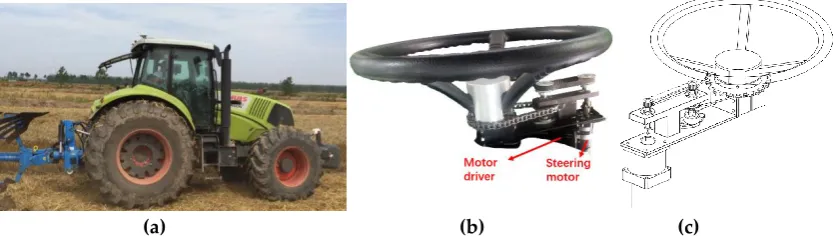
Here a traditional tractor of type AXION 850(CLAAS) is being modified into an intelligent tractor with the aid of a tractor driving robot that drives the tractor as shown in Figure 1(a). This tractor driving robot consists of a steering arm, a gears-shifting arm, a break leg, a clutch leg and an accelerator leg which can operate a tractor imitating a tractor driver. The steering arm uses motor to driver the steering wheel of the tractor through gears and chain, shown in Figure1(b)and(c). Moreover, a camera (BLUELOVER, resolution 1280×980) and an RTK GPS (X10, Huace Co., China) are installed on the tractor for automated guided operation.
The tillage procedure of the intelligent tractor includes two steps. Firstly, the tractor tills a round line under manual control or teleoperation control to create a boundary between new and old soil. Then the tractor works at autonomous navigation model based on the boundary calculated by using Guided Filtering, improved anti-noise morphology and Hough transformation in sequence in consideration of the severe randomness and ununiform of agricultural filed environment.
(a) (b) (c)
Figure 1. Intelligent tractor platform. (a) Tractor platform; (b) Steering configuration; (c) Structural schematic
diagram of the steering configuration.
2.1. Guided Filtering 2.1.1. Local linear model
Denote the input image as 𝐼 which is the image to be filtered, and the output as 𝑞. The local linear model of guided filter assumes that 𝑞 is a linear transform of the 𝐼 in a window 𝑤𝑘 centered at pixel 𝑘, so 𝑞𝑖 which is a pixel in 𝑞 can be expressed as
𝑞𝑖= 𝑎𝑘𝐼𝑖+ 𝑏𝑘 , ∀𝑖 ∈ 𝑤𝑘 (1) Where 𝑎 and 𝑏 are the coefficients of the linear function when the window is centered at the pixel index value 𝑘, 𝑖 and 𝑘 are the index of a pixel.
After gradient operation on both sides of the formula (1), we get
𝛻𝑞 = 𝑎𝛻𝐼 (2) Where 𝑞 and 𝐼 have similar gradients, so the output 𝑞 maintains the same edge characteristics with 𝐼.
2.1.2. Local linear model solution
The process of calculating linear function coefficients is called linear regression. Define the true value of the fitting function 𝑝, so the difference value between 𝑝 and the actual output is as below.
𝐸(𝑎𝑘, 𝑏𝑘) = ∑𝑖∈𝑤𝑘((𝑎𝑘𝐼𝑖+ 𝑏𝑘− 𝑝𝑖)2+ 𝜀𝑎𝑘2) (3) Where 𝑝 denotes the image to be filtered; 𝜀 is a parameter used for adjusting filtering effect whose purpose is to prevent a value from being too large. The filtering effect improves remarkably with the increment of 𝜀. Minimizing formula (3) transforms it to a least square problem within a certain window 𝑤𝑘, where the solution is given by:
𝑎𝑘=
1
|𝑤|∑𝑖∈𝑤𝑘𝐼𝑖𝑝𝑖−𝜇𝑘𝑝𝑘
𝜎𝑘2+𝜀 (4)
𝑏𝑘= 𝑝𝑘− 𝑎𝑘𝜇𝑘 (5) In which 𝜎𝑘2 and 𝜇𝑘 are the variance and mean of 𝐼 in 𝑤𝑘, 𝑝𝑘 is the average value of the image 𝑝 to be filtered in the window, |𝑤| denotes the number of pixels contained in the window.
In view of the fact that a pixel can be described by multiple linear functions, all linear function values containing the point are weighted averaged when calculating the output value of the point in the formula below.
𝑞𝑖 = 1
|𝑤|∑𝑖∈𝑤𝑘(𝑎𝑘𝐼𝑖+ 𝑏𝑘)= 𝑎𝜏𝐼𝑖+ 𝑏𝜏 (6)
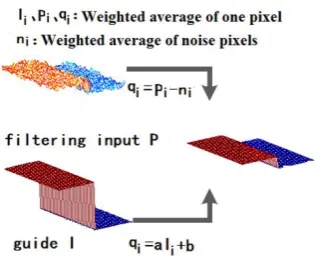
The process of weighted averaging is a linear translational variation filtering process, and the calculation of the Guided Filtering is based on this process.
Figure 2.The Guided Filtering process.
2.2. Improved anti-noise morphology algorithm for image navigation line extraction
Introducing the concept of mathematical morphology [15-19] to the image edge detection operator can overcome the shortcomings of the classical operator [20-22] and can greatly reduce the calculation amount. This paper proposed an improved anti-noise morphology algorithm for image navigation line extraction which selects a pair of smaller-scale structuring elements for further anti-noise processing to extract image navigation line based on the edge feature.
In the mathematical morphology algorithm, structuring elements should be selected according to actual needs. Small-scale structuring elements can make the extracted image edges more detailed and coherent, and obtain more accurate edge localization, whereas large-scale structuring elements can reflect the large edge contours in the image and have good noise suppression effect. Therefore, small-scale structuring elements were selected for obtaining complete edges in this paper.
The edge of the image is calculated as below:
𝑦𝑑 = (((𝑓 ∘ 𝐴1) ⋅ 𝐴2) ⊕ 𝐴2) ∘ 𝐴2− (𝑓 ∘ 𝐴1) ⋅ 𝐴2 (7)
𝑦𝑒= (𝑓 ∘ 𝐴1) ⋅ 𝐴2− (((𝑓 ∘ 𝐴1) ⋅ 𝐴2)𝛩𝐴2) ⋅ 𝐴2 (8) Where 𝐴1and 𝐴2 are two different structuring elements:
𝐴1= [0,1,0; 1,1,1; 0,1,0]
𝐴2= [1,0,0; 1,0,0; 1,0,0];
𝑓 is the image after Guided Filtering treatment. The anti-noise morphology edge detection operator is given as follows:
𝑦𝑑𝑒 = 𝑦𝑑+ 𝑦𝑒 (9) By some ordinary operations the edge information can be easily obtained from the images of the edges detected by equation (7) and (8). For detecting more detailed edges as well as improving the anti-noise ability of 𝑦𝑑𝑒 under the condition of equal noise, the noise immunity is defined as
𝑦 = 𝑦𝑑𝑒+ 𝐸𝑚𝑖𝑛 (10) Where 𝐸𝑚𝑖𝑛 is 𝑚𝑖𝑛{ 𝑦𝑑, 𝑦𝑒}; 𝑦𝑑 is the edge detected by equation (7); 𝑦𝑒 is the edge detected by equation (8); 𝑦𝑑𝑒 is the edge detected by equation (9).
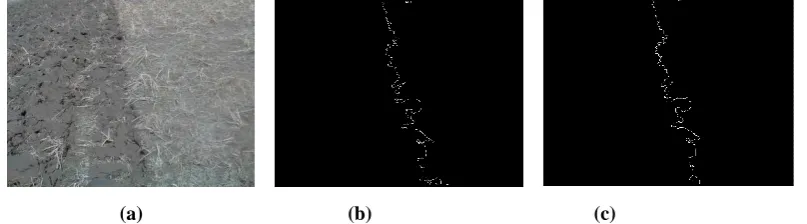
The new and old soil boundary line extracted by using the algorithm mentioned above is shown in Figure 3(b) and Figure 3(c) shows the boundary line extracted by color space conversion followed by threshold processing. There are remarkable errors at both ends of the navigation line in Figure 3(b) because of the calculation error caused by the truncation of the image, whereas it is obvious that the truncation error in Figure 3(c) is significantly improved for navigation line extraction.
(a) (b) (c)
Figure 3. The edge processing comparison. (a) Original; (b) Edge information; (c) Processed edge
information.
camera image as shown in Figure 4 where the front lines 𝑙𝑓 in the left view and right view are rotated to an acute angle (𝜃0𝑙) and an obtuse angle (𝜃0𝑟) to the horizontal line 𝑙ℎ.
(a) (b)
Figure 4. Direction correction diagram. (a) Left view; (b) Right view.
For simplifying the adjustment algorithm of the navigation line, the actual direction angle 𝜃 of the tractor is calculated as:
𝜃 = 𝜑 ⋅ 𝑘 (𝑘 =90°
𝜃0) (11)
Where 𝜑 denotes the navigation angle between the new and old soil boundary and the horizontal line of the tractor extracted from the image. 𝜃𝑒′ is the angle between the front line and the new and old soil boundary, 𝜃0 is the angle between the front line and the horizontal line in the image and equal to 𝜃0𝑙 and 𝜃0𝑟 respectively when the boundary line gets located at the left side and right side of the tractor.
During tractor navigation using new and old soil boundary line, 𝜃0 and 𝑘 are calculated as initialization. Then the navigation angle 𝜃 is obtained after navigation line extraction from the image.
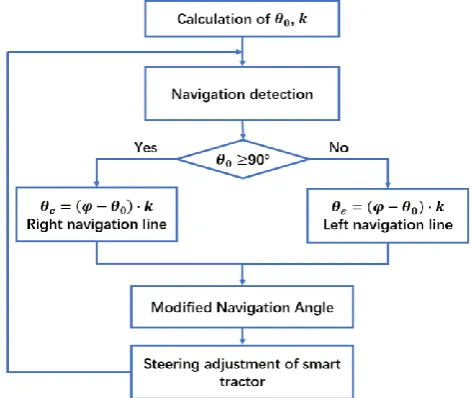
The tractor needs to turn left if the navigation angle 𝜃 is not more than 90° otherwise it needs
to turn right whether the boundary line locates at the left or right side of the tractor. The steering adjustment algorithm flowchart is a detailed algorithm flowchart of steering adjustment as shown in Figure 5.
Figure 5. Steering adjustment algorithm flowchart.
Figure 6. Improved anti-noise morphological algorithm.
3. Experiment
In this paper, the computer employed for the new and old soil boundary navigation line extraction is configured as follows: 64-bit Windows 10 operating system, 8G memory, and a 2-core processor Intel(R) Core(TM) i5-4200H CPU @ 2.80 GHz. The first experiment was carried out to verify the effectiveness of the proposed algorithm mentioned above using several tillage images of different farms. Secondly, the navigation algorithm was used for smart tractor tillage in an experimental farm of Nanjing Agricultural University. Moreover, the optimal template was studied to improve the efficiency of the algorithm.
3.1. Effectiveness verification of the algorithm 3.1.1. Color space selection
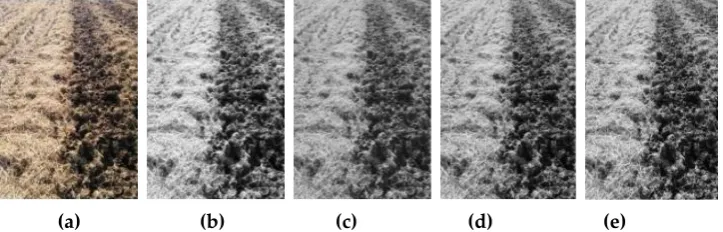
The time consumption and each optimal effect component of the YCbCr, HSV, HIS, and 2R-G-B [23-26] format images converted from the original image are shown in Table 1 and Figure 7, which indicate that the new and old soil boundary in the Cr component in YCbCr format image is clearest among all the gradation component images as well as it has the fastest conversion speed of around 0.094 𝑠.
Table 1. Consumption contrast of different color spaces.
Color Space Time loss/s
YCbCr 0.094
HSV 1.541
HIS 1.639
RGB 0.126
1. Convert grayscale image 𝑞 into binary image ℎ;
2. Narrow down the research template and select the area of interest 𝑓 in ℎ for research; 3. Select structuring elements:
𝐴1= [0,1,0; 1,1,1; 0,1,0]
𝐴2= [1,0,0; 1,0,0; 1,0,0];
4. Structure elements 𝐴1 and 𝐴2 filter image 𝑓 and get the image edge: 𝑦𝑑= (((𝑓 ∘ 𝐴1) ⋅ 𝐴2) ⊕ 𝐴2) ∘ 𝐴2− (𝑓 ∘ 𝐴1) ⋅ 𝐴2
𝑦𝑒= (𝑓 ∘ 𝐴1) ⋅ 𝐴2− (((𝑓 ∘ 𝐴1) ⋅ 𝐴2)𝛩𝐴2) ⋅ 𝐴2;
5. Perform the minimum operation on the image edge obtained in step 4 to get the detail edge:
𝐸𝑚𝑖𝑛= 𝑚𝑖𝑛{𝑦𝑑, 𝑦𝑒}; 6. Edge extraction: 𝑦𝑑𝑒 = 𝑦𝑑+ 𝑦𝑒;
7. Sum the edges of the images in step 5 and step 6 to get the final image edge: 𝑦 = 𝑦𝑑𝑒+ 𝐸𝑚𝑖𝑛;
8. Filter and remove boundary objects in 𝑓;
(a) (b) (c) (d) (e)
Figure 7. Component graph of each other space. (a) Original; (b) Cr; (c) V; (d) I; (e) 2R-G-B.
Besides, the histogram of the best gradation component in each image, shown in Figure 8, denotes that the frequencies of I and V gradation components are constantly zero, 2R-G-B gradation component has less obvious threshold segmentation pixel number whereas Cr gradation component has apparent threshold segmentation point at 15 pixels. So, the Cr component is selected for the identification of new and old soil boundary.
Figure 8. Histogram comparison of Y, V, I, 2R-G-B.
3.1.2. Filtering method selection
Now as the illumination strength in the filed does not remain constant hence to make the algorithm robust, images used in filter selection were captured in both weak and strong light environment as shown in Figure 9.
(a) (b)
Figure 9. Fields with different illumination strength. (a) Weak light intensity; (b) Strong light
intensity.
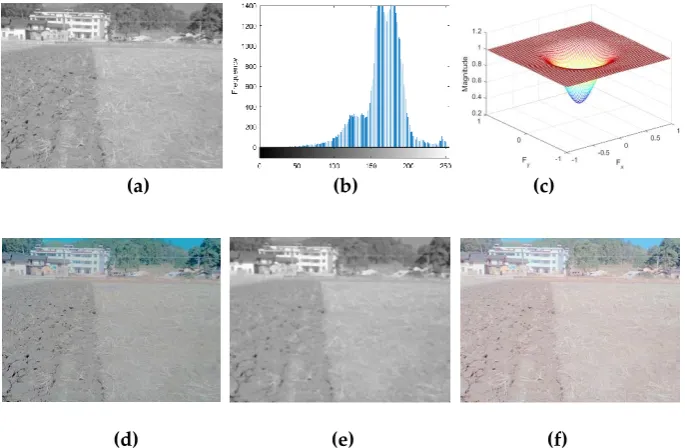
results under both the weak and strong light intensities are shown in Figure 10 and Figure 11 respectively. However as shown in the below figures, the Homomorphic Filtering method is not suitable for extracting the boundary line between new and old soil as the slow varying components are more in proportion than the abrupt components in the field tillage images.
(a) (b) (c)
(d) (e) (f)
Figure 10. The process of the weak light intensity image using Homomorphic Filtering algorithm. (a) Grayscale; (b) Grayscale histogram; (c) Frequency response of the high pass filter; (d) Butterworth high pass Filtering; (e) Median Filtering; (f) Homomorphic Filtering.
(a) (b) (c)
(d) (e) (f)
Figure 11. The process of the strong light intensity image using Homomorphic Filtering algorithm. (a) Grayscale; (b) Grayscale histogram; (c) Frequency response of the high pass filter; (d) Butterworth high pass Filtering; (e) Median Filtering; (f) Homomorphic Filtering.
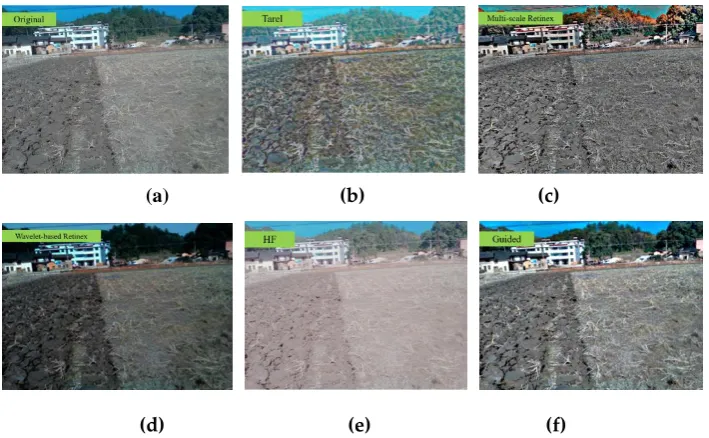
to identify the boundaries using the binarization method. The Guided Filtering algorithm can enhance the contrast between the new and old soil which make it convenient for the boundary extraction.
(a) (b) (c)
(d) (e) (f)
Figure 12. The input image and experiment results of the filtering algorithm. (a) Original; (b) Tarel; (c) Multi-scale Retinex; (d) Wavelet-based Retinex; (e) HF; (f) Guided.
The contrastive calculation time of the filtering algorithms mentioned above is shown in Table 2. Among them, the image processing time of the Guided Filtering algorithm is only 0.113 𝑠 followed by Multi-scale Retinex, HF, Tarel and Wavelet-based Retinex algorithms which take 0.552 𝑠, 0.867 𝑠, 0.902 𝑠 and 1.008 𝑠 respectively.
Table 2. The testing data to the different filtering methods.
Filtering method Highlighting Time loss/s
Tarel - 0.902
Multi-scale Retinex + 0.552
Wavelet-based Retinex + 1.008
HF - 0.867
Guided + 0.113
So, the Guided Filtering algorithm is selected for new and old soil boundary identification considered the image processing speed and the contrast of the new and old soil.
3.1.3. Navigation line extraction using improved anti-noise morphology algorithm
(a) (b)
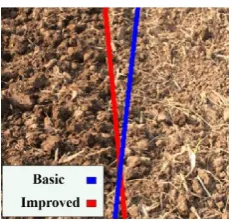
Figure 13. Edge results comparing different morphological processing. (a) Basic morphology; (b)
Improved anti-noise morphology.
Figure 14. Results of Hough transform.
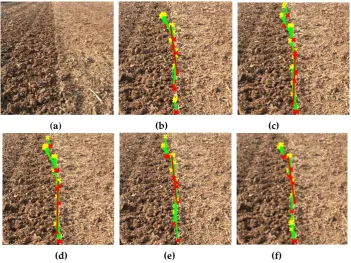
Different edge extraction results obtained by applying improved anti-noise morphology algorithm and other popular existing edge extraction algorithms such as Sobel [36-40], Roberts [41,42], Prewitt [43,44] and Log [45] are shown in Figure 15. There are some breakages in the extracted edges by using the later four algorithms which will lead to large error during navigation line identification processing. Moreover, the longest extracted navigation line created by using the improved anti-noise morphology combined with Hough transform method has best precision compared with others as shown in Figure 16.
(a) (b) (c)
(d) (e) (f)
Figure 15. The results of edge detection. (a) Original; (b) Sobel; (c) Roberts; (d) Prewitt; (e) Log; (f)
(a) (b) (c)
(d) (e) (f)
Figure 16. The longest line of operators. (a) Original; (b) Sobel; (c) Roberts; (d) Prewitt; (e) Log; (f) Improved anti-noise morphology.
The time consumption of the above algorithms is shown in Table 3. Among them, the time consumption of the improved anti-noise morphology is minimal, followed by the Sobel operator, the Roberts operator, the Prewitt operator, and the Log operator. The longest line is used as the tractor navigation line to calculate the orientation error for steering adjustment of the tractor.
Table 3. Time consumption contrast of different edge operators.
Edge operators Time loss/s
Sobel Roberts Prewitt
Log
Improved anti-noise morphology
0.089 0.090 0.090 0.096 0.073
3.1.4. Image template optimization
In order to further improve the real-time vision navigation during linear tillage operation of the tractor, the appropriate image should be cropped from the whole original image because a larger size picture needs more computer processing time. Tractor tillage operation includes two work mode, i.e. linear mode and turning mode. During the linear mode, at first the longest line of new and old soil boundary is created using the above improved anti-noise morphology algorithm. Then a rectangle centered at the middle of the longest line is used to crop a part of the original picture for navigation line calculation because the position and the navigation angle of boundary line of the soil change a little. During the turning mode, the original image should be adopted for navigation because the position of the boundary in the image varies a lot which leads to the boundary information loss in the rectangle.
The optimization template selection scheme is as follows:
(1) The original image is transformed to gray scale and uniformly scaled to 816 × 612 pixels. (2) The middle of the longest line is used as a reference point.
(a) (b)
Figure 17. Different templates. (a) Rectangular frame selection; (b) Navigation line extraction result.
The experimental results, shown in Figure 17(b), denote that the navigation angle error decreases significantly when the length and width are not less than 260 and 140 pixels respectively. When the template is less than 140 × 260 pixels, then the boundary information decreases with the shrinkage in template size as the size of the boundary signal in the image below that template size is not more than that of the background noise. Moreover, the processing of the algorithm costs only 47 𝑚𝑠 for the template size of 140 × 260 pixels compared with that containing 816 × 612 pixels with time consumption of 520 𝑚𝑠.
3.2. Navigation experiment in the field
The autonomous navigation experiment using the proposed new and old soil boundary was carried out in the farmland of Nanjing Agricultural University using a tractor (CLAAS AXION 850 model) equipped with the tractor driving robot developed by our team. For comparing the navigation precision, an RTK GPS (X10, Huace Co., China) was applied and the navigation line was used as the reference, as shown in Figure 18.
Figure 18. Tractor experiment diagram.
to the new and old soil boundary line. A navigation line identification diagram in the experiment is shown in Figure 19.
Figure 19. Navigation line extraction.
Firstly, the applied condition on the optimal template containing 140 × 260 pixels was studied by altering the deviation angle 𝜃e between the tractor’s longitudinal direction and the boundary between new and old soil. The experimental results indicate that, in Figure 20, the vision navigational deviation error δ increase dramatically when 𝜃e is more than 7.5° which means that the optimal template is suitable for the tractor body course error ranged between 𝜃em= [−7.5°, +7.5°]. Then the limit of the tillage operational speed of the tractor was studied based on the total processing time of the algorithm 𝑡 = 0.33 𝑠, the maximum permissible deviation angle 𝜃em, the physical field size corresponding to the optimal template of 140 × 260 pixels and the maximum deviation distance 𝑑max.
𝑑
𝑚𝑎𝑥=
0.62𝑠𝑖𝑛 7.5°
= 4.75𝑚
(12)𝑣
𝑚𝑎𝑥=
𝑑𝑚𝑎𝑥𝑡
= 14.40𝑚/𝑠 = 51.41𝑘𝑚/ℎ
(13)Figure 20. Error research.
Figure 21. Maximum allowable velocity.
Based on the above study, the vision navigation method is shown in the flowchart (Figure 22). The optimal template is adopted when the deviation angle 𝜃e is less than 7.5°, otherwise, the global template is applied for navigation.
Figure 22. Template selection algorithm.
4. Discussion and Conclusion
Automatic navigation in the field is a pivotal technology for intelligent agricultural machinery [46]. The satellite navigation technology such as GPS and BDS are applied in field operation of tractors by combined use of RTK technology with the disadvantage of high cost for reach centimeter-level navigation accuracy, but this absolute position navigation technology will lead to a cumulative error. In addition, it will also cause navigation failure or large errors due to the complicated farmland environment such as uneven ground and micrometeorology of remote farmland that will generate signal-interrupt [47]. LiDAR was used for agricultural robot navigation in orchard [48] and seedling crops [49] but need tall plants or trees as a reference. So, visual navigation method was introduced to agricultural machinery navigation. The central position of a cotton seedling row was identified as a navigation line for tractor navigation according to the regional vertical cumulative distribution graph of the images [50]. Green maize seedlings were identified and the accumulation of green pixels were used to extract curved and straight crop row for tractor navigation [51]. Most existed papers extracted the visual navigation line based on the color difference between the crops with the background.
ununiform, uneven illumination, straw disturbance. The accuracy of navigation angle of the proposed algorithm is not less than 0.5° compared with the precision of 1.15° using combination of RTK-GPS and IMU [52].
The optimal size of image is studied for improving the algorithm speed. The optimal template of 140 × 260 pixels is applied when the deviation angle 𝜃e is less than 7.5°. At this time, the navigation line extracted from the edge information processed by the improved anti-noise morphological operator with the aid of Hough transform is the most accurate and the fastest where the time consumption is only 0.047 𝑠. Under this optimal circumstance the real-time navigation of the tractor body can be satisfied as long as the tractor speed no more than 51.41 𝑘𝑚/ℎ. In our earlier discussion, the image processing time of the Guided Filtering algorithm is only 0.113 𝑠. Followed by Multi-scale Retinex, HF, Tarel and Wavelet-based Retinex algorithms which take 0.552 𝑠, 0.867 𝑠, 0.902 𝑠 and 1.008 𝑠 respectively. Moreover, as shown earlier the time consumption of the improved anti-noise morphology is minimal, followed by the Sobel operator, the Roberts operator, the Prewitt operator, and the Log operator. However the global template is used to satisfy the real-time visual navigation of the vehicle body when the course deviation is greater than 7.5° and the speed of the tractor is no more than 27.47 𝑘𝑚/ℎ .
The experiment results show that the navigation line extraction algorithm in this paper takes less time and has a good effect in the complex farmland environment. Therefore, the fast navigation line extraction method based on improved anti-noise morphology has the advantages of short time consumption and high precision and can meet the requirements of real-time vision navigation in the field tillage of intelligent tractor, which has important practical application value.
Future work will introduce the Thin-Plate Spline interpolation algorithm to calibrate colors in sRGB space [53], the depth camera [54] and advance artificial intelligent algorithms [55,56] for improving navigation precision, speed and robust during tractor tillage operation.
Author Contributions: W. L. proposed the conceptualization and methodology, and wrote the paper. M. Z.
programed the software. L. W. compared the performance of the algorithms. H. L. designed and carried out the experiments. Y. D. improved the methodology and conceived the experiment. S. M. and X. H. participated in the article discussion and revision. All authors reviewed the manuscript.
Funding: This research was funded by the National Natural Science Foundation of China (No. 11604154), the Natural Science Foundation of Jiangsu Province (No. BK20181315), the Agricultural Machinery Three New Project (No.SZ120170036), the Asia hub on WEF and Agriculture, and the NAU-MSU Joint Project (No.2017-H-11), and the Key Research Plan of Yangzhou (No. YZ2018038).
Conflicts of Interest: The authors declare no conflict of interest.
References
1. Khutaevich, A.B. A Laboratory Study of the Pneumatic Sowing Device for Dotted and Combined Crops. Ama-Agricultural Mechanization in Asia Africa and Latin America 2019, 50, 57-59.
2. Paraforos, D.S.; Hubner, R.; Griepentrog, H.W. Automatic determination of headland turning from auto-steering position data for minimising the infield non-working time. Computers and Electronics in Agriculture 2018, 152, 393-400, doi:10.1016/j.compag.2018.07.035.
3. Wang, J.; Yan, Z.; Liu, W.; Su, D.; Yan, X. A Novel Tangential Electric-Field Sensor Based on Electric Dipole and Integrated Balun for the Near-Field Measurement Covering GPS Band. Sensors 2019, 19, doi:10.3390/s19091970.
4. Zhang, C.; Zhao, X.; Pang, C.; Zhang, L.; Feng, B. The Influence of Satellite Configuration and Fault Duration Time on the Performance of Fault Detection in GNSS/INS Integration. Sensors 2019, 19, doi:10.3390/s19092147.
5. Mitterer, T.; Gietler, H.; Faller, L.-M.; Zangl, H. Artificial Landmarks for Trusted Localization of Autonomous Vehicles Based on Magnetic Sensors. Sensors 2019, 19, doi:10.3390/s19040813.
7. He, S.; Cha, J.; Park, C.G. EKF-Based Visual Inertial Navigation Using Sliding Window Nonlinear Optimization. Ieee Transactions on Intelligent Transportation Systems 2019, 20, 2470-2479, doi:10.1109/tits.2018.2866637.
8. Li, Y.; Wang, X.; Liu, D. 3D Autonomous Navigation Line Extraction for Field Roads Based on Binocular Vision. Journal of Sensors 2019, doi:10.1155/2019/6832109.
9. He, K.; Sun, J.; Tang, X. Guided Image Filtering. Ieee Transactions on Pattern Analysis and Machine Intelligence 2013, 35, 1397-1409, doi:10.1109/tpami.2012.213.
10. Majeeth, S.S.; Babu, C.N.K. Gaussian Noise Removal in an Image using Fast Guided Filter and its Method Noise Thresholding in Medical Healthcare Application. Journal of medical systems 2019, 43, 280-280, doi:10.1007/s10916-019-1376-4.
11. Xie, W.; Jiang, T.; Li, Y.; Jia, X.; Lei, J. Structure Tensor and Guided Filtering-Based Algorithm for Hyperspectral Anomaly Detection. Ieee Transactions on Geoscience and Remote Sensing 2019, 57, 4218-4230, doi:10.1109/tgrs.2018.2890212.
12. Han, Y.; Yang, J.; He, X.; Yu, Y.; Chen, D.; Huang, J.; Zhang, Z.; Zhang, J.; Xu, S. Multiband notch filter based guided-mode resonance for mid-infrared spectroscopy. Optics Communications 2019, 445, 64-68, doi:10.1016/j.optcom.2019.04.018.
13. Babashakoori, S.; Ezoji, M. Average fiber diameter measurement in Scanning Electron Microscopy images based on Gabor filtering and Hough transform. Measurement 2019, 141, 364-370, doi:10.1016/j.measurement.2019.04.051.
14. Guan, J.G.; An, F.W.; Zhang, X.Y.; Chen, L.; Mattausch, H.J. Energy-Efficient Hardware Implementation of Road-Lane Detection Based on Hough Transform with Parallelized Voting Procedure and Local Maximum Algorithm. Ieice Transactions on Information and Systems 2019, E102D, 1171-1182, doi:10.1587/transinf.2018EDP7279.
15. Nachtegael, M.; Kerre, E.E. Connections between binary, gray-scale and fuzzy mathematical morphologies. Fuzzy Sets and Systems 2001, 124, 73-85, doi:10.1016/s0165-0114(01)00013-6.
16. Yang, J.; Li, X.B. Boundary detection using mathematical morphology. Pattern Recognition Letters 1995, 16, 1277-1286, doi:10.1016/0167-8655(95)00082-1.
17. Andrade, A.O.; Prado Trindade, R.M.; Maia, D.S.; Nunes Santiago, R.H.; Guimaraes Guerreiro, A.M. Analysing some R-Implications and its application in fuzzy mathematical morphology. Journal of Intelligent and Fuzzy Systems 2014, 27, 201-209, doi:10.3233/ifs-130989.
18. Zhang, J. Research on Image Processing Based on Mathematical Morphology. Agro Food Industry Hi-Tech 2017, 28, 2738-2742.
19. Sussner, P.; Valle, M.E. Classification of fuzzy mathematical morphologies based on concepts of inclusion measure and duality. Journal of Mathematical Imaging and Vision 2008, 32, 139-159, doi:10.1007/s10851-008-0094-1.
20. Fan, P.; Zhou, R.-G.; Hu, W.W.; Jing, N. Quantum image edge extraction based on Laplacian operator and zero-cross method. Quantum Information Processing 2019, 18, doi:10.1007/s11128-018-2129-x.
21. Kaisserli, Z.; Laleg-Kirati, T.-M.; Lahmar-Benbernou, A. A novel algorithm for image representation using discrete spectrum of the Schrodinger operator. Digital Signal Processing 2015, 40, 80-87, doi:10.1016/j.dsp.2015.01.005.
22. He, Q.; Zhang, Z. A new edge detection algorithm for image corrupted by White-Gaussian noise. Aeu-International Journal of Electronics and Communications 2007, 61, 546-550, doi:10.1016/j.aeue.2006.09.008. 23. Kamiyama, M.; Taguchi, A. HSI Color Space with Same Gamut of RGB Color Space. Ieice Transactions on
Fundamentals of Electronics Communications and Computer Sciences 2017, E100A, 341-344, doi:10.1587/transfun.E100.A.341.
24. Alonso Perez, M.A.; Baez Rojas, J.J. Conversion from n bands color space to HSI (n) color space. Optical Review 2009, 16, 91-98, doi:10.1007/s10043-009-0016-5.
25. Lissner, I.; Urban, P. Toward a Unified Color Space for Perception-Based Image Processing. Ieee Transactions on Image Processing 2012, 21, 1153-1168, doi:10.1109/tip.2011.2163522.
26. Zhang, Z.; Shi, Y. Skin Color Detecting Unite YCgCb Color Space with YCgCr Color Space. Proceedings of 2009 International Conference on Image Analysis and Signal Processing 2009, 221-225.
27. Adelmann, H.G. Butterworth equations for homomorphic filtering of images. Computers in Biology and Medicine 1998, 28, 169-181, doi:10.1016/s0010-4825(98)00004-3.
29. Yoon, J.H.; Ro, Y.M. Enhancement of the contrast in mammographic images using the homomorphic filter method. Ieice Transactions on Information and Systems 2002, E85D, 298-303.
30. Highnam, R.; Brady, M. Model-based image enhancement of far infrared images. Ieee Transactions on Pattern Analysis and Machine Intelligence 1997, 19, 410-415, doi:10.1109/34.588029.
31. Kumari, A.; Sahoo, S.K. Fast single image and video deweathering using look-up-table approach. Aeu-International Journal of Electronics and Communications 2015, 69, 43-52, doi:10.1016/j.aeue.2015.09.001. 32. Zhu, M.; Su, F.; Li, W. Improved Multi-scale Retinex Approaches for Color Image Enhancement. Quantum,
Nano, Micro and Information Technologies 2011, 39, 32-37, doi:10.4028/www.scientific.net/AMR.39.32. 33. Yao, L.; Lin, Y.; Muhammad, S. An Improved Multi-Scale Image Enhancement Method Based on Retinex
Theory. Journal of Medical Imaging and Health Informatics 2018, 8, 122-126, doi:10.1166/jmihi.2018.2244. 34. Herscovitz, M.; Yadid-Pecht, O. A modified Multi Scale Retinex algorithm with an improved global
impressionof brightness for wide dynamic range pictures. Machine Vision and Applications 2004, 15, 220-228, doi:10.1007/s00138-004-0138-5.
35. Rising, H.K. Analysis and generalization of Retinex by recasting the algorithm in wavelets. Journal of Electronic Imaging 2004, 13, 93-99, doi:10.1117/1.1636763.
36. Zhang, Y.; Han, X.; Zhang, H.; Zhao, L. Edge Detection Algorithm of Image Fusion Based on Improved Sobel Operator; 2017; pp. 457-461.
37. Zhang, C.-C.; Fang, J.-D.; Atlantis, P. Edge Detection Based on Improved Sobel Operator. Proceedings of the 2016 International Conference on Computer Engineering and Information Systems 2016, 52, 129-132.
38. Wang, K. Edge Detection of Inner Crack Defects Based on Improved Sobel Operator and Clustering Algorithm. In Recent Trends in Materials and Mechanical Engineering Materials, Mechatronics and Automation, Pts 1-3, Luo, Q., Ed. 2011; Vol. 55-57, pp. 467-471.
39. Qu, Y.D.; Cui, C.S.; Chen, S.B.; Li, J.Q. A fast subpixel edge detection method using Sobel-Zernike moments operator. Image and Vision Computing 2005, 23, 11-17, doi:10.1016/j.imavis.2004.07.003.
40. Kutty, S.B.; Saaidin, S.; Yunus, P.N.A.M.; Abu Hassan, S. Evaluation of Canny and Sobel Operator for Logo Edge Detection; 2014; pp. 153-156.
41. Tao, J.; Cai, J.; Xie, H.; Ma, X. Based on Otsu thresholding Roberts edge detection algorithm research. Proceedings of the 2nd International Conference on Information, Electronics and Computer 2014, 59, 121-124. 42. Wang, A.; Liu, X.; Ieee. Vehicle License Plate Location Based on Improved Roberts Operator and Mathematical
Morphology; 2012; pp. 995-998.
43. Ye, H.; Shen, B.; Yan, S. Prewitt edge detection based on BM3D image denoising; 2018; pp. 1593-1597.
44. Yu, K.; Xie, Z. A fusion edge detection method based on improved Prewitt operator and wavelet transform. Engineering Technology and Applications 2014, 289-294.
45. Ando, T.; Hiai, F. Operator log-convex functions and operator means. Mathematische Annalen 2011, 350, 611-630, doi:10.1007/s00208-010-0577-4.
46. Han, X.Z.; Kim, H.J.; Jeon, C.W.; Moon, H.C.; Kim, J.H.; Yi, S.Y. Application of a 3D tractor-driving simulator for slip estimation-based path-tracking control of auto-guided tillage operation. Biosystems Engineering 2019, 178, 70-85, doi:10.1016/j.biosystemseng.2018.11.003.
47. Li, Y.; Wang, X.; Liu, D. 3D Autonomous Navigation Line Extraction for Field Roads Based on Binocular Vision. Journal of Sensors 2019, doi:10.1155/2019/6832109.
48. Malavazi, F.B.P.; Guyonneau, R.; Fasquel, J.-B.; Lagrange, S.; Mercier, F. LiDAR-only based navigation algorithm for an autonomous agricultural robot. Computers and Electronics in Agriculture 2018, 154, 71-79, doi:10.1016/j.compag.2018.08.034.
49. Higuti, V.A.H.; Velasquez, A.E.B.; Magalhaes, D.V.; Becker, M.; Chowdhary, G. Under canopy light detection and ranging-based autonomous navigation. Journal of Field Robotics 2019, 36, 547-567, doi:10.1002/rob.21852.
50. Li, J.B.; Zhu, R.G.; Chen, B.Q. Image detection and verification of visual navigation route during cotton field management period. International Journal of Agricultural and Biological Engineering 2018, 11, 159-165, doi:10.25165/j.ijabe.20181106.3976.
51. Garcia-Santillan, I.; Guerrero, J.M.; Montalvo, M.; Pajares, G. Curved and straight crop row detection by accumulation of green pixels from images in maize fields. Precision Agriculture 2018, 19, 18-41, doi:10.1007/s11119-016-9494-1.
53. Menesatti, P.; Angelini, C.; Pallottino, F.; Antonucci, F.; Aguzzi, J.; Costa, C. RGB Color Calibration for Quantitative Image Analysis: The "3D Thin-Plate Spline" Warping Approach. Sensors 2012, 12, 7063-7079, doi:10.3390/s120607063.
54. Tripicchio, P.; Satler, M.; Dabisias, G.; Ruffaldi, E.; Avizzano, C.A. Towards Smart Farming and Sustainable Agriculture with Drones. 2015 International Conference on Intelligent Environments Ie 2015 2015, 140-143, doi:10.1109/ie.2015.29.
55. Bauer, A.; Bostrom, A.G.; Ball, J.; Applegate, C.; Cheng, T.; Laycock, S.; Rojas, S.M.; Kirwan, J.; Zhou, J. Combining computer vision and deep learning to enable ultra-scale aerial phenotyping and precision agriculture: A case study of lettuce production. Horticulture Research 2019, 6, doi:10.1038/s41438-019-0151-5.