https://doi.org/10.5194/bg-16-1305-2019 © Author(s) 2019. This work is distributed under the Creative Commons Attribution 4.0 License.
Distribution of Fe isotopes in particles and colloids in the salinity
gradient along the Lena River plume, Laptev Sea
Sarah Conrad1, Johan Ingri1, Johan Gelting1, Fredrik Nordblad1, Emma Engström1,2, Ilia Rodushkin1,2, Per S. Andersson3, Don Porcelli4, Örjan Gustafsson5, Igor Semiletov6,7,8, and Björn Öhlander1
1Department of Chemical Engineering and Geosciences, Luleå University of Technology, Luleå, Sweden 2ALS Laboratory Group, ALS Scandinavia AB, Aurorum 10, Luleå, Sweden
3Department of Geosciences, Swedish Museum of Natural History, Stockholm, Sweden 4Department of Earth Sciences, Oxford University, Oxford, UK
5Department of Environmental Science and Analytical Chemistry, Stockholm University, Stockholm, Sweden 6International Arctic Research Center (IARC), University of Alaska, Fairbanks, AK, USA
7Pacific Oceanological Institute (POI), Far Eastern Branch of the Russian Academy of Sciences (FEBRAS), Vladivostok, Russia
8Tomsk National Research Politechnical University, Arctic Seas Carbon International Research Laboratory, Tomsk, Russia
Correspondence:Sarah Conrad ([email protected]) Received: 10 April 2018 – Discussion started: 26 April 2018
Revised: 27 February 2019 – Accepted: 12 March 2019 – Published: 28 March 2019
Abstract.Riverine Fe input is the primary Fe source for the ocean. This study is focused on the distribution of Fe along the Lena River freshwater plume in the Laptev Sea using samples from a 600 km long transect in front of the Lena River mouth. Separation of the particulate (>0.22 µm), col-loidal (0.22 µm–1 kDa), and truly dissolved (<1 kDa) frac-tions of Fe was carried out. The total Fe concentrafrac-tions ranged from 0.2 to 57 µM with Fe dominantly as particulate Fe. The loss of>99 % of particulate Fe and about 90 % of the colloidal Fe was observed across the shelf, while the truly dissolved phase was almost constant across the Laptev Sea. Thus, the truly dissolved Fe could be an important source of bioavailable Fe for plankton in the central Arctic Ocean, together with the colloidal Fe. Fe-isotope analysis showed that the particulate phase and the sediment below the Lena River freshwater plume had negative δ56Fe values (relative to IRMM-14). The colloidal Fe phase showed negativeδ56Fe values close to the river mouth (about−0.20 ‰) and positive
δ56Fe values in the outermost stations (about+0.10 ‰). We suggest that the shelf zone acts as a sink for Fe par-ticles and colloids with negativeδ56Fe values, representing chemically reactive ferrihydrites. The positiveδ56Fe values of the colloidal phase within the outer Lena River freshwater plume might represent Fe oxyhydroxides, which remain in
the water column, and will be the predominantδ56Fe com-position in the Arctic Ocean.
1 Introduction
colloids flocculate and settle in this mixing zone (Sholkovitz, 1978).
It has been recognized that dissolved Fe is related to dis-solved organic carbon (DOC) in freshwater (Perdue et al., 1976) and so, to investigate the pathways for organic car-bon (OC) in the Arctic, knowledge about Fe cycling and the coupling between the boreal–Arctic watershed and the Arc-tic basin is crucial. Iron and OC in water samples can be separated using a variety of filtration techniques. These in-clude both membrane filtration (0.22 to 0.7 µm) and ultrafil-tration (1, 10, or 30 kDa) and size fractions are thus often operationally defined as particulate matter (larger than 0.22 or 0.7 µm), colloidal (smaller than particles but do not pass an ultrafilter), and truly dissolved phases (passing through an ultrafilter). Due to the technical complexity with ultrafil-tration, including the extensive filtration time, there are few ultrafiltration Fe data available (Guo and Santschi, 1996; In-gri et al., 2000; Pokrovsky et al., 2012). Truly dissolved Fe data are scarce and deliver insights into this part of the Fe pool.
Previous studies showed that there is a relationship be-tween Fe and OC in the dissolved fraction and found two main forms of Fe compounds: Fe–OC and Fe oxyhydroxides (Escoube et al., 2015; Hirst et al., 2017b; Ilina et al., 2013; In-gri et al., 2006, 2000; Kritzberg et al., 2014; Pokrovsky et al., 2010, 2006; Pokrovsky and Schott, 2002; Raiswell and Can-field, 2012; Stolpe et al., 2013). It has also been shown that humic substances (HSs) are associated with newly formed Fe oxyhydroxides in freshwater (Pédrot et al., 2011; Tip-ping, 1981). The behaviour of these Fe and OC particles and colloids during estuarine mixing depend on their chem-ical reactivity, which is defined by their size and speciation (Poulton and Raiswell, 2005; Tagliabue et al., 2017). Hirst et al. (2017b) found that about 70 % of the total suspended Fe in the Lena River is in the form of reactive ferrihydrite. These ferrihydrites are independent particles within a network of amorphous particulate OC (POC) and are attached to the sur-faces of primary organic matter and clay particles (Hirst et al., 2017b).
Carbon–iron cycling is complex, and stable Fe-isotope data show that the isotopic compositions might be used to investigate chemical pathways for Fe and Fe bound to OC during weathering and estuarine mixing in the boreal–Arctic region (Dos Santos Pinheiro et al., 2014; Escoube et al., 2015, 2009; Ilina et al., 2013; Ingri et al., 2006; Mulholland et al., 2015; Poitrasson, 2006; Poitrasson et al., 2014). The 56Fe/54Fe and57Fe/54Fe ratios are defined relative to the in-ternational reference material IRMM-14 and are expressed as deviations from the standard in parts per thousand, or δ
notation (in per mille ‰), as
δ56Fe=
" 56Fe/54Fe sample 56Fe/54Fe
IRMM-14
−1 #
×103 (1)
δ57Fe=
" 57Fe/54Fe sample 57Fe/54Fe
IRMM-14
−1 #
×103. (2)
Using this definition, the continental crust has aδ56Fe value of 0.07±0.02 ‰ (Poitrasson, 2006). In low-temperature en-vironments theδ56Fe can vary by about 5 ‰ (Anbar, 2004; Beard et al., 2003; Fantle and DePaolo, 2004; Rouxel et al., 2005). The variations inδ56Fe can be used to trace different Fe phases in rivers (Dos Santos Pinheiro et al., 2014; Ilina et al., 2013; Ingri et al., 2006; Poitrasson et al., 2014) and to map the origin of Fe (Conway and John, 2014). Isotope frac-tionation processes result in aδ56Fe value that can be higher or lower compared to the continental crust. The Fe-isotopic composition is impacted by redox reactions (Wiederhold et al., 2006), complexation with organic ligands, and inorganic speciation of Fe, as well as the immobilization of Fe by pre-cipitation and adsorption (Beard et al., 2003, 1999; Beard and Johnson, 2004; Brantley et al., 2001; Bullen et al., 2001; Icopini et al., 2004; Poitrasson and Freydier, 2005; Skulan et al., 2002; Welch et al., 2003). These processes can yield either negative or positiveδ56Fe values, depending on the initial Fe-isotopic composition and the fractionation factor. Recent studies showed that sub-Arctic and temperate rivers, with high Fe and OC concentrations, have lowδ56Fe val-ues in the particulate phase, while the dissolved phase has highδ56Fe (Escoube et al., 2015, 2009; Ilina et al., 2013; In-gri et al., 2006; Rouxel et al., 2008; Severmann et al., 2006). Also, highδ56Fe values have been reported in the low molec-ular weight (LMW) fraction (<10 kDa), while colloids and particles showed highδ56Fe values (Ilina et al., 2013). Fur-thermore, seasonal variations in the Fe-isotopic composition and Fe speciation have been reported (Allard et al., 2004; Escoube et al., 2015; Ingri et al., 2006).
2 Sampling site and analytical methods 2.1 Study area
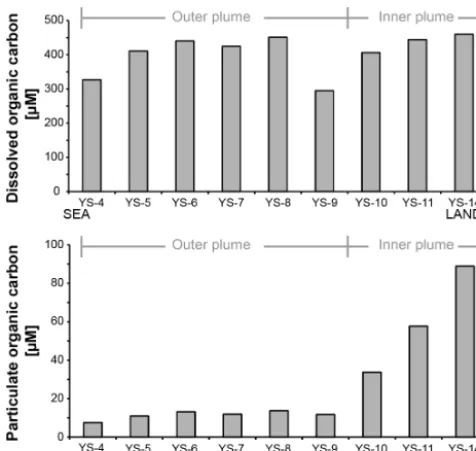
The Lena River is 4387 km long and has the eighth largest discharge in the world. It is the second largest river draining into the Arctic Ocean and flows into the Laptev Sea (Fig. 1). The Lena watershed covers an area of 2.46×10⁶km2 (Rachold et al., 1996) and is bound by the Verkhoyansk Mountain Ridge in the northeast and the central Siberian up-lands in the west. Larch forests cover 72 % of the watershed area and shrublands about 12 % (Wagner, 1997; Walter and Breckle, 2002). Permafrost underlies 78 %–93 % of the wa-tershed (Zhang et al., 1999) and extends to depths of up to 1500 m (Anisimov and Reneva, 2009). The annual discharge to the Arctic Ocean is 581 km3(Yang et al., 2002). During the spring flood, from late May to June, 31 %–45 % of the annual run-off occurs (Amon et al., 2012). The Lena River delivers 5.6–5.8 Tg of DOC into the Arctic Ocean annually (Holmes et al., 2012; Raymond et al., 2007), along with about 0.4 Tg of particulate OC (Semiletov et al., 2011). More than 50 % of the total OC (TOC) is delivered during a 2-month period in summer, with 6.6 Tg yr−1in June (Le Fouest et al., 2013) and 3.5 Tg yr−1in July (Kutscher et al., 2017). The run-off from the Lena River accounts for more of 70 % of the overall river inflow to the Laptev Sea (Antonov, 1967). The freshwater plume in the Laptev Sea is a mixing zone of about 600 km length and 50 km width (Fig. 2). A low-salinity freshwater plume overlies denser highly saline Arctic seawater (Alling et al., 2010). The Lena River plume can be divided into an inner and an outer plume based on a sharp increase in salin-ity, with salinities up to 5 in the inner plume and up to 15 in the outer plume (Alling et al., 2010). Both parts of the plume are separated by a strong halocline at about 10 m depth from the underlying dense Arctic seawater that has salinities up to 35 (Alling et al., 2010; Chester, 2003; Martin et al., 1993).
2.2 Sampling and processing
The samples were collected in August 2008 during the In-ternational Siberian Shelf Study (ISSS-08) from the RV Ya-cob Smirnitskyi. The ISSS-08 was part of the International Polar Year (IPY) and the Arctic GEOTRACES programmes. The sampling transect is 600 km long, stretching from off the Lena River mouth across the Laptev Sea, and samples from ten stations were collected after the GEOTRACES protocol (Figs. 1 and 2 and Table 1), (Cutter et al., 2010). Additionally, surface sediment (upper 2 cm) samples were taken from the Kara, Laptev, and East Siberian seas (Fig. 1). Samples from this region collected during this cruise have also been studied for DOC (Alling et al., 2010; Bröder et al., 2016; Karlsson et al., 2016; Salvadó et al., 2017), dissolved inorganic carbon (Alling et al., 2012), POC (Karlsson et al., 2016; Sánchez-García et al., 2011), nutrients and alkalinity (Anderson et al.,
2009; Pipko et al., 2017), and stable O isotopes (Rosén et al., 2015).
All water samples besides YS-14 were collected between 2.5 and 5.0 m depth using a peristaltic pump and acid-cleaned, silicon tubing. The tubing was attached to a flagpole, which was mounted to the bow of the ship. To avoid contami-nation from the ship, the flagpole was extended about 10 m in front of the ship. The samples were pumped into a 25 L con-tainer, which was rinsed with Milli-Q water between each station. Station YS-14 was sampled at 4.0 m depth using a 60 L Go-Flo®water sampler. All equipment in contact with the samples were cleaned with 5 % HNO3, rinsed with Milli-Q water, and dried in a HEPA-filtered clean-air hood. Mem-brane filtration was carried out within 12 h of sampling. All water samples were stored in acid-cleaned polyethylene (PE) bottles and acidified with ultrapure HNO3 to a pH<2, and all nitrocellulose filters (0.22 µm, Millipore®) were stored at−18◦C until further analysis (Ödman et al., 1999).
Sam-ples for POC were filtered with 0.7 µm GF/F glass-fibre fil-ters (Whatman®). The filters were pre-combusted for 4 h at 450◦C to limit the C blank.
Sediment samples were taken with a GEMAX gravity corer and a Van Veen grab sampler as described earlier (Vonk et al., 2012).
During cross-flow ultrafiltration the sample water (<
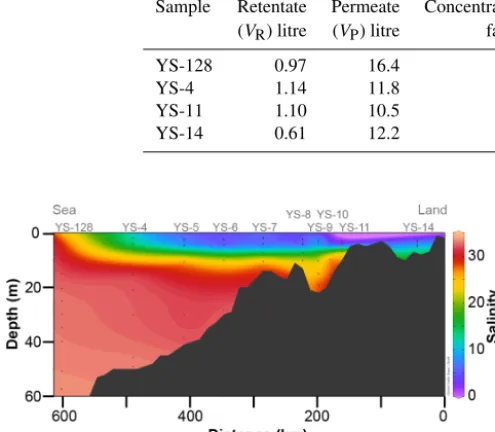
0.22 µm) flows across a membrane surface at a constant pres-sure. This process prevents clogging, while particles smaller than the membrane cut-off can pass, larger suspended parti-cles remain circulating in the sample water. The sample wa-ter progressively decreases in volume as the permeate crosses the filter, and the larger colloids and particles remain in the retentate, which is therefore progressively concentrated. The cross-flow ratio (CFR=QR/QP, whereQRandQPare the flow rates of the retentate and permeate, respectively) (Fors-berg et al., 2006; Ingri et al., 2000; Larsson et al., 2002) was kept between 60 and 100 to achieve an overall concentration factor larger than 10: (VP+VR)/VR, whereVPandVRare the final volumes of the permeate and retentate, respectively. For the concentration factors and cross-flow ratios; see Table 2. In this study, the water used for ultrafiltration was pre-filtered through a membrane (<0.22 µm) prior to introduction into the MilliPore® Prep/Scale ultrafiltration system, which had a cut-off of 1 kDa. Thus, the permeate is<1 kDa, while the retentate includes colloids between<0.22 µm and 1 kDa.
2.3 Analytical methods
Figure 1.Sampling stations in the Arctic Ocean. Black dots mark the stations on the detailed East Siberian Arctic Shelf map. Along the Lena River–Laptev Sea transect, membrane filtration and/or ultrafiltration was carried out. The sampling stations of this study follow the Lena River freshwater plume. The green numbers displayδ56Fe values measured in the uppermost sediment.
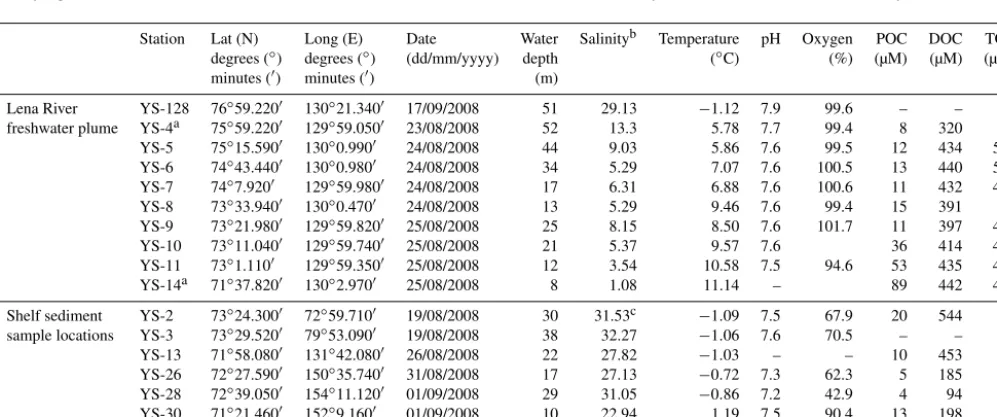
Table 1.Sampling stations in the Laptev Sea of the ISSS-08 research cruise. Temperature, salinity, pH, and oxygen data for the Lena River freshwater plume are obtained from water at a depth of 4 m, whereas the data for the shelf sediment sample locations are obtained from the overlying bottom waters. The measurements were done with a CTD Seabird 19+. Salinity is based on the Practical Salinity Scale PSS-78.
Station Lat (N) Long (E) Date Water Salinityb Temperature pH Oxygen POC DOC TOC degrees (◦) degrees (◦) (dd/mm/yyyy) depth (◦C) (%) (µM) (µM) (µM) minutes (0) minutes (0) (m)
Lena River YS-128 76◦59.2200 130◦21.3400 17/09/2008 51 29.13 −1.12 7.9 99.6 – – – freshwater plume YS-4a 75◦59.2200 129◦59.0500 23/08/2008 52 13.3 5.78 7.7 99.4 8 320 – YS-5 75◦15.5900 130◦0.9900 24/08/2008 44 9.03 5.86 7.6 99.5 12 434 503 YS-6 74◦43.4400 130◦0.9800 24/08/2008 34 5.29 7.07 7.6 100.5 13 440 543 YS-7 74◦7.9200 129◦59.9800 24/08/2008 17 6.31 6.88 7.6 100.6 11 432 454
YS-8 73◦33.9400 130◦0.4700 24/08/2008 13 5.29 9.46 7.6 99.4 15 391 –
YS-9 73◦21.9800 129◦59.8200 25/08/2008 25 8.15 8.50 7.6 101.7 11 397 437
YS-10 73◦11.0400 129◦59.7400 25/08/2008 21 5.37 9.57 7.6 36 414 441
YS-11 73◦1.1100 129◦59.3500 25/08/2008 12 3.54 10.58 7.5 94.6 53 435 468
YS-14a 71◦37.8200 130◦2.9700 25/08/2008 8 1.08 11.14 – 89 442 476
Shelf sediment YS-2 73◦24.3000 72◦59.7100 19/08/2008 30 31.53c −1.09 7.5 67.9 20 544 –
sample locations YS-3 73◦29.5200 79◦53.0900 19/08/2008 38 32.27 −1.06 7.6 70.5 – – –
YS-13 71◦58.0800 131◦42.0800 26/08/2008 22 27.82 −1.03 – – 10 453 –
YS-26 72◦27.5900 150◦35.7400 31/08/2008 17 27.13 −0.72 7.3 62.3 5 185 – YS-28 72◦39.0500 154◦11.1200 01/09/2008 29 31.05 −0.86 7.2 42.9 4 94 – YS-30 71◦21.4600 152◦9.1600 01/09/2008 10 22.94 1.19 7.5 90.4 13 198 – YS-39 71◦13.1500 169◦22.3700 04/09/2008 46 32.41 −1.64 7.4 64.3 5 46 –
aStation was also sampled for surface sediment.bSalinity, pH, and oxygen saturation for shelf sediment samples are measured in bottom water.cMeasured with a Hydrosonde M5.
carried out at Stockholm University (for analytical details; see Alling et al., 2010; Sánchez-García et al., 2011).
For element analysis, the water samples (colloidal: 1 kDa to 0.22 µm; truly dissolved: <1 kDa) were diluted (2–200 fold) with 10 % HNO3. The degree of dilution was dependent on the salinity of the sample. At least two dilutions of each sample were carried out: one high dilution for determination
[image:4.612.50.549.385.593.2]Table 2.Cross-flow ultrafiltration details.
Sample Retentate Permeate Concentration RetentateQR PermeateQP Cross-flow
(VR) litre (VP) litre factor (mL min−1) (mL min−1) ratio (CFR)
YS-128 0.97 16.4 18 >3000 30–50 60–100
YS-4 1.14 11.8 11 3000 30 100
YS-11 1.10 10.5 11 >3000 30–50 60–100
YS-14 0.61 12.2 21 >3000 30–50 60–100
Figure 2.The salinity gradient along the Lena River–Laptev Sea transect. Salinity is based on the Practical Salinity Scale PSS-78. The freshwater builds an almost 10 m thick surface layer in the Laptev Sea, and the plume itself extends over an area of about 50×600 km. The plume is divided into an inner and outer plume between stations YS-8 and YS-11 by a sharp increase in salinity.
Multi-elemental analysis of the water and filter samples was performed on an inductively coupled plasma sector field mass spectrometer (ICP-SFMS, ELEMENT2 Thermo Scien-tific) at ALS Scandinavia AB. The measurement procedure combines internal standardization and external calibration. For internal standardization, indium was added to all the so-lutions (Rodushkin et al., 2005; Rodushkin and Ruth, 1997). The analytical procedure was validated with different refer-ence materials (SLRS-4 river water CRM for trace metals, SLEW-2 estuarine water CRM for trace metals, and NASS-4 open ocean water – all supplied from National Research Council, Ottawa, Canada) (Rodushkin et al., 2005, 2016).
The blanks of digested filters (0.22 µm) for Fe were 2.79 µg L−1, which is about 0.25 % of the average Fe concen-tration in the samples for the Lena River sampling transect. Replicated measurements of sample concentrations showed a precision of ±3 % (n=4). The limit of detection for Fe in seawater (salinity 35) is 250 ppt, the salinity levels in the analysed samples were much lower, which decreases the limit of detection. Fe concentrations for the particulate, col-loidal, and truly dissolved phases are reported in Table 3. Aluminum and titanium concentrations can be found in the Supplement.
For the Fe-isotope ratio measurements, water samples (colloidal: 1 kDa to 0.22 µm) and digested filters were evap-orated to dryness, and the residue was redissolved in 1 mL 9 M HCl. Iron was separated from the matrix elements by using an AG-MP-1M ion-exchange resin (Ingri et al., 2006; Rodushkin and Ruth, 1997). After the sample was loaded, the matrix was washed with 9.6 M HCl, and Cu was eluted with 8 mL 5 M HCl. Afterwards, Fe was eluted with 6 mL 2 M HCl and can be used for further steps (Rodushkin et al., 2016). After evaporating to dryness, 50 µL of concentrated HNO3 was pipetted directly to the residue, followed by the addi-tion of 5 mL of Milli-Q water. Samples with high Fe con-tent were diluted with 0.2 M HNO3 to a concentration of 2 mg L−1 in the measurement solutions. Low Fe concen-tration water samples were further diluted to 40–50 µg L−1 and measured using high-efficiency desolvation nebulizer (Aridus) in a separate analytical sequence. Iron was sepa-rated from the matrix by ion exchange, with a recovery rate above 95 %. The Fe-isotope compositions in separated frac-tions from filters and water samples were measured using a multicollector inductively coupled plasma mass spectrom-eter (MC-ICP-MS, NEPTUNE PLUS®, Thermo Scientific) equipped with micro-concentric nebulizer and tandem cy-clonic Scott double-pass spray chamber. Instrumental mass biases were corrected by sample-standard bracketing using IRMM-14 CRM, while an internal standard (Ni) was added to all samples and used to correct for instrumental drift. Each sample was measured twice with the sample-standard brack-eting method. Detailed information on the correction pro-cedures can be found in Baxter et al. (2006). During the Fe-isotope analysis,δ56Fe andδ57Fe were measured. In the three-isotope plot ofδ56Fe andδ57Fe, all samples are plotted on a single mass fractionation line (Fig. S1 in the Supple-ment). We only discuss theδ56Fe in this study, although all Fe-isotope data are reported in Table 4, including 2σ(n=4).
3 Results
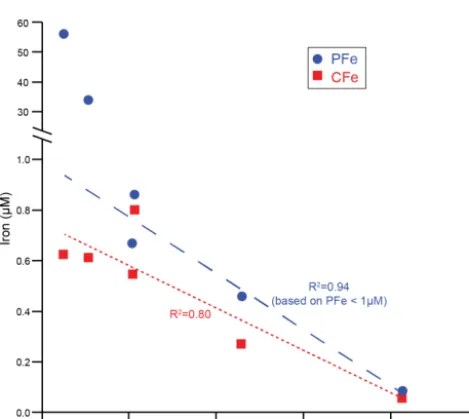
[image:5.612.45.293.91.307.2]Figure 3. Dissolved (<0.70 µm) and particulate (>0.70 µm) or-ganic carbon concentrations along the Lena River–Laptev Sea tran-sect. Close to the Lena River mouth, POC constitutes about 18 % of the TOC input, while at the outermost station it is only 2 % of the TOC.
3.1 Organic carbon distributions in the Lena River plume
The DOC concentrations show a small variation between 320 and 442 µM in the surface waters of the inner and outer plume (Table 1; Fig. 3). The average DOC concentration of 410 µM in the surface water of the Lena River freshwater plume has been reported by Alling et al. (2010) and is similar to previ-ous studies (Cauwet and Sidorov, 1996: 300–600 µM). It has been shown that DOC is behaving conservatively during mix-ing between Lena River water and Arctic Ocean water along the sampling profile (Alling et al., 2010; Opsahl et al., 1999; Pugach et al., 2018). The POC concentrations decrease from high values (89 µM) close to the coast to low values (8 µM) in the outer plume (Fig. 3). In the inner plume (14 to YS-10) the POC concentrations are high, between 89 and 36 µM, whereas in the outer plume the POC concentrations were al-most constant, with an average value of about 12 µM. The overall average POC concentration of about 28 µM has been reported earlier by Sánchez-García et al. (2011).
3.2 Iron concentrations in the Lena River freshwater plume
Three size fractions were analysed for Fe: particulate Fe (PFe; >0.22 µm), colloidal Fe (CFe; 1 kDa–0.22 µm), and truly dissolved Fe (DFe;<1 kDa). The total Fe (TFe) con-centration was calculated as the sum of PFe, CFe, and DFe (Table 3).
Figure 4.Total, colloidal, and truly dissolved Fe concentrations along the Lena River freshwater plume. Concentrations of PFe and CFe decreased along the salinity gradient, while the concentrations of DFe are almost constant. Note the logarithmic scale and the sharp decrease in PFe between the inner and the outer plume. The refer-ence for the Lena River is an average of all analysed samples (PFe
n=3; CFe and DFen=5) by Hirst et al. (2017b).
The PFe concentration decreased from 56 to 0.1 µM along the Lena River freshwater plume (Fig. 4). Between the in-ner and the outer plumes (i.e. between YS-11 and YS-8), the PFe concentration dropped to 0.9 µM, with a loss of>99 % of PFe. The loss of Fe was estimated as a fraction of the maximum Fe concentration of each size fraction (details can be found in the Supplement). The CFe concentration de-creased from 0.6 to 0.1 µM along the freshwater plume, a loss of about 90 % CFe (Fig. 4). The concentration of DFe was low, at around 8 nM, and relatively constant along the plume (Fig. 4). In total, a loss of>99 % TFe was observed between the first station (YS-14) and the last station (YS-128).
We observed non-conservative behaviour of PFe during mixing between Lena River water and Arctic Ocean water, while CFe showed generally conservative behaviour, with an almost linear correlation with salinity (Fig. 5). The PFe concentrations below 1 µM also showed an almost linear correlation at salinities above 5 in the outer plume. In the inner plume, at salinities below 5, the PFe showed non-conservative behaviour.
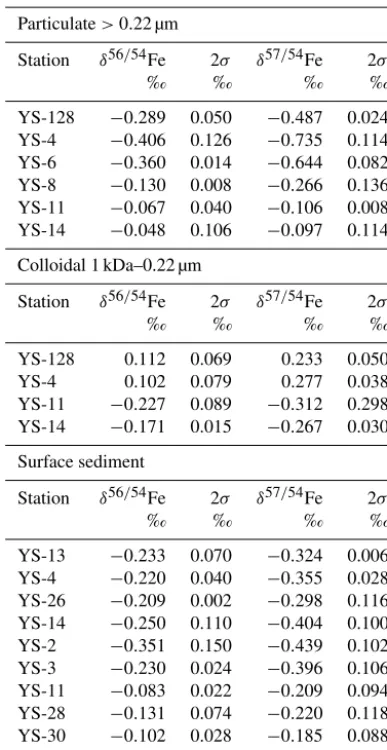
3.3 Iron isotopes in the Lena River freshwater plume The Fe-isotope compositions in the particulate and the col-loidal phases, as well as in the surface sediments, are re-ported in Fig. 6. Theδ56Fe values in the particulates var-ied between−0.05±0.11 ‰ (YS-14) in the inner plume and −0.41±0.12 ‰ (YS-4) in the outer plume (Fig. 6), with the
[image:6.612.311.545.66.175.2]Table 3.Iron concentrations of the different fractions for the Lena River freshwater plume.
Station Location Particulate Colloidal Truly dissolved Total pFe/cFe
µM µM nM µM mol ratio
YS-128 Lena transect; Laptev Sea 0.1 0.1 8 0.2 1
YS-4 Lena transect 0.5 0.3 7 0.8 2
YS-5 Lena transect – – – – –
YS-6 Lena transect 0.7 0.6 – 1.3 1
YS-7 Lena transect – – – – –
YS-8 Lena transect 0.9 0.8 – 1.7 1
YS-9 Lena transect – – – – –
YS-10 Lena transect – – – – –
YS-11 Lena transect 34.0 0.6 9 35.0 56
YS-14 Lena transect; Mohtaba Island 56.0 0.6 1 57.0 90
[image:7.612.51.286.267.477.2]Total Fe is calculated as a sum of particulate, colloidal, and truly dissolved Fe.
Figure 5.The colloidal and particulate Fe concentrations plotted vs. salinity. Salinity is based on the Practical Salinity Scale PSS-78. Note they-axis break due to the high range of PFe in the inner plume. The linear correlation between PFe and salinity is based on the data points below 1 µM PFe. In the low-salinity environment, the PFe is much higher compared to the CFe, whereas at salinities above 5 the differences are smaller.
4 Discussion
In the Laptev Sea, close to the river mouth, about 18 % of the total OC was present as POC and this was apparently rapidly lost during mixing (Fig. 3). In the outer plume only about 2 % of the total OC was present as POC. It has been sug-gested that POC in the Lena River freshwater plume is trans-ported in different forms, including large particles, which can sink, and almost neutrally buoyant flocculates of humic sub-stances (Gustafsson and Gschwend, 1997; Gustafsson et al., 2000; Sánchez-García et al., 2011). The POC, which is
as-Figure 6. Iron-isotope values along the Lena River freshwater plume and the uppermost sediment of the East Siberian Arctic Shelf (ESAS). The error bars represent±2σ. In some cases the symbol is larger than the error. Theδ56Fe values of PFe are negative at all stations: values close to zero are closer to the coast and more neg-ative ones are towards the open sea. Theδ56Fe values of the CFe are negative in the inner plume and positive in the outer plume. The
δ56Fe of the sediment samples were around−0.2 ‰, displaying the overall composition of the entire ESAS area.
sociated with larger particles (>0.7 µm), will settle close to land, whereas the humic substance flocculates will travel fur-ther out (Vonk et al., 2010).
[image:7.612.310.546.269.405.2]Table 4.Fe-isotope data for the particulate and the colloidal phase as well as Fe-isotope data for the surface sediments.
Particulate>0.22 µm
Station δ56/54Fe 2σ δ57/54Fe 2σ
‰ ‰ ‰ ‰
YS-128 −0.289 0.050 −0.487 0.024
YS-4 −0.406 0.126 −0.735 0.114
YS-6 −0.360 0.014 −0.644 0.082
YS-8 −0.130 0.008 −0.266 0.136
YS-11 −0.067 0.040 −0.106 0.008
YS-14 −0.048 0.106 −0.097 0.114
Colloidal 1 kDa–0.22 µm
Station δ56/54Fe 2σ δ57/54Fe 2σ
‰ ‰ ‰ ‰
YS-128 0.112 0.069 0.233 0.050
YS-4 0.102 0.079 0.277 0.038
YS-11 −0.227 0.089 −0.312 0.298
YS-14 −0.171 0.015 −0.267 0.030
Surface sediment
Station δ56/54Fe 2σ δ57/54Fe 2σ
‰ ‰ ‰ ‰
YS-13 −0.233 0.070 −0.324 0.006
YS-4 −0.220 0.040 −0.355 0.028
YS-26 −0.209 0.002 −0.298 0.116
YS-14 −0.250 0.110 −0.404 0.100
YS-2 −0.351 0.150 −0.439 0.102
YS-3 −0.230 0.024 −0.396 0.106
YS-11 −0.083 0.022 −0.209 0.094
YS-28 −0.131 0.074 −0.220 0.118
YS-30 −0.102 0.028 −0.185 0.088
YS-39 −0.241 0.086 −0.403 0.124
Fe (CFe+DFe) concentrations vary between 0.2 and 63 nM and the concentrations depend on distance to the shore and depths of sampling, with generally higher values in surface waters as well as close to the bottom sediment, which might be related to resuspension, sinking of brine, or resuspension from the sedimentary Fe (Klunder et al., 2012; Thuróczy et al., 2011). The CFe concentrations are higher close to the coast and decrease in the outer plume to values that are sim-ilar to CFe concentrations reported from further out in the Arctic Ocean (e.g. Thuróczy et al., 2011). Estuarine pro-cesses, including flocculation and sedimentation (e.g. Boyle et al., 1977; Sholkovitz, 1978), are the primary causes for the sharp decrease in particulate and dissolved Fe concentra-tions along the transect from the river towards the open Arc-tic Ocean. Within the estuaries, the destabilization of the Fe-rich colloids and particles by seawater cations causes floccu-lation along the salinity gradient (Escoube et al., 2009; Ger-ringa et al., 2007; Mosley et al., 2003) and successively
sed-imentation of the newly built flocculates (Daneshvar, 2015). The distribution of Fe between the different phases shows that PFe is the dominant Fe phase in the inner plume system (with a PFe/CFe ratio of about 90). However, most of the PFe is lost in the inner plume close to the shore and the ra-tio PFe/CFe decreases towards a ratio of about 1 in the outer plume.
dissolved Fe concentrations of 3 to 10 nM in the upper 20 m have been reported (Klunder et al., 2012). It has also been re-ported that about 74 % to 83 % of the dissolved Fe is present in the truly dissolved phase in the Arctic Ocean (Thuróczy et al., 2011). Slagter et al. (2017) report dissolved Fe concen-tration of 2.6 nM in the Transpolar Drift, which is transport-ing surface water from Siberian great rivers, e.g. Lena River, across the Arctic Ocean into the Atlantic. Available evidence indicates that the Ob River similarly contributes Fe into the open Arctic Ocean. Along the Ob River, the DFe shows rel-atively constant DFe concentrations of 36 to 44 nM in the 10 kDa fraction (Dai and Martin, 1995), which are some-what higher than reported here for the Lena, possibly due to a larger ultrafiltration cut-off size. The overall trend of this and earlier studies suggests a loss of DFe from the Lena River to the Lena River freshwater plume and almost constant con-centrations along the freshwater plume. The conservative be-haviour of DFe concentrations along a salinity gradient has been examined in estuarine mixing experiments, and it has been shown that freshwater Fe oxyhydroxide colloids ag-gregate into much larger particles in contact with seawater, whereas the truly dissolved phase was virtually unaffected (Gustafsson et al., 2000; Stolpe and Hassellöv, 2007). The observation that the truly dissolved phase is less affected by the increase in salinity suggests that this phase can be trans-ported through estuaries and further out into the open ocean (Laglera and Van Den Berg, 2009).
River water is the most important source of Fe for the cen-tral Arctic Ocean (Klunder et al., 2012) and estuarine pro-cesses significantly modify the amount and distribution of Fe between different fractions and therefore also the bioavail-ability of the river-derived Fe. Slomp et al. (2013) showed that Fe concentrations are likely to affect the sedimentation of organic matter and P in sediments of lakes and coastal seas. Therefore, the loss of Fe–OC aggregates close to the shoreline might also cause a great loss of phosphorous and thus contribute to the suggested “rusty carbon sink” (Lalonde et al., 2012; Salvadó et al., 2015).
4.2 Iron isotopes in the Lena River freshwater plume The measuredδ56Fe compositions in the Lena River plume are broadly similar to those reported in previous studies in other Arctic/sub-Arctic regions (e.g. Escoube et al., 2009; Staubwasser et al., 2013). In these areas, within the fully ox-idized water column, the PFe phase shows negative δ56Fe values, while the dissolved phase generally shows values enriched in Fe(III) compared to the PFe phase (Escoube et al., 2015, 2009; Ingri et al., 2006; Staubwasser et al., 2013; Zhang et al., 2015). It has been shown that the Fe-isotope composition is affected by seasonal variations in water flow paths to the river (Hirst et al., 2017a). Ingri et al. (2018) showed that the Fe-isotope composition is an in-dicator of different Fe aggregates and changing primary Fe sources throughout the season. Along the freshwater plume
the CFe phase has two different Fe-isotope compositions, positive and negativeδ56Fe values. Therefore it might also represent water masses from different seasons. This would suggest that the water masses in the inner plume represent spring flood discharge, whereas the water masses in the outer plume represent summer flow discharge. In contrast, Alling et al. (2010), claim that the age of the entire freshwater plume is approximately 2 months. All measured DOC sam-ples (400–420 µM) from their study plot on a mixing line of Lena River water measured in August and Arctic deepwater. If the water represented spring flood discharge, which has much higher DOC concentrations (1170 µM), their samples would be plotted on a different mixing line (Alling et al., 2010).
Sundman et al. (2014) measured the speciation of Fe in stream water samples with X-ray absorption spectroscopy and found iron-organic complexes with mixed speciation states of Fe as Fe(II, III)–OC and Fe(III)oxyhydroxides as-sociated with OC. The variations in the distributions of Fe between the different species in the iron-organic complexes are controlled by pH and OC concentrations (Neubauer et al., 2013; Sundman et al., 2013). The Fe speciation of these com-plexes regulate the Fe-isotopic composition. When Fe(II) is oxidized to Fe(III), the heavy56Fe is enriched in the Fe(III) phase, whereas Fe(II) becomes depleted in the56Fe isotope (Bullen et al., 2001; Homoky et al., 2012; Rouxel et al., 2008; Severmann et al., 2006; Welch et al., 2003; Wu et al., 2011). Laboratory experiments showed the existence of oxidative precipitation of Fe(II) to Fe(III) (e.g. Welch et al., 2003), which can occur in natural streams. Bullen et al. (2001) mea-sured an overall fractionation factor of about 0.9 in natural streams. Hence, Fe(III)oxyhydroxides should show a enrich-ment of56Fe in oxidized river water, while Fe(II, III)–OC complexes should show a depletion of56Fe. The differences in the Fe-isotope composition in the PFe and CFe fraction clearly indicate different sources for the two phases, as floc-culation of CFe into PFe would result in PFe with the same isotopic composition (e.g. Escoube et al., 2009). The exis-tence of two different Fe colloid pools, composed of organic-rich and Fe-organic-rich particles, was shown by Pokrovsky and Schott (2002) in small boreal rivers. Fe-isotope data from this study show the existence of two colloidal Fe phases with dif-ferentδ56Fe within the Lena River–Laptev Sea transect. The Fe-isotope values of CFe and PFe along the plume and the composition of the surface sediment suggest that the chem-ically reactive ferrihydrite represent colloids and particles, with a negativeδ56Fe value, sedimenting close to the shore-line. The Fe oxyhydroxides that remain in the water column could then be responsible for the positiveδ56Fe values in the colloidal phase in the outer plume. Therefore, in this case the Lena River is an important source of positiveδ56Fe values to the Arctic Ocean, along with small OC-rich Arctic and sub-Arctic rivers (Ilina et al., 2013; Pokrovsky et al., 2014).
re-sults from the removal of particulate and colloidal Fe(II, III)oxyhydroxides from the water column and burial in the sediment. As seen in earlier studies, flocculation during es-tuarine mixing did not fractionate the Fe-isotopic composi-tion of the colloids and particles (Bergquist and Boyle, 2006; Escoube et al., 2009; Fantle and DePaolo, 2004; Poitrasson et al., 2014). Other processes, such as resuspension of sed-iment and non-reductive dissolution of sedsed-iment to the sea-water (Radic et al., 2011), would lead to a much more nega-tive (−3.3 ‰ to−1.7 ‰) Fe-isotope composition of the sed-iment (Homoky et al., 2009; Severmann et al., 2006, 2010). Therefore, theδ56Fe of the uppermost sediment reflecting the
δ56Fe of the sedimenting colloids and particles from the wa-ter column seems reasonable.
5 Conclusions
Close to the coast and within the inner part of the river plume, the concentration of PFe dominates the total Fe budgets. In the outer part of the plume, the PFe and CFe concentrations are almost equal, as more than 99 % of the total Fe is lost. The loss of PFe, most likely in the form of chemically reactive ferrihydrite, results from increasing ionic strength due to in-creasing salinities, which promote flocculation. The coagula-tion and removal appear at the beginning of the mixing zone at low salinities (0–5). Colloidal Fe concentrations are almost constant along the inner plume and decrease along the outer plume due to conservative mixing. The truly dissolved Fe shows little variation along the Lena River freshwater plume. Therefore, the river-derived truly dissolved fraction could be an important source of bioavailable Fe, along with colloidal Fe, which may affect the primary production in the central Arctic Ocean.
The Fe-isotope compositions in the Lena River freshwa-ter plume provide clear indications of which forms of Fe reach the deep ocean basin. There are significant differences between the particulate and colloidal phases. The negative
δ56Fe values, found in the colloidal and particulate phases, are lost during estuarine mixing and buried in the sediment. These negativeδ56Fe values seem to represent chemically re-active ferrihydrite. Within the colloidal phase, we measured positiveδ56Fe values further out in the plume, which likely represent Fe oxyhydroxides, which remain buoyant in the water column, transported along the Lena River freshwater plume into the Arctic Ocean.
Data availability. Data used to generate all figures are available in the paper as tables and in the Supplement. Salinity data used to generate Fig. 2 can be found in the Bolin Centre Database at https: //bolin.su.se (last access: 22 March 2019).
Supplement. The supplement related to this article is available online at: https://doi.org/10.5194/bg-16-1305-2019-supplement.
Author contributions. JG, FN, PSA, DP, ÖG, and IS carried out the field and lab work. EE and IR performed the stable isotope analysis. SC analysed the data, prepared the figures, and wrote the manuscript under the supervision of JI and with contributions from JG, FN, PSA, EE, OS, DP, ÖG, IS, and BÖ.
Competing interests. The authors declare that they have no conflict of interest.
Acknowledgements. The ISSS-08 programme was supported by the Knut and Alice Wallenberg Foundation, the Far Eastern Branch of the Russian Academy of Sciences, the Swedish Research Council (621-2004-4039 and 211-621-2007), the U.S. National Oceanic and Atmospheric Administration, the Russian Foundation for Basic Re-search, the Swedish Polar Research Secretariat, and the Stockholm University Bert Bolin Centre for Climate Research. Örjan Gustafs-son also acknowledge a Distinguished Professor Grant from the Swedish Research Council (VR contract no. 2017-05687), an ad-vanced grant from the European Research Council (ERC-AdG CC-TOP project #695331). Igor Semiletov acknowledges the Russian Government (14.Z50.31.0012) and the Russian Scientific Founda-tion (15-17-20032). The ISSS-08 programme is part of the IPY (In-ternational Polar Year) and the GEOTRACES programme.
Review statement. This paper was edited by Aninda Mazumdar and reviewed by two anonymous referees.
References
Allard, T., Menguy, N., Salomon, J., Calligaro, T., Weber, T., Calas, G., and Benedetti, M. F.: Revealing forms of iron in river-borne material from major tropical rivers of the Ama-zon Basin (Brazil), Geochim. Cosmochim. Ac., 68, 3079–3094, https://doi.org/10.1016/J.GCA.2004.01.014, 2004.
Alling, V., Sanchez-Garcia, L., Porcelli, D., Pugach, S., Vonk, J. E., Van Dongen, B., Mörth, C. M., Anderson, L. G., Sokolov, A., Andersson, P., Humborg, C., Semiletov, I., and Gustafsson, Ö.: Nonconservative behavior of dissolved organic carbon across the Laptev and East Siberian seas, Global Biogeochem. Cy., 24, 1– 15, https://doi.org/10.1029/2010GB003834, 2010.
Alling, V., Porcelli, D., Mörth, C. M., Anderson, L. G., Sanchez-Garcia, L., Gustafsson, Ö., Andersson, P. S., and Humborg, C.: Degradation of terrestrial organic carbon, primary production and out-gassing of CO2in the Laptev and East Siberian Seas as inferred fromδ13C values of DIC, Geochim. Cosmochim. Ac., 95, 143–159, https://doi.org/10.1016/j.gca.2012.07.028, 2012. Amon, R. M. W., Rinehart, A. J., Duan, S., Louchouarn, P.,
Prokushkin, A., Guggenberger, G., Bauch, D., Stedmon, C., Ray-mond, P. A., Holmes, R. M., McClelland, J. W., Peterson, B. J., Walker, S. A., and Zhulidov, A. V.: Dissolved organic mat-ter sources in large Arctic rivers, Geochim. Cosmochim. Ac., 94, 217–237, https://doi.org/10.1016/j.gca.2012.07.015, 2012. Anbar, A. D.: Iron stable isotopes: Beyond biosignatures, Earth
Andersson, L. and Jutterstrøm, S.: Seawater carbonate chem-istry and nutrients measured on water bottle samples dur-ing the International Siberian Shelf Study 2008 (ISSS-08) in the Laptev, East Siberian and Chukchi Seas, Depart-ment of Chemistry, University of Gothenburg, PANGAEA, https://doi.org/10.1594/PANGAEA.715045, 2008.
Anderson, L. G., Jutterstrøm, S., Hjalmarsson, S., Wåhlström, I., and Semiletov, I. P.: Out-gassing of CO2from Siberian Shelf seas by terrestrial organic matter decomposition, Geophys. Res. Lett., 36, L20601, https://doi.org/10.1029/2009GL040046, 2009.
Anisimov, O. and Reneva, S.: Permafrost and
Chang-ing Climate: The Russian Perspective,
AM-BIO, 35, 169–175,
https://doi.org/10.1579/0044-7447(2006)35[169:PACCTR]2.0.CO;2, 2006.
Antonov, V. S.: The Mouth Area of the Lena, in: The Hydrographic Review, Gidrometeoizdat, Leningrad, 1967.
Asmala, E., Bowers, D., Autio, R., Kaartokallio, H., and Thomas, D. N.: Qualitative changes of riverine dissolved organic matter at low salinities due to flocculation, J. Geophy. Res.-Biogeo., 119, 1919–1933, https://doi.org/10.1002/2014JG002722, 2014. Baxter, D. C., Rodushkin, I., Engström, E., and Malinovsky,
D.: Revised exponential model for mass bias correction us-ing an internal standard for isotope abundance ratio mea-surements by multi-collector inductively coupled plasma mass spectrometry, J. Anal. Atom. Spectrom., 21, 427–430, https://doi.org/10.1039/b517457k, 2006.
Beard, B. L. and Johnson, C. M.: Ancient Earth and
Other Planetary Bodies, Rev. Mineral., 55, 319–357,
https://doi.org/10.2138/gsrmg.55.1.319, 2004.
Beard, B. L., Johnson, C. M., Cox, L., Sun, H., Nealson, K. H., and Aguilar, C.: Iron isotope biosignatures, Science, 285, 1889– 1891, https://doi.org/10.1126/science.285.5435.1889, 1999. Beard, B. L., Johnson, C. M., Von Damm, K. L., and
Poulson, R. L.: Iron isotope constraints on Fe
cy-cling and mass balance in oxygenated Earth oceans,
Geology, 31, 629–632,
https://doi.org/10.1130/0091-7613(2003)031<0629:IICOFC>2.0.CO;2, 2003.
Bergquist, B. A. and Boyle, E. A.: Iron isotopes in the Amazon River system: Weathering and transport signatures, Earth Planet. Sc. Lett., 248, 39–53, https://doi.org/10.1016/j.epsl.2006.05.004, 2006.
Boyle, E. A., Edmond, J. M., and Sholkovitz, E. R.: The mecha-nism of iron removal in estuaries, Geochim. Cosmochim. Ac., 41, 1313–1324, https://doi.org/10.1016/0016-7037(77)90075-8, 1977.
Brantley, S. L., Liermann, L., and Bullen, T. D.: Frac-tionation of Fe isotopes by soil microbes and organic acids, Geology, 29, 535–538, https://doi.org/10.1130/0091-7613(2001)029<0535:FOFIBS>2.0.CO;2, 2001.
Bröder, L., Tesi, T., Salvadó, J. A., Semiletov, I. P., Dudarev, O. V., and Gustafsson, Ö.: Fate of terrigenous organic matter across the Laptev Sea from the mouth of the Lena River to the deep sea of the Arctic interior, Biogeosciences, 13, 5003–5019, https://doi.org/10.5194/bg-13-5003-2016, 2016.
Bullen, T. D., White, A. F., Childs, C. W., Vivit, D. V., and Schultz, M. S.: Demonstration of a significant iron isotope fractionation in nature, Geology, 29, 699–702, https://doi.org/10.1130/0091-7613(2001)029<0699:DOSAII>2.0.CO;2, 2001.
Cauwet, G. and Sidorov, I.: The biogeochemistry of Lena River: organic carbon and nutrients distribution, Mar. Chem., 53, 211– 227, https://doi.org/10.1016/0304-4203(95)00090-9, 1996. Chester, R.: Marine geochemistry, 2nd Edn., Blackwell Pub,
Malden, 2003.
Conway, T. M. and John, S. G.: Quantification of dissolved iron sources to the North Atlantic Ocean, Nature, 511, 212–215, https://doi.org/10.1038/nature13482, 2014.
Cutter, G., Andersson, P., Codispoti, L., Croot, P., Francois, R., Lohan, M., van der Loeff, M. R.: Sampling and sample handling protocol for GEOTRACES cruises, Version 1.0, available at: http://www.geotraces.org/science/intercalibration/ 222-sampling-and-sample-handling-protocols-for-geotraces-cruises (last access: 22 March 2019), 2010.
Dai, M.-H. and Martin, J.-M.: First data on trace metal level and behaviour in two major Arctic river-estuarine systems (Ob and Yenisey) and in the adjacent Kara Sea, Russia, Earth Planet. Sc. Lett., 131, 127–141, https://doi.org/10.1016/0012-821X(95)00021-4, 1995.
Daneshvar, E.: Dissolved Iron Behavior in the
Raven-glass Estuary Waters, An Implication on the Early
Di-agenesis, Universal Journal of Geoscience, 3, 1–12,
https://doi.org/10.13189/ujg.2015.030101, 2015.
de Baar, H. J. W. and de Jong, J. T. M.: Distributions, sources and sinks of iron in seawater, in: Biogeochemistry of Iron in Seawa-ter, edited by: Turner, D. R. and HunSeawa-ter, K. A., Wiley, New York, 123–253, 2001.
Dos Santos Pinheiro, G. M., Poitrasson, F., Sondag, F., Cochon-neau, G., and Vieira, L. C.: Contrasting iron isotopic composi-tions in river suspended particulate matter: The Negro and the Amazon annual river cycles, Earth Planet. Sc. Lett., 394, 168– 178, https://doi.org/10.1016/j.epsl.2014.03.006, 2014.
Dudarev, O.: Cruise report International Siberian Shelf Study 2008 (ISSS-08), Swedish Knut and Alice Wallenberg Foundation, the Far-Eastern Branch of the Russian Academy of Sciences, the Swedish Research Councli, the Russian Foundation for Basic Re-search, NoAA, and the Swedish Polar Research Secretariat, Bre-merhaven, PANGAEA Documentation, Hdl:10013/epic32714, 2008.
Eckert, J. M. and Sholkovitz, E. R.: The flocculation of iron, alu-minum and humates from river water by electrolytes, Geochim. Cosmochim. Ac., 40, 847–848, 1976.
Escoube, R., Rouxel, O. J., Sholkovitz, E., and Donard, O. F. X.: Iron isotope systematics in estuaries: The case of North River, Massachusetts (USA), Geochim. Cosmochim. Ac., 73, 4045– 4059, https://doi.org/10.1016/j.gca.2009.04.026, 2009.
Escoube, R., Rouxel, O. J., Pokrovsky, O. S., Schroth, A., Max Holmes, R., and Donard, O. F. X.: Iron isotope systematics in Arctic rivers, CR Geosci., 347, 377–385, https://doi.org/10.1016/j.crte.2015.04.005, 2015.
Fantle, M. S. and DePaolo, D. J.: Iron isotopic fractionation dur-ing continental weatherdur-ing, Earth Planet. Sc. Lett., 228, 547–562, https://doi.org/10.1016/j.epsl.2004.10.013, 2004.
Figuères, G., Martin, J. M., and Meybeck, M.: Iron behaviour in the Zaire Estuary, Neth. J. Sea Res., 12, 329–337, 1978.
compari-son of techniques, Environ. Sci. Technol., 40, 3901–3905, https://doi.org/10.1021/es0600781, 2006.
Gerringa, L. J. A., Rijkenberg, M. J. A., and Wolterbeek, H. Th., Verburg, T. G., Boye, M., and de Abar, H. J. W.: Kinetic study reveals weak Fe-binding ligand, which affects the solu-bility of Fe in the Scheldt estuary, Mar. Chem., 103, 30–45, https://doi.org/10.1016/j.marchem.2006.06.002, 2007.
Gregor, J. E., Nokes, C. J., and Fenton, E.: Optimising natural or-ganic matter removal from low turbidity waters by controlled pH adjustment of aluminium coagulation, Water Res., 31, 2949– 2958, 1997.
Guieu, C., Huang, W. W., Martin, J. M., and Yong, Y. Y.: Outflow of trace metals into the Laptev Sea by the Lena River, Mar. Chem., 53, 255–267, https://doi.org/10.1016/0304-4203(95)00093-3, 1996.
Guo, L. and Santschi, P.: A critical evaluation of cross-flow ultra-filtration technique for sampling colloidal organic carbon in sea-water, Mar. Chem., 55, 113–127, https://doi.org/10.1016/S0304-4203(96)00051-5, 1996.
Gustafsson, C. and Gschwend, P. M.: Aquatic colloids: Concepts, definitions, and current challenges, Limnol. Oceanogr., 42, 519– 528, https://doi.org/10.4319/lo.1997.42.3.0519, 1997.
Gustafsson, Ö., Widerlund, A., Andersson, P. S., Ingri, J., Roos, P., and Ledin, A.: Colloid dynamics and transport of ma-jor elements through a boreal river – Brackish bay mixing zone, Mar. Chem., 71, 1–21, https://doi.org/10.1016/S0304-4203(00)00035-9, 2000.
Hirst, C., Andersson, P., Mörth, M., Kutscher, L., Murphy, M., Schmitt, M., Petrov, R., Maximov, T., and Porcelli, D.: Seasonal Variations in the Sources and Formation of Fe-Bearing Particles in the Lena River Basin; Evidence from Iron Isotopes, Goldschmidt Abstracts, 1643, available at: https://goldschmidtabstracts.info/abstracts/abstractView?id= 2017004101 (last access: 22 March 2019), 2017a.
Hirst, C., Andersson, P. S., Shaw, S., Burke, I. T., Kutscher, L., Mur-phy, M. J., Maximov, T., Pokrovsky, O. S., Mörth, C. M., and Porcelli, D.: Characterisation of Fe-bearing particles and colloids in the Lena River basin, NE Russia, Geochim. Cosmochim. Ac., 213, 553–573, https://doi.org/10.1016/j.gca.2017.07.012, 2017b. Holmes, R. M., McClelland, J. W., Peterson, B. J., Tank, S. E., Bulygina, E., Eglinton, T. I., Gordeev, V. V., Gurtovaya, T. Y., Raymond, P. A., Repeta, D. J., Staples, R., Striegl, R. G., Zhuli-dov, A. V., and Zimov, S. A.: Seasonal and Annual Fluxes of Nutrients and Organic Matter from Large Rivers to the Arc-tic Ocean and Surrounding Seas, Estuar. Coast., 35, 369–382, https://doi.org/10.1007/s12237-011-9386-6, 2012.
Homoky, W. B., Severmann, S., Mills, R. A., Statham, P. J., and Fones, G. R.: Proe-fluid Fe isotopes reflect the ex-tent of benthic Fe redoc recycling: Evidence from conti-nental shelf and deep-sea sediments, Geology, 37, 751–754, https://doi.org/10.1130/G25731A.1, 2009.
Homoky, W. B., Severmann, S., McManus, J., Berelson, W. M., Riedel, T. E., Statham, P. J., and Mills, R. A.: Dissolved oxygen and suspended particles regulate the benthic flux of iron from continental margins, Mar. Chem., 134–135, 59–70, https://doi.org/10.1016/j.marchem.2012.03.003, 2012.
Icopini, G. A., Anbar, A. D., Ruebush, S. S., Tien, M., and Brant-ley, S. L.: Iron isotope fractionation during microbial reduction
of iron: The importance of adsorption, Geology, 32, 205–208, https://doi.org/10.1130/G20184.1, 2004.
Ilina, S. M., Poitrasson, F., Lapitskiy, S. A., and Alekhin, Y. V.: Ex-treme iron isotope fractionation between different size colloids of boreal organic-rich waters, Geochim. Cosmochim. Ac., 101, 96–111, https://doi.org/10.1016/j.gca.2012.10.023, 2013. Ingri, J., Widerlund, A., Land, M., Gustafsson, Ö., Andersson, P.,
and Öhlander, B.: Temporal variations in the fractionation of the rare earth elements in a Boreal river; the role of colloidal par-ticles, Chem. Geol., 166, 23–45, https://doi.org/10.1016/S0009-2541(99)00178-3, 2000.
Ingri, J., Malinovsky, D., Rodushkin, I., Baxter, D. C.,
Widerlund, A., Andersson, P., Gustafsson, Ö., Forsling, W., and Öhlander, B.: Iron isotope fractionation in river colloidal matter, Earth Planet. Sc. Lett., 245, 792–798, https://doi.org/10.1016/j.epsl.2006.03.031, 2006.
Ingri, J., Conrad, S., Lidman, F., Nordblad, F., Engström, E., Ro-dushkin, I., and Porcelli, D.: Iron isotope pathways in the boreal landscape: Role of the riparian zone, Geochim. Cosmochim. Ac., 239, 49–60, https://doi.org/10.1016/j.gca.2018.07.030, 2018. Karlsson, E., Gelting, J., Tesi, T., van Dongen, B., Andersson,
A., Semiletov, I., Charkin, A., Dudarev, O., and Gustafsson, Ö.: Different sources and degradation state of dissolved, par-ticulate, and sedimentary organic matter along the Eurasian Arctic coastal margin, Global Biogeochem. Cy., 30, 898–919, https://doi.org/10.1002/2015GB005307, 2016.
Klunder, M. B., Bauch, D., Laan, P., De Baar, H. J. W., Van Heuven, S., and Ober, S.: Dissolved iron in the Arctic shelf seas and surface waters of the central Arctic Ocean: Impact of Arctic river water and ice-melt, J. Geophys. Res.-Oceans, 117, 1–18, https://doi.org/10.1029/2011JC007133, 2012.
Kritzberg, E. S., Villanueva, A. B., Jung, M., and
Reader, H. E.: Importance of boreal rivers in
provid-ing iron to marine waters, PLoS One, 9, e107500,
https://doi.org/10.1371/journal.pone.0107500, 2014.
Kutscher, L., Mörth, C. M., Porcelli, D., Hirst, C., Maximov, T. C., Petrov, R. E., and Andersson, P. S.: Spatial varia-tion in concentravaria-tion and sources of organic carbon in the Lena River, Siberia, J. Geophys. Res.-Biogeo., 122, 1999–2016, https://doi.org/10.1002/2017JG003858, 2017.
Laglera, L. M. and Van Den Berg, C. M. G.:
Evi-dence for geochemical control of iron by humic
sub-stances in seawater, Limnol. Oceanogr., 54, 610–619,
https://doi.org/10.4319/lo.2009.54.2.0610, 2009.
Lalonde, K., Mucci, A., Ouellet, A., and Gélinas, Y.: Preservation of organic matter in sediments promoted by iron, Nature, 483, 198–200, https://doi.org/10.1038/nature10855, 2012.
Larsson, J., Ingri, J., and Gustafsson, Ö.: Evaluation and optimiza-tion of two complementary cross-flow ultrafiltraoptimiza-tion systems to-ward isolation of coastal surface water colloids, Environ. Sci. Technol., 36, 2236–2241, https://doi.org/10.1021/ES010325V, 2002.
Le Fouest, V., Babin, M., and Tremblay, J.-É.: The fate of river-ine nutrients on Arctic shelves, Biogeosciences, 10, 3661–3677, https://doi.org/10.5194/bg-10-3661-2013, 2013.
Martin, J. H., Gordon, R. M., and Fitzwater, E. S.:
Iron Limitation?, Limnol. Oceanogr., 36, 1793–1802,
Martin, J. M. and Meybeck, M.: Elemental mass-balance or material carried by major world rivers, Mar. Chem., 7, 173–206, 1979. Martin, J. M., Guan, D. M., Elbazpoulichet, F., Thomas, A. J.,
and Gordeev, V. V.: Preliminary Assessment of the Distributions of Some Trace-Elements (as, Cd, Cu, Fe, Ni, Pb and Zn) in a Pristine Aquatic Environment – the Lena River Estuary (Rus-sia), Mar. Chem., 43, 185–199, https://doi.org/10.1016/0304-4203(93)90224-C, 1993.
Mosley, L. M., Hunter, K. A., and Ducker, W. A.: Forces between colloid particles in natural waters, Environ. Sci. Technol., 37, 3303–3308, https://doi.org/10.1021/es026216d, 2003.
Mulholland, D. S., Poitrasson, F., Boaventura, G. R., Allard, T., Vieira, L. C., Santos, R. V., Mancini, L., and Seyler, P.: Insights into iron sources and pathways in the Amazon River provided by isotopic and spectroscopic studies. Geochim. Cosmochim. Ac., 150, 142–159, https://doi.org/10.1016/j.gca.2014.12.004, 2015. Neubauer, E., Köhler, S. J., Von Der Kammer, F., Laudon, H., and
Hofmann, T.: Effect of pH and stream order on iron and ar-senic speciation in boreal catchments, Environ. Sci. Technol., 47, 7120–7128, https://doi.org/10.1021/es401193j, 2013.
Ödman, F., Ruth, T., and Pontér, C.: Validation of a field filtra-tion technique for characterizafiltra-tion of suspended particulate mat-ter from freshwamat-ter. Part I. Major elements, Appl. Geochem., 14, 301–317, https://doi.org/10.1016/S0883-2927(98)00050-X, 1999.
Opsahl, S., Benner, R., and Amon, R. M. W.: Major
flux of terrigenous dissolved organic matter through
the Arctic Ocean, Limnol. Oceanogr., 44, 2017–2023,
https://doi.org/10.4319/lo.1999.44.8.2017, 1999.
Passow, U.: Switching perspectives: Do mineral fluxes determine particulate organic carbon fluxes or vice versa?, Geochem. Geo-phy. Geosy., 5, Q04002, https://doi.org/10.1029/2003GC000670, 2004.
Pédrot, M., Le Boudec, A., Davranche, M., Dia, A., and Henin, O.: How does organic matter constrain the nature, size and availabil-ity of Fe nanoparticles for biological reduction?, J. Colloid In-terf. Sci., 359, 75–85, https://doi.org/10.1016/j.jcis.2011.03.067, 2011.
Perdue, E. M., Beck, K. C., and Reuter, J. H.: Organic complexes of iron and aluminium in natural waters, Nature, 260, 418–420, https://doi.org/10.1038/260418a0, 1976.
Pipko, I. I., Pugach, S. P., Semiletov, I. P., Anderson, L. G., Shakhova, N. E., Gustafsson, Ö., Repina, I. A., Spivak, E. A., Charkin, A. N., Salyuk, A. N., Shcherbakova, K. P., Panova, E. V., and Dudarev, O. V.: The spatial and interannual dynamics of the surface water carbonate system and air–sea CO2fluxes in the outer shelf and slope of the Eurasian Arctic Ocean, Ocean Sci., 13, 997–1016, https://doi.org/10.5194/os-13-997-2017, 2017.
Poitrasson, F.: On the iron isotope homogeneity level
of the continental crust, Chem. Geol., 235, 195–200,
https://doi.org/10.1016/j.chemgeo.2006.06.010, 2006.
Poitrasson, F. and Freydier, R.: Heavy iron isotope
composition of granites determined by high
reso-lution MC-ICP-MS, Chem. Geol., 222, 132–147,
https://doi.org/10.1016/j.chemgeo.2005.07.005, 2005.
Poitrasson, F., Cruz Vieira, L., Seyler, P., Márcia dos Santos Pin-heiro, G., Santos Mulholland, D., Bonnet, M. P., Martinez, J. M., Alcantara Lima, B., Resende Boaventura, G., Chmel-eff, J. Ô., Dantas, E. L., Guyot, J. L., Mancini, L., Martins
Pimentel, M., Ventura Santos, R., Sondag, F., and Vauchel, P.: Iron isotope composition of the bulk waters and sedi-ments from the Amazon River Basin, Chem. Geol., 377, 1–11, https://doi.org/10.1016/j.chemgeo.2014.03.019, 2014.
Pokrovsky, O. S. and Schott, J.: Iron colloids/organic matter associ-ated transport of major and trace elements in small boreal rivers and their estuaries (NW Russia), Chem. Geol., 190, 141–179, https://doi.org/10.1016/S0009-2541(02)00115-8, 2002. Pokrovsky, O. S., Schott, J., and Dupré, B.: Trace
ele-ment fractionation and transport in boreal rivers and soil porewaters of permafrost-dominated basaltic terrain in Cen-tral Siberia, Geochim. Cosmochim. Ac., 70, 3239–3260, https://doi.org/10.1016/j.gca.2006.04.008, 2006.
Pokrovsky, O. S., Viers, J., Shirokova, L. S., Shevchenko, V. P., Fil-ipov, A. S., and Dupré, B.: Dissolved, suspended, and colloidal fluxes of organic carbon, major and trace elements in the Sever-naya Dvina River and its tributary, Chem. Geol., 273, 136–149, https://doi.org/10.1016/j.chemgeo.2010.02.018, 2010.
Pokrovsky, O. S., Shirokova, L. S., Zabelina, S. A., Vorobieva, T. Ya., Moreva, O. Yu., Klimov, S. I., Chupakov, A. V., Shorina, N. V., Kokryatskaya, N. M., Audry, S., Viers, J., Zoutien, C., and Freydier, R.: Size fractionation of trace elements in a seasonally stratified boreal lake: control of organic matter and iron colloids, Aquat. Geochem., 18, 115–139, https://doi.org/10.1007/s10498-011-9154-z, 2012.
Pokrovsky, O. S., Shirokova, L. S., Viers, J., Gordeev, V. V., Shevchenko, V. P., Chupakov, A. V., Vorobieva, T. Y., Candau-dap, F., Causserand, C., Lanzanova, A., and Zouiten, C.: Fate of colloids during estuarine mixing in the Arctic, Ocean Sci., 10, 107–125, https://doi.org/10.5194/os-10-107-2014, 2014.
Poulton, S. W. and Raiswell, R.: Chemical and
physi-cal characteristics of iron oxides in riverine and glacial
meltwater sediments, Chem. Geol., 218, 203–221,
https://doi.org/10.1016/j.chemgeo.2005.01.007, 2005.
Pugach, S. P., Pipko, I. I., Shakhova, N. E., Shirshin, E. A., Per-minova, I. V., Gustafsson, Ö., Bondur, V. G., Ruban, A. S., and Semiletov, I. P.: Dissolved organic matter and its optical charac-teristics in the Laptev and East Siberian seas: spatial distribution and interannual variability (2003–2011), Ocean Sci., 14, 87–103, https://doi.org/10.5194/os-14-87-2018, 2018.
Rachold, V., Alabyan, A., Hubberten, H.-W., Korotaev, V. N., and Zaitsev, A. A.: Sediment transport to the Laptev Sea–hydrology and geochemistry of the Lena River, Polar Res., 15, 183–196, https://doi.org/10.3402/polar.v15i2.6646, 1996.
Radic, A., Laca, F., and Murray, J. W.: Iron isotopes in the seawater of the equatorial Pacif Ocean: New constraints for the oceanic iron cycle, Earth Planet. Sc. Lett., 306, 1–10, https://doi.org/10.1016/j.epsl.2011.03.015, 2011.
Raiswell, R. and Canfield, D. E.: The Iron Biogeochemi-cal Cycle Past and Present, Geochem. Perspect, 1, 1–220, https://doi.org/10.7185/geochempersp.1.1, 2012.
Raymond, P. A., McClelland, J. W., Holmes, R. M., Zhulidov, A. V., Mull, K., Peterson, B. J., Striegl, R. G., Aiken, G. R., and Gurtovaya, T. Y.: Flux and age of dissolved organic car-bon exported to the Arctic Ocean: A carcar-bon isotopic study of the five largest arctic rivers, Global Biogeochem. Cy., 21, 1–9, https://doi.org/10.1029/2007GB002934, 2007.
Inductively Coupled Plasma Mass Spectrometry, J. Anal. Atom. Spectrom., 12, 1181–1185, https://doi.org/10.1039/a702486j, 1997.
Rodushkin, I., Nordlund, P., Engström, E., and Baxter, D. C.: Improved multi-elemental analyses by inductively coupled plasma-sector field mass spectrometry through methane addi-tion to the plasma, J. Anal. Atom. Spectrom., 20, 1250–1255, https://doi.org/10.1039/b507886e, 2005.
Rodushkin, I., Engström, E., and Baxter, D.: Sources of con-tamination and remedial strategies in the multi-elemental trace analysis laboratory, Anal. Bioanal. Chem., 396, 365–377, https://doi.org/10.1007/s00216-009-3087-z, 2010.
Rodushkin, I., Pallavicini, N., Engström, E., Sörlin, D., Öh-lander, B., Ingri, J., and Baxter, D. C.: Assessment of the nat-ural variability of B, Cd, Cu, Fe, Pb, Sr, Tl, and Zn con-centrations and isotopic compositions in leaves, needles, and mushrooms using single sample digestion and two-column matrix separation, J. Anal. Atom. Spectrom., 31, 220–233, https://doi.org/10.1039/C5JA00274E, 2016.
Rosén, P.-O., Andersson, P. S., Alling, V., Mörth, C.-M., Björk, G., Semiletov, I., and Porcelli, D.: Ice export from the Laptev and East Siberian Sea derived from
δ18O values, J. Geophys. Res.-Oceans, 120, 5997–6007,
https://doi.org/10.1002/2015JC010866, 2015.
Rouxel, A., Bekker, K. J., and Edwards, O. J.: Iron isotope con-straints on the Archaen and Paleoproterozoic Ocean redox state, Science, 307, 1088–1091, 2005.
Rouxel, O., Sholkovitz, E., Charette, M., and Edwards,
K. J.: Iron isotope fractionation in subterranean
es-tuaries, Geochim. Cosmochim. Ac., 72, 3413–3430,
https://doi.org/10.1016/j.gca.2008.05.001, 2008.
Salvadó, J. A., Tesi, T., Andersson, A., Ingri, J., Dudarev, O. V., Semiletov, I. P., and Gustafsson, Ö.: Organic carbon remobilized from thawing permafrost is resequestered by reactive iron on the Eurasian Arctic Shelf, Geophys. Res. Lett., 42, 8122–8130, https://doi.org/10.1002/2015GL066058, 2015.
Salvadó, J. A., Bröder, L., Andersson, A., Semiletov, I. P., and Gustafsson, Ö.: Release of black carbon from thawing per-mafrost estimated by sequestration fluxes in the East Siberian Arctic Shelf recipient, Global Biogeochem. Cy., 31, 1501–1515, https://doi.org/10.1002/2017GB005693, 2017.
Sánchez-García, L., Alling, V., Pugach, S., Vonk, J., Van Dongen, B., Humborg, C., Dudarev, O., Semiletov, I., and Gustafsson, Ö.: Inventories and behavior of particulate organic carbon in the Laptev and East Siberian seas, Global Biogeochem. Cy., 25, 1– 13, https://doi.org/10.1029/2010GB003862, 2011.
Semiletov, I. P., Pipko, I. I., Shakhova, N. E., Dudarev, O. V., Pugach, S. P., Charkin, A. N., McRoy, C. P., Kosmach, D., and Gustafsson, Ö.: Carbon transport by the Lena River from its headwaters to the Arctic Ocean, with emphasis on flu-vial input of terrestrial particulate organic carbon vs. carbon transport by coastal erosion, Biogeosciences, 8, 2407–2426, https://doi.org/10.5194/bg-8-2407-2011, 2011.
Severmann, S., Johnson, C. M., Beard, B. L., and McManus, J.: The effect of early diagenesis on the Fe isotope compo-sitions of porewaters and authigenic minerals in continental margin sediments, Geochim. Cosmochim. Ac., 70, 2006–2022, https://doi.org/10.1016/J.GCA.2006.01.007, 2006.
Severmann, S., McManus, J., Berelson, W. M., and Hammond, D. E.: The continental shelf benthic iron flux and its iso-tope composition, Geochim. Cosmochim. Ac., 74, 3984–4004, https://doi.org/10.1016/j.gca.2010.04.022, 2010.
Sholkovitz, E. R.: Floculation of dissolved organic and inorganic matter during the mixing of river water and seawater, Geochim. Cosmochim. Ac., 40, 831–845, 1976.
Sholkovitz, E. R.: The flocculation of dissolved Fe, Mn, Al, Cu, Ni, Co and Cd during estuarine mixing, Earth Planet. Sc. Lett., 41, 77–86, https://doi.org/10.1016/0012-821X(78)90043-2, 1978. Skulan, J. L., Beard, B. L., and Johnson, C. M.: Kinetic and
equilibrium Fe isotope fractionation between aqueous Fe(III) and hematite, Geochim. Cosmochim. Ac., 66, 2995–3015, https://doi.org/10.1016/S0016-7037(02)00902-X, 2002. Slagter, H. A., Reader, H. E., Rijkenberg, M. J. A., Rutgers van
der Loeff, M., De Baar, H. J. W. W., Gerringa, L. J. A., Sal-vadó, J. A., Tesi, T., Andersson, A., Ingri, J., Dudarev, O. V., Semiletov, I. P., Gustafsson, Ö., Kutscher, L., Mörth, C. M., Porcelli, D., Hirst, C., Maximov, T. C., Petrov, R. E., Anders-son, P. S., Klunder, M. B., Bauch, D., Laan, P., De Baar, H. J. W. W., Van Heuven, S., Ober, S., Forsberg, J., Dahlqvist, R., Gelting-Nyström, J., Ingri, J., Pokrovsky, O. S., Shirokova, L. S., Viers, J., Gordeev, V. V., Shevchenko, V. P., Chupakov, A. V., Vorobieva, T. Y., Candaudap, F., Causserand, C., Lanzanova, A., and Zouiten, C.: Trace metal speciation in brackish water using diffusive gradients in thin films and ultrafiltration: com-parison of techniques, J. Geophys. Res.-Biogeo., 40, 8122–8130, https://doi.org/10.1016/j.marchem.2017.10.005, 2017.
Slomp, C. P., Mort, H. P., Jilbert, T., Reed, D. C., Gustafsson, B. G., and Wolthers, M.: Coupled dynamics of iron and phospho-rous in sediments of an oligotrophic coastal basin and the im-pact of anaerobic oxidation of methane, PLoS ONE, 8, e62386, https://doi.org/10.1371/journal.pone.0062386, 2013.
Staubwasser, M., Schoenberg, R., von Blanckenburg, F., Krüger, S., and Pohl, C.: Isotope fractionation between dissolved and suspended particulate Fe in the oxic and anoxic wa-ter column of the Baltic Sea, Biogeosciences, 10, 233–245, https://doi.org/10.5194/bg-10-233-2013, 2013.
Stolpe, B. and Hassellöv, M.: Changes in size distribution of fresh water nanoscale colloidal matter and associated elements on mix-ing with seawater, Geochim. Cosmochim. Ac., 71, 3292–3301, https://doi.org/10.1016/j.gca.2007.04.025, 2007.
Stolpe, B., Guo, L., and Shiller, A. M.: Binding and trans-port of rare earth elements by organic and iron-rich nanocol-loids in alaskan rivers, as revealed by field-flow fractiona-tion and ICP-MS, Geochim. Cosmochim. Ac., 106, 446–462, https://doi.org/10.1016/j.gca.2012.12.033, 2013.
Sundman, A., Karlsson, T., and Persson, P.: An experimen-tal protocol for structural characterization of Fe in di-lute natural waters, Environ. Sci. Technol., 47, 8557–8564, https://doi.org/10.1021/es304630a, 2013.
Sundman, A., Karlsson, T., Laudon, H., and Persson,
P.: XAS study of iron speciation in soils and waters
from a boreal catchment, Chem. Geol., 364, 93–102,
https://doi.org/10.1016/j.chemgeo.2013.11.023, 2014.
inven-tory, Nat. Geosci., 3, 252–256, https://doi.org/10.1038/ngeo818, 2010.
Tagliabue, A., Bowie, A. R., Boyd, P. W., Buck, K. N., Johnson, K. S., and Saito, M. A.: The integral role of iron in ocean biogeochemistry, Nature, 543, 51–59, https://doi.org/10.1038/nature21058, 2017.
Thuróczy, C.-E., Gerringa, L. J. A., Klunder, M., Laan, P., Le Guitton, M., and de Baar, H. J. W.: Distinct trends in the spe-ciation of iron between the shallow shelf seas and the deep basins of the Arctic Ocean, J. Geophys. Res., 116, C10009, https://doi.org/10.1029/2010JC006835, 2011.
Tipping, E.: The adsorption of aquatic humic substances by iron oxides. Geochim. Cosmochim. Ac., 45, 191–199, https://doi.org/10.1016/0016-7037(81)90162-9, 1981.
Vonk, J. E., van Dongen, B. E., and Gustafsson, Ö.: Selec-tive preservation of old organic carbon fluvially released from sub-Arctic soils, Geophys. Res. Lett., 37, L11605, https://doi.org/10.1029/2010GL042909, 2010.
Vonk, J. E., Sánchez-García, L., van Dongen, B. E., Alling, V., Kosmach, D., Charkin, A., Semiletov, I. P., Dudarev, O. V., Shakhova, N., Roos, P., Eglinton, T. I., Andersson, A., and Gustafsson, Ö.: Activation of old carbon by erosion of coastal and subsea permafrost in Arctic Siberia, Nature, 489, 137–140, https://doi.org/10.1038/nature11392, 2012.
Wagner, V.: Analysis of a Russian landscape map and landscape classification for use in computer-aided forestry research, IIASA Interim Report IR-97-54.56, International Institute for Applied Systems Analysis, Laxenburg, 1997.
Walter, H. and Breckle, S.-W.: Walter’s Vegetation of the earth?: the ecological systems of the geo-biosphere, Springer-Verlag, Berlin Heidelberg, 2002.
Wedepohl, K. H.: INGERSON LECTURE The composition of the continental crust, Geochim. Cosmochim. Ac., 59, 1217–1232, https://doi.org/10.1016/0016-7037(95)00038-2, 1995.
Welch, S. A., Beard, B. L., Johnson, C. M., and Braterman, P. S.: Ki-netic and equilibrium Fe isotope fractionation between aqueous Fe(II) and Fe(III), Geochim. Cosmochim. Ac., 67, 4231–4250, https://doi.org/10.1016/S0016-7037(03)00266-7, 2003. Wiederhold, J. G., Kraemer, S. M., Teutsch, N., Borer, P. M.,
Halliday, A. N., and Kretzschmar, R.: Iron isotope fractiona-tion during proton-promoted, ligand-controlled, and reductive dissolution of goethite, Environ. Sci. Technol., 40, 3787–3793, https://doi.org/10.1021/es052228y, 2006.
Windom, H. L., Beck, K., and Smith, R.: Transport of trace met-als to the Atlantic Ocean by three southeastern rivers, Southeast Geol., 12, 169–181, 1971.
Wu, L., Beard, B. L., Roden, E. E., and Johnson, C. M.: Sta-ble Iron Isotope Fractionation Between Aqueous Fe(II) and Hydrous Ferric Oxide, Environ. Sci. Technol., 45, 1847–1852, https://doi.org/10.1021/es103171x, 2011.
Yang, D., Kane, D. L., Hinzman, L. D., Zhang, X., Zhang, T., and Ye, H.: Siberian Lena River hydrologic regime and recent change, J. Geophys. Res.-Atmos., 107, ACL14-1–ACL14-10, https://doi.org/10.1029/2002JD002542, 2002.
Zhang, F., Zhu, X., Yan, B., Kendall, B., Peng, X., Li, J., Al-geo, T. J., and Romaniello, S.: Oxygenation of a Cryoge-nian ocean (Nanhua Basin, South China) revealed by pyrite Fe isotope compositions, Earth Planet. Sc. Lett., 429, 11–19, https://doi.org/10.1016/J.EPSL.2015.07.021, 2015.