https://doi.org/10.5194/bg-16-4113-2019 © Author(s) 2019. This work is distributed under the Creative Commons Attribution 4.0 License.
Effects of sea animal colonization on the coupling between dynamics
and activity of soil ammonia-oxidizing bacteria
and archaea in maritime Antarctica
Qing Wang1, Renbin Zhu1, Yanling Zheng2, Tao Bao1, and Lijun Hou2
1Anhui Province Key Laboratory of Polar Environment and Global Change, School of Earth and Space Sciences,
University of Science and Technology of China, Hefei 230026, China
2State Key Laboratory of Estuarine and Coastal Research, East China Normal University, Shanghai 200062, China
Correspondence:Renbin Zhu ([email protected]) and Lijun Hou ([email protected]) Received: 27 March 2019 – Discussion started: 1 April 2019
Revised: 5 August 2019 – Accepted: 17 September 2019 – Published: 28 October 2019
Abstract. The colonization by a large number of sea ani-mals, including penguins and seals, plays an important role in the nitrogen cycle of the tundra ecosystem in coastal Antarc-tica. However, little is known about the effects of sea ani-mal colonization on ammonia-oxidizing archaea (AOA) and bacteria (AOB) communities involved in nitrogen transfor-mations. In this study, we chose active seal colony tundra soils (SSs), penguin colony soils (PSs), adjacent penguin-lacking tundra soils (PLs), tundra marsh soils (MSs), and background tundra soils (BSs) to investigate the effects of sea animal colonization on the abundance, activity, and di-versity of AOA and AOB in maritime Antarctica. Results in-dicated that AOB dominated over AOA in PS, SS, and PL, whereas AOB and AOA abundances were similar in MS and BS. Penguin or seal activities increased the abundance of soil AOBamoAgenes but reduced the abundance of AOAamoA genes, leading to very large ratios (1.5×10²to 3.2×10⁴) of AOB to AOA amoAcopy numbers. Potential ammonia ox-idation rates (PAORs) were significantly higher (P =0.02) in SS and PS than in PL, MS, and BS and were significantly positively correlated (P <0.001) with AOBamoAgene abun-dance. The predominance of AOB over AOA and their cor-relation with PAOR suggested that AOB play a more impor-tant role in the nitrification in animal colony soils. Sequence analysis for gene clones showed that AOA and AOB in tun-dra soils were from theNitrososphaeraandNitrosospira lin-eages, respectively. Penguin or seal activities led to a pre-dominance of AOA phylotypes related to Nitrososphaera cluster I and AOB phylotypes related to Nitrosospira clus-ters I and II but very low relative abundances in AOA
phy-lotypes related to cluster II, and AOB phyphy-lotypes related to clusters III and IV. The differences in AOB and AOA com-munity structures were closely related to soil biogeochemical processes under the disturbance of penguin or seal activities: soil C : N alteration and sufficient input of NH+4–N and phos-phorus from animal excrements. The results significantly en-hanced the understanding of ammonia-oxidizing microbial communities in the tundra environment of maritime Antarc-tica.
1 Introduction
soils (Alves et al., 2013; Daebeler et al., 2017). Results indi-cated that the relative abundance and functional importance of AOA vs. AOB vary greatly in natural ecosystems. Envi-ronmental drivers, including substrate concentration, oxygen availability, pH, and salinity, might be responsible for the dif-ferent AOA and AOB abundances and distribution (Alves et al., 2013; Bouskill et al., 2012; Le Roux et al., 2008; Wang et al., 2015). The abundance, diversity, and activity of ammonia oxidizers have been explored in tundra soils of the Antarctic Peninsula (Jung et al., 2011; Yergeau et al., 2007) and the Antarctic Dry Valleys (Ayton et al., 2010; Magalhães et al., 2014; Richter et al., 2014) and in Antarctic coastal waters (Kalanetra et al., 2009; Tolar et al., 2016). However, there is still a large gap in our understanding of factors that control AOA vs. AOB prominence, and the relationships between ni-trification rates and ammonia-oxidizer dynamics need to be explored in Antarctica.
In maritime Antarctica, a large number of sea animals, such as penguins or seals, settle on coastal ice-free tundra patches. Tundra vegetation including mosses, lichens, and al-gae, penguin colonies, and their interactions form a special ornithogenic tundra ecosystem (Tatur et al., 1997). The soil biogeochemistry of an ornithogenic tundra ecosystem has be-come a research hotspot under penguin-activity disturbance (Otero et al., 2018; Riddick et al., 2012; Simas et al., 2007; Zhu et al., 2013, 2014). Previous studies indicated that sea animals significantly affect the tundra N and P cycles (Lin-deboom et al., 1984; Simas et al., 2007; Zhu et al., 2011), and the total N and P excreted by seabird breeders and chicks are 470 Gg N yr−1and 79 Gg P yr−1in Antarctica and the South-ern Ocean, accounting for 80 % of the N and P from total global seabird excreta (Otero et al., 2018). Uric acid is the dominant N compound in penguin guano, and during its min-eralization, different N forms, such as NH3, NH+4, and NO−3,
can be produced via ammonification, nitrification, and de-position, following the changes in soil pH and the C : N ratio (Blackall et al., 2007; Otero et al., 2018; Riddick et al., 2012). The alteration of soil biogeochemistry under the sea-animal-activity disturbance might have an impact on the abundance and diversity of the AOA and AOB involved in the nitrogen cycle. Increased bacterial abundance, diversity, and activity have been detected in penguin or seal colony soils (Ma et al., 2013; Zhu et al., 2015). Penguin or seal colonies have been confirmed as strong sources for greenhouse gas N2O (Zhu et
al., 2008, 2013), a by-product of microbial ammonia oxida-tion (Santoro et al., 2011). However, the effects of sea animal colonization on AOA and AOB community structures have not been thoroughly investigated in the maritime Antarctic tundra.
In the present study, we investigated the abundance, po-tential activity, and diversity of soil AOA and AOB in five tundra patches, including a penguin colony, a seal colony, the adjacent animal-lacking tundra, tundra marsh, and back-ground tundra, where soil biogeochemical properties were subjected to the differentiating effects of sea animal
activ-ities. Our objectives were (a) to examine the abundance, di-versity, and community structure of soil AOA and AOB using theamoAgene as a functional marker; (b) to investigate po-tential links betweenamoAgene abundance, AOA and AOB community structures, potential activity, and environmental variables; and (c) to assess the relative contribution of these two distinct ammonia-oxidizing groups to nitrification.
2 Materials and methods 2.1 Study area
The study area is located on the Fildes Peninsula and Ard-ley Island in the southwest of King George Island (Fig. 1), having oceanic climate characteristics. The mean annual air temperature is about −2.5◦C, with a range of daily mean temperature from−26.6 to 11.7◦C, and mean annual pre-cipitation is about 630 mm, mainly in the form of snow. The Fildes Peninsula (about 30 km2area) is a host to important sea animal colonies. Based on annual statistical data, a total of over 10 700 sea animals colonize this peninsula in the aus-tral summer. On the western coast there are established seal colonies including elephant seal (Mirounga leonine), Wed-dell seal (Leptonychotes wedWed-dellii), fur seal (Arctocephalus gazella), and leopard seal (Hydrurga leptonyx) (Sun et al., 2004). Ardley Island, with an area of 2.0 km in length and 1.5 km in width, is connected to the Fildes Peninsula via a sand dam. This island belongs to an important ecological re-serve for penguin populations in western Antarctica. A great majority of breeding penguins, including Adélie penguins (Pygoscelis adeliae), gentoo penguins (Pygoscelis papua), and chinstrap penguins (Pygoscelis antarcticus), colonize the east of this island in the austral summer. Seal excrements or penguin droppings rich in nitrogen and phosphorus are trans-ported into local tundra soils by ice and snow melting water during the breeding period (Sun et al., 2000, 2004). Mosses and lichens dominate local vegetation. However, the vege-tation is almost absent in penguin or seal colonies because of over-manuring and animal trampling. A more detailed de-scription of the study area can be found in Zhu et al. (2013). 2.2 Tundra soil collection
In the summer of 2014/2015, soil samples were collected from the following tundra patches, as illustrated in Fig. 1.
ar-Figure 1.Study area and soil sampling sites. Panel(a): the red dot indicates the location of the investigation area in maritime Antarctica. Panel(b): location of the sampling sites on the Fildes Peninsula. The sampling soils from tundra patches included the active seal colony tundra soils SS (SS1–5) in the western coast of the Fildes Peninsula and the background tundra soils on the upland areas (BS1–3). Panel(c): the location of the sampling sites on Ardley Island. The sampling soils from tundra patches included the western tundra marsh soils (MS1–5), the eastern active penguin colony tundra soils PS (PS1–5), and the adjacent penguin-lacking tundra soils PL (PL1–4). Note: the map was drawn using CorelDRAW X7 software (http://www.corel.com/cn/, last access: 20 September 2019).
eas) in the middle of Ardley Island, where penguins oc-casionally wander and have a typically low density; and the western tundra marsh, MS, moderately far from pen-guin nesting sites (i.e., a slight penpen-guin-activity area), where penguins rarely frequent the sites. In total, 14 soil samples were collected from Ardley Island to study the effects of penguin colonization on the abundance, activ-ity, and community structures of soil AOA and AOB. Specifically, samples PS1–PS5 were collected sequen-tially from the center of the colony in the PS. Samples PL1–PL4 and MS1–MS5 were randomly collected in the PL and MS.
ii. The seal colony and its adjacent tundra sites, SSs: these sites are on the western coast of the Fildes Peninsula. According to the distance to seal wallows (i.e., the in-tensity of seal activity), samples SS1–SS5 were lected in sequence to investigate the effects of seal col-onization. Site SS1 was closest to the seal colony (i.e., a high seal-activity site), whereas SS5 was the farthest from the seal colony (i.e., a low seal-activity site). iii. Background tundra sites, BSs: three soil samples were
collected from an upland tundra at about 40 m a.s.l. and with no sea animals around. The tundra surface is
cov-ered with mosses or lichens with a 10–15 cm organic clay layer (Zhu et al., 2013).
At each sampling site, soil was collected aseptically us-ing a clean scoop from the top 5–10 cm at the four corners of a 1 m2 subarea, and combined into one sample. Appro-priate precautions were taken to avoid cross-site or human-made contamination. Immediately after collection, each sam-ple was divided into two portions: one was stored in sterile plastic containers at−80◦C for the analysis of the microbial
community structures, and the other portion was stored at close to thein situtemperature to determine the geochemical characteristics and potential ammonia oxidation rates. All of the analyses were conducted within 1 month.
2.3 General analysis of soil characteristics
Soil pH was determined by mixing the soil and 1 M KCl solu-tion (1:3 ratio). Soil moisture was measured by oven drying at 105◦C to a constant weight. Total carbon (TC), total nitro-gen (TN), and total sulfur (TS) contents in the soils were de-termined through a CNS (carbon, nitrogen, sulfur) analyzer (vario MACRO, Elementar, Germany). The samples were di-gested in Teflon tubes using HNO3-HCl-HF-HClO4
[image:3.612.127.469.63.336.2]using ICP-OES (inductively coupled plasma optical emis-sion spectrometer; Perkin Elmer 2100DV, Waltham, MA, USA). The NO−3-N, NO−2-N, and NH+4-N concentrations were determined through a continuous-flow analyzer (Skalar, Netherlands) (Gao et al., 2018; Zhu et al., 2011).
2.4 Measurement of soil potential ammonia oxidation rate
The potential ammonia oxidation rate (PAOR) in tundra soil was determined using the chlorate inhibition method (Kurola et al., 2005; Xia, 2007). Sodium chlorate was used to inhibit NO−2 from being oxidized into NO−3. Briefly, 5 g fresh tun-dra soil was incubated in 20 mL of 1 mM phosphate-buffered saline with 1 mM of(NH4)2SO4and NaClO3in the dark at
15◦C. After moderately shaking for 24 h, the 5 mL of 2 M KCl was used to extract the nitrite. The optical density for the supernatant after centrifugation was determined spectropho-tometrically at 540 nm. The standard curve obtained from NaNO2 (0–2.5 µmol L−1) was used to calculate the PAOR
in the tundra soils.
2.5 DNA extraction and gene amplification (polymerase chain reaction, PCR)
Genomic DNA was extracted from 0.25 g of homoge-nized tundra soils using a PowerSoil™ DNA Isolation Kit (Mo Bio, Carlsbad, CA, USA) as described in the manufacturer’s protocol. The extracted DNA was eluted in 50 µL of elution buffer, quantified by a Nanodrop-2000 spectrophotometer (Thermo Scientific, Waltham, MA, USA), and stored at −20◦C. AOA amoA gene frag-ments (635 bp) were amplified using the primers Arch-amoAF (50-STAATGGTCTGGCTTAGACG-30) and
Arch-amoAR (50-GCGGCCATCCATCTGTATGT-30) (Francis et al., 2005). The amoA gene fragment (491 bp) of β -proteobacterial AOB, which represents known AOB in soil, was amplified using the primer set composed of amoA-1F (50-GGGGTTTCTACTGGTGGT-30) and amoA-2R (50-CCCCTCKGSAAAGCCTTCTTC-30) (Rotthauwe et al., 1997). All PCRs were performed using Taq PCR Master Mix (Sangon Biotech, Shanghai, China) in a total volume of 50 µL. PCRs were carried out with a thermal profile of 5 min at 95◦C; 35 cycles of 94◦C for 30 s, 56◦C for AOA or 55◦C for AOB for 45 s, 72◦C for 1 min; and a final 5 min extension cycle at 72◦C (Y. L. Zheng et al., 2014). Subsequently, the amplification products were visualized by electrophoresis on 1.0 % agarose gels.
2.6 Sequencing and phylogenetic analysis
The amplification products were sent to Sangon Company (Shanghai, China) for purification, cloning, and sequencing (Y. L. Zheng et al., 2014). The sequences were edited using DNAstar (DNASTAR, Madison, WI, USA) and then aligned by MUSCLE (Edgar, 2004) using the UPGMB (unweighted
pair group method with arithmetic mean) clustering method with the ClustalX program. The sequences with 97 % iden-tity were grouped into one OTU (operational taxonomic unit) using the mothur program (version 1.23.0; Schloss et al., 2009) by the furthest-neighbor approach (Y. L. Zheng et al., 2014). The closest reference sequences were identified at NCBI (http://www.ncbi.nlm.nih.gov/BLAST/, last access: 5 August 2018) using the BLASTn tool (Madden, 2002), and phylogenetic trees were constructed by the neighbor-joining method using the Molecular Evolutionary Genetics Analysis (MEGA) software (version 5.03, https://www.megasoftware. net/, last access: 5 August 2018). The sequences reported in this study have been deposited in GenBank under acces-sion numbers MH318029 to MH318568 and MH301331 to MH302505.
2.7 Quantitative real-time PCR
The AOB and AOAamoA gene copy numbers for tundra soils were determined in triplicate using quantitative real-time PCR (qPCR) on an ABI 7500 Sequence Detection Sys-tem (Applied BiosysSys-tems). The specific details were given by Y. L. Zheng et al. (2014). The strong linear inverse relation-ship confirmed the consistency of the qPCR assay between the threshold cycle and the log value of gene copy numbers (R2=0.997 for AOA;R2=0.999 for AOB). The amplifica-tion efficiencies for AOA and AOB were 99.8 % and 90.4 %, respectively. Melting curve analysis had only one observable peak at a melting temperature (Tm) (84.9◦C for AOA and 89.6◦C for AOB) (Fig. S1 in Supplement). Negative controls were subjected to exclude any possible carryover or contam-ination in all experiments.
2.8 Statistical analysis
sev-eral simulations of manual forward selection were performed with 499 Monte Carlo permutations to build the optimal models. The scaling in the final CCA biplots was focused on inter-sample relations.
3 Results
3.1 Soil chemistry and sea animal activities
Almost all the tundra soils were slightly acidic, and the mean pH ranged from 5.3 to 6.6 at each tundra patch (Table 1). In PS and SS, soil properties including TC, TN, TS, TP, NH+4 -N, and NO−3-N levels showed high heterogeneity due to the deposition of penguin or seal excreta. In the seal colony tun-dra soils, the highest TC, TN, TP, TS, and NH+4-N levels occurred at the sites (SS1–2) close to the seal wallows. In the tundra soils on Ardley Island, the highest TP, TS, and NH+4-N levels occurred in the soils close to the eastern pen-guin nesting sites (PS1-5). PS and SS had generally lower C : N ratios than PL, MS, and BS. Soil mean TN, TS, and NH+4–N levels were higher in PS, SS, PL, and MS than in BS. Soil NH+4–N contents were 1–2 orders of magnitude higher in PS and SS than in PL, MS, and BS, with means of 176.9 and 137.6 mg NH+4-N kg−1, respectively. The high-est NO−3-N contents occurred in SS. Phosphorus levels were significantly greater (p<0.05) in PS (10.6–32.9 mg g−1) than in other types of tundra soils (mean < 6.0 mg g−1). Overall, penguin or seal activities altered the local soil biogeochemi-cal properties through the deposition of their excreta, leading to generally low C : N ratios in tundra soils.
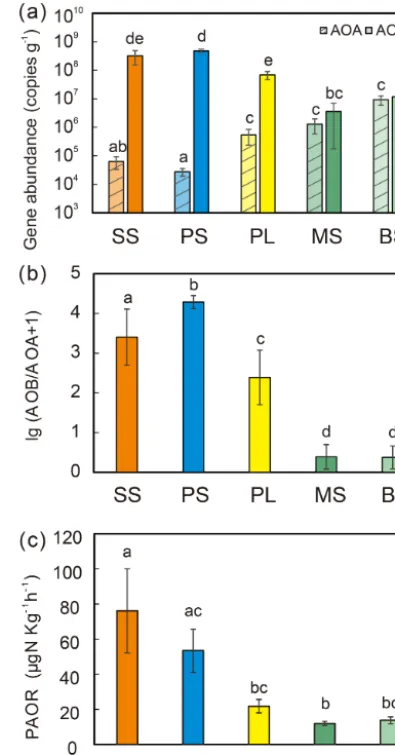
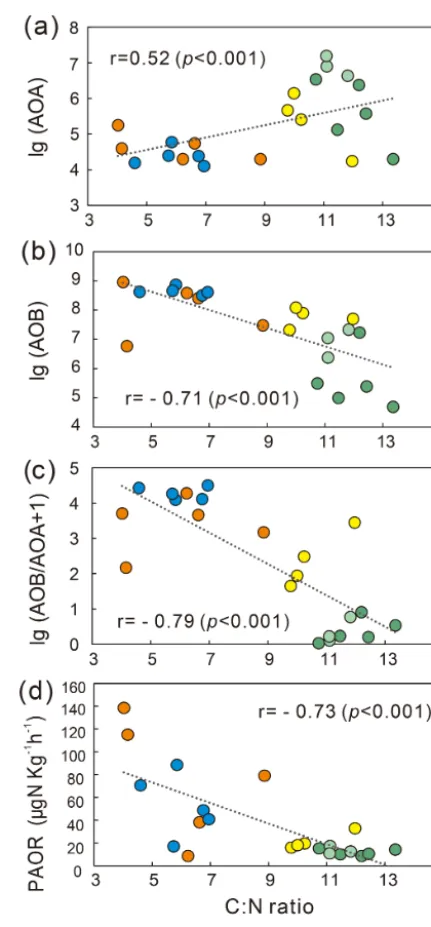
3.2 Gene abundances under sea animal colonization AOB amoAgene abundances were significantly higher (by approximately 2–4 orders of magnitude) than AOA amoA gene abundances (Wilcoxon test, n=22, P =0.002) in the penguin and seal colony and the adjacent tundra soils, PS, SS, and PL. However, amoA gene abundances were similar in the MS and BS soils (Fig. 2a). Overall, the abundances of AOB and AOA amoA genes were signifi-cantly negatively correlated (r= −0.93,P =0.002) across all the tundra patches (Fig. S2). The AOAamoAgene dances showed a heterogeneous distribution in the abun-dances among the different tundra patches, and they were 2 orders of magnitude lower in PS and SS relative to those in BS and MS. Maximum AOA amoAgene abundance ap-peared in BS, followed by MS and PL, whereas the PS and SS soils had the lowest AOA amoAgene abundances. The log values of soil AOAamoAgene abundances showed a significant positive correlation (r=0.52,P <0.001) with C : N ratios (Fig. 3a), but their abundances showed a signifi-cant negative correlation with NH+4-N contents (r= −0.52, P =0.013) (Table 2).
[image:5.612.328.526.67.445.2]Unlike AOA amoA gene abundances, AOBamoA genes showed the opposite distribution pattern. AOB amoA gene
Figure 2.Comparisons of soil AOA and AOBamoA gene copy numbers(a), log ratio of AOB : AOA abundances(b), and potential ammonia oxidation rates (PAORs)(c)between five tundra patches. The error bars indicate standard deviations of the means.
Table 2.Spearman correlations (n=22) among ammonia-oxidizer populations, the ratios of AOA : AOB abundances, potential ammonia oxidation rates (PAOR), and environmental variables in the soils of maritime Antarctic tundra.
pH Moisture TC TN C : N TS TP NH4+-N NO−3-N NO−2-N
AOA (copies g−1) 0.331 −0.108 0.002 −0.243 0.373 −0.381 −0.195 −0.523∗ −0.112 0.027 AOB (copies g−1) −0.191 −0.293 −0.434∗ −0.271 −0.748∗∗ 0.232 0.468∗ 0.526∗ −0.261 −0.108 AOB : AOA −0.274 −0.206 −0.337 −0.108 −0.720∗∗ 0.313 0.425∗ 0.622∗∗ −0.117 −0.022 PAOR (µg N kg−1h−1) 0.221 −0.104 −0.185 0.032 −0.667∗∗ 0.468∗ 0.430∗ 0.307 −0.304 −0.138
Note: significant correlations are indicated by∗at theP=0.05level and∗∗at theP=0.01level.
duced the abundance of AOA amoAgenes, leading to very large ratios (1.5×10²to 3.2×10⁴) of AOB to AOAamoA copy numbers in PS and SS. However, the ratios varied only from 0.1 to 7.2 in BS and MS.
3.3 Potential ammonia oxidation rates under sea animal colonization
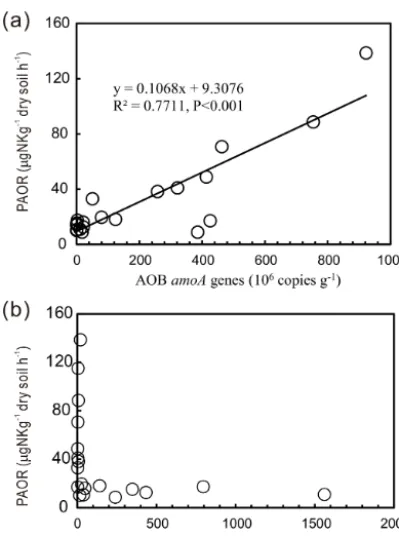
PAORs ranged from 8.9 to 138.8 µg N kg−1h−1 in all the soil samples (Table 1). The PAOR was slightly higher in SS (mean 76.1 µg N kg−1h−1) than in PS (mean 64.7 µg N kg−1h−1) but significantly higher than in PL, MS, and BS (mean 12.0–21.8 µg N kg−1h−1). Overall the PAOR was significantly higher in animal colony soils (mean 70.4 µg N kg−1h−1 for SS and PS) than in non-animal colony soils (mean 15.7 µg N kg−1h−1 for PL, MS, and BS; Kruskal–Wallis test, χ2=11.6, P =0.02) (Fig. 2c). The greatest PAOR occurred at the sites PS1 nearest the penguin nests (88.8±2.7 µg N kg−1h−1) and SS1 close to seal wallows (138.8±0.8 µg N kg−1h−1). The PAOR fol-lowed the distribution changes of AOB amoA gene abun-dances but showed the opposite trend to the AOAamoAgene abundances. A significant positive correlation (r2=0.77, P <0.001) was observed between the PAOR and the AOB amoA gene abundance when the data from all the tundra patches were combined, whereas no correlation occurred be-tween PAOR and AOAamoAgene abundance (Fig. 4). The higher abundance of AOB compared to AOA in PS, SS, and PL and their correlation with the PAOR suggested that AOB populations might contribute more to the PAOR than the AOA populations in penguin or seal colonies. In addition, PAOR significantly negatively correlated with soil C : N ra-tios (r= −0.73,P <0.001) (Fig. 3d) but significantly posi-tively correlated with TS contents (r=0.47,P <0.05) and TP contents (r=0.43,P <0.05) (Table 2).
3.4 Community structure of AOA and AOB under sea animal colonization
The PCR products were insufficient to construct the clone li-braries for the AOAamoAgene from SS and PS because of the low AOA abundance in the soils, as was the case with the AOB amoA gene from MS and BS. Overall, 10 AOA and 14 AOB amoAgene clone libraries were successfully
[image:7.612.321.537.209.673.2]Figure 4.Correlation between potential ammonia oxidation rates (PAORs) and AOA and AOBamoAgene copy numbers in tundra soils of maritime Antarctica.
constructed. The 543 AOA sequences and 1175 AOB qual-ity sequences were generated from the respective sites. Within each individual site, 1–6 AOA OTUs and 6–15 AOB OTUs were identified, as defined by < 3 % divergence in nu-cleotides. The AOA and AOB OTU numbers for each library are presented in Table S1. These numbers might be higher if more clones were sequenced, based on the rarefaction curves (Figs. S3 and S4). AOBamoAgene diversity was generally higher compared to AOA, based on the indices of Shannon– Wiener and Simpson. Specifically, AOAamoAgene diversity was higher in PL and MS than in BS, whereas AOBamoA gene diversity was higher in SS and PS compared with that in adjacent animal-lacking tundra soils (Table S1).
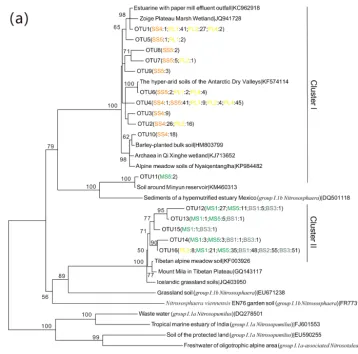
The 543 AOAamoAgene sequences had 76 %–100 % se-quence similarity to each other and 95 %–100 % identity with the corresponding top hitamoAsequences deposited in Gen-Bank. Phylogenetic analysis showed that the AOA amoA sequences were grouped into 16 unique OTUs, represent-ing 100 % of all the AOAamoAOTUs identified, and these sequences were affiliated with two Nitrososphaeraclusters (Fig. 5a): cluster I contained 11 OTUs and 264 clones, and 57.9 % of AOAamoAsequences were from PL, 41.3 % from SS and only 0.8 % from MS. In cluster II, there are five unique OTUs and 279 clones, and 58.8 % of them were from BS, 38.3 % from MS, and only 2.9 % from PL. Almost all the AOA phylotypes retrieved from PL and SS were re-lated to Nitrososphaeracluster I, whereas the AOA
phylo-types retrieved from MS and BS were distributed in cluster II (Fig. S5a). Seal or penguin activities led to the predom-inant existence of AOA phylotypes related to cluster I but very low relative abundances in AOA phylotypes related to cluster II, which were almost completely excluded in SS and PL. Almost all AOA phylotypes in BS and MS were related toNitrososphaeracluster II, whereas the relative abundances of AOA phylotypes related to cluster I were very low or un-detectable.
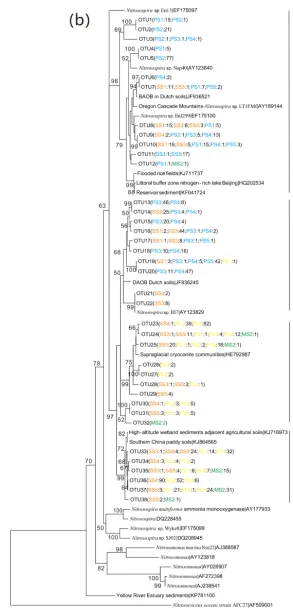
The 1175 AOBamoAgene sequences shared 87 %–100 % sequence identity to each other and 93 %–100 % identity with the closest matched GenBank sequences. Phylogenetic anal-ysis showed that the AOBamoAsequences could be grouped into 38 unique OTUs, representing 58.5 % of all the AOB amoAOTUs identified, and they were grouped into four Ni-trosospiraclusters according to the evolutionary distance of the phylogenetic tree (Fig. 5b): cluster I contained 11 OTUs and 226 clones, and 67.7 % of AOBamoAsequences were from PS, 23.5 % from SS, 8.4 % from PL, and only 0.4 % from MS. Clusters II and III contained 17 unique OTUs and 521 clones. The sources of the OTUs in cluster II were simi-lar to those of cluster I, with 69.8 % from PS, 29.9 % from SS, and 0.3 % from PL. For cluster III, 79.2 % of the se-quences were from PL, 19.8 % from SS, and 1.0 % from MS. Cluster IV contained nine unique OTUs and 370 clones from PL (50.0 %), SS (36.8 %), and MS (13.2 %). All the AOB phylotypes retrieved from PS were related to dominant Ni-trosospiraclusters I and II, whereas AOB phylotypes related to clusters III and IV were completely excluded because of penguin colonization (Fig. S5b). The AOB phylotypes re-trieved from SS were distributed in clusters I, II, III, and IV (16 %–38 % for each cluster). Almost all the AOB phylo-types retrieved from PL and MS were related toNitrosospira clusters III and IV.
3.5 Relationships of the ammonia-oxidizer community structure with environmental variables
Figure 5.
AOB genotype–environment relationships. The composition and distribution of AOB communities correlated significantly with C : N ratios (F =1.844,P =0.002) and NH+4-N (F = 1.823, P =0.002), and the two factors combined yielded 21.9 % of total CCA explanatory power. The others includ-ing TP, NO−3-N, and pH accounted for 27.1 % of the vari-ance. Penguin or seal activities significantly increased the AOB richness in SS and PS through higher NH+4-N and P in-put from sea animal excrement, whereas AOB richness was closely related to the soil C : N in PL and MS.
4 Discussion
4.1 Effects of sea animal colonization on AOA and AOB abundances
In this study, soil AOA amoAgene abundances were 2 or-ders of magnitude lower in PS and SS relative to BS and MS; however, AOB amoAgene abundances were approximately 2–3 orders of magnitude higher in PS and SS than in MS and BS, indicating that sea animal activities increased the
Figure 6.Canonical correspondence analysis (CCA) ordination plots for the relationship between the AOA and AOB community structures with environmental variables. The circles with different colors represent the various sampling sites. The size of the circles corresponds to the OTU richness in individual samples. The black triangles representamoAphylotypes. Environmental variables are represented by red arrows. The percentage of species–environment relation variance explained by the two principal canonical axes is represented close to the axes.
Table 3.Individual and combined contributions of soil biogeochem-ical properties to the AOA and AOB community structures in tundra patches.
Soil F P Individual
properties contribution
AOA C : N 2.593 0.022 21.5 %
TC 2.068 0.048 18.0 %
NO−3-N 1.847 0.078 16.5 %
pH 1.458 0.144 13.5 %
TP 1.035 0.406 10.5 %
NH+4-N 0.731 0.622 7.3 %
Combined effect 86.9 %
of all factors
AOB C : N 1.844 0.002 11.6 %
NH+4-N 1.823 0.002 11.5 %
TP 1.39 0.078 9.1 %
pH 1.383 0.066 9.0 %
NO−3-N 1.161 0.258 7.7 %
Combined effect 48.9 %
of all factors
and Miers Valley and the reverse for upper Wright Valley and Beacon Valley (Magalhães et al., 2014). The results for PS, SS, and PL are also in agreement with those detected in subglacial soils (Boyd et al., 2011).
The ratios of AOB to AOA showed significant correlations with C : N, NH+4-N, and TP when all the data were combined in the five tundra patches (Table 2). This suggested that C : N, NH+4-N, and TP are key factors in determining a predomi-nance of AOB over AOA. In Antarctica, the productivity of terrestrial ecosystems is strongly limited because of the ex-tremely low nitrogen levels (Park et al., 2007). However, the physiochemical properties for tundra soils were strongly in-fluenced by the deposition of penguin or seal excreta under the effects of local microbes (Tatur et al., 1997). Sea animals provide considerable external N inputs for their colony soils and adjacent tundra soils through direct input of their excreta and atmospheric deposition via ammonia volatilization (Lin-deboom, 1984; Sun et al., 2002; Blackall et al., 2007; Zhu et al., 2011; Riddick et al., 2012). In addition to ammonium, phosphorus can typically be found in penguin guano (Sun et al., 2000). Generally low C : N ratios and significantly ele-vated NH+4–N and TP concentrations occurred in PS and PL due to penguin or seal activities (Table 1). These conditions allow high abundance of AOBamoAgenes, which explains the strong correlations between AOB abundances and C : N, NH+4-N, and TP in the sea animal colony soils (Table 2). This agreed with the high bacterial abundance previously docu-mented in penguin or seal colony soils and ornithogenic sed-iments (Ma et al., 2013; Zhu et al., 2015).
[image:11.612.54.281.416.627.2]oligotrophic environments (Martens-Habbena et al., 2009; Stieglmeier et al., 2014). High NH+4-N concentrations might partially inhibit AOA populations (Hatzenpichler et al., 2008). This result is similar to that reported for some agri-cultural soils with increased fertilization and grassland soils with increased grazing (Fan et al., 2011; Prosser and Nicol, 2012; Pan et al., 2018), supporting the conclusion that AOA and AOB generally inhabit different niches in soil, distin-guished by the NH+4 concentration and availability (Ver-hamme et al., 2011; Wessén et al., 2011).
4.2 Effects of sea animal colonization on soil potential ammonia oxidation rates
The PAOR ranged from 9 to 139 µg N kg−1h−1, lower than nitrification rates measured in most agricultural soils (83– 1875 µg N kg−1h−1) (Fan et al., 2011; Ouyang et al., 2016; Daebeler et al., 2017). One reason might be the selection of a 15◦C incubation temperature, which was lower than the in-cubation temperatures used in other studies. Generally, the gross nitrification rate and amoAabundance increased sig-nificantly when the incubation temperature was higher than 15◦C (Daebeler et al., 2017; Zhao et al., 2014). Our mea-surements indicated that there were significant differences (P =0.02) in the PAOR across different tundra patches, and the PAORs in SS and PS were about 10 times higher than those in BS and MS. A significant correlation was obtained between the PAOR and C : N, TP, and TS (Table 2). Overall, ammonia oxidation activity was modulated by soil biogeo-chemical processes under the disturbance of penguin or seal activities: generally low C : N ratios and sufficient input of the nutrients TP, TS, and NH+4–N from sea animal excre-ments.
The higher AOB abundances (Fig. 2b) and significant neg-ative correlation of AOA abundance with NH+4–N levels (Ta-ble 2) indicated that AOB might play a more important role in nitrification in tundra soils. In agreement with these re-sults, AOB dominated nitrification in the areas where it was easy to achieve nitrogen input, whereas the relative contri-bution of AOA to nitrification was higher in the areas where the ammonium concentration remained low (Fan et al., 2011; Sterngren et al., 2015). Moreover, the cell-specific activity for AOB was 10 times higher than that for AOA due to the bigger cell size of AOB (Hatzenpichler, 2012; Prosser and Nicol, 2012). Therefore, AOB might play a more important role in nitrification in SS, PS, and PL with the input of NH+4– N from penguin or seal excrements.
In addition, AOA might play a role that cannot be ignored in MS and BS, just like the prevalence of AOA among am-monia oxidizers in arctic soils (Alves et al., 2013; Daebeler et al., 2017). AOB groups were mostly undetectable in the analysis of MS and BS. Although unknownγ-AOB groups might not have been detected, the primer set used here cov-ers theβ-AOB groups typically found in soils (Alves et al., 2013). The BS and MS were moderately far away from
pen-guin or seal colonies without the input of the nutrients from sea animal excrements, and their substrates can be provided only through the mineralization of organic matter from lo-cal tundra plants. The simple organic substrates and barren soil environment might favor AOA (Stopnišek et al., 2010; Habteselassie et al., 2013). Therefore, AOA showed rela-tively high abundance in MS and BS compared with PS and SS.
4.3 Effects of sea animal colonization on genotypic diversity of soil AOA and AOB
In this study, distinct AOA communities appear to inhabit different types of tundra patches, depending on sea animal activities (Fig. 5a). It was difficult to amplify the AOAamoA gene from SS and PS, whereas a high diversity of AOAamoA genes was observed in PL, MS, and BS. Phylogenetic analy-sis indicated that the AOAamoAsequences in cluster I were from PL and tundra soils close to seal wallows, while the se-quences in cluster II were from BS and MS (Fig. S5). AOA in most extreme environments have lower levels of microbial diversity than in benign ecosystems because of the require-ment for specific physiological adaptations which allow or-ganisms to exploit the combination of physical and biochem-ical stressors (Cowan et al., 2015). Detected OTUs in cluster I had their closest matches mainly in the hyper-arid soils of Antarctic Dry Valleys (Magalhães et al., 2014), wetland soils (Y. K. Zheng et al., 2014), alpine meadow soils (Zhao et al., 2017), and some agricultural soils (Glaser et al., 2010). Clus-ter II was more prevalent in BS and MS, probably because of their stronger adaptation to barren soil environments. In clus-ter II, the sequences were affiliated with sequences recovered from cold environments, including the soils of the Tibetan Plateau (Xie et al., 2014) and Icelandic grassland soils (Dae-beler et al., 2012). The compositions of soil AOA populations are likely not to be explained by individual physicochemi-cal properties, and their community structures significantly correlated with tundra soil C : N, and TC, which was consis-tent with previous studies (Glaser et al., 2010; Wessén et al., 2011).
Pre-vious studies have shown that multiple environmental factors affected the AOB communities (Dang et al., 2008; Mosier and Francis, 2008). In this study, the C : N ratios and NH+4-N concentrations seemed to be the most important factors influ-encing the AOB community structure, which was in accor-dance with the results from different environments (Bouskill et al., 2012; Jung et al., 2011; Li et al., 2015). Moreover, the TP also affected the AOB amoAcommunity composi-tions (Zheng et al., 2013). Therefore, the AOB community compositions were impacted by the biogeochemical factors related to sea animal activities, such as low C : N ratios and a sufficient supply of the nutrients NH+4–N and TP from sea animal excreta.
5 Conclusions
The findings of this study concerning the abundance, poten-tial activity, and diversity of tundra soil AOA and AOB pro-vide insights into microbial mechanisms driving nitrification in maritime Antarctica. We confirmed the presence of AOA and AOB amoA genes in five different tundra patches and demonstrated that the spatial distribution heterogeneities of the tundra soil AOA and AOB communities were driven by penguin or seal activities. The soil AOBamoAcopy numbers were generally higher than the AOA amoAcopy numbers, following the higher PAOR in penguin or seal colonies and their adjacent tundra, compared with that in the background tundra and marsh tundra. Penguin or seal activities resulted in a significant shift in soil AOA and AOB community com-positions. AOBamoAgene diversity was higher in SS and PS than in PL and MS, and the majority of the AOB se-quences was closely related to Nitrosospira-like sequences. The AOAamoAgene had higher diversity in PL and MS than in BS, and it was associated withNitrososphaerasequences recovered from barren soils. Soil AOB and AOA abundances, and their community compositions, were related to soil bio-geochemical processes under the sea-animal-activity distur-bance, such as soil C : N alteration and a sufficient supply of the nutrients NH+4–N, N and P from animal excreta. This study significantly enhances the understanding of ammonia-oxidizing microbial communities in the tundra environment of maritime Antarctica.
Data availability. The final derived data presented in this study are
available at https://doi.org/10.5281/zenodo.1260292 (Wang, 2018).
Supplement. The supplement related to this article is available
on-line at: https://doi.org/10.5194/bg-16-4113-2019-supplement.
Author contributions. RBZ, LJH, and QW conceived of the study
together. QW conducted the laboratory analyses and statistical
anal-yses with support from LJH and YLZ. TB retrieved samples during field work. The paper was written by QW with support by RBZ.
Competing interests. The authors declare that they have no conflict
of interest.
Acknowledgements. This work was supported by the NSFC (grant
nos. 41576181, 41776190). We are particularly grateful to the mem-bers of the Chinese Antarctic Research Expedition and the Polar Office of the National Ocean Bureau of China for their support and timely help.
Financial support. This research has been supported by the
Na-tional Natural Science Foundation of China (grant nos. 41576181, 41776190).
Review statement. This paper was edited by Denise Akob and
re-viewed by Weidong Kong and Barbara Bayer.
References
Alves, R. J. E., Wanek, W., Zappe, A., Richter, A., Svenning, M. M., Schleper, C., and Urich, T.: Nitrification rates in Arctic soils are associated with functionally distinct popula-tions of ammonia-oxidizing archaea, ISME J., 7, 1620–1631, https://doi.org/10.1038/ ismej.2013.35, 2013.
Ayton, J., Aislabie, J., Barker, G. M., Saul, D., and Turner, S.: Crenarchaeota affiliated with group 1.1 b are prevalent in coastal mineral soils of the Ross Sea re-gion of Antarctica, Environ. Microbiol., 12, 689–703, https://doi.org/10.1111/j.14622920.2009.02111.x, 2010. Baker, B. J., Lesniewski, R. A., and Dick, G. J.: Genome-enabled
transcriptomics reveals archaeal populations that drive nitrifica-tion in a deep-sea hydrothermal plume, ISME J., 6, 2269–2279, https://doi.org/10.1038/ismej.2012.64, 2012.
Belser, L. W. and Schmidt, E. L.: Diversity in the ammonia-oxidizing nitrifier population of a soil, Appl. Environ. Microbiol., 36, 584–588, 1978.
Beman, J. M., Popp, B. N., and Francis, C. A.: Molecular and bio-geochemical evidence for ammonia oxidation by marine Crenar-chaeota in the Gulf of California,ISME J., 2, 429–441, 2008. Blackall, T. D., Wilson, L. J., Theobald, M. R., Milford, C.,
Nemitz, E., Bull, J., and Sutton, M. A.: Ammonia emis-sions from seabird colonies, Geophys. Res. Lett., 34, L10801, https://doi.org/10.1029/2006GL028928, 2007.
Bouskill, N. J., Eveillard, D., Chien, D., Jayakumar, A., and Ward, B. B.: Environmental factors determining ammoniaoxidizing or-ganism distribution and diversity in marine environments, En-viron. Microbiol., 14, 714–729, https://doi.org/10.1111/j.1462-2920.2011.02623.x, 2012.
nitrifying and nitrate-reducing microbial assemblages in a sub-glacial ecosystem, Appl. Environ. Microbiol., 77, 4778–4787, https://doi.org/10.1128/AEM.00376-11, 2011.
Cowan, D. A., Ramond, J. B., Makhalanyane, T. P., and De Maayer, P.: Metagenomics of extreme environments, Curr. Opin. Mi-crobiol., 25, 97–102, https://doi.org/10.1016/j.mib.2015.05.005, 2015.
Daebeler, A., Abell, G. C., Bodelier, P. L., Bodrossy, L., Framp-ton, D. M., Hefting, M. M., and Laanbroek, H. J.: Ar-chaeal dominated ammonia-oxidizing communities in Icelandic grassland soils are moderately affected by long-term N fer-tilization and geothermal heating, Front. Microbiol., 3, 352, https://doi.org/10.3389/fmicb.2012.00352, 2012.
Daebeler, A., Bodelier, P. L., Hefting, M. M., Rütting, T., Jia, Z., and Laanbroek, H. J.: Soil warming and fertil-ization altered rates of nitrogen transformation processes and selected for adapted ammonia-oxidizing archaea in sub-arctic grassland soil, Soil Biol. Biochem., 107, 114–124, https://doi.org/10.1016/j.soilbio.2016.12.013, 2017.
Dang, H., Zhang, X., Sun, J., Li, T., Zhang, Z., and Yang, G.: Diver-sity and spatial distribution of sediment ammonia-oxidizing cre-narchaeota in response to estuarine and environmental gradients in the Changjiang Estuary and East China Sea, Microbiology, 154, 2084–2095, https://doi.org/10.1099/mic.0.2007/013581-0, 2008.
Di, H. J., Cameron, K. C., Shen, J. P., Winefield, C. S., O’callaghan, M., Bowatte, S., and He, J. Z.: Nitrification driven by bacteria and not archaea in nitrogen-rich grassland soils, Nat. Geosci., 2, 621–624, https://doi.org/10.1038/ngeo613, 2009.
Edgar, R. C.: MUSCLE: multiple sequence alignment with high ac-curacy and high throughput, Nucl. Acid. Res., 32, 1792–1797, 2004.
Fan, F., Yang, Q., Li, Z., Wei, D., Cui, X. A., and Liang, Y.: Impacts of organic and inorganic fertilizers on nitrifi-cation in a cold climate soil are linked to the bacterial ammonia oxidizer community, Microb. Ecol., 62, 982–990, https://doi.org/10.1007/s00248-011-9897-5, 2011.
Francis, C. A., Roberts, K. J., Beman, J. M., Santoro, A. E., and Oakley, B. B.: Ubiquity and diversity of ammonia-oxidizing archaea in water columns and sediments of the ocean, P. Natl. Acad. Sci. USA, 102, 14683–14688, https://doi.org/10.1073/pnas.0506625102, 2005.
Gao, Y. S., Yang, L. J., Wang, J. J., Xie, Z. Q., Wang, Y. H., and Sun, L. G.: Penguin colonization follow-ing the last glacial-interglacial transition in the Vestfold Hills, East Antarctica, Palaeogeogr. Palaeocl., 490, 629–639, https://doi.org/10.1016/j.palaeo.2017.11.053, 2018.
Glaser, K., Hackl, E., Inselsbacher, E., Strauss, J., Wanek, W., Zechmeister-Boltenstern, S., and Sessitsch, A.: Dynam-ics of ammonia-oxidizing communities in barley-planted bulk soil and rhizosphere following nitrate and ammonium fer-tilizer amendment, FEMS Microbiol. Ecol., 74, 575–591, https://doi.org/10.1111/j.1574-6941.2010.00970.x, 2010. Gubry-Rangin, C., Novotnik, B., Mandiˇc-Mulec, I., Nicol, G. W.,
and Prosser, J. I.: Temperature responses of soil ammonia-oxidising archaea depend on pH, Soil Biol. Biochem., 106, 61– 68, https://doi.org/10.1016/j.soilbio.2016.12.007, 2017. Habteselassie, M. Y., Xu, L., and Norton, J. M.:
Ammonia-oxidizer communities in an agricultural soil treated with
contrasting nitrogen sources, Front. Microbiol., 4, 326, https://doi.org/10.3389/fmicb.2013.00326, 2013.
Hatzenpichler, R.: Diversity, physiology, and niche differentiation of ammonia-oxidizing archaea, Appl. Environ. Microbiol., 78, 7501–7510, https://doi.org/10.1128/AEM.01960-12, 2012. Hatzenpichler, R., Lebedeva, E. V., Spieck, E., Stoecker,
K., Richter, A., Daims, H., and Wagner, M.: A mod-erately thermophilic ammonia-oxidizing crenarchaeote from a hot spring, P. Natl. Acad. Sci. USA, 105, 2134–2139, https://doi.org/10.1073/pnas.0708857105, 2008.
Jung, J., Yeom, J., Kim, J., Han, J., Lim, H. S., Park, H., Hyun, S., and Park, W.: Change in gene abundance in the nitro-gen biogeochemical cycle with temperature and nitronitro-gen ad-dition in Antarctic soils, Res. Microbiol., 162, 1018–1026, https://doi.org/10.1016/j.resmic.2011.07.007, 2011.
Kalanetra, K. M., Bano, N., and Hollibaugh, J. T.: Ammonia-oxidizing Archaea in the Arctic Ocean and Antarc-tic coastal waters, Environ. Microbiol., 11, 2434–2445, https://doi.org/10.1111/j.1462-2920.2009.01974.x, 2009. Könneke, M., Bernhard, A. E., José, R., Walker, C. B.,
Wa-terbury, J. B., and Stahl, D. A.: Isolation of an autotrophic ammonia-oxidizing marine archaeon, Nature, 437, 543–546, https://doi.org/10.1038/nature03911, 2005.
Kurola, J., Salkinoja-Salonen, M., Aarnio, T., Hultman, J., and Romantschuk, M.: Activity, diversity and popula-tion size of ammoniaoxidising bacteria in oilcontaminated landfarming soil, FEMS Microbiol. Lett., 250, 33–38, https://doi.org/10.1016/j.femsle.2005.06.057, 2005.
Lam, P., Jensen, M. M., Lavik, G., McGinnis, D. F., Müller, B., Schubert, C. J., Amann, R., Thamdrup, B., and Kuypers, M. M.: Linking crenarchaeal and bacterial nitrification to anammox in the Black Sea, P. Natl. Acad. Sci. USA, 104, 7104–7109, https://doi.org/10.1073/pnas.0611081104, 2007.
Le Roux, X., Poly, F., Currey, P., Commeaux, C., Hai, B., Nicol, G. W., Prosser, J. I., Schloter, M., Attard, E., and Klumpp, K.: Effects of aboveground grazing on coupling among nitrifier ac-tivity, abundance and community structure, ISME J., 2, 221–232, https://doi.org/10.1038/ismej.2007.109, 2008
Leininger, S., Urich, T., Schloter, M., Schwark, L., Qi, J., Nicol, G. W., Prosser, J. I., Schuster, S. C., and Schleper, C.: Archaea pre-dominate among ammonia-oxidizing prokaryotes in soils, Na-ture, 442, 806–809, https://doi.org/10.1038/nature04983, 2006. Li, J., Nedwell, D. B., Beddow, J., Dumbrell, A. J., McKew, B. A.,
Thorpe, E. L., and Whitby, C.: amoA gene abundances and nitri-fication potential rates suggest that benthic ammonia-oxidizing bacteria and not archaea dominate N cycling in the Colne Estu-ary, United Kingdom, Appl. Environ. Microbiol., 81, 159–165, https://doi.org/10.1128/AEM.02654-14, 2015.
Lindeboom, H. J.: The nitrogen pathway in a penguin rookery, Ecol-ogy, 65, 269–277, https://doi.org/10.2307/1939479, 1984. Ma, D. W., Zhu, R. B., Ding, W., Shen, C. C., Chu, H. Y., and
Lin, X. G.: Ex-situ enzyme activity and bacterial community di-versity through soil depth profiles in penguin and seal colonies on Vestfold Hills, East Antarctica, Pol. Biol., 36, 1347–1361, https://doi.org/10.1007/s00300-013-1355-z, 2013.
Magalhães, C. M., Machado, A., Frank-Fahle, B., Lee, C. K., and Cary, S. C.: The ecological dichotomy of ammonia-oxidizing archaea and bacteria in the hyper-arid soils of the Antarctic Dry Valleys, Front. Microbiol., 5, 515, https://doi.org/10.3389/fmicb.2014.00515, 2014.
Martens-Habbena, W., Berube, P. M., Urakawa, H., José, R., and Stahl, D. A.: Ammonia oxidation kinetics determine niche sepa-ration of nitrifying Archaea and Bacteria, Nature, 461, 976–979, https://doi.org/10.1038/nature08465, 2009.
Mintie, A. T., Heichen, R. S., Cromack Jr, K., Myrold, D. D., and Bottomley, P. J.: Ammonia-oxidizing bacte-ria along meadow-to-forest transects in the Oregon Cas-cade Mountains, Appl. Environ. Microbiol., 69, 3129–3136, https://doi.org/10.1128/AEM.69.6.3129-3136.2003, 2003. Mosier, A. C. and Francis, C. A.: Relative abundance and
di-versity of ammonia-oxidizing archaea and bacteria in the San Francisco Bay estuary, Environ. Microbiol., 10, 3002–3016, https://doi.org/10.1111/j.1462-2920.2008.01764.x, 2008. Nunes-Alves, C.: Do it yourself nitrification, Nat. Rev. Microbiol.,
14, 61, https://doi.org/10.1038/nrmicro.2015.20, 2016.
Otero, X. L., Peña-Lastra, S., Pérez-Alberti, A., Ferreira, T. O., and Huerta-Diaz, M. A.: Seabird colonies as important global drivers in the nitrogen and phosphorus cycles, Nat. Commun., 9, 246, https://doi.org/0.1038/s41467-017-02446-8, 2018.
Ouyang, Y., Norton, J. M., Stark, J. M., Reeve, J. R., and Habteselassie, M. Y.: Ammonia-oxidizing bacte-ria are more responsive than archaea to nitrogen source in an agricultural soil, Soil Biol. Biochem., 96, 4–15, https://doi.org/10.1016/j.soilbio.2016.01.012, 2016.
Pan, H., Xie, K. X., Zhang, Q. C., Jia, Z. J., Xu, J. M., Di, H. J., and Li, Y.: Archaea and bacteria respectively dominate nitrification in lightly and heavily grazed soil in a grassland system, Biol. Fert. Soils, 54, 41–54, https://doi.org/10.1007/s00374-017-1236-7, 2018.
Park, J. H., Day, T. A., Strauss, S., and Ruhland, C. T.: Biogeochem-ical pools and fluxes of carbon and nitrogen in a maritime tundra near penguin colonies along the Antarctic Peninsula, Pol. Biol., 30, 199–207, https://doi.org/10.1007/s00300-006-0173-y, 2007. Prosser, J. I. and Nicol, G. W.: Archaeal and bacterial ammonia-oxidisers in soil: the quest for niche specialisa-tion and differentiaspecialisa-tion, Trends Microbiol., 20, 523–531, https://doi.org/10.1016/j.tim.2012.08.001, 2012.
Richter, I., Herbold, C. W., Lee, C. K., McDonald, I. R., Barrett, J. E., and Cary, S. C.: Influence of soil proper-ties on archaeal diversity and distribution in the McMurdo Dry Valleys, Antarctica, FEMS Microbiol. Ecol., 89, 347–359, https://doi.org/10.1111/1574-6941.12322, 2014.
Riddick, S. N., Dragosits, U., Blackall, T. D., Daunt, F., Wan-less, S., and Sutton, M. A.: The global distribution of ammonia emissions from seabird colonies, Atmos. Environ., 55, 319–327, https://doi.org/10.1016/j.atmosenv.2012.02.052, 2012.
Rotthauwe, J. H., Witzel, K. P., and Liesack, W.: The ammonia monooxygenase structural gene amoA as a functional marker: molecular fine-scale analysis of natural ammonia-oxidizing pop-ulations, Appl. Environ. Microbiol., 63, 4704–4712, 1997. Santoro, A. E., Buchwald, C., McIlvin, M. R., and
Cas-ciotti, K. L.: Isotopic signature of N2O produced by
ma-rine ammonia-oxidizing archaea, Science, 333, 1282–1285, https://doi.org/10.1126/science.1208239, 2011.
Schloss, P. D., Westcott, S., Ryabin, T., Hall, J., Hartmann, M., Hol-lister, E., Lesniewski, R. A., Oakley, B. B., Parks, D. H., Robin-son, C. J., Sahl, J. W., Stres, B., Thallinger, G. G., Van Horn, D. J., and Weber, C. F.: Introducing mothur: Open-source, platform-independent, community-supported software for describing and comparing microbial communities, Appl. Environ. Microbiol., 75, 7537–7541, https://doi.org/10.1128/AEM.01541-09, 2009. Shen, J. P., Zhang, L. M., Di, H. J., and He, J. Z.: A review of
ammonia-oxidizing bacteria and archaea in Chinese soils, Front. Microbiol., 3, 296, https://doi.org/10.3389/fmicb.2012.00296, 2012.
Simas, F. N. B., Schaefer, C. E. G. R. , Melo, V. F., Albuquerque-Filho, M. R. A., Michel, R. F. M., Pereira, V. V., Gomes, M. R. M., and da Costa, L. M.: Or-nithogenic cryosols from Maritime Antarctica: Phosphatiza-tion as a soil forming process, Geoderma, 138, 191–203, https://doi.org/10.1016/j.geoderma.2006.11.011, 2007.
Silva, A. F., Carvalho, G., Oehmen, A., Lousada-Ferreira, M., van Nieuwenhuijzen, A., Reis, M. A., and Crespo, M. T. B.: Micro-bial population analysis of nutrient removal-related organisms in membrane bioreactors. Appl. Microbiol. Biotechnol., 93, 2171– 2180, https://doi.org/10.1007/s00253-011-3499-5, 2012. Silva, M. C., Poly, F., Guillaumaud, N., van Elsas, J. D.,
and Falcão Salles, J.: Fluctuations in ammonia oxi-dizing communities across agricultural soils are driven by soil structure and pH, Front. Microbiol., 3, 77, https://doi.org/10.3389/fmicb.2012.00077, 2012.
Sterngren, A. E., Hallin, S., and Bengtson, P.: Archaeal ammonia oxidizers dominate in numbers, but bacteria drive gross nitrifi-cation in N-amended grassland soil, Front. Microbiol., 6, 1350, https://doi.org/10.3389/fmicb.2015.01350, 2015.
Stieglmeier, M., Mooshammer, M., Kitzler, B., Wanek, W., Zechmeister-Boltenstern, S., Richter, A., and Schleper, C.: Aer-obic nitrous oxide production through N-nitrosating hybrid for-mation in ammonia-oxidizing archaea, ISME J., 8, 1135–1146, 2014.
Stopnišek, N., Gubry-Rangin, C., Höfferle, Š., Nicol, G. W., Mandiˇc-Mulec, I., and Prosser, J. I. : Thaumarchaeal ammonia oxidation in an acidic forest peat soil is not influenced by am-monium amendment, Appl. Environ. Microbiol., 76, 7626–7634, https://doi.org/10.1128/AEM.00595-10, 2010.
Sun, L. G., Liu, X. D., Yin, X. B., Zhu, R. B., Xie, Z. Q., and Wang, Y. H.: A 1,500-year record of Antarctic seal popula-tions in response to climate change, Pol. Biol., 27, 495–501, https://doi.org/10.1007/s00300-004-0608-2, 2004.
Sun, L. G., Xie, Z. Q., and Zhao, J. L.: Palaeoecology: A 3,000-year record of penguin populations, Nature, 407, 858, https://doi.org/10.1038/35038163, 2000.
Sun, L., Zhu, R., Xie, Z., and Xing, G.: Emissions of ni-trous oxide and methane from Antarctic tundra: role of pen-guin dropping deposition, Atmos. Environ., 36, 4977–4982, https://doi.org/10.1016/S1352-2310(02)00340-0, 2002. Tatur, A., Myrcha, A., and Niegodzisz, J.: Formation of
aban-doned penguin rookery ecosystems in the maritime Antarctic, Pol. Biol., 17, 405–417, https://doi.org/10.1007/s003000050135, 1997.
oxidation to chemoautotrophy in Antarctic coastal waters, ISME J., 10, 2605, https://doi.org/10.1038/ismej.2016.61, 2016. Verhamme, D. T., Prosser, J. I., and Nicol, G. W.: Ammonia
con-centration determines differential growth of ammonia-oxidising archaea and bacteria in soil microcosms, ISME J., 5, 1067–1071, https://doi.org/10.1038/ismej.2010.191, 2011.
Wang, B. Z., Zhao, J., Guo, Z. Y., Ma, J., Xu, H., and Jia, Z. J.: Differential contributions of ammonia oxidizers and nitrite oxi-dizers to nitrification in four paddy soils, ISME J., 9, 1062–1075, https://doi.org/10.1038/ismej.2014.194, 2015.
Wang, Q.: Table. Effects of sea animal colonization on the coupling between dynamics and activity of soil ammonia-oxidizing bacteria and archaea in maritime Antarctica, https://doi.org/10.5281/zenodo.1260292, 2018.
Wessén, E., Söderström, M., Stenberg, M., Bru, D., Hell-man, M., Welsh, A., Thomsen, F., Klemedtson, L., Philip-pot, L., and Hallim, S.: Spatial distribution of ammonia-oxidizing bacteria and archaea across a 44-hectare farm re-lated to ecosystem functioning, ISME J., 5, 1213–1225, https://doi.org/10.1038/ismej.2010.206, 2011.
Wuchter, C., Abbas, B., Coolen, M. J. L., Herfort, L., van Blei-jswijk, J., Timmers, P., Strous, M., Teira, E., Herndl, G. J., Mid-delburg, J. J., Schouten, S., and Sinninghe Damsté, J. S.: Ar-chaeal nitrification in the ocean, P. Natl. Acad. Sci. USA, 103, 12317–12322, https://doi.org/10.1073/pnas.0600756103, 2006. Xia, Y., Zhu, Y. G., Gu, Q., and He, J. Z.: Does long-term
fertiliza-tion treatment affect the response of soil ammonia-oxidizing bac-terial communities to Zn contamination?, Plant Soil, 301, 245– 254, https://doi.org/10.1007/s11104-007-9441-z, 2007. Xie, Z., Le Roux, X., Wang, C., Gu, Z., An, M., Nan, H., Chen,
B. Z., Li, F., Liu, Y. J., Du, G. Z., Feng, H. Y., and Ma, X. J.: Identifying response groups of soil nitrifiers and den-itrifiers to grazing and associated soil environmental drivers in Tibetan alpine meadows, Soil Biol. Biochem., 77, 89–99, https://doi.org/10.1016/j.soilbio.2014.06.024, 2014.
Yang, Y., Shan, J., Zhang, J., Zhang, X., Xie, S., and Liu, Y.: Ammonia-and methane-oxidizing microorganisms in high-altitude wetland sediments and adjacent agricul-tural soils, Appl. Microbiol. Biotechnol., 98, 10197–10209, https://doi.org/10.1007/s00253-014-5942-x, 2014.
Yao, H. Y., Gao, Y. M., Nicol, G. W., Campbell, C. D., Prosser, J. I., Zhang, L. M., Han, W. Y., and Singh, B. K.: Links between ammonia oxidizer community structure, abundance, and nitrifi-cation potential in acidic soils, Appl. Environ. Microbiol., 77, 4618–4625, https://doi.org/10.1128/AEM.00136-11, 2011. Yergeau, E., Kang, S., He, Z., Zhou, J., and Kowalchuk, G. A.:
Functional microarray analysis of nitrogen and carbon cycling genes across an Antarctic latitudinal transect, ISME J., 1, 163– 179, https://doi.org/10.1038/ismej.2007.24, 2007.
Zhang, L. M., Wang, M., Prosser, J. I., Zheng, Y. M., and He, J. Z.: Altitude ammonia-oxidizing bacteria and archaea in soils of Mount Everest, FEMS Microbiol. Ecol., 70, 208–217, https://doi.org/10.1111/j.1574-6941.2009.00775.x, 2009. Zhao, K., Kong, W. D., Khan, A., Liu, J. B., Guo, G. X.,
Muhan-mmad, S., Zhao, X. Z., and Dong, X. B.: Elevational diversity and distribution of ammonia-oxidizing archaea community in meadow soils on the Tibetan Plateau, Appl. Microbiol. Biotech-nol., 101, 7065–7074, https://doi.org/10.1007/s00253-017-8435-x, 2017.
Zhao, X., Wang, S., and Xing, G.: Nitrification, acidification, and nitrogen leaching from subtropical cropland soils as affected by rice straw-based biochar: laboratory incubation and column leaching studies, J. Soil. Sediment., 14, 471–482, 2014. Zheng, Y. K., Wang, X. B., Gu, Y. F., and Zhang, X. P.: Diversity
of ammonia-oxidizing archaea in Tibetan Zoige plateau wetland, Acta Microbiol. Sin., 54, 1090–1096, 2014.
Zheng, Y. L., Hou, L. J., Liu, M., Lu, M., Zhao, H., Yin, G. Y., and Zhou, J. L.: Diversity, abundance, and activity of ammonia-oxidizing bacteria and archaea in Chongming eastern inter-tidal sediments, Appl. Microbiol. Biotechnol., 97, 8351–8363, https://doi.org/10.1007/s00253-012-4512-3, 2013.
Zheng, Y. L., Hou, L. J., Newell, S., Liu, M., Zhou, J. L., Zhao, H., You, L. L., and Cheng, X. L.:. Community dynamics and ac-tivity of ammonia-oxidizing prokaryotes in intertidal sediments of the Yangtze estuary, Appl. Environ. Microbiol., 80, 408–149, https://doi.org/10.1128/AEM.03035-13, 2014.
Zhu, R. B., Liu, Y. S., Xu, H., Ma, J., Zhao, S. P., and Sun, L. G.: Nitrous oxide emissions from sea animal colonies in the maritime Antarctic, Geophys. Res. Lett., 35, L09807, https://doi.org/10.1029/2007GL032541, 2008.
Zhu, R. B., Sun, J. J., Liu, Y. S., Gong, Z. J., and Sun, L. G.: Poten-tial ammonia emissions from penguin guano, ornithogenic soils and seal colony soils in coastal Antarctica: effects of freezing-thawing cycles and selected environmental variables, Antarct. Sci., 23, 78–92, https://doi.org/10.1017/S0954102010000623, 2011.
Zhu, R. B., Liu, Y. S., Xu, H., Ma, D. W., and Jiang, S.: Marine animals significantly increase tundra N2O and CH4emissions in
maritime Antarctica, J. Geophys. Res.-Biogeo., 118, 1773–1792, https://doi.org/10.1002/2013JG002398, 2013.
Zhu, R. B., Wang, Q., Ding, W., Wang, C., Hou, L. J., and Ma, D. W.: Penguins significantly increased phosphine formation and phosphorus contribution in maritime Antarctic soils, Sci. Rep., 4, 7055, https://doi.org/10.1038/srep07055, 2014.