Abstract: Learning is remarkably a complex process that is influenced by a variety of factors. Observational learning also referred to as modeling or social learning occurs by observing, retaining, and replicating behavior seen in others. This phenomena is also applicable in the virtual world as social media is massive, full of information and resources which makes it ideal for promoting meta-cognitive processes, active-learning, and connectivism. This primary research was driven by the fact that today’s learning environment has significantly expanded and individuals no longer have to simply adapt to what has been learnt but now have the ability to expand their learning terrain by pushing the knowledge acquisition boundaries of the traditional social learning environment. This study synthesizes the current literature on social learning theory and social media, proposes a conceptual framework to apply Albert Bandura’s social learning theory on social media environment and empirically validates through statistical intervention, effect of Bandura’s social learning theory on knowledge acquisition by social media users. Primary data was collected through questionnaire method and analyzed in Predictive Analytical Software. Factorial ANOVA and Mixed Factorial techniques were used to test hypotheses, while Sphericity was assessed through a Mauchly’s Test of Sphericity. Results were able to substantiate with reliable difference and significance that knowledge acquisition through social learning occurs on social media in the form of non-linear, symbolic and construct/deconstruct learning.
Index Terms: Knowledge acquisition, social learning, symbolic learning, non-linear learning.
I. INTRODUCTION
There is no denying the fact that people are social animals and when Albert Bandura coined the elements of his classical social learning theory, it was proven then that learning is a complex process that occurs on socially networked platforms. Bandura’s social learning theory provides a very basic structure to understand how learning occurs in a social context, taking inspiration from learning and development theories. Social learning theory has suggested inclusion of an important component, which otherwise was missing in conventional learning theory that social activity is an observable phenomenon, that can be reinforced through imitation [1]. Therefore, if anything sums up the social learning theory, then it is that people observe, imitate and replicate behavior. The interesting question is, if Bandura prognostication was valid in his time, then will it be still applicable in the age of social media explosion. So, if earlier it was interaction and cognition that manifested the fabric of social learning, then now,
Revised Manuscript Received on June 05, 2019
Sadia Riaz, Assistant Professor and Head of Amity School of Foundation Studies at Amity University Dubai Campus. She holds a PhD in Information Technology from the Universiti Teknologi PETRONAS, Malaysia.
Arif Mushtaq, Assistant Professor in MIS department. PhD in Information Technology from the Universiti Teknologi PETRONAS, Malaysia
it is technology driven platform that has completely
transformed elements of human social experience. We all feel connected and enthralled to interact socially using Twitter, Facebook, and Instagram etc. Therefore, in the words of William Shakespeare the world a stage and men and women all are players happens to be more accurate in context of social media. One of the drawbacks of this theory is however that it is sometimes considered complex in contextual interpretation of social observation behavior, therefore, changes in the environment do not signify changes in behavior as well. Likewise, biological and hormonal outlooks are also not considered. There has been an enormous increase in the explosive presence, access and usage of social media [2]. It would be fair to say that with the emergence of internet, scope of collaboration and interaction among users has touched new pinnacles of interdependence, for social and emotional reasons [3]. The digital world continues to escalate and deploys unlimited resources for connecting people virtually. The uses can now easily see and relate to each other’s world across, previously defined within geographical boundaries; one to one across time and space. With social media, comes connectivity, and with that comes plethora of data, information and knowledge. For example, according to a report published in Global Web Index, that collected primary data from 89,029 people aged 16-40 countries across 40 countries, the average person now has 7.6 active social media accounts, with 98% of people having at least one social network account. Sharing web-links and pictures have always been the most popular usage of internet. However, social networks have motivated users to generate customized online content and share at the same time worldwide with different platforms, which earlier was restricted to only through email. It is estimated that on average, a social network user uploads their own photos, comment and leave feedback reviews of products or upload their videos. The most popular types of shared content have been videos and photos, as well as, online articles and links of third content source. It is reported that 57% of social content sharing activity occurs on Facebook globally. Seeing the popularity of social media, international brands also use innovative methods to share content through videos, messages and pictures to gain popularity and brand acceptance among users. In 2016, Red Bull energy drink brand’s video was the most shared video with roughly over 27 million shares and views. Likewise, the most popular category of advertisement on social media has been nature and entertainment. Generally, about 43% of Youtube users in US alone have shared video of themselves, and recently social media live streaming video and usage has become extremely popular such as Snapchat and Periscope [4].
A Pedagogical Evaluation of Knowledge Acquisition
by Social Media Users
It is believed that the widespread use of social media creates a dynamic, recursive socio-technical information and knowledge sharing system, a knowledge ecosystem [5]. It therefore takes us to the next important aspect of this study; which is the process of knowledge acquisition. Knowledge acquisition is defined as a process that sets rules and ontologies required for developing knowledge-based system. The word is used interchangeably with expert systems that are capable to mine data, select domains and extract knowledge using objects, rules and frame supported ontologies [6]. Ontology comprises representation of prescribed naming, definition of classifications, properties and associations of various concepts, data and objects that validate existing supporting domains. In study [7] social media is evaluated as a complementary learning tool for teaching and learning. The study analyzes learners’ perspective on using YouTube for learning purpose and compares users’ usage patterns and relevant factors that trigger them to use YouTube. Another study [8] examines social media networks as learning tools by examining how convenient it becomes for students if learning content is shared on social media network such as Facebook. Knowledge acquisition and learning process are two connected or interrelated concepts in context of e-learning [9]. Researchers have validated this claim and proven scientifically that knowledge acquisition is an outcome of learning process and vice versa [10]. The characteristics of learning on social media are different as social media is full of symbolic, perceptive, verbal, and has dynamic elements that enable continuous and consistent learning. Several new ways of learning are rapidly emerging and taking over the online portal significantly improving the user’s knowledge base. The ontology formulation is extremely rapid and diverse on learning from social media and its subsequent knowledge acquisition. In the advent of new environments, it is imperative to apply Bandura’s social learning theory on social media users to see if knowledge acquisition happens by way of social learning process. The research is unique and highly significant to understand components of social media learning process and design future expert systems based on acquired knowledge.
Purpose of the Study – The purpose of the study was to: 1. Synthesize the current literature on social learning theory
and social media,
2. Apply social learning theory on social media environment (propose a conceptual framework), and
3. Empirically validate through statistical intervention and hypotheses testing, effect of Bandura’s social learning theory on knowledge acquisition by social media users.
Need of the Study – Social learning theory and social media are interconnected, yet the current literature does not adequately ascertain their impact on users’ knowledge acquisition. The bandura’s social learning theory has not been applied on social media to understand the knowledge acquisition process. By exploring existing literature on both social learning theory and social media, this study attempts to connect the two concepts in order to better understand knowledge acquisition core components.
II. LITERATUREREVIEW
In this section, literature has been synthesized to build basic understanding of learning theories and how social media has completely redefined the theoretical concepts of behaviorism, constructivism and experiential learning. Literature also reviews Bandura’s social learning theory and factors that set the foundation of observational learning. Then, by probing the power of social media in terms of its users, content sharing and reach, literature is presented to discuss various dimensions of social learning and how social learning is leads to knowledge acquisition.
Learning theories are frameworks which show how information is absorbed, processed and interpreted during learning. Cognitive, social, environment as well as prior experiences plays a major role in understanding how knowledge is acquired or skills retained [11]. Learning theories have evolved over time. As said earlier, most popular theories include behaviorism, constructivism and experiential learning. These theories hold significance in teaching and learning environments as they tend to provide a baseline structure to meet learning needs of learners. The theories are built on learner’s cognitive models providing insightful information related to background, behavior, and needs as well as on how to enhance learning in classroom setting. Theory of behaviorism is a learning theory that primarily draws its inspiration from behaviors that can be objectively observed, while discarding any independent activities of the mind. The theory narrows down the learning process to just acquisition of new behavior based on contextual environmental settings. This theory was given by Thorndike [12] which states that reaction to any external provocation or trigger is reinforced when it is balanced with providing satisfying rewards; and it eventually becomes stronger by imitation and repetition. Likewise, constructivism as proposed by Jean Piaget [13] focuses on humans understanding of their interaction based on their past experiences and new ideas. This theory has given rise to the concept that learners continue to draw meaning of information provided to them and actively response by constructing new knowledge through interaction with external and internal environments. It suggests a paradigm shift from acquisition of knowledge to creation of knowledge. This theory has a deep impact on learning theories and also on evolution teaching methodologies in education. The next paradigm exploration in understanding linkage of learning process with knowledge acquisition is based on Carl Rogers [14] experiential learning theory which is based on self-indulgence or self-regulated learning concepts. The theory hovers around two broad categories: cognitive learning (meaningless) which involves any academic knowledge, while the second one is termed as experiential leaning (significant) this is applied knowledge. This form of learning support knowledge creation and application as it is based on needs and wants of the learner, includes qualities of self-involvement and self-initiation. Experiential learning provides students with an
and reasoning ways [15]. One of the most influential theories of learning– the ‘social learning theory’ bridges the gap between behaviorism and cognitivism [16]. “Most human behavior is learned observationally through modeling: from observing others one forms an idea of how new behaviors are performed, and on later occasions this coded information serves as a guide for action”. Proposed by Canadian psychologist Albert Bandura, the theory stated that people learn by watching other’s actions, behaviors, and consequences of those behaviors. He termed this phenomenon as “observational learning” and found out four principles of learning within a social context, namely attention, retention, reproduction and motivation [1]. As per social learning theory by Bandura, one can learn:
1. When they are attentive (attention) to a particular task or behavior.
2. When we internalize (retention) the information in our memory to which we paid attention.
3. When they reproduce by way of demonstrating (reproduction) the observed information (behavior, task or knowledge). It helps in better and faster learning.
4. When they are motivated (motivation) for learning. These motives ultimately affect decisions to imitate or not to imitate a behavior.
The emerging educational structures are designed to cater to the needs of social media learners and platforms supporting, hence completing redefining the theoretical concepts of behaviorism, constructivism and experiential learning. For example, a correlation study [17] examines social media effects on learning time, deployment of resources and self-reflection. Another study conducted on medical sciences discipline [18] investigated the concerns related to communication skills of health professional students and faculty in a private university and explored whether the use of social networking services (SNS) influenced health care students' written and oral communication skills. Likewise, an article [19] published on university students’ social media usage and its influence on their offline engagement highlighted that student educational profiles helped them in gaining access and recognized by higher educational communities. Hence, in the interactive world of social media, application of social learning theory presents an opportunity to understand contextual learning that is promoted and its subsequent knowledge acquisition. These traits are widely sustainable through social media, increasing cognitive processes associated with learning and knowledge acquisition. Hence, to sum up it is obvious that social media applies range of learning theories to support cognitive learning and subsequent knowledge acquisition by users. The power of social media is mind-boggling. In 2000, approximately 100 million people could access the internet, and it had become quite common for users to be socially engaged online. This hobby turned into addiction when the huge boom of social media happened. In the past few years, social media has grown to unfathomable heights. The global online population currently consists of 2.8 billion active users. The way this multi- billion-dollar industry is engaging the whole world in real time, fueling interaction and reaction in the process, is truly commendable. Statistics as of March 2017 showed that a user has 5 social media accounts on an
average, YouTube videos have over 2 million views per minute, WhatsApp, the social media giant is being used in over 190 countries, and its users send more than 50 million messages every day, around 75% of all the users spend more than half an hour on Facebook, up to 8700 photos are shared on Snapchat per second, Instagram generates around 3.5 billion likes per day and over 93% of Pinterest users use the site to make purchases. Clearly, this rapid growth of social media is showing no signs of slowing [20].
With the emergence of social media over the years and the unstoppable storm it has created amongst the people of all generations pushing the boundaries of learning and conceiving to a whole another level, it has created a stir in the world making people very dependent and accustomed to it. Social media has made itself so prominently dominating and intriguing that people have made their learning revolve around the social media which facilitates people with an extensive source of knowledge and has shrunk the boundaries of distance, connectivity, reaching and facing any issues when it comes to accumulating knowledge than the conventional ways of learning. Albert Bandura’s theory was substantially significant when the social media didn’t take over the world by surprise, but, with the passage of time and the tenure when social media was growing, gradually, the theory proposed by Albert Bandura began to lose its significance because of the evolution of the preferences which people had when it came to conceiving of information, reproducing it or getting it more significant by discussing it with the desired people or a mass. With these advancements in learning and the gap that social media trenched in accordance to learning, relating to Albert Bandura’s theory, AB’s theory is falling short to explain knowledge acquisition process of social learning through social media.
As per AB’s social learning theory, it is now a well-established fact that social learning revolves around the process of knowledge acquisition. In the process, learning is directly correlated to the observation of models. The models are based on interpersonal imitation or media sources, while effective modeling preaches generic guidelines and strategies for handling different situations. With regards to knowledge acquisition on social media, study using questionnaire method [21] explores the process of knowledge acquisition through social media and how it may support academic performance among undergraduate students. The study substantially concludes significant barriers to knowledge acquisition on social media. Knowledge acquisition is an outcome of user interactions and the way people acquire knowledge on social media is interaction based, hence interaction with a gadget or a system is inevitable. Studies are available that explore interaction aspect of social media users with different applications or gadgets to determine their influence on knowledge acquisition. Study [22] discusses role of social media in promoting self-directed professional learning and achieving self-efficacy by exploring interaction of users with Voxer which is a multimodal messaging tool (interface with an application) that allows for voice, text, image, and video communication. Similar
media interactions, influence on users learning process and monitors activities performed during its implementation. The study concludes that student impression of all implemented techniques was in contrast of teacher’s estimated amount of acquired knowledge. Study [24] discusses how to make best use of social media in an educational setting and foster social, collaborative knowledge construction, sharing through peer-networks. Peer-groups and social networks have proven out to be mammoths when it comes out to influencing people or people getting influenced, as the trust is still is prominent over the friends whom they refer to in case of any glitches or be new information that they seek. People now pick up conversations, argue, debate, discuss about a topic/their views over a subject etc. to learn or to gain knowledge over a certain topic [25].
Three distinct but very innovative theories are reported in literature that elaborate on process of knowledge acquisition by social media users as follows:
A. Symbolic
Symbolic learning originates from symbolic learning theory that considerably takes into account effectiveness of images – that help in developing mental blueprints by triggering motor cognition in brain [26]. With the emergence of GIF’S and emoji’s, people tend to use graphical representations or short moving pictures to describe their feelings over a subject as their reply or reaction which is comprehensive in its own way.
B. Non-Linear
Non-linear learning means as in sources of information that possibly many in social media, however, it may not directly related (linearly) with what outcome is achieved in terms of knowledge acquisition by the social media users. This form of learning focuses over the fact that people these days are full of knowledge or try to gain the most out of it but the question is whether they believe in anything and everything they see over the internet? There have always been groups of people or parties who have tried to morph or distort the past in order to pass the baton with doctored information suiting their needs or agendas, also people when discussing will always have two types of opinions (for and against) regarding a particular statement; non-linear way of learning capacitates the platform which gives a fair share of chance to both sects of people who are in or against the support of their agendas and give them a very viable platform to express, learn and change(if the change is satisfactory).
C. Construct/Deconstruct
It is a new source of learning as it implicates a source to the user through which he can put forth an opinion over a subject which he is certain of and wants to share it with the world or his group of acquaintances over the social media, by putting forth his/her views in a well refined manner. It will require studying, fabricating and laying out a self-processed ideology and share it amongst the peers or people in order to enlighten them, make them aware of it or to put forth his opinion by modifying or fragmenting down the information through which people learn about something they are unaware of.
The nonlinear and construct/deconstruct variables are derived from the eight-way framework of Aboriginal
pedagogy by Yunkaporta where indigenous pedagogies connect human history with contemporary experiences and multimodal learning [27]. Nonlinear in this framework, means putting different ideas together and creating new knowledge whereas construct/deconstruct emphasizes on working from whole to parts, watching and then doing. The interactive variable was taken from the Eclectic learning model where interaction is seen as a way of learning from others in groups.
III. RESEARCHMETHODOLOGY
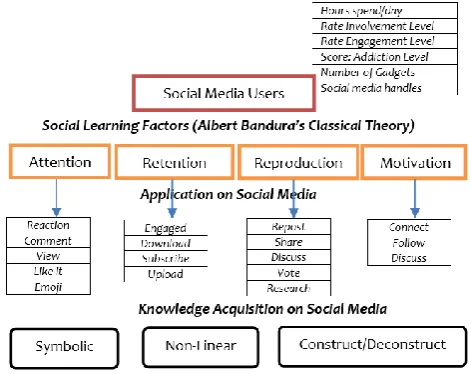
[image:4.595.315.551.423.610.2]After carefully synthesizing the current literature on social learning theory, social media and establishing their influence on process of knowledge acquisition, in this section we will now apply a conceptual framework to transform Albert Bandura’s classical social learning theory in context of now dominatingly known as social media. The primary aim is to investigate whether the concepts of Attention, Retention, Reproduction and Motivation (as suggested in Albert Bandura classical social learning theory) stimulate learning on social media, and if they do, what is the extent to which these elements contribute towards knowledge acquisition? The research also tests interaction effect of knowledge acquisition (symbolic, non-linear, and construct/deconstruct) by classifying social media users in to two categories (high-end users and low end-users). Based on literature review and derivation of important variables/concepts from relevant theories, Knowledge Acquisition Model for social media users is conceptualized as under Fig 1.
Fig 1. Knowledge Acquisition by Users on Social Media.
A. About the framework
1. Social Media Users: Independent variable classified based on six study parameters
3. Application on Social Media: Translates or provides a digital reflection and relevance to the four factors of Bandura’s Theory on Social Media (Hypothesized). 4. Knowledge Acquisition: Stores knowledge acquired by
social media users on Social Media (Hypothesized). a. Symbolic learning – occurs in the form visual
representation or images formed for knowledge acquisition.
b. Non-linear learning – occurs in the form of random learning from various sources, not necessarily deep knowledge acquisition occurs, but in terms of breadth, it’s wide but shallow, therefore cannot be associated with any fixed set of patterns. Non-linear learning does not reflect linearity but depending on contextual stored information and once own interest and aptitude, knowledge acquisition may vary from person to person.
c. Construct/deconstruct learning – occurs when knowledge is acquired and shared. This form of learning requires is also represented in acquired set of skills that users develop over period of time. Sharing, reposting and sometimes constructing/deconstructing new ideas are important aspects of this form of learning.
B. Methods & Procedure
Primary data collection was done using a questionnaire method. Respondents of the questionnaire were selected using randomized probability sampling technique. The questionnaire was developed on framework model as shown in Figure 1. Total number of respondents were 67, which after adjusting for missing data and outliers was narrowed down to 63.
C. Data Normality
Shapiro-Wilk test was used to confirm data normality as the numbers of cases were 63 elements. The data was found to have p-value of 0.324, hence concluded that data emerged from a normal distribution. Data normality was also checked with Skewness and Kurtosis values that were found to be within normal ranges, while Sphericity was assessed through a Mauchly’s Test of Sphericity.
D. Classification of Social Media Users
Data was collected on possible details that would make social media users’ classification accurate. Later, data correctness technique (coding/recoding) was used to classify respondents as per their usage, addiction, and engagement habits/behavior on social media. Few adjustments were made to club extreme values reported. Sub-emerging categories were re-coded to adjust questions and in the end two major categories, namely social media high-end users and low-end users emerged.
E. Reliability Analysis
Reliability of constructs was estimated and was reported to have Cronbach alpha of .604.
F. Hypothesis Testing
1. RQ1: To investigate difference in social learning i.e. Attention, Retention, Reproduction, and Motivation based on types of social media users i.e. high-end and low-end towards Knowledge Acquisition on Social Media. (Being able to find reliable significant difference in high-end and low-end social media users would support the argument that social learning constructs are a reason behind
knowledge acquisition occurs as shown in Figure 1). Hypotheses to test:
a. Ho: There is no difference in interaction of social learning (Attention, Retention, Reproduction and Motivation) on symbolic learning of social media users.
b. H1: There is a difference in interaction of social learning (Attention, Retention, Reproduction and Motivation) on symbolic learning of social media users.
c. Ho: There is no difference in interaction of social learning (Attention, Retention, Reproduction and Motivation) on non-linear learning of social media users.
d. H2: There is a difference in interaction of social learning (Attention, Retention, Reproduction and Motivation) on non-linear learning of social media users.
e. Ho: There is no difference in interaction of social learning (Attention, Retention, Reproduction and Motivation) on construct & deconstruct learning of social media users. f. H3: There is a difference in interaction of social learning
(Attention, Retention, Reproduction and Motivation) on construct & deconstruct learning of social media users. To test hypothesis H1, H2, H3 statistical technique used was Factorial ANOVA. It was used to compare the main effects of independent variables (high-end and low-end social media users) and the interaction effect between second set of independent variables related to social learning constructs of Albert Bandura’s theory 1. Attention, 2. Retention, 3. Reproduction, 4. Motivation) towards predicting Knowledge Acquisition; which was treated as a sub-set of three dependent variables, 1. Symbolic learning, 2. Non-linear learning, 3. Construct/Deconstruct.
2. RQ: To investigate if there is any significant difference in Knowledge Acquisition (sum of Symbolic learning, Non-linear learning and Construct/deconstruct learning) based on type of (high-end and low-end) social media users. Hypotheses to test:
a. Ho: There is no significant interaction effect of Knowledge Acquisition (sum of Symbolic learning, Non-linear learning and Construct/deconstruct learning) on social media users (high-end versus low-end).
b. H4: There is a significant interaction effect of Knowledge Acquisition (sum of Symbolic learning, Non-linear learning and Construct/deconstruct learning) on social media users (high-end versus low-end).
To test Hypothesis H4 - Mixed Factorial ANOVA design was the selected technique.
IV. DATAFINDINGSANDANALYSIS
Following subsections will explain data findings and analysis on the data.
A. Social Media Users Analysis
Fig 2 shows average time spent by social media users in hours/day on various social medias’. Respondents reported their level of usage addiction of social media on a continuous scale of (0-10). Results showed that users classified as high-end social media users on average spent about 8 hours and plus on social media in a day and reported their mean addiction to be 9.32. While,
on average they spent approximately 4 hours in a day. Their reported addiction was 6.12.
Fig 2. Users Reported Time Spend and Level of Addiction with Social Media.
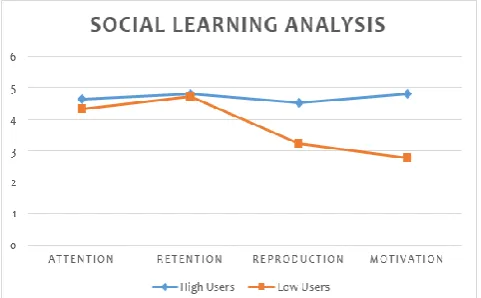
Fig 3 is an analysis of social media users (high-end versus low-end) in terms of their overall reported social learning on social media reported in Table 1. Constructs for the analysis are taken from Albert Bandura’s classical Social Learning Theory.
Fig 3. Users Reported Time Spend and Level of Addiction with Social Media
[image:6.595.306.547.123.284.2]Data analysis shows that on average high-end and low-end users have reported close mean social learning for the constructs; Attention (high = 4.63, low = 4.34) and Retention (high = 4.82, low = 4.34), while for the constructs Reproduction, high-end users have reported mean social learning of 4.53, and low= end users have reported 3.23. Likewise, for the construct Motivation, difference is marginally higher between the two end-users of the social media (high = 4.81, low 2.77).
Table 1: Reported Social Learning on Social Media (Mean Estimation)
Users Attention Retention Reproduction Motivation
High-en
d 4.63 4.82 4.53 4.81
Low-end 4.34 4.72 3.23 2.77
B. Homogeneity of Variance
Fig 4 is an analysis based on mean estimation and variance
distribution using Levene’s Test to determine significant difference on social learning of high-end and low-end social media users on new conceptualized constructs, i.e. Symbolic learning, Non-linear learning and Construct/Deconstruct learning.
Fig 4. Mean Estimation of Social Learning on Social Media
1. Symbolic learning – Mean estimation results show that high-end users experienced symbolic learning relatively higher (M = 5.32) than low-end users (M = 4.12). Homogeneity of variance was tested using Levene’s Test for Equality of Variance and results showed that equality of variance assumption has been violated with F (63) = .851, p = .033 < 0.05.
2. Non-linear learning – Mean estimation results show that high-end users experienced non-linear learning marginally higher (M = 6.43) than low-end users (M = 5.63). Results of the Levene’s Test for Equality of Variance showed that equality of variance assumption has not been violated with F (63) = .402, p = .536 > 0.05. 3. Construct/de-construct learning – Mean estimation results show that high-end users experienced this form of learning much higher (M = 7.07) than low-end users (M = 2.27). Results of the Levene’s Test for Equality of Variance showed that equality of variance assumption has not been violated with F (63) = .711, p = .603 > 0.05.
C. RQ1: Social learning for Knowledge Acquisition on Social Media
Symbolic learning: All effects were significant at .05 significance level except for the Reproduction factor for two classified types of social media users. The main effect for Albert Bandura’s theory yielded an F-ratio of F (2, 61) = 137.5, p < .001 indicating a significant difference in high-end and low-end social media users in terms of Attention, Retention and Motivation. Hence, it can be confirmed that Symbolic learning rightly occurs on social media as conceptualized in the research framework.
Non-linear learning: All effects of Factorial ANOVA were significant at .05 significance level except for the Attention and Retention factors for two classified types of social media users. The main effect for Albert Bandura’s theory yielded an F-ratio of F (2, 61) = 206.2, p
[image:6.595.49.290.359.508.2] [image:6.595.44.293.701.760.2]low-end social media users in terms of Reproduction and Motivation. Hence, it can be confirmed that Non-linear learning somewhat occurs on social media as conceptualized in research framework.
Construct/Deconstruct learning: All effects of Factorial ANOVA were significant at .05 significance level except for the Attention factor for two classified types of social media users. The main effect for Albert Bandura’s theory yielded an F-ratio of F (2, 61) = 317.2, p < .05 indicating a significant difference in high-end and low-end social media users in terms of Attention, Reproduction and Motivation. Hence, it can be confirmed that Construct/Deconstruct learning as conceptualized in research framework.
There is statistical evidence to accept alternative hypotheses H1 & H3 while H2 is partially failed to be rejected.
[image:7.595.46.292.463.536.2]D. RQ2: Knowledge Acquisition by Social Media Users Sphericity is an important assumption of repeated or mixed measures ANOVA. It refers to the condition where the variances of the differences between all possible pairs of within-subject conditions (i.e., levels of the independent variable) are equal. Mauchly's sphericity test is a statistical test used to validate a repeated measures analysis of variance. Mauchly's Test of Sphericity tests the null hypothesis that the variances of the differences are equal. Thus, if Mauchly's Test of Sphericity is statistically significant (p < .05), we can reject the null hypothesis and accept the alternative hypothesis that the variances of the differences are not equal (i.e. sphericity has been violated). The results of this test show (see Table 2) that sphericity has not been violated (p = .266).
Table 2: Mauchly’s Test of Sphericity
Within subjects Effect
Mauchly’s
W Approx. Chi –
Square
Df Sig. Epsilon
Greenh ouse – Geisser
Huynh
– Feldt Lower –
bound
Knowledge Acquisition by type of Social Media Users
.705 2.650 2 .26
6 .874 1.000 .500
An epsilon of 1 (i.e., ε = 1) indicates that the condition of sphericity is exactly met. The further epsilon decreases below 1 (i.e., ε < 1), the greater the violation of sphericity. Both the Greenhouse-Geisser and the Huynd-Feldt procedures attempt to estimate epsilon (ε). Greenhouse-Geisser estimate is reported to be .874 and Huynh-Feldt is 1.
Repeated measure interaction effect of Knowledge Acquisition (sum of symbolic learning, non-linear learning and construct/deconstruct learning) was found to have a significant overall interaction with the two types of social media users (high-end and low-end), F = 4.840, p = .014 < .05. It indicates that Knowledge Acquisition happens over social media in the form of symbolic learning, non-linear learning, and construct/deconstruct learning. Moreover, this interaction is significantly and reliably different for the two-types of social media users (high-end and low-end). Therefore, we have statistical evidence to accept alternative H4 hypothesis.
V. CONCLUSION
This study was designed with three broad study objectives, 1) to synthesize the current literature on social learning theory and social media, 2) to apply social learning theory on social media environment (propose a conceptual framework), and 3) empirically validate through statistical intervention and hypotheses testing, effect of Bandura’s social learning theory on knowledge acquisition by social media users. The social learning theory by Bandura is based on notion that learning occurs as an outcome of observation by people. It is believed to be an internal thought process that can stimulate and change behavior, trigger rationalization and adoption of behaviors to achieve desired goals. Moreover, it is highly self-directed and that any negative external stimulus, such as reinforcement or punishment can have an unidentified effect on both learning and behavior.
The study is able to conclude that social learning hovers around the process of knowledge acquisition and a conceptual framework proposed in this study has been validated using statistical inference and hypothesis testing. The validation of the framework was done using statistical analysis to determine, whether Bandura’s theory is applicable on a social context and leads to knowledge acquisition, already been established through literature. The social media users were carefully samples selected and grouped with key heterogeneous and indigenous characteristics in profile. The social media users were categorized as high-end and low-end users so the effect of variance difference on knowledge acquisition can be statistically compared and measured. The research findings concluded that significant difference is reported in high versus low end social media users in terms of knowledge acquisition; symbolic, non-linear and construct/deconstruct. These elements aid innovative behaviors that support acquisition, access, manipulation, retrieval, and visualization of information.
Author-2 Photo REFERENCES
1. A. Bandura, “Social Learning Theory,”General Learning Corporation, 24 October 2013.
2. N.G. Kahveci, “Pre-service Teachers' Conceptions on Use of Social Media in Social Studies Education,”International Journal of Progressive Education, vol.11, Issue 1, pp.82-100.
3. J.B. Rotter, “The Social Learning Theory,” psych.fullerton.edu. Retrieved 2017-03-30.
4. Statista – The Statistics Portal. “The Most Popular Statistics About Social Media Usage,” [Accessed on December 2018] https://www.statista.com/stats/social%20media%20usage
5. J. Hemsley and R.M. Mason, “Knowledge and Knowledge Management in the Social Media Age,” Journal of Organizational Computing and Electronic Commerce, vol 23, Issue 1-2: Knowledge Management and Social Media: The Challenges and Benefits, pp. 138-167 | 16 Nov 2012.
6. R. Stuart and N. Peter, “Artificial Intelligence: A Modern Approach”Simon & Schuster, pp. 22–23. ISBN 0-13-103805-2. Retrieved 14 June 2014.
7. S. Moghavvemi, A. Sulaiman, N.I.Jaafar and N. Kasem, “Social Media as a Complementary Learning Tool for Teaching and Learning: The Case of Youtube,” The International Journal of Management Education, vol. 16, Issue 1, March 2018, Pages 37-42.
8. E. Kolokytha, S. Loutrouki, S.Valsamidis and G. Florou, “Social Media Networks as a Learning Tool,” Procedia Economics and Finance, vol. 19, 2015, pp. 287-295.
9. B.G. Kiselev, V.A. Yakutenko and M.A. Yuriev, “Knowledge Acquisition and Learning Process Description in Context of E-Learning,” Information Technologies in Education of the XXI Century (ITE-XXI), AIP Conf. Proc. 1797, 020007; doi: 10.1063/1.4972427.
10. A. Gomez-Perez, O. Corcho and M. Fernandez-Lopez, “Ontological Engineering: With Examples from the Areas of Knowledge Management,” E-Commerce and the Semantic Web, Springer, New York, 2004.
11. K. Illeris, “The Three Dimensions of Learning,”Malabar, Fla: Krieger Pub. Co. 2004, ISBN 9781575242583.
12. E.L. Thorndike, “The Elements of Psychology,”New York: A. G. Seiler, 1905.
13. J. Piaget, “The Growth of Logical Thinking from Childhood to Adolescence,” AMC, 10-12. 1958.
14. C. Rogers, “Client-Centered Therapy: Its Current Practice, Implications and Theory,”London: Constable, 1953, ISBN 1-84119-840-4.
15. R.J. Kraft and M. Sakofs, “The Theory of Experiential Education,” Boulder, CO: Association for Experiential Education, ISBN 0929361008.
16. Y.F. Yang, “The Influence of Social Interaction on Meaning Construction in a Virtual Community,” British Journal of Educational Technology, vol. 41, Issue 2, pp. 287-306, 2010.
17. J. V. Pavlik, “Fueling a Third Paradigm of Education: The Pedagogical Implications of Digital, Social and Mobile Media,”Contemporary Educational Technology, 2015, vol. 6, Issue 2, pp. 113-125. 18. L. Suit, P. Winkler, L. Campbell, K. Pennington, M.P. Szutenbach, R.
Haight, D. Roybal and M. McCollum, “A Correlation Study of Social Network Usage Among Health Care Students,” The Journal of Nursing Education, April 2015, vol. 54, Issue 4, pp.207-213.
19. K. Sutherland, C. Davis, U. Terton and I. Visser, “University Student Social Media Use and Its Influence on Offline Engagement in Higher Educational Communities,” Student Success, ISSN: 2205-0795 vol. 9, Issue 2, pp. 13-24 March 2018.
20. A. Dogtiev, “YouTube Revenue and Usage Statistics,” [Accessed on]
December 2018.
http://www.businessofapps.com/data/youtube-statistics/
21. M.Shamsul, M. Shoid, N.A. Kassim and M.A. Idris, “Knowledge Acquisition through Social Media towards Academic Performance among Undergraduate Students,”International Journal of Learning and Development, 6. 10.5296/ijld.v6i4.10342.
22. J. Carpenter and T. Green, “Self-directed Professional Learning and Educator Self-Efficacy: The Case of Voxer,” 10.1007/978-3-319-99858-9_10.
23. K. Zdravkova, “Reinforcing Social Media Based Learning, Knowledge Acquisition and Learning Evaluation,” Procedia - Social and Behavioral Sciences,vol. 228, 20 July 2016, pp. 16-23.
24. M. Mondahl and L. Razmerita, “Social media, Collaboration and Social Learning – a Case Study of Foreign Language Learning,” The Electronic Journal of e-Learning,vol. 12, Issue 4, 2014,pp. 339-352.
25. J. Grusec, “Social Learning Theory and Developmental Psychology: The Legacies of Robert Sears and Albert Bandura,” Developmental Psychology, vol. 28, Issue 5,pp. 776–786, 1992. doi:10.1037/0012-1649.28.5.776.
26. Oxford Reference, “Shannon and Weaver's model,” A Dictionary of Media and Communication, [Accessed on December 2018]http://www.oxfordreference.com/view/10.1093/oi/authority.201 10803100546763
27. T. Yunkaporta, “Aboriginal Pedagogies at the Cultural Interface,” Professional Doctorate (Research) thesis, James Cook University.
AUTHORSPROFILE
Sadia Riaz is an Assistant Professor and Head of Amity School of Foundation Studies at Amity University Dubai Campus. She holds a PhD in Information Technology from the Universiti Teknologi PETRONAS, Malaysia. Her core research area is Human-Computer Interaction Designing and Usability Engineering ([email protected]).