International Journal of Innovative Technology and Exploring Engineering (IJITEE) ISSN: 2278-3075, Volume-8 Issue-12, October 2019
Abstract: For the past two decades, wavelet based image compression algorithms for Wireless Sensor Network (WSN) has gained broad attention than that of the spatial based image compression algorithms. In that, Dual Tree Complex Wavelet Transforms (DTCWT) has provided better results in terms of image quality and high compression rate. However, the selection of DTCWT based image compressions for various WSN based applications is not practically suitable, due to the major limitations of WSN such as, low bandwidth, low energy consumption and storage space. Therefore, an attempt has been made in this paper to develop image compression through simulation by considering the modified block based pass parallel Set Partitioning In Hierarchical Trees (SPIHT) with Double Density Dual Tree Complex Wavelet Transform (DDDTCWT) for compressing the WSN based images. In addition, bivariate shrink method is also adopted with the DDDTCWT to obtain better image quality within less computation time. It is observed through simulation results that above mentioned proposed technique provides better performance than that of existing compression technique
Keywords : Bivariate Shrink Method, Double Density Wavelets, Image Compression, Set Partitioning in Hierarchical Trees, Wireless Sensor Networks .
I. INTRODUCTION
I
n
recent years, image based way of communication is receiving a lot of attention in various applications of WSN domain [1]. However, the number of redundancies present inside the images engages huge storage space and in turn increases the energy consumption during WSN based communication. With the intention that, to surmount the unwanted redundancies, image compression is the best choice. By removing the redundancies using image compression, the memory space, bandwidth and energy consumption needed to store and transmit the images are decreased effectively. Usually, the architecture of WSN has huge quantity of sensor nodes to capture images. Each node from WSN has the capacity to reduce/resize and communicate the original input images to the user location.In that case, lossy image compression methods are chosen for WSN to provide high compression ratio with better image features. But, most of the lossy image compression algorithms implemented so far, for the sensor nodes are inappropriate to
Revised Manuscript Received on October 05, 2019.
* Correspondence Author
P.Samundiswary*,Department of Electronics Engineering, Pondicherry University, Pondicherry, India. Email: [email protected]
H.Rekha,Department of Electronics Engineering, Pondicherry
retain the original features of the input image and also in reducing the computation time [2]. For instance, Chew et al. [3] have provided the evaluation of different image compression algorithms and analyzed their performance in terms of storage space, computational complexity and compressed image quality. Also, it is found through the several literature surveys that, Set Partitioning In Hierarchical Tree (SPIHT) provides high compression ratio and less computation complexity than other compression algorithms [4-6]. Later, Kumar and et al. [7] have projected a new approach based on Singular Value Decomposition (SVD). In this work, the author combined the SVD along with hybrid of Discrete Cosine Transform (DCT) and Block Truncation Coding (BTC) to get the better performance of compression in terms of Mean Square Error (MSE) and PSNR, than that of the existing JPEG (Joint Photographic Experts Group) and SPIHT image compression techniques.
Then, Nasri et al. [8] have presented a better adaptive image compression method that guarantees a considerable reduction in computational load and energy consumption as well as communication of image with better image quality. Here, the overall computation time is reduced by distributing the processing tasks among the clusters. After that, Ghorbel et al. [9] have described the importance of discrete cosine and discrete wavelet transform in image compression. Further, they gave the clear view about the performance comparison of these two transforms with various existing image compression algorithms in different WSN transmission scenario.
Later, Ghorbel et al. [10] have extended their work by considering the additional parameter called energy consumption and concluded that the effectiveness of the DWT is superior when compared to the DCT in terms of computation time and image quality. Followed by Ghorbel, Ma et al. , several researchers [11] have reviewed different multimedia based compression and transmission techniques by considering the resource constrained platform with respect to the performance metric namely energy efficiency. Despite, many compression techniques, only a small number of techniques have considered and utilized for practical applications to face the energy constraint problems. It is clear from the previous research works that the three basic image compression techniques such as JPEG (DCT), SPIHT and JPEG2000 (Embedded block coding using optimized truncation) are suitable for multimedia compression. The pros and cons of these three algorithms are analysed and compared by using their compression efficiency, storage space and computational complexity.
An Efficient Pass Parallel SPIHT based Image
Compression using Double Density Dual Tree
Complex Wavelet Transform for WSN
Wavelet Transform for WSN
Obviously, the experimental testing of each developed image compression algorithms on hardware test beds for real time applications is typically very hard to achieve [12]. For the past two decades, the compression algorithms such as JPEG and JPEG2000 are implemented in the sensor nodes and allowed for system controlled image size reduction and communication oriented decisions. Recently, some of the image compression based research works focus on Dual Tree Complex Wavelet Transforms (DTCWT) [13]. Due to better shift invariance and directionality properties of the DTCWT, the researchers combine the DTCWT with SPIHT to improve the image quality. Yet, the resource constrained problem is not solved and additional focus is needed to propose a low power image compression method for WSN based communication.
Lately, H. Rekha and P. Samundiswary [14] have proposed and analysed the effectiveness of the Double Density Dual Tree Complex Wavelet Transform (DDDTCWT) in image denoising for WSN. Therefore, to enhance the performance of the existing SPIHT based image compression, the wavelet transform DDDTCWT is combined with the modified SPIHT. This combination mainly used to reduce the unwanted noise present in the captured image, computational complexity and energy required to compute the image compression algorithm.
The overall research work is structured into five sections. Section I and Section II represents the introduction and the working principle of existing SPIHT based image compression techniques. Section III explains the concept of the proposed SPIHT method with DDDTCWT. The performance of the existing and the proposed SPIHT based image compression techniques are discussed and analysed through simulation results in Section IV. In the end, section V concludes with the effectiveness of the proposed algorithm through its performance analysis.
II. EXISTING SPIHT WITH DTCWT BASED IMAGE COMPRESSION ALGORITHM
Generally in SPIHT, bi-orthogonal wavelet basis are chosen for image decomposition because of their unitary and linear phase characteristics [15-18]. However, the compressed output image suffers from shift variance, aliasing and lack of directionality properties. Therefore, instead of using bi-orthogonal wavelet, another wavelet transforms are combined and tested with the SPIHT coding. In this work [19], the author describes the compression scheme applicable for wireless capsule endoscopic based images which utilizes Double Density Discrete Wavelet Transform (DDDWT) and SPIHT coding algorithm. Even though, the SPIHT encoding algorithm with wavelet transform improves the compression ratio and the visual quality, yet they are computationally complex.
Later on, P.R.Burad and R.K.Agrawal [20], have implemented the algorithm by using the combination of DTCWT and SPIHT for compression of satellite images. In this, the proposed algorithm was analysed and compared with the SPIHT with DWT based image compression in terms of image quality and compression rate. However, this work didn't concentrate on computation time and energy
consumption. Recently, Muthulakshmi and srinivasagam [21], employed the modified block based SPIHT with DTCWT for video compression so as to reduce the overall computation time. But, the combination of DTCWT with SPIHT is still complex and not suitable for practical image based domains like WSN. The basic workflow of the existing SPIHT with wavelet transform based image compression algorithm is given below in step by step,
At first, the original input image is decomposed as subbands. The total number of decompositions required for better compression is 5.
To locate the significant coefficients from the available coefficients, this method assign the wavelet coefficients as sorting pass. After that, encodes the significant coefficients.
Once the significant coefficients are encoded, then they placed as refinement pass. Here, two bits used to extract the real value from the reconstructive value.
The above mentioned steps are iterative. After the completion of each iteration, the threshold value (Tn = Tn−1/2) and the reconstructive output values (Rn = Rn−1/2) are decreased.
Finally, the reconstructed encoding bits stored and decoded at the end of the compression. The outcome of the SPIHT with wavelet transform based image compression is in the form of bitstream.
III. PROPOSED PASS PARALLEL SPIHT WITH DDDTCWT BASED IMAGE COMPRESSION METHOD
From the existing technique, the SPIHT based image compression provide better compression ratio with the combination of DTCWT. However, the computational complexity is not compromised. Generally, the characteristics of the Double Density Discrete Wavelet Transform (DDDWT) and DTCWT are related in many aspects. However, , the DDDWT is more comfortable than that of dual tree complex wavelet transform for the implementation of filters. The DDDWT has better design properties and low computational load excluding spatial orientation that creates problems in image reconstruction.
Therefore, the enhancement of the spatial orientation is done by using hybrid of DDDWT and DTCWT. This arrangement is called as Double-Density Dual Tree Complex Wavelet Transform (DDDTCWT). In this section, a modified SPIHT based image compression algorithm is developed with the aid of DDDTCWT. Also, bivariate shrink method is integrated with the SPIHT-DDDTCWT combination for improving the compression ratio.
International Journal of Innovative Technology and Exploring Engineering (IJITEE) ISSN: 2278-3075, Volume-8 Issue-12, October 2019
A. DDDTCWT
To construct a two dimension DDDTCWT [22], four oversampled two-dimension Double Density Complex Wavelet Transform (DDCWT) is consider for carrying out each row and column of image simultaneously with the help of different filter banks in an image. Generally, the filter bank arrangement of the double-density complex wavelet transform consists of two parallel operated oversampled filter banks on the input data which is shown in fig. 2. After the iteration, four approximate sub-band co-efficients and thirty-two number of detail sub-band coefficients are obtained to express the more specific information of the image.
B. Bivariate Shrink Method
The bivariate method [23] is originally originated from Bayesian estimation. In general, the bivariate method is used to represent the wavelet co-efficient of the input images by using the non-Gaussian bivariate probability distribution function. The functional property of the bivariate is mainly concentrate on Maximum APostriori (MAP) based non-linear threshold functions. It improves the image quality depending upon the selection of the overall subband coefficients. For understanding purpose, the working principle of the bivariate shrink function is described in detail in the following steps,
Step 1: At first, the input image is decomposed into number of subband coefficients with the help of wavelet transform DDDTCWT, then the coefficients are represented like
Y=W+N (1) here, 'Y' represent the wavelet coefficient and 'W' is the input image coefficient and 'N' is the noise present in the image during image acquisition correspondingly.
Step 2: Then, the first and second subband coefficients such as w1 and w2 are declared as parent, which are from same
direction as mentioned below,
Y1 = W1 (2)
Y2 = W2 (3)
Step 3: For mathematical analysis, the above equations are written in vector form,
Y= [Y1,Y2] and W=[W1,W2]
Step 4: Then the MAP of the wavelet coefficient „w‟ is,
Y W p Y
w
Y w w
map( ) argmax (4)
Step 5: From the bayes estimation function, the above equation can be re-modelled as,
w
map(
Y
)
arg
max
W[
p
n(
Y
W
).
p
w(
W
)]
(5)Step 6: Followed by that, joint probability function of the wavelet coefficients is denoted as,
2
2 2 2
1 1
2 1
3 exp 2
3
W W
W
pw (6)
where σ1 and σ2 are signal variance of the first and second
order coefficients
Wavelet Transform for WSN
Fig. 2 Filter Bank section of the 2D-Double Density Dual Tree Complex Wavelet Transform [19]
C. Modified SPIHT Encoding and Decoding
Followed by the wavelet decomposition and bi-variate shrinkage of the image, the SPIHT coding algorithm is applied to segment the image into spatial orientation trees using wavelet coefficients. Generally, the spatial orientation tree structure mainly identifies the spatial self-similarity between the subband coefficients. Hence, each and every node of the orientation tree communicates to an individual pixel and acknowledged by pixel coordinate. The direct descendents of the four pixels with same spatial location of the next advanced level of the same subband is considered for next level. Pixels at the further wavelet levels are only the tree leaves without children. Each pixel is a division of 2 x 2 block along with its neighbouring pixels. The blocks are usual outcome of the hierarchical trees since all pixels inside the block share same parent.
However, this dynamic processing order may reduce the speed of the algorithm. In order to increase the speed of the encoding algorithm, a modified block based Pass Parallel SPIHT[24] is considered in this proposed image compression method. By using the modified SPIHT, the transformed output image is decomposed into 4 × 4 blocks. Further, at the same time, the bits are encoded in the bit plane of 4 × 4. Within the each and every bit plane, information is transmitted by using three lists, they are List of Insignificant Pixels (LIP), List of Insignificant Sets (LIS) and the last one is List of Significant pixels (LSP).
The above-mentioned lists are coefficient location lists along with their coordinates. After completion of the initialization, the algorithm will execute in two stages namely: sorting pass and the refinement pass for each level of threshold. Once the iterations over, the final information is stored as bitstream. To produce a reconstructed image, the final bitstream is fed into the SPIHT decoder section.
IV. SIMULATION RESULTS AND DISCUSSION
To understand the usefulness of the proposed image compression technique in WSN, certain input images of size 256 x 256 from Berkley database [25] are taken in to consideration. For demonstration purpose, the input images shown in fig. 3 are artificially corrupted by AWGN noise at noise level (σ) of 20db. In the proposed method, the input images are first decomposed in to wavelet coefficients using DDDTCWT. Then, the noise present in each subband is reduced with the help of bivariate shrink method. Finally, modified SPIHT encoding is applied on each subband to reduce the redundancies. With the intention of improving the coding efficiency, the combination of Huffman coding and run length encoding is considered for an entropy encoding.
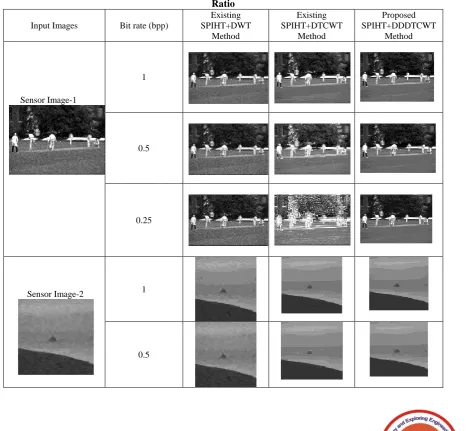
The analysis of the proposed compression method is demonstrated by comparing the simulation results of the proposed method with the existing SPIHT with DTCWT based image compression and SPIHT with DWT methods. The most important criteria to analyse the performance of the proposed image compression algorithm are PSNR and compression ratio or encoding bit rate. The quantitative comparison of the proposed and the existing SPIHT with wavelet based image compression algorithms in terms of SSIM, PSNR and computation time for different bit rate is denoted in Table-I. It is observed through the simulation results shown in Table-1 that, the proposed pass parallel SPIHT with DDDTCWT shows the best compression performance with less computation time in terms of image quality and compression rate than that of the existing techniques.
The following Table-II represents the noisy input images and its corresponding compressed output images of the existing and the proposed image compression method. From the figure, it is clear that the image quality of the proposed compressed output images is better for different compression rates than that of the existing technique. In addition, without degrading the quality measures, the proposed pass parallel SPIHT with DDDTCWT method effectively reduce the computation time for different set of images than that of the existing SPIHT technique.
Sensor Image-1 Sensor Image-2 Sensor Image-3
International Journal of Innovative Technology and Exploring Engineering (IJITEE) ISSN: 2278-3075, Volume-8 Issue-12, October 2019
Table-I Quantitative Comparison of the Proposed pass parallel SPIHT with DDDTCWT Method and the Existing SPIHT with DWT and SPIHT with DTCWT based Image Compression Methods
At noise level (σ)=20dB
Bit rate=1.00bpp Bit rate=0.50bpp Bit rate=0.25bpp
Images Method PSNR
(dB)
SSIM Time (sec)
PSNR (dB)
SSIM Time (sec)
PSNR (dB)
SSIM Time (sec)
Sensor Image-1
Existing SPIHT+DWT
30.59 0.918 3.07 29.48 0.842 3.31 26.84 0.810 3.88
Existing
SPIHT+DTCWT 34.69 0.931 1.849 28.214 0.897 2.26 25.33 0.824 3.19 Proposed
SPIHT+DDDTCWT 37.84 0.982 0.98 35.56 0.946 1.45 30.868 0.908 2.08
Sensor Image-2
Existing SPIHT+DWT 33.70 0.924 2.81 29.72 0.891 3.24 27.09 0.880 3.33
Existing
SPIHT+DTCWT 35.19 0.943 2.09 33.35 0.912 3.12 27.98 0.881 3.76 Proposed
SPIHT+DDDTCWT 38.26 0.986 1.39 36.95 0.957 2.02 31.12 0.90 2.98
Sensor Image-3
Existing SPIHT+DWT 34.22 0.931 2.224 32.93 0.916 2.809 31.12 0.905 3.25
Existing
SPIHT+DTCWT 35.94 0.946 1.85 30.66 0.901 2.54 28.11 0.895 3.25 Proposed
SPIHT+DDDTCWT 37.18 0.976 1.11 33.34 0.918 1.49 31.62 0.916 2.29
Table II Qualitative Analysis of Existing and the Proposed Image Compression Method for Different Compression Ratio
Input Images Bit rate (bpp)
Existing SPIHT+DWT
Method
Existing SPIHT+DTCWT
Method
Proposed SPIHT+DDDTCWT
Method
Sensor Image-1
1
0.5
0.25
Sensor Image-2
1
[image:5.595.74.542.353.784.2]Wavelet Transform for WSN
0.25
Sensor Image-3
1
0.5
0.25
V. CONCLUSION
The existing SPIHT based image compression techniques so far developed for WSN provides better compression results at the cost of high computation time. Hence, in this paper,the modified SPIHT image compression algorithm along with DDDTCWT is developed to reduce the computation time while maintaining the image quality measures. The performance comparison of the existing methods such as SPIHT with DTCWT and SPIHT with DWT are examined along with the proposed pass parallel SPIHT with DDDTDWT based image compression method through simulation in terms of quantitatively and qualitatively. It is observed through the simulation results that the combination of pass parallel SPIHT and DDDTCWT provides better visual quality with image enhancement for reasonable compression rate. Moreover, the computation time of the proposed method is very less than that of the existing SPIHT with DTCWT method. Overall, the newly developed modified SPIHT with DDDTCWT based image compression algorithm satisfies the requirement of WSN in terms of image quality, bit rate and computation time.
REFERENCES
1. Mohsen Nasri, Abdelhamid H and et.al, “Adaptive image transfer for wireless sensor networks (WSNs)”, In Proceedings of International Conference on Design and Tech. of Integrated System .in Nanoscale Era, Tunisia, 23-25, March 2010, pp. 1-7.
2. Ian F. Akyildiz, Kaushik R. Chowdhury and TommasoMelodia, “Wireless multimedia sensor networks: Applications and testbeds”, In Proceedings of the IEEE, Vol. 96, No.10, Oct.2008, pp.588-1605. 3. Chew Li Wern, Li-MinnAng and Seng K. P. "Survey of Image
Compression Algorithms in Wireless Sensor Networks", In Proc. of IEEE International Symposium Information Technology, Kualalumpur Convention Centre, Malaysia, Vol.4, August 2008, pp. 1–9.
4. Xu Lin and Fu A., “Research on Energy Conservation Method of the Image Compression Coding Based on Wavelet Transform for WVSNs”, In Proceedings of Seventh Chinese Control and Decision Conference, Qingdao, China, 23-25 May 2015, pp.1425-1430. 5. Arafat Senturk and Resul Kara, “An analysis of image compression
6. Hanaa Zain Eldin, Mostafa A. Eltosseini and Hesham A. Ali, “Image compression algorithms in wireless multimedia sensor networks: a survey”, Ain Shams Engineering Journal, Vol.6, pp.481-490, 2015. 7. Kumar V, Kumar A, Bhardwaj A. "Performance evaluation for image
compression techniques", In Proceedings of Internationsl Conference on Devices, Circuits and Systems (ICDCS), Coimbatore, India, 2012, pp.447–450.
8. Nasri M, Helali A, Sghaier H, Maaref, ‟‟ Adaptive image compression technique for wireless sensor networks, Comp. and Electrical Engineering, Vol.37, 2011, pp.798–810.
9. Ghorbel O, Jabri I and Ayedi. "Experimental Study of Compressed Images Transmissions through WSN", In Proceedings of International Conference on IEEE Microelectronics (ICM),Hammamet, Tunisia, 2011, pp.1–6.
10. Ghorbel O, Ayedi W, Jmal MW and Abid M. "Image compression in WSN: performance analysis", In Proceedings of 14th IEEE International Conference on Comm. Tech. (ICCT),Chengdu, China, 2012, pp.1363–1368.
11. Ma Tao, Hempel M, Peng Dongming and Sharif H. "A survey of energy efficient compression and communication techniques for multimedia in resource constrained systems", Communication Surveys Tutorials, 2013, pp.963–972.
12. D. Johnson, T. Stack, R. Fish, D. M. Flickinger, L. Stoller, R. Ricci, and J. Lepreau, “Mobile Emulab: A robotic wireless and sensor network testbed”, In Proceedings of IEEE Conf. on Comp. Comm.,
Barcelona, Spain, 2006, pp.1-12.
13. JitendraPatil and ShailajaPatil, "Image compression by DWT and DTCWT using an SPIHT algorithm", International Journal of Science, Engg. and Applied Sciences, Vol.1, No.1, 2015, pp.321-326. 14. H.Rekha and P.Samundiswary, "Double density wavelet with fast
bilateral filter based image denoising for WMSN", In Proceedings of ninth International Conference on advanced computing, Anna University, Chennai, India, 2017, pp.315-319.
15. Ahmed Chefi, l Soudani, G Sicard, "Hardware compression scheme based on low complexity arithmetic encoding for low power image transmission over WSNs", AEU – International Journal of Electronics .and Communication., Vol.68, No.1, 2014, pp.193-200.
16. Tao Xiang, JinyuQu and Di Xiao, “Joint SPIHT compression and selective encryption”, Applied Soft Computing., Vol.21, No.1, 2014, pp.159-170.
17. Kadam, A. G., Mr, & Pingle, N., Prof. (n.d.), "Overview of SPIHT based image compression algorithm",. International Journal of Engineering Sciences & Research Technology, Vol.7, No.2, Feb.2018, pp.232-240.
International Journal of Innovative Technology and Exploring Engineering (IJITEE) ISSN: 2278-3075, Volume-8 Issue-12, October 2019
19. Varun P.Gopi, P.Palaniswamy, “ Endoscopic Image compression based on double density discrete wavelet transform and SPIHT coding”, In Proceedings of IEEE International Conference on Control System, Computer and Engineering, Malaysia, 2011, pp.466-471. 20. P.R.Burad and R.K.Agrawal, “Satellite Image Compression Using
Dual tree complex wavelet transform”, IOSR Journal of Electronics and Communication Engineering., Vol.9, No.1, 2014, pp.29-34. 21. K.Muthulakshmi and V.Seenivasagam, “Dual tree complex wavelet
with modified SPIHT algorithm for video compression”, International Journal of Biomedical Engineering .and Tech.nology, Vol.25, 2017, pp.1-6.
22. C.Vimala and P.ArunaPriya, “ DegradedImage Enhancement Through Double Density Dual Tree Discrete Wavelet Transform”, Indian Journal of Science and Technology., Vol.9, No.28, 2016, pp.1-4. 23. Pan Jin-Feng and Pan XueFeng, “The Adaptive Bivariate Shrinkage
Denoising Method", In Proc. of Int. Conf. on Computational Intelligence, Sanya, China, 2010, pp.1-5.
24. Yongseok Jin and Hyuk-Jae Lee and et.al, “ A Block based Pass-Parallel SPIHT Algorithm", IEEE Trans. on Circuits and Systems for Video Tech., Vol.22, No.1, 2012, pp.1064-1075.
25. The Berkley Segmentation Datasets and Benchmark images (BSDS500)Link:
http://www.eecs.berkley.edu/Research/Projects/CS/vision/grouping/se gbench/
AUTHORSPROFILE
P. Samundiswary: She is currently working as Assistant Professor in the Department of Electronics Engineering at Pondicherry University, Pondicherry, India. She received her B.Tech and M.Tech degrees in the field of Electronics and Communication Engineering from Pondicherry Engineering College affiliated to Pondicherry University. She obtained her Ph. D degree in the field of Electronics and Communication Engineering from Pondicherry Engineering College affiliated to Pondicherry University, Pondicherry, India in 2011. She has nearly 20 years of experience in teaching profession. She is a author of more than 100 papers in national and international conference proceedings and journals. She has been one of the authors of the book published by LAMBERT Academic Publishing. Also, she has co-authored five book chapters in INTECH and Springer Publishers. Her area of interest includes Wireless Communication and Networks, Wireless Security and Computer Networks. She will be available at [email protected].
![Fig. 2 Filter Bank section of the 2D-Double Density Dual Tree Complex Wavelet Transform [19]](https://thumb-us.123doks.com/thumbv2/123dok_us/8166497.251101/4.595.84.269.58.268/filter-bank-section-double-density-complex-wavelet-transform.webp)