Abstract— Technology-assisted living is a growing trend in most developing nations, particularly for young-aged demographic countries, as it presents a platform for personal development and knowledge management. However, this society-scaping trend has also introduced the myriad opportunity for the formation of complex crime, which is often beyond the (immediate) capability of the policing entity in developing nations. To address this lingering and futuristic problem, particularly in Nigeria, this study developed a context-based digital policing framework for the enhancement of the Nigerian Police. This Nigerian-context framework presents the viability and relevance of the digital policing mechanism in addressing challenges ravaging society. Furthermore, it also presents a modality for improving and enhancing the policing apparatus of the Nigerian society, as a model for other developing nations. The knowledge from the Nigerian-context of digital policing has both research and societal implications. In terms of research, it opens the community of security researchers into the contextual characteristics of digital policing as well as the probable research direction required to implement digital policing in developing nations. With respect to society, knowledge provides a substratum for the integration of the community-policing model.
Keywords: context-based digital policing, developing nations, community-policing model, technology-assisted crime, security
I. INTRODUCTION
Poor governance is often defined as the bane of economic growth in Sub-Sahara African countries, particularly in Western African states. Theories and research have established the correlation between economic growth and the rate of crime in each society. This consequential phenomenon has also been identified as a major cause of security challenges in Most African states. However, the African continent is believed to comprise a significant size of the young population with the propensity to technology-assisted living. Amalgamating technology-technology-assisted living and the current high crime-rate presents a logical outcome of which can be termed technology-assisted criminality. In
Revised Manuscript Received on May 29, 2019.
Idris Ismaila, Department of Cyber Security Science Federal University of Technology Minna, Nigeria ([email protected])
Victor Y. Legbo, Department of Cyber Security Science Federal University of Technology Minna, Nigeria. ([email protected])
Adeyemi R. Ikuesan, Department of Computer science University of Pretoria,South Africa. ([email protected])
Shaka A. Imavah, Department of Library and Information Technology, Federal University of Technology Minna, Nigeria. ([email protected])
Abdullahi B. Mohammad, Department of Computer science, Federal University of Technology Minna, Nigeria. ([email protected],ng)
Fatimah J. Abduldayan, Department of Library and Information Technology, Federal University of Technology Minna, Nigeria. ([email protected])
Meshach Baba, Department of Cyber Security Science Federal University of Technology Minna, Nigeria. ([email protected])
contrast, the police rely on the traditional method of policing, which is inadequate to handle a technology-assisted crime.
There is, therefore, a need to develop a technology-enhanced policing process that can be seamlessly integrated into the current policing capability. Some Countries such as Saudi Arabia, the UK, Singapore, and Australia, have established the use of technology-assisted policing, a phenomenon, which has led to the development of digital policing. However, digital policing is a context-based policing model, which requires the comprehension of the unique context of the society and the peculiar governance model of the Country. Therefore, whilst digital policing presents an appropriate platform for the enhancement of the policing capability of a society, a contextual adaption of digital policing mechanism would be required to address the current technology-assisted criminality in most developing nations.
This paper attempted to explore this initiative. Specifically, the paper examines some of the existing policing models. It anatomizes the current state of the Nigerian police force. It further develops a framework for the digital policing model in Nigeria. Furthermore, it also presents a modality for improving and enhancing the policing apparatus of the Nigerian society, as a model for other developing nations. The knowledge from the Nigerian-context of digital policing has both research and societal implications. In terms of research, it opens the community of security researchers into the contextual characteristics of digital policing as well as the probable research direction required to implement digital policing in developing nations. With respect to society, knowledge provides a substratum for the integration of the community-policing model.
II. THE POLICING MODELS
Police and Policing are two phenomena, which are interrelated conceptually. On the one hand, Police is an agency of state saddled with the responsibilities of crime detection and prevention, law enforcement and maintaining order. On the other hand, Policing can be defined as a “measure and action taken by a variety of institutions and groups (both formal and informal) in society to regulate social relations and practices in order to secure the safety of members of community as well as conformity to the norms and values of society” [1]. Thus, policing is a highly political activity. Model of policing is a strategy or
Towards a Digital Policing in Developing
Nations: The Nigerian Context
methodology adopted by a police department to perform their specialist role in enforcing Law and Order. Although, some agencies may be unaware of tested strategies that could be integrated into their traditional models in order to enhance operational efficiency.
There are different models of policing that works in different contexts of a community. These contexts may include transitional society, societal/political disagreement, economic-inequality, industrial dispute, urban and ethnic tensions, and a stable and prosperous community.[2] The various policing models are discussed in turn as follow:
2.1 Democratic policing
Democratic policing model is the most advocated policing model, which is often asserted to provide a reliable measure of the restoration of the legitimacy, stability, and peace in public administration. Generally, a policing system is such that is publicly accountable, subjective to the constitutional law, respectful of human dignity and intrudes into citizens‟ life under strict adherence to the constituted process required by law. This policing model requires that citizens‟ inquiries and request are promptly and effectively addressed. Democratic policing is prevalent in Asian and African countries as a result of their history of colonization and military dictatorships. During those “undemocratic” periods, the notion of policing is relegated to military policing, where the policing system is deemed effective (from the rulers‟ perspective) and the fiercest (from the citizens‟ perspective) tool to control society and suppress opposition and resistance where applicable [2]. However, the problem of political bias is still a cause of disagreement in several parts and among several stakeholders.
2.2 Community-based policing
Community-based Policing (CbP) is a law enforcement philosophy and a viable organizational strategy, which promotes a partnership based on collaborative efforts between the police and the community as a way of effectively and efficiently identifying, preventing and solving societal vices such as crime, the fear of crime, physical and social disorder, as well as neighborhood decay. Consequently, a CbP aims to improve the quality of life, and a safer society for everyone. A CbP generally comprises police-community partnership, the transformation of an organizational, and problem-solving [3]. Thus, CbP extends beyond improving the relationship between police and society. However, it has the potential to effectively reduce crime, and conversely, improves citizen satisfaction and trust in the police. CbP is a policing innovation that has gained wider adoption in the 1990s after several years of unpleasant comparison with „standard‟ police practices.
2.3 Problem-based policing
Problem-based policing (PbP, problem-solving, or problem-based partnerships) is a methodical approach to addressing context-specific problems; it aims to apply the rational and evidence-based analysis of problems and their solutions to a policing context. A Problem-solving approach can systematically identify and analyze crime, develop specific responses to individual problems. Therefore, PbP is the process of identifying context-based specific societal challenges that can lead to disorder and consequently using
context-specific analysis to plan responses. This strategy often targets the underlying causes of crime and disorder and attempts to proactively combat crime before it manifests. Simply put, problem-based policing approach, in contrast to other forms of policing, posits that police should focus more attention on societal challenges, as opposed to
incidents [4]. Such challenges can be recognized as collections of related incidents or as underlying conditions that give rise to societal disorder, and other substantive community which citizens expect the police to address. By focusing more on challenges than on incidents, preventive measures can be emphasized by the police to address crime causation, rather than mere symptoms. The police agencies that implement, organize and practice PbP widely accepted and adopted the SARA model. The attributes of the model includes Scanning (the process of identifying the recurring societal challenges), Analysis (the process of collecting and analyzing relevant data on the societal challenges),
Response (the process of seeking out responses that might have worked elsewhere and then selecting/implementing modalities that can address the identified societal challenge), and Assessment (the process of seeking out if the response reduced the challenges and to identify new probable strategies that could be deployed for efficiency[5]. In addition to the SARA model, the PAT (Problem Analysis Triangle) model is used to determine what the problem exactly is, which invites those who are looking at problems to consider three elements that all problems have: an offender, a victim, and location. These three elements can help to understand (analysis) the problem [6]. However, the effectiveness of PbP is bounded by crime specificity in contrast to blanket appropriation and administration. Therefore, the process of establishing PbP requires an acute appropriation and concentration which should align with the SARA approach [7]. Furthermore, PbP relies on reliable information, to avoid confounding information, which prompts the necessity of information verification, as well as the method of evaluation of acquired information. A depiction of problem-based policing practices is the Polar Star Project of the Hong Kong Police. With initiation in 1998, the Yuen Long police, for instance, attempted to understudy and comprehend the causation of the rampant juvenile delinquency in the district, and consequently address the underlying causation [2].
2.4 Neighbourhood policing
decade of the twenty-first century to address local crime and disorder issues, reassure the public, and reconnect the police with communities” [8] Similar to the community-policing model, the underlying principle of the neighborhood policing model revolves around public consent. For instance, a web-based national tool has been designed and deployed in the UK to supports local policing process through engagements with local communities [2]. Typically, the foot-patrol monitoring process forms the substratum of the neighborhood policing model, as the presence of patrol officers can provide reassurance for the citizen. However, such patrol-officers would work with local community partners to adopt a problem-solving approach that can reduce the local crime rate and antisocial behavior [9].
2.5 Reassurance policing
A Reassurance policing model is a policing approach which prioritizes the importance of the relationship between the Police and the community being policed through efficient communication processes so as to maintain a positive image to the public. Consequently, ensure that the public is reassured on the effectiveness of the policing system [10]. It is closely allied to “community-based policing” and “neighborhood policing.” It leverages on the signal crimes perspective developed by Martin Innes and colleagues in the early 2000s, which held that specific (but varying) types of crime and disorder – including some incidents not traditionally considered to be „serious‟ – can disproportionately convey messages to individuals and communities about their security [9]. The model essentially seeks to achieve a combination of responsiveness of police forces and the signals of crime [2]. The reassurance model advocates proactive and pre-emptive crime investigation thus attempt to prevent crime escalation. It generally relies on components such as high visibility patrols (performed by police officers who are known to the public), the targeting of “signal crimes” and “signal disorders”, as well as the informal social control exercised by the local communities [9]. Whilst a signal crime can be expressed as an incident that initiates behavioral change in society or in the perception of security, a signal disorder can be termed as a breach of social conventions. These “signals” implies a subjective and collective experience of insecurity as well as the process of early detection to prevent crime escalation. The reassurance policing was introduced by the British police in response to the abysmal between the rate of falling crime, the associated ignorance of the society, and the falling confidence of citizen on the police service. Simply put, the public needs to be reassured of the responsibility and effectiveness of the Police service in the event of a crime or criminal acts.
2.6 Intelligence-led policing
As asserted by Anderson [11], an intelligence-led policing is the collection, integration, analysis, and presentation of potentially incriminating information which can aid in investigative intelligence that can be used in the informed-decision-making process, both at the tactical, strategic and organizational level. In this model, intelligence is used as a guide to policing operations, in contrast to the converse. This model requires a higher level of innovation,
resourcefulness, as well as robustness to the volume of available information, to perform the desired policing functions. This model of policing often provides a balance between the lack of budget and the potential to perform policing functions. Carter and Carter [12] reported that in the post 9/11 era witnessed a rapid change in the intelligence gathering capability of law enforcement agencies. The need for a re-engineering of intelligence gathering and functions was highlighted in October 2001, where the Police Investigative Operations Committee discussed the challenges militating against the state, local, and tribal law enforcement (SLTLE). Furthermore, the meeting highlighted the need for more law enforcement agencies to develop an intelligence capacity as well as the implication of engaging national leadership to establish laws and rules for intelligence gathering, integration, and utilization process. From this meeting, an Intelligence Summit was held in March 2002, by the International Association of Chiefs of Police (IACP), with funding from the Office of Community Oriented Policing Services (COPS). The summit made a series of recommendations including the development of a criminal intelligence sharing plan. The use of the intelligence-led model of policing has gained wider adoption in settings in the UK and US, as well as Canada, China, New Zealand, and Australia [13].
2.7 Evidence-based policing
III. THE CURRENT STATE OF THE NIGERIAN POLICE FORCE
The 1999 Nigerian Constitution made provisions for the Nigerian Police Force (NPF), Police Council, and the Police Service Commission. Section 214(1) of the 1999 Constitution provided that: “There shall be a Police Force for Nigeria, which shall be known as the NPF, and subject to the provisions of this section, no other police force shall be established for the Federation or any part thereof.” The 1999 Constitution further re-established the Nigerian Police Council (NPC), in similitude to the 1963 Constitution, which was omitted in the 1979 Constitution. Furthermore, the Third Schedule of the 1999 Constitution established the Police Service Commission (PSC). The Police Council comprises the President of the Federal Republic of Nigeria; Executive Governor of each States of the Nigerian Federation; chairman of the Police Service Commission; and the Inspector-General of Police (IGP). Accordingly, the President of the Federal Republic of Nigeria shall be the Chairman of the Police Council. The functions of the Police Council include: “the organization and administration of the NPF and all other matters relating thereto (not being matters relating to the use and operational control of the Force or the appointment, disciplinary control and dismissal of members of the force; the general supervision of the NPF; and Advising the President on the appointment of the IGP”. The 1999 Constitution, like the 1963 Constitution of the Federation, also provided for the establishment of a civilian oversight body; the Police Service Commission. The commission has members not less than seven headed by a Chairman, “as may be prescribed by an Act of the National Assembly”. The Constitution further stipulates that the Commission shall have the power to “Appoint persons to police offices (other than the office of the IGP) in the NPF; and (ii) Dismiss and exercise disciplinary control over persons holding any office referred to in their jurisdiction”. “Section 4 of the Police Act prescribes the functions to be performed by the NPF as (i) Prevention and detection of crime; (ii) Apprehension of offenders (iii) Preservation of law and order; (iv) Protection of life and property; (v) Enforcement of all laws and regulations with which they are charged; and (vi) Military duties within or without Nigeria as may be required of them” [1].
3.1 Structure of the Nigerian Police Force
The Nigerian Police Force (NPF) structure is provided for in section 214(2)(a) and 215(2) of the 1999 Constitution, works in a multi-divisional form, with a recent structural operation which covers the combination of many other structures. According to Section 215(2): “The NPF shall be under the Command of the IGP and any contingents of the NPF stationed in a state shall be subject to the authority of the IGP, and under the command of Commissioner of Police of that state”. From the foregoing three different structures in the Police Force can be extracted. They include (i) a
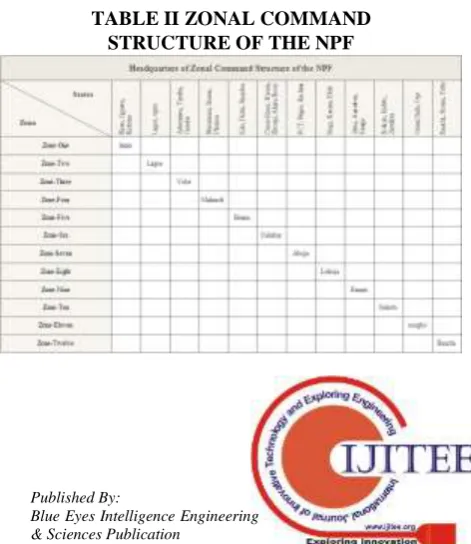
Command Structure, (ii) an Administrative structure, (iii) an Organizational structure [16]. These structures were reformed in 1986 by the Ibrahim Babangida government into 7 departments (see Table 1) and 12 zonal commands (see Table 2) to meet the constitutional expectations of the Police. The NPF uses a regimented hierarchy Command
[image:4.595.311.542.341.493.2]structure presented in the Chain of Command (Authority) as follows: Inspector General of Police→ Deputy Inspector-general of Police (DIG)→ Assistant Inspector-General of Police (AIG)→ Commissioner of Police (CP)→ Deputy Commissioner of Police (DCP)→ Assistant Commissioner of Police (ACP)→ Chief Superintendent of Police (CSP)→ Superintendent of Police (SP)→ Deputy Superintendent of Police (DSP) → assistant superintendent of police (ASP) → inspector of police→ sergeant major→ sergeant→ corporal→ constable. The NPF is the principal law enforcement agency in Nigeria with a staff strength of about 371,800 and plans to increase the force to 650,000. According to section 6 of the Police Act, 1990 laws, “the NPF is commanded by the IGP, who transform inputs from the oversight bodies into programmes and guidance for police managers to implement”. The office of the IGP is located at the police headquarters in Abuja, where, administratively, there are seven deputy inspectors-general (DIGs) in charge of different departments as shown in Table 1. The Office of the Secretary to the NPF, and the Force Intelligence Bureau (FIB), both manned by assistant inspectors-general (AIGs), are also part of the Police Management Team Odeyemi and Obiyan [17].
TABLE I ADMINISTRATIVE STRUCTURE OF THE NPF
The 12 zonal commands were created from the 36 states and the Federal Capital Territory (FCT). Each zone consists of 2 and 4 states (see Table 2), at the direct command of an AIG, who are directly answerable to the IGP.
[image:4.595.311.547.559.831.2]The Nigerian federation operates 36-states and one federal capital territory (FCT). Each State including the FCT is headed by a commissioner of police (CP), who is assisted by a deputy commissioner. A CP oversees areas under the State commander, which comprises all the divisional police officers (DPOs), who also have the station officers and police posts under them. There are six departments within each state headquarters: administration and finance ↔ operations, logistics and supplies ↔ investigation and intelligence ↔ training and general policy on manpower development, and research and planning [17].
The various socio-cultural and historical background of every country influences the policing systems for various countries. For example, for most countries policing works by the principle of the state law unlike in the United Kingdom where policing works based on the principle of consent by the people. Criminologists have tried to bring out common features in police structures world over because of certain features, the most prominent of them being the command architecture, and as such, police organizations are distinct across countries. It could be classified based on the legitimacy or legal backing of police function (that is policing by function or policing by law); or classified based on command structure (that is a number of forces to be commanded or type of forces) [18].
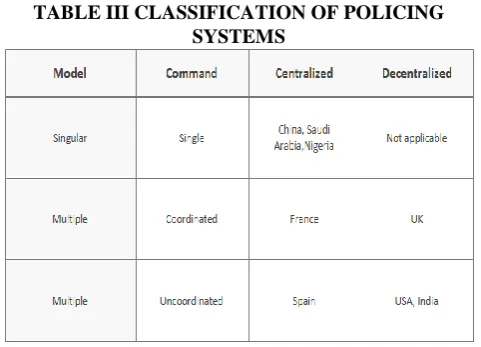
• Number of forces to be commanded: If the entire police force in the country is organized as a single force under a single commander (China, Saudi Arabia, and Nigeria, for example), the model is called singular model, and if in a single country, there are several police forces, it is called multiple models. Inside the multiple models, if the police forces have well-defined territories of functioning and their functions do not overlap each other, the model is called multiple coordinated, if the case is reversed, where many agencies can have overlapping jurisdictions, it is called multiple uncoordinated.
• Type of forces: If the police forces in a country are highly organized and having a centralized command, it is called coordinated centralized police force, and if the police forces in a country do not have an apparent centralized command structure, it is called
[image:5.595.49.290.594.767.2]decentralized command structure. Table 3 shows the different classification of policing systems by countries:
TABLE III CLASSIFICATION OF POLICING SYSTEMS
3.2 The Nigerian police and community policing
In 2004, Community policing was initiated to address the growing problem of insecurity and criminality in Nigeria in collaboration with police authorities, with six states selected for the pilot scheme. The induction of people in the pilot states by the “Police covered issues of quality service delivery, partnership, accountability, empowerment, and problem-solving”. By 2007, the number of states that have adopted the model of community policing has increased from 6-states to 18-states. However, the adoption of the community policing philosophy into the Nigerian Police service and practice can be defined as introductory, as many of the police personnel are still entangled with the traditional law enforcement approaches, which negate the principle of community partnership policing [19]. Generally, the integration of community policing comprises several fundamental adjustments, which often include citizen-empowerment, Police-Citizen partnership, and context-based problem-solving approach. These are key compositions required for effectiveness.
3.3 The changing trend of the society: from analog to digital society
The dynamics of the current information age is contingent on the transition from the traditional narrowly linked analog society to a broader digital interconnected society. This section discusses the digital perspective of Nigeria, as it relates to the Police.
3.3.1 The demographics of the Nigerian society (age)
The total population of citizens in Nigeria was estimated to 166.2 million people in the year 2012 and over 178.5 million according to the Nigeria National Bureau of Statistics. The current population of Nigeria is estimated to be over 196million, which is equivalent to 2.57% of the total world population. The country has a relatively young population as the median age in Nigeria is estimated to be 17.9 years for both male and female [20]. Nigeria has about 98.3 million people that use the internet as at December 2017 according to the Nigerian Communications Commission (NCC) [21]. Google also ranked Nigeria to be among the top three with the highest online searches in the world early this year [22]
3.3.2 Globalization and the changing society
Criminals can commit a crime in one country and hide in another country where they are protected. This leads to high cost of tracking and prosecuting of these criminals because of differences in laws and policies between countries and anonymity due to lack of a single database that identifies everyone in this global word.
3.3.3 The increasing complexity of crime
Digital crime (Cybercrime) is an offense committed against computer systems and its data through modification of data and unauthorized access of the digital system. Digital crime is a rapidly growing area of crime as criminals are exploiting the strength of the digital age (convenience, speed, and anonymity) to commit different criminal activities to cause serious harm and real threat to all victims worldwide. Before the advent of the digital age, individuals or groups within a local area or country mainly committed crimes. However, the emergence of the digital age meant the introduction of a complex network of activities of organization and individual. Leveraging human and system inefficiency, complex cybercriminal networks are frequently being established. Ranging from hackers for hire, to state-organized/sponsored cyber terrorism, a complex crime such as espionage, destruction/sabotage of critical infrastructure, massive denial of service attack through distributed denial of service attack, as well as stealing of trade secret using Bots and other malicious forms of software. Thus, trotting from one sophisticated network to another, the digital societal has ushered in, increase in crime complexity both in a near real-time and zero-day attack scenario. Whilst the crimes themselves are not necessarily new – such as theft, fraud, illegal gambling, and sale of illegal items –they, however, are evolving in line tandem with available online opportunities and therefore, becoming more widespread and damaging (Mohammed, 2015). In contrast to traditional crime, a digital crime has a peculiar advantage, ranging from perceived anonymity to the exploitation of virtual complex crime opportunities. The logic of “no geographic boundaries” further introduces a complex methodology of crime perpetration. Therefore, a digital theft can be effected without leaving any physical trace, and in some cases, any digital trail. Some example of digital crimes or cybercrimes includes: Assault through Threat, Child Pornography, Cyber-laundering, Cyber theft through the use of a computer, Cyber-terrorism, Denial of service, Cyber Fraud, Online blackmailing and many more.
These rapid growths in cybercrime and the difficulty in combating these trends have created many challenges that needs need addressing. Since these challenges affect the local environment, the country, and the international community, there are needs to address the challenges from the grassroots, then the country and collaboration with the international community. These can be achieved through the combination of traditional means of policing and digital means of policing. The digital policing will use forensic evidence to address digital crimes through trails left behind by cybercriminals while traditional policing can help in tracking the traditional crimes.
The relationships between the criminals can be discovered through proper policing laws, policies and collaborations between the entities involved.
IV. DIGITAL POLICING MODEL IN NIGERIA
Digital policing as a model of policing is a complementary approach to existing policing model. It leverages technological innovations and growth to expand the investigative possibilities of the police. A digital policing model in the context of Nigeria is the integration of digital component into the policing apparatus of the Nigerian Police Force. Digital component implies the transformation of the paper-based process of investigation into a digital component through which further knowledge-based process can be applied. Such knowledge-knowledge-based can be leveraged to develop expert systems for the police service. A police expert system can be used to develop geographical profiling, crime hotspot mapping, enhanced police-citizen relationship through timely investigation, enhanced investigation process, as well as personnel effectiveness. Owing to the change in crime landscape over time, often in response to technological advances, there is a need for an integrated policing model which delivers services in response to technological advances. This is particularly true for developing nations, where the crime rate tends to grow astronomically in response to technological advances. This can be attributed to the tendency to adopt technology in most developing nations by the citizen, in contrast to the willingness to embrace technology revolve with technology by the Police force. Therefore, digital policing involves the use of digital technology to transform the way policing is delivered by integrating the society, virtually, with the police stations, thus bringing the Police closer to communities and crime spots. Thus, digital technologies establish the platform for police officers to be collocated within a crime scene and their respective offices, as well as when it is happening – even in a virtual [24]. There are diverse focal areas (see Figure 1) of transformation on which to apply digital technology for effective and efficient service delivery such as proactive policing, digital public engagement, mobile workforce optimization, and digital investigation.
[image:6.595.304.553.544.668.2]4.1 Component of digital policing
Fig. 1. The wheel of digital policing
Applying digital technologies across policing services can enable police forces to use their resources more intelligently, proactive in identifying and addressing
criminal activity, and to deliver a faster and directed response through near real-time information-sharing and
DIGITAL POLICING
Mobile Policing optimization
Proactive policing
Digital Case development
Digital Investigation Intelligent Case management
Cyber Forensics Cyber profiling
Intelligence-led evidence acquisition
Digital public engagement and digital contact management
effective decision-making. The potential area of the digital policing area is presented in Fig. 1.
These areas provide a substratum for the development of digital policing. A brief description is further presented. • Proactive policing: This means getting there before
crime happens, thereby deterring criminal activity through proactive action, driven by data analytics and evidence-based policing. This is possible by demand forecasting to guide resourcing decisions, predictive policing analytics to model future risks and
intelligence-based evidence acquisition and analytics to drive the deployment decisions. It can also involve the process of intelligently managing the daily operation of the Police in enhancing case management.
• Digital public engagement and digital contact management: This means to identify incidents before witnesses call through multi-channel communication with the public, online crime reporting and crowd-sourced intelligence, investigation via social media platforms, and digital channels for low-risk contact with the police. All these services can reduce demand for control rooms and Contact Centres.
• Mobile workforce optimization: This means getting the best out of Officer‟s time through Neighborhood and response officers patrolling the beat more regularly, enabled by mobile devices which they can use to receive and deliver tasking and intelligence, search internal systems, capture statements and record supporting evidence. Another component also includes the potential to profile individual in an online platform, on the motion pattern detection using CCTV camera, as well as a near-real-time recurrent anomaly detection in public domain.
• Digital investigation: This means accelerating the investigation through real-time information exchange using an electronic witness statement and electronic suspect image. mobile digital case file with real-time sharing and digital evidence capture, mobile ID verification and multi-system search in custody, crowd-sourced investigation through social media and digitized collaboration with CPS and court proceedings. Other related areas include cyber forensics, intelligent investigation,
• However, these areas have the potential to elicit the following technological component as a modernized approach to policing:
• Online Crime Reporting: This is to digitize crime reporting and evidence submission procedures in order to improve the efficiency with which people can report crimes and generate significant costs savings for police forces. This will allow investigations to start immediately and save hours of police time as officers would no longer have to collect physical media.
• Live streaming of Video Footage into Control Rooms: The digitization of video footage allows the live streaming of CCTV and Body Worn Video (BWV) footage into control rooms and alarm-monitoring stations thereby saves police time and money, as well as improves officer safety, which further increases their situational awareness.
• Security & Identity: The proliferation of Digital Identity Technologies to improve online safety and reduce the impact of cyber-crime. Identity verification and management tools could significantly aid crime prevention and ease the burden on the police.
• Police Adoption of the Cloud: This is to address the data storage problem currently facing forces and to enable them to realize the potential of data and analytics tools. • Digital Skills in Policing: A structured and
comprehensive approach to address the gap in Digital Skills in Policing through enabling Digital Investigation and Intelligence (DII) programme that should further develop police capability in relation to the skills and technology required to effectively police a digital age and protect victims of digital crime. This can be achieved by adopting a three-tiered approach to digital skills for police, consisting of training to a minimum viable level for all officers; equipping frontline officers with mobile accessible digital toolkits; and establishing a Managed Service framework to allow police to access specialist capabilities from industry.
• Smarter Procurement & Accessing Innovation: A Smarter Approach to Procurement to ensure that Government and police forces are better able to access innovation.
V. PROBABLE POLICING-FRAMEWORK
TO ADAPT IN NIGERIA
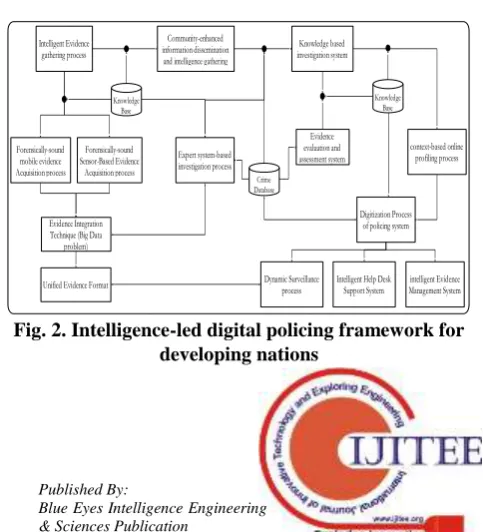
[image:7.595.307.549.563.829.2]The proposed digital policing framework to adapt for Nigeria is described as the integration of Intelligence-focused policing and community-oriented policing in a democratic setting, as shown in Figure 2. This preliminary framework requires an iterative process and continual contextual re-engineering. Given that the Country‟s policing apparatus is largely divided into zones as highlighted in Table 2, there will be an integration of contextual alignment of policies and digital capability amalgamation. This implies that the Police will be required to leverage expertise and knowledge from Zones with a high digital presence, to Zone with a lower digital presence, while ensuring that the required manpower for highly digitized is not shortchanged for the converse.
Fig. 2. Intelligence-led digital policing framework for developing nations
Intelligent Evidence gathering process
Community-enhanced information dissemination and intelligence gathering
Expert system-based investigation process
context-based online profiling process Knowledge based
investigation system
Forensically-sound Sensor-Based Evidence
Acquisition process
Digitization Process of policing system
intelligent Evidence Management System Evidence
evaluation and assessment system
Dynamic Surveillance
process Intelligent Help Desk Support System Knowledge
Base
Crime Database Knowledge
Base
Forensically-sound mobile evidence Acquisition process
Evidence Integration Technique (Big Data problem)
The framework comprises several components which leverage diverse policing models. This includes intelligence, reassurance, community policing, as well as problem-based policing models. More importantly, however, is the integration of knowledge-based component into policing. Furthermore, the framework considers the integration of evidence reliability and forensic soundness as a composition of the framework. The framework can be thematized into two interconnect asymmetric half. The first-half integrates the need for forensic soundness into evidence gathering, storage, and analysis. this implies the need for effective chain-of-custody, chain-of-evidence, and chain-of analysis. this process is expected to eventually culminate into the development of a unified evidence format which can be used to coordinate cross-regional cases. In the second phase, the need for digitization of the policing process is presented. This notion presumes that the traditional paper-based manual policing process in Nigeria can leverage the trend in technological advancement to digitize the policing process. The overall framework, therefore, presupposes that the Nigerian police force considers the contextual peculiarity of the various Zones (as categorized by the Police Force) of the Country, which may require further extrapolation and justification. One major application of the proposed framework is the development of a tacit knowledge base. Such a knowledge base involves the retention of tacit knowledge from experience and retiring/retired police personnel. Knowledge from such development can be leveraged to enhance policing. With such a knowledge base, expert systems which utilized artificial intelligence, nature-inspired heuristic algorithms, as well as metaheuristic processes, can be developed. This could also serve as a source of data for research and knowledge transference.
VI. CONCLUSION
The notion of digital policing in a developing nation, particularly in Nigeria, is presented in this manuscript. Approaches and models of policing are identified and discussed. The need for the digitization of the various policing apparatus of developing nation is defined as a core requirement for effective policing in the current information age. This further elicited the development of a digital policing framework for developing nation with a focus on the practicality of application in tandem with infrastructural projections. The framework presented in this manuscript will be further evaluated in close collaboration with the Nigerian police force and other identified developing nations. This proposed policing framework has the potential to provide a baseline for the integration of digital competency, as an effective policing mechanism for developing nations.
VII. ACKNOWLEDGEMENT
The authors would like to acknowledge the contribution of the digital policing and forensics research group at the Federal University of Technology Minna, the Nigerian Police Force, as well as the University of Pretoria towards accomplishing this project.
REFERENCES
1. E. O. Alemika and I. C. Chukwuma, "Analysis of Police and Policing in Nigeria," CLEEN Foundation, Lagos, 2005. 2. M. D. Boer, P. C and C. Scheltus, "Good Policing:
Instruments, Models and Practices.," Asia-Europe Foundation (ASEF) and Hanns Seidel Foundation Indonesia (HSF Indonesia)., Jakarta, 2011.
3. C. Gill, D. Weisburd, C. W. Telep, Z. Vitter and T. Bennett, "Community-Oriented Policing To Reduce Crime, Disorder and Fear and Increase Satisfaction and Legitimacy among Citizens: A Systematic Review.” in ,," Journal of Experimental Criminology, 2014.
4. H. Goldstein, Problem-Oriented Policing, New York:
McGraw-Hill., 1990.
5. Center for Problem‐ oriented Policing, "The SARA model," University at Albany, State University of New York., New York, 2018.
6. J. Eck and R. Clarke, Intelligence Analysis for Problem Solvers, Washington: Community Oriented Policing Services (COPS), 2013.
7. D. Weisburd, C. W. Telep, J. C. Hinkle and J. E. Eck, "The Effects of Problem-Oriented Policing on Crime and Disorder.," Campbell Systematic Reviews, vol. 14, no. 1, 2018.
8. A. Higgins, "The Future of Neighbourhood Policing," The Police Foundation. The UK‟s policing think tank., London, 2018.
9. A. W. J. C. J. C. S. a. G. J. Longstaff, "Neighbourhood policing: Past, present and future - A review of the literature," Technical Report, NA, 2015.
10. A. Millie, "Reassurance Policing and Signal Crimes," in Encyclopedia of Criminology and Criminal Justice, New York, Springer, 2014, pp. 4327-4335.
11. R. Anderson, "Intelligence-Led Policing: a British Perspective.," Intelligence-Led Policing: International Perspectives on in the 21st Century Policing Smith, A (ed.), p. NA, 15 September 1997.
12. D. L. Carter and J. G. Carter, "Intelligence-Led Policing: Conceptual and Functional Considerations for Public Policy," Criminal Justice Policy Review, vol. 20, no. 3, pp. 310-325, 2009.
13. J. H. Ratcliffe and R. Guidetti, "State police investigative structure and the adoption of intelligence-led policing," International Journal of Police Strategies & Management, vol. 31, no. 1, pp. 109-128, 2008.
14. C. Lum, C. W. Telep, C. S. Koper and J. Grieco, "Receptivity to research in policing," Justice Research and Policy, vol. 14, no. 1, pp. 61-95, 2012.
15. L. Sherman, Evidence-based policing, Washington DC: Police Foundation, 1998.
16. A. I. Ogbo, O.-A. H.O., E. K. Agbaeze and W. I. Ukpere, "Strategic Restructuring for Effective Police System in Nigeria," Journal of Governance and Regulation, vol. 3, no. 4, pp. 15-28, 2014.
17. T. I. Odeyemi and A. S. Obiyan, "Exploring the subsidiarity principle in policing and the operations of the Nigeria Police Force," African Security Review, 2017.
18. J. Varghese, "Police Structure: A Comparative Study of Policing Models," SSRN Electronic Journal, 2010.
20. World Population Review, "Nigeria Population," 17 October
2018. [Online]. Available:
http://worldpopulationreview.com/countries/nigeria/. [Accessed 2018 October 2018].
21. T. C. Magazine, "Internet Users in Nigeria hit 98.3 million," Nigerian Communications Commission, Abuja, 2018. 22. E. Okonji, "Google ranks Nigeria among top three in global
online search," Thisdaylive, 8 February 2018.
23. S. Mohammed, "An Introduction to Digital Crimes," International Journal in Foundations of Computer Science & Technology (IJFCST), vol. 5, no. 3, pp. 13-24, 2015. 24. J. Taylor, L. Simpson and V. Sidorova, The Digital Policing