Wright State University Wright State University
CORE Scholar
CORE Scholar
Browse all Theses and Dissertations Theses and Dissertations
2016
Private Record Linkage: A Comparison of Selected Techniques for
Private Record Linkage: A Comparison of Selected Techniques for
Name Matching
Name Matching
Pawel B. Grzebala Wright State University
Follow this and additional works at: https://corescholar.libraries.wright.edu/etd_all Part of the Computer Engineering Commons
Repository Citation Repository Citation
Grzebala, Pawel B., "Private Record Linkage: A Comparison of Selected Techniques for Name Matching" (2016). Browse all Theses and Dissertations. 1474.
https://corescholar.libraries.wright.edu/etd_all/1474
This Thesis is brought to you for free and open access by the Theses and Dissertations at CORE Scholar. It has been accepted for inclusion in Browse all Theses and Dissertations by an authorized administrator of CORE Scholar. For more information, please contact [email protected].
Private Record Linkage:
A Comparison of Selected
Techniques for Name Matching
A thesis submitted in partial fulfillment of the requirements for the degree of Master of Science in Computer Engineering
By
PAWEL B. GRZEBALA B.S., Wright State University, 2013
2016
WRIGHT STATE UNIVERSITY GRADUATE SCHOOL
April 11th 2016
I HEREBY RECOMMEND THAT THE THESIS PREPARED UNDER MY
SU-PERVISION BY Pawel B. GrzebalaENTITLED Private Record Linkage:
A Comparison of Selected Techniques for Name MatchingBE ACCEPTED IN
PARTIAL FULFILLMENT OF THE REQUIREMENTS FOR THE DEGREE OF
Master of Science in Computer Engineering.
Michelle Cheatham, Ph.D. Thesis Director
Mateen M. Rizki, Ph.D.
Chair, Department of Computer Sci-ence and Engineering
Committee on Final Examination
Michelle Cheatham, Ph.D.
Keke Chen, Ph.D.
Krishnaprasad Thirunarayan, Ph.D.
Robert E.W. Fyffe, Ph.D. Vice President for Research and Dean of the Graduate School
ABSTRACT
Grzebala, Pawel. M.S.C.E. Department of Computer Science and Engineering, Wright State University, 2016. Private Record Linkage: A Comparison of Selected Techniques for Name Matching.
The rise of Big Data Analytics has shown the utility of analyzing all aspects of a problem by bringing together disparate data sets. Efficient and accurate private record linkage algorithms are necessary to achieve this. However, records are often linked based on personally identifiable information, and protecting the privacy of in-dividuals is critical. This work contributes to this field by studying an important component of the private record linkage problem: linking based on names while keep-ing those names encrypted, both on disk and in memory. We explore the applicability, accuracy, speed and security of three different primary approaches to this problem (along with several variations) and compare the results to common name-matching metrics on unprotected data. While these approaches are not new, this work provides a thorough analysis on a range of datasets containing systematically introduced flaws common to name-based data entry, such as typographical errors, optical character recognition errors, and phonetic errors. Additionally, we evaluate the privacy level
of the q-grams based metrics by simulating the frequency analysis attack that can
occur in case of potential data breaches. We show that, for the use case we are
con-sidering, the best choice of string metric are paddedq-gram based metrics which can
provide high record linkage accuracy and are resilient to frequency analysis attack under certain conditions.
Contents
1 Introduction 1
1.1 Motivation . . . 1
1.2 Private Record Linkage . . . 1
1.3 Application Scenario . . . 2
2 Background 6 2.1 Private Record Linkage Taxonomy . . . 6
2.1.1 Approximate Matching PRL Techniques . . . 8
2.2 Relevant String Similarity Metrics . . . 11
2.3 Challenges in Private Record Linkage . . . 14
3 Approach 16 3.1 String Similarity Metrics . . . 16
3.2 Benchmark Datasets . . . 17
4 Evaluation and Analysis 20 4.1 Observations on String Metric Comparison . . . 20
4.1.1 Observation 1: Soundex is not viable, but (padded) q-grams are 20 4.1.2 Observation 2: Dice is preferable to Jaccard for calculating q -gram similarity . . . 22
4.1.3 Observation 3: Lower thresholds are better for q-grams . . . . 22
4.1.4 Observation 4: Some types of errors are worse than others . . 24
4.1.5 Observation 5: The efficiency penalty for these privacy-preserving
string similarity metrics is small . . . 25
4.1.6 Observation 6: Asq increases, the record linkage quality degrades. 27 4.2 Evaluation of Privacy Level of q-grams . . . 29
4.2.1 q-grams Technique Privacy Vulnerabilities . . . 29
4.2.2 Frequency Attack Approach . . . 30
4.2.3 Observations on Frequency Attack Analysis . . . 36
5 Conclusion and Future Work 43 5.1 Summary of Comparison Study . . . 43
5.2 Future Work . . . 45
Bibliography 46
List of Figures
2.1 Private Record Linkage techniques classification . . . 6
4.1 Illustration accuracy of record linkage of selected string metrics as a
function of threshold. Solid lines correspond to accuracy when linkage was performed on datasets corrupted with 1 Character Edit, dotted
lines with 2 Character Edits. . . 21
4.2 Accuracy of string metrics used to perform record linkage on a dataset
with 10% of the records corrupted using OCR Edits with 1 corruption
per record. . . 25
4.3 The average time of record linkage using selected string metric techniques. 27
4.4 Illustration of accuracy of record linkage based on different types ofq
-grams. Linkage was performed on datasets corrupted with 1 Keyboard
Edit. . . 29
4.5 Illustration of accuracy of record linkage based on different types ofq
-grams. Linkage was performed on datasets corrupted with 2 Keyboard
Edits. . . 29
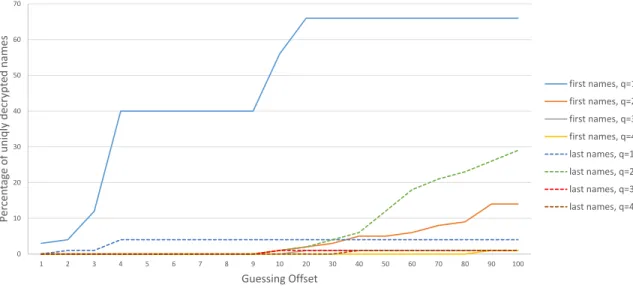
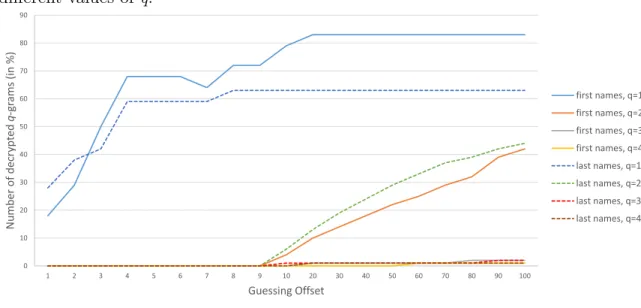
4.6 The percentage of decrypted first and last names for different values ofq. 37
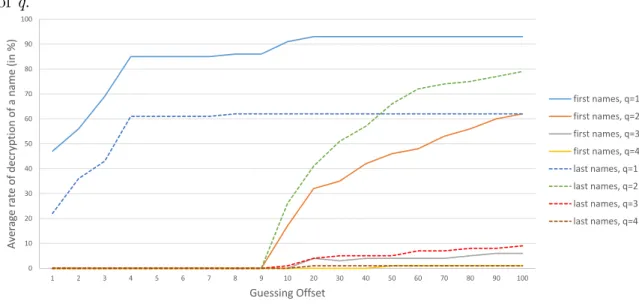
4.7 The average rate of decryption of first and last names for different
values of q. . . 38
4.8 The rate of q-gram decryption for first and last names encoded with
different values ofq. . . 40
4.9 First and last name distribution based on the length of the name. . . 41
4.10 First and last names distribution based on the length of the name. . . 42
List of Tables
4.1 Performance of record linkage based on encrypted Soundex encodings.
The percentage values reflect the number of corrupted records that
were successfully matched with their uncorrupted versions. . . 22
4.2 Sample results of record linkage performed against phonetically
cor-rupted dataset showing the performance ofq-grams based string
simi-larity metrics . . . 23
4.3 Top 10 most commonly occurring q-grams in encrypted and public
datasets of first names where q=2. . . 32
4.4 An example of an encrypted record. . . 34
4.5 Lists of possible translations for encrypted q-grams used to encrypt
the name ”sara” . . . 35
4.6 List of encrypted q-gram translations after one iteration . . . 35
4.7 Number of unique q-grams in datasets of first and last names. . . 38
ACKNOWLEDGEMENTS
I would like to express my deepest gratitude to my thesis advisor, Dr. Michelle Cheatham, for her invaluable and persistent guidance throughout the duration of this project. I would also like to thank Dr. Chen and Dr. Krishnaprasad for serving on my thesis committee. I am extremely grateful to my mother Renata and my father Zbigniew for their continuous support during my years of study at Wright State University. Finally, I would like to give special thanks to my closest friends that were always there for me when I needed help.
This work was partially supported by the LexisNexis corporation.
1
Introduction
1.1
Motivation
Data silos, in which organizations keep their data tightly isolated from other systems, are a major barrier to the effective use of data analytics in many fields. Unfortunately, when the data in question involves information about people, integrating it often necessitates querying or joining based on personally identifiable information (PII) that could be used to explicitly identify an individual. As recent security breaches at organizations ranging from Target [Yang, Jia L and Jayakumar, Amrita ] to the United States Postal Service [Sheehan, Brian ] have made clear, it is important to protect PII, both while it is at rest on a system and when it is read into memory. The goal of this effort is to explore the applicability, accuracy, speed and security of existing algorithms for querying and joining databases while keeping the PII within those databases protected.
1.2
Private Record Linkage
Integrating large volumes of data containing personal information in a privacy pre-serving manner have been researched for years. In the scientific community this area of study is known as PRL (Private Record Linkage), PPRL (Privacy-Preserving Record Linkage), or private information retrieval [Vatsalan et al. 2013]. Linking records with
1.3. APPLICATION SCENARIO 2 personal information has numerous applications in diverse areas such as health care, crime investigation, fraud detection, and statistical studies, to name a few.
The process of integrating databases consists of multiple steps, where the most crucial ones are: (1) schema matching, (2) record linkage, and (3) data fusion. The first step is necessary to ensure that all attributes and fields of records have their corresponding equivalences in all databases to be linked (i.e. the attributes contain the same type of information in the same format). The goal of the second step is to identify the records from the databases that correspond to the same entity based on common attributes. Finally, the last step in the data integration process is responsible for consolidating the records of the same entity into a single record. The second of these steps is the one of most interest to PRL researchers, because it is the one most likely to require the database owners to exchange PII. This step also tends to be the most difficult, for a number of reasons. An attribute appearing in one database may not be present in the other one, it may contain error(s), or there may be different spelling variations of the same value. The parties interested in record linkage cannot directly share the attribute’s value due to privacy, legal, or business constraints. The majority of the research in the PRL field operates under the assumption that the parties are interested only in sharing the information about the intersection of records of all parties. Examples of such studies are provided in Chapter 2. Some of the work in the field assumes that neither party should learn anything at all about the records in the other databases. This kind of approach is desirable when the database is used to perform data mining or statistical data analysis [Mohammed et al. 2011]. In this work we focus on a PRL application scenario outside of these research threads.
1.3
Application Scenario
This work focuses particularly on the situation in which a data provider maintains a database which authorized subscribers are able to query. For instance, consider a company that maintains a database containing its customer data. The company
1.3. APPLICATION SCENARIO 3 wishes to allow third party entities who have contracted with it to access the
informa-tion in this database.1 At the same time, the company wants to limit its vulnerability
to data breaches by keeping the data encrypted as much as possible, including while it is stored in the database and when it is loaded into memory to do query processing. For instance, if an attacker gets access to the system on which the database resides, he should not be able to see the raw data values, either on disk or in memory.
Even though this situation occurs frequently, research on private record linkage tends to focus more on a different use case, in which the data provider and the data consumer do not fully trust one another. This typically leads to solutions involving trusted third parties or asymmetric cryptography that go beyond the requirements of this ubiquitous application scenario, and these additional, unneeded capabilities negatively impact performance. For instance, because access control mechanisms are already in place, this work is not concerned about the data consumer (who has paid to access the information in the database) gaining knowledge of any, or even all, of the records in the database. Furthermore, this project is not concerned about the data consumer preventing the data provider from gaining knowledge about what queries are being made. Rather, the present use case allows a system in which the data consumer submits a query containing the raw PII values, these values are encrypted
using symmetric key cryptography2, and the encrypted values are then used to query
the database.
This work focuses on supporting privacy-preserving querying and merging on string attributes and does not consider numeric data. While private record link-age based on numeric fields of is course an important capability to establish, the techniques involved for this are distinctly different than for string-based linking. Fur-thermore, string attributes, in particular person names, are a particularly common
1A standard access control system to allow authorized consumers to query the database while
preventing unauthorized users from doing so is assumed to be in place.
2Note that this exposes the raw PII values in memory, though only those in the query, not those
1.3. APPLICATION SCENARIO 4 linkage point between datasets. We therefore leave the challenge of numeric attributes for future work and focus on name-based linking here. The requirements of our target application scenario require PRL methods that support encryption and do not need to act directly on the raw field values, so approaches that utilize the original string values at any stage in the process are not suitable in this case. Because names are fre-quently misspelled, mispronounced, or mistyped, it is important for the approach to support fuzzy (approximate) matching as well as exact matching. This fuzzy match-ing should be particularly tailored to support the types of lexical variations specific to names. No data should be decrypted, even in memory, until a match is ensured. In this paper we analyze the accuracy and efficiency of several metrics that meet these requirements and compare those results to that of standard name-matching methods employed on unencrypted data. The paper focuses entirely on technical consider-ations of the targeted use case. Laws and regulconsider-ations also have a bearing on this application, but that aspect is not addressed here due to wide variance between legal jurisdictions and the authors’ lack of legal expertise.
Note that nothing in this application scenario places any restrictions upon the infrastructure in which the data records are stored. In particular, the results presented here can be applied directly, with no modification, to data stored as RDF triples in accordance with the linked data principles. This work therefore joins a growing body of literature regarding how linked data can be secured while retaining its utility for
those authorized to access it [Giereth 2005; Mu˜noz et al. 2012].
The main contributions of this work are:
• The usage of an advanced name matching benchmark generation tool to analyze
the performance of several different name-based similarity metrics in a nuanced way. In our analysis we consider numerous realistic sources of errors and study the effect of the threshold value applied to each of the metrics.
• The accuracy of the privacy-preserving similarity metrics is compared to that of
1.3. APPLICATION SCENARIO 5 lost in support of data privacy.
• The computational efficiency of the privacy-preserving similarity metrics is also
compared to that of standard string metrics.
• The evaluation of the level of privacy thatq-gram based string metrics can provide
in the event of a data breach. In our analysis we attempt to decipher personal information from an encrypted database using a frequency analysis attack. The rest of this paper is organized as follows: In Chapter 2 we provide an overview of some related work and discuss the challenges that make record linkage on names difficult. Chapter 3 introduces the metrics and algorithms used to perform record linkage in this study. This includes the string similarity metrics for unencrypted data which are used as a baseline for comparison purposes and the metrics relevant to private record linkage. Chapter 4 analyzes and evaluates the performance of the algorithms mentioned in Chapter 3 in terms of accuracy and computational efficiency. In this chapter we also describe and evaluate the results of the frequency analysis attack conducted against a database containing personal information in the form
of encrypted q-grams. Finally, Chapter 5 concludes the paper by summarizing the
2
Background
2.1
Private Record Linkage Taxonomy
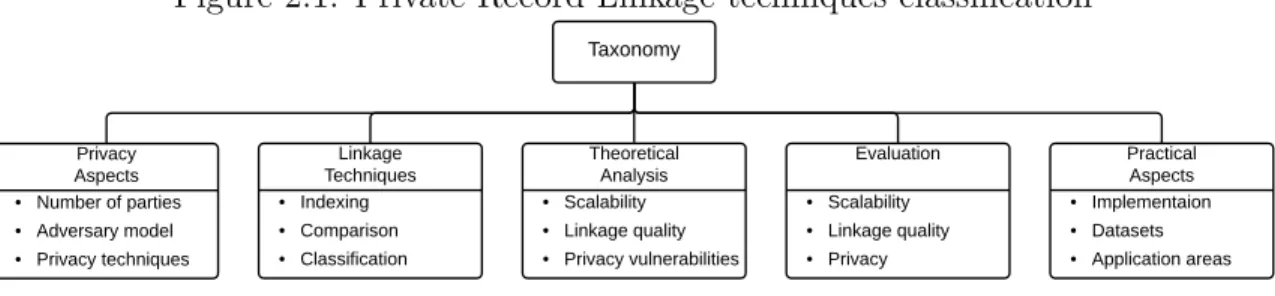
Although all PRL algorithms are designed to achieve the same goal, that is identifica-tion of records corresponding to the same entities in a privacy preserving environment, the approaches that they take differ significantly. In most cases a particular PRL tech-nique has its design dictated by specific requirements of the target application. Such requirements might include constraints regarding the number of parties involved in the linkage process, linkage quality, or execution time. Since the requirements almost always vary from application to application, it is difficult to present the overall outline of current approaches to PRL due to the lack of standard classification metrics. One recent survey paper by [Vatsalan et al. 2013] introduced a 15-dimensional taxonomy that provides a comprehensive overview of major PRL research areas. The taxonomy is shown in Figure 2.1.
Figure 2.1: Private Record Linkage techniques classification
Taxonomy Privacy Aspects - Number of parties - Adversary model - Privacy techniques Linkage Techniques - Indexing - Comparison - Classification Theoretical Analysis - Scalability - Linkage quality - Privacy vulnerabilities Evaluation - Scalability - Linkage quality - Privacy Practical Aspects - Implementaion - Datasets - Application areas 6
2.1. PRIVATE RECORD LINKAGE TAXONOMY 7 With respect to this PRL taxonomy, our work can be categorized by the following characteristics:
• Privacy Aspects: Two parties are involved in the record linkage process (data
publisher and subscriber). We don’t consider any adversary models other than the third party intercepting the encrypted database. A standard encryption algorithm (AES) is used to keep the PII secured.
• Linkage techniques: The string similarity metrics evaluated in this work support
approximate matching. We study the effects of applying different threshold values to the similarity metric results in order to classify records as matches or non-matches. No indexing technique is used in this work.
• Theoretical Analysis and Evaluation: This work provides information about the
results of record linkage by presenting the accuracy and computational efficiency of the investigated techniques. We also study the severity of a potential frequency analysis attack in the event the encrypted database is captured by an attacker.
• Practical Aspects: All record linkage algorithms and the framework used to
per-form the record linkage were implemented in Java. Synthetic datasets were used to study the performance of the record linkage techniques. We target a specific type of applications in which the data publisher allows trusted subscribers complete access to the data.
The main requirement of our target application is supporting approximate record linkage while keeping the PII attributes encrypted at all times. Based on the PRL taxonomy and the requirements of our target application, we are interested in the PRL techniques that meet the following characteristics. The PRL technique should require as few parties to perform the record linkage as possible. It should take into consideration an adversary model in which the attacker might intercept the encrypted records. Utilization of a private record linkage technique that operates (or could po-tentially operate) on encrypted record values is also desirable. The linkage technique
2.1. PRIVATE RECORD LINKAGE TAXONOMY 8 should also support fuzzy matching and preferably threshold based classification rules that can be adjusted to modify the sensitivity of the PRL techniques. It is difficult to find PRL algorithms that meet all the requirements of our application. Therefore, this chapter will provide an overview of relevant existing PRL techniques that at least partially fulfill those requirements. To support approximate record linkage on attributes that represent first and last names we also provide an overview of relevant string similarity metric techniques that will be used in this study. We conclude this chapter by summarizing common challenges involved in PRL.
2.1.1
Approximate Matching PRL Techniques
The PRL techniques that support approximate record matching can be divided into those that utilize a third party in order to perform the record linkage operation and those that do not. In the former approaches, the third party (i.e. middle-man between the two parties interested in linking their records) is used to prevent either party from learning the contents of the other’s database other than the matching records. These PRL techniques are often considered more secure than the two party protocols [Vatsalan et al. 2013]. The following are selected examples of approaches that make use of a third party to conduct the record linkage process.
The study presented by [Churches and Christen 2004] is based on using encoded
q-gram lists to calculate similarity between two records which is performed by a third
party. The q-grams in this study were formed from string attributes representing
individual names. To perform the record linkage, each database holder converts the
record’s string attribute into a set of q-grams. Additionally, multiple subsets of the
set ofq-grams are also created. All sets ofq-grams are encoded using a hash function,
resulting in a list of encoded q-grams sets. Each element in the list contains
addi-tional information about the number ofq-grams in the set (or the subset) of encoded
q-grams, and a record identifier. Such lists are sent to the third party that calculates
2.1. PRIVATE RECORD LINKAGE TAXONOMY 9 lists. A threshold value is used to determine whether the two attributes correspond to the same record. The authors claim that their technique is secure, however they emphasize that it can still be subject to a frequency analysis attack. Unfortunately, the effects of different threshold values on record linkage quality were not reported. The main drawback of this PRL technique is the large communication overhead re-quired to calculate the string similarity coefficients. For example, when linkage was performed on last names with a threshold value set to 0.7 the communication volume increased by a factor of 577 (where the baseline was sending raw string values of the last names).
The approach introduced by [Karakasidis and Verykios 2009] performs record linkage using encoded values of string attributes produced by the Soundex phonetic algorithm. The Soundex algorithm and a more detailed description of its use to con-duct record linkage in a private manner is described in the next section. The type of string attributes used in the linkage process in this study include: first name, last name, and suburb name. Similar to the previous example, a third party is involved to perform the record linkage operation. Before sending their own records to the third party, each database holder encodes the aforementioned attributes using the Soundex algorithm. Additionally, a large number of dummy records with fake Soundex encod-ings is injected into the databases in order to prevent the third party from discovering the real size of the original datasets. After the linkage, the third party shares identi-fiers of records that were evaluated as matches with the two database holders. The study has shown the proposed technique can be used to conduct high quality linkage despite the injection of fake records. For instance, even when the databases contained a fake record ratio of 5 to 1 (for each original record there were 5 fake ones), and the linkage was performed based on the three attributes, nearly 100% of original records were correctly classified as matches. Furthermore, the linkage quality does not signif-icantly degrade when the string attributes contain randomly generated mistakes by inserting, substituting, or deleting one of the string’s characters.
2.1. PRIVATE RECORD LINKAGE TAXONOMY 10 Another PRL study conducted by [Schnell et al. 2009] proposed a three party protocol that uses Bloom Filters to calculate the similarity of two encoded strings. The protocol could easily be modified so that it involves only two parties without changing the underlying principle of the linkage technique. Bloom Filters are
bit-arrays that represent the encoded value of a string S as a sequence of 0s and 1s.
To perform the encoding, S is converted to a set that contains all possible q-grams
of S. Each q-gram becomes an input to a set of independent hash functions whose
outputs set corresponding bit values in the array to 1s. To compute the similarity of the encoded strings using Bloom Filters the Dice coefficient was used. The study has shown that the similarity values of the encoded strings are close to the similarity values
computed on the rawq-grams. Although some studies have shown that record linkage
utilizing Bloom filters is vulnerable to frequency analysis attacks, it has also been suggested that the privacy level can be increased by applying several modification to the protocol [Niedermeyer et al. 2014].
The second type of PRL techniques that support approximate record matching while maintaining privacy is the one in which the record linkage protocol involves only the record owners. The algorithms used in these techniques are more complex than the approaches using the third party in order to prevent the database owners from fully discovering the content of the other party’s database. Ideally, after the record linkage protocol is finished, both database owners should have knowledge only about the identifiers of the records that were classified as matches. The records’ contents are exchanged between the owners over a secure channel after the linkage. It is often the case that two party approaches have lower communication costs than the techniques utilizing a third party [Vatsalan et al. 2013]. The following are two examples of approaches that do not use a third party for record linkage purposes.
In the two-party protocol presented by Vatsalan and his colleagues in [Vatsalan et al. 2011], two database owners compute similarity values between the records in their dataset and public reference values. Then, the similarity values are binned into
2.2. RELEVANT STRING SIMILARITY METRICS 11 intervals and the bins are exchanged between the two database owners. Based on the exchanged bins the protocol uses the reverse triangular inequality of a distance metric to compute the similarity values of two records without revealing the records themselves.
Another, somewhat similar, two-party protocol was proposed by Yakout et al. in [Yakout et al. 2009]. In this approach, each database owner converts all of their records into vector representations that are later mapped to points in a complex plane. The planes are then exchanged between the owners in order to identify pairs of points that are in proximity of each other. To calculate similarity values between the candidate vectors, the Euclidean distance of two records is computed using a secure distance computation. The last two approaches are typical of many existing PRL techniques and, like the majority of those techniques, they implicitly assume that the records to be linked are not encrypted. A more in-depth review of techniques proposed to achieve private record linkage can be found in [Christen 2012].
In this work we present a PRL approach that doesn’t utilize a third party for record linkage purposes, due to the privacy and legal constraints of our target application model. The record attributes required for the linkage process carry PII information and it is not desirable to send data containing PII, even in encrypted form, to any third party. Furthermore, the existing PRL approaches put emphasis on protecting sensitive data of all of the parties involved in the record linkage process. In our use case, we consider a situation in which the subscriber submits a query containing the raw PII values that are later used to query the encrypted database. Additionally, we are interested in record linkage performed only on string attributes representing individual first and last names.
2.2
Relevant String Similarity Metrics
A comprehensive overview of several name matching techniques was provided by Snae in [Snae 2007]. Snae describes four different types of name matching algorithms and
2.2. RELEVANT STRING SIMILARITY METRICS 12 compares them in terms of accuracy and execution time: spelling analysis based al-gorithms (Guth and Levenshtein), phonetic based alal-gorithms (Soundex, Metaphonez, and Phonex), composite algorithms (combination of sound and spelling based meth-ods, e.g. ISG), and hybrid algorithms (combination of phonetic and spelling based approaches, e.g. LIG). The hybrid algorithms were recommended for many name based record linkage applications because of their flexibility that allows them to be easily tuned for specific use cases. However, the results indicated that there is no single best method for name matching. In the conclusion, the author suggests that the choice of the name matching algorithm should depend on the specific application needs. Moreover, this work doesn’t take into consideration the important aspect of our study, which is linking records while keeping them encrypted.
One important thing to note is that not all string similarity metrics can be applied to the problem of name-based private record linkage. In order for a metric to be usable in this scenario, the metric must not require access to individual characters within this string. This is because any such metric would have to “encrypt” a string character-by-character, which is essentially a classical substitution cipher that is not at all secure. This eliminates common metrics such as Levenshtein and Monge Elkan from consideration.
Among the techniques that support approximate matching for linking records are the Soundex and q-gram string similarity metrics. The Soundex metric was originally designed as a phonetic encoding algorithm for indexing names by sound. [Christen 2006] Soundex encodes a string representing a name into a code that consists of the first letter of the name followed by three digits, by applying a set of transformation rules to the original name. When two Soundex encodings are compared, the com-parison is an exact match rather than approximate comcom-parison but common name
mispronunciations will not cause the algorithm to miss a match1. To use Soundex
1In 1990 Lawrence Philips created a phoenetic algorithm called Metaphone that improves upon
Soundex by considering numerous situations in which the pronunication of English words differs from
2.2. RELEVANT STRING SIMILARITY METRICS 13 for private record linkage, both the name and the phonetic encoding are stored in the database in encrypted form for each record, but the encrypted phonetic encoding is the one used to respond to queries. The comparison is still an exact rather than fuzzy comparison, but because it is now being done on a phonetic encoding, common misspellings or other slight differences will not cause the algorithm to miss matching records. This was the approach suggested in [Churches and Christen 2004].
Another of the string similarity metrics that can be used is q-grams. A q-gram
is created by splitting a string into a set of substrings of length q. An example of
a q-gram, given q=2 and the input string Alice, is {”Al”,”li”,”ic”,”ce”}. As with
the Soundex approach, in order to useq-grams for name-based private record linkage
additional information must be stored with each record. In the case of q-grams, the
person’s name is divided into q-grams, each of the substrings in the set of q-grams
is encrypted, and those encrypted substrings are also stored as part of the record. The amount of similarity between two records is then computed as the degree of
overlap between these set of encrypted q-grams for each record. Each individual
substring is compared based on exact match. The degree of overlap is computed using a traditional set similarity metric such as Jaccard or Dice, which are calculated as follows:
Jaccard = gramscommon
grams1+grams2−gramscommon
Dice = 2 x gramscommon
grams1+grams2
, where gramscommoncorresponds to the number of q-grams that are common to both
strings, grams1to the number ofq-grams in the first string, and grams2 to the number
of q-grams in the second string. The intuition behind usingq-grams to compare two
names is that a typo, misspelling, or other variation will only impact a limited number of substrings and therefore similar strings will still have a high degree of overlap and for this effort because the extensions that it makes beyond Soundex are primarily intended to
improve the performance on regular words rather than on names; however, the metric does fit the
2.3. CHALLENGES IN PRIVATE RECORD LINKAGE 14 thus a high similarity value. The downside is that the order of the substrings is not considered, so it is possible for two very different strings, such as “stop” and “post” to have very high similarity according to this metric.
In this work, we have evaluated the performance of the Soundex and q-gram
algorithms for name-based private record linkage in the scenario described in the in-troduction. Because it is unrealistic to expect a privacy-preserving record linkage algorithm to perform better than a linkage method that does not provide any
pro-tection for the data, we have compared the performance of Soundex and q-gram to
the performance of some traditional string similarity metrics on unencrypted data. Specifically, we have used Levenshtein and Jaro-Winkler, two of the most commonly used string similarity metrics, as a baseline. Levenshtein is an edit distance metric. It simply counts the number of edits (insertions, deletions, or substitutions) that must be applied to one string in order to transform it into another one. For example, the Levenshtein distance between ”Michelle” and ”Micheal” is 2. Jaro-Winkler is based on the Jaro metric, which counts the number of “common” characters of two strings. Characters are considered common when the difference between their indexes is no greater than half of the length of the longer string. Jaro also takes into consideration the number of character transpositions. The Jaro-Winkler version of the algorithm increases the similarity value returned by Jaro if the two strings begin with the same sequence of characters and differences appear only in the middle or at the end of string. [Christen 2012]
2.3
Challenges in Private Record Linkage
Name matching has been researched for many years and numerous studies have proven that it is not an easy task. This is because a name’s spelling can be malformed in a wide variety of ways, including punctuation, abbreviation, pronunciation, spelling, the order of writing, use of prefixes, typos, or optical recognition errors to name a few. In addition, privacy concerns have made it very difficult to find publicly available
2.3. CHALLENGES IN PRIVATE RECORD LINKAGE 15 data that can be used for benchmark purposes, particularly a collection of names that accurately reflects worldwide name distribution rather than being US-centric. This lack of suitable benchmarks was a considerable challenge during this study, leading to the use of a newly-available name matching benchmark generation system, described in Section 4.
3
Approach
We analyzed the performance of several string similarity metrics for linking encrypted
records. The metrics considered were Soundex and several variations of the q-gram
technique. This performance was compared against that of Jaro and a normalized version of Levenshtein on the unencrypted data. The data and Java source code are available from https://github.com/prl-dase-wsu/prl-technique-comparison.
3.1
String Similarity Metrics
We used two metrics based on q-grams. The first is q-grams with q=2 (also called
bigrams). Because studies have shown [Keskustalo et al. 2003] that padding the input string with a special character (one that never appears as part of any string in the dataset) at the beginning and the end of string can increase the accuracy when
comparing two different q-grams we also tried padded q-grams with q=2. Both q
-grams and padded q-grams were compared using two different similarity coefficient
methods, Jaccard and Dice.
The string metrics that were used on unencrypted data, Jaro and Levestein, were introduced in Section 2. To formally define both algorithms, the similarity value of two strings returned by the Jaro algorithm is calculated as follows:
Jaro = c s1 + c s2 + c - t c 3 16
3.2. BENCHMARK DATASETS 17
, where c is the number common characters in both strings, s1 is the length of the
first string, s2 is the length of the second string, andt is the number of transpositions
(the number of common characters that are not in sequence order, divided by 2). Since all of the metrics used in this study return a value between 0.0 (when strings are completely different) and 1.0 (when string are the same) we modified the original Levenshtein algorithm so that it returns a similarity value that falls in the same range. The Normalized Levenshtein formula is defined as follows:
NormalizedLevenshtein = 1− Levenshtein
max(s1,s2)
, whereLevenshtein is the number of replacements needed to transform the first string
into the second string, s1 is the length of the first string, and s2 is the length of the
second string.
3.2
Benchmark Datasets
The benchmark datasets used in this study were created by using the advanced per-sonal data generation tool called “GeCo” and developed by K-N. Tran et al. [Tran et al. 2013] The tool was created to address the issue of lack of publicly available data that contains PII information. GeCo has two main functionalities: data generation and data corruption. The data generation module provides the user with an interface capable of producing records with five different attribute generation mechanisms. The first two can be used to generate individual attributes such as credit card number, social security number, name, age, etc. The attribute values are created by either user-defined functions or based on frequency look-up files that specify the set of all possible values of an attribute and their relative frequencies. The other three types of attribute generation mechanisms allow the user to produce compound attributes where the attributes’ values depend on each other. For example, a compound at-tribute with fields such as: city, gender, and blood pressure can be created, where the value of the blood pressure depends on the previously generated city and gender
3.2. BENCHMARK DATASETS 18 values. The second module of GeCo provides users with a sophisticated interface allowing them to corrupt the generated data using six different corruption techniques that simulate real-world errors that can occur during data processing. Those tech-niques include introducing: (1) missing values (one of the record’s fields gets lost), (2) character edits (a random character of a string attribute is inserted, deleted, substi-tuted, or transposed), (3) keyboard edits (simulates a human mistake during typing), (4) optical character recognition (OCR) errors (simulates OCR software mistakes), (5) phonetic edits (replaces substrings with their corresponding phonetic variations), and (6) categorical value swapping (replaces an attribute value with one of its pos-sible variations). The user can also specify numerous other parameters such as: the number of records to corrupt, the number of corruptions applied to a record or single attribute, or the probability of corruption of a particular attribute.
For benchmark purposes we generated a dataset of 10,000 records where each of the records had the following attributes: first name, last name and credit card number. Then, we used the GeCo tool to introduce various types of realistic corruption to the generated dataset. The corrupted datasets produced by the GeCo tool were categorized using three parameters: type of applied corruption technique (Character Edit, Keyboard Edit, OCR Edit, Phonetic Edit, or mix of all), the percentage of original record corruption (high - 10%, medium - 5%. or low - 2%), and the number of corruptions applied to either the first name, last name, or both (1 or 2). This resulted in 30 variations of the dataset. Once the datasets were corrupted we added additional
attributes containing encrypted versions of theq-grams and Soundex encodings of the
first and last name to each of the records from all datasets to be able to perform record
linkage using the encrypted values. Each q-gram array and Soundex encoding were
encrypted using 256-bit AES password-based encryption.
To evaluate the performance of the string metrics, the uncorrupted dataset was cross joined with each of the corrupted datasets using each of the string metrics discussed in the previous section. During the join operation only the pairs of records
3.2. BENCHMARK DATASETS 19 with the highest similarity score that exceeded a threshold value were joined. If the a pair of joined records corresponded to the same individual we counted it as a ”Correct” join, otherwise the join was counted as a ”False Positive”. If none of the scores returned by a string metric exceeded a threshold value we incremented the ”False Negative” count by 1 to indicate that a corresponding record was not found in the other dataset. In a special case, when more than one pair of records had the same highest score, the pair of records that corresponded to the same individual was marked as ”Correct” and the rest of the pairs were counted as ”False Positive”.
4
Evaluation and Analysis
4.1
Observations on String Metric Comparison
Performing record linkage using each of the seven string metrics (q-grams compared
using Jaccard coefficient, q-grams compared using Dice coefficient, padded q-grams
compared using Jaccard coefficient, paddedq-grams compared using Dice coefficient,
Soundex, Levenshtein, and Jaro) between the uncorrupted dataset and the 30 cor-rupted datasets resulted in a massive amount of statistical data. Instead of presenting the outcome of every single cross join operation, this section summarizes our key find-ings, with an emphasis on practical advice related to selecting a metric, setting the threshold, and conveying the type of performance that can be expected by someone attempting to do name-based private record linkage.
4.1.1
Observation 1: Soundex is not viable, but (padded)
q
-grams are
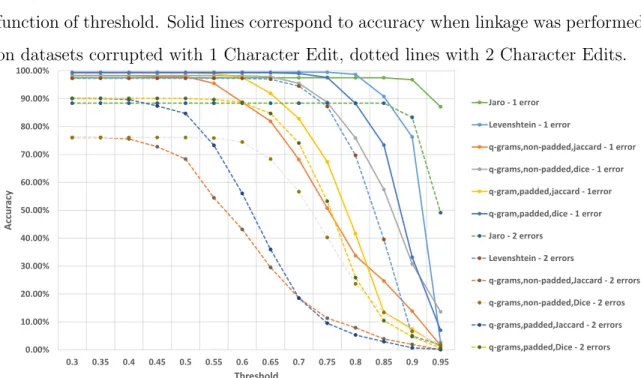
Figure 4.1 shows the results of all of the string metrics on a version of the data in which 10 percent of the names have had one (the solid lines) or two (the dotten lines)
characters edited. In the single edit case, all versions of the q-gram metric are able
to achieve the same, nearly perfect, accuracy on the encrypted data that Levenshtein and Jaro achieve on the unencrypted data. The performance of all metrics is lower
4.1. OBSERVATIONS ON STRING METRIC COMPARISON 21 for the two character edit case, with a top accuracy of 90 percent rather than the completely accurate results possible in the single edit situation. However, we again
see that the performance of at least the padded versions of the q-gram approach on
the ciphertext can match that of Levenshtein and Jaro on the plaintext.
Figure 4.1: Illustration accuracy of record linkage of selected string metrics as a function of threshold. Solid lines correspond to accuracy when linkage was performed on datasets corrupted with 1 Character Edit, dotted lines with 2 Character Edits.
0.00% 10.00% 20.00% 30.00% 40.00% 50.00% 60.00% 70.00% 80.00% 90.00% 100.00% 0.3 0.35 0.4 0.45 0.5 0.55 0.6 0.65 0.7 0.75 0.8 0.85 0.9 0.95 Ac cu rac y Threshold Jaro - 1 error Levenshtein - 1 error q-grams,non-padded,jaccard - 1 error q-grams,non-padded,dice - 1 error q-gram,padded,jaccard - 1error q-gram,padded,dice - 1 error Jaro - 2 errors Levenshtein - 2 errors q-grams,non-padded,Jaccard - 2 errors q-grams,non-padded,Dice - 2 erros q-grams,padded,Jaccard - 2 errors q-grams,padded,Dice - 2 errors
The results for the Soundex metric are not included in Figure 4.1 because the results showed that comparing names based on encrypted Soundex encodings is not viable in most of the cases as a record linkage technique. The only exception was noted when the datasets containing records with the phonetic type of record corruption were joined. Still, in the best case scenario only 60.71% of corrupted data was successfully matched using this technique. Table 4.1 presents the accuracy of record linkage on all types of corrupted datasets using the Soundex technique.
4.1. OBSERVATIONS ON STRING METRIC COMPARISON 22 Table 4.1: Performance of record linkage based on encrypted Soundex encodings. The percentage values reflect the number of corrupted records that were successfully matched with their uncorrupted versions.
Corruption type Number of corruptions per record
1 2 Character Edit 47.24% 24.06% Keyboard Edit 48.06% 21.94% OCR Edit 38.29% 13.71% Phonetic Edit 60.71% 43.88% Mix 50.82% 25.47%
4.1.2
Observation 2: Dice is preferable to Jaccard for
calcu-lating
q
-gram similarity
Out of the four similarity metrics based onq-grams, the ones using the Dice coefficient
to measure the similarity between the sets of encryptedq-grams were more accurate.
This was the case with q-grams as well as padded q-grams. This can be explained
by the fact that Dice favors the occurrences of common q-grams more than Jaccard.
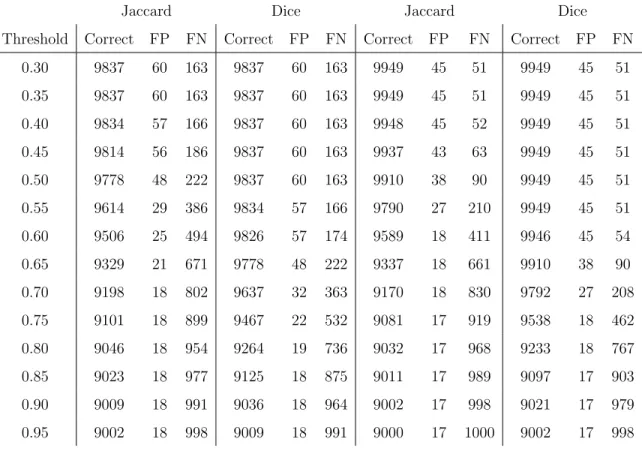
As a result, a pair of similar records is likely to have a higher similarity score when calculated using the Dice coefficient. To illustrate this, in Table 4.2 we provide a sample of results from record linkage performed against a dataset with the phonetic type of corruption, where 10% of original records had two phonetic errors introduced. Similar results were recorded for datasets with other types of corruptions.
4.1.3
Observation 3: Lower thresholds are better for
q
-grams
Figure 4.1 illustrates that the threshold value for the Levenshtein and Jaro metrics can be set relatively high without sacrificing accuracy when linking the unencrypted data,
4.1. OBSERVATIONS ON STRING METRIC COMPARISON 23 Table 4.2: Sample results of record linkage performed against phonetically corrupted
dataset showing the performance of q-grams based string similarity metrics
unpadded q-grams padded q-grams
Jaccard Dice Jaccard Dice
Threshold Correct FP FN Correct FP FN Correct FP FN Correct FP FN
0.30 9837 60 163 9837 60 163 9949 45 51 9949 45 51 0.35 9837 60 163 9837 60 163 9949 45 51 9949 45 51 0.40 9834 57 166 9837 60 163 9948 45 52 9949 45 51 0.45 9814 56 186 9837 60 163 9937 43 63 9949 45 51 0.50 9778 48 222 9837 60 163 9910 38 90 9949 45 51 0.55 9614 29 386 9834 57 166 9790 27 210 9949 45 51 0.60 9506 25 494 9826 57 174 9589 18 411 9946 45 54 0.65 9329 21 671 9778 48 222 9337 18 661 9910 38 90 0.70 9198 18 802 9637 32 363 9170 18 830 9792 27 208 0.75 9101 18 899 9467 22 532 9081 17 919 9538 18 462 0.80 9046 18 954 9264 19 736 9032 17 968 9233 18 767 0.85 9023 18 977 9125 18 875 9011 17 989 9097 17 903 0.90 9009 18 991 9036 18 964 9002 17 998 9021 17 979 0.95 9002 18 998 9009 18 991 9000 17 1000 9002 17 998
data. For instance, to achieve an accuracy of 99.5% when performing linkage against datasets where records contain one corruption of any type, the threshold value applied to the Jaro or Levenshtein metric was set to 0.8 whereas the threshold value applied
toq-grams based metrics needs to be set to a value between 0.55 and 0.75 to achieve
the same result, depending on the type of corruption applied to the datasets.
Table 4.2 makes the point that the padded versions of theq-gram metric in
partic-ular have better performance when the threshold value is kept low, which as explained in the previous paragraph is the optimal approach. For threshold values up to 0.7 for
the Jaccard coefficient and 0.8 for the Dice coefficient, padding theq-grams produces
better results. For higher threshold values, the unpadded version is slightly better.
4.1. OBSERVATIONS ON STRING METRIC COMPARISON 24
higher when the differences between the strings used to generate the q-grams appear
in the middle of the strings. [Christen 2012] When the differences appear at the beginning or at the end of strings the similarity scores are lower because the number
of common q-grams is smaller. Statistically, the differences between strings appear
more often in the middle, which explains why the paddedq-grams can produce higher
similarity scores for the majority of corrupted data. This pattern occurred in all of the results produced during this study.
4.1.4
Observation 4: Some types of errors are worse than
others
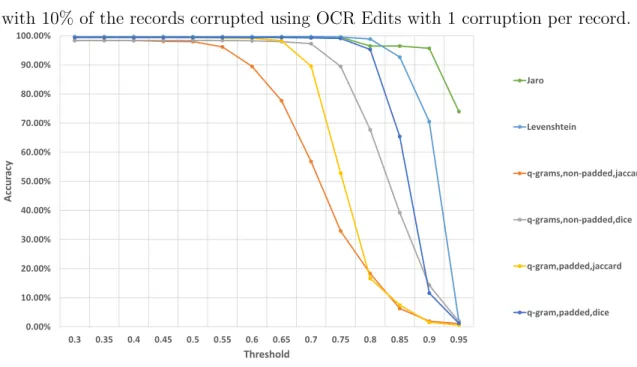
Out of all corrupted datasets the worst performance in terms of accuracy and the number of false positives found was “achieved” when the datasets with OCR Edits were linked. This is most likely due to the fact that some of the mistakes that OCR Edits introduce are replacements of two characters in place of one character, or vice versa. For instance, character “m” can be replaced with “rn” and the string “cl” can be replaced by the character “d”. Those kind of replacements can have a significant negative impact on the string similarity scores produced by all of the metrics. The best performance results were recorded when the datasets corrupted with Character Edits were linked, those are presented in Figure 4.1. Figure 4.2 illustrates the accuracies of linking datasets corrupted with OCR Edits errors. The accuracies of datasets corrupted with Keyboard Edits, Phonetic Edits, and a mix of all types of edits fall in between the accuracies presented in Figure 4.1 and Figure 4.2.
Another pattern common for the results obtained from linking all types of cor-rupted datasets was a significant drop in accuracy when the corcor-rupted records
con-tained more than one error of any type. For instance, for Threshold=0.85 the
accura-cies of the Jaro, Levenshtein, unpadded q-grams compared using the Dice coefficient,
and paddedq-grams compared using the Dice coefficient were 97.5%, 90.79%, 57.46%,
4.1. OBSERVATIONS ON STRING METRIC COMPARISON 25 Figure 4.2: Accuracy of string metrics used to perform record linkage on a dataset with 10% of the records corrupted using OCR Edits with 1 corruption per record.
0.00% 10.00% 20.00% 30.00% 40.00% 50.00% 60.00% 70.00% 80.00% 90.00% 100.00% 0.3 0.35 0.4 0.45 0.5 0.55 0.6 0.65 0.7 0.75 0.8 0.85 0.9 0.95 Ac cur acy Threshold Jaro Levenshtein q-grams,non-padded,jaccard q-grams,non-padded,dice q-gram,padded,jaccard q-gram,padded,dice
per record. When the number of errors per corrupted record increased to two, the accuracies decreased to 88.39%, 39.54%, 13.31%, and 10.41%. Figure 4.1 presents a full overview of the accuracy degradation for datasets corrupted with Character Edits where 10% of all original records were corrupted.
4.1.5
Observation 5: The efficiency penalty for these
privacy-preserving string similarity metrics is small
The Jaro, Levenshtein, and Jaccard and Dice variants of the q-grams metric all
have a O(nm) time complexity, where n and m are the lengths of the strings to be
compared. Because the Soundex metric is only checking for equality of the Soundex
representation of the strings, its time complexity is just O(n). When determining
whether a particular name is in the dataset, the query name is compared against all of the names in the dataset. It should be noted that the Soundex algorithm, because it is an exact rather than fuzzy match, could be made more efficient by indexing the database on the Soundex representation of the name. Also, there has been some work
4.1. OBSERVATIONS ON STRING METRIC COMPARISON 26 on eliminating the need to consider all names in the dataset when querying using the Jaro metric through the user of character and length-based filters to quickly determine if it is possible for a particular name to match the query within a specified threshold [Dreßler and Ngomo 2014]. Neither of these optimizations were considered in this work.
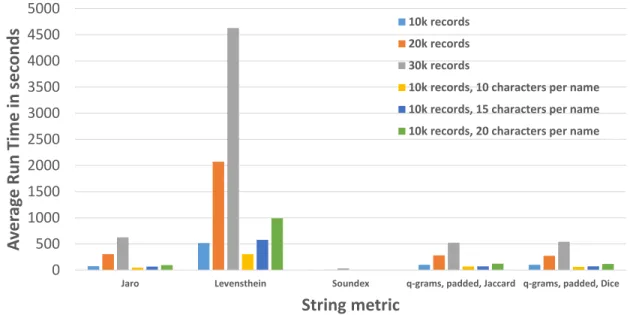
While most of the string metrics considered have the same computational com-plexity, constant factors differ between the approaches. For example, because Jaro only looks for matching characters within a window that is half the length of the longer string, it is generally faster than Levenshtein. To evaluate the computational efficiency of each of the string metrics in a practical setting, the time taken to perform the join operation between the original dataset and the corrupted dataset was mea-sured. We explored the impact on the performance when the number of characters in names increases. In this case, the datasets always consisted of 10,000 records, but the number of characters in each name was equal to 10, 15, or 20. These tests were done on datasets with a record corruption of 10%, where the records were corrupted using the Character Edit technique and contained one corruption per record. All tests were performed on the same PC with Windows 10 OS and equipped with Intel Core i7-4790K CPU running at 4.00GHz and 16GB of RAM. The results are shown in Figure 4.3. The timing results of linkage performed on the other corrupted datasets were very similar to the ones presented in this figure.
The results show that the q-grams approaches are very slightly faster than Jaro
in these tests, and significantly faster than Levenshtein. The average time taken to perform the join operation on the datasets using Levenshtein was more than five times the magnitude of the time taken by the other string metrics. Of course, the best speed was observed when the datasets were linked using the Soundex metric. In those cases the linkage was performed almost instantly, averaging only about one second.
num-4.1. OBSERVATIONS ON STRING METRIC COMPARISON 27 ber of records increases. Three datasets of different volumes (10, 20, and 30 thousand records) were linked to conduct the tests. The results shown in Figure 4.3 indicate that as the number of records to be linked increases, the time required to link all the
records is again very similar for Jaro and theq-grams techniques, significantly greater
for Levenstein, and very low for Soundex.
Figure 4.3: The average time of record linkage using selected string metric techniques.
0 500 1000 1500 2000 2500 3000 3500 4000 4500 5000
Jaro Levensthein Soundex q-grams, padded, Jaccard q-grams, padded, Dice
A ver ag e Ru n Ti me in sec o n d s String metric 10k records 20k records 30k records
10k records, 10 characters per name 10k records, 15 characters per name 10k records, 20 characters per name
4.1.6
Observation 6: As
q
increases, the record linkage
qual-ity degrades.
We also have studied the effects of the value of q on the accuracy of the q-grams
approach. Asq increases, fewer q-grams are needed to encode a string. This implies
that every difference between two strings encoded usingq-grams and compared using
the Dice or Jaccard coefficient will be penalized more and more as q increases. It
is therefore expected that performance will drop as q increases. Our goal was to
investigate the magnitude of this drop. We therefore studied the accuracy of the
4.1. OBSERVATIONS ON STRING METRIC COMPARISON 28
As expected, bi-grams (q=2) yielded the best results for all types of datasets.
Fig-ure 4.4 presents the accuracy of record linkage of datasets containing keyboard errors (10% of records were corrupted with one random insertion, deletion, substitution, or transposition of a character). The records were linked based on Dice and Jaccard coefficient scores. The solid lines represent the results of linking records using
un-paddedq-grams, the dotted lines indicate that theq-grams were padded. All versions
of q-grams demonstrated a very similar degradation pattern in linkage quality. For
example, when the records containing unpadded q-grams were linked based on Dice
coefficient scores with a threshold value set to 0.65 the percentages of successfully
linked records (that contained the aforementioned corruption) forq=2, 3, and 4 were
equal to 99%, 84%, and 57% respectively. This pattern holds for all types of dataset corruptions (character, keyboard, OCR, or phonetic errors). When the number of corruptions per record increases to two, the record linkage quality suffers even more. Figure 4.5 illustrates the accuracy of record linkage of datasets where 10% of records were corrupted with two random keyboard errors (Figures 4.4 and 4.5 were created using the same color-coded series representing the linkage performed using the same
q-gram, padding, andq-gram similarity coefficient combination to allow easy
compar-ison between the results). For low threshold values, the record linkage using q-grams
with q=4 resulted in correct linkage of only about 15% of corrupted records, and
even the usage of padded versions ofq-grams didn’t significantly improve the results.
The linkage utilizing tri-grams and bi-grams performed 3 to 6 times better depending
on the particular combination of q value, padding, andq-gram similarity coefficient.
As before, the same linkage quality degradation pattern was reported for all types of data corruption.
4.2. EVALUATION OF PRIVACY LEVEL OFQ-GRAMS 29
Figure 4.4: Illustration of accuracy of record linkage based on different types of q
-grams. Linkage was performed on datasets corrupted with 1 Keyboard Edit.
0.00% 10.00% 20.00% 30.00% 40.00% 50.00% 60.00% 70.00% 80.00% 90.00% 100.00% 0.3 0.35 0.4 0.45 0.5 0.55 0.6 0.65 0.7 0.75 0.8 0.85 0.9 0.95 Acc ur acy Threshold q=2,unpadded,Dice q=2,unpadded,Jaccard q=3,unpadded,Dice q=3,unpadded,Jaccard q=4,unpadded,Dice q=4,unpadded,Jaccard q=2,padded,Dice q=2,padded,Jacccard q=3,padded,Dice q=3,padded,Jaccard q=4,padded,Dice q=4,padded,Jaccard
Figure 4.5: Illustration of accuracy of record linkage based on different types of q
-grams. Linkage was performed on datasets corrupted with 2 Keyboard Edits.Threshold
0.00% 10.00% 20.00% 30.00% 40.00% 50.00% 60.00% 70.00% 80.00% 90.00% 100.00% 0.3 0.35 0.4 0.45 0.5 0.55 0.6 0.65 0.7 0.75 0.8 0.85 0.9 0.95 Ac cu rac y Threshold q=2,unpadded,Dice q=2,unpadded,Jaccard q=3,unpadded,Dice q=3,unpadded,Jaccard q=4,unpadded,Dice q=4,unpadded,Jaccard q=2,padded,Dice q=2,padded,Jaccard q=3,padded,Dice q=3,padded,Jaccard q=4,padded,Dice q=4,padded,Jaccard
4.2
Evaluation of Privacy Level of
q
-grams
4.2.1
q
-grams Technique Privacy Vulnerabilities
An important measure of any PRL technique, in addition to its performance and scal-ability, is the level of privacy. In general, the PRL privacy requirements assume that
4.2. EVALUATION OF PRIVACY LEVEL OFQ-GRAMS 30 once the record linkage is complete only limited amount of information will be shared between interested parties. [Vatsalan et al. 2013] The ”limited amount” term usually means revealing data such as: number of linked records, explicit identifiers of the linked records, or linked records along with their selected attributes. The work pre-sented here assumes that the querying entity can discover as much information about the records in the database as it wishes. Here, the emphasis is instead on making sure the records (more specifically the PII attributes) are always encrypted in order to protect the identities of entities associated with records in case of potential data
breaches. For theq-grams based techniques, each of the q-grams was encrypted with
an AES password-based encryption algorithm. A brute force attack (i.e. dictionary attack) on this kind of encryption algorithm has proven to be infeasible [Al Hasib and
Haque 2008]. However, as other researchers have noted, the q-gram based techniques
are prone to a frequency based attack. [Schnell et al. 2009; Churches and Christen 2004] A frequency attack can be mounted by comparing the frequency of each
en-crypted q-gram with its relative frequency derived from data that is likely to have a
similar distribution of q-gram occurrences. In the case of first and last names, such
data can be very easily found online. For example, a dataset that contains more than 5,000 first names and nearly 90,000 last names was published by U.S. Census Bureau
in 1990 [U.S. Census Bureau ]. To evaluate privacy level of q-gram based techniques
we want to answer the following question: What is the percentage of records whose identities can be discovered by conducting a frequency based attack? This section describes an overview of the approach taken to prepare the attack, and the following sections present our findings and observations.
4.2.2
Frequency Attack Approach
The ultimate goal of the attack is to decrypt as many first and last names that are
stored in the form of encrypted q-grams as possible. When designing the attack the
4.2. EVALUATION OF PRIVACY LEVEL OFQ-GRAMS 31
• The attacker managed to obtain access to all encrypted records from the database,
along with all attributes of each record, but he/she doesn’t have access to their unencrytped version.
• The attributes corresponding to first and last names can be identified by the
attacker. In other words, the attacker knows the schema of the record and can
identify which q-grams correspond to first name or last name. Additionally, the
q number used to form q-grams is also known.
• To fully explore the vulnerabilities ofq-gram based techniques none of the names
(first or last) in the attacker’s dataset was corrupted since random errors in the dataset could influence the results of the attack.
• Since the attacker can distinguish between q-grams corresponding to first name
or last name, the attack will be conducted on first and last names separately.
• The lists of first and last names published by the U.S. Census Bureau will be used
by the attacker to calculate relative frequencies of q-grams.
The simplest and most intuitive approach to conduct the frequency analysis attack
would be as follows. The attacker creates a list of encrypted q-grams containing the
frequency of occurrences of each of the q-grams. Using publicly available sources of
first and last names, the attacker can prepare similar lists with unencrypted versions
of the q-grams. Finally, the two lists can be ordered by the q-gram frequencies and
merged together in order to substitute the encryptedq-grams with their unencrypted
equivalents in all records from the database. However, such a naive approach will not work. Since the attacker has no knowledge about the name distribution in the
en-crypted database, the two lists of q-gram frequencies are not likely to provide enough
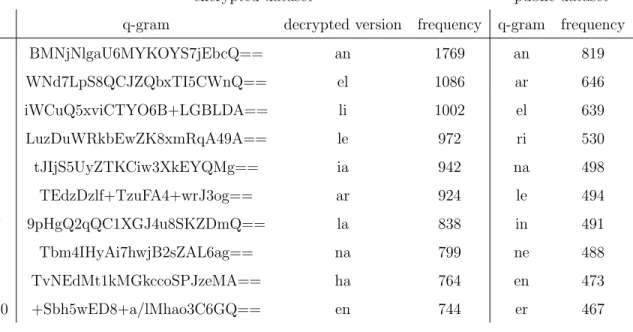
correctly guessedq-gram decryptions to decrypt a significant number of names. Table
4.3 presents a selected part of the two lists created by analyzing q-gram frequencies
4.2. EVALUATION OF PRIVACY LEVEL OFQ-GRAMS 32
of 323 encrypted q-grams there were only 8 matches where the nth q-gram from the
encrypted dataset had the exact same frequency rank as the q-gram derived from
the public dataset. A brute force solution to substitute every single possible
decryp-tion for each of the encrypted q-grams is not feasible. Such an attempt will result
in creating 3233 variations of q-gram decryptions. Evaluating each of the variations
would require too many computational resources. Therefore, it is clear that a more sophisticated approach is needed.
Table 4.3: Top 10 most commonly occurringq-grams in encrypted and public datasets
of first names where q=2.
encrypted dataset public dataset
q-gram decrypted version frequency q-gram frequency
1 BMNjNlgaU6MYKOYS7jEbcQ== an 1769 an 819 2 WNd7LpS8QCJZQbxTI5CWnQ== el 1086 ar 646 3 iWCuQ5xviCTYO6B+LGBLDA== li 1002 el 639 4 LuzDuWRkbEwZK8xmRqA49A== le 972 ri 530 5 tJIjS5UyZTKCiw3XkEYQMg== ia 942 na 498 6 TEdzDzlf+TzuFA4+wrJ3og== ar 924 le 494 7 9pHgQ2qQC1XGJ4u8SKZDmQ== la 838 in 491 8 Tbm4IHyAi7hwjB2sZAL6ag== na 799 ne 488 9 TvNEdMt1kMGkccoSPJzeMA== ha 764 en 473 10 +Sbh5wED8+a/lMhao3C6GQ== en 744 er 467
To conduct the frequency attack in an efficient manner we decided to take an
advantage of the fact that the frequencies of q-grams derived from the public dataset
are usually not too far off from the frequencies of the encryptedq-grams. For example,
the encryptedq-gram ”ar” in Table 4.3 was classified as the 6th most frequent in the
encrypted database and as the 2nd most frequent among q-grams derived from the
public dataset of names. This information can significantly reduce the number of
possible decryption variations for the encrypted q-grams. To reduce it even further,
4.2. EVALUATION OF PRIVACY LEVEL OFQ-GRAMS 33
identifies the most probable q-gram translation.
Once a table similar to the one present in Table 4.3 is obtained, the attacker
iterates through each of the encrypted records. Based on the assumption that the q
number is known to the attacker, the length of the encrypted name can be deduced
using the formula: L=n+q−1, whereL is the length of the name,n is the number
of q-grams used to form the name and q is the q number. The length of the name
is used to pull all instances of names from the publicly available dataset of the same length. Those names will serve as guesses of the encrypted name. It is likely that the
number of names of length L will be in the hundreds or even thousands. To reduce
this number, in the next step the attacker prepares another table with the number of
rows equal to the number of encrypted q-grams in the record. Each row contains an
encrypted q-gram and a list of potential translations of this q-gram obtained from a
table such as Table 4.3. The list is populated with theq-gram translation that matches
the frequency rank of the encrypted q-gram as well as additional q-gram translations
that are within a specified range (later on referred to as the ”Guessing Offset”) above
and below the frequency matching q-gram. An example of such table is presented
in Table 4.5, where each possible q-gram translation includes the information about
the offset between a translation itself and the translation that matches the frequency
of the encrypted q-gram. The offset represents how close the frequency rank of a
potential q-gram translation is to that of the frequency of the encryptedq-gram. For
example, the second encryptedq-gram in Table 4.5 ”TEdzDzlf+TzuFA4+wrJ3og==”
includes possible translations such as ”le:0”. ”le” is the translation that matches
the frequency rank of the encrypted q-gram (see Table 4.3), so there is no offset.
Another possible translation ”ar:4” indicates that the q-gram ”ar” has an offset of
4 between ”ar” and the q-gram that matches the frequency rank of the encrypted
q-gram (”le”). This table is used to eliminate the guesses of the encrypted name that
are not valid due to the fact that they cannot be formed given the lists of possible
4.2. EVALUATION OF PRIVACY LEVEL OFQ-GRAMS 34
the possible q-gram translation “ri” can be eliminated from the second row because
none of the possibilities in the first row end with “r”. The corresponding list of possible guesses for the encrypted name can then be further reduced. In the final step, each of the names in the guesses list is assigned a penalty score. The score
is the sum of the offsets that had to be taken to include all q-grams used to form
the name. Based on Table 4.5, a name ”tere” would receive the penalty score of 1 (”te:1”) + 4 (”er:4”) + 2 (”re:2”) = 7. The name with the lowest score is identified
as the best possible guess for the encrypted name. The q-grams used to form this
guess are stored in a separate table (called the Translation Table) that contains the
encryptedq-grams and their corresponding translations obtained from the name with
the lowest penalty score. When the attacker is done iterating through all of the
encrypted records, the translation for an encrypted q-gram is identified by taking
its most common translation from the Translation Table. The attacker can now
substitute the encrypted q-grams with their unencrypted versions in all encrypted
names in the dataset.
We now provide an example iteration of the frequency attack approach described above. Table 4.4 illustrates one of the encrypted records that the attacker obtained from the database during the security breach. The attribute called ’First Name’
represents a set of encryptedq-grams separated by commas that were used to encrypt
the name ”sara”. The attacker can infer the length of the name behind the encrypted Table 4.4: An example of an encrypted record.
Record Id First Name ....
rec-1081 uSpcZZ71KiNrD8Av/FS3cA==,
TEdzDzlf+TzuFA4+wrJ3og==, 2gP9jD8Zg5ugC6YTQg3UMQ== ....
q-grams by applying the following formula: length= 3 + (2−1) = 4 since he knows
that the q number is equal to 2. From a publicly available dataset of names, he or
she can obtain the list of all names of length 4: john, hera, sara, carl ,tera, tere, etc. to serve as the guesses list. To trim the list, a Table 4.5 is prepared where each of