Educational complex of light-colored modeling of urban
environment
Vladimir E. Karpenko1,
1Far Eastern Federal University (FEFU), School of Engineering, Department of Architectural Environment and Interior Design, 8
Sukhanova St. Vladivostok 690090, Russia
Abstract. Mechanisms, methodological tools and structure of a training complex of light-colored modeling of the urban environment are developed in this paper. The following results of the practical work of students are presented: light composition and installation, media facades, lighting of building facades, city streets and embankment. As a result of modeling, the structure of the light form is determined. Light-transmitting materials and causing characteristic optical illusions, light-visual and light-dynamic effects (video-dynamics and photostatics), basic compositional techniques of light form are revealed. The main elements of the light installation are studied, including a light projection, an electronic device, interactivity and relationality of the installation, and the mechanical device which becomes a part of the installation composition. The meaning of modern media facade technology is the transformation of external building structures and their facades into a changing information cover, into a media content translator using LED technology. Light tectonics and the light rhythm of the plastics of the architectural object are built up through point and local illumination, modeling of the urban ensemble assumes the structural interaction of several light building models with special light-composition techniques. When modeling the social and pedestrian environment, the lighting parameters depend on the scale of the chosen space and are adapted taking into account the visual perception of the pedestrian, and the atmospheric effects of comfort and safety of the environment are achieved with the help of special light compositional techniques. With the aim of realizing the tasks of light modeling, a methodology has been created, including the mechanisms of models, variability and complementarity. The perspectives of light modeling in the context of structural elements of the city, neuropsychology, wireless and bioluminescence technologies are proposed. Conclusions are given on the environment-forming and transforming significance of artificial light and light technologies in the space of modern city. Light-colored modeling identity is expressed in methodical and figurative-artistic continuity in the use of techniques of light composition and optical art. The use of light composition contributes to the expression of local identity by means and techniques of light composition in the context of the image, “genius loci” using the example of the Vladivostok seaside city. Identity in psychology is expressed in the personal selection of the techniques of light composition, which are used in light-colored modeling.
1 Features of the educational complex of light-colored modeling of the urban
environment
1.1 Structure of the educational complex
Methodological logic and the application of light effects in environmental design are accompanied by profound study of the laws of the psychology of visual perception, the theory of optical art [1] and light urbanism [2]. The structure of the educational complex includes a lecture block: modern visual art [3], psychophysiology, the theory of modern lighting design, lighting technology, a unit of practical works and virtual modeling. The structure of practical tasks includes several directions: creating a light composition, installation, media facade, lighting the facade of a building or street, creating a public pedestrian light environment.
1.1.1 Modeling of light form
The light form in art and lighting design can be defined as a form consisting of a series of transparent and opaque elements whose structure and main idea are revealed when using an artificial light source or light flux. Polychrome and monochrome radiation can participate in the formation of light volume and space with flooding or local lighting with a certain rhythm of light sources, light lines and a spot of light pattern. The following light-dynamic phenomena of the light
2
form are singled out: 1.) the photostatic – a state of form fixed at the moment of invariability, revealing its light-shadow regularities, the values of brightness and contrast frozen in a drawing, outline and silhouette. Video-dynamics – the state of form changing, with a video sequence which allows researchers to study its movement, to program illumination changes, and to capture changes in the direction of the rays. The main purpose of this practical work is to study the features and the use of artistic means and techniques of op-art in creating a light composition. [1, 4]The task of expressing optical illusion in a new modeled form is to create a three-dimensional or frontal light form, taking into account the shape formative (hue, colorfulness, lightness) and psychological (perception and interpretation) properties of the light and color by using mirror, glossy or matte surfaces. Various types of reflection are used as a means of visual transformation, expression of depth and planning, dynamics of reflections. These include: the superposition and overlapping of falling color and monochrome shadows that create a complex composite structure. The translucence effect and a narrow beam of light, created with the help of special materials, that form a characteristic light contour and pattern. The dynamics of changes in intensity, color and rhythm of luminescence over time, and the use of color filter reception that significantly change the aspect of the form.
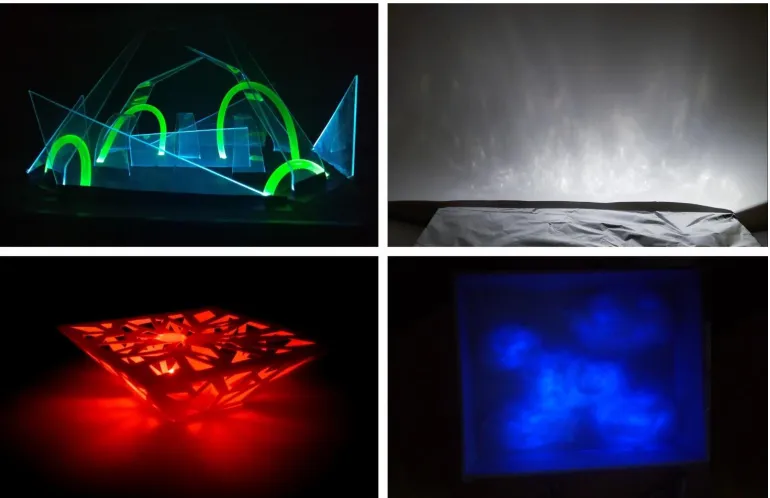
[image:2.482.47.432.320.569.2]Figure 1 shows some examples of light compositions (light forms) in educational and practical works. In the upper left image is a composition called "Composition 1" (A. Afonin). The work is made with cardboard and light-scattering elements (transparent plastic, rubber band of green color). The dimensions are: 220 x 300 x 50 mm, and it contains a light source LED strip (1 m). Its main idea is expressed in the distribution and dispersion of light through light-scattering elements. In the upper right image – the composition "Northern Lights" (P. Molinyova), is made with cardboard, foil and paper. The main idea is the optical effect of the Northern Lights created through the transfusion of light. The light coming from the flashlight is refracted, and projected onto the wall. The lower left image is the composition "Light Pyramid" (E. Bondarenko). The shape is made with paper, cardboard and LED light source (10 x 10 cm). The main idea is to create optical illusions and the effect of light scattering by filling the volume with a concentrated beam of light from a flickering LED. The lower right composition is called "Clouds" (S. Dorofeeva). It is made with foam board, matte plastic, two flashing LEDs, foil, and packing tape. The dimensions are 17,5 x 21,5 x 8 cm. The basic idea is to create a background flow of light from the source through the openings. Such a composition can be placed in window openings to create additional lighting effects in a room in daylight.
Fig. 1. Examples of light composition in practical educational works.
1.1.2 Modeling of light installation
3
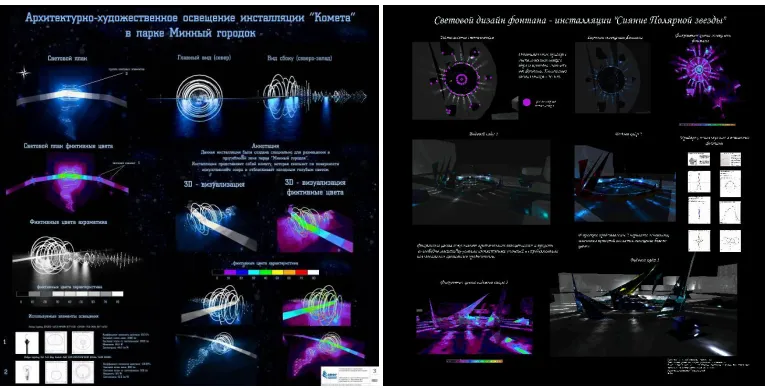
recorders and computer processors are built into the installation design and form a single form. Modern techniques and means of light installation are expanded and become dependent, in many aspects, on scientific and technological achievements and social conditions. The main objectives of this practical work are to study the features, artistic means and techniques for creating a light installation using natural, artificial and other necessary light sources. [image:3.482.48.431.206.400.2]When modeling the educational light installation, prototypes were studied, artistic methods of their creation and the features of using light technologies in its composition were revealed, and the technical arrangement of the light installation space was considered. At the same time, various optical, psychological effects and illusions are revealed in the light form of the installations, taking into account the following: colorimetry parameters (hue, colorfulness, lightness), photometry (wavelength, P, (%), luminance – L (kcd/m2)), reflection coefficients, refraction and absorption of materials, light dynamics and light animation [4]. The light installation "Comet" in Fig. 2 (left) shows techniques used to reflect the light form on water surface. The reflection effect complements the flickering circular image of the spiral, and is associated with the twisting motion of the cosmic body. The comet slides and leaves a cool blue light (E. Bondarenko, M. Borodavkina, S. Kucenko). In Fig. 2 (right), the light design of a fountain called "Lights of the Polar Star", the effect of the movement of water is recreated by directing the light rays from the fountain (A. Akimova).
Fig. 2. Blue water reflection and glow, special direction blue light in educational light installation and fountain, in “genius loci” context, op-art and psychology identity.
1.1.3 Modeling of media facade
Modern trends in architecture and design actively use interactive, network and computer technologies. Architecture becomes the background for the broadcasting of certain media content. Buildings and structures acquire a second visual envelope – a media facade, which allows the daytime parameters of the architectural object to be transformed into displays of advertisements and other visual images at night. A media facade is a large-scale display, which consists, as a rule, of LED modules. However, today media facades acquire a variety of artistic and technical forms. The media facades, for example, also can be applied to video-mapping – the projection of content on buildings and structures. The purpose of the practical work is to study the artistic, lighting technical features and means, the methods of creating media facades with use of LED, information, network and wireless technologies, taking into account also the optical and psychological effects and illusions generated by artificial light.
Previously studied analogues of media facades revealed their typology in accordance with the technical device and the use of LEDs in their construction. Artistic methods of media facade content are based on the use of light graphic or visuals, animations. Light sources can also create raster or point animation, or a static image. The features of the media facade content are determined by the power of the light projection or the technology of the LED monitors. According to the projection method, the lamps can illuminate the facade of the building or exhibit interior light passing through the glass facade. Media facades may also not contain light elements. In such cases, their mechanical parts, repeatedly replicated on the plane of the facade of the building, form a kind of mechanical mutable forms. [5, 6]
1.1.4 Modeling the light image of building or architectural ensemble
4
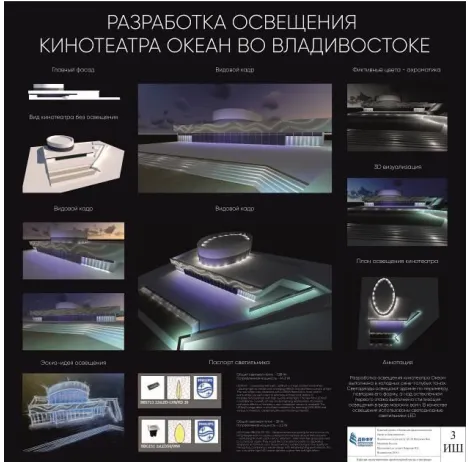
pilasters, fragments of walls, porticos or other architectural elements. This creates light tectonics and a certain light rhythm. Total flood lighting of the building increases the light scale. Lighting several nearby buildings, for example, the architectural ensemble of a historic street can form a light ensemble. The purpose of the practical work: the formation of the light ensemble of a historic street; application of modern media and lighting technologies, lighting systems and LED light sources. [image:4.482.121.355.266.497.2]Simulation of architectural ensemble light form consists of individual facade light models of buildings, connected in a single complex by light-composite lighting techniques. Pre-executed also are contour, color models, schemes of arrangement of lighting installations with a designation of beams direction. With the help of brightness programming (regulation of maximum brightness and illumination), the dominant volumes of the most significant architectural objects, which form the city's quarters, are illuminated, whereas intermediate objects form the local non-main illumination. Revealing architectural dominants, modeling and arrangement of maximum and minimum brightnesses of illuminated buildings are done with light revealing the depth and planning of the historical environment and space of the street. Complex plastic facades of historic buildings are emphasized by local color and common flood light. Different rays are used. The light silhouette of the buildings’ facades and forged elements of the parapets and balcony fences (reception of the сontre-jour), the light rhythm of the facades’ plastic elements are revealed. A light accentuation of axial forms (arches, niches, windows, pediments, porticos), domed corner elements of the buildings’ composition are created. [2] When modeling the light image of a unique building, shown in Fig. 3, the light graphics associated with sea waves are applied: curvilinear point drawing, cold light (P. Malineva, Ja. Nipunova). These light elements contain a symbolic link to the name of the building "Ocean" – a cinema is located in the embankment of a seaside city, and elements of the identity of "genius loci".
Fig. 3. Methods of light modeling – blue glow, light structuring of volume in unique architectural object.
1.1.5 Modeling of city pedestrian lightspaces
5
of the city, can be distinguished by bright and neutral-white light, high level of illumination, special light-composition techniques, and a system of light signs and visual communications. This practical task has a complex nature. It can generalize the development of previous tasks and include techniques of light composition, new light installations and media facades, light ensembles and dominants. The goal of the practical work is to create a harmonious, artistically expressive, comfortable and safe light environment of a city’s pedestrian area, the use of modern media and lighting technologies, lighting systems and light sources.Modeling the pedestrian space supposes initial functional zoning with the goal of determining the qualitative (chromaticity of light, density and light field nature, light dynamics) and quantitative (brightness and illumination level) parameters of the light environment. In the process of zoning pedestrian spaces the light spaces are divided into that of communication, movement and recreation, for which the appropriate types of lamps are chosen: architectural, landscape, road-pedestrian and decorative purposes. The media surfaces, light installations, light sculptures, previously created in other practical works are used in pedestrian spaces. Light-spatial depth is achieved by the methods of light panorama. The functional indexes of the environment – homogeneity of illumination with specified color temperature, brightness and illumination level, and figurative-artistic characteristics – creation and realization of light composition effects, adjusted psychoemotional atmosphere of comfort, safety and rest, are achieved when modeling artificial light. Blue glow of the plankton of the sea refers to the images of water, wave, sea depth, bottomlessness. The modeling of light-form receptions associatively constitutes stable psychological connections and creative thinking, which cause figurative associative thinking in the context of creative identity. [2, 7-9]
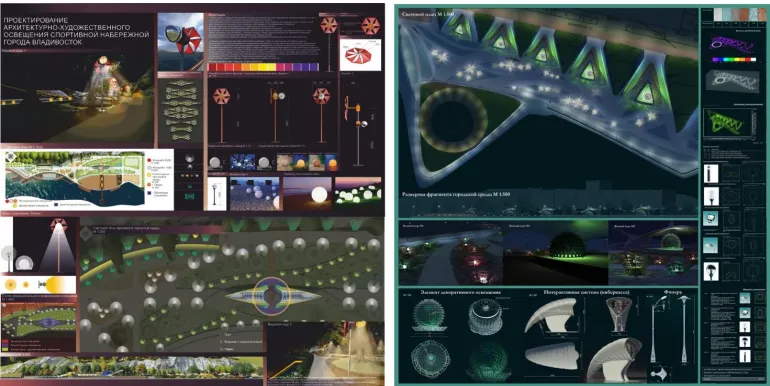
[image:5.482.46.431.366.559.2]Figure 4 presents practical work on the formation of the light environment of the coastal space of the city Vladivostok – the embankment. The image on the left shows the project "Architectural and artistic illumination of Vladivostok Sports Harbor" (E. Kiseleva). The main idea of the project is the development and application of wind energy in the light installations and the creation of uniform horizontal illumination. The design of the lamp includes a wind turbine (one meter diameter), which consists of six working blades. Wind-generated energy is integrated in the accumulator. Flashlights can be used as a power battery and electricity. The lights are charged for lighting walkways in the evening. These light units and a luminous flux are produced from a central control. In the image to the right – the project "Designing architectural and artistic illumination of Vladivostok Sports waterfront "Bioluminescence of the sea" (A. Voroncova). The main idea of this project is to imitate the bioluminescent glow of marine organisms in order to create a bright image of the Sports waterfront attractive for visitors in the evening. This decorative lighting will create a special atmosphere of the coast, making a walk along the waterfront more enjoyable, especially on foggy days. The project includes conceptual design lamps, and a list of recommended equipment. Feature of the project is small LED elements embedded in the pavement, which gradually light up and fade in a certain rhythm, simulating the glow of plankton in the water.
Fig. 4. Modeling and using of seawater images in lighting effects of the practical works. Formation of “genius loci” in architectural-light environment of the Vladivostok embankments.
1.2 Methods of the educational complex
6
The choice and performance of a particular assignment depends on the preliminary design of the day-time architectural environment and the goals and tasks of individual preference. This determines the principle of variation in the educational complex. The smoothness of the educational process consists of the sequential acquaintance with the works of optical art, the trends in the world of light design and new forms in the urban environment, the means of virtual design, the achievements of lighting technology and psychology.1.2.2 Complementarity
The light techniques of each practical work are mutually complementary. They can be used and supplemented in any practical work. Elements and receptions of light design worked out in every practical work can be used in other practical works. For example, the techniques of light composition are used in the design of light architectural ensemble and object; media facades are used in the design of a fragment of the light environment of a pedestrian space or an architectural object.
1.2.3 The principle of 3 models
The principle of three models includes the stage of creating a light image of an object or a form, which are depicted in the form of sketch drawings. Graphic model is preliminarily formed – creating a contour drawing of an object. This project stage fixes the proportional and compositional features of the object. Architectural rhythm, plastic, tectonics are then analyzed. Following that, the color (reproduction of the color of the object) and the light model are formed. The second stage is the creation of light model, which is creation of the light architecture of the object, taking into account its color parameters and architectural plastics. This stage involves the creation of a light rhythm of the elements of the facade's plastic, installation, composition and identification of tectonics. Points for placing luminaires of local or general flood lighting are marked. Herewith, the techniques of light composition can be used. The basic principles of lighting for a particular object, which take into account the contour pattern, proportional and compositional features, rhythm, plastic, tectonics, color, light and shape silhouette, are formulated.
The means of modeling the light environment are computer graphics, as well as a sketch with artistic visual means – dark paper and pastel. Means of designing the light environment are computer modeling, in which the values of illumination or brightness are checked in the theoretical environment, and the distribution and nature of artificial light, brightness fields and contrasts are simulated. The creation of a light composition also includes a prototyping process, in which miniature color diode light sources, light-transmitting and reflective materials are used.
2 Results of educational-practical works
The light composition in the lighting design is defined as a form consisting of a series of transparent and opaque elements, the main idea of which is manifested when using an artificial light source. Simultaneously, it is characterized by the dynamics or static of the light effect. As a result of the educational process, means of light composition have been developed. These include: specular, diffuse and mixed reflection and its structural capabilities, contrast (shadow), transmission of light, and chromaticity. Simultaneously, the mechanism of the formation and use of psychological skills, associations, motility and memory in using special techniques in light form, composition, and in the spaces of the embankments of the city was discovered. For example, wavy lines - light graphics, blue light, gradients of brightness, vanishing and flickering blue water light projected onto the foil light, are elements that make up the light composition which are associated with sea waves, a sea city. Such a light composition can be expressed in objects of the Vladivostok embankments, referring to the local-geographical identity. Thus, the objects of the light design acquire a different meaning, evoking and referring to the figurative memory and spirit of the place, which resides in all the seaside cities in general. Light techniques transform the object and inscribe it into the environment and approximate its sense of finding and matching the image of the place.
The design of the media facade is conditioned by the development of LED technologies and the increase of luminous flux of the projection devices [5, 6]. Modern trends in the technical and artistic means of media facades acquire a variety of artistic and technical forms, to which can also be attributed video-mapping. Many of the light techniques and artistic form of the light composition worked out by the students resemble a light installation in miniature [4].
The night visual image of a building or architectural ensemble is built by local illumination or general flood lighting. In the first case spotlights soffits, which can reveal architectural details, are placed on the building. Total flood lighting of the building increases the light scale. The lighting of several nearby buildings of a historic street can form a light ensemble. The logic of lighting historical objects or buildings in the style of eclecticism, historicism, postmodernism with complex facade plasticity dictates the identification of light tectonics.
7
When modeling lighting projects, we came to the conclusion that in light design, the volume-spatial composition of an architectural object determines the techniques of light composition, and the contextuality of their use in accordance with the spirit and identity of the place, as evidenced by the methodology and project-methodological practice in creating a light image of the object. Objects themselves in many ways set the choice of lighting techniques. The development of light composition is also aimed at developing the skills of invention and fantasy of light techniques, which then find expression in objects of the environment and architecture, in new light images.3 New technologies in modeling the city's artificial light environment
3.1 Light structural elements as modeling units in the urban environment
Kevin Lynch's theoretical works (1960) in the field of image formation of a city are taken into account in light modeling from the point of view of the methodology of the planning structure of the city. He defined five structural elements: landmarks, paths, nodes, borders and districts [7]. Each of these elements and their combination in light-composition interpretation – certain fragments of the urban environment, buildings or architectural ensembles, can be highlighted with certain light-composition techniques or light stimulus. The universality of the structural theory is expressed in the fact that it can be applied to various spaces of the city, visually perceived directly by man. At the same time, certain emotional characteristics of the environment are created, its atmosphericity is achieved.
Intuitive subconscious following of a person to the bright spaces in the evening, to the direction of light forms as landmarks, paths, nodes, boundaries, areas and dominants, which is determined by the physiological mechanisms of visual transmission of light signal, specifies a certain program, and trajectory of motion. This is the psychological meaning of the light stimulus – to encourage activity in the night space of the city. The ways of urban displacement, the acquisition of cognitive and emotional-sensory reactions, the establishment of visual and psychological connections in the urban environment by means of recognizing the light stimulus, signs, light fields, the planning structure of the city and its elements, form certain atmospheric environments of the city; and the light forms execute the function of a light guide. At the same time, the process of visual perception has an individual and subjective character. [2, 10, 11]
3.2 Neuro, wireless, bioluminescent technologies and light forms in urban environment modeling The impact of artificial light in psychological processes is expressed in its ability to form a spatio-temporal distribution of light stimulus on the retina of the eye, send electrical and neurochemical signals further to the visual regions of the brain, and cause imaginative thought processes and associations. In this case, neurostimulants are combinations of light stimulus in light form or light composition.
With the help of light form, it brings the possibility to create special light techniques that play the role of neurostimulators and neuroprogrammers, thus allowing emotional states to be set with the help of new light technologies and tools. Light stimulus can create a positive mood and have a certain therapeutic and psychological effect on a person. By stimulus, light effects are the structural parts of the light form. Thus, a psychological reconstruction and adjustment of emotional settings take place in the night city space with the help of light stimulus and the effects in the light composition. The introduction of light installations, media facades, light sculptures and small architectural forms into the urban environment is a means of excitation of neuroprocesses, and the forms themselves are neurostimulants.
4 Conclusions and prospects of educational technologies in light design
4.1 Main conclusions
Images of new art and technological innovations are short-lived. Media facades, light installations and their technical equipment depend on the parameters of light sources and current art trends, and their meaning. Content changes even more rapidly in the unstable conditions of the modern city.
The methods of projecting light, setting special artistic tasks, revealing the building's tectonic system using artificial light lead to a typological convergence of the light form of the building's facade (light architecture), media facade, light projection and video mapping.
The methodological accents of the educational complex are expressed in a preliminary study of the techniques of optical art, in which works of the light elements or special lighting effects are initially laid and prototypes of the light composition have been constructed. In the process of creating a light composition, a certain number of light techniques are developed. The students studied modern trends in art, the visual series of which allows to develop abstract thinking, expand memory, and invent individual methods of lighting.
The peculiarities of the methodology of this training complex are that for the first time the stages (models), variability (choice of medium in daylight forms for light projection) and complementarity (universality and combination of light techniques for various environmental forms) are proposed in the educational and practical design of the light environment by means of computer simulation.)
The methodological results of the practical work also show that techniques and means, as well as structural combinations of light techniques, help express the light image of buildings, develop and consolidate the student’s skills of creating memorable images of the "genius loci", which in turn help express psychological, personal and geographical identity, continuity and identity in optical art. The achieved results show especially in the light composition that psychological and cultural memory is clearly manifested through many stages of development in art. Some techniques of light composition are based on the works of Laszlo Moholy-Nagy [15] and the Bauhaus school as a whole [16]. In the works of students there is a conscious use of forms of optical art. In our opinion, there is a certain temporary identity and continuity in design and art.
4.2 Prospects of educational technologies in light design and modeling
Modern lighting design is transformed into a tool for managing the psychological state and the mood of a urban person. This leads to the neuroprogramming the human consciousness and its behavior. Modern lighting contributes to the transformation of the environment and urban life, largely due to the use of new technical means. But modern visual art offers a wide range of artistic and visual forms. Practical tasks for light-colored modeling of the urban environment reflect the synthesis of new technologies and modern visual art, at the junction of which new environmental forms are formed. Media facades, light installations and their technical equipment depend on the parameters of light sources and actual art techniques, and their content and meaning. Content changes even more rapidly in the unstable conditions of the modern city. Preliminary study of prototypes helps to freely use the means of light design and navigate in the aesthetic directions of contemporary art, which ultimately contributes to the creation of modern and relevant light environment of the city.
The result of the educational complex is the means of light composition: mirror, diffuse and mixed reflection and its structural capabilities, contrast (shadow), radioscopy or transmission of light, and chromaticity. In the embankment spaces, light creates "edges". It is a planning and spatial atmospheric means of designing town-planning units. It identifies road-transport structures and borders, landscape and plant elements; and is a signal and warning component. Light is an active element of environmental forms and reproduces techniques of light composition, as well as compositional logic which defines and determines the choice of various techniques of light composition.
Some practical tasks are built on the basis of the town-planning structure, which includes various public pedestrian areas of the city – embankments, central historical streets and squares. For example, in one of the practical works it is necessary to project a light environment of pedestrian space, use lamps or light devices offered by well-known companies. In any case, the main goal of light modeling is to create a harmonious, safe and artistically expressive light environment that combines modern medium and light technologies. At the same time, light-modeling techniques can be expanded; their purpose can be diverse and extensive while simultaneously achieving the necessary image-visual effects.
References
1. M. Holzhey, Victor Vasarely. 1906–1997. Pure Vision (Tashen, Köln, 2005) 2. N. I. Shchepetkov, Light design of the city (Architecture – S, Moscow, 2006)
3. A. V. Efimov, Color + form. The Art of 20-21 centuries (painting, sculpture, installation, land art, digital art (BooksMArt, Moscow, 2014)
6. M. H. Haeusler, Media Facades. History, Technology, Content (Leibfarth & Schwarz GmbH & Co.KG, Ludwigsburg, 2009)
7. K. Lynch, The Image of the City (The MIT Press, 1960)
8. J. Jacobs, The Death and Life of Great American Cities (Vintage, 1992)
9. R. Narboni, Lighting the Landscape. Art Design Technologies (Brikhäuser – Publishers for Architecture, 2004) 10. G. Debord, The Society of the Spectacle (Annotated Edition, Bureau of Public Secrets, 2014)
11. C. Ellard, Places of The Heart. The Psychogeography of Everyday Life (Bellevue Literary Press, New York, 2015) 12. E. Kandel, The Age of Insight: The Quest to Understand the Unconscious in Art, Mind, and Brain, from Vienna 1900
to the Present (Random House, 2012)
13. W. J. Mitchell, Me++: The Cyborg Self and the Networked City (The MIT Press, 2004)
14. S. Stossel, My Age of Anxiety: Fear, Hope, Dread, and the Search for Peace of Mind (Knopf, 2014) 15. L. Moholy-Nagy, Telehor (Ad Marginem Press, 2014)