Copyright © 200X Inderscience Enterprises Ltd.
Towards a competency model for adaptive assessment to support
lifelong learning
Onjira Sitthisak *, Lester Gilbert and Hugh C. Davis
Learning Technologies Group, School of Electronics and Computing Science University of Southampton, Highfield, Southampton, SO17 1BJ, United Kingdom E-mail: {os05r, lg3, hcd}@ecs.soton.ac.uk*Corresponding author
Abstract: Adaptive assessment provides efficient and personalised routes to establishing the proficiencies of learners. We can envisage a future in which learners are able to maintain and expose their competency profile to multiple services, throughout their life, which will use the competency information in the model to personalise assessment. Current competency standards tend to over simplify the representation of competency and the knowledge domain. This paper presents a competency model for evaluating learned capability by considering achieved competencies to support adaptive assessment for lifelong learning. This model provides a multidimensional view of competencies and provides for interoperability between systems as the learner progresses through life. The proposed competency model is being developed and implemented in the JISC-funded Placement Learning and Assessment Toolkit (mPLAT) project at the University of Southampton. This project which takes a Service-Oriented approach will contribute to the JISC community by adding mobile assessment tools to the E-framework.
Keywords: adaptive assessment, competency, knowledge level
1 Introduction
Recently, emphasis has shifted away from content-based education, which describes what instructors do and the content of material presented during classroom instruction, to intended learning outcomes, which describe what learners can do as a result of their educational experiences. This change is associated with changes in the main goal of assessment.
Assessment is part of the developmental process of learning [1] and is related to the accomplishment of learning outcomes. Learners expect to be able to maintain and expose their competency profiles to multiple services throughout their life. Learners learn what they personally need to learn and do not need to learn what they already know. Through assessment, learners are able to identify what they have already learned and which are their strengths and weaknesses, to observe their personal learning progress, and to decide how to further direct their learning process. Therefore, the assessment of learning is an essential part, both of the instructional design process, and of an educational system [2].
In the context of an adaptive assessment system, assessment is part of the process of diagnosing the learner’s proficiency. The learner’s estimated proficiency can then be used to guide the adaptation of the system. Establishing adaptive assessment systems to support lifelong learning is extremely challenging due to a significant number of problems.
The solution to those problems of adaptive assessment relies on introducing a competency model to adaptive assessment. However, existing competency standards, such as the HR-XML competency standards and the IMS Reusable Definition of Competency or Educational Objective (IMS RDCEO) specification [3,4] do not support implementation of the detail of competencies. These standards have to be extended to implement more detail of competencies in practice [5].
2
In this paper, we present an overview of adaptive assessment and the problems involved in competency, present the competency model, and show related topics involving Learning Design (LD) and Service Oriented Architecture (SOA).
2 Adaptive Assessment
There are a number of adaptive assessment methods and technologies that can be used to assess students’ strengths and weaknesses based on item-by-item and learner responses [6]. These allow learners to be tested on materials at their level. Adaptive assessments change their behavior and structure depending on the learner’s responses and detected abilities [7].
The key idea of an adaptive assessment system is that questions are selected by the computer to individually match the ability level of each learner. In this approach, the test is tailored to each learner [6,8]. Adaptive assessment aims to assess a learner’s competency by posing a minimum number of questions in order to decrease test length which is one of the main goals in adaptive assessment [9]. Another main goal includes offering personalized support according to the personal needs and ability of each learner [10]. The system may skip over what learners have learned and find out what they should learn further. As a result, most existing test engines present questions according to the level of the learner’s abilities in order to eliminate too easy or too difficult questions [6,11]. Therefore, adaptive questioning is an efficient and effective mean of knowledge based assessment.
3 Some problems of adaptive assessment
3.1 Inconsistency arising from adaptive assessment systems estimating the learner’s knowledge level differently
There are many systems using the number of questions answered correctly and the difficulty level of answered questions in order to estimate the ability or knowledge level of each learner, such as Personal-reader [12], INSPIRE [13], and COMPASS [14]. Each system classifies ability or knowledge level and difficulty level of assessment using different approaches and techniques. Most adaptive assessment systems do not easily permit reuse or allow the exchange of a learner’s knowledge level between learning management systems [12]. This causes interoperability and reusability problems if the learner’s knowledge level in one system needs to be used in other systems.
3.2 The limited affordance offered, in what is a multidimensional problem, by simply using a numerical value to match a learner’s knowledge level
There are many well known theories for selecting questions in order to match a learner’s knowledge level such as granularity hierarchies, Bayesien nets, and Item Response Theory (IRT) [15]. These theories have assumptions concerning the mathematical relationship between abilities and item responses. A numerical value from these theories may be appropriate to decide who the best learner is, but an evaluation of education intends to assess the learners’ readiness for further learning [16]. Therefore, selecting a question in adaptive assessment should be multidimensional.
3.3 The dependency of existing adaptive assessment systems on specific knowledge domains in supporting lifelong learning
about “acquiring and updating all kinds of abilities, interests, knowledge and qualifications in order to promote the development of knowledge and competences throughout life” [19].
4 The need for competency model
The problems of inconsistency arising from adaptive assessment systems estimating the learner’s knowledge level differently, and the use of numerical values to match a suitable question with learner’s knowledge level draw, attention to estimating a learner’s “knowledge level”. However, specifying a degree or a level of knowledge may not be important [20]. Hence, the proposed solution is the use of learned capability instead of the use of estimated knowledge level.
This important point is expressed in the knowledge space theory [21]. The knowledge of a learner is characterised by a set of assessments. The capability of solving problems can be evaluated from their achieved competencies in each course. In a general sense, competency is a specific statement of personal capability, skill, knowledge and other characteristics that enable successful performance by completing a task effectively [22].
In order to support lifelong learning, existing assessment systems have to focus on representation and updating a variety of knowledge domains, rules, assessments and learner’s competency profiles. A competency model supports storing, organising and sharing of achieved, current, and intended performance data relating to all aspects of education and training in a persistent and standard way, so as to ensure that learners can find learning activities that fit and improve their acquired competencies. This supports personalisation for individuals through adaptive assessment.
The use of a competency model supports representing, expressing and integrating knowledge domains, activity-based teaching and learning, and assessments.
5 The criteria for a good competency model
Competency is defined as the integrated application of knowledge, skills, values, experience, contacts, external knowledge resources and tools to solve a problem, to perform an activity, or to handle a situation [23,24]. The criteria for a good competency model are as follows.
First, competency should be defined with a rich data structure for description, comprehensive reference, and exchange to support maintaining learner’s competency profile throughout their life. In order to assess learned capability and perform competency gap analysis, it should support recording competency achievements and the attainment of intended learning outcomes.
Second, meeting personal needs requires highly flexible competency-based learning. Many learners have different roles, proficiencies, preferences, abilities and backgrounds. A good competency model should support such personalisation.
Third, monitoring and recording learner’s competency is important for selecting suitable questions in an adaptive assessment system. Mechanisms for selecting questions are based on learning progress and decisions about the further direction of the learning process. A good competency model should support straightforward transformations between competency statements and assessment of such competencies.
Fourth, competency should be concerned with specific, identifiable and measurable behaviours [25]. It enables the creation of assessments by transforming learned capabilities to question statements. This supports the automatic collection and expression of assessment for individual and group competencies.
6 The proposed competency model
[image:4.595.156.443.122.375.2]
4
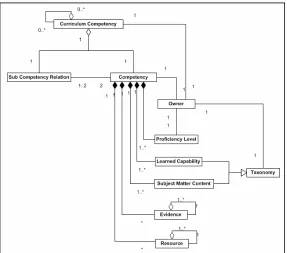
Figure 1 Competency model
The beginning of lifelong learning is education at high schools and universities [26] when each course programme states a curriculum competency which is the top level of competency. The curriculum competency comprises many lower level competencies with a relation between them called a sub competency relation. The sub competency relation represents a hierarchy of competencies. A competency is an enabling competency identifying the learned capability with each subject matter content, the proficiency level, the evidence and the resource defined. Each curriculum competency, competency, proficiency level, learned capability and subject matter content has an owner who possesses these elements. Some descriptions of those are be defined as follows.
First, the learned capability is the behaviour that can be observed in the learner based on a taxonomy of learning such as Bloom’s taxonomy [27], Gagne’s nine areas of skill [28], and Merrill’s cognitive domain [29].
Second, the subject matter content is the subject domain of what the learner can do by the end of course.
Third, proficiency may be expressed by some demonstration of appropriate behaviour in the context. The proficiency level indicates the level of proficiency that learners possess on a particular competency.
Fourth, the competency evidence is used to capture information for substantiating the existence, sufficiency, or level of a competency. The competency evidence might include test results, reports, evaluation, certificates, or licenses.
Fifth, external knowledge resources and tools are able to support and promote problem solving, activity performing or situation handling.
7 Competency model and Learning Design
In IMS Learning Design (IMS LD), prerequisites and learning objectives can be defined using an unstructured textual resource or an IMS RDCEO specification [30]. This is unhelpful for an instructional designer seeking to design learning activities, environments and assessments [31]. The cause may be that the IMS RDCEO specification emphasises the representation of competency for interoperability among learning systems instead of supporting an effective teaching and learning process. By identifying learned capabilities, proficiency levels, resources and evidences, the competency model provides the critical components impacting on the design of useful learning activities, environments, and services to help learners achieve their competencies.
Hence, IMS LD should incorporate a structured competency definition in order to implement a Unit Of Learning (UOL) with a solid instructional design foundation.
8 Competency model and service oriented architecture
The concept of competency is increasingly important since it involves the process of acquiring and updating knowledge throughout a learner’s life. Competency modelling should be the shared responsibility of governments, educational institutions, and businesses. These partners are still exploring how to perform their roles and duties in practice [32].
In order to provide cross institutional cooperation, designing, building and managing a distributed computing infrastructure and information is required. SOA is suggested as a guiding pattern for the implementation of the competency model underlying learning and teaching within lifelong learning. The service oriented approach promotes the use of loosely-coupled, reusable services, with standards-based, well-defined service specifications that enable them to be discovered and consumed by independent service consumers [33]. The competency model is compatible with the SOA that may be derived from a collaborative virtual teaching and learning environment (CVTLE) SOA [34].
9 Conclusion and Future work
We have looked at the problems with adaptive assessment systems. We have proposed a competency model to support adaptive assessment which provides a rich data structure for description, comprehensive reference, and exchange to support maintaining learner’s competency profile throughout their life; a flexible competency-based learning for meeting personal needs; a model for monitoring and recording learner’s competency; and the structuring of measurable behaviours for creating assessments. We have described some related topics involving Learning Design and Service Oriented Architecture.
The proposed competency model is being developed and implemented based on SOA in the JISC-funded Placement Learning and Assessment Toolkit (mPLAT) project (http://www.mplat.ecs.soton.ac.uk/) at the University of Southampton. This project aims to provide a mobile learning toolkit to support practice based learning, mentoring and assessment. This toolkit will provide an interface so that the course leader can specify, in a flexible manner, the learning outcomes to be met, the method of assessment, the timing of the assessment(s) and the feedback to be given in response to the results, suitable learning resources to support these learning outcomes, and the actions to be taken when assessments are not completed in a timely manner. The project will contribute to the JISC community by adding mobile assessment tools to the E-framework.
6
References
1 Kommers, P., Grabinger, S. and Dunlap, J., (1996) 'Hypermedia Learning Environments', Instructional Design and Integration.
2 Mislevy, R. J. (1996) 'Some recent developments in assessing student learning', Princeton, NJ, Educational Testing Service.
3 HR-XML Consortium (2006) Competencies (Measurable Characteristics) Recommendation. In Allen, C. (Ed.), at http://xml.coverpages.org/HR-XML-Competencies-1_0.pdf.
4 IMS RDCEO (2002) IMS Resuable Definition of Competency or Educational Objective-Best Information Model, 1.0 Final Specification. IMS Global Learning Consortium Inc, at http://www.imsglobal.org/competencies/rdceov1p0/imsrdceo_infov1p0.html.
5 Karampiperis, P., Sampson, D. and Fytros, D. (2006) 'Lifelong Competence Development: Towards a Common Metadata Model for Competencies Description - The Case Study of Europass Language Passport', Proceedings of the 6th IEEE International Conference on Advanced Learning Technologies.
Kerkrade, The Netherlands, IEEE Computer Society Press.
6 Askins, D. (2004) 'Adaptive Assessment', Toolkit - The Nuts and Bolts e-Newsletter.
7 Ostyn, C. (2005) 'Competency Data for Training Automation', White Paper - Draft 0.2. Ostyn Consulting.
8 Way, W. D. (2005) 'Practical Questions in Introducing Computerized Adaptive Testing for K-12 Assessments', Research Report 05-03.
9 Welch, R. E. and Frick, T. W. (1993) 'Computerized adaptive testing in instructional settings',
Educational Technology Research and Development, Vol. 41, No. 3, pp. 47-62.
10 Brusilovsky, P., 1996. 'Methods and Techniques of Adaptive Hypermedia', User Modeling and User-Adapted Interaction, Vol. 6, No. 2-3, pp.87-129.
11 Gouli, E., Kornilakis, H., Papanikolaou, K. and Grigoriadou, M., (2001) 'Adaptive Assessment Improving Interaction in an Educational Hypermedia System', Proceedings of the PanHellenic Conference with International Participation in Human-Computer Interaction, pp.217- 222.
12 Cheniti-Belcadhi, L. and Braham, R. (2004) 'A generic framework for assessment in adaptive educational hypermedia', Proceedings of IADIS International Conference WWW/Internet 2004 (ICWI 2004). Madrid, Spain.
13 Papanikolaou, K. A., Grigoriadou, M., Magoulas, G. D. and Kornilakis, H. (2002) 'Towards New Forms of Knowledge Communication: the Adaptive Dimension of a Web-based Learning Environment', Vol. 39, No. 4, pp. 333-360.
14 Gouli, E., Gogoulou, A., Papanikolaou, K. and Grigoriadou, M. (2004) 'COMPASS: An adaptive web-based COncept MaP ASSessment tool', First Int. Conference on Concept Mapping. Pamplona, Spain. 15 Collins, J. A., Greer, J. E. and Huang, S. X. (1996) 'Adaptive assessment of using granularity
hierarchies and Bayesien nets', Proceedings of Intelligent Tutoring Systems, pp.569-577.
16 Falmagne, J.-C., Cosyn, E., Doignon, J.-P. and Thiery, N. (2003) 'The Assessment of Knowledge, in Theory and in Practice', Integration of Knowledge Intensive Multi-Agent Systems.
17 Tzanavari, A., Retalis, S. and Pastellis, P. (2004) 'Giving More Adaptation Flexibility to Authors of Adaptive Assessments', Adaptive Hypermedia 2004 Conference Proceedings.
18 Lalos, P., Retalis, S. and Psaromiligkos, Y. (2005) 'Creating personalised quizzes both to the learner and to the access device characteristics: the Case of CosyQTI'.
19 The European Commission (2006) Lifelong learning, at
http://ec.europa.eu/education/policies/lll/life/what_islll_en.html.
20 Paquette, G., Leonard, M., Lundgren-Cayrol, K., Mihaila, S. and Gareau, D. (2006) 'Learning Design based on Graphical Knowledge-Modelling', Education Technology and Society, Vol. 9, No. 1, pp. 97-112.
21 Doignon, J.-P. and Falmagne, J.-C. (1985) 'Spaces for the Assessment of Knowledge', International Journal of Man-Machine Studies, No. 23, pp.175-196.
22 Jackson, S. E. and Schuler, R. S. (2003) Managing Human Resources through Strategic Partnerships,
Manson, OH, South-Western.
23 Friensen, N. and Anderson, T. (2004) 'Interaction for lifelong learning', British Journal of Educational Technology, Vol. 35, No. 6, pp.679-687.
24 Sandberg, R. (2000) 'Competence-the Basis for a Smart Workforce', In R. Gerber and C. Lankshear (Eds.) Training for a Smart Workforce (Ed.) London, Routledge.
25 Draganidis, F. and Mentzas, G. (2006) 'Competency based management: a review of systems and approaches', Information Management & Computer Security, Vol. 14, No. 1, pp.51-64.
26 Gonczi, A. (1994) 'Developing a competent Workforce', Adelaide:National Centre for Vocational Education Research.
27 Bloom, B. S. and Krathwohl, D. R. (1956) Taxonomy of educational objectives: The classification of educational goals by a committee of college and university examiners, New York, Longman.
29 Merrill, M. D. (1999) 'Instructional Transaction Theory (ITT): Instructional Design Based on Knowledge Objects', Instructional-Design Theories.
30 Koper, R. and Tattersall, C. (Eds.) (2005) Learning Design · A Handbook on Modelling and Delivering Networked Education and Training, Springer.
31 Paquette, G. and Rosca, I. (2004) 'An ontology-based Referencing of Actors, Operations and Resources in eLearning Systems', the 2nd International Workshop on Applications of Semantic Web Technologies for E-Learning. Eindhoven, The Netherlands.
32 Descy, P. and Tessaring, M. (2000) 'Training and learning for competence', Vocational training research in Europe.
33 Wilson, S., Blinco, K. and Rehak, D. (2004) 'Service-Oriented Frameworks: Modelling the infrastructure for the next generation of e-Learning Systems'.