Linking Cognitive Development
and
Curriculum Design
Suzanne Cavell
Dip.Biochem., MSc., Dip. Ed.
Submitted in fulfilment of the requirements for the degree of Doctor of Philosophy
University of Tasmania
Declaration
This Thesis contains no material which has been accepted for the award of any other degree or diploma in any institution and, to the best of my knowledge and belief, contains no material previously published or written by another person except where due reference is made in the text.
Authority of Access
This Thesis may be made available for loan and limited copying in accordance with the
Copyright Act 1968.
It is well documented that many school students come to science class with a variety of 'alternative conceptions' and that these remain largely untouched by teaching. This thesis describes research work that determined, analysed, and developed strategies to promote students' understanding of two physics topics. This research looked at the learning and teaching of science from both a cognitive and a curriculum perspective.
The principal aims of this research were to investigate students' understanding of 'light' and of 'sound' in terms of theoretical cognitive models, to design and implement instructional units on these topics that would facilitate the development of a scientific understanding, and to monitor changes in the levels of understanding, over the period of the investigation, in terms of the theoretical models. 'Light and seeing' was the focus of the preliminary investigation or pilot study; 'sound and hearing' was the main focus of the research.
There were two main components of this research. The first was a psychological component that utilised a theoretical framework, based on the SOLO Taxonomy of cognitive functioning, for students' developing understanding of the concept. In the study of 'light and seeing', the theoretical model of Collis, Jones, Sprod, Watson, and Fraser (1998) was used. In the study of 'sound and hearing', the theoretical model was formulated by the researcher. The second component was a curriculum component in which constructivist Teaching Units for both topics were developed, structured in such a way as to follow the pathways postulated in the theoretical models of cognitive development. It was the linking of cognitive developmental theory and curriculum design in science education that set the present research apart from the work of other researchers.
Acknowledgements
To so many people over so many years!
To Professor Kevin Collis and Dr Brian Jones, both now retired, who started me on the long road
To Dr Jane Watson who picked up the pieces, kept me on the straight and narrow, and helped me to bring this to fruition
To Professor John Williamson for his advice
To the Faculty of Science & Engineering and Dr John Humble for their support
To my colleagues at Fahan School who supported and encouraged me
To the girls of Fahan School who put up with my questionnaires, interviews, and 'constructivist' teaching
To my parents, Norman and Betty, who waited for this
Above all, to my husband, Kingsley, and my daughters, Emma, Joanna, and Katie, who must have wondered when it would end!
Chapter 1
Introduction
1.1 Why this study? 1.2
1.3 1.4 1.5 1.6
Principal aims of the research Main components of the research
Overview of the sequence for the practical component Structure of the thesis
Limitations of the investigation
Chapter 2
Review of the literature
2.1 2.2 2.3 2.4 2.5 2.6 2.7
2.8
2.9 IntroductionTheories of learning
The constructivist view of learning and teaching
2.3.1 The many faces of constructivism and their implications for learning and teaching
2.3.2 Criticisms of constructivism
Alternative conceptions of science and their implications for the science curriculum
The cognitive aspects of children's conceptions of science Students' conceptions of light and vision
Students' conceptions of sound and hearing
Other aspects of teaching pedagogy relevant to the present research Conclusion
Chapter 3
Light and seeing: a preliminary
investigation
3. ·1 Introduction 3.2
3.3
Methodology for the investigation of 'light and seeing' Eliciting student understanding
3 4 5
5
6 8 8 11 12 17 20 2328
3337
38
40 42 3.3.1 The questionnaire used to determine student understanding 423.4
3.3.2 The development map for the standard seeing framework 44 3.3.3 Assigning the level of cognitive functioning from the responses · 46
to question one of the questionnaire
3.3.4 Assigning the level of cognitive functioning from the responses 47 to question two of the questionnaire
The teaching unit
3.4.1 The orientation stage
48
3.5
3.6
3.4.2 The elicitation and restructuring stage 3.4.3 The review stage
Determining the change in level of cognitive functioning from the analysis of the responses to the questionnaire
3.5.1 Analysis of the year 9/95 responses 3.5.2 Analysis of the year 9/96 responses Conclusion
Table of Contents
51 55
56
56
66
73Chapter 4
Sound and hearing: methodology,
theoretical model, and teaching unit
4.1 4.2 4.3 4.4 4.5 4.6
4.7
4.8 IntroductionMethodology for the investigation of 'sound and hearing'
Eliciting student understanding 4.3.1 Preliminary investigations 4.3.2 Designing the questionnaire 4.3.3 The final questionnaire
Procedure for the analysis of the responses to question one of the questionnaire
75
76
77 77 81 82 864.4.1 Identifying the key elements in the responses to question one 86
4.4.2 Determining the level of cognitive functioning 87
4.4.3 Assigning a score for the number of key elements present in 88 the responses to question one
The development map for hearing
Testing the model of the development map for hearing from responses to interviews and from the responses to question one of the questionnaire 4.6.1 Interviewing year 1 and year 3 students
4.6.1.1 Year 1 students 4.6.1.2 Year 3 students
4.6.2 Re-analysis of interviews with year 4 and year 7 students 4.6.3 Year 6 responses to question one of the questionnaire 4.6.4 Year 10 and physics 1 responses to question one of the
questionnaire
Testing the model of the development map for hearing from the responses to question two of the questionnaire
Procedure for the analysis of the responses to question three of the questionnaire
92
98
98
99
101 102 104 108 109 1124.9
4.8.2 Determining the level of cognitive functioning 113
4.8.3 Assigning a score for the number of key elements present in 115 the responses to question three
Testing the model of the development map for hearing from the 119 responses to question three of the questionnaire
4.10 Comparing the overall performances of students using the combined 123 total scores for question one and question three
4.11 Design of the teaching unit 4. 11.1 The 1997 teaching unit 4.11 .2 The 1998 teaching unit 4.12 Conclusion
126 128
134
136
Chapter 5
Sound and hearing: results with the target
group
5.1 5.2 5.3 5.4 5.5 5.6 5.7 IntroductionAnalysis of the year 9/97 responses to question one
5.2.1 Comparison of the SOLO levels and of the changes in scores for key elements of individual students in the year 9/97 instruction group determined from question one
5.2.2 Comparison of the SOLO levels of the year 9/97 instruction and non-instruction groups determined from question one Analysis of the year 9/97 responses to question two
Analysis of the year 9/97 responses to question three
5.4.1 Comparison of the SOLO levels and the changes in scores for key elements of individual students in the year 9/97 instruction group determined from question three
5.4.2 Comparison of the SOLO levels of the year 9/97 instruction and non-instruction groups determined from question three Comparison of the overall performances of students in the year 9/97 instruction and non-instruction groups at each phase of the investigation using the combined total scores for question one and question three Analysis of the year 9/98 responses to question one
5.6.1 Comparison of the SOLO levels and of the changes in scores for key elements of individual students in the year 9/98 instruction group determined from question one
5.6.2 Comparison of the SOLO levels of the year 9/98 instruction and non-instruction groups determined from question one Analysis of the year 9/98 responses to question two
5.8
Table of Contents
Analysis of the year 9/98 responses to question three
5.8.1 Comparison of the SOLO levels and the changes in scores for key elements of individual students in the year 9/98 instruction group determined from question three
5.8.2 Comparison of the SOLO levels of the year 9/98 instruction and non-instruction groups determined from question three
201 201
210
5.9 Comparison of the overall performances of students in the year 9/98 218 instruction and non-instruction groups at each phase of the investigation
using the combined total scores for question one and question three
5.10 Comparison of the combined data for the year 9/97 and year 9/98 222 instruction and non-instruction groups
5.11 Determining the statistical significance of the observed outcomes for the 225 combined year 9/97 and year 9/98 instruction and non-instruction groups
5.12 Conclusion 226
Chapter 6
Discussion, researcher•s observations,
suggestions for future research, and
potential for implemetation of the findings
6.1 6.2 6.3 6.4 6.5 6.6 6.7 Introduction
Aims and objectives of the research
Researcher's observations on the usefulness of the SOLO taxonomy for this study
Light and seeing: a preliminary investigation
228 228 230
231 6.4.1 Discussion of results and comparison with the work of other 232
researchers
6.4.2 Researcher's observations Sound and hearing
234
235 6.5.1 Discussion of results and comparison with the work of other 236
researchers
6.5.2 Researcher's observations
Potential for implementation of the findings Conclusion
239
242
243
References
245Chapter 3
Table 3.1
Table 3.2
Table 3.3
Table 3.4
Table 3.5
Table 3.6
Table 3.7
Table 3.8
Table 3.9
Table 3.10
Table 3.11
Table 3.12
Highest status paired elements of the development map for seeing in the responses of individual year 9/95 students to question one at each phase of the investigation
Number (percentage) of year 9/95 students holding each of the paired elements of the development map for seeing at each phase of the investigation
Seeing conception selected in question two by individual year 9/95 students who selected conceptions other than the scientific conception at any phase of the investigation
Number (percentage) of year 9/95 students selecting a particular seeing conception in question two at each phase of the
investigation
Mean number of connections of the development map for seeing in the responses of year 9/95 students pre-, immediate post-, and delayed post-instruction
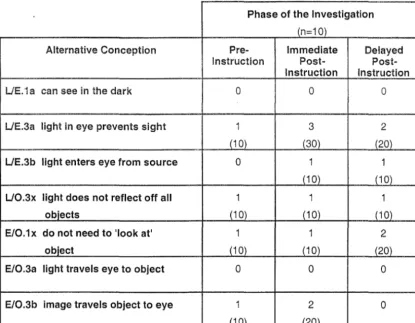
Number (percentage) of year 9/95 students holding a particular alternative conception at each phase of the investigation Highest paired elements of the development map for seeing in the responses of individual year 9/96 students to question one at each phase of the investigation
Number (percentage) of year 9/96 students holding each of the paired elements of the development map for seeing at each phase of the investigation
Seeing conception selected in question two by individual year 9/96 students who selected conceptions other than the scientific conception at any phase of the investigation
Number (percentage) of year 9/96 students selecting a particular seeing conception in question two at each phase of the
investigation
Mean number of connections of the development map for seeing in the responses of year 9/96 students pre-, immediate post-, and delayed post-instruction
Number (percentage) of year 9/96 students holding a particular alternative conception at each phase of the investigation
Chapter 4
Table 4.1 Table 4.2 Table 4.3 Table 4.4 Table 4.5 Table 4.6 Table 4.7 Table 4.8 Table 4.9 Table 4.10 Table 4.11 Table 4.12 Table 4.13 Table 4.14 Table 4.15 Table 4.16List of Tables
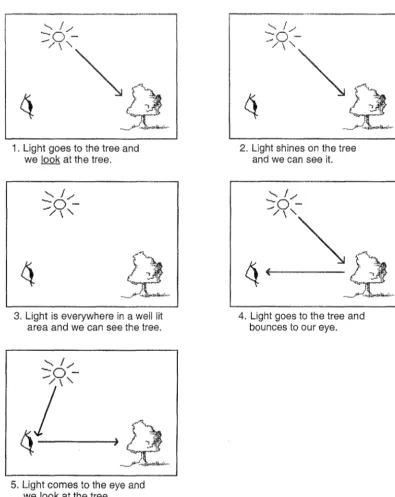
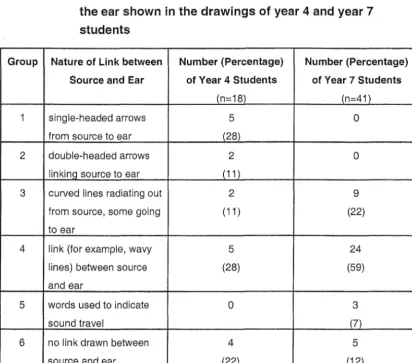
Nature of the links between the source of the sound and the ear shown in the drawings of year 4 and year 7 students
Scoring key elements in the responses to question one of the questionnaire
Selected student responses to question one with the number of key elements and SOLO level assigned
Relationship between the number of key elements and the SOLO level in the responses to question one of the questionnaire SOLO level of year 1 students determined from the drawings and from the interviews
SOLO level of year 3 students determined from the drawings and from the interviews
Number of key elements and SOLO level in the responses of year 6 students to question one of the questionnaire
Number (percentage) of year 6 students operating at each SOLO level with corresponding number of key elements determined from the responses to question one
Number (percentage) of year 10 students operating at each SOLO level with corresponding number of key elements determined from the responses to question one
Number (percentage) of physics 1 students operating at each SOLO level with corresponding number of key elements determined from the responses to question one
Number (percentage) of year 6, year 10, and physics 1 students selecting a particular option in question two of the questionnaire Scoring key elements in the responses to question three of the questionnaire
Selected student responses to question three with the number of key elements and SOLO level assigned
Number (percentage) of year 6 students operating at each SOLO level with corresponding number of key elements determined from.the responses to question three
Number (percentage) of year 10 students operating at each SOLO level with corresponding number of key elements determined from the responses to question three
Number (percentage) of physics 1 students operating at each SOLO level with corresponding number of key elements determined from the responses to question three
Table 4.17
Chapter 5
Table 5.1
Table 5.2
Table 5.3
Table 5.4
Table 5.5
Table 5.6 Table 5.7 Table 5.8 Table 5.9 Table 5.10 Table 5.11
Number (percentage) of year 6, year 10, and physics 1 students in each range of combined total score for question one and question three
Number of key elements and SOLO level in the responses of students in the year 9/97 instruction group to question one at each phase of the investigation
Comparison of the SOLO levels of individual students in the year 9/97 instruction group at each phase of the investigation
Changes in individual scores and the average change in score for students in the year 9/97 instruction group for question one, pre- to immediate post- (P/IP), immediate to delayed post- (IP/DP), and immediate to 12-month delayed post-instruction (IP/12DP) Number (percentage) of year 9/97 students in the instruction and non-instruction groups operating at a particular SOLO level in question one at each phase of the investigation Number (percentage) of year 9/97 students in the instruction and non-instruction groups selecting a particular option in question two at each phase of the investigation
Number of key elements and SOLO level in the responses of students in the year 9/97 instruction group to question three picture (i) at each phase of the investigation
Number of key elements and SOLO level in the responses of students in the year 9/97 instruction group to question three picture (ii) at each phase of the investigation
Number of key elements and SOLO level in the responses of students in the year 9/97 instruction group to question three picture (iii) at each phase of the investigation
Number of key elements and SOLO level in the responses of students in the year 9/97 instruction group to question three picture (iv) at each phase of the investigation
Number of key elements and SOLO level in the responses of students in the year 9/97 instruction group to question three picture (v) at each phase of the investigation
Number of key elements and SOLO level in the responses of students in the year 9/97 instruction group to question three
Table 5.12
Table 5.13
Table 5.14
Table 5.15
Table 5.16
Table 5.17
Table 5.18
Table 5.19
Table 5.20
Table 5.21
Table 5.22
Table 5.23
List of Tables
picture (vi) at each phase of the investigation
Changes in individual scores and the average change in score for students in the year 9/97 instruction group for question three, pre- to immediate post- (P/IP), immediate to delayed post- (IP/DP), and immediate to 12-month delayed post-instruction (IP/12DP) Number (percentage) of year 9/97 students in the instruction and non-instruction groups operating at a particular SOLO level for question three picture (i) at each phase of the investigation Number (percentage) of year 9/97 students in the instruction and non-instruction groups operating at a particular SOLO level for question three picture (ii) at each phase of the investigation Number (percentage) of year 9/97 students in the instruction and non-instruction groups operating at a particular SOLO level for question three picture (iii) at each phase of the investigation Number (percentage) of year 9/97 students in the instruction and non-instruction groups operating at a particular SOLO level for question three picture (iv) at each phase of the investigation Number (percentage) of year 9/97 students in the instruction and non-instruction groups operating at a particular SOLO level for question three picture (v) at each phase of the investigation Number (percentage) of year 9/97 students in the instruction and non-instruction groups operating at a particular SOLO level for question three picture (vi) at each phase of the investigation Number (percentage) of students in the year 9/9? instruction and non-instruction groups in each range of combined total score for question one and question three at each phase of the investigation
Number of key elements and SOLO level in the responses of students in the year 9/98 instruction group to question one at each phase of the investigation
Comparison of the SOLO levels of individual students in the year 9/98 instruction group at each phase of the investigation
Changes in individual scores and the average change in score for students in the year 9/98 instruction group for question one, pre- to immediate (P/IP), immediate to delayed post-(IP/DP), and immediate to 12-month delayed post-instruction (IP/12DP)
Number (percentage) of year 9/98 students in the instruction and non-instruction groups operating at a particular SOLO level in
Table 5.24 Table 5.25 Table 5.26 Table 5.27 Table 5.28 Table 5.29 Table 5.30 Table 5.31 Table 5.32 Table 5.33 Table 5.34 Table 5.35
question one at each phase of the investigation
Number (percentage) of year 9/98 students in the instruction and non-instruction groups selecting a particular option in question two at each phase of the investigation
Number of key elements and SOLO level in the responses of students in the year 9/98 instruction group to question three picture (i) at each phase of the investigation
Number of key elements and SOLO level in the responses of students in the year 9/98 instruction group to question three picture (ii) at each phase of the investigation
Number of key elements and SOLO level in the responses of students in the year 9/98 instruction group to question three picture (iii) at each phase of the investigation
Number of key elements and SOLO level in the responses of students in the year 9/98 instruction group to question three picture (iv) at each phase of the investigation
Number of key elements and SOLO level in the responses of students in the year 9/98 instruction group to question three picture (v) at each phase of the investigation
Number of key elements and SOLO level in the responses of students in the year 9/98 instruction group to question three picture (vi) at each phase of the investigation
Changes in individual scores and the average change in score for students in the year 9/98 instruction group for question three, pre- to immediate post- (P/IP), immediate to delayed post- (IP/DP), and immediate to 12-month delayed
post-instruction (IP/12DP)
Number (percentage) of year 9/98 students in the instruction and non-instruction groups operating at a particular SOLO level for question three picture (i) at each phase of the investigation Number (percentage) of year 9/98 students in the instruction and non-instruction groups operating at a particular SOLO level for question three picture (ii) at each phase of the investigation Number (percentage) of year 9/98 students in the instruction and non-instruction groups operating at a particular SOLO level for question three picture (iii) at each phase of the investigation Number (percentage) of year 9/98 students in the instruction and non-instruction groups operating at a particular SOLO level for question three picture (iv) at each phase of the investigation
Table 5.36
Table 5.37
Table 5.38
Table 5.39
Table 5.40
Chapter 6
Table 6.1
List of Tables
Number (percentage) of year 9/98 students in the instruction and non-instruction groups operating at a particular SOLO level for question three picture (v) at each phase of the investigation Number (percentage) of year 9/98 students in the instruction and non-instruction groups operating at a particular SOLO level for question three picture (vi) at each phase of the investigation Number (percentage) of students in the year 9/98 instruction and non-instruction groups in each range of combined total score for question one and question three at each phase of the investigation Number (percentage) of students in the combined year 9/97 and year 9/98 instruction and non-instruction groups in each range of combined total score for question one and question three at the pre-instruction and delayed post-instruction phases Values used to determine the statistical significance of the observed outcomes for the combined year 9/97 and year 9/98 instruction and non-instruction groups
Mean number of connections of the development map for seeing in the responses of year 9/95 and year 9/96 students at each phase of the investigation
216
217
219
223
226
Chapter 2
Figure 2.1 Figure 2.2 Figure 2.3 Figure 2.4
Chapter 3
Figure 3.1 Figure 3.2 Figure 3.3 Figure 3.4 Figure 3.5 Figure 3.6 Figure 3.7Chapter 4
Figure 4.1 Figure 4.2 Figure 4.3 Figure 4.4 Figure 4.5 Figure 4.6 Figure 4.7 Figure 4.8 Figure 4.9 Figure 4.10 Figure 4.11Chapter 5
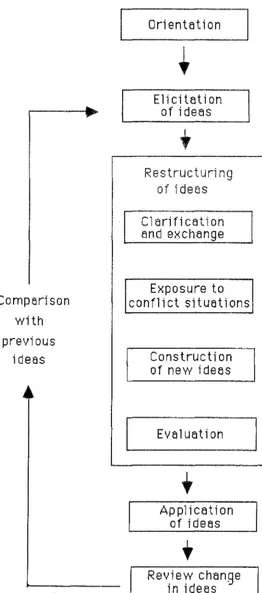
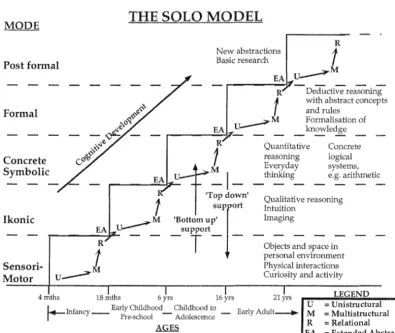
Figure 5.1A constructivist teaching sequence The SOLO model
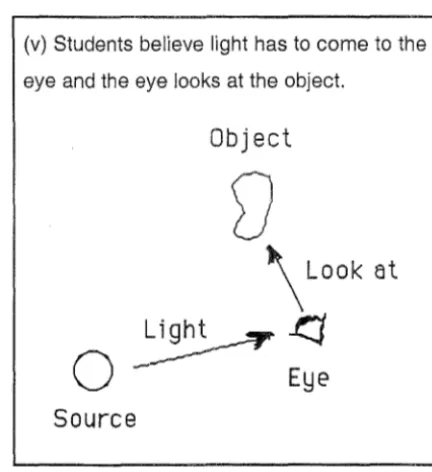
Student notions of the role of light in seeing A further student notion of the role of light in seeing
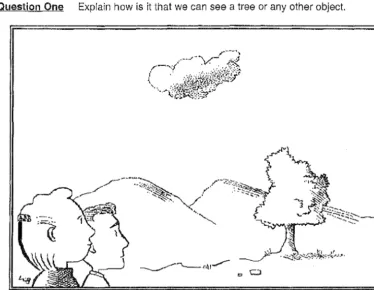
Question one of the questionnaire on 'light' Question two of the questionnaire on 'light'
Development map for the standard seeing framework Year 9/95 group (i) concept map
Year 9/95 group (ii) concept map
Year 9/95 group (i) illustration of 'seeing a book' Year 9/95 group (ii) illustration of 'seeing a book'
Question one of the questionnaire on 'sound' Question two of the questionnaire on 'sound' Question three of the questionnaire on 'sound' Development map for hearing in the ikonic mode
Development map for hearing in the concrete symbolic mode Development map for the standard hearing framework Graphs showing the percentage of year 6, year 10, and physics
1
students in each range of combined total score for question one and question threeVibration of a tuning fork A typical wave diagram
A typical high frequency wave diagram Apparatus used to determine hearing range
Figure 5,2
Figure 5,3
Figure SA
Figure 5.5
List of Figures
Graphs showing the percentage of students in the year 9/97 non-instruction group in each range of combined total score for question one and question three at each phase of the investigation
Graphs showing the percentage of students in the year 9/98 instruction group in each range of combined total score for question one and question three at each phase of the investigation
Graphs showing the percentage of students in the year 9/98 non-instruction group in each range of combined total score for question one and question three at each phase of the investigation
Graphs of combined data for year 9/97 and year 9/98 instruction and non-instruction groups showing the percentages of
students in each range of combined total score at the pre- and delayed post-instruction phases
186
220
221
Appendix 1 Description of the 'string telephone' 256
Appendix 2 The teaching unit on 'light and seeing' 257
Appendix 3 Responses of year 9/95 students to questionnaire on light 264 and seeing at each phase of the investigation
Appendix 3.1 Pre-instruction responses 264
Appendix 3.2 Immediate post-instruction responses 274
Appendix 3.3 Delayed post-instruction responses 284
Appendix 4 Responses of year 9/96 students to questionnaire on light 294 and seeing at each phase of the investigation
Appendix 4.1 Pre-instruction responses 294
Appendix 4.2 Immediate post-instruction responses 297
Appendix 4.3 Delayed post-instruction responses 301
Appendix 5 Transcript of interview with year 4 students on sound 305 and hearing
Appendix 6 Samples of year 4 drawings on sound and hearing 307
Appendix 7 Transcript of interview with year 7 students on sound 310 and hearing
Appendix 8 Samples of year 7 drawings on sound and hearing 312
Appendix 9 Responses of year 10 students to questionnaire on sound 315 and hearing
Appendix 10 Responses of physics 1 students to questionnaire on sound 333 and hearing
Appendix 11 Responses of year 6 students to questionnaire on sound 359 and hearing
Appendix 12 Transcripts of interviews with year
1
students on sound 371 and hearingAppendix 13 Drawings of year 1 students on sound and hearing 376
Appendix 14 Transcripts of interviews with year 3 students on sound 379 and hearing
Appendix 15 Drawings of year 3 students on sound and hearing 387
Appendix 16 The 1998 teaching unit on 'sound and hearing' 390
Appendix 17 Responses of year 9/97 students to questionnaire on sound 399 and hearing at each phase of the investigation
Appendix 17.1 Pre-instruction responses 399
Appendix 17.2 Immediate post-instruction responses 416
Appendix 17.3 Delayed post-instruction responses 425
List of Appendices
Appendix 18 Responses of year 9/98 students to questionnaire on sound
456
and hearing at each phase of the investigation
Appendix 18.1 Pre-instruction responses
456
Appendix 18.2 Immediate post-instruction responses
470
Appendix 18.3 Delayed post-instruction responses
476
Introduction
1.1
Why this study?
Cognitive developmental theory has long been of interest to educationalists (Demetriou, Gustafsson, Efklides, & Platsidou, 1992). The theorists attempt to specify the cognitive competence of the student at the successive phases of his/her development. The educationalists attempt to organise the curriculum such that it offers maximum benefit to the student. The ideal situation is a collaboration between the two. In the present research this collaboration is undertaken, and cognitive developmental theory is linked to curriculum design in science education. It is the linking of these two major areas of science education that sets this research apart from the work of other researchers.
This study was prompted, in the first instance, by the researcher's own observations that some of her science students had 'unusual ideas' about why things happened. These 'unusual ideas' turned out to be well documented in the 'alternative conceptions' literature (see Pfundt & Duit, 1991 ). In addition, as research was currently being undertaken at the University of Tasmania into 'alternative conceptions of vision', this seemed an ideal place to start. The Principal of the independent girls' school at which the researcher was employed as a science teacher readily agreed to allow the research to take place and for the students to be used as the subjects of the investigation. As the research was undertaken during the students' normal teaching program, parental permission was not required. Students were given the option of completing the questionnaire or not, and were told that their responses were strictly confidential and would not be used for purposes other than this research. The University Ethics Committee also gave approval for the investigation.
Despite the ideas concerning science phenomena that students hold being well documented in a number of areas, little has been done to instruct teachers in how to address these ideas and how to teach in order to facilitate learning and to promote understanding. In order to get students to construct new knowledge in the face of strongly held beliefs, it is necessary to identify teaching strategies that encourage and assist students to change their beliefs. According to Fetherstonhaugh and Treagust (1992), students may participate in instruction in an area of science, perform well in a test, yet not undergo any meaningful change in their conceptions of the particular topic. If conceptual change does take place, it may be short-lived and students may revert to earlier, more firmly held beliefs.
1 Introduction
topics. According to Dykstra, Boyle, and Monarch (1992), alternative conceptions are not addressed by standard instruction either in the physics classroom or in introductory physics textbooks. Hewson and Thorley (1989) state that, even when teaching occurs, reported research rarely provides suf'ficient evidence to gauge the status of students' conceptions following a teaching interaction. This too was the researcher's observation in a search of the current literature.
Learning is about changing an individual's conceptual knowledge (Hand & Prain, 1995); teaching is about facilitating that change. Much of the cutting-edge research in the domains of the cognitive-psychological approach to learning theory, classroom learning, and the improvement of teaching, has been based on the learning and teaching of science and mathematics (Phillips, in press). Research has identified student understandings of a broad range of science topics, although, more recently, attention has shifted to the application of constructivist teaching/learning approaches. In addition, there is growing recognition of the role of the social and cultural aspects in learning science as well as the personal constructivist aspects.
This study set out to explore students' understanding in two physics content areas with the purpose of illuminating and addressing some of the problems of learning and teaching science in schools. It is believed that if teachers are aware of what students already know and how it is they have made sense of their prior experience, then they (the teachers) may be able to make more informed decisions about how to organise their teaching in order to facilitate further learning and to promote understanding. The identification of students' alternative conceptions combined with teaching designed to confront and eliminate these in classroom settings has the potential to improve teaching and learning. It has the potential also to inform curriculum development and to help teachers guide students in the construction of the accepted 'scientific' meaning.
The teaching in the present research employed a constructivist strategy to facilitate the development of an understanding of the selected science concepts. Thinking about science from a constructivist perspective helps science educators to decide what might comprise a science curriculum (Tobin & Tippins, 1993). According to Tobin and Tippins, whatever science knowledge is constructed by students will be an interpretation of experience in terms of prior knowledge. Therefore, teachers must consider what experiences should be provided to the student in order to facilitate learning, how they can assist the student to interpret these new experiences in terms of their prior knowledge, and, finally, how they can help the student to move forward in conceptual terms.
change in which the student moves to a higher level of understanding, then understanding the dynamics of cognitive development must surely assist teachers to develop effective teaching methods. In the present research, theoretical cognitive models for the development of an understanding of the physics concepts were used to inform the design of the curriculum units, and to monitor changes in levels of understanding resulting from participation in these units. As stated at the beginning of this section, this linking of cognitive developmental theory and curriculum design had not previously been undertaken, and it is this that is the key feature of the present research.
1
p
the
The principal aims of this research were to investigate students' understanding of 'light' and of 'sound' in terms of theoretical cognitive models, to design and implement instructional units on these topics that would facilitate the development of a scientific understanding, and to monitor changes in the levels of understanding over the period of the investigation in terms of the theoretical models. 'Sound and hearing' was the main focus of the research; 'light and seeing' was the focus of the preliminary investigation or pilot study that preceded the research into 'sound and hearing'. 'Light and seeing' was a logical area in which to commence the present investigation for two reasons. Firstly, the topics 'light' and 'sound' are often taught together as there are a number of conceptual similarities that underpin their accepted scientific explanations. In addition, as mentioned in Section i. i, research into students' understanding of vision was being undertaken at that time by Collis and his co-researchers, published subsequently in Collis, Jones, Sprod, Watson, and Fraser (i998). These researchers had developed a theoretical model for the development of an understanding of vision, as well as a questionnaire to determine students' understanding, both of which were used in the preliminary investigation and which served as models for a similar study of 'sound and hearing'.
Thus the principal research questions addressed were:
• can a theoretical model be proposed for the development of an understanding of 'sound and hearing' ;
• can the theoretical model be used to inform the design of a curriculum unit that will facilitate the development of understanding of the topic; and
1 Introduction
alignment with a theoretical model, and in using a theoretical model to monitor changes in students' levels of understanding. This experience was then applied to the principal focus of the present investigation, which involved the formulation of a theoretical model for the development of an understanding of 'sound and hearing', the design of a Teaching Unit on 'sound and hearing' that closely followed the theoretical model, and the monitoring of students' developing understanding in terms of the theoretical model.
1
Main components of the research
The research consisted of two main components. The first of these was a psychological component in which, in the case of 'sound', the researcher established a theoretical model for students' development of an understanding of 'sound and hearing'. This theoretical model was based upon the Structure of Observed Learning Outcome (SOLO) Taxonomy of cognitive functioning developed by Biggs and Collis (i982; updated 1991). The responses of students to a questionnaire specifically designed by the researcher to determine their understanding of 'sound and hearing' were interpreted in terms of the theoretical model. Using this model it was possible to determine the cognitive levels at which the students were observed to be functioning. It was, therefore, also possible to observe changes in the levels of students' understanding over the course of the investigation, and as a result of their participation in the teaching module. The psychological component of the preliminary research into 'light and seeing' utilised the theoretical model and questionnaire of Collis et al (1998).
learner's prior knowledge and by his/her social setting. A constructivist teaching strategy was utilised but without losing sight of the fact that there was a body of knowledge to be learned. This is the crux of the dilemma for the science teacher, how to balance the curriculum to be taught with the concept of constructivism as a process by which students deal with content. The theoretical models together with the allied Teaching Units would be available then for practising teachers to use with their students. The theoretical models could be adapted also to other areas of the science curriculum and used both to design curriculum units and to monitor students' development of an understanding of the particular concepts.
the
ponent
The practical components of the research into 'light and seeing' and 'sound and hearing' were carried out in the following sequence. The same sequence was employed for both areas. Firstly, the prior knowledge of the target group (Year 9 students, aged 13-14 years) was determined using the questionnaire designed to elicit their understanding of the topic. Responses to the questionnaire were interpreted then in terms of the theoretical model of cognitive development. The results of this analysis were, in turn, used to devise a teaching module appropriate to the target group that took into account their prior knowledge and 'alternative conceptions'. As mentioned in Section 1.3, the teaching module was closely aligned to the theoretical model. Upon completion of the teaching sequence, the questionnaire was given again to the students in order to determine whether the teaching unit had been effective. Did the students now have a clearer understanding of the concepts taught and did they hold the accepted scientific view? In other words had cognitive development or conceptual change tal< en place? Six months later for 'light and seeing', and five and twelve months later for 'sound and hearing', the questionnaire was given again to the students in order to determine how stable their understanding was; that is, did they still hold the 'scientific notion' or had they reverted to their previously held notions? The practical component of the investigation thus consisted of the following principal phases: a pre-instruction phase, an intervention or pre-instruction phase in which the Teaching Unit was implemented, an immediate post-instruction phase, a delayed post-instruction phase, and, in the case of 'sound' only, a 12-month delayed post-instruction phase.
1.5 Structure of the thesis
1 Introduction
conceptions of science. Included in Section 2.5 is a detailed discussion of the model of cognitive functioning upon which the theoretical models used in the present research are based. Section 2.6 deals with the literature on students' conceptions of 'light', which sets the scene for the preliminary investigation into 'light and seeing'. Section 2.7 contains a review of recent research into 'sound', which leads into the major focus of the present research, namely an investigation of 'sound and hearing'. Section 2.8 discusses the nature of the research project, and some relevant aspects of teaching pedagogy not covered elsewhere in the chapter.
Chapter 3 discusses the preliminary investigation into students' conceptions of 'light and seeing'. The chapter details the two major components of the investigation, namely the psychological and the curriculum components, the methods used to analyse students' responses to the questionnaire and to determine the observed levels of cognitive functioning, the design of the Teaching Unit on 'light and seeing', and the outcomes observed with the target groups of Year 9 students, over two consecutive years.
Chapters 4 and 5 deal with the principal focus of the present research, the investigation into students' understanding of 'sound and hearing'. Chapter 4 discusses in detail the methods used in the investigation, the preliminary investigations that led to the design of the questionnaire used to elicit students' understanding of 'sound and hearing', the techniques used to analyse students' responses and to determine their levels of cognitive ·functioning, the development of the theoretical cognitive model that formed the basis of this research and its testing by application to students of a range of ages and stages of development, and the design of the Teaching Unit used in the instruction phase of the investigation.
Chapter 5 details the results obtained with the target groups of Year 9 students. Outcomes observed with the two different groups, over two consecutive years, are discussed and compared. Changes made to the Teaching Unit as a consequence of the first investigation, and implemented with the second group, are discussed also.
Chapter 6 contains a discussion of the findings of the research and includes comments, evaluations, comparisons with the work of previous researchers discussed in Chapter 2, and suggestions for future research. The potential for the application of the cognitive models and the Teaching Units by teachers desirous of improving their teaching and the understanding of their students, is discussed also.
1.6 limitations of the investigation
As the school comprised both primary and secondary students, the researcher had access to a wide range of age groups for the developmental stages of the investigation into 'sound and hearing', as well as to the target groups of Year 9 students.
The nature of the school meant that the size of the groups used in this investigation were smaller than was desirable from a statistical perspective, and the students were possibly more able and perhaps more motivated than might have been encountered at other schools. The researcher had no control over the size of the class groups, which were smaller than expected in the second year, nor over the allocation of students into the groups. However, the benefits of the ready access to the students were considered to outweigh the disadvantages of the small groups.
Chapter 2
Review of the literature
"Unless we know what children think and why they think that way, we
have little chance of making an impact with our teaching no matter how
skilfully we proceed."
(Osborne & Freyberg, 1985, p.13)
2.1
Introduction
This chapter contains a review of recent literature in the areas of interest for the present research. Since this research involves the linking of cognitive developmental theory and curriculum design in science education, it is important to examine the literature relevant to these areas and to the particular physics content areas selected for the investigation. Sections 2.2 to 2.5, inclusive, contain a review of the literature dealing with theories of learning, constructivism, alternative conceptions in science and their implications for the science curriculum, and the cognitive aspects of children's conceptions of science. The section on constructivism includes an overview of the constructivist view of learning and teaching and its relevance to science education, as well as criticisms of constructivism. Section 2.5 includes a detailed discussion of the model of cognitive functioning upon which the theoretical models used in the present research are based. Section 2.6 deals with the literature on students' conceptions of 'light' as well as referring briefly to the theoretical cognitive model for the development of an understanding of vision used in the present research. This discussion sets the scene for the preliminary investigation into 'light and seeing'. Section 2. 7 contains a review of recent research into 'sound' which leads into the major focus of this study, namely an investigation of 'sound and hearing'. Section 2.8 discusses briefly the nature of the research project and some relevant aspects of teaching pedagogy not mentioned elsewhere in the chapter, such as the technique of questioning and the use of analogies. Section 2.9 contains a brief conclusion to the chapter.
2.2 Theories of learning
Groundwater-Smith, Cusworth, and Dobbins (1998), a behaviourist approach might apply for simple tasks, but it is unlikely to be successful for complex learning.
Piaget (1959) proposes a four-stage theory of intellectual or cognitive development. He emphasises the notion that children construct their own tools for understanding and discovering the world through interaction with their environment. As novel experiences occur the child adapts by relating each new experience to familiar ones (assimilation). At times, however, the experience requires an adjustment by the child to cope with something new
(accommodation). The interplay between assimilation and accommodation, known as
equilibration, results in mental structures that are progressively more decentred.
Ausubel (1967) explores the role of the child's internal cognitive structures in learning. He suggests that as items are learnt the learner organises and stores them in larger units or
schema that allow the knowledge to be retrieved as required. New knowledge is integrated with past knowledge and the schemata expanded. Previously stored knowledge affects how the new information is interpreted. Schema theory thus attributes great importance to the learner's active involvement in the learning process.
In the last thirty years there has been a growing realisation that learning is a collaborative process (Groundwater-Smith et al., 1998). A social constructivist or socio-cultural-historical
approach to learning emphasises the importance of shared interaction, collaboration, and negotiated meanings. Vygotsky (1978) focuses on the importance of the socio-cultural dimensions and of language as important characteristics of learning. One of the major elements of Vygotsky's theory is his notion of the zone of proximal development. This he defines as the distance between the current developmental level of a child as determined by independent problem solving and the level of potential development as determined through problem solving in collaboration with adults or more capable peers. He emphasises the importance of the role played by adults in guiding learning for children. Children are constantly on the verge of acquiring new learning and a teacher's task is to place learning within the zone of proximal development.
2 Review of the literature
Vygotsky's notions of scaffolding, guided discovery, and of the importance of the interaction between the child and his/her environment to facilitate understanding, is essentially a
constructivist approach. However the degree of guidance is more pronounced than with Piaget's idea of constructivism in which there is little emphasis on direct teaching (Pressley, Harris, & Marks, 1992). There are, however, many similarities between Vygotsky's and Piaget's theories for the classroom. Both emphasise the importance of active involvement by children in learning, of peer interaction, and of situating the learning experiences in the real world of experiences for children. However, where Piaget favours unstructured experiences and self-initiated discovery, Vygotsky emphasises the need for guidance and assisted discovery to lead development.
Vygotsky (1978) also emphasises language as a major means by which cognitive development occurs. Piaget, in contrast, believes that cognitive development occurs independently of language development, and facilitates the acquisition of language.
According to Lemke (1990) learning is essentially a social process and language is an important element of this process. Learning science means learning to 'talk science'. It means learning to communicate in the language of science and to act as a member of the community of people who do so. Science teachers belong to a community of people who speak the language of science. Students, at least initially, do not. Because communication and teaching are social processes, they depend on attitudes, values, and social interests, not just on knowledge and skills.
Driver, Asoko, Leach, Mortimer, and Scott (1994) stress that the significance of social constructivism for learning is not just in terms of fostering the construction of individual meaning, but also in terms of the ways this can foster the introduction of the learner into the conventions and symbolic world of science. According to Gunstone (in press), it is social construction and its impact on the nature of learning that is crucial in discriminating constructivist classrooms from 'discovery learning' classrooms.
Lemke (1982) maintains that the effective language of the classroom is the shared language of pupils and teachers, a constantly changing hybrid of common parlance with the language teachers and pupils use in other settings (for example, in textbooks, in discussions with peers). Frequent explicit explanations that introduce new concepts and new ways of talking may initially do little more than attract the attention of the students to the words. However, Lemke believes that every moment of the discourse during which a particular thematic system is in use is rich with implicit cues to the structure of that system and its connection to other systems.
openly and freely (Lemke, 1990). Tobin (1990) emphasises the importance of the social dimensions of learning. He maintains that individuals working alone, or collaborating with peers, is a good way for learners to deal with their own prior knowledge as they learn new science concepts. Discussions with others often sort out understandings and clarify meanings.
A major research theme in instructional psychology emphasises students' self regulation of their own learning (Bereiter & Scardamalia, 1993). This notion is particularly interesting in the context of conceptual change. Research in reading (Scardamalia & Bereiter, 1984 ), writing (Scardamalia & Bereiter, 1987), and intentional learning (Bereiter & Scardamalia, 1989; Chan, Burtis, Scardamalia, & Bereiter, 1992) has shown the importance of a problem-centred approach to learning. Two contrasting approaches to understanding new concepts in unfamiliar domains have been identified: direct assimilation that involves fitting new
information directly into existing knowledge, and knowledge building that involves learners
treating new concepts as something that they need to explain (Bereiter & Scardamalia, 1993). These are similar to Piaget's notions of assimilation and accommodation discussed
earlier in this section.
Chan, Burtis, and Bereiter (1997) propose that the contrasting approaches of direct assimilation and knowledge building provide a useful framework for examining the persistence of naive or 'alternative' conceptions and the process of conceptual change. They argue that alternative conceptions tend to persist because students process new information by directly assimilating it into their existing knowledge, often based on everyday experience. Alternatively, students who use a knowledge-building approach are more likely to experience conceptual change. The role of knowledge-building in fostering learning is consistent with current notions that conceptual change involves knowledge restructuring (Chi, Slotta, & de Leeuw, 1994). Learning is no longer viewed simply as the transfer of knowledge from the teacher to the learner, but rather as the learner actively constructing knowledge on the basis of knowledge already held (Duit & Treagust, 1998).
2.3
The constructivist view of learning and teaching
2 Review of the literature
constructivism) as often the differences are only slight, a matter of philosophical debate, and will not have any bearing on this research. As much of the research in constructivism is in the field of science and mathematics, the general discussion of constructivism will include frequent references to findings in these areas.
2.3.1 The many faces of constructivism and their implications for
learning and teaching
Much of the cutting-edge research in the domains of the cognitive-psychological approach to learning theory, classroom learning, and the improvement of teaching, has been based on the learning and teaching of science and mathematics (Phillips, in press). This is reflected in the comprehensive collection of research articles on constructivism edited by Steffe and Gale (1995). There is growing recognition of the role of the social and cultural aspects in learning science as well as the personal constructivist aspects. This is illustrated in the writings of Solomon (1987), Tobin (1990), and Driver et al. (1994). Therefore, this discussion of the many faces of constructivism will include frequent references to science.
The constructivist view of learning has its roots in the long-standing epistemology of the interpretive or Verstehen tradition (Weber, 1949) that has at its centre the importance of meaning as 'constructed' by individuals in their attempt to make sense of the world. The constructions are seen as tentative models that are continually tested against experience and, if necessary, modified. This tradition is concerned with the intents, beliefs and emotions of individuals as well as their conceptualisations, and recognises the influence that prior experience has on the way phenomena are perceived and interpreted (Driver & Oldham, 1986).
A traditional view of learning puts the learner in a passive role as absorber of information; the teacher is the active transmitter and the curriculum is that which is taught or transmitted to someone else. A constructivist view of learning suggests new meanings for the concept of 'curriculum'. The curriculum no longer can be seen as a body of knowledge to be transmitted as is usually detailed in teaching syllabuses. Constructivists consider it inappropriate to prescribe conceptual learning outcomes in detail (Driver, 1989a). Instead the curriculum can be viewed as including the meanings constructed by the students, a series of learning tasks and strategies, the context in which the learning occurs, and the thinking skills used by students for conceptual development (Bell, 1991; Driver, 1989b). Rather than prescribing detailed learning outcomes, it is seen as more appropriate to describe the learning opportunities and tasks that will enhance the likelihood of conceptual change within a knowledge area.
and/or the restructuring of existing conceptions, and the acceptance of the new ideas (Osborne, 1982). A constructivist curriculum would contain more guidelines as to how to develop students' conceptions, and in what general knowledge areas, and less prescribed scientific knowledge.
Effective learning occurs when individuals construct their own knowledge and understanding through interaction with the environment. This environment includes interpersonal (social networks - families, peers, schools) and intrapersonal (the individual's existing knowledge, attitude, motivation) variables, and external conditions and experiences (Mcinerney & Mcinerney, 1994). Learning is seen as an adaptive process, one in which the learner's conceptual schemes are progressively reconstructed so that they are in keeping with an increasing range of experiences and ideas. It is seen also as an active process of 'sense making' over which the learner has some control (Driver, 1989b). This perspective differs from that of Piaget in that it emphasises the development of domain specific knowledge structures rather than the development of general logical capabilities.
Moshman (1982) considers there are three major types of constructivism. The first is
endogenous constructivism, based on Piaget's theory, that emphasises the intrapersonal
aspect and stresses the importance of child-centred discovery rather than direct teaching. The second type is exogenous constructivism that places greater emphasis on the role of external factors in learning, such as teaching through modelling and explanation. Thirdly, there is dialectical constructivism that advocates guided discovery assisted by teachers, adults, and peers. This third type is Vygotsky's notion of constructivism which also emphasises the importance of interaction between the child and his/her social environment to facilitate meaningful learning, but with less direct teaching than exogenous constructivism.
Treagust, Duit, and Fraser (1996) describe constructivism as consisting of two basic principles, one psychological and the second epistemological, and emphasise that knowledge cannot be separated from knowing. Treagust et al. maintain that these two principles, which make up von Glasersfeld's (1990) radical constructivism, include many facets of Piaget's genetic epistemology and often serve as a reference position for discussions of constructivism in education. The first principle states that students construct their own understandings from the words or visual images they receive, and, consequently, students' prior knowledge is important. The second principle states that the learner constructs explanations of experiences and of 'reality' in a personal and subjective way.
Phillips (in press) divides constructivists into two broad camps. The first consists of
psychological constructivists who regard constructivism as the construction of knowledge by
2 Review of the literature
constructivists, including Dewey, who stress the socio-political influences on the construction
of a discipline such as physics or chemistry. This second broad area of constructivism is sometimes also called social constructionism. Phillips points out that not all psychological
constructivists are psychologists - the crucial thing is that their focus is on the way in which individuals construct their own understandings.
Von Glasersfeld (1984) describes his version of psychological constructivism as radical constructivism to contrast it with constructivism built on prior knowledge. He writes that his form of constructivism is radical because "it breaks with convention and develops a theory of knowledge in which knowledge does not reflect an 'objective' ontological reality, but exclusively an ordering and organisation of a world constituted by our experience" (p. 24). That is, knowledge about the world outside is viewed as human construction. A reality outside the individual is not denied; rather it is claimed that what we know about reality is our own personal construction (Duit & Treagust, 1998).
Both social constructivism and psychological constructivism have important implications for education (Phillips, in press). As one considers the pedagogical implications of constructivism, the focus of teaching moves from proficiency at content delivery to assisting individuals in their interpretation of concepts (Dana & Davis, 1993).
Good, Wandersee, and St. Julien (1993) see constructivism as a powerful and unifying force in the practice of science education. Treagust et al. (1996) contend that the constructivist view has become the leading theoretical position in education and has become a powerful driving force in science and mathematics education. If, as stated by Tobin and Tippins (1993), the aim of teaching is "to build a classroom that maximises student learning" (p. 7), then Treagust et al. (1996) maintain that constructivism acts as a powerful theoretical referent for this aim. Tobin (1993) believes that thinking of science from a constructivist perspective helps science teachers to decide on the structure of a science curriculum.
Interestingly, Gunstone (in press) does not agree with the view of constructivism as a dominant theoretical influence. Rather he claims that science teachers have used theoretical positions from areas other than constructivism to address the problems observed in their classrooms. Gunstone maintains that, rather than being driven by theory, teachers have been merely users of it. The major concern of teachers was not what form of constructivism they adhered to but rather whether or not their students better learned the concepts of science. This difference of opinion concerning the 'theory' of constructivism appears related to one of the criticisms listed by Bell and Gilbert (1996), namely the search for the 'grand theory'. Criticisms of constructivism are discussed in Section 2.3.2.
problem) that requires students to invoke and clarify their own conceptions or frameworks. By debating their existing conceptions, students are encouraged to state their ideas clearly and concisely. Leder (1992) suggests that instructional activities should be designed to give rise to genuine problems for students. Such problems constitute opportunities for them to reflect and reorganise their current ways of thinking.
To produce conceptual change, students need not only to appreciate alternative views but also to perceive them as more intelligible, plausible, and fruitful than their present viewpoint (Posner, Strike, Hewson, & Gertzog, 1982). In addition, Claxton (1984) suggests that conceptual change requires a supportive environment where an individual's ideas are valued.
A contribution to the development of a constructivist approach to learning science has been made by Osborne and Wittrock (1985) based on the generative learning model of Wittrock (1974), initially applied to reading. This model stresses the importance of what learners bring with them to the learning situation and recognises the active construction of meaning that goes on constantly as individuals interact with their environment. A number of researchers, including Driver and Oldham (1986), Minstrel! (1989), and Scott, Asoko, and Driver (1992), have emphasised the important role that students' prior knowledge plays in learning, and that there should be a major reconsideration of the teaching of science in schools to take this into account. This is summed up by Ausubel (1968): "The most important single factor influencing learning is what the learner already knows. Ascertain this and teach him accordingly" (p. vi).
Galilli, Bendall, and Goldberg (1993) believe that if teachers do not take into account students' prior knowledge then vestiges of that knowledge may emerge later as a source of difficulty. In addition, according to Driver (1989b), the context in which science is learnt influences the learning outcomes and the ability to use knowledge appears to depend on the context in which that knowledge was acquired.
An individual's knowledge, therefore, is not considered as a set of discrete 'bits' but as a series of structures, and learning involves the development and change of such structures. A central question for educators becomes how to elucidate the processes by which such changes occur (Driver & Oldham, 1986).
2 Review of the literature