Distributing Recognition in
Computational Paralinguistics
Zixing Zhang, Eduardo Coutinho, Jun Deng, and Bj ¨orn Schuller,
Member, IEEE
Abstract—In this paper, we propose and evaluate a distributed system for multiple Computational Paralinguistics tasks in a client-server architecture. The client side deals with feature extraction, compression and bit-stream formatting, while the client-server side performs the reverse process, plus model training and classification. The proposed architecture favors large-scale data collection and continuous model updating, personal information protection, and transmission bandwidth optimization. In order to preliminar-ily investigate the feasibility and reliability of the proposed system, we focus on the trade-off between transmission bandwidth and recognition accuracy. We conduct large-scale evaluations of some key functions, namely, feature compression/decompression, model training and classification, on five common paralinguistic tasks related to emotion, intoxication, pathology, age and gender. We show that, for most tasks, with compression ratios up to 40 (bandwidth savings up to 97.5 ˙%), the recognition accuracies are very close to the baselines. Our results encourage future exploitation of the system proposed in this paper, and demonstrate that we are not far from the creation of robust distributed multi-task paralinguistic recognition systems which can be applied to a myriad of everyday life scenarios.
Index Terms—Computational Paralinguistics, Distributed Recognition System, Split Vector Quantization, Emotion.
F
1
I
NTRODUCTIONI
N recent years, computational paralinguistics has attracted the attention of speech and language pro-cessing researchers due to its prominent potential for practical applications in everyday life scenarios [1], [2]. For instance, it can support the interpretation of people’s stable and transitory states, such as their intentions, emotional and mood states, confidence and stress levels, physical condition, age, gender, person-ality traits, amongst many others. From a computer science perspective, such information is crucial for the improvement of machine mediated human-human interactions as well as human-machine interactions. An example are call centers, as it can support, for instance, the detection of negative emotional states in customers which in turn can inform the development of new strategies to ameliorate the interactions and service provided.1.1 Embedded vs. Client-Server-Based
Recogni-tion Systems
Most state-of-the-art academic research in this area focuses on statically embedded recognition [1], [2],
• Zixing Zhang, Eduardo Coutinho, Jun Deng, and Bj¨orn Schuller are with the Machine Intelligence & Signal Processing Group, Technische Universit¨at M ¨unchen, Germany.
E-mail:{zixing.zhang, e.coutinho, jun.deng, schuller}@tum.de
• Eduardo Coutinho is also with the School of Music, University of Liverpool, United Kingdom.
E-mail: [email protected]
• Bj¨orn Schuller is also with the Department of Computing, Imperial College London, United Kingdom.
E-mail: [email protected]
[3], [4]. Such systems have a good degree of flexi-bility since they can be used without Internet access and therefore applied in a wide range of practical scenarios. Nonetheless, at present, this advantage is becoming less relevant. On the one hand, because cur-rent data-driven pattern recognition systems largely benefit from processing large amounts of data for training and continuous development, which requires data transmission for the integration of data from multiple users (as well as vast storage and compu-tational resources for training). Furthermore, sophis-ticated computational paralinguistic systems may re-quire advanced computational models whose imple-mentation is not feasible in users’ devices [5]. On the other hand, because internet access is now ubiquitous on account of the advent of far-ranging coverage and high-speed wireless networks such as 3G, 4G and wireless LAN, and the breakout of mobile electronic devices like smartphones, laptops, and tablets.
clients.
Such a solution has several advantages for the future development and application of paralinguistic recognition systems in real-life scenarios. First, it can overcome one of the most important limitations for the development of robust paralinguistic recognition tasks – data scarcity. In contrast to other pattern recognition areas like automatic speech recognition, the data for computational paralinguistics is quite scarce, which constitutes a major concern in this field that needs to be addressed [1], [2], [7]. To this goal, client-server-based systems have the potential to al-low the collection of large amounts of labeled and unlabeled realistic data from thousands of users in real-life scenarios, which can be exploited for training models and enhancing their performance using ma-chine learning techniques like semi-supervised learn-ing [8], co-trainlearn-ing [7], active learnlearn-ing [9], or even advanced crowd sourcing [10]. Such data enrichment and optimization techniques are of crucial importance to continuously enhance the systems’ robustness [8], without the need of users to exchange data on the client side. Second, it can accelerate the improvement of paralinguistic recognition systems since having the data processed on the server side computer scientists can continuously develop and apply more effective techniques (e.g., Bidirectional Long Short-Term Mem-ory (BLSTM) [11] or cumulative evidence [12]) and combine various data sources to boost the systems’ performance and robustness. Moreover, user profiles can be stored in the server to support long-term analysis and improve user-specific models. Third, on the client side, the requirements of computing power, the conditions of operating systems and hardware configurations are greatly relaxed, therefore making it possible to spread the use of paralinguistic analysis to a wide range of personal mobile or fixed devices.
1.2 Network vs. Distributed Recognition Systems
Concerning the location where the feature extraction takes place, client-server architectures for computa-tional paralinguistics can be categorized into two classes: network recognition systems and distributed recognition systems [6]. The former uses conventional speech coding for the transmission of speech from a client device to a server where decoding and feature extraction are undertaken. The latter implies that the feature extraction stage is processed on the client side, but the recognition is made on the server.
One of the major advantages of adopting a network recognition approach is that it is not necessary to develop a completely new system for paralinguis-tic recognition tasks. Indeed, numerous commercial applications already implement speech coding, and so, without the need to change the applications on existing devices and networks, we can simply use preexisting recognition models on the server side
to process the encoded speech signals. Moreover, it shares all the advantages of server-based systems in terms of system maintenance, update and device requirements [6]. Nonetheless, as it will be discussed in the next section (1.3), network recognition systems posit various challenges related to privacy and trans-mission bandwidth limitations.
In distributed pattern recognition systems, instead, the feature extraction process occurs on the client side, where a representation of the speech signal with a lower dimensionality and redundancy can be obtained and optimized for transmission. Such sys-tems have been adopted in various applications, being some of the most impressive and successful ones developed in the context of speech recognition, where both theoretical (e.g., packet loss via transmission [13], feature compression techniques [14], and noise robust-ness [15]) and applied (e.g., Google search engines and Apple’s Siri [16]) research has been conducted. In other fields, distributed pattern recognition has also been applied, for instance, to the recognition of human actions through the use of wearable motion sensor networks [17], nature elements (such as trees or weeds) or faces [18].
In relation to computational paralinguistics, if dis-tributed computing can be demonstrated to be feasible and reliable, some of the current limitations prevent-ing recognition systems to be applied to large-scale realistic applications can be greatly mitigated. More importantly, this would be beneficial to a variety of areas, such as, remote medicine treatment, remote conferences or negotiations, remote education, and even advanced driver assistance systems, where par-alinguistic recognition systems have manifold appli-cations.
the aim of dealing in efficient ways with transmission bandwidth limitations and warranting users’ privacy, which are core aspects for the future application of such framework.
1.3 Privacy and Transmission Bandwidth
Limita-tions
One major concern in paralinguistic recognition is
security since the privacy of the speakers has to be guaranteed. This is particularly important in real-life contexts where personal information and sensitive data may be collected. Paralinguistic information is indeed of highly private nature as it can contain, for instance, emotional statements, information about alcohol intoxication, tiredness, etc. [21].
The transmission of raw coded speech is a common approach in client-server architectures. The speech data are normally coded by protocols like G.711, G.726, and AMR-WB [22]. However, these coding protocols target a faithful recovery of speech for better communication quality, which could lead to exposure of user personal information. As mentioned earlier, a possible alternative is to perform feature extraction directly in the client and transmit Low-Level-Descriptors (LLDs) [19], therefore preventing direct access to users’ speech. Unfortunately, previous work has shown that it is feasible to reconstruct the audio from static feature vectors like Mel frequency cepstral coefficients (MFCCs) and pitch (e.g., [23], [24]) which is why they are used for speech recognition and speaker recognition. This once more generates important privacy-related concerns.
For our system, we propose to generate and trans-mit statistical feature vectors obtained by applying functionals over LLDs for each utterance. The proce-dure of generating such feature vectors is irreversible, and therefore they avoid the reconstruction of the speech signal and permit to overcome the issue of users’ privacy violation. Because of this irreversibility, the speakers’ speech content is fully protected, which is significantly important since the speech content is widely admitted as the most important personal in-formation. Moreover, even though access to statistical features could be used to infer private information (e.g., age or gender of speakers), that would be only possible by having access to the computational mod-els stored in the server (something that is extremely unlikely). Additionally, in the context of state-of-the-art computational paralinguistic research, statistical features are nowadays a well-accepted standard for extracting relevant information from speech (e.g., [1], [2], [25]).
Another major concern of network-based systems with relevance to our work istransmission bandwidth. Let us consider as an example the official databases of the INTERSPEECH 2009–2012 Challenges [26], [4], [27], [28], which will be used in this paper to evaluate
TABLE 1
Turn duration (average, minimum, maximum, and standard deviation) and required transmission bandwidth for three transmission strategies –raw
coded speech,LLDs, andstatistical feature set – and all corpora used in this paper (AEC, ALC, NCSC and Agen; a detailed description of the databases and
respective acronyms is given in Section 4.1).
uttr. length (s) bandwidth (kb/s) Corpus1 avg min max std raw LLDs stat
AEC 1.7 0.1 24.5 0.8 16∼40 51.2 7.3 ALC 11.4 1.5 61.8 14.2 16∼40 188.8 12.3 NCSC 3.1 0.9 21.2 1.8 16∼40 204.8 62.4 Agen 2.6 0.3 11.3 1.2 16∼40 92.8 5.5
our framework. We calculated the bandwidth neces-sary for each of the coding strategies mentioned above (raw coded speech, LLDs, and statistical features) for various turn durations (the ITU-G.726 protocol was considered for coding raw speech, and single precision floating point – 32 bit – was used for LLDs and statistical feature sets). In the case of statisti-cal features, given that the vector dimensionality is always the same per turn (and so the transmission bandwidth will vary as a function of turn duration), the bandwidth size was calculated for the average turn duration in each data set. As it can be observed from Table 1, with the exception of the pathology task, the statistical feature set requires less bandwidth than the remaining coding strategies.
Signal Preprocessing
LLD Extraction Chunking H. Functional
Extraction
Feature Select. / Gen.
Task Selection
Feature Compression
(SVQ)
Framing, Bit-Stream Formatting, Error Protection,
Secure coding Feature Extraction
Bit-Stream /secure Decoding, Error Mitigation
Feature
Decompre-ssion (SVQ)
Recognizer Language
Model Acoustic
Model Model Learning
Fusion Encoding
Parameter Selection Model
Selection
Client Front-End
Server Back-End
Transmission Channel
Feedback to Client Input
Speech Signal
VAD
Other information
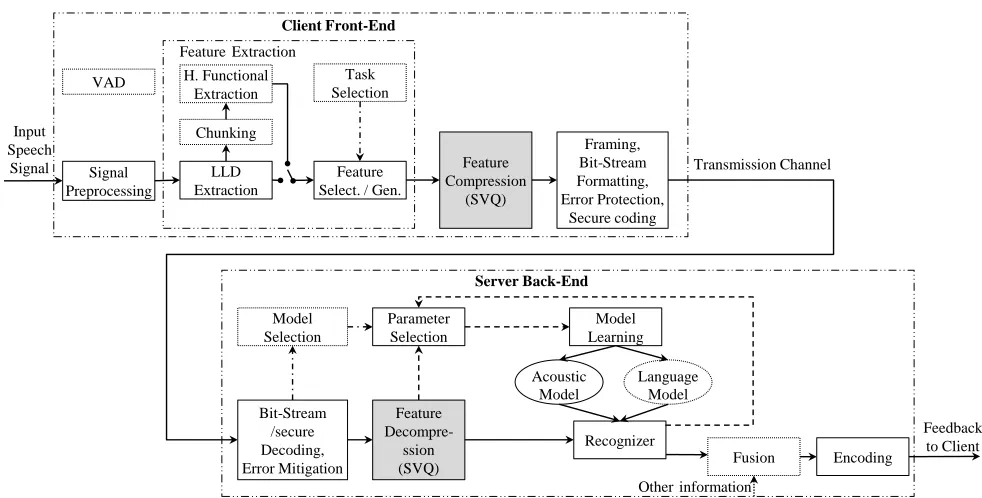
Fig. 1. Proposed framework for distributed paralinguistic recognition system. Dotted boxes indicate optional components. Dashed lines show steps carried out only during system training or adaptation phases. Dash dottedlines indicate steps carried out when multiple recognition tasks need to be processed at the same time or separately.
the various paralinguistic tasks used in this work (cf. Section 4.2). There are two main reasons for this. First, we intend to focus only on the essential components of the distributed system. Feature selection techniques can easily be integrated into the system as a ‘plug-in’ [32]. Second, in order to directly and fairly compare the performance of the distributed system with the baseline performances of embedded systems the same features sets should be used.
Feature compression generally refers to methods that transform a high dimensional feature space into a lower dimensional one. Typical dimensionality reduc-tion methods include Principle Component Analysis (PCA) [35] and Linear Discriminant Analysis (LDA) [36], and have been implemented, for instance, in dis-tributed face recognition [37], speaker identification [38], and speech recognition [39]. Another family of methods for (lossy) compression is Vector Quantiza-tion (VQ) [40], which has been very popular in a variety of research fields such as speech coding [41], image and video compression [42], and various pat-tern recognition applications (e.g., face detection [43], texture classification [44]). There are many variations of VQ proposed in the literature, such as, distance-based VQ [45], histogram-distance-based quantization (HQ) [46], lattice VQ, and address VQ [47]. Concerning the work presented in this paper, we opted for a particular VQ compression algorithm known as split vector quantization (SVQ) [48]. The main reasons for choosing SVQ are: i) the assignment of prototype
numbers from a codebook eliminates any direct fea-ture information from the user, thus ensuring privacy [19]; ii) SVQ is the officially recommended method by the ETSI standards [19] for distributed speech recog-nition; and iii) it is a well established and efficient compression technique [47], [40], [41].
The remainder of this paper is organized as follows. Section 2 describes a unified distributed recognition system for paralinguistic tasks. In Section 3 we de-scribe the SVQ feature compression method, and in Section 4 we introduce the four corpora covering short-term, medium-term, and long-term paralinguis-tic tasks for classification used in this paper. In Sec-tion 5 we evaluate the impact of feature independence for SVQ on the proposed system, and present the results for a large-scale experiment on five paralin-guistic tasks. Finally, in Section 6, we deliver our conclusions and discuss the strengths, limitations, and implications of the work presented in this paper.
2
O
VERVIEW OF THED
ISTRIBUTEDR
ECOG-NITION
S
YSTEM FORP
ARALINGUISTICT
ASKSFig. 1 illustrates the framework of the distributed paralinguistic recognition system proposed in this paper. It consists of two main modules: client and server.
2.1 Client Module
[image:4.567.34.525.50.299.2]in-formation as possible about the speech signals while using the less transmission bandwidth possible, and dealing with transmission distortion.
First, a Voice Activity Detection (VAD) algorithm is used for detecting speech signals and dropping the non-speech frames. If speech is detected, the sig-nals are then delivered to the following processing components. Given that the incoming speech signals are always distorted by various noise sources, such as additive noise of multiple speakers, environmental and recording noise, as well as convolutional noise like reverberation, the goal of the speech preprocess-ing stage (“Signal Processpreprocess-ing” block) is to enhance the incoming speech signals and filtering out unde-sired signals. Common techniques to deal with these problems include adaptive filters [49], spectral nor-malization and subtraction [50], Non-negative Matrix Factorization (NMF) [49], and beamforming [51].
Following the “Signal Processing” stage, the de-noised and enhanced signals are sent to the feature extraction module. Considering the advantages high-lighted in Section 1.3 regarding privacy and band-width requirements, we propose the encoding of the speech signals using statistical features computed on LLDs rather than raw coded speech or simply LLDs. LLDs were computed at approximately 100 frames per second with typical window sizes of 10–30 ms. The windowing functions used for extraction of LLDs in the time or time-frequency domain are typically smooth (Hamming or Hann) or rectangular [2]. Then, the LLD sequence is divided (chunked) into ‘super-segmental’ turns, and functionals over LLDs are ap-plied to each turn (“Chuncking” block). The turns can be a fixed number of frames, syllables, words, acoustic chunks, sub-turns, or complete turns [52]. In our framework, the selection of turns depends on the requirements of the specific recognition tasks (e.g., the emotion-related information often involves transient speech, while the gender information can cover the whole speech track). For the experimental work pre-sented in this paper, we recur to the LLD set used in the INTERSPEECH 2009–2012 Challenges [26], [4], [27], [28], whose dimensionality per frame ranges from 16×2 to 60×2 (the exact number of features depends on the recognition task) if the derivatives are also adopted. By applying functionals to each trunk, the final transmission bandwidth requirements lies between5.5kb/sand 62.4kb/s(cf. Table 1).
As discussed earlier, in order to further reduce the required transmission bandwidth a feature compres-sion stage is useful (a detailed description will be provided in Subsection 3). Following feature compres-sion, and before the compressed features enter into the physical transmission channel, framing, bit-stream formatting, error protection, and secure coding algo-rithms are necessary in order to meet the transmission requirements (e.g., IP routing, clock recovery), prevent channel distortion (e.g., channel noise, packet loss),
and guarantee information security.
Given the need of dealing with various tasks simul-taneously, and the fact that information required for a specific task may also be relevant to other tasks, task selection algorithms are definitely important. A common way is to allow the client to perform task selection which in turn would determine the feature set chosen on the client side and the model selected on the server side. If no specific tasks are prede-fined, however, Computational Auditory Scene Anal-ysis (CASA) could be used to automatically analyze the circumstances of speech recording (e.g., driving, cocktail party, home, street) and determine the pos-sible tasks [53]. It is nevertheless out of the scope of this paper to introduce automatic task selection.
2.2 Server Module
Turning now to the server module, we start by in-cluding bit-stream and secure decoding as well as error mitigation in order to recover the transmitted signal and convert it back to the compressed feature set. Then, the feature set is decompressed into its corresponding higher dimensional set (“Feature De-compression (SVQ)” stage) by using the codebook generated by the server (the codebook allows the translation from the compressed feature space to the original one, and vice-versa). Next, the decompressed feature set is delivered to the recognizer for classifica-tion, which in turn outputs discrete labels which are associated with the particular recognition task (e.g., positive/negative arousal) or regression values when the output is a continuous quantity (e.g., speaker’s height or age). The classification/regression results from the acoustic and language models can also be integrated with other information such as facial expressions, motion patterns, among others. Finally, the relevant feedback information is encoded and transmitted to the client through the network.
3
F
EATURE(D
E)C
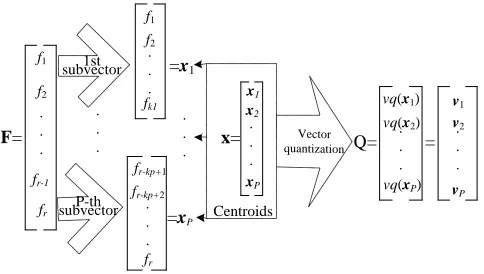
OMPRESSIONSVQ algorithms split the high dimensional feature vectors into several subvectors which automatically group the original feature set through some sort of clustering algorithm (e.g., k-means). Each subvector is then represented by the centroid of each group.
F=
f2
. . . f1 1st
subvector
P-th subvector
. . .
=x1
f2 . . . f1
fk1
=xP
fr-kp+2
. . .
fr-kp+1
fr
. . .
Vector
quantization =
vP v1 v.2
. . vq(x.2)
. .
Q= x= ..
.
Centroids
vq(xP)
vq(x1)
xP x2 x1
fr-1
[image:6.567.36.278.141.278.2]fr
Fig. 2. Diagram of Split Vector Quantization (SVQ) algorithm.
Fig. 2 shows a diagram depicting the SVQ algorithm. The encoding scheme firstly partitions the whole r-dimensional feature vector F = [f1, f2, . . . , fr]T into P subvectors, X = [x1,x2, . . . ,xP]T, each of which has k dimensions. Thus, r is equal to the sum of dimensions of each subvector,r=k1+k2+. . .+kP. In the particular case of having the same number of dimensions in each subvector, then r = k×P. Following, each subvector is quantized using a different VQ codebook, Q = vq(X) = [vq(x1), vq(x2), . . . , vq(xP)]T = [v1,v2, . . . ,vP]T, where vi ∈ Ci. Note that the codebook (Ci) pertaining to a particular subvector can be different from that of other codebooks, not only in the clustering space but also in size.
In our implementation, we used a k-means algo-rithm for clustering. That is, each observation belongs to the closest quantization centroid which is found by using a weighted Euclidean distance to determine the index:
dji =xi−vij, i= 1, . . . , P;j= 1, . . . , Ni, (1)
idxi= arg min 1≤j≤(Ni)
(dji)Wi(d j
i), (2)
where vji is the j-th codevector in the codebook Ci, dji denotes the Euclidean distance between subvector
xi and codevectorvij,Ni is the size of the codebook, Wi is the weight matrix, e.g., identity matrix, to be applied to the codebookCi, and theidxi denotes the codevector index chosen to represent the vectorxi.
The final set of quantized vectors,
[idx1, idx2, . . . , idxP]T, is used to represent the
TABLE 2
Overview of selected corpora for emotion (AEC), intoxication (ALC), pathology (NCSC), age and gender
(Agen) recognition tasks. Languages (LA): German (DE) and Dutch (NL); speech types (TY): spontaneous
(S) and promoted (P); number of subjects (S) and instances (INST); total speech time (TT) and average
speech time per chunk (TC); recording rate (Hz).
Corpus LA TY S # TT[H] TC[s] INST # Hz
AEC DE S 51 8.9 1.7 18 216 16k
ALC DE P 162 43.8 11.4 12 360 16k
NCSC NL P 55 2.0 3.1 2 386 16k
Agen1 DE P 770 35.9 2.6 53 074 8k
corresponding speech chunk, and is transmitted to the server back-end. On the server back-end, the SVQ process is reversed by using the same codebook used in the front-end for each subvector:
ˆ
xi =vidxi i, (3)
wherexˆi denotes the estimate ofxi. Then, we unify all estimated subsets of features into a single vector,
ˆ
F = [ ˆx1,xˆ2, . . . ,xˆP]T.
Finally, it is important to mention that there are var-ious aspects that need to be taken into consideration when using SVQ as they can impact the performance of the various recognition task. Those will be dealt with in Subsections 5.1 and 5.2.
4
D
ATABASES ANDA
COUSTICF
EATURES4.1 Databases
In this paper we recur to four frequently used par-alinguistic databases to test our system: the FAU Aibo Emotion Corpus, the Alcohol Language Corpus, the NKI CCRT Speech Corpus, and the Agender database. The tasks associated with the four corpora cover a variety of time-relations of paralinguistic groups from the short-term (emotion), medium-term (intoxi-cation and pathology), and long-term (age and gen-der) phenomena. Further details on the four corpora are shown in Table 2. Table 3 shows the speaker-independent partition of instances. In what follows we briefly describe each of the four databases.
4.1.1 Emotion: FAU Aibo Emotion Corpus
The FAU Aibo Emotion Corpus (AEC) [25] is the offi-cial corpus of the INTERSPEECH 2009 Emotion Chal-lenge (EC) [26]. This corpus contains audio record-ings of German-speaking children interacting with Sony’s pet robot Aibo [25]. For the construction of this database, children were led to believe that the Aibo was responding to their commands by produc-ing a series of fixed and predetermined behaviors. Nevertheless, the Aibo robot did sometimes disobey
TABLE 3
Instances distribution per partition (Train, Develop or Test) for four paralinguistic corpora – AEC, ALC, NCSC, and Agender. NEG: negative; IDL: idle; (N)AL: (non-)intoxicated; (N)I: (non-)intelligible; C/Y/A/S: children/young/adult/senior; X/M/F: children/male/female. No development set is defined on the AEC.
AEC ALC NCSC Agender: Age Agender: Gender
NEG IDL NAL AL I NI C Y A S X M F
Train 3 358 6 601 3 750 1 650 384 517 4 406 8 657 8 990 10 473 4 406 13 985 14 135 Develop 2 790 1 170 341 405 2 396 4 892 5 873 7 387 2 396 8 508 9 644 Test 2 465 5 792 1 620 1 380 475 264
Σ 5 823 12 393 8 160 4 200 1 200 1 186 6 802 13 549 14 863 17 860 6 802 22 493 23 779
to the children’s commands, which provoked various types of emotional reactions. The recordings include speech samples from 51 children (30 females) with ages ranging from 10 to 13 years from two differ-ent German schools, MONT and OHM. The various recordings were labeled using two cover classes: one consisting ofNEGative emotion labels (angry,touchy,
reprimanding,emphatic), and the other (IDLe) consist-ing of non-negative states (for more information about the database development and data processing please refer to [26]).
4.1.2 Intoxication: Alcohol Language Corpus
The Alcohol Language Corpus (ALC) [54] is the of-ficial corpus of the Intoxication Sub-Challenge from the Speaker State Challenge (SSC) at INTERSPEECH 2011 [27]. The database includes speech recordings of various people with ages ranging from 21 to 75 years old, either sober or with blood alcohol concentrations (BACs) ranging from 0.28 to 1.75 per mill. Three different speech recording conditions were conducted: read speech, spontaneous speech, and command & control. For our experiments, the recordings from speakers with BAC≤0.5 per mill were labeled as non-alcoholized (NAL). All other instances were labeled as alcoholized (AL).
4.1.3 Pathology: NKI CCRT Speech Corpus
The “NKI CCRT Speech Corpus” (NCSC) [55] is the official corpus of the Pathology Sub-Challenge of the INTERSPEECH 2012 Speaker Trait Challenge (STC) [28]. The database was created at the Department of Head and Neck Oncology and Surgery of the Netherlands Cancer Institute and consists of speech recordings from 55 speakers (10 female; mean age of 57 y.o.) before and after chemo-radiation treatments (CCRT). All speakers read a text in the Dutch lan-guage with an emotionally neutral content. Thirteen speech pathologists evaluated the speech recordings in an online experiment on an intelligibility scale ranging from 1 to 7. Finally, an evaluator weighted estimator (EWE) was used to compute and discretize the ratings into binary classes – intelligible (I) and non-intelligible (NI) – using the median of the ratings distribution.
TABLE 4
Features used for five paralinguistic tasks. (Int.: intoxication)
# Features Emotion Int. Pathology Age/Gender
LLDs 16 59 64 29
Functionals 12 39 61 8 Total 384 4 368 6 125 450
4.1.4 Age and Gender: Agender
The Agender database [56] is the official corpus of the INTERSPEECH 2010 Paralinguistic Challenge (PC) Age and Gender Sub-Challenges [4]. This database was collected by a commercial company with the aim of identifying people of specific targeted ages and genders. The participants were asked six times to call an automated Interactive Voice Response system and to repeat various German utterances or to produce free speech content. The calls were made through a mobile phone in various recording environments, and in different days and times so as to ensure more variation in the voices of each speaker. In the Challenge task, four classification classes were used for age –Children, Young, Adult, and Senior – and three for gender – Children (X), Male, and Female. Additionally, here we also consider seven new classes which are generated by combining the various age and gender classes. Hereinafter, we will refer to this classification task as “Age+Gender” (for more details please refer to [4]).
4.2 Acoustic Features
As introduced in Section 2, the feature set was com-puted by applying functionals over LLDs per trunk and corresponding first and/or second order delta regression coefficients. For our experiments, we use the same feature sets used in the INTERSPEECH Challenge 2009–2012 for emotion, intoxication, pathol-ogy, age and gender tasks. All features were extracted using the openSMILE toolkit [57]. Table 4 gives a detailed overview of the features used.
as cepstral coefficients (MFCCs, etc.), line prediction cepstral coefficients (LPCCs), and line spectral pairs (LSPs); voice-related features, like perturbation (jitter, shimmer, etc.), harmonicity (harmonics-to-noise ratio (HNR), noise-to-harmonics ratio (NHR), etc.), funda-mental frequency (F0), and probability of voicing; and linguistic features, e.g., length of words, fragments, repetitions. In relation to the functionals used, they include extreme values and position (maximum, min-imum, etc.), mean (arithmetic, quadratic, etc.), mo-ments (standard deviation, variance, skewness, kurto-sis, etc.), percentiles and percentiles range, regression (linear and quadratic approximation, etc.), centroid, peaks (number, distance, etc.), segments (number, du-ration, etc.), spectral (Discrete Cosine Transformation coefficients, etc.) and temporal (durations, positions, etc.) parameters. For full details on the feature sets please refer to [26], [4], [27], and [28].
5
E
XPERIMENTS ANDR
ESULTSIn our classification experiments, we adopt linear SVMs trained with the Sequential Minimal Optimiza-tion (SMO) algorithm as implemented in the Weka toolkit [58], in line with the INTERSPEECH 2009– 2012 EC [26], PC [4], SSC [27], and STC [28] chal-lenges. Furthermore, we follow the classifier set-ups for the five Sub-Challenges. The complexity constants were optimized on the development set or through cross-validation of the training set (depending on the task). The resulting values were 0.05, 0.01, 0.001, 0.05, and 0.05 for emotion, intoxication, pathology, age, and gender tasks, respectively. Furthermore, as in the challenge, to alleviate the influence of instance im-balance, we implemented instance upsampling before any learning process, which produces a random sub-sample of the dataset belonging to sparse categories with-/out replacement.
In relation to the classification performance evalua-tion, we recur to the unweighted average recall (UAR; the sum of the recalls per class divided by the number of classes), which is the performance measure used in the 2009–2012 INTERSPEECH Challenges. In our ex-periments on ALC and NCSC tasks, the training and development sets are combined for training, and the test sets are used for testing. For the AEC task, given that there is no development set, only the training set is used for training (and the test set for testing). In relation to the Agender task, the development set is used for testing given that there is no test set. The UAR baselines for the binary classification on the emotion, intoxication, and pathology classification tasks are 67.6 %, 66.0 %, 69.0 %, respectively. The base-line for the three-class gender classification is 76.0 %, and the baseline for the four-class age classification is 45.7 %. It should be pointed out that the baselines ob-tained in this paper are different from those reported in the 2009–2012 INTERSPEECH due to the use of a different Weka version.
For the sake of simplicity, in each paralinguistic task we split the whole feature vector (r dimensions) into multiple subvectors with the same dimensionality k (note that the last subvector dimensionality may be smaller thankand equal tormodk). We also adopted the same codebook size N (N = 2L, where L is codevector length) for all subvectors. In this case, the transmission bandwidthBw for such compressed features is
Bw= (d r
ke ·L)/T. (4)
Hence, its corresponding feature compression rate R for a transmission bandwidth requirement Bw/o (no feature compression) is calculated by the equation
R= Bw/o
Bw
= (32·r)/T (dr
ke ·L)/T
∼
= 32· k
L, (5)
whereLis the length of codevector, T is the average length of a chunk, and assuming a single-precision floating point for the transmission of uncompressed data (32 bits). Obviously, the feature compression rate R is in direct proportion to the subvector dimension kand in inverse proportion to the codevector length L.
5.1 Influence of Attributes Independence
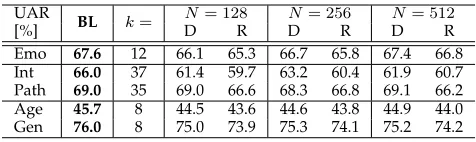
As discussed in Section 3, a central issue of SVQ is the splitting of the whole feature set into multiple subvectors in an effective way. The most important factor is arguably the cross correlation of attributes in the feature domain. A simple method to deal with this issue is to adopt a splitting strategy based on the types of LLDs, that is, the statistical features belonging to the same LLD are grouped into one subvector. In order to test this method, we compared the performance of this strategy with the performance achieved using a random clustering of the features on the five paralinguistic tasks. The dimensionality of all subvectors was set to the same value in each task – k= 12,37,35,8,8for emotion, intoxication, pathology, age, and gender recognition, respectively. Given that the number of functionals over each LLD within each task may be different, we defined the dimensionality of the subvectors for each task as the maximum number of functionals over all LLDs. Table 5 shows the results obtained for the various tasks.
As it can be seen in Table 5, the performance achieved through LLD-based vector splitting strategy is always better than the strategy that used a random splitting strategy. This improvement is evident for all codebook sizes and across all tasks, and lies in the range of 1 ∼ 3 % (absolute UAR). Results also show that the improvement delivered by the LLD-based splitting strategy over the random one is more noticeable for the tasks with larger features spaces, i.e., Intoxication (absolute average improvement of
TABLE 5
Performance comparison for five paralinguistic tasks using two types of vector splitting strategies: LLD-based (D) and random (R). BL: baseline;k: dimension of subvector;N: codebook size for each subvector.Emotion,Intoxication,Pathology,Gender.
UAR
BL k= N= 128 N= 256 N= 512
[%] D R D R D R
Emo 67.6 12 66.1 65.3 66.7 65.8 67.4 66.8 Int 66.0 37 61.4 59.7 63.2 60.4 61.9 60.7 Path 69.0 35 69.0 66.6 68.3 66.8 69.1 66.2 Age 45.7 8 44.5 43.6 44.6 43.8 44.9 44.0 Gen 76.0 8 75.0 73.9 75.3 74.1 75.2 74.2
of 2.3 %). The absolute average improvement on the Emotion, Age and Gender tasks is less pronounced:
0.8 %,0.8 %and 1.1 %, respectively.
5.2 Distributed Paralinguistic Tasks
Classifica-tion
In the context of distributed speech recognition, the feature set typically comprises 14 features, and ad-jacent features are grouped into pairs [19]. This is quite different from distributed paralinguistic tasks, where the feature spaces are much larger (cf. Table 4). Therefore, grouping features into pairs would lead to a very large number of subvectors and low compres-sion rates, which is not ideal given the bandwidth limitations. In order to investigate the influence of the dimensionality of the subvectors as well as the codebook sizes and their impact on the recognition performance, we considered several permutations of these two parameters for each task. Given the results presented in the previous section, we adopted a LLD-based splitting strategy, and so, each subvector is quantized using the same codevector length and their own codebook.
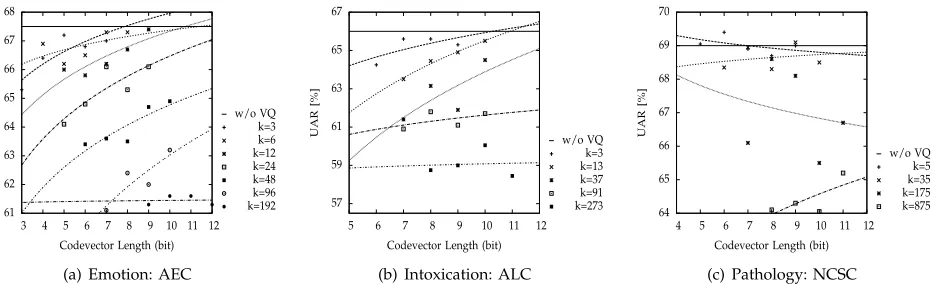
Fig. 3 and 4 depict the classifier performance for the short-, medium-, and long-term recognition tasks for various codevector lengths (the length of each codevector is L = log2N, where N is the codebook
size) and subvector sizes (k; increasing values of k indicate higher compressions rates). The horizontal lines in each figure indicate the baseline performance for each task. As expected, for increasing codevector lengths (i.e., smaller quantization error) and lower subvector dimensionalities (i.e., lower compression rates) the recognition performance is improved for all tasks, except some cases of the “Pathology” task (k = 5 and k = 175; discussed below). Taking the “Emotion” task as a representative example (see Fig. 3(a)), we can observe that for k = 24 the UAR varies between (approximately) 62.6 % (L = 3) to 67.0 % (L = 12), a value very close to the baseline (67.6 %). If we increase the subvector dimensionality (e.g, k= 48), the performance varies between 61.0 % (L = 3) to (approximately) 65.3 % (L = 12), which
is further away from the baseline. Naturally, with a higher value of k a smaller bandwidth is required. In the example given, for a codevector of length 12, the bandwidth would be (384/24)∗12/1.7 ≈ 113b/s (k = 24) and (384/48)∗12/1.7 ≈ 57b/s (k = 48). Compared to the no compression case the bandwidth reduction would be of 98.4 % and 99.2 %, respectively. As mentioned above, the Pathology task does not follow the same pattern and shows a more complex relationship between the code vector length and sub-vector dimensionality. As it can be seen in Fig. 3(c) for different values of k the performance either de-creases (k = 5 and k = 175) or increases (k = 35
and k = 875) for increasing code vector lengths. In our view, this phenomenon might be caused by data scarcity. As it can be observed in Table 3, there are only 2 386 instances in total for this task, which is potentially an insufficient number of instances to train a robust SVQ model and/or recognizer. This seems to be corroborated by the results of the “Agender” task, where we have 53 074 instances, and the stability and reliability of the system is much higher (and also the fact that age and gender recognition tasks have a more solid ground truth). Despite this unexpected result, and as it will be shown in the next section, the relationship between recognition performance, feature compression rate, and bandwidth follows a pattern that is similar to that of other tasks (see Figs. 5 and 6). Finally, it is also noticeable that in this task com-pressing the feature set to a certain degree increased the performance of the model over the baseline – in the case of k = 5/L = 6 the UAR is 69.4 %, and in the case of k = 35/L = 9 the UAR is 69.1 %. This may indicate that, to a certain degree (both values are actually not significantly higher than the baseline), the compression process attributed more weight to relevant features and reduced the impact of less relevant ones.
5.2.1 Performance, Feature Compression Rate, and Bandwidth
61 62 63 64 65 66 67 68
3 4 5 6 7 8 9 10 11 12
UAR
[%]
Codevector Length (bit)
w/o VQ k=3 k=6 k=12 k=24 k=48 k=96 k=192
(a) Emotion: AEC
57 59 61 63 65 67
5 6 7 8 9 10 11 12
UAR
[%]
Codevector Length (bit)
w/o VQ k=3 k=13 k=37 k=91 k=273
(b) Intoxication: ALC
64 65 66 67 68 69 70
4 5 6 7 8 9 10 11 12
UAR
[%]
Codevector Length (bit)
w/o VQ k=5 k=35 k=175 k=875
[image:10.567.57.524.55.199.2](c) Pathology: NCSC
Fig. 3. Performance for distributedshort-term(emotion, AEC) andmedium-term(intoxication, ALC;pathology, NCSC) paralinguistic tasks.k: subvector size.
38 40 42 44 46
3 4 5 6 7 8 9 10 11 12
UAR
[%]
Codevector Length (bit)
(a) Age: Agender
66 68 70 72 74 76
3 4 5 6 7 8 9 10 11 12
UAR
[%]
Codevector Length (bit)
(b) Gender: Agender
35 37 39 41 43 45
3 4 5 6 7 8 9 10 11 12
UAR
[%]
Codevector Length (bit)
(c) Age+Gender: Agender
[image:10.567.55.518.244.420.2] [image:10.567.299.507.466.635.2]w/o VQ k = 3 k = 8 k = 15 k = 30 k = 75 k = 150
Fig. 4. Performance for distributedlong-termparalinguistic tasks:age,gender, andage+gender.k: subvector size.
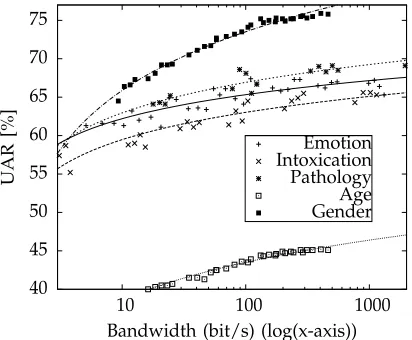
Given that a crucial aspect of a distributed recog-nition system is the trade-off between recogrecog-nition ac-curacy and bandwidth limitations, in Fig. 6 we show the relationship between recognition performance and required transmission bandwidth for all five tasks (the transmission bandwidth is calculated by Eq. 4). This figure can be used to obtain an estimation of the recognition task accuracy for a particular transmission bandwidth, and vice versa. As expected, the perfor-mance decreases for lower transmission bandwidth rates, and is particularly degraded for rates below 100 bit/s. For instance, considering the “Gender” classification task, if a transmission bandwidth of 10 bit/s is available the recognition accuracy would be of about 65.0 %. If a better performance is required, for instance 75.0 %, then a transmission bandwidth of more than 100 bit/s would be necessary.
6
C
ONCLUSION ANDO
UTLOOKIn this paper, we introduced a general distributed architecture for paralinguistic speech signal process-ing. We have described the various components of the proposed system, and focused on creating the
40 45 50 55 60 65 70 75
10 40 160 640
UAR
[%]
Feature Compress Rate (log(x-axis)) Emotion Intoxication Pathology Age Gender
Fig. 5. Relationship between recognition performance (UAR) and feature compression rate for the various tasks with manifold permutations of codevector length and subvector dimensionality.
transmis-40 45 50 55 60 65 70 75
10 100 1000
UAR
[%]
[image:11.567.50.256.61.231.2]Bandwidth (bit/s) (log(x-axis)) Emotion Intoxication Pathology Age Gender
Fig. 6. Relationship between recognition performance (UAR) and bandwidth requirements for the various tasks with manifold permutations of codevector length and subvector dimensionality.
sion bandwidth optimization. In order to warrant data privacy, we have used statistical features extracted from Low-Level-Descriptors (LLDs) due to their irre-versibility. Furthermore, such strategy also promoted efficiency in terms of performance and bandwidth requirements. The required bandwidth was further optimized by means of features compression. To that end, we have focused on Split Vector Quantization (SVQ) due to its efficiency, security, and the fact that it is the official compression method recommended by ETSI for distributed speech recognition. Finally, we conducted various experiments to investigate the fea-sibility and efficiency of the system on large-scale par-alinguistic tasks, including short-term states, medium-term phenomena, and long-medium-term traits.
We started by showing that there is a strong in-fluence of feature attributes on the performance of the compression algorithm. Compared to a random clustering strategy, grouping the feature attributes under same LLDs reduced the information loss when implementing compression of the feature set using SVQ. We have also shown that subvector and code-book size have a critical impact on the system’s perfor-mance – the classification perforperfor-mance degrades for almost all tasks when either large subvector or small codebook size (or both) is used. Overall, our results demonstrated that when the feature compression rate is less than 40, the classification performance is similar to that with no compression.
Overall, our results are very informative and en-couraging for future exploitation of the system pro-posed in this paper. Nonetheless, this work is only a first step towards the creation of large-scale dis-tributed paralinguistic information recognition sys-tems for the application in real life contexts, and sev-eral issues still need to be addressed. A central issue is the optimization of the various modules. In this
article we focused on demonstrating the feasibility of the whole system, but there is plenty of room for im-provements in the various modules. For instance, we have used a common feature compression technique (SVQ), but given the demonstrated importance of the compression stage it would be very beneficial to ex-plore other state-of-the-art feature compression tech-niques such as Principle Component Analysis (PCA) [35], Linear Discriminant Analysis [36], Histogram-Based Quantization [14], and sparse representations [59]. Further, while we used preselected features sets for each task, it would be worth exploring the use of feature selection as it could improve compression rates and reduce the required bandwidth while main-taining or improving the recognition tasks perfor-mance. Furthermore, given that the dimensionality of statistical features vectors used in this paper is always the same per turn, the transmission bandwidth will vary as a function of turn duration, which may lead to bandwidth bursts for consecutive short turns. A possible way of overcoming such a problem is to consider different methods for dealing with long and short turns so as to avoid its negative impact on the client-server communication. Yet, another possible solution would be to evaluate the contribution of the features used for each classification task, and vary the dimensionality and codebook size for the attributes with different levels of importance (in this paper we considered that all features are equally important to the classification tasks).
Another aspect that should be at the very center of future developments is the enhancement of the system robustness, in particular regarding recording devices disparity, environmental noise and reverbera-tion, voice variation across users, security protecreverbera-tion, and the impact of packet loss during data transmis-sion. This is crucial for the implementation and use of the system proposed in this paper. Furthermore, other technical aspects such as energy efficiency on the client side must be investigated so as to warrant the applicability of the system. Energy optimization algorithms such as optimal time-resource allocation [62] provide ways of defining costs models of local computing and transmission which can be used to find an optimal balance between performance, com-plexity, computational power and energy consump-tion.
Despite the many issues still to be addressed in this area, we have shown very promising results and demonstrated that we are not far from the cre-ation of robust distributed multi-task paralinguistic recognition systems that can be applied to a myriad of everyday life scenarios, such as, remote medicine treatments, remote conferences or negotiation, remote education, or even advanced driver assistance sys-tems. Also, and very importantly, as we mentioned in the introduction to this paper, this type of systems may also be crucial to the future of computational par-alinguistics by providing the essential speech signals for the development of robust recognition systems.
A
CKNOWLEDGMENTSThe research leading to these results has received funding from the European Research Council in the European Community’s 7th Framework Program un-der grant agreements No. 338164 (Starting Grant iHEARu) and 230331 (Advanced Grant PROPER-EMO). It was further partially supported by research grants from the China Scholarship Council (CSC) awarded to Zixing Zhang and Jun Deng. The authors would also thank to J ¨urgen Geiger for his feedback on an early version of this paper.
R
EFERENCES[1] B. Schuller, “The computational paralinguistics challenge,” Signal Processing Magazine, IEEE, vol. 29, no. 4, pp. 97–101, 2012.
[2] B. Schuller, S. Steidl, A. Batliner, F. Burkhardt, L. Devillers, C. M ¨uller, and S. Narayanan, “Paralinguistics in speech and language—state-of-the-art and the challenge,”Computer Speech and Language, Special issue on Paralinguistics in Naturalistic Speech and Language, vol. 27, no. 1, pp. 4–39, 2013.
[3] M. Li, K. J. Han, and S. Narayanan, “Automatic speaker age and gender recognition using acoustic and prosodic level in-formation fusion,”Computer Speech and Language, Special issue on Paralinguistics in Naturalistic Speech and Language, vol. 27, no. 1, pp. 151–167, 2013.
[4] B. Schuller, S. Steidl, A. Batliner, F. Burkhardt, L. Devillers, C. M ¨uller, and S. Narayanan, “The INTERSPEECH 2010 paralinguistic challenge,” in Proc. of INTERSPEECH 2010, Makuhari, Japan, 2010, pp. 2794–2797.
[5] A. Arimond, “A distributed system for pattern recognition and machine learning,” M. Eng. thesis, TU Kaiserslautern & DFKI, Kaiserslautern, Germany, 2010.
[6] Z. Tan and I. Varga, “Network, distributed and embedded speech recognition: An overview,” inAutomatic Speech Recogni-tion on Mobile Devices and over CommunicaRecogni-tion Networks, Z. Tan and B. Lindberg, Eds. Berlin: Springer, 2008, pp. 1–23. [7] Z. Zhang, J. Deng, and B. Schuller, “Co-training succeeds in
computational paralinguistics,” inProc. of ICASSP, Vancouver, Canada, 2013, pp. 8505–8509.
[8] Z. Zhang, F. Weninger, M. W ¨ollmer, and B. Schuller, “Unsuper-vised learning in cross-corpus acoustic emotion recognition,” inIEEE workshop on ASRU, Big Island, HY, 2011, pp. 523–528. [9] Z. Zhang and B. Schuller, “Active learning by sparse instance tracking and classifier confidence in acoustic emotion recogni-tion,” inProc. of INTERSPEECH, Portland, OR, 2012, 4 pages. [10] Y. Yan, G. M. Fung, R. Rosales, and J. G. Dy, “Active learning from crowds,” inProc. of ICML, Bellevue, WA, 2011, pp. 1161– 1168.
[11] A. Metallinou, M. Wollmer, A. Katsamanis, F. Eyben, B. Schuller, and S. Narayanan, “Context-sensitive learning for enhanced audiovisual emotion classification,” IEEE Transac-tions on Affective Computing, vol. 3, no. 2, pp. 184–198, 2012. [12] B. Schuller, S. Steidl, A. Batliner, F. Schiel, J. Krajewski,
F. Weninger, and F. Eyben, “Medium-term speaker states – a review on intoxication, sleepiness and the first challenge,” Computer Speech & Language, vol. 28, no. 2, pp. 346–374, 2014. [13] A. Gomez, A. Peinado, V. Sanchez, and A. Rubio, “Combining media-specific FEC and error concealment for robust dis-tributed speech recognition over loss-prone packet channels,” IEEE Transactions on Multimedia, vol. 8, no. 6, pp. 1228–1238, 2006.
[14] C. Wan and L. Lee, “Histogram-based quantization for robust and/or distributed speech recognition,”IEEE Transactions on Audio, Speech, and Language Processing, vol. 16, no. 4, pp. 859– 873, 2008.
[15] R. Flynn and E. Jones, “Robust distributed speech recognition using speech enhancement,” IEEE Transactions on Consumer Electronics, vol. 54, no. 3, pp. 1267–1273, 2008.
[16] Wikipedia, “Siri—wikipedia, the free encyclopedia,” 2014, [accessed 10-February-2014]. [Online]. Available: http://en.wikipedia.org/wiki/Siri
[17] A. Yang, R. Jafari, S. Sastry, and R. Bajcsy, “Distributed recog-nition of human actions using wearable motion sensor net-works,”Journal of Ambient Intelligence and Smart Environments, vol. 1, no. 2, pp. 103–115, 2009.
[18] G. Nagy, “Interactive, mobile, distributed pattern recognition,” inProc. of ICIAP, Cagliari, Italy, 2005, pp. 37–49.
[19] Speech Processing, Transmission and Quality Aspects (STQ); Dis-tributed Speech Recognition; Extended Advanced Front-End Feature Extraction Algorithm; Compression Algorithms; Back-End Speech Reconstruction Algorithm. ETSI ES 202 212 V1.1.1, ETSI standard, 2003.
[20] W. Han, Z. Zhang, J. Deng, M. W ¨ollmer, F. Weninger, and B. Schuller, “Towards distributed recognition of emotion in speech,” inProc. of ISCCSP, Rome, Italy, 2012, pp. 1–4. [21] A. Batliner and B. Schuller, “More than fifty years of speech
processing – the rise of computational paralinguistics and ethical demands,” inProc. of ETHICOMP, Paris, France, 2014, no pagination.
[22] T. S. Rappaport,Wireless communications: principles and practice. New Jersey: Prentice Hall PTR, 1996, vol. 2.
[23] D. Chazan, R. Hoory, G. Cohen, and M. Zibulski, “Speech reconstruction from mel frequency cepstral coefficients and pitch frequency,” inProc. of ICASSP, vol. 3. IEEE, 2000, pp. 1299–1302.
[24] B. Milner and X. Shao, “Clean speech reconstruction from MFCC vectors and fundamental frequency using an integrated front-end,”Speech Communication, vol. 48, no. 6, pp. 697–715, 2006.
[25] S. Steidl,Automatic Classification of Emotion-Related User States in Spontaneous Children’s Speech. Berlin: Logos Verlag, 2009. [26] B. Schuller, S. Steidl, and A. Batliner, “The INTERSPEECH
[27] B. Schuller, S. Steidl, A. Batliner, F. Schiel, and J. Krajewski, “The INTERSPEECH 2011 speaker state challenge,” inProc. of INTERSPEECH 2011, Florence, Italy, 2011, pp. 3201–3204. [28] B. Schuller, S. Steidl, A. Batliner, E. N ¨oth, A. Vinciarelli,
F. Burkhardt, R. van Son, F. Weninger, F. Eyben, T. Bocklet, G. Mohammadi, and B. Weiss, “The INTERSPEECH 2012 speaker trait challenge,” inProc. of INTERSPEECH 2012, Port-land, OR, 2012, 4 pages.
[29] I. Guyon and A. Elisseeff, “An introduction to variable and feature selection,” The Journal of Machine Learning Research, vol. 3, pp. 1157–1182, 2003.
[30] A. Jain and D. Zongker, “Feature selection: Evaluation, ap-plication, and small sample performance,”IEEE Transactions on Pattern Analysis and Machine Intelligence, vol. 19, no. 2, pp. 153–158, 1997.
[31] H. Peng, F. Long, and C. Ding, “Feature selection based on mu-tual information criteria of max-dependency, max-relevance, and min-redundancy,” IEEE Transactions on Pattern Analysis and Machine Intelligence, vol. 27, no. 8, pp. 1226–1238, 2005. [32] J. Rong, G. Li, and Y.-P. P. Chen, “Acoustic feature selection
for automatic emotion recognition from speech,” Information processing & management, vol. 45, no. 3, pp. 315–328, 2009. [33] S. Planet and I. Iriondo, “Comparative study on feature
selec-tion and fusion schemes for emoselec-tion recogniselec-tion from speech,” International Journal of Interactive Multimedia and Artificial In-telligence, Special Issue on Intelligent Systems and Applications, vol. 1, no. 6, pp. 44–51, 2012.
[34] A. Batliner, S. Steidl, B. Schuller, D. Seppi, T. Vogt, J. Wagner, L. Devillers, L. Vidrascu, V. Aharonson, L. Kessous et al., “Whodunnit–searching for the most important feature types signalling emotion-related user states in speech,” Computer Speech & Language, vol. 25, no. 1, pp. 4–28, 2011.
[35] I. T. Jolliffe, Principal Component Analysis. Berlin: Springer, 1986.
[36] Z. Fan, Y. Xu, and D. Zhang, “Local linear discriminant analy-sis framework using sample neighbors,”IEEE Transactions on Neural Networks, vol. 22, no. 7, pp. 1119–1132, 2011.
[37] A. Majumdar, “Distributed face recognition,” inFace Recogni-tion: Methods, Applications and Technology, A. Quaglia and C. M. Epifano, Eds. Hauppauge, NY: Nova, 2012.
[38] M. McLaren and D. van Leeuwen, “Source-normalized LDA for robust speaker recognition using i-vectors from multiple speech sources,”IEEE Transactions on Audio, Speech, and Lan-guage Processing, vol. 20, no. 3, pp. 755–766, 2012.
[39] S. S. Kajarekar, B. Yegnanarayana, and H. Hermansky, “A study of two dimensional linear discriminants for ASR,” in Proc. of ICASSP, Salt Lake City, UT, 2001, pp. 137–140. [40] A. Gersho and R. M. Gray, Vector Quantization and Signal
Compression. Boston, MA: Kluwer Academic Publishers, 1992, vol. 159.
[41] J. Makhoul, S. Roucos, and H. Gish, “Vector quantization in speech coding,” Proceedings of the IEEE, vol. 73, no. 11, pp. 1551–1588, 1985.
[42] T. Lookabaugh, E. Riskin, P. Chou, and R. Gray, “Variable rate vector quantization for speech, image, and video com-pression,”IEEE Transactions on Communications, vol. 41, no. 1, pp. 186–199, 1993.
[43] C. Garcia and G. Tziritas, “Face detection using quantized skin color regions merging and wavelet packet analysis,”IEEE Transactions on Multimedia, vol. 1, no. 3, pp. 264–277, 1999. [44] G. McLean, “Vector quantization for texture classification,”
IEEE Transactions on Systems, Man and Cybernetics, vol. 23, no. 3, pp. 637–649, 1993.
[45] J. Arrowood and M. Clements, “Extended cluster information vector quantization (ECI-VQ) for robust classification,” inProc. of ICASSP, Montreal, Canada, 2004, pp. 889–892.
[46] C. Wan and L. Lee, “Joint Uncertainty Decoding (JUD) with Histogram-Based Quantization (HQ) for robust and/or dis-tributed speech recognition,” in Proc. of ICASSP, Toulouse, France, 2006, pp. 125–128.
[47] A. Vasuki and P. Vanathi, “A review of vector quantization techniques,”IEEE Potentials, vol. 25, no. 4, pp. 39–47, 2006. [48] V. Digalakis, L. G. Neumeyer, and M. Perakakis, “Quantization
of cepstral parameters for speech recognition over the world wide web,” IEEE Journal on Selected Areas in Communications, vol. 17, no. 1, pp. 82–90, 1999.
[49] J. Benesty, S. Makino, and J. Chen,Speech Enhancement. Berlin: Springer, 2005.
[50] A. J. Ferreira, “Combined spectral envelope normalization and subtraction of sinusoidal components in the odft and mdct frequency domains,” in Proc. of WASPAA, New Paltz, New York, 2001, pp. 51–54.
[51] P. A. Naylor and N. D. Gaubitch, Speech Dereverberation. Berlin: Springer, 2010.
[52] A. Batliner, S. Steidl, D. Seppi, and B. Schuller, “Segmenting into adequate units for automatic recognition of emotion-related episodes: a speech-based approach,” Advances in Human-Computer Interaction, vol. 2010, pp. 3:1–3:15, 2010. [53] F. Eyben, F. Weninger, S. Squartini, and B. Schuller, “Real-life
voice activity detection with lstm recurrent neural networks and an application to hollywood movies,” inProc. of ICASSP. Vancouver, Canada: IEEE, 2013, pp. 483–487.
[54] F. Schiel, C. Heinrich, and S. Barfsser, “Alcohol language corpus: the first public corpus of alcoholized German speech,” Language Resources and Evaluation, vol. 46, no. 3, pp. 503–521, 2012.
[55] L. Van Der Molen, M. van Rossum, A. Ackerstaff, L. Smeele, C. Rasch, and F. Hilgers, “Pretreatment organ function in patients with advanced head and neck cancer: clinical outcome measures and patients’ views,” BMC Ear Nose and Throat Disorders, vol. 9, no. 10, 2009.
[56] F. Burkhardt, M. Eckert, W. Johannsen, and J. Stegmann, “A database of age and gender annotated telephone speech,” in Proc. of LREC, Valletta, Malta, 2010, pp. 1562–1565.
[57] F. Eyben, M. W ¨ollmer, and B. Schuller, “openSMILE—the Mu-nich versatile and fast open-source audio feature extractor,” in Proc. of ACM MM, Florence, Italy, 2010, pp. 1459–1462. [58] M. Hall, E. Frank, G. Holmes, B. Pfahringer, P. Reutemann, and
I. H. Witten, “The WEKA data mining software: an update,” ACM SIGKDD Explorations Newsletter, vol. 11, no. 1, pp. 10–18, 2009.
[59] K. Huang and S. Aviyente, “Sparse representation for signal classification,” inProc. of NIPS, Vancouver, Canada, 2006, pp. 609–616.
[60] B. Schuller, M. W ¨ollmer, F. Eyben, G. Rigoll, and D. Arsic, “Se-mantic speech tagging: Towards combined analysis of speaker traits,” inProc. of AES 42nd International Conference, Ilmenau, Germany, 2011, pp. 89–97.
[61] D. Ververidis and C. Kotropoulos, “Automatic speech classifi-cation to five emotional states based on gender information,” inProc. of EUSIPCO, Vienna, Austria, 2004, pp. 341–344. [62] G. Thatte, M. Li, S. Lee, B. Emken, M. Annavaram,
S. Narayanan, D. Spruijt-Metz, and U. Mitra, “Optimal time-resource allocation for energy-efficient physical activity detec-tion,”IEEE Transactions on Signal Processing, vol. 59, no. 4, pp. 1843–1857, 2011.
Eduardo Coutinhoreceived his diploma in Electrical Engineering and Computer Sci-ences from the University of Porto (Portugal, 2003), and his doctoral degree in Affective and Computer Sciences from the the Uni-versity of Plymouth (UK, 2008). Currently, Coutinho is a postdoctoral fellow at the Tech-nische Universit ¨at M ¨unchen, an Affiliate Re-searcher at the Swiss Center for Affective Sciences (CISA), and an Honorary Research Fellow at the School of Music from the Uni-versity of Liverpool. In his current research, Coutinho focuses on the link between low-level acoustics and the expression and perception of emotion in music and speech.
Jun Deng received his bachelor degree (2009) in electronic and information engi-neering from Harbin Engiengi-neering University and his master degree (2011) in information and communication engineering from Harbin Institute of Technology, Heilongjiang, China. He is currently pursuing his Ph.D. degree in the Machine Intelligence & Signal Processing Group, Institute for Human-Machine Com-munication, Technische Universit ¨at M ¨unchen (TUM). His interests are machine learning and speech emotion recognition.