Making Sense of Mental Health Difficulties through Live Reading:
An Interpretative Phenomenological Analysis of the Experience of
Being in a Reader Group
Ellie Gray
Supervisors:
Dr Gundi Kiemle
Dr Josie Billington
Professor Phil Davis
30
thApril 2013
Word Count: 24,999
i
ii
Abstract
Reader groups involve the reading aloud of complex literature by a skilled facilitator in a group setting, followed by group discussion in relation to the text. They are delivered to a wide variety of populations within both physical and mental health and social care services, across community, residential and inpatient settings. A limited body of existing literature indicates that reader groups can produce positive therapeutic effects to enhance mental health and well-being, but research thus far is largely based on pilot studies with small samples. Further investigation is warranted to explore the experience of reader groups from the perspective of individuals with mental health problems and to consider possible psychological mechanisms underpinning
potential therapeutic effects, since this is the first psychological study to be conducted in this area. The aim of the current research was to explore the experience of being in a community reader group for people with mental health problems, and to consider how participation relates to making sense of life experiences and relationships, both inside and outside the group. Eight participants took part in semi-structured interviews, which were transcribed and analysed using Interpretative Phenomenological Analysis. Five master themes pertaining to participants’ experience of reader groups emerged: ‘Literature as an Intermediary Object’, ‘Boundaries and Rules of Engagement’, ‘Self as Valued, Worthy, Capable’, ‘Community and Togetherness in
Relational Space’, and ‘Changing View of Self, World, Others’. The findings were discussed in
iii
Acknowledgements
Firstly, I would like to thank all the participants who kindly shared their experiences with me. I was touched by your stories, and am indebted to each and every one of you for allowing me to hear them.
I would also like to express my gratitude to my supervisors, Dr Gundi Kiemle, Professor Phil Davis, and Dr Josie Billington. Thank you for your support and guidance throughout this intense and challenging process, and for encouraging me to believe in myself – your help and advice has been invaluable.
Thanks also to The Reader Organisation and their staff, for enabling the research to take place. I would particularly like to thank the facilitators for inviting me into their reader groups, and for their help during the recruitment phase. Thanks also to the library and drop-in centre staff for being so accommodating.
To my wonderful friends and family, thank you for your continued encouragement and
understanding, and for tolerating my escalating stress levels and frequent disappearances! Special thanks to Emma, Annie and Dulcie for your help with typing and proof reading.
iv
Dedication
v
Contents
Abstract
ii
Acknowledgements
iii
Dedication
iv
List of Tables
ix
1.0
Introduction
1-24
1.1 Search strategy
1
1.2 Background: Literature and health
1
1.3 Bibliotherapy
2
1.4 Self-help bibliotherapy (SHB)
3
1.4.1
Strengths and limitations of SHB
4
1.5 Creative bibliotherapy
7
1.6 Group reading
10
1.7 ‘Get into Reading’: The reader group model
14
1.7.1
Previous findings
15
1.7.1.1 Therapeutic function 15
1.7.1.2 Literary function 16
1.7.1.3 Social function 18
1.7.1.4 Role of facilitator 20
1.7.1.5 Role of environment 20
1.7.2
Summary and critique
21
1.8 Study rationale
22
vi
2.0
Method
25-41
2.1 Design
25
2.2 Qualitative methodology
25
2.3 Interpretation phenomenological analysis
26
2.3.1
Reflexivity
29
2.4 Procedure
30
2.4.1
Participants
30
2.4.1.1 Sample size 30
2.4.1.2 Sampling strategy 30
2.4.1.3 Inclusion and exclusion criteria 31
2.4.2
Recruitment
32
2.4.3
Designing and conducting the interview
33
2.4.3.1 Development of the interview schedule
33
2.4.3.2 Interview procedure
34
2.4.4
Ethical considerations
35
2.5 Analytic procedure
36
2.5.1
Ensuring quality and validity
38
2.6 Position of the researcher
39
2.7 Reflections on methodology
41
3.0
Analysis
42-67
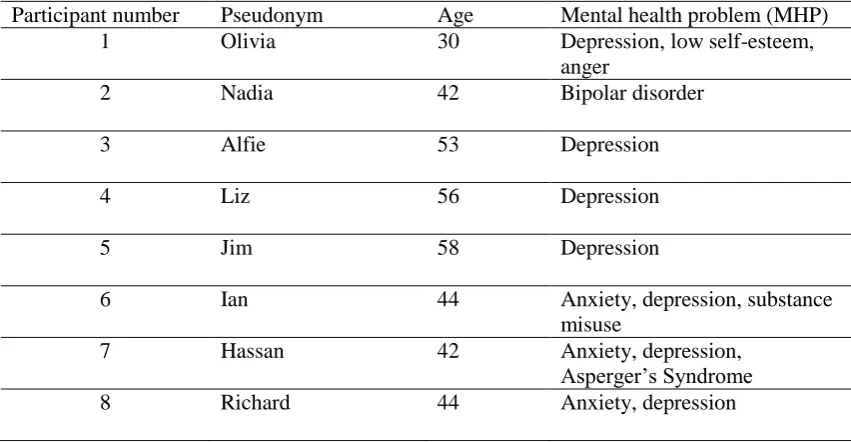
3.1 Participants
42
3.2 Overview of master themes
43
3.3 Literature as an intermediary object
43
3.3.1
Attunement to text, self, other
44
3.3.2
Literature eliciting self-reflection in safe
environment
45
3.3.3
Testing ground for new ways of being
46
vii
3.4.1
RG as separate (protected) space
48
3.4.2
Structure and unplanned happenings
49
3.4.3
RG as unpressured/failure-free
50
3.4.4
Acceptance and non-judgement
52
3.5 Self as valued, worthy, capable
53
3.5.1
Fulfilment of otherwise unaccomplished
endeavours
53
3.5.2
Sense of potential through (enjoyable) learning
and achievement
55
3.5.3
Opportunity for contribution/involvement
56
3.6 Community and togetherness in relational space
57
3.6.1
Interpersonal self-efficacy counteracting social
difficulty
58
3.6.2
Attachment to others fosters trust and belonging
59
3.6.3
RG as collective experience/venture
60
3.7 Changing view of self, world, others
62
3.7.1
Re-appraising self as normal
62
3.7.2
Psychological flexibility
63
3.7.3
Connecting past and present self
64
3.8 Reflections on analysis
65
4.0
Discussion
68-89
4.1 Overview of study
68
4.2 Relating findings to previous literature
68
4.2.1
Literature as an intermediary object
68
4.2.2
Boundaries and rules of engagement
71
4.2.3
Self as valued, worthy, capable
74
4.2.4
Community and togetherness in relational space
76
4.2.5
Changing view of self, world, others
78
viii
4.3 Strengths and limitations
80
4.4 Clinical implications
82
4.5 Future research
84
4.6 Reflections on discussion
86
4.7 Conclusion
88
References
90-108
Appendices
Appendix A – Literature Search Strategy
Appendix B – Therapeutic Factors of Group Psychotherapy
Appendix C – Recruitment Flyer
Appendix D – Interview Schedule
Appendix E – Participant Information Sheet
Appendix F – Consent Form
Appendix G – Demographic Data Form
Appendix H – Approval from Division of Clinical Psychology Research Committee
Appendix I – Confirmation of Ethical Approval from University of Liverpool Committee
on Research Ethics
Appendix J – Distress Contacts
Appendix K – Steps in the Analytic Procedure
Appendix L – Example of Initial Noting and Emergent Themes
Appendix M – Examples of Superordinate Theme Development
Appendix N – Excerpts from Reflective Journal
Appendix O – Details of Notation used in Participant Quotes
Appendix P – Pen Pictures
ix
List of Tables
Table name
Page number
Table 1.1
Yalom & Leszcz’s (2005) Therapeutic Factors of
Group Psychotherapy
11
Table 2.1
Initial Noting and Emergent Themes (Participant 1)
37
Table 2.2
Emergent Themes Clustered into Superordinate
Theme (Participant 2)
38
Table 3.1
Participant Demographics
42
Table 3.2
Table of Master themes and Subthemes
43
Table A1
Literature Search Strategy: Search Terms and
Number of Hits per Database
Appendix A
Table A.2
Summary of Yalom & Leszcz’s (2005) Therapeutic
Factors of Group Psychotherapy
Appendix B
Table A.3
Steps in the Analytic Procedure
Appendix K
Table A.4.
Notation used in Participant Quotes
Appendix O
Table A.5.
Master Themes, Sub-Themes and Superordinate
Themes with Relevant Participants
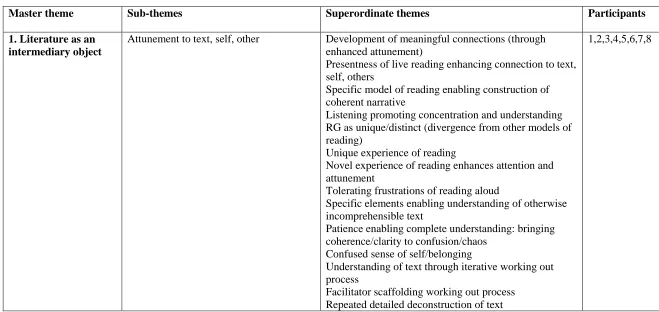
1
1.0
Introduction
Chapter one presents a critique of research pertaining to literature and mental health. I present research into different types of bibliotherapy, and assess their relative strengths and limitations. A brief discussion of reading in groups follows. I then consider more specifically the ‘Get into Reading’ (GiR) model of shared reading used in reader groups (RGs) in the current study, and critique existing RG research to identify gaps in the literature. The chapter concludes with the study rationale, aims and objectives.
1.1 Search strategy
An extensive literature search was carried out using the databases and search terms presented in Table A1 (Appendix A). Article relevance was assessed according to the title and abstract contents. Because many articles pertained to education or cognitive/language development, initial broader searches were followed by more specific searches (e.g. shared reading/reading aloud with adults). Additional articles were accessed by searching the ‘publications’ section of The Reader Organisation (TRO) website (who deliver GiR), and through personal
communication with TRO researchers. Further literature was found by manually searching the reference lists of relevant articles.
1.2 Background: literature and health
2
2002, promotes reading of a range of both fiction and non-fiction materials to alleviate physical and mental illness (Reading Agency, 2003). Furthermore, a shift in mental health service delivery has led to the development of therapeutic approaches outside of the traditional model (Reeves & Stace, 2005); one such approach is reading.
1.3 Bibliotherapy
Perhaps the most familiar use of reading in mental health is bibliotherapy, broadly defined as “the use of literature to bring about therapeutic effects” (Hodge, Robinson & Davis, 2007, p. 100). Bibliotherapy has been applied to a variety of populations in a range of formats (e.g. Fanner & Urquhartt, 2008; Pehrsson & McMillen, 2005), including written, audio and internet-based materials, delivered individually or in groups, accompanied by varying levels of therapist face-to-face/phone/email contact (e.g. Kaltenthaler, Parry & Beverley, 2004; McCulliss, 2011; Pardeck & Pardeck, 1984; Thomas, 2011). The nature of therapeutic change is influenced by the type of text. Professionally authored non-fictional materials are designed to guide the reader through self-help programmes actively aiming to change behaviours, while fiction, poetry and biographical literature may be used to encourage reflection on personal experiences (Riordan, Mullis & Nuchow, 1996).
3
In the current study, consistent with Brewster (2009), the term ‘self-help bibliotherapy’ (SHB) will be used to denote the use of self-help literature which clinically advises on behaviour change, while ‘creative bibliotherapy’ (CB) will refer to the use of fiction/poetry for therapeutic effect. Although Brewster’s (2009) and other definitions of CB also encompass creative, expressive or biographical writing (e.g. Turner, 2008), the current study focuses exclusively on the use of reading. Thus, where studies are reported to have employed ‘CB’ in this literature review, they refer only to the use of reading, and not writing, as a therapeutic tool.
The RGs in the current study are considered a form of CB (Brewster, 2009) but, in contrast to more formal CB approaches, books are not selected with specific therapeutic outcomes in mind, and are rather chosen for their relevance to the human condition (TRO, 2011). RGs will therefore be referred to as ‘informal CB’, because they are not therapy per se (Hodge et al., 2007). However, their consistent format sets them apart from the unstructured, ad hoc delivery of CB techniques that Brewster (2009) describes as ‘informal bibliotherapy’, such as library staff recommendations. RGs thus share elements of CB, but deliver these in a less formal way. Again, ‘informal CB’ excludes the use of creative writing. I now consider each of these bibliotherapies in turn.
1.4 Self-help bibliotherapy
4
2008; Gunning Richards & Prescott, 2011; Porter et al., 2008; Robertson, Wray, Maxwell & Pratt, 2008). BoP provides access to self-help literature from local libraries for specific difficulties, including anxiety (Kennerley, 2009) and depression (Gilbert, 2009a).
Despite the large number of people experiencing mental health problems (MHPs) in the UK, only a proportion receives appropriate treatment (Clark et al., 2009). This ‘treatment gap’ (Ridgway & Williams, 2011) is partly attributable to limited resources, long waiting lists and stigma (e.g. Kupshik & Fisher, 1999; Mead et al., 2005; Reeves & Stace, 2005). In
accordance with government drives to improve access to evidence-based mental health interventions (Department of Health, 1999; Layard, 2004), SHB schemes have been set up in the UK in an attempt to reduce the treatment gap (e.g. Gunning et al., 2011, Turner, 2008).
1.4.1 Strengths and limitations of SHB
A series of meta-analyses and literature reviews indicate that SHB is a reasonably effective intervention for a range of mild to moderate MHPs, including depression, anxiety, and assertiveness difficulties (e.g. Apodaca & Miller, 2003; Chamberlain et al., 2008; Papworth, 2006; Ridgway & Williams, 2011), with overall effect sizes ranging from 0.565 (Marrs, 1995) to 0.84 (Den Boer, Wiersma & Van den Bosch, 2004). Evidence from clinical practice and randomised controlled trials (RCTs) provide further support for SHB, particularly in treating depression and anxiety (e.g. Kupshik & Fisher, 1999; Reeves & Stace, 2005; Songprakun & McCann,2012; Van Straten, Cuijpers & Smits, 2008).
5
found no clinically/statistically significant differences in depressive symptoms between standard care and self-help cognitive behaviour therapy (CBT). Even with similar samples, inconsistencies emerge, with Mead and colleagues (2005) reporting no significant differences between self-help and waiting list control groups in an RCT of 114 primary care patients with significant anxiety or depression symptoms. Furthermore, methodological issues in meta-analyses, including high drop-out (Papworth, 2006), non-clinical populations (Marrs, 1995), and small sample sizes (Cuijpers, 1997), indicate findings should be interpreted with caution. Some SHB materials lacked empirical validation, thus overall effectiveness of SHB for a particular problem could be based on books of varying quality (Marrs, 1995). Given the lack of clarity around the term ‘bibliotherapy’, it is questionable whether studies are comparable.
Comparing SHB to traditional psychotherapy, Cuijpers, van Straten and Smit (2006)
conducted a meta-analysis of cognitive and behavioural SHB for older adults with depression, and reported no significant differences in outcomes of depression (measured using
6
It is important to note that most of these benefits are also applicable to the GiR model. However, unlike RGs, SHB is not read aloud and, rather than promoting enjoyment, it is problem-focused, thus relies on correctly identifying and targeting the ‘problem’ as a single phenomenon. Furthermore, SHB is dependent upon a certain level of literacy and cognitive skill (e.g. Richardson, Richards & Barkham, 2010), whereas GiR does not depend on intellectual ability.
From a clinical perspective, SHB is still largely reliant upon CBT, which is not universally suitable. Although SHB does make use of other psychological models (e.g. Cognitive Analytic Therapy [CAT, Wilde McCormick, 2008]), CBT is the dominant theoretical framework (Cuijpers, 1997; van Straten et al., 2008). However, therapeutic intervention should not be a ‘one size fits all’ approach (Chamberlain et al., 2008). Even if alternative self-help books are available, those prescribing them (e.g. general practitioners) do not necessarily possess the clinical skills to select the most appropriate therapeutic model. Furthermore, some individuals may not be ready to engage in therapy, which is overlooked by BoP systems. Without a skilled therapist to address these concerns, people may disengage from services altogether.
SHB is also limited by its primary application to mild to moderate difficulties (as in the above studies), and is not amenable to those with more complex presentations (e.g. comorbidity, dementia). Additionally, studies evaluating SHB largely focus on symptom change, and overlook other aspects of well-being, such as quality of life. The therapeutic relationship is also lacking in SHB (Richardson et al., 2010), hence the reader cannot experience
7
In summary, SHB appears to be moderately effective in reducing symptoms of some mild to moderate mental health difficulties, offering access to an additional cost-effective treatment option. However, in contrast to GiR RGs, it is problem-focused, limited to certain
presentations and client groups, dependent upon literacy, and is heavily reliant on the CBT framework, which is not universally appropriate. In addition, SHB offers limited exposure to the benefits of a therapeutic relationship, and change is largely concerned with symptom reduction, rather than general well-being.
1.5 Creative bibliotherapy
In contrast to SHB, CB1 uses imaginative/fictional literature to elicit therapeutic effects (e.g. Giannini, 2001; McNulty, 2008; Tani, 2011). While non-fictional bibliotherapy promotes cognitive change by instructing and informing, fiction also encourages emotional engagement with text, in that it evokes real feelings, which Gold (2001) terms a “lived-through quality” (p. 35). However, there is limited empirical evidence of CB effectiveness (Pehrsson &
McMillen, 2005), with considerably fewer papers in this area, of which several are case studies, anecdotal accounts, or bibliographic lists (e.g. Baker, 2006; Giannini, 2001; McNulty, 2008; Riordan et al., 1996).
Imaginative literature can be used as a vehicle for expressing personal narratives (Pehrsson and McMillen, 2005) and constructing identity (Gold, 2001). Reading stories about others can help supplement or ‘re-story’ one’s own narrative, especially when theirs is blocked by difficult events, such as loss (Gold, 2001). The ‘life story’ has received attention in psychotherapy, since narratives are fundamental to making sense of experience (Burns & Dallos, 2008). Because sense-making is guided by organising/categorising, having a coherent story of experience is considered therapeutic (Divinsky, 2007) hence the clinical application
8
of narrative to psychotherapy (e.g. Morgan, 2000) and life story work (e.g. Thompson, 2011). Psychotherapy involves exploration of one’s life history, in terms of past events/experiences, to create a coherent contextual understanding of present difficulties (Carr & McNulty, 2006b). This is where reading imaginative literature may be helpful; Gold (2001) argues that by engaging with multiple layers/networks of information within fiction, the reader selects what is relevant to them to organise and understand their own experience. This reframing process enables new perspectives, culminating in a cognitive shift (Gold, 2001) which, however small, can have considerable consequences for emotion and behaviour (Toner, 2012).
In addition to cognitive change, CB facilitates new emotional experiences. Literature is described as a ‘symbolic equivalent’ of actual experience (McCulliss, 2012), since reading fiction can articulate the same feelings as the experience itself (Gold, 2001). However, contrary to traditional psychotherapy, fiction can “transport the reader to a parallel situation in which they can process their own circumstances from the safety of intellectual and emotional distance” (McNulty, 2008, p. 26), thus providing a model for discussing painful experiences without explicitly focusing on the individual (Pardeck & Pardeck, 1984). Repressed
memories may be elicited, negotiated and tolerated through vicarious involvement in the thoughts and feelings of others (Gold, 2001).
Pertinent to both cognitive and emotional processes, Shrodes (1949/1950 as cited in
McCulliss, 2012) proposed a psychodynamic model of CB. Firstly, the client identifies with experiences/events within the literature, and projects their own emotions and drives onto characters, whose intentions and relationships are related to one’s own difficulties, thereby enhancing self-awareness. The client then expresses their reactions via spontaneous emotional release (McArdle & Byrt, 2001). Insight and integration follow, whereby the
9
literature. Bhattacharyya (1997) noted the powerful effects of this process in resolving internal conflicts; “as insight comes through identification, the projected unacceptable parts can be owned and integrated, making whole that which was fragmented before” (p. 15), thus promoting the aforementioned coherence in identity and narrative. Others highlight the normalising effect of identification (e.g. Gold, 2001), which can help validate attitudes, beliefs and experiences (Usherwood & Toyne, 2002). However, support for the model is largely derived from anecdotal accounts, and it remains unclear whether these processes can occur without the guidance of a skilled therapist, as in the case of RGs.
In addition to intra-psychic processes, CB promotes interpersonal development (Pardeck & Pardeck, 1984); how we understand, relate to and tolerate others is mediated by connections with characters (Usherwood & Toyne, 2002). Burns & Dallos (2008) reported that reading literature enhances our ability to imagine internal states of others (as well as our own), promoting attunement to our own and others’ consciousness. They related these findings to Fonagy’s concept of reflective self-function (Fonagy, Steele, Steele, Moran & Higgit, 1991), which is developed through attachment relationships and help us understand internal worlds of self and others. Burns and Dallos (2008) suggest that reading might help us develop reflective self-function, especially in adult-child relationships, through internalising and empathising with characters’ experiences and emotions. It remains unclear whether this process applies to shared reading with adults.
10
through distraction, relaxation, or involving oneself in a different world (Burns & Dallos, 2008). The rhythm and imagery of poetry is argued to be relaxing (McArdle & Byrt, 2001), which may emulate the meditative quality of relaxation in psychotherapy (Carr & McNulty, 2006a). It is important to note, however, that some of these processes, including relaxation, escapism, and distraction apply not only to CB, but also to reading fiction in general (Reading Agency, 2003). Therefore, these benefits cannot be claimed exclusively by engaging in CB.
In summary, there is limited empirical research around CB, with much of the support derived from anecdotal or clinical reports. Such accounts indicate that it can impact upon cognitive, emotional and behavioural processes, both intra- and inter-personally. However, it remains unclear whether such processes can occur naturally, without the guidance of a therapist, or in shared reading within a group setting.
1.6 Group reading
Individual bibliotherapy gradually evolved into group bibliotherapy (McCulliss, 2012). Again, few empirical examples exist in the psychological literature, but there is some
supportive evidence of group CB for MHPs in adults. For instance, an Israeli study compared inpatients’ functioning in standard group therapy and group bibliotherapy, using an
observational instrument (Client Behaviour System, Hill & O’Brien, 1999, cited in
Shechtman & Nir-Shfrir, 2008) within a repeated measures design. Both groups employed an ‘affective-support’ approach, focusing on emotional expression, group support and
11
attributed to psychodynamic processes similar to those operating in Shrodes’ (1949/1950, as cited in McCulliss, 2012) model, occurring between the readers and the text. However, the study relied on a small sample (n=25), and the intervention took place over only three
sessions, so longer-term outcomes are unclear. Giannini (2001) reported improved symptoms and interpersonal behaviour among inpatients following engagement in group bibliotherapy using a science-fiction series. In contrast to RGs, clients read texts prior to group sessions. Although discussion was strictly limited to the literature, Giannini suggested that “overt interpretations of the books evolved into thinly disguised covert expressions of self” (p. 57). However, his account was purely anecdotal, and no quantitative/qualitative measures were reported, providing no indication of how the above conclusions were generated. Without a comparison group, it is unclear to what extent these tenuous conclusions were attributable to the group setting (rather than the literature), which may itself enable personal development (Powell, 1950).
[image:21.595.103.370.566.723.2]Yalom & Leszcz (2005) presented 11 ‘therapeutic factors’ occurring in group settings, listed in Table 1.1 (full summary in Appendix B).
Table 1.1
Yalom & Leszcz’s (2005) Therapeutic Factors of Group Psychotherapy
Therapeutic factors Instillation of hope Universality
Imparting information Altruism
The corrective recapitulation of the primary family group Development of socialising techniques
Imitative behaviour Interpersonal learning Group cohesiveness Catharsis
12
It is not possible to address these factors in detail, but it is worth noting that they could be partially responsible for some of the above outcomes, such as self-disclosure (catharsis) and interpersonal behaviour (interpersonal learning). Although developed from research into group psychotherapy, the factors also relate to non-therapy groups (Yalom & Leszcz, 2005), such as GiR or other forms of informal CB.
13
enhances these effects, since responses to literature occur in real time, rather than as retrospective memories from a relatively removed reading experience.
Studies of live group reading are scarce, but there is a small body of literature developing in this area with people with neurological difficulties. Reading literature aloud in groups has been found to promote positive affect, improve engagement and alertness, elicit memory, and reduce disruptive behaviour in people with dementia and brain injury (e.g. Gardiner, Furois, Tansley & Morgan, 2000; Holm, Lepp and Ringsberg, 2005; Skrajner & Camp, 2007). Holm et al. (2005) reported that their storytelling group for people with Alzheimer’s disease
prompted existential discussions and a sense of fellowship, consistent with Yalom and Leszcz’s (2005) existential factors and group cohesiveness. This study also highlighted that, although entertainment and stimulation are valuable benefits of group reading (Higgins et al., 2005), giving structure to such activity is important for moving beyond just entertainment, and reaping deeper psychological gains. However, in those studies with no comparison group (e.g. Holm et al., 2005; Skrajner & Camp, 2007), it is possible that some reported gains, such as increased positive affect, are attributable to non-specific group effects, such as social interaction and peer support.
14
to moderate functional MHPs. GiR, on the other hand, is delivered across both community and residential/secure/inpatient settings, with a range of populations (e.g. forensic, looked after children, learning disability) (Barkway, 2007; Billington, 2011; Weston & McCann, 2011). The following section provides an overview of the GiR RGs, and critiques research into this particular model.
1.7 ‘Get into Reading’: The reader group model
GiR is a social inclusion programme set up by The Reader Organisation (TRO), a “nationally recognised centre for the promotion of reading as an intervention in mental health”
(Billington, Dowrick, Hamer, Robinson, & Williams, 2011, p. 8). It aims to provide access to complex literature for those otherwise unable to do so, due to practical/educational/cultural constraints (Davis, 2009). Driven by government strategies in mental health, GiR promotes social inclusion and engagement in therapeutic leisure activity (Department of Health, 1999).
15
1.7.1 Previous findings
Despite limited research in GiR, various projects have been undertaken to evaluate RGs. The findings below are based on studies of RGs for people with depression (Billington et al., 2011; Dowrick, Billington, Robinson, Hamer & Williams, 2012), neurological conditions (Robinson 2008a), acute psychiatric illness (McLaughlin & Colbourn, 2012) and dementia (Billington, Carroll, Davis, Healey & Kinderman, 2012), plus mixed samples, including a primary care health centre (Robinson 2008b), a non-clinical community group, a drug rehabilitation group, and men attending a homeless hostel (Hodge et al., 2007). The studies explored members’ participation in and experience of RGs (Hodge et al., 2007; McLaughlin & Colbourn, 2012; Robinson 2008a, 2008b), and investigated therapeutic benefits (Billington et al., 2011, 2012) and impact on recovery (Robinson 2008a, 2008b), from the perspectives of RG members and staff. Most studies were qualitative, involving group observations and interviews, with some incorporating basic quantitative methodology (Dowrick et al., 2012) or descriptive statistics (Billington et al., 2012).
Overall, the effects of participation can be broadly categorised into literary, social and therapeutic functions. Dowrick et al. (2012) and Billington et al. (2011, 2012) suggest four ‘mechanisms of action’ underpinning these effects, aligning with the aforementioned elements of RGs (literature, group, facilitator). The fourth mechanism was the RG environment. These mechanisms and functions will now be discussed.
1.7.1.1 Therapeutic function
16
findings (based on thematic analysis and an ethnographic approach to conversation analysis) indicate that participation in RGs help people feel more positive (TRO, 2011), provide distraction from personal difficulties (Billington et al., 2011), promote confidence in recovery, and foster a sense of purpose, achievement (Robinson, 2008a) and self-worth (Billington et al., 2012). More specifically, RGs enhance confidence in sharing personal stories (TRO, 2011), and promote self-expression and catharsis through the “articulation of profound issues of self and being” (Billington et al., 2011, p. 81). This is consistent with the notion that reading provides a vehicle for expressing narratives (Pehrsson & McMillen, 2005), and resonates with Shrodes’ earlier description of ‘emotional release’ (Pardeck & Pardeck, 1984). It is suggested that emotional expression is facilitated by the ‘in-the-moment’ nature of RGs, in terms of the intensity of response elicited by the text, and subsequent reflection in a supportive environment (Robinson, 2008a). As such, it is the literary function of RGs that is regarded as primary, with social and therapeutic effects acting as by-products of the interaction between text, group and reader (Hodge et al., 2007).
1.7.1.2 Literary function
From a literary perspective, “serious literature offers a model of, and language for, human thinking and feeling”, enabling readers to locate and alleviate emotional distress (Dowrick et al., 2012, p. 2). In the depression study, RG participation enabled the discovery of new and re-discovery of “old and/or forgotten modes of thought, feeling and experience” (Billington et al., 2011, p. 6), which can be difficult to access when one is depressed. Through
17
group members were able to relate to and empathise with characters in the book (Davis, 2009), similar to Shrodes’ identification process (McCulliss, 2012) and Yalom and Leszcz’s (2005) sense of giving ‘universality’ to an individual’s problems.
Serious literature and associated discussion can also equip group members with language to express complex emotional and personal struggles (Dowrick et al., 2012). Clinically, being unable or unwilling to constructively express internal feelings can lead to unhelpful
consequences, such as repression, avoidance, or dissociation, so articulation of distress is important for coping (Carr & McNulty, 2006b), and for communicating concerns to practitioners (Robinson, 2008a).
18
Of fundamental importance in producing such outcomes was the specific way in which literature is read aloud in the group, as opposed to lone silent reading. Reading out loud was experienced as relaxing, and enhanced members’ experience of the story (Hodge et al., 2007). This is an interesting finding in the context of previous discussions pertaining to
relaxation/distraction in formal CB, because it appears that as well as gaining distance from troubling experiences, RGs also seem to enhance readers’ attunement to their experiences. Billington et al. (2012, p. 17) suggest that “a powerful literary language helps to establish present attention in group members”, which is resonant of the therapeutic state of mindful awareness in psychotherapy (Williams, Teasdale, Segal & Kabat-Zinn, 2007). In contrast to formal bibliotherapy, it is through a primary emphasis on reading, and not therapy, that this ‘present attention’ occurs in RGs.
Greater attention is demanded in RGs by the slower pace of reading, and by the multiple exchanges and interactive processes that occur (Davis, 2009). Through live reading and in-the-moment discussion, group members process internally what is heard externally, then share the associated subjective experience publicly with the group to create collective meaning. This highlights both the communality and uniqueness of members’ experience (TRO, 2011), and is in contrast to standard book clubs, in which the same interactions/processes are not enabled because reading occurs privately and separately (Davis, 2009).
1.7.1.3 Social function
19
social contact continued outside of RG sessions, both of which created a valuable sense of involvement and belonging (Billington et al., 2011), resonant with Yalom and Leszcz’s (2005) cohesiveness. This sense of togetherness was evident across all studies, and group members valued hearing other peoples’ experiences and opinions as well as the opportunity to express their own (Billington et al., 2012). The aforementioned collaborative negotiation of difficult literature provided a sense of mutual support and encouragement to collectively work through challenges, which individuals may have given up on (or not approached at all) were they reading alone (Billington et al., 2011). It is possible that seeing others struggling with and overcoming difficulty could normalise one’s own struggles and instil hope in their ability to defeat them (Yalom & Leszcz, 2005), or promote a stronger sense of self-efficacy, which is an important coping resource. Through group discussions, shared understandings emerge, sometimes leading to collective (in addition to individual) identification with the text (Billington et al., 2011). This reinforces connectedness between group members, yet still allows for personal narratives to continue as undercurrents beneath the surface of discussion, which members can choose whether or not to share (Billington et al., 2011).
Finally, there is some, albeit limited, evidence that RGs impact upon relationships with those outside the group. For one member, RGs prompted her to read with her mother, describing this as “probably the most precious moments I have with my mother now. They bring us very close [together]” (TRO, 2011, p. 4). This conveys a powerful sense of intimacy through reading outside the group, but it also highlights a relatively underdeveloped area of RG research; firstly, consideration of the impact of RG participation on intimate/familial
20
1.7.1.4 Role of facilitator
The facilitator is credited with making the book come alive in the group, and using their literary knowledge to select appropriate texts that enable discussion of important human issues relevant to group members (Billington et al., 2011). The facilitator’s skill in guiding discussion was helpful both socially and therapeutically (Robinson 2008a). Socially, facilitators encourage involvement, ensuring that members feel they are actively part of something, but without putting pressure on them to participate. By being socially aware, facilitators prioritise the needs of the group above those of individuals, to maintain group cohesiveness (Billington et al., 2011). Therapeutically, discussion is guided around people’s responses to the text, allowing group members to express themselves emotionally or recall a past memory. The facilitator ensures that discussion is grounded in the text, thus maintaining the safe emotional distance protecting against an explicit focus on an individual’s painful experiences (e.g. McNulty, 2008).
1.7.1.5 Role of environment
The relaxed nature of GiR was also reflected in the general atmosphere of RGs. Members across multiple groups collectively reported that they experienced the group as welcoming, non-judgemental, unpressured and comforting (Billington et al., 2011, 2012; Dowrick et al., 2012). Of particular value were the voluntary nature of the group and the absence of
21
RGs helps in enabling their therapeutic quality, by encouraging reflection on in-the-moment internal states as they occur (Robinson 2008a).
1.7.2 Summary and critique
In summary, there is a scarcity of literature around the GiR model, but existing research does indicate that RGs can produce positive therapeutic effects (e.g. Billington et al., 2011). This occurs in the absence of a skilled psychotherapist, in contrast to SHB and formal CB. GiR also distinguishes itself from other bibliotherapies by exclusively employing serious
literature, which is selected for its relevance to the human condition, rather than to address a particular problem. Consequently, GiR removes the problem-focus, and is accessible to people with a wider variety of MHPs, including those whose engagement in SHB/formal CB is limited by cognitive ability, readiness to change and complexity.
22
Although RGs clearly have a role to play in mental health and well-being, it remains unclear precisely what this role is and the mechanisms underpinning it. Billington et al. (2012) identified potential mechanisms for change, but these were derived from ethnographic methodologies, and therefore only go so far in explaining potential psychological processes occurring within RGs. Furthermore, they refer only to processes occurring within the group, and do not account for potential continuation of effects outside the group, including possible influences on relationships. Because of this within-group focus, existing research does not address how present occurrences in RGs may link to past experiences. Although there is limited quantitative data demonstrating symptom change over the course of RG involvement (e.g. Billington et al., 2011), this area is yet to be explored qualitatively. Thus, further research is warranted to explore RG participation and mechanisms in further detail, using different methodological approaches (Dowrick et al., 2012), and to move beyond a within-group focus to consider potential therapeutic benefits, relating to people’s past and present experiences and relationships, outside of the group.
1.8 Study rationale
The current research aims to expand on existing literature firstly by adopting a focus on experience, in order to understand what participation in a RG is like from the perspective of the individual group member. Although previous researchers have addressed this issue to an extent (e.g. Hodge et al., 2007), the current study benefits from more in-depth analysis of individual cases, enabling the researcher to delve deeper into the subjective psychological world of the group member.
23
versa. This includes addressing how individuals’ past experiences might link to present group experiences, enabling access to perceived change over time, and a stronger focus on
relationships, enabling the exploration of interpersonal processes occurring both within and outside of the group.
Thirdly, this research offers a more detailed exploration of the RG experience from a psychological perspective, by adopting a different methodological approach (Interpretative Phenomenological Analysis [IPA]). The phenomenological aspect of IPA allows for greater interpretation than the ethnographic approaches employed previously, and enables access to aspects of experience that the participant themselves may not be consciously aware of. It is hoped that this will add another dimension to existing research, by providing psychological insight into the mechanisms occurring within RGs. To the author’s knowledge, this is the first piece of psychological research to be conducted on the GiR model of group reading.
Finally, the current research focuses exclusively on people experiencing functional MHPs. Given the aforementioned ‘treatment gap’, it is “essential that new ways of delivering services are explored” (Reeves & Stace, 2005, p. 341). Although SHB goes some way towards
providing an alternative to medication/traditional psychotherapy, it still presents clinical limitations. GiR on the other hand, although not a ‘cure’ or therapy (Davis, 2009), provides a less prescriptive and less stigmatised avenue for enhancing emotional well-being.
24
the recovery model of mental health (McLaughlin & Colbourn, 2012), which fosters an on-going whole-person approach to the development of coping and resilience, and promotes hope for a meaningful life despite mental health difficulties (LeVine, 2012). It may be that RGs can offer support to those individuals who wish to engage in less pathologising wellness-focused activities, rather than problem-wellness-focused clinical services. It is therefore important to understand how such alternative supports may be helpful to those experiencing psychological distress.
1.9 Aims and objectives
The research question asks what is the experience of being in a RG for people with MHPs? The overall aim was to explore participants’ experiences of being in a RG, and the impact of participation upon how people make sense of their lives and relationships. Objectives for meeting this aim are to: (i) explore the intra- and inter-personal experience of being in a RG, and the meaning of participation to the individual; (ii) understand how participation affects how people make sense of past and present experiences and relationships, both inside and outside the group, in the context of mental health difficulties; (iii) consider how the
25
2.0 Method
This chapter outlines the study design and provides an overview of Interpretative
Phenomenological Analysis (IPA), its key features, and epistemological underpinnings. The rationale for IPA is discussed relative to other qualitative methodologies. I then describe the methodological procedures, and consider reflexivity, quality/validity and ethical practice.
2.1 Design
The aim of the study was to explore participants’ experiences of being in a reader group (RG), and the impact of participation upon how people make sense of their lives and relationships, in the context of mental health problems (MHPs). Data were collected via individual semi-structured interviews, and analysed using IPA.
2.2 Qualitative methodology
A qualitative approach was selected for several reasons. Firstly, qualitative approaches enable the use of linguistic data to explore in detail the subjective meaning of a particular phenomenon (Langdridge, 2007); in this case, the experience of being in a RG. Focusing explicitly on individual cases, they do justice to the complexity and richness of human experience, unlike quantitative methods (Ashworth, 2003). The latter, in contrast, employ objective measurement of numeric data to test hypothesised outcomes across a representative sample (Langdridge, 2007). Such approaches were deemed unsuitable for meeting the aims of the current study because they cannot capture in-depth individual experience, and the research is exploratory, rather than testing a predetermined hypothesis (Smith & Osborn, 2008).
26
They reject the positivist notion of a single objective reality, instead arguing that reality is a function of individual perceptions and understandings (Ashworth, 2003). One such approach is IPA.
2.3 Interpretative Phenomenological Analysis
IPA aims to understand how people attach meaning to lived experience, and how they make sense of their personal and social world in relation to that experience (Eatough & Smith, 2008). Although developed relatively recently (Smith, 1996), IPA draws on the long-established philosophies of phenomenology and hermeneutics (Larkin, Watts & Clifton, 2006), and concern with subjective experience (James, 1890). Of fundamental interest is how such experience is interpreted and understood (Barker, Pistrang & Elliott, 2002), since
perceived meaning is more important than objective reality (Willig, 2008). In contrast to positivism, phenomenology views reality as a product of an individual’s “practical
engagements with things and others” in the world (Eatough & Smith, 2008, p. 180). Edmund Husserl, phenomenology’s founder, argued that we cannot separate reality from experience because reality is experience, and therefore the meaning we attach to experience is key to understanding how humans make sense of their world (Ashworth, 2003). A series of interrelated meanings become bound together in what Husserl termed the ‘lifeworld’;
27
It is this ‘meaning-making’ process that constitutes the ‘interpretative’ aspect of IPA which assumes that making sense of experience is part of the human condition (Smith et al., 2009), and distinguishes IPA from more descriptive phenomenological approaches (e.g. Giorgi & Giorgi, 2008; Pringle, Drummond, McLafferty & Hendry, 2011). Drawing on hermeneutics, Heidegger proposed that it is through our state of ‘being in the world’ that we make sense of ourselves (Eatough & Smith, 2008), and therefore we cannot meaningfully exist outside a temporal/geographical context (Larkin et al., 2006). How we perceive and understand objects/events is inevitably influenced by existing knowledge and beliefs, derived from experience (Eatough & Smith, 2008). Consistent with symbolic interactionism, interpretation is intersubjective, occurring in, and as a result of, social interactions (Smith, 1996). In IPA, the researcher and participant engage in a joint meaning-making process, using a ‘double hermeneutic’; seeking out the participant’s perception of their experience (‘first
hermeneutic’), while also critically analysing aspects of experience which the participant may be unaware of, or unwilling to acknowledge (‘critical hermeneutic’, Smith & Osborn, 2008).
IPA is also idiographic, with in-depth analysis occurring at the individual level (Larkin et al., 2006). This contrasts to the nomothetic approach dominant in psychology, which generates laws to explain and predict behaviour at population level (Smith et al., 2009). By focusing on the particular rather than the universal, IPA makes claims about individuals rather than generalised populations, reiterating its aim to “understand meaning in the individual life” (Eatough & Smith, 2008, p. 183).
Accordingly, IPA involves detailed analysis on a case-by-case basis (Smith, 2011).
28
hermeneutic’); “from rich description through to abstract and more conceptual
interpretations” (Eatough & Smith, 2008, p. 187), to capture the totality and complexity of individual experience (Smith & Osborn, 2008). Although IPA is systematic, it boasts a “healthy flexibility” (Smith et al. 2009, p. 79), allowing the analysis to be guided by the individual account. During the interview, the researcher can probe interesting areas as they arise (Smith, 2004), which not only helps maintain idiographic focus, but is also useful for exploratory research when there is little existing literature, as is the case for RGs.
IPA was thus selected as the preferred methodology for the current study because it enables the researcher to generate an interpretative account of participants’ lived experience of being in a RG, to better understand this phenomenon from the perspective of individuals with MHPs. Because IPA seeks to uncover a chain of connection between what participants say and their thoughts and emotion states (Smith & Osborn, 2008), it is hoped that this approach will shed light on the underlying cognitive and affective processes involved in RG
participation, and associated meaning-making. IPA is also useful for exploring issues
involving transformation or change (Eatough & Smith, 2008), so it was felt that this approach could provide insight into participants’ experience of change processes or development over time within the RG.
29
Trinidad, 2007). While IPA endorses DA’s social constructionist viewpoint that language is a fundamental aspect of reality construction, it argues that we must move beyond linguistic interaction to fully understand experience, because language alone “does not speak to the empirical realities of people’s lived experiences” (Eatough & Smith, 2008, p. 184). In contrast to DA, IPA researchers, drawing on the social-cognitive paradigm, are also concerned with inner mental states, but what DA offers is a welcome endorsement of the importance of language and context in IPA’s pursuit of understanding the meaning of such cognitions in relation to lived experience (Smith, 1996). Finally, IPA shares similarities with narrative analyses, in its commitment to interpretative meaning making and experiential emphasis (Eatough & Smith, 2008). However, narrative researchers focus more on the structure and organisation of stories (e.g. beginning-middle-end, plots), and relate this to meaning making within a context of temporal continuity (Murray, 2003; Murray & Sergeant, 2012). The emphasis on storytelling and temporal continuity implies a sense of ‘journeying’, so perhaps this approach would be more suited to the exploration of experience where a journey is more prominent (e.g. the experience of illness from diagnosis to recovery).
In summary, IPA was selected for the current project because of its clear phenomenological emphasis on participants’ experiential concerns (Larkin et al., 2006). Its groundings in phenomenology and hermeneutics mean that it is well placed to facilitate an interpretative account of what it is like to be in a RG, and how participants derive meaning from this experience (Smith et al., 2009).
2.3.1 Reflexivity
30
potential influence on the interpretation of participant accounts (e.g. Smith, 1995). Husserl suggested that researchers should ‘bracket off’ these assumptions and adopt a ‘natural attitude’, to understand another’s experience without being biased by our own values.
However, Heidegger argued that bracketing in this sense is impossible since we cannot escape our own subjectivity (Langdridge, 2007). Therefore, while it is not possible to completely separate the researcher from their conceptions and experience, the researcher’s position must be clearly outlined. Consistent with Reid et al. (2005), I will provide my reflections on each stage of the research process, which were regularly recorded in a reflective journal. It was felt appropriate to present an on-going account of my reflections in each chapter, in order to align the reader with my thought processes as the research evolved.
2.4 Procedure
2.4.1 Participants
2.4.1.1 Sample size
Sample sizes in IPA studies vary widely, depending upon multiple factors including ease of recruitment, depth of analysis, and data quality (Eatough & Smith, 2008). For instance, where accounts lack detail, more participants are required to gain sufficient richness of data, while fewer cases enables greater investment in the analytic procedure for each individual (Smith, 2011). It was decided in the current study to follow Smith et al.’s (2009)
recommendation of four to ten participants for a professional doctorate, depending upon the richness of the data collected.
2.4.1.2 Sampling strategy
31
running and the prevalence of known MHPs within the group, to ensure that some members should meet inclusion criteria (see below). Although not intentional, groups were located in urban areas with high levels of deprivation (Local government statistics – Anonymous, 2007, 20102).
IPA research should aim for a reasonably homogenous sample (Smith & Osborn, 2008); in the current study, homogeneity lies in participants’ membership of a RG and experience of MHPs. However, IPA is not exclusively interested in what is shared between participants, but also what is not shared, so explores both convergence and divergence (Reid et al., 2005). Therefore, some heterogeneity is valuable to illuminate the diversity of human experience (Eatough & Smith, 2008), and can help the reader make (albeit tentative) judgements about transferability of the account to other groups (Pringle et al., 2011). Recruiting participants with a range of MHPs, and from different groups, encouraged some level of heterogeneity among the current sample.
2.4.1.3 Inclusion and exclusion criteria
People were eligible to participate in the study if they:
attended RGs regularly (i.e. on most weeks) for six months or more (long/frequently
enough for the group to have some impact on their life/psychological state);
were experiencing MHPs either at the time of recruitment, or at the time they joined
the RG. MHPs were identified by any of the following: having received a formal clinical diagnosis; contact with mental health services;
2
32
self-identifying MHPs (experiencing significant psychological distress, which had a significant impact on daily functioning for a period of several months or more);
were over 18 years old;
could speak and understand English sufficiently well to participate in a one hour
interview.
People were not eligible to participate if they did not meet the above criteria, or if they were experiencing acute distress such that participation in the interview may be detrimental to well-being.
2.4.2 Recruitment
The researcher presented the study at selected RGs, providing information about its purpose, inclusion criteria and nature of participation. I acknowledged that I was aware that RGs were not primarily for people with MHPs, but that some people in the group may have experienced MHPs, due to their high lifetime prevalence (The Health and Social Care Information Centre, 2007). To avoid people feeling singled out/exposed, however, all group members were given a recruitment flyer (Appendix C), and people were invited to ask questions or contact me privately for further information. The recruitment flyer also had a slip attached which could be completed and returned to express interest in the study. In practice, all those who participated expressed their interest publicly, suggesting that they were open about their MHPs within the group.
33
group, which provided some idea of how many met this particular criterion. Of the estimated 13 group members who were eligible to participate, 10 agreed to take part, but one later withdrew from the study. Nine people were interviewed, but one was later excluded from the analysis because it emerged that the participant had only attended the group for five months. Another interview was terminated prematurely (after 32 minutes) due to an interruption, but it was nonetheless included in the analysis. Eight interviews were analysed in total.
2.4.3 Designing and conducting the interview
2.4.3.1 Developing the interview schedule
Data were collected using semi-structured interviews, selected because they enable the researcher to probe areas of interest, and allow for more flexible data collection than a structured interview (Eatough & Smith, 2008). Because the research was exploratory, it was not possible to predetermine the nature of the data, hence pre-define possible responses. Semi-structured interviews therefore accommodate the variability of subjective experience, whereas a more restricted questioning approach would counteract the aim of enabling the participant to tell their personal story (Smith & Osborn, 2008). Semi-structured interviews also allow the researcher to establish rapport with the participant, which is likely to elicit a more natural account (Reid et al., 2005).
34
The interview questions were open-ended, and covered the following areas (full interview schedule in Appendix D):
Participants’ inter- and intra-personal experience of being in a RG and the meaning
they attach to participation.
The relationship between participants’ experience of the RG (over a period of time)
and their life outside the group, both past and present, including MHPs.
The perceived impact of RG participation on how people make sense of their own
lives and relationships (including MHPs), and the experiences of others.
The perceived impact of RG participation on how people relate to themselves and
others.
Participants’ experience of shared reading relative to other group activities and
reading alone.
Pilot interviews were conducted with two participants to assess the suitability of the interview schedule. This helped to ensure that questions were clear, and would enable the participant to tell their story with as little prompting as possible (Smith & Osborn, 2008). Following the first pilot interview, two questions were re-worded following participant feedback and reflection on the interview, which indicated that two questions were difficult to understand (e.g. ‘how do you experience yourself and others in the group?’). Subsequent interviews indicated that revised questions were clearer. As this was the only change in the interview schedule, pilot interviews were included in the final analysis.
2.4.3.2 Interview procedure
35
(Appendix E), and invited to ask questions about the study before completing a consent form (Appendix F). Participants also completed a demographic data form (Appendix G), which is deemed important in providing a context within which the individual’s account could be located and understood (Reid et al., 2005).
Interviews were intended to last approximately one hour, but ranged from around 30 to 120 minutes, with a mean of 66.5 minutes. This discrepancy will be reflected upon in the reflexivity section. The researcher drew on principles of active listening (e.g. Fitzgerald & Leudar, 2010) during interviews to convey warmth and empathy, and facilitate rapport. Consistent with Smith and Osborn (2008), the interview schedule was used to guide discussion, but the order was not followed exactly, and interesting areas followed up with additional questions.
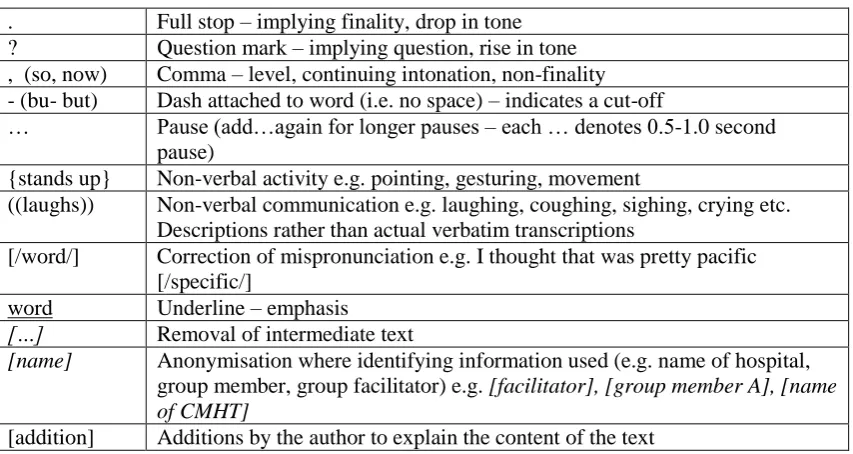
Interviews were recorded using a Dictaphone, and transcribed verbatim by the researcher (three interviews) or paid transcriber (five interviews), under a confidentiality agreement. Since there are no universally agreed rules for transcription of qualitative data (McClellan, McQueen & Neidig, 2003), the transcription style was based on an amalgamation of various transcription conventions and recommendations (e.g. Smith & Osborn, 2008; Silverman, 2006) and was consistent throughout all transcripts.
2.4.4 Ethical considerations
The study was approved by the Division of Clinical Psychology research committee
36
Participants were provided with written information detailing their right to withdraw from the study at any time, the limits of confidentiality, how anonymity would be ensured, data storage and the risks/benefits of participation (Appendix E). All participants were invited to ask additional questions before giving written consent to participate in the study. Consistent with Smith and Osborn (2008), feedback about emotional state was elicited from participants during the interview, and the researcher was mindful of signs that may indicate distress. A list of useful contacts (Appendix J) was available to participants in the event of distress, but this was not needed.
Participant anonymity was protected using participant numbers to identify transcripts, and pseudonyms in the written thesis. Additional identifying information (e.g. place names) was also altered. Participants were aware that interviews would be transcribed, and anonymised quotes may be used in the final write-up. IPA interview transcripts cannot be totally anonymous because of the nature of data they contain, but I was conscious not to use quotes that could potentially identify the participant. All data were stored securely and accessible only to the research team. Following completion of the research, hard data were destroyed and electronic data archived by the data custodian.
2.5
Analytic procedure
As recommended for novice IPA researchers (Gee, 2011), the analytic procedure followed Smith et al.’s (2009) guidelines, summarised in Appendix K. First, self-contained analyses of individual transcripts were conducted; repeated readings of each transcript involved
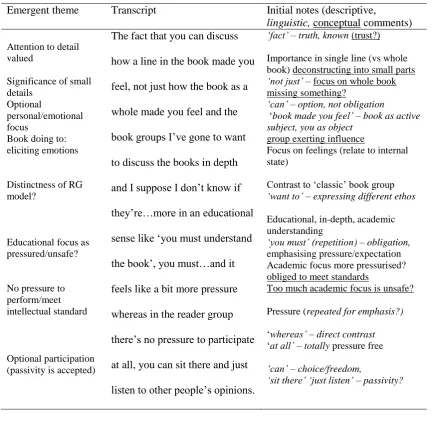
37 Table 2.1
Initial Noting and Emergent Themes (Participant 1)
Emergent theme Transcript Initial notes (descriptive,
linguistic, conceptual comments)
Attention to detail valued
Significance of small details
Optional
personal/emotional focus
Book doing to: eliciting emotions
Distinctness of RG model?
Educational focus as pressured/unsafe?
No pressure to perform/meet intellectual standard
Optional participation (passivity is accepted)
The fact that you can discuss how a line in the book made you feel, not just how the book as a whole made you feel and the book groups I’ve gone to want to discuss the books in depth and I suppose I don’t know if they’re…more in an educational sense like ‘you must understand the book’, you must…and it feels like a bit more pressure whereas in the reader group there’s no pressure to participate at all, you can sit there and just listen to other people’s opinions.
‘fact’ – truth, known (trust?) Importance in single line (vs whole book) deconstructing into small parts ‘not just’ – focus on whole book missing something?
‘can’ – option, not obligation
‘book made you feel’ – book as active subject, you as object
group exerting influence
Focus on feelings (relate to internal state)
Contrast to ‘classic’ book group ‘want to’ – expressing different ethos Educational, in-depth, academic understanding
‘you must’ (repetition) – obligation, emphasising pressure/expectation Academic focus more pressurised? obliged to meet standards
Too much academic focus is unsafe?
Pressure (repeated for emphasis?) ‘whereas’ – direct contrast ‘at all’ – totally pressure free ‘can’ – choice/freedom,
‘sit there’ ‘just listen’ – passivity?
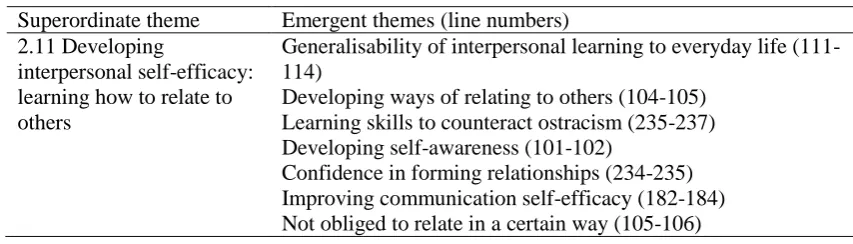
38 Table 2.2
Emergent Themes Clustered into Superordinate Theme (Participant 2)
Superordinate theme Emergent themes (line numbers) 2.11 Developing
interpersonal self-efficacy: learning how to relate to others
Generalisability of interpersonal learning to everyday life (111-114)
Developing ways of relating to others (104-105) Learning skills to counteract ostracism (235-237) Developing self-awareness (101-102)
Confidence in forming relationships (234-235) Improving communication self-efficacy (182-184) Not obliged to relate in a certain way (105-106)
This process was repeated independently for all interviews, before comparing theme clusters across the whole sample. The latter involved looking for patterns between cases, paying attention to convergence and divergence within the data to identify shared higher order categories as well as unique idiosyncrasies. Throughout the analysis, the researcher moved between the two levels of descriptive and critical interpretation (‘double hermeneutic’). All analyses were conducted manually, and involved laying out strips of paper containing themes on a large surface and re-arranging them according to connections identified between them. Because IPA is an iterative process, this sometimes led to the re-naming or re-configuring of themes. The end product was a series of master themes and superordinate themes, which will be discussed in the next chapter.
2.5.1 Ensuring quality and validity
39
from key papers addressing this issue in qualitative research (Brocki & Wearden, 2006; Elliott, Fischer & Rennie, 1999; Smith, 2011; Tong, Sainsbury & Craig, 2007; Yardley, 2000).
Recognising IPA’s subjectivity, all transcripts, individual analyses and the final analysis were shared with supervisors, to externally audit the validity of themes (Pringle et al., 2011). Unavoidable time constraints meant that it was not possible to carry out validity checks with the participants themselves. However, care was taken to clarify what was the participant’s original account and what was the interpretation (Brocki & Wearden, 2006), and quotes from the transcripts were used to illustrate how the latter were grounded in the former.
Reflexivity is also an important part of ensuring quality (Reid et al., 2005). In my reflective journal (excerpts in Appendix N), I reflected on my thoughts about the data, in terms of possible emergent themes and relationships between them, including convergence/divergence. I also recorded personal reflections, to make explicit the possible impact of my own
assumptions on how the data were interpreted, and to ‘own my perspective’ (Elliott et al., 1999). To provide optimum transparency, the following section outlines the researcher’s position.
2.6 Position of the researcher
40
gaps between services, which I have observed in clinical practice. I have a strong interest in exploring alternative or additional means by which activities with therapeutic effect may be made accessible to people with mental health difficulties, particularly those for whom traditional services are unsuitable. Whilst working on an inpatient acute assessment unit, I noticed that it was often engagement in simple everyday tasks, rather than a session with the psychiatrist or psychologist, which seemed to have the greatest impact upon someone’s functioning in the short-term, and so became interested in how everyday tasks such as reading may be employed to enhance mental health and well-being.
The appeal of reading for this purpose is not only its apparent simplicity but also its creative quality, since I am also interested in how engagement with artistic creations (e.g. music, literature, film) can reveal insights around emotional experiences both for creator and audience. My interest in the relationship between arts and mental health developed when I was doing my Masters dissertation, which looked at how people perceive and understand schizophrenia through cinematic portrayals in contemporary North American film.
Conducting this research illustrated that others’ stories can potentially be extremely useful in helping people understand what it is like to live with emotional distress, and perhaps be better able to make sense of it.
With this context in mind, I contacted The Reader Organisation, and through initial