13
Exploring and Evaluating Language Learning
Web Sites
Jeong-Bae Son
Abstract
The use of the Internet is a significant issue in recent computer-assisted language learning (CALL) research and practice. With the growth of the Internet, particularly the Web (WWW or World Wide Web), the number of Web sites has grown rapidly in a very short time. There are now a large number of Web sites for language learning and teaching and the amount of information on the Web sites is enormous. As a result, it is difficult for language teachers to find quality Web sites that match their needs and interests. This situation raises a need for a Web evaluation system, including a list of useful Web sites, which can guide teachers to find and use Web resources effectively and to assess Web sites efficiently. This chapter explores the use of language learning Web sites and presents a model for Web site categorization and evaluation. It also reports the results of a review of selected English as a second/foreign language (ESL/EFL) Web sites using the model.
INTRODUCTION
clear ideas of Web resource quality factors. They need to know how to evaluate Web resources critically (Son, 2000). It allows them to guide students to material that is interesting and useful to them and appropriate for their language proficiency level (Robb, n.d.). They also need to know the types of interactions and delivery strategies employed on the Web in order to develop and implement effective pedagogy in Web environments (Bush, 1996).
In order to develop a Web evaluation system, it is important to undertake a research-based investigation of current Web sites, develop a prototype system, and then evaluate and adjust the prototype accordingly. Taking into account this process and the discipline of human-computer interaction (HCI), this chapter presents a model for Web site evaluation and reports the results of a study on the classification and evaluation of selected English as a second/foreign language (ESL/EFL) Web sites. Considering that HCI research relates to the CALL context (Chapelle, 1994) and the computer is an important instrument to help clarify the process of second language acquisition (SLA) (Doughty, 1987), theoretical bases for the study were formulated on the basis of principles in HCI, SLA and CALL.
DEVELOPMENT OF A WEBSITE REVIEW FORM
As design and evaluation are complementary to each other, practical design considerations can be applied to the evaluation of Web sites or pages. Bell (1998) suggests some guidelines for creating an effective Web site: (a) Know your goals; (b) Keep it simple; (c) Borrow with honour; (d) Provide context; (e) Don’t assume knowledge on the user’s part; (f) Don’t assume technology on the user’s part; (g) Test your pages; and (h) Keep your pages up to date. Kelly (2000) also suggests the following guidelines for designing a good Web site for ESL students: (a) Make your site usable by everyone if possible; (b) Make your site as fast as possible; (c) Make your site easy to use; (d) Make your site useful; (e) Maintain Integrity. Be professional; (f) Make your site friendly and fun to use; (g) Use ‘cutting edge technology’ wisely and effectively; (h) Remember that what you think is true may not be true; and (i) Worry about the minority who use less powerful computers, use older browsers and have slow Internet access.
Table 1
Web site evaluation criteria
Alexander & Tate (1996) Authority Accuracy Objectivity Currency Coverage
Davis (2000) Authority and Credibility Citation and Accuracy Content
Design
Timeliness or Currency
Joseph (1999) Speed
First impression – general appearance Ease of site navigation
Use of graphics / sounds / videos Content / Information
Currency
Availability of further information McKenzie (1997) Reliability
Accuracy Authority Currency Fairness Adequacy Efficiency Organization
Nelson (1998) Purpose
Pedagogy
Design / Construction
Schrock (1996) Technical and visual aspects of the Web page Content
Authority
Seguin (1999) Origin
From critical analysis of this information, a list of Web site evaluation criteria was made and incorporated into a language learning Website review form (see Appendix). The review form asks for administrative information such as the title of the site, its URL, language activities/skills and target audience. There is also space for a site description. The evaluation section of the form contains 15 criteria to which reviewers highlight the site to be “Very Unsatisfactory”, “Unsatisfactory”, “Uncertain”, “Satisfactory” or “Very Satisfactory”. The criteria cover:
1. Purpose (i.e., Is the purpose clear? Is the content in line with the
purpose? Is the Website appropriate for its targeted learner?)
2. Accuracy (i.e., Is the content accurate? Are spelling and grammar
accurate?)
3. Currency (i.e., Is the Website current? Is the Website updated
regularly?)
4. Authority (i.e., Is there information on the author? Is the author well-recognized for his or her work?)
5. Loading speed (i.e., Does the Website download fast? Do the content
pages download efficiently?)
6. Usefulness (i.e., Does the Website provide useful information? Are the language activities or tasks useful?)
7. Organization (i.e., Is the Website well organised and presented? Is the Website interesting to look at and explore? Are screen displays effective?)
8. Navigation (i.e., Is the Website easy to navigate? Are on-screen
instructions easy to follow? Is it easy to retrieve information? Are hyperlinks given properly?)
9. Reliability (i.e., Is the Website free of bugs and breaks? Is the Website free of dead links?)
10.Authenticity (i.e., Are the learning materials authentic? Are authentic materials provided in appropriate contexts?)
11.Interactivity (i.e., Is the Website interactive? Are methods for user input effectively employed?)
12.Feedback (i.e., Is feedback on learner responses encouraging? Is error handling meaningful and helpful?)
13.Multimedia (i.e., Does the Website make effective use of graphics,
sound and colour? Is the level of audio quality, the scale of graphics or video display appropriate for language learning?)
14.Communication (i.e., Can the user communicate with real people
15.Integration (i.e., Can the learning materials be integrated into a curriculum? Does the content fit with curricular goals?).
The form also asks reviewers to give an Overall Rating, from five options: Very Poor (Not recommended at all), Poor (Not appropriate), Adequate (Acceptable with reservation), Good (Appropriate for use), and Excellent (Highly recommended). Finally, there is space for additional comments and the reviewers are asked to sign and date the form.
SELECTION OF WEBSITES
Web searches were conducted for Web sites centred on the learning and teaching of ESL/EFL. The results of the search displayed numerous sites claiming to be useful for ESL/EFL learners. These sites were then checked and some were eliminated for the following reasons: (a) the site required membership; (b) a fee was required to use materials on the site; and/or (c) there was too much advertising which made using the site difficult or frustrating. In other words, Web sites were selected based on their free open access and features useful for ESL/EFL learners and teachers.
A total of twelve sites were initially selected and an email was sent to authors of the sites. The email outlined the purpose of the project and the reasons why the particular site was selected. It asked for permission for the site to be reviewed and listed on a project Web site. Of the ten authors from the twelve sites, nine replied to the email granting permission to evaluate their site. Eleven sites were then reviewed. However, as two authors each had two sites, only one of the two sites from each author was selected. As a result, nine sites were included in the final evaluation.
CREATION OF THE PROJECT WEBSITE
rating, a record of the number of reviewers, and additional comments from those reviewers. For screen displays, visit the project Web site: http://www.usq.edu.au/users/sonjb/projects/web_reviews/.
Such an information-driven Web site is ideally suited to being dynamically generated from records stored in a database. This allows separation of content from formatting in the pages, meaning that changes to either are easier and less prone to error. However, a disadvantage of such a solution is that ongoing maintenance of the Web site requires knowledge of the programming language and database structure used to generate it. The compromise solution used in this case was to use scripting technologies during development (ASP pages generated from a Microsoft Access database) and then deliver the generated pages.
The Web site uses a number of graphs to display information about the reviewers’ ratings of each of the categories of each review. These ratings are on a scale from 0 to 5. They are averaged from the scores of each of the reviewers and rounded to one decimal place. This means that there are 50 different possible graph lengths (0.0 to 5.0). Rather than generating an image file for each of these, it was decided to display two images immediately side by side and adjust their relative size properties. The two images used are single pixel gifs, so download time could be kept as low as possible.
REVIEW OF THE SELECTED WEBSITES
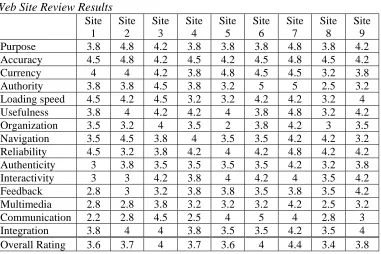
Table 2
Web Site Review Results
Site 1 Site 2 Site 3 Site 4 Site 5 Site 6 Site 7 Site 8 Site 9
Purpose 3.8 4.8 4.2 3.8 3.8 3.8 4.8 3.8 4.2
Accuracy 4.5 4.8 4.2 4.5 4.2 4.5 4.8 4.5 4.2
Currency 4 4 4.2 3.8 4.8 4.5 4.5 3.2 3.8
Authority 3.8 3.8 4.5 3.8 3.2 5 5 2.5 3.2
Loading speed 4.5 4.2 4.5 3.2 3.2 4.2 4.2 3.2 4
Usefulness 3.8 4 4.2 4.2 4 3.8 4.8 3.2 4.2
Organization 3.5 3.2 4 3.5 2 3.8 4.2 3 3.5
Navigation 3.5 4.5 3.8 4 3.5 3.5 4.2 4.2 3.2
Reliability 4.5 3.2 3.8 4.2 4 4.2 4.8 4.2 4.2
Authenticity 3 3.8 3.5 3.5 3.5 3.5 4.2 3.2 3.8
Interactivity 3 3 4.2 3.8 4 4.2 4 3.5 4.2
Feedback 2.8 3 3.2 3.8 3.8 3.5 3.8 3.5 4.2
Multimedia 2.8 2.8 3.8 3.2 3.2 3.2 4.2 2.5 3.2
Communication 2.2 2.8 4.5 2.5 4 5 4 2.8 3
Integration 3.8 4 4 3.8 3.5 3.5 4.2 3.5 4
Overall Rating 3.6 3.7 4 3.7 3.6 4 4.4 3.4 3.8
Note. Site 1: Activities for ESL Students (http://a4esl.org/); Site 2: Advanced Composition for Non-Native Speakers of English (http://www204.pair.com/ebaack/ Æ http://www.eslbee.com/); Site 3: English Club (http://www.englishclub.com/); Site 4: English Exercise Online (http://www.smic.be/smic5022/); Site 5: English Forum (http://www.englishforum.com/); Site 6: ESL Café (http://www.eslcafe.com/); Site 7: ESL Cyber Listening Lab (http://www.esl-lab.com/); Site 8: Grammar Bytes! (http://www.chompchomp.com/); Site 9: Guide to Grammar and Writing (http://ccc.commnet.edu/grammar/)
CONCLUDING REMARKS
In analysing and interpreting the review results, it is noted that a rating given to each criterion is more meaningful than the overall rating. Also, the overall rating of an evaluation checklist cannot be a definite measure of evaluation since each item of the checklist has relative importance and is difficult to measure equally in most cases. This implies that the results from any kind of checklist should not be used as an absolute guideline for judging the effectiveness of a Web site. Instead, they would provide a quick summary of user reaction, and can assist the evaluator to come to a final decision.
Although a small number of teachers have participated in the review of the Web sites at the initial stage, the results show the value of Web site evaluation with a system in identifying strengths and weaknesses of a language learning Web site. They indicate that the evaluation system can provide a useful source for selecting and using Web sites. User responses to each evaluation criterion of the system, importantly, would allow teachers to choose specially well-designed Web-based activities or materials and use them in best places. Given that the review results reported here are limited in terms of the number of reviewers, it is planned that more teachers be invited for the evaluation of the Web sites through an on-going project. The information to be provided further and regularly updated on the project Web site will be of help to ESL/EFL teachers in the task of selecting and evaluating Web sites in Web-based language learning environments.
REFERENCES
Alexander, J., & Tate, M. A. (1996). Checklist for an informational Web page. Retrieved June 24, 2003 from http://www2.widener.edu/Wolfgram-Memorial-Library/webevaluation/inform.htm
Allodi, A., Dokter, D., & Kuipers, E. (1998). WELLS: Web-enhanced language
learning. In S. Jager, J. Nerbonne, & A. V. Essen (Eds.), Language
teaching and language technology (pp. 123-135). Lisse: Swets & Zeitlinger.
Bell, C. (1998). Everone’s using the Web, so why aren’t we?: Web design and the ESOL teacher. CAELL Journal, 8(4), 8-12.
Bush, M. (1996). Language learning via the Web. Paper presented at the CALICO
Chapelle, C. (1994). Theoretical bases for human-computer interaction research in
CALL. In Proceedings of the CALICO 1994 annual symposium, Duke
University, North Carolina.
Davis, R. S. (2000). Evaluating Web sites. Retrieved June 24, 2003 from http://www.eslnetworld.com/evaluate.html
Doughty, C. (1987). Relating second language acquisition theory to CALL research and application. In W. F. Smith (Ed.), Modern media in foreign language education: Theory and implementation (pp. 133-167). Lincolnwood, IL: National Textbook Company.
Felix, U. (1999). Web-based language learning: A window to the authentic world.
In R. Debsky, & M. Levy (Eds.), WORLDCALL: Global perspectives on
computer-assisted language learning (pp. 85-98). Lisse: Swets & Zeitlinger.
Joseph, L. C. (1999). WWW CyberGuide ratings for content evaluation. Retrieved June 24, 2003 from http://www.cyberbee.com/guides.html
Kelly, K. (2000). Guidelines for designing a good Web site for ESL students. The Internet TESL Journal, 6(3). Retrieved June 24, 2003 from http://iteslj.org/Articles/Kelly-Guidelines.html
Knobel, M., & Lankshear, C. (1997). WWW projects: The “Glam Tart”. CAELL
Journal, 7(4), 20-26.
Li, R.-C., & Hart, R. S. (1996). What can the World Wide Web offer ESL teachers? TESOL Journal, Winter, 5-10.
Liou, H.-C. (1999). The impact of use of World Wide Web on EFL college learning. Proceedings of the National Science Council, Republic of China, Part C: Humanities and social sciences, 9(1), 1-13.
McKenzie, J. (1997). Comparing & evaluating Web information sources. Retrieved June 24, 2003 from http://www.fno.org/jun97/eval.html
Nelson, J. (1998). A system for the evaluation of ESL Web sites. Retrieved June 24, 2003 from
http://www.wsu.edu:8080/%7Ejtnelson/thesis/complete_thesis.html
Robb, T. (1995). Web projects for the ESL/EFL class: Famous Japanese personages. CAELL Journal, 6(4), 21-24.
Robb, T. (n.d.). The Web as a tool for language learning. Retrieved June 24, 2003 from http://www.kyoto-su.ac.jp/~trobb/lla.html
Schrock, K. (1996). Critical evaluation of a Web site: Secondary school level. Retrieved June 24, 2003 from
http://school.discovery.com/schrockguide/evalhigh.html
Son, J.-B. (1998). Understanding hypertext: A discussion for TEFL. English Teaching, 53(3), 113-124.
Son, J.-B. (2000, June). Evaluating Web resources. ALAA Newsletter, 42.
Warschauer, M. (1995). E-mail for English teaching: Bringing the Internet and
computer learning networks into the language classroom. Alexandria, VA: Teachers of English to Speakers of Other Languages.
Zhao, Y. (1996). Language learning on the World Wide Web: Toward a
framework of network based CALL. CALICO Journal, 14(1), 37-52.
APPENDIX
Language Learning Website Review Form
Site Information Title
URL
Target Audience
Language
Activities/Skills □ Reading □Writing □ Listening □Speaking □ Grammar □Vocabulary □Other—Please specify:
Site Evaluation
1. Purpose: Is the purpose clear? Is the content in line with the purpose? Is the Website appropriate for its targeted learner?
Very Very Unsatisfactory Unsatisfactory Uncertain Satisfactory Satisfactory
2. Accuracy: Is the content accurate? Are spelling and grammar accurate?
Very Very Unsatisfactory Unsatisfactory Uncertain Satisfactory Satisfactory
3. Currency: Is the Website current? Is the Website updated regularly?
Very Very Unsatisfactory Unsatisfactory Uncertain Satisfactory Satisfactory
4. Authority: Is there information on the author? Is the author well-recognized for his or her work?
Very Very Unsatisfactory Unsatisfactory Uncertain Satisfactory Satisfactory
5. Loading speed: Does the Website download fast? Do the content pages download efficiently?
Very Very Unsatisfactory Unsatisfactory Uncertain Satisfactory Satisfactory
6. Usefulness: Does the Website provide useful information? Are the language activities or tasks useful?
7. Organization: Is the Website well organised and presented? Is the Website interesting to look at and explore? Are screen displays effective?
Very Very Unsatisfactory Unsatisfactory Uncertain Satisfactory Satisfactory
8. Navigation: Is the Website easy to navigate? Are on-screen instructions easy to follow? Is it easy to retrieve information? Are hyperlinks given properly?
Very Very Unsatisfactory Unsatisfactory Uncertain Satisfactory Satisfactory
9. Reliability: Is the Website free of bugs and breaks? Is the Website free of dead links?
Very Very Unsatisfactory Unsatisfactory Uncertain Satisfactory Satisfactory
10. Authenticity: Are the learning materials authentic? Are authentic materials provided in appropriate contexts?
Very Very Unsatisfactory Unsatisfactory Uncertain Satisfactory Satisfactory
11. Interactivity: Is the Website interactive? Are methods for user input effectively employed?
Very Very Unsatisfactory Unsatisfactory Uncertain Satisfactory Satisfactory
12. Feedback: Is feedback on learner responses encouraging? Is error handling meaningful and helpful?
13. Multimedia: Does the Website make effective use of graphics, sound and colour? Is the level of audio quality, the scale of graphics or video display appropriate for language learning?
Very Very Unsatisfactory Unsatisfactory Uncertain Satisfactory Satisfactory
14. Communication: Can the user communicate with real people on-line through the Web site? Is on-line help available?
Very Very Unsatisfactory Unsatisfactory Uncertain Satisfactory Satisfactory
15. Integration: Can the learning materials be integrated into a curriculum? Does the content fit with curricular goals?
Very Very Unsatisfactory Unsatisfactory Uncertain Satisfactory Satisfactory
Overall Rating
_____ 1 Very Poor (Not recommended at all) _____ 2 Poor (Not appropriate)
_____ 3 Adequate (Acceptable with reservation) _____ 4 Good (Appropriate for use)
_____ 5 Excellent (Highly recommended)
Additional Comments
Reviewer Date reviewed