High and low pre-inoculation temperatures
decrease the effectiveness of the
Lr20
and
Sri5
rust resistance genes in wheat
R. A. RAMAGE and M. W. SUTHERLAND1
Department of Biology, Faculty of Sciences, The University of Southern Queensland, Toowoomba
QLD 4350. Australia
Spring wheat seedlings containing Lr20 and Srl5 resistance alleles were raised at 30°C, prior to inoculation with leaf rust (Puccinia recondita race 76-2.3) and stem rust (Puccinia graminis f.sp. tritici race 343-1.2.3.5,6)
pathogens, respectively. Infected plants were then grown at one of seven temperatures in the range 18°-30° C and infection types were scored at 10 days post-inoculation. These results were compared with those obtained for plants raised at a pre-inoculation temperature of 18 °C. In both 18 C and 30° C pre-grown plants, a progressive increase in infection type was observed on resistant lines as post-inoculation temperature increased.
However, resistant lines raised at 30°C had significantly higher infection types than plants raised at 18° C at all post-inoculation temperatures for which some degree of resistance was still evident in the plants raised at 18° C. The maximum temperature for expression of resistance was significantly higher for Lr20 than for Srl5, irrespective of pre-inoculation temperature. A lowering of the resistance expression was also evident in Sr/J-bearing lines raised at a very low pre-inoculation temperature (4°C). The effects of low pre-inoculation temperature on resistance were assessed in both winter and spring wheat lines. These results are discussed in the light of current ideas concerning the host membrane location of pathogen recognition events.
1
INTRODUCTION
Temperature effects on host-pathogen interactions in cereals were first noted in the late 1920s when a loss of rust resistance in wheat and oat seedlings was observed under warm summer conditions (Waterhouse, 1929). Later studies, in which environmental temperature was strictly controlled, confirmed these observations (Forsyth. 1956; Lange el al., 1958; Bromfield, 1961: Zimmer & Schafer, 1961; Luig & Rajaram, 1972). Subsequently, in a study of oat seedlings infected with the stem rust pathogen {Puccinia graminis f.sp.
avenue). Martens el al. (1967) demonstrated that temperature sensitivity is a specific property of particular resistance genes, and that the temperature at which resistance is lost varies for different resistance genes, independently of the genetic background in which they occur.
Not all temperature-sensitive resistance genes lose effectiveness as
temperatures increase, A survey of leaf rust (Puccinia recondita) resistance 2
genes backcrossed into the wheat variety Thatcher indicated that several of these genes are effective at higher temperatures (20-25 C) but ineffective at lower temperatures (10—15CC) (Dyck & Johnson, 1983). Similar
temperature-dependent resistance against stripe rust (Puccinia striiformis
f.sp. tritici) has also been reported (Gerechter-Amitai et al., 1984; Park et al.,
1992). While the potential of temperature-sensitive resistance genes for use as experimental material in mechanistic studies of cereal rust resistance was recognized quite early (Bromfield, 1961), relatively few studies have attempted to investigate this potential. Rather, investigations have concentrated on determining which genes exhibit temperature-dependent expression, and the range of post-inoculation temperatures within which they maintain their effectiveness (Bromfield. 1961; Martens el al.. 1967; Dyck & Johnson. 1983). Perhaps the best studied are the wheat genes Srl5 and Lr20
(Jones & Deverall. 1977a. 1977b; Gousseau el al,. 1985; Gousseau &
Deverall 1986, 1987). which confer resistance towards avirulent races of the stem rust and leaf rust pathogens, respectively. Theseresistance factors prevent growth of the respective avirulent races at 20°C, but are increasingly ineffective as post-inoculation temperatures approach 30°C. It is considered that the two characters are expressions of a single gene which is effective against avirulent races of both pathogens (Mclntosh, 1977; Deverall & McLeod, 1980).
While the effects of post-inoculation temperature on host-pathogen interactions in cereals have been widely recognized, there have been only a few reports of the effect of pre-inoculation temperature on these interactions (Sharp 1962; Jones & Deverall, 1977a; Gousseau & Deverall, 1987). These studies suggest that the effectiveness of certain temperature-sensitive resistance genes is lowered when seedlings are raised at high temperatures before inoculation. The effect of very low pre-inoculation temperatures on such disease interactions has not been reported.
In the present study we have systematically examined the effect of both high and low pre-inoculation temperatures on post-inoculation expression of the
Lr20 and Srl5 genes in wheat. Our results indicate a significant sensitivity of gene expression in response to either extreme of pre-inoculation temperature.
METHODOLOGY
Materials
Seed samples of spring wheat lines were obtained from the University of Sydney Plant Breeding Institute, Cobbitty, New South Wales, Australia. Fully susceptible lines (Federation and Chinese Spring) contained lr20 and
srl5. Lines containing Lr20 and Srl5, of similar genetic background to susceptible lines, were Fedka (Federation*3/ Kenya W744) and Chinese Spring* 5/Axminster 7A. Winter wheat lines were obtained from the Australian Winter Cereals Collection, Tarnworth, New South Wales, Australia. Chancellor, a soft red winter wheat containing srl5, was chosen as the fully susceptible line. Lines with Sr15 in a Chancellor background were Norka/ 8*Chancellor (AWCC accession 14160), Axminster/8*Chancellor (AWCC 14157) and Asll/ 8*Chancellor (AWCC 14159).
Uredospores of Puccinia recondita race 76-2,3 and Puccinia graminis f.sp.
iritici race 343-1,2,3,5,6, avirulent with Lr20 and Sri 5, respectively, were obtained from Dr R. Rees at the Queensland Wheat Research Institute, Toowoomba, Queensland, Australia. Adequate supplies of uredospores were maintained by increase on the susceptible cultivar Morocco and stored under liquid nitrogen until required.
Methods
Prior to inoculation, wheat seed was planted in pots 10 cm in diameter in a 1:1:1 vermiculite: peat: sand mixture and seedlings were raised at
temperatures of either 18 °C or 30° C for 7 to 9 days in temperature-controlled growth cabinets. A 16'8-h day/night photoperiod was employed and light intensity ranged from 180 to 250 /^mol/ s/m2 at soil level. Seedlings to be raised at 4° C were germinated at 18 C until coleoptile emergence and then transferred to a 4 °C glass-door refrigerator for approximately 24 days. Natural and incandescent light provided plants with a light intensity of 70 ^mol/s irr at soil level. In all cabinets, humidity levels were between 70% and 80%. Temperature was controlled to within 1°C of the set temperature and was monitored with a thermohygrograph.
for 15 days, since at these temperatures symptom development was much slower.
Infection types were assessed 10 days (or 15 days) after inoculation, and typical leaves were photographed in order to ensure consistency of infection typing over time. The criteria used to classify stem rust and leaf rust infection types were based on those of Stakman et al- (1962), and are listed in Table 1. Leaves with necrosis present were regarded as expressing some degree of resistance despite the size or abundance of pustules also present. Fully susceptible responses had no associated necrosis on the leaf.
RESULTS
Table 1Criteria used to determine the infection types of Puccinia graminis f.sp. tritici and Puccinia recondita in wheat, 10 days after inoculation3
Rating Description
0 Immune host response, no macroscopic symptoms of infection ; Small necrotic flecks
1 Small pustules surrounded by necrosis
2 Medium to large pustules surrounded by necrosis 3 Pustules with or without surrounding chlorosis
X Mesothetic reaction, several infection types on the one leaf
a
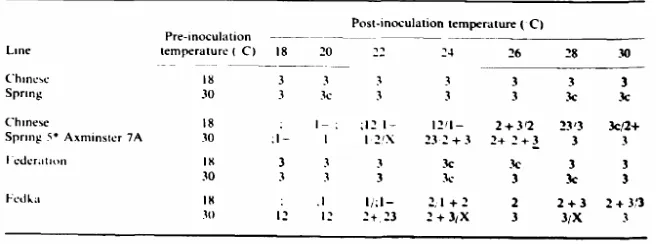
Where two or more ratings are given without separating punctuation, infection types listed appeared on the same leaf. A comma between types indicates differences between leaves of the same replicate, while a diagonal slash indicates differences in the infection types of replicates. The most frequent reaction type is underlined. Extensive chlorosis on the leaf is denoted by 'c', and plus or minus signs indicate that pustules were larger or smaller than the normal size limits
Expression of
Lr20
Spring wheat lines with Ir2t) were susceptible to P recondita race 76-2.3 at all post-inoculation temperatures tested, regardless of pre-inoculation temperature (Table 2). Resistance to the leaf rust pathogen, conferred by
Lr20. was observed as necrotic flecks on leaves in plants raised at 18 C before inoculation and at 18°, 20° and 22°C for 10 days after inoculation. Some uredia appeared on seedlings kept at post-inoculation temperatures of 24°C and 26°C, but were surrounded by necrotic tissue. On the leaves of Lr20-containing lines maintained at 28° C and 30°C, many large uredia were observed, with small necrotic flecks being associated with the margins of only a very few uredia (Table 2).
necrotic tissue were observed on the leaves of plants kept at 18°C and 20C for 10 days after inoculation, and a mixed response was evident on seedlings maintained at a temperature of 22°C after inoculation (Table 2). At post-inoculation temperatures of 24°, 26° and 28°C, uredia were abundant on leaves, and only a few of these were associated with necrotic flecks. Wheat lines with Lr20 grown at 30°C before and after inoculation exhibited a completely susceptible infection type in response to P. recondita infection.
Expression of
Sr15
All lines containing srl5 were susceptible to P. graminis f.sp. tritici race 343-1,2,3,5,6, regardless of the temperature regime employed (Table 3). Both winter and spring wheat lines bearing the Sri5 allele, raised at 18° C prior to inoculation, had necrotic flecks or very small pustules surrounded by necrosis on infected leaves at post-inoculation temperatures of 20° C and below. Larger pustules with associated rings of necrosis were present on leaves at 22° C and 24° C.
[image:5.459.74.402.293.415.2]Table 2 The development of Puccinia rccondita race 76-2,3 in spring wheat lines at different pre- and post-inoculation temperatures
Table 3 The development of Puccinia graminis f.sp. tritici race
All lines were completely susceptible to the stem rust pathogen at and above temperatures of 26°C, 10 days after inoculation (Tables 3 and 4).
By comparison, 5r/5-bearing lines raised at a pre-inoculation temperature of 30°C were completely susceptible to P. graminis f.sp. tritici race 343-1,2,3,5,6 at post-inoculation temperatures of 22°C and above. At 18°C and 20° C. infected leaves developed pustules of restricted size which were surrounded by necrotic tissue (Table 3).
Wheat lines bearing Srl5, raised at 4°C before inoculation, were also completely susceptible to P. graminis f.sp. tritici race 343-1,2.3.5,6 at post-inoculation temperatures of 22° C and above (Tables 3 and 4). Symptoms on the same lines at post-inoculation temperatures of 12° C and 15° C were seen as small pustules surrounded by necrosis, 15 days after inoculation. Pustules with minimal associated necrosis were observed 10 days after inoculation on these lines at post-inoculation temperatures of 18°C and 20°C.
Table 4The development of Puccinia graminis f.sp. tritici race
343-1,2,3,5,6 in winter wheat lines at different pre- and post-inoculation temperatures
Plants grown at 4°C were raised at lower light intensities (70/xmol/s/m2) than the plants maintained at 18°C and 30°C, due to lighting limitations in the cold cabinet that was used. This did not appear to have any significant effect on the symptoms observed, since plants that were raised at 18°C under low light intensities (70 ^mol/s/m2) before inoculation, and then transferred to 18° C and normal light conditions after inoculation, gave similar results to plants raised at 18CC at the higher light intensity (180-250 /jmol/s/m2) used for all other temperatures (data not shown).
DISCUSSION
Our studies represent the first systematic investigation of the effects of pre-inoculation temperature on post-pre-inoculation expression of the Lr20\Srl5
consistent with those of previous studies (Jones & Deverall, 1977a; Gousseau
et al., 1985) and establish that this 4°C difference between the stability of
Lr20 resistance expression and that of Srl5 occurs regardless of pre-inoculation temperature (Tables 2 and 3).
The change from resistance to susceptibility, in seedlings with Lr20/SrI5
raised at 30°C before inoculation, occurred at post-inoculation temperatures significantly lower than those recorded for plants grown at 18°C prior to inoculation (Tables 2 and 3). Furthermore, in plants raised at 30°C, there is a comparative decrease in the degree of resistance conferred by Lr20 and Sr15
at all post-inoculation temperatures at which resistance is normally expressed in plants raised at 18°C. Previously, Jones & Deverall (1977a) observed that the growth of avirulent P recondita colonies on the wheat cultivar Thew
(Lr20j Sr15) at 26° C was more extensive on plants raised at a
pre-inoculation temperature of 30-5°C than on those raised at 205'°C. Similarly, Gousseau & Deverall (1987) observed that the development of avirulent P. graminis f.sp. tritici colonies in the presence of the Sr15 resistance gene was more extensive at a post-inoculation temperature of 18°C when cv. Thew seedlings were raised at 30°C than when they were raised at 18°C prior to infection.
Both genetic mapping (The & Mclntosh, 1975) and mutational analysis of
Lr20 and Sr15 (Mclntosh, 1977) provide strong evidence that a single host gene product recognizes the avirulence gene product from each of the two rust pathogens. If one host gene is indeed responsible for both resistance characters, then the finding that recognition of the P. recondita avirulence gene product is less sensitive to temperature-induced changes than recognition of the P. graminis f.sp. tritici avirulence gene product implies that the products of the two avirulence genes are different. This view is supported by the observation that, in mutant lines, the degree of change in resistance expression against the two pathogens was not the same (Mclntosh, 1977).
The results obtained for resistant lines grown at a low temperature (4°C) indicate a loss of subsequent Srl5 expression that is at least as marked as that observed in the same lines when raised at high temperatures (30°C) (Table 3). To our knowledge, this is the first report of low pre-inoculation temperatures altering resistance gene expression in cereals.
Several hypotheses have been proposed to explain the effects of temperature on some disease resistance genes. Ellingboe (1976) suggested that
More recently, Gousseau et al. (1985) have suggested that changes in plant cell membrane properties which occur in response to changes in
environmental temperature may alter the tertiary protein structure of membrane-associated resistance gene products, thus modifying their ability to recognize corresponding pathogen avirulence gene products. Such modifications could explain both increases and decreases in resistance as post-inoculation temperatures are increased.
Research on both chilling injury and high temperature stress in plants has revealed that acclimation to persistent low or high temperature brings about changes in both the composition and the fluidity of plasma membranes (reviewed in Raison, 1985). These changes can also affect the conformation and activity of membrane-bound proteins (Raison, 1980). Such changes may be responsible for the lowered resistance expression o(Lr20/Srl5 in seedlings acclimatized to very low or very high pre-inoculation temperatures (Tables 2, 3 and 4).
The concept that post-inoculation temperatures alter the sensitivity of membrane-located recognition events has been developed further by Judelson and Michelmore (1992). They propose that altered membrane properties restrict signal transduction rather than, or in addition to, directly restricting the recognition function of resistance gene products. If signal transduction is the critical temperature-labile event, then loss of resistance should occur at the same temperature for both avirulent pathogens, given that trans-membrane signal transduction is likely to be the same for all recognition events conditioned by Lr20/Srl5. This is clearly not the case. Rather, our results are consistent with temperature-induced alterations to the membrane-located Lr20/Srl5 product differentially affecting its ability to bind with the leaf rust and stem rust avirulence products, with recognition of the stem rust product being more sensitive to these changes. An earlier study in wheat (Gousseau et al., 1985) showed that the temperature sensitivity of Sr9b
resistance varied towards two avirulent strains. This again suggests that the primary recognition event is sensitive to temperature variation, rather than the subsequent signal transduction pathway.
Studies of the adaptation of thylakoid membranes of rye and wheat to low temperatures have suggested that, in varieties which differ in cold hardiness, membrane fluidity differs at the end of the hardening process (Vigh et al.,
on expression. There is one report (Dyck & Johnson, 1988) that, in a study of four European wheat cultivars bearing Lr20, the resistance of one cultivar (Sicco) displayed a much higher temperature sensitivity than the others tested. The authors suggested that variation in the Lr20 allele might be responsible, rather than differences in genetic background. If this hypothesis is correct, then it is entirely consistent with the sensitivity of Lr20/ SrI5
resistance expression to small alterations in gene product conformation indicated both by our results and by the earlier mutation studies (Mclntosh, 1977).
The present study clearly demonstrates that the well-recognized post-inoculation temperature sensitivity of the expression of the Lr20! Srl5 gene complex can be significantly modified by the pre-inoculation temperature conditions. In particular, very low pre-inoculation temperatures have been observed to lower the resistance expression of the Srl5 gene significantly. Furthermore, if one accepts that Lr20 and Sri5 are expressions of the same gene (Mclntosh, 1977), the observation that the phenotypic expression of
Lr20 is stable at significantly higher temperatures than that of Srl5 implies that the avirulence gene products from the two fungal species are different. Thus we have an example of gene-for-gene complementarity (Dixon & Lamb, 1990; Keen, 1990) in which a single resistance gene product recognizes two structurally different avirulence gene products from related fungal pathogens. Given that changes in lipid composition and membrane fluidity have been shown to occur at both high and low temperatures (Raison, 1985), these results support an important role for the plasma membrane in host-pathogen interactions. Further experimental manipulation of
temperature-dependent gene complexes, such as Lr20/SrJ5, may provide valuable insights into the biochemical and physiological mechanisms whereby the expression of resistance genes can be modified in vivo.
REFERENCES
Bromfield KR, 1961. The effect of post-inoculation temperature on seedling reaction of selected wheat varieties to stem rust. Phytopathology 51, 590-3.
Deverall BJ, McLeod S, 1980. Responses of wheat cells around heat inhibited rust mycelia and associated with the expression of the Lr20, Sr6 and Sri 5 alleles for resistance. Physiological Plant Pathology 17, 213-9.
Dixon RA, Lamb CJ, 1990. Molecular communication in interactions between plants and microbial pathogens. Annual Review of Plant Physiology and Plant Molecular Biology 41, 339-67.
Dyck PL, Johnson R, 1983. Temperature sensitivity of genes for resistance in wheat to Puccinia recondita. Canadian Journal of Plant Pathology 5, 229-34.
Dyck PL. Johnson R, 1988. Resistance to the leaf or brown rust pathogen {Puccinia recondita) due to Lr20 and its temperature sensitivity in European spring wheats.
Vienna, Austria. Institute for Plant Protection. 91-3.
Ellingboe AH, 1976. Genetics of host-parasite interactions. In: Williams PH. Heitfuss R, eds. Physiological Plant Pathology. New Series, Vol. 4. Berlin: Springer-Verlag, 761-78.
Forsyth FR. 1956. Interaction of temperature and light on the seedling reaction of McMurachy wheat to race 15B of stem rust. Canadian Journal of Botany 34, 745-9.
Gerechter-Amitai ZK, Sharp EL. Reinhold M, 1984. Temperature-sensitive genes for resistance to Puccinia striiformis in Triticum Dicoccoides. Euphytica 33, 665-72.
Gousseau HDM. Deverall BJ. 1986. Effects of the Sr15 allele for resistance on development of the stem rust fungus and cellular responses in wheat. Canadian Journal of Botany 64, 626-31.
Gousseau HDM, Deverall BJ. 1987. Manipulation of the temperature-sensitive expression of the Srl5 allele conditioning resistance to stem rust in wheat.
Physiological and Molecular Plant Pathology 30, 157-65.
Gousseau HDM. Deverall BJ, Mclntosh RA, 1985. Temperature-sensitivity of the expression of resistance to Puccinia graminis conferred by the Srl5. SrVh and Srl4
genes in wheat. Physiological Plant Pathology 27, 335 43.
Jones DR. Deverall BJ. 1977a. The effect of the Lr20 resistance gene in wheat on the development of leaf rust. Puccinia recondita. Physiological Plant Pathology 10, 275 84.
Jones DR. Deverall BJ. 1977b. Experimental manipulation of the hypersensitive response associated with the expression of the Lr20 gene in wheat following infection by leaf rust, Puccinia recondita. Physiological Plant Pathology 10, 285 90.
Judelson HS. Michelmore RW. 1992. Temperature and genotype interactions in the expression of host resistance in lettuce downy mildew. Physiological and Molecular Plant Pathology 40, 233-45.
Keen NT, 1990. Gene-for-gene complementarity in plant-pathogen interactions.
Annual Reviews in Genetics 24, 447-63.
Lange CT, Kingsolver CH, Mitchell JE, Cherry E, 1958. Determination of the effects of different temperatures on uredial infection with Puccinia graminis var. tritici. Phytopathology 48, 658-60.
Luig NH, Rajaram S, 1972. The effect of temperature and genetic background on host gene expression and interaction to Puccinia graminis tritici. Phytopathology 62, 1171-4.
Mclntosh RA, 1977. Nature of induced mutation affecting disease reaction in wheat. In: Induced Mutations Against Plant Diseases. Vienna: International Atomic Energy Agency, 551-65.
Park RF, Ash GJ. Rees RG, 1992. Effects of temperature on the response of some Australian wheat cultivars to Puccinia striiformis f.sp. tritici. Mycological Research
96, 166-70.
Raison JK. 1980. Effect of low temperature on respiration. In: Davies D, ed. The Biochemistry of Plants. Vol. 2. New York: Academic Press, 613-26.
Raison JK. 1985. Alterations in the physical properties and thermal response of membrane lipids: correlations with acclimation to chilling and high temperature. In: St John JB. Berlin E, Jackson PC, eds. Frontiers of Membrane Research in Agriculture, Vol. 9. Ottawa: Rowman & AJlanheld, 383-401.
Sharp EL, 1962. Effects of pre-inoculation host temperature on infection of cereal seedlings by Puccinia striiformis. Nature 19, 593-4.
Stakman EC, Stewart DM. Loegering WQ, 1961 Identification of Physiologic Races of Puccinia graminis var. tritici. United States Department of Agriculture, Agricultural Research Service Publication E617.
The TT, Mclntosh RA, 1975. Cytogenetical studies in wheat. VIII. Telocentric mapping and linkage studies involving Sr22 in chromosome 7AL. Australian Journal of Biological Sciences 28, 531-8.
Vigh L, Horvath I, Farkas T. Horvath U. Belea A. 1979. Adaptation of membrane fluidity of rye and wheat seedlings according to temperature. Phytochemistrv 18, 787-9.
Vigh L, Horvath I. Woltjes J. Farkas T. Van Hasselt P. Kuiper PJC, 1987. Combined electron-spin resonance. X-ray diffraction studies on phospholipid vesicles obtained from cold-hardened wheats. Pimm 170, 14-19
Waterhouse WL. 1929. Australian rust studies. I. Proceedings of the Linnean Society NSW' 54,615-80,