Copyright © 2002, American Society for Microbiology. All Rights Reserved.
Insertions in the Reverse Transcriptase Increase both Drug Resistance
and Viral Fitness in a Human Immunodeficiency Virus Type 1 Isolate
Harboring the Multi-Nucleoside Reverse Transcriptase Inhibitor
Resistance 69 Insertion Complex Mutation
Miguel E. Quin˜ones-Mateu,
1* Mahlet Tadele,
1Mariona Parera,
2Antonio Mas,
3Jan Weber,
1He´ctor R. Rangel,
1Bikram Chakraborty,
1Bonaventura Clotet,
2Esteban Domingo,
3Luis Mene´ndez-Arias,
3and Miguel A. Martínez
2Department of Virology, Lerner Research Institute, Cleveland Clinic Foundation, Cleveland, Ohio,1and Laboratorio de
Retrovirología, Fundacio´n irsiCaixa, Hospital Universitario Germans Trías i Pujol, Badalona,2and Centro de
Biología Molecular “Severo Ochoa,” Consejo Superior de Investigaciones Científicas,
Universidad Auto´noma de Madrid, Madrid,3Spain
Received 2 May 2002/Accepted 3 July 2002
Recent studies have shown that the accumulation of multiple mutations associated with nucleoside reverse transcriptase inhibitor (NRTI) resistance may be grouped as multi-NRTI resistance (MNR) complexes. In this study, we have examined the viral fitness of recombinant viruses carrying the reverse transcriptase (RT) of a human immunodeficiency virus type 1 (HIV-1) primary isolate harboring mutations comprising the MNR 69 insertion complex. Different RT mutants were prepared in the sequence context of either the wild-type RT sequence of the HIV-1BH10isolate or the sequence found in a clinical HIV-1 isolate with the MNR 69 insertion mutation. As expected, in the presence of zidovudine, recombinant viruses harboring the MNR RT from the patient were more fit than wild-type viruses. However, in the absence of drug, the virus with the RT from the original clinical isolate (SS) was more fit than (i) the wild-type virus with an engineered serine insertion between residues 69 and 70 (T69SSS) and (ii) the recombinant virus with the MNR RT where the insertion was removed (2S0S). These results suggest that RT insertions, in the right sequence context (i.e., additional mutations contained in the MNR 69 insertion complex), enhance NRTI resistance and may improve viral fitness. Thus, comparing complex mutation patterns with viral fitness may help to elucidate the role of uncharacterized drug resistance mutations in antiretroviral treatment failure.
Multidrug-resistant (MDR) human immunodeficiency virus type 1 (HIV-1) strains, with reduced susceptibilities to antiret-roviral drugs from two or more classes, are now commonly found in extensively treated patients (13, 27). A recent study has shown that at least 50% of HIV-positive individuals in the United States are infected with drug-resistant variants (D. D. Richman, 2nd HIV DRP Symp. Antivir. Drug Resist., p. 51, 2001.), which may have a profound effect on suboptimal treat-ment responses, reduced viral fitness, and the potential for transmission of drug-resistant virus (5, 20). Among MDR vi-ruses, resistance to multiple nucleoside analogue reverse tran-scriptase inhibitors (NRTI), or multi-NRTI resistance (MNR), can be developed by at least three main pathways: (i) accumu-lation of mutations associated with cross-resistance to NRTI, previously called zidovudine or thymidine analogue resistance mutations, recently referred to as multi-NRTI-associated mu-tations (e.g., M41L, D67N, K70R, L210W, T215Y/F, and K219Q/E); (ii) selection of the key 151 M mutation, followed by the mutations A62V, V75I, F77L, and F116Y, denominated the 151 complex; and (iii) the 69 insertion complex, consisting of a mutation at codon 69 (typically Ser), followed by an
in-sertion of two or more amino acids (e.g., Ser-Ser, Ser-Arg, or Ser-Gly) and generally accompanied by multi-NRTI-associ-ated mutations (13, 15, 36; http://www.iasusa.org). To date, it is still unclear why viruses choose one or the other resistance pathway, although the molecular events leading to selection of specific drug-resistant variants are probably determined by the viral genetic background.
Although with a relatively low prevalence (1 to 3%), several studies have identified heavily treated patients carrying HIV-1 isolates with the MNR 69 insertion complex (1, 2, 6, 10, 11, 19, 24, 31, 34, 37–40, 41). Viral isolates harboring these mutations often show moderate to high-level resistance to all NRTI (11, 19, 23–25, 34, 37, 39, 41). This insertion is located in the3-4 hairpin loop, at the fingers subdomain of HIV-1 reverse tran-scriptase (RT) (39, 41). The biochemical properties of the wild-type HIV-1BH10 RT are not significantly altered upon
introduction of the dipeptide insertion (4, 23). However, the insertion appears to be critical in enhancing AZT resistance in the sequence context of the MDR RT, containing additional NRTI resistance-related mutations (23). Drug susceptibility assays have shown that in the presence of the zidovudine (AZT) resistance mutations M41L, L210W, and T215Y, the insertion confers a moderate to large increase in resistance to NRTI (23).
In the absence of antiretroviral therapy, HIV-1 strains con-taining drug resistance mutations have a reduced fitness
com-* Corresponding author. Mailing address: Cleveland Clinic Founda-tion, Lerner Research Institute, Department of Virology/NN10, 9500 Euclid Ave., Cleveland, OH 44195. Phone: (216) 444-2515. Fax: (216) 444-2998. E-mail: [email protected].
10546
on November 8, 2019 by guest
http://jvi.asm.org/
pared to the wild-type virus (9). However, this impairment on viral fitness is generally compensated with secondary mutations (3, 8, 16, 26). Multiple studies have reported impaired enzyme function and reduced viral fitness of HIV-1 isolates harboring mutations conferring resistance to protease and RT inhibitors (PI and RTI, respectively) (for reviews, see references 8, 26, and 29). Several others have assessed the in vitro fitness of MNR viruses (18, 22, 29). Fitness studies with viruses resistant to multiple NRTI have shown that HIV-1 isolates harboring the MNR-151 complex display higher fitness than the wild-type virus in the absence of drug (18, 22). On the other hand, viral dynamics studies suggest that viruses carrying the MNR 69 insertion complex have a clear selective disadvantage com-pared with HIV-1 variants lacking the insertion (6, 21, 41). In this work, we have analyzed the impact on viral fitness of an insertion of two amino acids (Ser-Ser) between residues 69 and 70 of HIV-1 RT through the use of a dual infection/competi-tion assay (30). The results reveal the role of the viral genetic background on HIV-1 fitness and how the RT sequence con-text (i.e., additional mutations) may play a role in improving the replication capacity of viruses harboring these insertions.
Plasma samples were obtained from a highly treated HIV-infected individual as part of a previous study that screened HIV-1-infected patients for the presence of virus with an amino acid insertion between codons 69 and 70 of HIV-1 RT (7). This HIV-infected 38-year old man had been extensively treated with several RTI and PI, which included a first period of AZT monotherapy (1992 to 1996) and a current regimen combining five antiretroviral drugs (i.e., dideoxyinosine, stavu-dine, nevirapine, saquinavir, and nelfinavir). At the time of sample collection, the plasma viral load was 29,420 HIV-1 RNA copies/ml, with a CD4⫹cell count of 144 cells/l (7, 23).
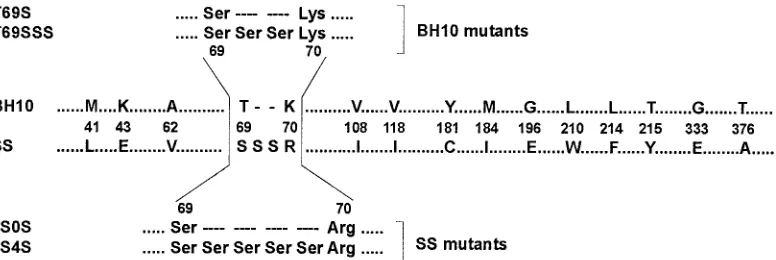
Viral RNA was extracted from the plasma and the RT-coding region was RT-PCR amplified and cloned as previously de-scribed (6). Sequencing of the HIV-1polgene revealed mul-tiple mutations in the protease and RT, many of them associ-ated with resistance to PI and RTI (23). In addition to the insertion of two serines between residues 69 and 70, 43 addi-tional mutations scattered throughout the entire RT-coding sequence were identified (6, 23), including 15 amino acid sub-stitutions related to RTI resistance (36) (Fig. 1).
The role of this dipeptide insertion and its RT genetic
back-ground in HIV-1 replication was evaluated by using a series of HIV-1 variants obtained through recombination of the ana-lyzed RT-coding region with an RT-deleted HXB2-D clone (17, 23). Recombinant constructs included viruses harboring either the RT sequence of a wild-type HIV-1BH10 strain
(termed BH10) or the RT found in an MDR clinical isolate (designated as SS). Two mutant RTs were prepared by replac-ing the Thr-69 with Ser (T69S), or by makreplac-ing this substitution and inserting two additional serines between codons 69 and 70 of the wild-type HIV-1BH10 RT (T69SSS) (Fig. 1). Mutant
derivatives of the SS RT include 2S0S, which lacked the Ser-Ser insertion, and 2S4S, which contained four serines instead of two between codons 69 and 70 (Fig. 1). Recombinant viruses recovered from transfection experiments, carrying the appro-priate nucleotide sequence, were propagated in MT-4 cells.
Peripheral blood mononuclear cells (PBMC) from HIV-seronegative blood donors were obtained by Ficoll-Hypaque density gradient centrifugation of heparin-treated venous blood. Prior to HIV-1 infection the cells were stimulated with 2g of phytohemagglutinin (PHA; Gibco BRL) per ml for 3 to 4 days and maintained in RPMI 1640–2 mML-glutamine
me-dium (Cellgro) supplemented with 10% fetal bovine serum (Cellgro), 10 mM HEPES buffer (Cellgro), 1 ng of interleu-kin-2 (IL-2)/ml (Gibco BRL), 100 U of penicillin/ml, and 100 g of streptomycin/ml (both from Cellgro). Two syncytium-inducing and two non-syncytium-syncytium-inducing HIV-1 primary iso-lates (A-92UG029 and E-CMU06, and A-92RW009 and C-92BR025, respectively) were obtained from the AIDS Re-search and Reference Reagent Program to be used as controls in the growth competition experiments. All viral stocks (i.e., recombinant virus and primary isolates) were expanded in PHA-stimulated, IL-2-treated PBMC. Tissue culture doses for 50% infectivity (TCID50) were determined for each isolate in
triplicate with serially diluted supernatants of each viral prop-agation. RT activity in culture supernatants on day 8 of culture was used to calculate TCID50 values using the Reed and
Muench method (32). Titers were expressed as infectious units per milliliter (IU/ml).
[image:2.587.100.488.72.202.2]In previous studies, we and others had shown that the inser-tion per se of two serines between amino acids 69 and 70 of the HIV-1 RT did not confer significant resistance to NRTI (19, 23, 41). Thus, the wild-type RT (BH10) as well as mutants
FIG. 1. Amino acid sequence differences between RTs from wild-type (BH10) and clinical (SS) HIV-1 mutants. Only those amino acid differences found at codons associated with resistance to RTIs (36) are indicated. Six different plasmid constructions were generated containing RT sequences from the wild-type strain (BH10) and the sequence found in the clinical isolate (SS) (see text for details). The amino acid sequences around positions 69 and 70 of mutants used in this study having insertions, deletions, or substitutions are shown above and below the alignment.
on November 8, 2019 by guest
http://jvi.asm.org/
T69S and T69SSS were all highly susceptible to AZT (Table 1). On the other hand, all recombinant viruses with clinical (SS) background showed resistance to AZT (Table 1) and to other NRTI (i.e., dideoxycytosine, dideoxyinosine, lamivudine, and stavudine) (23). Interestingly, the removal of the two serines
(2S0S) or the addition of two extra serines (2S4S) in the SS RT sequence context produced 5-fold and⬎200-fold reductions in the 50% inhibitory concentration (IC50) value for AZT,
re-spectively (Table 1). These results suggest that both (i) the insertion of two serines and (ii) the correct sequence back-ground are necessary to achieve the high-level resistance to AZT found in the RT obtained from the clinical isolate (SS), as depicted in the MNR 69 insertion complex.
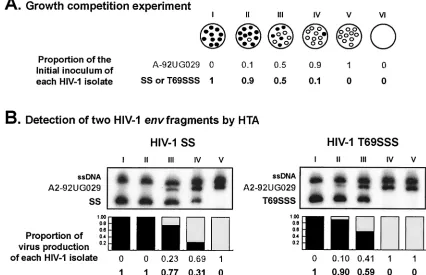
Dual infection/competition experiments were performed in PBMC from one donor as previously described (30) in order to determine the viral fitness of these recombinant HIV-1 strains. Briefly, the dual infection/competition assay involved three separate dual infections with two HIV-1 isolates at different multiplicities of infection (MOIs; expressed as infectious units per cell) (Fig. 2A). Each recombinant HIV-1 variant was added to growth competition experiments along with each of four control HIV-1 primary isolates (i.e., A-92UG029, E-CMU06, A-92RW009, and C-92BR025) under two different conditions: in the absence of drug and in the presence of 6 nM AZT. We used this AZT concentration since it was the deter-mined IC50value for the wild-type HIV-1BH10strain (Table 1).
One milliliter of these virus mixtures was incubated with 106
[image:3.587.43.283.93.191.2]PBMC for 2 h at 37°C, 5% CO2.Subsequently, the cells were
FIG. 2. Schematic representation of growth competition experiments and HTA detection for dual infections. (A) Dual infections with a pair of HIV-1 isolates were performed at three different MOIs (proportion of viruses in wells II, III, and IV). Wells I and V correspond to positive controls for both viruses. An uninfected culture (well VI) was used as a negative control. (B) HTA results from growth competition experiments involving two recombinant HIV-1 strains (SS and T69SSS) and the HIV-1A-92UG029control. Final ratios of each HIV-1 variant in the dual infection
were measured by HTA. NestedenvPCR products from the competitions were denatured and annealed to a subtype B probe (HIV-1B-SF162). The
proportion of virus production of each HIV-1 isolate is shown below the autoradiographs. To derive relative fitness values for each recombinant HIV-1 variant, the final amount of each virus produced from the dual infection was divided by the initial proportion of the virus in the inoculum, as previously described (30). The total relative fitness is the average of four relative fitness values, corresponding to the four competitions of each recombinant virus with each of four controls (i.e., A1, HIV-1A-92RW009; C, HIV-1C-92BR025; A2, HIV-1A-92UG029; and E, HIV-1E-CMU06). See text
[image:3.587.75.501.360.635.2]for experimental details. ssDNA, single-stranded DNA from the probe. A-92UG029, SS, and T69SSS correspond to DNA heteroduplexes. TABLE 1. Susceptibility to AZT and relative fitness of
recombinant HIV-1 constructs
Construct
group RT AZT IC(M)a50
Total relative fitness (% relative to wild type)b
No drug AZT, 6 nM
BH10 mutants T69S 2.4⫻10⫺3(0.4⫻) 2.53 (89.4) 1.41 (49.8)
T69SSS 2.2⫻10⫺3(0.3⫻) 1.56 (55.1) 1.19 (42.1)
BH10 6.6⫻10⫺3 2.83 (100) 1.71 (60.4)
SS mutants SS 5.17 (786⫻) 1.86 (65.7) 4.37 (154) 2S0S 0.94 (143⫻) 1.04 (36.7) 4.37 (154) 2S4S 0.024 (3.6⫻) 0.82 (28.9) 4.13 (146)
aBased on data taken from reference 23. IC
50values represent the mean of
two to four tests, each one performed in sextuplicate. The fold increase in IC50
relative to the wild-type HIV-1BH10virus control is shown in parentheses.
bTotal relative fitness is the average of four relative fitness values,
correspond-ing to the four competitions of each viral construction with each of four HIV-1 control strains (see text for details). Viral fitness was calculated relative to that of the wild-type HIV-1BH10control (100%).
on November 8, 2019 by guest
http://jvi.asm.org/
washed three times with phosphate-buffered saline and then resuspended in complete medium (106 cells/ml). Cells were
washed and fed with complete medium twice a week. New PHA–IL-2–prestimulated PBMC from the same donor were added weekly to replenish viable cells from cultures. Superna-tants and two aliquots of cells were harvested at day 15, resus-pended in dimethyl sulfoxide-fetal bovine serum, and then stored at⫺80°C for subsequent analysis.
Proviral DNA was extracted from lysed PBMC using the QIAamp DNA blood kit (Qiagen) and then PCR amplified using a set of external [envB (14)-ED14 (12) (the gp120-coding region ofenv,⬇1.7 kb)] and nested [E80-E105 (35) (C2-C4env
region, 0.66 kb)] primers. Both external and nested PCRs were carried out in a 100-l reaction mixture as previously described (30). Nested PCR products were isolated in agarose gels, pu-rified using the QIAquick PCR purification kit (Qiagen), and then analyzed using heteroduplex tracking analysis (HTA) (30) (Fig. 2B). Briefly, the same genomic region (env C2-C4) was PCR amplified from the HIV-1B-SF162strain for use as a DNA
probe. For this amplification, the E80 primer was radiolabeled using T4 polynucleotide kinase and 2Ci of [␥-32P]ATP.
Re-action mixtures containing DNA annealing buffer (100 mM NaCl, 10 mM Tris-HCl [pH 7.8], 2 mM EDTA), 10 l of unlabeled PCR-amplified DNA from the competition culture, and approximately 0.1 pmol of radioactive probe DNA were denatured at 95°C for 3 min and then rapidly annealed on wet ice. After 30 min on ice, the DNA heteroduplexes were re-solved on Tris-borate-EDTA buffer 5% nondenaturing poly-acrylamide gels (30:0.8 poly-acrylamide:bispoly-acrylamide) for 2.5 h at 200 V. Gels were dried, exposed to X-ray film (Eastman Kodak Co., Rochester, N.Y.), and scanned for analysis using 1D Im-age Analysis software (Kodak). To estimate the viral fitness of the recombinant viruses, the final ratio of the two viruses produced from each of the three dual infections (MOI ratios of 10:1, 1:1, and 1:10) were determined by HTA and compared to production in the monoinfections as previously described (30). Briefly, a relative fitness value for each virus was obtained from the average of the three independent dual infections (i.e., production of individual HIV-1 strain in a dual infection, di-vided by its initial proportion in the inoculum). The ratio of relative fitness values of each HIV-1 variant in the competition is a measure of the fitness difference between both HIV-1 strains (i.e., recombinant and control viruses) (30). Finally, total relative fitness was calculated as the average of four relative fitness values, corresponding to competitions between each recombinant HIV-1 variant and each one of the four HIV-1 control strains (30). Examples of two HIV-1 dual in-fections and detection of HIV-1env fragments by HTA are shown in Fig. 2.
Growth kinetics curves in the absence of AZT (based on HIV-1 p24 antigen and RT activity determinations in MT-4 cells and PBMC, respectively) were similar for all recombinant viruses (data not shown). However, some differences were ob-served when dual infection experiments were carried out in the absence or in the presence of 6 nM AZT. Figure 3A shows the fitness difference of recombinant viruses relative to the four HIV-1 control strains used. Recombinant viruses carrying a wild-type BH10 RT outcompeted the control strains in growth competition experiments in the absence of drug, while viruses with an MNR RT derived from the clinical isolate totally
outcompeted the control strains in the presence of 6 nM AZT (Fig. 3A). Based on these growth competition experiments and fitness difference values, we were able to calculate the total relative fitness of each recombinant virus in these two different environments (i.e., no drug and 6 nM AZT) (Table 1). Al-though not statistically significant, the total relative fitness of all recombinant viruses carrying wild-type BH10 RT was higher in the absence of drug than when AZT was present in the cell culture (relative fitness ranges of 1.56 to 2.83 and 1.19 to 1.71, respectively) (Table 1). Conversely, relative fitness values were significantly lower for all three recombinant vi-ruses carrying an MNR SS RT in the absence of drug than with those obtained in the presence of AZT (relative fitness ranges of 0.82 to 1.86 and 4.13 to 4.37, respectively;P⬍0.001, Mann-Whitney test) (Table 1). These results are in agreement with previous studies revealing that an accumulation of drug resis-tance mutations has a debilitating effect on HIV-1 replication (and, consequently, viral fitness) while conferring a selective advantage over the wild-type virus in the presence of antiret-roviral drugs (reviewed in references 26 and 29).
Total relative fitness values for each recombinant HIV-1 variant were compared with the viral fitness of recombinant virus having the RT of the wild-type HIV-1BH10strain (BH10).
The fitness of each recombinant virus was then expressed as a percentage of the wild-type virus fitness (taken as 100%) (Fig. 3B). A rank order of viral fitness among the recombinant viruses in the absence or presence of drug was determined. As expected, in the presence of AZT, recombinant viruses bearing the MNR SS RT showed higher fitness than viruses carrying a wild-type BH10 RT (i.e., SS⫽2S0S⬎2S4S⬎⬎WT⬎T69S⬎ T69SSS) (Table 1; Fig. 3B). In addition, there was a correlation between the corresponding AZT IC50values and the relative
fitness of recombinant viruses determined in the presence of AZT (r⫽0.98,P⫽ 0.003; Pearson product moment). How-ever, in the absence of drug, the order for viral fitness was wild type⬎T69S⬎SSⱖ T69SSS⬎2S0S⬎2S4S (Table 1; Fig. 3B). Interestingly, the virus with the RT from the original clinical HIV-1 isolate (SS) was slightly more fit than the wild-type virus with the engineered serine insertion (T69SSS) (65.7 and 55.1% of the wild-type BH10 control, respectively) (Table 1; Fig. 2 and 3B). Moreover, the introduction of a dipeptide insertion in a wild-type RT background (T69SSS) was not sufficient to confer AZT resistance (Table 1), although viral fitness was significantly reduced in this mutant (Table 1; Fig. 3B). On the other hand, deleting the two serine insertions from the MNR background (2S0S virus) did not have a large impact on AZT resistance, but viral fitness in the absence of drug was considerably reduced (36.7%; Table 1 and Fig. 3B). From these results, it is clear that development of high-level resis-tance to AZT and optimal viral fitness requires both the in-sertion at codons 69 and 70 and additional mutations found in the SS RT sequence (i.e., MNR 69 insertion complex) whose identification remains to be investigated.
Our results indicate that the insertion between codons 69 and 70 of the viral RT does not confer a selective advantage in the absence of drug. This observation is consistent with its low prevalence in HIV-infected individuals (approximately 1 to 3%) (1, 2, 6, 24, 39, 40, 41) and with the fluctuating nature of the genomes harboring the insertion, which disappears quickly after AZT treatment is interrupted (6, 21). Estimates obtained
on November 8, 2019 by guest
http://jvi.asm.org/
from a theoretical model considering viral dynamics in vivo showed that the relative fitness of the insertion mutant in the absence of therapy was less than 84%, compared to wild-type virus (21). Interestingly, insertions at codons 69 and 70 have
not been detected in antiretroviral therapy-naïve patients, sug-gesting that they could bear a selective disadvantage in the absence of compensatory mutations. On the other hand, in extensively treated HIV-infected individuals,
insertion-con-FIG. 3. Viral fitness of recombinant HIV-1 variants in the absence (No drug) or presence (6 nM AZT) of drug selection. (A) Fitness differences were derived from the three dual infections in each competition with a control strain (i.e., A1, HIV-1A-92RW009; C, HIV-1C-92BR025; A2,
HIV-1A-92UG029; and E, HIV-1ECMU06). Even though our equation for fitness difference always produces a positive value, these values were plotted
as negative when the recombinant virus was less fit than the control strain, to facilitate data interpretation (30). Thus, a positive or negative fitness difference corresponds to a recombinant HIV-1 strain being more or less fit than the HIV-1 control isolate, respectively. (B) Total relative fitness of each recombinant HIV-1 strain, with wild-type (BH10) or clinical isolate (SS) RT background, calculated relative to the viral fitness of the wild-type HIV-1BH10control (100%).
on November 8, 2019 by guest
http://jvi.asm.org/
taining multi-NRTI mutants were able to maintain high viral loads in the presence of antiretroviral therapy (21). A recent study has identified three patients infected with viruses har-boring the MNR 69 insertion complex mutation (1). In these case, the insertion persisted in both plasma HIV-1 RNA and proviral DNA in all patients after a 1-year follow-up, despite several changes in antiretroviral regimens, while exhibiting sus-tained virologic failure (1). These results, as well as several studies indicating the presence of these mutants in heavily treated individuals (1, 2, 6, 7, 10, 11, 24, 34, 37–39, 41), indicate that these viruses are selected and replicate efficiently despite the fitness loss expected from drug resistance mutations.
Altogether, our results suggest that RT insertions may im-prove the fitness of viruses harboring the Ser-Ser insertion at codons 69 and 70 of the RT-coding region within the MNR 69 insertion complex (i.e., 69SSS in a background of NRTI resis-tance mutations). This would help explain why insertion mu-tations have only been found in this particular RT sequence context. Hence, both drug resistance and viral fitness play a role in selection of HIV-1 RT mutations. The emergence of specific mutations is often highly dependent on the baseline sequence as well as on the sequential selection of compensa-tory mutations that contribute to viral fitness (28, 33; J. Weber, H. Valdez, H. R. Rangel, B. Chakraborty, E. Connick, K. Smith, A. Landay, D. R. Kuritzkes, M. M. Lederman, and M. E. Quin˜ones-Mateu, 9th Conf. Retrovir. Opportunistic In-fect., p. 266, 2002). Additional studies will be necessary to evaluate the role of drug resistance mutations on viral fitness and the clinical significance of this relationship on HIV-1 pathogenesis and drug failure.
Research performed at the Cleveland Clinic Foundation (M.E.Q.-M.) was supported by research grants from the National Heart, Lung, and Blood Institute, National Institutes of Health (NIH) (5-KO1-HL67610-02), and the NIH Center for AIDS Research (AI36219) at Case Western Reserve University. Grants 01/0067-01 (to L.M.-A.) and 01/0067-02 (to M.A.M.) from the Spanish Fondo de Investigacio´n Sanitaria and grant 36207/01 (to L.M.-A. and M.A.M.) from the Fundacio´n para la Investigacio´n y Prevencio´n del SIDA en Espan˜a are acknowledged. Research at Badalona (M.A.M.) was also supported by funds of Fundacio´ irsiCaixa. The Centro de Biología Molecular “Severo Ochoa” is a recipient of an institutional grant from Fundacio´n Ramo´n Areces.
REFERENCES
1.Andreoletti, L., L. Weiss, A. Si-Mohamed, C. Piketty, T. Prazuck, G. Calamy, J. E. Malkin, M. Matta, F. X. Mbopi-Keou, F. Clavel, M. D. Kazatchkine, and L. Belec.2002. Multidrug-resistant HIV-1 RNA and proviral DNA variants harboring new dipeptide insertions in the reverse transcriptasepol gene. J. Acquir. Immune Defic. Syndr.29:102–104.
2.Balotta, C., M. Violin, L. Monno, P. Bagnarelli, C. Riva, G. Facchi, A. Berlusconi, M. Lippi, S. Rusconi, M. Clementi, M. Galli, G. Angarano, and M. Moroni.2000. Prevalence of multiple dideoxynucleoside analogue resis-tance (MddNR) in a multicenter cohort of HIV-1-infected Italian patients with virologic failure. J. Acquir. Immune Defic. Syndr.24:232–240. 3.Berkhout, B.1999. HIV-1 evolution under pressure of protease inhibitors:
climbing the stairs of viral fitness. J. Biomed. Sci.6:298–305.
4.Boyer, P. L., J. Lisziewicz, F. Lori, and S. H. Hughes.1999. Analysis of amino insertion mutations in the fingers subdomain of HIV-1 reverse transcriptase. J. Mol. Biol.286:995–1008.
5.Brenner, B. G., J. P. Routy, M. Petrella, D. Moisi, M. Oliveira, M. Detorio, B. Spira, V. Essabag, B. Conway, R. Lalonde, R. P. Sekaly, and M. A. Wainberg.2002. Persistence and fitness of multidrug-resistant human immu-nodeficiency virus type 1 acquired in primary infection. J. Virol.76:1753– 1761.
6.Briones, C., A. Mas, G. Gomez-Mariano, C. Altisent, L. Menendez-Arias, V. Soriano, and E. Domingo.2000. Dynamics of dominance of a dipeptide insertion in reverse transcriptase of HIV-1 from patients subjected to pro-longed therapy. Virus Res.66:13–26.
7.Briones, C., and V. Soriano.1999. Different outcome in the first two patients with an HIV-1 multinucleoside drug-resistant T69SSS insertion in Spain. Antivir. Ther.4:125–127.
8.Clavel, F., E. Race, and F. Mammano.2000. HIV drug resistance and viral fitness. Adv. Pharmacol.49:41–66.
9.Coffin, J. M.1995. HIV population dynamics in vivo: implications for genetic variation, pathogenesis, and therapy. Science267:483–489.
10.De Antoni, A., A. Foli, J. Lisziewicz, and F. Lori.1997. Mutations in the pol gene of human immunodeficiency virus type 1 in infected patients receiving didanosine and hydroxyurea combination therapy. J. Infect. Dis.176:899– 903.
11.de Jong, J. J., J. Goudsmit, V. V. Lukashov, M. E. Hillebrand, E. Baan, R. Huismans, S. A. Danner, J. H. ten Veen, F. de Wolf, and S. Jurriaans.1999. Insertion of two amino acids combined with changes in reverse transcriptase containing tyrosine-215 of HIV-1 resistant to multiple nucleoside analogs. AIDS13:75–80.
12.Delwart, E. L., E. G. Shpaer, J. Louwagie, F. E. McCutchan, M. Grez, H. Ru¨bsamen-Waigmann, and J. I. Mullins.1993. Genetic relationships deter-mined by a DNA heteroduplex mobility assay: analysis of HIV-1envgenes. Science262:1257–1261.
13.Fontaine, E., K. Van Vaerenbergh, A.-M. Vandamme, and D. Schmitt.1999. Multidrug resistant human immunodeficiency virus type 1. AIDS Rev.1:231– 237.
14.Gao, F., L. Yue, S. Craig, C. L. Thornton, D. L. Robertson, F. E. McCutchan, J. A. Bradac, P. M. Sharp, B. H. Hahn, and WHO Network for HIV Isolation and Characterization.1994. Genetic variation of HIV type 1 in four World Health Organization-sponsored vaccine evaluation sites: generation of func-tional envelope (glycoprotein 160) clones representative of sequence sub-types A, B, C, and E. AIDS Res. Hum. Retrovir.10:1359–1368.
15.Hirsch, M. S., F. Brun-Vezinet, R. T. D’aquila, S. M. Hammer, V. A. John-son, D. R. Kuritzkes, C. Loveday, J. W. Mellors, B. Clotet, B. Conway, L. M. Demeter, S. Vella, D. M. Jacobsen, and D. D. Richman.2000. Antiretroviral drug resistance testing in adult HIV-1 infection: recommendations of an International AIDS Society—USA panel. JAMA283:2417–2426. 16.Hirsch, M. S., B. Conway, R. T. D’aquila, V. A. Johnson, F. Brun-Vezinet, B.
Clotet, L. M. Demeter, S. M. Hammer, D. M. Jacobsen, D. R. Kuritzkes, C. Loveday, J. W. Mellors, S. Vella, and D. D. Richman.1998. Antiretroviral drug resistance testing in adults with HIV infection: implications for clinical management. International AIDS Society—USA Panel. JAMA279:1984– 1991.
17.Kellam, P., and B. A. Larder. 1994. Recombinant virus assay: a rapid, phenotypic assay for assessment of drug susceptibility of human immunode-ficiency virus type 1 isolates. Antimicrob. Agents Chemother.38:23–30. 18.Kosalaraksa, P., M. F. Kavlick, V. Maroun, R. Le, and H. Mitsuya.1999.
Comparative fitness of multi-dideoxynucleoside-resistant human immunode-ficiency virus type 1 (HIV-1) in an in vitro competitive HIV-1 replication assay. J. Virol.73:5356–5363.
19.Larder, B. A., S. Bloor, S. D. Kemp, K. Hertogs, R. L. Desmet, V. Miller, M. Sturmer, S. Staszewski, J. Ren, D. K. Stammers, D. I. Stuart, and R. Pau-wels.1999. A family of insertion mutations between codons 67 and 70 of human immunodeficiency virus type 1 reverse transcriptase confer multinucleoside analog resistance. Antimicrob. Agents Chemother.43:1961– 1967.
20.Little, S. J., E. S. Daar, R. T. D’aquila, P. H. Keiser, E. Connick, J. M. Whitcomb, N. S. Hellmann, C. J. Petropoulos, L. Sutton, J. A. Pitt, E. S. Rosenberg, R. A. Koup, B. D. Walker, and D. D. Richman.1999. Reduced antiretroviral drug susceptibility among patients with primary HIV infection. JAMA282:1142–1149.
21.Lukashov, V. V., R. Huismans, M. F. Jebbink, S. A. Danner, R. J. De Boer, and J. Goudsmit.2001. Selection by AZT and rapid replacement in the absence of drugs of HIV type 1 resistant to multiple nucleoside analogs. AIDS Res. Hum. Retrovir.17:807–818.
22.Maeda, Y., D. J. Venzon, and H. Mitsuya.1998. Altered drug sensitivity, fitness, and evolution of human immunodeficiency virus type 1 withpolgene mutations conferring multi-dideoxynucleoside resistance. J. Infect. Dis.177:
1207–1213.
23.Mas, A., M. Parera, C. Briones, V. Soriano, M. A. Martinez, E. Domingo, and L. Menendez-Arias.2000. Role of a dipeptide insertion between codons 69 and 70 of HIV-1 reverse transcriptase in the mechanism of AZT resis-tance. EMBO J.19:5752–5761.
24.Masquelier, B., E. Race, C. Tamalet, D. Descamps, J. Izopet, C. Buffet-Janvresse, A. Ruffault, A. S. Mohammed, J. Cottalorda, A. Schmuck, V. Calvez, E. Dam, H. Fleury, F. Brun-Vezinet, and the ANRS AC11 Resistance Study Group.2001. Genotypic and phenotypic resistance patterns of human immunodeficiency virus type 1 variants with insertions or deletions in the reverse transcriptase (RT): multicenter study of patients treated with RT inhibitors. Antimicrob. Agents Chemother.45:1836–1842.
25.Miller, M. D., N. A. Margot, P. D. Lamy, M. D. Fuller, K. E. Anton, A. S. Mulato, and J. M. Cherrington.2001. Adefovir and tenofovir susceptibilities of HIV-1 after 24 to 48 weeks of adefovir dipivoxil therapy: genotypic and phenotypic analyses of study GS-96–408. J. Acquir. Immune Defic. Syndr.
27:450–458.
on November 8, 2019 by guest
http://jvi.asm.org/
26.Nijhuis, M., S. Deeks, and C. Boucher.2001. Implications of antiretroviral resistance on viral fitness. Curr. Opin. Infect. Dis.14:23–28.
27.Omrani, A. S., and D. Pillay.2000. Multi-drug resistant HIV-1. J. Infect.
41:5–11.
28.Precious, H. M., H. F. Gunthard, J. K. Wong, R. T. D’aquila, V. A. Johnson, D. R. Kuritzkes, D. D. Richman, and A. J. Leigh Brown.2000. Multiple sites in HIV-1 reverse transcriptase associated with virological response to com-bination therapy. AIDS14:31–36.
29.Quin˜ones-Mateu, M. E., and E. J. Arts.2001. HIV-1 fitness: implications for drug resistance, disease progression, and global epidemic evolution, p. 134– 170.InC. Kuiken, B. Foley, B. Hahn, P. Marx, F. McCutchen, J. Mellors, S. Wolinsky, and B. Korber (ed.), HIV sequence compendium 2001. Theoret-ical Biology and Biophysics Group, Los Alamos National Laboratory, Los Alamos, N.Mex.
30.Quin˜ones-Mateu, M. E., S. C. Ball, A. J. Marozsan, V. S. Torre, J. L. Albright, G. Vanham, G. G. van der, R. L. Colebunders, and E. J. Arts.2000. A dual infection/competition assay shows a correlation between ex vivo human immunodeficiency virus type 1 fitness and disease progression. J. Vi-rol.74:9222–9233.
31.Rakik, A., M. Ait-Khaled, P. Griffin, D. A. Thomas, M. Tisdale, J. P. Kleim, et al.1999. A novel genotype encoding a single amino acid insertion and five other substitutions between residues 64 and 74 of the HIV-1 reverse tran-scriptase confers high-level cross-resistance to nucleoside reverse transcrip-tase inhibitors. J. Acquir. Immune Defic. Syndr.22:139–145.
32.Reed, L. J., and H. Muench.1938. A simple method of estimating fifty percent endpoints. Am. J. Hyg.27:493–497.
33.Rose, R. E., Y. F. Gong, J. A. Greytok, C. M. Bechtold, B. J. Terry, B. S. Robinson, M. Alam, R. J. Colonno, and P. F. Lin.1996. Human immuno-deficiency virus type 1 viral background plays a major role in development of resistance to protease inhibitors. Proc. Natl. Acad. Sci. USA93:1648–1653. 34.Ross, L., M. Johnson, N. Graham, M. Shaefer, and M. St. Clair.1999. The reverse transcriptase codon 69 insertion is observed in nucleoside reverse transcriptase inhibitor-experienced HIV-1-infected individuals, including those without prior or concurrent zidovudine therapy. J. Hum. Virol.2:290– 295.
35.Sanders-Buell, E., M. Salminen, and F. McCutchan.1995. Sequencing prim-ers for HIV-1, p. III-15–III-21.InB. Korber, B. D. Walker, J. P. Moore, G.
Myers, C. Brander, R. A. Koup, and B. Haynes (ed.), Human retroviruses and AIDS. Theoretical Biology and Biophysics Group, Los Alamos National Laboratory, Los Alamos, N.Mex.
36.Shafer, R. W., K. Dupnik, M. A. Winters, and S. H. Eshleman.2000. A guide to HIV-1 reverse transcriptase and protease sequencing for drug resistance studies.InC. Kuiken, B. Foley, B. Hahn, P. Marx, F. McCutchen, J. Mellors, S. Wolinsky, and B. Korber (ed.), HIV sequence compendium 2000. Theo-retical Biology and Biophysics Group, Los Alamos National Laboratory, Los Alamos, N.Mex.
37.Sugiura, W., M. Matsuda, Z. Matsuda, H. Abumi, A. Okano, T. Oishi, K. Moriya, Y. Yamamoto, K. Fukutake, J. Mimaya, A. Ajisawa, M. Taki, K. Yamada, and Y. Nagai.1999. Identification of insertion mutations in HIV-1 reverse transcriptase causing multiple drug resistance to nucleoside analogue reverse transcriptase inhibitors. J. Hum. Virol.2:146–153.
38.Tamalet, C., J. Izopet, N. Koch, J. Fantini, and N. Yahi.1998. Stable rear-rangements of the3-4 hairpin loop of HIV-1 reverse transcriptase in plasma viruses from patients receiving combination therapy. AIDS12:F161– F166.
39.Tamalet, C., N. Yahi, C. Tourres, P. Colson, A. M. Quinson, I. Poizot-Martin, C. Dhiver, and J. Fantini.2000. Multidrug resistance genotypes (insertions in the3-4 finger subdomain and MDR mutations) of HIV-1 reverse transcriptase from extensively treated patients: incidence and asso-ciation with other resistance mutations. Virology270:310–316.
40.Van Vaerenbergh, K., K. Van Laethem, J. Albert, C. A. Boucher, B. Clotet, M. Floridia, J. Gerstoft, B. Hejdeman, C. Nielsen, C. Pannecouque, L. Perrin, M. F. Pirillo, L. Ruiz, J. C. Schmit, F. Schneider, A. Schoolmeester, R. Schuurman, H. J. Stellbrink, L. Stuyver, J. Van Lunzen, B. Van Remoor-tel, E. Van Wijngaerden, S. Vella, M. Witvrouw, S. Yerly, E. De Clercq, J. Destmyer, and A. M. Vandamme.2000. Prevalence and characteristics of multinucleoside-resistant human immunodeficiency virus type 1 among Eu-ropean patients receiving combinations of nucleoside analogues. Antimi-crob. Agents Chemother.44:2109–2117.
41.Winters, M. A., K. L. Coolley, Y. A. Girard, D. J. Levee, H. Hamdan, R. W. Shafer, D. A. Katzenstein, and T. C. Merigan.1998. A 6-base pair insert in the reverse transcriptase gene of human immunodeficiency virus type 1 confers resistance to multiple nucleoside inhibitors. J. Clin. Investig.102:
1769–1775.