Manipulating the Manipulators:
Richer Models of Strategic Behavior in Judgment
Aggregation
MSc Thesis
(Afstudeerscriptie)
written by
Zoi Terzopoulou
(born August 6, 1993 in Athens, Greece)
under the supervision ofDr Ulle Endriss, and submitted to the Board of Examiners in partial fulfillment of the requirements for the degree of
MSc in Logic
at theUniversiteit van Amsterdam.
Date of the public defense: Members of the Thesis Committee: June 15, 2017 Prof Jan van Eijck
Contents
Abstract v
Acknowledgements vi
1 Introduction 1
1.1 About Judgment Aggregation . . . 1
1.2 About this Thesis . . . 4
2 Background 5 2.1 Formula-based Judgment Aggregation . . . 5
2.2 Agendas . . . 6
2.3 Rules . . . 7
2.4 Axioms . . . 10
2.5 Binary Aggregation with Integrity Constraints . . . 11
2.6 Preference Relations . . . 12
2.7 Strategic Manipulation . . . 14
3 Strategic Manipulation under Partial Information 17 3.1 Information Functions . . . 18
3.2 Strategy-proofness under Partial Information . . . 21
3.3 Best Strategies . . . 22
3.4 The Interplay between Full and Partial Information . . . 23
3.5 Relevant Information . . . 26
3.6 The Premise-based Procedure: An Extended Analysis . . . 29
3.7 Avoiding the Impossibility . . . 33
3.8 Concluding Remarks . . . 36
4 Higher-level Strategic Manipulation 37 4.1 Information about the Information of Others . . . 39
4.2 Strategizing with Second-level Reasoning . . . 41
4.3 The Interplay between First-level and Second-level Reasoning . . . . 42
4.4 Examples . . . 44
4.5 Strategizing with Higher-level Reasoning . . . 46
4.6 Common Knowledge on Preferences — An Example . . . 47
4.7 The Interplay between Lower and Higher Levels of Reasoning . . . . 50
4.8 Concluding Remarks . . . 53
5 Iterative Judgment Aggregation 55 5.1 The Model under Full Information . . . 56
5.2 Iterative Premise-based Procedure under Full Information . . . 59
5.3 Adding Partial Information . . . 61
5.4 Iterative Premise-based Procedure under Zero Information . . . 64
5.5 Iterative Plurality . . . 65
5.6 Is Strategic Behavior Socially Profitable? . . . 69
5.7 Concluding Remarks . . . 77
6 Conclusion 79 6.1 Summary of the Results . . . 79
6.2 Future Research . . . 81
Appendix 83
List of Symbols 93
Abstract
Judgment Aggregation is a formal framework of collective decision making. When agents that belong to a group express their individual opinions on a set of logically interconnected issues, a good rule is required in order to combine these opinions and induce a representative collective judgment for the group. However, it is often the case that some agent may find a way to achieve a preferable outcome for herself, by reporting a dishonest opinion. This kind of strategic behavior, namely manipulation, constitutes the heart of this thesis. Until now, researchers have been making two very strong assumptions in the context of Judgment Aggregation: first, that all the agents fully know the truthful opinions of all the other members of their group; and second, that every agent thinks that everyone else is always truthful. In this thesis we start with enriching the existing model of Judgment Aggregation in a twofold manner: we account for partially informed agents who behave strategically under various types of uncertainty, as well as for higher-level strategic reasoners, who reflect on the reasoning of their peers. We employ analytical methods, and we explore how the aforementioned assumptions affect the agents’ choices and insincere acts in Judgment Aggregation. Moreover, after investigating in depth single-round aggregation processes, a model of Iterative Judgment Aggregation is developed. In our third model, the agents have the possibility to change their initially submitted judgments in a sequential random order, while they are (maybe partially) observing the acts of their peers. We studypaq
whether common aggregation rules in iteration reach equilibria states, pbq how fast they do, and pcq what the potential benefits of strategic behavior are, for a group of agentsen masse.
Having read the acknowledgments of other theses before, I thought that mentioning one’s supervisor first is just a matter of good manners. But now I know; if other students have had an experience even remotely similar to mine, then their supervisor’s principal place in the acknowledgments is more than well-deserved. This was meant to say: “Thank you, Ulle”. For believing in me before I even learned how to spell “Gibbard-Satterthwaite”, for pushing me forward with your comments in every single meeting, for carefully checking my work and teaching me the importance of aesthetics in writing, and for reminding me to give some examples, in between of my definitions. Studying in Amsterdam as an independent adult was made possible thanks to the Amsterdam Science Talent Scholarship program, and the Onassis Foundation, that generously financed me. I am very grateful to the people who made that happen. I would also like to thank Jan, Ronald, and Sonja, for being in my committee and taking the time to read this thesis. Moreover, thank you, Sonja, for being there for me, available for discussion and advice every time I needed it during the Master’s.
I owe a big thanks to the members of the Computational Social Choice group: Ronald, Sirin, Weiwei. Thank you for the interest you showed in my work since the very first moment, and thank you for the support and motivation that you were con-stantly offering, even without realizing. Next, Laura, I cannot express how different the last two years would have been without you. You have been an italian sister, mother, and best friend for me. I am honored to have met you, and I am very happy to be the first one from our year to acknowledge how amazing your cakes are. Bonan, thanks for your positive energy, that was filling our flat and was often giving me a new perspective on things. Levin and Lisa, thank you for letting me talk to you about anything that worried me, from science to life, and for sharing your beautiful ideas. Natalia, thank you for always being willing to travel. I wish I could mention every other person that did the Master of Logic with me, but this thesis is already long. You know who you are: your enthusiasm and kindness made this experience unique!
Finally, to my friends and family from Greece: thank you for making sure that I always remember how much trust you have in my potentials, either by giving me the warmest welcome when I come back, or by being there, loving faces behind a screen. To my mother, my father and my brother: you are able to make the dark dutch sky look lighter. Thank you, I will need it. Μαμά, Μπαμπά, Παναγιώτη: Ευχαριστώ!
Chapter 1
Introduction
Judgment Aggregation is a formal framework that has its roots in the area of Social Choice Theory and models a particular class of collective decision making problems emerging from Political Science, Philosophy, Law, but also Economics and Artificial Intelligence. The situations that Judgment Aggregation is concerned with involve in-dividuals (agents) expressing binary (Yes / No) opinions on possibly interconnected issues, upon which a collective decision has to be made. Since the first appearance of democratic societies, citizens have been participating in various procedures with the aim of aggregating individual judgments and making collective choices. The individ-uals in a Judgment Aggregation setting may also be people engaging in everyday-life, small-scale collective decision making. For example, groups of friends or families, boards of companies, or juries of courts. On the other hand, computerized intelligent agents may also make use of aggregation methods to make collective decisions. In Section 1.1 we review the framework of Judgment Aggregation and we motivate its applications. In Section 1.2 we give an overview of this thesis, which investigates several aspects of strategic behavior in Judgment Aggregation, and we discuss our broader contributions to related fields.
1.1
About Judgment Aggregation
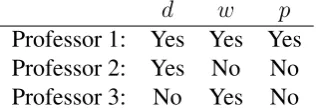
Consider a committee consisting of three professors that has to evaluate the Master’s thesis of a student.1 The committee is expected to collectively pass or fail the student, depending on the individual judgments of its members. Specifically, according to the regulations of the Master’s program, the student can obtain a final passing grade (p) if and only if her thesis is considered satisfactory in both the following two criteria: “dif-ficulty” (d) and “writing” (w). Suppose now that the professors express the judgments depicted on Table 1. A Yes-judgment on a criterion means that the thesis is evaluated
1The thesis-evaluation example is inspired by thedoctrinal paradox, initially observed by
Korn-hauser and Sager (1986) in the context of Legal Theory, and later discussed by Pettit (2001) (see also Mongin, 2012).
d w p Professor 1: Yes Yes Yes Professor 2: Yes No No Professor 3: No Yes No
Table 1: The thesis-evaluation example.
as good enough regarding that particular criterion. Professor 1 liked the thesis a lot; he thinks that it satisfies both criteria and hence, that the student should pass. However, Professors 2 and 3 disagree in different ways. In Professor 2’s opinion, even if the content of the thesis is advanced, its writing-style does not correspond to the Master’s level, and this constitutes a sufficient reason for the student to fail. To the contrary, Professor 3 thinks that the thesis is well-written, but she suggests a failing final grade on the basis of the student’s poor performance with regard to the difficulty criterion. In total, two out of the three members of the committee evaluate the thesis as satisfy-ing on each one of the stated criteria. So, if a majority rule operates, focussatisfy-ing only on the evaluations of the professors concerning the thesis’ difficulty and writing-style, then the student should pass. But if the committee’s decision is based only on the final grades that the professors would assign individually, then a majority would prescribe failing the student. Finally, if the decision of the committee is induced by the opinion of the majority on each issued,w, andpseparately, then it will be inconsistent with respect to the regulations, suggesting a “Yes” considering the two criteria, but a “No” regarding the student’s passing final grade.
The crucial role of the chosen aggregation method applied in an aggregation prob-lem is now brought into light. Different procedures may prescribe totally opposite, even inconsistent, actions for a group. Abstracting from specific situations, the frame-work of Judgment Aggregation is able to study the common structure between differ-ent aggregation scenaria, and provide answers to questions like: Under which con-ditions does a given aggregation process result in “appropriate” collective outcomes? What kind of aggregation rules are guaranteed to always induce “good” group deci-sions? As a formal framework in its own right, Judgment Aggregation was introduced by List and Pettit (2002, 2004) (see Endriss (2016) and List (2012) for two recent reviews of the field). Creating a general basis for numerous types of collective de-cision making problems, it incorporates a large framework that has been developed independently: Preference Aggregation (that is most prominently exemplified in Vot-ing Theory; see for instance the review by Zwicker, 2016), and is closely connected to Belief Merging (mainly studied in Computer Science, e.g., by Everaere et al., 2015).
Strategizing
1.1. About Judgment Aggregation 3
Once a machinery for making social choices from individual tastes is es-tablished, individuals will find it profitable, from a rational point of view, to misrepresent their tastes by their actions [...]
Arrow’s claim will become clearer considering again the thesis-evaluation situa-tion. The committee has now chosen to use the first aggregation procedure that we mentioned in the example. That is, the student can pass if and only if, with respect to each criterion, more than half of the professors believe that her thesis is sufficiently good. Then, if the committee reports the judgments of Table 1, the student should indeed pass. However, imagine that during a meeting where the members of the com-mittee discuss about their evaluations of the thesis, Professor 2 gets to know the exact opinions of her colleagues. Hence, she realizes that, if she truthfully declares her judgment, then the committee will pass the student, following the regulations. But this does not please Professor 2, who judges that the student should not obtain a Mas-ter’s degree because her writing skills are disappointing. Smart as she is, Professor 2 then decides to lie; she pretends that, similarly to Professor 3, she found the difficulty-level of the thesis not satisfying. In that case, more than half of the professors claim that the student’s performance on one criterion is insufficient, and as a result, the stu-dent will fail. At the end of the day, one individual had the chance tomanipulatethe decision making process, in order to obtain a more desirable outcome for her.
It is shown by Dietrich and List (2007c) that situations like the previous one are often unavoidable in Judgment Aggregation. More precisely, aggregation procedures that meet some reasonable properties are always manipulable, when the agents are fully aware of the judgments of their peers and they expect everyone else to be truth-ful.2 Subsequently, scholars have been hunting through Dietrich and List’s assump-tions, for those conditions whose relaxation could reveal some more positive news (see Baumeister et al. (2017) for an overview). First, a successful approach (already pointed out in the same article of Dietrich and List, 2007c) relates to limiting the pos-sible opinions that a group of agents can submit, viz., imposingdomain restrictions.3 Second, another renowned method, principally employed by computer scientists (e.g., Endriss et al., 2012), shows that deciding the manipulation problem of certain aggre-gation procedures is computationally hard, and hence practically impossible to happen (see also Bartholdi et al. (1989) for an older work in Voting).4
In this thesis we give an answer to the following naturalresearch question: Do the negative implications of Dietrich and List’s theorem hold for more refined assumptions concerning the information and the reasoning abilities of the agents?
2This result is analogous to the famous impossibility theorem of Gibbard (1973) and Satterthwaite
(1975) in Voting Theory.
3A domain restriction for instance isunidimensional alignment (List, 2003), according to which
the members of a group can be aligned in a left-to-right order, such that, for every issue upon which judgments are expressed, all the agents that have the same opinion are either on the left or on the right side of those that disagree with them.
4In Voting, alternative ways to escape the inevitability of manipulation have been attempted too, as
1.2
About this Thesis
Our goal is to extend the basic model of Judgment Aggregation, by accounting for richer aspects of intelligent agents’ (either human or artificial) interactions, and ex-amining the correlations with their strategic attitudes. Our study is systematic, in the sense that it consistently investigates the manipulability of common aggregation procedures under various assumptions, yet flexible, since it allows for additional mod-ifications. This thesis is purely formal, but motivated by psychological and behavioral facts. Chapter 2 presents the technical background, that is followed by the main body in Chapters 3, 4 and 5 (further explained below). We conclude in Chapter 6.
Chapter 3. In aggregation procedures that take place in large groups, or that involve confidential issues, etc., it is obvious that the assumption that the agents are fully in-formed about all the opinions of others is rather stringent. But how would agents reason when they are ignorant of a part of their peers’ opinions? Can such uncer-tainty influence their incentives for manipulation? We design a model of Judgment Aggregation that embodiespartial information, and we answer those questions.
Chapter 4. Once intelligent agents start reasoning about a decision-making situa-tion, where other agents participate too, it is reasonable to assume that they will be tempted to reason about the reasoning of their peers. So, what happens if an agent realizes that a member of her group has a reason to report an insincere judgment? Are the first agent’s possible incentives to manipulate affected? We investigate this issue by developing a model ofhigher-level reasoningin Judgment Aggregation.
Chapter 5. In practice, collective decision making procedures may take place in multiple rounds, instead of a single one. We study the manipulative acts of the agents in a model of Iterative Judgment Aggregation. The main questions that we address are: Do iterative aggregation processes reach a terminal state where no-one can profit by a unilateral deviation (i.e., an equilibrium)? Do they reach this state fast? And how beneficial is strategic behavior in the end for a society or a group as a whole?
Chapter 2
Background
This chapter is meant to provide a baseline for the formal language of this thesis. We present the model of formula-based Judgment Aggregation(Section 2.1), discussing various agendas (Section 2.2) on which aggregation rules are applied (Section 2.3), and we examine the rules’ normative appeal grounded on sets ofaxioms(Section 2.4). We also introduce an alternative but equivalent framework of Judgment Aggregation:
Binary Aggregation with Integrity Constraints (Section 2.5). Next, individual prefer-enceswith regard to collective decision making are analyzed (Section 2.6), facilitating the transition of our focus to the study ofstrategic behavior(Section 2.7).
2.1
Formula-based Judgment Aggregation
We now present the basic model of formula-based Judgment Aggregation, which is going to be used throughout this thesis. We follow Baumeister et al. (2016); En-driss (2016) and List and Pettit (2002). Consider a finite set of individuals (agents) N “ t1,2, . . . , nu, withn ě 2, that constitute a group whose judgments are to be
aggregated into one collective decision. The issues that the agents express opinions upon are calledpropositionsand are represented as formulas in classical Propositional LogicL. In the sequel we will assume acquaintance of the reader with the basic con-cepts of Propositional Logic.5 We define „φ the complement of formulaφ P L as follows: „φ :“ φ1 ifφ
“ φ1 for some formula φ1, and
„φ :“ φ otherwise. The domain of the decision making is anagenda Φ, whereH ‰Φ Ď L, andΦis closed under complementation (i.e., for every formulaφPL, ifφ PΦ, then„φ PΦ).
Each individual i’s judgment set (or opinion) Ji Ď Φ is the set of propositions
that she accepts inΦ. We assume that all individual judgment sets areconsistent, i.e. consistent sets of propositions in the standard sense of Logic, andcomplete, i.e. they
5An extended model of Judgment Aggregation which captures propositions expressed in richer
logical languages, such as Predicate Logic, Modal Logic, and Multi-valued or Fuzzy Logic is developed by Dietrich (2007), but goes beyond the scope of our work.
contain at least one member of each proposition-complement pair inΦ.6 The set of all the consistent and complete subsets of the agendaΦ, which are the possible judgment sets of the agents, is denoted asJpΦq. In addition, we say that two judgmentsJandJ1 agree on propositionφ if and only if φ belongs to both or neither of them, and they
disagreeotherwise. AprofileJ “ pJ1, . . . , Jnq PJpΦqnis a vector of all the agents’
judgment sets, andJ´i stands for the partial profile of judgments of the whole group
except for agenti. We denote withNφJ the set of agents who acceptφinJ, and with NJ
φ its set-theoretic complement, i.e., the set of agents who rejectφand accept„φ.
Finally, an aggregation ruleF is a function that maps every profile J of individ-ual judgment sets to a set FpJq of collective decisions, which are (not necessarily complete or consistent) subsets of the agenda. When FpJqis a singleton, i.e., when F :JpΦqn Ñ2Φ, the ruleF is calledresolute. In general, the practical aim of an ag-gregation rule is to provide us with an answer about what the collective decision of the agents is, or should be. To that end, resolute rules are essential. Hence, for what fol-lows we will always work with them (even when it is not mentioned, all the definitions and results stated hereafter will refer to resolute rules); when resoluteness is not the case, we will additionally consider alexicographic tie-breaking ruleto resolve the ties between the suggested collective opinions. To be precise, a lexicographic tie-breaking rule ranks all the possible subsets of the agenda (the sets in2Φ) using a linear order,
and if the result of an aggregation rule consists of at least two judgment sets, then it dictates the choice of the one ranked higher. Intuitively, the prescribed linear order can be thought to represent the preference of a leading agent, whose desires are to be satisfied when the aggregation rule does not suggest a unique solution. For example, the president of a company may be asked to resolve the ties when the judgments of the board clash.7
2.2
Agendas
The set of propositions on which a collective decision is to be made, i.e., the agenda of an aggregation problem, is a prime constituent of the Judgment Aggregation frame-work. Several restrictions can be imposed on the structure of an agenda, in order to better capture the essence of specific aggregation situations, or to establish certain desirable properties of the aggregation, such as logical consistency of the collective
6These conditions have been relaxed by some authors. For example, Dietrich and List (2008)
con-sider a framework in Judgment Aggregation with incomplete individual opinions.
7An alternative technique of breaking ties could exploitrandom tie-breaking. In this thesis however,
we insist on the use of lexicographic tie-breaking orders. One of our main reasons is that breaking ties with a linear order satisfies the independence of irrelevant alternatives principle(Ray, 1973). The independence of irrelevant alternatives principle, also known as Sen’s propertyα(Sen, 1969, 1970), states that if an alternativeJ is chosen from a setS, andJis also an element of a subsetS1ofS, then
2.3. Rules 7
outcome. The former case is further discussed below; the latter is part of a research focus that goes by the name safety of the agenda, and will not be relevant for this thesis (but for the interested reader we refer to Endriss et al., 2010, 2012).
Two examples of special agendas are theconjunctiveand thedisjunctiveagendas.
Definition 2.1. Aconjunctiveagenda consists of a set ofpremises, which are propo-sitional variables a1, . . . , ak, and aconclusionc, where cØ pa1^. . .^akq, as well
as their negations.
The thesis-evaluation example in the Introduction uses an instance of a conjunctive agenda with two premises. Analogously, the conclusion of a disjunctive agenda is equivalent to the disjunction of all the premises. Naturally, conjunctive and disjunctive agendas appear in situations in which a final decision has to be made on a conclusion, but the reasons that lead to that choice, described by the premises, are also important. A more general class of agendas, which includes the ones mentioned above, is that of the path-connected agendas, defined by Dietrich (2007) and related to the concept of total-blockedness (Nehring and Puppe, 2007). In the words of Dietrich and List, an agenda of propositions under consideration is path-connected if any two propositions in the agenda are logically connected with each other, either directly or indirectly, via a sequence of (conditional) logical entailments. Formally, propositionφ
conditionally entailspropositionψ iftφ, ψu YΨis consistent for someΨĎΦ con-sistent with φ and with ψ. The agenda Φ is path connected if for all propositions φ, ψ PΦthat are not tautologies nor contradictions, there is a sequence of propositions φ1, φ2, . . . , φk P Φwithφ “φ1andψ “φksuch thatφi´1conditionally entailsφi, for
everyiP t2, . . . ku. Almost every standard and interesting agenda is path-connected. Whenever we assume that the examined agendas are of a specific kind, it will be made clear in the text.
2.3
Rules
The core of the theory of Judgment Aggregation consists of course of the aggregation rules. The first encounter of the reader with aggregation rules in this thesis has been in the Introduction, where we mentioned different possible methods to aggregate the judgments of the committee in the thesis-evaluation example. One of them was the
majority rule. Re-stated slightly more formally here, the majority rule accepts each issue in the agenda if and only if at least half of the agents accept it (for the strict case, an acceptance by more than half of the group is required). Generalizing the majority rule, thequota rulesmay be defined. According to them, a proposition is part of the collective decision if and only if at least some proportion of the agents (exceeding the relevantquota) agrees with it.
Definition 2.2. Consider a fixed quota qφ P r0, n `1s for every proposition φ in
A peculiar category of aggregation rules, inspired by the quota rules but being less appealing to our intuitions, consists of theparity rules. The odd(even)-parity rule accepts a propositionφif and only if an odd (even) number of agents accepts it.
However, we already saw in the Introduction that when the majority rule is im-plemented, the collective outcome may end up being logically inconsistent (recall the thesis-evaluation example: the majority of the professors accepts that the student passes each evaluation criterion, but the majority also wants the student to fail). Such unfortunate cases hold for the other quota rules too. To resolve this problem, an ef-fective method is the use of thepremise-based procedure. We consider this rule with regard to conjunctive agendas (the definition for disjunctive agendas is similar).
Definition 2.3. Consider a conjunctive agendaΦwith Φp :
“ ta1, . . . , akuthe set of
its premises and cits conclusion. Having a profile J of judgments of n agents, we define the outcome of thepremise-based procedureFpr as follows: First, a collective decision is made on the premises with respect to the majority rule, that is, for all ai PΦp,ai P FprpJqif|NaiJ| ą
n
2, and ai P F
prpJqotherwise. Then,cPFprpJqif
ai PFprpJqfor allai PΦp, and cPFprpJqotherwise.
Since c Ø pa1 ^. . .^akq, a consistent outcome is then guaranteed. Alternatively,
one could also use the conclusion-based procedure. In that case, the opinion of the group is aggregated again using the majority rule, only regarding the conclusion, and individual judgments on the premises are ignored. It is clear from the Introduction that the premise-based procedure and the conclusion-based procedure may produce diametrically opposite results. As demonstrated in our thesis-evaluation example, the former rule would advise giving to the student a passing grade, because the student is good enough in each evaluation criterion separately, while the latter would fail her, following the opinion of the majority of the professors on the conclusion. Hence, it is easy to understand why choosing between the premise-based and the conclusion-based procedure has generated numerous philosophical debates among political scientists and economists (e.g., Chapman, 2002; Dietrich and List, 2007c; Elster, 1998; Pettit, 2001). In several parts of this thesis we will contribute to this discussion.
The most trivial and objectionable aggregation rule is the dictatorship. Living up to its name, the dictatorship is connected to a single agent, the dictator, whose individual judgment is taken to be the collective judgment independently of the input profile. The dictatorship vacuously guarantees that the opinion of the group, that is exactly the opinion of the dictator, will satisfy all the nice properties of individual opinions, like completeness and consistency.
Fortunately, there are several other aggregation rules that present the above ad-vantage. For example, thedistance-based or Kemeny ruleFK (Endriss et al., 2012;
Pigozzi, 2006; Miller and Osherson, 2009) takes into account a notion of distance
between judgment sets and specifies the winner(s) to be the complete and consistent judgment set(s) that is (are) closer to the profile of the agents’ opinions. Specifically, the Hamming-distance HpJ, J1
q of two judgment sets J, J1
2.3. Rules 9
HpJ, J1q:“ |Φ| ´ |JXJ1| ´ |JXJ1|
Then, theHamming-distance HpJ, Jqof the profile J “ pJ1, . . . , Jnqand the
judg-ment setJ sums the Hamming distances of all judgment setsJ1, . . . , JnandJ.
HpJ, Jq:“
ÿ
iPt1,...,nu
HpJi, Jq
Given the profileJ, we have thatFK
pJq “arg min
JPJpΦq
HpJ, Jq. This is a direct
trans-lation of the Kemeny rule that appeared in Voting Theory many years earlier in the work of Kemeny (1959). Endriss and Grandi (2014) later introduced the class of
representative-voter rules, which choose a voter that better represents the input pro-file according to specific criteria and make her judgment be the collective decision. A natural choice for a representative voter is the one realized by the average-voter rule Fav. According to it, the collective outcome is taken to be the individual judg-ment(s) in the profileJ for which the Hamming distance toJ is minimized (note that contrary to the Kemeny rule, the decision of the group is now selected among the sub-mitted judgment sets only). Formally, for the profile J “ pJ1, . . . , Jnq, we have that
Fav
pJq “ arg min
Ji:iPt1,...,nu
HpJ, Jiq.
Lastly, another aggregation rule directly inspired by Voting is theplurality rule.
Definition 2.4. Theplurality rule considers the aggregated outcome to be the judg-ment set(s) submitted by the largest number of individuals.
2.4
Axioms
The axiomatic approach serves as a skeleton for both the descriptive and the norma-tive analysis of systems in many branches of formalized Social Science, such as Logic, Decision and Social Choice Theory. In Judgment Aggregation, basic features of ag-gregation rules have been explored and defined via axioms for example by List and Pettit (2002). Descriptively, axiomatic characterizations provide a structured way to look into aggregation rules, helping us to compare them and better understand them. On the other hand, axioms are constructive from a normative perspective because they directly reflect properties that we wish our designed aggregation rule to adopt. Here, we refer to axiomatic characteristics of resolute rules only.
• We call the aggregation ruleF responsiveif it gives the chance to every propo-sition to be accepted by the group. Formally, if for every propopropo-sition φthat is not a tautology nor a contradiction, there exists a profileJ such thatφP FpJq, and another profileJ1
such thatφRFpJ1q.
• The rule F isanonymousif it treats all individuals symmetrically, i.e., for any permutation π : N Ñ N, it holds thatFpJ1, . . . , Jnq “ FpJπp1q, . . . , Jπpnqq.
Intuitively, anonymity is a stronger version ofnon-dictatorship.
• Neutrality for F suggests that all propositionsφ, ψ inΦare treated symmetri-cally, that is, for any profileJ, ifNJ
φ “NψJ, thenφP FpJq ô ψ PFpJq.
• Monotonicityprescribes that extra support for a propositionφPΦcan never be damaging. Formally,φP J1
i zJientails thatφ PFpJi,J´iq ñφ PFpJi1,J´iq,
for allpJi,J´iq PJpΦqnandJi1 P JpΦq.
• A more controversial property isindependence, according to which each propo-sition φin Φis treated separately by the aggregation rule F. Formally, for all profilesJ,J1, ifNJ
φ “NJ
1
φ , thenφP FpJq ô φP FpJ1q. It is easy to see that
the Kemeny, the average-voter, and the plurality rule are not independent.
• RuleF is said to becomplete(similarlyconsistent) ifFpJqis complete (con-sistent) for everyJ PJpΦqn.
A straightforward characterization can be provided for the quota rules, based on a number of the above axioms.
Theorem 2.1(Dietrich and List, 2007b). The quota rules are exactly those aggrega-tion rules that satisfy anonymity, neutrality, independence and monotonicity simulta-neously.
2.5. Binary Aggregation with Integrity Constraints 11
established tradition in Social Choice Theory after Arrow’s famous impossibility the-orem (Arrow, 1951b) in Preference Aggregation, List and Pettit (2002, 2004) prove that if an agenda Φcontains at least two literals and their conjunction, then there is no complete and consistent judgment aggregation rule onΦ that is also anonymous, neutral, and independent. In the literature of Judgment Aggregation this result was extended by several authors, such as Dietrich (2007); Dietrich and List (2007a); Pauly and Van Hees (2006); and Van Hees (2007). Some ways out of the impossibility have also been attempted, with the most prominent beingdomain restrictions(e.g., Dietrich and List, 2010; List, 2003), that is, limiting our attention to profiles of judgments with specific (convenient) structure.
2.5
Binary Aggregation with Integrity Constraints
An alternative setting of Judgment Aggregation has been explored by Grandi and En-driss (2011) and Grandi (2012). This framework will be useful in certain parts of this thesis, which will be specified in the text (but if not mentioned otherwise, we will stick to Formula-based Judgment Aggregation). In the model of Binary Aggregation with Integrity Constraints, instead of an agenda the agents express their opinions on a finite set ofissuesI “ t1, . . . , mu. TheballotBi of an agenti, analogously to a judgment
set, indicates the issues that agentiaccepts. Formally,Bi is a vector int0,1um, with0
and1denoting acceptance and rejection of the corresponding issue, respectively. We callD“ t0,1umthedomain. Collecting all the individual ballots of the groupN, we have a profileB “ pB1, . . . , Bnq, which is the input of the aggregation procedure. As
expected, the collective decision will be a ballot inD.
Furthermore, depending on the application we have in mind, some elements of the domain may not be suitable to form opinions. Hence, in the terminology of Grandi and Endriss (2011), it is necessary to specify which of them are rational. Given the set of m issues I, a set of propositional variables, one for each issue, is created: PS “ tp1, . . . , pmu. We do so using the language of Propositional Logic. LetLPS be
the propositional language constructed by closingPS under boolean connectives. For any formula φ P LPS, Modpφq designates the set of propositional assignments that
satisfy φ. Then, we call anintegrity constraint some formulaIC P LPS. Thanks to
integrity constraints, we can capture logical interconnections between issues, and dis-tinguish between rational and irrational ballots, which now correspond to assignments to the variablesp1, . . . , pm. So, fixing an integrity constraintIC, a rational ballotB is
one that satisfies IC, i.e., an element ofModpICq. Similarly, a rational profile is an element ofModpICqn.
It can be shown that there is a translation from Formula-based Judgment Aggrega-tion to Binary AggregaAggrega-tion with Integrity Constraints and back. One direcAggrega-tion is easy. Given a Judgment Aggregation framework defined by an agendaΦ “ tφ1, . . . , φmu,
we can define a set of issuesIΦ “ tiφ1, . . . , iφmuthat interprets it, creating an issueiφ
More-over, having a binary ballot B P D, let us denote by Bj its jth coordinate. In these
terms, a ballot B will correspond to a judgment set J as follows: for every formula φr P Φ, φr P J if and only ifBr “ 1 (call this correspondence p‹q). Also, an
in-tegrity constraint can be constructed, to dictate that only the ballots that correspond to complete and consistent judgment sets are rational. For the other direction, we mention a result due to Dokow and Holzman (2009, 2010) (see also Endriss et al., 2016a). It is shown that for every nonempty subset X of t0,1um, there exists an agenda Φ “ tφ1, ..., φmu Ď Ltp1,...,pmu such that thatBJpΦqn “ X, where BJpΦqn is
derived by translating every profile of judgment sets inJpΦqninto a profile of binary ballots, using correspondencep‹q.
2.6
Preference Relations
The notion of preference is principal in disciplines that study individual and collec-tive decision making, including modern (micro)Economics, Rational Choice and So-cial Choice Theory. Von Neumann and Morgenstern (1944) initiated the treatment of preferences as formal mathematical relations whose properties can be stated axiomat-ically, and radically influenced other prominent economists who kept working in that direction afterwards, like Arrow (1951b).8
The central idea of this thesis is to interpret an aggregation problem as a strategic situation, where the agents, besides holding individual judgments, also prefer specific collective decisions more than others. In other words, we can think of an aggregation situation in terms of a game: every individual chooses an action, which is the (truthful or untruthful) judgment set she submits, and the outcome is computed by the submitted profile of the group’s judgments, in accordance with the aggregation rule that is used. An agent’s action, as in every standard game, is directly connected to the agent’s preferences over the outcomes. To that end, we assume that every member i of a group N in an aggregation problem holds some preference relation Ái over all the
possible collective judgment sets J P 2Φ. By writingJ Á
i J1, we mean that agent i
wants the collective decision to be the judgment setJat least as much as she wants it to be judgmentJ1. Considering all judgment setsJ, J1, J2
P2Φ, we take the relationÁi
to be reflexive(J Ái J), transitive (J Ái J1 and J1 Ái J2 implies J Ái J2), and
complete (either J Ái J1 or J1 Ái J). Thus, we assume that individuals rank all
pairs of possible outcomes relative to each other; no collective results are going to be incomparable.9 Finally, we write J „
i J1 ifJ Ái J1 andJ1 Ái J, and we denote by
8For a recent work on individual preferences see Dietrich and List (2013).
9The requirement of completeness of preferences has triggered lot of discussion among philosophers
2.6. Preference Relations 13
J ąi J1the strict component ofJ Ái J1, i.e., the case whereJ Ái J1, but notJ „i J1.
The type of preferences that the agents hold will play a crucial role in our anal-ysis about individual strategic behavior in aggregation problems. So, we will now reflect on some further assumptions that we can make about them. For example, in many aggregation contexts it is natural to suppose that the preferences of an agent depend on the truthful judgment set that this agent holds. Recall for instance the thesis-evaluation example in the Introduction. There, the members of the examina-tion committee express their sincere opinions on whether the student should pass or fail the Master’s program, and it would be reasonable to assume (supposing they are all well-intentioned) that they would like the final collective decision to match their own judgment. Hence, we will restrict our study to cases where individual judgments and preferences over collective outcomes are expected to be related. A full identifica-tion of scenaria that satisfy our assumpidentifica-tions is an empirical problem, which certainly deserves further investigation.
Consider an agendaΦ. Along the lines of Dietrich and List (2007c), we present three conditions that capture stronger and weaker assumptions with respect to the con-nection between an agent’s judgment and her preferences over the collective decision. In all the following cases, the agents want the judgment of the group to “agree” to some extent with their own individual judgment. Each of the three conditions uniquely defines a class of preferences.
Top-respecting Preferences. For each agentiwith truthful judgment setJi, we
de-fineTpJiqas the set of all preference relationsÁi Ď2Φˆ2Φ according to whichJi is
ranked on top of all the other judgment sets. Formally,TpJiq:“ tÁi :Ji Ái J, for all
J P 2Φu. We denote withT the family of all such preference relations with regard to
individual judgment sets, i.e.,T :“ tTpJiq:Ji PJpΦqu.
Closeness-respecting Preferences. We say that a judgment setJ isat least as close to Ji as another judgment setJ1 if for all formulasφ P Φ, ifJ1 agrees withJi on φ,
thenJ also agrees withJionφ. A preference relationÁrespects closenesstoJi if for
any two judgment setsJ andJ1, ifJ is at least as close toJ
i asJ1, thenJ ÁJ1.
We can now define the class ofcloseness-respecting preferences. For each individ-ual judgment setJi, letCpJiqbe the set of all preference relationsÁi Ď 2Φˆ2Φ that
respect closeness to Ji. We denote withC the family of all such preference relations
with respect to individual judgment sets, i.e.,C :“ tCpJiq:Ji PJpΦqu.
Then,C ĂT.
Hamming-distance Preferences. One particular example of commonly used pref-erences in the literature that are closeness-respecting (for instance, Botan et al. (2016) base their analysis on those) are theHamming-distance preferences. For every agenti, the Hamming-distance naturally induces a (reflexive, transitive and complete) prefer-ence relationÁion judgment sets. According to it, agentiorders higher the judgments
which agree on a greater number of propositions with her truthful opinionJi:
J Ái J1 ôHpJ, Jiq ď HpJ1, Jiq
We denote with HpJiq the unique preference relation Ái Ď 2Φˆ2Φ that is defined
as above, with respect to a fixed judgment set Ji. The family H contains all the
Hamming distance preferencesHpJiq, induced by anyJi PJpΦq, i.e.,H :“ tHpJiq:
Ji PJpΦqu. Obviously,H ĂC ĂT.
2.7
Strategic Manipulation
This section summarizes the main definitions and results in the literature of strategic behavior in Judgment Aggregation, which will constitute a cornerstone for the rest of this thesis. We focus on agents who may reason strategically and resort to untruthful behavior individually, in order to achieve a better outcome for themselves. Moreover, in accordance with the approaches of all the authors in the field to date, in this sec-tion we make two implicit assumpsec-tions: First, we assume that in every aggregasec-tion problem all the agents holdfull information about the sincere opinions of their peers. Second, all the agents are taken to befirst-level reasoners, i.e., they think strategically themselves, but they do not consider the possibility that the rest of the group may think strategically too. This research direction was initiated by Dietrich and List (2007c).
To start off, consider a functionPRthat assigns to each agentiand judgment set Ji P JpΦq a non-empty setPRpJiq of reflexive, transitive and complete preference
relationsÁi, which are considered “compatible” withJi. Then, abusing the notation,
we will also denote withPRthe class of preferences constructed by that function, i.e., PR :“ tPRpJiq : Ji P JpΦqu(examples of such a class are the top-respecting, the
closeness-respecting, and the Hamming-distance preferences defined above).10 So, when does an agent with a truthful judgmentJi and a preference relationÁi have an
incentive to submit a dishonest judgment in an aggregation problem? Definition 2.5 provides a formal answer. Note that we will use the words “incentives” and “reasons” interchangeably.
Definition 2.5. Consider a truthful profile of judgmentsJ “ pJ1, . . . , Jnq P JpΦqn,
an aggregation ruleF and a class of preferencesPR. Then, agent i P N who holds
10The analysis of Dietrich and List (2007c) does not require completeness. However, to simplify the
2.7. Strategic Manipulation 15
preferencesÁi PPRpJiqhas anincentive to manipulateon the profileJ if there is at
least one individual judgment setJ˚
i PJpΦq, such thatFpJi˚,J´iqąi FpJi,J´iq.
In words, the potential of obtaining a strictly more desirable result can provide a suf-ficient reason to an individual to lie. If some agent has an incentive to manipulate an aggregation rule in some aggregation situation, then we say that the aggregation rule ismanipulable.
Definition 2.6. The aggregation ruleF ismanipulablefor the class of preferencesPR if there are a profile J P JpΦqn and an individual i P N holding preferences Ái P PRpJiq, such thatihas an incentive to manipulate onJ.
The following definition introduces formally the notion of strategy-proofness of an aggregation rule, i.e., the absence of incentives for manipulation on it, for all the agents, in all aggregation situations.
Definition 2.7. The aggregation ruleF isstrategy-proof for the class of preferencesPR if for all individualsiP N, all profilesJ “ pJ1, . . . , Jnq P JpΦqn, all preference
re-lations Ái P PRpJiq and all individual judgment sets Ji˚ P JpΦq, FpJi,J´iq Ái
FpJ˚
i,J´iq.
Definition 2.7 implies that the agents have a noticeable truth-bias. That is, in case where they equally like all the possibly induced collective outcomes, they will choose to be honest. Obraztsova et al. (2013) justify this assumption by remarking that strate-gizing is costly for the agents, for example in time and cognitive effort, so they have a slight preference for truthfulness when they cannot unilaterally affect the outcome. Nevertheless, the gain obtained by being sincere can be assumed to be small enough, so that the agents will still try to manipulate if they can obtain a preferable result. The aggregation rule F is strategy-proof for the class of preferencesPR if and only if F is not manipulable forPR.11 We will often refer to strategy-proofness asimmunity to manipulationand to manipulability assusceptibility to manipulation.
2.7.1
Characterization Results
Dietrich and List (2007c) were able to axiomatize the strategy-proof aggregation rules, considering groups of agents with reflexive and transitive, closeness-respecting pref-erences. Theorem 2.2 states their result, which establishes that the strategy-proof rules are exactly those that are both independent and monotonic. The idea for one direction can be grasped intuitively: if a rule is independent, it means that each proposition in the agenda is treated separately; together with monotonicity, an agent could never obtain a collective outcome that is closer to her truthful opinion if she tries to lie on some of the formulas. In order to prove that an aggregation rule is strategy-proof only
11Note that in order to obtain Definition 2.6 as a contrapositive of Definition 2.7, we make use of the
if it is independent and monotonic, however, Dietrich and List follow a more indirect path, which is explained in the Appendix (see Theorem 2.3).
Theorem 2.2(Dietrich and List, 2007c). An aggregation rule F is strategy-proof for all reflexive and transitive closeness-respecting preferences if and only if F is inde-pendent and monotonic.
We further show in Theorem 2.3 that the characterization result of Dietrich and List remains valid for agents whose preferences are also complete. In a trivial manner, we have that any independent and monotonic aggregation rule is strategy-proof for ev-ery subset of the class of all reflexive and transitive, closeness-respecting preferences (and the class of all reflexive, transitive and complete, closeness-respecting prefer-ences is obviously such a subset). Moreover, we prove in the Appendix that the non-straightforward direction also holds.
Theorem 2.3. An aggregation ruleF is strategy-proof for all reflexive, transitive and complete closeness-respecting preferences if and only ifF is independent and mono-tonic.
2.7.2
The Main Impossibility
The attempts to escape manipulability in Social Choice Theory and particularly in Vot-ing Theory (or Preference Aggregation) have been haunted for decades by the famous impossibility theorem of Gibbard (1973) and Satterthwaite (1975). These scholars showed independently that any voting procedure with at least three candidates, where each one of them could be the winner in some voting scenario, is immune to strategic manipulation if and only if it is a dictatorship of some individual.
Dietrich and List (2007c) present a Gibbard-Sattethrwaite-style impossibility re-sult conveyed in the framework of Judgment Aggregation. According to Dietrich and List’s theorem, any aggregation rule functioning on an agenda obtained from the large class of path-connected agendas, satisfies a number of reasonable axiomatic properties together with strategy-proofness if and only if it is dictatorial.
Theorem 2.4(Dietrich and List, 2007c). For a path-connected agendaΦ, an aggre-gation ruleF is complete, consistent, responsive and strategy-proof for the class of all closeness-respecting preferences if and only ifF is a dictatorship of some individual.
Chapter 3
Strategic Manipulation under Partial
Information
The central goal of this chapter is to provide a richer model of Judgment Aggregation that accounts for partial information, and explore its implications with regard to known aggregation rules and results of the literature. In this framework each agent knows the formation of the group that she belongs to (i.e., the members of the group) and the aggregation rule that is applied. Each agent is also aware of her own truthful judgment set, but she may hold incomplete information about the judgment sets of the rest of the group. For example, a member of a committee may know the opinions of all the other members on one specific issue on the agenda, in case this issue has been already discussed, but be ignorant about their judgments on the rest of the issues. In a different situation, an agent may be fully informed only about the judgments of a subset of the group members, of those people that she happens to be friends with, for instance.
We assume that each agent receives some information about her peers, which may fully or partially describe their truthful judgments. Each agent knows that the infor-mation she holds is accurate, in the sense that it only provides valid data about the truthful judgments of the group, and believes that the other agents are going to report their truthful judgments when they are asked to do so (we call agents with that belief
level-1 reasoners). The latter assumption will be dropped in Chapter 4. Moreover, it is common knowledge that the aggregation procedure takes place in a single round (a refinement will be studied in Chapter 5). Our question is: Under which conditions will an agent be better off by reporting an untruthful judgment, and what kind of (partial) information may protect an aggregation rule from manipulation?
The remainder of this chapter is structured as follows. Section 3.1 introduces
judgment information functions, which model the information of the agents about the truthful judgments of the rest of the group. Each judgment information function in-duces an amount ofuncertainty, which we are able to measure formally. Section 3.2 provides the definitions needed in order to determine when an agent has an incentive to lie under partial information, and Section 3.3 introduces an agent’sbest strategies.
Subsequently, we study the logical connections between full and partial information (Section 3.4), by addressing the following topics. First, is an aggregation rule that is immune to manipulation under full information guaranteed to be immune to manip-ulation under partial information? Our reply here is positive. On the other direction, if an agent has a reason to manipulate an aggregation procedure when she is fully informed about the truthful judgments of the group, does she still have a reason to manipulate when there is information that she is missing? The answer to this question is slightly more complex; both positive and negative, depending on the aggregation rule that is used in combination with the nature of the information that the agent pos-sesses. We continue in Section 3.5 by introducing the notion ofrelevant information
in an aggregation problem. Furthermore, we take an axiomatic perspective and we show for example that if an aggregation rule is independent and monotonic, then it is immune to manipulation under any kind of partial information. Afterwards, we focus on the premise-based procedure (Section 3.6). Inspired by a result of Dietrich and List (2007c) according to which the premise-based procedure is manipulable under full information when the agents only care about the result on the conclusion (and not the premises) of a conjunctive or a disjunctive agenda, we prove that manipulability is also the case under any kind of uncertainty. However, we can obtain results that sup-port immunity to manipulation when we consider agents with preferences that take into account, up to some degree, both the premises and the conclusion. Finally, in Section 3.7 we show how accounting for the partial information that the agents may hold can be crucial in order to circumvent the impossibility result of Dietrich and List (2007c), explained in the Background. This is the main contribution of this chapter. We conclude in Section 3.8.
3.1
Information Functions
The (partial) information that the agents hold in an aggregation problem may be of different types. For example, it may suffice to identify a number of profiles of judg-ments that are possible to be held by the group, by clarifying how many agents have a specific opinion, but not who holds which judgment, etc. The analysis of this sec-tion is largely inspired by previous work in Voting Theory by Reijngoud and Endriss (2012).12 We callI the set of all different data about the judgments of the rest of the group that an agent can be informed about before the final reporting of judgments. We formally define a judgment information function (JIF) π : NˆJpΦqn Ñ I, which
maps agents and profiles of judgments to elements of I. Intuitively, a JIF represents the available information for every agent, given the truthful profile of judgments of the group. To ease the notation, we will writeπipJqfor the information of the agention
the profileJ :“ pJ1, . . . , Jnq. The following are some possible choices for elements
12Recently, a different approach on partial information in Judgment Aggregation has been undertaken
3.1. Information Functions 19
ofI, together with their corresponding JIFπ.
• Profile: The profile-JIF returns the full input profile for every agent: πipJq “ J, for alliPN.
• Anonymous profile (a-profile): The a-profile-JIF returns the number of agents that accept each formula in the input profile:
πipJq “ p|NφJ|qφPΦ, for alliPN.
• Judgment sets’ number (js-number): The js-number-JIF returns the number of
agents that submit each judgment set in the input profile: πipJq “ p|tiPN :Ji “Ju|qJPJpΦq, for alliPN.
• Winner: The winner-JIF returns the judgment set that is submitted by the largest number of agents in the input profile (if there are more than one such judgment sets, ties are broken by a fixed lexicographic-tie breaking):13
πipJq “ J PJpΦq:J Parg max J1PJpΦq
|tiP N :Ji “J1u|, for alliPN.
• All but φi: The all but φi-JIF returns for each agentithe judgments of the rest
of the group on each formula apart from the formulaφi PΦ:
πipJq “ pNφJqφPΦztφi, φiu, for alliP N.
• Zero: The zero-JIF does not return any information; it just gives us a constant value:
πipJq “ 0, for alliPN.
Our framework allows for the above JIFs to be combined, in the sense that different agents may have access to different types of information. Now, having the information expressed by a JIFπand a truthful profile of judgmentsJ, we define the set of (partial) profiles that a level-1 reasonericonsiders possible:
Wi1,π,J :“ tJ1´i :πipJi,J1´iq “ πipJqu
That is,Wi1,π,J contains all the judgments of the rest of the group that are compatible with agent i’s information and level-1 reasoning. Note that in the present work we only deal with qualitative beliefs. We assume that the agents cannot or do not want to assign any numerical value (probability) to their beliefs about the possibility of the oc-currence of each scenario concerning the judgments of the group.14 Hence, in order to account for the most general case that only distinguishes between “possible” and “not
13The winner-JIF actually conveys the plurality winner.
14Due to the extensive discussion in Decision Theory about imprecise beliefs and ambiguity (e.g.,
possible” scenaria, a suitable tool is the notion of qualitative uncertainty (Halpern, 2005). As Reijngoud and Endriss (2012) (see also Chopra et al., 2004) observe, Wi1,π,J satisfies the three axioms of reflexivity (REF), symmetry (SYM) and transi-tivity (TRANS). For all judgment setsJiand for all (partial) profilesJ´i,J˚´i,J
˚˚ ´i:
(REF) J´i PW
1.π,pJi,J´iq i
(SYM) if J´i PW
1,π,pJi,J˚ ´iq
i , then J
˚ ´i PW
1,π,pJi,J´iq i
(TRANS) if J´i PW
1,π,pJi,J˚ ´iq
i and J
˚ ´i PW
1,π,pJi,J˚˚ ´iq
i , then J´i PW
1,π,pJi,J˚˚ ´iq i
Axiom (REF) expresses that every agent always considers possible the truthful profile of judgments of the rest of the group. Axioms (SYM) and (TRANS) together state that whenever an agent considers some profile possible, then that profile would also induce the same information set as her current one.
A JIFπrepresents the amount of information that the agents possess, hence it is useful to define a formal measure of theuncertaintythat this information induces.
Definition 3.1. Consider a JIFπ.
• UiJpπq:“ |W
1,π,J
i | ´1
|JpΦqn´1| ´1
is the uncertainty of the agention the truthful profileJ that the JIFπinduces.15
• Uipπq:“ max
JPJpΦqnU
J
i pπq
is the uncertainty of the agentithat the JIFπinduces.
• Upπq:“max
iPN Uipπq
is the uncertainty that the JIFπinduces.
The uncertainty that the JIFπ induces for an agent on a profile is a real number from 0 to 1, i.e., 0 ď UiJpπq ď 1, where 0 denotes full certainty and 1 total uncertainty. The more partial profiles are possible for the agent, the more her uncertainty increases. For example, according to the profile-JIF the agent only considers possible the truthful partial profile, thus the uncertainty of the profile-JIF is 0. At the other extreme, the uncertainty of the zero-JIF is 1, because according to it the agent considers possible all the partial profiles. Overall, the uncertainty of a JIF π is the maximum of the uncertainty it induces for all the agents and for all the potential truthful profiles.
15UJ
3.2. Strategy-proofness under Partial Information 21
3.2
Strategy-proofness under Partial Information
Definitions 2.6 and 2.7, given in the Background, constitute the standard approach with regard to strategy-proofness in the literature of Judgment Aggregation to date. However, these definitions implicitly assume that every agent is fully informed about the truthful judgments of the group. We now refine them, accounting for agents with incomplete information.
Definition 3.2. Consider a truthful profile J “ pJ1, . . . , Jnq P JpΦqn. For an
ag-gregation rule F and a class of preferences PR, agent i P N holding preferences Ái P PRpJiqhas anincentive toπ-manipulateon the profileJ if there is at least one
individual judgment setJ˚
i PJpΦq, such that
1. FpJ˚
i,J
1
´iqąi FpJi,J1´iq, for someJ
1 ´i PW
1,π,J
i and
2. FpJi˚,J
2
´iqÁi FpJi,J2´iq, for all otherJ
2 ´i P W
1,π,J
i
This means that an agent has an incentive to manipulate under the (partial) informa-tion provided by the JIFπ by reporting an untruthful judgment if there is a scenario consistent with her information that will result in a more desirable collective decision for her and there is no scenario where she will be worse off than when reporting a truthful judgment. That is, we adopt the pessimistic perspective (from the agents’ standpoint) according to which they are willing to lie only if they are totally safe to do so. Said differently, the agents are taken to be risk-averse: if there is at least one possible scenario where lying induces a less desirable result, then they remain truthful. In that sense, agents arecautiouswhen it comes to manipulation.
If there is a profileJ where at least one agent has an incentive toπ-manipulate, then we say that the aggregation rule isπ-manipulable.
Definition 3.3. The ruleF isπ-manipulablefor the class of preferencesPR if there is some profile J “ pJi,J´iq P JpΦq and at least one individual i P N holding
preferencesÁi P PRpJiqsuch thatihas an incentive toπ-manipulate onJ.
The aggregation ruleF isπ-strategy-proof for the class of preferencesPRif and only ifF is notπ-manipulable forPR.16
Definition 3.4. The aggregation rule F is π-strategy-proof for the class of prefer-ences PR if for all individuals i P N, all profiles J “ pJ1, . . . , Jnq P JpΦqn, all
preference relationsÁi PPRpJiqand all individual judgment setsJi˚ PJpΦq,
1. FpJi,J1´iqÁi FpJi˚,J
1
´iq, for allJ
1 ´i PW
1,π,J
i or
2. FpJi,J2´iqąi FpJi˚,J
2
´iq, for someJ
2 ´i PW
1,π,J
i
16In order to obtain Definition 3.4 as a contrapositive of Definition 3.3, we make use of the fact that
Definition 3.4 brings out a further assumption concerning thetruth-biasof the agents. Justifying it as in the case of full information, whenever an agent cannot unilaterally change the outcome, she chooses to be honest, and moreover the same holds if being sincere induces a preferable collective decision in some scenario (no matter whether lying does the same in a different scenario). For what follows we will concentrate our analysis on closeness-respecting preferences. If it is clear from the context, we may write that an aggregation ruleF is simply (π-)strategy-proof, omitting the class of preferences we refer to.
Obviously, whenπis the profile-JIF,π-strategy-proofness (manipulation) is equiv-alent to strategy-proofness (manipulation) under full information. We can further un-derstand the importance of partial information on strategy-proofness as follows. Con-sider an agent i. If this agent possesses full information about the judgments of the rest of the group, then she will manipulate with no second thought in case she finds an untruthful judgment that makes her better off. However, finding such an insincere judgment is not sufficient to make agentimanipulate under partial information. Then, an extra condition needs to be satisfied: for all possible scenaria, the untruthful judg-ment should induce a result at least as good as the one induced by the agent’s truthful judgment. Loosely speaking, this second condition provides an additional layer of safety against manipulation for an aggregation rule.
3.3
Best Strategies
An alternative way to specify the incentives of an agent to manipulate an aggregation process is by looking at herbest strategiesunder the information she holds.
Consider an aggregation rule F, a truthful profile J “ pJi,J´iq, and an agent
i P N with preferencesÁi, who considers possible the set of (partial) profilesW Ď
JpΦqn´1 to be truthfully held by the group. First, we say that a judgment set J P
JpΦq is undominated in the standard game-theoretical sense, if there is no other judgment set J1 such that p1q FpJ1,J1
´iq ąi FpJ,J1´iq, for some J
1
´i P W andp2q
FpJ1,J2
´iq Ái FpJ,J2´iq, for all otherJ
1 ´i ‰ J
2
´i P W. Then, recalling that
accord-ing to our assumptions the agents are truth-biased, we will say that if agenti’s truthful judgment Ji is undominated, then it will be her unique best strategy. Otherwise, all
the undominated judgment sets can be used by agentias her best strategies.17
Definition 3.5. We define the setS :“SiFpW,Ái, Jiqof agenti’sbest strategies.
• If agenti’s truthful opinionJiis undominated, thenS:“ tJiu.
• Otherwise,S :“ tJ P JpΦq:J is undominatedu.
17In such situation, the agent could practically break her tie in various ways that are not of our
3.4. The Interplay between Full and Partial Information 23
Lemma 3.1 is immediate.
Lemma 3.1. It always holds that
(a) SF
i pW,Ái, Jiq ‰ H;
(b) Ji PSiFpW,Ái, Jiqif and only ifSiFpW,Ái, Jiq “ tJiu.
Hence, an agent has an incentive to manipulate if some insincere opinion is a best strategy of hers, while there is no incentive for manipulation if the only best strategy of the agent is telling the truth.
Definition 3.6. Consider an aggregation ruleF, an agentiholding preferencesÁi, a
truthful profileJ “ pJi,J´iq, and a JIF π. Agentihas anincentive toπ-manipulate
onJ if and only if an untruthful judgment set of hersJ˚
i belongs to her best strategies
when she considers possible the set of partial profilesWi1,π,J induced byπ. That is, if and only ifJ˚
i PSiFpW
1,π,J
i ,Ái, Jiq, if and only ifJi RSiFpW
1,π,J
i ,Ái, Jiq.
3.4
The Interplay between Full and Partial
Information
A natural next question is the following: Is there a logical relation between full and partial information with regard to strategy-proofness? We show that as one could expect, any aggregation rule that is proof under full information is strategy-proof under partial information too, or equivalently, any rule that is manipulable under partial information is also manipulable under full information (Theorem 3.4).
Consider an agendaΦ. Theorem 3.2 builds a basis for a number of results that follow. It generalizes the proof of Dietrich and List (2007c) (recall Theorem 2.2 in the Background), connecting strategy-proofness under partial information with two well-known axioms of judgment aggregation rules: independenceandmonotonicity.
Theorem 3.2. For any JIFπ, if an aggregation ruleF is independent and monotonic, thenF isπ-strategy-proof for the classC of all closeness-respecting preferences.
Proof. Assume, aiming for a contradiction, that the statement of the theorem is not true. Then, there is an independent and monotonic aggregation ruleF and a JIFπsuch thatF is notπ-strategy-proof for the classC of all closeness-respecting preferences. That is, there are an agent i, a profile pJi,J´iq, a closeness-respecting preference
Ái P CpJiq and a judgment set Ji˚ such that FpJi˚,J1´iq ąi FpJi,J1´iq, for some
J1´i P Wi1,π,J (andFpJi˚,J
2
´iq Ái FpJi,J2´iq, for all other J
2 ´i P W
1,π,J
i ). By the
definition of closeness-respecting preferences, we have that there is someφPJi such
thatφ P FpJ˚
i ,J
1
´iqandφ R FpJi,J1´iq. By independence and monotonicity, this is
possible only ifφ P J˚
i too. But then, by independence, it should be φ P FpJi˚,J
1 ´iq
Interestingly, the JIFπdid not have a salient role in the proof of Theorem 3.9. This ob-servation will let us generalize even further the above result in later sections, showing that independent and monotonic rules are resistant to manipulation when we consider richer models of strategic behavior too. Now, since quota rules are independent and monotonic (recall Theorem 2.1 in the Background), Corollary 3.3 holds.
Corollary 3.3. Quota rules are immune toπ-manipulation, for every JIFπ.
Our main claim of this section, namely that strategy-proofness under full information guarantees strategy-proofness under partial information, is proven in Theorem 3.4. (Note that, when it is clear from the context, we simply write “strategy-proof”, mean-ing “strategy-proof under full information”, and similarly for “manipulable”.)
Theorem 3.4. For the classCof all closeness-respecting preferences, all aggregation rules that are strategy-proof are alsoπ-strategy-proof, for every JIFπ.
Proof. Dietrich and List (2007c) show that the strategy-proof rules for the class of preferencesC are independent and monotonic (see the Background). Also, all inde-pendent and monotonic rules areπ-strategy-proof, for every JIFπ(Theorem 3.2).
Corollary 3.5. For the classC of all closeness-respecting preferences and for every JIFπ, all aggregation rulesF that areπ-manipulable are also manipulable.
Theorem 3.4 can be understood as a special case of a more general fact. Let us call a JIF π at least as informative as another JIF σ if for all profilesJ and all agentsi, Wi1,π,J ĎWi1,σ,J. As anticipated, if a JIFπis at least as informative as another JIFσ, then the uncertainty induced byσ is at least as high as the uncertainty induced byπ. Lemma 3.6 translates in our framework an analogous result from Voting, worked out by Reijngoud and Endriss (2012), whose proof can be found in the Appendix.
Lemma 3.6. If a JIFπis at least as informative as another JIFσ, then all aggregation rules that areσ-manipulable for a class of preferencesPRare alsoπ-manipulable for
PR.
Corollary 3.7. If a JIF π is at least as informative as another JIF σ, then all ag-gregation rules that are π-strategy-proof for the class of preferences PR are also
σ-strategy-proof forPR.
Obviously, the profile-JIF is at least as informative as every other JIFπ. Hence, The-orem 3.4 follows by Corollary 3.7.
As Theorem 3.8 shows next, the notions of strategy-proofness and π-strategy-proofness are not equivalent. This means that there are cases where an aggregation rule is not strategy-proof, but still, it isπ-strategy-proof for some JIFπ.
Theorem 3.8. Consider an agenda Φ. There are an aggregation ruleF and a JIFπ