A Computational Method for Philosophical
Interpretation
MSc Thesis
(Afstudeerscriptie)
written by
Silvan Hungerb¨uhler (born 26.10.1992 in Lenzburg)
under the supervision of Arianna BettiandVeruska Zamborlini, and submitted to the Board of Examiners in partial fulfillment of the requirements
for the degree of
MSc in Logic
at theUniversiteit van Amsterdam.
Date of the public defense: Members of the Thesis Committee:
Abstract
Contents
1 Introduction 3
1.1 Embedding Within the e-Ideas Project . . . 3
1.2 A First Sketch of the Method . . . 4
1.3 Thesis Outline . . . 6
2 Related Work 7 2.1 Ontologies in the Humanities . . . 7
2.2 Computational Linguistics for Philosophy . . . 9
2.3 Theory Building with Formal Tools . . . 11
3 The Method: Formalization, Automated Reasoning, and Natural Lan-guage Processing for Philosophical Interpretation 13 3.1 A Protocol to Test Philosophical Interpretations . . . 13
3.2 Philosophical Perspective . . . 22
3.3 Practical Perspective . . . 26
4 Case Study 30 4.1 Validation . . . 31
4.2 Bernard Bolzano . . . 32
4.3 Inconsistent Test Case . . . 32
4.4 Full Interpretation Test Case . . . 34
5 Conclusion and Outlook 44 5.1 Recapitulation . . . 44
5.2 Future Work: General Remarks Regarding the Method . . . 45
5.3 Future Work: A Concrete Proposal . . . 46
A A Brief Introduction to Description Logics 52 A.1 Example Expressions . . . 52
A.2 Formal Syntax and Semantics . . . 54
A.3 Basic Reasoning . . . 55
B Full Formalizations 57 B.1 Test Set —T EST . . . 57
B.2 Expected Inferences —VAL . . . 64
B.3 Actual Reasoning Output —CLO . . . 65
C
1
Introduction
The goal of this thesis is to contribute to the effort of making use of formal and computational tools to support academic philosophical research. Specifically, I present a method to support researchers working on philosophical interpretation. Philosophicalinterpretation orexegesisdenotes the effort of arriving at a correct interpretation of a philosophical text. This is a central activity in philosophical practice because there is often a great deal of disagreement among scholars as to what precisely it is that a piece of philosophical writing expresses. I will be concerned with philosophy in its written form. Nothing necessarily confines philosophy to this medium, of course, but textual presentations certainly have been and still are the central locus of Western academic philosophical discourse. The concrete contribution I present within this thesis is to combine a number of formal and computational techniques to build a method which can support researchers working on philosophical interpretation. I present a schematic out-line of how tools developed for formal knowledge representation, automated reasoning, and text mining can be used to gather evidence for or against an interpretation of a primary philosophical text. This schematic outline is not meant to be completely specified. The steps and processes comprising this out-line could be concretely realized in many different ways. To give an indication of the method’s concrete implementation potential, I present excerpts of my own attempts of using the method together with a team of researchers. These cases of application give some illustration of how the method can be fully fleshed out. Simultaneously, they are also used to scaffold my argument for the method’s adequacy.
1.1
Embedding Within the e-Ideas Project
This thesis forms part of an on-going effort by the e-Ideas project to provide a methodological basis for incorporating into philosophical research specific tech-niques developed for natural language processing1 (NLP, for short) and logic-based modeling of expert knowledge about philosophical domains.[10] The e-Ideas project is based in Amsterdam and brings together philosophers and com-putational experts to combine a novel theoretical foundation for the history of ideas with the computational power of digital tools.[10]2 History of ideasrefers to efforts to trace concepts through time and across locations. For this purpose, researchers in the project are currently devising a sound methodology that, al-though retaining the fundamental nature of traditional methods in the history of ideas, can be scaled up computationally to be used on a much larger quantity of data.[10]
A central premise of the project is that merely applying shallow bottom-up methods3from NLP to digitalized texts is insufficient for thorough philosophical
1For a very brief description of what NLP encompasses, see the opening paragraphs of Section 3.
2See this link for the project’s website: https://conceptsinmotion.org/e-ideas/.
research. Used in isolation, such techniques fall woefully short of the require-ments of extremely fine-grained and contextualized analyses of textual material as conceptually dense as philosophy tends to be. To circumvent this problem, e-Ideas rests on Betti’s and Van den Berg’s notion ofconceptual models.[12] A conceptual model represents ideas as complex relational structures with both stable and variable elements.[12] Due to their high level of structure and the fact that they systematically make explicit the knowledge presupposed by humani-ties experts, these models are well-suited for implementation in a computational system. e-Ideas combines these formal representations of expert knowledge with automatic ontology extraction from the textual data.[10] The project attempts to strike the right balance between top-down framing of what is already known and bottom-up learning from the yet uninterpreted data. The hope driving this approach is that the computer will allow researchers access to evidence on an unprecedented scale which is based, nonetheless, upon sound methodology. In sum, e-Ideas seeks to combine two different computational approaches to study large corpora of text.[10]
The computational approaches are designed to supplement traditional philo-sophical methods.4 The aim is to uphold the essence of these traditional
prac-tices while simultaneously showcasing that expertise and skills in humanities will not become obsolete. It is foreseeable, however, that more interdisciplinary work in larger teams will come to the fore.
The efforts presented as this master thesis are firmly embedded within the e-Ideas project. As already stated, the present project pursues the methodolog-ical goal of demonstrating the viability of harnessing computational power for philosophical research. In this pursuit, the author could count on the inspira-tion, guidance, and concrete technical support from e-Idea’s members.5 This is especially true for the philosophical test case which underlies the validation and illustration of my method in this thesis. I conducted this philosophical research together with the philosophy experts Pauline van Wierst and Arianna Betti who are both working on e-Ideas.
1.2
A First Sketch of the Method
In order to get support from computational systems for any task, one first needs to understand what the task consists in. Then one can instruct a com-puter precisely what there is to do. In fact, one needs to understand the task so thoroughly that one can explicitly describe all relevant aspects of it. In light of this requirement, I think it conducive to view the task of philosophical interpretation in analogy to doing experimental science: The scientist forms a hypothesis about the nature of a phenomenon in reality; she makes explicit what observable consequences that hypothesis should have in reality, and hypotheses-cum-computed consequences are called her scientific theory; she gathers data about the phenomenon; she confirms or rejects her hypothesis depending on the correspondence between data and her theory, particularly her hypothesis’ consequences.
4Traditionally, philosophical research involves individuals who close-read and analyze rel-evant texts by hand.
Analogously to this, I view the philosophical interpreter to proceed thus: The interpreter forms a hypothesis about the conceptual relations contained in a textual corpus of primary philosophical writing; she states, usually in ordinary language, what the hypothesis is and what it entails with respect to the philoso-pher’s conceptual universe; she goes to the text and points to parts of it that are relevant to the theory about this piece of philosophy; based on the correspon-dence between text parts and theory, the interpreter rejects are corroborates the theory.
Now, within this thesis I do not assume the role of interpreters myself, but merely build supportive systems for the task. I do so in the following way, under the assumption that the procedure is generalizable: At a first stage an inter-preter reads a philosophical theory, as stated in natural language, and comes up with an informal understanding of it. Either alone or with the support of a knowledge engineer she then makes her interpretation explicit by formalizing it in a suitable formal language. This yields a formal correlate or axiomatization of her interpretation.
At a second stage, the axiomatization is encoded so that a computational device can process it. A piece of software can then reveal information about the axiomatization, and indirectly about the interpretation because it is a for-malization of the interpretation. To provide a concrete example, a computer can check whether an axiomatization is self-contradictory — a logical formal-ization of some theory turns out to be logically inconsistent — or it can list consequences that follow from it. Both of these tasks can be so tedious6 to be virtually impossible to realize by hand and the naked eye, thus the computer’s contribution discloses important facts to the researcher.
Finally, the computational device’s output is linked back to the original philosophical theory. For, ultimately, the researcher is not interested in the for-malization per se, but in the light it sheds on the philosophical theory and her interpretation thereof. Here again there are computational ways to support the researcher. The field of computational linguistics offers many techniques and tools to navigate and analyze textual corpora. Some of these can be fruitfully applied to the task of comparing a formalization with the corpus from which it is derived by a two-fold process of interpretation; first, an informal interpre-tation of the corpus by a philosophy expert, and second, a formal rendering of the informal interpretation to yield the axiomatization. Upon performing this comparison either the interpretation (or parts of it) or the axiomatization (or parts of it) can be confirmed or revised.
The formal languages I chose for axiomatization in this thesis are description logics (henceforth, DLs). DLs are a family of logics. They are fragments of first-order logic, designed to allow for understanding the computational cost of adding or removing logical constructs. Logical languages typically exhibit a trade-off between expressivity — capturing complicated conceptual relations — and computational cost — the time or memory space it takes to perform a computational task; the more expressive a logical language, the more costly the reasoning will be. In effect, DL enable us to balance expressivity with computational efficiency.[5, Chapter 1] That is, respectively, the expected time or space resources to answer a given question and the possibility of expressing a certain concept or relation with our formalism at all. However, expressivity
will always be limited to a subset of first order logics to guarantee decidability (i.e. there well be an answer, even if it takes long).
There is, to the best of my knowledge, no work, either in philosophy or in the humanities more broadly, that attempts to make use of computational tools in the way I do it here. Thus, my work presents completely unchartered territory where basic principles must first be established. It is, consequently, a rather experimental endeavor. See it as a first pencil stroke on an empty canvas, sketching shapes of possibilities, more explorative than definitive.
It is in this explorative fashion that the thesis derives illustrations and val-idation from what we are doing within e-Ideas. It is not my primary aim to pursue formalization and further computer-supported processing of the philos-ophy studied in the project. Rather it should be seen as an exploration of novel methods which have been made possible through technological and informa-tional progress.
1.3
Thesis Outline
The thesis is structured as follows: In Section 2 I give an overview of three kinds of work, each of which is related to this thesis project in a different way. Since my work is innovative insofar as it combines already existing ideas and techniques drawn from approaches relying on formal ontologies, formalization-cum-automated-reasoning, and NLP, it is insightful to consider how these ideas and techniques have been used in the humanities independently from each other. Section 3 presents the method I developed for supporting researchers working on philosophical exegesis. In addition to a schematic description, I here discuss ways in which the method could be concretely realized. Furthermore, I pro-vide some reflection on more foundational, philosophical issues surrounding its methodology. After abstractly describing the method in Section 3, I test it in concrete cases of application in Section 4. Section 5 recalls the contents of this thesis, describes possible avenues of future research as well as general thoughts on the development of computational approaches to philosophical research, and concludes.
2
Related Work
The work presented in this thesis relates to a number of very dissimilar projects which operate on the intersection of the social sciences, formal, and computa-tional methods. To structure my attempt at giving an overview, I group the related efforts into three categories:
(i) Research constructing logic-based ontologies for knowledge representation in the humanities.
(ii) Projects using formal means to model theories within the social science for purposes of clarification, analysis, and computational processing.
(iii) Philosophers who employ tools from natural language processing, such as word embeddings, for example, to analyze corpora of text.
While efforts in the second of these groups have a long history, the other two are relatively new endeavours. According to the best of my knowledge, only few efforts exist in these directions. Hence, these fields are presumably still un-dergoing an experimental and developmental stage. Both for the philosophical use of (i) formal knowledge representation and (iii) tools from computational linguistics well-functioning and standardized methodologies have yet to be con-structed, tested, and disseminated.
Techniques pertaining to ontologies and NLP are only being employed in philosophy with relative recency, but they are already widely used in other do-mains. Therefore, most of the efforts subsumed in categories (i) and (iii) are not so much foundational, in the sense that they aim at developing representation formalisms and computational tools from scratch. Rather they draw on and tweak what has been proven to work in other domains.
In what follows I shall in turn give overviews of work in each of the three categories. My aim is to highlight aspects that are potentially valuable to us and to place my own efforts in an emerging field.
2.1
Ontologies in the Humanities
There is a vast literature on formal ontology building and their use in general. Rather than try to review seminal work of this field, I want to focus partic-ularly on efforts to employ formal ontologies in the humanities. A number of researchers are working on projects whose basic aim is to collect and system-atize knowledge about a certain domain of interest within humanities research. Formal ontologies are a way of representing what experts know about a sub-ject in a way so structured as to lend itself to navigation, further processing, interchange, comparison, and educational purposes.[51]
In [6], for one, Bartalesi and Meghini describe the process of building an ontology to support studying the work of the poet Dante Alighieri. In the knowledge base7they build, Bartalesi and Meghine capture scholarly knowledge
collected from scattered commentaries and literary sources on Dante’s primary work. Additionally, they devised an online application to support scholars in navigating Dante’s work by querying the ontology.
Another example, more geared towards education, can be found in [53]. Here Pasin and Motta present an ontology to navigate one specific philosophical work, Ludwig Wittgenstein’s Tractatus Logico-Philosophicus. The process of formalization is entirely manual. They develop a prototype tool,PhiloSurfical, allowing students to explore the Tractatus from different perspectives, such as historical, theoretical or geographical. The authors express not only an intention to capture Wittgenstein’s philosophy, but suggest that their approach to the representation of entities and relations could be used to model the domain of philosophy in general.
In this respect Grenon and Smith, in [30], are very similar. They present a draft of an ontology of philosophy designed to ease navigation of the field in view of its explosive growth as an academic discipline. Concomitantly, they provide a methodology for building ontologies which they claim should be applicable to other domains as well. They explicitly do not want to populate their formal ontology via semi-automatic application of NLP techniques, just like Pasin and Motta theirs is a also a manual endeavour.
Another approach which shares this goal of eventually capturing larger swathes of philosophy is [49]. Niepert, Buckner, and Allen provide the Stanford Encyclo-pedia of Philosophy (SEP), an authoritative online reference point for philoso-phers, with a layer of metadata — machine-readable descriptions of the primary content — in the form of a formal ontology. In contrast to Pasin and Motta as well as Grenon and Smith, however, they go beyond hand-formalizing and con-struct their ontology with a number of different tools. While there is a place for formalizing by hand, they also provide methods to extract information relevant to the ontology in automated fashion. Primary content on SEP undergoes a periodical updating process, therefore the metadata needs to be refreshed each time there is new primary content so it remains current. The authors note that ordinary statistics-based models of linguistic meaning, such as distributional se-mantics8, are ill-equipped for the subtleties of philosophy. Thus, they enhance
the updating process with regular queries to domain experts. The ontology is then adapted by combining the experts’ machine-readable expertise with auto-matically collected bottom-up information (based on term co-occurrence statis-tics of keywords). What is noteworthy about Niepert, Buckner, and Allen’s effort is their readiness to admit limitations of formal and computational tools. They state that as of right now, if not in principle, the practice of philosophy cannot be fully automated. Hence, the systematic and repeated use of interac-tion with actual human experts must form part of any successful method.
In light of these insights, Buckner, Allen, and Niepert follow up their 2007 paper in [16] with a more general reflection on the project of elaborating a for-mal representation of the academic discipline of philosophy. The challenge they identify and tackle here is the numeric explosion of academic publications, re-searchers, and institutions in recent years which makes it hard to enter the field, navigate it, and distinguish the irrelevant from the pertinent. To bring structure to the unruliness, the authors propose to use dynamic computational ontologies which are constructed in tandem by domain experts and automated techniques. They illustrate what they have in mind by adding to their previous attempt of developing an explicit, formal, and computationally-tractable representation
8See Section 2.2 as well as Section 3.2.3 for brief explanations of the ideas behind
of SEP’s contents. To meet this goal, authors submitting or updating articles to SEP are solicited for their expert knowledge. They are asked about taxo-nomic relationships and term relatedness within their submission. Additionally, experts confirm or falsify unvalidated information gathered automatically via NLP techniques. Only the information validated through the expert-loop is then used for the actual provision of metadata on SEP. Although Buckner et al. do not elaborate much on this, their quality-control loop foresees experts checking novel inferences gathered via automated reasoning algorithms. Hence, such an approach could even point researchers to new findings, thus automating parts of the creative work involved in research. With this sidenote they are, to my knowledge, the only authors in the formal ontology camp in philosophy who are considering to harness the computational powers of their systems to obtain new insights, instead of simply managing what is already known.
2.2
Computational Linguistics for Philosophy
Due to the awe-inspiring size of their dataset and the abundant avenues of re-search their work points to, Michel et al.’s [46] stands out among the relevant papers in this group, although they have not addressed any philosophical ques-tion in depth. They report having collected an impressively large dataset of digitalized books, with their corpus covering roughly 4% of all books ever pub-lished. Using this vast corpus the authors use a quantitative approach to the study of changes and trends in human culture as reflected in language. In this particular paper they take cursory looks at a diverse set of issues in linguistics and history.
[38], on the other hand, presents a much more focused investigation. The computational linguist Herbelot collaborates with the philosophers Redecker and M¨uller to apply techniques from distributional semantics to analyze con-cepts relating to gender and race in large text corpora. The authors show that collaborations between computational linguistics and the humanities are pos-sible, provided that the computational methods are neatly aligned with the research questions. In their paper, the formal representation of meaning from the computational side indeed matches the concept of meaning underlying the research question in feminist philosophy, to wit, how certain concepts are used in linguistic discourse. For example, the authors claim that the use of gender concepts in discourse, eg. woman, is influenced by and influences how gender roles are perceived and formed.
The authors are looking for hard evidence to support their philosophical claims. They are looking to avoid two common points of critique raised against attempts to perform discourse analysis in traditional, non-computational ways which means close-reading and analyzing the use of relevant concepts in a small selection of pertinent texts. Critique number one goes that the selection of the text could be biased, and other texts would not warrant the same finding; number two, the selection of analyzed texts is too small, hence the finding cannot be expected to be prevalent elsewhere.
appears. Because a computer can very quickly process all the occurrences and contexts of a concept within a large amount of data, the authors obtain for-mal representations of a concepts’s meaning and assess the (forfor-mally captured) semantic relations it is involved in with other concepts.
An important observation for my own purposes is that Herbelot, Redecker, and M¨uller’s work is convincing because the research questions they address naturally fits their choice of formal and computational methods. It thus illus-trate nicely that such happy fusions are possible, but tools and questions need to be matched carefully. Stubbornly forcing a formalism on a problem is to set up a failure.
In [52], Overton chooses a computationally simpler approach than Herbelot et al. He reports using simple statistical methods on a dataset of 781 articles from the journal Science to investigate the concept ofexplanation in science. The author uses two methods: First, he compares the relative frequency with which words that are indicative of a concept’s relevance are used in the cor-pus. Second, from all the sentences in which such a word occurs he randomly samples a small selection. He then classifies the type of explanation present in the selected sentences by hand, thus obtaining example cases which are im-mune against charges of biased selection. Aside from Overton’s philosophical conclusions (explanationis indeed an important, yet diverse, part of science), he assesses his experimental method positively. For one, firmly establishing some facts of the matter quickly and efficiently has made his research easier; also, his results are more likely to be methodologically robust because they are not made on the basis of hand-selected cases but on cases chosen via random sampling.
In the forthcoming [13], Betti, van den Berg, Oortwijn, and Treijtel take a similar approach as Overton. These authors seek the likely origin of the concept conceptual scheme in W.V.O. Quine’s philosophy. They use NLP to look for the bigram “conceptual scheme” within a corpus of articles from scientific journals around the time when the concept first came up. They collect metadata for each article (author, institution, year, etc.) and hand-annotate the passage where the bigram occurs. Using these data the authors apply descriptive statistics to support their claims about the likely diffusion of the concept. Just as Overton does, these authors stress the message that such techniques are meant to support philosophical research and not to supplant it in any way.
the co-occurrence of words, and indicate words that seem most relevant for par-ticular parts of the corpus. For these computational facilities the tool relies on the well-known technique of word counts. The authors describe the technical as-pects ofSalVe and apply it to a concrete philosophical research question. They conclude that its use has indeed significantly sped up the research process and, at the same time, made it more thorough.
It becomes visible from these few early projects that statistics-based NLP methods can be fruitfully applied to philosophy, but that these methods should currently be thought of as supportive tools. Even in the case of Herbelot et al., where the research question is extremely neatly aligned with a rather sophis-ticated computational tool, human researchers must interpret its output and conduct careful analysis.
2.3
Theory Building with Formal Tools
The earliest example of work using formalizations to assess and strengthen sci-entific theories I found is [54] where Peli, Masuch, Bruggeman and ´O Nuall´ain employ first-order logic to formalize a particular scientific theory,Organizational Ecology, from the field of management science. Upon axiomatizing the theory, the authors manually compute theorems implied by the axiomatization. In light of these implications they evaluate Organizational Ecology. Peli et al.’s idea to formalize a scientific theory in order to compute its consequences is involved in my method as well. Differently from them, however, I did not compute the consequences of axiomatizations by hand as they do.
In this sense, [41] and [40] are two efforts that bear more resemblance to my project than Peli et al.’s. In [41] Kamps and Masuch seek to improve on Peli et al. by automating the process of computing partial deductive closures of Orga-nizational Ecology’s axiomatization. The authors propose a cyclical process as illustrated in Figure 1. They view theories as propositional systems which are logically structured. Formally speaking, a theory is a set of statements closed under the inference rules of the logic one adopts. The authors make a difference, however, between what a theoretician explicitly states (what the authors call a premise set), the complete, deductively-closed theory (complete theory), and theories in between, made up of premise set plus some subset of the complete theory (intermediate theory). In addition, the authors call theoretical expec-tations whatever an expert knows about the domain of interest, regardless of whether it is represented formally, in ordinary language or otherwise. In analogy to the cyclical process of empirical research, consisting of preliminary identifica-tion of the issue at hand, the formulaidentifica-tion of hypotheses, the gathering of data, and hypothesis testing, the authors then describe a logical cycle capturing the interaction between theoretical expectation, formalization, and the computation of consequences.
un-expected, but compatible, insights with which the theoretical expectations will have to be updated.
Figure 1: The Logical Cycle in Kamps and Masuch [41]
In a 1999 paper, [40], Kamps follows up the logical formalization-cum-automated reasoning approach to Organizational Ecology by considering its application to social sciences in general. Specifically, the author here aims to unite insights from the fields of logic and philosophy of science to establish evaluation criteria for axiomatized theories in the social sciences. The criteria Kamps identifies as important are tailored so as to be tested by using computa-tional support from automated theorem provers and model searchers. However, due to the undecidability of first-order logic there are systematic limitations to this approach. The author thus urges readers to view the criteria’s test not as a rigid, final result, but rather as useful feedback to be incorporated during the formalization process. According to Kamp, axiomatization is best not viewed as the final step in the lifetime of a scientific theory where its final version is formally enshrined. Instead it should play a dynamic role in its development.
3
The Method: Formalization, Automated
Reason-ing, and Natural Language Processing for
Philo-sophical Interpretation
In this section I present and discuss a method to support philosophical re-searchers through a combination of formalization, automated reasoning, and NLP techniques.
For the formalization I use DLs, a family of logics combining expressivity with good computational properties. They are developed particularly to model and process human knowledge in a variety of domains, and thus there exists a wide range of techniques as well as ready-made software packages for researchers in philosophy to access and reuse.[31] Knowledge formalized in DL can be auto-matically processed by a computer in ways that no human researcher plausibly could.
NLP is a field of research that uses computational tools to build natural lan-guage text or speech applications. It is related to computational linguistics, an area of linguistics research relying on computational techniques to advance sci-entific understanding of natural language phenomena.[19] The knowledge thus obtained can be used to develop computer systems serving a wide variety of purposes. Principal applications include translation between natural languages, artificial intelligence, user interfaces, and summarization of text or speech recog-nition.[19] Importantly for my purposes, methods from NLP can be used to navigate and analyse large bodies of machine-readable text, calledcorpora.
As indicated in the previous section on related work, I am not aware of any work in philosophy that focused on combing computational techniques from NLP with DL-based knowledge representation and, crucially, automated rea-soning. Also, some recent efforts focus on NLP for philosophical research, but this has not been combined with logical methods. In the specific way in which I make use of these tools my work is thus unprecedented. Although there are DL-based ontologies to provide metadata for philosophical corpora, for navigation or didactic purposes, automated reasoning is at most peripheral to these projects. For other research projects automated reasoning lies at the core, but their for-malisms greatly differ from my DL approach. I now describe my method which draws on these fields in very broad terms at first. Afterwards, I shall discuss each of its aspect in some more detail.
3.1
A Protocol to Test Philosophical Interpretations
An issue related to the problem of bias is that sometimes an interpreter’s preliminary notions with which she approaches the text for close-reading are left opaque. But, as no text carries its interpretation on its sleeve, an explicit account of an interpreter’s conceptual scheme would be needed to assess a partic-ular attempt at interpretation. This omission can arise because of the vagueness and ambiguity of ordinary language in which the interpretation is presented, or simply because of lacking scientific rigor. It is sometimes left under- or entirely unspecified what concrete hypotheses are under scrutiny in exegesis. In addi-tion to vagueness and lack of transparency there is the mundane possibility of human error. Philosophical writings can be long and exceedingly difficult, both linguistically and conceptually. Human attention is limited and so is the time to look for the parts of primary texts that really matter for a particular research question.
A principled answer to some of the issues lately sketched is to treat philo-sophical interpretations as scientific hypotheses about aphenomenonwithin the primary text. These hypotheses are corroborated or rejected by the reality of the primary text. When subscribing to this plan, hypotheses must be stated ex-plicitly so that their consequences can be computed. The hypotheses plus these consequences following from them build a theory which the interpreter claims to be a correct description of the primary text’s content. This theory must then pass the test of comparison with the textual corpus. In case the corpus refutes parts of the theory, the theory must be revised.9
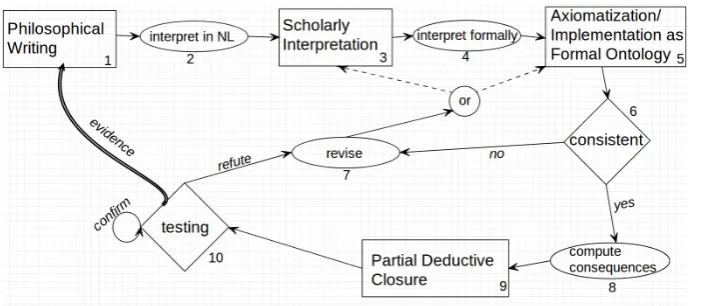
I use computational systems and techniques to support philosophical inter-pretation on these principles. A general and high-level description of a way to apply theses computational methods is represented in the diagram in Figure 2. Arrows indicate in what sequence the method’s steps are carried out. Boxes stand for representations or data which undergo transformations or processes depicted by ovals. Rhombi indicate decision nodes where the satisfaction of a condition decides on how to proceed. Finally, there is oneor-node, represented in a circle, where there are two possible ways to proceed, but no clear condition is specified.
Figure 2: The Method in a Diagram
Initially, there is a primary philosophical text we would like to interpret. A human expert might very carefully read the text in the traditional manner and provide us with an interpretation thereof. This interpretation typically takes the form of a secondary text in a natural language, like English or Kiswahili. Possibly, the expert already takes a step towards formalization and expresses her interpretation in semi-formal style, in preparation of what follows. In a next step, the informal or semi-formal interpretation is fully formalized in DL to a) make it completely unambiguous and explicit about what is expressed, and b) give the interpretation a form which a computer can process. The formaliza-tion is a set of formal expressions, also known as axiomatization, where each expression is one axiom. Subsequently, the axiomatization is implemented in a DL editor which is a piece of software to work with formal ontologies. Upon its implementation as a formal ontology we can apply automated theorem proving software to our axiomatization. This automated reasoner computes a part of the deductive closure of our axiomatization — the set of all derivable consequences — so that we get an overview over what our formalized interpretation of the primary text entails. Obtaining the partial deductive closure allows us to test immediately whether our axiomatization is consistent. Checking an axiomati-zation’s consistency is a standard facility of DL reasoning software. In case of inconsistency, some reasoners even provide explanations of where things went wrong. In case it is consistent, however, we treat the partial deductive closure as the fully specified formal theory of our interpretation. We then test this theory against the primary text. We assess whether the theory, consisting of axioma-tization plus inferred statements, can be justified as a plausible interpretation of the primary text. What we are looking for is evidence in favor or against the theory’s truth. We try to gather this evidence by a series of different means, ranging from traditional expert assessment to automated and highly sophisti-cated NLP techniques. Because the data against which our exegetical theory is tested consists of text, techniques from computational linguistics are uniquely suited to support the search for evidence of this kind. To end the cycle, we either reject or accept (parts) of the theory. In case of rejection we go back to either informal or formal interpretation and revise our theory.
3.1.1 Axiomatization
The diagram in Figure 2 depicts the outset of my method as the box number 1, representing an uninterpreted piece of philosophical writing, and the circle number 2, standing for the initial act of informal interpretation. This process yields an informally stated scholarly interpretation of the philosophical writing, depicted in box number 3. Based on this informal interpretation, the process of formal interpretation is applied — oval number 4 — which results in an axiom-atization of the informal interpretation. This formal correlate to the scholarly interpretation is presented as box number 5.
Let it be clear that finding an adequate formal correlate to a natural lan-guage theory is no easy task and always subject to heavy philosophical assump-tions.[60][50, Chapter 3.3] It is important to note that formalization, just as the informal interpretation, always involves an act of interpretation.[55, Chapter 2] Different interpreters might arrive at different formalizations of the same in-formal interpretation, due to the context-dependency and ambiguity of natural language. It is doubtful in principle whether a formalization in a given language can be thought of as a process of mapping, in the sense of a mathematical func-tion, a piece of text in natural language to the one correct corresponding set of expressions in the formal language.10[7]
As an alternative to a full procedure mapping natural language text to a formalism of choice, one could rely on criteria or guidelines for the production of adequate formalizations.11 One of the more recent, and perhaps the most thorough, work offering such criteria is Georg Brun’s bookDie richtige Formel, [15].[7] 12 Aside from these works, relatively little sustained analysis has been
given to standards of correctness of formalizing natural language.[50, p. 97] While there are few authorative reference points for the general project of formalizing natural language text, my interests are slightly different. I pursue the specific purpose of using DLs as the basis of formal ontologies — symbol structures modeling some aspect of the world while abstracting away from ir-relevant detail.[5, Chapter 10] Due to the wide usage of DLs for modeling some universe of discourse, a number of guidelines are available, stating basic prin-ciples of ontology modeling. Among these stand out [5, Chapter 10], [31], and [51].
Note that the informal and the formal interpretation step need not necessar-ily be carried out by the same individual. One clear benefit of a separation of tasks is that whoever is in charge of the formalization process does not need a great deal of philosophical expert knowledge herself, as her role is restricted to that of a supportive knowledge engineer. Most likely, however, it would come down to a collaboration between experts in philosophy and formalization.13
10Although some proposals exist, think of Davidson’s programmatic statements that such a procedure is a necessary precondition for a theory of meaning or the more hands-on pro-cedures of Chomsky and Montague, there is currently no generally applicable and effective formalization procedure available.[7]
11The literature mentions only few such studies. Among them are [58],[22],[23], and [14]. 12See also [7] itself for a take on necessary and sufficient conditions of adequacy of formal-izations.
One problem one could run into as we formalize is that our DL formalism of choice is not expressive enough to capture the philosophical notions involved in an interpretation. As previously stated, DL are deliberately limited languages so as to grant good computational properties. It seems possible, however, that there are systematic ways to compromise on some of these issues in particular cases. An example of such a way can be found in [34] where Guizzardi and Zam-borlini outline a strategy to partially map axiomatizations in a more expressive language (OntoUML) to the less expressive web ontology language (OWL).
3.1.2 Implementation as an OWL/DL Ontology
Once an adequate formalization is in place, it is implemented in an ontology editor. Due to the use of OWL/DL ontology in a great number of domains of ap-plication, especially the semantic web14, there is a sizeable and growing number
of ontology editors and reasoners available. Some outstanding software is free and open-source, notably Prot´eg´e, a flexible and widely used ontology editor. Perhaps due to its broad user-base, there is excellent documentation available for Prot´eg´e. Other editors, such as OntoStudio and TopBraid Composer, require licenses but come equipped with visualization tools. For a detailed comparison of a few ontology editors from the semantic web context, see [3]. In this article the author states that:
It is quite clear that Ontology development is mainly an ad-hoc approach. Among several viable alternatives, a user needs to find which one would work better for the projected task and which one easily and effectively can be maintained and expressed.
Thus, it appears that the choice of editor boils down to pragmatism, once the question of formalism is settled. Technically speaking, one could design and implement software to build and maintain an ontology that caters especially to the needs of whatever philosophical research one is currently conducting. Such an effort can turn out to be monumental, however. Hence, one might often be much better off using software that is readily available and well-documented and adapt it to one’s purpose.
3.1.3 Consistency Requirement
Upon implementing our axiomatization as a formal ontology in a suitable editor, we can check whether the axiomatization is consistent. This check is presented diagrammatically in rhombus number 6. If this requirement should not be ful-filled, we move along the edge labeled with “no” leading from rhombus number 6 to the oval number 7. Three possibilities arise, from which two are represented in the diagram: The first possibility is that the informal interpretation we are working with is true to the primary text, and the axiomatization truly captures the informal interpretation, but the philosophy we are interpreting was logically inconsistent all along. In such a case, any effort at systematic reconstruction is futile and we best abandon the attempt to arrive at a consistent interpretation,
for such a reading would directly and clearly go against the primary philoso-pher’s intentions. Because it contravenes the basic assumptions of my method, this option is not represented in the diagram.
There are, however, a second and third possibility consisting in either faulty informal interpretation or axiomatization. Either we are working with an erro-neous informal interpretation which has been axiomatized correctly and conse-quently leads to an inconsistent set of formulae; or our informal interpretation was in order, but our axiomatization thereof has introduced the inconsistency. When presented with logical inconsistency, we have no way of seeing where the error has occurred. It could even have occurred at two levels of interpretation at the same time.15 In any case, if a reasoner detects that our formal interpretation is inconsistent, we need to reconsider both levels of our interpretation. Thus, there is an “or”-node in the diagram indicating to revise either box number 3 or 5, or both.
One way to systematically check only the formal interpretation would be to implement axiomatization step-wise, adding one axiom at a time while always checking the current state of the logical closure. This procedure presupposes, however, that the interaction of the axioms is fairly transparent. In case it is unclear how the axioms come to imply theorems, one could also compute all possible combinations of axioms and run the reasoner for each to analyse under which setting the problems occur. The problem, of course, is that the number of possible combinations grows exponentially in function of the number of axioms. Therefore, this approach only works for rather small axiomatizations.
3.1.4 Computing Consequences
If the axiomatization passes the consistency check, we move along the “yes”-edge from rhombus number 6 to oval number 8 where we consider the editor’s reasoning output. Here also, a pragmatic stance should guide our choice of reasoning software. Many of the editors available come with built in theorem provers.[1][5, Chapter 8]
However, particular logical languages or reasoning tasks might require tailor-made reasoning software. DL reasoning and its optimization is a lively area of research, so novel reasoning algorithms might suddenly render certain tasks feasible.[20]
Once we have settled on a suitable reasoner, we obtain the partial deductive closure of our axiomatization from the reasoning software. This corresponds to box number 9 in the diagram. Loosely speaking, the deductive closure of a set of formulae in a logic is the set of all formulae which can be deduced from the original set. The output is only a partial deductive closure because any tautology forms part of the complete closure, since tautologies follow from anything. Yet, we are usually not interested in tautologies, nor can we explicitly represent an infinite number of them. In this sense the reasoner’s output is only a selection of consequences.
15Wandering even more into the realm of possibilities, we cannot even strictly trust a consis-tent axiomatization. It is conceivable that a consisconsis-tent axiomatization reflects afalse positive
To be formally precise, we could follow [40] and let Σ denote the set of expressions in our axiomatization. A formula ϕ, then, is a theorem of that axiomatization if and only if it is a logical consequence of the axiomatization, that is, if Σ ϕ. Finally, the full formal theory — T — is the logical closure of our axiomatization, i.e. the set of all theorems: T = {ϕ | Σ ϕ}. The partial deductive closure — call it P — forms a subset of T because of the aforementioned reasons.
3.1.5 Testing
If inconsistency is not an issue, then what we have in hands is a formal theory of our interpretation.
We can now assess whether the statements inT can be justified as plausible interpretations of the primary text by going back to the corpus. What the au-tomated reasoning step has brought us, apart from the basic test of consistency, are more possibilities to assess the adequacy of our interpretation, since the partial deductive closure is usually a superset of the axiomatization. That is to say that usually Σ⊂ T.
The testing phase is represented by rhombus number 10 in the diagram. It is presented as a decision node, since finding contrary evidence should lead us to revise our interpretations, as indicated by the edge labeled “refute” going to oval number 7. In case our testing strengthens the partial deductive closure, we follow the reflexive “confirm”-edge that loops back into the testing phase and continue testing the theory. The double line between rhombus number 10 and box number 1, labeled with “evidence”, indicates that the testing phase involves going back to the original piece of philosophical writing.
The guiding question of the testing phase is: What kind of evidence can be found in the primary text for the statements in the partial deductive closure? To discover and collect this evidence we rely on a series of different means, from asking philosophical experts to the employment of automated NLP tools, and mixtures of the two. I now present a list of tools that we use (or think about using in the future) in the e-Ideas project. Of course, this list is not meant to be exhaustive as I merely intend to illustrate what kind of possibilities are around. It must be said as a preliminary note, however, that e-Ideas is in possession of a fairly clean corpus of philosophical writings which researchers in the group are interested in. Building such a large and clean corpus has been a very labo-rious effort.[8] The process involves getting a hold of high-quality scans of the relevant works, finding or building reliable OCR16, and a considerable amount
of post-correction to eliminate errors introduced in either of the first two steps. Although it is likely that this process will become easier in the future, as more books are digitalized and freely available and as the performance of the neces-sary software improves. Nonetheless, it should not be underestimated how hard it is to get hold of a high-quality corpus.
With such a corpus in hand, however, the comparison-step, consisting of linking the consequences back to the data of the corpus, is supported in a number of computational ways. These tools could be ordered by degree of computational involvement.
One entirely non-computational way is traditional: Ask an expert to access her memory and knowledge of a philosopher’s writings in order to manually navigate the corpus and find refuting or corroborating evidence for a particular statement in the theory. A variant of this is probably needed for all tools I am about to present. Human expert knowledge is unlikely to become obsolete within the foreseeable future, therefore experts will certainly need to be kept in the loop.
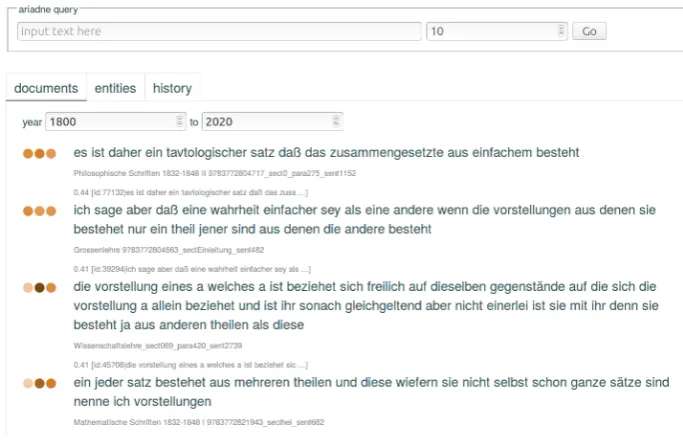
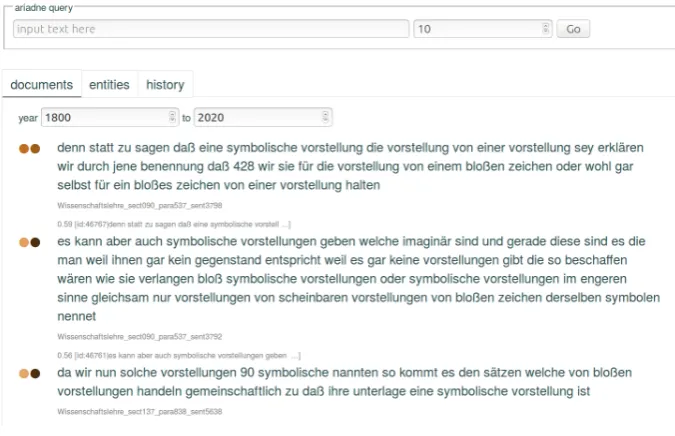
Perhaps the smallest computational step would be to use a simple search function to navigate the corpus. This would allow one to find passages within a corpus where a given string occurs. A somewhat simple computational tool isSalVe.17 It was tailor-made for work along the lines of e-Ideas and has been proven to speed up the research process while also increasing its thoroughness.[8] A much more sophisticated computational tool isAriadne. The technology underpinning it are word embeddings in which words are semantically repre-sented — embedded — in a vector space. Words that are similar in meaning are mapped to points in each other’s proximity in the vector space. Ariadne features a visual interface allowing users to explore the entities in this space and thus to interactively navigate the context of query terms in a textual cor-pus.[62] Because of its visual interface, no great technical knowledge is required to perform the queries.[8]
Ariadne was originally developed for a corpus of scientific articles, but it has since been successfully applied to other types of corpora18, specifically for
philosophical data.[8]
It is an online tool, so the speed with which it answers queries was a big con-cern in its development.[42] Therefore, the tool now requires an off-line prepa-ration phase where each entity is semantically represented not based on the co-occurrences in the data, but on the context it shares with other entities.[42] Then the online interface suitably reduces the number of hits to a query so that they are easy to grasp and navigate.[42] When a user enters (possibly multiple) search query terms, these are matched to entities in the semantic space.[42]
According to a comparison between different embedding techniques, carried out by the designers of Ariadne, their tool is particularly fit for the task of information retrieval: Given a search term, it indicates what parts of the corpus fit the query best.[42] This information retrieval facility can be very powerful. In practical application Ariadne enables a human researcher to detect passages in the primary text that are about given concepts.[8]
What is needed for this is a list oflabels assigned to each concept modeled in the ontology. Labels are natural language expressions of a concept. Because the corpus is processed by Ariadne based on the surface form of Bolzano’s writing, there is a need to bridge the conceptual level of the formalization with the level of word-shapes. Once this preliminary work is done, we can navigate the corpus in order to find the most relevant passages for or against a certain item in our partial deductive closure.
Another computational approach consists of using a tool to automatically ex-tract grammatical relations within the corpus, a so-calleddependency parser.19
Perhaps one could use the dependency parser to determine the dependency
re-17It has already been introduced here 2.2.
18The tool uses no language-specific preprocessing, so non-English corpora pose no problem to it.[8]
lations between grammatical constituents within the sentences of a textual cor-pus. If the extraction is successful, these relationships, in turn, could be used to obtain more information on how terms relate to each other in the text along grammatical lines. For example, if a term is a noun we would like to determine its objects in case it occurs as a subject, and its subject if it is an object. If we know what terms are associated with a particular philosophical concept we are interested in, we could use the output of the dependency parser to see all the relations of these terms. Because the terms are the concept’s labels this would allow us to see see if among the relations we find those which are predicted by the partial closure of the formal ontology. The viability of this idea has been discussed in e-Ideas, but we have not taken concrete steps towards realizing and testing it. A possible drawback of this technique is the amount of manual work it requires, since presumably a part of the corpus would have to be carefully manually annotated for the method to work.
A different take on the same computational idea would be to focus not on grammatical but on philosophy-specific relations.20 An expert philosopher
would first have to annotate a portion of the corpus with layers of metadata to identify the relevant relations. One would then train a machine learning classifier to extend the annotation to all of the corpus. This too could turn out to be challenging because of the work it requires. In addition to the high labor requirements, it is unclear what relation would be both philosophically valuable and learnable at the same time.
A final, quite sophisticated computational approach would involve training a distributional semantic model on the philosophical corpus. A standard approach here would be to use a model from the Word2Vec family which are based on neural networks.[29] However, Word2vec is unlikely to work in philosophical contexts because much more data is needed to train these models than typically available in philosophy. Perhaps it would be possible to depart from concepts which are already known in order to compare the performance of Word2Vec models, which are based on neural networks, with other count-based models for word embeddings. Hereupon, one could use operations on the models to see whether a given conceptual relation is as the reasoning output of the ontology predicts.
3.1.6 Further Reflection
This concludes the overview over a computational method for philosophical interpretation as I envision it. I deliberately choose a presentation that does not specify completely how the individual steps of the method are to be realized. Rather, I try to show a number of possibilities and limitations at each step, so that researchers interested in a method along these lines may feel inspired to adapt what they can use for their own purposes. I shall shortly present my own attempt concrete realizations of the method when I apply it in Section 3.
Before I get there, however, a further discussion of methodological assump-tions is in order. To the best of my knowledge, this type of computational methodology presents completely unchartered territory in the field of philoso-phy. Given this status of methodological novelty and experiment, two stances could be taken towards my method: Under the first, perhaps more
minded, viewpoint, I decide to go ahead and think about applying the method sooner rather than later. Further methodological considerations makes way for concrete practical application, so we get to see how the method fares in prac-tice. Thinking about philosophical foundations is postponed to a later point in time. Under the second, perhaps more philosophically-minded, point of view, I proceed more cautiously and first analyse thoroughly what I have in hands here before engaging in a host of shaky investigations.
I believe that both of these stances have their respective merit. Therefore I now briefly treat them in turn, starting with the more philosophical considera-tions before also treating some issues related to practical application.
3.2
Philosophical Perspective
I have stated it before, but it bears repeating: Neither formal, mathematical redescription nor the use of computational tools and systems is likely to re-place traditional philosophical analysis any time soon. What I hope to achieve, for now, is to build formal and computational systems that support human researchers in their efforts.
Because simply issuing this caveat is not enough, I take further looks at a number of issues related to philosophy and the use of such methods. The first of these issues concerns the proper role of formalization in philosophy. These considerations are guided by Rota, Pinosio, and Dutilh Novaes who all have written on the relationship between mathematical or formal methods and phi-losophy.[57][56][50] The second issue concerns the reasoning process which I automate through my use of formal ontologies and theorem proving software. The question I address here is: What guarantee do we have that the inferences enabled by our formal logic and carried out by our reasoning software coincide with the reasoning process in traditional research? A third and final bundle of issues I touch upon is how more sophisticated NLP methods fit in with my philosophical setting. Such sophisticated methods may bring with them very substantial assumptions about philosophically sensitive concepts such as mean-ing, for example.
3.2.1 Formalization in Philosophy
Upon the arrival and popularization of major innovations in formal logic, the 20th century has been marked by the application of logical formalisms to a wide range of philosophical questions. As Gian-Carlo Rota, a prominent mathemati-cian and philosopher, laments, this has sometimes led to abuse of both philos-ophy and formal tools.[57] He and Riccardo Pinosio, a philosopher working on the formalization of Kant, particularly disapprove of unprincipled attempts to resolve philosophical problems by capturing fundamental informal philosophical concepts in formal axiomatizations to then go off and prove results, supposedly about the informal philosophical concepts. Rota and Pinosio point out that attempts of this sort often break down because the relationship between the in-formal philosophical notions or theory and the axiomatization is unclear.[57][55, Chapter 2]
Consider, to give a concrete example, an attempt at formalizing an inconsis-tent philosophical theory in classical logic. From this axiomatization one then quickly moves on to prove further consequences, supposedly entailed by, but not explicitly mentioned in, the informal philosophical theory. Such an exercise is devoid of point, since anything can be proven from an inconsistent axiomatiza-tion in classical logic.[17]
It must be kept in mind that the process of formalization involves an act of interpretation.[7] Moving from an informally stated theory to a precise and largely unambiguous formal theory requires us to decide on particular inter-pretations among the possibilities left open by vagueness or other sources of underdetermination. When formalizing, we are forced to abstract from aspects of the informal theory, what we deem inessential is left out, and what we deem essential is enshrined in our axiomatization. Examples and other illustrations are left behind, ambiguities and other uncertainties collapse into singular ways of interpretation.[55, Chapter 2]
Think of the exegetical method lately described as involving different levels of interpretation. On the null level there is the primary philosophical text which stands uninterpreted. A scholar’s informally stated interpretation of the primary text constitutes a first level of interpretation. An axiomatization of the informal interpretation of the source text stands on a second level of interpretation. The axiomatization’s relationship with the primary text is thus only indirect, it is mediated by the informal interpretation of the text. This must be kept in mind, especially when reasoning about the axiomatization. We reason primarily about the axiomatization, secondarily about the informally stated interpretation, and only remotely about the content of the original philosophical text. This being said, however, how close a formalization can be aligned with philosophical text always depends on the specific text in question. There exists, of course, very ambiguous philosophy where many formal routes could be taken, and then there is philosophy which is presented nearly or fully formally already. In the latter case there might be very little reasonable disagreement about adequate formal correlates.21
Another important mental slip Rota denounces is to think that imitating mathematics requires us to start out with clear definitions from which we then compute theorems.[57] First of all, in philosophy one usually ends with a defini-tion and does not start with one. Concepts such astruthor mind are not clear from the start of philosophical inquiry but are clarified over a lengthy process of deliberation. Secondly, Rota stresses that in mathematics the theorems mo-tivate the axioms just as much as the axioms the theorems. Axioms are chosen in light of the theorems provable from them.
A good definition is “justified” by the theorems one can prove with it, just like the proof of a theorem is “justified” by appealing to a previously given definition. There is, thus, a hidden circularity in formal mathematical exposition.[57, p. 172]
The question then becomes: What is the role of formalization in philosophy if it is not completely solve philosophical problems in an axiomatic system? A possible answer lies in Rota’s remark that there is cyclicity in mathemati-cal exposition. Although any axiomatization of a philosophimathemati-cal theory requires
a preliminary understanding or pre-formed interpretative attitude towards the theory, the process and results of the axiomatization open up new exegetical possibilities which were not previously considered. There is, thus, a place for what Pinosio calls a “virtuous hermeneutic cycle”[55, p. 11] where formal-ization and non-formal understanding of the philosophical theory update each other iteratively. Under this view, both the formalization and the informal in-terpretation are perennially unterminated and incomplete, they are only stages in an on-going hermeneutic process. The formalization is best viewed not as an end in itself, but as a tool to advance and refine our understanding of the philosophical text in tandem with our informal theory.
This points to the particular benefit of formalization that, just as in scientific theory building, it requires us to focus on the essential aspects of a phenomenon and abstract from the unimportant. Moreover and very importantly, it forces us to be entirely explicit about our interpretations. This can have tremendous advantages in terms of both conceptual and linguistic clarity. With formalized interpretations in hand it could become much easier to pinpoint the differences and overlaps between two interpretations which might be very hard to disen-tangle in their informal form.
3.2.2 Notions of Logical Entailment
A crucial feature of knowledge representation systems based on DL is that they contain implicit knowledge which is made explicit through logical inferences.[5, Chapter 2] The standards of correctness of these inferences is regulated by the formal definition of the DL underpinning a formal ontology. It is a question worth asking whether the patterns of inference licensed by the DL coincide with those a human researcher would draw. Abstracting from the specific issue of logical inference, misunderstandings might arise because a computational system does not represent the world and reason about it in the same way as a particular human researcher might.
There is one feature of DL-based formal ontologies where this issue becomes very tangible, namely, the open world assumption. DL knowledge bases are sometimes thought of as a particular kind of database. This view can lead to modeling errors. Because, although DL knowledge bases and databases bear certain similarities and analogies — schemes in databases correspond to TBoxes and actual data entries correspond to ABoxes — their semantic interpretation is markedly different. An instance of a database represents one and only one formal interpretation consisting of objects and tuples, while an ABox represents all its models. Consequently, in DL knowledge bases an absence of information is viewed agnostically — we do not know whether it holds or not. In databases, on the other hand, an absent piece of information is interpreted as false.[5, Chapter 16] The contrary assumption in DL, that absent information is not necessarily false, is called theopen world assumption.
It might shine through that this is the stuff that major misunderstanding and futile arguments are made of. Two researcher departing from different (formal) assumptions could obtain results that diverge radically from each other, though their treatment of the subject matter might look similar on the surface. The validity of inferences, for example, could be the focal point of very fundamental difference.22
These are debates we must be willing to lead as there certainly exists ample room for differences in opinion when it comes to such foundational matters. However, we do gain one clear advantage through our formalization in a specific logical language. Working formally makes the difference in logical inferences explicit. By laying it in the open, together with a complete formal explanation of our reasoning principles, a discussion about such foundational issues might turn out to be more tractable.
3.2.3 NLP in Philosophy
My final point related to methodology from a philosophical perspective concerns the use of more sophisticated NLP tools. This issue is perhaps best introduced via a concrete example: Distributional models of word meaning.
Assume that a philosopher is interested in the meaning of the relationship between the concepts woman and man.23 She might try to use distributional
models as a computational tool in her quest. Distributional models are NLP tools which formally represent the meaning of words through the context in which they have been observed. Their philosophical foundation is sometimes called the distributional hypothesis, vaguely inspired by Ludwig Wittgenstein’s philosophy. It states that two words are similar in meaning if they occur in sim-ilar contexts.[24] Typically, word meanings are represented as points in vector spaces where spatial relations in the vector space can be interpreted as seman-tic relations between words.[36] Proximity in the vector space, for example, is interpreted as similarity in meaning. The words’ location in the vector space is based on their occurrences in bodies of data, textual, visual or otherwise. The process of embedding a word sometimes requires fairly involved algorithms.
In order to have some success in her project of comparing the concepts man andwoman, the philosopher needs to critically assess whether her research question fits this rather sophisticated machinery. She must realize, for example, that whatever formal representation she receives as output from the computer is a descriptive, and not a normative, account of what the words “woman” or “man” mean in the corpus she happens to have studied.[11] Also, this is only an accurate representation of the words’ meaning under the assumption that the distributional hypothesis is accepted. Furthermore, the philosopher was interested in the concept ”woman” or ”man”, but what she has in hands is a formal representation of the meaning of the words “woman” or “man”. That this is a crucial difference should be clear to any trained philosopher, but amidst all the formality and computational ruckus the point might still go underappreciated.
What is the message of all this? Philosophical investigation that relies on in-creasingly sophisticated computational means runs the risk of using inadequate tools to pursue its interests. This is especially true for NLP systems which seemingly deal with the same entities as philosopher (think of meaning) but do so in their own particular manner. This requires philosophers to constantly check whether the formal system’s notion aligns with the philosophical notion in
one of the inferences drawn from it turns out to be explicitly rejected by the primary philo-sophical text. Now, what if the interpreter claims inference our system just drew to be invalid, and therefore her interpretation should still stand?
a desirable way. We should also remind ourselves once more that these welcome systems of support provide no end-all solutions to philosophical problems, and that their outputs should be taken with a grain of salt.
3.3
Practical Perspective
Let us put these philosophical questions aside for a moment and assume a more practical perspective on the use of the method lately described. The guiding questions here are whether the method can work and how we can make it work in particular cases. Whether it can work will have to be established by using it in actual research and the present section contains more discussion of what it would mean for the method to “work”. As for the second question, concerning how it can be made to work, I can impossibly give definitive answers at the present time, as nothing has been tried thus far. I shall, however, issue some thoughts on what strikes me as promising practical steps.
Notwithstanding the philosophical concerns and caveats voiced in the pre-vious section, my method is most likely a good one if it produces good results. In this sense the ends justify the means. Yet still, what counts as a “good” re-sult is certainly unclear and I would be foolish to simply assume that whatever comes out of an application of the method qualifies as such. Thus, I now want to assess practical points concerning three aspects of my method: Formaliza-tion, the availability and quality of data, and the necessity to test my method comprehensively.
3.3.1 Practical Aspects: Formalization in Philosophy
As a starting point I ask myself what possible good could come out of my method. In essence, there are two potential practical benefits. First, formaliza-tion itself has been widely used as a tool of analysis in philosophy, especially since the big innovations in logic have taken hold in the 20th century. Second, modern computers can do certain tasks very quickly that no human researcher can hope to do in reasonable time.
To start with practical advantages of formalization, philosophers typically communicate their insights by writing texts in natural language. Due to the high conceptual density and the sometimes idiosyncratic use of expressions, confu-sions arise quite easily in philosophical debate about what a piece of philosophi-cal writing is trying to express. Because a text could mean more than one thing, an exegetical question comes up as to how the text is supposed to be read.
![Figure 1: The Logical Cycle in Kamps and Masuch [41]](https://thumb-us.123doks.com/thumbv2/123dok_us/8382547.320988/13.595.134.463.167.325/figure-logical-cycle-kamps-masuch.webp)