Johan van Benthem
Cognition as interaction
Abstract
Many cognitive activities are irreducibly social, involving interaction between several different agents. We look at some examples of this in linguistic communication and games, and show how logical methods provide exact models for the relevant infor-mation flow and world change. Finally, we discuss possible connections in this arena between logico-computational approaches and experimental cognitive science.
1 Introduction: from lonesome cognitive performance to social skills
When King Pyrrhus of Epirus, one of the foremost well-educated generals of his age, had crossed over to Italy for his famous expedition, the first reconnaissance of a Ro-man camp near Tarentum dramatically changed his earlier perception of his enemies (Plutarch, “Pyrrhus”, Penguin Classics, Harmondsworth, 1973):
Their discipline, the arrangement of their watches, their orderly movements, and the planning of their camp all impressed and astonished him – and he remarked to the friend nearest him: “These may be barbarians; but there is nothing barbarous about their discipline”.
2 Questions, answers and the spectrum of language use
In modern logic and semantics, the dynamics of language use has come into focus. The individual speech acts that take place can only be understood in terms of mutual infor-mation that agents have about each other, and more generally, the resulting interaction. Consider a simple conversation like:
Q “Is the KNAW on this canal?” A “Yes”.
Here the questioner Q conveys that she does not know the answer, and probably also, that she thinks it possible that the answerer A does know. After the answer has been given, Q has not just learnt the fact that this canal is indeed the location of the Royal Academy. She also knows that A knows that location, and even that A knows that she knows it now, and so on. Ideally, the two agents have achieved common knowledge, to any depth of mutual iteration.
Now, this simple episode of communicative language use lies on a much longer natural chain of inter-locking cognitive abilities. First, before we can process the in-formation in given statements, we need to understand what they say. This is seldom a purely one-agent matter, but it rather involves a process of interpretation for reach-ing an equilibrium between speaker’s and hearer’s meanreach-ing. Bi-directional Optimality Theory describes part of this – but authors like Parikh (2002) and van Rooy (2004) have even full-fledged game-theoretic accounts of the crucial higher-level interactions here. Next, successful communication requires an account of the presuppositions and effects of various kinds of speech act. Just which information is passed exactly when we use a particular linguistic construction? This can be much more sophisticated than the above elementary scenario. For example, in a classroom, if Q were a teacher, and A were a student, we would not expect Q to be ignorant of the answer, and we definitely do not expect her to have illusions about the ‘knowledgeability’ of A. Next, individual ques-tions make sense only when there is a broader intention behind them. This brings us to conversations with strategies for repeated asking and answering, as well as just the right amount of revealing and hiding information to achieve intended effects and reach goals. Conversations live at the level of strategic games, and again they achieve some sort of game-theoretic equilibrium between agents giving and receiving information. But games are again just episodes in a longer stream of linguistic behaviour, which involves accumulated memory over time. For instance, our ideas about the reliability of conversation partners may encode a lot of past experience, as well as the resulting expectations about the future. Thus, we get into the temporal analysis of long-term pro-tocols and learning. And moving beyond the aggregation level and life-span of single agents, we can even look at long-term linguistic practises in societies, or even evolu-tionary processes of language change. These long-term phenomena transcend the scope of standard logic, and eventually involve the mathematics of dynamical systems.
their cues from quite diverse disciplines, such as linguistics, philosophy, logic, com-puter science, economics and cognitive psychology. The next section provides some concrete examples of this confluence, all from a logician’s perspective.
3 Dynamic–epistemic logic for communication
Communication involves update of information. To describe such processes in precise terms, we need to have an account of both the information states of groups of agents, and the basic and complex actions that can change one of these states into another. For this purpose, logical techniques turn out quite useful.
Epistemic logic
To analyse the above question–answer episode, we use a well-known system from the philosophical tradition, viz. epistemic logic – originally developed as a tool for analysing epistemological notions and arguments. In a self-explanatory notation, here are some key features of our question–answer episode:
Q asked a factual question “P?”, A answered truthfully “Yes”.
For a truthful answer A must know thatP: KAP.
A normal cooperative question then has the two presuppositions: (a) Q does not know ifP: ¬KQP ∧ ¬KQ¬P, (b) Q thinks it possible that A knows ifP: Q(KAP ∨KA¬P ). After the answer,P becomes common knowledge: C(Q,A}P.
Information update
Next, the updates that take place when speech acts occur change the relevant informa-tion models. For example, here is a simple model for an initial situainforma-tion whereP holds, while Q does not know this (Figure 1).
The line between the two worlds indicates the initial uncertainty of agent Q. The absence of such a line for agent A indicates that the latter knows whetherP is the case. This absence is transparent for Q who therefore does know that A knows ifP.
Next, the update corresponding to a public assertionP!by A thatP holds (which is the logical content of the above answer “Yes”) removes the¬P-world to the right in this model, leaving us with only the situation depicted in Figure 2.
Figure 2.
This new model shows pictorially how both agents know that P-and indeed, that
P has become common knowledge among them. As for the general process here, public announcement changes the current information model by world elimination.
Dynamic–epistemic logic
Epistemic logic describes what agents know at the static intermediate stages of an informational process. But really, it is the state-changing actions themselves that seem of primary interest. To bring the latter into focus, one can borrow an idea from computer science, viz. the dynamic logic of programs, interpreted as actions that change states of some computing device. A combined dynamic–epistemic logic has formulas with both epistemic operators and action modalities. These formulas are interpreted in epistemic models M (i.e., diagrams as above) at particular worlds s, where they describe facts and properties of agents – as seen from the standpoint ofs. In particular, the following dynamic action modality [P!]φ describes what happens in the updated model after something has been said:
M, s|= [P!]φ iff if M, s|=P , then M|P , s|=φ.
The right-hand side of this truth condition says thatφ is true in model M at world s
after an action of true announcement ofP has taken place to produce the model M|P. More complex dynamic–epistemic formulasφthen describe what agents know (or do not know) after an announcement action has taken place:
[P!]Kiφ agentiknows thatφ afterP has been announced,
[P!]CGφ afterP has been announced,φis common knowledge.
In this manner, we get a logical system that describes the effects of communication. Its set of valid principles is known to be simply axiomatisable, and it is even decidable by means of a mechanical algorithm that could run – in principle – on a computer. Important advances in this paradigm of dynamic–epistemic logic have been made in the 1990s by Plaza, Gerbrandy, van Ditmarsch and others – with Baltag et al. (1998) as a particularly seminal contribution. We refer to van Benthem (2002, 2004a, 2006) for a survey of the state of the art plus a list of open problems.
For our purpose here, perhaps the main thing to observe is the meeting of academic cultures in just one dynamic–epistemic formula describing effects of communication:
The systematic study of speech acts likeP!was initiated in the philosophy of language by Austin and Searle. The knowledge operator K goes back to Hintikka’s work in philosophical logic and epistemology. And the dynamic logic operator[ ]comes from the tradition of Hoare, Pratt and many others in computer science and mathematics. Finally, the study of communication by such means seems more like a topic in the social sciences. Thus, humanities, natural sciences and social sciences meet in one single locus. C.P. Snow deplored the chasm between the ‘Two Cultures’, but they still do meet in unexpected places.
Benefits: new issues
Let us explore this interdisciplinary meeting point in a bit more detail. A logical sys-tem provides a lense for looking at phenomena that may not have been visible clearly before. For instance, what is the general effect of a speech act like making a public assertion P? It seems plausible that this must always produce common knowledge, reflected in the dynamic–epistemic formula
[P!]CGP .
But the latter principle is problematic as true logical law of communication. Back at the start of analytical philosophy, G.E. Moore formulated his notorious true-but-infelicitous sentences such as
“P, but I don’t believe thatP”,
which do not seem appropriate in communication. In particular, given some minimal assumptions in epistemic logic, one can never know the analogous logical proposition
P&¬KP. This phenomenon made its way from philosophy to mathematics in puzzles, such as the famous Muddy Children and its ilk: ‘hats’, cheating housewives, . . . . In a given group of muddy and clean children, each child can see the others, but not its own forehead. Now their father tells them publicly that at least one child is dirty. In the ensuing process of questioning which child knows its status, they all say first that they do not know if they have mud on their foreheads. But as this question and answer process is repeated, a last round occurs where everybody has figured out who are dirty. For instance, in a group with two dirty children and one clean one, the dirty ones can figure out their status after one round:
If I were clean, the one dirty child I see would have seen only clean children around her, and so she would have known that she was dirty at once. But she did not. So I must be dirty, too!” This reasoning is symmetric for both muddy children – so both know in the second round. The third child knows it is clean one round later, after they announced that.
is ubiquitous. van Benthem (2004b) shows how the same difficulty underlies the ‘Fitch Paradox’ of verification, which says that the apparently plausible principle that “Every true proposition is learnable” cannot be maintained consistently. In logic itself, this raises the technical issues just which propositionsP achieve their own common knowl-edge when truly announced. See van Benthem (2002) for some partial results – but the general question is still open.
Communicative update in general
The preceding example shows how even something as simple as making a public an-nouncement can hide unexpected subtleties. But of course, there are many further types of communication. We seem to be very good in providing partial information, making sure that only the right people know what we want them to know, while others do not. This brings in issues of security, hiding, lying, and all those more subtle skills that lu-bricate civilised social life. Moreover, this information is not just conveyed by speech acts. We also get it by mere observation, or by inference from what we already know. All these sources can occur intertwined, with switches from one to the other. If I want to know if paracetamol is sold close to the Academy, I can either try to reason it out inside my head, using the KNAW documentation at my disposal, or I can perceptu-ally inspect houses on the Kloveniersburgwal, or I can resort to communication, and ask some reliable-looking person in the vicinity. Richer systems of dynamic–epistemic logic exist which can handle at least communication and perception at the same time, including partiality and hiding, by using update with event models. Indeed, this was the main innovation due to Baltag et al. (1998). And once we have such more subtle systems in place, we can start looking at the total area of human communicative behav-iour, asking which tasks are harder than others – and where are the natural boundaries of complexity separating one practice from another.
The triangle: logic, cognition and computation
4 From single actions to strategic games
The individual information-bearing moves described by dynamic epistemic logics nat-urally lead to the next step in the ladder of cognitive phenomena. For instance, humans are good at turning any given practise into a sort of game.
Information games
Here is an example. Any topic of discourse, and any conversation space of admissible assertions about it, leads to information games, where players must say something nontrivial at every turn, and the goal is to be the first to know the true situation. More complex examples are found in parlour games like “Clue” (van Ditmarsch, 2000) which have been designed so that the game remains enjoyable to play, though not too hard to get stuck in sheer complexity.
Game theory and dynamic–epistemic logic
To describe agents’ behaviour in this richer setting where conversation has a goal, and participants are aware of this, we must turn to game theory. The optimal thing to say depends on what we have heard before, plus our current plan. This requires strategies on players’ part, and the best outcomes for all are often well described by the usual Nash equilibria. Though these equilibria may be computed by general techniques (including probabilistic mixed strategies), most of their outcome values are unknown for even simple information games. But even when available, game values are global features at best of the process. Dynamic–epistemic logic adds the fine-structure of players’ information as they are observing events in the course of the game, while trying to plan their next move.
Belief revision
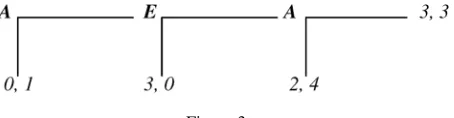
In a game setting, however, update of information is no longer the only relevant process. Players must also be able to revise their beliefs when confronted with evidence contra-dicting their expectations so far. To see this, consider a game of the famous Centipede type. Two players can play either ‘Down’ or ‘Across’ (Figure 3).
[image:7.553.166.393.548.607.2]The value of an outcome for E is indicated first in these pairs, that for A follows. In this scenario, the standard recommendation of game theory proceeds by a line of reasoning called ‘Backward Induction’:
We analyse the behaviour of A at the end, and then work back toward the initial node. It is to his advantage there to play Down (this gives him 4 instead of 3). But since E knows this, she will play Down at her move, since this gives her 3 instead of 2. But then, knowing this again, at the start of the game, A should play Down – because this gives him 1 instead of 0.
This reasoning, though it sounds compelling, has the surprising effect that, with this outcome, both players are worse off than they would have been if the game had proceeded toward the far right. In longer Centipede games, the difference in pay-off can be startling. But will this initial opt-out happen, and does Backward Induction apply? There is a presupposition involved here. Standard rational agents always choose the action that is to their own greatest advantage. But this is not the only possible kind of player, and E may have other beliefs about the sort of agent she is dealing with, like
‘A is stupid, or generous, or adventurous. . .’.
In particular, even when E starts with a standard expectation of ruthless ‘rationality’ – after A plays across, it seems likely that E will change her beliefs about A. As with information update, the best current logical theories of belief revision come from com-puter science, e.g., reasoning in AI (Gärdenfors and Rott, 1995). But there are also connections with belief revision as studied in cognitive science (Castelfranchi, 2004).
Diversity of agents
Long-term processes
Finally, even games as normally understood are just episodes on a larger time-scale. In the total arena of life, finite terminating processes co-exist with ones that are for all practical purposes infinite, such as the operating system of my computer, or the gen-eral conventions of the society that our behaviour lives in. Understanding this broader setting requires an integration of dynamic–epistemic logic and game theory with the mathematical theory of dynamical systems. This is happening already in modern evo-lutionary game theory, and I am sure that logic will follow suit. Cf. the epistemic tem-poral logic systems of Fagin et al. (1995), Parikh and Ramanujam (2003), Belnap et al. (2001). Thus, serious mathematical models and logical calculi live along the whole spectrum of cognitive phenomena mentioned in Section 2.
5 Toward cognitive reality
The preceding account of logics for communication and games may have shown that there are many interesting structures to be discovered in the area of social cognitive phenomena. Nevertheless, it is fair to say, looking at the relevant literature in logic, linguistics, philosophy and computer science, that much of the reference made there to ‘real cognition’ is mere rhetoric! Even the most innovative authors on the logic side show little inclination to really go out and be confronted with the experimental evidence. But this is not because such contacts would be useless. In fact, if we were to go out and see whether humans are really ‘so good’ at communicative subtlety, or even prior to that: how they really do things – we might be in for many creative surprises.
One reason for a persistent armchair syndrome are philosophical preconceptions, such as the celebrated ‘antipsychologism’ of Frege and his followers, which has been adopted by mainstream philosophers and logicians ever since. This allows them to theorise, use the attractions of real-life examples (and sell papers by making a few eye-catching claims in that direction), but just at the moment when confrontation with reality threatens: to comfortably retreat to a more normative or theoretical position. Personally, I find this strategy more and more empty, and almost intellectually dishon-est. But much worse than dishonesty: it has become boring, and the time seems ripe to actually confront all of the above with experimental facts. Most of what was said in the preceding two sections suggest experimental questions, such as:
What do people get out of various types of assertion? What do their conversation plans really look like? How do they cope with diversity of agents?
and on another note, do they really feel ‘complexity barriers’ when jumping from one practise to another (say from honest reporting to lying) as predicted by computational theory? Experimental game theorists have already made their move toward cognitive psychology here: semanticists, philosophers, and logicians might follow.
of-ten come as accessories with them), or let people play known games in various degrees of complexity by manipulating rules, such as in the move from Chess to Kriegsspiel, where one does not know the positions of the Opponent’s pieces. After lectures on dy-namic epistemic logic, I often get intriguing responses from members of the audience telling me how they play modified information games, ‘complexifying’, e.g., Clue to make it more interesting. Some variations seem to work there, others do not. For ex-ample, adding a fourth guessing category of Motive in addition to Room, Person, and Murder Weapon is reported as easy – whereas allowing some ‘cheating moves’ makes the game almost impossible to successfully complete. It would be up to socially minded cognitive scientists to use this spontaneous evidence, and find out. . . .
6 Conclusion
This chapter has tried to make a case that interactive social cognitive phenomena are important – and also, that they are endowed with a logical–computational structure rich enough to make for interesting scientific analysis. But perhaps, the sheer social stance by itself is worth emphasising. I am always amazed by the ‘individualist’ bias in cogni-tive studies. We look at language in terms of individual competence, even though there are usually Speaker and Hearer interacting, and even though the real language skill to be taught is successful communication, not writing grammatically correct sentences in your private diary. And while we are at it, take that teaching itself. We model sin-gle agents forming hypotheses about a grammar or some other model for an observed string of phenomena. But again, this is just a one-dimensional projection of the most striking two-agent setting for teaching, being that of a Student with a Teacher. Our models should emphasise the latter, and then specialise to the former. Finally, logical systems emphasise lonesome reasoners, or even crystalline proofs where all traces of human activity have been washed off with formalin. But surely, the prototypical logical activity is argumentation, which happens in an interactive social setting.
a positive view of the result, we see that
computation and conversation have equal processing power!
Insights like this allow us to look at familiar phenomena in unexpected ways. Com-puting machines communicate, but communicating humans also engage in complex computational processes. Heaven knows, we might even be able to tap those compu-tational resources! This commonality is reinforced by the earlier observation that we are already living in, and coping with, mixed human-machine societies, involving di-versity of agents of many different types. Indeed, our ability to do so constitutes one of the most amazing cognitive skills that we have – and one that should be explained!
One final attractive feature of the social aspect of cognition is that it is all around us. This may be a bit hard to see at first. In science we are used to the idea that some things are too far away to see with the naked eye, and astronomers have to send their rockets and other expensive machines out to do the exploring for them. But social cognition may be too close to our skins to recognise its importance and structure straightaway. But once we do, we see that our whole world is already a gigantic Cognitive Lab. We do not need multibillion dollar machines to force elementary particles into accelerating loops that reveal their potential and limitations. Such things happen automatically. Just think of the Internet, surely a multibillion dollar machine, created for free, and all those agents playing all sorts of differential informative games using their emails, and playing their cc and bcc buttons for achieving complex epistemic effects! So, the experiments are already running. Now we must go and read off the results. . . .
References
Abramsky, Samson. 2006. Information, processes and games. In Adriaans, Pieter and Johan van Benthem (eds). (to appear). Handbook of the Philosophy of Information. Elsevier, Amsterdam.
Axelrod, Robert. 1984. The Evolution of Cooperation. Basic Books, New York.
Baltag, Alexandru, Lawrence Moss and Slawomir Solecki. 1998. The logic of public announcements, common knowledge and private suspicions. In Proceedings TARK 1998, Morgan Kaufmann, Los Altos, pp. 43–56.
Belnap, Nuel, Michael Perloff and Ming Xu. 2001. Facing the Future. Oxford University Press, Oxford. Castelfranchi, Christiano. 2004. Reasons to believe: cognitive models of belief change. Ms. ISTC-CNR,
Roma. Invited lecture, Workshop Changing Minds, ILLC Amsterdam, October 2004. Extended ver-sion. Castelfranchi, Cristiano and Emiliano Lorini, The cognitive structure of surprise. In Helen Hodges, Wilfrid Hodges and Johan van Benthem (eds.), Logic and Psychology, special issue of Topol, to appear.
Fagin, Ron, Joseph Halpern, Yoram Moses and Moshe Vardi. 1995. Reasoning about Knowledge. The MIT Press, Cambridge, MA.
Gärdenfors, Peter and Hans Rott. 1995. Belief revision. In D.M. Gabbay, C.J. Hogger, and J.A. Robinson (eds), Handbook of Logic in Artificial Intelligence and Logic Programming 4. Oxford University Press, Oxford.
Licklider, John. 1965. Man–Computer Partnership. Palo Alto, Digital Systems Research Center. Also in International Science and Technology.
Miller, Joseph and Lawrence Moss. 2003. The undecidability of iterated modal relativization. Technical report. Indiana University Computer Science, Bloomington. Studia Logica 39(3): 373–407.
Parikh, Rohit and Ram Ramanujam. 2003. A knowledge based semantics of messages. In J. van Benthem and R. van Rooy (eds), special issue on Information Theories, J. Log. Lang. Inf. 12 (4): 453–467. van Benthem, Johan. 2002. One is a lonely number. Tech Report PP-2002-27, ILLC Amsterdam. Appeared
in Z. Chatzidakis, P. Koepke and W. Pohlers (eds.) 2006. Logic Colloquium ’02. Colloquium Logicum. AMS Publications, Providence.
van Benthem, Johan. 2004a. A mini-guide to logic in action. In Philosophical Researches, Suppl. Beijing, pp. 21–30. Chinese Academy of Sciences.Updated version in F. Stadler and M. Stoelzner (eds.), 2006. Time and History. Ontos Verlag. Frankfurt, pp. 419–440.
van Benthem, Johan. 2004b. What one may come to know. Analysis 64 (282): 95–105.
van Benthem, Johan. 2006. Open problems in update logics. In D. Gabbay, S. Goncharov and M. Zakharya-shev (eds.), Mathematical Problems from Applied Logic. Russian Academy of Sciences/Plenum Press, Novosibirsk/New York, pp. 137–192.
van Benthem, Johan and Fenrong Liu. 2004. Diversity of logical agents in games. Philosophia Scientiae 8 (2): 163–178.
van Ditmarsch, Hans. 2000. Knowledge games. Dissertation DS-2000-06, ILLC Amsterdam and Univer-sity of Groningen.