
Alu and LINE-1 methylation and lung
function in the normative ageing study
The Harvard community has made this
article openly available. Please share how
this access benefits you. Your story matters
Citation
Lange, Nancy E, Joanne Sordillo, Letizia Tarantini, Valentina Bollati,
David Sparrow, Pantel Vokonas, Antonella Zanobetti, et al. 2012. Alu
and LINE-1 methylation and lung function in the normative ageing
study. BMJ Open 2(5): e001231.
Published Version
doi:10.1136/bmjopen-2012-001231
Citable link
http://nrs.harvard.edu/urn-3:HUL.InstRepos:10581400
Terms of Use
This article was downloaded from Harvard University’s DASH
repository, and is made available under the terms and conditions
applicable to Other Posted Material, as set forth at http://
Alu and LINE-1 methylation and lung
function in the normative ageing study
Nancy E Lange,1–3Joanne Sordillo,1,3Letizia Tarantini,4Valentina Bollati,4 David Sparrow,5Pantel Vokonas,5Antonella Zanobetti,6Joel Schwartz,6 Andrea Baccarelli,4,6Augusto A Litonjua,1–3Dawn L DeMeo1–3
To cite:Lange NE, Sordillo J, Tarantini L,et al. Alu and LINE-1 methylation and lung function in the normative ageing study.BMJ Open 2012;2:e001231.
doi:10.1136/bmjopen-2012-001231
▸ Prepublication history for this paper are available online. To view these files please visit the journal online (http://dx.doi.org/10.1136/ bmjopen-2012-001231).
Received 26 April 2012 Accepted 6 September 2012
This final article is available for use under the terms of the Creative Commons Attribution Non-Commercial 2.0 Licence; see
http://bmjopen.bmj.com
For numbered affiliations see end of article
Correspondence to
Dr Nancy E Lange; renal@ channing.harvard.edu
ABSTRACT
Objectives:To investigate the association between methylation of transposable elementsAluand long-interspersed nuclear elements (LINE-1) and lung function.
Design:Cohort study.
Setting:Outpatient Veterans Administration facilities in greater Boston, Massachusetts, USA.
Participants:Individuals from the Veterans Administration Normative Aging Study, a longitudinal study of aging in men, evaluated between 1999 and 2007. The majority (97%) were white.
Primary and secondary outcome measures:
Primary predictor was methylation, assessed using PCR-pyrosequencing after bisulphite treatment. Primary outcome was lung function as assessed by spirometry, performed according to American Thoracic Society/European Respiratory Society guidelines at the same visit as the blood draws.
Results:In multivariable models adjusted for age, height, body mass index (BMI), pack-years of smoking, current smoking and race,Alu
hypomethylation was associated with lower forced expiratory volume in 1 s (FEV1) (β=28 ml per 1%
change inAlumethylation, p=0.017) and showed a trend towards association with a lower forced vital capacity (FVC) (β=27 ml, p=0.06) and lower FEV1/FVC
(β=0.3%, p=0.058). In multivariable models adjusted for age, height, BMI, pack-years of smoking, current smoking, per cent lymphocytes, race and baseline lung function, LINE-1 hypomethylation was associated with more rapid decline of FEV1(β=6.9 ml/year per 1%
change in LINE-1 methylation, p=0.005) and of FVC (β=9.6 ml/year, p=0.002).
Conclusions:In multiple regression analysis,Alu hypomethylation was associated with lower lung function, and LINE-1 hypomethylation was associated with more rapid lung function decline in a cohort of older and primarily white men from North America. Future studies should aim to replicate these findings and determine ifAluor LINE-1 hypomethylation may be due to specific and modifiable environmental exposures.
INTRODUCTION
Lung function has both environmental and genetic determinants.1–5Epigenetic variation,
which may influence gene expression patterns without changing DNA sequence, may mediate the effects of environmental expo-sures on disease outcomes. DNA methylation, one type of epigenetic change, is the revers-ible addition of a methyl group to cytosine nucleotides. Methylation changes may or may not persist over time in the human genome, as epigenetic marks are highly plastic.
A large portion of methylation sites within the genome are found in repeat sequences and transposable elements, such as Alu and long-interspersed nuclear element (LINE-1) which are among the most common and best characterised repetitive elements.6–8 Alu is the most abundant of the short-interspersed nuclear elements (SINE) with over one million copies per genome.9 Alu elements compose approximately 11% of the mass of human genome and contain 30% of its methylation sites.7 10 LINE-1 elements are present at over half a million copies.9 11Methylation of repeti-tive elements such asAluand LINE-1 has been shown to correlate with total genomic methyla-tion content.11 12Hypomethylation in transpos-able elements is associated with higher genomic instability and alterations or deregula-tion of gene expression.13 14
Prior studies have found associations between methylation of Alu or LINE-1
ARTICLE SUMMARY
Article focus
▪ Association between methylation, an epigenetic marker, and lung function.
Key messages
▪ Relative hypomethylation of transposable ele-ments is associated with lower lung function and more rapid lung function decline in a cohort of older North American primarily white men.
Strengths and limitations of this study
▪ First study to evaluate methylation of transpos-able elements in relation to lung function. ▪ Difficult to interpret implications of methylation
elements and various diseases including multiple cancers,7 cardiovascular disease,15–17 and neurological disease,18 as well as with markers of inflammation19and the infl amma-tory response.20 Studies on gene-specific methylation and non-neoplastic lung disease have found associations between GATA4, CDKN2A (p16) and lung function and an interaction with wood smoke exposure,21as well as multiple genes in association with chronic obstructive pulmonary disease (COPD) presence and severity.22To our knowledge no prior study has investigated associations between methy-lation of transposable elements and non-neoplastic lung disease. Moreover, case–control studies which are common in genomic studies are more problematic for epigenetic marks since sampling cases after disease onset makes it impossible to determine whether epigenetic changes pre-ceded or resulted from the disease. Hence, cohort studies or nested case−control studies within cohorts are particu-larly valuable. Our aim was to examine whether methylation of the repetitive elements Alu and LINE-1 was associated with measures of lung function, COPD status and longitu-dinal change in lung function in a cohort of men, the Normative Aging Study. Preliminary results from these ana-lyses were previously reported in abstract form.23
METHODS Population
Study participants were from the Veterans Administration Normative Aging Study, an ongoing longitudinal study of aging established in 1963.24 This is a cohort of 2280 healthy male volunteers from the greater Boston, Massachusetts, area who were 21–80 years of age at entry and who enrolled after an initial health screening deter-mined that they were free of known chronic medical con-ditions. Participants were re-evaluated every 3–5 years using detailed on-site physical examinations and ques-tionnaires. The study was approved by the Institutional Review Boards of all participating institutions. All partici-pants gave written informed consent.
Prior to 1999, 706 individuals had died and others were either lost to follow-up, being followed by questionnaire only, or had no blood samples left for analyses (n=792). All 782 individuals had blood samples that were available for methylation analysis resulting in 704 with unique IDs and methylation data as previously described.25 26 For this study, individuals evaluated at least once between March 1999 and June 2007 with methylation data and concomitant spirometry were included. During the study period, this included 663 total individuals, 194 of whom reported for blood draw two times, for a total of 857 samples collected. For the analysis of lung function decline, a second spirometric measurement was available on 301 individuals who had had an initial blood draw for methylation measurement.
Measures
Spirometry was performed as previously described27 and was repeated up to a maximum of eight spirograms, so
that at least three acceptable spirograms were obtained, at least 2 of which were reproducible with forced expira-tory volume in 1 s (FEV1) and forced vital capacity (FVC)
measurements within 5% of each spirogram; the best of these 2 values was selected from a given encounter. Acceptability of spirograms was judged according to American Thoracic Society standards.28 29All spirometric values are pre-bronchodilator. Per cent predicted values for FEV1 and FVC were calculated using equations by
Crapo et al30 COPD was defined as GOLD stage II or higher (FEV1/FVC<70% and FEV1<80% predicted).31
Techniques for assessing DNA methylation were previ-ously described in detail.32 33Briefly, we performed DNA methylation assessment ofAluand LINE-1 repetitive ele-ments on bisulphite-treated blood leucocyte DNA using highly quantitative PCR–pyrosequencing technology. The degree of methylation was expressed as the percentage of methylated cytosines over the sum of methylated and unmethylated cytosines. Each marker was tested in tripli-cate, and their average was used in the statistical analysis.
Statistical analysis
Analyses for cross-sectional associations were performed using repeated measures with adjustment for the correl-ation between measurements in a given individual using mixed effects models (PROC MIXED) for continuous outcomes (FEV1, FVC, FEV1/FVC) and generalised
esti-mating equations (PROC GENMOD) for binary out-comes (COPD). Covariates in multivariable models were chosen for their clinical relevance and strong bivariate associations ( p≤0.05) with lung function or change in effect estimate criterion of >10% after addition to the model and included age, height, race, pack-years of cig-arette smoking, smoking status (dichotomised as current vs ex-smokers and never smokers) and body mass index (BMI). We also considered variables previously asso-ciated with methylation of repetitive elements,34 such as folate intake, alcohol intake, total white blood cell count and both per cent neutrophils and per cent lympho-cytes. With the exception of per cent lymphocytes, which was included in models with LINE-1 only, these covariates were not included in final models because they were not associated withAluor LINE-1 methylation and did not meet the change in estimate criteria. Becausefigure 2depicts bivariate relationships, per cent predicted values were used for both FEV1 and FVC to
show an adjusted value; actual values for FEV1and FVC
were utilised in multivariable models. To examine asso-ciations between methylation of Alu and LINE-1 and change in lung function over time, a rate was calculated using the change in lung function between the two time points divided by the amount of time elapsed between the two measurements in years. This value was utilised as an outcome and analysed using multivariate linear regression models. A total of 301 individuals had a second lung function data point subsequent to the initial methylation value. SAS V.9.1 (SAS Institute, Cary, North Carolina, USA) was used for all analyses.
RESULTS
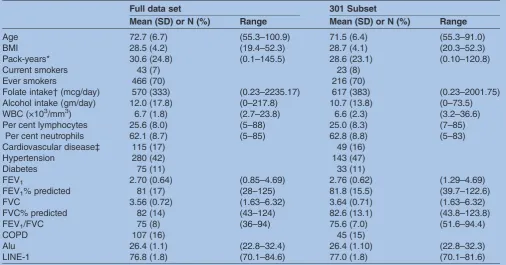
Baseline characteristics of the 663 individuals included in this study as well as of the subset of 301 individuals with two lung function measures are shown in table 1. All were male and the majority (640, 97%) of white race. Forty-three (7%) were current smokers and 197 (30%) were never smokers. There was wide variation in lung function values. Of the 107 individuals with COPD, 77 (72%) were GOLD stage II, 26 were stage III and 4 were stage IV; overall 20 (20%) of the individuals with COPD were current smokers.
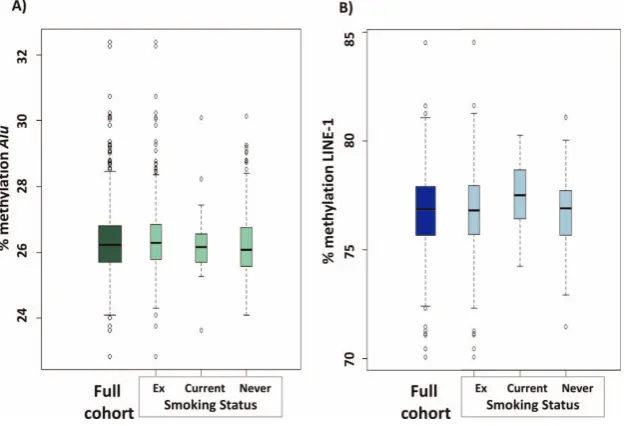
The distribution of percentage methylation of both Alu and LINE-1 elements among the population and stratified by smoking status is shown infigure 1.
Bivariate relationships betweenAluand LINE-1 methy-lation with outcomes and covariates considered for inclu-sion in the multivariable model are shown intable 2.Alu methylation was associated or showed a trend towards association positively with FEV1, BMI and FEV1/FVC and
negatively with age and COPD status. LINE-1 methylation was positively associated with current smoking and nega-tively with per cent lymphocytes. NeitherAlunor LINE-1 methylation was associated with FVC, pack-years of smoking or ever smoking status. Folate intake, alcohol intake, total white blood cell count and per cent neutro-phils were not significantly associated withAluor LINE-1 methylation in bivariate analyses. There was no
significant relationship between methylation of Aluand LINE-1 to each other ( p=0.23).
In multivariate models that included age, height, race, pack-years of smoking, smoking status and BMI, Alu methylation was positively associated with FEV1, and
showed a trend towards association with FVC and FEV1/
FVC. Because of recent data suggesting that current smoking status may have differential effects on methyla-tion,35 36and because this may relate to disease outcome or risk, we investigated whether our results would change if current smokers were excluded from the analyses. Higher Alu methylation was still associated with lower odds of COPD (OR 0.80 (0.64 to 0.99) p=0.046). In ana-lyses of lung function measures, results were in the same direction but were no longer significant except for FEV1/
FVC (FEV1 p=0.17, FVC p=0.7, FEV1/FVC p=0.029).
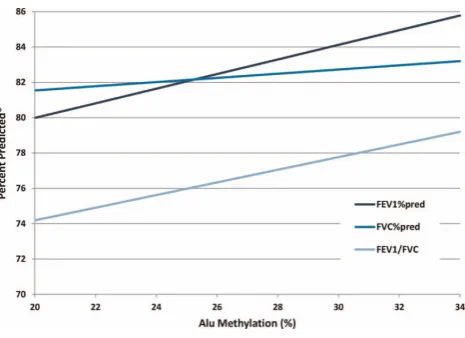
There were no significant associations between LINE-1 methylation and any of the cross-sectional outcomes (table 3). Figure 2 depicts the bivariate associations of Alumethylation with FEV1% predicted, FVC% predicted
and FEV1/FVC.
[image:4.595.46.553.433.698.2]We also analysed whether methylation of Alu and LINE-1 were associated with rate of change in lung func-tion in a subset of participants who had two consecutive lung function measures (N=301). The mean number of years elapsed between measurements was 4.03 (SD 1.23). Models were adjusted for baseline FEV1, FVC or FEV1/
Table 1 Baseline characteristics of 663 individuals from the Normative Aging Study and subset of 301 individuals who had more than one lung function measurement for analysis of lung function decline
Full data set 301 Subset
Mean (SD) or N (%) Range Mean (SD) or N (%) Range
Age 72.7 (6.7) (55.3–100.9) 71.5 (6.4) (55.3–91.0)
BMI 28.5 (4.2) (19.4–52.3) 28.7 (4.1) (20.3–52.3)
Pack-years* 30.6 (24.8) (0.1–145.5) 28.6 (23.1) (0.10–120.8)
Current smokers 43 (7) 23 (8)
Ever smokers 466 (70) 216 (70)
Folate intake†(mcg/day) 570 (333) (0.23–2235.17) 617 (383) (0.23–2001.75) Alcohol intake (gm/day) 12.0 (17.8) (0–217.8) 10.7 (13.8) (0–73.5) WBC (×103/mm3) 6.7 (1.8) (2.7–23.8) 6.6 (2.3) (3.2–36.6)
Per cent lymphocytes 25.6 (8.0) (5–88) 25.0 (8.3) (7–85) Per cent neutrophils 62.1 (8.7) (5–85) 62.8 (8.8) (5–83)
Cardiovascular disease‡ 115 (17) 49 (16)
Hypertension 280 (42) 143 (47)
Diabetes 75 (11) 33 (11)
FEV1 2.70 (0.64) (0.85–4.69) 2.76 (0.62) (1.29–4.69)
FEV1% predicted 81 (17) (28–125) 81.8 (15.5) (39.7–122.6)
FVC 3.56 (0.72) (1.63–6.32) 3.64 (0.71) (1.63–6.32)
FVC% predicted 82 (14) (43–124) 82.6 (13.1) (43.8–123.8)
FEV1/FVC 75 (8) (36–94) 75.6 (7.0) (51.6–94.4)
COPD 107 (16) 45 (15)
Alu 26.4 (1.1) (22.8–32.4) 26.4 (1.10) (22.8–32.3)
LINE-1 76.8 (1.8) (70.1–84.6) 77.0 (1.8) (70.1–81.6)
*Pack-years in current or ex-smokers only.
†Calculated based on supplement intake and fortified foods from food frequency questionnaire. ‡Angina, stroke, myocardial infarction, ischaemic heart disease.
BMI, body mass index; COPD, chronic obstructive pulmonary disease; FEV1, forced expiratory volume in 1 s; FVC, forced vital capacity;
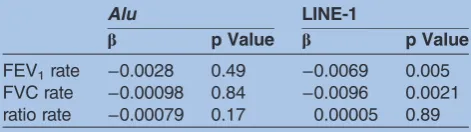
FVC (respectively for the given outcome) as well as age, pack-years of smoking, BMI, height, race, per cent lym-phocytes and smoking status. Relative hypomethylation in LINE-1 but not Alu was associated with faster rate of decline in FEV1 and FVC ( p<0.005). Neither measure
was associated with rate of change of FEV1/FVC
(table 4). Including bothAluand LINE-1 methylation in the models did not change the results (data not shown). Because of prior associations between methylation of repetitive elements and cardiovascular disease,15–17 we repeated both cross-sectional and longitudinal analyses including variables for cardiovascular disease (myocardial infarction, stroke, angina, hypertension, ischaemic heart disease) and diabetes and found no difference in the results (data not shown). Analyses were also repeated in whites only to determine whether results might be due to population stratification and results did not change (data not shown). Analyses excluding current smokers remained significant (data not shown). Because of the known association between aging and methylation, we also repeated the models using age2, as an additional
covariate to saturate the model for an age effect and found no difference in our results (data not shown).
DISCUSSION
We examined associations between methylation levels of the repetitive elements Alu and LINE-1 in a cohort of older men in relation to lung function and COPD status. In cross-sectional analyses, we found that Alu hypo-methylation was associated with lower FEV1with a trend
towards association with lower FVC and FEV1/FVC.
LINE-1 hypomethylation was associated with more rapid lung function decline (FEV1and FVC).
[image:5.595.143.456.57.270.2]Prior studies have found associations between methyla-tion of repetitive transposable elements such as Aluand LINE-1 and several diseases including multiple cancers,7 cardiovascular disease15–17and neurological disease,18 as well as with markers of inflammation.19 To our knowl-edge this is the first study to examine associations between methylation of Alu and LINE-1 transposable elements and measures of lung function.
Figure 1 Distribution (median, IQR) of percentage (A)Aluand (B) long-interspersed nuclear elements (LINE-1) methylation in the overall cohort and stratified by smoking status.
Table 2 Bivariate associations betweenAlu, LINE-1 methylation and other covariates
Alu LINE-1
β p Value β p Value
Age −0.3 0.07 −0.2 0.1
BMI 0.106 0.059 0.054 0.17
Current smoking 0.35 0.14 0.697 0.0002
Per cent lymphocytes 0.08 0.73 −0.31 0.04
FEV1 0.024 0.06 −0.006 0.53
FVC 0.023 0.22 −0.004 0.73
FEV1/FVC 0.31 0.046 −0.05 0.67
COPD OR 0.87 (0.73 to 1.03) 0.1 1.02 (0.92 to 1.13) 0.76
BMI, body mass index; COPD, chronic obstructive pulmonary disease; FEV1, forced expiratory volume in 1 s; FVC, forced vital capacity;
LINE-1, long-interspersed nuclear elements.
[image:5.595.44.550.603.725.2]Previous work has shown that in normal subjects, Alu hypomethylation is associated with increased age,8 37 greater alcohol use and gender (lower in males).34 In this same cohort (Normative Aging Study), hypomethy-lation has been associated with higher incidence of cancer in general and lung cancer specifically (LINE-1 methylation), as well as higher mortality from cancer (Alu and LINE-1 methylation).38 A variety of environ-mental exposures such as lead,39 traffic particles,33 organic pollutants,40 metals, air pollutants and endo-crine disrupting agents,41 may all affect global methyla-tion levels, specifically some that may relate to lung function such as various air pollutants.
Hypomethylation of transposable elements may or may not be causally linked to lower lung function and faster rates of lung function decline. Lower methylation ofAlu and LINE-1 may increase their activity as retrotransposable sequences, leading to greater genomic instability and more mutations.13Furthermore, oxidative damage caused by environmental exposures may cause hypomethylation.42 This may lead to alteration of gene expression through a variety of mechanisms including disrupting transcrip-tion factor binding sites or reading frames, altering regula-tory sequences, altering methylation patterns of gene
promoters or introducing new transcription factor-binding sites.43–45Aluelements specifically are preferentially found in gene-rich regions.46 Black carbon and increased PM2.5
exposure,33 as well as PM10 exposure,41 have been found
[image:6.595.42.556.72.149.2]to be inversely associated with LINE-1 methylation and bothAluand LINE-1 methylation, respectively, which may impact on lung function or lung function decline.47 LINE-1 hypomethylation may also increase transcription of genes that have LINE-1 in regulatory regions. It is pos-sible that other specific environmental or dietary expo-sures previously not known to be associated with lung function may be mediated through epigenetic changes such asAluor LINE-1 hypomethylation. Alternatively, this may be a marker of a specific exposure but not causally linked to lower lung function. Lastly, becauseAlu methyla-tion decreases with increasing age, as does lung funcmethyla-tion, ourfindings may represent some other measure of‘aging’ or exposures resulting in similar processes beyond just chronological age.8We repeated all of our analyses using age2, as an additional covariate to saturate for an age effect and found no differences in our results. As our under-standing of epigenetic processes and the exposures that affect these processes increases, the implications of our findings will become clearer.
Figure 2 Alumethylation and lung function bivariate associations betweenAlumethylation and forced expiratory volume in 1 s (FEV1)% predicted, forced vital capacity (FVC)% predicted and FEV1/FVC. *For FEV1/FVC y axis is per cent, not per cent
[image:6.595.182.415.529.698.2]predicted.
Table 3 Multivariate models for lung function and bothAluand LINE-1 methylation*
Alu LINE-1
β p Value Β p Value
FEV1 0.028 0.017 −0.015 0.08
FVC 0.027 0.06 −0.017 0.11
FEV1/FVC 0.3 0.057 −0.092 0.44
COPD 0.85 (0.71 to 1.03) 0.09 1.01 (0.89 to 1.15) 0.83
*Adjusted for age, height, race, BMI, pack-years of smoking, smoking status. Models with LINE-1 also include per cent lymphocytes. BMI, body mass index; COPD, chronic obstructive pulmonary disease; FEV1, forced expiratory volume in 1 s; FVC, forced vital capacity;
These data must be interpreted in the context of the study design. Our study was limited to older men the majority of whom were white, and our findings may or may not be generalisable to other populations. It is diffi -cult to know how to interpret methylation of retrotran-sposons, as opposed to gene-specific methylation, in relation to specific outcomes such as lung function and lung function decline. Future studies in this and other cohorts should include gene-specific methylation ana-lyses similar to Qiu et al,22 to elucidate mechanisms by which methylation changes may relate to these out-comes. We did not control for a variety of environmental exposures that may be associated with both lung func-tion and methylafunc-tion. However, alterafunc-tion in methylafunc-tion patterns may be the pathway through which these changes are mediated and thus including these expo-sures in multivariate models would be overadjusting. Methylation levels vary in different tissue types and it is possible that assessments of methylation in white blood cells may not reflect alterations seen in lung tissue. However, systemic processes involving white blood cells, such as inflammation, may play a role in the pathophysi-ology of lung function decline,48 and may nonetheless be markers of specific exposures (such as cigarette smoking) that exert a systemic effect.
In summary, we found that relative hypomethylation ofAluwas associated with lower lung function measures, and that LINE-1 hypomethylation was associated with more rapid lung function decline. Future studies on both gene-specific methylation as well as exposures related to methylation of retrotransposons will improve our understanding of the relationship between epigen-etic changes and lung function, potentially informing new diagnostic and therapeutic approaches to lung func-tion decline and diseases such as COPD.
Author affiliations
1Channing Division of Network Medicine, Brigham and Women’s Hospital,
Boston, Massachusetts, USA
2Division of Pulmonary and Critical Care Medicine, Department of Medicine,
Brigham and Women’s Hospital, Boston, Massachusetts, USA
3Department of Medicine Harvard Medical School, Boston, Massachusetts,
USA
4Department of Environmental and Occupational Health, Center of Molecular
and Genetic Epidemiology, Università degli Studi di Milano and IRCCS Maggiore Policlinico Hospital, Milan, Italy
5Veterans Administration Boston Healthcare System and Department of
Medicine, Boston University School of Medicine, Boston, Massachusetts, USA
6Department of Environmental Health, Harvard School of Public Health,
Boston, Massachusetts, USA
Acknowledgements We would like to thank all of the participants of the Normative Aging Study.
Contributors NEL designed the study, performed the data analysis and prepared the manuscript. JS contributed to the data analysis and provided critical revision of the manuscript. LT contributed to data collection and provided critical revision of the manuscript. VB contributed to data collection and provided critical revision of the manuscript. DS and PV were involved in conception of the study and critical revision of the manuscript. AZ contributed to data collection and provided critical revision of the manuscript. JS contributed to the study design and provided critical revision of the manuscript. AB contributed to data collection and provided critical revision of the manuscript. AAL contributed to study design, assisted with the data analysis and provided critical revision of the manuscript. DLD designed the study, assisted with the data analysis, and provided critical revision of the manuscript.
Funding Funded by NIH grants AG027214, ES015172, ES014663, HL007427, HL089438, ES015172–01 and ES000002, and VA Research and Development Service. DM is supported by a Doris Duke Clinical Scientist Development Award. The Cooperative Studies Program/Epidemiology Research and Information Center of the US Department of Veterans Affairs supported the VA Normative Aging Study, which is a component of the Massachusetts Veterans Epidemiology Research and Information Center, Boston, MA. This research was also supported by a VA Research Career Scientist award to D S.
Competing interests None.
Ethics Approval Veterans administration.
Provenance and peer review Not commissioned; externally peer reviewed.
Data sharing statement There are no additional data available.
REFERENCES
1. Hancock DB, Eijgelsheim M, Wilk JB,et al. Meta-analyses of genome-wide association studies identify multiple loci associated with pulmonary function.Nat Genet2011;42:45–52.
2. Hubert HB, Fabsitz RR, Feinleib M,et al. Genetic and environmental influences on pulmonary function in adult twins.Am Rev Respir Dis 1982;125:409–15.
3. McClearn GE, Svartengren M, Pedersen NL,et al. Genetic and environmental influences on pulmonary function in aging Swedish twins.J Gerontol1994;49:264–8.
4. Redline S, Tishler PV, Rosner B,et al. Genotypic and phenotypic similarities in pulmonary function among family members of adult monozygotic and dizygotic twins.Am J Epidemiol1989;129:827–36. 5. Soler Artigas M, Loth DW, Wain LV,et al. Genome-wide association
and large-scale follow up identifies 16 new loci influencing lung function.Nat Genet2011;43:1082–90.
6. Ehrlich M, Gama-Sosa MA, Huang LH,et al. Amount and
distribution of 5-methylcytosine in human DNA from different types of tissues of cells.Nucleic Acids Res1982;10:2709–21.
7. Wilson AS, Power BE, Molloy PL. DNA hypomethylation and human diseases.Biochim Biophys Acta2007;1775:138–62.
8. Bollati V, Schwartz J, Wright R,et al. Decline in genomic DNA methylation through aging in a cohort of elderly subjects.Mech Ageing Dev2009;130:234–9.
9. Lander ES, Linton LM, Birren B,et al. Initial sequencing and analysis of the human genome.Nature2001;409:860–921. 10. Deininger PL, Batzer MA. Alu repeats and human disease.Mol
Genet Metab1999;67:183–93.
11. Yang AS, Estecio MR, Doshi K,et al. A simple method for estimating global DNA methylation using bisulfite PCR of repetitive DNA elements.Nucleic Acids Res2004;32:e38.
[image:7.595.47.283.85.151.2]12. Weisenberger DJ, Campan M, Long TI,et al. Analysis of repetitive element DNA methylation by MethyLight.Nucleic Acids Res 2005;33:6823–36.
Table 4 Multivariate models for rate of change in lung function (in l/year) and bothAluand LINE-1 methylation*
Alu LINE-1
β p Value β p Value
FEV1rate −0.0028 0.49 −0.0069 0.005
FVC rate −0.00098 0.84 −0.0096 0.0021 ratio rate −0.00079 0.17 0.00005 0.89
*Adjusted for age, height, race, BMI, pack-years of smoking, smoking status and baseline FEV1, FVC or FEV1/FVC
respectively depending on outcome. Models with LINE-1 also adjusted for per cent lymphocytes.
BMI, body mass index; FEV1, forced expiratory volume in 1 s;
FVC, forced vital capacity; LINE-1, long-interspersed nuclear elements.
13. Gravina S, Vijg J. Epigenetic factors in aging and longevity.Pflugers Arch2010;459:247–58.
14. Dean W, Lucifero D, Santos F. DNA methylation in mammalian development and disease.Birth Defects Res C Embryo Today 2005;75:98–111.
15. Baccarelli A, Wright R, Bollati V,et al. Ischemic heart disease and stroke in relation to blood DNA methylation.Epidemiology 2010;21:819–28.
16. Castro R, Rivera I, Struys EA,et al. Increased homocysteine and S-adenosylhomocysteine concentrations and DNA hypomethylation in vascular disease.Clin Chem2003;49:1292–6.
17. Kim M, Long TI, Arakawa K,et al. DNA methylation as a biomarker for cardiovascular disease risk.PLoS One2010;5:e9692.
18. Bollati V, Galimberti D, Pergoli L,et al. DNA methylation in repetitive elements and Alzheimer disease.Brain Behav Immun
2011;25:1078–83.
19. Baccarelli A, Tarantini L, Wright RO,et al. Repetitive element DNA methylation and circulating endothelial and inflammation markers in the VA normative aging study.Epigenetics2010;5:222–8. 20. Crow MK. Long interspersed nuclear elements (LINE-1): potential
triggers of systemic autoimmune disease.Autoimmunity2010;43:7–16. 21. Sood A, Petersen H, Blanchette CM,et al. Wood smoke exposure
and gene promoter methylation are associated with increased risk for COPD in smokers.Am J Respir Crit Care Med2010;182:1098–104. 22. Qiu W, Baccarelli A, Carey VJ,et al. Variable DNA methylation is
associated with chronic obstructive pulmonary disease and lung function.Am J Respir Crit Care Med2012;185:373–81. 23. Lange NE, Sordillo JE, Tarantini L,et al. Global DNA methylation
and lung function in the normative aging study (abstract).Am J Respir Crit Care Med2011;183:A5694.
24. Bell B, Rose C, Damon A. The Normative aging study: an interdisciplinary and longitudinal study of health and aging.Aging Human Dev1972;3:5–17.
25. Madrigano J, Baccarelli A, Mittleman MA,et al. Prolonged exposure to particulate pollution, genes associated with glutathione pathways, and DNA methylation in a cohort of older men.Environ Health Perspect2011;119:977–82.
26. Wright RO, Schwartz J, Wright RJ,et al. Biomarkers of lead exposure and DNA methylation within retrotransposons.Environ Health Perspect2010;118:790–5.
27. Sparrow D, O’Connor G, Colton T,et al. The relationship of nonspecific bronchial responsiveness to the occurrence of respiratory symptoms and decreased levels of pulmonary function. The Normative Aging Study.Am Rev Respir Dis1987;135:1255–60. 28. Standardization of spirometry—1987 update. Statement of the
American Thoracic Society.Am Rev Respir Dis1987;136:1285–98. 29. Standardization of Spirometry, 1994 Update. American Thoracic
Society.Am J Respir Crit Care Med1995;152:1107–36. 30. Crapo RO, Morris AH, Gardner RM. Reference spirometric values
using techniques and equipment that meet ATS recommendations. Am Rev Respir Dis1981;123:659–64.
31. Global Initiative for Chronic Obstructive Lung Disease. Global strategy for the diagnosis, management, and prevention of chronic obstructive pulmonary disease. (Updated 2010) http://www.goldcopd.org/ Guidelineitem.asp?l1=2&l2=1&intId=989 (accessed 17 May 2011).
32. Bollati V, Baccarelli A, Hou L,et al. Changes in DNA methylation patterns in subjects exposed to low-dose benzene.Cancer Res 2007;67:876–80.
33. Baccarelli A, Wright RO, Bollati V,et al. Rapid DNA methylation changes after exposure to traffic particles.Am J Respir Crit Care Med2009;179:572–8.
34. Zhu ZZ, Hou L, Bollati V,et al. Predictors of global methylation levels in blood DNA of healthy subjects: a combined analysis.Int J Epidemiol2012;41:126–39.
35. Breitling LP, Yang R, Korn B,et al. Tobacco-smoking-related differential DNA methylation: 27K discovery and replication.Am J Hum Genet2011;88:450–7.
36. Wan ES, Qiu W, Baccarelli A,et al. Cigarette smoking behaviors and time since quitting are associated with differential DNA methylation across the human genome.Hum Mol Genet 2012;21:3073–82.
37. Jintaridth P, Mutirangura A. Distinctive patterns of age-dependent hypomethylation in interspersed repetitive sequences.Physiol Genomics2010;41:194–200.
38. Zhu ZZ, Sparrow D, Hou L,et al. Repetitive element
hypomethylation in blood leukocyte DNA and cancer incidence, prevalence, and mortality in elderly individuals: the Normative Aging Study.Cancer Causes Control2010;22:437–47.
39. Pilsner JR, Hu H, Ettinger A,et al. Influence of prenatal lead exposure on genomic methylation of cord blood DNA.Environ Health Perspect2009;117:1466–71.
40. Rusiecki JA, Baccarelli A, Bollati V,et al. Global DNA
hypomethylation is associated with high serum-persistent organic pollutants in Greenlandic Inuit.Environ Health Perspect 2008;116:1547–52.
41. Baccarelli A, Bollati V. Epigenetics and environmental chemicals. Curr Opin Pediatr2009;21:243–51.
42. Valinluck V, Tsai HH, Rogstad DK,et al. Oxidative damage to methyl-CpG sequences inhibits the binding of the methyl-CpG binding domain (MBD) of methyl-CpG binding protein 2 (MeCP2). Nucleic Acids Res2004;32:4100–8.
43. Norris J, Fan D, Aleman C,et al. Identification of a new subclass of Alu DNA repeats which can function as estrogen
receptor-dependent transcriptional enhancers.J Biol Chem 1995;270:22777–82.
44. Vansant G, Reynolds WF. The consensus sequence of a major Alu subfamily contains a functional retinoic acid response element.Proc Natl Acad Sci USA1995;92:8229–33.
45. Asada K, Kotake Y, Asada R,et al. LINE-1 hypomethylation in a choline-deficiency-induced liver cancer in rats:
dependence on feeding period.J Biomed Biotechnol 2006;2006:17142.
46. Batzer MA, Deininger PL. Alu repeats and human genomic diversity. Nat Rev Genet2002;3:370–9.
47. Andersen ZJ, Hvidberg M, Jensen SS,et al. Chronic obstructive pulmonary disease and long-term exposure to traffic-related air pollution: a cohort study.Am J Respir Crit Care Med
2010;183:455–61.
![5 [(E) 2 (4 Methoxycarbonylphenyl)ethenyl] 1,1,3,3 tetramethylisoindolin 2 yloxyl](data:image/gif;base64,R0lGODlhAQABAIAAAP///wAAACH5BAEAAAAALAAAAAABAAEAAAICRAEAOw==)