Responses following Vaccination with Live Attenuated Classical Swine
Fever Virus (CSFV) and Virulent CSFV Challenge
Giulia Franzoni,a,bNitin V. Kurkure,a,cDaniel S. Edgar,a,bHelen E. Everett,aWilhelm Gerner,dKikki B. Bodman-Smith,b Helen R. Crooke,aSimon P. Grahama
Virology Department, Animal Health and Veterinary Laboratories Agency, Addlestone, United Kingdoma; Department of Microbial and Cellular Sciences, University of
Surrey, Guildford, United Kingdomb; Nagpur Veterinary College, Maharashtra Animal and Fishery Sciences University, Nagpur, Indiac; Department of Pathobiology,
Institute of Immunology, University of Veterinary Medicine Vienna, Vienna, Austriad
Vaccination with live attenuated classical swine fever virus (CSFV) induces solid protection after only 5 days, which has been
associated with virus-specific T cell gamma interferon (IFN-
␥
) responses. In this study, we employed flow cytometry to
charac-terize T cell responses following vaccination and subsequent challenge infections with virulent CSFV. The CD3
ⴙCD4
ⴚCD8
hiT
cell population was the first and major source of CSFV-specific IFN-
␥
. A proportion of these cells showed evidence for
cytotoxic-ity, as evidenced by CD107a mobilization, and coexpressed tumor necrosis factor alpha (TNF-
␣
). To assess the durability and
recall of these responses, a second experiment was conducted where vaccinated animals were challenged with virulent CSFV
af-ter 5 days and again afaf-ter a further 28 days. While virus-specific CD4 T cell (CD3
ⴙCD4
ⴙCD8
␣
ⴙ) responses were detected, the
dominant response was again from the CD8 T cell population, with the highest numbers of these cells being detected 14 and 7
days after the primary and secondary challenges, respectively. These CD8 T cells were further characterized as CD44
hiCD62L
ⴚand expressed variable levels of CD25 and CD27, indicative of a mixed effector and effector memory phenotype. The majority of
virus-specific IFN-
␥
ⴙCD8 T cells isolated at the peaks of the response after each challenge displayed CD107a on their surface,
and subpopulations that coexpressed TNF-
␣
and interleukin 2 (IL-2) were identified. While it is hoped that these data will aid
the rational design and/or evaluation of next-generation marker CSFV vaccines, the novel flow cytometric panels developed
should also be of value in the study of porcine T cell responses to other pathogens/vaccines.
C
lassical swine fever (CSF) is one of the most important viral
infectious diseases of domestic pigs and wild boars. CSF is
caused by the classical swine fever virus (CSFV), a highly
conta-gious, small, enveloped, single-stranded RNA virus belonging to
the family
Flaviviridae
(
1
). Since 1990, outbreaks of CSF in the
European Union have been controlled through a stamping-out
slaughter policy, epidemiological and virological investigations,
and movement restriction for pigs and pig products (
1
,
2
). Owing
to the economic losses caused by the stamping-out policy, there is
pressure to develop alternative strategies to control CSF outbreaks
and to minimize the need for mass culling (
2
).
Live attenuated CSF vaccines, such as C-strain viruses, provide
a rapid onset of complete protection but pose problems in
dis-criminating infected from vaccinated animals. Many studies have
aimed to develop marker subunit vaccines, but they frequently fail
to show an appropriate level of efficacy for use under emergency
outbreak conditions (
1
,
3
,
4
). An understanding of the
immuno-logical basis of rapid protection afforded by live attenuated
C-strain vaccine would aid the development of the next generation of
marker CSFV vaccines, both through the identification of vaccine
candidate antigens and through informing the selection of
appro-priate delivery systems/adjuvants to trigger protective responses.
While the immunological effector mechanisms are not well
de-fined, C-strain-induced protection may precede the appearance of
neutralizing antibody but not gamma interferon (IFN-
␥
)-secret-ing cells in peripheral blood, suggest)-secret-ing that cellular immunity is
responsible (
5
). Moreover, it has recently been shown that there is
a close temporal correlation between the induction of
CSFV-spe-cific T cell IFN-
␥
responses and rapid protection induced by a
C-strain vaccine (
6
). In addition to the secretion of IFN-
␥
, which
has been shown to exert direct antiviral effects on CSFV
in vitro
(
7
), vaccine-induced CSFV-specific T cells have also been shown
to have the capacity to lyse infected cells with specificities mapped
to the structural protein E2 and the nonstructural protein NS3
(
8–10
). Flow cytometric studies have identified both CD4 and
CD8 T cells as the cellular source of CSFV-specific IFN-
␥
, with the
latter coexpressing the cytolytic molecule perforin (
7
,
11
). Further
evidence for a protective role for T cells stems from recent subunit
vaccine studies which have shown that the protective capacity of a
CSFV E2 DNA vaccine was associated with T cell IFN-
␥
rather
than neutralizing antibody responses (
12
) and that inclusion of a
defined NS3 T cell epitope improved the immunogenicity and the
degree of protection afforded by a peptide-based CSF vaccine
(
13
).
The goal of an efficient vaccine is to generate memory CD4
and/or CD8 T cells capable of recognizing and rapidly expanding
to combat infection (
14
). While challenging, it has been proposed
Received27 June 2013 Returned for modification26 July 2013 Accepted12 August 2013
Published ahead of print21 August 2013
Address correspondence to Simon P. Graham, [email protected].
Supplemental material for this article may be found athttp://dx.doi.org/10.1128 /CVI.00415-13.
Copyright © 2013, American Society for Microbiology. All Rights Reserved.
doi:10.1128/CVI.00415-13
on August 17, 2020 by guest
http://cvi.asm.org/
that the efficacy of T-cell-based vaccines could be improved by
manipulating the generation and maintenance of distinct memory
T cell subsets which in recent years have been identified in humans
and mice through the application of multiparameter flow
cytom-etry (
15
). The two main categories of memory T cells are classified
as effector memory (T
EM) and central memory (T
CM) (
16
) and
can be distinguished with the lymph node homing markers
CD62L and CCR7, with CD62L
⫹CCR7
⫹and CD62L
⫺CCR7
⫺cells representing the T
CMand T
EM, respectively (
17
). The
adhe-sion molecules CD44 and CD11a are further used to differentiate
naive from effector/memory CD8 T cells (
17
). Moreover, the
si-multaneous detection of cytokines (e.g., IFN-
␥
, tumor necrosis
factor alpha [TNF-
␣
], interleukin 2 [IL-2]) and other effector
molecules/markers (e.g., CD107a mobilization) has enabled
as-sessment of T cell polyfunctionality and has been attributed to
cells capable of exerting multiple functions with greater protective
capacity (
18
). Recent studies using such approaches have
sug-gested that effector memory and/or polyfunctional CD8 T cells
play an important role in immunity to other viruses belonging to
the family
Flaviviridae
, such as hepatitis C virus (HCV) (
19–21
)
and yellow fever virus (YFV) (
22
). To provide an improved
un-derstanding of the role that T cells may play in immunity to CSFV,
we deployed novel flow cytometric antibody panels to
quantita-tively and qualitaquantita-tively assess the T cell response induced
follow-ing C-strain vaccination and subsequent CSFV challenge
infec-tion. We additionally assessed whether the T cell responses of
vaccinated and challenged animals were sustained and/or readily
recalled upon subsequent rechallenge infection and the impact
that this rechallenge had on their phenotype/function.
MATERIALS AND METHODS
Ethics statement.All animal work was approved by the Animal Health and Veterinary Laboratories Agency Ethics Committee, and all proce-dures were conducted in accordance with the United Kingdom Animals (Scientific Procedures) Act 1986 under project license permit numbers PPL 70/6559 and 70/7403. To minimize animal suffering, careful comple-tion of clinical score sheets and regular observacomple-tion were conducted which informed euthanasia decisions based on a predefined humane endpoint (clinical score of⬎15 or if temperature was ⬎41°C and more than 2 individual scores [other than the temperature score] had a value of 3). However, none of the animals experienced clinical signs necessitating eu-thanasia. All animals were euthanized on predetermined days by intra-muscular (i.m.) administration of ketamine-xylazine (Rompun) sedative followed by intravenous administration of 20% sodium pentobarbitone solution.
Viruses.A commercially available live attenuated C-strain CSFV (AC Riemser Schweinepestvakzine; Riemser Arzneimittel AG, Riems,
Ger-many) was used for vaccinations. This CSFV C-strain vaccine was atten-uated by multiple passages through rabbits followed by adaptation to culture in porcine kidney cells (23) and had previously been shown able to protect pigs against CSFV challenge after only 5 days (6). For challenge infections, the CSFV Brescia stain (kindly provided by Alexandra Meindl-Böhmer, University of Veterinary Medicine, Hannover, Germany) was selected as it had been shown in recent studies to be a highly virulent strain (24–26). The virulent CSFV Alfort 187 strain (AHVLA CSF Reference Laboratory Virus Archive, Addlestone, United Kingdom) was selected for use inin vitrorestimulation assays, since this virus is of the same subgeno-group (1.1) as C-strain and Brescia and, importantly, readily grows to high titers in PK15 cells, enabling its use in restimulation assays at a mul-tiplicity of infection (MOI) of 1, which we had previously shown to induce a better recall of T cell responses than lower MOIs (7). All three viruses were propagatedin vitroby inoculation of subconfluent PK15 cell mono-layers. PK15 cells were maintained in Eagle’s minimum essential medium (E-MEM) (Invitrogen, Paisley, United Kingdom) supplemented with 100 IU/ml penicillin, 100g/ml streptomycin (Invitrogen), and 10% fetal bovine serum (FBS) (Autogen Bioclear, Calne, United Kingdom). After 4 days, the supernatant was collected and pooled with a freeze-thawed cell lysate. The resultant pool was clarified by centrifugation at 524⫻gfor 10 min, aliquoted, and stored at⫺80°C. Virus titers were obtained by serial dilution of the virus suspension on PK15 cells followed by immunoper-oxidase staining to identify infection rates as described previously (27). Mock virus supernatant was prepared in an identical manner from unin-fected PK15 cells.
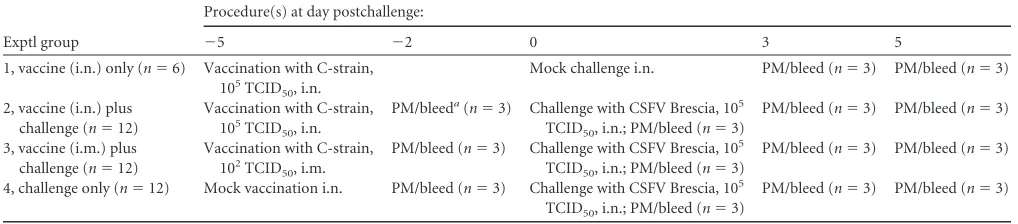
Vaccination and challenge of pigs with CSFV.In the first experiment (experiment 1), 42 Large White/Landrace crossbreed pigs of 8 to 10 weeks of age were randomly assigned to four groups. Numbers of animals per group, the treatments administered, and the days that animals were sam-pled and responses were analyzed are summarized inTable 1. Five days prior to challenge, animals in groups 1 (n⫽6) and 2 (n⫽12) were inoculated intranasally (i.n.) with 10550% tissue culture infective doses (TCID50) of C-strain CSFV (1 ml divided equally between each nostril and administered using a mucosal atomization device [MAD-300; Wolfe Tory Medical, USA]), those in group 3 (n⫽12) were inoculated with 2 ml of reconstituted vaccine into the brachiocephalic muscle (as recommended by the manufacturer, Riemser Arzneimittel AG), and those in group 4 (n⫽12) were intranasally inoculated with 1 ml of mock virus supernatant as described for groups 1 and 2. On day 0 postchallenge, groups 2 to 4 were inoculated intranasally with 105TCID
50of CSFV Brescia strain as de-scribed above and group 1 received a similar inoculation of mock virus supernatant. On days⫺2 and 0 postchallenge, three animals were eutha-nized from groups 2 to 4, and on days 3 and 5 postchallenge, three animals were euthanized from all four groups and blood samples were collected for analysis of CSFV-specific T cell responses. A second experiment (ex-periment 2) utilized 11 Large White/Landrace pigs, 6 months of age. Eight animals were vaccinated at day⫺5 postchallenge by intramuscular inoc-ulation of 105TCID
50of C-strain CSFV and challenged at day 0 and day 28 by intranasal inoculation of 105and 106TCID
50of CSFV Brescia, respec-TABLE 1Experimental design of first vaccination/challenge experiment
Exptl group
Procedure(s) at day postchallenge:
⫺5 ⫺2 0 3 5
1, vaccine (i.n.) only (n⫽6) Vaccination with C-strain, 105TCID
50, i.n.
Mock challenge i.n. PM/bleed (n⫽3) PM/bleed (n⫽3)
2, vaccine (i.n.) plus challenge (n⫽12)
Vaccination with C-strain, 105TCID
50, i.n.
PM/bleeda(n⫽3) Challenge with CSFV Brescia, 105
TCID50, i.n.; PM/bleed (n⫽3)
PM/bleed (n⫽3) PM/bleed (n⫽3)
3, vaccine (i.m.) plus challenge (n⫽12)
Vaccination with C-strain, 102TCID
50, i.m.
PM/bleed (n⫽3) Challenge with CSFV Brescia, 105
TCID50, i.n.; PM/bleed (n⫽3)
PM/bleed (n⫽3) PM/bleed (n⫽3)
4, challenge only (n⫽12) Mock vaccination i.n. PM/bleed (n⫽3) Challenge with CSFV Brescia, 105
TCID50, i.n.; PM/bleed (n⫽3)
PM/bleed (n⫽3) PM/bleed (n⫽3)
aPM/bleed, euthanization and collection of blood samples.
Characterization of CSFV-Specific CD8 T Cell Responses
on August 17, 2020 by guest
http://cvi.asm.org/
tively, as described above. Three negative-control animals received similar inoculations of mock virus supernatant on each occasion. A third animal experiment (experiment 3) was performed, and the experimental design and procedures were described previously (28). In brief, 6 Large White/ Landrace cross male pigs, 8 to 10 weeks of age, were utilized. Four pigs were inoculated with 1 ml (100 50% protective doses [PD50]) of the re-constituted C-strain vaccine into the brachiocephalic muscle (as recom-mended by the manufacturer, Riemser Arzneimittel AG), and two unvac-cinated pigs were used as negative controls and housed in a separate pen.
Clinical, hematological, and virological methods.Animals were in-spected twice daily (a.m. and p.m.), and 9 parameters relevant for indica-tion of CSF (liveliness, body tension, body shape, breathing, walking, skin, eye/conjunctiva, appetite/leftovers at feedings, and defecation) were ex-amined and scored as 0 (normal), 1 (slightly altered), 2 (distinct clinical sign), or 3 (CSF symptoms) (29). A total clinical score for each animal was assigned twice daily, and temperatures were monitored by rectal ther-mometer readings and recorded once daily. For experiment 1, tempera-ture and clinical score monitoring commenced on day⫺11 postchallenge and continued until the termination of the experiment (day 5 postchal-lenge), and for experiment 2, temperature and clinical score were moni-tored for 7 days before and after each of the CSFV Brescia inoculations. Peripheral blood leukocytes were enumerated every 3 or 7 days during experiment 1 or 2, respectively, using flow cytometry (29). In brief, 50l EDTA blood was incubated with 5l of anti-porcine CD45-fluorescein isothiocyanate (FITC) monoclonal antibody (MAb) (0.1 mg/ml, K252-1E4; AbD Serotec, Oxford, United Kingdom) for 10 min at room temper-ature (RT) in the dark (details of all the antibodies used in this work are reported inTable 2). Fluorescence-activated cell sorting (FACS) lysing solution (945l) (BD Biosciences, Oxford, United Kingdom) was added for 10 min at RT to lyse erythrocytes and fix leukocytes. Cell counts were obtained on a volumetric flow cytometer (MACSQuant Analyzer; Milte-nyi Biotec, Bisley, United Kingdom) by gating FITC-positive events, and leukocyte counts perl of blood were obtained by multiplying the leuko-cyte density by the dilution factor (⫻20). For experiment 1, CSFV RNA was detected in blood samples collected every 3 days. Total RNA was extracted from EDTA blood using the QIAamp viral RNA mini-extrac-tion kit, according to the manufacturer’s protocols (Qiagen, Crawley, United Kingdom). CSFV viral copy numbers were assessed by quantita-tive reverse transcription-PCR (RT-PCR), using the One-Step Super-script III Platinum kit (Invitrogen) (29). Primers CSF100-F and CSF192-R were used at a concentration of 600 nM, and the 6-carboxy-fluorescein (FAM)-labeled CSF probe (30) was used at 200 nM. The viral genome copy number was determined by comparison to a 10-fold serial
dilution of a standard, which consisted of RNA transcribed from plasmid pCRXLV234-6, containing the 5=untranscribed region (UTR) of CSFV strain Alfort 187 (29).
Purification and cryopreservation of PBMC.Heparinized venous blood was collected on days⫺5,⫺2, 0, 2, and 5 postchallenge during experiment 1; on days⫺5 and 0 and every 7 days until day 56 postchal-lenge during experiment 2; and on days 0, 3, 6, 9, 12, 15, and 18 postvac-cination during experiment 3. Peripheral blood mononuclear cells (PBMC) were prepared by diluting 20 ml of blood in 10 ml of phosphate-buffered saline (PBS) (Invitrogen), layering it over 20 ml of Ficoll (Ficoll-Paque Plus; GE Healthcare, Uppsala, Sweden), and centrifuging it at 1,455⫻gfor 30 min at room temperature (RT), without braking, in a rotating bucket centrifuge (Beckman Coulter, High Wycombe, United Kingdom). PBMC were aspirated from the plasma-Ficoll interface and washed three times in PBS by centrifugation at 930⫻gfor 5 min at 4°C. PBMC were resuspended in RPMI 1640 medium supplemented with 10% FBS, 100 IU/ml penicillin, and 100g/ml streptomycin (cRPMI), and cell density was determined by analyzing 50l of cell suspension using a volumetric flow cytometer (Miltenyi Biotec) and gating on events with typical forward scatter (FSC) and side scatter (SSC) for PBMC. Cells were cryopreserved for later analyses. PBMC were adjusted to a density of 1⫻ 107to 2⫻107cells/ml, resuspended in cold (4°C) 10% dimethyl sulfoxide (DMSO) (Sigma, Poole, United Kingdom) in FBS, and transferred to precooled (4°C) labeled cryotubes. These tubes were immediately trans-ferred to a precooled (4°C) Cryo 1°C freezing container (Nalgene; Fisher Scientific, Loughborough, United Kingdom) containing 250 ml of 100% isopropyl alcohol (4°C), which was placed in a⫺80°C freezer for a mini-mum of 4 h to a maximini-mum of 24 h. Cryotubes were then transferred to a liquid nitrogen storage container.
Stimulation of peripheral blood mononuclear cells.To resuscitate cryopreserved cells, cryovials were rapidly thawed in a 37°C water bath and cells were transferred to tubes containing 10 ml of prewarmed (37°C) cRPMI. Cells were washed by centrifugation, 930⫻gfor 5 min at RT, and resuspended in fresh warm cRPMI. Cell densities were calculated using flow cytometry as described above and adjusted to 1⫻107cells/ml, and 100l was transferred to wells of a 96-well round-bottom microtiter plate (Costar; Fisher Scientific). PBMC were stimulated with 100l of CSFV Alfort 187 strain at an MOI of 1. Mock-virus-infected PK15 supernatant and concanavalin A (ConA; Sigma, 10g/ml) were used as negative and positive controls, respectively. Cells were incubated at 37°C for 14 to 16 h, then brefeldin A (GolgiPlug; BD Biosciences) was added (0.2l/well), and cells were further incubated for 6 h before performing flow cytometric analysis. To detect cytotoxic degranulation, PBMC were incubated with TABLE 2Monoclonal antibodies for flow cytometric analysis of porcine T cell responses
MAb Source Clone Concn (mg/ml) Isotype Labeling Working dilution
CD45 AbD Serotec K252-1E4 0.1 IgG1 FITC Neat
CD107a AbD Serotec 4E9/11 0.05 IgG1 Alexa Fluor 647 Neat
CD8␣ BD Pharmingen 76-2-11 0.2 IgG2a PE 1/10
CD4 BD Pharmingen 74-12-4 0.2 IgG2b PerCP-Cy5.5 1/10
CD3 Southern Biotech BB23-8E6 0.5 IgG1 Unconjugated 1/2a
␥␦-TcR1-N4 VMRD PGBL22A 1.0 IgG1 Unconjugated 1/2a
CD25 AbD Serotec K231.3B2 Not determined IgG1 Unconjugated 1/5
CD27 In-house b30c7 Not determined IgG1 Unconjugateda 1/4
CD44 eBioscience IM7 0.2 IgG2b eFluor450 1/16
CD62L AbD Serotec CC32 1.0 IgG1 Unconjugated 1/100
IFN-␥ AbD Serotec CC302 0.05 IgG1 FITC or Alexa Fluor 647 1/10
TNF-␣ BioLegend MAb11 0.5 IgG1 Pacific Blue 1/10
IL-2 Invitrogen A150D 3F1 1.0 IgG2a Unconjugated 1/4a
Mouse IgG1 BD Pharmingen A85-1 0.2 Rat IgG1 APC 1/20
IgG1 isotype control AbD Serotec NAc 0.05 IgG1 FITC or Alexa Fluor 647 Neat, 1/10b aMAb dilution following Zenon labeling.
b
Isotype control used neat to control CD107a staining and 1/10 for IFN-␥staining. cNA, not applicable.
on August 17, 2020 by guest
http://cvi.asm.org/
virus/mock supernatants for 6 h before the addition of CD107a-Alexa Fluor 647 or IgG1 isotype control-Alexa Fluor 647 MAbs (both from AbD Serotec; 10l/well) (Table 2), brefeldin A (as above), and monensin (Golgi Stop; BD Bioscience; 0.2l/well) and then cultured for a further 14 h.
Multiparameter cytofluorometric analysis of peripheral blood mononuclear cells.Cells were harvested and washed in Dulbecco’s PBS without Mg2⫹ and Ca2⫹ (Invitrogen). To assess viability, cells were stained with Near InfraRed Fixable Live/Dead viability dye (Invitrogen) for 30 min at 4°C and then washed twice with Dulbecco’s PBS without Mg2⫹and Ca2⫹supplemented with 2% FBS and 0.09% sodium azide (FACS buffer). Cells were stained with the MAbs specific for surface markers for 10 min at RT and then washed twice with FACS buffer. MAbs used to discriminate T and NK cell populations were CD8␣ -phycoeryth-rin (PE) (76-2-11; BD Pharmingen), CD4-peridinin chlorophyll protein (PerCP)-Cy5.5 (74-12-4; BD Pharmingen), and CD3 (BB238E6; South-ern Biotech, Cambridge Bioscience, Cambridge, United Kingdom). CD3 MAb was labeled using the Zenon Alexa Fluor 647 IgG1 labeling kit, according to the manufacturer’s instructions (Invitrogen). To directly assess the contribution of␥␦T cells to CSFV-specific IFN-␥responses, CSFV/mock-virus-stimulated PBMC from three representative C-strain-vaccinated/Brescia-challenged pigs from each of experiments 1 (day 5 postchallenge) and 2 (day 21 postchallenge) were stained with CD8␣-PE MAb and a MAb against␥␦-TcR1-N4 (PGBL22A; VMRD, Pullman, WA, USA) conjugated to the Alexa Fluor 647 Zenon IgG1 labeling kit.
Since results showed that CSFV-specific IFN-␥⫹cells were located solely in CD3⫹␥␦-TcR1⫺CD4⫹CD8␣lowand CD3⫹␥␦-TcR1⫺CD4⫺ CD8␣high T cell populations (seeFig. 2and4and also Fig. S1 in the supplemental material), subsequent stainings were conducted with the omission of CD3 MAb and used only CD4 and CD8␣MAbs to discrimi-nate these two T cell populations. The following MAbs were used to assess surface expression of activation/memory markers: CD25 (K231.3B2; AbD Serotec), CD27 (b30c7 [31]), CD44-eFluor450 (IM7; eBioscience, Hat-field, United Kingdom), and CD62L (CC32; AbD Serotec). Since cryo-preservation of human PBMC had been reported to induce a decrease in CD62L expression (32), an experiment was conducted to compare expres-sion of CD62L, CD44, CD25, and CD27 on antigen-specific IFN-␥⫹CD8 T cells stimulated from fresh versus cryopreserved/thawed PBMC. Two pigs previously infected with porcine reproductive and respiratory syn-drome virus (PRRSV) were utilized, and PBMC were stimulated with a synthetic PRRSV peptide previously shown to be recognized by CD8 T cells from these animals (H. Mokhtar and S. P. Graham, unpublished data). Staining with CD25, CD27, and CD62L MAbs was visualized by incubation of cells with allophycocyanin (APC)-conjugated rat anti-mouse IgG1 (BD Biosciences) for 10 min, and then cells were washed twice with FACS buffer.
Surface-stained cells were fixed and permeabilized using CytoFix/Cy-toPerm solution (BD Bioscience) for 20 min at 4°C. After two washes in BD Perm/Wash buffer (BD Biosciences), PBMC were incubated with cy-tokine-specific MAbs at RT for 10 min in the dark. MAbs used were IFN-␥–FITC or -Alexa Fluor 647 (CC302; AbD Serotec), TNF-␣–Pacific Blue (MAb11; Biolegend, Cambridge Bioscience), and IL-2 (A150D 3F1; Invitrogen), labeled using the Zenon Alexa Fluor 647 mouse IgG2a label-ing kit (Invitrogen). IgG1-FITC or -Alexa Fluor 647 isotype control MAbs were used to control staining with IFN-␥MAbs. Unstained cells were used as controls for IL-2 and TNF-␣. The cells were given two final washes in BD Perm/Wash buffer and resuspended in FACS buffer prior to flow cytometric analysis. Further details of all the antibodies used in this study are reported inTable 2. All the washes used centrifugation at 930⫻gfor 2 min, and cells were analyzed on a MACSQuant (Miltenyi Biotec) or a CyAn ADP (Beckman Coulter) flow cytometer. Cells were analyzed by exclusion of doublets followed by gating on viable cells (Live/Dead Fixable Dead Cell stain negative) in the lymphocyte population, and defined lym-phocyte subpopulations were then gated upon and their expression of cytokines was assessed. Gates were set using the corresponding isotype/
unstained controls, and values were corrected by subtraction of the per-cent positive events in the biological negative control (mock virus super-natant stimulated). The number of singlet, live lymphocytes acquired for analysis ranged from 200,000 to 400,000, which translated to 20,000 to 80,000 CD8 T cells being analyzed. To determine the absolute numbers of IFN-␥-producing cells, the PBMC density in peripheral blood was as-sessed by CD45 staining as described above except with the exclusion of granulocytes, which were distinguished by their forward and side scatter characteristics. This value was then used to convert the percentage of IFN-␥-secreting cells within the viable PBMC gate to a cell density/l of blood.
Data analysis and statistics.Graphical and statistical analysis was per-formed using GraphPad Prism 5.04 (GraphPad Software Inc., La Jolla, CA). Data were represented as means with standard errors of means (SEM) quoted to indicate the uncertainty around the estimate of the group mean. The differences between mean values were analyzed by a two-tailed unpairedttest or a one-way analysis of variance (ANOVA) followed by Bonferroni’s posttest or Dunnett’s test, and aPvalue of⬍0.05 was considered statistically significant.
RESULTS
CD8 T cells are the primary source of virus-specific IFN-
␥
after
C-strain vaccination and challenge with virulent CSFV.
The
rapid onset of protection conferred by the C-strain vaccine has
previously been correlated with the induction of a broadly
cross-reactive T cell IFN-
␥
response (
7
). To characterize this early
re-sponse, an
in vivo
experiment was conducted where pigs were
vaccinated with the C-strain vaccine and challenged after 5 days
with the virulent Brescia strain. Vaccinated pigs were solidly
pro-tected against CSF. In contrast, unvaccinated challenge control
pigs developed clinical signs of the disease, viremia, and
leukope-nia (
Fig. 1
). PBMC from vaccinated and challenged control pigs
were collected longitudinally during the experiment, at days
⫺
2,
0, 3, and 5 postchallenge, and cryopreserved. CSFV-specific IFN-
␥
release from different lymphocyte populations was assessed using
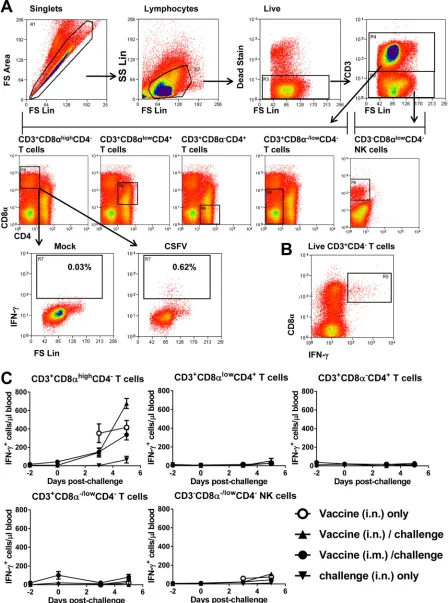
flow cytometry in order to identify the cellular source (
Fig. 2A
). As
shown in
Fig. 2B
, CD8 T cells, as defined by the CD3
⫹CD4
⫺CD8
␣
highphenotype (
33
), were identified as the initial source of
CSFV-specific IFN-
␥
after vaccination with the C-strain virus.
Neither CD4
⫹CD8
␣
⫺nor CD4
⫹CD8
␣
lowT cells, which in swine
have been proposed to represent naive and activated/memory
populations, respectively (
33
), showed a significant increase in
CSFV-specific IFN-
␥
⫹cells over the time period analyzed. CD3
⫺CD8
␣
⫹NK cells and CD8
␣
low/⫺T cells, which are mostly
␥␦
T
cells (
33
), did not show significant IFN-
␥
expression after virus
stimulation at any of the time points examined. To exclude the
possibility that CD8
␣
⫹␥␦
T cells falling within the CD3
⫹CD4
⫺CD8
␣
highgate were contributing to the IFN-
␥
⫹cells detected,
assays were performed with a pan-
␥␦
-T cell MAb and utilizing
PBMC from 3 representative vaccinated and challenged pigs (see
Fig. S1 in the supplemental material). Both challenged and
un-challenged vaccinated animals, but not the challenge-only pigs,
displayed significant virus-specific CD8 T cell IFN-
␥
responses
from 8 days after vaccination (day 3 postchallenge) (
P
⬍
0.05).
Interestingly, CD8 T cells from vaccinated but unchallenged
ani-mals showed a higher frequency of IFN-
␥
⫹CD8 T cells than did
vaccinated and challenged animals at 8 days postvaccination (
P
⬍
0.05;
Fig. 2C
). The frequency of virus-specific CD8 T cells
in-creased most markedly in the vaccinated and challenged pigs on
day 5 postchallenge (10 days after vaccination), with the greatest
number of cells being observed in those vaccinated intranasally
(
P
⬍
0.05).
Characterization of CSFV-Specific CD8 T Cell Responses
on August 17, 2020 by guest
http://cvi.asm.org/
In order to further characterize this early T cell response, the
ability of the IFN-
␥
-expressing CD8 T cells to degranulate and
release other antiviral cytokines upon stimulation with CSFV was
investigated. Translocation of lysosome-associated membrane
protein 1 (LAMP1/CD107a) to the cell membrane has been
con-firmed as a marker of cytotoxic degranulation by CD8 T and NK
cells (
34
). While CD107a mobilization has been reported as a
marker for porcine NK cell degranulation (
35
), this is the first
report of its application to assess porcine CD8 T cell
degranula-tion. PBMC isolated 5 days postchallenge were stimulated with
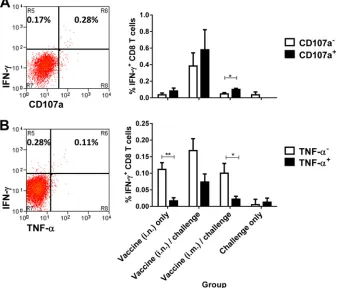
CSFV. A proportion of IFN-
␥
-expressing CD8 T cells from all
vaccinated animals expressed CD107a on their surface, suggestive
of cytotoxic activity against CSFV-infected antigen-presenting
cells (
Fig. 3A
). Assessment of the coexpression of IFN-
␥
and
TNF-
␣
by CD8 T cells after virus stimulation showed individual
variability between animals (data not shown), but on average, the
majority of CSFV-specific CD8 T cells expressed IFN-
␥
and not
TNF-
␣
(
Fig. 3B
). Comparison of TNF-
␣
and CD107a expression
on IFN-
␥
⫹CD8 T cells between experimental groups showed a
significantly greater number of TNF-
␣
⫺IFN-
␥
⫹cells in all
vacci-nated groups than in the challenge control group (
P
⬍
0.05), but
only the intranasally vaccinated and challenged animals showed a
greater number of TNF-
␣
⫹IFN-
␥
⫹CD8 T cells (
P
⬍
0.05). This
group was also the only one which expressed a greater number of
both CD107a
⫹- and CD107a
⫺-expressing IFN-
␥
⫹CD8 T cells.
There were no significant differences in the proportions of
TNF-
␣
⫹IFN-
␥
⫺or CD107a
⫹IFN-
␥
⫺CD8 T cells between
mock- and CSFV-stimulated conditions (data not shown).
CSFV C-strain-induced CD8 T cell responses are sustained
and boosted upon later rechallenge infection.
To further
inves-tigate the possible role for T cells in providing protection against
CSFV, another experiment was conducted whereby
C-strain-vac-cinated animals were challenged with the Brescia strain after 5
days and then rechallenged with a 10-fold-higher dose after 28
days. All animals were protected against both challenge infections
with no reduction in leukocyte counts or clinical signs of CSF
being observed (data not shown). PBMC were collected
longitu-dinally during the experiment, and the CSFV-specific IFN-
␥
re-sponse was again investigated
ex vivo
using flow cytometry (
Fig.
4
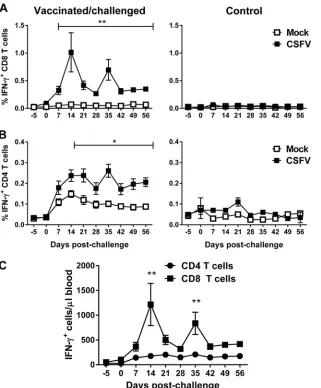
). Significant virus-specific CD8 (CD3
⫹CD4
⫺CD8
␣
high) (
Fig.
4A
) and “memory” CD4 (CD3
⫹CD4
⫹CD8
␣
low) (
Fig. 4B
) T cell
responses were detected in vaccinated and challenged animals, but
not control animals, from days 7 and 14 postchallenge,
respec-tively. No virus-specific IFN-
␥
expression was detected in “naïve”
CD4 T cell (CD3
⫹CD4
⫺CD8
␣
high), CD8
␣
low/⫺T cell, or NK cell
populations (data not shown). As described above, the
contribu-tion of
␥␦
T cells was directly assessed on a subset of pigs using a
T-cell receptor (TcR)
␦
-chain MAb, and no CSFV-specific
in-crease in IFN-
␥
⫹␥␦
T cells was detected (see Fig. S1 in the
sup-plemental material). The CD8 T cell response showed an initial
peak on day 14 postchallenge, contracted to a degree, and then
peaked again 7 days after the second challenge infection (day 35)
(
Fig. 4A
). The percentage of cells remaining in the contracted
CSFV-specific CD8 T cell population following this second peak
was similar to that observed after the first, at
⬃
0.4%. Individual
differences between animals were observed in the kinetics of the
response, with pigs which showed the greatest peak in response to
the first challenge infection displaying less evidence of a recall in
response to the second challenge (data not shown). The kinetics of
the memory CD4 T cell IFN-
␥
response was largely similar to the
CD8 response except that the frequency of cells was lower and was
accompanied with an increase, albeit to lower levels, in the
per-FIG 1Outcome to challenge with virulent CSFV following vaccination with live attenuated C-strain CSFV. Five days after intranasal (i.n.) or intramuscular (i.m.) vaccination, animals were challenged by intranasal inoculation with the CSFV Brescia strain. Two additional groups were vaccinated but not challenged or challenged only. (A) Clinical signs of CSF were scored twice daily. (B) Viral RNA copy numbers in peripheral blood were determined by real-time RT-PCR. (C) Leukocyte counts assessed by volumetric flow cytometry. Results are expressed as the mean data for each group, and error bars represent SEM.
on August 17, 2020 by guest
http://cvi.asm.org/
FIG 2CD8 T cells are the primary source of CSFV-specific IFN-␥following vaccination and challenge. At days⫺2, 0, 3, and 5 postchallenge, PBMC were stimulatedin vitrowith CSFV or mock virus supernatant and IFN-␥expression was assessed by flow cytometry. (A) Gating strategy used to interrogate responses in singlet, live lymphocytes and representative data from pig 51, vaccine (i.n.)/challenge group, day 5 postchallenge, are displayed. T cell populations were defined as CD3⫹CD8␣highCD4⫺, CD3⫹CD8␣lowCD4⫹, CD3⫹CD8␣⫺CD4⫹, and CD3⫹CD8␣low/⫺CD4⫺, and NK cells were defined as CD3⫺CD8␣lowCD4⫺.
Finally, intracytoplasmic IFN-␥expression was assessed in each population and compared to staining with an isotype control MAb. (B) Representative data of the expression of IFN-␥versus CD8␣on live, singlet CD3⫹CD4⫺T cells after CSFV stimulation (pig 51, vaccine [i.n.]/challenge group, day 5 postchallenge). (C) Mean numbers of IFN-␥-producing cells/l blood in response to CSFV stimulation for each lymphocyte population following correction for the IFN-␥expression in response to mock virus supernatant. The mean data from three randomly selected pigs/group/time point are presented, and error bars represent SEM.
on August 17, 2020 by guest
http://cvi.asm.org/
centage of IFN-
␥
-expressing CD4 T cells in response to the mock
virus supernatant, an effect not observed in the control animals
despite these animals having been inoculated with this
superna-tant in place of the vaccine/challenge viruses. Subtraction of the
response to mock virus supernatant from the CSFV-stimulated
responses and conversion of this percentage to the number of
IFN-
␥
-expressing cells per
l of blood clearly revealed that the
CD8 T cell population was the major contributor to the
CSFV-specific T cell response (
Fig. 4C
). The comparison of fluorescence
intensity measurements revealed no differences between IFN-
␥
expression levels of CD8 (
Fig. 4A
) and memory CD4 T cells, and
the levels did not differ significantly over time (data not shown).
Following challenge, CSFV C-strain-induced CD8 T cell
re-sponses are polyfunctional and show a putative mixed effector/
effector memory phenotype.
Phenotypic and functional analysis
was performed on PBMC previously cryopreserved at the peaks
following primary and secondary challenge infections, days 14
and 35 post-primary challenge, respectively, and PBMC were
compared to cells collected from pigs at the peak of response
post-C-strain vaccination (day 9) (
28
). Due to the limited number of
cryopreserved cells, for some parameters only 5 randomly chosen
vaccinated and challenged pigs out of 8 were analyzed. On day 9
postvaccination, and days 14 and 35 postchallenge, the majority of
IFN-
␥
-expressing CD8 T cells expressed high levels of the cell
adhesion and indicative effector memory marker CD44 (
Fig. 5A
)
and lacked expression of the peripheral lymph node homing
re-ceptor, L-selectin/CD62L (
Fig. 5B
). Evaluation of the expression
of CD44 and CD62L at the other time points postchallenge
re-vealed that CD44
highCD62L
⫺was the dominant phenotype
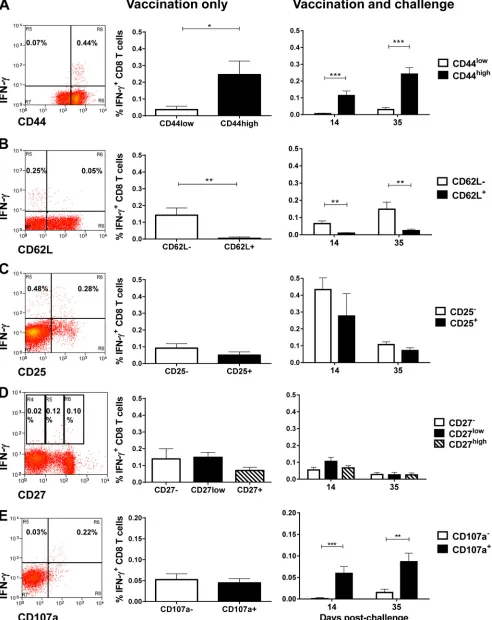
throughout (data not shown). In contrast, CSFV-specific T cells
from both groups and selected time points displayed variable
lev-els of both CD25 and CD27 (
Fig. 5C
and
D
). There were no
sig-nificant differences in expression of these markers by IFN-
␥
⫺CD8
T cells between mock- or CSFV-stimulated conditions (data not
shown). To assess the potential effect of previous cryopreservation
on porcine CD8 T cell memory/activation marker expression,
which might have influenced these data, a separate experiment
was conducted to directly compare expression of CD62L, CD44,
CD25, and CD27 by antigen-specific IFN-
␥
⫹CD8 T cells
stimu-lated from fresh versus cryopreserved/thawed PBMC (see Fig. S2
in the supplemental material). Following stimulation with a
model antigenic peptide, the phenotype of specific IFN-
␥
⫹CD8 T
cells did not differ between fresh and previously cryopreserved
PBMC, with a CD62L
⫺CD44
highCD25
⫺CD27
⫹phenotype
be-ing discerned in both cases. However, when considerbe-ing the entire
CD8 T cell population, there was a small but measurable decrease
in the proportion of cells expressing CD62L, CD25, and CD27
following cryopreservation.
The polyfunctionality of CSFV-specific CD8 T cells at the
peaks of response postvaccination and vaccination/challenge was
FIG 3Functional and phenotypic characterization of “early” CSFV-specific CD8 T cells. Five days postchallenge, PBMC were stimulatedin vitrowith CSFV or mock virus supernatant and the expression of CD107a, IFN-␥, and TNF-␣by singlet, live CD8␣highCD4⫺T cells was assessed by flow cytometry. The gating
strategy was identical to the one illustrated inFig. 2Aexcept with the exclusion of the CD3 MAb. Representative dot plots show quadrant gates defining expression of IFN-␥and CD107a (A) and IFN-␥and TNF-␣(B) by the live, singlet CD8␣highCD4⫺T cell population. Data represent the means of 6 replicates (2
replicates/pig/group) following subtraction of responses to mock virus supernatant, and error bars represent SEM. Values were compared using a two-tailed unpairedttest, and significance is indicated by *** (P⬍0.001), ** (P⬍0.01), and * (P⬍0.05). Data for CD107a⫹IFN-␥⫺and TNF-␣⫹IFN-␥⫺cells are not presented since the frequency of these cells did not differ significantly between CSFV- and mock-virus supernatant-stimulated cultures.
on August 17, 2020 by guest
http://cvi.asm.org/
again investigated by their ability to degranulate and coexpress
cytokines upon virus stimulation. As had been observed in the
earlier experiment, only a proportion (
⬃
50%) of IFN-
␥
⫹CD8 T
cells from the vaccinated-only group had mobilized CD107a,
in-dicative of cytotoxic degranulation (
Fig. 5E
). In contrast, the
ma-jority of cells from vaccinated and challenged animals, on both day
14 and day 35, showed evidence of degranulation. Coexpression of
TNF-
␣
and IL-2 by CSFV-specific IFN-
␥
⫹CD8 T cells was
as-sessed using the gating strategy illustrated in
Fig. 6A
. Interestingly,
significant variability was observed in the cytokine profile between
individual animals, groups, and time points (
Fig. 6B
). Nine days
postvaccination, the majority of CSFV-specific CD8 T cells
se-creted only IFN-
␥
, with a significant minority (19.4 to 42% of
CSFV-specific IFN-
␥
⫹CD8 T cells) coexpressing TNF-
␣
. Only 2
of the 4 animals were found to present a small proportion of CD8
T cells expressing all three cytokines (2.9% and 5.1% of
CSFV-specific IFN-
␥
⫹CD8 T cells). Analysis of the vaccinated and
chal-lenged animals showed that on day 14 postchallenge, cells
coex-pressing IFN-
␥
and TNF-
␣
were the largest population in 2/5
animals (43.6% and 49.9% of CSFV-specific IFN-
␥
⫹CD8 T cells),
with the single IFN-
␥
expressers being the major population in the
other animals. In 4 of the 5 animals, there was a significant
popu-lation of cells expressing all three cytokines, which ranged from
9.1% to 29.6% of CSFV-specific IFN-
␥
⫹CD8 T cells. On day 35
postchallenge (7 days post-rechallenge), there was an increase in
the relative proportion of single IFN-
␥
expressers in three
ani-mals, while in the other two the greatest increase was observed in
the triple expressers (pig 8) and IFN-
␥
and TNF-
␣
dual expressers
(pig 10). There were no significant differences in the proportions
of TNF-
␣
⫹IFN-
␥
⫺, IL-2
⫹IFN-
␥
⫺, or CD107a
⫹IFN-
␥
⫺CD8 T
cells between mock- and CSFV-stimulated conditions (data not
shown). Assessment of the relative IFN-
␥
expression levels, by
FIG 4Vaccine-induced CD8 T cells display a sustained response and are boosted by rechallenge with virulent CSFV. PBMC from eight pigs vaccinated with C-strain CSFV and challenged with CSFV Brescia strain after 5 days and a further 28 days (vaccinated/challenged) and from unvaccinated/unchallenged pigs (control) were isolated on the indicated days and stimulatedin vitrowith CSFV or a mock virus supernatant. (A and B) IFN-␥expression by CD8 (CD3⫹CD4⫺ CD8␣high) (A) and CD4 (CD3⫹CD4⫹CD8␣low) (B) T cells was assessed by flow cytometry using the gating strategy illustrated inFig. 2A. (C) The absolute
numbers of CSFV-specific CD8 and CD4 T cells were calculated from mock-virus stimulation-corrected percent IFN-␥⫹cells and absolute PBMC count data. The data represent the means of 16 and 4 replicates for the vaccinated/challenged and control groups (2 replicates/pig/group), respectively,⫾SEM. Mean values were compared using a two-tailed unpairedttest, and significance is indicated by ** (P⬍0.01) and * (P⬍0.05).
Characterization of CSFV-Specific CD8 T Cell Responses
on August 17, 2020 by guest
http://cvi.asm.org/
FIG 5Phenotypic and functional characterization of CSFV-specific CD8 T cells. PBMC from pigs vaccinated with C-strain (animal experiment 3) or C-strain-vaccinated pigs challenged with CSFV Brescia (animal experiment 2) were stimulated with CSFV and mock virus supernatant 9 days after vaccination or 14 days after challenge (day 14) and 7 days after rechallenge (day 35), respectively. The expression of CD44 (A), CD62L (B), CD25 (C), CD27 (D), and CD107a (E) on IFN-␥⫹singlet, live CD8␣highCD4⫺T cells was assessed by flow cytometry. Data represent the mean mock-virus stimulation-corrected percent IFN-␥⫹CD8 T
cells for 8 or 16 replicate cultures (2 replicates for four vaccine-only pigs and eight vaccinated and challenged pigs, respectively), and error bars represent SEM. Values were compared using a two-tailed unpairedttest, and significance is indicated by *** (P⬍0.001), ** (P⬍0.01), and * (P⬍0.05).
on August 17, 2020 by guest
FIG 6Characterization of polyfunctional cytokine expression by CSFV-specific CD8 T cells. PBMC from pigs vaccinated with C-strain CSFV (animal experiment 3;n⫽ 4) or C-strain-vaccinated pigs challenged with CSFV Brescia (animal experiment 2;n⫽5) were stimulated with CSFV and mock virus supernatant 9 days after vaccination or 14 days after challenge (day 14) and 7 days after rechallenge (day 35), respectively. The expression of TNF-␣and IL-2 by CSFV-specific IFN-␥⫹singlet, live CD8␣highCD4⫺T cells was determined by flow cytometry. (A) Representative dot plots. (B) Mock-corrected mean proportions of IFN-␥-secreting CD8 T cells
expressing either of the two other cytokines, for duplicate cultures/animal. (C) Mean fluorescence intensity (MFI) of IFN-␥staining of each population is presented. Data represent the mean mock-virus stimulation-corrected percent IFN-␥⫹CD8 T cells for 8 or 10 replicate cultures (two replicates for four vaccinated pigs and eight vaccinated and challenged pigs, respectively), and error bars represent SEM. Statistical analyses were performed using a one-way ANOVA followed by Dunnett’s multiple comparison test against CD8 T cells secreting only IFN-␥. Significance is indicated by *** (P⬍0.001), ** (P⬍0.01), and * (P⬍0.05).
Characterization of CSFV-Specific CD8 T Cell Responses
on August 17, 2020 by guest
http://cvi.asm.org/
comparing fluorescence intensity measurements, revealed that on
day 9 postvaccination and days 14 and 35 postchallenge, the
triple-cytokine-expressing CD8 T cells produced significantly larger
amounts of IFN-
␥
than did the single and dual expressers
(
Fig. 6C
).
DISCUSSION
For the first time, our results provide detailed phenotypic and
functional data on the T cell response induced by vaccination with
a live attenuated C-strain vaccine and boosted upon subsequent
challenge infections. We demonstrate that CD8 T cells (CD3
⫹CD8
␣
highCD4
⫺) are the initial source of CSFV-specific IFN-
␥
after vaccination with the C-strain vaccine and can be detected in
the blood as early as 8 days postvaccination. IFN-
␥
-producing
CD8 T cells were detected in all vaccinated groups, independently
of the route of vaccine administration (intranasal [i.n.] or
intra-muscular [i.m.]); in contrast, infection of unvaccinated animals
did not result in a detectable T cell IFN-
␥
response against the
virus and animals developed clinical signs of the disease,
leucope-nia, and viremia. Our results are in accordance with previous
pub-lications, where it has been reported that a CSFV-specific T cell
IFN-
␥
response can be identified in the blood as early as 6 or 8 days
after C-strain vaccination (
5–7
), and confirm the correlation
be-tween the T cell IFN-
␥
response and protection against CSF. The
inability to detect a CSFV-specific IFN-
␥
response in
unvacci-nated challenge control pigs is in accordance with earlier studies
conducted by our group utilizing moderately virulent CSFV
strains (
6
,
7
) but contrasts with a previous report where IFN-
␥
-producing CD4 and CD8 T cells were detected in unvaccinated
pigs challenged with a virulent strain of CSFV (
11
). While CD8 T
cells were detected as the first source of IFN-
␥
produced in
re-sponse to CSFV, they were also shown to be the major producers,
with 400 to 1,200 CSFV-specific CD8 T cells/
l being detected in
blood. In comparison, virus-specific CD4 T cells were present at
2-to 6-fold-lower numbers, which is in general accordance with our
earlier studies (
7
). Moreover, rechallenge of animals resulted in a
significant boosting of specific CD8 T cell numbers while
CSFV-responding CD4 T cells remained relatively constant in number.
Interestingly, vaccinated/challenged pigs showed an increase in
the percentage of IFN-
␥
-expressing memory CD4 T cells in
re-sponse to culture with the mock virus supernatant. We might
speculate that this is due to reactivity against an (as yet)
unidenti-fied antigen present in the PK15 lysate. The presence of CSFV may
have adjuvanted the response to this antigen so that it was
ob-served only following vaccination and challenge and not seen in
control animals inoculated with the mock virus supernatant.
We next addressed the memory/activation phenotype of the
CSFV-specific CD8 T cells, since it has become apparent in recent
years that the efficacy of T-cell-based vaccines is highly dependent
upon the quality of the memory population induced.
CSFV-spe-cific IFN-
␥
⫹CD8 T cells expressed high levels of the cell adhesion
glycoprotein CD44 and lacked expression of the lymph node
homing receptor CD62L. Based upon current models of CD8 T
cell differentiation, this would classify these cells as either effectors
(T
EFF) or T
EMcells, which traffic via nonlymphoid tissues, rather
than T
CMcells which express CD62L (
17
). CD27, a costimulatory
receptor that provides a critical survival signal to activated T cells
(
36
), is required for CD8 memory T cell formation and
respon-siveness. CD27 expression is lost on human CD8 T
EFFcells, and
expression increases upon differentiation to memory cells with
low levels expressed on T
EMcells and higher levels on T
CMcells
(
37
,
38
). A recent study of CD27 expression by porcine CD4 T cells
has shown that antigen-specific IFN-
␥
-expressing CD4
⫹CD8
␣
⫹T cells may be either CD27
⫺or CD27
⫹(
39
). Compared to CD27
⫺CD4
⫹CD8
␣
⫹T cells, CD27
⫹CD4
⫹CD8
␣
⫹T cells respond to
polyclonal activation with enhanced cytokine production and
re-duced proliferation. They also lack or show rere-duced expression of
lymph node homing receptors, and it has therefore been proposed
that CD27
⫹and CD27
⫺porcine CD4 T cells may represent T
CMand T
EM, respectively. While a comparable analysis of CD27
ex-pression by porcine CD8 T cells is still to be conducted, a
longitu-dinal study of CD27 expression on porcine CD8 T cells from birth
to 6 months of age suggested that early effector cells expressed low
levels of CD27, which was absent on late effector or memory cells
(
40
). Thus, we may only speculate at this time that the variable
level of CD27 expression on CSFV-specific CD8 T cells reflects a
mixture of effector and memory phenotypes. Variable expression
of CD25, the alpha-chain of the IL-2 receptor that is expressed on
the surface of activated lymphocytes (
11
,
41
,
42
), was also seen.
Heterogeneity in expression of CD25 on CD8 T cells has been
described in an acute murine virus infection model, with low
CD25 expression associated with generation of long-lived
mem-ory and high expression associated with terminal effector
differ-entiation (
43
). This expression pattern may therefore also imply a
mixed CSFV-specific T
EFFand T
EMpopulation and explain the
previously described lack of association between enhanced
CSFV-specific IFN-
␥
production and upregulation of CD25 on CD8 T
cells (
11
). Since this analysis was conducted following
in vitro
restimulation of previously cryopreserved PBMC, it remains to be
determined whether these phenotypes accurately represent those
of CSFV-specific CD8 T cells
in vivo
. We have recently identified a
number of CD8 T cell epitopes on CSFV (G. Franzoni and S. P.
Graham, unpublished data), and together with the recent
devel-opment of porcine major histocompatibility complex (MHC)
class I tetramers (
44
), tools could be developed to confirm the
phenotype of CSFV-specific CD8 T cells by direct
ex vivo
exami-nation. We finally assessed the polyfunctionality of the
CSFV-specific CD8 T cell population since this may be central to their
protective capacity. Based on current models, CD8 T
EMcells have
been shown to have high
ex vivo
cytotoxic potential and rapidly
produce cytokines upon reexposure to antigens, whereas CD8
T
CMcells possess a greater proliferative capacity (
15
).
Interest-ingly, we found that early postchallenge or in the absence of
chal-lenge only a proportion of CSFV-specific IFN-
␥
CD8 T cells
mo-bilized CD107a, compared to later time points postchallenge,
where the majority expressed CD107a on their surface. CD107a is
expressed on the cell surface following activation-induced
degran-ulation, and it has been described as a marker for cytotoxic CD8 T
cell activity whose expression has been associated with loss of
per-forin following antigen stimulation (
34
). The data presented here
suggest that CSFV-specific IFN-
␥
-expressing cells may also have
cytotoxic capacity and consolidate our previous results where we
showed that IFN-
␥
expression was restricted to CD8 T cells
ex-pressing intracellular perforin (
7
) and other earlier studies that
demonstrated CSFV-specific cytotoxic activity by T cell cultures
isolated from vaccinated pigs (
8–10
). While IFN-
␥
-secreting T
EMcells have been implicated in protection against a variety of
intra-cellular pathogens, simultaneous production of IFN-
␥
, TNF-
␣
,
and IL-2 detected at the single-cell level by multiparameter flow
cytometry has been correlated with enhanced vaccine-induced
on August 17, 2020 by guest
http://cvi.asm.org/
protection (
45–51
). Moreover, data suggest that such
polyfunc-tional CD8 T memory cells are critical to long-term protection
against other viruses belonging to the family
Flaviviridae
(
20
,
22
).
In the present study, we observed that the majority of CD8 T cells
produced only IFN-
␥
or IFN-
␥
and TNF-
␣
, with only a small
percentage coexpressing IFN-
␥
, TNF-
␣
, and IL-2. As seen with
CD107a mobilization, there appeared to be a trend toward an
increase in functionality following challenge, although
interani-mal variability was observed. Since all aniinterani-mals were solidly
pro-tected against the challenge infections, we were unable to correlate
polyfunctionality with enhanced protection. Nevertheless,
triple-cytokine-expressing T cells showed the highest “quality” of
re-sponse followed by the cells coexpressing TNF-
␣
, similar to that
observed in other systems (
48
,
52
,
53
).
Overall, our data support the hypothesis that CD8 T
EFF/T
EMcells play a key role in the protection afforded by C-strain CSFV in
the early period preceding the appearance of neutralizing
antibod-ies and are also readily recalled by later challenge. This
informa-tion and the novel flow cytometric panels developed and
em-ployed for the first time in the pig to characterize these responses
will hopefully aid the development and evaluation of
next-gener-ation vaccines against CSFV and more broadly against other
por-cine pathogens.
ACKNOWLEDGMENTS
We thank Nicole Piontkowski, Riemser Arzneimittel AG, Germany, for supplying the C-strain CSFV vaccine; Alexandra Meindl-Böhmer, Uni-versity of Veterinary Medicine, Hannover, Germany, for provision of the CSFV Brescia strain; Adam Whelan and Bernardo Villarreal-Ramos, AHVLA TB Department, for discussions on cross-reactive T cell marker MAbs; Christine Jansen, Utrecht University, the Netherlands, for advice on CD107a mobilization assays; Bentley Crudgington and Helen Mokhtar, AHVLA Virology Department, for technical assistance during the first animal experiment; Derek Clifford and the AHVLA Animal Ser-vices Unit for the care of animals and provision of samples; and Falko Steinbach, AHVLA Virology Department, for critical review of the man-uscript.
This work was supported by project SE0796 from the Department for the Environment, Food and Rural Affairs of the United Kingdom. N.V.K. was supported by a DBT CREST Award from the Ministry of Science & Technology, Government of India.
The authors declare that they have no commercial or other association that may pose a conflict of interest.
REFERENCES
1.Moennig V.2000. Introduction to classical swine fever: virus, disease and control policy. Vet. Microbiol.73:93–102.
2.van Oirschot JT.2003. Emergency vaccination against classical swine fever. Dev. Biol. (Basel)114:259 –267.
3.van Oirschot JT.2003. Vaccinology of classical swine fever: from lab to field. Vet. Microbiol.96:367–384.
4.Beer M, Reimann I, Hoffmann B, Depner K. 2007. Novel marker vaccines against classical swine fever. Vaccine25:5665–5670.
5.Suradhat S, Intrakamhaeng M, Damrongwatanapokin S. 2001. The correlation of virus-specific interferon-gamma production and protec-tion against classical swine fever virus infecprotec-tion. Vet. Immunol. Immuno-pathol.83:177–189.
6.Graham SP, Everett HE, Haines FJ, Johns HL, Sosan OA, Salguero FJ, Clifford DJ, Steinbach F, Drew TW, Crooke HR.2012. Challenge of pigs with classical swine fever viruses after C-strain vaccination reveals remark-ably rapid protection and insights into early immunity. PLoS One 7:e29310. doi:10.1371/journal.pone.0029310.
7.Graham SP, Haines F, Johns H, Sosan OA, La Rocca SA, Lamp B, Rumenapf T, Everett H, Crooke H.2012. Characterization of vaccine-induced, broadly cross-reactive IFN-␥secreting T cell responses that
cor-relate with rapid protection against classical swine fever virus. Vaccine 30:2742–2748.
8.Ceppi M, de Bruin MG, Seuberlich T, Balmelli C, Pascolo S, Ruggli N, Wienhold D, Tratschin JD, McCullough KC, Summerfield A. 2005. Identification of classical swine fever virus protein E2 as a target for cyto-toxic T cells by using mRNA-transfected antigen presenting cells. J. Gen. Virol.86:2525–2534.
9.Rau H, Reverts H, Balmelli C, McCullough K, Summerfield A.2006. Immunological properties of recombinant classical swine fever virus NS3 proteinin vitroandin vivo. Vet. Res.37:155–168.
10. Pauly T, Elbers K, Konig M, Lengsfeld T, Saalmuller A, Thiel HJ.1995. Classical swine fever virus-specific cytotoxic T lymphocytes and identifi-cation of a T cell epitope. J. Gen. Virol.76:3039 –3049.
11. Suradhat S, Sada W, Buranapradiktun S, Damrongwatanapokin S. 2005. The kinetics of cytokine production and CD25 expression by por-cine lymphocyte subpopulations following exposure to classical swine fe-ver virus (CSFV). Vet. Immunol. Immunopathol.106:197–208. 12. Tarradas J, Argilaguet JM, Rosell R, Nofrarias M, Crisci E, Córdoba L,
Pérez-Martín E, Díaz I, Rodríguez F, Domingo M, Montoya M, Ganges L.2010. Interferon-gamma induction correlates with protection by DNA vaccine expressing E2 glycoprotein against classical swine fever virus in-fection in domestic pigs. Vet. Microbiol.142:51–58.
13. Tarradas J, Monsó M, Fraile L, de la Torre BG, Muñoz M, Rosell R, Riquelme C, Pérez LJ, Nofrarías M, Domingo M, Sobrino F, Andreu D, Ganges L.2012. A T-cell epitope on NS3 non-structural protein enhances the B and T cell responses elicited by dendrimeric constructions against CSFV in domestic pigs. Vet. Immunol. Immunopathol.150:36 – 46. 14. Kaech SM, Wherry EJ, Ahmed R.2002. Effector and memory T-cell
differentiation: implications for vaccine development. Nat. Rev. Immu-nol.2:251–262.
15. Thakur A, Pedersen L, Jungersen G.2012. Immune markers and corre-lates of protection for vaccine induced immune responses. Vaccine30: 4907– 4920.
16. Sallusto F, Lenig D, Forster R, Lipp M, Lanzavecchia A.1999. Two subsets of memory T lymphocytes with distinct homing potentials and effector functions. Nature401:708 –712.
17. Wiesel M, Walton S, Richer K, Oxenius A.2009. Virus-specific CD8 T cells: activation, differentiation and memory formation. APMIS117:356 – 381.
18. Larsen M, Sauce D, Arnaud L, Fastenackels S, Appay V.2012. Evalu-ating cellular polyfunctionality with a novel polyfunctionality index. PLoS One7:e42403. doi:10.1371/journal.pone.0042403.
19. Barnes E, Folgori A, Capone S, Swadling L, Aston S, Kurioka A, Meyer J, Huddart R, Smith K, Townsend R, Brown A, Antrobus R, Ammen-dola V, Naddeo M, O’Hara G, Willberg C, Harrison A, Grazioli F, Esposito ML, Siani L, Traboni C, Oo Y, Adams D, Hill A, Colloca S, Nicosia A, Cortese R, Klenerman P.2012. Novel adenovirus-based vac-cines induce broad and sustained T cell responses to HCV in man. Sci. Transl. Med.4:115ra1. doi:10.1126/scitranslmed.3003155.
20. Mikkelsen M, Holst PJ, Bukh J, Thomsen AR, Christensen JP.2011. Enhanced and sustained CD8⫹T cell responses with an adenoviral vec-tor-based hepatitis C virus vaccine encoding NS3 linked to the MHC class II chaperone protein invariant chain. J. Immunol.186:2355–2364. 21. Urbani S, Boni C, Missale G, Elia G, Cavallo C, Massari M, Raimondo
G, Ferrari C.2002. Virus-specific CD8⫹lymphocytes share the same effector-memory phenotype but exhibit functional differences in acute hepatitis B and C. J. Virol.76:12423–12434.
22. Akondy RS, Monson ND, Miller JD, Edupuganti S, Teuwen D, Wu H, Quyyumi F, Garg S, Altman JD, Del Rio C, Keyserling HL, Ploss A, Rice CM, Orenstein WA, Mulligan MJ, Ahmed R.2009. The yellow fever virus vaccine induces a broad and polyfunctional human memory CD8⫹T cell response. J. Immunol.183:7919 –7930.
23. Kaden V, Lange E, Küster H, Müller T, Lange B.2010. An update on safety studies on the attenuated “RIEMSER Schweinepestoralvakzine” for vaccination of wild boar against classical swine fever. Vet. Microbiol.143: 133–138.
24. Gladue DP, Holinka LG, Largo E, Fernandez Sainz I, Carrillo C, O’Donnell V, Baker-Branstetter R, Lu Z, Ambroggio X, Risatti GR, Nieva JL, Borca MV.2012. Classical swine fever virus p7 protein is a viroporin involved in virulence in swine. J. Virol.86:6778 – 6791. 25. Fernandez-Sainz I, Gladue DP, Holinka LG, O’Donnell V,
Gudmunds-dottir I, Prarat MV, Patch JR, Golde WT, Lu Z, Zhu J, Carrillo C,
Characterization of CSFV-Specific CD8 T Cell Responses