This is a repository copy of Prediction of confined, vented methane-hydrogen explosions using a computational fluid dynamic approach.
White Rose Research Online URL for this paper: http://eprints.whiterose.ac.uk/79576/
Version: Accepted Version
Article:
Woolley, RM, Fairweather, M, Falle, SAEG et al. (1 more author) (2013) Prediction of confined, vented methane-hydrogen explosions using a computational fluid dynamic approach. International Journal of Hydrogen Energy, 38 (16). 6904 - 6914. ISSN 0360-3199
https://doi.org/10.1016/j.ijhydene.2013.02.145
[email protected] https://eprints.whiterose.ac.uk/
Reuse
Unless indicated otherwise, fulltext items are protected by copyright with all rights reserved. The copyright exception in section 29 of the Copyright, Designs and Patents Act 1988 allows the making of a single copy solely for the purpose of non-commercial research or private study within the limits of fair dealing. The publisher or other rights-holder may allow further reproduction and re-use of this version - refer to the White Rose Research Online record for this item. Where records identify the publisher as the copyright holder, users can verify any specific terms of use on the publisher’s website.
Takedown
If you consider content in White Rose Research Online to be in breach of UK law, please notify us by
Prediction of Confined, Vented Methane-Hydrogen
Explosions Using a Computational Fluid Dynamic
Approach
R.M. Woolley
aand M. Fairweather
bab
Institute of Particle Science and Engineering,
School of Process, Environmental and Materials Engineering,
University of Leeds, Leeds LS2 9JT, UK
a
[email protected] (corresponding author)
Tel: +44 (0) 113 343 2351
Fax: +44 (0) 113 343 2384
b[email protected]
S.A.E.G. Falle
cc
School of Mathematics,
University of Leeds, Leeds LS2 9JT, UK
c[email protected]
J.R. Giddings
dd
Mantis Numerics Ltd.,
1 Oakwood Nook,
Leeds LS8 2JA, UK
ABSTRACT
Hydrogen is seen as an important energy carrier for the future, with a great benefit
being carbon-free emissions at its point of use. A hydrogen transport system between
manufacturing sites and end users is required, and one solution proposed is its
addition to existing natural gas pipeline networks. A major concern with this approach
is that the explosion hazard may be increased, relative to natural gas, should an
accidental release occur. This paper describes a mathematical model of confined,
vented explosions of mixtures of methane and hydrogen of value in performing
consequence and risk assessments. The model is based on solutions of averaged forms
of the Navier-Stokes equations, with the equation set closed using k- and
second-moment turbulence models, and the turbulent burning velocity determined from
correlations of data on CH4-H2mixtures reported in the literature. Predictions derived
for explosions in a 70m3 vessel, with and without internal pipe congestion, show
reasonable agreement with available data, and demonstrate that hydrogen addition can
have a significant effect on overpressure generation. Conclusions drawn from the
calculations go some way to identifying safe operating limits for hydrogen addition.
KEYWORDS
CFD, turbulent premixed combustion, confined vented explosions, Reynolds stress
1. INTRODUCTION
There is presently an increasing global interest in the use of hydrogen as an
energy carrier, this being considered an essential part of achieving a sustainable
economic and industrial development. A hydrogen delivery system is required, and
one proposed solution is its addition to existing natural gas pipeline networks. In order
to facilitate such a development, the European Commission-funded project NaturalHy
[1] was employed in the study of all relevant technical and socio-economic aspects of
this proposal. These included durability, integrity, end use, life cycle and, in the case
of the present study, safety concerns. With respect to the latter, one major issue is that
the explosion hazard may be increased, relative to natural gas, should an accidental
release occur. In contrast to methane, hydrogen has a relatively high burning velocity,
and can readily make the transition from deflagration to detonation. It is therefore
essential to investigate the possible behaviour of such gaseous mixture releases upon
ignition in both confined and unconfined areas representative of domestic buildings
and industrial plant. Subsequently, information obtained can be used in the safe
design of equipment and plant, and to improve safety and reduce the risk of a
deflagration to detonation transition.
The notably differing chemical and physical properties of H2 and CH4 raise a
number of issues with respect to the integrity and durability of a pipework
infrastructure originally constructed for, and operated using, natural gas. Whilst part
of the project is involved with addressing these concerns, another entails the
assessment of the hydrogen quantity which could be introduced into a gas pipeline
network without adversely impacting upon the safety of plant and the public due to an
increase in explosion severity or detonation propensity. Involved in these studies has
with the intention of observing the consequences of methane-hydrogen explosions in
enclosures representative of industrial plant. This work has provided a comprehensive
database with which to validate the project element described in this manuscript,
namely mathematical tools for the prediction of such occurrences.
An additional aspect of experimental study undertaken by the NaturalHy [1]
project is also incorporated into the current work. This takes the form of the most
recent and comprehensive laminar and turbulent burning velocity measurements for
CH4-H2 mixtures [3] evaluated using an experimental explosion bomb [4] at the
University of Leeds. These data build upon earlier works [5], and are implemented in
the present mathematical model via inclusion in a premixed turbulent flame
propagation sub-model in a modified version of an adaptive general-purpose fluid
dynamics code referred to as QICA, provided by Mantis Numerics Ltd., and being a
development of the earlier COBRA code. The code combines a numerical technique
for the description of propagating flames with the experimentally prescribed burning
velocity, and incorporates a semi-empirical relationship between this and the
flow-induced turbulence. These methods were previously developed and applied, coupled
with a k-model [6] for the representation of turbulence, in a number of works [7-9].
However, this new implementation employs for the first time, in addition to the recent
experimentally-derived burning velocity data, a second-moment representation of the
Reynolds stresses in the form of the Reynolds stress transport model of Jones and
Musonge [10]. For further discussion regarding the relative performances of COBRA
and other currently used explosion models, the reader is directed to the work of Popat
et al. [11].
Predictions were based on solutions of the ensemble-averaged, density-weighted
progress variable, which is fully discussed later in Section 2.2. Closure of this
equation set was achieved via both the k- and the Reynolds stress transport
turbulence models in an attempt to elucidate their different qualities in such
applications. Presented are the results of this approach applied to the modelling of gas
mixtures in both congested and uncongested vented geometries, representative of
industrial plant enclosures. The mixtures investigated comprised methane with 0%,
20% and 50% hydrogen addition by volume, and two methods of representation of the
geometries are considered and compared. Firstly, a full three-dimensional formulation
is presented, and it is demonstrated that the model is capable of yielding reliable
predictions of explosions in the geometries considered, and has value as a design tool.
The second approach is a two-dimensional representation of the experiments and,
overall, it is demonstrated that this model is equally capable of yielding reliable
predictions of explosions in the geometries considered, and has value as a design tool
in the prediction of hazards and the design of mitigation measures, with significantly
reduced model run times when compared to the full, three-dimensional formulation.
2. MATHEMATICAL MODELLING
2.1 Experimental Work
The predictions presented in this paper are a selection taken from a number of
simulations of large-scale experiments undertaken by Loughborough University. A
full account of the experimental conditions, the rig, and of observations, is presented
elsewhere [2], hence only a brief overview of these is given here.
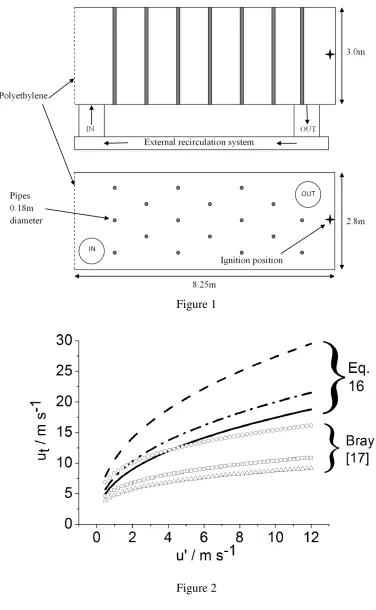
The experimental rig was of steel construction and measured 8.25m in length,
3.0m in width, and 2.8m in height. One 3.02.8m end of the rig was effectively open
retain the gas-air mixture prior to ignition. Figure 1 depicts the rig, and indicates the
configuration of pipe-work congestion and the spark ignition points, although not to
scale.
The gases investigated were mixtures of methane, hydrogen, and air, with the
hydrogen-to-methane ratio by volume being 0:100, 20:80 and 50:50. Methane and
hydrogen were introduced into the enclosure from separate gas supplies and then the
mixture recirculated using an external system containing a fan. A composition with an
equivalence ratio of 1.1 was selected, being that expected to generate the highest
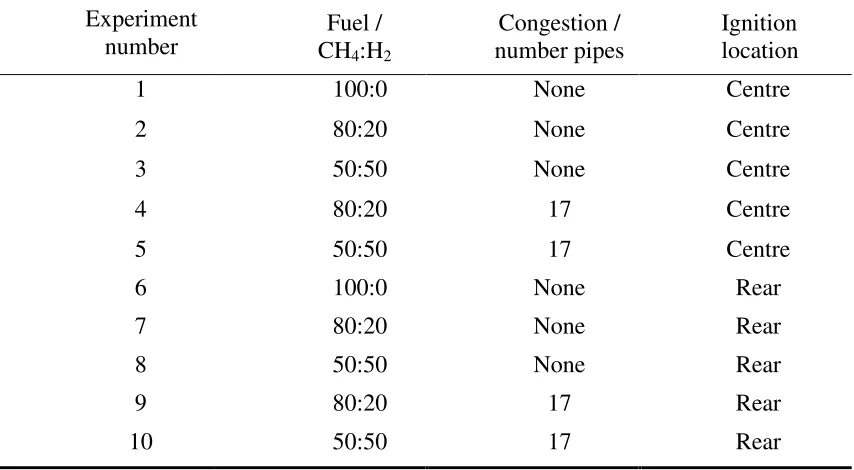
overpressures. Table 1 contains a summary of the test programme and hence the
configurations used in the subsequent mathematical modelling reported in this paper.
The reader is directed to the aforementioned publication [2] for further details
regarding the experiments.
Experiment number
Fuel / CH4:H2
Congestion / number pipes
Ignition location
1 100:0 None Centre
2 80:20 None Centre
3 50:50 None Centre
4 80:20 17 Centre
5 50:50 17 Centre
6 100:0 None Rear
7 80:20 None Rear
8 50:50 None Rear
9 80:20 17 Rear
[image:7.595.85.512.433.668.2]10 50:50 17 Rear
2.2 Turbulent Flow Calculations
Predictions were based on the solutions of the ensemble-averaged,
density-weighted forms of the transport equations for mass, momentum, total energy, and a
reaction progress variable. The latter two equations are defined in Section 2.3. Closure
of this equation set was achieved via compressibility-corrected forms of the k- [6]
and a Reynolds stress [10] transport turbulence model in an attempt to elucidate their
different qualities in such applications. Solutions to the time-dependent forms of the
descriptive equations were obtained using a modified version of a general-purpose
fluid dynamics code referred to as QICA, and provided by Mantis Numerics Ltd.
Within this code, integration of the equations employed a second-order accurate
finite-volume scheme in which the transport equations were discretised following a
conservative control-volume approach with values of the dependent variables being
stored at the computational cell centres. Approximation of the diffusion and source
terms was undertaken using central differencing, and a second-order accurate variant
of Godunov’s method applied with respect to the convective and pressure fluxes. The
fully-explicit time-accurate method was a predictor-corrector procedure, where the
predictor stage is spatially first-order, and used to provide an intermediate solution at
the half-time between time-steps. This is then subsequently used at the corrector stage
for the calculation of the second-order fluxes. A further explanation of this algorithm
can be found elsewhere [12]. The calculations also employed an adaptive
finite-volume grid algorithm which uses a two- or three-dimensional rectangular mesh with
grid adaption achieved by the successive overlaying of refined layers of
computational mesh. Each layer is generated from its predecessor by doubling the
number of computational cells in each spatial direction. This technique [13] enables
variables, and conversely, relatively coarse grids where the flow field is numerically
smooth. Additionally, the updating of the grids after each time-marching cycle
ensures that the required resolution always follows the movement of flow features
such as the flame front.
2.3 Premixed Combustion Model
The turbulence and premixed combustion interaction was represented using a
method first introduced by Catlin and Lindstedt [8]. This semi-empirical approach
incorporates the effects of kinetic and turbulence influences upon the burning velocity
of the flame whilst also retaining a realistic flame thickness throughout the
computation. Following the method of Catlin et al. [7], this approach was
implemented by the solution of equations representing a reaction progress variable
and the total energy of the mixture, in addition to the equations describing the fluid
flow. The former are defined as:
i c
0i i i
c c c
u S c
t x x x
(1)
i
i ij
j T p
0i i i i i
E E p T
u u u C S E
t x x x x x
(2)
The reaction progress variable is defined as Equation (3):
,0 1 f f Y c Y (3)
and is such that it takes a value of 0 in the unburned mixture and 1 in the burned. The
total energy of the mixture is defined as:
2
1 2 i
E e u k where
0
T v T
The stress tensor evident in Equation (2) is represented by either a Boussinesq
relationship or by substitution with its transported value, when applied with the
two-equation or Reynolds stress turbulence model, respectively. The source terms in
Equations (1) and (2) are related to a modified form of the eddy break-up reaction rate
expression in the following manner:
cS c R
(5)
cS E R q
(6)
where
2
4
1 u
c
b
R Rc c
(7)
and
0 1 1 u u b pq
(8)
In the study of Catlin and Lindstedt [8], the form of the reaction rate term as defined
by Equation (7) was derived so as to eliminate the cold front quenching problem by
prescribing variation of the reaction rate throughout the flame thickness based upon a
power law expression. This removes the requirement to explicitly specify a quench
criterion. Additionally, an eigenvalue analysis of the steady-state flow equations of
one-dimensional planar flames propagating in constant turbulence provided unique,
expansion-ratio independent values for the burning velocity and flame thickness
eigenvalues. Hence, these quantities are expressed as:
1 2 1t
u R (9)
1 2 2 t R
(10)
and subsequent formulations of the diffusion coefficients and source terms in
1 2 l t c c u
(11)
1 2 l t T T u
(12)
2 4 2 1 1 t u b uS c c c
(13)
where the flame thickness is taken to be a turbulence length scale, given by:
3 2 3 4 t k l C
(14)
2.4 Turbulent Burning Velocity
It now only remains to prescribe a value for the turbulent burning velocity of the
mixture to fully close the equation set. This was effected through use of the results of
an analysis [14] of numerous detailed experimental data sets obtained during the
complementary burning velocity studies undertaken at the University of Leeds [3].
The method of applying the newly-derived laminar and turbulent data within the
framework of the fluid dynamics code was then in principle that outlined by Catlin et
al. [7] who alternatively applied expressions describing the turbulent burning velocity
based upon the data of Abdel-Gayed et al. [15] and the formulations of Gulder [16]
and of Bray [17].
The experimental data of Fairweather et al. [3] was made available in a similar
form to that of Bray [17] in that it is presented as a function of the Karlovitz stretch
factor, K. Two correlations are proposed [14] for hydrogen content between 0 and
20%, and for a 50% concentration by volume as:
( 0.49)
0 20% t 0.37
l l
u u
K
u u
( 0.47)
50% t 0.54
l l u u K u u (16) where 2 1 0.157 l l u K u R
(17)
and t
l
l R u
[image:12.595.95.459.72.209.2] (18)
Figure 2 presents a performance comparison of the correlations of Bray [17] and of
and the expressions above at three arbitrary values of the turbulence kinetic energy.
Plotted is the predicted turbulent burning velocity against increasing values of the
r.m.s. of the turbulent fluctuating velocity, and it is evident that the new correlations
do predict magnitudes notably smaller than their predecessors. Although inconclusive
in its own right, these observations are conforming with those made by Catlin et al.
[7] when undertaking similar comparisons of burning velocity correlations.
The remaining unknown in Equations (15), (16), and (17) is the laminar burning
velocity of the fluid which was again prescribed from the experimental observations
of Fairweather et al. [3] and Burluka et al. [18] and given values of 0.49, 0.59, and
0.81 m s-1 for the three cases of 0%, 20%, and 50% hydrogen content by volume.
These values were corrected for the effects of temperature and pressure within the
code via the relation [19]:
1 2 2 ,0 0 0 u l l T u u T
3. RESULTS AND DISCUSSION
3.1 Three-dimensional Calculations
For these calculations the geometry modelled was a three-dimensional volume
containing the rig discussed in Section 2.1, and shown schematically in Figure 1.
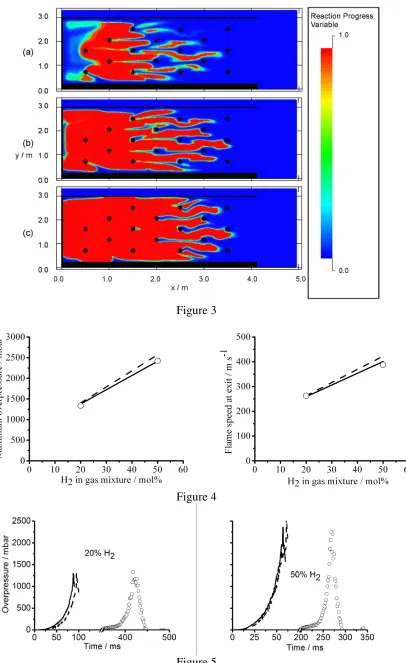
Figure 3 depicts three, two-dimensional planar sections through this geometry, where
the left and upper boundaries represent a solid wall, and the extreme right an outflow
boundary. The lower boundary represents a floor raised slightly above the ground
level of the vessel exterior. The remaining two walls of the vessel were represented as
solid surfaces and hence a complete three-dimensional representation of the vessel
interior was used. These walls are not visible in Figure 3 as they lie on the planes z=0
and z=3. A small area of burned gas, represented by a region where the progress
variable equals 1.0, was initially located adjacent to the left boundary and central to
its face in order to instigate the numerical reaction. The base computational mesh was
dimensioned to be a 2488 grid, with 5 possible levels of grid refinement available.
Sensitivity analyses using varying base meshes and levels of grid refinement indicated
that the results presented below are free of numerical instability and error.
From an assembly of time-lapse sequences of the reaction progress variable such
as those shown in Figure 3, the temporal behaviour of the flame front can be seen to
be in-line with expectation. Initially progressing at a relatively slow rate, the reaction
zone subsequently accelerates through the unreacted fluid upon each obstacle
interaction due to the turbulence induced by flow over the obstacle, returning to a near
constant velocity in between these areas of turbulence generation.
The experimental cases considered using the three-dimensional approach were
those of rear ignition in the congested rigs; namely, experiments 9 and 10 as noted in
computational requirements of the problem dimensionality. One calculation therefore
typically requires 8 gigabytes of volatile RAM and, in the case of geometries with a
large solid/fluid interfacial area, upwards of three weeks to complete using a single
3GHz processor running with a 1.3GHz front side bus. Since completion of this work,
the code has been developed to run on parallel processors, which provides a great
saving on computational time, given suitable available CPU resources.
Analysis of the results provides the maximum overpressures achieved and the
flame front vessel-exit velocities predicted by both the k- and second-moment
turbulence closures, which are presented in Figure 4. It is evident from these results
that the magnitude of the predictions, and hence ultimately their conformity with
experiment, depends upon the turbulence model, which in turn has a performance
dependency upon the fuel being investigated. For the three-dimensional calculations
considered here, the more reliable Reynolds stress model is seen to be at variance with
its two-equation counterpart with respect to recorded maximum overpressures and
exit flame speeds. In these rear ignited cases, and at the high turbulence levels
associated with the congested geometry, the flow becomes increasingly less isotropic
with time and it is likely that a notable component of the turbulence stress-tensor is
not represented accurately in the k- case. Scrutiny of the calculated results also
reveals a relative deterioration of the k- model’s predictive ability in the cases of
higher hydrogen content, this being likely due in part to the introduction of hydrogen
effecting an increase in both the laminar and turbulent burning velocity, and hence an
increase in the turbulence generated. Generally, at the lower hydrogen concentration,
both turbulence models are seen to reproduce experimental evidence well, whereas
the Reynolds stress model appears to be a requisite for more accurate predictions at
Figure 5 shows predicted pressure traces, including peak values, plotted
alongside experimental data for the two cases discussed above. Encouragingly, the
forms of the calculated and experimental traces are very similar. However, there is a
notable discrepancy between the observed times of the calculated and experimental
pressure peaks. A phenomenon observed in reactive systems such as those studied
here is the laminar to turbulent transition behaviour of the proceeding flame front, and
this is notoriously difficult to represent in a mathematical framework. The current
model assumes that the developing flame front initially encounters low levels of
isotropic turbulence to establish a numerically stable solution, and as such no
transitional region is defined. Hence, no distinction is observed between a laminar and
a turbulent development stage numerically. With the rear ignited cases the initial
flame front development occurs in an obstacle-free environment in which the
generation of turbulence energy is minimal. This effects an initially relatively slow
progression of the front through the domain, which reflects the experimentally
observed behaviour of a laminar flame development gradually making a transition to
turbulent. Although the numerical model does not contain a mechanism to account for
the laminar to turbulent transition, when applied to the rear ignited case, the nature of
its obstacle geometry does partly accommodate for this phenomena. This is reflected
in the accurate prediction of peak overpressures, although these do occur far too early
in relation to experimental observation. The experimental data display a region of
laminar growth with respect to overpressure, which then progresses to a period of
rapid accelerating increase, before dropping away with a negative gradient of similar
magnitude. This period of growth delay is not evident in the calculated results,
although the model does reliably predict the rate of significant pressure rise and the
Predicted flame front arrival times obtained using the two turbulence models for
the 20% and 50% H2 cases, corresponding to the results of Figure 5, are plotted
against experimental data in Figure 6. This furthers the previous discussion regarding
the timing of the observed peak overpressures noted in Figure 5, in that although the
calculated rate of significant progress of the reaction front is seen to be in line with
observations, the delay due to the laminar to turbulent transition of the flame is
absent. Figure 6 also confirms the application of the two-equation turbulence model is
predicting generally higher flame velocities than the second-moment closure in these
two cases.
Overall, these three-dimensional calculations yield reasonable predictions of the
propagating turbulent premixed flames of methane and hydrogen which interact with
obstacles within the test vessel considered. In particular, the rate of significant rise in
flame speeds and pressure, and peak overpressures, are in line with experimental
results. In agreement with earlier studies [7, 9], the delay period caused by the
transition of the flame front from laminar to turbulent cannot be accommodated.
However, provided that the high levels of turbulence generated by flow over obstacles
present within the test vessel are predicted accurately, then the significant rise in
flame speed and pressure caused by the flame front interacting with turbulent regions
within the flow are predicted well, and as a result so are the damaging overpressures
that are generated. The present results also show that, although the second-moment
turbulence closure leads to more reliable predictions, the differences between the two
turbulence modelling approaches are not as significant as might be expected.
Additionally, and importantly, these predictions also demonstrate that the turbulent
burning velocity correlations of [3] yield reliable results for the methane-hydrogen
correlations described in Section 2.4, not shown here, which lead to significantly
higher overpressures than observed experimentally due to their over-prediction of the
turbulent burning velocity of methane-hydrogen mixtures, as exemplified by the
results of Figure 2.
3.2 Two-dimensional Calculations
Given the significant computational times required to perform full
three-dimensional calculations, and the inevitable restriction this places on the use of
computational fluid dynamic models in routine consequence and risk assessments, a
second approach of employing a simplified representation of the experiments was also
pursued. In this study, the geometry modelled was a two-dimensional section of that
shown in Figure 1. Figure 7 depicts this geometry and, similarly to the approach used
in modelling the full three-dimensional vessel, the left boundary represents a solid
wall, and the extreme right boundary an outflow. The base and the roof of the vessel
were also represented as solid surfaces, and hence a complete two-dimensional
representation of the vessel interior was used. It was found through trials that an area
external to the vessel also required modelling to ensure representation of the influx of
air from the surroundings into the vessel, and enable meaningful calculations at the
point at which the flame front exited the vessel. Two examples of these calculations
are depicted in Figure 7. The first is the rear ignited case of Experiment 10, and the
second a centrally ignited case, that being Experiment 5. The base computational
mesh was dimensioned to be a 4515 grid, and similarly to the previously discussed
calculations, 5 levels of possible grid refinement were employed. Sensitivity analyses
with differing base meshes and levels of grid refinement again indicated that the
Figure 8 depicts predicted maximum overpressures and vessel exit flame speeds
calculated for all five rear-ignited experimental tests given in Table 1. Similar
observations can be made with respect to the performance of the two different
turbulence models in the case of the vessel containing obstacles as were noted for the
three-dimensional model considered in Section 3.1. However, the varied performance
of the models is highlighted when the results obtained from the calculations of the
empty rig are considered. Here, compared to observations of the relatively high
turbulence cases with obstacles, the Reynolds stress model is seen to predict notably
lower maximum overpressures than its k-counterpart over the three fuels considered.
Generally, the larger discrepancies between the turbulence model predictions and the
data also arise at the higher hydrogen levels, and hence higher flame speeds.
Turning to the predictions of the five centrally ignited cases depicted in Figure
9, results less conforming with experiment are observed in all instances. Maximum
overpressures and exit flame speeds are all seen to be notably over-predicted in all
cases, although the greater accuracy of the Reynolds stress approach is demonstrated
when considering the maximum observed overpressure. For the lower hydrogen
concentration case, its performance is an improvement over the k-approach, and this
is compounded at the 50% hydrogen concentration level. These observed differences
are also reflected in the exit flame speed predictions by an increase in magnitude of
the k-model results over those of the Reynolds stress approach.
The differences in the models’ predictive abilities between the rear- and
centrally-ignited test cases with obstacles warrant further deliberation. As discussed in
Section 3.1, a notoriously difficult to model phenomenon observed in reactive systems
such as those studied here is the laminar to turbulent transitional behaviour of the
represented by an expanding turbulent region located within the matrix of solid
obstacles. With no defined laminar combusting region, interaction between this front
and the obstacles immediately effects the generation of turbulence energy which leads
to the over-prediction of maximum overpressures, with this being increasingly evident
with greater hydrogen concentration. The rear ignited cases do not display a similarly
large over-prediction due to the initial flame front development occurring in an
initially obstacle-free environment in which the generation of turbulence energy is
lower than if centrally ignited.
Analysis of the results pertaining to the non-congested experiments is difficult
due to the evident lack of turbulence and turbulence-generation mechanisms within
the domain. The very nature of the k-and Reynolds stress models makes them suited
to the modelling of regions of high turbulence kinetic energy, or regions with energy
generation mechanisms such as those promoted by the presence of solid obstacles.
The expansion of a progressive flame front through a quiescent volume of gas is not
such an example, and it is hence expected for results to display anomalous qualities
when comparing with the alternate cases. In the rear-ignited 0 obstacle case, it can be
seen that, conversely to the 17 obstacle case, a component of the turbulence is perhaps
not being recorded by the Reynolds stress model. This is to be expected in regions
where turbulence generation is minimal, and the additional energy generated by the
two-equation model is likely to be due to the simplifying assumptions it makes.
Further investigation is warranted to assess the importance of the individual Reynolds
stress components and the applicability of the turbulence modelling approaches for
each experimental condition, although this is difficult in the absence of detailed
Similar statements can be made with consideration of the centrally ignited cases,
in that higher levels of turbulence are generated by application of the two-equation
model, leading to a notable over-prediction of maximum overpressure when compared
to experimental data (Figure 9). The reason for this exaggerated production of
overpressure can be attributed once again to the problem of modelling the laminar to
turbulent transition with such turbulence models. Omitting the effect of such a
transition dictates that the flame kernel growth is influenced by the turbulent burning
velocity at a very early stage, as turbulence kinetic energy is generated with no regard
to laminar development. The assumption of an isotropic eddy viscosity in this instance
is evidently detrimental to prediction, and the Reynolds stress model clearly
demonstrates an improvement over the k- model with prediction of overpressure.
Again, the observable differences between the models become more exaggerated with
increasing hydrogen content, indicating the increase in turbulence energy generation
with increasing reactivity of the fuel.
Drawing comparison with the three-dimensional rear-ignited predictions,
overpressures are seen to be slightly decreased but are of a similar conformity with
experimental data. Exit flame speeds also show a similarity although are slightly
higher than their three-dimensional counterparts. These minor differences are to be
expected due to the three-dimensional model incorporating the physical effects of a
higher-dimensionality. A generally superior performance can be noted in the case of
predictions derived using the second-moment turbulence closure.
Lastly, Figure 10 presents the maximum overpressures observed in calculations
of rear-ignited, 17 obstacle cases using the two-dimensional approach and
k-turbulence model. In addition to the two fuels investigated experimentally, results also
and 50% hydrogen by volume. Evident in this plot is an initial rapid increase in
overpressure with inclusion of 10% hydrogen. Following this, a linear period of
increase is observed between 10 and 45%, at which point an inflection and the
beginning of a likely increased growth phase can be seen. Also shown in this figure
are associated measured and predicted flame speeds at the vessel exit, for which
similar behaviour can be observed. These observations are broadly in line with the
overall findings of the NaturalHy project [1] which established that within buildings,
the severity of explosions is increased if hydrogen is added to natural gas. However,
this increase was judged to be only slight for hydrogen addition up to 20%, with
analysis of experimental and theoretical findings suggesting that the explosion
frequency could increase by a factor of two as a result of adding up to 20% hydrogen
by volume.
4. CONCLUSIONS
For the first time, a Reynolds stress turbulence model has been applied to the
prediction of large-scale vented explosions, coupled to a turbulent premixed
combustion model. Maximum predicted overpressures and flame front velocities for
ten test cases are presented, and comparisons made to calculations based on the k-
model. The Reynolds stress model is seen to generally be at variance with the simpler
turbulence modelling approach, although in terms of predicted overpressures and
flame front velocities these differences are often small. However, the increase in
turbulence anisotropy caused by internal pipe work within a vessel necessitates the
use of a Reynolds stress model on physical grounds alone. These observations are
valid for both approaches used to represent the geometry considered, with the level of
future studies. This study has also demonstrated that the combustion model attributed
to Catlin and Lindstedt [8], incorporated with the most recently available
experimental data collected by Fairweather et al. [3], can model confined, venting
explosions of methane-hydrogen mixtures representing industrial scenarios with a
good degree of accuracy.
It has also been demonstrated that in highly turbulent conditions such as densely
congested regions where the progressing flame front can fully develop within the
domain, both the k- and the Reynolds stress model can accurately model
overpressures and flame speeds in such conditions. However, in conditions such as
those created by the central ignition of the gas volume, or in the uncongested cases
which appear not to permit a full numerical development of the reacting turbulent
medium, the model performance is notably reduced. This is most apparent in the
application of the k- turbulence model, although since both turbulence models
applied assume fully developed turbulent flow their failure to accurately predict the
dynamics of explosions in such situations is to a large extent to be expected.
Although overpressures and flame speeds in the congested cases discussed
previously are modelled well, the arrival times of the flame front throughout the
domains are more difficult to capture. It is concluded that without a mechanism
representing a laminar growth period, followed by the transition to a turbulent flow,
this phenomenon will not be accurately described by the present modelling strategy. It
should however be noted that, as expected, the Reynolds stress model does effect
superior results in the prediction of arrival times over the two-equation approach.
An important observation made during this course of study is that of the
apparent change in gradient of the curve of predicted overpressure at around the 45%
transition to a steeper gradient, which is indicative of a beginning increased growth
phase. This being the case, the 45% level would be a barrier in the consideration of
mixture usage with respect to safety considerations. An increased gradient such as this
is indicative of a rapidly increasing rate of reaction, which in reality may relate to a
5. NOMENCLATURE
c reaction progress variable Cp specific heat at constant pressure
e specific internal energy Cv specific heat at constant volume
k turbulence kinetic energy C turbulence viscosity constant
l length scale E total energy
p pressure K Karlovitz stretch factor
t time R reaction rate constant
u velocity S source term
'
u r.m.s. turbulent velocity T temperature
x,y,z spatial coordinates Y mass fraction
Greek Symbols
ratio of specific heats density
flame thickness Prandtl/Schmidt number
turbulence kinetic energy stress tensor
dissipation rate c T/ turbulent diffusion coefficient
of c or T
viscosity 1, 2 eigenvalues
Subscripts
0 initial value j vector indice
b burned l laminar component
f fuel t turbulent component
i vector indice u unburned
6. ACKNOWLEDGEMENTS
The authors wish to thank the European Commission for providing financial support
for this work as part of the Integrated Project NaturalHy (SES6/CT/2004/50266),
funded by the Sixth Framework Programme (2002-2006) for research, technological
development and demonstration (RTD).
7. REFERENCES
[1] NaturalHy, EC funded project, see http://www.naturalhy.net/ (accessed
01/08/12).
[2] Lowesmith BJ, Mumby C, Hankinson G, Puttock JS. Vented confined
explosions involving methane/hydrogen mixtures. Int. J. Hydrogen Energ.
2011; 36: 2337-2343.
[3] Fairweather M, Ormsby MP, Sheppard CGW, Woolley R. Turbulent burning
rates of methane and methane-hydrogen mixtures. Combust. Flame 2009; 156:
780-790.
[4] Bradley D, Haq MZ, Hicks RA, Kitagawa T, Lawes M, Sheppard CGW,
Woolley R. Turbulent burning velocity, burned gas distribution, and associated
flame surface definition. Combust. Flame 2003; 133: 415-430.
[5] Bradley D, Lau AKC, Lawes M. Flame stretch rate as a determinant of
turbulent burning velocity. Phil. Trans. R. Soc. Lond. A 1992; 338: 359-387.
[6] Jones WP, Launder BE. The prediction of laminarization with a two-equation
model of turbulence. Int. J. Heat Mass Tran. 1972; 15: 301-314.
[7] Catlin CA, Fairweather M, Ibrahim SS. Predictions of turbulent, premixed
[8] Catlin CA, Lindstedt RP. Premixed turbulent burning velocities derived from
mixing controlled reaction models with cold front quenching. Combust. Flame
1991; 85: 427-439.
[9] Fairweather M, Hargrave GK, Ibrahim SS, Walker DG. Studies of premixed
flame propagation in explosion tubes. Combust. Flame 1999; 116: 504-518.
[10] Jones WP, Musonge P. Closure of the Reynolds stress and scalar flux
equations. Phys. Fluids 1988; 31: 3589-3604.
[11] Popat NR, Catlin CA, Arntzen BJ, Lindstedt RP, Hjertager BH, Solberg T,
Saeter O, Berg ACVd. Investigations to improve and assess the accuracy of
computational fluid dynamic based explosion models. J. Hazard. Mater. 1996;
45: 1-25.
[12] Falle SAEG. Self-similar jets. Mon. Not. R. Astron. Soc. 1991; 250: 581-596.
[13] Falle SAEG, Giddings JR. Flame capturing. In: Baines MJ, Morton KW,
editors. Numerical Methods for Fluid Dynamics 4, Oxford: Clarendon Press;
1993. p. 337-343.
[14] Fairweather M, Woolley RM, Computational fluid dynamic modelling of gas
explosions in industrial enclosures, EC Naturalhy Project, Work Package 2,
Deliverable D54, Report R0056-WP2-R-0, October 2008.
[15] Abdel-Gayed RG, Bradley D, Lawes M. Turbulent burning velocities: A
general correlation in terms of straining rates. Proc. R. Soc. London A. 1987;
414: 389-413.
[16] Gulder OL. Turbulent premixed flame propagation models for different
combustion regimes. Proc. Combust. Inst. 1991; 23: 743-750.
[17] Bray KNC. Studies of the turbulent burning velocity. Proc. R. Soc. London A.
[18] Burluka AA, Fairweather M, Ormsby MP, Sheppard CGW, Woolley R. The
laminar burning properties of premixed methane-hydrogen flames determined
using a novel analysis method. In: Proceedings of the 3rd European
Combustion Meeting, Chania: Combustion Institute (Greek
Section)/Mediterranean Agronomic Institute of Chania; 2007, Paper 6-4.
[19] Andrews GE, Bradley D. The burning velocity of methane-air mixtures.
FIGURE CAPTIONS
Figure 1 Schematic diagram of the experimental rig.
Figure 2 Comparison of the predictions of two turbulent burning velocity correlations (upper, middle and lower curves correspond to k=5000, 1000 and 500 m2s-2, respectively).
Figure 3 Two-dimensional planar sections of reaction progress variable predictions in the three-dimensional geometry at (a) z=0.15, (b) 0.25, and (c) 1.50.
Figure 4 Maximum overpressures and exit plane flame speeds for the 17 obstacle geometry with rear ignition, and 20% and 50% hydrogen concentrations, calculated using the three-dimensional approach (symbols – experiment; solid line – Reynolds stress; dashed line – k-).
Figure 5 Pressure traces for the 17 obstacle geometry with rear ignition, and 20% and 50% hydrogen concentrations, calculated using the three-dimensional approach (symbols – experiment; solid line Reynolds stress; dashed line – k-)
Figure 6 Flame front arrival times for the 17 obstacle geometry with rear ignition, and 20% and 50% hydrogen concentrations, calculated using the three-dimensional approach (symbols – experiment; solid line Reynolds stress; dashed line – k-).
Figure 7 Plots of reaction progress variable predictions indicating the extent of reaction in rear (upper) and centrally (lower) ignited cases for 50% hydrogen and 17 obstacles calculated using the two-dimensional approach.
Figure 8 Maximum overpressures and exit plane flame speeds for the 0 and 17 obstacle geometries with rear ignition, and 0%, 20% and 50% hydrogen concentrations, calculated using the two-dimensional approach (symbols – experiment: o 17 objects, 0 objects; solid line – Reynolds stress, dashed line – k-).
Figure 9 Maximum overpressures and exit plane flame speeds for the 0 and 17 obstacle geometries with central ignition, and 0%, 20% and 50% hydrogen concentrations, calculated using the two-dimensional approach (symbols – experiment: o 17 objects, 0 objects; solid line – Reynolds stress, dashed line – k-).
Figure 1
Figure 3
Figure 4
Figure 6
Figure 7
Figure 9
![Figure 2 presents a performance comparison of the correlations of Bray [17] and of](https://thumb-us.123doks.com/thumbv2/123dok_us/7986708.204222/12.595.95.459.72.209/figure-presents-performance-comparison-correlations-bray.webp)