COMMISSION OF THE EUROPEAN COMMUNITIES DG XII- RESEARCH, SCIENCE, EDUCATION
RAW MATERIALS
RESEARCH AND DEVELOPMENT
STUDIES ON SECONDARY RAVV MATERIALS
VI. SORTING AT SOURCE
OF CONSUMER WASTE
September
1979For official use only
(,t;, oo'f. "j.;.
1- f.#:-i, r'!
COMMISSION OF THE EUROPEAN COMMUNITIES " DG XII- RESEARCH, SCIENCE, EDUCATION ,
~RAW
MATERIALS
RESEARCH AND DEVELOPMENT;
STUDIES ON SECONDARY RAV\1 MATERIALS,
Volv~
VI.~ORTING
AT SOURCE
OF CONSUMER
WAST~
September 1979
For official use only
L E G A L NOTICE
This document was prepared under the sponsorship of
the Commission of the European Communities.
Neither the Commission of the European Communities,
its contractors nor any person acting on their
be-half, guarantee the accuracy or completeness of the
information herein contained, or are responsible for
PREFACE
This volume is part of a series of aaaeaament studies on Secondary
Raw Materials that have been prepared under the sponsorship of the
"Commission of the European Communities" (Directorate-General tor
Research, Science
andEducation).
The decision to carry out such studies, as well as other work to be
published under the general heading
"RawMaterials Research
andDe-velopment", reaul ta from current concern about prospects of supplying
the European Community with raw materials
insufficient quantities
andat acceptable coats in the mid- to long-term •
.Anessential part in
de-fining the purpose
andscope of the work was
pl~edby a Sub-Committee
of CREST (1), established to investigate on-going activities in the
member states, both in the areas of primary
andsecondary raw materials,
in order to determine what R
&D actions, if
any,should be undertaken
by the Community to alleviate ita supply problems.
The volume comprises
3 reports, prepared under contracts with the
European Economic Community:
1.
SORTING AT SOURCE OF CONSUMER WASTE IN THE EEC.
Report from STICHT:nro VERWIJDER:nro AFV.ALSTOFFEN
(s.v.J..),
Amersfoort.
·
(Contract no.
215-76-9
ECI N)
2.
SORT:nro AT SOURCE OF CONSUMER WASTE IN DENXARK.
· Report from ENVIROPLAN
A/
S, Copenhagen.
(Contract no.
276-76-9
ECI DK)
3.
SORTING AT SOURCE OF CONSUMER WASTE IN THE U.K.
Report from the DEPARTMENT OF ENVIRONMENT
(Di-rectorate General of Water
~neering),London.
(Contract no.
277-76-9
ECI UK)
'
COMMISSION OF THE EUROPEAN COMMUNITIES
{Directorate General XII - Research, Science, Education>
SORTING AT SOURCE OF CONSUMER WASTE
IN THE E.E.C.
STICHTING VERWIJDERING
AFVALSTOFFEN
Postbus 184
Natriumweg 7
3800- AD Amersfoort
{Netherlands)
Report by
Drs. J.M. Joosten {SVA)
January 1978
I
Contents
Conclusions and Recommendations. I I
1. Terms of references. 1
2. Introduction. 2
3. General remarks and considerations. 4 3.1. Voluntary organizations or municipalities. 4
3.2. The way of collection. 6
3.3. Simultaneous collection? 7
3.4. Frequency of collection. 8
3.5. Type of residence, collection means and
social level. 8
3.6. Cost-Benefit. 10
3.6.1. General remarks. 10
3.6.~. Cost-Benefit analysis. 11
3.6.3. Savings on collection and disposal costs. 12 3.6.4. General remarks on the economic results. 13
4. Paper. 15
4.1. General remarks. 15
4.2. Technics and organization. 17
4.3. Economics. 19
4.3.1. The revenues. 20
4.3.2. Costs. 21
5. Glass. 23
5.1. General remarks. 23
5.2. Technics and organization. 24
5.3. Economics. 29
5.3.1. The revenues. 29
5.3.2. The costs. 30
5.3.3. Cost-Benefit. 31
6. Iron and non-ferrous metals. 32
6.1. Introduction. 32
6.2. Technics and organization. 32
6.2.1. Revenues and costs. 33
6.3. Economics. 35
7. Plastics. 35
7.1. Introduction. 35
7.2. Technics and Organization. 36
7.3. Economics. 37
7. 3. 1. Benefits and costs. 3 7
8. Textiles. 38
I I
Conclusions and Recommendations.
Conclusions.
1. In every country sorting at source is considered an
important method to reclaim materials which can be re-used
in industry.
2. Sorting at source activities, especially the collection of
the materials, can be carried out bywhethervoluntary
organizations or by the municipality (the public cleansing
service or a private firm indicated by the municipality).
3. In general voluntary collection tends to be less regualer
as collection by the municipality which means at the same
time that the collected quantities are not as big as possiblE'.
4. In the case of municipal collection the collected quantity
turned out to be bigger but consequence of this is higher
collection costs.
5. In principle the demand for secondary raw mal~rials depends on the economic situation in industry. In this context
voluntary collection is much more flexible that is to say
that in times of falling prices supply decreases.
6. The two main methods of collection are house to house
collection and container collection. In general container
collection turns out to be less expensive but on the other
hand the amount of reclaimed materials tends to be smaller.
7. The same relation can be found speaking about the frequency
of the collection. In general a higher frequency results in
bigger quantities. However, costs will raise too.
8. Special arrangements in the form of special bags or dustbins
are positively of influence on the collected amount. But
here too we can say that as a consequence of this, costs will
I I I
9. As the social level of the population concerns in my view
there is no impermeable prove that a relation exists between
social level of the population and the collected quantity.
Though the figures show more materials from the higher social
levels we think not all possible causes (less consumption, lack
of storage space) are taken into account.
~0. About the economic profitability the con~lusion can ne drawn that in general all acitivites (except voluntary collection}
show a loss.
11. Comparing the economic results of the activities i t turned out to
be very difficult to find a common basis. Due to different
economic circumstances in the countries, the presence of
raw materials and basis industry, the accounting system and
the way of collection (one or more components; only households
and household and shops) only a shallow evaluation was pO$Sible.
Recommendations.
The knowledge of reclamation of waste materials from households
is to a great extent based on accidental information from the
collections. In some cases a great effort has been made to obtain
information of the possible relationship between different
parameters influencing the amounts yielded. But i t is probable
that not all parametres have been disclosed, and i t is obvious
that those focused on in the past and at present are not measured
with the degree of exactitude which is necessary to make correct
conclusions,
To increase ~he knowledge of reclamation of waste materials from households research studies must be undertaken.
In this section research is proposed on subjects on which lack
of sufficient knowledge has been found. Recording of fundamental
d~ta as well as detailed studies of already developed processes
During the preparation of this study exchange of views on
needed research and development has taken place with Stichting Verwijdering Afvalstoffen, Holland, the Department of the
Environment, United Kingdom and the Danish National Agency of Environmental Protection.
1. Standard definitions of terms, waste components and analyzing should be agreed upon.
The definition of waste components should be related to both "waste" and to "secondary raw material".
2. Standard definition of costs and benefits in connection with retrieval of "secondary raw materials" from households.
The costs and benefits should be evaluated from a profitability point of view which also includes environmental and resource oriented aspects both locally and nationally.
3. Amounts of waste produced by the household and composition of the wastes should be recorded in detail.
A necessary and sufficient knowledge of amounts and composition of wastes is needed to enable a usage of statistical
predictions on a national scale. Influence of social and
sociological parameters should be disclosed. The relationship between amounts reclaimed from households and materials from other sources should be established.
4. A more detailed knowledge is needed about when and how
products become waste during the flow through the household. This knowledge is essential in order to establish a relationship between quality of potential reclaimable waste material and
the moment at which the waste is retrieved for ~eclamation. 5. Research should be undertaken on the possible degree of
extraction of reclaimable waste materials ;,.Jn tne households.
This includes research into possible parametres influencing the motivation for participation in reclamation. The impact on way of life and waste handling traditions in the households according to type of collection (collection by voluntary
organization, as part of Total Waste Collection Arrangement by municipality, collection by reclamation industry) should be
V
Amounts collected in relationship to collectlon method,
collection frequency, type of residence, etc., should be
studied.
Research and development studies are needed esp~cially for
apartment houses where the recorded results Je,LrJlly show
smaller collected specific amounts (i.e. pe1 nousehold)
than for single-family houses. Specially applied collection
methods have indicated during a field trial that increases
of specific amounts are possible. Introduction of two or more
refuse chutes in apartment houses would possibly yield greater
specific amounts.
6. Degree of efficiency in collecting and transporting of
reclaimed wastes should be recorded and relationship to
methods and techniques establ~shed.
Design of collecting vehicle related to types of wastes to
be collected troro the households should be stu~1ed. Lc~er
costs have beer. :-.~corded per ton of collectE<l r···claimed waste when collection was part of a Total Waste ~ollection
Arrangement comprising garden and bulky wastes as well.
Type, number and design of vehicles used in the collection
rounds influences to a great extent the costs of collection
bec~useman-hours spent are directly related to these parametres. All handling of reclaimable wastes must be regarded in
relation to material quality wherefore a necessary and
sufficient degree of sorting is interrelated with the
sensivity of the industrial processes when using secondary
raw materials.
7 ~ Research should be undertaken of the chan~,e s in waste
production by households and in the flux cf the amounts of
reclaimable and reclaimed waste materials as a. r·· sul t of
introducing intensified or mandatory coll~.:t]ons and recycling.
It
is important to obtain a knowledge abouL possibleintroduction of substi tutional materials in lh~ 11ousehold due
to alteration of waste flow. The relationshi? between proposed
changes of collections and the resulting reactions in
household behaviour should be known to prevent unnecessary
and unwanted changes in amount and quality of reclaimable
-
1-1. Terms of references.
By order of the EuroFean Committee (contract no. 275-76-9
ECI N) a study has been m~de concerning the present situation
in the field of separate ~·lllection of components of domestic waste. Partly this study is made by the Institute for Waste
Disposal (Amersfoort, 'l'Le Netherlands) of the situation in
Belgium, France, Western-Germany, Italy, Ireland, Luxemburg
and the Netherlands. A similar study of the Danish situation
has been made by Enviroplan in Copenha~en. Fin~lly tte Department
of Environment in London gave a description of tne situation
in the United Kingdom. This final report gives a con~ilation
of the Dutch study, the Danish and the English study.
Unfortunately Italian activities on sorting at source are not
-2-2. Introduction.
Sorting at source can be defined as a form of recycling of
components of domestic waste whereby on one side one or
more components of domestic waste are sorted by the households
and whereby on the other side these components dre collected
separately. It will be clear that several definitons are
possible. The UK final report uses the following definition:
"All activities necessary to make certain components available
to collecting parties and to transport those compor1e.1ts to
recovery industries''. Reading both definitions one thing is
important: Mechanical sorting is excluded.
Recycling of waste materials has existed at all times in the
communities. According to period and place the motives behind
recycling have been different. Until the ecological conscience
appeared in the industrial societies economic evaluations have
dominated to a great extent.
Nowadays stimulation of recycling and especially sorting at
source is based on environmental considerations. This means
that making an evaluation of recycling projects not only the
economic motive has to be considered.
In this report, however, we agree upon two principles.
In the first place sorti~g at source can give us secondary
raw materials which is important in view of our future material
supply. And secondly sorting at source diminishes the quantity
of waste to be disposed of.
In this report we only pay attention to consume~ wastes.
Recycling of these wastes can be done by s0rting at source and
by mechanical separation. As we have said before in this context
only sorting at source interests us.
Though i t is indicated that recycling activities have to be
evaluated on a great number of aspects, our main interest will
be efficiency and costs. This because no sufficient data on the
other aspects are available and because of the restrict~on made
-3-That is why our investigation studies two aspects, that is
to say the technical-organizational aspect and the economical
aspect.
The information received shows a great number o: activities.
We thought i t impossible and not very useful as well to give
a detailed description of all projects.
Our main interest has been to investigate cerl~ir: similarities
in the activities as well as significant differences. As we
will explain later in this report i t is hardly f0Ssible to
compare the results of the projects in detail. That is why
in chapter 3 we will give some general remarks and considerations
concerning parameters which can be of influence on the results
of the projects.
The chapters 4, 5, 6, 7 and 8 do cottent more detailed lnformation
per component studied namely paper, glass, iron and non-ferrous
-4-3. General remarks and considerations.
As we have said the results of sorting at source activities
depend on quite a number of parameters. In thi5 chapter we
would like to give some general remarks and considerations
on the following questions. What should be preferred collection
by volunteers or collection by the municipaljty?
Is there any difference in result between house to house collection
or other forms of collection (containers)? The collection of
recyclable materials, is i t carried out simulta~eously with the collection of domestic waste or is i t carried out by separately
operating collection units? Is there any relation between
frequency of the collection and the quantities collectec?
Can we expect better results when specific bags or dustcins
are made available? Can we say that a relatl.on exists between
social level of the population and collected quantity? And
finally the question about.the profitability of the activities.
Collection of reclaimable waste materials from households is
today executed by both voluntary organizations and the
municipalities. In this context I think i t is better to speak
of non-professional and professional col:! c, f .:,l·-:; because of the
fact that in several sorting at source activities private firms
are operational, however, with the permission of the municipality.
The motives on which separate collection is based, however,
are quite different. It will be clear that volur· ary organizations
or private enterprises almost only collect ~·ec lr.nma.ble materials because of the economic profit. There are some exceptions
especially in the case of voluntary organi7atlqns. However,
the greater part of the collection is done by schools, ~lubs etc.
Though they are aware of the environmentaJ. considerations their
-5-The collection by the municipality is predomin2ntly based
on environmental motives. Furthermore the opir LOll .Ls gaining
ground that voluntary collection does not g~ve enough
guarantee for future material supply. It will be clear that
voluntary collection and collection by private firms depend
on the price fluctuations. When prices are relatively low
there will be less spirit to collect the reclaimable materials.
As a result of this the supply decreases. In this case one
could say that there does not exist a stable pattern in the
collection and in the supply of materials.
Another motive which can result in collection Ly the municipality can be found in the fact that voluntary and private collectors
often only are interested in the larger quantities in view of
collection cost~. In that case the collected quantity does not reach the possLble maximum.
Though understandable motives some remarks are justified.
In general we can say that prices are a reflection of demand
and supply. That means that when prices are relat~vely low
there obviously exists a limited demand for ravr materials by
the industry. One of the main problems of municipal collection
is that the supply stays at the same level. In times of falling
prices the consequence of a stable supply can be a further fall
of prices. The same applies to mechnanical separation. In
principle this system is not very flexible too. When prices
are high there will be less reclaimable material (especially
paper) in domestic wastes because of the fact that these
materials are kept separate because of their value. The
mechanical separation system is confronted with excess capacity.
However, when prices are low we meet the same problem as has
been described before concerning municipal collection.
In the case of mechanical separation the problem can be even
worse because of the fact that more reclaimable materials are
not kept separately. So more materials are supplied to the
-6-Summarizingwe can say that collection by the rnllnicipality has the advantage that there will be a contlneous collection and a rather stable supply of materials. Il wi:l be clear
that the advantage of voluntary collection la~~ in elimination of the disadvantages of municipal col le t J ( ·n.
So voluntary collection is rather flexiblE. · ir1·2n prices are falling, supply decreases. Furthermore voluntary collec~ion
is less costly.
In principle two systems of collection can b0 distinguished, collection house to house and collection by means of containers placed in the area. Generally speaking the containersystem is used in particular for glass collection, while home to home collection covers all components. The reason why in various actions (especially in the Netherlands) containers are used is just the economical side of the collection. ~tudying the results the container collection turned out to be much cheaper than house to house collection.
However, comparing the quantities collecteu the house to house collection gives the better results. It will be clear tllat the motivation to cooperate is much higher when the component is collected at regular times house to house. Con::ainer collection just depends on the willingness of the popul1tion to bring their bottles to a container. But in spite of the bigger quantities collection costs per ton are higher in a house to house system. Nevertheless i t is believed in the Netherldnds that the
-
I~
-7-In general container collection is carried out by means of
rather large containers (up to 9m
3
). Using smaller containers
we hope the quantities collected will increase because of
the fact that people have to go a shorter distance.
When 30% of the population cooperates it is calculated that
the collection trucks of 20 m
3
each will be almost full after
one day collection. If one succeeds to attain a 40% cooperation
the action does not give any loss.
Summarizing we can say that in principle house to house
collection gives higher quantities. However, the costs per
ton will
pe
higher.
All will depend on the leading principle
on which the recycling activity is based. If one has the
intention that in principle the total possible amount of a
component must be collected,house to house collection is
preferably. Costs, however, will be very high.
3.3. Simultaneous collection?
---Studying the various experiments we can say that with the
exceptionof one activity the collection of the components is
carried out by separately operating collection units.
The traditional collection frequency of domestic waste is
at least one a week. Besides this collection of domestic waste
most countries have a monthly collection of bulky waste.
In a few cases the separate collection of certain components
takes place on the day of this bulky waste collection.
In view of future research the question can be put if a
system is thinkable which combines the normal collection of
domestic or bulky waste with the separate collection.
-8-In Germany too one thinks of this kind of collection.
Because of the above mentioned possible savings we think
it worth while to stimulate research in this direction.
3.4.
~E~s~~~s~_9£_s9!!~s~!2~·One of the questions put in the context of this study is if there
is any relation between the frequency of collection and the
quantities collected. As we have said before house to house
collection of certain components generally takes place once
a month mainly at dates when bulky waste is collected.
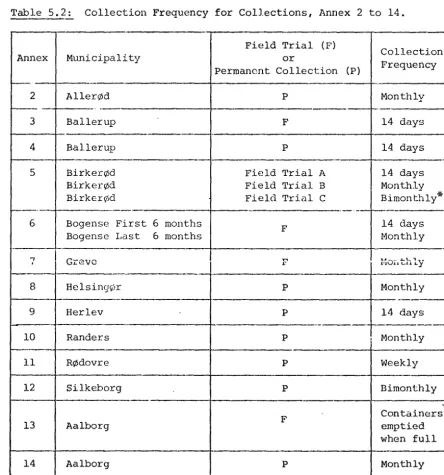
In several studies one has made variations in frequency. Except
from the Danish studies one could not say that a higher frequency
of collection results in larger quantities of collected materials.
As we have said in the Danish experiment in
Birker~d,however,
the contrary was true. Changing the frequency from 14 days
collection to a month and from a month to a bimonthly collection,
a decrease was observed of at least 20%. For apartment houses
the decrease was even greater (44%).
Though the other experiments did not show a significant relation
between collected quantity and frequency of collection we dare
say that a relation like this exists. Especially where collection
at apartment houses is concerned one could imagine that lack of
available space prevents storing of reclaimable materials for
longer periods. In that case the materials are more likely to be
disposed of together with the ordinary household refuse.
3.s.
!~E~_2!-~~2!9~~£~L-£9!!~£~!Q~--m~e~2-en9_2Q£!e!_!~Y~!·It will be clear that the influence of the type of residence
on the efficiency of the collection in principle is the same
as on the collection of domestic waste as such. A report made
by the Stichting Verwijdering Afvalstoffen on the efficiency
of the collection of domestic waste made it very clear that the
efficiency of the collection is much better in the case of
-9-However, speaking about the amount of separate collected
materials we see the contrary. In principle the efficiency
of collection in the case of apartment houses is better than
collection on single-family houses, however, in the case of
collection of reclaimable materials the collected quantity
from single-family houses is larger.
Probably this is caused by a lack of available space in the
apartment which prevents storing of reclaimable materials for
longer periods. So we see once again that the frequency of
collection is very important.
Another question which is asked for in several studies was if
there is any relation between the social level of the population
and the collected amount of materials. Although some positive
relation was found,that is to say that in general the amount is
larger when the social level is "higher", i t is not yet fully clear
if the difference in amount is a result of either a greater
cooperation (motivation) or a quantitive difference in the
consumption of certain components by the households.
Furthermore one must be aware of the fact that i t is possible
that just people with a "lower" social level live in apartment
houses where, as we have seen, storage possibilities are not
always available.
Finally the question was put if there is any relation between
the collected amount and special collection arran~ements that is to say special dustbins or plastic bags on behalf of certain
components. Though we have only two references (Denmark en Germany)
we believe that i t is justified to say that this relation exists.
When special bags are used the amount tendsto be larger.
One can imagine that special arrangements of this kind work
-
10-3.6.1. General remarks.
Studying the various experiments i t turned out to be very
difficult to compare the results and the efficiency especially
the economics. In the first place we are confronted with the
problem that the economic situation in the countries is quite
different (level of wages, taxes etc.). Another problem that
faced us is the simultaneous collection of more components
(glass and paper or paper and PVC etc.). In these cases i t is
impossible to calculate the costs for a single component.
The same applies to experiments which include more than only
collection (f.i. paper is already sorted or pressed into
bales). Real collection costs cannot be deduced from the
calculations.
However, not only costs comparing is very difficult, the same
applies to profits. In principle we can say that the price of
secondary raw materials depends on the price of primary materials.
In general the quality of secondary raw materials is some what
lower so prices will be lower. But even when the quality is
quite the same we often see lower prices probably because of
the fact that one is not quite sure that the supply wil+ be
stable and regularly.
Knowing this i t will be clear that there is a great difference
between the countries. In the first place i t is important if a
country has primary raw materials of her own. If not sorting
at source can be more succesful economically spoken, because
of the fact that prices are relatively higher as a result of
transport. Besidesit can be advantageous to use home materials.
At the other side the economic possibilities of sorting at
source can be influenced in a detrimental way if in the country
there is no industry to use the collected secondary raw materials.
It will be clear that in principle this even applies to one
-11-Apart from the above mentioned difficulties in comparing
the economic results of sorting at source activities we
finally faced another problem.
In principle we are dealing with domestic waste. However, in
various experiments the term domestic waste has been defined
in rather a broad sense. Often waste from shops and offices
is included. So the collected materials do not fully originate
from households.
3.C.2. Cost-Benefit analysis.
In this report the economic results of sorting at source have
been compared on the basis of costs and revenues of reclaimed
materials, that is to say a cost-benefit analysis in traditional
sense. In modern literature on environment and economics i t is
emphasized more and more that the cost-benefit analysis has to
take into account the economic impact of indirect consequences
of a certain activity. We quite agree with the Danish report
which says (page 5) that too limits of materials anC energy are
important in orde~ to make a well balanced evaluation. But too
environmental aspects are connected to sorting at source activities
and the same applies to the problem of employment.
In principle sorting at source has two main consequences.
Firstly sorting at source results in smaller quantities of
waste to be disposed of. Through this the environmental
impact of the disposal of waste can be reduced for instance
the emission of incinerators or in the case of landfill soil
pollution. Besides i t is possible that there will be savings
in the field of disposal costs or in landfill capacity.
Secondly sorting at source (secondary raw materials) results
-
12-As we have said in principle these consequences should be
part of the evaluation of sorting at source projects.
However, in practice i t turns out to be very difficult to
quantify these impacts. Not only because of the fact that
we are not quite able to translate them into money but too
because of the problem that i t is very hard to co~pare the
environmental impacts of an activity in different places.
However, one consequence in this context is worth ~entioning
which is the possibility of savings on disposal costs.
3.b.3. Savings on collection and disposal costs.
In several studies concerning cost-benefit analysis of
separate collection systems one has taken into account savings
as a result of the fact that a smaller quantity of waste has
to be treated or incinerated. Concerning this saving we can make
the following remarks.
The question has to be put as to how far it is right to claim
the integral collection and disposal costs as a saving.
The Institute for Waste Disposal has made a more detailed study
on this which shows that two points are essential.
a. long run or short run approach,
b. the organization of the disposal system.
In general the collection of domestic waste is carried out by
the municipality. When a municipality has its own public
cleansing service the savings will be not more than the variable
costs in the short run. The greater part of the costs can be
considered fixed. Only in the long run when the public cleansing
service has been adjusted to the new situation the integral
costs can be considered a saving. Another situation exists when
a private firm does the collection .. When the municipality pays
-
13-The same can be said of the disposal. Here too when the
municipality pays per ton the saving is equal to the integral
costs. However, there is one remark to be made. When collection
and disposal organizations
a~econfronted with less waste
the result can be an undercapacity.
In that case price increase is not
unthinkabl~.Finally a striking example. When it is decided in the Netherlands
to collect paper, glass and tin cans separately on the short run
there will be no saving at all. In the Netherlands a considerable
part of domestic waste is incinerated in four installations which
generate energy. Due to a lower waste supply and a lower caloric
value the revenue received on the sale of electricity will decrease
so much that the expected saving on the variable costs in reality
will be a loss.
In other words when speaking of savings on collection and disposal
costs as a result of the fact that the quantity of waste decreases
we have to be very careful. In our opinion these
~avingscan
only be part of the revenues when they are actually converted.
3.6.4. General remarks on the economic results.
Comparing the costs and revenues only one conclusion can be drawn.
With the exception of the voluntary collection system all
activities show a loss. However, there is one exception. In some
municipalities in Belgium domestic waste is collected by a
private firm. This collector does not only collect normal domestic
waste but too paper en glass from this kind of waste. Not only
collection but also disposal of this waste (composting) is one
of his activities. This collector declares that his separate
collection does not give extra costs because of the fact that
the collection unit has costs too when he does not collect
separately. The question can be put if this is the right way
to calculate. However, when the collection unit is able to
collect both the components and the remainder of the waste the
-
14-Almost qll the other activities show a loss. Which justifies
the question if these activities have to be continued.
Answering this question i t will be clear that costs only are
not sufficient to make a decision. In the first place one will
have less waste to dispose of. Especically when this waste is
landfilled some saving of space is the result or in other words
landfill places can be used for a longer time.
Secondly one has to take into account the future raw material
supply. It is to be expected that prices raise in future so
that recycling can be more profitable. However, in that case
one must be aware of the fact that a certain raise of prices
can transform certain waste components into raw materials.
Private (volunteers or trade) collection will take their
chance especially where delivery of the components to the
regular collection-organization is not dictated.
Finally i t is possible that separate keeping and separate
collection results in a certain awakening of the consumption
pattern which can be of no harm in our throw away society.
It will be clear that quantifying this consideration is
hardly possible. Nevertheless this factor cannot be missed
-
15-4. Paper.
4.1. General remarks.
---Thinking of recycling components of domestic waste one firstly
thinks of paper. Already for a long time paper is recycled.
Technically i t is rather easy to use waste paper as raw material
for the production of certain paper and cardboard products.
In the context of sorting at source i t is important to know the
share of paper in domestic waste.
Share of paper in domestic waste.
Belgium 23 per cent
France 30 11 11
Italy 11 11
W-Germany 28 11 11
Netherlands 23 11 11
Luxemburg 22
-
25 11 11Ireland 25
-
30 " 11U.K. 25 " 11
Denmark 11 11
As one can see there seems to be no great difference in these
figures. However, before calculating with these figures i t would
of sense to relate them to the amount of waste per head of the
population per year.
In general the material input of the paper industry consists of
rather a high percentage of waste paper. The OECD-report
"Prospects and Policies for Waste Paper Recycling" (1976) (page 31)
- 16...;
Table 2: Actual Utilisation of Waste Paper.
Belgium/Luxemburg France
Italy W-Germany Netherlands United Kingdom Denmark
Ireland
18,4 36,0 40,6 45,2 42,6 45,8 46,6 66
per cent
11 11
11 11
11 11
11 11
11 11
11 11
11 11
However, not all the waste paper originates from the countries which use it. In these figures import is included. So we have to consider the actual recovery rate:
Table 3: Actual Recovery Rate.
Belgium/L~xemburg 29,9 per cent
France 30,6 11 11
Italy 27,9 11 11
W-Germany 31,9 11 11
Netherlands 46,1 11 11
United Kingdom 27,6 11 11
Denmark 27,7 11 11
Ireland 21 11 11
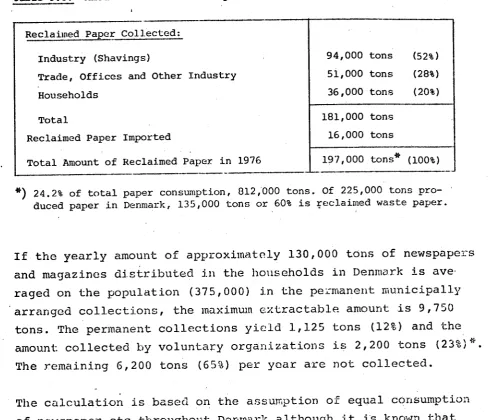
Especially the figure of the Netherlands is important, because of the fact that this amount is collected for rather a great part at the household by predominantly volunta~y organizations. In order to see.what is s t i l l possible in paper collection by means of separate collection i t is important to know what part
o~ the recovered paper originates from households. In this context we would like to use two figures one from the already
-
17-Table 4: Household contribution to total waste paper recovery.
Questionn. OECD
Belgium 5 5
France 2 5
Italy 15
W-Germany 2,8 8
Netherlands 40 45
Luxemburg 56-60
United Kingdom
Denmark 21
Ireland 2
Though we can see some remarkable differences between these figures, two figures are worth mentioning i.e. Luxemburg and the Netherlands. In both countries the collection system is predominantly based on volunteers.
4.2. !~shu!s~-~u9_Qrs~u!~~E!2U·
As we have seen the collection of paper from households is
predominantly a voluntary matter in Luxembourg and the Netherlands. In general the collection is carried out by schools, boyscouts, etc. in order to earn some additional income. That does not mean that in the other countries there is no voluntary collection at all. However, in most cases there is no continuity and the
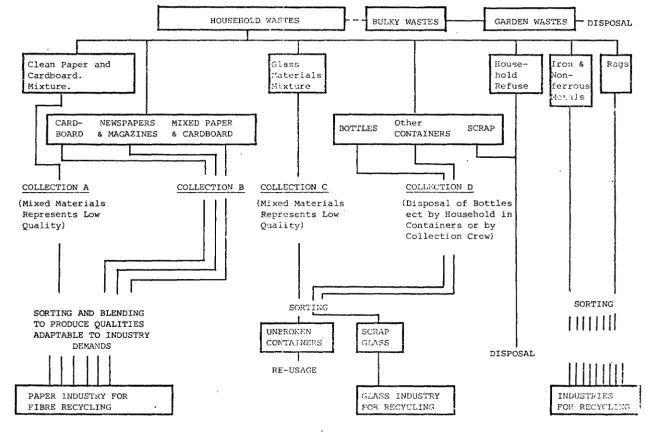
quantities collected are rather small.
In the other countries the opinion is gaining ground that in the long run a voluntary system will be no acceptable solution. That is why one tries to set up a waste paper collection system, carried out by the public cleansing service or at least
[image:29.576.41.488.79.306.2]-
18-Belgium
France
Luik, Bergen, Brussels, Charleroi
La Rochelle, Lyon, Le Havre
W-Germany Konstanz, Dusseldorf
Netherlands: Rijsenhout
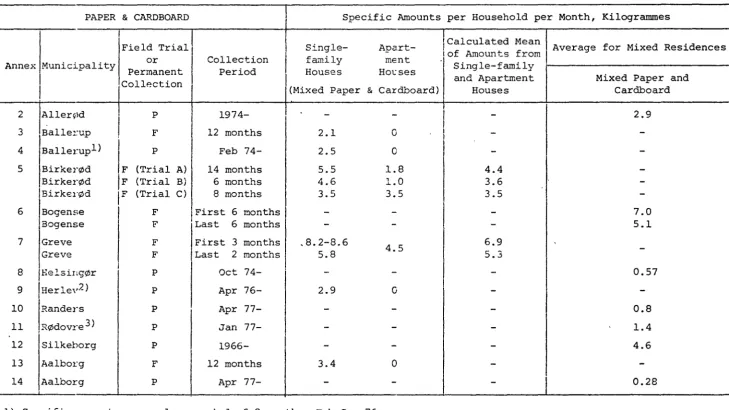
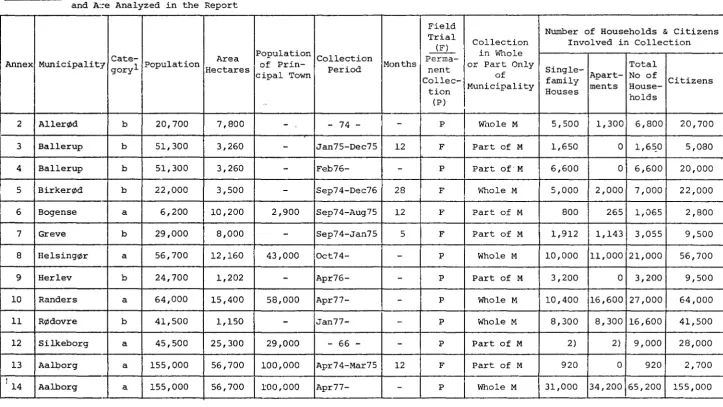
Denmark Birkenr~d, Bogense, Ballerup, Herler, Alborg.
U.K. Oxfam.
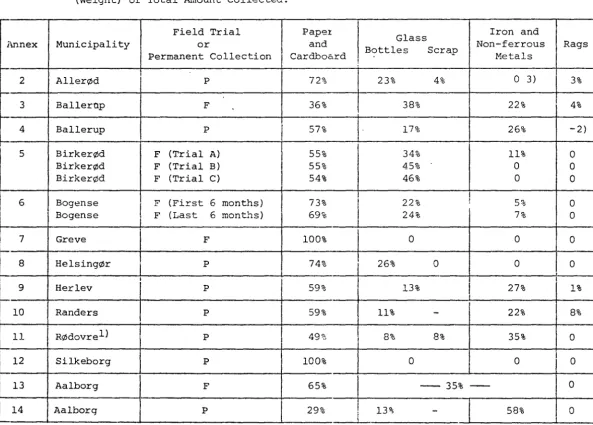
One of the most important results is the quantity of collected
waste paper during these experiments. Studying the activities
i t turned to be not possible to give some average. There is a
great difference in quantities collected per head of the
population. Comparing fourteen experiments we got the following
range: 8,2 - 40 kg p.h. p.y.
When we relate the parameters and general conclusions mentioned
in chapter 3 to the component paper we can see the same pattern.
However, there is one question which is very important in the
view of future paper supply. That is the question about the
quality of the collected paper.
If only paper from households is collected we roughly got the
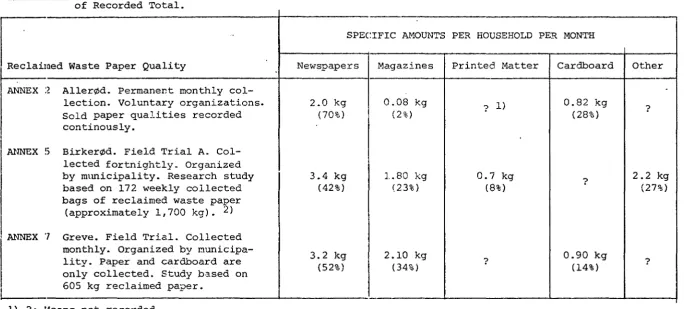
following composition:
80 per cent newspapers and magazines,
20 per cent cardboard and other papers.
It will be clear that the composition fully depends on the way
the collection is organized that is to saywhetheronly households
cooperate or the collection is also directed to shops, offices etc.
An experiment of this kind has been carrieq out in La Rochelle
(France) with the following result:
11 per cent paper,
89 per cent card board.
Another question about the quality of the collection is to what
extent polluted matter (plastics etc) can be expected. Studying
the experiments we can say that in general this will be not more
-
19-We already mentioned that i t is very important to know the
composition of paper used in households and offices. A recent
study about waste paper in the Netherlands indicates that in
the near future the input of waste paper in the paper production
can be · expected to increase considerably as a result of new
technics (de-inking, disperging etc.) and improvement of existing
technics. The question is in what way this amount can be made
available. Is i t possible to stimulate the present situation of
voluntary collection (in the Netherlands) or do we expect that
collection by the municipality is necessary to attain the desirable
amount. Even when prices of waste paper will rise in future
collection by the municipality will show a loss. Especially when
the municipality is not the only collector (volunteers collect
as well) the costs will be remarkable. That is why i t is believed
that the two systems cannot exist together, whether the collection
is carried out by the municipality or by volunteers.
Another question which can be asked for in this context is if i t
possible to issue a prohibition to put waste paper in the normal
domestic waste. In that case the collected amount can be much
higher. Answering this question one has to know one thing.
The results of all activities depend on the voluntary cooperation
of the public.
We do not have enough information to answer this question.
Hov1ever, for the Netherlands we can say that i t will be very hard
to introduce a measure like this.
4.3. Economics.
__
,..._____ _
We already indicated that i t is very hard to compare the economic
results of the experiments. Next to the problem mentioned before
some other problems faced us:
1. In many cases during the experiments not only paper is collected. 2. Sometimes the experiment does include more than only collection
f.i. sorting etc. while this is not deducible from the cost
-
20-Nevertheless we will give some figures. In order to be able to compare these figures the European Unit of Account of
1-1-1977 is used.
4.3.1. The revenues.
Due to differences in the economic situation in the countries it does not have sense to use absolute figures ~f costs and revenues. It has more sense to indicate the ratio betv1een costs and revenues. Another important factor is the period in which sorting at source activities took place, because of the fact that especially paper prices show strong fluctuations.
Furthermore one must be aware of the fact that the revenue received from the old paper trade or from the paper industry depends on the way of supply. In some cases paper is already sorted or even pressed into bales.
European Unit of Account of 1-1-1977:
West-Germany 1 UoA = 2,68045 DM
France = 5,57233 Fr.Fr.
Italy = 985,151 Lire
Netherlands = 2,80409 Hfl.
Belgium/Luxemburg = 41,1509 Fr.
UK/Ireland = 0,654430£
Denmark = 6,60115 D.kr.
Revenue per ton (1000 kg) in E.U.A.:
Belgium 41,3
10,9
France (paper) 26,9
(card-board)
Netherlands
Luxemburg
32,1
10,7
12,2
paper industry old paper trade old paper trade volunteers
municipalities mixed paper
paper industry municipalities
"
"
sorted and baled paper industry old paper trade old paper trade volunteers
mixed paper
Ireland
18,3
West Germany
10,3
Denmark (aver.) 11
U.K. (Oxfam)
38
-
21-old paper trade volunteers
mixed paper
old
pa~ertrade municipalities
mixed paper
old paper trade municipalities
volunteers
.paper industry- volunteers (paper is sorted
etc.)
As you can see the compensation from the old paper trade to the
municipalities or the voluntary organizations lies in general
in the same range. An exception has to be made for France.
The activities in this country of which economic data are
available cover more actions than just collecting. In fact in
these cases the municipalities have taken over the function of
the old paper trade i.e. sorting and baling. Therefore the
revenue received from the paper industry is much higher.
However, when we see the revenues of the old paper trade from
the industry in Belgium and the Netherlands the French prices
are in the same range.
4.3.2. Costs.
---Speaking about the costs of a separate collection system we are
mainly interested in the costs of a separate collection activity
carried out by the municipalities. When paper is collected
separately by volunteers there are no costs that is to say
volunteers do not charge any collection costs.
-
22-Costs per ton (1000 kg) in E.U.A.:
Netherlands
France La Rochelle
Le Havre
Bruay
Germany Konstanz A
B
c
D E F G Diisseldorf LuxemburgBelgium Liege
Bergen
Denmark
U.K. (Oxfam)
120 80 34 39 32,3 25,2 24,2 37,9 24,0 38,3 42,7 23 24 48
with separation
with separation
driver + 2 loaders with
distribution costs of bags
26,72 Research figure; Monthly collection.
106
Combined paper/glass/(non) ferrous metals
When costs and revenues are related one can conclude that only
in a few cases one can speak of an equation. However, one must
be aware of the fact that this equation was found in 1974, the
period of very high prices of waste paper.
However, there is one exception. In some municipalities in
Belgium domestic waste is collected by a private firm.
This collector does not only collect normal domestic waste but
too paper en glass from this kind of waste. Not only collection
but also disposal of this waste (composting) is one of his activities. As we have said this collector declares that his separate collection does not give extra costs because of the fact
that the collection unit has costs too when he does not collect
-
23-In general, however, all the activities show a loss.
In this context the main question will be whether other
aspects {environment etc) are considered important enough to
justify the loss.
5. Glass.
•
The second material which interests us in the context of
recycling is glass, mainly because of her share in domestic
'lrlaste.
Share of glass in domestic waste
Belgium
6to
8per cent
Luxemburg
10,1"
11France
2to
8"
11Italy
11 11Ireland
8 11 11W-Germany
15"
"
Netherlands:
13."
"
•
U.K.
,.
"
Denmark
..
.
'·
"
'
~
Already for a long time the glassindustry uses cullet on behalf
Jof the production of glass. This cullet, however mainly originates
from bottlers (old bottles) and industries.
The glassindustry
knows the composition of the glass. However, separate collection
of glass of domestic waste gives cullet from all kinds of bottles.
In other words in the first place the glass industry has to
-
24-In other words from a technical point of view there is no
problem to use "domestic" cullet. Furthermore it is expected
that using this cullet energy savings will be possible.
These two factors - share in domestic waste and no technical
problem !s using domestic cullet - have resulted in experiments
on separate collection of non-returnable glass.
5.2.
!=~~~~~~-~~9_9~S~~!~~E!9~·In contradistinction to separate collection of paper the
collection of glass is not predominantly house to house.
The following experiments are studied:
Denmark
Birker~d
- house to house
Bogense
Ballerup
-Herler
11 11
11
Alborg
- container in the area.
Netherlands
About 250 communities - container in the area
1 community
West-German:t
Various communities
Konstanz
Mllnchen
Belgium
Various communities
Bergen
Ireland
- house to house
-
container in the area
-
container in the area
-
and house to house
container in the area
- container in the area
- house to house
Italy
No information available.
France
Marseille
Aix en Provence
St.Foy - Les Lyon
Le Havre
U.K.
Oxfam
.::.
25-- container in the area
11
- house to house
- house to house
- house to house
It must be noted that the activities mentioned above are not
the only glass collection projects within the Community.
However, from these projects some information is available.
When we analyse the results of these separate collections
the main conclusion can be that especially the collected
quantities are somewhat disappointing.
One of the main q~estions in this context is if there is any significant difference in quantities collected between a house
to house collection system and a system of container collection.
In general we can say that as far as the collected quantity
concerns the results are better when using a house to house
collection system.
In this context, however, we have to say that the container
collection system can be much improved. One of the main causes
of diminishing cooperation of the people in a container system
is the fact that one has to take more pains to make recycling
possible. We have said already that all activities depend on
the voluntary cooperation of the people. They are willing to
cooperate when things are made easy for them. That is why one
has to try -when a container system will be chosen- to make i t
as easy as possible. Which means that the di;,tance to the
-
26-In other words the container density is of influence on the
results of the collection which is shown on the basis of some
experiences in the Netherlands.
Shortly in the Netherlands an experiment will stqrt with 2200
1.containers in an area of 1.100.000 inhabitants. On the basis
of a result of 30 per cent (that means that 30 percent of the
population cooperates) in this area 500 containers will be
placed which means one container on 210Ginhabitants. If the
calculations turn out to be right these containers will be full
and emptied every week.
Describing the results in the Netherlands one uses the cooperation
rate. The consumption of non-returnable glass is about 27
kilo-grammes per head per year. On this basis we are able to measure
the results of an experiment.
Some results:
~Netherlands
number of
population
Utrecht
250.000
Apeldoorn
125.
ooo'i
Papendrecht
21.800:
Woerden
22.000 ::·
...
collected
quantity
1260 ton
720 ton
250 ton
110 ton
coop.
rate
19
%21
%42
%18,5%
containers
container x
density
10
1:25.000
14
1: 9.000
12
1: 1.800
4
1: 5.500
·· fn
the description of the experiments in other countries one does
not use the consumption of non-returnable glass but simply the
amount of glass in domestic waste assuming that this glass is all
non-returnable.
-
27-Denrnar~:
number of
collected coop.
house to
population
quantity
rate
house
BirkerszSd
21.000
318
ton
601 paper bag
Bogense
2.700
45,6
11paper bag
Ballerup
5.080
42
11bags
Herler
9.500
25
11bags
Alborg
2.700
19
11containers
Because of the fact that we do not know the yearly consumption
of non-returnable glass it is very hard to give a cooperation
rate. Comparing thes.e figures with the Dutch results we can
conclude that in principle house to house collection gives
better results. However, one must be a\'lare of the fact that
the collection areas in the Netherlands are much larger than
in Denmark. In general the motivation in smaller towns or
areas is greater. For instance Rijsenhout a little village in
the Netherlands. Glass is collected house to house; number of
inhabitants 4500. Collected quantity 94 tons: cooperation
rate 75%.
West German:L:
inhabitants
quantity
Konstanz A
271
5,2 ton house to house
B
680
12,5
11house to house
c
865
6,5
11house to house
D
796
26
11house to house
E
989
21
11container 4400
F
782
7,6
11container 1100
1
G
520
5,5
11container 1100
1Miinchen
3000
1146 containers
For these experiments too it is not easy to find a cooperation
rate because of the fact that we do not know the annual
-
28-Despite of all this i t can be concluded that the results
(quantities) are better in a house to house collection system.
In Luxemburg a system of container collection exists carried
out by the glass trade. The containers are emptied when they
are full. No details are known about the quantities collected.
In Ireland separate collection of glass from households is
negligible. There is a form of separate collection at bars
and restaurants carried out mainly by the glass trade.
Details about quantities are not known.
In Belgium in some communities a container system is used to
collect non-returnable glass. A house to house system is applied
in about 50 communities. In these towns the collection is carried
out by a privat firm. In some communities this firm uses a two
compartment car. The area in which he is operating counts
240.000 inhabitants. For next year the expectation is 5000 tons
of glass. On an annual glass consumption of 40 kg. This means a
cooperation rate of 52 per cent.
Lyon: -cooperation rate 45 per cent
-St. Foy 39 11 11
-Duchere 15 11 11
-Passin 38 11 11
house to
-Oullin 37 11 11 house
-Pierre Benite 34 11 11
Montceau 53.000 inhabitants
Aix en Provence
-
container system 10a
15 per cent Marseille-
container system 10a
15 per cent.In France too i t can be concluded that a house to house collection
system gives better results. As in the study of Konstanz one has
asked in the experiments in St. Foy and Duchere if there is any
relationship between social level and collected quantity. As
one can see the difference in the results of the two areas is
-~-Though in the U.K. varous actions on glass are carried out,
it is not quite possible to give a cooperation rate. However,
the figures of Oxfam show that the average weekly quantities
collected and the cooperation are rather good.
Summarizing the results of activities mentioned we can conclude
that without some exceptions house to house collection of
non-returnable glass gives better results than container
collection. In the Netherlans, however, one believes that a
container system is most suitable. In principle we can see the
Dutch system with small containers as an intermediate form
between house to house collection and collection with big
containers that is to say one container on a great number of
inhabitants. In principle the economics and the environmental
aspects must answer the question what system is most suitable
in a particular situation.
5.3. Economics.
---5.3.1. The revenues.
In general what has been said about paper revenues applies to
the component glass. The price of glass, however, does not show
fluctuations as strong as in the case of paper.
The price which can be obtained by the collector depends on
the way the cullet is supplied to the glass industry.
The consumption of glass concerns three kinds of glass i.e.
white, green and amber. When mixed glass is collected separately
and in this formdeliveredto the glassindustry the cullet only
can be used to produce green glass. When the cullet is sorted
on colour the price which the glass industry is willing to pay
will be higher. Up until now, however, in no country separate
collection of sorted glass exists.
Netherlands
Ireland
Germany
-
30-Revenues per ton (1000 kg) glass 26,7 UA glass industry glass trade
3,6 UA glass trade municipalities mixed glass
23,7 UA glass industry glass trade sorted
11,2 UA glass trade municipality
France
transport costs for municipality 25,1 UA glass industry trade or
municipality which has sorted
Denmark
U.K.
3,6 UA glass trade collector
5
or initiator UA glass trade municipality
mixed glass 9,1 UA glass trade
mixed glass
As one can see the prices do not differ very much.
The compensation from the glass industry to trade or municipality which has taken over the functions of the trade lies in the same range (from 23,7 to 26,7). The same applies to the compensation from trade to municipality. Only in Germany a difference exists because of the fact that the expenses of transport are for the account of the municipality.
5.3.2. The costs.
It will be clear that what has been said about the collection costs of paper applies to glass. In most activities we see a combined separate collection of certain components. Only for the German study of Konstanz and some Dutch activities it is possible to give the collection costs for glass only.
Germany Konstanz A 3713 house to house; dustbins 50 11 once a month B 3719 house to house; dustbins 30 11 once a month
c
4712 house to house; box'
once a month D 3813 house to house; dustbins 50 11 once a monthE 1111 container in area 4,4 m 3 when full


![Figure 5.3 and 5.4 are shown specific amounts collected single-famil]' and apart-ment houses respectively](https://thumb-us.123doks.com/thumbv2/123dok_us/7983105.203139/95.567.46.526.577.819/figure-shown-specific-amounts-collected-single-houses-respectively.webp)