This is a repository copy of
Elastomeric spring actuator using nylon wires
.
White Rose Research Online URL for this paper:
http://eprints.whiterose.ac.uk/121210/
Version: Accepted Version
Proceedings Paper:
Ingham, E., Miyashita, S. and Damian, D. (2017) Elastomeric spring actuator using nylon
wires. In: Gao , Y., Fallah, S., Jin, Y. and Lekakou, C., (eds.) Towards Autonomous Robotic
Systems. TAROS 2017. Conference Towards Autonomous Robotic Systems, TAROS
2017, 19-21 July 2017, Guildford, United Kingdom. Lecture Notes in Computer Science
(10454 ). Springer, Cham , pp. 540-547. ISBN 9783319641065
https://doi.org/10.1007/978-3-319-64107-2_43
[email protected] https://eprints.whiterose.ac.uk/
Reuse
Items deposited in White Rose Research Online are protected by copyright, with all rights reserved unless indicated otherwise. They may be downloaded and/or printed for private study, or other acts as permitted by national copyright laws. The publisher or other rights holders may allow further reproduction and re-use of the full text version. This is indicated by the licence information on the White Rose Research Online record for the item.
Takedown
If you consider content in White Rose Research Online to be in breach of UK law, please notify us by
Elastomeric Spring Actuator Using Nylon Wires
Emily Ingham1∗
, Shuhei Miyashita2 , Dana Damian3
1
Department of Bioengineering, University of Sheffield.2
Department of Electronics, University of York.3
Department of Automatic Control and Systems Engineering, University of [email protected]
Abstract. Medical devices are designed for collaboration with the hu-man body, which makes the steps to create them increasingly more com-plex if the device is to be implanted. Soft robots have the unique po-tential of meeting both the mechanical compliance with the interacting tissues and the controlled functionality needed for a repair or replace-ment. Soft devices that fulfill fundamental mechanical roles are needed as parts of soft robots in order to carry out desired tasks. As the medical devices become increasingle low-profile, soft devices must feature multi-functionality that is embedded in the structure. A device embedded with nylon actuators allows for the controlled collapsing of an elastomeric spring by compression alone or compression and twisting. In this paper we present the concept of a novel elastomeric spring, its fabrication and mechanical characterization.
1
Introduction
Soft devices that fulfill fundamental mechanical roles are becoming increasingly important in the design of soft robots. Especially for low-profile soft robots, it is important that their complex behavior is embedded in the design of the composite material thus reducing the integrated components and the complexity in control [1]. Applications of these low-profile soft robots can be found in human-machine interaction, and mostly in surgery and tissue engineering.
For example, there is a need of devices that approximate tissues together in the treatment of long-gap oesophageal atresia (LGOA). This is a congenital dysfunction affecting about 2000 babies in US and UK every year, in which babies are born with an incomplete oesophagus that is reconstructed by pulling together the two oesophageal stubs [2]. Also in tissue engineering, scaffolds may be proffered to exhibit mechanical capabilities that may lead to a better cell orientation and more functional tissue product. For these application, we need linear actuators that are soft, compressible and potentially scalable.
7], or polymer/carbon nanotube (CNT) composite fibres [8] and [9]. Pneumatic and hydraulic-based soft actuators have also been employed in many applica-tions [10] [11] [12] [13]. Electrically driven actuators such as in [14, 15] have been shown to change rigidity, however, thermally driven actuators such as [16] proved to be some of the simplest and cheapest to power.
We present a soft device that is able to contract, like the basic mechanical spring, or twist, due to the full elasticity of its underlying structure and the configuration of its embedded soft coiled actuators.
The design outlined in the paper is linearly designed to contract and then re-lax uniaxially. However, other forms of linear actuators such as [13,17] contract and bend as a result. Compared to the actuators aforementioned, the presented actuators are both inexpensive and low power, and can be developed to be bio-compatible and easily integrated in low-profile medical devices.
Ideally, a controlled form of collapsing would allow the elastomeric spring to fold neatly and apply traction to a tissue to which is being attached, much like other deployable but stiffer actuators, as detailed in [18] and [19], may perform. In the following, we present the design concept of the elastomeric spring actuator, its fabrication and analyze its electro-mechanical properties.
2
Design of Elastomeric Spring Actuator (ESA)
2.1 Materials
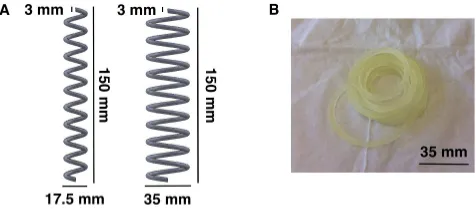
[image:3.612.182.420.514.625.2]The elastomeric substrate was a translucent rubber (TangoPlus) that is soft with a degree of pliability. The spring structure was designed using SolidWorks with two specifications of width, as shown in Fig. 1A. This was 3D printed (Objet500 Connex3 3D Printer) to produce a collapsed string design, presented in Fig. 1B, that can be assembled into a functional spring. This structure was designed so that it maintained its shape when fully contracted, with no increase in width.
Properties of elastomers do not typically allow for structured folding, how-ever, by placing linear actuators within the structure a controlled compression of the spring can be achieved. To complete the design of the collapsible spring, the spring was embedded with four nylon-coiled actuators, as shown in Fig. 2. These coiled actuators encompass nylon and silver wires that contract under the application of heat generated by electricity. The production of these actuators is outlined in [3].
2.2 Design of ESA with 17.5mm width
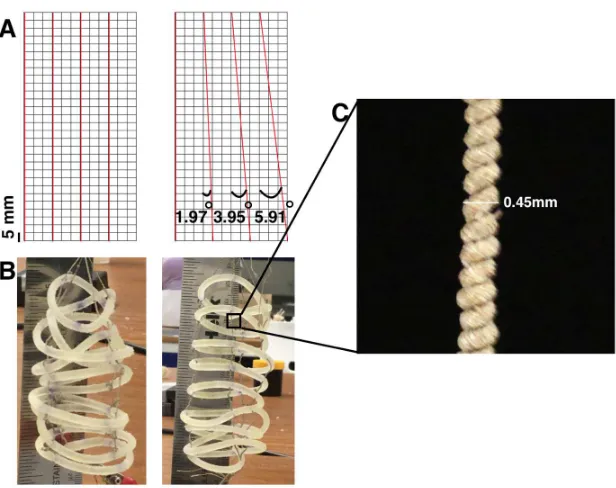
The first type of ESA weighed 4.8g. Each coil actuator was manually sewn through the elastomeric spring, using a surgical needle that was similar to the coils diameter of 0.45mm. The coils were sewn in a parallel configuration as depicted in Fig. 2A. Combining the coils and elastomer resulted in a smaller overall length of the elastomeric spring than that shown in Fig. 1A. At rest, the length was approximately 108mm. Once the coils had been embedded in the elastomer, the resistance of each coil was measured. Once this had been established, the elastomeric spring actuators were placed in a circuit where a potential difference between 1V and 12V was applied at maximum 0.2A and the contraction measured accordingly.
2.3 Design of ESA with 35mm width
The second type of ESA weighed 9.8g. To examine the best arrangement of the coils to produce the ideal orientation for the contraction of the spring, two different designs were tested (Fig. 2). The designs in Fig. 2A show the outlines for the paths of the nylon actuators through the spring. The first one is the parallel design, characterized by coiled actutors sewn in parallel along the longitudinal axis of the spring. The second one is the angled design, in which coiled actuators were sewn at an increasing angle compared to the first actuator. The angle of the each of the paths is increasing gradually until the end the fourth path meets the end of the first. Ideally, this design should produce a rotational contraction, in addition to an axial contraction as in the case of the parallel design. Fig. 2B shows the designs of the springs once completed. Figure 2C presents a detail of the coil actuator.
Both the parallel and angled designed elastomeric spring actuators were in-dividually placed into the circuit as described in the previous section. The con-tractions were then visually assessed using a ruler placed behind the actuators.
3
Experimental Results
3.1 Results for Contraction of ESA with 17.5mm width
4.8g weight of the spring. The largest contraction was 2.5mm. The contraction of the actuators resulted in a minor rotational effect of around 5 degrees, most likely attributed to human error while manually sewing the coils.
Fig. 3.Percentage contraction of the small spring
3.2 Results for Contraction of ESA with 35mm width
The second set of full size springs with the patterns set out in Fig. 2 were tested using the same method. Fig. 4 shows the comparison between the elastomeric spring actuator with the angled design at zero contraction and at maximum contraction. The application of low current was significant enough to register a 4mm contraction.
[image:6.612.229.412.492.635.2]Before the current was applied to the elastomeric spring actuator with the parallel design, the resistances of the individual coils were measured (130, 174, 122 and 143 Ohms) and used to calculate the overall resistance of the actuator (34.9 Ohms). This reasonably low resistance meant the applied current could be as low as 0.2A.
The results of the larger spring with the parallel design are shown in Fig. 5A. Upon the application of potential difference from 1V until 8V, the elastomeric spring actuator reached a maximum contraction of 11mm at 8V. Two subse-quent tests were undertaken after the first, however, one of the coil actuators had stopped conducting. As the graphs in Fig. 5 show, between 8 and 10V, the elastomeric spring actuators begin to relax and revert to a state of zero contrac-tion. We believe this is due to the inability to further conduct after the system short-circuits. A strong application of current can lead to a break in a coil actu-ator, resulting in an inability to contract. This occurred within the elastomeric spring actuator with the parallel design.
The elastomeric spring actuator with the angled design was subsequently tested after recording the resistances (116, 157, 141 and 198 Ohms) and calcu-lating the total resistance (36.9 Ohms). This also resulted in the application of a potential difference from 1V to 12V and a current of around 0.2A.
[image:7.612.146.464.428.538.2]The results of the elastomeric spring actuator with the angled design are shown in Fig. 5B. The results in relation to maximum contraction are very similar to that of the parallel design and also result in breakage after 8V. None of the coil actuators in the angled design experienced a break to such an extent that all the nylon actuators were still fully functional after the tests had concluded.
Fig. 5.(A) Results relating to the percentage contraction of the large spring with the parallel design; (B) Results relating to the percentage contraction of the large spring with the angled design
3.3 Rotational Contraction Results for ESA
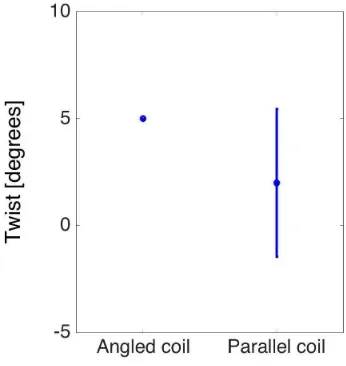
the elastomeric spring actuator with the angled design. The results are shown in Fig. 6. The results for the elastomeric spring actuator with the angled design were not considered as the rotation produced was influenced heavily by a loss of integrity of the elastomeric spring’s structure.
Fig. 6. Results comparing the rotational effects of the small parallel spring and the large angled spring, including possible errors
Figure 6 shows that there is a larger twist in the elastomeric spring with angled-coil design than in the one with parallel design. The latter one showed a rather large standard deviation prompting to further tests that need to be undertaken.
4
Discussion & Conclusion
Whilst the elastomeric spring actuators have sufficient strength to contract the spring of weight 9.8g and dimensions 150x35x3, their strength is currently insuf-ficient to cause complete approximation of tissues for the treatment of LGOE. However, an improvement in the spring design, e.g., Archimedean spiral, and in the sewing pattern of the coiled actuator can be further achieved.
The integration of soft sensors such as [20] and [21] is also a future avenue of research for such soft actuators.
Acknowledgment
This work was supported by the University of Sheffield.
References
1. R. Pfeifer, M. Lungarella, F. Lida ”Self-organisation, Embodiment and Biologi-cally Inspired Robotics”. In:Science. 318(58530) (2010), pp. 1088-1093.
2. J.E. Foker, T.C. Kendall Krosch, K. Catton, F. Munro, K.M.Khan ”Long-gap esophageal atresia treated by growth induction: the biological potential and early follow-up results”. In:Seminars in Pediatric Surgery. 18 (2009). pp. 23-29. 3. C. Haines, M. Lima, N. Li, G. Spinks, J. Foroughi, J. Madden, S. Kim, S. Fang, M.
Andrade, F. Gktepe, . Gktepe, S. Mirvakili, S. Naficy, X. Lepr, J. Oh, M. Kozlov, S. Kim, X. Xu, B. Swedlove, G. Wallace, R. Baughman ”Artificial Muscles From Fishing-Line and Sewing Thread”. In:Science. 343 (2014), pp. 868-872.
4. S. M. Mirvakili, A. R. Ravandi, I. W. Hunter, C. S. Haines, N. Li, J. Foroughi, S. Naficy, G. M. Spinks, R. H. Baughman, J. D. W. Madden ”Simple and Strong: Twisted Silver Painted Nylon Artificial Muscle Actuated by Joule Heating”. In:
Proc. SPIE. 9056 (2014)
5. M. C. Yip, G. Niemeyer ”High-Performance Robotic Muscles from Conductive Nylon Sewing Thread”. In:IEEE International Conference on Robotics and Au-tomation (ICRA). (2015)
6. J. Leng, X. Lan, Y. Liu, S. Du ”Shape-memory Polymers and their Composites: Stimulus Methods and Applications”. In:Prog. Mater. Sci.. 56 (2011), pp. 1077-1135
7. P. Miaudet, A. Derr, M. Maugey, C. Zakri, P. Piccione, R. Inoubli, P. Poulin ”Shape and Temperature Memory of Nanocomposites with Broadened Glass Transition”. In:Science. 318 (2007), pp. 1294-1296.
8. H. Koerner, G. Price, N. Pearce, M. Alexander, R. Vaia ”Remotely Actuated Poly-mer Nanocomposites - Stress-recovery of Carbon-nanotube-filled Thermoplastic Elastomers”. In:Nat. Mater.. 3 (2004), pp. 115-120.
9. R. H. Baughman, A. A. Zakhidov, W. A. de Heer ”Carbon Nanotubes - The Route Toward Applications”. In:Science. 297(5582) (2002), pp. 787-792. 10. F. Connolly, P. Polygerinos, C. Walsh, K. Bertoldi ”Mechanical Programming of
Soft Actuators by Varying Fiber Angle”. In:Soft Robotics. 2(1) (2015), pp. 26-32. 11. S. Wakimoto, K. Suzumori, K. Ogura ”Miniature Pneumatic Curling Rubber Ac-tuator Generating Bidirectional Motion with One Air-Supply Tube”. In:Advanced Robotics. 25 (2011), pg 1311-1330.
12. A. Stilli, H.A. Wurdemann, K. Althoefer ”Shrinkable, stiffness-controllable soft manipulator based on a bio-inspired antagonistic actuation principle”. In:IEEE International Conference on Intelligent Robots and Systems (IROS). (2014) 13. S. Russo, T. Ranzani, J. Gafford, C.J. Walsh, R.J. Wood ”Soft Pop-up
14. W. Shan, S. Diller, A. Tutcuoglu, C. Majidi ”Rigidity-tuning Conductive Elas-tomer”. In:Smart Materials and Structures. (2015)
15. M. D. Lima, N. Li, M. Andrade, S. Fang, J. Oh, G. Spinks, M. Kozlov, C. Haines, D. Suh, J. Foroughi, S. Kim, Y. Chen, T. Ware, M. Shin, L. Machado, A. Fonseca, J. Madden, W. Voit, D. Galvo, R. Baughman ”Electrically, Chemically, and Pho-tonically Powered Torsional and Tensile Actuation of Hybrid Carbon Nanotube Yarn Muscles”. In:Science. 338 (2012), pp. 928-932.
16. A. Balasubramanian, M. Standish, C. Bettinger ”Microfluidic Thermally Acti-vated Materials for Rapid Control of Macroscopic Compliance”. In: Advanced Functional Materials. 24(30) (2014), pp. 4860-4866.
17. R. V. Martinez, C. R. Fish, X. Chen, G. Whitesides ”Elastomeric Origami: Pro-grammable Paper-Elastomer Composites as Pneumatic Actuators”. In:Advanced Functional Materials. 22 (2012), pp. 1376-1384.
18. S. Miyashita, S. Guitron, K. Yoshida, S. Li, D. Damian, D. Rus ”Ingestible, Controllable and Degradable Origami Robot for Patching Stomach Wounds”. In:
IEEE International Conference on Robotics and Automation (ICRA). (2016), pp. 909-916.
19. K. Kuribayashi, K. Tsuchiya, Z. You, D. Tomus, M. Umemoto, T. Ito, M. Sasaki ”Self-deployable Origami Stent-grafts as a Biomedical Application of Ni-rich TiNi Shape Memory Alloy Foil”. In:Materials Science and Engineering. 419 (2006), pp. 131-137.
20. P. Roberts, D. Damian, W. Shan, T. Lu, C. Majidi ”Soft-Matter Capacitive Sensor for Measuring Shear and Pressure Deformation”. In:IEEE International Confer-ence on Robotics and Automation (ICRA). (2013), pp. 3514-3519.