ISSN: 2231-3354 Received on: 04-10-2011 Revised on: 15:10:2011 Accepted on: 22-10-2011
A. Amrouche, A. Saneba A. Moussaoui, K. Mebarki, A Chaoufi
Laboratory of Plant Resource Development and Food Security in Semi Arid Areas, South West of Algeria, BP 417, University of Bechar, Algeria.
A. Lazouni .H, D. Chabane Sari Laboratory of Natural Products Research (LAPRONA) University of Tlemcen, Algeria.
H. Benmehdi
aLaboratory of LASNABIO,
Department of Chemistry, University of Tlemcen 13000 Algeria.
b Laboratory of Plant Resource
Development and Food Security in Semi Arid Areas, South West of Algeria, BP 417, University of Bechar, Algeria.
For Correspondence A. Amrouche
Laboratory of Plant Resource Development and Food Security in Semi Arid Areas, South West of Algeria, BP 417, University of Bechar, Algeria.
Evaluation of antifungal activity of some oils from
Algerian medicinal plants against Aspergillus
flavus strain produced aflatoxins
A. Amrouche, H. Benmehdi,
A. Moussaoui,
K. Mebarki, A Chaoufi,
A. Saneba, A. Lazouni .H and D. Chabane Sari
ABSTRACT
Antifungal activity of the oils extracts of Citrullus colocynthis L., Linum usitatissimum
L., Nigella sativa L. collected from Bechar Department in the region of (Algeria) has been
evaluated in this present study. Two methods were used in this investigation: radial growth on solid medium and biomass on liquid medium. The oils extracts were obtained by Soxhlet extraction of the seeds part. The values of physicochemical indices of our oils such as acid, acidity and peroxide were also determined. The results of the antifungal potency revealed that the
seeds oils exhibited different degrees of inhibition against Aspergillus flavus MTTC 2799.
However, evaluation of radial growth on Potatoes Dextrose Agar (PDA) solid medium showed slight mycelial growth proportional to oil concentration added to the medium. Antifungal indices investigation allowed as to put our oils in the order of effectiveness: L. usitatissimum (29%) > C. colocynthis (26.5 %) > N. sativa (18.75 %). Evaluation of Aspergillus flavus biomass production on Potatoes Dextrose Broth (PDB) on liquid medium revealed that the studied oils produced a
variable weight reduction (C. colocynthis and L. usitatissimum at concentration superior to
(80µl/ml). On the contrary, N. sativa oil reduced Aspergillus flavus biomass at concentrations of
80µl/ml and 100µl/ml.
Keywords: Antifungul activity, oils, Citrullus colocynthis L., Linum usitatissimum L., Nigella
sativa L., Aspergillus flavus
INTRODUCTION
grains/cereals for human consumption without toxicity problems that are ecofriendly and not capital intensive. Plant extracts of many higher plants have been reported to exhibit antifungal properties under laboratory trails (Okigbo and Ogbonnaya, 2006; Bouamama et al., 2006; Mohana and Raveesha, 2006; Ouraïni et al., 2005). Plant metabolites and plant based pesticides appear to be one of the better alternatives as they are known to have minimal environmental impact and danger to consumers. This led the authors to screen in vitro oils extracts of C. colocynthis, L.
usitatissimum, N. sativa. for antifungal activity against A. flavus
specie with the ultimate aim of developing plant based formulations for plant disease management and safe storage of grains.
MATERIALS AND METHODS
Plant material and extracts preparation
The C. Colocynthis plant used for the present study was
collected in February 2010 in ain Essdar, Kenadsa area, Bechar Department, Algeria. The seeds were separated from fruits and shade dried at room temperature for 10 days. In contrast, the L.
usitatissimum and N. sativa seeds were purchased from Bechar
Market in the same date. The dried seeds part plants were milled to a fine powder in an electrical mill and stored in the dark at room temperature in recipients until required. The finely powdered seeds materials were extracted with organic solvent chloroform using soxhlet apparatus for 6 hours. The different extracts obtained were subsequently concentrated under reduced pressure to get their corresponding oils extracts residues (AFNOR, 1988).
Fungal material and confirmation of testing strain
The seeds oil extracts were assayed for antifungal activity against the fungal strain A. flavus MTTC 2799 obtained from
Arachis hypogaea in biology laboratory at Bechar University.
Confirmation of Aspergillus genera was realized by micro-culture method described by Harris (1989) and Barnett (1972). Furthermore, confirmation of A.flavus species was carried out by Single Spore method using three cultures media: Malt Extract Agar (M.E.A) at 25°C, Glycerol Nitrate Agar (G25N) at 25°C and Czapek Yeast Agar (C.Y.A) at 5°C and 37°C. Using the identification keys of Pitt and Hocking (1973), observation has been made after the first and second week. Confirmation of
A.flavus strains was carried out by inoculation at 25°C in AFAP
medium which give oranges Revers plate. This fungus was stored in tubes of PDA acidified at 4oC.
Aflatoxinogenic Test
A. flavus was sowed on Y.E.S (Yeast Extract Sucrose)
medium rich on B vitamin complex. After two weeks of incubation at 30 ± 2 °C, the biomass was removed by filtration of Y.E.S. The filtrate was added then to 180 ml of chloroform and stirred for 30min. After decantation, the organic layer was concentrated to 2ml. Aflatoxins were determined in each extract by spotting samples onto thin layer chromatography plate. Plate was developed with a toluene/Ethyl acetate/ Formic acid (50:40:10, v/v/v) solvent
system. Aflatoxin standard was spotted on the same plate as reference and aflatoxin spots were identified using 365 nm UV (Asso. of off. Anal. Chem., 1975). The presence of Aflatoxins was provided by appearance of blue fluorescence for AFB which has the same Rf as control.
Determination of percent mycelial inhibition by growth radial technique on solid medium
Selected concentrations of 50 µl/ml ,100 µl/ml ,150 µl/ml ,200 µl/ml ,250 µl/ml, 275 µl/ml and 300 µl/ml of seeds oil
extracts of C. colocynthis, L. usitatissimum and N. sativa were prepared using 5% Tween 80 and 20% Agar added then to 20 mlof PDAa solid medium. After agitation, the selected solutions were transferred into a Petri plates which were incubated for 7days at 25 ± 2°C. Mycelial radial growth was measured from the third day of incubation (Soro, 2010; Kra, 2009). The inhibition percentage of mycelial growth of each oil was calculated using the following formula (PIg = ((DT –D)/DT) x 100) where DT is mean diameter of
mycelial growth in control and D is mean diameter of mycelial growth in treatment (Singh et al., 2009).
Determination of percent mycelial inhibition by biomass technique on liquid medium
Evaluation of biomass liquid medium was achieved by counting of spores’ number using Malassez hematimeter in order to obtain the concentration of 105spores/ml (Serghat et al..; 2004). This technique consists to put different volumes of oil in flasks and completed them with 50 ml of PDBa (Potato Dextrose Broth acidified) in order to obtain the following concentrations: 20 µl/ml ,40 µl/ml ,60 µl/ml ,80 µl/ml ,100 µl/ml, 110 µl/ml and 120 µl/ml. These liquid cultures were sowed with 30µl of sporal suspension.
The flasks were incubated for 14 days at 25 ± 2°C (Tubajika, 2006; Hibar et al., 2006). After filtration, the filter paper was dried at 60°C during 24hours (Dhandhukia P.C. and Thakkar; 2007). Biomass weight formed (P) was determined using the following formula of Imtiaj and Lee (2007) (P = P1 – P0) where P0 is the filter
paper weight and P1 is the filter paper and fungal biomass weight
after dryness.
RESULTS
Extraction carried out on seeds part plants has given the following yields of oils of L.usitatissimum (39.96%), N.sativa (33.71%) and C.colocynthis (17.63%). In order to determine the quality of our oils, physico-chemical indices were measured and illustrated in table 1. On the other hand, our results obtained by identification methods provided that our strain corresponded well
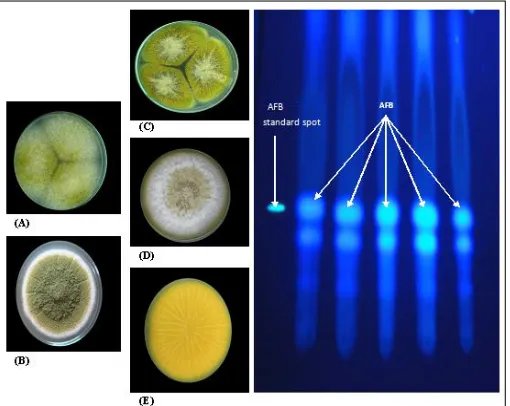
to A. flavus group. Besides, as seen in figure 1, aflatoxinogenic test
Table 1. Physico-chemical results analysis.
C. colocynthis oil L. usitatissimum oil N. sativa oil Refraction indice 1.4754 1.4595 1.4700
Relative density 0.895 0.987 1.030
Acid indice (KOH/g)
5.3 1.59 52.9
Acidity (%) 2.66 0.80 26.58
Peroxide indice
(meq.O2/kg) 7.35 5.68
30.01
shows the activity of oil residue of C. colocynthis with complete sporulation and means efficacies on mycelial growth of A.flavus. In contrast, N.sativa oil appears more efficacies on sporulation and shows less inhibition on mycelial growth of A.flavus (Figure 2C).
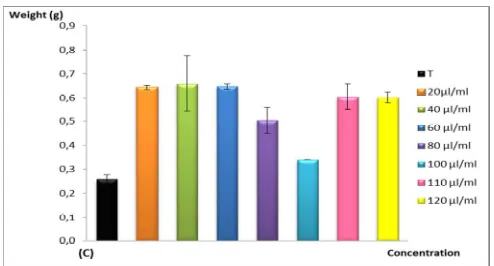
As shown in figure 3, the results of biomass technique on liquid medium revealed that the biomass weight formed under action of our oils were variable and superior to controls. Results analysis of fungal biomass produced by different concentrations of
L.usitatissimum oil showed that the biomass weight (0.2190g and
1.1530 g) were more orless superior to controls (0.2584 g) (Figure 3A). Whereas, biomass weights at concentrations of 20, 40 and 60
µl/m were proportional to concentration of oil added in the
medium. In contrast, biomass formed under effect of the rest concentrations were inversely proportional. Same results were obtained for C. colocynthis oil (figure 3B). As given in Figure 3(C), we observed a fluctuation in mean biomass weight under action of the different concentrations of N. sativa oil. So, at
concentrations of 20, 40, and 60 µl/ml the weights are nearly
constant (0.6400g), then decrease in concentrations of 80 and
100µl/ml (0.5047 g - 0.3390 g). We observed also, elevation of
biomass weight by increase of the oil concentrations (110 and 120
µl/ml) where the weight value was found to be 0.6000 g.
Fig 1. A. flavus strain by « Single Spore » method: A: G25N at 25°C; B: MEA medium at25°C ; C : CYAmedium at 37°C; D : AFAP medium at 25°C ; E: AFAP revers strain and TLCof aflatoxinogenic test.
Fig 3. Biomass weight formed in the presence of different concentrations of oils: L. usitatissimum (A); C. colocynthis (B) and N. sativa (C)
DISCUSSION
Aflatoxins are the most notorious of the mycotoxins causing acute and chronic toxicoses in foodstuff (CAST, 2003).
A.flavus is one of the species of Aspergillus that produce
aflatoxins. This fungus can grow on a wide range of agricultural commodities. Aflatoxins can be produced in preharvest as well as in stored products as cereals (Wilson and Payne; 1994). Plant-produced compounds are becoming of interest as a source of safer and more effective substances than synthetically produced antimicrobial agents. Many oils obtained from plant parts have been reported as effective inhibitors of fungal growth and aflatoxin production and have also been shown to contain antitoxigenic properties (Bhatnagar and McCormick, 1988; Ansari and Shrivastava , 1991). The present study was undertaken in order to observe the effect of various concentrations of seeds oils of
C.colocynthis L., L.usitatissimum L. and N. sativa L on the growth
of A. flavus and aflatoxin production.
In the first experiment for determination of oils extraction yields, the values varied between 17 and 39%. For N. sativa oil, the result of extraction has found to be 33.71% which is in agreement with findings of Meral et al.. (2004), AL-Beitawi et al.. (2009), and Rouhou-Cheikh et al.. (2007) who reported similar oil yield varying between 33.71% and 40.35%. This variation of weight residue may be due to collect period, environment conditions, soil, extraction and storage conditions. For C. colocynthis, the yield of extraction oil was found to be (17.63%) which is supported by some reports of Sebbagh et al.. (2009), Abu naser and Potts (1953) and Schafferman et al.. (1998). In addition, from L. usitatissimum, yield of 39.90% of oil was obtained from seeds part plant. This value corresponded well to Quebec research Center (35 to 45 %) and Diedrichsen findings (26 to 45%).
In the second experiment, the analytical control of oils was based on determination of chemical indices (peroxide, acid and acidity). The values of peroxide indice of C. colocynthis (7.35 meq. of O2/kg) and L. usitatissimum (5.68 meq. of O2/kg) are in
agreement with codex normes (inferior to 10 meq. of O2/kg of oil).
These results confirm that our oils are not oxidized, in contrast to
N.sativa with high value of peroxide indice (30.01 meq. of O2/kg).
This oxidation may be due to extraction and storage conditions that produced oxidation reaction of unsaturated fatty acids, carotenoids
or vitamins A and B (Ghedira, 2006; Appelbaum et al., 1989). For acid indice, the data showed that L. usitatissimum has as value 1.59 mg KOH/g conformed to codex normes (4 mg KOH/g). It is to note that C. colocynthis presented a slight elevation (5.3 mg KOH/g) compared to codex normes. However, Akpambang and Amoo (2008) reported that C. colocynthis oil obtained from Nigerian country has as acid indice value 8.02 ± 0.07 mg KOH/g. From our findings, we observed well that N.sativa oil presented high value which may be attributable to free fatty acids high present in the seeds. In contrast to our study, Tauseef (2009) showed that N.sativa oil possess indice acid value of 0.34 mg KOH/g inferior to our oil (52.9 mg KOH/g). In addition to these indices, other parameters such as refraction indice and relative density were also determined. As seen in table 1, our results of refraction indice (1.4595, 1.4700 and 1.4754 respectively for L.
usitatissimum, N. sativa and C. colocynthis) are nearly similar to
codex norms (1.4677-1.4707) and Akpambang report. Furthermore, the relative density values of C. colocynthis reported by Akpambang et al. (2008) (1.51 ± 0.02) is higher than our oil 0.8950. Besides, Tauseef (2009) demonstrated that N. sativa presented relative density of 0.923 ± 0.001 inferior to our obtained data (1.0300).
In the third experiment, and in order to complete the previous works on antimicrobial plants, we have attempted to evaluate antifungal potency of seeds oils of N.sativa,
L.usitatissimum and C.colocynthis against A. Flavus strain by
growth radial on solid medium and biomass evaluation on liquid medium. The preliminary results of growth radial technique revealed that all the oils tested exhibited different degrees of antifungal activity against Aspergillus flavus. The percent of inhibition of L.usitatissimum was found to be 29% compared to
C.colocynthis (26.5%) and N.sativa (18.75%). Yingying et al..
(2008) reported about the antifungal activity of seeds oil of
L.usitatissimum (seeds powder at 6% concentration inhibit
completely (100%) the development of A. flavus). The present study confirms this investigation where activity may be due to fatty acids more frequent in the seeds especially linoleic acid (Schafferman et al., 1998; Dale et al., 2004). For C.colocynthis, Belsem et al.. (2009) reported the antifungal activity of the fruits parts. Moreover, Schafferman et al.. (1998) suggested that the reduction of the growth strain may be correlated to linoleic acid more present in C.colocynthis seeds oil.
For N.sativa, numerous works have been made to provide
the antifungal activity of this plant against various strains. Agrawal
et al.. (1979) found that oil extract has been proved to possess
excellent activity against A.niger, besides Nazrul et al.. (1989) confirmed the studied effect of N.sativa seeds on A.flavus strain. Furthermore, Singh et al.. (2005) showed that 6 µl/ml of oil
Results obtained from biomass weight on liquid medium showed different fungal weights which are superior to controls. These data may be due to inoculum quantity added on culture medium or strain using oil as carbon source. Comparing biomass weight to selected concentrations, L.usitatissimum and
C.colocynthis oils reduced biomass weights at concentration of
80µl/ml. This reduction effect may be due to linolenic and linoleic
acids abundant in these oils. This assumption has been confirmed by Dale et al.. (2004) report (reduction of biomass weight at 100
µl/ml concentration).
Finally, for N.sativa, fluctuation of biomass weights was
observed beginning by diminution at 80µl and 100 µl/ml
concentrations of oil. Same observations have been reported by Al-Jabre et al.. (2005) and Akhtar et al.. (2007) who suggested that
biomass variation is believed to be due to thymoquinone.
CONCLUSION
The oil extracts of the plants part used showed prominent antifungal activity against A. flavus. This potency may be attributable to fatty acids especially linoleic and linolenic acids or synergic effect of their constituents. Further investigations on their mechanisms will be able to provide a great potential for the control of AFB production.
REFERENCES
Abu naser A.M., Potts W.M.. The Analysis and Characterization
of the Oil from the Seed of Citrullus colocynthis. The journal of the
American oil chemists society 1953; 118-120.
Agrawal R., Kharya M.D, Shrivastava R. Antimicrobial and anthelmintic activities of the essential oil of Nigella sativa Linn. Indian J Exp Biol. 1979; 17: 1264-1265.
Akhtar N., Alakloby O.M., Aljabre. S.H., Alqurashi A.R., Randhawa M.A.. Comparison of Antifungal Activity of Thymoquinone and Amphotericin B Against Fusarium solani in-vitro. Scientific Journal of King Faisal University (Basic and Applied Sciences) 2007; 8. (2): 173-145.
Akpambang V., Amoo I.A., Izuagie A.A.. Comparative compositional analysis on two varieties of melon (Colocynthis Citrullus and Cucumeropsis edulis) and a variety of almond (Prunus amygdalus). Research Journal of Agriculture and Biological Sciences 2008; 4 (6): 639-642.
AL-Beitawi N.A., EL-Ghousein S.S., Nofal A.H. Replacing bacitracin methylene disalicylate by crushed Nigella sativa seeds in broiler rations and its effects on growth, blood constituents and immunity. Livestock Science 2009; 125: 304-307.
AFNOR. Corps gras, grains oléagineuses, produits dérives, Recueil de norme française 1988.
Al-Jabre S., Al-Akloby O-M., Al-Qurashi A-R., Akhtar N. Thymoquinone, an active principle of Nigella sativa, inhibited Aspergillus niger. Pakistan Journal of Medical Research 2005; 42 (3): 102-104
Ansari A.A. and Shrivastava A.K. The effect of eucalyptus oil
on growth and aflatoxin production by Aspergillus flavus.
Lett.App.Microbiol. 1991; 13: 75-77.
Appelbaum M., Forrat C., Nillus P. Abrégé de diététique et de nutrition 2nd édition Masson Paris (1989) 473.
Association of Official Analytic Chemists. Natural poisons 26. Official methods of analysis. Association of Official Analytic Chemists, Washington, D.C. (1975) 24
Barnett H.L. Illustred general of imperfection fungi. Burgess
publishing company. 3rd edition Minnesota (USA) (1972).
Belsem M., Marzouk Z., Décor R., Edziri H. Antibacterial and anticandidal screening of Tunisian Citrullus colocynthis Schrad. from Medenine. Journal of Ethnopharmacology 2009; 125: 344-349.
Bhatnagar D. and McCormick S.P. The inhibitory effect of neem
(Azadirachta indica) leaf extracts on aflatoxin synthesis in Aspergillus
parasiticus. J.Ass.Off.Chem.Soc. 1988; 65, : 1166-1168.
Bouamama H., Noel T., Villard J., Benharref A. and Jana M.
Antimicrobial activities of the leaf extracts of two Moroccan Cistus L.
species. Journal of Ethnopharmacology 2006; 104: 104-107.
Bourais I., Amine A. Aflatoxines toxiques redoutables dans nos aliments. Revue. Les technologies de laboratoire 2006 ; 4-8.
CAST. Mycotoxins: Risks in plant, animal, and human systems. Council for Agricultural Science and Technology, Ames, IA (2003). Available from http://www.cast-science.org/cast/pub/Mycotoxins.pdf.
Chandra R. and Sarbhoy A.K. Production of Aflatoxins and Zearalenone by the toxigenic fungal isolates obtained from stored food grains of commercial crops. Indian Phytopathology 1997; 50: 458-68.
Dale W., Raynor L., Mitchell A., Walker R., Walker K. Antifungal Activities of Four Fatty Acids against Plant Pathogenic Fungi. Mycopathologia revue 2004; 157 (1): 87-90.
Devi K.T., Mayo M.A., Reddy G., Emmanuel K.E., Larondelle Y. and Reddy D.V.R.. Occurrence of Ochratoxin A inblack pepper, coriander, ginger and turmeric in India. Food Additives Contamination 2001; 18: 830-835.
Dhandhukia P.C., Thakkar V.R.. Standardization of growth and fermentation criteria of Lasiodiplodia theobromae for production of jasmonic Acid. African Journal of Biotechnology 2007; 6 (6) : 707-712.
Ghedira K. La nigelle cultivée : Nigella sativa L. (Ranunculaceae). Laboratoire de pharmacognosie, faculté de pharmacie de Monastir, Tunisie. Phytothérapie 2006 ; 5:220-226.
Haris C. Introduction to modern microbiology black wall scientific publication 1989; 179.
Hibar K., Daami-Remadi M., Jabnoun-Khiareddine H., Znaïdi I.E., El Mahjoub M. Effet des extraits de compost sur la croissance
mycélienne et l’agressivité du Fusarium oxysporum f. sp.
Radicislycopersici. Biotechnol. Agron. Soc. Environ. 2006; 10 (2): 101-108.
Imtiaj A., Lee T.S. Screening of antibacterial and antifungal activities from Korean wild mushrooms. World journal of agricultural sciences 2007; 3 (3): 316-321.
Janardhana G.R., Raveesha K.A. and Shetty H.S. Modified atmosphere storage to prevent mould-induced nutritional loss in maize. Journal of Science Food and Agriculture 1998; 76: 573-578.
Janardhana G.R., Raveesha K.A. and Shetty H.S. Mycotoxin contamination of maize grains grown in Karnataka (India). Food Chemical Toxicology 1999; 37: 863-868.
Kra K.D., Diallo H.A., Kouadio Y. J.. Activités antifongiques de l’extrait de Chromolaena odorata (L.) King & Robins sur deux isolats de Fusarium oxysporum (E.F. Sm.) responsables du jaunissement mortel des feuilles des bananiers. Journal of Applied Biosciences 2009; 24 : 1488-1496.
Lopez Grio S.J., Frenich A.G., Martinez Vidal J.L., Romero-Gonzalez R.. Determination of aflatoxins B1, B2, G1, G2 and Ochratoxine A in animal feed by ultra high-performance liquid chromatography– tandem mass spectrometry. J. Sep. Sci. 2010 ; 33 : 502-508.
Marin. S., Homedes V., Sanchis V., Ramos A.J. and Magan N..
Impact of Fusarium moniliforme and F. proliferatum colonisation of
maize on calorific losses and fumonisin production under different environmental conditions. Journal of Stored Product Research 1999; 35: 15-26.
Matheron G., Amsallem I., Puygrenier M., Abecassis J. Étudier les contaminants chimiques ou microbiens des aliments. Alimentation, Nutrition, Santé 2005; 2 : 18-21.
Meral I., Donmez N., Baydas B., Belge F., Kanter M. Effect of Nigella sativa L. on heart rate and some haematological values of alloxan-induced diabetic rabbits. Scandinavian Journal of Laboratory Animal Science 2004; 31 (1): 49-53.
pathovars: an eco-friendly approach. Journal of Agricultural Technology 2006; 2: 317-327.
Nazrul I., Ahsan M., Choudhury M. H., Abdul malek M.. Antifungal activities of the oils of Nigella sativa seeds. Pakistan Journal of Pharmaceutical Sciences 1989; 2(1): 25-28.
Okigbo R.N. and Ogbonnaya U.O. Antifungal effects of two
tropical plant leaf extracts (Ocimum gratissimum and Aframomum
melegueta) on post harvest yam (Dioscorea spp.) rot. African Journal of
Biotechnology 2006; 5: 727-731.
Ouraïni D., Agoumi A., Ismaïli-Alaoui M., Alaoui K. Étude de l’activité des huiles essentielles de plantes aromatiques à propriétés antifongiques sur les différentes étapes du développement des dermatophytes. Phytothérapie 2005; 4: 147-157.
Pitt J.I., Basilico J.C., Abaraca M.L., Lopez C. Mycotoxins and toxigenic fungi. Medical Mycology 2000; 38 (1): 41-46.
Pitt J.I. An appraisal of identification methods for Penicillium species. Novel taxonomic criteria based on temperature and water relations. Mycology 1973; 65: 1135-1157.
Rouhou-Cheikh S., Besbes S., Hentati B., Blecker C. Nigella sativa L.: Chemical composition and physicochemical characteristics of lipid fraction. Food Chemistry 2007; 101: 673-681.
Schafferman D., Beharav A., Shabelsky E., Yaniv Z.. Evaluation of Citrullus colocynthis, a desert plant native in Israel, as a potential source of edible oil. Journal of Arid Environments 1998; 40: 431-439.
Sebbagh N., Cruciani-Guglielmacci C., Ouali F., Sari C. Comparative effects of Citrullus colocynthis, sunflower and olive oil-enriched diet in streptozotocin-induced diabetes in rats. Algeria. Diabetes & Metabolism 2009; 35: 178-184
Serghat S., A. Mouria A., Ouazzani touhami A., Badoc A., Douira A.. Effet de quelques fongicides sur le développement in vitro de
pyricularia grisea et helminthosporium oryzae. Bull. Soc. Pharm. 2004; 143: 7-18.
Singh P., Kumar A., Dubey N.K., Gupta R.. Essential Oil of Aegle marmelos as a Safe Plant-Based Antimicrobial Against Postharvest
Microbial Infestations and Aflatoxin Contamination of Food
Commodities. Journal of food science 2009; 74 (6): 302-307.
Singh G., Marimuthu P., Heluani C., Catalan C. Chemical constituents and antimicrobial and antioxidant potentials of essential oil and acetone extract of Nigella sativa seeds. Journal of the Science of Food and Agriculture 2005; 85: 2297-2306.
Soro S., Ouattara D., Guédé N.Z., Coffi K. Effet Inhibiteur in Vitro et in Vivo de l’extrait de Poudre et de l’huile Essentielle de Xylopia Aethiopica (Dunal) A. Rich. (Annonaceae) sur Fusarium oxysporum f. sp Radicis-lycopersici (Forl), Champignon Parasite des Cultures de Tomate .European Journal of Scientific Research 2010 ; 39(2): .279-288.
Tauseef M. Characterization of black cumin seed oil and exploring its role as a functional food. Thèse de doctorat. Inédite, national institute of food science and Technology University of agriculture. Faisalabad (2009).
Tubajika K.M. Efficacy of alkyl dimethyl benzyl amonium chlorid on supression of physalospora vaccinii in laboratory assays. Journal of food protection 2006; 69 (10): 2460-2464.
Wilson D.M. and Payne G.A. Factors affecting Aspergillus
flavus group infection and aflatoxin contamination of crops. In the
toxicology of aflatoxins. Human Health, Veterinary, and agricultural
significance (David L. Eaton and John D. Groopman, San Diego: Academic Press, (1994).