This is a repository copy of Creativity Training.
White Rose Research Online URL for this paper:
http://eprints.whiterose.ac.uk/97334/
Version: Submitted Version
Book Section:
Birdi, K.S. (2016) Creativity Training. In: Sparrow, P., Shipton, H., Budhwar, P. and Brown,
A., (eds.) Human Resource Management, Innovation and Performance. Palgrave
Macmillan , Houndmills, Basingstoke, Hampshire, UK , pp. 298-312. ISBN 9781137465184
https://doi.org/10.1057/9781137465191
[email protected] https://eprints.whiterose.ac.uk/ Reuse
Items deposited in White Rose Research Online are protected by copyright, with all rights reserved unless indicated otherwise. They may be downloaded and/or printed for private study, or other acts as permitted by national copyright laws. The publisher or other rights holders may allow further reproduction and re-use of the full text version. This is indicated by the licence information on the White Rose Research Online record for the item.
Takedown
If you consider content in White Rose Research Online to be in breach of UK law, please notify us by
1
This document is a slightly longer version of the following book chapter:
Birdi, K. (2016). Creativity Training. In H. Shipton, P. Budhwar, P. Sparrow and
A. Brown (Eds.) Human Resource Management, Innovation and Performance,
London: Palgrave Macmillan.
CREATIVITY TRAINING
Kamal Birdi
Institute of Work Psychology, Sheffield University Management School
As already outlined in the other chapters, global competition and the ever more rapid emergence of new products and services means the ability to innovate and solve problems has become critical for organisational survival and prosperity (Anderson, Poto nik and Zhou, 2014). Many strategies have
been adopted by organisations to enhance their innovativeness and one of the most popular is in terms of conducting creativity training for employees. Within this chapter, I will discuss how widespread the use of creativity training is, the main types of interventions used in organisations, review the literature for evidence of their effectiveness and then offer some personal reflections on
developing and implementing a new creativity training model (CLEAR IDEAS) for organisations. The chapter will finish off with some practical guidelines on what make for more effective creativity training interventions.
1. Definition of creativity training
Creativity training can be defined as instruction to develop an individual’s capability to generate novel and potentially useful solutions to (often complex and ill-defined) problems (Scott, Leritz & Mumford, 2004a). The instruction can come in various forms, as will be discussed later, but the underlying aim of all creativity training is to help participants generate more original ideas to deal with challenges they are facing. A crucial point is that these ideas need to have some value for
2
new and useful ideas, innovation also includes the subsequent implementation of those ideas. Hence, innovation training can be considered a mix of both creativity and implementation skills (Fischer & Afifi, 2013). The extant literature is typically hazy when using these terms but the focus has tended to be on idea generation so this chapter will use the term creativity training and point
out where relevant the link to innovation training.
2. Prevalence of creativity training
The perception that creativity training is widespread in organisations is to some extent supported by the evidence. For example, over 20 years ago Hequet (1992) summarised trends in Training
Magazine’s U.S. Industry Report which found that 32% of organisations with more than 100 employees offered some form of creativity training in 1990, compared to 16% in 1986; however, this dropped back to 27% in 1991.
This type of information was lacking in the U.K. hence myself and colleagues conducted a Learning Practices Survey in 2003 of 580 organisations based in the country. A telephone survey was
conducted with one senior head of training and development (or similar position) in each organisation (see Birdi, Patterson and Wood (2007) for details). It was found that 19% of organisations provided some form of creativity or innovation training for their members and there was no significant difference in uptake between sectors. A similar figure was reported in a survey of
850 UK chartered management professionals which showed that one fifth of participants reported that their organization had conducted some form of creative problem-solving training (Patterson & Kerrin, 2009). A more widescale survey of UK organisations was undertaken with the UK 2011 Workplace Employment Relations Study, including interviews with 2680 managers and 1002 employee representatives (van Wanrooy, Bewley, Bryson, Forth, Freeth, Stokes & Wood, 2013).
Again, it was shown that 19% of managers surveyed said problem-solving training was offered to their biggest occupational group and this was nearly identical to the 20% reported in 2004. Most recently, the UK Innovation Survey 2013 collected data from over 14000 enterprises (Department for Business, Innovation and Skills, 2014). Questions were asked about the types of innovation activities that were invested in and 14% of the sample reported investing in training for innovative
3
The support for creativity training appears to vary widely from country to country. A summary of the Community Innovation Surveys (CIS) conducted across 19 countries between 2004-6 indicated that in Luxembourg and Portugal, more than 70% of innovative firms engaged in innovation-related training activities, while the share was less than 50% for other countries including Spain, Denmark and Italy (O.E.C.D., 2010). The average total was 57%. Other analyses of the CIS across countries
from 2008-10 asked respondents to rate the effectiveness of different methods thought to be useful for stimulating creativity (Eurostat, 2013). Again, responses differed by country, with only 8% of Italian firms and 12% of Estonian firms rating training as effective compared to 53% in Cyprus and 46% in Luxembourg. Overall training ranked third most effective, compared to brainstorming
sessions in first and having multi-disciplinary or cross-functional teams in second. Incentives (both financial and non-financial) and job rotation of staff were rated as less effective than training.
In summary, we can conclude that in real terms significant numbers of employees in organisations take part in some form of creativity training each year.
3. Types of creativity training
There are four underlying principles of creativity training interventions regardless of type. First, interventions attempt to reduce cognitive inhibition or fixedness in thinking of ways to deal with a problem. Second, training programmes teach techniques to increase associative thinking in order to
generate new ideas. The more remote the association between the original problem and a new stimuli, the more original the idea will probably be. Third, courses can vary in their balance of divergent and convergent thinking. Divergent thinking is the capacity to generate multiple solutions or opportunities while convergent thinking involves critical capacities such as assessing the quality of ideas generated. Effective creativity is acknowledged to require both convergent and divergent
thinking (Onarheim and Friis-Olivarius, 2013). Finally, there is the consideration of affective mechanisms where participants can develop both the motivation and self-efficacy to be creative through instruction and practice.
There is no consistent typology of creativity training. Bull, Montgomery and Baloche (1995)
4
these process models and identified eight core processing operations: (a) problem construction or problem finding, (b) information gathering, (c) concept search and selection, (d) conceptual combination, (e) idea generation, (f) idea evaluation, (g) implementation planning, and (h) action monitoring (see Scott et al., 2004a)). However, in reviewing the literature, I found the Puccio, Cabra, Fox and Cahen (2010) approach to be a good overview of the different schools of creativity training
utilised by organisations and the following summary is partly based on their categorisation.
Brainstorming. When asked to describe creative thinking techniques, brainstorming is
probably the approach that most people would mention i.e. producing ideas in a group
context where judgment of ideas is done separately from their generation. In the 20th Century, it was popularised through the work of Alex Osborn in the 1940s and 1950s (e.g. Osborn, 1953). Unstructured brainstorming is not influenced by any form of guidelines while structured (classical) brainstorming typically is guided by four principles: criticism is not
permitted; free-wheeling is encouraged to generate more wild and original ideas; the emphasis is on generating as many ideas as possible; and building on and modifying other member’s ideas is encouraged (Proctor, 2010). The use of brainstorming is widespread. For example, Sudhaman, Bridges and Strauss (2012) surveyed 650 Public Relations professionals from more than 35 countries. About 38% said their organisation provided training in creative
techniques and approximately 37% of that group said they did brainstorming.
Synectics: The focus of this approach is to aid the generation of novel ideas by joining
together apparently irrelevant elements through the use of analogies. William Gordon (1961) developed the approach of synectics following research into notable historic
discoveries that derived from the use of analogies with similar problems found in nature or elsewhere in life. For example, the sycamore leaf spiralling to the ground off the tree influenced the design of the helicopter blade. The process works as follows. First, a real-world problem is identified. Second, an analogy for the real-real-world problem is chosen. Third, time is spent understanding how the analogy deals with the problem or issue. Fourth,
5
cognitive principle here is to encourage remote associations between the problem and other stimuli to open creative new lines of thought (Onarheim and Friis-Olivarius, 2013).
Morphological Analysis: The progenitor of this approach was Fritz Zwicky, an astronomer
who worked on a range of aerospace issues in the 1950s and 1960s. One clear example of the method was demonstrated when Zwicky worked at the California Institute of Technology on redesign of jet engine technology (Zwicky, 1969). His initial task was to define the important parameters of the technology, which include fuel type, oxidizer and thrust
mechanism. He continued, in turn, to break each of these technologies down into its
component parts to examine whether any new ideas emerged from this more fine-grained
analysis. Having exhausted the possibilities under each parameter heading, he then
assembled the component parameters in all possible permutations: for example, a turbojet
that used oxygen and a solid fuel. For some combinations, a jet engine system already
existed but for others, no systems or products were available. These latter combinations
thus provoked a stimulus for creativity and an investigation into whether they could be
achieved. The breaking down of a problem into its component parts (e.g. steps in a process, parts of a product or actors involved in a situation) and the reconfiguration of those parts into unique combinations provides a means of promoting remote associations and therefore
divergent thinking.
Lateral Thinking: Edward de Bono’s seminal work on lateral thinking (de Bono, 1977, 1992)
has proven to be very influential in the business world. He defines vertical thinking as that based on developing logical linkages while lateral thinking involves a complete shift in
thinking or perception around a problem. In a nice analogy, de Bono (1992) declares that vertical thinking is about digging a hole deeper whereas lateral thinking is about digging the hole in different places. To aid these radical shifts in perception, a wide variety of techniques have been developed which can be broadly categorised into three categories (Proctor, 2010). Awareness techniques help redefine and clarify current ideas (e.g. ‘assumption
6
Provocative methods involve pushing for generation of radical ideas by using a variety of techniques (e.g. ‘reversal’ involves taking the opposite view of a situation or parameter). Another popular approach developed by de Bono is that of Six Thinking Hats (1985) where users are required to adopt specific modes of thinking (e.g. generating ideas, judging ideas)
in turn when addressing a problem.
Theory of Inventive Problem-Solving (TRIZ): This approach originated in the former Soviet
Union from the 1940s onwards with the intention of creatively invigorating the engineering design and problem-solving domain. The inventor Genrich Altshuller took the viewpoint that
many engineering problems and solutions were due to a smaller underlying set of core principles. He therefore set out with colleagues to analyse thousands of patents to identify the most common problems addressed with their most common solutions (Altshuller & Altov, 1996). This led to the core ‘40 inventive principles’ which are used to drive idea
generation in TRIZ e.g. ‘segmentation’ asks problem solvers to consider taking a part or a step in a process and breaking it down into smaller components; ‘taking out’ involves removing steps in a process to see what happens; and ‘blessing in disguise’ asks problem-solvers to look at wasteful or negative elements and see if they can be turned into a positive. Since its inception TRIZ has been continuously developed and more tools have been added
to it for generating innovative ideas and solutions for problem solving, including ‘76 standard solutions’, ‘a contradiction matrix’, ‘evolutionary patterns’, and ‘ideal final results’ (Wang, Shang, & Kao, 2010). TRIZ has gathered support for improving innovative problem-solving (Birdi, Leach & Magadley, 2012); Michelin’s Tweel (a tyre which requires no air but instead uses flexible spokes to absorb impacts) was a direct result of the use of TRIZ
techniques (Filmore, 2006).
Creative Problem Solving (CPS): This is one of the earliest process-based models of creativity
training and based on the work of Osborn and Parnes (e.g. Osborn, 1953; Noller and Parnes, 1972) with subsequent development over the years (see Puccio, Cabra, Fox and Cahen, 2010
7
understanding / clarification, idea generation / transformation and action planning / implementation. A key principle of the CPS approach is that a balance of divergent and convergent thinking is used. Participants are therefore trained during the programme in the skills required for each of the processes. The advantage of this approach compared to many other schools of creative thinking is that it not only develops more divergent and convergent
thinking but also focuses on the other skills needed to implement ideas.
Other methods are used but the above are those predominantly present in organisations. In the following section, we will review the evidence for creativity training effectiveness and highlight the issue that unfortunately much of the research has been conducted with children or students in
educational contexts.
4. Evidence of the impact of creativity training
One of the earliest reviews of creativity training was conducted by Torrance (1972). The focus was on creativity training for children and 142 studies were chosen for analyses. Most (103) used the
Torrance Tests of Creative Thinking (TTCT) to evaluate creative outcomes (fluency, flexibility, originality and elaboration). Interventions to teach children to think creatively were categorised into nine types (e.g. Creative Problem Solving programmes, motivation and reward mechanisms, media and reading programs). Each study was assigned a score from 1 if the objectives of getting children to think more creatively were achieved to 0 if no objectives were achieved. Using this basic metric,
CPS programmes showed the best outcomes with a 91% rate of success. Programmes involving the creative arts, complex combinations involving packages of materials (e.g. the Purdue Creative Thinking Program (Feldhusen, Treffinger and Behlke, 1971)), media and reading programs and motivational interventions were also found to be reasonably successful with a greater than 75%
success rate. Studies investigating curricular and administrative arrangements (50%) and teacher-classroom variables (55%) showed the lowest effects. Torrance concluded “The most successful approaches seem to be those that involve both cognitive and emotional functioning, provide adequate structure and motivation and give opportunities to for involvement, practice and
interaction with teachers and other children” (p.203).
8
had been evaluated in several studies (e.g. CPS training), mainly with children and a small number with college students. The authors concluded that there was mixed evidence for the effectiveness of creativity training programmes and again methodological and conceptual limitations to studies were raised. Although there was some support for the view divergent thinking could be improved, it was
questioned whether this would translate to real-life changes in creative performance of adults.
Rose and Lin (1984) subsequently tackled some of the methodological variations in the literature by using meta-analytic techniques to gauge the impact of creativity training. The authors gathered articles from the above two reviews as well as a new literature search to identify a final sample of 46 studies for analysis. Studies were included for analysis if they used the TTCT to assess creativity, used
a series of lessons or treatments and included enough data to calculate an effect size (i.e. the mean difference in creativity indices between treatment and control groups divided by the standard deviation of the control group). Effect sizes generally vary from 0 (no effect) to 0.2 (small) to 0.5 (medium) to 0.8+ (large) (Cohen, 1977). Training interventions were split into five categories (CPS; Productive Thinking Program (Covington, Crutchfield, Davies & Olton, 1970)); Purdue Creative
Thinking Program; other creative training programs which combine several essential components of creativity; school programs with regular classroom arrangements; and other long-term programmes that use special techniques to enhance creativity such as creative dramatics). The overall mean effect size for creativity training on all creativity components was 0.468 (i.e. the score of the average
person in the training group was 0.468 standard deviations above the average person in the non-training control group), accounting for 22% of the variance in overall creative thinking performance of subjects and which the authors considered to be relatively small. In terms of the four indices of creativity, the biggest overall effects were seen for originality (ES = .499) and fluency (.455). Interestingly, there were a wide range of effect sizes across the different categories of creativity
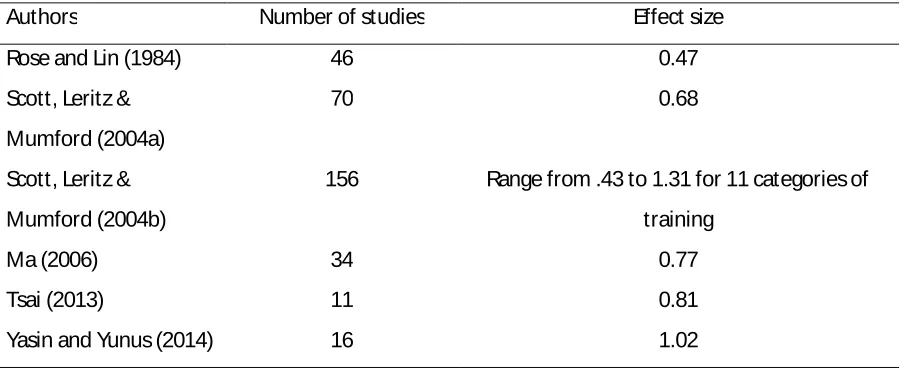
training programmes but the most consistent impact was for the CPS training (overall ES = .629). The overall conclusion was that training does affect creativity but the impact can be moderated by the type of creativity being assessed and the intervention used. Again, it should be borne in mind that the large majority of studies included here used children as participants. Table 1 summarises the
9
Table 1. Effect sizes for creativity training effectiveness derived from meta-analytic studies.
Authors Number of studies Effect size
Rose and Lin (1984) 46 0.47
Scott, Leritz & Mumford (2004a)
70 0.68
Scott, Leritz &
Mumford (2004b)
156 Range from .43 to 1.31 for 11 categories of
training
Ma (2006) 34 0.77
Tsai (2013) 11 0.81
Yasin and Yunus (2014) 16 1.02
The best review of creativity training came ten years later with the Scott, Leritz and Mumford (2004a) meta-analysis. Another trawl of the literature was undertaken including the studies in the
previous reviews and 70 studies were finally included in the analysis. Creativity criteria were more wide-ranging than the previous reviews with outcomes including divergent thinking, problem-solving, performance (generation of creative products) and attitudes/ behaviour. The overall mean effect size (Cohen’s delta) this time was 0.68, with a good .75 for divergent thinking and .84 for
problem-solving. However, the effect sizes were weaker for performance (ES = .35) and attitude/ behaviour (ES = .24). Much more detailed analyses were done than previously to investigate the factors influencing the effectiveness of creativity training. First, in breaking down the different aspects of divergent thinking, the biggest effect was found on originality (.81), followed by flexibility (.75), fluency (.67), and elaboration (.54). Second, the sample was split into younger (<14yrs) and
older (>14yrs) and no meaningful differences were found. Third, the effect size for academic samples was actually less than for organisational samples (although it should be noted there were three organisational studies compared to 67 academic ones). Fourth, in analysing content of interventions, the most successful ones were based on a cognitive framework as opposed to social, personality or motivational approaches. Fifth, when examining which processes were covered in the training,
problem identification, idea generation and conceptual combination made the strongest unique contributions to training effects overall. Sixth, 17 creativity training techniques were compared and, interestingly, critical thinking, convergent thinking, constraint identification and meta-cognition produced the largest positive relations with effect size. In comparison, use of expressive activities, illumination, imagery, elaboration and metaphors actually resulted in negative relationships with
10
structured analysis of complex problems are more successful than ones where a lot of time is spent just on unconstrained exploration. Seventh, when looking at different delivery methods, more positive training effects were found where: there was more practice and a longer training time; a model was used to underpin the training as opposed to an ad hoc grouping of techniques; realistic, domain-specific exercises were used; component skills were developed systematically rather than an
holistic approach used; instructional media that encouraged knowledge application were used, more specifically social modelling, co-operative learning and case-based learning (it should be noted that lectures also came out reasonably positively); and domain-based performance/ production exercises were used. Scott et al., (2004a) concluded that “creativity training works” (p382) with interventions
providing a cognitive, systematic basis that cover problem finding, conceptual combination and idea generation proving most effective. The view was expanded by an additional meta-analysis from the same authors (Scott, Leritz and Mumford, 2004b). This undertook a content analysis on 156 studies in order to identify the major types of creativity training conducted according to cognitive processes, training techniques, media and types of practice exercises. Cluster analysis produced 11 categories
of creativity training where Creative/ Critical Thinking (ES= 1.31) and Creative Process training (ES = 1.08) demonstrated the strongest effects. This demonstrates the importance of enhancing both divergent and convergent thinking skills that are required across different stages of the creative process.
Following up on the Scott et al (2004a) study, Ma (2006) conducted a more focused meta-analysis looking at a different categorisation of techniques. A literature review was conducted of creativity training studies but only ones with experimental and control groups were chosen. Creativity training programs this time were classified into ten basic types (e.g. simple ideation training, brainstorming,
morphological analysis, synectics) plus another five composite types which used a mix of techniques (e.g. CPS, Purdue Creative Thinking Program). Dependent variables were attitude, ideation without evaluation and ideation with evaluation (problem-solving). A final sample of 34 studies with 268 effect sizes were chosen for analysis. An overall mean effect size of 0.77 was found, which was found to be statistically significant at p<.001. There was no significant difference in terms of the creativity
criteria used (although the strongest effect on divergent thinking was for originality and for problem-solving on flexibility); interestingly, attitude showed the strongest effect size (1.34) which is much higher than the Scott et al., (2004a) study. A good point about this study compared to the Scott et al., (2004a) one was that age this time was split into five groups (kindergarten, elementary school pupils, high school students, college students, adults) and it was found there were stronger training
11
ranged from a low of 0.2 (for incubation) to a high of 1.46 for attitude training with CPS coming in at 0.82. Duration of training had no effect.
A valid criticism of the reviews discussed above is that the majority of the studies come from using children. Therefore, Tsai (2013) took a more defined look at the literature (1980 - 2012) by choosing
studies with adults as participants for meta-analysis. The criteria for inclusion this time were only studies conducted in formal learning settings whose participants were graduate students or subjects with a mean age of greater than 25 and where a control group was also used. Studies in organisational settings were not considered and a resulting 11 studies were chosen for analyses. The average weighted effect size (Cohen’s d) for all studies was 0.81 and indicating the effect size of
creativity training was reasonably strong. A significant impact was shown on four out of five dimensions of creativity (flexibility (d = 1.42), fluency (d= 1.29), originality (d = .95) and attitude (d =.57)) but not elaboration (d = .03). It should be noted that both the Ma (2006) and Tsai (2013) studies used a single rater to code the studies hence there is a greater margin for rater error
compared to the Scott et al., (2004a,b) meta-analyses.
Finally, the most recent meta-analysis by Yasin and Yunus (2014) covers studies in engineering and technology educational contexts. Criteria for inclusion included studies published between 2000 and 2012, where contexts were engineering or technology teaching and experimental methods were used with control groups. 16 studies with 42 effect sizes were included in the analyses and samples
included both school and University students. The overall mean effect size was a large 1.02. The studies were categorised into seven types of creativity training interventions and the strongest general effects across studies were shown by CPS (ES= 1.41) and TRIZ (ES= 1.05) training approaches. Summary analyses showed that the mean effect size was good for pre-school (1.53), school (1.08) and university samples (1.15). The effect sizes for creativity training in this meta-analysis were again
stronger than in Scott et al., (2004a) but the authors do also caution that the study was based on a small sample of articles.
Summarising the above meta-analyses, creativity training does have an effect on improving effective thinking (particularly in the realm of originality), with effect sizes increasing to larger levels as more rigorous experimental criteria are adopted in studies. Given the limited data, the effects seem
12
However, it should be clear from the above discussion that studies of creativity training have been dominated by educational contexts, whether at school or college / University level. Investigations in organizational contexts have been relatively and unfortunately rare. For example, out of the 70 studies included in the Scott et al. (2004) meta-analysis, only three were conducted in occupational as opposed to academic settings. Furthermore, an early study by Rickards (1975) failed to find a
notable impact of training in brainstorming techniques on managers’ generation of ideas. More successful is Basadur, Graen and Green’s (1982) study of creative problem-solving training for engineers, where improvements in problem finding and problem solving were produced. However, the emphasis in that study was on the generation of ideas and did not examine the extent to which
the ideas were put into practice. Taking a broader focus, Rickards and De Cock (1994) described the evaluation of the creativity training program run by their business school. It was found that the workshops improved participants’ attitudes towards creativity and over half the respondents mentioned the training had a subsequent impact on their work. Wang and Horng (2002) conducted a long-term evaluation of creative problem solving training for R&D personnel and found that certain
aspects of creative ability and work performance improved after training. Puccio et al., (2006) provided a useful narrative review of CPS training effectiveness conducted in the workplace. They concluded that positive impacts had been demonstrated in terms of participant attitudes (e.g. preference for active divergent thinking), behaviour (e.g. generating more original solutions to problems and better accuracy in evaluating ideas) and give a number of useful examples of
organizational impact.
The lack of organisational studies evaluating creativity training has been a driver for my own research. In one study (Birdi, 2005), I evaluated three different creativity training workshops (de
Bono’s Lateral Thinking and Six Thinking Hats and a new approach called Business Beyond The Box (O’Keeffe, 1998)) conducted in a UK Government Department. Trainees in the workshops reported significant but moderate improvements in their creativity knowledge, creative motivation and later idea generation and implementation back at work. Trainees undertaking more than one type of workshop reported bigger impacts compared to those just taking one type and improvements in
idea implementation at work were significantly influenced by the amount of social support for innovation. A second study by Birdi, Leach and Magadley (2012) evaluated a TRIZ training course for design engineers in a multi-national company. Over the longer term, analysis of self-reported impacts of training and comparison between trainees and non-trainees indicated that TRIZ trainees had better levels of idea generation at work. There was less support for changes in idea
13
Still, a notable subsample of trainees were able to give examples of where the training had been applied, and meaningful impacts on organisational performance were reported. In both studies, improvements in idea generation back in the workplace were due to both increases in creative
knowledge/ skills and motivation from the training.
The research I and others conducted over the years demonstrated that creativity training was able to improve individuals’ idea generation at work but other factors more strongly affected whether those ideas were actually put into practice. This led me to develop a new innovation training
intervention myself in 2005 which covered the skills required to both generate and then implement those ideas.
5. The CLEAR IDEAS innovation training model
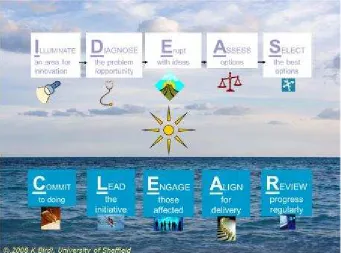
CLEAR IDEAS is a vehicle designed to translate the lessons from research into a practical set of steps that can be followed to analyse challenges, creatively generate and assess solutions and then plan strategies for their implementation. The name of the model is an acronym which represents
[image:14.595.128.469.505.758.2]different elements of the innovation process (see Figure 1).
14
The IDEAS part (Illuminate, Diagnose, Erupt, Assess, Select) helps participants learn how to define opportunities for innovation, generate many creative new ideas to meet the opportunity and select the best ones. This first part integrates research findings on creative thinking and problem-solving
techniques and therefore introduces both divergent and convergent thinking skills. The CLEAR part of the model (Commit, Lead, Engage, Align, Review) outlines five major aspects consistently identified in the literature that need to be addressed for successful implementation of new ideas (e.g. Birdi, Denyer, Munir, Neely and Prabhu, 2003). This second part is more novel and based on
research evidence but has not been used in previous creativity training approaches. The stages of the model are iterative, in that different facets can be moved between as required (hence the ‘spiked sun’ in Figure 1).
The CLEAR IDEAS model has been introduced to organisations through one- or two-day training
workshops where groups learn to apply the steps of the framework by using real-life challenges facing them. Since 2005, I have conducted CLEAR IDEAS workshops for hundreds of people from organisations in the private, public and voluntary sectors in the UK and abroad. The CI workshops incorporate many of the features of effective creativity training as identified in the literature
discussed previously: an underlying, systematic model to tie all the content together; coverage of different stages of the innovation process; development of both convergent (Detail, Assess) and divergent (Erupt) thinking skills; use of role modelling and case studies to demonstrate how the different aspects operate; group working and lots of practice in applying skills to real challenges in order to develop motivation and confidence.
Evaluation surveys have shown that participants find the CI workshops valuable. For example, analysis of questionnaire data from 181 public sector workshop participants has shown statistically significant improvements in all targeted innovation-related competencies (e.g. generation of new ideas, planning for implementation). The surveys also showed that 98% agreed/ strongly agreed that
15
6. Guidelines for effective creativity training interventions
The final part of this chapter incorporates findings from the literature (particularly Scott et al., 2004a) and my own experiences to offer some practical recommendations for developing more
effective creativity training interventions.
The training should be based on a robust, valid, model of the cognitive activities underlying
different stages of the innovation process from problem identification and analysis to idea
generation and evaluation to implementation. CPS seems to be the best approach from the literature as it covers the range of these processes while CLEAR IDEAS attempts to provide more detail on the implementation aspects also. Make sure you create or utilise a model that is easy to
understand or use for non-academics. The language and nature of the CI model has gone through a
number of amendments over the years based on user feedback so that it is now at a point where it is
relatively easy to communicate the principles to a wide range of audiences.
Before running the creativity training workshops
• Have meetings with senior management before the workshops are introduced in order to decide:
– The types of issues to be addressed in workshops
– Whether a creativity training approach is suitable for their context and issues
– Who will be sent on the workshop. The aim of the CI approach is to be as inclusive as possible but experience shows that participants need to have scope to apply their newly-acquired creative knowledge back at work. This is easier in the case of managers who have a degree of autonomy in their job but can be problematic for lower level employees so ensure appropriate provisions are made.
– How transfer of learning will be supported. Following on from the previous point, there is a need to discuss in advance potential barriers to applying the learning (e.g. lack of time and support) and how they can be overcome.
• Contact participants beforehand to get them to think of a work-related problem they want to work on during the workshop. Evidence from the learning strategies literature shows that
16
own circumstances, knowledge and skills are retained longer compared to simply rote memorisation (e.g. Bjork, Dunlosky & Kornell, 2013; Warr, Allan & Birdi, 1999). A postgraduate research project I supervised evaluating the transfer of CI training also supported this conclusion, with trainees who came prepared to address a particular problem taking away more from the course.
During the training workshops
• Training courses should be lengthy and relatively challenging with each set of specific cognitive skills being described with respect to their influence on creative efforts. These explanations should be accompanied by illustrations and examples of how they would be applied in real-world cases, including the organisational context in which participants work.
• There should be plenty of opportunity for trainees to practice applying these cognitive skills since this is not only useful for embedding the learning but it is also good for building up one’s self-confidence in using the skills post-workshop.
• In the CI workshops, if possible, I get participants to work on their own-real life challenges quite early on and this is a good strategy for building up their motivation as they can quickly
start making connections between the training and how it could contribute back at work.
• Collaborative problem-solving in groups is exciting and useful but it is important to get the mix of people right. This means in terms of having enough variety of perspectives to shed useful light on a problem and also ensuring that participants contribute constructively at
each stage. For example, I sometimes have to step in to groupwork at the Erupt stage to remind certain individuals to not judge any ideas at that stage.
• Offer a toolbox approach. I have found in all my workshops that different people show a preference for certain thinking techniques so I try and make sure a variety of creative and
analytical thinking techniques are presented.
17 After the creativity training
• Build in follow-up activities from creativity training workshops. Boosts to creativity knowledge and skills will decline in the longer term if participants are not quickly
encouraged to try out their learning. Some useful activities include:
– Do a follow-up session some weeks later where groups present back what they did since the initial workshop
– Set trainees assignments for applying their learning – Conduct follow-up surveys or interviews
– Be available to give advice to trainees if they are having problems trying certain things out
• Support from management, colleagues and others is vital for encouraging transfer so ensure strategies are in place to enable this. One useful approach is to train senior managers first before sending through their subordinates. This means that management have a better understanding of the environmental support needed
• Impact can take months or even years to emerge so it is important to keep in contact and
maintain relationships with trainees. The CI impact example I gave previously regarding a
council launching a redesigned social care service actually took two years to reach full implementation after conducting a CI workshop to tackle the problem.
In conclusion, I hope this chapter has provided useful insights into both the research into creativity training and its translation to organisational practice. With the right approach in the right context and with the right support, creativity training has the capability to make major contributions to organisations: our study evaluating TRIZ training in an engineering company (Birdi et al., 2012)
unearthed an example where the workshop led to the redesign of a new engine brake part that saved the company £120 million!
7. REFERENCES
Altshuller, G., & Altov, H. (1996). And Suddenly the Inventor Appeared: Triz, the Theory of Inventive
18
Anderson, N., Poto nik, K., & Zhou, J. (2014). Innovation and creativity in organizations: A state-of-the-science review, prospective commentary, and guiding framework. Journal of Management, 40(5), 1297-1333.
Basadur, M., Graen, G., & Green, S. (1982). Training in creative problem-solving: Effects on ideation and problem finding and solving in an industrial research organization. Organizational
Behaviour and Human Decision Processes, 30, 41-70.
Birdi, K., Leach, D., & Magadley, W. (2012). Evaluating the impact of TRIZ creativity training: An organizational field study. R & D Management, 42(4), 315-326.
Birdi, K., Patterson, M., & Wood, S. (2007). Learning to perform? A comparison of learning practices
and organizational performance in profit- and non-profit-making sectors in the UK. International Journal of Training and Development, 11, 265-281.
Birdi, K. S. (2005). No idea? Evaluating the effectiveness of creativity training. Journal of European Industrial Training, 29(2), 102 - 111.
Birdi, K., Denyer, D., Munir, K., Neely, A. & Prabhu, J. (2003). Post Porter: Where Does The UK Go
From Here? Summary report from the AIM Management Research Forum. London: AIM.
Bull, K. S., Montgomery, D., & Baloche, L. (1995). Teaching creativity at the college level: A synthesis of curricular components perceived as important by instructors. Creativity Research Journal 8, 83-90.
Cohen, J. (1977). Statistical Power Analysis for the Behavioral Sciences. New York: Academic Press.
Covington, M. V., Crutchfield, R. S., Davies, L., & Olton, R. M. (1970). The Productive Thinking Program: A Course In Learning To Think. Columbus, OH: Merrill.
de Bono, E. (1992). Serious Creativity. London: Harper Collins.
de Bono, E. (1985). Six Thinking Hats. Harmondsworth: Viking.
de Bono, E. (1977). Lateral thinking. Middlesex: Pelican.
Department of Business, Innovation and Skills (2014). First findings from the UK Innovation Survey 2013. Knowledge and innovation analysis. London: Department of Business, Innovation and
Skills.
Eurostat (2013). Proportion of innovative enterprises by type of methods for stimulating creativity
considered highly successful, 2008-2010. Downloaded from http:/ / ec.europa.eu/ eurostat/
19
_for_stimulating_creativity_considered_highly_successful,_2008-2010_yb2_.png&oldid=137034
Feldhusen, J. F., Treffinger, D. J., & Bahlke, S. (1970). Developing creative thinking: The Purdue Creative Thinking Program. Journal of Creative Behavior, 4, 85-90.
Filmore, P. (2006). The real world: TRIZ in two hours for undergraduate and masters level students.
Paper presented at the TRIZCON2006, Milwaukee, WI, USA.
Fischer, B., & Afifi, R. (2013). An analysis of creativity and innovation training in organizations. International Journal of Management & Human Resources, 1(1), 170.
Gordon, W. (1961). Synectics. New York: Harper & Row.
Hequet, M. (1992). Creativity training gets creative. Training, 41-46.
Ma, H.-H. (2006). A synthetic analysis of the effectiveness of single components and packages in creativity training programs. Creativity Research Journal, 18(4), 435-446.
Mansfield, R., Busse, T., & Krepelka, E. (1978). The effectiveness of creativity training. Review of Educational Research, 48(4), 517-536.
Noller, R. B., & Parnes, S. J. (1972). Applied creativity: The creative studies project: The curriculum. Journal of Creative Behavior, 6, 275-294.
O.E.C.D. (2010). Measuring innovation: A new perspective. O.E.C.D.
O'Keeffe, J. (1998). Business beyond the box. London: Nicholas Brealy Publishing Ltd.
Onarheim, B., & Friis-Olivarius, M. (2013). Applying the neuroscience of creativity to creativity
training. Frontiers in Human Neuroscience, 7(656), 1-10.
Osborn, A. (1953). Applied imagination: Principles and procedures for creative thinking. New York: Schribner.
Patterson, F., & Kerrin, M. (2009). Innovation for the recovery. London: Chartered Management
Institute.
Proctor, T. (2010). Creative Problem Solving for Managers (3rd Edition). London: Routledge.
Puccio, G. J., Cabra, J., Fox, J., & Cahen, H. (2010). Creativity on demand: Historical approaches and future trends. Artificial Intelligence for Engineering Design, Analysis and Manufacturing, 24, 153-159.
20
Rickards, T., & De Cock, C. (2004). Creativity in MS / OR: Training for creativity findings in a European context. Interfaces, 24(6), 59-65.
Rickards, T. (1975). Brainstorming; An examination of idea production rate and level of speculation in real managerial situations. R&D Management, 6(1), 11-14.
Rose, L., & Lin, H. (1984). A meta-analysis of long-term creativity training programs. Journal of
Creative Behavior, 18(1), 11-22.
Scott, G., Leritz, L., & Mumford, M. (2004a). The effectiveness of creativity training: A quantitative review. Creativity Research Journal, 16(4), 361-388.
Scott, G., Leritz, L. E., & Mumford, M. D. (2004b). Types of creativity training: Approaches and their
effectiveness. Journal of Creative Behavior, 38(3), 149-179.
Sudhaman, A., Bridges, C., & Strauss, K. (2012). Creativity in PR: A global study. The Holmes Report & Now Go Create.
Torrance, E. P. (1972). Can we teach children to think creatively? Journal of Creative Behavior, 6, 114-143.
Tsai, K. (2014). A review of the effectiveness of creative training on adult learners. Journal of Social Science Studies, 1(1), 17-30.
van Woonroy, B., Bewley, H., Bryson, A., Forth, J., Freeth, S., Stokes, L., & Wood, S. (2013). The 2011 Workplace Employment Relations Study. First Findings. London: Department for Business,
Innovation and Skills.
Wang, M. Y., Chang, D. S., & Kao, C. H. (2010). Identifying technology trends for R&D planning using TRIZ and text mining. R&D Management, 40(5), 491-509.
Wang, C., & Horng, R. (2002). The effects of creative problem solving training on creativity, cognitive type and R&D performance. R&D Management, 32(1), 35-45.
Warr, P., Allan, C., & Birdi, K. (1999). Predicting three levels of learning outcome. Journal of Occupational and Organizational Psychology, 72, 351-375.
Yasin, R., & Yunus, N. (2014). A meta-analysis study on the effectiveness of creativity approaches in technology and engineering education. Asian Social Science 10(3), 242-252.
Zwicky, F. (1969). Discovery, Invention, Research - Through the Morphological Approach. Toronto: