Open Access
Study protocol
Development of a decision support tool to facilitate primary care
management of patients with abnormal liver function tests without
clinically apparent liver disease [HTA03/38/02]. Abnormal Liver
Function Investigations Evaluation (ALFIE)
Peter T Donnan*
1, David McLernon
1, Douglas Steinke
2, Stephen Ryder
3,
Paul Roderick
4, Frank M Sullivan
1, William Rosenberg
5and John F Dillon
6Address: 1Tayside Centre for General Practice, Community Health Sciences, University of Dundee, Dundee, UK, 2College of Pharmacy, University of Kentucky, Lexington, KY, USA, 3Directorate of Medicine, Division of Gastroenterology, Queen's Medical Centre, University Hospital NHS Trust, Nottingham, UK, 4Public Health Sciences and Medical Statistics Group, School of Medicine, University of Southampton, UK, 5School of Medicine, Division of Infection, Inflammation and Repair, University of Southampton, UK and 6Division of Pathology and Neurosciences, Ninewells Hospital and Medical School, University of Dundee, Dundee, UK
Email: Peter T Donnan* - [email protected]; David McLernon - [email protected];
Douglas Steinke - [email protected]; Stephen Ryder - [email protected]; Paul Roderick - [email protected]; Frank M Sullivan - [email protected]; William Rosenberg - [email protected]; John F Dillon - [email protected] * Corresponding author
Abstract
Background: Liver function tests (LFTs) are routinely performed in primary care, and are often the gateway to further invasive and/or expensive investigations. Little is known of the consequences in people with an initial abnormal liver function (ALF) test in primary care and with no obvious liver disease. Further investigations may be dangerous for the patient and expensive for Health Services.
The aims of this study are to determine the natural history of abnormalities in LFTs before overt liver disease presents in the population and identify those who require minimal further investigations with the potential for reduction in NHS costs.
Methods/Design: A population-based retrospective cohort study will follow up all those who have had an incident liver function test (LFT) in primary care to subsequent liver disease or mortality over a period of 15 years (approx. 2.3 million tests in 99,000 people). The study is set in Primary Care in the region of Tayside, Scotland (pop approx. 429,000) between 1989 and 2003. The target population consists of patients with no recorded clinical signs or symptoms of liver disease and registered with a GP. The health technologies being assessed are LFTs, viral and auto-antibody tests, ultrasound, CT, MRI and liver biopsy.
The study will utilise the Epidemiology of Liver Disease In Tayside (ELDIT) database to determine the outcomes of liver disease. These are based on hospital admission data (Scottish Morbidity Record 1), dispensed medication records, death certificates, and examination of medical records from Tayside hospitals. A sample of patients (n = 150) with recent initial ALF tests or invitation to biopsy will complete questionnaires to obtain quality of life data and anxiety measures. Cost-effectiveness and cost utility Markov model analyses will be performed from health service and patient perspectives using standard NHS costs. The findings will also be used to develop a computerised clinical decision support tool.
Discussion: The results of this study will be widely disseminated to primary care, as well as G.I. hospital specialists through publications and presentations at local and national meetings and the project website. This will facilitate optimal decision-making both for the benefit of the patient and the National Health Service.
Published: 16 April 2007
BMC Health Services Research 2007, 7:54 doi:10.1186/1472-6963-7-54
Received: 6 March 2007 Accepted: 16 April 2007
This article is available from: http://www.biomedcentral.com/1472-6963/7/54
© 2007 Donnan et al; licensee BioMed Central Ltd.
Background
Liver function tests (LFTs) are routinely performed in pri-mary and secondary care, and are often the gateway to fur-ther invasive and/or expensive investigations. Little is known of the consequences in people with an initial abnormal liver function (ALF) test [1]. Further investiga-tions such as liver biopsy and endoscopic retrograde cholangiopancreatography may be dangerous for the patient and/or expensive for the National Health Service. Recent guidelines for primary care have been published for evaluation of abnormal liver enzyme results in asymp-tomatic patients but did not cover other tests nor take account of costs to the patient or the health service [2]. Despite the increasing use of LFTs, patients continue to present with potentially fatal complications of undiag-nosed end stage liver disease, which may have been pre-ventable by earlier diagnosis. These include: autoimmune hepatitis which is responsive to steroids, hepatitis C which can be cured in a significant proportion of patients by antiviral drugs, and alcohol misuse [3]. The abnormality of liver function tests may be secondary to serious disease elsewhere requiring treatment, such as malignancy where its early detection may improve the prognosis. Improved patient care demands integration of data from all stages of the patient's illness in order to redesign services appropri-ately [4,5]. There is a need for quality measures used in the redesign process to be based on routinely collected data rather than instituting specific record searches to address current problems [6].
Most of the published epidemiological studies report only the prevalence of liver disorders rather than addressing the absolute or relative risks of subsequent liver injury fol-lowing abnormal liver enzyme tests [7-9]. One study examined incidence rates derived from selected hospital-ised patients using data from mortality registries [10]. Duh et al, [11] quantified the incidence of liver enzyme abnormalities in the general population but neglected those subjects that subsequently retested normal or did not retest at all, with no long term follow-up to possible liver disease. Although the latter are minor and do not indicate serious disease, they do utilise considerable resources. Recently, a large cohort study in Korea (n = 142 055) reported the association between a key LFT serum aminotransferase (AST and ALT) and mortality from liver disease indicating that even values that were borderline within the normal range were associated with poor out-come [12,13].
Pilot work in Tayside demonstrated that approximately 25% of patients with ALF tests are dead within a year of their first abnormal test result, although this includes those with existing liver disease. A study from Nottingham [14] has reported a similar prevalence of ALF tests and has
gone on to investigate the causes, intervening where inves-tigation had not been performed or was inadequate.
Research objectives
a) To quantify and characterise incident abnormal liver function (ALF) tests in the UK population using data from Tayside and Nottingham. The subjects studied are those with no clinically apparent liver disease with subsequent maximum follow-up over a 15-year period of further investigations, liver disease, non-liver disease and mortal-ity. The study will determine those with no health conse-quences, those who develop liver disease such as cirrhosis, and its complications, or other liver diseases [see Addi-tional file 1], as well as those who develop serious non-hepatic illness such as cancer. In particular, to determine outcomes at 2, 5 and 10 years and characterise those sub-jects with:
1) ALF tests that upon investigation are judged as clini-cally without liver disease;
2) ALF tests that upon investigation are diagnosed with liver disease;
3) ALF tests with no further investigations and apparently normal on follow-up;
4) ALF tests with no further investigations and diagnosed with liver disease on follow-up;
Those who have an initially normal test may also have fur-ther tests or no furfur-ther tests and may or may not develop liver disease. This important group enables estimation of specificity and sensitivity of liver function tests.
b) To devise estimates of the probabilities of disease out-comes following an ALF test with or without further inves-tigations and determine what information would be most useful to clinicians for predicting future patient outcomes and guiding management.
c) To estimate and compare the costs to the National Health Service in terms of LFTs, ultrasound, and other investigative procedures and length of stay in hospital for those with an initial ALF test or normal LFT.
d) To derive decision trees for the various pathways fol-lowing ALF tests and estimate optimum management of patients in primary care with cost-utility and cost-effec-tiveness analyses.
Methods/Design
Design
liver function test (ALF) as well as those who were initially normal (to allow calculation of sensitivity, specificity) to subsequent liver disease or mortality. Prior probabilities will be based on pooled measures of prevalence of out-comes in Tayside and Nottingham. Having obtained prior probabilities and probabilities of outcomes from cohort data using logistic or Cox regression modelling, these will be used to create a decision analysis tree, which covers clinically relevant pathways. Finally, the patient survey will provide quality of life measures or utilities to enable cost-utility and cost-effectiveness analyses to be carried out.
Setting
The study is set within Primary Care in the region of Tay-side, Scotland (pop ~. 429,000) between 1989 and 2003. Additionally, primary care data with a median follow-up of 15 months will be provided from Nottingham.
Target Population
Exclusions
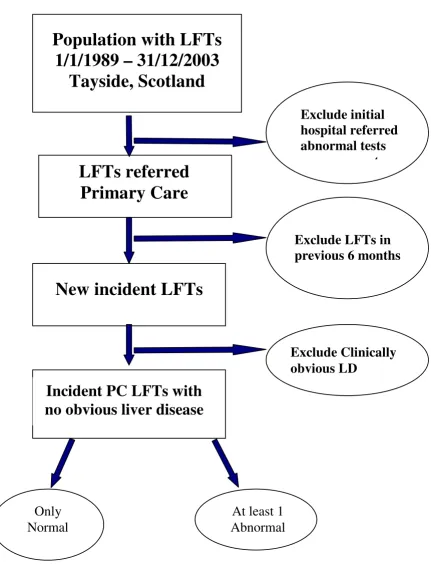
Patients with no obvious clinical signs and symptoms of liver disease with at least one liver function test and regis-tered with a Tayside GP between 1989 and 2003 will be eligible. A window of 6 months will be used to screen out individuals with already existing liver disease and with previous abnormal LFTs for monitoring purposes. This will ensure only new incident tests in primary care will be included on patients with no clinically obvious liver dis-ease (figure 1).
The following exclusions will ensure that the study popu-lation of patients have no clinically obvious liver disease and only includes LFTs referred from primary care:
• Patients under 16
• Patients with liver disease or abnormal LFT in previous 6 months will be excluded
• Based on electronic biochemistry records we will exclude patients whose initial LFTs are hospital referred abnormal LFTs leaving all possible initially abnormal tests requested from primary care
• We will exclude those who have a positive initial bilirubin test (clearly jaundiced at presentation, bilirubin > 35 µmol/l).
• Those with ascites, encephalopathy or variceal bleeding within six weeks of their initial LFTs will be admitted to hospital and can be identified from ELDIT database, SMR1 record as well as spironolactone prescriptions from the Health Informatics Centre database [15].
Health Technologies being assessed
LFTs antibody tests, ultrasound, CT, MRI and liver biopsy [see Additional file 2]
Data Sources
The Epidemiology of Liver disease in Tayside (ELDIT) database
The ELDIT project created a liver database in Tayside link-ing administrative clinical data with laboratory data [16]. Briefly, all electronic medical records (including labora-tory tests) for Tayside were electronically linked with a unique identifier, the community health index (CHI) [15]. The community health index is used for all health encounters in Tayside for the population registered with a general practice. The following independent data sources were electronically record linked, via the CHI, to maxim-ise the accuracy of diagnosis and dmaxim-isease ascertainment:
• Prescribing database: The Health Informatics Centre (HIC) has person-specific dispensing information for the whole of Tayside [17],
• Hospitalisation, Scottish Morbidity Records (SMR1 – general admissions, SMR4 – alcohol related psychiatric admissions and SMR6 – cancer admissions),
• Death registry from the General Registry Office,
• Carstairs categories for social deprivation based on the decennial census [18],
• Endoscopy,
• Regional biochemistry,
• Pathology,
• Virology, and
• Immunology databases.
Diagnostic algorithms for liver diseases have been created and this database has already been used to assess the epi-demiology and economic burden of viral hepatitis [19] and other liver diseases.
Selection of the study population of Liver function tests with no clinically obvious liver disease
Figure 1
Selection of the study population of Liver function tests with no clinically obvious liver disease.
(n=853)
Population with LFTs
1/1/1989 – 31/12/2003
Tayside, Scotland
Incident PC LFTs with
no obvious liver disease
Exclude initial
hospital referred
abnormal tests
measurements
Exclude LFTs in
previous 6 months
At least 1
Abnormal
LFTs referred
Primary Care
Only
Normal
New incident LFTs
approximately 2 million tests after exclusions, bias due to missing tests will be minimal.
The ELDIT database as described above will provide robust probabilities of outcomes. Costs of drugs, proce-dures and hospital admissions will be obtained from standard published values. We are currently updating the ELDIT database to 2003, which is funded by the British Liver Trust.
Prospective questionnaire data from patients undergoing abnormal liver function tests as well as patients undergo-ing liver biopsy will provide utility-based quality of life measures in order to populate the decision trees. Permis-sion will be sought from the general practitioner as well as the patient. Other utility values will be obtained from the literature and an expert panel of GPs and hepatologists.
Data from the Nottingham study with follow-up of patients in primary care who received an ALF test with a median follow-up of 15 months will also provide infor-mation on indication, alcohol, BMI, height and weight.
Ethics and Data Protection
The proposal has Research Ethics Committee approval as well as the Caldicott Guardians to ensure compliance with the Data Protection Act. All data will be anonymised according to the Standard Operating Procedures (SOPs) of HIC so that the research will be conducted on non-identifiable electronic data.
Proposed sample size
The annual incidence of ALF tests ranges from 489 to 869 per 100,000 people in the whole Tayside population depending on type of test and year. With a total of approx-imately 70,000 ALF tests over a 14 year period, of whom approximately 5,500 have liver disease as defined by the ELDIT database, power will be more than adequate (> 90%) to detect relative hazards of the order of 1.2 or greater at the 5% significance level.
Statistical methods
Descriptive epidemiology for each group as defined by pattern of ALF testing will include analysis of continuous and categorical data on subject characteristics using χ2 tests for categorical variables and by t-tests for continuous variables or non-parametric equivalents.
For the baseline population, liver function tests will be extracted and number and frequency tabulated by year. The 'liver function tests' will be:
Liver function
• Bilirubin
• Albumin
Liver damage
• Alkaline phosphatase (Alk Phos)
• Gamma-glutamyl transferase (GGT)
• Alanine transaminase (ALT)
• Aspartate aminotransferase (AST)(not routinely meas-ured)
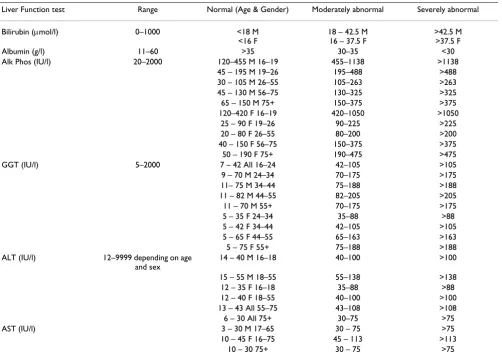
Normal and abnormal (and possibly mildly abnormal) categories will be defined for each test using regional lab-oratory standard cut-offs which vary by age and sex for some tests (table 1). Sensitivity analyses will be performed for some tests (eg ALT where mild abnormality or top quartile in Normal range may be a useful category for pre-diction.)
Categories of patterns of tests will be defined. For example the following may be possible:
1. Raised ALT + normal Alk Phos + normal GGT (suggest-ing hepatitis)
2. Raised Alk Phos +/- raised GGT + normal ALT (suggest-ing biliary cirrhosis)
3. Any one abnormal
4. Any 2 or more abnormal and/or explore patterns.
Patterns of repeat tests will also be explored. The main outcomes and covariates will be tabulated by initial and repeat LFT patterns (Rates presented as events per thou-sand person years).
Sensitivity, specificity, positive predictive value and likeli-hood ratios will be calculated for LFT patterns compared with actual outcome. Kaplan-Meier plots of time to out-comes will be plotted for patterns of tests and individual tests above.
Derivation of probabilities
the baseline hazard, an alternative is the Weibull paramet-ric regression model which easily allows estimation of probability of outcome over any time period. The Weibull accelerated failure time model has been used to derive the Framingham coronary heart disease (CHD) risk equation [22] and a CHD risk score for type 2 diabetes from Tayside data [23]. This gives greater flexibility in modelling over different time periods.
The main outcomes will be all-cause mortality (Yes/No); Liver disease mortality (Yes/No); Liver disease such as non-alcoholic fatty liver disease (NAFLD), alcohol related liver disease, viral hepatitis and primary biliary cirrhosis (PBC) (Yes/No); Any hospitalization; Cirrhosis/portal Hypertension.
The above models will also allow derivation of risks of outcomes stratified by factors entered in the regression model. For example, the risk of liver disease is clearly greater in patients with known alcohol abuse compared to those without alcohol abuse. The following factors will be entered in the regression models to assess their effect on risk and estimate factor-specific risks:
1) Further tests such as repeated LFTs, liver biopsy, ultra-sound, virology, immunology and ferritin as well as time between tests. Other baseline stratification factors may be:
2) Age – derived from the first 6 digits of patient identifier, the community health index (may be categorized as < 40 and 40+ depending on age distribution);
3) Gender – derived from the 9th digit of the patient iden-tifier, the community health index;
4) Pregnancy – from hospitalisation records, SMR2. This will, of course, miss home births;
5) Opioid abuse – A proxy measure will be obtained using methadone prescribing from the HIC prescription data-base
[image:6.612.57.559.99.458.2]6) Alcohol abuse – We will use hospitalisation records from SMR1 and SMR6 which includes ICD10 codes F10, X65 and T51. Y90 and Y91 may be used as supplementary information. This will represent the more extreme end of alcohol abuse which is a weakness in missing others with
Table 1: Liver function tests and definitions of abnormal
Liver Function test Range Normal (Age & Gender) Moderately abnormal Severely abnormal
Bilirubin (µmol/l) 0–1000 <18 M <16 F
18 – 42.5 M 16 – 37.5 F
>42.5 M >37.5 F
Albumin (g/l) 11–60 >35 30–35 <30
Alk Phos (IU/l) 20–2000 120–455 M 16–19 455–1138 >1138 45 – 195 M 19–26 195–488 >488 30 – 105 M 26–55 105–263 >263 45 – 130 M 56–75 130–325 >325 65 – 150 M 75+ 150–375 >375 120–420 F 16–19 420–1050 >1050
25 – 90 F 19–26 90–225 >225 20 – 80 F 26–55 80–200 >200 40 – 150 F 56–75 150–375 >375 50 – 190 F 75+ 190–475 >475
GGT (IU/l) 5–2000 7 – 42 All 16–24 42–105 >105
9 – 70 M 24–34 70–175 >175 11– 75 M 34–44 75–188 >188 11 – 82 M 44–55 82–205 >205 11 – 70 M 55+ 70–175 >175 5 – 35 F 24–34 35–88 >88 5 – 42 F 34–44 42–105 >105 5 – 65 F 44–55 65–163 >163 5 – 75 F 55+ 75–188 >188 ALT (IU/l) 12–9999 depending on age
and sex
14 – 40 M 16–18 40–100 >100
15 – 55 M 18–55 55–138 >138 12 – 35 F 16–18 35–88 >88 12 – 40 F 18–55 40–100 >100 13 – 43 All 55–75 43–108 >108 6 – 30 All 75+ 30–75 >75
AST (IU/l) 3 – 30 M 17–65 30 – 75 >75
mild or moderate alcohol abuse. On the other hand, this is also a strength in giving a clear definition and measures of the drivers of costs to the health service. The alternative of general practice notes would be prohibitively expensive and prone to classification error.
7) Social deprivation – The Carstairs social deprivation score assigned to postcodes for all residents of Tayside, is derived from the decennial census, incorporating the var-iables, housing density, car ownership, social class of the head of household and male unemployment [18].
Although social deprivation is a marker for cigarette smoking and co-morbidity, we will also be able to assess the affect of individual co-morbidities on risk.
8) Diabetes will be defined from the Diabetes Audit and Research in Tayside, Scotland (DARTS) database which is 97% sensitive for ascertainment of diabetes in the popu-lation [23].
9) The Hearts database (sensitivity 95%) will identify those who have definite CHD (myocardial infarction or demonstrated coronary artery disease) in the Tayside pop-ulation [24].
Other major co-morbidities [see Additional file 3] such as
10) respiratory disease
11) cerebrovascular disease,
12) renal disease,
13) ischaemic heart disease,
14) cancers other than liver cancer
will be defined by the Scottish Morbidity Record which contains details of all hospital admissions, including ICD9, ICD10 codes, for all Tayside residents, which is held in HIC.
HIC also contains the database of all encashed prescrip-tions in Tayside. This resource can also be used to create co-morbidity variables such as
15) Psychotropic drugs: monoamine oxidase inhibitors, Phenothiazines
16) Analgesics: NSAIDS, paracetamol, aspirin
17) Antibiotics
18) Lipid lowering agents such as statins and fibrates
19) sodium valproate
20) oestrogens (oral contraceptives, HRT)
Importantly, this resource will allow us to identify receipt of prescribed hepatotoxic drugs at the time of any ALF test.
Costs which are invariably positively skewed will be sum-marised and compared between cohorts using bootstrap-ping procedures for means and confidence intervals [26,27]. Statistical analysis will be performed on SAS ver-sion 8.0 (SAS Institute, Cary, NC)
Decision analyses
Decision analysis is the formal process whereby the prob-abilities of outcome events, such as liver disease, are com-bined with patients' preferences or values. The approach is most useful in informing clinical decisions where the optimal pathway is not immediately apparent, and for making clinical reasoning explicit [28]. Hence, these anal-yses will inform the management of patients with an abnormal liver function test, but who are otherwise well. The probabilities of outcomes are generally derived from regression analysis of cohort studies of large populations or from previous published results. The analysis of the Tayside population will provide robust estimates of these probabilities stratified by important confounders. For example, the measurement of alkaline phosphatase is known to be dependent on age, gender, and blood type and so the probability estimate needs to be adjusted appropriately. The Weibull regression analyses described above can be enhanced using a Bayesian approach whereby prior probabilities (prevalence or previous pub-lished results) can be updated by new data, utilizing the software WinBUGS.
provide utility data essential for the cost-utility analysis in which the decision analysis aims to maximize expected utility. This questionnaire survey will focus on the more serious investigations such as liver biopsy, as the utility of a single liver function test such as bilirubin in an other-wise healthy patient is likely to be close to 1. A literature search will enable us to find and possibly pool estimates of liver diseases such as hepatitis C and various stages of cirrhosis.
Decision analyses also allow other measures such as costs to be incorporated and the analysis aims to minimize costs or maximize cost-effectiveness from a health service perspective. An example of how a decision tree for alka-line phosphatase might look is given in figure 2. This has been simplified for presentation, and is based on Pratt and Kaplan [2]
One limitation of decision analysis is that the time hori-zon is generally short and costs, utilities and probabilities may vary over time as well as by type of liver disease. However, the approach of Markov modeling allows exten-sion of time indefinitely and hence is useful for modelling cost and utilities until death of all members of the cohort [29]. The Markov process simulates movement of an indi-vidual or cohort through various states, each of which is associated with a probability, utility and cost. As some liver disease may not be apparent in a short period of time Markov modelling will be utilized in modelling cost-effec-tiveness and cost-utility analysis over longer time periods.
As the probabilities, cost and utilities are fixed estimated values in decision analysis, it is more realistic to allow for error of these measures using Bayesian methods in proba-bilistic sensitivity analyses. Decision analyses will utilize the software Data 4 (TreeAge).
Proposed outcome measures
The study will use the epidemiology of liver disease data-base (ELDIT) in Tayside, and the Nottingham cohort to determine the outcome of liver disease (as listed in appen-dix 2). In Tayside, outcomes of the extent of liver disease and co-morbidities of subjects with no retest or subse-quent normal liver function tests will be determined by hospital admission data (Scottish Morbidity Record 1), dispensed medication records, death certificates, and examination of medical records from Tayside hospitals. Those with normal tests are less likely to be investigated and hence classified with liver disease on death certifi-cates. Simulation of likely misclassification rates will demonstrate whether this potential bias has a large influ-ence on results. Sensitivity, specificity, positive and nega-tive likelihood ratio and yield (1/PPV) will be calculated for each pathway. All liver function tests (LFTs) will be obtained from the ELDIT and biochemistry databases and
standard costs applied. All procedures and hospitalisa-tions of all subjects will be obtained from the Tayside por-tion of the SMR1 record and the cost per day by speciality and hospital will be applied from published NHS costs. Future costs will be discounted at 6% per year, where nec-essary.
Cost-effectiveness and cost utility analyses will be per-formed from health service and patient perspectives. Cost effectiveness will seek to minimise the cost of investiga-tions per case of liver disease detected, while cost-utility analyses will seek to maximize expected utility. In the Markov models effectiveness is measured as life expect-ancy by risk factor strata, adjusted using utilities to give QALYs.
The findings will also be used to develop a computerised clinical decision support tool. This will be evaluated and validated in a further study as the subject of a separate application as part of a program of research in Dundee's Health Informatics Centre (HIC), where funded develop-ment of decision support tools in cardiovascular risk, cae-sarean delivery, breast and colorectal cancer are already underway. The results of this study will be widely dissem-inated to primary care, as well as G.I. hospital specialists through publications and presentations at local and national meetings and the project website This will facili-tate optimal decision-making both for the benefit of the patient and the National Health Service.
Discussion
Consumers
The Health Informatics Centre has developed a User Par-ticipation Group for input from the consumer for research ideas, development of research tools, and dissemination. The views of this group will be sought in developing the study materials in relation to the patient survey and in dis-semination of the results.
Impact on and benefit to the NHS
developed Area Community Health Index. The Tayside Core Network connects every GP practice and hospital within Tayside with a single access to NHSNet and pres-ently has 88 sites with over 4000 PCs connected. This pro-posal will be developed, within the IT framework established by the Board and the Trusts to ensure that the decision support system, this project develops can be ade-quately supported by them and demonstrate the practical-ity for the wider NHS.
In summary, this study will determine the natural history of abnormalities in LFTs before overt liver disease presents
in the population and will also provide identification of those who require minimal further investigations with the potential for reduction in NHS costs.
Abbreviations
LFT – Liver function tests
ALF – Abnormal liver function
ELDIT – Epidemiology of Liver Disease in Tayside
HIC – Health Informatics Centre
[image:9.612.60.548.82.520.2]Example of possible simplified decision analysis tree following alkaline phosphatase test (LD – liver disease, based on Pratt and Kaplan, 2000)
Figure 2
Example of possible simplified decision analysis tree following alkaline phosphatase test (LD – liver disease, based on Pratt and Kaplan, 2000).
Normal
No LD
No LD
Bone D
LD
LD
LD
Normal
Raised
Raised
Repeat test
Further
tests
SMR – Scottish Morbidity Record
CHI – Community Health Index
QALY – Quality Adjusted Life Year
ALT – Alanine transaminase
GGT – Gamma-glutamyl transferase
AST – Aspartate aminotransferase
Competing interests
The author(s) declare that they have no competing inter-ests.
Authors' contributions
All authors contributed to the writing of the study proto-col and approved the final version. The study was initiated by PTD, JD, FS and DMcL. The ELDIT database was devel-oped by JD, DS, DMcL and PTD. SR, WR, PR provided leading UK liver disease expertise.
Additional material
Acknowledgements
Funding: This project is funded by the NHS R&D Programme Health Tech-nology Assessment Programme (project number 03/38/02).
Department of Health Disclaimer: The views and opinions expressed therein are those of the authors and do not necessarily reflect those of the Department of Health.
References
1. Van Walraven C, Naylor CD: Do we know what inappropriate laboratory utilization is? A systemic review of laboratory clinical audits. JAMA 1998, 280:550-8.
2. Pratt DS, Kaplan MM: Evaluation of abnormal liver-enzyme results in asymptomatic patients. N Eng J Med 2000,
342:1266-71.
3. Sherman D, Finlayson NDC, Camillari M, Carter DC, ed: Diseases of the Gastrointestinal Tract and Liver 3rd edition. Churchill Livingstone, UK; 1997:1097-1114.
4. Smith J: Redesigning health care. BMJ 2001, 322:1257-1258. 5. Gandhi TK, Puopolo AL, Dasse P, Haas JS, Burstin HR, Cook EF,
Bren-nan TA: Obstacles to collaborative quality improvement: the case of ambulatory general medical care. Int J for Quality in Health Care 2000, 12:115-123.
6. Kerr FA, Krein SL, Vijan S, Hofer TP, Hayward RA: Avoiding pitfalls in chronic disease quality measurement: a case for the next generation of technical quality measures. Am J Manag Care
2001, 7:1033-1043.
7. Bellentani S, Tiribelli C, Saccoccio G, Sodde M, Fratti N, Martin D, Christinanini G, Dionysus Study Group: Prevalence of chronic liver disease in the general population of north Italy – the Dionysus study. Hepatology 1994, 20:1442-49.
8. Futatsuka M, Kitano T, Nagano M, Inaoka T, Arimatsu Y, Ueno T, Wakamiya J: An epidemiological study with risk analysis of liver disease in the general population living in a methyl mer-cury polluted area. J Epidemiol Commun Health 1992, 46:237-40. 9. Sorensen HT, Moller-Petersen JF, Felding P, Andreasen C, Nielsen JO:
Epidemiology of abnormal liver function tests in general practice in a defined population in Denmark. Dan Med Bull
1991, 38:420-22.
10. Almdal TP, Sorensen TIA: Danish Association for the Study of the Liver. Incidence of parenchymal liver disease in Den-mark. 1981 to 1985: analysis of hospitalised registry data. Hepatology 1991, 3:650-55.
11. Duh M, Walker A, Kronlund K: Descriptive epidemiology of acute liver enzyme abnormalities in the general population of central Massachusetts. Pharmacoepidemiology and Drug Safety
1999, 8:275-83.
12. Kim HC, Nam CM, Jee SH, Han KH, Oh DK, Suh I: Normal serum aminotransferase concentration and risk of mortality from liver disease: prospective cohort study. BMJ 2004. doi/10.1136/ bmj.38050.593634.63.
13. Roderick P: Commentary: Liver function tests: defining what's normal. BMJ 2004, 328:987.
14. Sherwood P, Lyburn I, Brown S, Ryder S: How are abnormal results for liver function test dealt with in primary care? Audit of yield and impact. BMJ 2001, 322:276-8.
15. Evans JMM, MacDonald TM: Record-linkage for pharmacovigi-lance in Scotland. Br J Clin Pharm 1999, 47:105-10.
16. Steinke D, Weston T, Morris A, MacDonald T, Dillon J: The Epide-miology of Liver Disease in Tayside (ELDIT) database: a pop-ulation based record linkage study. Journal of Biomedical Informatics 2003, 35:186-193.
17. Donnan PT, Wei L, Steinke DT, Phillips G, Clarke R, Noone A, Sulli-van FM, MacDonald TM, Davey PG: Presence of bacteriuria caused by trimethoprim resistant bacteria in patients pre-scribed antibiotics: multilevel model with practice and indi-vidual patient data. BMJ 2004, 328:1297-301.
18. McLone P: Carstairs codes for Scottish postcode sectors from the 1991 census Glasgow Public Health Unit, University of Glasgow; 1994. 19. Steinke DT, Weston TL, Morris AD, MacDonald TM, Dillon JF:
Epi-demiology and economic burden of viral hepatitis: an obser-vational population based study. Gut 2002, 50:100-105. 20. Hosmer DW, Lemeshow S: Applied Survival Analysis, regression
model-ling of time to event data John Wiley and Sons, New York; 1999. 21. Aalen OO: Effects of frailty in survival analysis. Statistical
Meth-ods in Medical Research 1994, 3:227-43.
22. Anderson KM: A non-proportional hazards Weibull acceler-ated failure time model. Biometrics 1991, 47:281-288.
23. Donnan PT, Donnelly L, New J, Morris AM: Predicting the abso-lute risk of major coronary heart disease (CHD) events in type 2 diabetes in the United Kingdom population. Diabetes Care 2006, 29:1231-36.
24. Morris AD, Boyle DIR, MacAlpine R, Emslie-Smith A, Jung RT, New-ton RW, MacDonald TM: The Diabetes Audit and Research in
Additional File 1
Appendix 1. Indications for liver function tests with no obvious liver dis-ease, and consequent investigations
Click here for file
[http://www.biomedcentral.com/content/supplementary/1472-6963-7-54-S1.doc]
Additional File 2
Appendix 2. Possible Outcomes following abnormal liver function tests Click here for file
[http://www.biomedcentral.com/content/supplementary/1472-6963-7-54-S2.doc]
Additional File 3
Appendix 3. ICD9/ICD10 codes for liver disease, comorbidities and other outcomes
Click here for file
Publish with BioMed Central and every scientist can read your work free of charge "BioMed Central will be the most significant development for disseminating the results of biomedical researc h in our lifetime."
Sir Paul Nurse, Cancer Research UK
Your research papers will be:
available free of charge to the entire biomedical community
peer reviewed and published immediately upon acceptance
cited in PubMed and archived on PubMed Central
yours — you keep the copyright
Submit your manuscript here:
http://www.biomedcentral.com/info/publishing_adv.asp
BioMedcentral
Tayside Scotland (DARTS) Study: electronic record linkage to create a district diabetes register. BMJ 1997, 315:524-528. 25. Donnan PT, Dougall HT, Sullivan F: Optimal strategies for
identi-fying patients with myocardial infarction in general practice. Family Practice 2003, 20:706-710.
26. Desgagne A, Castilloux AM, Angers JF, LeLorier J: The use of the bootstrap statistical method for the pharmacoeconomic cost analysis of skewed data. Pharmacoeconomics 1998,
13:487-497.
27. Campbell M, Torgerson D: Confidence intervals for cost-effec-tiveness ratios: the use of 'bootstrapping'. J Health Serv Res Pol-icy 1997, 2:253-255.
28. Detsky AS, Naglie G, Krahn MD, Naimark D, Redelmeier DA:
Primer on medical decision analysis. Med Decis Making 1997,
17:123-125.
29. Montgomery AA, Fahey T, Ben-Shlomo Y, Harding C: The influence of absolute cardiovascular risk, patient utilities, and costs on the decision to treat hypertension: a Markov decision analy-sis. J Hypertension 2003, 21:1753-1759.
Pre-publication history
The pre-publication history for this paper can be accessed here: