Briefing Paper
GOING BITERNATIOMAL: THE DEVELOPMENT OF EXPORT-ORIENTATED INDIGENOUS ELECTRONICS FTBMS
James McCalman, Centre for Technical and Organisational Change University of Glasgow Business School
This paper examines the development of indigenous e l e c t r o n i c s firms and argues t h a t there i s a need to develop growth onto international markets of a number of Scottish electronics concerns. The paper argues t h a t the emphasis of companies which operate a t internatonal trading l e v e l s should be supported by government agencies, such as the Scottish Development Agency (SDA) by the encouragement of a g r e a t e r degree of indigenous spin-off which stems from the foreign base in S c o t t i s h e l e c t r o n i c s , i s h i g h l y technological in i t s product base, i s e x p o r t - o r i e n t e d , and over time w i l l develop multinational c h a r a c t e r l s t c s in i t s own right.
The emphasis of SDA p o l i c y in the electronics industry has hitherto been the attraction of inward investment, which i t has managed to achieve very successfully. However, the presumed indirect benefits of a cohesive indigenous support sector which develops p o t e n t i a l of i t s own has not developed as a result of the attraction of foreign e l e c t r o n i c s firms. Scotland's level of local sourcing by foreign-owned firms has been f a l l i n g during the 1970s and 1980s and there i s no evidence t h a t any dramatic policy i n t i t i a t i v e s aimed at r e v e r s i n g t h i s d e c l i n e have been forthcoming. Although there have been e f f o r t s on the part of both the SDA and foreign firms themselves to increase local content i t s t i l l continues to decline. Quite simply the p o l i c y goal of a " c r i t i c a l mass" of e l e c t r o n i c firms has not been a t t a i n e d in the sense t h a t foreign presence, although s u b s t a n t i a l , has not generated increased local content and spin-off enterprises.
This paper argues t h a t i t i s a lack of enterprise culture in the Scottish economy
which prevents t h i s development occurring, and s t r e s s e s the need for an increased level of awareness of opportunity both on the part of organisations, such as the SDA, and within the e l e c t r o n i c s industry itself. Middle managers in large foreign-owned companies in particular may have the p o t e n t i a l and o p p o r t u n i t y to develop successful s t a r t - u p s which, although i n t i t i a l l y t i e d to l a r g e r firms, may be able to break out of t h i s dependency by manufacturing sophisticated products which can be sold on i n t e r n a t i o n a l markets. Given the increasing level of R&D work being allocated to S c o t t i s h s u b s i d i a r i e s there should be no reason to suspect that the level of spin-off e n t e r p r i s e s in ' S i l i c o n glen' cannot a t l e a s t follow those of 'Silicon valley*. What r e s t r i c t s these devlopments i s a lack of enterprise in the Scottish economy coupled with poor management team cohesion, and minimal external support.
The indigenous electronics sector
The problem faced by the indigenous sector in trying t o develop onto i n t e r n a t i o n a l markets via increased l e v e l s of exports, and e v e n t u a l l y e s t a b l i s h i n g Scottish m u l t i n a t i o n a l s in t h e e l e c t r o n i c s industry, i s t h a t the product base of the sector l i e s in two main product areas -industrial and commercial applications and subcontract design and assembly work. These areas account for 68per cent of the
Note:
indigenous e l e c t r o n i c s firms. A t h i r d product a r e a , components ( e x c l u d i n g semiconductors) accounts for another 18 per cent of S c o t t i s h firms. The SDA in 1982 pointed out t h a t few indigenous companies had experienced s i g n i f i c a n t expansion and growth i n employment although a l i m i t e d number might have growth p o t e n t i a l . The reasons for t h i s lack of growth were t h a t the majority of indegenous companies were in s p e c i a l i s e d low-volume product markets or offered l o c a l design/consultancy s e r v i c e s and t h e i r growth prospects were therefore l i m i t e d . S i m i l a r l y , t h e o u t p u t of indigenous firms tends to be aimed at the S c o t t i s h market and shows very l i t t l e impetus t o develop e x p o r t p o t e n t i a l . Buxton (1986) argues t h a t there may be a strong case for relating investment grants and allowances directly to the proportion of output exported to encourage changes in t h e s t r u c t u r e of p r o d u c t i o n and c o m p o s i t i o n of o u t p u t in favour of exports.
However, the SDA study (SDA, 1982) noted t h a t there were a l i m i t e d number of c o m p a n i e s which appeared to have a sound technical base and c r e d i b l e market niches capable of s u b s t a n t i a l e x l o i t a t i o n . Similarly, new indigenous start-ups at t h e b e g i n n i n g of t h e 1980s were spreading themselves throughout the m a j o r p r o d u c t g r o w t h a r e a s i n electronics. Companies were being set up in d a t a p r o c e s s i n g / s y s t e m s - r e l a t e d , medical, i n d u s t r i a l / o i l - r e l a t e d , sub-c o n t r a sub-c t / p r i n t e d sub-c i r sub-c u i t b o a r d s and software/design consultancy fields. What was important about these s t a r t - u p s was t h a t they were drawn p r i m a r i l y from Scotland's existing e l e c t r o n i c s industry, especially the foreign-owned sector.
The foreign s e c t o r has progressed from a branch plant image of the 1970s with i n c r e a s e s in both the development of products for the European market and the l e v e l and s o p h i s t i c a t i o n of R&D work. Haug, Hood and Young (1983) p r o v i d e evidence that the, * emergence and growth of R&D a c t i v i t y was seen to be l a r g e l y induced by the need for response to market s i g n a l s ...(and)... seemed t o provide a mechanism for f a c i l i t a t i n g technology transfers from the parent multinationals, and t h e p r o p o r t i o n of c o m m e r c i a l applications from the research results was
high and tended t o be based i n t h e a f f i l i a t e s t h e m s e l v e s .x Growing R&D
intensity a t the level of the a f f i l i a t e in Scotland o f f e r s the opportunity for new enterprise spin-offs. Young (1986) notes that, *the number of spin-offs, encouraged spin-outs and associated companies related to e l e c t r o n i c s has been growing q u i t e rapidly in Scotland over the l a s t five to seven y e a r s , even a l t h o u g h t h e i r employment record remains a source for continued disappointment*.
However, the emphasis in foreign-owned s u b s i b i a r i e s remains with productive a c t i v i t i e s , and t h i s d i s t i n g u i s h e s electronics in Scotland from that in south e a s t England. Sayer and Morgan (1984) argue t h a t , "The overseas sector remains poorly integrated with multiplier effects which afford l i t t l e secondary employment and, perhaps most important for long-term prospects, a significant indigenous sector has not developed. What i s notable about indigenous firms (eg. Rodime) i s t h a t to keep abreast of international leading-edge innovation, they feel obliged t o expand o u t s i d e B r i t a i n (in the US in t h i s case) soon after birth.%
For those indigenous spin-off firms which have developed there i s an awareness that many a r e poorly managed and u n d e r -c a p i t a l i s e d (Hood, 1986). The indi-cation i s that not enough are launched under the d i r e c t surveillance of mature management teams with d i r e c t experience in l a r g e r companies while many are academic spin-offs with high technological s k i l l s and low managerial competence. Hood (1986) argues the case for specific, radical and c o n t r o v e r s i a l schemes to ensure t h a t p r o j e c t s are b e t t e r founded. This gives an indication t h a t to be able to survive the e a r l i e r years of s t a r t - u p , firms in the high technology sector do not only have to compete in terms of technology, quality and price but also have to have within them the r i g h t mix of managerial and technical s k i l l s . Many new start-ups suffer because although they have the r i g h t product, they lack the management team framework to sell that product to the o u t s i d e world. The i n d u s t r y could certainly do with fewer gifted engineers s e t t i n g up in business on t h e i r own and more experienced teams which combine the necessary management s k i l l s needed for business success.
As far as the growth of those indigenous firms which can be regarded as successful i s concerned, Young (1986) i d e n t i f i e s an i n t e r n a t i o n a l l y o r i e n t a t e d sub-group within the total population of indigenous high tech firms in Scotland. An important f a c t o r involved in the push t o w a r d s i n t e r n a t i o n a l i s a t i o n on the p a r t of Scottish electronics firms are the remarks made relating to small UK market size and the need to penetrate the American market. Manufacturing f a c i l i t i e s and an American l i s t i n g a r e regarded as c r u c i a l for Scottish firms to break into the lucrative US government c o n t r a c t market. This appears to be the pathway to success for indigenous f i r m s . There are several examples of indigenous e l e c t r o n i c s firms i n S c o t l a n d w h i c h h a v e b e c o m e international primarily because the market i t s e l f i s international. The willingness to service the local market for particular e l e c t r o n i c p r o d u c t s r e s t r i c t s growth o p p o r t u n i t i e s . Indigenous firms become tied i n t o the growth p a t t e r n s of those foreign-owned firms in Scotland which they service. The attainment of a ' reasonable* level of p r o f i t as the vendor firm of a major American multinational appears t o satisfy most Scottish companies. What i t does not do however i s provide the nation with the level of export p o t e n t i a l which i t currently requires. I t has been noted
elsewhere that the need to achieve export surpluses in the Scottish economy should i n f l u e n c e development and g r a n t aid provided t o new s t a r t - u p business and t h e r e i s some argument for p o s i t i v e discrimination in favour of firms with the p o r t e n t i a l of becoming i n t e r n a t i o n a l in their own right (Buxton, 1986, p.12).
Young (1986, pages 25-28) also believes t h a t there i s a need for change when one examines the i s s u e s related to higher t e c h n o l o g y p r o d u c t s a n d t h e i n t e r n a t i o n a l i s a t i o n of S c o t t i s h firms. His assessment of the p o s i t i v e impact of achieving or maintaining indigenous high technology manufacture and the foreign income t h i s generates are tempered by the b e l i e f t h a t in some cases S c o t t i s h companies are perceived as being too small a t the moment. To stimulate overseas activity Young recommends three particular strategies:
i ) S h o r t - t e r m : Encouragement of exports from Scotland;
i i ) Long-term: J o i n t v e n t u r e s , Licensing, Back-up foreign investment in sales and service sectors and in the manufacture of spare parts;
i i i ) A l t e r n a t i v e s : M e r g e r and d i v e r s i f i c a t i o n of S c o t t i s h electronics firms.
His analysis of 21 indigenous hardware and software companies with active overseas i n t e r e s t s r e l a t e s the major reasons for movement abroad as small UK market size and the need to penetrate the American market, topics raised in the two case s t u d i e s below. Added to t h i s , however, are future projections which are likely to encourage the outward movement of Scottish firms. These are related to low economic growth in the UK economy and the continued globalisation of markets.
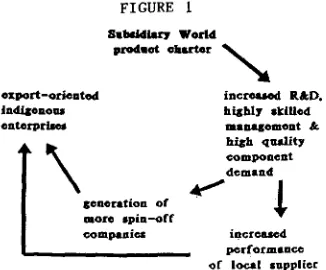
these. For the remainder of the sector t h e r e may be some hope t h a t through collaborative ventures and close l i a i s o n with the foreign sector present in the S c o t t i s h economy indigenous e n t e r p r i s e s will survive and prosper. There appear to be two development models open to Scottish f i r m s , both of which depend on t h e continued and expanding r o l e presence of the foreign s e c t o r . The model (figure 1) i n d i c a t e s t h e i m p o r t a n c e of t h e MNE subsidiary t o the successful development of indigenous e n t e r p r i s e . In terms of s p i n - o f f companies and "piggy-back" exporters the c e n t r a l key r e s t s with an expanded foreign sector which achieves higher levels of autonomy, and which gains R&D c a p a b i l i t y and world or European p r o d u c t market c h a r t e r s (defined as subsibiary repsonsibility for a l l aspects of R&D, manufacturing and i n t e r n a t i o n a l marketing).
FIGURE 1
SabaMiarj World protfaet charter
X
oxport-orientodindigenous enterprise*
\
increased R&D. highly skilled management *fe high quality component demand
generation of more spin-off
companies increased
1
performance of local supplierThere would appear t o be a l o g i c a l stepping process in the model from the e s t a b l i s h m e n t of R&D f a c i l i t i e s in S c o t l a n d w i t h a s s o c i a t e d technology transfer from the parent to the subsidiary t h r o u g h t h e need f o r h i g h e r q u a l i t y supplier and higher grade management and professionals at the subsidiary plant, to the creation of more spin-off enterprises and export-orientated suppliers. Although t h i s model i s s i m p l i s t i c and open t o c r i t i c i s m t h a t i t does not r e f l e c t corporate centralisation there i s evidence (Buchanan, 1987; Young, 1986) that several S c o t t i s h based MNEs a r e moving in t h i s d i r e c t i o n and t h i s should give hope for the future. What i s needed therefore i s a change in what the SDA (1986) describes as the " c u l t u r a l and management weaknesses'' in the indigenous sector to be able to take advantage of o p p o r t u n i t i e s which
currently e x i s t and may increase in the near future.
Two Case Studies of Indigenous Success
I t i s a g a i n s t the background of growing foreign-owned R&D a c t i v i t y and t h e potential t h i s has for a larger number of spin-off companies, the need t o develop export potential, the ability of firms to compete in an international sense, and the presence of an internationally-orientated sub-group of indigenous electronics firms, which led to the analyses of two paticular Scottish companies - Prestwick C i r c u i t s and F l e x i b l e Technology. These c a s e s t u d i e s a t t e m p t e d t o d e t e r m i n e the development of the companies towards international markets, their relationships with the foreign s e c t o r , and t h e i r views concerning the devlopment of electronics in Scotland. I t i s not the i n t e n t i o n to d e t a i l the studies here, but they do provide a number of general conclusions which are relevant to the analysis of the future prospects of indigenous firms in the electronics industry in Scotland.
Although the data are qualitative and what i s true for two firms in the industry may not be generally applicable across the broad s u b - d i v i s i o n s within e l e c t r o n i c s , the case studies are valuable in providing milestones of achievement from which others may learn. They are also important in pinpointing the f r a g i l e relationships which e x i s t between the foreign-owned sector and indigenous e n t e r p r i s e s . This i s particularly true in two areas. First, the level of 'presumed" autonomy which s u b s i d i a r i e s in Scotland have i s called i n t o question. Second, the treatment of the spin-off entrepeneur by h i s previous employer does not follow the "Silicon v a l l e y " model. Leaving t h e l a r g e r organisation to go i t alone seems to be an anathema t o the senior management of foreign-owned subsidiaries where one would suggest that there are net benefits to be had by the subsidiary in encouraging spin-offs.
1. The development of entrepeneurship in the Scottish economy needs a major injection of effort on the part of government, industry and universities.
Given the a v a i l a b i l i t y of s t a r t - u p finance a major policy i n t i t i a t i v e from industry, supported by government and academic i n s t i t u t i o n s i s needed to encourage more new e n t e r p r i s e s in e l e c t r o n i c s , and o t h e r i n d u s t r i a l sectors. One of the major ideas which the managing director of Prestwick had, in h i s r o l e as vice-chariman of the Scottish CBI, was to have the chairmen of major companies embrace a new e n t e r p r i s e i n t i t i a t i v e encouraging middle managers t o s e t up in business for themselves.
2 . To succeed, the new enterprise culture needs directly to attack the two major negative enterprise cultures which currently e x i s t in the S c o t t i s h econoBy.
There are marked differences in the encouragement given to new start-ups in the United States and Scotland. These differences are strongly apparent in the treatment of f a i l u r e by p o t e n t i a l financial backers, and the attitudes of organisations towards employees who l e a v e to s e t up in b u s i n e s s f o r themselves.
These negative cultures stem from two areas. F i r s t , the desire on the part of l a r g e r organisations t o maintain t h e i r middle management e l i t e s for succession purposes without recognising the possible advantages of supporting spin-off companies. Second, the intrinsic culture that favours security of employment a t the expense of r i s k and t h e u n p o p u l a r c o n n o t a t i o n s associated with setting up in business for oneself when the r e s u l t ends in failure.
3. The successful ezaaples of indigenous electronics firms are more likely to be p r o d u c t i n n o v a t i v e , e x p o r t orientated/import substituting concerns which eventual l y becoae international in their own right.
Those indigenous firms that recognised the market p o t e n t i a l of p r o v i d i n g
products a t an international level were l i k e l y to be those with the major l e v e l s of s u c c e s s . A t w o - t i e r indigenous sector exists with firms who serve international markets by exports, or become m u l t i n a t i o n a l in t h e i r own r i g h t being the major examples of indigenous success.
Electronics firms in Scotland are faced with the alternatives of suplying major foreign-owned s u b s i d i a r i e s based in S c o t l a n d and m a i n t a i n i n g t h e s e linkages, or expanding beyond these confines t o operate on i n t e r n a t i o n a l markets. To do so requires t h a t they are e i t h e r product innovators in the mould of companies, such as Flexible Technology, or they compete on cost and quality c r i t e r i a , or do both.
One p o s s i b i l i t y i s t h a t firms which currently have close relationships with foreign firms use these r e l a t i o n s h i p s to build up their own quality, cost and product innovative potential and take these onto wider markets. The crucial step i s breaking out of the restrictive boundaries imposed by buyer/vendor r e l a t i o n s to become more independent and therefore able to concentrate on i m p o r t s u b s t i t u t i o n or e x p o r t orientation. At present, the best hope appears to be from a s e r i e s of new s t a r t - u p s coming from within l a r g e r e l e c t r o n i c companies, with t h e i r s p e c i f i c b a c k i n g , and aimed a t substituting for imports with eventual development of export potential.
For example, Flexible Technology's main m a r k e t s for high q u a l i t y f l e x i b l e c i r c u i t s were m i l i t a r y , computer and communications manufacturers. The growth markets for these products were in the United S t a t e s and the company had always i n t e n d e d being e x p o r t orientated.
In s e t t i n g up t h e two f i r m s , the founders were aware of the failings of t h o s e f i r m s a l r e a d y in e x i s t e n c e . These f a i l i n g s r e f l e c t e d the lack of firms in p a r t i c u l a r markets and the benefits of being xf i r s t to the market
and standard pcbs which encouraged the start-ups.
4. Product and management experience were crucial factors for success.
The management teams which s e t up the companies had a broad range of technical and management s k i l l s to ensure the success of the venture. The future establishment of spin-off or new indigenous e n t e r p r i s e i n S c o t l a n d should view this as a pre-requisite for success.
These conclusions lead one to suggest that in i t s c u r r e n t format the indigenous sector of the electronics industry i s not geared towards exports. P o l i c i e s which encourage the b i r t h of new s t a r t - u p s p a r t i c u l a r l y from w i t h i n t h e f o r e i g n s e c t o r , should therefore s t r e s s the need for export-orientation. The existence and a t t r a c t o n of foreign e n t e r p r i s e s and the growth of a strong domestic supplier base a r e u n q u e s t i o n a b l y i m p o r t a n t t o the Scottish economy. However, there i s also a need to p e n e t r a t e i n t e r n a t i o n a l markets. The pay-offs w i l l be s u b s t a n t i a l and several indigenous high-tech firms appear to be pointing the way. What i s required i s an i n i t i a t i v e which encourages firms to develop foreign markets and compete a t international levels.
References
Buchanan, D A, 1987 *Job enrichment i s dead: long l i v e high performance work design*, Personnel Management, May 1987.
Bollinger, L, Hope K, and Utterback, J M, 1983, *A review of the l i t e r a t u r e and h y p o t h e s e s on new t e c h n o l g y - b a s e d firms", Research Policy, Vol. 12, North-Holland
Buxton, N K, 1985, *Performance and problems of S c o t l a n d ' s i n d u s t r i a l economy', Scottish Council Development and Industry,, The International Forum, December 1986.
F i r n , J, Roberts D, 1984, ' H i g h -Technology I n d u s t r i e s ' , in N. Hood and S. Young (Eds), Industry Policy in the
Scottish Economy, Edinburgh University Press.
Haug, P, Hood N, and Young S, 1983, * R&D Intensity in the Affiliates of US-Owned Electronics Companies Manufacturing in Scotland, REgional Studies, Vol 17, 6, PP 33-392
Hood N, 1986 " F u t u r e of t h e Multinational in Scotland*, Working paper for the conference on Scotland and the Multinationals, IRM and Strathclyde International Business Unit, Glasgow
McCalman, J, 1987 'What's wrong with S c o t t i s h Firms? Local sourcing in E l e c t r o n i c s " , F r a s e r of A l l a n d e r
I n s t i t u t e , Quarterly Economic
Commentary, University of Strathclyde, February.
McCalman, J, 1987 "Going International : The development of export-orientated indigenous electronics firms*, Glasgow Business Schol Working Paper S e r i e s , November.
Roberts, T, 1980 "Getting new ventures off the ground", Management Review, June 1980.
Sayer, A, and Morgan, K, 1984 "The E l e c t r o n i c s I n d u s t r y and Regional Development in Britian", in A. Amin and J B Goddard (Eds), Technological Change, Industrial Restructuring and Regional Development.
S c o t t i s h Development Agency, 1982 Scotland's Electronic Strategy, f i n a l report to the SDA by Booz, Allen and Hamilton Consultants.
S c o t t i s h Development Agency, 1986 "Electronics Scotland", Newsletter of the Electronics Division of the SDA, Glasgow.