Int. J. Electrochem. Sci., 13 (2018) 461 – 471, doi: 10.20964/2018.01.28
International Journal of
ELECTROCHEMICAL
SCIENCE
www.electrochemsci.orgProduction of Electricity from Rice Straw with different
Pretreatment Methods Using a Sediment Microbial Fuel Cell
Tian-shunSong1,2,3,4, Shuai Hou1,3, Jiguang Zhang1,3, Haoqi Wang1,3, Jingjing Xie1,2,3,4,* 1
State Key Laboratory of Materials-Oriented Chemical Engineering, Nanjing Tech University, Nanjing 211816, PR China
2
CAS Key Laboratory of Bio-based Materials, Qingdao Institute of Bioenergy and Bioprocess Technology, Chinese Academy of Sciences, Qingdao 266101, China
3
College of Life Science and Pharmaceutical Engineering, Nanjing Tech University, Nanjing 211816, PR China
4
Jiangsu National Synergetic Innovation Center for Advanced Materials (SICAM), Nanjing 211816, PR China
*
E-mail: [email protected]
Received: 7 September 2017 / Accepted: 31 October 2017 / Online Published: 1 December 2017
The purpose of this study is to improve the performance of solid phase microbial fuel cells (SMFC) by pretreating straw with several reagents (H2SO4,NaOH and H2O2). Electrochemical performance and straw properties were measured. The results show that when compared with the control group (untreated rice straw), the SMFC with rice straw after hydrogen peroxide pretreatment (SMFC-H2O2) and the SMFC with rice straw after sulfuric acid pretreatment (SMFC-H2SO4) lasted more than 6 to 8 days under high voltage (higher than 500 mV). Furthermore, an SMFC with rice straw after sodium hydroxide pretreatment (SMFC-NaOH) can last more than 22 days under high voltage, which is almost twice the endurance of the control group. The maximum power density of the SMFC-NaOH was 140 mW/m2 on day 50, which was 3.6 times that of the control. Therefore the NaOH pretreatment worked in favor of rice straw biodegradation by anaerobic microorganisms and extended the sustained discharge time of the SMFC.
Keywords: Straw resource utilization; Electricity; Long discharge; Cellulose; Pretreatment
1. INTRODUCTION
organic matter available in these environments. In addition, SMFC can perform in situ bioremediation of this organic matter and accelerate the removal of these organics (even refractory organic matter) [10-12].
The low mass transfer rate, in the anode region [13, 14], is one of the important limiting factors for SMFCs, leading to limited output power and short sustained discharge time. Several approaches have been demonstrated for improving the mass transfer rate in the anode region, by addition of plant rhizodeposits [15] or biomass, such as chitin or cellulose [16, 17]. Among these, cellulose is the structural component of the primary cell walls of green plants, dead leaves and stems of plants, such as straw [4] which can also be added to improve SMFC performance. Straw comprises the largest fraction of agricultural waste in many countries, especially in China. Most of the straw is commonly used as mulch or fodder and the rest is burnt or left unused. Therefore, using straw as the substrate of an SMFC, for power generation, provides us with an innovative solution for the treatment of this straw waste.
Straw contains a high percentage of lignin, which is hardly biodegradable by anaerobic microorganisms [18]. However, the crystalline structure and available surface area of lignocellulosic materials make the anaerobic process difficult, because the enzyme cannot reach the reaction sites, unless the lignocellulosic structure is opened. Thus, pretreatment is required to improve the anaerobic process, by changing the structure of the straw. Various methods for pretreatment of these agricultural residues have been studied, including mechanical, thermal, chemical (i.e. alkali, acidic, oxidative) and biological methods [19]. These pretreatment methods result in improvements to the subsequent enzymatic hydrolysis. Nevertheless, most of these studies have been performed in connection with ethanol or biogas production. For example, acid pretreatment can cut the long chains of cellulose and most of the hemicellulose is removed. It has been reported that acid pretreatment of rice straw produces 66.79% of the theoretically expected ethanol yield [20]. NaOH was found to be one of the most effective alkaline reagents for removal of lignin. It has been reported that a 72.9% increase in total biogas production was achieved with straw, treated with a 2.0% solution of NaOH [21]. Rice straw can use as substrate for electricity in MFC [22]. However, few studies have focused on the effects of straw, using various pretreatment methods, on SMFC performance.
In this study, three different types of reagents (acid, alkali and hydrogen peroxide) were used in the pretreatment of rice straw, to evaluate their effects on the performance of the SMFC. All the SMFCs operated for two months. The performance differences of these SMFCs are explained through in-depth analyses.
2. MATERIALS AND METHODS
2.1. SMFC construction and operation
weight) was added to 600 g of wet soil. Stirred evenly. All experimental groups were set up in duplicates, and the experimental group without straw was set up as control. Water loss via evaporation during the operation was routinely replenished with tap water to maintain water level above the cathode electrode 2cm or so. Unless otherwise stated, no additional substances are added. The electrodes used in this experiment (the same cathode anode electrode) were carbon felt (5 cm * 20 cm * 0.3 cm. The size of this anode was 200 mm× 50 mm×30 mm (length × width × thickness), to minimize mass transfer limitation within the soil, as well as to increase the opportunities for contact between the soil and anode. Each anode was placed along a polyvinyl chloride cylindrical holder (31.8 cm2 based on electrode footprint area), with the cathode (54 cm2) floating above the water. The SMFCs were operated at a fixed external resistance of 1000 and maintained at 25 ℃.
2.2. Pretreatment of rice straw
Rice straw was collected locally and cut into 10 mm × 5 mm pieces. For the acid pretreatment, 10 g of rice straw was added to each of the 1000 mL beakers, which were each then filled with 200 ml of sulfuric acid (3%). The wet rice straw, in the beakers, was shaken for 24 h, at 37 ℃, and washed with distilled water, until the pH of the wash solution was neutral, then dried at 60 ℃, and subsequently added to the anode chamber of the SMFC-H2SO4. For the alkali and the hydrogen peroxide pretreatments, 10 g of rice straw were added to 1000 mL beakers, which were then filled with 200 ml sodium hydroxide (5%) and hydrogen peroxide (3%), respectively. The next steps were the same as for the acid pretreatment, and then added to the anode chambers of the NaOH and the SMFC-H2O2.
2.3. Analysis
3. RESULTS AND DISCUSSION
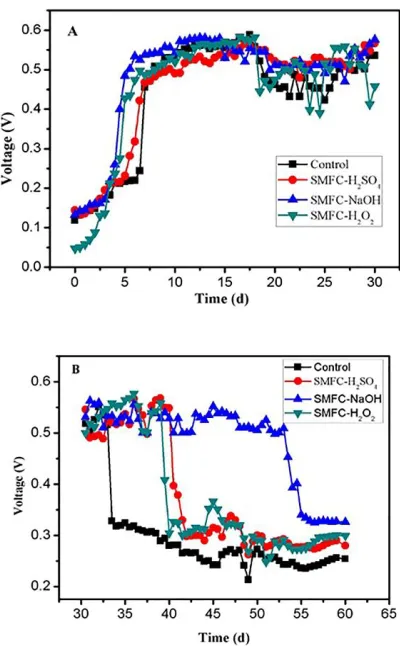
Figure 1. Voltage generation produced by the SMFCs with rice straw, after pretreatment with different reagents. (A)0-30 days and (B) 30-60 days
3.1. Electricity generation from SMFCs
[image:4.596.191.391.114.437.2]
the voltage of the pretreated SMFCs became stable (about 530 mV), with the differences among the voltages produced by all the SMFCs not being very significant, during 30 days of operation.
30 days later, all the SMFCs were still stable (Figure 1B), the voltage of the control declined to 318 mV on day 34. This was the first voltage drop shown by any of the SMFCs. But later, a similar phenomenon was observed in other SMFCs. The phenomenon of maintaining high voltage was obvious in the SMFC-NaOH, where the voltage of the SMFC-NaOH declined rapidly until day 56, which was almost 2 times the number of days, when compared to the control. Until the end of the experiment, the voltage of the control group was 254 mV, while those of the SMFC-H2SO4 and the SMFC-H2O2 were 280 mV and 299 mV, respectively. The SMFC-NaOH still had the highest voltage at 326 mV.
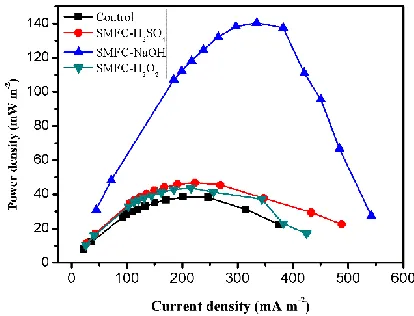
Figure 2. Power curves collected for the SMFCs with rice straw, after pretreatment with different reagents, on day 50.
The maximum power density (Pmax), as functions of current density power curves for the different SMFCs, were obtained, as shown in Figure 2, on day 50. All the Pmax values of the SMFCs with rice straw pretreatment were higher than that of the control (38 mW/m2), with the Pmax of the SMFC-NaOH at 3.6 times that of the control. Internal resistance was estimated from the slope of the plot of voltage versus current. The rapid reduction of the internal resistance can greatly enhance the output power. It was reported that adding 20% graphite flake into SMFC improved the power output 42.3% (from 0.26 mW/m2 to 0.37 mW/m2) [26, 27]. In our case, the control group had an internal resistance of 510 Ω and the SMFCs with rice straw pretreatment decreased the internal resistance. The internal resistance of the SMFC-H2SO4 and the SMFC-H2O2 were 430 Ω and 449 Ω. When compared to the control, the SMFC-NaOH generated the lowest internal resistance (301 Ω), thus yielding the highest Pmax.
3.2. Electrode potential
[image:5.596.188.395.258.416.2]
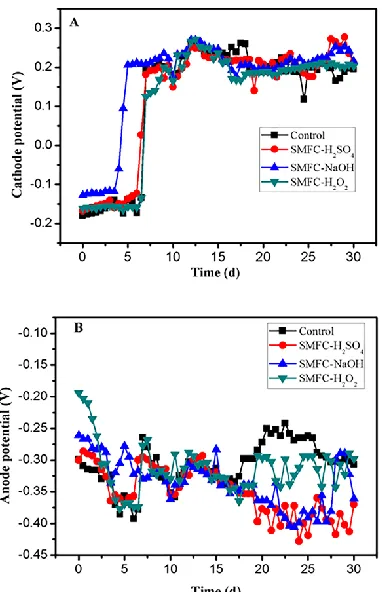
the SMFC-NaOH reached comparatively high values of about 200 mV within 5 days. This was faster than that which the other SMFCs reached. Carbon felt as cathode was easily form biocathodes [28] and improved the cathode potential [14]. SMFCs with NaOH pretreated release the more soluble organic matter and may stimulate the growth of microbes in the cathode region and thus accelerate the biocathode formation rates. After that, the cathodes of the all the SMFCs were almost the same through 30 days (Figure 3A). The kinetics of electron transfer from microorganisms to the anode was mainly restricted by the anode potential [24]. Compared to the SMFC-H2O2 (-194 mV), the other SMFCs had higher initial anode potentials (more negative) (Figure 3B). This lowest anode potential phenomenon led to the lowest voltage of the SMFC-H2O2, which implies that rice straw, with hydrogen peroxide, may reduce the formation of biofilms on the anode. After this initial period, the anode potential of the control fluctuated from -350 mV to -250 mV, while the anode potential of the other SMFCs fluctuated from -400 mV to -300 mV over the 30 days of operation. The results show that, to a certain extent, pretreatment of the rice straw was beneficial to the anodic oxidation reaction.
Figure 3. Working potential produced by the (A) cathodes and (B) anodes of the SMFCs with rice straw, after pretreatment with different reagents, from 0-30 days.
[image:6.596.192.383.306.602.2]
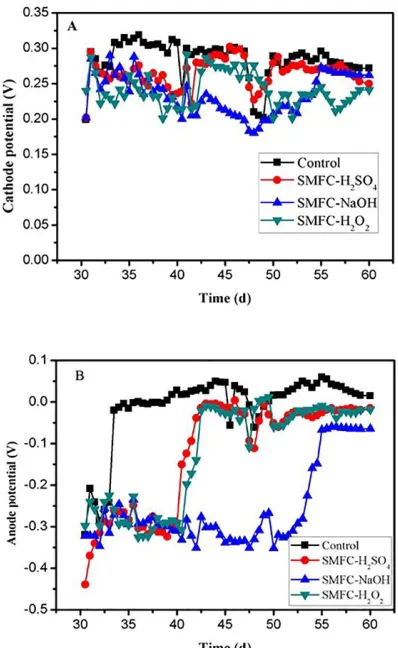
43, respectively. The SMFC-NaOH had the longest time for maintaining the higher anode potential (higher negative). By day 56, the anode potential of the SMFC-NaOH had increased to -6 mV. At the end of the experiment, the SMFC-NaOH still had lower (higher negative) anode potentials (-66 mV), when compared to the control (15 mV).
Figure 4. Working potential produced by the (A) cathodes and (B) anodes of the SMFCs with rice straw after pretreatment with different reagents, from 30-60 days.
3.3. Characteristics of rice straw after pretreatment
[image:7.596.187.386.152.476.2]
Figure 5. SEM of rice straw with no treatment(a,e), H2SO4 pretreatment(b,f), NaOH pretreatment(c,g), H2O2 pretreatment(d,h) in low and high scale, respectively.
The effect of various chemical pretreatments on the composition of rice straw has been presented in Figure 6. It was observed that the composition of rice straw had been significantly affected by the pretreatment methods. A remarkable decrease in lignin content has been demonstrated by the acid treatment (20.6%), in comparison to the untreated control (50.2%); furthermore, the lignin content decreased to 8.5% via the alkali treatment. Therefore, the cellulose content increased from 37.7% (control) to 67.4% (acid treatments) and 80.2% (alkali treatment). Hemicellulose content had a little change undergoing the acid and alkali treatments, maintained at about 12%. After the hydrogen peroxide pretreatment, lignin content was dropped to 13%, and hemicellulose content was significantly decreased to 5%, yielding a high cellulose content (80.7%).
Figure 6. Compositions of corn straw pretreated with different reagents
[image:8.596.128.466.70.227.2] [image:8.596.191.391.466.612.2]
1~4 mW/m2. Their maximum output power was further increased (> 100 mW/m2) via the application of some improved methods, such as increasing the oxygen reduction rate of the cathode [35,36], improvement of sediment/soil conductivity [37,38] and improving the substrate mass transfer of the anode [4,16]. In these factors, the substrate mass transfer of the anode will also affect the longer sustained discharge time of the SMFC, which was another key parameter for power supply, in addition to the maximum output power. In a previous study [4], we proposed that biomass added into the sediment/soil inside the anodes of these SMFCs can increase their output power, but as a result, the higher lignin content, of straw, yielded a low degradation efficiency in the SMFC. In this paper, we demonstrated that the use of rice straw with pretreatment, as the substrate, can extend the sustained discharge time of an SMFC, at a higher voltage. The sustained discharge time of the SMFC-NaOH, at higher voltage, lasted almost twice as long, in comparison with the control. Although both acid and alkali pretreatments can destroy lignocellulose, the alkali pretreatment is more destructive to the structure of the lignin, releasing more cellulose (Fig.5 and 6), which is beneficial to the anodic oxidation reaction. The hydrogen peroxide pretreatment not only destroyed the structure of the lignin, but also dissolved some of the hemicellulose, resulting in a decline in the total amount of available organic matter. Furthermore, pretreatment with hydrogen peroxide can make the surface of the rice straw smooth; and the processing of the straw may not expend all of the available oxidants, leaving some of the H2O2 or other, possibly pretreatment byproduct oxidants, still available. This may explain why at the start, the voltage in the SMFC-H2O2 was lower than that of other groups and why its sustained discharge time, at higher voltage, was lower than that of the SMFC-NaOH. However, the different reagents used in the pretreatment of the straw did not significantly increase the maximum output power in the experiments, this may be due to higher organic matter (LOI content) in soil, and the low electron transfer rate, implying that more electron collectors, within the anode regions [39], may increase the power density of the SMFCs with straw.
4. CONCLUSION
In this work, the straw after pretreatment added to the SMFC reactor, can significantly improve the voltage and discharge time. It also demonstrated good reproducibility. The relevant analysis show pretreatment is the reason for the improvement of SMFC performance. Thus, showing that our pretreatment effect is significant.
ACKNOWLEDGEMENTS
References
1. B.E. Logan and J.M. Regan, Trends Microbiol., 14 (2006) 512.
2. D.R. Bond, D.E. Holmes, L.M. Tender and D. R. Lovley, Science, 295 (2002) 483. 3. C.T. Wang, F.Y. Liao and K. S. Liu, Int. J. Hydrogen Energy, 38 (2013) 11124.
4. T.S. Song, D.B. Wang, S. Han, X.Y. Wu and C.C. Zhou, Int. J. Hydrogen Energy, 39 (2014) 1056.
5. X. Xu, Q.L. Zhao and M.S. Wu, RSC Adv., 5 (2015) 62534.
6. C.E. Reimers, L.M. Tender, S. Fertig and W. Wang, Environ. Sci. Technol., 35 (2001) 192. 7. C. Donovan, A. Dewan, D. Heo and H. Beyenal, Environ. Sci. Technol., 42 (2008) 8591. 8. C. Donovan, A. Dewan, D. Heo, Z. Lewandowski and H. Beyenal, J. Power Sources , 233
(2013) 79.
9. Y.R.J. Thomas, M. Picot, A. Carer, O. Berder, O. Sentieys and F. Barriere, J. Power Sources, 241 (2013) 703.
10. X. Cao, H.L. Song, C.Y. Yu and X.N. Li, Bioresour. Technol., 189 (2015) 87. 11. W.W. Li and H.Q. Yu, Biotechnol Adv., 33 (2015) 1.
12. T.S. Song, Z.S. Yan, Z.W. Zhao and H.L. Jiang, J. Chem. Technol. Biotechnol., 85 (2010) 1489. 13. L. Hsu, B. Chadwick, J. Kagan, R. Thacher, A. Wotawa-Bergen and K. Richter, RSC Adv., 3
(2013) 15947.
14. T.S. Song and H.L. Jiang, Bioresour Technol, 102 (2011) 10465.
15. N. Kaku, N. Yonezawa, Y. Kodama and K. Watanabe, Appl Microbiol Biotechnol, 79 (2008) 43. 16. F. Rezaei, T.L. Richard, R.A. Brennan and B.E. Logan, Environ Sci Technol, 41 (2007) 4053. 17. T.K. Sajana, M.M. Ghangrekar and A. Mitra, Bioresour. Technol., 155 (2014) 84.
18. M.J. Taherzadeh and K. Keikhosro, Int. J. Mol. Sci., 9 (2008) 1621 19. G.Y.S. Mtui, Afr. J. Biotechnol. , 8 (2009) 1398.
20. X. Lu, Y. Zhang and I. Angelidaki, Bioresour. Technol., 100 (2009) 3048.
21. M. Zheng, X. Li, L. Li, X. Yang and Y. He, Bioresour. Technol., 100 (2009) 5140.
22. S.H.A. Hassan, S. M. F. G. El-Rab, M. Rahimnejad, M. Ghasemi, J. H. Joo, S. O. Yong, I. S. Kim and S.E. Oh, Int. J. Hydrogen Energy, 39 (2014) 9490.
23. B.E. Logan, B. Hamelers, R.A. Rozendal, U. Schrorder, J. Keller, S. Freguia, P. Aelterman, W. Verstraete and K. Rabaey, Environ. Sci. Technol. , 40 (2006) 5181.
24. Y. Ziaie-Shirkolaee, J. Mohammadi-Rovshandeh, P. Rezayati-Charani and M.B. Khajeheian, Bioresour. Technol., 99 (2008) 3568.
25. J. Zhao, X.F. Li, Y.P. Ren, X.H. Wang and C. Jian, J. Chem. Technol. Biotechnol., 87 (2012) 1567.
26. A. Dominguez-Garay, A. Berna, I. Ortiz-Bernad and A. Esteve-Nunez, Environ. Sci. Technol. , 47 (2013) 2117.
27. S.L. De, P. Boeckx and W. Verstraete, Appl. Microbiol. Biotechnol., 87 (2010) 1675 28. M. Lenin Babu and S. Venkata Mohan, Bioresour Technol, 110 (2012) 206.
29. Z.H. Hu and Z.Y. Wen, Biochem. Eng. J. , 38 (2008) 369.
30. X. Liu, S. M. Zicari, G. Liu, Y. Li and R. Zhang, Bioresour. Technol., 185 (2015) 150. 31. I.F. Akyildiz, D. Pompili and T. Melodia, Ad. Hoc. Netw., (2005) 257.
32. E. Santi, S. Paloscia, S. Pettinato and G. Fontanelli, Int. J. Appl. Earth., 48 (2016) 61.
33. S.W. Hong, I.S. Chang, Y.S. Choi, B.H. Kim and T.H. Chung, Bioprocess Biosyst. Eng., 32 (2009) 389.
34. G. Martins, L. Peixoto, D.C. Ribeiro, P. Parpot, A.G. Brito and R. Nogueira, Bioelectrochemistry, 78 (2010) 67.
35. Z. He, H.B. Shao and L.T. Angenent, J. Biosens. Bioelectron., 22 (2007). 3252.
37. B.M. Lenin and M.S, Venkata. Bioresour. Technol., 110 (2012) 206.
38. A. Domı´nguez-Garay, A. Berna, I. Ortiz-Bernad and A. EsteveNu´nez, Environ. Sci. Technol., 47 (2013) 2117.
39. B.C. Liu, I. Williams, Y. Li, L. Wang, A. Bagtzoglou, J. Mccutcheon and B. Li, J. Biosens. Bioelectron., 79 (2016) 435.