This is a repository copy of
A facile synthetic approach to nanostructured Li2S cathodes
for rechargeable solid-state Li–S batteries
.
White Rose Research Online URL for this paper:
http://eprints.whiterose.ac.uk/153303/
Version: Published Version
Article:
El-Shinawi, H. orcid.org/0000-0002-4743-5576, Cussen, E.J.
orcid.org/0000-0002-2899-6888 and Corr, S.A. orcid.org/0000-0002-9303-4220 (2019) A
facile synthetic approach to nanostructured Li2S cathodes for rechargeable solid-state
Li–S batteries. Nanoscale, 11 (41). pp. 19297-19300. ISSN 2040-3364
https://doi.org/10.1039/c9nr06239d
[email protected]
https://eprints.whiterose.ac.uk/
Reuse
This article is distributed under the terms of the Creative Commons Attribution (CC BY) licence. This licence
allows you to distribute, remix, tweak, and build upon the work, even commercially, as long as you credit the
authors for the original work. More information and the full terms of the licence here:
https://creativecommons.org/licenses/
Takedown
If you consider content in White Rose Research Online to be in breach of UK law, please notify us by
COMMUNICATION
Cite this:Nanoscale, 2019,11, 19297
Received 22nd July 2019, Accepted 9th September 2019 DOI: 10.1039/c9nr06239d
rsc.li/nanoscale
A facile synthetic approach to nanostructured
Li
2
S cathodes for rechargeable solid-state
Li
–
S batteries
†
Hany El-Shinawi,
*
aEdmund J. Cussen
band Serena A. Corr
*
aLi–S solid state batteries, employing Li2S as a pre-lithiated
cathode, present a promising low cost, high capacity and safer alternative to their liquid electrolyte counterparts, where dis-solution of intermediate polysulfide species can result in loss of active material and a subsequent decrease in ionic conductivity. A nanostructured Li2S material would afford greater flexibility in
optimising the cathode composite for more harmonious elec-trode–electrolyte interactions, yet facile routes to such nanoscale materials are limited. Here, we report a facile and scalable micro-wave approach to directly synthesize nanostructured Li2S from a
glyme solution containing lithium polysulfides. As-synthesized Li2S
presents an ideal architecture for the construction of free-standing cathodes for all-solid-state Li–S batteries.
Reversible electrochemical lithiation of S to Li2S in
recharge-able Li–S batteries is a promising approach to realizing low-cost, high energy density batteries.1 Abundant, light-weight
sulfur offers a potential specific capacity of 1672 mA h g−1 which, at an order of magnitude higher than that provided by conventional intercalation-type cathodes such as LiCoO2 and
LiFePO4, makes Li–S batteries suitable for high energy storage
applications such as powering electric vehicles.1,2 Li2S has
been suggested as a pre-lithiated cathode, negating the neces-sity of metallic lithium as an anode.2,3With the application of a solid-electrolyte, further advantages such as higher ionic conductivities and potentially mitigating deleterious polysul-fide shuttle activity are possible.4–6
However, a serious bottle-neck in the widespread uptake of such a pre-lithiated material has been the limited synthetic routes to Li2S. Preferably, Li2S
would be composited with an electronic conductor and a Li-ion conducting medium on the nanoscale to promote greater
electrode–electrolyte interactions, in an architecture that would accommodate the volume changes associated with cycling. The application of nanostructured Li2S also Recent
years have seen efforts made in developing novel Li2S
compo-sites, for example in combination with carbon and/or solid electrolyte.3A significant benefit to the community would be a
reliable and scalable synthetic route to nanostructured Li2S,
which up to now has been limited and in several cases compli-cated and costly. Reported routes include impregnating carbon materials with ethanolic solutions of commercial Li2S,7–16
chemical reaction of sulfur with lithium triethylborohydride or stabilized lithium metal powder,4,17–23carbon-based reduction
of Li2SO4 and polysulfides,24–30 reactions between H2S and
lithium naphthalenide,31 and burning Li foils in a CS2
vapour.32Thus, there remains a lack of facile routes to Li 2S
which are scalable and afford control over the final particle morphology and size. Here we report the synthesis of nano-structured Li2S, prepared by a simple microwave approach,
together with its performance in an all solid-state Li–S battery. Our results demonstrate that nanostructured Li2S employed
within a free-standing cathode displays exceptional cycling stability, achieving capacities of 440 mA h g−1at cycling rates
of 100 µA cm−2up to 400 cycles.
Nanostructured Li2S is prepared using a simple 20-minute
microwave-assisted heat treatment of a tetraglyme solution containing elemental sulfur and lithium tert-butoxide, at temperatures as low as 200 °C (see ESI for experimental details†). X-ray diffraction patterns of this microwave-syn-thesised Li2S powder (Fig. 1) reveal peak broadening consistent
with a reduction in particle size (with an estimated crystallite size of 10 nm from Scherrer broadening), compared to a com-mercial Li2S sample (Sigma Aldrich, 99.98%). All peaks could
be indexed to the cubic lattice of the antifluorite structure of Li2S. Nanoparticles of Li2S are confirmed by scanning electron
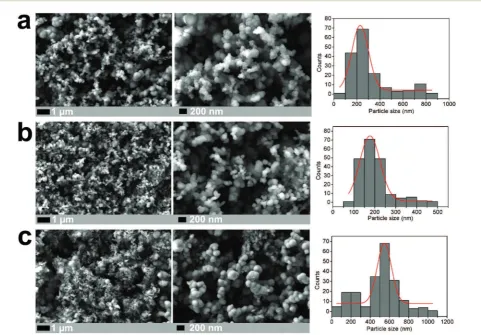
microscopy (SEM) images, were aggregates of particles are observed. Fig. 2 illustrates the importance of the S/lithiumtert -butoxide concentration ratio on the resulting particle size and distribution, with three examples shown (see Fig. S1† for
†Electronic supplementary information (ESI) available. See DOI: 10.1039/ c9nr06239d
aDepartment of Chemical and Biological Engineering, University of Sheffield,
Sir Robert Hadfield Building, Sheffield, S1 3JD, UK. E-mail: s.a.corr@sheffield.ac.uk bDepartment of Materials Science and Engineering, University of Sheffield,
Sir Robert Hadfield Building, Sheffield, S1 3JD, UK
Open Access Article. Published on 17 October 2019. Downloaded on 11/11/2019 11:51:51 AM.
This article is licensed under a
Creative Commons Attribution 3.0 Unported Licence.
View Article Online
further SEM images). Our experiments reveal that Li2S
pre-pared using 0.15 M sulfur solution gave particles with the smallest size and narrowest size distribution.
Such nanostructured material provides a promising elec-trode architecture in terms of providing shorter pathlengths for Li-ion transport, as well as larger electrode–electrolyte contact areas, compared with bulk materials and this sample was selected for further electrochemical study.
It has been previously observed that conductive thin layers of Li3PS4 can be deposited from a THF solution containing
Li2S and P2S5.4,33 Here, we followed a modified approach to
incorporate our microwave-synthesized nanostructured Li2S in
a three-phase Li3PS4/nano-Li2S/C nanocomposite. Firstly,
nanostructured carbon black is composited with P2S5 using a
melt-diffusion technique (Fig. S2†) before mixing with micro-wave-synthesized Li2S in THF (molar ratio of P2S5: Li2S is
1 : 20) to produce the final Li3PS4/Li2S/C nanocomposite. This
corresponds to 40 wt% Li2S in the composite. Characterisation
[image:3.595.48.285.50.227.2]of the final composite by SEM, EDX and XRD are shown in Fig. 3. EDX analysis reveals a homogeneous phosphorus and sulfur distribution across the material, while the presence of Li3PS4is not evident from XRD nor from SEM ( pureβ-Li3PS4
has a distinctive morphology of micron-sized, porous brick-shaped particles). These data suggest the formation of a thin film of Li3PS4, which is either amorphous or is formed on a
much shorter length scale not detectable by Bragg diffraction. The formation of a Li3PS4thin coating on the Li2S/C surface is
Fig. 1 XRD patterns of commercial Li2S and microwave-synthesized Li2S (0.15 M sulfur solution). An air tight sample holder employing a Mylar window was employed.
Fig. 2 Morphology and particle size distributions based on SEM (N= 170) of Li2S prepared from (a) 0.075 M, (b) 0.15 M and (c) 0.3 M sulfur solutions. The mean particle sizes are given as 228 (±72) nm, 177 (±49) nm and 546 (±74) nm respectively.
Communication Nanoscale
Open Access Article. Published on 17 October 2019. Downloaded on 11/11/2019 11:51:51 AM.
This article is licensed under a
Creative Commons Attribution 3.0 Unported Licence.
[image:3.595.61.543.357.692.2]consistent with previous reports.4This is further confirmed by
performing the control experiment, in which a P2S5-rich/C
composite is mixed with Li2S (molar ratio of P2S5: Li2S is
1 : 10). In addition to formation of bulkβ-Li3PS4, which is
con-firmed by XRD and SEM (Fig. S3†), a homogeneous distri-bution of P and S is also observed across this material indicat-ing the formation again of a thin coatindicat-ing of Li3PS4.
An all-solid-state battery was prepared using the Li3PS4/
Li2S/C nanocomposite as a free-standing cathode,β-Li3PS4as
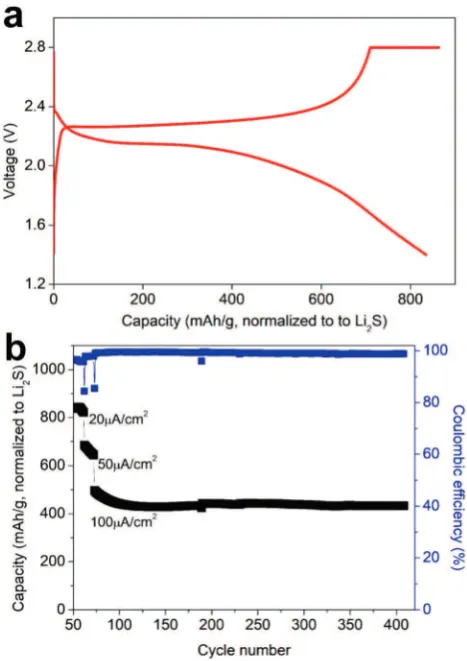
the solid electrolyte and metallic lithium as the anode. These components were pressed together under 2 tons of pressure, employing Al and Ni foils to support and collect the current from the cathode and the anode, respectively (Fig. 4a, insert). The cell cycled at 60 °C and at current densities ranging between 20 and 100 µA cm−2 for up to 400 cycles
(corres-ponding to∼C/2 and C/10). Fig. 4a shows the typical charge
and discharge profiles of the battery at 20 µA cm−2. In addition
to retaining the capacity, it is notable that the voltage profiles comprise well-defined discharge and charge plateaus, display-ing small potential hysteresis. We attribute this small hyster-esis to improved electronic and ionic conductivities of the composite cathode and a reduced interfacial resistance at the solid-electrolyte/cathode interface, as illustrated by impedance spectroscopy measurements (see below). Increasing the dis-charge/charge rate from 20 to 100 µA cm−2 reduced the
capacity from ∼ 840 to∼ 440 mA h g−1, but this capacity is
retained over more than 300 additional cycles with coulombic efficiency close to 100% (Fig. 4b). Fig. S4† displays SEM images of the Li3PS4/Li2S/C electrode before and after cycling
revealing no obvious change of the morphology after 410 cycles at different rates. Some surface cracks are observed which can be attributed to volume changes during cycling; importantly, these cracks do not lead to a loss of contact between the electrode domains or to delamination of the
elec-trode and the solid electrolyte. Impedance measurements prior to and after cycling, indicated an increase of the resis-tance of the cell from∼250 Ωto ∼600 Ω after 410 cycles at
different rates (Fig. S5†). This limited growth of cell resistance with long-term cycling is consistent with capacity retention and maintaining electrode integrity and suggests good stability of the solid-electrolyte/cathode interface. For comparison, in a recent study on Li6PS5Cl–Li2S all-solid-state batteries, a cycled
battery employing Li2S/C as the cathode exhibited an
inter-facial resistance that is one order of magnitude higher than the resistance of the fresh cell after only 37 cycles.34
Conclusions
In summary, we demonstrate that nanostructured Li2S can be
prepared by a simple, fast, microwave heat treatment of a glyme solution containing lithium polysulfides. The as-syn-thesized Li2S presents an ideal architecture for the
construc-tion of free-standing cathodes comprising Li3PS4/Li2S/C
nano-composites. Crucially, this synthetic approach is highly repro-ducible, having been repeated numerous times, and scalable. The performance of this nanostructured Li2S as a cathode in
Fig. 3 SEM/EDX analysis and XRD pattern of the as-synthesized Li3PS4/ Li2S/C composite.
Fig. 4 (a) Typical charge/discharge profile of the all-solid-state battery at 20 µA cm−2current density. (b) Cycle performance of the battery at current densities of 20, 50 and 100 µA cm−2over 400 cycles.
Open Access Article. Published on 17 October 2019. Downloaded on 11/11/2019 11:51:51 AM.
This article is licensed under a
[image:4.595.311.545.48.379.2] [image:4.595.61.274.48.247.2]an all-solid-state battery demonstrates excellent capacity reten-tion at current densities of up to 100μA cm−2, with limited
increases in cell resistance and close to 100% coulombic efficiencies, which we attribute to increased electrode– electro-lyte contact area and shorter Li+di
ffusion pathlengths.
Con
fl
icts of interest
There are no conflicts to declare.
Acknowledgements
We gratefully acknowledge the support of the University of Sheffield in our research. Our work was supported by the EPSRC [EP/N001982/2] and the ISCF Faraday Challenge project “SOLBAT− The Solid-State (Li or N (a) Metal-Anode Battery”
[grant number FIRG007].
Notes and references
1 (a) P. G. Bruce, S. A. Freunberger, L. J. Hardwick and J. M. Tarascon, Nat. Mater, 2012, 11, 19; (b) S.-K. Lee,
Y. J. Lee and Y. K. Sun,J. Power Sources, 2016,323, 174.
2 A. Manthiram, Y. Fu, S.-H. Chung, C. Zu and Y.-S. Su,
Chem. Rev., 2014,114, 11751.
3 D. Su, D. Zhou, C. Wang and G. Wang,Adv. Funct. Mater., 2018,28, 1800154.
4 Z. Lin, Z. C. Liu, N. J. Dudney and C. D. Liang, ACS Nano, 2013,7, 2829.
5 F. Han, J. Yue, X. Fan, T. Gao, C. Luo, Z. Ma, L. Suo and C. Wang,Nano Lett., 2016,16, 4521.
6 Z. Jiao, L. Chena, J. Si, C. Xu, Y. Jiang, Y. Zhu, Y. Yang and B. Zhao,J. Power Sources, 2017,353, 167.
7 F. Wu, H. Kim, A. Magasinski, J. T. Lee, H.-T. Lin and G. Yushin,Adv. Energy Mater., 2014,4, 1400196.
8 F. Wu, A. Magasinski and G. Yushin, J. Mater. Chem. A, 2014,2, 6064.
9 C. Wang, X. Wang, Y. Yang, A. Kushima, J. Chen, Y. Huang and J. Li,Nano Lett., 2015,15, 1796.
10 M. Wu, Y. Cui and Y. Fu,ACS Appl. Mater. Interfaces, 2015,
7, 21479.
11 F. Wu, J. T. Lee, F. Fan, N. Nitta, H. Kim, T. Zhu and G. Yushin,Adv. Mater., 2015,27, 5579.
12 Y. Qiu, G. Rong, J. Yang, G. Li, S. Ma, X. Wang, Z. Pan, Y. Hou, M. Liu, F. Ye, W. Li, Z. W. Seh, X. Tao, H. Yao,
N. Liu, R. Zhang, G. Zhou, J. Wang, S. Fan, Y. Cui and Y. Zhang,Adv. Energy Mater., 2015,5, 1501369.
13 G. Zhou, E. Paek, G. S. Hwang and A. Manthiram, Adv. Energy Mater., 2016,6, 1501355.
14 J. He, Y. Chen, W. Lv, K. Wen, C. Xu, W. Zhang, W. Qin and W. He,ACS Energy Lett., 2016,1, 820.
15 F. Wu, J. T. Lee, E. Zhao, B. Zhang and G. Yushin, ACS Nano, 2016,10, 1333.
16 D. H. Wang, D. Xie, T. Yang, Y. Zhong, X. L. Wang, X. H. Xia, C. D. Gu and J. P. Tu,J. Power Sources, 2016,313,
233.
17 J. A. Gladysz, V. K. Wong and B. S. Jick,Tetrahedron, 1979,
35, 2329.
18 Z. Lin, C. Nan, Y. Ye, J. Guo, J. Zhu and E. J. Cairns,Nano Energy, 2014,9, 408.
19 K. Zhang, L. Wang, Z. Hu, F. Cheng and J. Chen,Sci. Rep., 2014,4, 6467.
20 C. Nan, Z. Lin, H. Liao, M. K. Song, Y. Li and E. J. Cairns,
J. Am., Chem. Soc., 2014,136, 4659.
21 Y. Hwa, J. Zhao and E. J. Cairns,Nano Lett., 2015,15, 3479.
22 L. Suo, Y. Zhu, F. Han, T. Gao, C. Luo, X. Fan, Y.-S. Hu and C. Wang,Nano Energy, 2015,13, 467.
23 S. Zheng, Y. Chen, Y. Xu, F. Yi, Y. Zhu, Y. Liu, J. Yang and C. Wang,ACS Nano, 2013,7, 10995.
24 Z. Yang, J. Guo, S. K. Das, Y. Yu, Z. Zhou, H. D. Abruña and L. A. Archer,J. Mater. Chem. A, 2013,1, 1433.
25 Z. Li, S. Zhang, C. Zhang, K. Ueno, T. Yasuda, R. Tatara, K. Dokko and M. Watanabe,Nanoscale, 2015,7, 14385.
26 J. Zhang, Y. Shi, Y. Ding, L. Peng, W. Zhang and G. Yu,Adv. Energy Mater., 2017,7, 1602876.
27 M. Yu, Z. Wang, Y. Wang, Y. Dong and J. Qiu,Adv. Energy Mater, 2017, 1700018.
28 F. Ye, H. Noh, J. Lee, H. Lee and H.-T. Kim,J. Mater. Chem. A, 2018,6, 6617.
29 Y. Fu, C. Zu and A. Manthiram, J. Am. Chem. Soc., 2013,
135, 18044.
30 M. Kohl, J. Brückner, I. Bauer, H. Althues and S. Kaskel,
J. Mater. Chem. A, 2015,3, 16307.
31 X. M. Li, C. A. Wolden, C. M. Ban and Y. G. Yang,ACS Appl. Mater. Interfaces, 2015,7, 28444.
32 G. Tan, R. Xu, Z. Xing, Y. Yuan, J. Lu, J. Wen, C. Liu, L. Ma, C. Zhan and Q. Liu,Nat. Energy, 2017,2, 17090.
33 H.-D. Lim, H.-K. Lim, X. Xing, B.-S. Lee, H. Liu, C. Coaty, H. Kim and P. Liu,Adv. Mater. Interfaces, 2018,5, 1701328.
34 C. Yu, S. Ganapathy, N. J. J. de Klerk, I. Roslon, E. R. H. van Eck, A. P. M. Kentgens and M. Wagemaker, J. Am. Chem. Soc., 2016,138, 11192.
Communication Nanoscale
Open Access Article. Published on 17 October 2019. Downloaded on 11/11/2019 11:51:51 AM.
This article is licensed under a
Creative Commons Attribution 3.0 Unported Licence.