mechanisms for interactive information retrieval. Journal of the
American Society for Information Science and Technology, 57 (7). ISSN
1532-2882 ,
This version is available at https://strathprints.strath.ac.uk/2716/
Strathprints is designed to allow users to access the research output of the University of Strathclyde. Unless otherwise explicitly stated on the manuscript, Copyright © and Moral Rights for the papers on this site are retained by the individual authors and/or other copyright owners. Please check the manuscript for details of any other licences that may have been applied. You may not engage in further distribution of the material for any profitmaking activities or any commercial gain. You may freely distribute both the url (https://strathprints.strath.ac.uk/) and the content of this paper for research or private study, educational, or not-for-profit purposes without prior permission or charge.
Any correspondence concerning this service should be sent to the Strathprints administrator: [email protected]
The Strathprints institutional repository (https://strathprints.strath.ac.uk) is a digital archive of University of Strathclyde research outputs. It has been developed to disseminate open access research outputs, expose data about those outputs, and enable the
for Interactive Information Retrieval
Ryen W. White
1Institute for Advanced Computer Studies
University of Maryland
College Park, MD USA 20742
[email protected]
Tel: +1 301 405 2748
Ian Ruthven
Department of Computer
and Information Sciences
University of Strathclyde
Glasgow, Scotland. G1 1XH.
[email protected]
Abstract
Advances in search technology have meant that search systems can now offer assistance to users
beyond simply retrieving a set of documents. For example, search systems are now capable of
inferring user interests by observing their interaction, offering suggestions about what terms
could be used in a query or reorganizing search results to make exploration of retrieved material
more effective. When providing new search functionality, system designers must decide how the
new functionality should be offered to users. One major choice is between offering automatic
features that require little human input but give little human control, or interactive features, which
allow human control over how the feature is used but often give little guidance over how the
feature should be best used. This article presents a study in which we empirically investigate the
issue of control by presenting an experiment in which subjects were asked to interact with three
experimental systems that vary the degree of control they had in creating queries, indicating
which results are relevant and in making search decisions. We use our findings to discuss why
and how the control users want over search decisions can vary depending on the nature of the
decisions and the impact of those decisions on the user’s search.
Keywords
Information retrieval, user interfaces, evaluation, implicit relevance feedback.
1. Introduction
The widespread use of commercial search systems has highlighted the importance of user
interaction in Information Retrieval (IR). Web search engines such as Google, Yahoo! and MSN
Search have grown in popularity and process millions of queries daily. The users of these
systems are responsible for all aspects of their interaction, from the selection of query terms to the
assessment of the results obtained. This can be problematic as users typically receive no formal
training in how to formulate queries, exhibit limited interaction with the results of their searches
and do not examine results closely (Jansen, Spink & Saracevic, 2000).
The decisions that users must make can be divided into those related to three major search
activities:
• selecting query terms and operators. Almost all search systems require a user to enter a set
of terms to initiate a search. Some search systems also allow users to enter special operators
such as “” to indicate phrases and +/− to indicate the inclusion/exclusion of terms. Boolean
operators such as AND, OR and NOT can also be used to control search results. Search engines
such as AltaVista have also been effective in suggesting new query terms to users (Anick,
2003).
• making search decisions. If a search does not retrieve all the relevant information required
then a user must decide whether or not to continue with the search. The user has control over
when new queries are issued, how many are issued and at what point to stop searching.
Desktop search systems such as Yahoo! Desktop Search allow users to reorder retrieved
search results based on criteria other than relevance to the query (e.g., modification date, file
location). These information seeking decisions are controlled by users and fit within an
• indicating relevance. If the user finds interesting or relevant pages the system can use the
content of these pages to improve the search. Google’s “similar pages” option is one
example of this. Non-web search systems use Relevance Feedback (RF) (Salton & Buckley,
1990) which automatically modifies queries based on relevance information provided to the
search system by the user. Browse-based interfaces can also use relevance information (what
pages the user has selected to view) as the basis for deciding what new pages to offer. In
relevance feedback the user must decide which documents to mark as relevant and when to
ask the system to modify their query.
In all these areas the user must make decisions on some aspect (selection of search terms,
continue searching, marking documents relevant, etc.) and leave some decisions to the system
(how search terms are used to retrieve documents, how to modify the user’s query, etc.). The
result is that there is a shift in control from user to system and back again throughout the search.
The decision on who has control over what aspects of the search is taken by the system designer
who allows the user control over some decisions and the system control over others. However
this balance does not necessarily reflect the way that users may wish to interact with search
systems; they may want control over some aspects and less control over others.
This article presents an investigation of user control in the three aspects of searching outlined
above: query creation, indicating relevance and search continuation. Our subjects perform
searches on systems with different ways of doing each of these. The aim of this study is to
establish how much control users actually want over each task. Through studies of this nature we
can gain a better understanding of how search systems are used and how interface support in such
This article is structured as follows: Section 2 motivates the work and we describe the
experimental methodology in Section 3. In Section 4 we present the findings of our study,
discuss their implications for the design of new search interfaces in Section 5 and conclude in
Section 6.
2. Background and Motivation
Search interfaces are the means through which users interact with search systems and control
aspects of their search. The importance of developing effective interfaces for these systems has
already been widely acknowledged, (e.g., Hearst, 1995; Shneiderman, Byrd & Croft, 1998).
However, in situations where users struggle to exercise their control effectively it may be
desirable to delegate control over certain aspects of the search to the search system (Bates, 1990).
It is vital therefore to determine when the system should take control and when the user should be
involved (Beaulieu & Jones, 1998).
RF systems typically have components that allow users to indicate which information is relevant,
create and modify queries and use these queries to update the results display. RF techniques have
been shown to improve search effectiveness in non-interactive settings (Buckley, Salton & Allan,
1994) but the user interface challenge is to provide an easy and effective way to control their use
in feedback systems; this is the focus of the experiment described in this article.
2.1 Indicating Relevance
In some search engines and RF systems users are responsible for explicitly indicating which
documents are relevant. This technique allows users who may be unable to create effective
queries to receive assistance by providing examples to the search system of what information is
relevant. The information can then be used to retrieve similar documents or rank similar
the property “relevance” to a search system by showing the system examples of search results
that contain relevant information. RF gives users control over which information the search
system regards as relevant but intrudes on their primary line of activity (i.e., finding useful
information) and increases the cognitive burden (Beaulieu & Jones, 1998). That is, RF forces
users to make two sets of decisions: decisions on finding relevant material and decisions on how
to operate RF.
Giving users control over which documents the system uses is only one way in which relevance
information can be provided. Systems that use Implicit Relevance Feedback (IRF) (Morita &
Shinoda, 1994; Kelly & Teevan, 2003) make assumptions about the relevance of top-ranked
search results or results with which users interact. IRF has been implemented either through the
use of surrogate measures based on interaction with documents (such as reading time, scrolling or
document retention) (Kelly & Teevan, 2003) or using interaction with browse-based result
interfaces (Campbell & Van Rijsbergen, 1996). These techniques have demonstrated that it is
possible to elicit feedback from users in ways other than the traditional RF model. In this study,
we use implicit and explicit feedback techniques to investigate how much control users want
over the process of indicating which search results are relevant.
2.2 Creating Queries
Users are traditionally responsible for modifying their own queries during a search. However,
this process of query formulation can be problematic if users have insufficient knowledge of the
domain, search system or vocabulary used to index documents to create well-formed queries
(Furnas, Landauer, Gomez & Dumais 1987; Salton & Buckley, 1990). When needs are
ill-defined users may also face problems in transforming their need from one which they are
consciously aware (i.e., their conscious need) to a search query for presentation to the system
problems by selecting alternate query terms from the information marked as relevant. In
traditional RF systems the documents marked are used by the system to construct a new search
query. The level of user involvement in this aspect of the feedback process can vary. That is,
users can delegate all responsibility for creating new queries to the search system or retain full
control over which terms to select (i.e., only use the RF to suggest alternative query terms). A
number of studies have found that users exhibit a desire for RF and, in particular, term suggestion
features (Hancock-Beaulieu & Walker, 1992; Koenemann & Belkin, 1996; Beaulieu, 1997).
However, the evidence from these and related studies have indicated that the features of RF
systems are not used in interactive searching (Beaulieu, 1997; Belkin et al., 2001; Ruthven,
Tombros & Jose, 2001); there appears to be inconsistency between what subjects say they want
and what they actually use when confronted with RF systems. In this study, we use three
techniques for selecting query terms to investigate the control users want over the query
formulation process.
2.3 Making Search Decisions
Once a new query is created it must be presented to the system and used in some way. Search
systems typically use the new query to retrieve a new set of search results. Users are responsible
for this aspect of the search and have control over when this decision is made. This is only one
use of the query and it is also possible for search systems to choose when and how the modified
query is used (White, Jose & Ruthven, 2005). Systems such as PLEXUS (Vickery & Brooks,
1987) and I3R (Croft & Thompson, 1987) allow the selection of retrieval strategies by users or on
behalf of users, but are dependent on the initial construction of a model to represent the user and
their needs. In these systems users can select precisely what action happens and when it happens.
In this study, we use techniques that vary user control over how the query is used to
The study described in this article uses systems that vary each of these three factors and asks
users for their opinions of each variation to better understand what users of feedback systems
actually want. We now provide more details on the study.
3. Study
The aim of the experiment on which this study is based was to investigate the effectiveness of
three RF systems for interactive search. It is important to point out that the aim of this study is
not to test the effectiveness of new interface techniques, but to establish user preferences that may
shape the future development of search systems. We were motivated by trends in our
experimental results to pursue the investigation we present here. In this section we present details
of the experiment performed, beginning with the experimental systems used in this study.
3.1 Experimental Systems
We first describe interface features common to all systems, then the differences between systems.
3.1.1 Interface Features
INTERFACE
The interface used in all experimental systems (Figure 1) allowed users to interact with the
retrieved information at a lower level than traditional result presentation methods. The interface
uses many representations of the same Web pages (documents) to allow different views on the
information contained within documents and has been shown to be more effective than traditional
forms of Web search result presentation (White, Jose & Ruthven, 2003a).
DOCUMENT REPRESENTATIONS
Documents are represented at the search interface by their full-text and a variety of smaller,
query-relevant representations, created at retrieval time. The top-30 retrieved documents are
downloaded and all sentences from each document are extracted2. Each sentence is assigned a
score, using an algorithm similar to that in (White, Jose & Ruthven, 2003b). This algorithm gives
preference to sentences that contain the user’s query terms. These sentences are used to form
many representations of each document. Interacting with a representation guides users to a
different representation from the same document.
Document representations include the document title (2)3 and the query-biased summary of the
document (3); a list of top-ranking sentences (TRS) extracted from the top-30 documents
retrieved, scored in relation to the query (1), a sentence in the document summary (4), and each
summary sentence in the context it occurs in the document (i.e., with the preceding and following
sentence) (5). Each summary sentence and top-ranking sentence is regarded as a representation
of the document. These representations allow users to more deeply explore the retrieved
information and can combine to form an interactive relevance path at the search interface. The
default display contains the list of top-ranking sentences and the list of the first ten document
titles. Interacting with a representation guides users to related representations from the same
document. If they click the arrows next to the numbers adjacent to the top-ranking sentences the
system highlights the title of the source document. If they hover over a document title for a short
time the summary of that document appears in a small, moveable window in front of the other
information. Clicking arrows next to sentences in that summary shows the sentences in the
context they occur in the source document. The presentation of progressively more information
2 This number of documents was chosen to ensure the system responded in a timely manner.
from documents to aid relevance assessments has been shown to be effective (Zellweger, Regli,
Mackinlay & Chang, 2000; Paek, Dumais & Logan, 2004).
All experimental systems contain components to help users construct improved search queries.
Once created, the query can be used in different search decisions to generate a new set of results
(i.e., re-search Web) or restructure already retrieved information (i.e., reorder top-30 documents
or list of top-ranking sentences).
In this study we use different versions of the system that vary how users indicate which document
representations are relevant, modify their queries and make search decisions. In the remainder of
this section we describe these three variations.
3.1.2 Manual System
This system allowed users to indicate directly which document representations were relevant until
they were satisfied with the information marked. There are checkboxes next to all document
representations (including sentences and summaries) and using these the user can mark
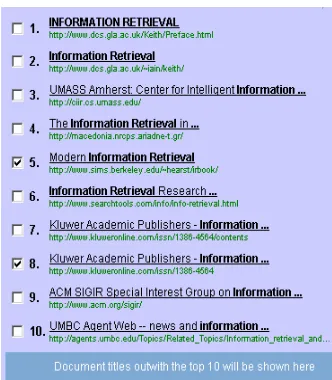
representations as relevant; this is effectively a standard RF interface. Figure 2 shows an example
of this at the interface. In the figure, checkboxes next to each title allow users to mark titles as
relevant.
[PUTFIGURE2HERE]
The interface contains control options that allow the user to request support with query
formulation, modify the query and choose retrieval strategies. The options, shown in Figure 3,
[PUTFIGURE3HERE]
When the useris satisfied with the representations marked relevant, they can click the “create
query” button and a new query will be constructed from the marked representations. Suggestions
for query modification are generated by analysing the documents or representations that are
marked as relevant. The terms chosen to expand the query are the best terms chosen by the RF
algorithm for selecting new query terms described in (White, 2004). These terms are appended to
the original query on a new line and presented in the search box for the user to edit (Figure 3).
In the Manual system the user has control over the nature and timing of search decisions (i.e.,
when to reorder the sentences, reorder the documents or re-search the Web). To do this, the user
selects the radio button that matches their desired action and click the “use query” button.
3.1.3 Assisted System
In this system there are no checkboxes for users to explicitly mark what representations are
relevant. Instead, this system makes inferences about users’ interests based on the information
with which they interact. As described earlier, interacting with a representation indicates other
representations from the same document that may be displayed at the interface. To users this is a
way they can find out more information from a potentially interesting source. To the system each
interaction of this nature is interpreted as an implicit indication of interest in the representation
and each representation is treated as relevant for the purpose of creating a list of new query terms.
A version of this technique is described and has been shown to be a good estimation of explicit
user feedback in (White, Ruthven & Jose, 2002).
Every five relevance paths (i.e., when a user views one or more representations from five separate
system’s estimate in the level of change in the topic of the search since the last user-controlled
query submission. The system chooses the top-ranked terms and presents these in a list of
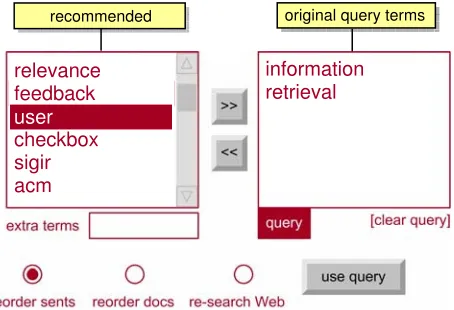
recommended terms. The control options for this experimental system are shown in Figure 4.
[PUTFIGURE4HERE]
The user can then control which terms are added or removed from the query. The arrowed
buttons can be used to transfer terms between the recommended list and the query. There is an
“extra terms” box where users can add additional terms to the query that are not in recommended
list.
When the system has a recommendation it shows its recommended terms and highlights the radio
button for the search decision it recommends. The user does not have to agree with the
recommended search decision and can choose another option.
3.1.5 Automatic System
The Automatic system obtains its relevance information implicitly in the same way as the
Assisted system. However, the system retains control of all other choices (i.e., the query terms
chosen and search decisions made). Rather than recommending what the user should do, the
Automatic system chooses terms and makes search decisions without direct user instruction, then
notifies the user.
This system allows the user to edit their original query and retrieve a new set of documents. No
provision is made for them to formulate a query for reordering sentences or documents; these
actions were controlled by the system. The system chose alternative query terms automatically
This system notified users that a new set of documents had been retrieved or the already retrieved
information was restructured using notification messages similar to that shown in Figure 5 in the
bottom left-hand corner of the interface.
[PUTFIGURE5HERE]
The messages give details of the query terms chosen by the system and the action the system has
taken. The query terms shown in the notification window are the full query not the list of terms
appended to the initial query. It is possible therefore for the new query to not contain the original
query terms. This design decision allows the Automatic system to automatically adapt to large
changes in the topic of the search without being tied to terms in the initial query.
3.2 Summary of Systems
In Table 1 we present a summary of the role of the user in indicating relevance, constructing
queries and choosing how these queries are then used in each of the three experimental systems
used in this study.
[PUTTABLE1HERE]
Subjects using the Manual system have control over relevance assessment. This system requires
users to make binary relevance judgements (i.e., relevant/non-relevant). Although there exist
ways of eliciting degrees of relevance from users at the interface (Ruthven, Lalmas & Van
Rijsbergen, 2002) the need to make many assessments meant the binary approach was the least
systems allowed users to reverse the effects of re-searching or document/sentence reordering. In
the next section we describe the experimental subjects who participated in this study.
3.3 Subjects
The experimental subjects were mainly undergraduate and postgraduate students in the Arts,
Sciences and Social Sciences faculties at the University of Glasgow, United Kingdom. 48
subjects were recruited; half were male and half were female. Recruitment was targeted at two
subject groups, each containing 24 subjects: inexperienced (infrequent computer users,
inexperienced searchers) and experienced (frequent computer users/professional computer users,
experienced searchers). Subjects completed an entry questionnaire that asked them about their
search experience and computer use. They were then divided into the two groups depending on
their search experience, how often they searched and the types of searches they performed.
The average age of the subjects was 22.83 years (maximum 51, minimum 18, σ = 5.23 years) and
three quarters had a university diploma or a higher degree. 47.91% of the subjects had, or were
pursuing, a qualification in a discipline related to Computer Science. The subjects were a mixture
of students, researchers, academic staff and others. All had some degree of experience with Web
searching4, and some with searching in other domains5.
3.4 Tasks
Search tasks were designed to encourage realistic search behaviour by our subjects and were
search scenarios that reflected real-life search situations. The tasks were phrased in the form of
simulated work task situations (Borlund, 2000), i.e., short search scenarios that were designed to
reflect real-life search situations and allow subjects to develop personal assessments of relevance.
4 Inexperienced subjects conducted Web searches on average “Once or twice a week”, Experienced subjects conducted
Web searches on average “Many times a day”.
5 Examples include: the University of Glasgow library, the British Library, their personal computer with desktop search
We devised six search topics (i.e., applying to university, allergies in the workplace, art galleries
in Rome, “Third Generation” mobile phones, Internet music piracy and petrol prices) based on
pilot testing with a small representative group of subjects. These subjects were not involved in
the main experiment.
For each topic, three versions of each work task situation were devised, each version differing in
their predicted level of task complexity. As Bell and Ruthven (2004) described, task complexity
is a variable that affects subject perceptions of a task and their interactive behaviour, e.g., subjects
perform more filtering activities with highly complex search tasks. By developing tasks of
different complexity we can assess how the nature of the task affects the subjects’ interactive
behaviour and hence the evidence supplied to RF algorithms. Task complexity was varied
according to the methodology described by (Bell & Ruthven, 2004), specifically by varying the
number of potential information sources and types of information required to complete a task.
Subjects chose one high complexity, one moderate complexity and one low complexity task.
They chose a task from a different topic each time and were not allowed to choose more than one
task for a particular topic. This minimised learning effects. Giving subjects a choice of topics
allowed them to select those that were most interesting. Borlund (2000) argues that interest is
one of the key factors in engaging subjects in simulated work task situations. The three tasks
devised for the “Petrol Prices” topic are shown as an example in the Appendix. They were asked
to read the task, place themselves in the situation it described and find the information they felt
was required to complete the task. That is, highly complex tasks can encourage exploratory
searching (e.g., browsing) and simple tasks focused directed searching (e.g., keyword search)
(Kuhlthau, 1993)6. In the next section we describe the experimental procedure.
6For succinctness of exposition we do not use the differences in complexity in our analysis. A detailed
3.5 Procedure
The experiment has a 2 × 3 factorial design; two levels of search experience and three
experimental systems. Subjects switched systems after each task and used each system once.
The order in which systems was used was randomised according to a Latin square experimental
design. A tutorial carried out prior to the experiment allowed subjects to use a non-feedback
version of the system to attempt a practice task before using the first experimental system.
Experiments lasted between one-and-a-half and two hours, dependent on variables such as the
time spent completing questionnaires. Subjects were offered a five minute break after the first
hour.
In each experiment:
i. the subject was welcomed and asked to read an introduction to the experiments and sign
consent forms. This set of instructions was written to ensure that each subject received
precisely the same information.
ii. the subject was asked to complete an introductory questionnaire. This contained questions
about the subject’s education, general search experience, computer experience and Web
search experience.
iii. the subject was given a tutorial on the interface, followed by a training topic on a version of
the interface with no RF.
iv. the subject was given the first task sheet and asked to choose one task from the six on that
sheet. No guidelines were given to subjects when choosing a task although complexity was
rotated by the experimenter so each subject attempted one high complexity task, one
v. after selecting the task, the subject was asked to perform the search and was given 15 minutes
to search. Subjects could terminate a search early if they were unable to find any more
information they felt helped them complete the task.
vi. after completion of the search, the subject was asked to complete a post-search questionnaire.
vii.the remaining task sheets were given to the subject, following steps iv. – vi. Since the topics
were the same on all three task sheets the subject was not allowed to choose the same topic as
attempted in a previous search even though subsequent choices would be from a different
level of complexity.
viii.the subject completed a post-experiment questionnaire and participated in a post-experiment
interview.
The findings of this study are now presented.
4. Findings
In this section we mainly focus on results concerning the interface differences between systems.
This is a study of how much control users want over aspects of their search, not of new
techniques to improve search effectiveness. As such, the findings we present focus mainly on
subjective impressions of the interface support mechanisms of each system.
Due to the ordinal nature of much of the data non-parametric statistical testing was used and the
level of significance was set to p < .05. The findings are presented across three aspects of the
search: indicating relevance, creating queries and interactive search strategies. SMan, SAssist and
SAuto are used to denote the Manual, Assisted and Automatic systems respectively. We used
5-point Likert scales and semantic differentials, and open-ended questions to elicit subject opinion
4.1 Indicating Relevance
The experimental systems differ in how users convey which items are relevant. The Manual
system presents checkboxes next to each document representation and allows users to explicitly
mark which representations are relevant. The ability to mark items as relevant gives users an
increased responsibility for making decisions but more control over the input to the system and
when system operations are carried out. Relevance indications on the Assisted and Automatic
systems are implicit. That is, the systems make inferences about what information is relevant
from their interaction. In this section we analyse subject perceptions of these methods.
4.1.1 Subject Perceptions
Subjects were asked about how relevance information was conveyed to each of the systems. That
is, how they told the system which document representations (e.g., titles, summaries, top-ranking
sentences) were relevant. They were asked to complete semantic differentials to elicit subject
opinion about:
1. the value of the assessment method i.e., How you conveyed relevance to the system (i.e.,
ticking boxes or viewing information) was: “easy”/ “difficult”, “effective”/ “ineffective”,
“useful”/ “not useful”.
2. the process of providing the feedback i.e., How you conveyed relevance to the system made
you feel: “comfortable”/ “uncomfortable”, “in control”/“not in control”.
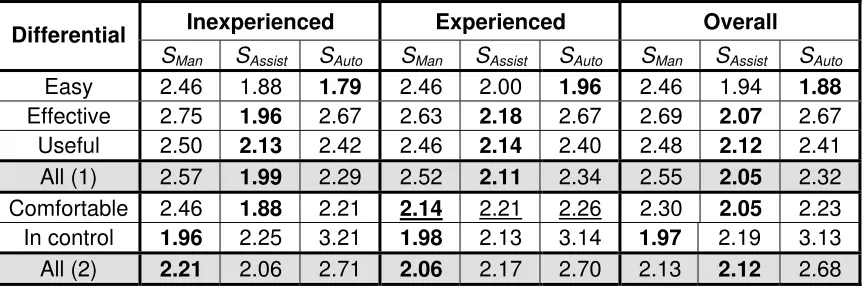
The average obtained differential values are shown in Table 2 for inexperienced subjects,
experienced subjects and all subjects regardless of search experience. The value corresponding to
“All” represents the mean of all differentials for a particular attitude statement (e.g., all three
differentials for statement 1). This gives some overall understanding of the subjects’ feelings
is used in this table and in all subsequent tables to denote the highest (or most positive) value for
a particular combination of variables (e.g., “easy”/inexperienced, most positive is SAuto (1.79)).
[PUTTABLE2HERE]
Friedman Rank Sum Tests were applied within each subject group7. The results of this analysis
suggested the existence of significant differences in all semantic differentials and all subject
groups8 except the “comfortable”/experienced comparisons9 (underlined in Table 2). Experienced
subjects appear equally comfortable with the methods used to provide relevance information in
all systems. Their search experience may allow them to move between interface technologies
more easily.
Dunn’s post hoc tests (multiple comparison using rank sums) were run on all differentials
revealing significant differences for all pair-wise comparisons. These differences suggest that
subjects found the implicit feedback methods “easy”, “effective” and “useful” in their search10. In
the Manual system subjects could decide which document representations were marked as
relevant. Subjects felt more “in control” when given the additional responsibility for indicating
which items were relevant but, for inexperienced subjects, not necessarily more comfortable.
Users with less search experience may find it problematic to adapt to new techniques for
controlling their search. All subjects found (explicit) relevance assessment in Manual system
more difficult than (implicit) assessment in the Assisted and Automatic systems. However, the
significance of the difference between the SAssist and SAuto systems suggests that factors other than
7 Since this analysis involved multiple comparisons, we use a Bonferroni correction to control the experiment-wise
error rate and set the alpha level (α) to .0167 and .0250 for both differentials (1) and (2) respectively, i.e., .05 divided by the number of tests performed. This correction reduces the number of Type I errors i.e., rejecting null hypotheses that are true.
8 all χ2
(2) ≥ 10.60, all p ≤ .005 9χ2
the value and the process of relevance indication affect subject preferences for different relevance
assessment methods.
4.1.2 Search Precision
We also use analysis of interaction logs to investigate how subjects actually conveyed relevance
in our experimental systems. To do this we measure the precision of the search; the proportion of
all possible representations in the top-30 documents retrieved that were relevant. In the Manual
system the search precision is in two forms: (i) the proportion of all possible representations that
were marked relevant by the user, and (ii) the proportion of all viewed representations that were
marked relevant by the user. In the Assisted and Automatic systems precision is based on the
proportion of all possible representations that the user expresses an interest in (i.e., viewed).
There are a maximum of 14 representations per document: 4 top-ranking sentences, 1 title, 1
summary, 4 summary sentences and 4 summary sentences in document context. Since the
interface to all three systems shows document representations from the top-30 documents there
are 420 possible representations that subjects can assess. Table 3 shows precision values for each
system. For the Manual system, the precision value is given in the format: precision from all
possible representations, (precision from all viewed representations) (potential precision if
implicit feedback had been used).
[PUTTABLE3HERE]
The average search precision values shown in Table 3 suggest large differences in the number of
items marked relevant in the Manual system and inferred relevant. Subject criteria for marking a
those of the Assisted and Automatic systems for both subject groups and overall11. The precision
values for the Assisted and Automatic are very similar and do not differ significantly between
subject groups12. From these results we can see that experienced subjects check more items yet
look at fewer. This may imply that they are being selective about the information they view, but
apply different criteria than inexperienced subjects when assessing relevance.
The results of this analysis indicate differences in feedback users are willing to give and the
amount that can be gathered implicitly. In the next section we present subject opinions of this
process.
4.1.3 Subject Opinions
Subjects were asked to comment informally on each of the experimental systems they used.
Subjects found the Manual system a hindrance in their search, that it presented them with too
many choices and that it added an additional component to the search process that could become
frustrating. Subjects found the need to mark representations in the Manual system annoying and
reduced its usability. Three factors emerged as important when indicating which results were
relevant: the method used to indicate, the value of the indication and the criteria used during the
indication. The method describes how relevance information was elicited at the interface and the
subjects typically forgot to provide these indications. The value describes the perceived benefit
of indicating relevance and subjects generally felt the process was not worth their effort. Finally,
the criteria that the subjects employed during the process were typicallystrict (i.e., results had to
be completely relevant) and subjects rarely found results they regarded as relevant. These
findings demonstrate the need for functional visibility in the RF process and the ways to address
the high cognitive load imposed by explicit RF systems (Beaulieu and Jones, 1998). The
Automatic and Assisted systems provided a mechanism through which relevance information
could be conveyed that was found to be straightforward and did not disrupt subjects’ search
patterns. From their comments subjects appeared willing to delegate responsibility for this
activity to the search system.
4.2 Creating Queries
At any point in the search the experimental systems allowed new search queries to be created.
When prompted, the Manual system presented the original query and the best non-query terms in
a text box and allowed the user to add additional terms or remove terms to formulate the new
query. The Assisted system presents a list of recommended terms and allows the user to add the
best from this list into the query or remove terms from the query. The Automatic system
generated a new non-editable query automatically. The Manual and Assisted systems gave users
control over their query terms. In this section we present subject perceptions of this process and
the levels of subject trust in the systems to form new queries.
4.2.1 Subject Perceptions
Subjects were asked to indicate on a Likert scale how comfortable they were with the method for
constructing the new query. The average responses are shown in the third row of Table 4.
[PUTTABLE4HERE]
A Friedman Rank Sum Test was applied to the values in each group and the results indicated
statistically significant differences in all groups13. Dunn’s post hoc tests were applied to the data
and revealed (in all groups) significant differences between the Assisted system and the other
13 all χ2
systems14. The differences between the Manual and Automatic systems were not significant in
any groups15.
The subjects appear to prefer systems that recommended terms to them in a way that does not
intrude on their search, giving them control over which terms could be added to their query. The
adding of terms represented an additional burden, but did not lessen their perceptions of the
technique.
4.2.2 Subject Trust
Trust is an important factor when relying on others. A relationship between user trust and
willingness to use controlling mechanisms or accept automated assistance has already been
established in the Ergonomics community (Lee & Moray, 1994). The same principles can be
applied to Interactive IR; to delegate responsibility to a search system, users must be able to trust
the system to act on their behalf. Subjects were asked whether they trusted the system to choose
terms for them. They completed a Likert scale to indicate the extent they agreed with the
statement I would trust the system to choose terms for me. The last row of Table 4 shows the
average responses.
Friedman Rank Sum Tests were conducted for each differential within each subject group. The
results suggested the existence of statistically significant pairs16. Dunn’s post hoc tests revealed
significant differences in all inexperienced comparisons and for the experienced and overall
subject groups, the Assisted /Automatic17 and Assisted/Manual18. Subjects appear to trust systems
that give them control over query modification more than those without this facility. Subjects are
14 all Z≥ 3.12, all p < .001
15inexperienced: Z = 1.16, p = .123; experienced: Z = 1.08, p = .141, overall: Z = 1.08, p = .139 16 all χ2
(2) ≥ 11.24, all p ≤ .001
more willing to delegate responsibility for the creation of queries to systems that allow them to
verify the correctness of system decisions. In a related study, Koenemann and Belkin (1996)
tested search systems with different levels of visibility and interactivity in creating queries. In
our study the Automatic system allows users to see the query created by the system. The Manual
and Assisted systems allow users to control and adjust the new query. In our study, as in
(Koenemann & Belkin, 1996), subjects prefer systems that gave them control over the new
queries. That is, they want help in selecting query terms but want ultimately to decide which
terms are used. From the results presented in Table 4, we can see that users prefer interface
mechanisms that give them control over query contents.
4.2.3 Source of Additional Query Terms
In all systems users could modify their query at any point in the search. This would involve them
selecting additional query terms based on tacit knowledge, the search task, their general search
experience and any additional information provided by the search system. After each search task
subjects were asked to describe the origin of all additional query terms they entered during the
search. These were not terms that the system suggested, but additional terms that users entered
that may have originated in ideas the system terms gave them.
Subjects could select one from “list of terms suggested by the system”, “retrieved set of
documents and extracted information”, “a combination of the first two” and “other”. Subjects
who chose “other”, were asked to specify the reason. Table 5 shows the origins of new terms
entered by the user. The values in the table are percentages and the sum of each column is 100%.
Most subjects appeared to choose additional terms based on the combination of the terms chosen
by the system and the documents and extracted information. The abundance of information in
these representations means it is more likely that new ideas will arise from there. What is
encouraging is that the small number of terms selected by the system are not only useful to
represent current information needs but to facilitate their development. Friedman Rank Sum
Tests were conducted for each differential within each subject group. The results implied the
existence of statistically significant differences in each group19. The high percentage of new ideas
from “other” sources (the percentages shown in the last row of Table 5) came from a combination
of the search task and the subject’s tacit knowledge. The differences between the subject groups
is significant for all differentials20. There is also evidence of interaction effects between the level
of search experience and the experimental systems for the “combination of the above” and
“other” differentials21. This suggests that the level of search experience affects where subjects get
their terms and that this source varies depending on the experimental system.
The findings show that in systems that removed control over the generation of alternative query
terms from subjects, they were more likely to use the terms proposed to initiate new ideas and
search directions. The Manual system was dependent on subjects marking results as relevant. As
a consequence, the terms suggested were from items the user already knew were relevant.
Systems that remove subject control over creating queries may be most appropriate for
encouraging new and potentially useful search directions. This can be helpful if the user is
struggling with their search. Whilst users want to retain control over the additional terms used, if
they are not experienced users, it may not be in their interests to do so.
19 all χ2
(2) ≥ 9.92, all p ≤ .007 20 all U(24) ≥ 392, all p ≤ .016 21 all χ2
The findings also show that the amount of interactivity in how additional terms were chosen
influences where the terms were chosen from. When given less control over how alternative
query terms were chosen, subjects were more likely use the system’s terms or other sources such
as the task, tacit knowledge or previous search experience. However, subjects did not use the
documents or extracted information as inspiration for new terms. Subjects depend on the
Automatic system to reorder documents and top-ranking sentences; subjects did not have any
control over those activities in that system. We can conjecture that when subjects could not
manipulate the space in which they searched, they were less likely to use that space to assist them
in constructing new queries.
4.2.4 Subject Opinions
Subjects were asked informally about the activity of creating queries in each of the three
experimental systems. Subjects preferred being able to select the terms used in the creation of
their query. They did not like the Automatic system which did not let them refine their query for
certain system operations. The selection of query terms is an activity for which users want
support from the system in proposing additional keywords and suggested that this could be
helpful where they may not be able to create good queries. However, subjects viewed the
creation of new query as an important activity which they would rather have ultimate control
over.
4.3 Making Search Decisions
Once a new query was created it could be used to retrieve a new set of documents, reorder
top-ranked sentences or reorder documents. The Assisted and Automatic systems both contain a
component that predicts when, and by how much, the topic of a search has changed. This
component selects search decisions for execution or recommendation. In this section we analyse
4.3.1 Subject Perceptions
The experimental systems implemented retrieval strategies to gather a new set of documents or
restructure the information already retrieved. The Automatic system acts on behalf of subjects,
the Assisted system recommends a strategy and the Manual system is solely dependent on the
subject to choose a strategy. In a similar way to the previous section, subjects were asked to
indicate on a Likert scale how comfortable they were with the method used to make search
decisions in the experimental systems. A summary of their responses is shown in Table 6.
[PUTTABLE6HERE]
A Friedman Rank Sum Test was applied to the values in each group and the results indicated the
presence of effects in all groups22. Dunn’s post hoc tests were applied to the data and revealed (in
all groups) significant differences between all systems and all other systems (all p ≤ .001). There
were no significant differences between subject groups23 and no significant interaction effects
between search experience and systems24. Subjects preferred the Assisted and Manual systems
since they had final control over how the new query was used. The Assisted system was
preferred because it also made recommendations about possible uses of the query. The
Automatic system was not liked because it removed this control and intruded on the search. The
option to reverse all strategies did not compensate subjects for the additional burden of having to
do so.
22 all χ2
(2) ≥ 14.26, all p < .001
23 Mann-Whitney Test, U(24) = 350, p = .10 24χ2
4.3.2 Subject Trust
In the same way as the techniques used to create queries, trust is important in choosing how these
new queries can be used. To effectively delegate responsibility users must be able to trust the
systems to use the new query in the best possible way.
Subjects were asked about this aspect of the search. They completed a Likert scale to indicate the
extent they agreed with the statement I would trust the system to choose an action for me. The
average responses are shown in the final row of Table 6. Since the attitude statement concerned
trust in system decisions it was not completed by subjects when they used the Manual system.
Wilcoxon Signed-Rank Tests were applied within each subject group to compare systems and all
subjects and systems compared to the mid-value of the Likert scale (i.e., three). The results
showed no significant within-group differences25 and significant differences from the mid-value26.
Subjects reacted positively to the search decisions made by the system. Inexperienced subjects
preferred systems where they had control over the search decisions made. That is, they trusted
systems that gave ultimate control over how the new query was used.
Another indicator of how much trust subjects had in the decisions made by the system is the
proportion of decisions that subjects chose to reverse. This can be an indicator of dissatisfaction
with the system and as an indicator of the extent to which subjects trusted the system to make the
right choice on their behalf (i.e., the more decisions they reverse, the less they trusted the system
to make the correct decisions for them). In Table 7 we present a summary of the proportion of
search decisions made by the system that were accepted and those reversed by experimental
subjects in each subject group and across all subjects, for each type of search decision.
[PUTTABLE7HERE]
The differences between the systems for all decisions within the subject groups is not significant27
but it is between subject groups28. Experienced subjects tended to accept a lower number of
search decisions than inexperienced subjects. These subjects may be more reticent about the
search systems making decisions of this nature on their behalf and feel able to make such
decisions on their own. In contrast, there were no significant differences in the proportion of
decisions reversed between the three types of decision29. Subjects appeared equally satisfied and
equally trustful of all types of search decision made by the systems.
4.3.3 Subject Opinions
Subjects were asked to comment informally about the search decisions. The Automatic system
removed all user responsibility for making new decisions, the Assisted system recommended
search decisions and the Manual system relied on users to make these decisions. In a similar way
to how they felt for query creation subjects wished to retain control over the strategies employed,
but responded well to recommendations made by the system. Where the retrieved information
was restructured (i.e., reordering) rather than recreated (i.e., re-searching), subjects were more
willing to delegate control to the search system. That is, the amount of control subjects wished to
retain was dependent on the predicted impact of the search decisions.
We now discuss the results and their implications for search interface design.
5. Discussion and Implications
In this study we investigated interface support mechanisms for interactive information retrieval.
The study focused on how much control users wished to retain over aspects of their search. A
27 Wilcoxon Signed-Rank Test, all T(24) ≤ 156, all p ≥ .431 28 Mann-Whitney Test, all U(24) = 399, all p ≤ .011 29 Friedman Rank-Sum Test, all χ2
deeper understanding of what users want to control and what they are happy to delegate can assist
in the development of more effective systems for interactive search.
Bates (1990) presented a framework for thinking about search system design that related system
involvement in the search process and the search activities that systems directly support. System
involvement ranges from Level 0 (i.e., no involvement) to Level 4b (i.e., complete system
involvement with no user notification). Search activities include moves (identifiable thoughts or
actions that are part of information seeking), tactics (one or more moves made to further a
search), stratagems (large/complex sets of moves/tactics) and overall strategy that determines the
direction of the search. The systems used in this study are involved in the search to different
degrees; the Manual system suggests search activities when asked (i.e., Level 3a involvement in
Bates’ framework), the Assisted system offers search activities always (i.e., Level 3b
involvement) and the Automatic system acts automatically and notifies user that it has done so
(i.e., Level 4a involvement). All systems provide support for moves by allowing users to view
documents and document representations and for tactics by providing assistance with query
formulation and relevance indication. The Assisted and Automatic systems also provide
assistance with stratagems by recommending or executing ways in which the query could be used
such as reordering the top-ranked results or re-searching the document collection.
In this study we have used three systems that vary the level of support for tactics and stratagems.
Meadows (1979) showed that it was problematic for systems to suggest moves as they may not be
in line with the overall goals of the search. However, in our study the success of the systems
using implicit relevance feedback do show that by tracking moves (e.g., document or document
representation selections) during a search it is possible to build an approximation of user
In a related study, Beaulieu and Jones (1998) investigated three factors that affect interaction with
IR systems: functional visibility, cognitive load and balance of control between the user and
system, relating them to a previous set of experiments. The functional visibility − allowing the
user more information on how the system works − is important at two levels. Not only must the
user be aware of what options are available at any stage but they must also be aware of the effect
of these options. The study by Beaulieu and Jones demonstrated that interfaces such as the
Manual system, that separate query modification and relevance assessment, can be more
cognitively demanding for users. In this experiment subjects appeared willing to delegate
responsibility for relevance assessment to the search system. However, they wished to retain
control over query reformulation and retrieval strategy selection, activities they perceived as
being important for the success of their search. That is, subjects were willing to delegate control
over the provision of relevance information as long as they could control how this information
was used.
A deeper understanding of what users want to control and what they are happy to delegate can
assist in the development of more effective systems for interactive search. Techniques to indicate
which items are relevant, form new queries and use these queries were all evaluated. In this
section we discuss the findings of our evaluation for each of these techniques.
5.1 Relevance Indications
Subjects wanted the search system to infer relevance. In all cases, systems that gathered
relevance information unobtrusively from subject interaction were preferred to systems that
required explicit subject involvement. Whilst the Manual system gave subjects an opportunity to
directly indicate which items were relevant the additional responsibility dissuaded subjects from
doing so. They felt that the implicit techniques were a reasonable approximation for their
Subjects felt that implicit relevance feedback was easier and more useable and that it was
comparable in terms of search success.
The Manual system differed from the other systems in how relevance information was conveyed;
the subject was required to explicitly mark representations as being useful in their search. This
was an onerous task that was not liked by subjects. In the experiment one subject commented
“[checking boxes] added a new dimension to search that could become frustrating”. This
summarises the general opinion of experimental subjects; that the need to mark boxes was
removed from the search for information and required a transition between two search activities:
locating useful information and marking that information if relevant. Subjects preferred systems
that used implicit relevance assessments since they did not require them to mark items as
relevant, they had difficulty marking items as relevant, they forgot to mark items and the marking
of the items intruded in their searching. Implicit relevance assessments may not be as accurate as
their explicit counterpart in determining which items are definitely relevant but they are able to
build a larger body of evidence for those that are potentially relevant. The Manual system forced
subjects to make binary assessments of what items were relevant; this may not always be
appropriate as the relevance of a search result may be uncertain or partial (Spink, Griesdorf &
Bateman, 1998; Maglaughlin & Sonnenwald, 2002).
Experimental subjects tended to only mark items that were definitely relevant, meaning they did
not provide the system with much evidence with which to make query modification decisions
(i.e., only around 2% of all representations were marked). Techniques such as those employed by
Aalbersberg (1992), Allan (1996) and Iwayama (2000) can be used to modify queries in
situations where only a small amount of relevance information is available. 15 of the 48
experimental subjects suggested that the process of relevance feedback could also be improved if
their search. After they had given this negative relevance feedback they would not want to see
items of this nature, or these terms, again during their search.
In this experiment “precision” was taken as a measure of search effectiveness and based on how
much of the retrieved document set the subjects classed as relevant. To compute this measure,
the Manual system used the proportion of potential representations30 that were actually marked
and the implicit feedback systems used the proportion of all representations that were classified as
being relevant. The results suggested a large difference between how much information the
implicit systems regarded as relevant and what the subject actually marked as being relevant. The
relevance and usefulness of the terms generated from the implicit feedback systems was higher
than that of the Manual systems, suggesting that more evidence, albeit less reliable than that
provided by the user allowed better quality terms to be chosen by the implicit feedback
framework. It also suggests that criteria subjects employed when assessing relevance was too
strict and that better queries could have arisen from the selection of more representations that
were perhaps not totally relevant.
5.2 Query Creation
Subjects preferred to retain control over query creation. The systems that allowed subjects to
monitor and change the query were preferred over the Automatic system, which did not. They
were willing to delegate the task of recommending potential keywords but not the task of adding
these terms. Subjects preferred control over the terms chosen by the system, even if this meant
more work for them in moving terms of interest from the recommended term list to the query.
This effort was seen to be both unnecessary (subjects were not forced to do it) and worthwhile
(subjects perceived a benefit from it). The implicit nature of the evidence captured may make the
search decisions of systems that use it unreliable and subjects may rather retain control to be sure
of their correctness. Subjects engendered more trust in systems where they could verify the
correctness of the terms chosen prior to their submission.
Subjects liked having terms suggested to them, but in a way that did not require them to delete
irrelevant terms (as in the Manual system), only select relevant ones; subjects did not want to
have to act to correct erroneous system decisions. Subjects were more willing to delegate
responsibility for the creation of queries to systems that allow them to verify the correctness of
system decisions. In a related study, Koenemann and Belkin (1996) tested search systems with
different levels of visibility and interactivity in creating queries. In this study the Automatic
system only allowed subjects to see the query created by the system; the Manual and Assisted
systems allow subjects to view and adjust the new query. Here, as in Koenemann and Belkin,
subjects preferred systems that gave them control over the new queries; they want help in
selecting query terms but want ultimately to decide which terms are used. In this study we
reinforce and extend Koenemann and Belkin’s research to show that their findings are true across
different types of searches.
The Manual system chose terms for subjects based on the items they had marked as relevant.
These items reflected their current information needs and the terms suggested by the system
appeared to reflect these needs also. Subjects chose terms from those recommended in the
Assisted system because: (i) they represented new ideas, (ii) they meant the same as the query
terms, and (iii) they were related to the query terms. The study by Koenemann and Belkin found
that subjects tended to choose semantically related feedback terms. In this study we found that
subjects use the query terms to give them ideas for what terms are appropriate or were related to
that the terms “pipe”, “iraq” and “dollar” are good feedback terms, but their semantic relationship
to the original query is not immediately apparent.
All experimental systems tried to increase the length of subjects’ query statements by expanding
the original search query. Belkin et al. (2003) have demonstrated that experimental subjects can
be more satisfied with search results if they submit longer queries to the search system. The use
of a feedback system to choose terms on a user’s behalf is only one way to create longer queries.
It is preferable to encourage users to better define their information needs themselves. However,
in circumstances where they may be unfamiliar with the topic of the search, they may be unable
to produce longer queries (Kelly & Cool, 2002).
5.3 Retrieval Strategy Selection
Subjects preferred to retain control over search decisions. Systems that gave the subjects control
over search decisions were preferred to those that did not. The Assisted system suggested
decisions that subjects may execute. Subjects liked receiving this support but in a similar way to
the creation of query statements wished to verify the correctness of any decisions before they
were taken.
The Assisted and Automatic systems dynamically update their internal representation of
information need change and adopt the search decision that reflects the level of change in the
information need of the user, as estimated by the search system. Different search decisions had
different levels of impact on a search. Reordering decisions restructured the already retrieved
information at the interface, whereas re-searching decisions generated a new set of documents.
The decisions increased in severity, from reordering Top-Ranking Sentences, to reordering
documents, to re-searching the Web. Subjects appeared more willing to retain control over the
user), but were willing to experiment with reordering (28.47% of all accepted reorder decisions
were initiated by the user). This suggests an association between the severity of the decision and
subjects’ willingness to retain control over them. That is, for less severe strategies subjects were
more willing to delegate responsibility to the system.
Different search decisions had different levels of impact on a search. Reordering decisions
restructured the already retrieved information at the interface, whereas re-searching decisions
generated a new set of documents. The decisions increased in severity, from reordering
top-ranking sentences, to reordering documents, to re-searching the Web. Subjects appeared more
willing to retain control over the number of re-search operations, but were willing to experiment
with reordering. This suggests an association between the severity of decisions and subjects’
willingness to retain control over them. That is, for less severe search decisions, subjects were
more willing to let the system make the decision. As the search activity shifts from moves to
tactics to stratagems (Bates, 1990), there is an increase in users’ willingness to control them. Of
these three activities, stratagems have the most influence on the success of the search; poor
stratagem selection is potentially more serious than a mistaken move or tactic. Through allowing
users to reverse the affects of bad stratagem selection our systems can handle incorrect decisions,
although only if users are knowledgeable enough to notice that a bad decision has been made.
At the end of the experiment subjects were asked to rank the three systems they used in their
order of preference. No instructions were given on what factors to use when making their
decision, but they were asked to explain their ordering. Table 8 summarises the average rank
assigned to each system.