White Rose Research Online URL for this paper: http://eprints.whiterose.ac.uk/142488/
Version: Accepted Version
Article:
Ahmed, A, Naqvi, SAA, Watling, D orcid.org/0000-0002-6193-9121 et al. (1 more author) (2019) Real-Time Dynamic Traffic Control Based on Traffic-State Estimation.
Transportation Research Record, 2673 (5). pp. 584-595. ISSN 0361-1981 https://doi.org/10.1177/0361198119838842
© 2019, National Academy of Sciences: Transportation Research Board. This is an author produced version of a paper published in Transportation Research Record. Reprinted by permission of SAGE Publications.
[email protected] https://eprints.whiterose.ac.uk/
Reuse
Items deposited in White Rose Research Online are protected by copyright, with all rights reserved unless indicated otherwise. They may be downloaded and/or printed for private study, or other acts as permitted by national copyright laws. The publisher or other rights holders may allow further reproduction and re-use of the full text version. This is indicated by the licence information on the White Rose Research Online record for the item.
Takedown
If you consider content in White Rose Research Online to be in breach of UK law, please notify us by
REAL-TIME DYNAMIC TRAFFIC CONTROL BASED ON TRAFFIC STATE
1
ESTIMATION
2 3 4
Afzal Ahmed
5
Director, Advanced Traffic Lab for Analytics and Simulation (ATLAS)
6
Assistant Professor, Department of Urban & Infrastructure Engineering
7
NED University of Engineering & Technology
8
University Road, Karachi, Pakistan.
9
Tel: +92-321-8224024 Email: [email protected]
10 11
Syed Ahsan Ali Naqvi
12
Postgraduate Research Student
13
Department of Electrical Engineering
14
Hong Kong Polytechnic University
15
11 Yuk Choi Rd, Hung Hom, Hong Kong
16
Email: [email protected]
17 18 19
David Watling
20
Centenary Professor of Transport Analysis
21
Institute for Transport Studies, University of Leeds
22
Leeds LS2 9JT, United Kingdom.
23
Tel: +44 (0)113 34 36612 Email: [email protected] 24
25 26
Dong Ngoduy
27
Professor
28
Department of Civil and Natural Resources Engineering,
29
University of Canterbury, New Zealand
30
Tel: 64 3 364 2987 (ext. 95119); Email: [email protected]
31 32 33
Word count: 7434 words text + 0 table x 250 words (each) = 7,434 words
34 35 36 37 38 39 40
Revision Submission Date: 14 November 2018
ABSTRACT
1
The accurate depiction of the existing traffic state on a road network is essential in reducing
2
congestion and delays at signalized intersections. The existing literature in the optimization of
3
signal timings either utilizes prediction of traffic state from traffic flow models or limited real-time
4
measurements available from sensors. Prediction of traffic state based on historic data cannot
5
represent the dynamics of change in traffic demand or network capacity. Similarly, data obtained
6
from limited point sensors in a network provides estimates which contain errors. A reliable
7
estimate of existing traffic state is, therefore, necessary to obtain signal timings which are based on
8
the existing condition of traffic on the network.
9
This research proposes a framework which utilizes estimates of traffic flows and travel times based
10
on real-time estimated traffic state for obtaining optimal signal timings. The prediction of traffic
11
state from the Cell Transmission Model (CTM) and measurements from traffic sensors are
12
combined in the recursive algorithm of Extended Kalman Filter (EKF) to obtain a reliable estimate
13
of existing traffic state. The estimate of traffic state obtained from the CTM-EKF model is utilized
14
in the optimization of signal timings using Genetic Algorithm (GA) in the proposed
15
CTM-EKF-GA framework.
16
The proposed framework is applied to a synthetic signalized intersection and the results are
17
compared with a model-based optimal solution and simulated reality. The optimal delay estimated
18
by CTM-EKF-GA framework is only 0.6% higher than the perfect solution, whereas the delay
19
estimated by CTM-GA model is 12.9% higher than the perfect solution.
20 21 22 23
Keywords: Cell Transmission Model; Extended Kalman Filter; Real-time Traffic State Estimation;
24
Adaptive Signal Control; Signal Optimization; Genetic Algorithm.
INTRODUCTION
1
Traffic congestion has been consistently increasing despite various measures to reduce vehicular
2
traffic demand in congested urban areas due to constraints on available resources and space for
3
increasing road capacity. A significant proportion of delay is caused due to capacity reduction at
4
the intersections. The conflicting movements at intersections reduce the intersection capacity,
5
which results in traffic congestion and queues at the intersection and its approaches. These
6
conflicts in traffic flow can be minimized by providing grade separated intersections which
7
increase the intersection capacity, but is constrained by the limitations in the right of way and
8
finances available to increase intersection capacity. Traffic signals provide a low-cost measure to
9
control conflicting traffic movements at the intersections and also ensure the operation of the
10
intersection at an optimum level. In addition to controlling conflicting movements at the
11
intersection, traffic signals have also been used to influence commuters’ route choice behavior and
12
to achieve system optimal solutions (1; 2).
13
Optimum signal control that results in smooth traffic operation can be accomplished by
14
estimating signal timing plans based on real-time measurements of traffic flow parameters.
15
Various Adaptive Traffic Control Systems (ATCS) have been developed and implemented in
16
different cities around the globe. The ATCS packages developed for optimal traffic control include
17
Dynamit 2.0 (3), RHODES (4), SPOT (5), PRODYN (6), OPAC (7), SCOOT (8) and SCATS (9).
18
SCOOT and SCATS are among the most widely implemented ATCS for optimal performance of a
19
traffic network. These ATCS packages adjust signal timings based on real-time measurements
20
obtained from sensors installed at appropriate locations in a traffic network. The implementation
21
of these packages has been reported to improve the performance of the traffic network in the
22
application areas. The implementation of SCOOT in Coventry and Glasgow resulted in a 12%
23
reduction in delay at the signalized intersections (8). Similarly, a reduction of 19% in delay at
24
signalized intersections was achieved in London by the implementation of SCOOT (10). Similar
25
improvements were observed in other urban traffic networks by the implementation of ATCS. The
26
ATCS and existing literature in real-time traffic control are extensively based only on real-time
27
measurements of traffic flow parameters.
28
Adaptive traffic signal control systems usually require road occupancy and traffic flow
29
measurements from traffic sensing devices (such as inductive loop detectors or camera vision
30
technology). For such applications, traffic sensors are required to be placed in suitable positions
31
and distance from each other (500m to 1 km), so as to obtain uninterrupted and sufficient
32
information to perform the optimization task. These sensor measurements are contaminated with
33
noises and errors, and therefore require the process of filtering and smoothing. Moreover, a fault in
34
the local controller, sensor breakdown and communication disruption can result in insufficient data
35
required for optimum traffic control, which can result in inefficient and inaccurate optimization
36
and traffic operation.
37
Real-time traffic state estimation based on traffic flow models integrates the prediction
38
power of traffic flow models with the benefit of real-time traffic measurements. The term state in
39
traffic state estimation represents the traffic flow variables modeled using the traffic flow model
40
employed, which are estimated using an estimation algorithm (11). The predicted state of traffic
41
using traffic flow models are adjusted with the measurements from traffic sensors in the estimation
42
process so that the final traffic state estimate is statistically more reliable than the measurement or
43
prediction alone. Ahmed et al(11), Wang et al (12), Wang et al(13), Wang and Papageorgiou (14),
44
and Meier and Wehlan (15) applied Extended Kalman Filter (EKF) for traffic flow based real-time
45
estimation of traffic state. Munoz et al (16), Gang et al (17), Tampere and Immers (18), Long et al
46
(19) and Long et al (20) estimated real-time traffic state using the Cell Transmission Model (CTM)
based Kalman Filter approach.
1
Extensive research has been carried out in traffic flow models based offline optimization of
2
traffic signals. Hadi and Wallace (21) utilize a Genetic Algorithm (GA) and TRANSYT-7F
3
software concurrently to achieve an optimal solution to the traffic signal. Foy et al (22) examine
4
the application of GA to produce optimal signal control timings. Lo (23) applied CTM and mixed
5
integer programming technique for signal control optimization. Park et al (24) use GA based
6
optimization by including modified delay minimization with a penalty function and throughput
7
maximization. Park et al (25) examine the efficiency of GA based optimization on the
8
oversaturated intersection. Li et al (26) applied GA to optimization of collaborative multi
9
intersection traffic control under various traffic demand. Wada (27) proposed an optimization
10
framework to minimize the total transportation cost by achieving an optimal state. Lo et al (28)
11
developed Dynamic Intersection Signal Control Optimization (DISCO) algorithm which uses
12
CTM along with GA to optimize traffic signal control. For an offline application, DISCO
13
improved the delay up to 33% compared with TRANSYT when applied to the same traffic
14
conditions. Numerous other studies have utilized prediction of traffic state from CTM for traffic
15
control optimization (28-33).
16
This research provides an alternative to the existing real-time measurements/traffic flow
17
model based applications for signal control optimization by replacing real-time measurements/
18
model-based predictions with a real-time traffic state estimation technique to determine the
19
prevailing traffic conditions. The predicted traffic flows from CTM are combined with
20
measurements of traffic flows from sensors in a recursive algorithm of EKF to obtain a more
21
reliable estimate of the existing traffic state. The estimated traffic state obtained from the
22
CTM-EKF model is utilized in the optimization of signal timings using a genetic algorithm. The
23
proposed framework is applied to a hypothetical scenario and results show a significant
24
improvement over the only CTM-based optimal solution while producing a solution with a
25
negligible difference from the simulated reality.
26
This research presents a framework that optimizes the signal timings based on real-time
27
estimated traffic state. The CTM-EKF algorithm employed in this research is a standard approach
28
in real-time traffic state estimation (11-14). New cycle length and green times are estimated after
29
every cycle. This makes this research more near-real-time compared to other adaptive control
30
methods, which keep the same signal plans for a certain time period. Furthermore, the real-time
31
traffic state is estimated based on measurements of the sensor located upstream of the signalized
32
intersection, which is used in the background to estimate the signal timing plan that minimizes the
33
overall network delay when the current cycle is in place. The estimated traffic state at the current
34
time-step is projected for the duration of the candidate timing plans using GA. So, it can be
35
inferred that the proposed framework is not only real-time but predictive in nature as well. The
36
optimal timing plans based on the estimated traffic state during the previous cycle are immediately
37
implemented after the previously estimated cycle is completed.
38
With growing interest in the potential of real-time data acquisition from connected vehicles
39
(CVs) and its application to real-time traffic management (34-40), the proposed research
40
framework can be extended to incorporate real-time data from CVs. Real-time traffic state
41
estimation using data from CVs can replace the dependency on a capital-intensive network of
42
sensors and communication and provide a cost-effective solution for adaptive traffic control
43
systems.
44 45
DYNAMIC TRAFFIC ESTIMATION, CONTROL, AND FEEDBACK FRAMEWORK
The CTM-EKF-GA framework proposed in this study integrates various models from existing
1
literature to optimize signal control devices. CTM proposed by Daganzo (41; 42) has been
2
implemented by various research studies to model traffic flow on urban arterials. Lo et al (28)
3
proposed a CTM-based traffic signal optimization model which determines optimal signal timings
4
plans to reduce delay at a signalized intersection using the Genetic Algorithm (GA) technique.
5
Like other model-based optimization frameworks, the CTM-GA model proposed by Lo et al (28)
6
is useful for offline optimization of signal control devices, which cannot depict real-time variation
7
in traffic demand or changes in capacity due to incidents and extreme weather conditions.
8
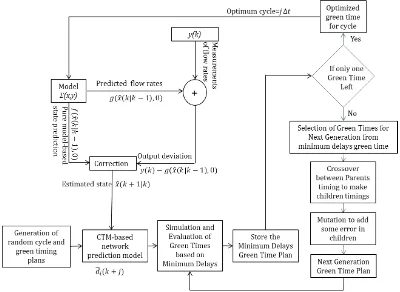
This section first describes the selected models CTM, EKF and GA separately and then the
9
integration of these models is described in figure-1, which explains the overall methodology of this
10
research.
11 12
Prediction of Traffic State using CTM
13
The CTM proposed by Daganzo (41) has been widely used in modeling urban network traffic
14
flows. The CTM is simpler to implement on a traffic network and it fits well with the actual field
15
measurements (43; 44). In comparison with other higher order traffic flow models, CTM has fewer
16
numbers of output variables and input parameters which qualifies CTM as a suitable model for
17
real-time applications (11). The CTM has been used for real-time traffic state estimation (16-20;
18
45) as well as for optimization of traffic networks (23; 30; 46-52).
19
The CTM represents a traffic network as a collection of cells with equal lengths which is
20
equal to the distance ) that a single vehicle travel during one time-step ( with free-flow speed.
21
In free-flow condition, a vehicle would move from one cell to another in one time-step. The
22
network is divided into i number of cells and each cell has a vehicle holding capacity of
23
determined by the following equation:
24
(1)
where is the jam density in veh/km and li is the length of cell i in km. The number of vehicles in
25
cell i at time-step k is ni(k) and qi(k) is inflow to cell i at time-step k. The inflow into cell i or
26
outflow from cell i-1 at time-step k is governed by the following equation:
27
q k min k (2)
where Ci(k) represents the capacity flow of cell i at a given time-step k; Ni - ni(k) represents the
28
available space in the cell, and is the ratio of shockwave speed to free-flow speed (w/v). Once
29
inflow for all the cells at time-step is determined using equation (2), the cell occupancy for all the
30
cells in the network for one time-step ahead is calculated as follows:
31
n k (3)
The effect of the traffic signal is modeled by formulating the capacity of the cell containing traffic
32
signal as a variable that switches between zero and saturation flow rate.
33
C k (4)
Based on Lo et al (28), the delay faced by vehicles in each cell i at times-step k is calculated as:
34
d k (5)
35
Estimation of Traffic Flow using EKF
36
The EKF has been established as a de facto state estimation algorithm for non-linear dynamic
37
systems. Various traffic flow models including CTM are nonlinear in nature; therefore EKF is
38
more suitable for CTM-based estimation framework. This paper adapts the CTM-EKF framework
39
proposed by Ahmed et al (11) for real-time estimation of traffic state with some modifications.
40
Ahmed et al (11) and other research studies (16-20; 45) estimated traffic density recursively by
taking prediction of traffic density from CTM and assuming real-time measurements of traffic
1
occupancy (density) from sensors. This study estimates inflow to cells (flow rates) instead of
2
traffic density (cell occupancy) as flow rates are one of the basic measurements from traffic
3
sensors. Traffic flow rates are also important in the optimization of traffic control devices as
4
estimated flow rates will be useful in quantifying traffic demand on various approaches of a
5
signalized intersection. Furthermore, real-time measurement devices such as inductance loop
6
detectors directly measure the occupancy and flow rates. In the conversion of occupancy into
7
density, the underlying error in conversion might increase the error in real-time measurements.
8
Using flow rate as a variable for real-time estimation is more useful, as it can be directly related to
9
the modeled flow-rate by the CTM.
10
In traffic state estimation, the predicted traffic flow by CTM based on equation (2) for current
11
time-step k using estimated density at time-step k-1 is as follows:
12
q k min k (6)
13
Where q k is predicted inflow by CTM, k is the cell occupancy based on estimated flows at
14
time-step k-1 and is white Gaussian noise in predthe iction of traffic flow. The measured traffic
15
flow at time-step k, with noise in measurement is related with the actual inflow to cell i as
16
follows:
17
(7)
18
The CTM-EKF framework described in Ahmed et al. (11) for real-time traffic state estimation is
19
then applied to obtain the estimated value of inflow q k . This estimated inflow is used in cthe
20
alculation of cell occupancy for the future time-step k+ 1.
21
n k (8)
22
The inflows and occupancies are estimated iteratively. x k k- contains the values of estimated
23
inflows and occupancies and y k contains all the measurements. The entire process of
24
correction-estimation using EKF is further explained in figure 1 and equation-11.
25 26
Estimating Delay using Estimated Traffic State
27
Lo et al (28) proposed quantifying approach delay for all the cells in the network by using equation
28
(5). This study updates equation (5) from prediction-based delay to real-time estimation-based
29
delay as follows:
30
k (9)
31
where k is the estimated delay for cell i at time-step k; is the estimated number of
32
vehicles and cell i and is the estimated flow proceeding from cell i to cell i+ 1. The link
33
delay can be determined by adding the estimated delay of the component cells in the link. The
34
objective function of signal optimization is to reduce the total network delay in real-time based on
35
the dynamics of traffic flow obtained from CTM-EKF.
36
min (10)
where D is the sum of delays in all the cells during j time-steps and j is the number of time-steps
37
estimated for the upcoming signal cycle. is obtained by predicting the traffic flows for
38
the network using randomly generated signal timing plans for j number of future time-steps based
39
on the estimated traffic state at time-step k. This study keeps the cycle length and green times as
40
dynamic variable which results in the minimum intersection delay.
41 42
Optimal Signal Timings using Genetic Algorithm
In this study, we develop a solution approach based on an artificial intelligence technique called
1
Genetic Algorithm to find an optimal timing plan for the traffic signal. This study utilizes the
2
CTM-GA approach proposed by Lo et al (28) to determine the optimal signal control timings
3
based on real-time estimated traffic state and delays. Lo et al (28) can be referred for further details
4
about determining the optimal cycle length based on GA. The optimal cycle lengths and green
5
times for signal phases at time-step k are estimated by simulating the traffic with candidate signal
6
plans proposed by GA and estimated traffic state at the current time-step k is predicted for the
7
duration of proposed cycle length.
8 9
Integration of CTM, EKF, and EKF to formulate CTM-EKF-GA Framework
10
In the proposed CTM-EKF-GA framework, the CTM-EKF estimates real-time traffic flow based
11
on observations from sensors along approaches of the intersection by replacing only CTM-based
12
traffic prediction model in CTM-GA with CTM-EKF estimation developed by Ahmed et al (11)
13
with some modifications. The CTM-EKF-GA framework proposed in this study is elaborated in
14
figure 1. ∑(x, y) represents CTM based state-space dynamic model for the prediction of traffic
15
flow and connecting the prediction of traffic flow to the measurements of traffic flow parameters
16
from sensors. It predicts the traffic flow for current time-step based on the estimated traffic density
17
that was calculated using CTM-EKF based estimated flow rates at the previous time-step
18
(equation-6). CTM-based function, f x k k- , predicts traffic flow rates for time step k, based
19
on all available measurements until time-step k-1. g x k k- is a differentiable function that
20
maps the predicted flow-rate for time-step k to the flow rates measured by the sensor y(k)
21
(equation-7). The measurement of traffic flow rates at time-step k is compared with the predicted
22
output from CTM and a correction factor called the Kalman Gain K is estimated using the variance
23
in the prediction and the measurement of the traffic flow rates. This correction is then added to the
24
pure model-based flow-rates and traffic density for time-step k+ 1 is predicted based on estimated
25
flow rates at time-step k (equation-8). This predicted density is then used recursively for
26
determining estimated traffic flow rates for all the time-steps in simulation horizon. The estimated
27
flow rates and traffic density are used for determining the delay for each cell in the link and overall
28
network delay for each simulation time-step. x k k represents the CTM-EKF based estimated
29
traffic flow rates and predicted densities calculated using estimated flow rates as follows:
30
x k k f x k k- K k y k -g x k k- (11)
31
The network delay based on CTM-EKF estimated state at time-step k is forwarded to
32
another CTM prediction model of the network, which simulates the current estimated traffic state
33
with the random timing plans generated by GA. The predicted delays and corresponding signal
34
timings are stored to determine the optimum signal control plan that results in the minimum delay.
35
The optimum cycle length consists of j number of time-steps, which is dynamic and may change
36
from cycle to cycle based on the existing traffic conditions. The same procedure is repeated after
37
the completion of each signal cycle. If is the duration of each simulation time-step, the
38
proposed CTM-EKF-GA framework estimates the optimal cycle length as the sum of green
39
splits of all the phases in one cycle.
1 2
FIGURE 1 CTM-EKF-GA framework for optimal signal control
3 4
SIMULATION SETUP
5
The ATCS becomes more significant when there is an unexpected change in traffic demand or
6
network capacity. This research paper highlights the significance of the proposed CTM-EKF-GA
7
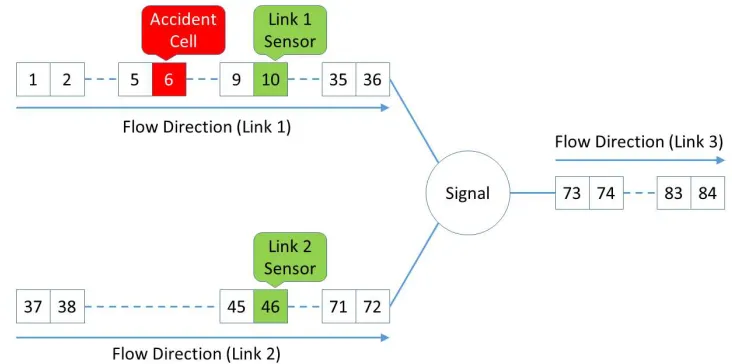
framework by simulating a signalized intersection affected with an incident. The simple network
8
consists of three links and a signalized merging intersection. Two links (link-1 and link-2), each of
9
two-lanes, are equipped with measurement sensors that provide real-time measurements of traffic
10
flows in cells-10 on link-1 and cell-46 on link-2. Links 1 and 2 are intersecting at the signalized
11
intersection S and merging on link-3 as shown in figure 2.
12
The synthetic network consists of 84 cells, each of 83.33 meters in length. The length of
13
link-1 is 2.9 km from cells 1-36 with cell-1 as a dummy cell having the infinite holding capacity.
14
The length of link-2 is similar to the length of link-1 with cells from 37-72. The length of link-3 is
15
1 km with 12 cells from cell 73-84. Free flow speed is taken as 60 km/hr, which corresponds to
16
time-step of 5 seconds. The capacity flow rate is 1800 veh/hr/ln and shockwave speed is taken as
17
20 km/hr. The simulation horizon is 90mins (1080 time-steps). Traffic demand for link-1 and
18
link-2 is constant at 2160 veh/hr for time-steps 1 to 900. After time-step 900, the traffic demand is
19
zero for both the links to simulate the cooling-off effect. Link-1 is affected by an accident for 15
20
mins starting from the 30th minute (time-step=360). The accident occurs in cell-6 of link-1, which
21
completely blocks both the lanes for 5 mins (time-step= 360 to 420), followed by one lane
22
blockage for following ten minutes (time-step= 421 to 540).
23
The optimal signal timings are estimated using GA, which estimates the optimal green time
24
between 20 and 180 seconds. Whereas, the optimal cycle length is estimated between 20 and 300
25
seconds in 30 iterations.
The measurement sensor is placed downstream of the accident location at cell-10 in the
1
simulated network. The location of the sensor affects the accuracy of the estimated traffic state
2
during an incident and the effect of the accident on traffic state is reflected at the sensor
3
downstream of the accident location (53). Therefore, a sensor is assumed downstream of the
4
affected cell. In a real-life scenario, the traffic sensor downstream of the accident location will be
5
important in estimating the affected traffic state. Ahmed et al. (53) can be referred for a detailed
6
discussion on this topic.
7 8
[image:10.612.122.488.172.354.2]9
FIGURE 2 Network Diagram showing cell and signal positions
10
The significance and performance of the proposed CTM-EKF-GA framework are
11
evaluated by comparing the optimal signal timing plans and resulting delays obtained by
12
CTM-EKF-GA framework with the signal timing plans and resulting delays in CTM-GA
13
framework and simulated reality. Thus, the network shown in figure 2 is simulated with three
14
different frameworks as follows:
15 16
Simulated Reality (SIM)
17
The scenario of simulated reality estimates optimal signal timings and resulting delays using a
18
CTM-GA model with perfect information about the duration, location, and impact of the incident.
19
The CTM model in simulated reality scenario (SIM) is provided with the exact location of the
20
accident, reduction in capacity and duration of the capacity drop due to the incident. SIM is
21
considered as the base scenario for comparison of the performance of CTM-EKF-GA and naïve
22
CTM-GA frameworks. SIM provides the best possible signal timing plan, which is based on a
23
perfectly aware (ideal) model and results in minimum (ideal) delay.
24 25
Naïve CTM-GA
26
CTM-GA scenario determines optimal timing plans using a naïve CTM model for simulation of
27
the predicted traffic state. CTM-GA and CTM-EKF-GA are simulated with exactly the same
28
traffic demand, assuming that there is no variation in traffic demand and it is not deviating from the
29
historic trend. The optimal signal timing plans obtained by naïve CTM-GA are applied to a
30
perfectly aware CTM model that is provided with all the details of the accident. This will
31
determine the actual delays that commuters will experience if the optimal timings plans obtained
32
by naïve CTM-GA are applied to a network affected with the incident.
CTM-EKF-GA Framework
1
CTM-EKF-GA scenario is also based on a naïve CTM in the background for modeling traffic flow
2
and no direct information about the incident is provided to CTM-EKF-GA model. However,
3
CTM-EKF-GA framework is capable of estimating real-time changes using real-time
4
measurements from the sensors and EKF technique. The synthetic measurements for sensors are
5
generated using a perfectly aware CTM model (running as part of CTM-EKF-GA model) which
6
provides measurements of traffic flows only for the cells with measurement sensors (cell-10 and
7
46) to the CTM-EKF-GA framework. A white Gaussian noise is also added in the measurements
8
to represent the error in actual measurements corrupted with noise.
9
The optimal signal timing plans obtained using CTM-EKF-GA model is applied to the
10
perfectly aware CTM model to simulate traffic state and estimate delays for optimal signal timing
11
plans proposed by CTM-EKF-GA model. This reflects the actual delay experienced by commuters
12
if the signal timings proposed by CTM-EKF-GA are implemented on the affected network. The
13
delay obtained by implementing CTM-EKF-GA on perfectly aware CTM is used for evaluation of
14
the CTM-EKF-GA performance and comparison with other scenarios.
15 16
RESULTS AND DISCUSSION
17
The proposed CTM-EKF-GA framework is applied to the network shown in figure 2. The
18
performance and improvement achieved by CTM-EKF-GA framework are evaluated by
19
comparing the network delay faced by vehicles in CTM-EKF-GA scenario with the network delay
20
in CTM-GA model and simulated reality. The simulation results of all three scenarios are
21
discussed in this section.
22 23
Simulated Reality
24
Cell occupancies for the scenario of simulated reality are shown in figure 3. Variation in cell
25
occupancies for all the cells in links 1, 2 and 3 for the entire simulation horizon can be observed
26
from this figure. The results of simulation obtained in this scenario are used to compare with the
27
other two scenarios (CTM-GA and CTM-EKF-GA) to evaluate their performance. Simulated
28
reality shows the dynamics of traffic network in a system which has perfect information about the
29
duration and intensity of the accident.
30
The drop in capacity of cell-6 during the incident results in low vehicle occupancy for the
31
cells downstream of incident location and high vehicle occupancy on the upstream of the incident
32
location (cell-6). After the incident is cleared, the entire link-1 can be observed in congestion, due
33
to the increased demand and stopped vehicles during the incident. These occupancies are obtained
34
when the network is simulated with an optimal signal plan obtained using CTM-GA model with
35
perfect information about the incident.
1
FIGURE 3 Cell occupancy for the network in simulated reality
2
The delay experienced (veh*time-step) with optimal timing in simulated reality is shown
3
in Figure 4. It shows that before the incident few cells upstream of the signal were congested in
4
link-1. During the incident, all the cells of link-1 downstream of the incident location have no
5
delay, as the outflow from cell-6 is restricted and capacity is reduced during the incident. Link-3
6
always remains in the free-flow state as traffic demand for link-3 is always less than the available
7
capacity of the link.
8 9
[image:12.612.74.538.352.519.2]10
FIGURE 4 Delay experienced by the vehicles in simulated reality
11 12
Naïve CTM-GA Framework
13
The simulation results obtained by simulating the network with CTM-GA framework are
14
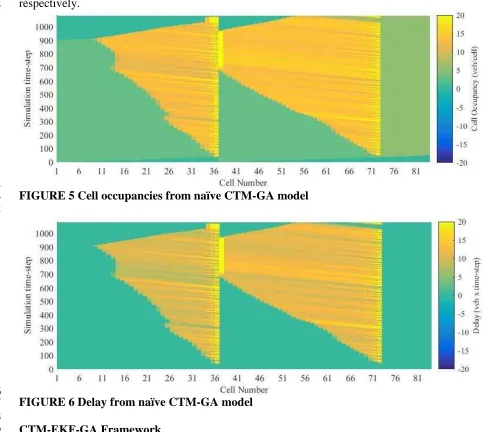
discussed in this section. Figure 5 shows cell occupancies when naïve CTM-GA framework has no
15
information about the incident. This figure shows cell occupancies if the network was not affected
16
and there was no incident. The comparison of figure-5 and figure-3 reveals the difference in
17
predicted network state using naïve CTM and the simulated reality, which highlights the
18
importance of using real-time information for optimization during the disrupted state. Figure-6
19
shows predicted delays using naïve CTM-GA model for the entire simulation horizon. Figure 6
20
shows that the cells upstream of the signals experience congestion, as the demand is higher than
21
the available capacity of the signalized intersection. This results in a gradual queue buildup till
22
time-step 900, as the network is simulated with traffic demand till time-step 900. The gradual drop
in cell occupancies and delay after time-step 900 can be seen from figure-5 and figure-6,
1
respectively.
2
[image:13.612.53.542.76.508.2]3
FIGURE 5 Cell occupancies from naïve CTM-GA model
4 5
6
FIGURE 6 Delay from naïve CTM-GA model
7 8
CTM-EKF-GA Framework
9
This results obtained by simulating the disrupted network with CTM-EKF-GA framework are
10
discussed in this section. Figure-7 shows a comparison of predicted and estimated cell occupancies
11
with the cell occupancies from the simulated reality scenario for selected cells in link-1. While
12
comparing the occupancies, it should be noted that the incident location is at cell-6 and sensor
13
location is at cell-10 in link-1. In cell-5, which is upstream of the incident cell, the estimated traffic
14
state is not much different from the simulated reality, whereas the predicted traffic state deviates
15
significantly from the actual traffic condition during the incident. However, the CTM-EKF is
16
unable to detect the drop in flow due to the incident from cell-6 to cell-10, as the information about
17
reduced flow is provided by the sensor at cell-10. Ahmed et al (53) discussed this phenomenon of
18
difference in estimated density while estimating real-time traffic state in a network affected by the
19
incident. Thus, the traffic state estimated by CTM-EKF-GA framework might deviate from the
20
actual traffic state from the affected cell to the cell containing the sensors, which is still better than
21
naïve CTM or just measurements from two consecutive sensors. This shortcoming can be
22
improved by future research in incident detection and real-time capacity estimation for all the cells
23
in the network.
Cell occupancy for cell-5 Cell occupancy for cell-7
Cell occupancy for cell-9 Cell occupancy for cell-11
FIGURE 7 Comparison of predicted (CTM-GA) and estimated (CTM-EKF-GA) cell
1
occupancies with the simulated reality for selected cells in link-1
2
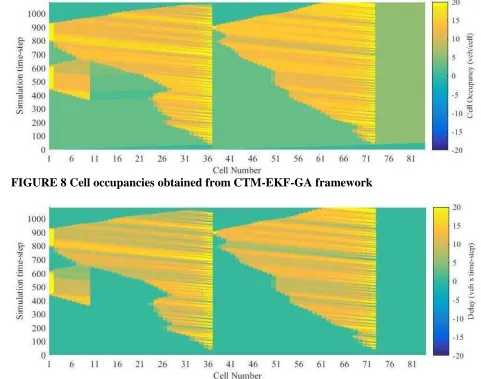
Figure 8 shows estimated cell occupancies using CTM-EKF-GA framework for the
3
network for the entire simulation horizon. The comparison of figure-3 with figure-8 indicates the
4
difference between the estimated state and the actual state (simulated reality). It can be observed
5
that the spillback at the upstream of cell-6 is tracked at cell-10 (sensor cell) in CTM-EKF-GA
6
framework. Whereas for the cells downstream of sensor location, the estimated traffic state
7
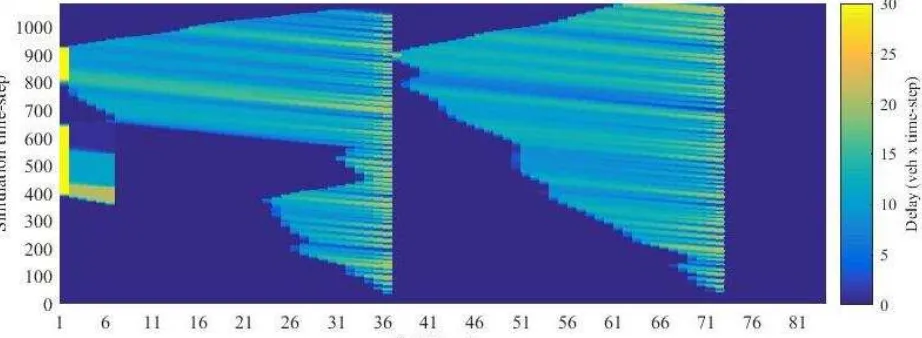
matches with the simulated reality. Figure 9 shows delay for all the cells in the network for the
8
entire simulation horizon.
[image:14.612.69.547.55.437.2]1
FIGURE 8 Cell occupancies obtained from CTM-EKF-GA framework
2 3
4
FIGURE 9 Estimated delays from CTM-EKF-GA
5 6
Comparison of Outputs from Naïve CTM-GA and CTM-EKF-GA with Simulated Reality
7
This section compares various outputs from simulation results obtained from naïve CTM-GA and
8
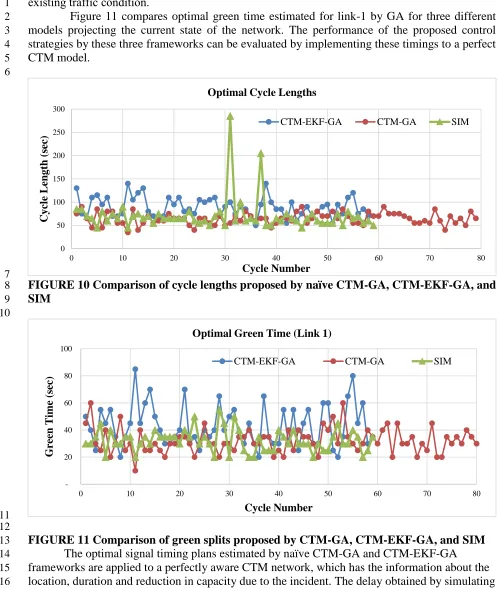
CTM-EKF-GA framework with the simulated reality (SIM). Figure 10 compares the optimal
9
cycle lengths obtained using CTM-GA, CTM-EKF-GA, and SIM. Figure 10 shows that the
10
number of cycles in CTM-EKF-GA and SIM is approximately equal in the simulation horizon,
11
while the number of cycles in CTM-GA is comparatively higher, due to the difference in duration
12
of the cycle.
13
The actual reason for shorter cycle lengths estimated by CTM-GA (in comparison with
14
CTM-EKF-GA) is that the CTM-GA model does not have any information about the incident and
15
it estimates the optimal cycles as if there were no incident. Therefore, the cycle lengths estimated
16
by CTM-GA are shorter and remain almost the same throughout the simulation horizon.
17
CTM-EKF-GA is based on a naïve CTM model and estimates the real-time traffic state
18
based on information from limited point sensors. Thus, SIM and CTM-EKF-GA have the
19
capability to track real-time changes in traffic state due to the incident. Therefore, CTM-EKG-GA
20
and SIM models propose longer cycles when the network dynamics change due to the incident.
21
However, the strategies evaluated by the CTM-EKF-GA and SIM are different due to the
22
non-deterministic nature of the employed optimization algorithm (GA). Nevertheless, both the
23
strategies attempt to meet the same objective, which is to minimize the network delay based on the
existing traffic condition.
1
Figure 11 compares optimal green time estimated for link-1 by GA for three different
2
models projecting the current state of the network. The performance of the proposed control
3
strategies by these three frameworks can be evaluated by implementing these timings to a perfect
4
CTM model.
5
6
[image:16.612.44.542.63.652.2]7
FIGURE 10 Comparison of cycle lengths proposed by naïve CTM-GA, CTM-EKF-GA, and
8
SIM
9 10
[image:16.612.69.542.142.339.2]11 12
FIGURE 11 Comparison of green splits proposed by CTM-GA, CTM-EKF-GA, and SIM
13
The optimal signal timing plans estimated by naïve CTM-GA and CTM-EKF-GA
14
frameworks are applied to a perfectly aware CTM network, which has the information about the
15
location, duration and reduction in capacity due to the incident. The delay obtained by simulating
16
perfect CTM model with CTM-GA and CTM-EKF-GA model depicts actual delays that these
17
timing plans will produce on an affected traffic network. Figure 12 shows delay for all the cells in
18
the network with CTM-EKF-GA proposed signal plan simulated with perfect CTM. The
19
comparison of figures 12 and 13 shows the significance and improvement by implementing the
20
timing plans proposed by CTM-EKF-GA to a disrupted network. Figure 14 shows the difference
21
0 50 100 150 200 250 300
0 10 20 30 40 50 60 70 80
C
ycl
e
L
engt
h
(se
c)
Cycle Number Optimal Cycle Lengths
CTM-EKF-GA CTM-GA SIM
20 40 60 80 100
0 10 20 30 40 50 60 70 80
G
re
en
T
im
e
(se
c)
Cycle Number Optimal Green Time (Link 1)
of network-wide occupancies during the simulation horizon by subtracting the occupancies
1
obtained by implementing CTM-GA and CTM-EKF-GA frameworks to the perfect CTM. The
2
implementation of CTM-EKF-GA framework shows a significant improvement in overall network
3
delay during the incident.
4 5
[image:17.612.81.542.130.299.2]6
FIGURE 12 Estimated delay obtained by CTM-EKF-GA proposed plans to perfect CTM
7 8
[image:17.612.82.531.341.506.2]9
FIGURE 13 Network-wide delays obtained by implanting CTM-GA signal plan to perfect
10
CTM model
1
FIGURE 14 Difference of cell occupancies obtained by simulating perfect CTM with timings
2
proposed by CTM-GA and CTM-EKF-GA (CTM-GA minus CTM-EKG-GA)
3
The simulated reality (SIM) scenario is considered as an ideal framework and the
4
performance of CTM-GA and CTM-EKF-GA are compared with simulated reality. SIM proposed
5
timing plans resulted in the lowest total delay for the entire simulation horizon (1.5 hrs) with 644.4
6
veh-hr. In comparison with SIM, the total network delay using timings proposed by
7
CTM-EKF-GA is only 0.6% higher than the simulated reality scenario (648.5 veh-hrs). Whereas,
8
the timing plans proposed by naïve CTM-GA model result in a total network delay of 727.4
9
veh-hr, which is 12.9% higher than the simulated reality and 12.1% higher than the total network
10
delay resulted using CTM-EKF-GA model.
11 12
CONCLUSIONS
13
This research paper proposes a novel framework for optimizing traffic signal control based on
14
CTM-based real-time traffic state estimation. The existing literature in the optimization of traffic
15
control is mainly based on either traffic flow models or direct measurements from various
16
real-time measurement technologies. The research, for the first time, utilizes a traffic flow
17
model-based estimation techniques and uses CTM-EKF based real-time estimated state for
18
optimizing traffic control using the GA technique. The proposed framework in this research does
19
not depend on GA, but any heuristic optimization algorithms (such as cross entropy method,
20
Simulated Annealing, etc.) can be applied in place of GA. As this optimization problem is
21
non-smooth, this research is focused on finding a reasonably good solution, not the global one
22
(which is impossible to obtain).
23
The proposed CTM-EKF-GA framework is applied to a synthetic network, disrupted with
24
an incident. Simulation results show that a reduction of 12.1% in total network delay is achieved
25
by using CTM-EKF-GA model instead of CTM-GA model. The network delay by CTM-EKF-GA
26
is only 0.6% higher than the network delay estimated with a simulated reality which is based on
27
perfect CTM model. This difference in performance on CTM-EKF-GA can also be improved if the
28
incident location, duration, and impact of the incident are also estimated using a real-time capacity
29
estimation of all the cells in the network. This research only utilizes GA as an optimization tool to
30
determine optimal timing plans, which may be extended to include some other optimization
31
algorithms to evaluate the performance of various algorithms with real-time traffic estimation. The
32
proposed framework may also be extended to estimate real-time traffic state using the real-time
33
data available from connected vehicles, which may reduce the dependency on a network of costly
sensors installed throughout the network to provide real-time measurements, as connected vehicles
1
can be used as mobile sensors spread throughout the network.
2
This research develops a framework for optimization of a standalone signalized
3
intersection, which can be expanded for network optimization and signal coordination. Signal
4
offset optimization can be improved by utilizing model-based real-time traffic state estimation.
5 6
Author Contribution Statement
7
The authors confirm contribution to the paper as follows: 8
Study conception and design: A. Ahmed 9
Simulation and Modeling: S.A.A. Naqvi, D. Ngoduy, D. Watling 10
Draft manuscript preparation: A. Ahmed, S.A.A. Naqvi, D. Ngoduy, D. Watling 11
Analysis and interpretation of results: A. Ahmed, S.A.A. Naqvi, D. Ngoduy, D. Watling 12
REFERENCES
13
1. Smith, M., and R. Mounce. A splitting rate model of traffic re-routeing and traffic control. 14
Procedia-Social and Behavioral Sciences, Vol. 17, 2011, pp. 316-340. 15
2. Smith, M. J. The stability of a dynamic model of traffic assignment—an application of a method of 16
Lyapunov. Transportation Science, Vol. 18, No. 3, 1984, pp. 245-252. 17
3. Ben-Akiva, M., M. Bierlaire, H. Koutsopoulos, and R. Mishalani. DynaMIT: a simulation-based system 18
for traffic prediction.In DACCORS Short Term Forecasting Workshop, The Netherlands, Citeseer, 1998. 19
4. Mirchandani, P., and L. Head. A real-time traffic signal control system: architecture, algorithms, and 20
analysis. Transportation Research Part C: Emerging Technologies, Vol. 9, No. 6, 2001, pp. 415-432. 21
5. Donati, F., V. Mauro, G. Roncolini, and M. Vallauri. A hierarchical decentralized traffic light control 22
system. The first realisation" Progetto Torino". 1984. 23
6. Henry, J.-J., J.-L. Farges, and J. Tuffal. The PRODYN real time traffic algorithm.In IFACIFIPIFORS 24
CONFERENCE ON CONTROL IN, 1984. 25
7. Gartner, N. H. OPAC: A demand-responsive strategy for traffic signal control. 1983. 26
8. Hunt, P., D. Robertson, R. Bretherton, and R. Winton. SCOOT-a traffic responsive method of 27
coordinating signals.In, 1981. 28
9. Lowrie, P. The Sydney coordinated adaptive traffic system-principles, methodology, algorithms.In 29
International Conference on Road Traffic Signalling, 1982, London, United Kingdom, 1982. 30
10. Chandler, N., and D. Cook. Traffic control studies in London: SCOOT and bus detection.In, 1985. 31
11. Ahmed, A., D. Ngoduy, and D. Watling. Prediction of traveller information and route choice based on 32
real-time estimated traffic state. Transportmetrica B: Transport Dynamics, Vol. 4, No. 1, 2016, pp. 23-47. 33
12. Wang, Y., P. Coppola, A. Tzimitsi, A. Messmer, M. Papageorgiou, and A. Nuzzolo. Real-time freeway 34
network traffic surveillance: Large-scale field-testing results in southern Italy. Intelligent Transportation 35
Systems, IEEE Transactions on, Vol. 12, No. 2, 2011, pp. 548-562. 36
13. Wang, Y., M. Papageorgiou, and A. Messmer. Real-time freeway traffic state estimation based on 37
extended Kalman filter: Adaptive capabilities and real data testing. Transportation Research Part A: Policy 38
and Practice, Vol. 42, No. 10, 2008, pp. 1340-1358. 39
14. Wang, Y. B., and M. Papageorgiou. Real-time freeway traffic state estimation based on extended 40
Kalman filter: a general approach. Transportation Research Part B-Methodological, Vol. 39, No. 2, 2005, 41
pp. 141-167. 42
15. Meier, J., and H. Wehlan. Section-wise modeling of traffic flow and its application in traffic state 43
estimation.In Intelligent Transportation Systems, 2001. Proceedings. 2001 IEEE, IEEE, 2001. pp. 440-445. 44
16. Muñoz, L., X. Sun, R. Horowitz, and L. Alvarez. Traffic density estimation with the cell transmission 45
model.In American Control Conference, 2003. Proceedings of the 2003, No. 5, IEEE, 2003. pp. 3750-3755. 46
17. Gang, L., G. Jiang, and Z. Cai. Traffic State Estimation Method for Arterial Street.In International 47
Conference on Transportation Engineering 2007, ASCE, 2007. pp. 443-448. 48
18. Tampere, C. M. J., and L. H. Immers. An extended Kalman filter application for traffic state estimation 49
using CTM with implicit mode switching and dynamic parameters. 2007 Ieee Intelligent Transportation 50
19. Long, J., Z. Gao, H. Ren, and A. Lian. Urban traffic congestion propagation and bottleneck 1
identification. Science in China Series F: Information Sciences, Vol. 51, No. 7, 2008, pp. 948-964. 2
20. Long, J., Z. Gao, X. Zhao, A. Lian, and P. Orenstein. Urban traffic jam simulation based on the cell 3
transmission model. Networks and Spatial Economics, Vol. 11, No. 1, 2011, pp. 43-64. 4
21. Hadi, M. A., and C. E. Wallace. Hybrid genetic algorithm to optimize signal phasing and timing. 1993. 5
22. Foy, M. D., R. F. Benekohal, and D. E. Goldberg. Signal timing determination using genetic algorithms. 6
Transportation Research Record, No. 1365, 1992, p. 108. 7
23. Lo, H. K. A novel traffic signal control formulation. Transportation Research Part A: Policy and 8
Practice, Vol. 33, No. 6, 1999, pp. 433-448. 9
24. Park, B., C. Messer, and T. Urbanik II. Enhanced genetic algorithm for signal-timing optimization of 10
oversaturated intersections. Transportation Research Record: Journal of the Transportation Research 11
Board, No. 1727, 2000, pp. 32-41. 12
25. Park, B., C. Messer, and T. Urbanik. Traffic signal optimization program for oversaturated conditions: 13
genetic algorithm approach. Transportation Research Record: Journal of the Transportation Research 14
Board, No. 1683, 1999, pp. 133-142. 15
26. Li, X., Z. Zhao, L. Liu, Y. Liu, and P. Li. An Optimization Model of Multi-Intersection Signal Control 16
for Trunk Road under Collaborative Information. Journal of Control Science and Engineering, Vol. 2017, 17
2017. 18
27. Wada, K., T. Akamatsu, and S. Kikuchi. Convergence of day-to-day traffic flow dynamics under 19
tradable bottleneck permits. WIT Transactions on The Built Environment, Vol. 101, 2008. 20
28. Lo, H. K., E. Chang, and Y. C. Chan. Dynamic network traffic control. Transportation Research Part 21
A: Policy and Practice, Vol. 35, No. 8, 2001, pp. 721-744. 22
29. Ukkusuri, S. V., and S. T. Waller. Linear programming models for the user and system optimal dynamic 23
network design problem: formulations, comparisons and extensions. Networks and Spatial Economics, Vol. 24
8, No. 4, 2008, pp. 383-406. 25
30. Ziliaskopoulos, A. K. A linear programming model for the single destination system optimum dynamic 26
traffic assignment problem. Transportation Science, Vol. 34, No. 1, 2000, pp. 37-49. 27
31. Zhang, L., Y. Yin, and S. Chen. Robust signal timing optimization with environmental concerns. 28
Transportation Research Part C: Emerging Technologies, Vol. 29, 2013, pp. 55-71. 29
32. Li, Z. Modeling arterial signal optimization with enhanced cell transmission formulations. Journal of 30
Transportation Engineering, Vol. 137, No. 7, 2010, pp. 445-454. 31
33. Lin, W.-H., and C. Wang. An enhanced 0-1 mixed-integer LP formulation for traffic signal control. 32
IEEE Transactions on Intelligent transportation systems, Vol. 5, No. 4, 2004, pp. 238-245. 33
34. Lioris, J., R. Pedarsani, F. Y. Tascikaraoglu, and P. Varaiya. Platoons of connected vehicles can double 34
throughput in urban roads. Transportation Research Part C: Emerging Technologies, Vol. 77, 2017, pp. 35
292-305. 36
35. Talebpour, A., and H. S. Mahmassani. Influence of connected and autonomous vehicles on traffic flow 37
stability and throughput. Transportation Research Part C: Emerging Technologies, Vol. 71, 2016, pp. 38
143-163. 39
36. Agbolosu-Amison, S. J., I. Yun, and B. B. Park. Quantifying benefits of a dynamic gap-out feature at an 40
actuated traffic signalized intersection under cooperative vehicle infrastructure system. KSCE Journal of 41
Civil Engineering, Vol. 16, No. 3, 2012, pp. 433-440. 42
37. Christofa, E., J. Argote, and A. Skabardonis. Arterial queue spillback detection and signal control based 43
on connected vehicle technology. Transportation Research Record: Journal of the Transportation 44
Research Board, No. 2356, 2013, pp. 61-70. 45
38. Day, C. M., H. Li, L. M. Richardson, J. Howard, T. Platte, J. R. Sturdevant, and D. M. Bullock. 46
Detector-Free Optimization of Traffic Signal Offsets with Connected Vehicle Data. Transportation 47
Research Record: Journal of the Transportation Research Board, No. 2620, 2017, pp. 54-68. 48
39. Goodall, N., B. Smith, and B. Park. Traffic signal control with connected vehicles. Transportation 49
40. Lin, X., J. Xu, P. Lin, C. Cao, and J. Liu. Improved Road-Network-Flow Control Strategy Based on 1
Macroscopic Fundamental Diagrams and Queuing Length in Connected-Vehicle Network. Mathematical 2
Problems in Engineering, Vol. 2017, 2017. 3
41. Daganzo, C. F. The Cell Transmission Model - a Dynamic Representation of Highway Traffic 4
Consistent with the Hydrodynamic Theory. Transportation Research Part B-Methodological, Vol. 28, No. 5
4, 1994, pp. 269-287. 6
42. Daganzo, C. F. The cell transmission model, part II: network traffic. Transportation Research Part B: 7
Methodological, Vol. 29, No. 2, 1995, pp. 79-93. 8
43. Lin, W.-H., and D. Ahanotu. Validating the basic cell transmission model on a single freeway link. 9
PATH technical note; 95-3, 1995. 10
44. Lin, W.-H., and C. Daganzo. Technical description of NETCELL: General framework and data 11
structure. Institute of Transportation Studies, University of California, Berkeley, California PATH, 1994. 12
45. Muñoz, L., X. Sun, R. Horowitz, and L. Alvarez. Piecewise-linearized cell transmission model and 13
parameter calibration methodology. Transportation Research Record: Journal of the Transportation 14
Research Board, Vol. 1965, No. -1, 2006, pp. 183-191. 15
46. Li, X., and J.-Q. Sun. Signal Multiobjective Optimization for Urban Traffic Network. IEEE 16
Transactions on Intelligent Transportation Systems, 2018. 17
47. Wada, K., K. Usui, T. Takigawa, and M. Kuwahara. An optimization modeling of coordinated traffic 18
signal control based on the variational theory and its stochastic extension. Transportation Research Part B: 19
Methodological, 2017. 20
48. Ai, X., J. Yu, and S. Yang. Optimization of signal timing schedule of traffic network based on CTM.In 21
Control Conference (CCC), 2014 33rd Chinese, IEEE, 2014. pp. 3367-3372. 22
49. Wang, P., L. Jones, Q. Yang, and S. Gurupackiam. Cell transmission model based traffic signal timing 23
in oversaturated conditions. Journal of Central South University, Vol. 20, No. 4, 2013, pp. 1129-1136. 24
50. Chiu, Y.-C., H. Zheng, J. Villalobos, and B. Gautam. Modeling no-notice mass evacuation using a 25
dynamic traffic flow optimization model. IIE Transactions, Vol. 39, No. 1, 2007, pp. 83-94. 26
51. Gomes, G., and R. Horowitz. Optimal freeway ramp metering using the asymmetric cell transmission 27
model. Transportation Research Part C: Emerging Technologies, Vol. 14, No. 4, 2006, pp. 244-262. 28
52. Liu, Y., X. Lai, and G.-L. Chang. Cell-based network optimization model for staged evacuation 29
planning under emergencies. Transportation Research Record: Journal of the Transportation Research 30
Board, Vol. 1964, No. 1, 2006, pp. 127-135. 31
53. Ahmed, A., D. Watling, and D. Ngoduy. Significance of sensor location in real-time traffic state 32
estimation. Procedia Engineering, Vol. 77, 2014, pp. 114-122. 33