City, University of London Institutional Repository
Citation
:
Lichtenstein, Y., Cucuy, S. & Fink, L. (2015). Pre-defined and Optional Staging for the Deployment of Enterprise Systems: a case study and a framework. Enterprise Information Systems, 11(3), pp. 414-433. doi: 10.1080/17517575.2015.1057768This is the accepted version of the paper.
This version of the publication may differ from the final published
version.
Permanent repository link:
http://openaccess.city.ac.uk/18017/Link to published version
:
http://dx.doi.org/10.1080/17517575.2015.1057768Copyright and reuse:
City Research Online aims to make research
outputs of City, University of London available to a wider audience.
Copyright and Moral Rights remain with the author(s) and/or copyright
holders. URLs from City Research Online may be freely distributed and
linked to.
For Peer Review Only
Pre-defined and Optional Staging for the Deployment of Enterprise Systems: A Case Study and a Framework
Journal: Enterprise Information Systems
Manuscript ID: TEIS-2014-0033.R3 Manuscript Type: Original Article
Keywords: Enterprise Systems, Deployment, Staging, Real options, Risk, CRM
For Peer Review Only
Pre-defined and optional staging for the deployment of
enterprise systems: A case study and a framework
Abstract
The effective deployment of enterprise systems has been a major challenge for many
organizations. Customizing the new system, changing business processes, and integrating
multiple information sources are all difficult tasks. As such, they are typically done in
carefully planned stages in a process known as phased implementation. Using ideas from
option theory, this paper critiques aspects of phased implementation. One customer
relationship management (CRM) project and its phased implementation are described in
detail and ten other enterprise system deployments are summarized as a basis for the
observation that almost all deployment stages are pre-defined operational steps rather than
decision points. However, option theory suggests that optional stages, to be used only when
risk materializes, should be integral parts of project plans. Although such optional stages are
often more valuable than pre-defined stages, the evidence presented in this paper shows that
they are only rarely utilized. Therefore, a simple framework is presented; it first identifies
risks related to the deployment of enterprise systems, then identifies optional stages that can
mitigate these risks, and finally compares the costs and benefits of both pre-defined and
optional stages.
Keywords: enterprise systems; deployment; staging; real options; risk; CRM
For Peer Review Only
1. Introduction
While cloud computing, social networks, and other new technologies spark the public’s
imagination, enterprise systems continue to grow and evolve and to capture the attention of
chief information officers (CIOs). Enterprise systems are either commercial software
packages or self-developed systems that enable the integration of transaction-oriented data
and business processes throughout an organization. Vendors report that demand for enterprise
systems by both existing and new customers is increasing continuously. SAP reports a 16%
increase in software revenue from changes in volume and prices, and that 18% of software
orders, about forty-five thousand deals, are attributed to new customers (SAP 2010).
Although the incorporation of new technologies such as software as a service into enterprise
systems adds to their functionality and facilitates their deployment, many challenges remain
in the planning and implementation of enterprise systems. These include the involvement of
multiple stakeholders with differing and possibly conflicting interests and the need to
integrate across functions and modules, to standardize data and processes, and to rapidly
implement new systems such that existing operations are not interrupted (H. M. Beheshti and
C. M. Beheshti 2010; Gosain 2004; G. Pan, Hackney, and S. L. Pan 2008; Soh and Sia 2005).
To address such challenges, the literature suggests that technical customization and
organizational change be carefully choreographed to design, implement, stabilize, improve,
and finally transform the organization and its systems (Hong and Kim 2002; Leonard-Barton
1988; Zeng and Skibniewski 2013). In practice, enterprise systems are deployed in stages to
reduce the attendant risks and to facilitate learning within project teams and across
organizations (Luo and Strong 2004; Motwani, Subramanian, and Gopalakrishna 2005;
Wagner and Antonucci 2009). This type of gradual deployment, however, requires the ability
to identify risks and stages, to manage the interfaces among sub-projects, and to integrate the
knowledge gleaned from these efforts to achieve the overall objectives.
For Peer Review Only
This paper reports on a technique to better identify and evaluate the staging of
enterprise system deployment. The findings are based on a critical analysis of the staging
decisions made during the deployment of a customer relationship management (CRM)
system in a large organization. The detailed case study emphasizes relevance by addressing a
critical issue in the contemporary management of enterprise information systems, involving
practitioners directly in the research, and developing a feasible solution (Rosemann and
Vessey 2008). The applicability of these findings is confirmed through interviews with ten
experienced managers, each of whom describes the deployment of an enterprise system.
The suggested technique relies on a simple framework that includes three steps: (1)
identification of pre-defined stages, rough evaluation of their costs and benefits; (2)
identification of risk-items related to the deployment, identification of optional stages that
mitigate risk, and rough evaluation of their costs and benefits; (3) comparison of pre-defined
and optional stages and selection of the staging to be included in the deployment plan (may
require return to steps 1 and 2).
The contribution of the current paper is to the literature on both enterprise systems and
real options. The refinement of the standard technique of phased implementation should help
IT managers to better plan and implement the deployment of enterprise systems. The
framework is an enhancement of techniques commonly used by managers, who should
therefore find the framework easy to comprehend and apply. The case and framework are
also useful in demonstrating the practical implications of thoroughly understanding IT project
risk and of systematically managing it. In addition, contributions to the real options literature
include a focus on and enhancement of a specific project management technique. In contrast
to the broader and more general expositions of real options ideas found in the literature, one
type of option, that of staging, is focused upon and specific project management risks are
discussed, resulting in a simple framework attuned to deployment. This narrow and detailed
For Peer Review Only
focus has the potential to enhance the practicality of real options thinking for IT project
management.
2. Case background
The research site is a large communication service provider with more than two million
domestic and business customers. The company, for which the pseudonym iComm is used, is
one of the largest communication service providers in Israel. iComm employs several
thousand staff within a large engineering division, a domestic customer division, a business
customer division, and multiple call centers. The company is characterized by a technological
ethos and a culture of careful planning, which have been very useful for the present study.
This allows studying a project plan and deployment reasoning that were carefully crafted by
experienced IT managers in a technology-savvy organization. This ethos, however, is
probably responsible for the formation of an intricate architecture of home-grown systems
that makes the deployment of new systems very challenging.
This study focused on the deployment of an enterprise-wide CRM system, which has
become a strategic necessity for iComm given the blurring of boundaries between telephone,
internet, and cable television and the concomitant need to integrate products and customer
service. Motivated by this strategic drive, iComm wanted to enter the “CRM era” as quickly
as possible. However, it was burdened not only by its own complexity, but also by that of the
CRM system, which included product and service catalogues, sales management, technical
help desk management, and a customer preservation module. Indeed, about three hundred
interfaces were defined to help the CRM system integrate with iComm’s existing information
systems.
The enterprise-wide CRM system replaced several home-grown systems with limited
CRM functionalities. The latter included two sales management systems that were
For Peer Review Only
specifically developed and operated independently by each of the main business units and
two technical help desk management systems that were also separately developed and
operated by the two units. In addition, the new CRM system replaced some functionality of
the billing system, a technician assignment and scheduling system, and an order management
fulfillment system. Figure 1 presents this study’s main activities as related to iComm’s CRM
project.
[Insert Figure 1 about here]
Full access to the project planning documentation and to the CRM Project Office
manager (hereinafter “project manager”) were given to us (step 2a in Figure 1). About ten
interviews of two hours each with the project manager were conducted, mostly to gain an
understanding of company documentation, to identify and prioritize risks, to calculate costs
and benefits of the project, and to discuss pre-defined and optional staging. In preparing
material for the interviews, the project manager consulted several members of his staff. Other
managers, including the CIO, a financial analyst, and a senior IT architect were interviewed
as well (step 2b in Figure 1).
The complexity of organization and system, and the need to convert iComm’s data
architecture from a billing-centered to a CRM-centered structure, highlighted the issue of
deployment policy in the early planning stages of the project. On the one hand, the business
units and the chief executive officer (CEO) advocated making a “clean break,” in contrast to
a gradual transition from the old systems to the new CRM system. Such a sharp change
would confine operational glitches to a short period of time and eliminate the need to operate
the old and new systems in parallel. On the other hand, iComm’s IT department considered
gradual deployment an effective means of obtaining a stable system whose operation can be
learned before full deployment. The gradual approach contained several variations, including
a pilot confined to a specific geographical area and to a small number of customers, staged
For Peer Review Only
deployment of the system first in one business unit and then in the others, and scaled-down
deployment of most CRM functionality.
Several top management discussions about the deployment principles were held (step
1b in Figure 1). At the same time, the IT department and the project office studied several
deployment alternatives and assessed the constraints and risks associated with each. This
process led to the decision to deploy the system gradually. The project was divided into eight
main modules or sub-projects, including the product and services catalogue, sales
management, technical help desk management, customer preservation, and data conversion,
as detailed in the next section.
3. Pre-defined staging
Organizational learning is the process through which organizations enhance their knowledge
and improve their actions and performance (March and Olsen 1975). Module-by-module
implementation of enterprise systems is a viable alternative to full deployment because it
promotes a gradual leaning process by the organization, its vendors, and the respective teams
involved in the implementation (Luo and Strong 2004; Motwani, Subramanian, and
Gopalakrishna 2005). Organization-specific learning is needed because organizations
typically have different experiences with technology, processes, and ways of dealing with
change and outsourcing management. Therefore, pre-defined staging is used to allow learning
and reduce the risks inherent in the implementation of enterprise systems. This approach
involves implementation in planned stages to reduce the probability of unwanted outcomes,
such as cost overruns, missing functionality, or project failure. In addition, pre-defined stages
are often used when resources are limited; for example, if the number of available
deployment experts is limited, the system can be deployed gradually, one department at a
For Peer Review Only
time, thus ensuring that experts are on-hand during the deployment period in each
department.
iComm’s CRM project included several levels of pre-defined staging, the highest of
which was related to a strategic transformation of iComm’s focus from technology to
marketing, as noted by the CIO:
“Since 1997, when the strategic focus was changed, information systems were
gradually transformed from home-grown, efficiency-focused systems into
off-the-shelf enterprise systems that should enable market agility. This transformation
spanned more than ten years. The new systems were considered a strategic
imperative, thus the focus of the decision process was not on return on investment,
but on reducing operational problems. Thus, staging of both major investments
and within-project deployment was the norm.”
The two central types of staging used by iComm were functionality staging and
customer staging. Namely, gradual deployment of major functions and addressing different
customer groups gradually. Both may be seen as generalizations of the module-by-module
deployment reported for enterprise resource planning (ERP) systems as each module
addresses different functionality and different users. The CIO explained:
“Our thinking about CRM deployment, already in the initial presentation to the
board of directors, was to start with our business customers rather than with
domestic customers, because we expected competition in this segment….Our
legacy systems were divided into two main functional areas, technical-support
and marketing. So, we initially suggested four stages: business marketing,
business technical-support, domestic marketing, and domestic technical-support.
There were other staging possibilities, for example geographic area-by-area 2
For Peer Review Only
staging, but we decided on customer and functional staging starting with the most
contested segment and function.”
The CIO’s reasoning focused on an anticipated benefit: the new system was essential to
ensure market agility, which was urgently needed in the business segment and for marketing.
But from the learning perspective, this reasoning may be problematic as the focus is on the
benefit and not on learning. The order of staging, indeed, was reversed in later discussions, as
noted by the project manager:
“We considered starting with domestic customers because the functionality was
simpler. Business-customer needs and thus products were more complex, reflected
in the number and complexity of interfaces to other systems. So, we preferred to
deploy first with the easier customer segment, functionality, and interfaces.”
This reversal of priorities is consistent with learning and risk mitigation. The project
addresses the easier challenges first and postpones the most complex ones until later, when
the deployment experts understand the new system better and have acquired personal
experience with the customization and deployment teams. However, staging and learning
have their costs. First, partial system deployments characteristic of modular approaches
require the construction of interfaces to the legacy systems, which will gradually become
redundant as more functionality is deployed. Second, partial deployment involves
organizational costs. For example, in iComm, a staging possibility was rejected because it
undermined immediate value creation and endangered the change management process that
was trying to achieve quick wins (Kotter 1995). The project manager elaborated:
“We also discussed the possibility to deploy most but not all functionality for the
domestic customers. Marketing functionality is relatively complex; should we
delay it to a second stage? We decided not to do so, because marketing is central
in materializing the value of the system.” 2
For Peer Review Only
In parallel to these discussions, the possibility of geographical staging was considered.
As iComm was spread across several geographical areas, it seemed logical to experiment in
one area and then to deploy, possibly gradually, in other areas. The project manager
explained why geographical staging was eventually deemed inappropriate:
“A previous system, a technician scheduling system, was deployed gradually area
by area. It made sense because technicians were managed via forty-two local
centers. However, area by area deployment does not make sense for CRM
because we operate call centers uniformly with virtual customer queues, and
representative assignment is managed by availability and skill, not by location.”
Finally, simple, resource-related staging, in which customer representatives were
trained in batches of 30 per week and technical call center representatives were trained in
batches of 20 per week, was exploited at the research site. One of the goals of the employee
training was to alleviate the pressure on iComm’s customer-facing employees by reducing
availability and quality problems at the call centers while training for the new system and by
reducing overtime costs. In addition, this staging aimed to improve the training material, to
enhance training staff skills, and to increase the number of trainees that could participate in
subsequent training sessions.
Decisions about deployment were finalized by the CEO in a forum of IT and business
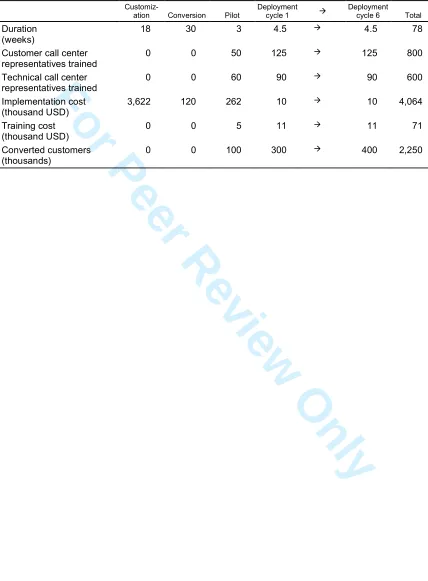
division managers. Project duration, including customization, data conversion, testing,
training, and deployment, would be 18 months. Deployment would begin with a pilot in the
domestic customer division that was scheduled to last about two months and expected to
convert1 about 100,000 customers and 100 representatives to the new system. Full
functionality would then be available and customers and representatives would be converted
1 Conversion represented the transformation of a customer record from the legacy systems into the new CRM system; namely, the information about the customer, product and services purchased, payment and so on was converted into the new system. Call center representatives who were trained to use the new system were also labeled as being part of the conversion.
For Peer Review Only
in six phases, each of which would last four weeks and cover up to 400,000 customers. The
initial deployment phases were planned at the domestic customer level and the final phases
were aimed at the business customer segment. Table 1 shows the main implementation and
deployment stages.
[Insert Table 1 about here]
To summarize, pre-defined staging of enterprise system deployment is the norm at the
research site, whose managers reason confidently, although in approximate terms, about the
costs and benefits of various staging possibilities. These include staging related to customer
segments, functionality, geography, and resources.
4. Optional staging
The staged deployment of enterprise systems – as described in the literature and exercised at
iComm – is common and has received considerable managerial attention. However, the
literature on real options shows that this type of pre-defined staging is often not optimal.
Real options theory estimates the value of managerial control in the progress of an
investment project. Managerial control refers to the ability of managers to affect the course of
a project by responding to uncertainty over time. The term real options, coined by Myers
(1977), reflects the notion that managerial control is merely a description of the options made
available to managers as part of a project and that it is contingent on the real assets
underlying the project rather than on financial instruments. Therefore, real options are rights
to future choices embedded within an investment in real assets. A significant steam of
research has applied real options theory to study IT investments (Ullrich 2013). This
literature has identified several types of real options, including deferral, staging, scaling up or
down, abandonment, growth or follow-up projects, and resource switching. However, the
main relevance of this literature to the current study is the realization that real options are not
For Peer Review Only
inherent in IT projects and, therefore, there is a need for an explicit risk identification
mechanism and an ability to embed in the deployment process the corresponding options
required to mitigate risk (Benaroch 2002). Specifically, the decision to initiate a deployment
stage should be contingent on the anticipated costs, benefits, and risks at the time the stage is
reached, similar to any sequential investment decision (Benaroch et al. 2007; Fichman, Keil,
and Tiwana 2005).
This line of thinking was applied to the iComm case in two steps: (1) risk identification
and costing, and (2) option identification and evaluation. The first step typically includes the
identification of risk items, evaluation of the likelihood and potential loss of each risk item,
planning risk mitigation techniques for each risk item, and monitoring the risks and
implementing the corresponding mitigations (Boehm 1991; ITIL 2011). The second step
systematically links options to risks. It is based on the logic of simply identifying staging
opportunities that reduce the consequences of materialized risk. The general approach to
pre-defined and optional staging is illustrated in Figure 2.
[Insert Figure 2 about here]
Thus, the process started by analyzing risks systematically. Although risks were
discussed by project managers and mentioned frequently in project documents, neither their
likelihood nor the magnitude of the potential loss was evaluated systematically. To fill this
gap, the main risks as mentioned in the project documents were written down, each risk was
discussed with the project manager (who consulted other managers of the project), and an
agreed upon likelihood and a potential loss for each risk item were recorded. An initial list of
about three dozen risks was reduced to ten main risk items that included: a schedule slip of up
to three months of the customization work, acceptance testing, or data conversion; missing
system functionality found during the testing stage; longer-than-expected service times for
customer problem solving, discovered during the pilot stage; lack of CRM expertise among
For Peer Review Only
the members of the deployment team; and overall failure of the pilot stage. These items were
consistent with previous reports about risks in IT projects and included project planning and
control risks, requirement related risks, and expertise or team related risks (Wallace, Keil,
and Rai 2004).
After determining the risks, they were linked with options. Several options reported in
the literature (Benaroch 2002) were considered, including the option to explore through pilots
or prototypes, the option to expand or reduce scale according to consequences, and the option
to stage (stop-resume). Less relevant to this study were options to defer an investment to
learn about its outcomes before committing, the option to abandon, options to lease or
outsource the project, and growth options that consider future investment opportunities
generated by the new system. These options were considered less applicable to the project
because the project office was tasked with deploying the system, while the commitments to
the system and to the outsourcing vendor were already made and were beyond the project
office’s prerogative, as were issues related to future investment or growth options.
The potential threat engendered in the list of risks is easily demonstrated by considering
the highest item on the risk list, a schedule slip of three months in the customization work.
Given that the planned duration of the project was 18 months and that the customization
phase was scheduled to last four months, such a schedule slip was considered disastrous.
Indeed, its occurrence would imply the existence of significant, fundamental problems in
requirement engineering, in the interaction between the vendor and client teams, and possibly
in project planning and control at the customization team level.
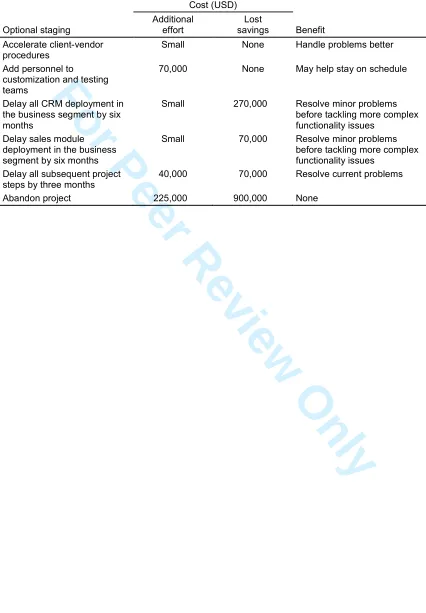
Table 2 summarizes the main points of the discussion with the project office about their
options in the event of such a schedule slip. The options were each assigned a cost, which
was roughly estimated according to two measures, the additional effort needed (for example,
to build temporary interfaces to legacy systems) and the savings lost due to late deployment.
For Peer Review Only
The numbers in the column for additional effort refer to the investment required, in USD, for
extra person months of system-analysts, developers, testing-engineers, training-personnel,
and CRM-experts (or champions) in the end-user departments. Lost savings are based on the
anticipated operational savings, mostly at the call centres, as a result of CRM deployment.
The loss of new opportunities that the system was expected to create was not taken into
account because of their high uncertainty. The option to abandon the project was added to
illustrate the cost ceiling.
Each of the optional staging entries in Table 2 was also assigned a qualitative benefit. It
was found that these were adequate descriptions for promoting the identification of viable
options and the subsequent discussions about them to select the best alternative. Detailed
option value calculations were performed for the main options, and one such calculation is
included in the Appendix. However, it was found that the complexity of modeling was not
matched by its benefit to the decision makers. This finding supports the notion that option
thinking is highly useful for IT project management, even in the absence of explicit modeling
and value calculation (Fichman, Keil, and Tiwana 2005).
[Insert Table 2 about here]
The discussion with the project manager led to the agreement that several of the options
should have been included in the project plan. In particular, the option to delay CRM
deployment in the business segment by either three or six months was considered prudent in
the event that the customization schedule slip were to materialize. Although this type of
staging was rejected in iComm’s management discussions about pre-defined staging, in the
context of active risk management (and of this research), it was readily agreed that this option
is highly efficient.
To summarize, prior to enterprise system deployment, its main risks should be
considered. For each risk item, options that minimize the loss if the risk occurs should be
For Peer Review Only
identified, and the estimated cost and anticipated benefit of each option discussed. Options
that represent efficient measures for minimizing loss can then be included in the deployment
project plan.
Figure 3 illustrates the proposed framework for staging the deployment of enterprise
systems. The more elaborate steps in the analytical process described in the framework
involve the consideration of risks and their corresponding options. Once options are linked to
risks, the process goes through the comparison and selection of pre-defined and optional
stages. This process is iterative in the sense that the identification of pre-defined stages
should be revisited upon making staging decisions. This iterative process was found to be
intuitive to the managers at iComm.
[Insert Figure 3 about here]
5. Validation
Following the case study at iComm, the common staging techniques used in the local
industry were examined (step 2c in Figure 1). For this preliminary examination, ten
experienced IT managers were selected from ten large organizations in multiple sectors of the
Israeli economy. These organizations included five government departments, one large
municipality, and one commercial organization each from the healthcare, banking, chemical,
and aircraft/defense industries. The senior managers, who all had between 20 and 30 years of
experience, were asked to identify and briefly describe a major enterprise system deployed in
their respective organizations during the last five years. The discussion with each manager
inquired about the staging techniques in terms of pre-defined and optional staging used to
deploy the enterprise system. Specifically, each manager was asked first to describe the
deployment planning for the selected enterprise system. Then, the terms pre-defined staging
and optional staging were explained to the manager, who was subsequently asked to describe
For Peer Review Only
the deployment plan again using the classification of stages as either pre-defined or optional.
The interviews were face to face (with one of the authors) and lasted between two to three
hours. The interviews were conducted at the headquarters of the respective organizations in
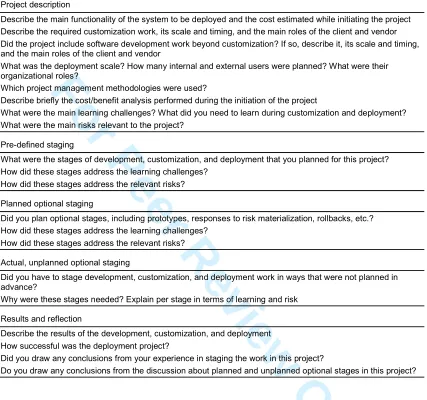
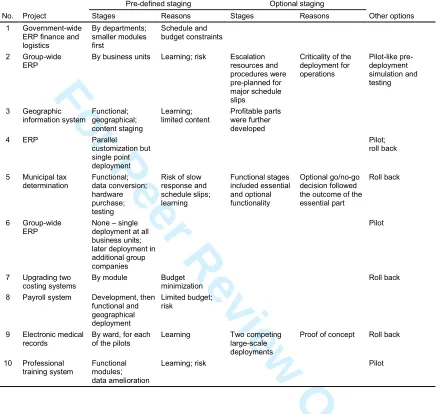
the Tel-Aviv area from November 2011 to March 2012. Table 3 describes the question
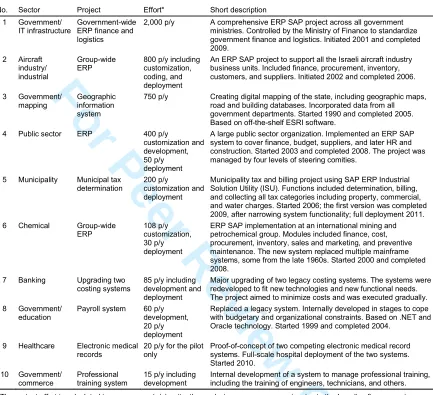
protocol that guided the interviews, Table 4 summarizes the resulting project descriptions,
and Table 5 presents the approach of these projects to pre-defined and optional staging.
[Insert Table 3 about here]
[Insert Table 4 about here]
[Insert Table 5 about here]
These interviews confirmed that while pre-defined staging is common, optional staging
is only seldom used. All respondents described some level of pre-defined staging related to
learning, resource constraints, or risk mitigation. Most projects included pre-defined staging
by function, some by geography, business unit, or company, and others used major project
tasks, such as development, customization, data improvement, and conversion, around which
to organize staging.
In contrast, as can be seen in Table 5, only four of the ten projects included some type
of optional staging; two projects included optional functionality or content that was planned
to be developed contingent on the successful deployment of the essential functionality or
content. One project included escalation procedures that comprised the optional involvement
of top executives and optional resources to handle schedule slip. Interestingly, many of the
managers that were interviewed recognized optional thinking as a common project
management technique. Specifically, the deployment of an initial system – a pilot – before
finalizing the full deployment plan was described in four of the ten projects. Rollback – the
option to revert to the previous system in case of failure of the development or of the
For Peer Review Only
deployment project – was also included in four projects. However, although option-thinking
was often incorporated at the beginnings and ends of projects, it was neither common nor
systematically employed in the planning of intermediate project stages. The validation step
confirmed the external validity of the case study (steps 2a and 2b in Figure 1) by showing
that the staging and risk management techniques used at iComm are standard practices in the
industry.
6. Lessons learned
Four important lessons for staging the deployment of enterprise systems may be learned from
this study.
6.1. Project managers should consider multiple types of pre-defined staging
To consider all possible stages, it is helpful to begin with a checklist of staging types that
includes:
Customer-segment staging: Often it is useful to start with customers who have simple
needs, an approach that fosters learning by the project managers before they are obligated to
contend with customers with more complex needs.
Functional staging: Start with simple functionality to learn the new system, its
customization issues, and the vendor team. This type of learning will help when addressing
complex functionality in later stages.
Geographical staging: Used mostly to reduce costs and risk exposure by focusing on a
specific locality; it is useful when each locality has only limited types of customers and
internal users and when each locality requires limited functionality.
Organizational staging: Starting with cooperative business units promotes conditions
favorable for learning how to resolve problems and to achieve quick wins. The lessons
For Peer Review Only
learned and expertise developed during the first stages will help project managers address
business units that present more challenges.
Infrastructure staging: Building the infrastructure first facilitates the resolution of
problems related to hardware, networks, and foundation software. This approach enables
demanding organizational problems typical of enterprise systems to be tackled when the
technological ‘ground’ is stable.
Resource-based staging: Learn by using a small amount of a specific resource – for
example, programming and customization personnel. Later customization and deployment
under full resource conditions is subsequently easier.
While managers at iComm considered different staging possibilities, they did not do so
systematically. The ten experienced IT managers with whom staging was discussed
confirmed that although staging was common, none of them used a formal tool or process to
systematically compare different staging possibilities. Therefore, a checklist such as that
described above could facilitate such a comparison. Managers should ask, for example, “what
organizational staging can we do?” For each staging possibility, the benefits in terms of
learning and risk reduction should be discussed and rough costs should be estimated.
Repeating this exercise for each staging type should help reveal a variety of opportunities to
facilitate learning and reduce the incidence of risk using pre-defined stages.
6.2. Project managers should tie optional staging to risks
The common practice of implementing pre-defined staging misses significant opportunities to
minimize loss when risks materialize. Although pre-defined staging assumes that there are
constraints and risks and that dealing with them entails a staged learning process, only the
inclusion of an explicit, systematic process for identifying and assessing the risks and their
corresponding optional stages will ensure that all staging possibilities are fully considered.
For Peer Review Only
As an example, consider organizational staging at iComm. A marked disparity existed
between the domestic and business customer divisions. Management estimated that the
products and processes of the business division possessed much higher complexity and risk
than those of the domestic division. The pilot system was thus planned to be deployed only in
the domestic customer division, on the basis of the assumption that uncertainties would be
resolved by this pilot deployment. But because iComm wanted to supply its business
customers with CRM functionality as soon as possible, actual deployment was planned to be
roughly at the same time in the two divisions.
Thus, although risk was understood and an effort was made to reduce the likelihood and
potential loss of unwanted outcomes, project managers had little planned in the event that
something went awry. One effective protective measure could be to delay the start of the
more complex parts of the project. For example, the project manager was asked to consider
the possibility that customization work would slip by a few months. He agreed that this was
the top risk item, and indeed he considered its occurrence to be plausible. Were this risk
actualized in the midst of the project with no optional staging, the possible reactions would be
limited – either continue with the original plan, in the process probably putting a lot of
pressure on the vendor and on iComm’s project team, or abandon the project. Therefore,
options to delay the sales module for the business customer division or the full functionality
for this division must be included as staging options to enable a systematic reaction to the
materialization of risk.
The lesson here is simple – if the potential for a major risk being realized has been
identified, one should try to reduce it. However, failure to completely neutralize the risk
mandates the consideration of options – to delay, to stage – ready for implementation should
the risk materialize.
For Peer Review Only
6.3. Pre-defined and optional staging often complement each other
There are several reasons why the two types of staging complement each other. As the
previous lesson shows, pre-defined stages are often included to reduce risk while optional
stages should be included to reduce the consequences of risk when it materializes. It is
therefore advisable to plan stages that reduce the probabilities of unwanted outcomes and
their potential losses. Managers should then complement their project planning by
considering their potential actions if risk materializes, often by planning optional staging.
Another explanation of the complementarity of pre-defined and optional staging is
related to a difference between learning and risk management. The logic of learning, which is
central to pre-defined stages, is that starting with simple tasks, or slow rates of deployment,
contributes to learning how to handle subsequently complex tasks or high rates of
deployment. The logic behind risk management, which underlies optional staging, dictates
that the riskiest steps be dealt with and resolved as early in the process as possible.2 Using
both types of logic should allow project managers to consider a large number and variety of
staging possibilities. However, the iComm research site and interviewees did not provide
examples of “risk first” staging. While “risk first” staging is probably relevant in projects
where technological risk is central and it is often resolved in a prototype or other early
optional staging, it is less relevant in the current context of enterprise systems where
organizational risks are paramount.
6.4. Optional staging is often much more valuable than pre-defined staging
Pre-defined stages focus on a normal, uneventful deployment. As such, their value is related
to improving the efficiency of the deployment process. Risk-related optional staging,
2 In general, stages can be performed nonlinearly, with the most risky shifted to as early or as late in the process as possible (Benaroch 2002); pre-defined and optional staging complement each other when early risk resolution is preferred.
For Peer Review Only
however, considers the occurrence of significant deployment problems, including even
disastrous events. Under such circumstances, therefore, the value of reducing loss is often
significant.
For example, consider the CRM deployment case. Managers at iComm considered six-
and nine-cycle deployments. A nine-cycle model was considered to allow for slower and
better learning of the deployment procedures and training of the call center representatives.
Moreover, it was also seen as a way to reduce the risks of schedule slips, poor training, and
poor representative knowledge of the new system. A six-cycle model was considered to
reduce the deployment work and the related organizational uncertainty. A rough estimate of
the added value of preferring the nine-cycle over the six-cycle model, as reasoned by the
project manager, was in the tens of thousands of dollars. In comparison, a conservative
estimate of the value of the option to delay CRM deployment at the business customer level
was USD 148,000 (see the Appendix).
7. Conclusion
Based on discussions with experienced IT managers and on ideas borrowed from option
theory, this paper identifies a weakness in the practice of staging the deployment of enterprise
systems. Therefore, a simple framework is suggested to improve this practice by adding to
the commonly used pre-defined stages the element of optional staging. Using data from a
large CRM deployment project, this paper showed how optional staging was related to risk
management and how it complemented pre-defined staging. The analysis also demonstrates
the usefulness of option theory thinking to practitioners, who find explicit modeling and
value calculation impractical. The suggested improvement seems practical, simple to
implement, and highly valuable in the deployment of enterprise systems.
For Peer Review Only
Appendix. Calculation of the value of an optional staging exampleThe staging option of deploying the CRM system at iComm first in the domestic customer
division and only much later in the business customer division was evaluated. This option is
to be exercised if a considerable slip in the customization work schedule is detected. The
evaluation was done using an Excel worksheet and a very simple modeling approach. Costs
and benefits were calculated per year, and benefits were either realized immediately (the
good scenario) or gradually over the course of four years (the scenario in which risk
materializes). Value was calculated for a ten-year horizon. The calculation, contained in a
single page, assumes acquaintance with basic finance techniques. The only non-trivial
calculation was of the implied volatility, which was easily done using an Excel macro
contained in John Hull’s book Options, Futures and Other Derivatives.
System benefits were calculated according to the call center cost reductions, better
marketing procedures, back-office cost savings, and a reduction in IT maintenance that
together totaled $2.9m in the domestic division and $526k in the business division (figures
are in US Dollars, at a rate of NIS 3.8 per USD). The setup costs, which included client and
vendor personnel, hardware, and software licenses, were $7.4m in iComm’s domestic
division and $1.6m in the business division. Annual costs (similar items to the setup costs)
were $790k and $526k in the domestic and business divisions, respectively.
To calculate the value of the staging option, two possible states, good and bad, of
nature (i.e., the project) were considered, such that the latter corresponded to the
materialization of risk. In the good state, benefits were realized immediately, whereas in the
bad state, benefits were only gradually realized. Two managerial decisions were also
modeled: deployment was either immediate in both divisions or it was staged, such that it was
immediate in the domestic division and late in the business division. To simplify the
calculation, a one-year delay was assumed.
For Peer Review Only
The benefits of deployment without staging included the immediate realization of
benefits, with the net present value (NPV) calculated at $1.5m. Under the scenario of gradual
realization (0% during the first year, 30% during the second year, 75% during the third year,
and 100% during fourth and subsequent years), the NPV was $450k.
The NPV with staging was then considered, but only in the bad state. There is no
reason to resort to staging if the risk does not materialize. The benefits of delaying
deployment in the business division by one year were expressed in an NPV of $746k.
To calculate the option value, for simplicity it was assumed that the probability of each
of the states of nature was 50%, so the option value was half (the probability of the bad state)
the difference between NPVs for immediate and staged deployment, namely: 0.5 × ($746k–
$450k) = $148k. In other words, the option was worth USD 148,000.
It is useful to understand the magnitude of risk the model represents. For simplicity, the
Black-Scholes formula was used with the assumptions that the stock was the full benefits
realized immediately, the option type was an American Call, and the exercise time was one
year. In other words, the second stage of deployment was allowed to start anytime during the
first year, including the project manager’s suggestion to include an option for a half year
delay. It was further assumed that the exercise price was the business division setup costs
($1,580k). A risk free rate of 10% was used because of the project’s considerable risk, and
the implied volatility was 21%. At almost twice the volatility of iComm’s stock during the
time this project was planned and contracted, the implied volatility thus represented
technological risk in addition to the underlying commercial risk.
For Peer Review Only
AcknowledgementWe are grateful to iComm managers, especially to EF and NG, for their invaluable help in
this study and for sharing their expertise with us.
References
Beheshti, H. M., and C. M. Beheshti. 2010. “Improving Productivity and Firm Performance
with Enterprise Resource Planning.” Enterprise Information Systems 4 (4): 445-472.
Benaroch, M. 2002. “Managing Information Technology Investment Risk: A Real Options
Perspective.” Journal of Management Information Systems 19 (2): 43-84.
Benaroch, M., M. Jeffery, R. J. Kauffman, and S. Shah. 2007. “Option-Based Risk
Management: A Field Study of Sequential Information Technology Investment
Decisions.” Journal of Management Information Systems 24 (2): 103-140.
Boehm, B. W. 1991. “Software Risk Management: Principles and Practices.” IEEE Software
8 (1): 32-41.
Fichman, R. G., M. Keil, and A. Tiwana. 2005. “Beyond Valuation: ‘Options Thinking’ in IT
Project Management.” California Management Review 47 (2): 74-96.
Gosain, S. 2004. “Enterprise Information Systems as Objects and Carriers of Institutional
Forces: The New Iron Cage?” Journal of the Association for Information Systems 5 (4):
151-182.
Hong, K. K., and Y. G. Kim. 2002. “The Critical Success Factors for ERP Implementation:
An Organizational Fit Perspective.” Information & Management 40 (1): 25-40.
ITIL (Information Technology Infrastructure Library) 2011. IT Service Management – ITIL
2011 Edition. http://www.itil-officialsite.com/.
Kotter, J. P. 1995. “Leading Change: Why Transformation Efforts Fail.” Harvard Business
Review 72 (2): 59-67.
Leonard-Barton, D. 1988. “Implementation as Mutual Adaptation of Technology and
Organization.” Research Policy 17 (5): 251-267.
Luo, W., and D. M. Strong. 2004. “Framework for Evaluating ERP Implementation
Choices.” IEEE Transactions on Engineering Management 51 (3): 322-333.
For Peer Review Only
March, J. G., and J. P. Olsen. 1975. “The Uncertainty of the Past: Organizational Learning
under Ambiguity.” European Journal of Political Research 3 (2): 147-171.
Motwani, J., R. Subramanian, and P. Gopalakrishna. 2005. “Critical Factors for Successful
ERP Implementation: Exploratory Findings from Four Case Studies.” Computers in
Industry 56 (6): 529-544.
Myers, S. C. 1977. “Determinants of Corporate Borrowing.” Journal of Financial Economics
5 (2): 147-175.
Pan, G., R. Hackney, and S. L. Pan. 2008. “Information Systems Implementation Failure:
Insights from PRISM.” International Journal of Information Management 28 (4):
259-269.
Rosemann, M., and I. Vessey. 2008. “Toward Improving the Relevance of Information
Systems Research to Practice: The Role of Applicability Checks.” MIS Quarterly 32
(1): 1-22.
SAP 2010. Annual Report. http://www.sap.com/corporate-en/investors/reports/annualreport/
2010/pdf/SAP_2010_Annual_Report.pdf.
Soh, C., and S. K. Sia. 2005. “The Challenges of Implementing ‘Vanilla’ Versions of
Enterprise Systems.” MIS Quarterly Executive 4 (3): 373-384.
Ullrich, C. 2013. “Valuation of IT Investments Using Real Options Theory.” Business &
Information Systems Engineering 5 (5): 331-341.
Wagner, W., and Y. L. Antonucci. 2009. “The ImaginePA Project: The First Large-Scale,
Public Sector ERP Implementation.” Information Systems Management 26 (3):
275-284.
Wallace, L., M. Keil, and A. Rai. 2004. “Understanding Software Project Risk: A Cluster
Analysis.” Information & Management 42 (1): 115-125.
Zeng, Y., and M. J. Skibniewski. 2013. “Risk Assessment for Enterprise Resource Planning
(ERP) System Implementations: A Fault tree Analysis Approach.” Enterprise
Information Systems 7 (3): 332-353.
For Peer Review Only
Figure 1. Methodology flow chart 2
For Peer Review Only
Yes
....
No
Plan and execute
Plan and execute should risk materialize
End of deployment plan Stage
1
Stage n
Optional stage
Risk materialized? Enterprise
deployment plan
Pre-defined stages
Optional stages
Figure 2. Pre-defined and optional staging
For Peer Review Only
Identify risk factors
Assess damage if
risk materializes
Identify options per
risk factor
Assess benefit of each option
Select main risks
Select best options Identify
pre-defined stages
Analyze
risk factors Map risk to options
Compare pre-defined
stages to optional
stages
Select pre-defined stages, plan
for optional stages
Figure 3. A framework for staging enterprise system deployment
For Peer Review Only
Table 1. Pre-defined stages
Customiz-ation Conversion Pilot
Deployment cycle 1
Deployment cycle 6 Total
Duration (weeks)
18 30 3 4.5 4.5 78
Customer call center representatives trained
0 0 50 125 125 800
Technical call center representatives trained
0 0 60 90 90 600
Implementation cost (thousand USD)
3,622 120 262 10 10 4,064
Training cost (thousand USD)
0 0 5 11 11 71
Converted customers (thousands)
0 0 100 300 400 2,250
For Peer Review Only
Table 2. Optional staging related to customization schedule slip of three months
Optional staging
Cost (USD)
Benefit Additional
effort
Lost savings Accelerate client-vendor
procedures
Small None Handle problems better
Add personnel to
customization and testing teams
70,000 None May help stay on schedule
Delay all CRM deployment in the business segment by six months
Small 270,000 Resolve minor problems before tackling more complex functionality issues
Delay sales module deployment in the business segment by six months
Small 70,000 Resolve minor problems before tackling more complex functionality issues
Delay all subsequent project steps by three months
40,000 70,000 Resolve current problems
Abandon project 225,000 900,000 None
For Peer Review Only
Table 3. Interview protocol (validation phase)
Project description
Describe the main functionality of the system to be deployed and the cost estimated while initiating the project Describe the required customization work, its scale and timing, and the main roles of the client and vendor Did the project include software development work beyond customization? If so, describe it, its scale and timing, and the main roles of the client and vendor
What was the deployment scale? How many internal and external users were planned? What were their organizational roles?
Which project management methodologies were used?
Describe briefly the cost/benefit analysis performed during the initiation of the project
What were the main learning challenges? What did you need to learn during customization and deployment? What were the main risks relevant to the project?
Pre-defined staging
What were the stages of development, customization, and deployment that you planned for this project? How did these stages address the learning challenges?
How did these stages address the relevant risks?
Planned optional staging
Did you plan optional stages, including prototypes, responses to risk materialization, rollbacks, etc.? How did these stages address the learning challenges?
How did these stages address the relevant risks?
Actual, unplanned optional staging
Did you have to stage development, customization, and deployment work in ways that were not planned in advance?
Why were these stages needed? Explain per stage in terms of learning and risk
Results and reflection
Describe the results of the development, customization, and deployment How successful was the deployment project?
Did you draw any conclusions from your experience in staging the work in this project?
Do you draw any conclusions from the discussion about planned and unplanned optional stages in this project?
For Peer Review Only
Table 4. Project descriptions (validation phase)
No. Sector Project Effort* Short description
1 Government/ IT infrastructure
Government-wide ERP finance and logistics
2,000 p/y A comprehensive ERP SAP project across all government ministries. Controlled by the Ministry of Finance to standardize government finance and logistics. Initiated 2001 and completed 2009.
2 Aircraft industry/ industrial
Group-wide ERP
800 p/y including customization, coding, and deployment
An ERP SAP project to support all the Israeli aircraft industry business units. Included finance, procurement, inventory, customers, and suppliers. Initiated 2002 and completed 2006.
3 Government/ mapping
Geographic information system
750 p/y Creating digital mapping of the state, including geographic maps, road and building databases. Incorporated data from all government departments. Started 1990 and completed 2005. Based on off-the-shelf ESRI software.
4 Public sector ERP 400 p/y
customization and development, 50 p/y deployment
A large public sector organization. Implemented an ERP SAP system to cover finance, budget, suppliers, and later HR and construction. Started 2003 and completed 2008. The project was managed by four levels of steering comities.
5 Municipality Municipal tax determination
200 p/y
customization and deployment
Municipality tax and billing project using SAP ERP Industrial Solution Utility (ISU). Functions included determination, billing, and collecting all tax categories including property, commercial, and water charges. Started 2006; the first version was completed 2009, after narrowing system functionality; full deployment 2011. 6 Chemical Group-wide
ERP
108 p/y customization, 30 p/y deployment
ERP SAP implementation at an international mining and petrochemical group. Modules included finance, cost, procurement, inventory, sales and marketing, and preventive maintenance. The new system replaced multiple mainframe systems, some from the late 1960s. Started 2000 and completed 2008.
7 Banking Upgrading two costing systems
85 p/y including development and deployment
Major upgrading of two legacy costing systems. The systems were redeveloped to fit new technologies and new functional needs. The project aimed to minimize costs and was executed gradually. 8 Government/
education
Payroll system 60 p/y development, 20 p/y deployment
Replaced a legacy system. Internally developed in stages to cope with budgetary and organizational constraints. Based on .NET and Oracle technology. Started 1999 and completed 2004.
9 Healthcare Electronic medical records
20 p/y for the pilot only
Proof-of-concept of two competing electronic medical record systems. Full-scale hospital deployment of the two systems. Started 2010.
10 Government/ commerce
Professional training system
15 p/y including development
Internal development of a system to manage professional training, including the training of engineers, technicians, and others.
* The project effort is calculated in person year (p/y) units; the analysis uses a common p/y price in the Israeli software services market of NIS 250,000, which is roughly USD 66,000.
For Peer Review Only
Table 5. Pre-defined and optional staging (validation phase)
No. Project
Pre-defined staging Optional staging
Other options
Stages Reasons Stages Reasons
1 Government-wide ERP finance and logistics By departments; smaller modules first Schedule and budget constraints
2 Group-wide ERP
By business units Learning; risk Escalation resources and procedures were pre-planned for major schedule slips
Criticality of the deployment for operations Pilot-like pre-deployment simulation and testing
3 Geographic information system Functional; geographical; content staging Learning; limited content Profitable parts were further developed
4 ERP Parallel
customization but single point deployment
Pilot; roll back
5 Municipal tax determination Functional; data conversion; hardware purchase; testing
Risk of slow response and schedule slips; learning Functional stages included essential and optional functionality Optional go/no-go decision followed the outcome of the essential part
Roll back
6 Group-wide ERP
None – single deployment at all business units; later deployment in additional group companies
Pilot
7 Upgrading two costing systems
By module Budget
minimization
Roll back
8 Payroll system Development, then functional and geographical deployment
Limited budget; risk
9 Electronic medical records
By ward, for each of the pilots
Learning Two competing
large-scale deployments
Proof of concept Roll back
10 Professional training system
Functional modules; data amelioration
Learning; risk Pilot
For Peer Review Only
Enterprise Information Systems, Manuscript ID TEIS-2014-0033.R3"Pre-defined and optional staging for the deployment of enterprise systems: A case study and a framework"
27-May-2015
Dear Professor Ip,
We appreciate the opportunity given to us to publish in Enterprise Information Systems and we wish to thank the editorial team for the additional constructive suggestions. We have acted upon these suggestions and we hope that the revised paper can now be formally accepted.
Referee: 2
Comment: "In validation, interview questions are still missing as well as "when and where" did you conducted it. Please tabulate the sample questions in a table. The time and place you conducted the interview should be mentioned on pages 15-16. After you making these two changes, the paper will be in final form."
Response: We now include an additional table in the paper (Table 3), which describes the question protocol that guided the interviews in the validation phase. We also include text in the paper itself (p. 16, highlighted in yellow) that describes where and when the interviews were conducted. Thank you for emphasizing the importance of this additional information, which allows readers to better understand the research methodologies leading to our findings.