C A S E S T U D Y
Open Access
Severe malaria in Canada, 2001
–
2013
Anne E McCarthy
1*, Chardé Morgan
1, Chatura Prematunge
2and Jennifer Geduld
3Abstract
Background:Imported malaria is the principal, preventable, life-threatening infection among Canadians travelling abroad. The Canadian Malaria Network supplies information and parenteral malaria therapy to healthcare providers treating severe and complicated malaria and gathers surveillance information on these cases.
Methods:Data were collected on the characteristics, risk factors, and clinical outcomes of severe malaria cases in Canada from June 2001 to December 2013.
Results:The need for parenteral therapy in Canada has increased in the last decade. The vast majority of cases are reported from Ontario and Quebec and occur among travellers to and from Africa. Regardless of country of birth, all persons originating from endemic and non-endemic countries are at a similar risk of malaria-related complications. Overall use and appropriateness of pre-travel advice and chemoprophylaxis remains low. Most cases result from patient delays in recognizing symptoms and seeking appropriate medical attention. Although some healthcare delays occurred in a select number of cases, the majority of patients were diagnosed quickly and were appropriately treated with parenteral therapy within a few hours of diagnosis.
Conclusions:Data from the Canadian Malaria Network provide insight into the characteristics of imported severe and complicated malaria infections in Canada. Improved understanding of this population can help target risk reduction strategies and interventions to limit personal susceptibility and healthcare treatment delays.
Keywords:Severe malaria, Imported malaria, Artesunate, Quinine
Background
Malaria is the principal, life-threatening, infection among international travellers from Canada, and a frequent health concern for individuals travelling between Canada and en-demic regions. The majority of malaria infections in Canada are imported and occur in new immigrants or Canadians travelling to their region of origin to visit friends and rela-tives (VFR) [1,2]. In 2009, 35% of Canadian travellers bound to destinations other than the USA visited regions with a risk of malaria, a 131% increase from 2000 [3]. Between 1991 and 2011, an average of 483 (range: 333–1032) mal-aria cases per year were reported to the Public Health Agency of Canada [4]. Many of these infections can be pre-vented through pre-travel healthcare consultation, appro-priate use of chemoprophylaxis, and personal protective measures to prevent mosquito bites. Moreover, the conse-quences of infection can be minimized through health care
provider knowledge of disease symptoms, early diagnosis and treatment.
Risk of severe malaria is associated with Plasmodium falciparum infection which progresses to severe disease, leading to clinical complications such as coma, renal failure, respiratory distress, or death [5]. Severe malaria infection can occur when malaria is not treated rapidly with appropriate anti-malarial therapy. Parenteral artesu-nate, introduced to Canada in 2009, is the preferred medication for the treatment of severe malaria due toP. falciparum. Parenteral quinine is the alternative therapy when artesunate is contra-indicated, or when the only indication for parenteral therapy is failure to tolerate oral therapy. Both drugs are made available in Canada via the Canadian Malaria Network (CMN) through Health Canada’s Special Access Programme that allows practitioners to request access to drugs that are unavail-able for sale in Canada [6-8].
The CMN is a national network of designated medical centres of malaria expertise across Canada that supply in-formation, rapidly distribute parenteral malaria therapy and collect surveillance data on severe and complicated
* Correspondence:[email protected] 1
Division of Infectious Diseases, The Ottawa Hospital, 501 Smyth Road, Ottawa, ON K1H 8L6, Canada
Full list of author information is available at the end of the article
malaria [6]. No research to date has collectively examined malaria infections requiring parenteral therapy in Canada. Therefore, with the aim of better understanding imported severe malaria infections in the region, surveillance data from CMN between 2001 and 2013 were analyzed to de-scribe national trends, risk factors and delays associated with accessing parenteral anti-malarial therapy across Canada.
Methods
Data collection
Data for cases accessing parenteral therapy were reported to CMN’s coordinating site. Attending physicians are re-quired to complete two case report forms, which are sup-plied with the treatment medication [see Additional file 1] Form A collects non-nominal information on patient demographics, travel history, infection, and treatment de-lays on day 1 of treatment. Form B collects follow-up infor-mation on disease outcome (s), health care requirements, drug utilization and adverse events seven days following initial treatment administration. Both forms are available on the CMN website.
Definitions
Severe malaria is defined by the clinical features established at the World Health Organization (WHO) that includes: History of recent possible exposure and no other related pathology OR asexual forms ofPlasmodium falciparumon blood smear AND any one or more of the following features: hyperparasitemia (>2% in non-immune, >5% in semi-immune); impaired consciousness or coma; prostration (unable to walk or sit up without assistance); multiple convulsions (>2 in 24hrs); respiratory distress (acidotic breathing); respiratory failure/pulmonary edema/ ARDS; circulatory collapse/shock (SBP<80mmHg adults and <50mmHg children); acute kidney injury/renal failure (Cr >265μmol/L or >upper limit for age for children); jaundice (total bilirubin >45μmol/L); abnormal spon-taneous bleeding/DIC; hypoglycemia (<2.2mmol/L); metabolic acidosis/acidemia (pH<7.25, HCO3<15m-mol/L); severe anemia (< 50g/L, in children; <70g/dL, in adults); hemoglobinuria (macroscopic); hyperlacta-taemia (lactate >5mmol/L) [7]. Complicated malaria is defined as malaria infection in an individual who can-not tolerate oral treatment (e.g., vomiting), without clinical features of severe disease.
All case reports submitted to CMN were reviewed by a tropical medicine physician (AM) to establish treat-ment and chemoprophylaxis appropriateness [7]. Appro-priate indication for parenteral anti-malarial treatment was classified as complicated malaria or severe malaria infection [7]. Chemoprophylaxis regimen appropriate-ness was established by travel destination and prevention
guidelines published by the Committee to Advise on Tropical Medicine and Travel (CATMAT) [9].
Patient birth countries were classified as malaria-endemic (mBC) or non-malaria-endemic (non-mBC) using the WHO list of malaria-endemic countries [10].
Patient delays were defined as days between symptom onset and initial Canadian physician visit. Healthcare system delays were defined as: 1) days between the first physician visit and laboratory-confirmed malaria diagnosis; 2) hours between laboratory-confirmed diagnosis and CMN treatment request; 3) hours between treatment re-quest and treatment receipt; and, 4) hours between treat-ment receipt and treattreat-ment administration. All delays are described as median values.
Therapy-related adverse events were classified as minor, serious or other. Minor adverse events were de-fined as symptoms of fatigue, dizziness and occasional tinnitus. Serious adverse events were defined as haemolysis, hypotension and delayed hemolysis. Delayed hemolysis was defined as hemolysis that occurred 1 - 3 weeks after initi-ation of treatment. Other adverse events were considered to be adverse outcomes unrelated to parental anti-malarial therapy alone and classified by the tropical medicine phys-ician (AM) reviewing case forms.
Data analysis
Data analysis was performed using Stata 13 [11]. Cases were separated by patient birth country and IV anti-malarial drug type. Results were compared using t-test, Chi-square test and Fisher’s exact test. Statistical signifi-cance was set atp<0.05.
Results
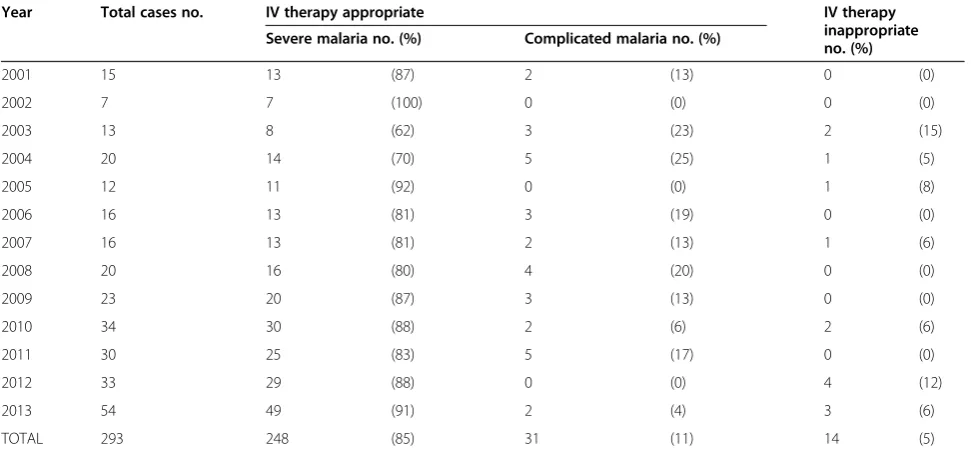
Between June 2001 and December 2013, 293 patients accessed IV quinine and/or artesunate treatment through CMN. Of these, 248 (85%) were treated for se-vere malaria, 31 (11%) for complicated malaria and 14 (5%) had neither severe nor complicated malaria and were classified as inappropriately treated. Overall, 95% (279) of parenteral treatment requests to CMN were ap-propriate (Table 1). Unless otherwise indicated, the remaining results focus on patients with severe malaria.
Severe malaria
therapy (82%) occurred in cities with a CMN site or sat-ellite site.
Demographics and risk factors
Severe malaria case demographic characteristics and travel-related risk factors are summarized in Tables 2 and 3. The majority of severe malaria cases (53%) oc-curred among mBC by visits to and from Africa (89%). The greatest percentage of cases originated from Ghana (12%), Nigeria (11%), Cameroon (7%) and Uganda (7%)
(Figure 2).Plasmodium falciparumaccounted for 94% of severe malaria infections. Although 36% accessed pre-travel advice and 23% reported chemoprophylaxis use, only 55% of chemoprophylaxis regimens were classified as appropriate.
There were no statistically significant differences among severe malaria cases of non-mBC and mBC with respect to region of exposure, appropriateness of chemo-prophylaxis regimens, species of infection or time to parasite clearance. However, mBC cases were younger (median age mBC 33 years vs non-mBC 41 years), less likely to have accessed pre-travel advice (mBC 19% vs non-mBC 56%), less likely to use chemoprophylaxis (mBC 16%vs non-mBC 31%) and more likely to report VFR (mBC 65% vs non-mBC 18%) as the predominant reason for travel. Although not statistically significant, a greater proportion of mBC travellers were children, female and reported a longer median length of travel.
Diagnosis and treatment delays
[image:3.595.56.542.101.327.2]Patient and healthcare system delays are summarized in Table 4. The median time between landing in Canada to illness was seven days. Patients waited a median of three days following symptom onset to seek medical treatment.
Following first presentation to a Canadian physician, most infections were laboratory confirmed within 24 hours. A 45-minute delay occurred between diagnosis and paren-teral treatment request from CMN, a 1.5-hour delay oc-curred between treatment request from CMN and receipt of IV drug and a 1-hour delay occurred from receipt of the drug to treatment administration. Collectively, these delays result in a median healthcare system delay of two or more hours from presentation to treatment.
Table 1 Malaria cases treated through the CMN by appropriateness of IV therapy
Year Total cases no. IV therapy appropriate IV therapy
inappropriate no. (%) Severe malaria no. (%) Complicated malaria no. (%)
2001 15 13 (87) 2 (13) 0 (0)
2002 7 7 (100) 0 (0) 0 (0)
2003 13 8 (62) 3 (23) 2 (15)
2004 20 14 (70) 5 (25) 1 (5)
2005 12 11 (92) 0 (0) 1 (8)
2006 16 13 (81) 3 (19) 0 (0)
2007 16 13 (81) 2 (13) 1 (6)
2008 20 16 (80) 4 (20) 0 (0)
2009 23 20 (87) 3 (13) 0 (0)
2010 34 30 (88) 2 (6) 2 (6)
2011 30 25 (83) 5 (17) 0 (0)
2012 33 29 (88) 0 (0) 4 (12)
2013 54 49 (91) 2 (4) 3 (6)
TOTAL 293 248 (85) 31 (11) 14 (5)
[image:3.595.57.290.473.665.2]Table 2 Socio-demographics of severe malaria cases
All severe cases no./no. (%) non-mBC no./no. (%) mBC no./no. (%) P value
Male 137/245 (56) 70/115 (61) 67/130 (52) 0.142
Age, years, median (range) 38 (0–77) 41 (0–77) 33 (1–74) 0.002
Children (<18 years) 45/248 (18) 15/116 (13) 30/132 (23) 0.046
Residency
Canadian resident 197/245 (80) 109/115 (95) 88/130 (68) 0.000
Recent immigranta 29/245 (12) 0/115 (0) 29/130 (22) 0.000
Visitor 16/245 (7) 3/115 (3) 13/130 (10) 0.019
Other 3/245 (1) 3/115 (3) 0/130 (0) 0.064
Abbreviations:non-mBCnot born in malaria-endemic country,mBCborn in malaria-endemic country.
a
A recent immigrant was defined as an individual who immigrated within the last year.
Table 3 Travel characteristics among severe malaria cases
Characteristic All severe cases no./no. (%) non-mBC no./no. (%) mBC no./no. (%) P value
Reason for travel
Visiting friends and relatives 97/214 (45) 16/89 (18) 81/125 (65) 0.000
Business 40/214 (19) 34/89 (38) 6/125 (5) 0.000
Immigration 34/214 (16) 1/89 (1) 33/125 (26) 0.000
Vacation 29/214 (14) 23/89 (26) 6/125 (5) 0.000
Volunteer 20/214 (9) 17/89 (19) 3/125 (2) 0.000
Education 9/214 (4) 3/89 (3) 6/125 (5) 0.608
Military 0/214 (0) 0/89 (0) 0/125 (0)
-Medical 0/214 (0) 0/89 (0) 0/125 (0)
-Other 8/214 (4) 4/89 (4) 4/125 (3) 0.623
Region of travel
Africa 220/248 (89) 100/116 (86) 120/132 (91) 0.243
Central & South America 10/248 (4) 7/116 (6) 3/132 (2) 0.133
Caribbean 7/248 (3) 3/116 (3) 4/132 (3) 0.833
Asia 9/248 (4) 4/116 (3) 5/132 (4) 0.887
Oceania 2/248 (1) 2/116 (2) 0/132 (0) 0.130
Length of travel, days, median (range) 31 (4–946) 31 (4–536) 35 (5–946) 0.599
Pre-travel advice obtained 78/216 (36) 55/98 (56) 23/118 (19) 0.000
Chemoprophylaxis used 55/239 (23) 35/112 (31) 20/127 (16) 0.000
Chemoprophylaxis appropriate 30/55 (55) 20/35 (57) 10/20 (50) 0.791
Infection species
P. falciparum 229/244 (94) 105/114 (92) 124/130 (95) 0.287
P. vivax 9/244 (4) 5/114 (4) 4/130 (3) 0.588
P. malariae 1/244 (0) 1/114 (1) 0/130 (0) 0.285
P. ovale 2/244 (1) 1/114 (1) 1/130 (1) 0.926
P. knowlesi 0/244 (0) 0/114 (0) 0/130 (0)
-Unknown 10/244 (4) 6/114 (5) 4/130 (3) 0.390
[image:4.595.60.542.332.725.2]A clinically significant difference in median time from treatment request and receipt of IV drug was observed between cases presenting in cities with a CMN site or satellite centre (1 hour) versus cities that did not have a CMN centre (2.8 hours). This time difference was not statistically significant.
Treatment requested
Among severe malaria cases, 116 (47%) were treated with IV quinine and 129 (52%) were treated with IV artesunate; both drugs were requested for three cases for which each was initially started on IV quinine, and were changed to IV artesunate therapy (1.0%). In one case treatment was switched to artesunate due to increased QTc with IV quinine, in two other cases quinine was given, since it was in stock, while awaiting transfer of artesunate from another hospital. Since the introduction of IV artesunate to Canada in 2009, the proportion of se-vere malaria cases treated with IV artesunate has in-creased rapidly as the treatment of choice (Figure 3).
Symptom presentation
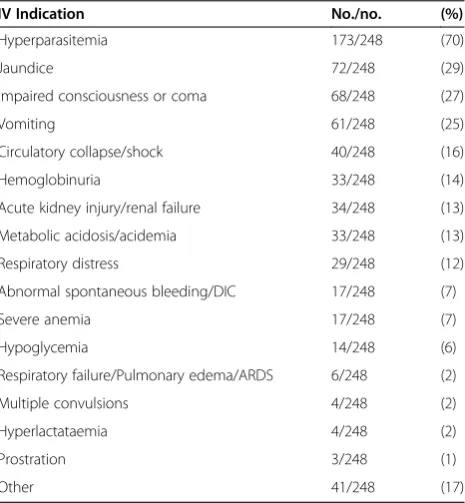
The most commonly reported clinical features of severe malaria include: hyperparasitaemia (70%), jaundice (29%),
impaired consciousness or coma (27%) (Table 5). In addition, vomiting was reported as a symptom of malaria in 25% of severe malaria cases.
Hospitalization
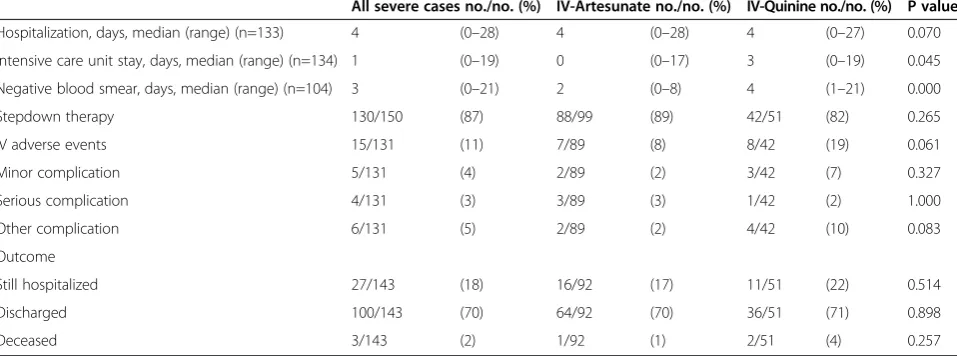
CMN collects information on hospitalization, malaria complications and drug adverse events on Form B. Form B was completed for 43% of all patients accessing IV therapy, and in 60% of severe malaria cases (Table 6). There were no clinical or statistically significant differ-ences between mBC and non-mBC cases for length of hospitalization, days to negative smear, length of inten-sive care unit (ICU) stay, administration of step-down therapy, supportive treatments, outcome or adverse events. Median time to a negative blood smear following treatment was three days among severe malaria patients. Cases spent a median of four days in hospital and a me-dian one day in ICU. The majority of severe cases (87%) were prescribed at least one form of step-down therapy.
Adverse events
[image:5.595.61.539.88.235.2]Adverse events related to parenteral therapy were re-ported by 11% of severe malaria cases. Adverse events were classified as minor, serious or other (Table 6). Figure 2Severe malaria cases in Canada, by country of acquisition (n = 246).
Table 4 Time delays associated with access to health care and treatment among severe malaria cases
Delay Mean Median SD Range
Patient (days)
Date of illness to first MD visit (n=229) 4.2 3.0 5.3 (0–50)a
Healthcare system (hours)
Time from MD visit to lab diagnosis (n=229) 30.2 0.0 94.94 (0–864)b
Time from diagnosis to contact CMN (n=90) 2.0 0.8 4.6 (0–24)
Time from contact to receive IV drug (n=133) 2.2 1.5 2.8 (0–24)
Time from receipt to drug administration (n=18) 1.2 1.0 1.1 (0–3.5)
Total healthcare system delay (n=248) 29.9 2.0 91.6 (0–864)c
Abbreviations:SDstandard deviation.
a
Two cases had delays of greater than 30 days.
b
Five cases had delays of 9 days to a maximum of 35 days. Delays due to: P.vivax infection, unavailability of microbiologists.
c
[image:5.595.58.539.573.699.2]Minor adverse events (fatigue, dizziness and occasional tinnitus) were reported in 7% of patients treated with quinine and 2% of those treated with artesunate. Serious adverse events were reported by 3% of cases (n=4) and involved a single case of hypotension and ischemic en-cephalopathy related to IV quinine, two cases of delayed haemolysis, and one case of early haemolysis associated with IV artesunate. Five per cent of severe cases reported adverse events classified as ‘other’ but were determined by the CMN physician (AM) to be unrelated to IV therapy alone and included nausea, vomiting and vivid
dreams. No adverse events resulted in death. For a brief case summary of the severe drug-associated ad-verse events, see Additional file 2.
Fatalities
Three fatalities occurred among severe and complicated malaria cases. All deaths occurred in mBC or VFR trav-ellers. None of the reported deaths occurred in children. No fatalities were related to adverse events or complica-tions from parenteral therapy. For a brief case summary of each fatality, see Additional file 2.
Discussion
This study describes national trends, demographic char-acteristics, risk factors, and delays associated with all cases of severe and complicated malaria reported to CMN. CMN data demonstrate a gradual increase in an-nual incidence of severe malaria over time. This trend is consistent with results observed in the USA reported by the 2011 Morbidity and Mortality Weekly Report malaria surveillance summary [12]. The increase may be attributed to increased global travel and immigration [1,13].
In Canada there were slightly more severe malaria in-fections (18%) among children under age 18 years than in the USA (16%). Canada also had a higher percentage of severe cases withP. falciparum infection (94%), com-pared to 74% in the USA; however it is important to note that a species was identified and reported in 94% of Canadian cases versus only 77% in USA cases.
[image:6.595.56.541.88.306.2]Most severe malaria cases identified Canada as their primary country of residence (80%) and in the USA, 75% identified the USA as their country of residence. Compared to the USA, a smaller proportion of Canadian travellers Figure 3Severe malaria cases in Canada per year by type of IV parenteral therapy requested.
Table 5 Severe malaria cases by indication for IV therapy
IV Indication No./no. (%)
Hyperparasitemia 173/248 (70)
Jaundice 72/248 (29)
Impaired consciousness or coma 68/248 (27)
Vomiting 61/248 (25)
Circulatory collapse/shock 40/248 (16)
Hemoglobinuria 33/248 (14)
Acute kidney injury/renal failure 34/248 (13)
Metabolic acidosis/acidemia 33/248 (13)
Respiratory distress 29/248 (12)
Abnormal spontaneous bleeding/DIC 17/248 (7)
Severe anemia 17/248 (7)
Hypoglycemia 14/248 (6)
Respiratory failure/Pulmonary edema/ARDS 6/248 (2)
Multiple convulsions 4/248 (2)
Hyperlactataemia 4/248 (2)
Prostration 3/248 (1)
[image:6.595.58.291.481.733.2]reported VFR as their reason for travel, 45% in Canada ver-sus 59% in the USA.
The vast majority of severe and complicated malaria cases were reported from the most populated Canadian provinces of Quebec and Ontario, and occurred among travellers to and from Africa. These findings are consist-ent with the latest reports from Statistics Canada that state the highest proportions of new/recent immigrants to Canada reside in Quebec and Ontario, and originate from malaria-endemic regions such as Africa, Asia and Pacific, and South and Central Americas [14].
It was demonstrated that an individual’s country of birth is not a risk factor for malaria, indicating Canadian residents originating from mBC and non-mBC are at similar risk of malaria-related complications. Although more individuals from non-endemic birth countries re-ported accessing pre-travel advice, the overall use of ap-propriate and effective chemoprophylaxis was minimal at 13% (37/280) among all cases treated with IV therapy. Experts believe diagnosis and treatment delays attrib-uted to the non-specific symptomatology and unpredict-able clinical complications of infection are the primary cause of severe infections in non-endemic regions, like Canada [15-18]. Patient delays of approximately three days occurred among reported cases. This finding highlights the importance of emphasizing malaria prevention and pre-travel health consultation prior to international travel, especially among VFR travellers heading to endemic re-gions [19]. Pre-travel consultations should inform travel-lers of malaria symptoms and outline the importance of seeking immediate medical attention should malaria symptoms develop. This same information should also be distributed to recent immigrants to Canada from malaria-endemic areas.
Even though the majority of severe malaria cases were diagnosed quickly and appropriately treated with paren-teral therapy within a few hours of presentation to a Canadian physician, better health care provider know-ledge of malaria symptoms (by travellers and health care practitioners) and reduced delays in access to effective therapy may reduce the number of cases that progress to severe disease. Furthermore, health care providers should educate Canadian VFR travelers of their malaria risk and loss of acquired malaria immunity over time during pre-travel medical visits.
Limitations of this analysis stem from missing data and gaps in the existing CMN dataset. A large number of case report forms were missing key information, and nearly half (43%) of the follow-up Form B were never submitted to CMN. As a result, presentation of a complete picture of malaria treatment procedures and outcomes, complications or adverse effects was not possible. Furthermore, given that Form B is collected 7 days following treatment initiation, cases of delayed hemolysis may not have been reported to CMN. Incomplete reporting of data highlights the import-ance of physician engagement in CMN surveillimport-ance activ-ities in order to improve the availability and delivery of anti-malaria medications to patients. Additionally, the study sample was limited to patients treated with IV malaria ther-apies in Canada provided through the CMN. Therefore, the ability to capture information on additional cases of severe malaria with other treatments was limited, such as ex-change therapy not possible.
Conclusions
[image:7.595.59.538.104.282.2]These findings demonstrate the utility of pre-positioning effective parenteral malaria therapy across the country through the CMN. The current trend of increased travel Table 6 Outcomes of severe malaria casesa
All severe cases no./no. (%) IV-Artesunate no./no. (%) IV-Quinine no./no. (%) P value
Hospitalization, days, median (range) (n=133) 4 (0–28) 4 (0–28) 4 (0–27) 0.070
Intensive care unit stay, days, median (range) (n=134) 1 (0–19) 0 (0–17) 3 (0–19) 0.045
Negative blood smear, days, median (range) (n=104) 3 (0–21) 2 (0–8) 4 (1–21) 0.000
Stepdown therapy 130/150 (87) 88/99 (89) 42/51 (82) 0.265
IV adverse events 15/131 (11) 7/89 (8) 8/42 (19) 0.061
Minor complication 5/131 (4) 2/89 (2) 3/42 (7) 0.327
Serious complication 4/131 (3) 3/89 (3) 1/42 (2) 1.000
Other complication 6/131 (5) 2/89 (2) 4/42 (10) 0.083
Outcome
Still hospitalized 27/143 (18) 16/92 (17) 11/51 (22) 0.514
Discharged 100/143 (70) 64/92 (70) 36/51 (71) 0.898
Deceased 3/143 (2) 1/92 (1) 2/51 (4) 0.257
a
to endemic areas will increase the number of cases of se-vere malaria in Canada. These cases will continue to augment the need for access to parenteral therapy. There is a need for better travel health strategies to improve the up-take of pre-travel consultation and knowledge of malaria symptoms. These findings can inform the development of improved travel health practices and policies across Canada, and can be used to justify the development of such strategies in other non-endemic countries managing indi-viduals with travellers’malaria. Ideally, better education of travellers visiting malaria-endemic areas, especially VFR travelers returning to their country of origin, will result in faster treatment-seeking behaviour, leading to earlier diag-nosis and effective therapy, thus minimizing the risk of severe disease.
Additional files
Additional file 1:Forms used by physicians for the monitoring of parenteral therapy for severe malaria.
Additional file 2:Adverse events and fatalities.
Abbreviations
CATMAT:Committee to Advise on Tropical Medicine and Travel; CDC: Centers for Disease Control and Prevention; CMN: Canadian Malaria Network; ICU: Intensive care unit; IV: Intravenous; mBC: Malaria-endemic birth country; MMWR: Morbidity and Mortality Weekly Report; non-mBC: Non-malaria endemic birth country; P.falciparum: Plasmodium falciparum; PHAC: Public Health Agency of Canada; VFR: Visiting friends and relatives; WHO: World Health Organization.
Competing interests
The authors declare that they have no competing interests.
Authors’contributions
AM planned the project and analysis, assisted in data cleaning, helped to interpret the findings of the analysis, was also involved with drafting of the manuscript. CM carried out data cleaning, analysis and drafting of the manuscript, as well as incorporation of edits. CP assisted with data cleaning and analysis, contributed to the drafting of the manuscript. JG provided feedback on the analysis and interpretation of results, as well as critical input into manuscript edits. All authors approved and made significant
contributions to this manuscript.
Acknowledgements
The authors would like to extend their thanks to the Public Health Agency of Canada for its support of the Canadian Malaria Network. Thank you to contributing physicians, pharmacists and pharmacy technicians–without your collaboration, the distribution of information, lifesaving drugs and the collection of this surveillance data would not have been possible. The authors would also like to thank Rosemary Zvonar, Anne-Marie Dugal, Suzanne Fetzer, Jeremy Levine, Donna Garber, Lesli Ransome, and Stephanie Carson. This work was supported by the Public Health Agency of Canada.
Author details
1Division of Infectious Diseases, The Ottawa Hospital, 501 Smyth Road, Ottawa, ON K1H 8L6, Canada.2Public Health Ontario, Ottawa, Canada.3Travel and Migration Health Division, Public Health Agency of Canada, Ottawa, Canada.
Received: 6 October 2014 Accepted: 3 March 2015
References
1. Lee CS, Gregson DB, Church D, Laupland KB, Eckhardt R, Ross T, et al. Population-based laboratory surveillance of imported malaria in metropolitan Calgary, 2000–2011. PLoS One. 2013;8:e60751.
2. Bui Y-G, Trépanier S, Milord F, Blackburn M, Provost S, Gagnon S. Cases of malaria, hepatitis A, and typhoid fever among VFRs, Quebec (Canada). J Travel Med. 2011;18:373–8.
3. Geduld J, Bryson M, Straight-Caron T. Canadian trends of international travel and risk of malaria exposure. In: 12th Conference of the International Society of Travel Medicine. Boston, Massachusetts, USA: Public Health Agency of Canada, Infectious Disease Prevention and Control Branch; 2011. 4. Reported malaria cases from 1924 to 2011 in Canada.
[http://dsol-smed.phac-aspc.gc.ca/dsol-smed/ndis/charts.php?c=pl]
5. Trampuz A, Jereb M, Muzlovic I, Prabhu RM. Clinical review: severe malaria. Crit Care. 2003;7:315–23.
6. Streamlined medical access to artesunate or quinine for severe malaria treatment. [http://thinkottawamedicine.ca/clinical-care/canadian-malaria-network/] 7. Management of severe malaria–a practical handbook. [http://
www.who.int/malaria/publications/atoz/9789241548526/en/index.html] 8. Special Access Programme (SAP). [http://www.hc-sc.gc.ca/dhp-mps/acces/
drugs-drogues/index-eng.php]
9. Boggild A, Brophy J, Charlebois P, Crockett M, Geduld J, Ghesquiere W et al: Canadian Recommendations for the Prevention and Treatment of Malaria Among International Travellers. CCDR: Volume 40-7, April 3, 2014. ISSN 1481-8531 (On-line) http://www.phac-aspc.gc.ca/publicat/ccdr-rmtc/ 14vol40/dr-rm40-07/dr-rm40-07-prev-eng.php.
10. List of malaria endemic countries. [http://www.rollbackmalaria.org/ endemiccountries.html]
11. StataCorp. Stata statistical software: release 13. College Station, Texas: StataCorp LP; 2013.
12. MMWR surveillance summaries: malaria surveillance (1983–2013). [http://www.cdc.gov/mmwr/mmwr_ss/ss_pvol.html]
13. Odolini S, Gautret P, Parola P. Epidemiology of imported malaria in the Mediterranean region. Mediterr J Hematol Infect Dis. 2012;4:e2012031. 14. Immigration overview: permanent and temporary residents. [http://
www.cic.gc.ca/english/resources/statistics/facts2013/permanent/10.asp] 15. Suh KN, Kain KC, Keystone JS. Malaria. CMAJ. 2004;170:1693–702. 16. Kain KC, MacPherson DW, Kelton T, Keystone JS, Mendelson J, MacLean JD.
Malaria deaths in visitors to Canada and in Canadian travellers: a case series. CMAJ. 2001;164:654–9.
17. Kain KC, Harrington MA, Tennyson S, Keystone JS. Imported malaria: prospective analysis of problems in diagnosis and management. Clin Infect Dis. 1998;27:142–9.
18. Humar A, Sharma S, Zoutman D, Kain KC. Fatal falciparum malaria in Canadian travellers. CMAJ. 1997;156:1165–7.
19. Boggild AK, Geduld J, Libman M, Ward BJ, McCarthy AE, Doyle PW, et al. Travel-acquired infections and illnesses in Canadians: surveillance report from CanTravNet surveillance data, 2009–2011. Open Medicine. 2014;8:e20–32.
Submit your next manuscript to BioMed Central and take full advantage of:
• Convenient online submission
• Thorough peer review
• No space constraints or color figure charges
• Immediate publication on acceptance
• Inclusion in PubMed, CAS, Scopus and Google Scholar
• Research which is freely available for redistribution