Open Access
Methodology
Pyrosequencing™ : A one-step method for high resolution HLA
typing
Daniel Ramon
1, Megan Braden
1, Sharon Adams
2, Francesco M Marincola
2and Lu Wang*
1Address: 1Pel-Freez Clinical Systems, LLC. Brown Deer, WI. USA and 2Department of Transfusion Medicine, Clinical Center, NIH, Bethesda MD.
USA
Email: Daniel Ramon - [email protected]; Megan Braden - [email protected]; Sharon Adams - [email protected]; Francesco M Marincola - [email protected]; Lu Wang* - [email protected]
* Corresponding author
Abstract
While the use of high-resolution molecular typing in routine matching of human leukocyte antigens (HLA) is expected to improve unrelated donor selection and transplant outcome, the genetic complexity of HLA still makes the current methodology limited and laborious. Pyrosequencing™ is a gel-free, sequencing-by-synthesis method. In a Pyrosequencing reaction, nucleotide incorporation proceeds sequentially along each DNA template at a given nucleotide dispensation order (NDO) that is programmed into a pyrosequencer. Here we describe the design of a NDO that generates a pyrogram unique for any given allele or combination of alleles. We present examples of unique pyrograms generated from each of two heterozygous HLA templates, which
would otherwise remain cis/trans ambiguous using standard sequencing based typing (SBT) method.
In addition, we display representative data that demonstrate long read and linear signal generation. These features are prerequisite of high-resolution typing and automated data analysis. In conclusion Pyrosequencing is a one-step method for high resolution DNA typing.
Introduction
Solid organ transplantation and allogeneic stem cell trans-plantation currently represent a common treatment for end-stage organ failure and several hematological and non-hematological malignances. Matching of patient and unrelated donor for human leukocyte antigen (HLA) mol-ecules significantly decreases the probability of graft rejec-tion, graft vs. host disease and transplant-related mortality [1]. However, the extensive diversity of the HLA genes makes the identification of matched donors extremely challenging. Although, in several instances it might not be feasible to identify perfect matches, algorithms have been developed that allow identification of likely histocompat-ibility based on the molecular definition of individual
alleles [2,3]. This algorithm grades mismatches according to the number of variant epitopes present between donor and recipient. As histocompatibility is inversely correlated with number of mismatches it is likely that sequence-based information that provides the definitive informa-tion about HLA allele identity will become increasingly important in the future. High-resolution information about HLA alleles identity is best achieved using sequenc-ing-based methodology that could be performed using high-throughput automated systems [4]. Although signif-icant advancement has been made in resolution, automa-tion, throughput and data analysis in DNA sequencing and other polymorphism analysis techniques, the search continues for more efficient methods that could resolve
Published: 26 November 2003
Journal of Translational Medicine 2003, 1:9
Received: 17 October 2003 Accepted: 26 November 2003
This article is available from: http://www.translational-medicine.com/content/1/1/9
cis/trans ambiguities in highly polymorphic genetic sys-tems such as HLA genes. Currently, commonly used HLA molecular typing methods include sequence specific oli-gonucleotide probes (SSOP), polymerase chain reaction (PCR) using sequence specific primers (SSP) and sequence based typing (SBT) [5]. Among them, SSOP solely exploits DNA hybridization and, therefore, results
in the most cis/trans ambiguities. SSP can solve ambiguous
combinations if primers are designed to cover the gene-omic region where the ambiguity is present. In this case, amplification of the genomic region framed by two
prim-ers assures the occurrence in cis of these two regions. This
strategy, however, requires a large number of primers to reach a desired resolution and cover various combina-tions of ambiguous sites within HLA loci. SBT provides by far the highest resolution and currently represents the golden standard for high resolution DNA typing and novel allele discovery. In addition, recent advances made possible to perform SBT at a high throughput level in rou-tine HLA typing laboratories [4]. The biggest challenge that SBT of HLA alleles incurs is the resolution of intrinsic cis/trans ambiguities that cannot be solved by SBT unless time consuming cloning of individual genes is performed [6]. This is because nucleotide incorporation proceeds simultaneously along all DNA templates in a SBT reaction [7].
Pyrosequencing™ [9-11] is a real-time, sequencing by syn-thesis method catalyzed by four kinetically well-balanced enzymes, DNA polymerase, ATP sulfurylase, luciferase, and apyrase. It fundamentally differs from Sanger's sequencing method in the order of nucleotide incorpora-tion. Each nucleotide is dispensed and tested individually for its incorporation into a nascent DNA template. Each incorporation event is accompanied by release of pyro-phosphate (PPi) in a quantity equimolar to the amount of nucleotide incorporated. ATP sulfurylase quantitatively converts PPi to ATP in the presence of adenosine 5' phos-phosulfate. ATP then drives the luciferase-mediated con-version of luciferin to oxyluciferin that generates visible light in amounts that are proportional to the amount of ATP. The light is detected by a charge coupled device (CCD) camera and displayed as a peak in a pyrogram™. Each peak height is proportional to the number of nucle-otides incorporated. Unincorporated dNTP and excess ATP are continuously degraded by Apyrase. After the deg-radation is completed, the next dNTP is added and a new Pyrosequencing cycle is started. As the process continues, the complementary DNA strand is built up. To pyrose-quence an unknown DNA sepyrose-quence, a cyclic nucleotide dispensation order (NDO) is generally used. As a result of each cycle of dATP, dGTP, dCTP and dTTP dispensation, one of the four dNTPs is incorporated into the DNA tem-plate while the other dNTPs are degraded by Apyrase. When a DNA sequence is known, non-cyclic NDOs can be
programmed with predictable pyrograms. Nucleotide sequence is determined from the order of nucleotide dis-pensation and peak height in the pyrogram.
Based on the programmable nucleotide incorporation feature of Pyrosequencing, we set out to optimize Pyrose-quencing for high resolution HLA DNA typing. Here we describe the design of NDO that generates a pyrogram that is unique for any given allele or combination of alle-les. We present unique pyrograms generated from each of the heterozygous HLA templates that would otherwise be cis/trans ambiguous using sequencing based typing (SBT) methods. We also present representative data that demon-strate long read and linear signal generation. These fea-tures are prerequisite of high-resolution typing and automated data analysis. In conclusion, Pyrosequencing can be used as a one-step method for high resolution DNA typing and could be applied in several settings spanning from HLA typing in support of donor/recipient selection to become a complement to comprehensive immunoge-netic profiling in several clinical setting where other aspects of immune polymorphism need to be explored [8].
Results
Design of nucleotide dispensation order (NDO) that generates unique pyrogram for any allele or combination of alleles
out-of-NDO optimization
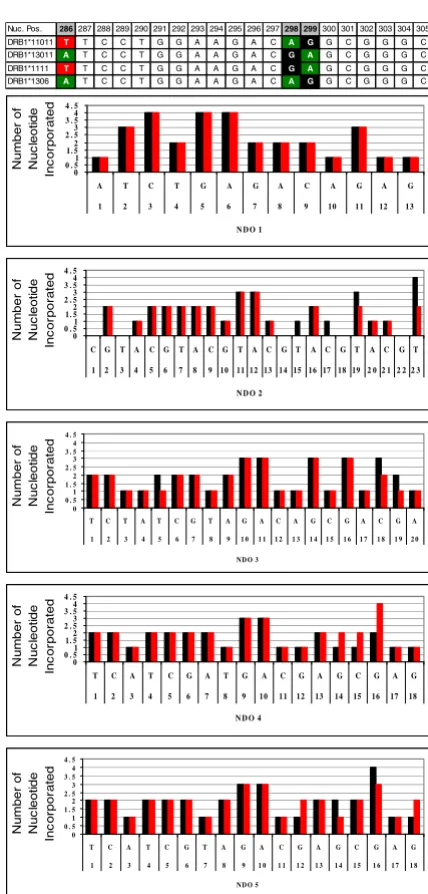
Figure 1
NDO optimization. Sequences of DRB1*11011, 13011 and DRB1*1111, 1306 are shown on the top (5'-286-305-3'). NDO 1 to NDO 5 are designed to pyrosequence these two pairs of heterozygous templates. X-axis represents the NDO. G, A, T and C represent the dNTP that is dispensed at each. Alphabetical numbers represent the dispensation step. E.g. the first step dis-penses dATP. Y-axis represents theoretical peak height, shown as number of nucleotide incorporated into the two molecules of template alleles at each nucleotide dispensation step. Black peaks represent signals generated from DRB1*11011, 13011. Red peaks represent signals generated from DRB1*1111, 1306.
0 0 . 51 1. 52 2 . 53 3 . 54 4 . 5
A T C T G A G A C A G A G
1 2 3 4 5 6 7 8 9 10 11 12 13
N D O 1
N
u
mber
of
N
u
c
leoti
de
Inc
o
rpor
ated
0 0 . 51 1. 52 2 . 53 3 . 54 4 . 5
C G T A C G T A C G T A C G T A C G T A C G T
1 2 3 4 5 6 7 8 9 10 11 12 13 14 15 16 17 18 19 2 0 2 1 2 2 2 3
N D O 2
N
u
m
ber
of
N
u
c
leoti
de
In
c
o
rpor
ated
0 0 . 5 1 1 . 5 2 2 . 5 3 3 . 5 4 4 . 5
T C T A T C G T A G A C A G C G A C G A 1 2 3 4 5 6 7 8 9 1 0 1 1 1 2 1 3 1 4 1 5 1 6 1 7 1 8 1 9 2 0
N D O 3
N
u
mber
of
N
u
c
leoti
de
Inc
o
rpor
ated
0 0 . 51 1. 52 2 . 53 3 . 54 4 . 5
T C A T C G A T G A C G A G C G A G
1 2 3 4 5 6 7 8 9 10 11 12 13 14 15 16 17 18
N D O 4
N
u
m
ber
of
N
u
c
leoti
de
In
c
o
rpor
ated
0 0 . 5 1 1 . 5 2 2 . 5 3 3 . 5 4 4 . 5
T C A T C G T A G A C G A G C G A G 1 2 3 4 5 6 7 8 9 1 0 1 1 1 2 1 3 1 4 1 5 1 6 1 7 1 8
N D O 5
N
u
mber
of
N
u
c
leoti
de
Inc
o
rpor
ated
phase fashion. NDO 1 requires the least number of nucle-otide dispensations but it generates the same theoretical pyrogram from both templates. NDO 2, which is a typical cyclic NDO, generates unique theoretical pyrograms from each template but it requires more nucleotide dispensa-tions than the other four NDOs, partly due to the inclu-sion of four negative dispensations. NDO 3 generates unique theoretical pyrograms from both templates at pensations 5, 18 and 19 and, requires less nucleotide dis-pensations than NDO 2 because of the lack of negative dispensations. NDO 4 also generates unique theoretical pyrograms at three dispensations (dispensations 14, 15 and 16). In addition, it requires less nucleotide dispensa-tions as compared to NDO 3 (18 Vs. 20). NDO 5 is the most effective. It generates the most number of differen-tial theoretical peak heights at positions 12, 14, 16 and 18, and requires only 18 dispensations as well. Using this technique, on one hand, each DNA template sequence can generate different pyrograms. On the other hand, dif-ferent DNA template sequences can generate identical pyrograms. Our NDO design software automatically com-pares a theoretical pyrogram generated by a given NDO from any homozygous or heterozygous HLA template sequence against that from all other homozygous or het-erozygous HLA template sequences in the database (Shi et al, unpublished results). Among the NDOs that result in unique theoretical pyrogram, NDOs that produce that shorter theoretical number of dispensations are chosen.
Pyrosequencing resolves intrinsic sequencing based typing
(SBT) cis/trans ambiguity
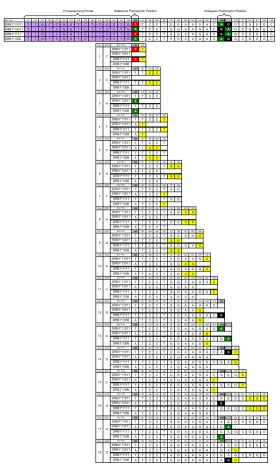
Although high-resolution SBT of HLA allleles provides the highest resolution, it cannot effectively solve many intrin-sic cis/trans ambiguities unless coupled with time consum-ing clonconsum-ing of sequencconsum-ing of individual clones. The sequence difference between the two heterozygous tem-plates at position 5'-298-299-3' as described in Figure 1, for example, is a commonly encountered SBT ambiguous example. In an effort to solve this SBT ambiguity, we tested whether or not experimentally obtained pyrogram matched the theoretical pyrogram predicted by NDO 5. Figure 2 further illustrates NDO 5 step-wise. We chose to place the 3' end of the Pyrosequencing primer just upstream of another polymorphic site at 5'-286-3', desig-nated reference polymorphic site. Out-of-phase NDO is designed at the very first nucleotide dispensation. T is incorporated in to template DRB1*110101 but not DRB1*130101. The pyrogram output, as shown in Figure 3, demonstrates differential peak heights at all four
theo-retically different positions. Using the 11th peak adjacent
and upstream of the first differential peak (the 12th peak)
as a normalizer, we could observe that peak height ratios at peaks 12, 14, 16 and 18 closely correlated with theoret-ical peak height ratios proposed in Figure 1 (IDO 5). The
12th peak deviates from the prediction by 18%. The 14th
peak deviates by 13.5%. while both 16th and 18th peaks
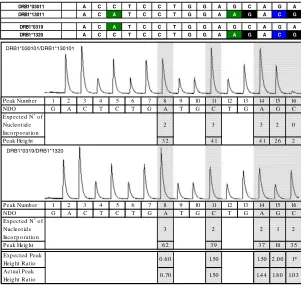
demonstrated deviations from prediction close to 0%. As an average the deviation from theoretical prediction was 7.9%. Figures 4 demonstrates another HLA-DRB1 SBT ambiguity, DRB1*030101, 130101 Vs. DRB1*0319, 1320, that Pyrosequencing can solve. Using the upstream
adjacent peak (the 7th peak) as a normalizer, calculated
peak height ratios at peaks 8, 11, 14, 15 and 16 also closely correlated with theoretical ratios with a deviation range between 0% to 16.7% and an average deviation of 6.7%. These two examples demonstrate how Pyrose-quencing can be used to quantify differences and there-fore identify the cis/trans conformation of ambiguous HLA heterozygous pairs that cannot be resolved by SBT.
The general principles for the design of NDO can be sum-marized as follows: a primer is usually placed in proximity upstream of the reference polymorphic site chosen to be the one closest to the ambiguous polymorphic site to be investigated. The first nucleotide dispensation is usually out-of-phase. As a result, SBT ambiguity at one position is generally magnified into pyrograms differences at multi-ple peaks. This greatly enhances sensitivity and accuracy in detection of peak height differences. In our experience, ambiguities that cannot be solved by SBT within the HLA-DRB1 locus can be consistently solved by unique Pyrose-quencing NDO (Wang et al, unpublished results).
Long read and linear signal generation facilitates automated data analysis
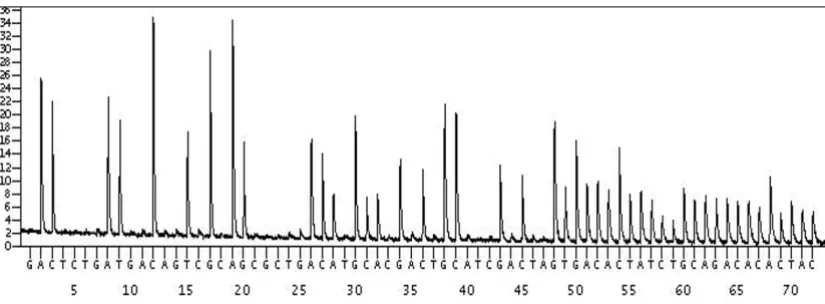
The ability to perform long Pyrosequencing reads (length of the genomic region investigated) is often necessary for reasonable throughput. It is essential for achieving high resolution when the reference polymorphic site down-stream of the Pyrosequencing primer is distant from the ambiguous site. In addition to the optimized NDO, the PCR amplicons are designed to prevent background gen-eration that could occur during a long Pyrosequencing reaction. The pyrogram shown in Figure 5 is an example of a linear and predictable reduction in signal generation with low background signal generation through 72 nucle-otide dispensations. The background signal ranges from 2% to 11% with an average of 6% of the signals immedi-ately upstream and downstream (Figure 6, bottom panel). The low background signal makes possible the discrimi-nation of linear sequence-specific signals. One trend line is plotted against the signals generated from dATP (Figure 6, Top panel). A similar trend line is plotted against the signals generated from dGTP, dCTP and dTTP (Figure 6, middle panel). The dATP trend line is plotted separately because of its kinetics slightly faster than the other three dNTPs. Note that both trend lines indicate high
confi-dence level with R2 greater than 95%. This linearity allows
actual peak height can be extrapolated using the formula: "Extrapolated peak = [Split Height + (Slope × Disp#)] × Nuc#". The extrapolated peak heights only vary from the
theoretical peak heights from 0% to 20%, averaging at 4.3%. This algorithm offers powerful aid to automated data analysis of Pyrosequencing results.
[image:5.612.125.406.79.546.2]The same NDO can generate unique pyrogram from DRB1*11011, 13011 and DRB1*1111, 1306
Figure 2
The same NDO can generate unique pyrogram from DRB1*11011, 13011 and DRB1*1111, 1306. The two heterozygous tem-plates used are DRB1*11011, 13011 and DRB1*1111, 1306. The SBT ambiguous positions are at 5'-298-299-3'. The Pyrose-quencing primer is high lighted in purple color with its 3' end located at 5'-285-3'. Nucleotide incorporation starts at position 5'-286-3'. NDO is indicated on the left, from top to bottom. The nucleotides incorporated into each allele of template DRB1*11011, 13011 and each allele of template DRB1*11011, 13011 are highlighted in yellow at each nucleotide dispensation
step except for the nucleotides involve in the ambiguities that are with the color red for , green for and black for .
Nuc. Pos. 271 272 273274 275 276 277278 279 280 281282 283 284285 286 287 288289 290 291 292293 294 295296 297 298299 300 301 302 303304 305 DRB1*11011 T T G T C G G T C T T C C T G T T C C T G G A A G A C A G G C G G G C DRB1*13011 T T G T C G G T C T T C C T G A T C C T G G A A G A C G A G C G G G C DRB1*1111 T T G T C G G T C T T C C T G T T C C T G G A A G A C G A G C G G G C DRB1*1306 T T G T C G G T C T T C C T G A T C C T G G A A G A C A G G C G G G C
Disp.NDO 286 287 T T
T T
Disp.NDO 286 287 288289 T T C C
T T C C
Disp.NDO 286 287 288289 T T C C A T T C C A Disp.NDO 286 287 288289 290
T T C C T A T T T C C T A T Disp.NDO 286 287 288289 290
T T C C T A T C C T T C C T A T C C Disp.NDO 286 287 288289 290 291 292
T T C C T G G A T C C T T C C T G G A T C C Disp.NDO 286 287 288289 290 291 292
T T C C T G G A T C C T T T C C T G G A T C C T Disp.NDO 286 287 288289 290 291 292293 294
T T C C T G G A A A T C C T T T C C T G G A A A T C C T
Disp.NDO 286 287 288289 290 291 292293 294 295 T T C C T G G A A G A T C C T G G T T C C T G G A A G A T C C T G G Disp.NDO 286 287 288289 290 291 292293 294 295296
T T C C T G G A A G A A T C C T G G A A T T C C T G G A A G A A T C C T G G A A Disp.NDO 286 287 288289 290 291 292293 294 295296 297
T T C C T G G A A G A C A T C C T G G A A T T C C T G G A A G A C A T C C T G G A A Disp.NDO 286 287 288289 290 291 292293 294 295296 297 298
T T C C T G G A A G A C A T C C T G G A A G T T C C T G G A A G A C G A T C C T G G A A G Disp.NDO 286 287 288289 290 291 292293 294 295296 297 298299
T T C C T G G A A G A C A A T C C T G G A A G A T T C C T G G A A G A C G A A T C C T G G A A G A Disp.NDO 286 287 288289 290 291 292293 294 295296 297 298299 300
T T C C T G G A A G A C A G G A T C C T G G A A G A T T C C T G G A A G A C G A G A T C C T G G A A G A
Disp.NDO 286 287 288289 290 291 292293 294 295296 297 298299 300 301 T T C C T G G A A G A C A G G C A T C C T G G A A G A C T T C C T G G A A G A C G A G C A T C C T G G A A G A C
Disp.NDO 286 287 288289 290 291 292293 294 295296 297 298299 300 301 302 303304 T T C C T G G A A G A C A G G C G G G A T C C T G G A A G A C G
T T C C T G G A A G A C G A G C G G G A T C C T G G A A G A C
Disp.NDO 286 287 288289 290 291 292293 294 295296 297 298299 300 301 302 303304 T T C C T G G A A G A C A G G C G G G A T C C T G G A A G A C G A
T T C C T G G A A G A C G A G C G G G A T C C T G G A A G A C A
Disp.NDO 286 287 288289 290 291 292293 294 295296 297 298299 300 301 302 303304 T T C C T G G A A G A C A G G C G G G A T C C T G G A A G A C G A G T T C C T G G A A G A C G A G C G G G A T C C T G G A A G A C A G G 18 G DRB1*1306 17 A DRB1*1306 16 G DRB1*1306 15 C DRB1*1306 14 G DRB1*1306 13 A DRB1*1306 12 G DRB1*1306 11 C DRB1*1306 10 A DRB1*1306 9 G DRB1*1306 8 A DRB1*1306 7 T DRB1*1306 6 G DRB1*1306 5 C Nuc. Pos. Nuc. Pos. Nuc. Pos. Nuc. Pos. DRB1*11011 DRB1*13011 DRB1*1111 DRB1*1306 4 T DRB1*11011 DRB1*13011 DRB1*1111 DRB1*1306 3 A DRB1*11011 DRB1*13011 DRB1*1111 DRB1*1306 DRB1*11011 DRB1*13011 DRB1*1111 DRB1*1306 1 T DRB1*11011 DRB1*13011 DRB1*1111 DRB1*1306
Ambigous Polimorphic Position Pyrosequncing Primer Reference Polimorphic Position
Nuc. Pos. 2 C Nuc. Pos. DRB1*11011 DRB1*13011 DRB1*1111 Nuc. Pos. DRB1*11011 DRB1*13011 DRB1*1111 Nuc. Pos. DRB1*11011 DRB1*13011 DRB1*1111 Nuc. Pos. DRB1*11011 DRB1*13011 DRB1*1111 Nuc. Pos. DRB1*11011 DRB1*13011 DRB1*1111 Nuc. Pos. DRB1*11011 DRB1*13011 DRB1*1111 Nuc. Pos. DRB1*11011 DRB1*13011 DRB1*1111 Nuc. Pos. DRB1*11011 DRB1*13011 DRB1*1111 Nuc. Pos. DRB1*11011 DRB1*13011 DRB1*1111 Nuc. Pos. DRB1*11011 DRB1*13011 DRB1*1111 Nuc. Pos. DRB1*11011 DRB1*13011 DRB1*1111 Nuc. Pos. DRB1*11011 DRB1*13011 DRB1*1111 Nuc. Pos. DRB1*11011 DRB1*13011 DRB1*1111
Discussion
Pyrosequencing offers a new approach to data acquisition, analysis and identification of known and unknown (new) alleles, in particular in heterozygous conditions. This method may represent a useful tool to the screening and characterization of polymorphic genetic markers in sev-eral clinical or experimental settings [12-24]. In addition, Pyrosequencing has been applied for the study of gene expression [23] and could be a usefull complement to high throughput single nucleotide polymorphism identi-fication system as a substitute to SBT [8,24]. Here we pro-pose that Pyrosequencing may confront the most challenging task of solving ambiguities in HLA typing by SBT in heterozygous conditions. Although its reading
length is currently shorter than that routinely covered by SBT, automated dNTP dispensation could compensate for this limitation by controling simultaneous reactions in multiple wells using primers that anneal to different loca-tions of the template DNA. In fact, a reading length of 70 to 100 nucleotides allows the high-resolution genotyping of Exon II of HLA-DRB1 (Wang et al, unpublished results). NDOs can also be designed to achieve higher throughput and lower genotyping resolution by introduc-ing fewer numbers of out-of-phase dispensations (Wang et al, unpublished results). Without automatization, it is possible to process 96 to 384 wells PCR product by Pyrosequencing within 4 hours. Constant improvements in the chemistry for sample preparation for
[image:6.612.110.502.99.408.2]Pyrosequenc-Pyrograms generated from two heterozygous DNA templates using the same NDO
Figure 3
Pyrograms generated from two heterozygous DNA templates using the same NDO. Top pyrogram is generated from Pyrose-quencing reaction in one well of a 96 well plate. Bottom pyrogram is generated from PyrosePyrose-quencing reaction in a separate well of a 96 well plate. The X axis of each pyrogram, from left to right, indicates the order of reagent addition. E represents enzyme. S represents substrate. The expected number of nucleotides incorporation into each pair of heterozygous DNA tem-plate and actual peak height are indicated for the normalizer peaks and differential peaks below each pyrogram. At the bottom of the figure is shown expected ratio of peak heights and the ratio of normalized peak heights (in shadowed area).
DRB1*1111/DRB1*1306 DRB1*11011/DRB1*13011
Peak Number 1 2 3 4 5 6 7 8 9 10 11 12 13 14 15 16 17 18 NDO E S T C A T C G T A G A C G A G C G A G Expected N˚ of
Nucleotide Incorporation
1 2 4 1 Peak Height 11.7 18.3 34.9 9.6
Peak Number 1 2 3 4 5 6 7 8 9 10 11 12 13 14 15 16 17 18 NDO E S T C A T C G T A G A C G A G C G A G Expected N˚ of
Nucleotide Incorporation
2 1 3 2 Peak Height 19.5 10.3 25.7 16.O Expected Peak
Height Ratio 0.50 2.00 1.33 0.50 Actual Peak
ing and Pyrosequencing [25-34] and the implementation of automation devices http://www.pyrosequencing.com it may be possible in the future to apply this technology directly for routine typing of HLA and other immune related genes characterized by extensive polymorphisms [8].
Materials and Methods
DNA samples
Genomic DNA samples were locally available or obtained from the International Histocompatibility Workshops (IHW) cell lines panel, UCLA interchange panel and samples.
PCR amplification
Each PCR amplification mixture of 50 µl contains 1 × PCR
buffer (made in house), 2 mM MgCl2, 0.2 mM of each dNTP (purchased from Amersham Biosciences Inc.), 0.2 mM PCR primers, 2 U Taq DNA polymerase, and 250 ng genomic DNA. Either forward or reverse primer is bioti-nylated. PCR reaction starts with a 95°C denaturation for 5 minutes. This is followed with a 50-cycle thermal cycling. Each cycle is programmed to include 30 seconds denaturation at 95°C, 60 seconds annealing at appropri-ate temperature, and a 10 seconds final extention at 72°C. The PCR amplicon produced is enough for more 8 pyro-sequencing reactions. The PCR amplicons used in this
[image:7.612.159.461.111.397.2]The same NDO can generate unique pyrogram from DRB1*030101, 130101 Vs
Figure 4
The same NDO can generate unique pyrogram from DRB1*030101, 130101 Vs. DRB1*0319, 1320. Top pyrogram is generated from Pyrosequencing reaction in one well of a 96 well plate. Bottom pyrogram is generated from Pyrosequencing reaction in a separate well of a 96 well plate. The X axis of each pyrogram, from left to right, indicates the order of reagent addition. E rep-resents enzyme. S reprep-resents substrate. The expected number of nucleotides incorporation into each pair of heterozygous DNA template and actual peak height are indicated for the normalizer peaks and differential peaks below each Pyrogram. At the bottom of the figure is shown expected ratio of peak heights and the ratio of normalized peak heights (in shadowed area).
DRB1*030101/DRB1*130101
DRB1*0319/DRB1*1320
Peak Numb er 1 2 3 4 5 6 7 8 9 10 11 12 13 14 15 16
NDO G A C T C T G A T G C T G A G C
Exp ected N˚ o f Nucleo t id e Inco rp o rat io n
2 3 3 2 0
Peak Heig ht 3 2 4 1 4 1 2 6 2
Peak Numb er 1 2 3 4 5 6 7 8 9 10 11 12 13 14 15 16
NDO G A C T C T G A T G C T G A G C
Exp ect ed N˚ o f Nucleo t id e Inco rp o rat io n
3 2 2 1 2
Peak Heig ht 6 2 3 9 3 7 18 3 5
Exp ect ed Peak
Heig ht Rat io 0 .6 0 1.50 1.50 2 .0 0 1*
Act ual Peak
Heig ht Rat io 0 .70 1.50 1.4 4 1.8 0 1.0 3
DRB1*03011 A C C T C C T G G A G C A G A
DRB1*13011 A C A T C C T G G A A G A C G
DRB1*0319 A C A T C C T G G A G C A G A
work is 286 bp containing Exon II and the flanking intron sequences.
Sample Preparation
Biotinylated PCR products are immobilized on streptavi-din-coated Sepharose beads (Amersham Biosciences). 50 ul of Binding buffer (PyrosequencingAB) was added to the 50 ul of PCR product. Then 4 ul of streptavidin-coated Sepharose beads was added and the mixture was vigor-ously mixed at room temperature for 10 minutes. The streptavidin-coated Sepharose bead and PCR mixture is transferred to a filter plate (Amersham Biosciences) and the Binding buffer is removed by vacuum. The bioti-nylated DNA attached to the streptavidin-coated Sepharose beads was denaturated in 50 ul of
Denatura-tion buffer (PyrosequencingAB) for 1 minute. The Dena-turation buffer was removed by vacuum and DNA was washed twice in 150 ul of Wash Buffer (Pyrosequenc-ingAB). The DNA is resuspended in 50 ul of Annealing buffer (PyrosequencingAB).
Pyrosequencing Reaction
40 ul of well mixed DNA was transferred to a 96-well PSQ96 plate (PyrosequencingAB). The appropriate sequencing primer was added in a volume of 5 ul using a 3 uM stock solution, resulting in 45 ul reaction volume. The sequencing primer is allowed to anneal on a heat plate set for 80°C for 2 minutes. Samples are allowed to cool for 5 minutes at room temperature. Once samples have cooled down the plate in placed on the
[image:8.612.91.504.225.377.2]Pyrose-Linear signal generation through a 72 nucleotide dispensation Pyrosequencing run
Figure 5
Linear signal generation through a 72 nucleotide dispensation Pyrosequencing run. Shown on the top in red is the Pyrose-quencing primer sequence from 5' end to 3' end in the direction the red arrow points to. In this PyrosePyrose-quencing reaction, nucleotide incorporation into DRB1*1201, 1302 starts immediately downstream of the 3' end of Pyrosequencing primer and ends at the 3' end template sequence shown. The polymorphic positions are shown and underlined in blue. Pyrogram is shown below template sequence. Y-axis represents peak heights. X-axis represents NDO.
The percentage of each background peak over sequence-specific signal is calculated by dividing each background peak height with the average peak height of the proximal upstream and downstream sequence-specific peak height
Figure 6
The percentage of each background peak over sequence-specific signal is calculated by dividing each background peak height with the average peak height of the proximal upstream and downstream sequence-specific peak height. Top panel depicts a trend line generated from all the "A" peak heights of the pyrogram shown in Figure 5. Middle panel depicts a trend line
gener-ated from all the "G, C and T" peak heights of the pyrogram shown in Figure 5. R2 are shown on the upper right corners of
both panels. Bottom depicts theoretical and extrapolated peak heights generated from the NDO and peak heights shown in top panel. The formula that is used is: Extrapolated peak= [Split Height + (Slope × Disp#)] × Nuc#. Average background is the average of all background signals. MAX background is the highest background signal over sequence specific signal. MIN back-ground is the lowest backback-ground signal over sequence specific signal.
0 0.5 1 1.5 2 2.5 3
1 3 5 7 9 11 13 15 17 19 21 23 25 27 29 31 33 35 37 39 41 43 45 47 49 51 53 55 57 59 61 63 65 67 69 71
Nucleotide Dispensation Steps
P
eak H
e
ig
h
ts
Expected Peak Heights Extrapolated Peak Heights Extrapolated Background Heights
Average background=6%, MAX background=11%, MIN background=2%
Signal Generation From dGTP dCTP and dTTP R 2
= 0.9583
0 5 10 15 20 25
1 6
11 16 21 26 31 36 41 46 51 56 61 66 Nucleotide Dispensation Steps
pe
ak
he
ig
hts
Signal Generation From dATP R2 = 0.9764
0 5 10 15 20 25
1 5 9 13 17 21 25 29 33 37 41 45 49 53 57 61 65 69
Nucleotide Dispensation Steps
pe
a
k
he
ig
ht
Publish with BioMed Central and every scientist can read your work free of charge "BioMed Central will be the most significant development for disseminating the results of biomedical researc h in our lifetime."
Sir Paul Nurse, Cancer Research UK
Your research papers will be:
available free of charge to the entire biomedical community
peer reviewed and published immediately upon acceptance
cited in PubMed and archived on PubMed Central
yours — you keep the copyright
Submit your manuscript here:
http://www.biomedcentral.com/info/publishing_adv.asp
BioMedcentral
quencer and the PSQ96 reagents are added to the SQA car-tridge (PyrosequencingAB). NDO is automatically designed using software developed at Pel-Freez Clinical Systems. Pyrosequencing data output is quantified using Peak Height Determination Software v1.1 (PyrosequencingAB).
Acknowledgements
We wish to acknowledge PyrosequencingAB for their outstanding technical support. We are grateful to Mostafa Ronaghi for the valuable discussions. We thank Yunxia Wang, Joel Shi, Dina Berchanskiy and Xiang Jun Liu for their assistance and helpful discussions. Daniel Ramon is a PhD candidate in the field of Biochemistry at Universidad Nacional de San Luis (Argentina).
References
1. Petersdorf EW, Mickelson EM, Anasetti C, Martin PJ, Wool-frey AE, Hansen JA: Effect of HLA mismatches on the outcome of
hematopoietic transplants.Curr Opin Immunol 1999, 11:521-526.
2. Duquesnoy RJ: HLA matchmaker: a molecularly based algo-rithm for histocompatibility determination. I Description of
the algorithm.Hum Immunol 2002, 63:339-352.
3. Duquesnoy RJ, Marrari M: HLA matchmaker: a molecularly based algorithm for histocompatibility determination. II. Verification of the algorithm and determination of the rela-tive immunogenicity of amino acid triplet-defined epitopes. Hum Immunol 2002, 63:353-363.
4. Adams SD, Krausa P, McGinnis M, Simonis TB, Stein J, Marincola FM: Practicality of high-throughput HLA sequencing based
typing.ASHI Quarterly 2001, 25:54-57.
5. Erlich HA, Opelz G, Hansen JA: HLA DNA typing and
transplantation.Immunity 2001, 14:347-356.
6. Adams SD, Barracchini KC, Chen D, Robbins F-M, Stroncek D, Mar-incola FM: Ambiguous allele combinations in sequence-based
typing.ASHI Quarterly 2003 in press.
7. Sanger F, Nickels S, Coulson AR: DNA sequencing with
chain-terminating inhibitors. Proc Natl Acad Sci U S A 1977,
74:5463-5467.
8. Jin P, Wang E: Polymorphism in clinical immunology. From
HLA typing to immunogenetic profiling.J Transl Med 2003,
1(18):.
9. Ronaghi M, Uhlen M, Nyrén P: A sequencing method based on
real-time pyrophosphate.Science 1998, 281:363-365.
10. Ronaghi M: Pyrosequencing sheds light on DNA sequencing. Genome Res 2001, 11:3-11.
11. Wang L, Marincola FM: Applaying Pyrosequencing to HLA-typ-ing.ASHI Quarterly 2003, 27:16-18.
12. Ahmadian A, Gharizadeh B, Gustafsson AC, Sterky F, Nyren P, Uhlen M, Lundeberg J: Single-nucleotide polymorphism analysis by
Pyrosequencing.Anal Biochem 2000, 280:103-10.
13. Sun YQ, Monstein HJ, Nilsson LE, Petersson F, Borch K: Profiling and identification of eubacteria in the stomach of Mongolian
gerbils with and without Helicobacter pylory infection.
Helico-bacter 2003, 8:149-157.
14. Vozarova B, Fernandez-Real JM, Knowler WC, Gallart L, Hanson RL, Gruber JD, Ricart W, Vendrell J, Richart C, Tataranni PA, Wolford JK.: The interleukin-6 (-174) G/C promoter polymorphism is associated with type-2 diabetes mellitus in Native
Ameri-cans and Caucasians.Hum Genet 2003, 112:409-413.
15. Hefler LA, Ludwig E, Lampe D, Zeillinger R, Leodolter S, Gitsch G, Koelbl H, Tempfer CB: Polymorphisms of the endothelial nitric
oxide synthase gene in ovarian cancer. Gynecol Oncol 2002,
86:134-137.
16. Elahi E, Pourmand N, Chaung R, Rofoogaran A, Boisver J, Samimi-Rad K, Davis RW, Ronaghi M: Determination of hepatitis C virus
genotype by Pyrosequencing.J Virol Methods 2003, 109:171-176.
17. Pacey-Miller T, Henry R: Single-nucleotide polymorphism detection in plants using a single stranded Pyrosequencing
protocol with a universal biotinylated primer.Analyt Biochem
2003, 317:165-170.
18. De Vivo I, Huggins GS, Hankinson SE, Lescault PJ, Boezen M, Colditz GA, Hunter DJ: A functional polymorphism in the promoter of
the progesterone receptor gene associated with
endome-trial cancer risk.Proc Natl Acad Sci U S A 2002, 99:12263-12268.
19. Wolford JK, Gruber JD, Ossowski VM, Vozarova B, Antonio Tataranni P, Bogardus C, Hanson RL: A C-reactive protein pro-moter polymorphism is associated with type 2 diabeter
mel-litus in Pima Indians.Molec Genet Metab 2003, 78:136-144.
20. Barber RC, O'Keefe GE: Characterization of a single nucleotide polymorphism in the lipopolysaccaride binding protein and
its association with sepsis. Am J Respir Crit Care Med 2003,
167:1316-1320.
21. Robin C, Lyman RF, Long AD, Langley CH, Mackay TFC: Hairy: a quantitative trait locus for Drosophila Sensory Bristle
Number.Genetics 2002, 162:155-164.
22. Olofsson P, Holmberg J, Tordsson J, Lu S, Akerstrom B, Holmdahl R: Positional identification of Ncf1 as a gene that regulates
arthritis severity in rats.Nature Genetics 2003, 33:25-32.
23. Nordstrom T, Nourizad K, Ronaghi M, Nyren P: Method enabling
Pyrosequencing on double-stranded DNA.Anal Biochem 2000,
282:186-93.
24. Sundstrom M, Vliagoftis H, Karlberg P, Butterfield JH, Nilsson K, Met-calfe DD, Nilsson G: Functional and phenotypic studies of two variants of a human mast cell line with a distinct set of
muta-tions in the c-kit proto-oncogene.Immunology 2003, 108:89-97.
25. Ronaghi M, Karamohamed S, Pettersson B, Uhlen M, Nyren P: Real-time DNA sequencing using detection of pyrophosphate
release.Anal Biochem 1996, 242:84-9.
26. Wang E, Adams S, Zhao Y, Panelli MC, Simon R, Klein H, Marincola
FM: A strategy for detection of known and unknown SNP
using a minimum number of oligonucleotides.J Transl Med
2003, 1:4.
27. Eriksson S, Berg LM, Wadelius M, Aldeborn A: Cttochrome P450 genotyping by multiplex real-time DNA sequencing with
Pyrosequencing™ technology.Assay Drug Develop Technol 2002,
1:49-59.
28. Ringquist S, Alexander AM, Rudert WA, Styche A, Trucco M: Pyro-sequencing-based typing of alleles of the HLA-DQB1 gene. Biotechniques 2002, 33:166-175.
29. Gharizadeh B, Nordstrom T, Ahmadian A, Ronaghi M, Nyren P: Long-read Pyrosequencing using pure
2'-deoxyadenosine-5'-O'-(1-thiotriphosphate) Sp-isomer. Analyt Biochem 2002,
301:82-90.
30. Gharizadeh B, Ghaderi M, Donnelly D, Amini B, Wallin KL, Nyren P:
Multiple-primer DNA sequencing method.Electrophoresis 2003,
24:1145-1151.
31. Lahser FC, Wright-Minogue J, Skelton A, Molcolm BA: Quantitative
estimation of viral fitness using Pyrosequencing.Biotechniques
2003, 34:26-28.
32. Ronaghi M, Uhlen M, Nyren P: A sequencing method based on
real-time pyrophosphate.Science 1998, 281:363-365.
33. Hochberg EP, Miklos DB, Neuberg D, Eichner DA, McLaughlin SF, Mattes-Ritz A, Alyea EP, Antin JH, Soiffer RJ, Ritz J: A novel rapid single nucleotide polymorphism (SNP)-based method for assessment of hematopoietic chimerism after allogeneic
stem cell transplantation.Blood 2003, 101:363-369.
34. Fakhrai-Rad H, Pourmand N, Ronaghi M: Pyrosequencing: an accurate detection platform for single nucleotide