R E S E A R C H
Open Access
Engineered single nucleotide polymorphisms in
the mosquito MEK docking site alter
Plasmodium
berghei
development in
Anopheles gambiae
Ashley A Brenton
1†, Lattha Souvannaseng
1†, Kong Cheung
1, Michael Anishchenko
2, Aaron C Brault
2and Shirley Luckhart
1*Abstract
Background:Susceptibility toPlasmodiuminfection inAnopheles gambiaehas been proposed to result from naturally occurring polymorphisms that alter the strength of endogenous innate defenses. Despite the fact that some of these mutations are known to introduce non-synonymous substitutions in coding sequences, these mutations have largely been used to rationalize knockdown of associated target proteins to query the effects on parasite development in the mosquito host. Here, we assay the effects of engineered mutations on an immune signaling protein target that is known to control parasite sporogonic development. By this proof-of-principle work, we have established that naturally occurring mutations can be queried for their effects on mosquito protein function and on parasite development and that this important signaling pathway can be genetically manipulated to enhance mosquito resistance.
Methods:We introduced SNPs into theA. gambiaeMAPK kinaseMEKto alter key residues in the N-terminal docking site (D-site), thus interfering with its ability to interact with the downstream kinase target ERK. ERK phosphorylation levelsin vitroandin vivowere evaluated to confirm the effects of MEK D-site mutations. In addition, overexpression of various MEK D-site alleles was used to assessP. bergheiinfection inA. gambiae. Results:The MEK D-site contains conserved lysine residues predicted to mediate protein-protein interaction with ERK. As anticipated, each of the D-site mutations (K3M, K6M) suppressed ERK phosphorylation and this inhibition was significant when both mutations were present. Tissue-targeted overexpression of alleles encoding MEK D-site polymorphisms resulted in reduced ERK phosphorylation in the midgut ofA. gambiae. Furthermore, as expected, inhibition of MEK-ERK signaling due to D-site mutations resulted in reduction inP. bergheidevelopment relative to infection in the presence of overexpressed catalytically active MEK.
Conclusion:MEK-ERK signaling inA. gambiae, as in model organisms and humans, depends on the integrity of conserved key residues within the MEK D-site. Disruption of signal transmission via engineered SNPs provides a purposeful proof-of-principle model for the study of naturally occurring mutations that may be associated with mosquito resistance to parasite infection as well as an alternative genetic basis for manipulation of this important immune signaling pathway.
Keywords:Anopheles, Mosquito, MAPK, Plasmodium, Malaria, Single nucleotide polymorphism, Immunity
* Correspondence:[email protected] †Equal contributors
1
Department of Medical Microbiology and Immunology, School of Medicine, University of California Davis, 95616 Davis, CA, USA
Full list of author information is available at the end of the article
Background
Malaria is caused by protozoan parasites of the genus Plasmodium, transmitted by female anopheline mosqui-toes to humans during blood feeding. Prevention and treatment of the disease requires extensive efforts and co-ordination among the general public, health care organiza-tions, and government agencies. Despite increased global efforts, malaria remains a top-ranked vector-borne disease and major global health concern, affecting over half of the world’s population every year [1]. Reports from popula-tions in Sub-Saharan Africa recorded the highest numbers of cases and deaths estimated at 80% and 90% of the global burden, respectively, in 2012 [1]. In this region,P. falciparumis responsible for the largest number of infec-tions and is the most deadly species, transmitted by Anopheles gambiae, the main mosquito vector.
A network of highly conserved cell signaling pathways controls malaria parasite development in and transmis-sion by the anopheline mosquito host. Among these are the mitogen-activated protein kinase (MAPK) pathways, which function in growth, differentiation, and immune processes from nematodes to humans [2-5]. MAPKs function in multi-tiered sequential signaling cascades, in which an activated MAP4K phosphorylates and activates a MAP3K which, in turn, activates a downstream MAP2K, which activates a MAPK that can phosphorylate effector proteins or transcription factors to positively or negatively regulate a wide variety of cellular functions [6-8]. The subgroup involved in cellular proliferation and differen-tiation includes the extracellular signal-related kinase (ERK) and its upstream dual specificity MAPK/ERK kin-ase (MEK) [8].
Efficient propagation of MEK-ERK signaling requires a stable docking interaction between the upstream activat-ing kinase and its downstream target. The N-terminal ERK docking site or D-site of MEK interfaces with the common docking or CD domain of ERK [9-13]. In humans, the first 32 or 36 residues of MEK1 or MEK2, respectively, comprise the D-site that mediates inter-action with the common docking or CD domain of ERK [12,13]. The MEK D-site shares a conserved motif found in other MAPK-interacting proteins that includes a basic region, a ØA-X-ØB motif where Ø is leucine, isoleucine, or valine, and a hydrophobic-X-hydrophobic spacer gion [14-17]. Deletion and mutational studies have re-vealed that the D-site is essential for enhancing the rate of MEK phosphorylation of ERK, and that the loss of the domain or substitution of the conserved basic and hydrophobic residues diminished the ability of MEK to bind to ERK [12,18]. In addition to the role of the MEK D-site in facilitating efficient activation, it is thought to tether ERK in the cytosol in resting cells [9].
The MEK-ERK signaling module plays a central role in the regulation of malaria parasite development inAnopheles
stephensi, the Indian malaria mosquito [19-22]. In par-ticular, human transforming growth factor-beta1
(TGF-β1) ingested with a P. falciparum-infected blood meal induces ERK activation in the midgut [20-22]. The provision of small molecule inhibitors of MEK in the blood meal reproducibly reduced ERK activation in theA. stephensi midgut and enhanced nitric oxide synthase (NOS) transcription within 24 h after infection, resulting in the production of inflammatory levels of reactive oxy-gen and nitrooxy-gen species in the midgut lumen [23] that are directly toxic to P. falciparum [24] and leading to significant reductions in oocyst numbers on the midgut epithelium [21]. Confirmation that small molecule hibition of MEK can significantly reduce mosquito in-fectivity suggests that overexpression of altered MEK alleles could form the basis of a genetic strategy to gen-erate parasite-resistant mosquitoes. Accordingly, we hy-pothesized that the introduction of non-synonymous single nucleotide polymorphisms (SNPs) into the highly conserved D-site of MEK could reduce ERK phosphor-ylation and decrease malaria parasite development in the mosquito hostin vivo. Herein, we demonstrate that overexpression of a catalytically active MEK allele inA. gambiae cells in vitro resulted in enhanced ERK phos-phorylation in these cells, while overexpression of a MEK allele with D-site mutations reduced ERK phos-phorylation. Using a transient transformation strategy, midgut-specific overexpression of the same mutated MEK allelein vivoreduced ERK phosphorylation in this tissue and reduced development of naturally acquired Plasmodium berghei in vivo, suggesting for the first time that tissue-specific overexpression of mutated MEK could be used as the basis for a malaria transmission blocking strategy.
Methods
on artificial blood meals of washed human erythrocytes and heat-inactivated human serum provided through a Hemotek Insect Feeding System (Discovery Workshops).
MEKallele plasmid construction and transfection for in vitrostudies
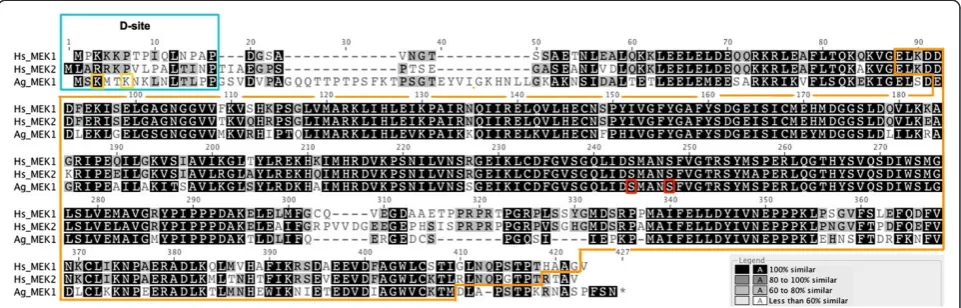
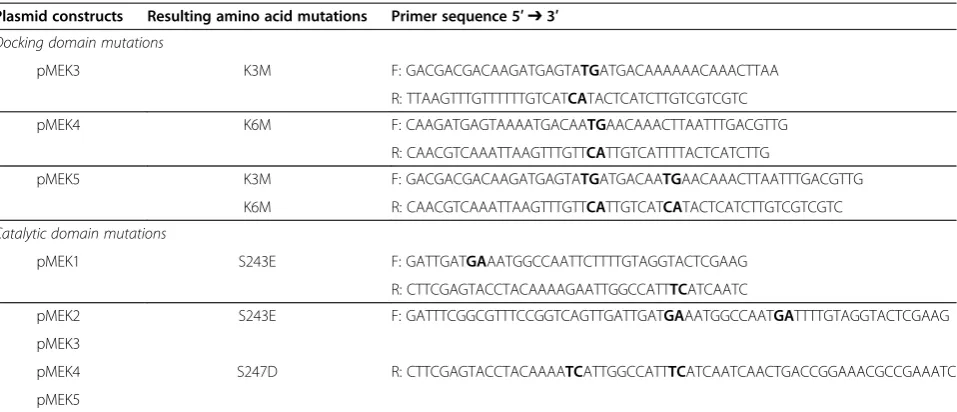
The complete mRNA sequence ofA. gambiae MEK [Gen-Bank: XM_322064] in the pDREAM 2.1 vector (Gen-script) (wild type MEK or wtMEK) was used to generate five additional plasmids encodingMEK mRNA with vari-ous combinations of SNPs: pMEK1, pMEK2, pMEK3, pMEK4 and pMEK5 (see Table 1 for a summary of these mutations). In brief, SNPs were introduced at codon po-sitions 3 and 6 to convert lysines (K) to methionines (M) and at positions 243 and 247 to convert serines (S) to glutamic acid (E) and aspartic acid (D), respectively (Figure 1).
To introduce SNPs into the MEK-encoding sequence, paired synthetic primers that encoded the desired muta-tions were synthesized (See Table 2 for primer sequences; Sigma-Aldrich) and utilized for mutagenic primer-directed replication of both plasmid strands with high-fidelity PfuUltraDNA polymerase (Agilent). The following con-ditions were used for plasmid replication: 15–17 cycles of denaturation at 95°C for 30 sec, primer annealing for 1 min at 55°C, followed by extension at 68°C for 1 min per 1 kb amplified. The products were treated with endonuclease DpnI (New England BioLabs) for diges-tion of the parental DNA template and purificadiges-tion of the selected mutation-encoding synthesized DNA. The nicked synthesized plasmid DNAs with the desired mu-tations were transformed intoE. coliTOP10 chemically competent cells (Invitrogen). Eight to ten transformed colonies for every desired mutation were screened for plasmid DNA using the Qiagen Miniprep Kit and the manufacturer’s instructions (Qiagen). Among those, four to five plasmids were sequenced for confirmation of the introduced functional nucleotide changes (CDC Sequencing Facility, Fort Collins, CO).
MEK-encoding plasmids were transfected intoA. gam-biae Sua5B cells using Effectene Reagent (Qiagen) and the manufacturer’s recommended protocol. In brief, 1×10⁶ Sua5B cells in 2 mL medium were plated in 6-well tissue culture plates overnight at 28°C. At 24 h after
plating, cells were transfected with 0.6 μg of plasmid DNA and incubated at 28°C. At 36 h post-transfection, medium was removed and cells were washed with ice-cold phosphate buffered saline (PBS) in preparation for immunoblotting.
MEKallele plasmid construction forin vivostudies and microinjection of femaleA. gambiae
The plasmid for transgene overexpression in adult female A. gambiae was described previously [27]. To ensure midgut-specific expression of the transgene post-blood feeding, the A. gambiae carboxypeptidase promoter was engineered into the plasmid [28,29]. The MEK inserts wtMEK, pMEK2 and pMEK5 were cloned into the plas-mid using 5′-PstI and 3′-SalI restriction sites.
For each experiment, at least twenty laboratory reared 3–5 d old female A. gambiae were allowed to feed for 30 min on artificial blood meals at 16–24 h prior to MEK-encoding plasmid inoculation. For our studies, a mixture of 0.5 μg/μl MEK-encoding plasmid DNA, the in vivotransfection reagent jetPEITM (Polyplus-transfec-tion Inc.) and glucose at a final concentra(Polyplus-transfec-tion of 5% [27] was injected into the hemocoel of vitellogenic females (0.1 to 0.5μg DNA/female) using the Nanoject II Auto Nanoliter Injector (Drummond Scientific Company). At 24 h post injection, the mosquitoes were provided small cups of water for oviposition. F0 eggs were collected and reared through to the adult stage.
Mosquito cell and tissue preparation and immunoblotting To harvest proteins from A. gambiaeSua5B cells, cells were lysed in 200 μl cell lysis buffer (10 mM Tris–HCl pH 7.4, 1 mM EDTA, 100 mM NaCl, 1 mM NaF, 1 mM EGTA, 2 mM Na3VO420 mM Na4P2O7, 0.1% SDS, 1%
[image:3.595.56.539.638.706.2]Triton X-100, 0.5% sodium deoxycholate, 1 mM phenyl-methylsulfonyl fluoride, 10% glycerol, 60 mg/mL aproti-nin, 10 mg/ml leupeptin, 1 mg/ml pepstatin, 1 mg/ml calyculin A). Cellular debris was removed by centrifuga-tion at 14,000 ×gfor 10 min at 4°C. The resulting super-natants were mixed with Laemmli sample buffer (125 mM Tris–HCl pH 6.8, 10% glycerol, 10% SDS, 0.006% bromophenol blue, 130 mM dithiothreitol) and the proteins were denatured at 95°C for 4 min prior to electrophoresis.
Table 1 pMEK plasmid nucleotide changes to D-site lysines and catalytic site serines
Domain Codon Position wtMEK pMEK1 pMEK2 pMEK3 pMEK4 pMEK5
Docking (D)-Site 3 AAA (K) AAA (K) AAA (K) ATG (M)* AAA (K) ATG (M)*
6 AAA (K) AAA (K) AAA (K) AAA (K) ATG (M)* ATG (M)*
Catalytic 243 TCA (S) GAA (E)* GAA (E)* GAA (E)* GAA (E)* GAA (E)*
247 TCT (S) TCT (S) GAT (D)* GAT (D)* GAT (D)* GAT (D)*
Mosquito midguts were dissected into PBS and mixed to release blood, if any, by pipetting up and down. The midguts were washed in a filter column fitted with a fine mesh with a mixture of protease and phosphatase inhibi-tor cocktails (Sigma) in ice-cold PBS until all of the blood was removed. Fresh PBS mixture was added to loosen the midgut tissue from the filter, transferred to a fresh tube, and then centrifuged and prepared for electrophoresis as for cell culture lysate above.
Proteins were separated on 10% SDS-PAGE polyacryl-amide gels at 135 V for 1 h, 50 min. Proteins were trans-ferred to nitrocellulose membranes (Bio-Rad Laboratories) for 1 h, 15 min at 7 V. Coomassie blue staining of the poly-acrylamide gel was used to visually assess consistency of protein loading. Membranes were blocked in nonfat dry milk (5% w/v) in 1X Tris-buffered saline (TBS; pH 7.0) containing 0.1% Tween (TBS-T) for 1 h at room temperature, and then reacted overnight in primary antibody at 4°C. The membrane was washed 3 times, 5 min each with 1X TBS-T followed by incubation with appropriate secondary antibody 4°C overnight. The membrane was washed again 3 times, 5 min each with 1X TBS-T and then incubated in SuperSignal West Dura Extended Duration Substrate (Pierce). The Kodak Image Station 4000MM Pro Imaging System (Carestream Health, Inc.) was used to capture the image of the membrane and Quantity One (Bio-Rad Laboratories) software was used for densitometry analysis of the antibody-bound proteins. Levels of phosphorylated ERK (pERK) in Sua5B cells for each treatment were normalized to total ERK levels for protein loading and then normalized to pERK levels in the control cells transfected with wtMEK plasmid construct forin vitro
experiments. Levels of pERK in the midgut for each group of A. gambiae were normalized to GAPDH levels and then to pERK levels in control mosquitoes transformed with wtMEK plasmid construct forin vivoexperiments.
Primary antibodies and dilutions included anti-FLAG-M2 (A2220; Sigma-Aldrich) (1:7,500), anti-GAPDH (G9545; Sigma-Aldrich) (1:10,000), anti-diphosphorylated ERK (pERK) (M8159; Sigma-Aldrich) (1:10,000) and anti-ERK1/ 2 (total ERK) (9102; Cell Signaling Technology) (1:1,250). Anti-rabbit IgG-peroxidase (A0545; Sigma-Aldrich) (pERK 1:20,000; FLAG 1:2,000) and anti-mouse IgG-peroxidase (A9044; Sigma-Aldrich) (GAPDH and total ERK 1:20,000) were used as secondary antibodies for immunoblotting.
Real-time quantitative PCR
[image:4.595.58.539.90.244.2]48°C for 30 min, AmpliTaq Gold activation at 95°C for 10 min, and then 40 cycles of denaturation at 95°C for 15 sec and annealing/extension at 60°C for 1 min.
Laboratory infection of mice withP. bergheiand mosquito blood feeding
Female CD1 mice were infected with P. berghei for transmission to A. gambiae. When parasitemia reached 5-10% of peripheral red blood cells (typically at 4 d post-infection), mice were anesthetized and exposed to mosqui-toes for feeding. Thirty 3–5 d old F0 female mosquitoes transformed for midgut-specific overexpression of wtMEK, pMEK2 or pMEK5 were aspirated into individual cartons. Non-transformedA. gambiaefemales in a fourth carton served as an additional control. Mosquitoes were allowed to rest for 24 h and starved 2–4 h prior to blood feeding on anesthetized P. berghei-infected mice for 30 min. All non-blood fed females were removed from the containers using a mechanical aspirator while the remainder were maintained at 19°C and 80% humidity. At 12 d post-blood feeding, mosquito midguts were dis-sected in PBS and stained with mercurochrome for dir-ect counting ofP. bergheioocysts.
Protocols involving the culture and handling ofP. berghei were approved and in accord with regulatory guidelines and standards set by the Biological Safety Administrative Advisory Committee of the University of California, Davis. Experiments involving the use of animals were reviewed and deemed to be in accord with all relevant institutional policies and federal guidelines by the UC Davis Institu-tional Animal Care and Use Committee (protocol #17619, expiration 26 June 2014).
Statistical analyses
Differences in levels of ERK phosphorylation in Sua5B cells in vitro were analyzed by ANOVA (α= 0.05) for overall significance and by Bonferroni’s test for pairwise comparisons of means. Differences in exogenousMEK al-lele expressionin vivowere analyzed by ANOVA (α= 0.05) and by Bonferroni’s test for pairwise comparisons of means. A Pearson’s r test was performed to assess the relationship between docking site mutations and ERK phosphorylation levels in midgut tissue of transformed F0 females (α= 0.05). Significant differences in control (non-transformed mosquitoes) mean oocyst counts among replicates were determined by one-way ANOVA (α= 0.05); no differences were detected, so replicates were combined for analyses. Significant differences in oocyst counts from combined replicates were detected by unpaired t-tests (α= 0.05). All calculations were per-formed using GraphPad Prism version 5.02 for Windows (GraphPad Software, San Diego, California USA).
Results
S243E and S247D mutations in the catalytic core ofA. gambiaeMEK mimicked kinase activation in Sua5B cells in vitro
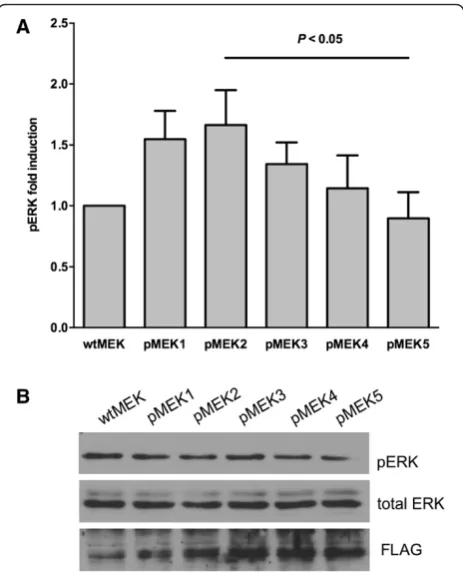
[image:5.595.60.539.99.305.2]The substitution mutations in A. gambiae MEK (S243E and S247D; Figure 1, Table 1) resulted in negatively charged residues that mimic phosphorylation in the ab-sence of exogenous stimuli and, therefore, mimicked kinase activation as described for the analogous mam-malian MEK mutations S218E/S222D [30,31]. Specific-ally, A. gambiae Sua5B cells that were transfected with pMEK1 (S243E) or with pMEK2 (S243E/S247D) had 50-70% higher levels of ERK phosphorylation relative to Table 2 Primer sequences for site-directed mutagenesis
Plasmid constructs Resulting amino acid mutations Primer sequence 5′➔3′
Docking domain mutations
pMEK3 K3M F: GACGACGACAAGATGAGTATGATGACAAAAAACAAACTTAA
R: TTAAGTTTGTTTTTTGTCATCATACTCATCTTGTCGTCGTC
pMEK4 K6M F: CAAGATGAGTAAAATGACAATGAACAAACTTAATTTGACGTTG
R: CAACGTCAAATTAAGTTTGTTCATTGTCATTTTACTCATCTTG
pMEK5 K3M F: GACGACGACAAGATGAGTATGATGACAATGAACAAACTTAATTTGACGTTG
K6M R: CAACGTCAAATTAAGTTTGTTCATTGTCATCATACTCATCTTGTCGTCGTC
Catalytic domain mutations
pMEK1 S243E F: GATTGATGAAATGGCCAATTCTTTTGTAGGTACTCGAAG
R: CTTCGAGTACCTACAAAAGAATTGGCCATTTCATCAATC
pMEK2 S243E F: GATTTCGGCGTTTCCGGTCAGTTGATTGATGAAATGGCCAATGATTTTGTAGGTACTCGAAG
pMEK3
pMEK4 S247D R: CTTCGAGTACCTACAAAATCATTGGCCATTTCATCAATCAACTGACCGGAAACGCCGAAATC
pMEK5
cells transfected with wtMEK plasmid, which encoded the unaltered MEK allele (Figure 2A). ERK phosphoryl-ation levels were approximately 20% higher, albeit not significantly, in cells transfected with pMEK2 relative to cells transfected with pMEK1 (Figure 2A), suggesting a modest additive effect of the activating mutations [30,31]. These increases in ERK phosphorylation were comparable to human TGF-β1-induced ERK phosphoryl-ation inA. gambiae cells (70% to 2.5-fold above control) [3], but were substantially lower than those observed fol-lowing analogous overexpression studies in mammalian cells. In particular, overexpression of human MEK S218E/ S222D in human kidney 293 or monkey kidney COS-7 cells increased ERK activity by more than 100-fold above wild type MEK levels [30,31]. However, background ERK phosphorylation in the absence of stimulation in both 293
and COS-7 cells is nearly undetectable [30,31], whereas previously observed basal ERK phosphorylation levels in A. gambiaecells in the absence of treatment [3] are nearly comparable to levels following transfection with wtMEK (Figure 2B).
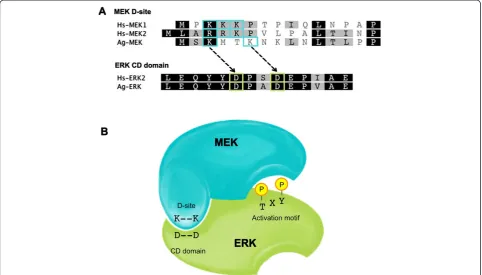
D-site mutations in catalytically activeA. gambiaeMEK reduced ERK phosphorylation in Sua5B cellsin vitro Based on functional interactions of MEK and ERK in mammalian cells [16], we predicted that conserved ly-sine residues K3 and K6 encoded in the A. gambiae MEK D-site should interact directly with two conserved aspartic acids in the CD domain of ERK (Figure 3). As such, MEK S243E/S247D is catalytically active, but the addition of K3M and K6M mutations would be expected to block the interaction of activated MEK with ERK and, hence, block ERK activation (Table 1). While not signifi-cant, overexpression of catalytically active MEK K3M (pMEK3) or catalytically active MEK K6M (pMEK4) in A. gambiae Sua5B cells reduced ERK phosphorylation relative to cells overexpressing catalytically active MEK (pMEK2; Figure 2A). Furthermore, overexpression of catalytically active MEK K3M/K6M (pMEK5) resulted in a significant reduction in ERK phosphorylation relative to cells that were transfected with pMEK2 (Figure 2A), suggesting that D-site lysine residues in A. gambiae are essential for functional docking and phosphorylation of ERK by MEK.
Transovarially acquired pMEK2 and pMEK5 resulted in midgut-biased transgene overexpression in F0 mosquitoes
Consumption of blood initiate vitellogenesis in the fe-male mosquito during which the fat body produces yolk protein precursors that are absorbed by the developing oocytes [32,33]. Penget al. [27] exploited this physiology to develop a “vertical DNA vector delivery method” to transiently manipulate gene expression in F0 offspring of plasmid-injected female mosquitoes. We used this strat-egy to investigate whether MEK D-site mutations could alter ERK phosphorylation in the A. gambiae midgut. Specifically, pMEK2 and pMEK5 plasmids were microin-jected into the hemocoels of vitellogenic female mosqui-toes that had fed on blood 16–24 h earlier. Following injection, mosquitoes were allowed to oviposit and eggs (F0) were collected for rearing.
[image:6.595.58.290.288.576.2]To confirm midgut-specific overexpression of the vari-ant MEK alleles, 4 d old F0 adult female offspring of plasmid-injected A. gambiae were allowed to feed on blood for 30 min. Age-matched F0 offspring from mosqui-toes from the same cohorts that were not injected with plasmid and, hence, not transformed were fed alongside transformed F0 females as controls to assess specificity of transcript detection. At 2 h post-feeding, midguts from six Figure 2SNPs within MEK D-site and catalytic domain alter
femaleA. gambiaein each group were dissected into PBS. TaqMan qRT-PCR with probes specific to exogenous variantMEKalleles revealed no detectable signals from midguts or carcasses of non-transformed F0 females; hence, relative levels of endogenous MEK mRNA in non-transformed females (NT) were used for compari-son to variantMEKallele expression in transformed F0 females (pMEK2, pMEK5; Figure 4). From replicated F0 cohorts, midgut expression of mRNAs encoding catalyt-ically active MEK (pMEK2) and catalytcatalyt-ically active MEK K3M/K6M (pMEK5) were detected at levels four- and three-fold higher (P< 0.05) than endogenousMEKmRNA levels in non-transformed mosquitoes (Figure 4). Surpris-ingly, expression of exogenous variantMEK alleles in the carcass appeared to be equivalent to endogenous MEK mRNA levels in the same tissue in non-transformed F0 females (compare carcass levels ofpMEK2 andpMEK5 to carcass levels of endogenousMEKin non-transformed females; Figure 4). While variantMEKallele probes specif-ically detected transcripts in transformed mosquitoes, we cannot exclude the possibility that some level of en-dogenousMEKmRNA is also detected by these probes, which would explain signal detection in the carcass of
transformed F0 females despite use of a midgut-specific promoter [29,34].
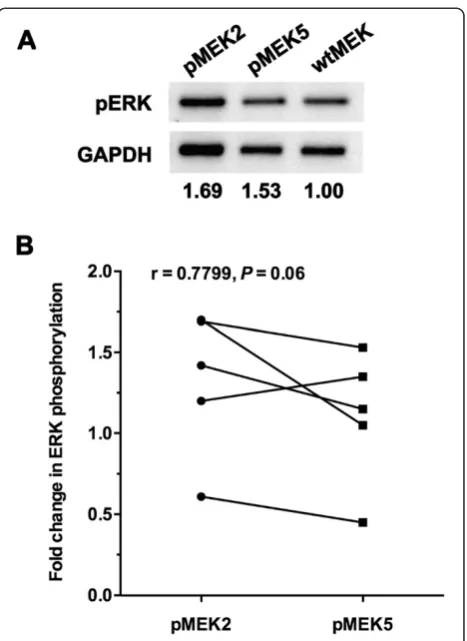
Midgut-directed overexpression ofMEKalleles with D-site polymorphisms decreased ERK phosphorylation
[image:7.595.57.540.90.365.2]ERK phosphorylation by the MEK inhibitor PD98059 [21] could result in significant inhibition of P. falciparum growth inA. stephensi.
Midgut-directed overexpression ofMEKalleles with D-site polymorphisms decreasedP. bergheidevelopment inA. gambiae
To determine whether overexpression of catalytically ac-tive MEK with D-site mutations would result in an in-fection phenotype similar to that induced by PD98059 inhibition of MEK [21], we allowed 3–5 d old female mosquitoes transformed for midgut-specific overexpres-sion of wtMEK, pMEK2 or pMEK5 to feed on P. ber-ghei-infected mice for 30 min (Figure 6). As expected, mosquitoes overexpressing catalytically active MEK (pMEK2) developed a significantly greater number of oocysts per midgut (42.2 ± 8.0) than did mosquitoes overexpressing wtMEK (14.1 ± 1.2 oocysts; P= 0.03). Oocyst counts in mosquitoes overexpressing wtMEK were not significantly different from non-transformed (NT) mosquitoes (P= 0.11). The introduction of D-site mutations (pMEK5) reduced oocyst development (28.0 ±
5.8 oocysts) relative to mosquitoes transformed with pMEK2 (P= 0.07) to levels that were not different from mosquitoes overexpressing wtMEK (P= 0.11) and non-transformed mosquitoes (P= 0.48). These results con-firm our previous observations that MEK-ERK signaling regulates parasite development and indicate that this regulation is dependent on MEK docking functionality.
Discussion
[image:8.595.306.540.86.407.2]In this study, we used a vertical DNA vector delivery method adapted from Peng et al. [27] to demonstrate Figure 4Midgut-specific overexpression of exogenous variant
[image:8.595.59.288.89.302.2]MEKalleles was confirmed by qRT-PCR.Total RNA was isolated from the midguts or carcasses of non-transformed (NT) female mosquitoes and female mosquitoes transformed with either pMEK2 or pMEK5 for qRT-PCR with probes that distinguished between exogenous variant and endogenousMEKalleles. Relative to levels of endogenousMEKmRNA in NT females, expression levels of exogenous variantMEKallele were four- or three-fold higher (P< 0.05) in midguts of females transformed with plasmids encoding catalytically active MEK (pMEK2) or catalytically active MEK K3M/K6M (pMEK5), respectively. VariantMEKallele expression levels in the carcass of transformed mosquitoes were comparable to endogenousMEKallele expression levels in NT female mosquitoes. Five independent mosquito cohorts were used in this experiment.
that mutations in the D-site of MEK disrupt downstream ERK phosphorylation in A. gambiae cells in vitro and in vivo. Further, these mutations can alter the success of malaria parasite infection in transformed F0 mosquitoes. Specifically, K3M and K6M mutations in the D-site (pMEK5; Table 1) significantly repressed ERK phosphor-ylation relative to cells or tissue in which catalytically ac-tive MEK was overexpressed (pMEK2; Figures 2, 5). These data suggest that the MEK D-site has conserved function-ality in an insect of public health importance.
Because of the critical involvement of MEK-ERK sig-naling in a number of chronic diseases and cancer, there has been significant interest in therapeutic approaches to disrupt the docking interaction of MEK and ERK, in-cluding the use of small molecule inhibitors [35], the introduction of mutations into the MEK D-site, and transfection of short blocking peptides that bind to the CD domain of ERK [36]. In mammals, disruption of the MEK D-site can also facilitate immune evasion by path-ogens. For example, the anthrax lethal factor (ALF) of Bacillus anthracis impairs host cell immune activation during early infection through cleavage of the MEK D-site by anthrax lethal protease [37-39]. In the context of
cancer, ALF-mediated cleavage of the D-site regulates both cell survival and growth. Specifically, ALF-mediated inhibition of MAPK signaling can trigger melanoma cell apoptosis and suppress the progression of renal cell car-cinoma [40-42]. From these studies, we suggest that en-hanced disruption of the D-site of MEK as a strategy to inhibit disease-associated MEK-ERK signaling could be applied to the development of transmission blocking strat-egies for malaria.
Our engineered mutations in the MEK D-site did not appear to exert a dominant negative effect, but induced an incomplete albeit functional block of ERK phosphor-ylation, much like the use of small molecule MEK inhib-itors. Based on these observations, we suggest that mutated MEK did not wholly outcompete endogenous MEK to block signal transmission. Alternatively, inhib-ition may have been more effective than was apparent because of feedback regulation. In particular, the MEK inhibitor PD98059 can interfere with ERK-dependent negative feedback regulation. Specifically, the Grb2-SOS complex is recruited to activate membrane-bound Ras, but ERK phosphorylation of SOS causes the complex to dissociate [43]. Following treatment with PD98059, ERK-dependent SOS phosphorylation is blocked, resulting in prolonged Ras activation in insulin- and epidermal growth factor (EGF)-treated human insulin receptor ex-pressing rat cells [44]. Thus, blocking the signaling inter-action of MEK and ERK can impair feedback regulation to partially restore ERK phosphorylation.
[image:9.595.57.291.88.291.2]In addition to canonical signaling through Ras-Raf-MEK, networked signaling pathways can provide alter-native targets for manipulation of ERK phosphorylation. For example, treatment of human breast cancer T47D cells with the MEK inhibitor U0126 in combination with the phosphoinositide 3-kinase/Akt inhibitor wortmannin synergistically suppressed EGF-induced ERK activation relative to treatment with U0126 alone [45]. Similarly, overexpression of phosphatase and tensin homolog (PTEN), which functions as an endogenous inhibitor of Akt, reduced basal levels of midgut ERK phosphoryl-ation relative to control A. stephensi, but had no effect on insulin-induced ERK activation relative to controls [34], suggesting that inhibition of Akt-dependent ERK signaling could be targeted to additively reduce ERK ac-tivation in the mosquito. The acac-tivation of endogenous ERK inhibitors has also proved successful in suppressing ERK activation with measurable biological effects. For example, overexpression of MAPK phosphatase MKP-3, which specifically targets ERK for dephosphorylation, induced hepatic gluconeogenesis and increased fasting blood glucose levels in lean mice, suggesting that MKP-3 could be targeted therapeutically for type 2 diabetes [46]. Similarly, Drosophila melanogaster MKP-3 is an endogenous regulator of ERK phosphorylation that is Figure 6Midgut-directed overexpression ofMEKalleles with
D-site polymorphisms decreasedP. bergheioocyst numbers in
indispensable to fly embryonic development [47], indi-cating that genetic manipulation of MKP-3 can provide highly conserved control of important biological re-sponses to ERK phosphorylation. Finally, the MKPs are an intense focus of development of therapeutic small molecule inhibitors and activators given the critical roles for MAPKs in various chronic and inflammatory human diseases [48], suggesting that analogous discov-ery and applications for enhancing MKP activity in mos-quitoes are both possible and likely to be successful.
Naturally occurring SNPs within A. gambiae immune genes have been found to be associated with parasite in-fection, including TOLL5B and ILP3 [49] as well as Sp SNAKElike and TOLL6 [50]. Indeed, it has been pro-posed that a breakdown in mosquito innate immunity is responsible for susceptibility to parasite infection [51], raising the possibility of undertaking studies searching for naturally occurring mutations in immune signaling genes. Most recently, Liet al. [52] identified nonsynon-ymous SNPs inA. gambiae adenosine deaminase(AgADA), fibrinogen-related protein 1(FREP1) andfibrinogen-related protein 30 (FBN30). RNAi-mediated silencing of FREP1 resulted in a significant decrease in infection prevalence while FBN30transcript ablation increased infection in-tensity two-fold relative to controls [52]. While these as-sociation studies support the role of natural genetic variation in the control of Plasmodium development, mutations such as these have thus far been used only to identify target genes for which to query the effects of RNAi-mediated silencing on infection phenotype. How-ever, many immune gene products require protein-protein interaction to form complexes or post-translational modi-fication to mediate specific cellular functions. As such, the work presented here indicates that functional SNP studies can be extended to determine the mechanisms by which coding sequence mutations specifically impact infection phenotype.
Conclusion
We have established proof-of-principle for the functional analysis of SNPs on protein function and infection sus-ceptibility inA. gambiae. In particular, we have demon-strated that engineered mutations in A. gambiae MEK recapitulate the effects of small molecule inhibition of MEK-ERK signaling in mosquito cells and on parasite infection [20,21]. In addition to proof-of-principle, the interruption of MEK-ERK signaling via engineered D-site mutations can be translated for the development of transgenicA. gambiaethat are resistant to malaria para-site development and transmission.
Competing interests
The authors declare that they have no competing interests.
Authors’contributions
AAB and SL conceived and designed the experiments of the study. MC and ACB performed mutagenesis to generate the SNP-encodingMEKplasmids. AAB carried out the experimentsin vitroand KC carried out the experiments in vivo. SL and LS conducted statistical analyses. SL and LS prepared the manuscript with AAB. All authors read and approved the final version of the manuscript.
Acknowledgments
This project support was provided by the National Institutes of Health National Institute of Allergy and Infectious Diseases R01 AI078183 (to SL), R01 AI080799 (to SL), T32 AI074550 (to AAB, LS). We thank Dr. Que Lan and her laboratory personnel (University of Wisconsin) for their patience in training us in the technique of plasmid microinjection and we regret that Dr. Lan’s untimely passing prevented us from sharing our success with her.
Author details
1Department of Medical Microbiology and Immunology, School of Medicine,
University of California Davis, 95616 Davis, CA, USA.2Division of Vector-Borne Diseases, National Center for Emerging Zoonotic Infectious Diseases, Centers for Disease Control and Prevention, 3156 Rampart Rd, 80521 Fort Collins, CO, USA.
Received: 11 February 2014 Accepted: 13 June 2014 Published: 23 June 2014
References
1. World Health Organization Global Malaria Program:World malaria report: 2013.Geneva: World Health Organization; 2013.
2. Li M, Liu J, Zhang C:Evolutionary history of the vertebrate mitogen activated protein kinases family.PLoS ONE2011,6:e26999.
3. Horton AA, Wang B, Camp L, Price MS, Arshi A, Nagy M, Nadler SA, Faeder JR, Luckhart S:The mitogen-activated protein kinome fromAnopheles gambiae: identification, phylogeny and functional characterization of the ERK, JNK and p38 MAP kinases.BMC Genomics2011,12:574.
4. Zahoor Z, Davies AJ, Kirk RS, Rollinson D, Walker AJ:Nitric oxide production by Biomphalaria glabrata haemocytes: effects of Schistosoma mansoni ESPs and regulation through the extracellular signal-regulated kinase pathway.Parasit Vectors2009,2:18.
5. Ibraim IC, De Assis RR, Pessoa NL, Campos MA, Melo MN, Turco SJ, Soares RP:Two biochemically distinct lipophosphoglycans from Leishmania braziliensis and Leishmania infantum trigger different innate immune responses in murine macrophages.Parasit Vectors2013,6:54. 6. Chang L, Karin M:Mammalian MAP kinase signalling cascades.
Nature2001,410:37–40.
7. Krishna M, Narang H:The complexity of mitogen-activated protein kinases (MAPKs) made simple.Cell Mol Life Sci2008,65:3525–3544. 8. Rubinfeld H, Seger R:The ERK cascade: a prototype of MAPK signaling.
Mol Biotechnol2005,31:151–174.
9. Fukuda M, Gotoh Y, Nishida E:Interaction of MAP kinase with MAP kinase kinase: its possible role in the control of nucleocytoplasmic transport of MAP kinase.EMBO J1997,16:1901–1908.
10. Adachi M, Fukuda M, Nishida E:Two co-existing mechanisms for nuclear import of MAP kinase: passive diffusion of a monomer and active transport of a dimer.EMBO J1999,18:5347–5358.
11. Wolf I, Rubinfeld H, Yoon S, Marmor G, Hanoch T, Seger R:Involvement of the activation loop of ERK in the detachment from cytosolic anchoring.
J Biol Chem2001,276:24490–24497.
12. Xu B, Wilsbacher JL, Collisson T, Cobb MH:The N-terminal ERK-binding site of MEK1 is required for efficient feedback phosphorylation by ERK2 in vitro and ERK activation in vivo.J Biol Chem1999,274:34029–34035. 13. Bromberg-White JL, Andersen NJ, Duesbery NS:MEK genomics in
development and disease.Brief Funct Genomics2012,11:300–310. 14. Mayor F Jr, Jurado-Pueyo M, Campos PM, Murga C:Interfering with MAP
kinase docking interactions: implications and perspective for the p38 route.Cell Cycle2007,6:528–533.
15. Zhou T, Sun L, Humphreys J, Goldsmith EJ:Docking interactions induce exposure of activation loop in the MAP kinase ERK2.Structure2006,
16. Tanoue T, Adachi M, Moriguchi T, Nishida E:A conserved docking motif in MAP kinases common to substrates, activators and regulators.
Nat Cell Biol2000,2:110–116.
17. Bardwell AJ, Flatauer LJ, Matsukuma K, Thorner J, Bardwell L:A conserved docking site in MEKs mediates high-affinity binding to MAP kinases and cooperates with a scaffold protein to enhance signal transmission.
J Biol Chem2001,276:10374–10386.
18. Xu B, Stippec S, Robinson FL, Cobb MH:Hydrophobic as well as charged residues in both MEK1 and ERK2 are important for their proper docking.
J Biol Chem2001,276:26509–26515.
19. Lim J, Gowda DC, Krishnegowda G, Luckhart S:Induction of nitric oxide synthase inAnopheles stephensibyPlasmodium falciparum: mechanism of signaling and the role of parasite glycosylphosphatidylinositols.
Infect Immun2005,73:2778–2789.
20. Surachetpong W, Pakpour N, Cheung KW, Luckhart S:Reactive oxygen species-dependent cell signaling regulates the mosquito immune response toPlasmodium falciparum.Antioxid Redox Signal2011,
14:943–955.
21. Surachetpong W, Singh N, Cheung KW, Luckhart S:MAPK ERK signaling regulates the TGF-beta1-dependent mosquito response toPlasmodium falciparum.PLoS Pathog2009,5:e1000366.
22. Price I, Ermentrout B, Zamora R, Wang B, Azhar N, Mi Q, Constantine G, Faeder JR, Luckhart S, Vodovotz Y:In vivo,in vitro, andin silicostudies suggest a conserved immune module that regulates malaria parasite transmission from mammals to mosquitoes.J Theor Biol2013,
334:173–186.
23. Peterson TM, Gow AJ, Luckhart S:Nitric oxide metabolites induced in
Anopheles stephensicontrol malaria parasite infection.Free Radic Biol Med 2007,42:132–142.
24. Ramiro RS, Alpedrinha J, Carter L, Gardner A, Reece SE:Sex and death: the effects of innate immune factors on the sexual reproduction of malaria parasites.PLoS Pathog2011,7:e1001309.
25. Muller HM, Dimopoulos G, Blass C, Kafatos FC:A hemocyte-like cell line established from the malaria vectorAnopheles gambiaeexpresses six prophenoloxidase genes.J Biol Chem1999,274:11727–11735. 26. Geneious version 5.5.8 created by Biomatters.[http://www.geneious.com/] 27. Peng R, Maklokova VI, Chandrashekhar JH, Lan Q:In vivofunctional
genomic studies of sterol carrier protein-2 gene in the yellow fever mosquito.PLoS ONE2011,6:e18030.
28. Moreira LA, Ghosh AK, Abraham EG, Jacobs-Lorena M:Genetic transformation of mosquitoes: a quest for malaria control.Int J Parasitol2002,32:1599–1605. 29. Corby-Harris V, Drexler A, Watkins De Jong L, Antonova Y, Pakpour N, Ziegler R,
Ramberg F, Lewis EE, Brown JM, Luckhart S, Riehle MA:Activation of Akt signaling reduces the prevalence and intensity of malaria parasite infection and lifespan inAnopheles stephensimosquitoes.PLoS Pathog2010,6:e1001003. 30. Mansour SJ, Matten WT, Hermann AS, Candia JM, Rong S, Fukasawa K,
Vande Woude GF, Ahn NG:Transformation of mammalian cells by constitutively active MAP kinase kinase.Science1994,265:966–970. 31. Huang W, Erikson RL:Constitutive activation of Mek1 by mutation of
serine phosphorylation sites.Proc Natl Acad Sci U S A1994,91:8960–8963. 32. Attardo GM, Hansen IA, Raikhel AS:Nutritional regulation of vitellogenesis in mosquitoes: implications for anautogeny.Insect Biochem Mol Biol2005,
35:661–675.
33. Anderson WA, Spielman A:Permeability of the ovarian follicle ofAedes aegyptimosquitoes.J Cell Biol1971,50:201–221.
34. Hauck ES, Antonova-Koch Y, Drexler A, Pietri J, Pakpour N, Liu D, Blacutt J, Riehle MA, Luckhart S:Overexpression of phosphatase and tensin homolog improves fitness and decreasesPlasmodium falciparum
development inAnopheles stephensi.Microbes Infect2013,15:775–787. 35. McCubrey JA, Steelman LS, Abrams SL, Chappell WH, Russo S, Ove R, Milella
M, Tafuri A, Lunghi P, Bonati A, Stivala F, Nicoletti F, Libra M, Martelli AM, Montalto G, Cervello M:Emerging MEK inhibitors.Expert Opin Emerg Drugs 2010,15:203–223.
36. Bardwell AJ, Frankson E, Bardwell L:Selectivity of docking sites in MAPK kinases.J Biol Chem2009,284:13165–13173.
37. Turk BE:Manipulation of host signalling pathways by anthrax toxins.
Biochem J2007,402:405–417.
38. Vitale G, Pellizzari R, Recchi C, Napolitani G, Mock M, Montecucco C:
Anthrax lethal factor cleaves the N-terminus of MAPKKs and induces tyrosine/threonine phosphorylation of MAPKs in cultured macrophages.
Biochem Biophys Res Commun1998,248:706–711.
39. Duesbery NS, Webb CP, Leppla SH, Gordon VM, Klimpel KR, Copeland TD, Ahn NG, Oskarsson MK, Fukasawa K, Paull KD, Vande Woude GF:Proteolytic inactivation of MAP-kinase-kinase by anthrax lethal factor.Science1998,
280:734–737.
40. Koo HM, VanBrocklin M, McWilliams MJ, Leppla SH, Duesbery NS, Vande Woude GF:Apoptosis and melanogenesis in human melanoma cells induced by anthrax lethal factor inactivation of mitogen-activated protein kinase kinase.Proc Natl Acad Sci U S A2002,99:3052–3057. 41. Huang D, Ding Y, Luo WM, Bender S, Qian CN, Kort E, Zhang ZF,
VandenBeldt K, Duesbery NS, Resau JH, Teh BT:Inhibition of MAPK kinase signaling pathways suppressed renal cell carcinoma growth and angiogenesisin vivo.Cancer Res2008,68:81–88.
42. Abi-Habib RJ, Urieto JO, Liu S, Leppla SH, Duesbery NS, Frankel AE:BRAF status and mitogen-activated protein/extracellular signal-regulated kinase kinase 1/2 activity indicate sensitivity of melanoma cells to anthrax lethal toxin.Mol Cancer Ther2005,4:1303–1310.
43. Nimnual A, Bar-Sagi D:The two hats of SOS.Sci STKE2002,2002:pe36. 44. Langlois WJ, Sasaoka T, Saltiel AR, Olefsky JM:Negative feedback
regulation and desensitization of insulin- and epidermal growth factor-stimulated p21ras activation.J Biol Chem1995,270:25320–25323. 45. Aksamitiene E, Kholodenko BN, Kolch W, Hoek JB, Kiyatkin A:
PI3K/Akt-sensitive MEK-independent compensatory circuit of ERK activation in ER-positive PI3K-mutant T47D breast cancer cells.Cell Signal2010,
22:1369–1378.
46. Wu Z, Jiao P, Huang X, Feng B, Feng Y, Yang S, Hwang P, Du J, Nie Y, Xiao G, Xu H:MAPK phosphatase-3 promotes hepatic gluconeogenesis through dephosphorylation of forkhead box O1 in mice.J Clin Invest 2010,120:3901–3911.
47. Kim M, Cha GH, Kim S, Lee JH, Park J, Koh H, Choi KY, Chung J:MKP-3 has essential roles as a negative regulator of the Ras/mitogen-activated protein kinase pathway duringDrosophiladevelopment.Mol Cell Biol 2004,24:573–583.
48. Doddareddy MR, Rawling T, Ammit AJ:Targeting mitogen-activated protein kinase phosphatase-1 (MKP-1): structure-based design of MKP-1 inhibitors and upregulators.Curr Med Chem2012,19:163–173.
49. Horton AA, Lee Y, Coulibaly CA, Rashbrook VK, Cornel AJ, Lanzaro GC, Luckhart S:Identification of three single nucleotide polymorphisms in
Anopheles gambiaeimmune signaling genes that are associated with naturalPlasmodium falciparuminfection.Malar J2010,9:160.
50. Harris C, Lambrechts L, Rousset F, Abate L, Nsango SE, Fontenille D, Morlais I, Cohuet A:Polymorphisms inAnopheles gambiaeimmune genes associated with natural resistance toPlasmodium falciparum.PLoS Pathog 2010,6:e1001112.
51. Riehle MM, Markianos K, Niare O, Xu J, Li J, Toure AM, Podiougou B, Oduol F, Diawara S, Diallo M, Coulibaly B, Ouatara A, Kruglyak L, Traore SF, Vernick KD:Natural malaria infection inAnopheles gambiaeis regulated by a single genomic control region.Science2006,312:577–579.
52. Li J, Wang X, Zhang G, Githure JI, Yan G, James AA:Genome-block expression-assisted association studies discover malaria resistance genes inAnopheles gambiae.Proc Natl Acad Sci U S A2013,110:20675–20680.
doi:10.1186/1756-3305-7-287
Cite this article as:Brentonet al.:Engineered single nucleotide polymorphisms in the mosquito MEK docking site alterPlasmodium
bergheidevelopment inAnopheles gambiae.Parasites & Vectors20147:287.
Submit your next manuscript to BioMed Central and take full advantage of:
• Convenient online submission
• Thorough peer review
• No space constraints or color figure charges
• Immediate publication on acceptance
• Inclusion in PubMed, CAS, Scopus and Google Scholar
• Research which is freely available for redistribution