Open Access
Technical Note
PKQuest_Java: free, interactive physiologically based
pharmacokinetic software package and tutorial
David G Levitt
Address: Department of Integrative Biology and Physiology, University of Minnesota, 6-125 Jackson Hall, 321 Church St. S. E., Minneapolis, MN 55455, USA
Email: David G Levitt - [email protected]
Abstract
Background: Physiologically based pharmacokinetics (PBPK) uses a realistic organ model to describe drug kinetics. The blood-tissue exchange of each organ is characterized by its volume, perfusion, metabolism, capillary permeability and blood/tissue partition coefficient. PBPK applications require both sophisticated mathematical modeling software and a reliable complete set of physiological parameters. Currently there are no software packages available that combine ease of use with the versatility that is required of a general PBPK program.
Findings: The program is written in Java and is available for free download at http:// www.pkquest.com/. Included in the download is a detailed tutorial that discusses the pharmacokinetics of 6 solutes (D2O, amoxicillin, desflurane, propofol, ethanol and thiopental)
illustrated using experimental human pharmacokinetic data. The complete PBPK description for each solute is stored in Excel spreadsheets that are included in the download. The main features of the program are: 1) Intuitive and versatile interactive interface; 2) Absolute and semi-logarithmic graphical output; 3) Pre-programmed optimized human parameter data set (but, arbitrary values can be input); 4) Time dependent changes in the PBPK parameters; 5) Non-linear parameter optimization; 6) Unique approach to determine the oral "first pass metabolism" of non-linear solutes (e.g. ethanol); 7) Pulmonary perfusion/ventilation heterogeneity for volatile solutes; 8) Input and output of Excel spreadsheet data; 9) Antecubital vein sampling.
Conclusion: PKQuest_Java is a free, easy to use, interactive PBPK software routine. The user can either directly use the pre-programmed optimized human or rat data set, or enter an arbitrary data set. It is designed so that drugs that are classified as "extracellular" or "highly fat soluble" do not require information about tissue/blood partition coefficients and can be modeled by a minimum of user input parameters. PKQuest_Java, along with the included tutorial, could be used as the basis of an interactive, on-line, pharmacokinetic course.
Background
Physiologically Based Pharmacokinetics (PBPK) refers to the approach of modeling drug kinetics using a realistic physiological description of the animal [1,2]. The PBPK modeling approach has remained primarily in the realm
of the specialist because of its requirement for both sophisticated mathematical software and a reliable set of physiological parameters describing the model organs. The PBPK software available as of 2002 was reviewed by Rowland et. al. [3]. The software that has been adapted for
Published: 5 August 2009
BMC Research Notes 2009, 2:158 doi:10.1186/1756-0500-2-158
Received: 30 April 2009 Accepted: 5 August 2009
This article is available from: http://www.biomedcentral.com/1756-0500/2/158
© 2009 Levitt et al; licensee BioMed Central Ltd.
PBPK modeling varies from general scientific computing packages (e.g. MATLAB) to biological and pharmacoki-netic routines (e.g. ADAPT II, NONMEM, WinNonlin, SAAM) to proprietary software designed for specific appli-cations that are difficult to adapt for general use (e.g. Gas-troPlus, Physiolab). More recently, Barboriak et. al. developed a freely distributed, dedicated PBPK model using JSim [4]. None of these programs provide the com-bination of an easy to learn, intuitive interface with the wide-ranging features that are necessary for the most gen-eral applications.
PKQuest, a freely distributed general purpose PBPK pro-gram, was released in 2002 [5]. It has now been used in the analysis of the pharmacokinetics of more then 30 dif-ferent solutes in a series of publications [5-14]. Using and refining the same parameter set for this large number of disparate solutes provides increased confidence in the validity and generality of the physiological parameters. Because PKQuest was written in Maple (Maplesoft), it required the purchase, installation and some minimal training in Maple. The purpose of this paper is to intro-duce PKQuest_Java, a completely revised, Java based, interactive version of PKQuest. It is available for free download at http://www.pkquest.com/. It requires that a recent version of the Java Runtime Environment (JRE) is installed on the computer where it will be run. The main features and a brief tutorial on its use are described below. Since its interactive design is intuitive and there is little installation required, the easiest way to learn about it is to simply download and run it.
PBPK modeling presents an ideal approach to introduce students to the dependence of pharmacokinetics on the interaction between the physical chemical properties of a drug and physiology. Included in the download is a detailed tutorial that takes the student through the phar-macokinetics of a series of 6 solutes in the human (D2O, amoxicillin, desflurane, propofol, ethanol and thiopen-tal) and two solutes in the rat (sevoflurane and propofol). These examples use actual experimental data and provide a good introduction to the major features of PKQuest_Java. All of the parameters for each solute are stored in Excel "example" files that are also included in the download. This tutorial could form the basis of an online pharmacokinetics course.
Implementation
The major features of PKQuest_Java are:
1) Intuitive and versatile interactive interface.
2) Absolute and semi-logarithmic graphical output.
3) Pre-programmed optimized human and rat param-eter data set (but, arbitrary values can be input).
4) Time dependent changes in the PBPK parameters.
5) Non-linear parameter optimization.
6) Unique approach to determine the oral "first pass metabolism" of non-linear solutes such as ethanol.
7) Pulmonary perfusion/ventilation heterogeneity for volatile solutes.
8) Input and output of Excel spreadsheet data.
9) Antecubital vein sampling.
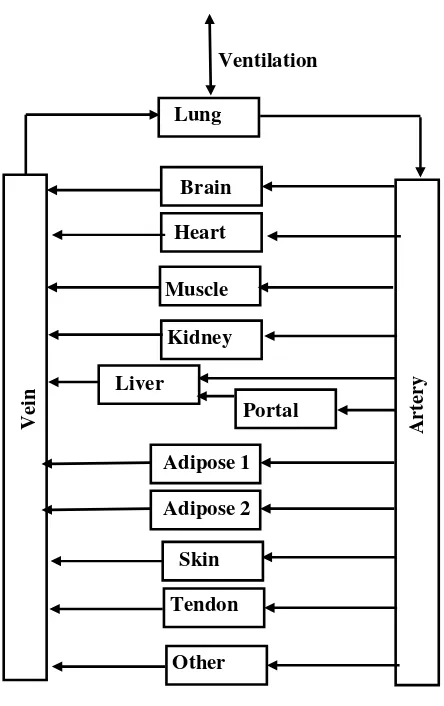
PKQuest_Java uses the standard "whole body" PBPK organ model (Figure 1) with each organ characterized by an adjustable volume, blood flow, capillary permeability, metabolism and tissue/blood partition coefficient. The major factor limiting the utility of the PBPK approach is uncertainty about the value of the tissue/blood partition coefficient for the different organs. Since this partition depends on specific and highly variable drug tissue bind-ing properties, each drug has a unique set of values [15]. However, there are two drug classes for which this parti-tion can be predicted just from in vitro measurements. The first is the class of "extracellular" solutes (e.g. β-lactam antibiotics) for which the partition depends primarily on interstitial albumin binding which can be predicted using in vitro measurement of plasma binding and previous knowledge of tissue albumin concentration [10]. The sec-ond class is that of the "highly fat soluble" drugs for which the partition coefficient can be accurately predicted from in vitro measurements of the fat/water partition coeffi-cient and previous determinations of tissue fat content [7,12,13]. PKQuest_Java is designed so that these special cases can be directly selected, allowing prediction of the pharmacokinetics with a minimum of user input.
When PKQuest_Java first opens, a series of windows are displayed (Model Parameters, Input, Plot, etc.). The "Model Parameter" window is shown in Figure 2. The default model parameters when the program is run are those used for modeling the pharmacokinetics of D2O. This is the simplest possible case, with D2O distributing in
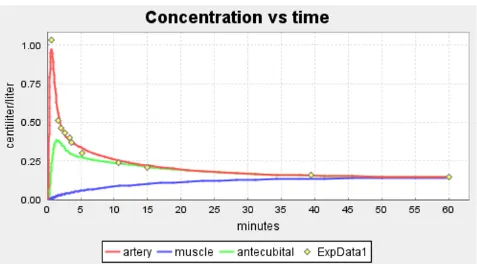
all of the organs selected by the user. Three plots are shown in Figure 3: the arterial, muscle and "antecubital" water concentration along with the experimental data. (A unique feature of PKQuest_Java is that an estimate of the antecubital concentration is provided based on the assumed mixing that occurs at this site [11]). PKQuest_Java allows non-linear optimization of all the major parameters. In the tutorial this feature is illustrated by adjusting the muscle blood flow (which dominates the D2O kinetics) to optimize the fit to the experimental data. This default case used the set of organ parameters that
have been optimized by application of PKQuest to a large number of different solutes and these parameters are automatically scaled for body weight and fat fraction. In general, unless one has good reason to assume that these values are incorrect (e.g. increased muscle blood flow dur-ing exercise) they should not be modified. Arbitrary val-ues for the organ perfusion, volume and capillary permeability can be input into a table opened by clicking the "Organ Par" button (Figure 2).
The pharmacokinetics of amoxicillin is discussed in the tutorial as an example of a typical "extracellular" solute for which the tissue/blood partition can be predicted from in vitro measurements of plasma binding. This drug class is selected by clicking the "Extracellular" box which acti-vates 3 other input boxes (see Figure 2): 1) the free plasma fraction, 2) A factor that adjusts the default extracellular volume of each organ; and 3) A capillary permeability fac-tor (= 1.0 for amoxicillin which is flow limited). In addi-tion, a value needs to be entered in the renal clearance box (Figure 3).
Two "high fat soluble" drug classes are discussed in the tutorial as examples of drugs whose tissue/partition coef-ficient can be predicted from in vitro measurements of fat/ water partition. The first are the volatile anesthetics, repre-sented by modeling the experimental desflurane pharma-cokinetics [12]. Since the metabolism of most volatile anesthetics is negligible, their elimination rate is com-pletely determined by the physiological ventilation parameters. This class is selected by clicking the "Volatile" check box and entering the values of blood/air, water/air and fat/water partition coefficients (see Figure 2). Option-ally, the alveolar volume and ventilation rate can be input if they differ from the default values. A unique feature of PKQuest_Java is that it can be used to model perfusion-ventilation heterogeneity. The boxes labeled "Perf/vent stdF and stdV characterize the values of the perfusion and ventilation heterogeneity (normal value = 1). The long time kinetics of these solutes is dominated by the adipose tissue exchange and an accurate model requires a hetero-geneous adipose perfusion [12]. This is modeled in PKQuest_Java by two equal volume adipose compart-ments with different perfusion rates (see Figure 1). The second "high fat soluble" drug in the tutorial focuses on the pharmacokinetics of the non-volatile propofol [13] and is selected by clicking the Fat/water partition box and filling in the fat/water partition and, optionally, the frac-tion free in plasma (if it differs from the default value). The propofol experimental data that is modeled has a complex input (2 different constant inputs and 1 expo-nential input) which is illustrated in the tutorial.
One class where PBPK modeling is a necessity is for drugs with non-linear metabolism. For example, in order to Flow diagram and arrangement of organs used for the PBPK
[image:3.612.66.288.88.441.2]model Figure 1
Flow diagram and arrangement of organs used for the PBPK model. Each box represents a well-stirred com-partment and each arrow is an input or output to the organ. The organ labeled "Portal" includes all organs drained by the portal vein (stomach, small and large intestine, spleen and pancreas). The organ labeled "Other" represents "connec-tive" tissue and its weight is adjusted during the run to so that total weight is equal to that set by the subject's "weight". Adipose tissue is represented by two equal volume adipose compartments with different perfusion rates.
Heart
Kidney Lung
Brain
Muscle
Liver
Portal
Adipose 1
Skin
Other
Vein
Arte
ry
Ventilation
Adipose 2
Snapshot of the "Model Parameters" window that opens when PKQuest_Java is first run Figure 2
Snapshot of the "Model Parameters" window that opens when PKQuest_Java is first run.
Snapshot of the "Output" window that is opened when the default PKQuest_Java (D2O kinetics) is run
Figure 3
Snapshot of the "Output" window that is opened when the default PKQuest_Java (D2O kinetics) is run. The
accurately model the non-linear ethanol pharmacokinet-ics it is necessary to determine the Vmax and Km for the liver metabolism. This requires an accurate simulation of the liver tissue concentration through a modeling of liver perfusion. The tutorial focuses on ethanol and illustrates, through a series of problems, the main pharmacokinetic features of non-linear solutes. A unique feature of PKQuest_Java is that it provides a rigorous definition and procedure for determining "first pass metabolism" using two sets of experimental data: the blood concentration following 1) intravenous and 2) oral input. It uses the fol-lowing procedure: Firstly, the non-linear PBPK parameters are determined using the IV input data. Secondly, the time course of the intestinal absorption that would produce the observed blood values following an oral input is deter-mined. (The intestinal absorption is modeled in the form of the Hill equation). Finally, the IV input required to fit this same blood concentration data following oral input is determined and the "first pass metabolism" is defined as the difference between the calculated oral and IV inputs. Although this seems to be a complicated procedure, it is made simple and transparent in PKQuest_Java and is dis-cussed in detail in the tutorial.
The above examples all used solutes for which the tissue/ blood partition coefficient can be determined from in vitro measurements. Unfortunately, the great majority of solutes are exceptions to this. Although rough estimates (within a factor of about 2) of this partition can be made from drug structure algorithms, accurate estimates usually require direct animal measurement of tissue/plasma par-tition [15]. This general parpar-tition case is illustrated in the tutorial using thiopental. It is selected by clicking the "tis-sue partition" check box and then clicking the "Partition" button (see Figure 2) which opens a table that requires the user to fill in the values of the tissue/plasma partition for each organ in the table.
The most important application of PBPK modeling is in the area of toxicokinetics and environmental risk assess-ment where it is essential to simulate local tissue concen-trations under varying exposure conditions (e.g. rest, exercise, etc.) [17,18]. For this analysis, the PBPK model must be able to simulate time dependent changes in the physiological parameters (e.g. ventilation rate, cardiac output, muscle blood flow). The design of PKQuest_Java provides a relatively simple procedure to model step changes in the PBPK parameters. One first develops (and saves in Excel files) separate models for each set of the constant PBPK parameters. Then, using an interactive option, one lists the order that the individual models are called and the time point when the switch is made and then the complete sequential set is run. This procedure is illustrated in the tutorial by the modeling of the experi-mental long time (6 day) washout of desflurane during a
period when the subject's alveolar ventilation varied as the conditions varied from anesthesia to ambulatory [12].
Conclusion
PBPK modeling still remains a subject for specialists, pri-marily in the area of environmental risk assessment. Highly refined sophisticated software that satisfies regula-tory requirements has been developed to meet these needs. PKQuest_Java is not designed as a substitute for these programs. In addition, PKQuest_Java makes no attempt to incorporate population modeling which adds another level of sophistication and training and is superbly described by NONMEM. PKQuest_Java is designed for the non-specialist who would like to attempt some PBPK modeling without acquiring detailed training or expensive software. In addition, it is hoped that PKQuest_Java along with the included tutorial can be used as an introduction to pharmacokinetics for students (possibly as an on-line tutorial). The version now being distributed is a first attempt and the author welcomes sug-gestions for modifying it to add additional features, make it more user friendly or increase its value as a student learning tool.
Availability and requirements
The jar file, tutorial and example files are now available for download from http://www.pkquest.com/
PKQuest_Java requires that a recent version of the Java Runtime Environment (JRE) is installed on the computer where it will be run.
The software application is freely available to anyone wishing to use it for non-commercial purposes, without restrictions such as the need for a material transfer agree-ment.
List of abbreviations used
PBPK: Physiologically based pharmacokinetic modeling.
Competing interests
The author declares that they have no competing interests.
Authors' contributions
DGL developed the software, the examples and the tuto-rial and has read and approved the final manuscript.
References
1. Reddy MB, Yang RSH, Clewell HJ 3rd, Andersen ME: Physiologically Based Pharmacokinetic Modeling Hoboken, New Jersey: Wiley-Inter-science; 2005.
2. Edginton AN, Theil FP, Schmitt W, Willmann S: Whole body phys-iologically-based pharmacokinetic models: their use in clini-cal drug development. Expert Opin Drug Metab Toxicol 2008,
4:1143-1152.
work-Publish with BioMed Central and every scientist can read your work free of charge "BioMed Central will be the most significant development for disseminating the results of biomedical researc h in our lifetime."
Sir Paul Nurse, Cancer Research UK
Your research papers will be:
available free of charge to the entire biomedical community
peer reviewed and published immediately upon acceptance
cited in PubMed and archived on PubMed Central
yours — you keep the copyright
Submit your manuscript here:
http://www.biomedcentral.com/info/publishing_adv.asp
BioMedcentral shop report (Georgetown University, Washington, DC, May
2930, 2002). AAPS PharmSci 2004, 6:E6.
4. Barboriak DP, MacFall JR, Viglianti BL, Dewhirst Dvm MW: Compar-ison of three physiologically-based pharmacokinetic models for the prediction of contrast agent distribution measured by dynamic MR imaging. J Magn Reson Imaging 2008,
27:1388-1398.
5. Levitt DG: PKQuest: a general physiologically based pharma-cokinetic model. Introduction and application to pro-pranolol. BMC Clin Pharmacol 2002, 2:5.
6. Levitt DG: PKQuest: capillary permeability limitation and plasma protein binding application to human inulin, dicloxa-cillin and ceftriaxone pharmacokinetics. BMC Clin Pharmacol 2002, 2:7.
7. Levitt DG: PKQuest: volatile solutes application to enflurane, nitrous oxide, halothane, methoxyflurane and toluene phar-macokinetics. BMC Anesthesiol 2002, 2:5.
8. Levitt DG: PKQuest: measurement of intestinal absorption and first pass metabolism application to human ethanol pharmacokinetics. BMC Clin Pharmacol 2002, 2:4.
9. Levitt DG: The use of a physiologically based pharmacokinetic model to evaluate deconvolution measurements of systemic absorption. BMC Clin Pharmacol 2003, 3:1.
10. Levitt DG: The pharmacokinetics of the interstitial space in humans. BMC Clin Pharmacol 2003, 3:3.
11. Levitt DG: Physiologically based pharmacokinetic modeling of arterial antecubital vein concentration difference. BMC Clin Pharmacol 2004, 4:2.
12. Levitt DG: Heterogeneity of human adipose blood flow. BMC Clin Pharmacol 2007, 7:1.
13. Levitt DG, Schnider TW: Human physiologically based pharma-cokinetic model for propofol. BMC Anesthesiol 2005, 5:4. 14. Levitt DG, Schoemaker RC: Human physiologically based
phar-macokinetic model for ACE inhibitors: ramipril and ramipri-lat. BMC Clin Pharmacol 2006, 6:1.
15. Fagerholm U: Prediction of human pharmacokinetics evalua-tion of methods for predicevalua-tion of volume of distribuevalua-tion. J Pharm Pharmacol 2007, 59:1181-1190.
16. Schloerb PR, Friis-Hansen BJ, Edelman IS, Solomon AK, Moore FD:
The measurement of total body water in the human subject by deuterium oxide dilution. J Clin Invest 1950, 29:1296-1310. 17. Clewell Iii HJ, Andersen ME, Blaauboer BJ: On the incorporation
of chemical-specific information in risk assessment. Toxicology Letters 2008, 180:100-109.