City, University of London Institutional Repository
Citation
:
Tan, L.H.T., Ward, G. & Grenfell-Essam, R. (2010). Examining the relationship between free recall and immediate serial recall: the effects of list length and output order. Journal of Experimental Psychology: Learning, Memory, & Cognition, 36(5), pp. 1207-1241. doi: 10.1037/a0020122This is the accepted version of the paper.
This version of the publication may differ from the final published
version.
Permanent repository link:
http://openaccess.city.ac.uk/15528/Link to published version
:
http://dx.doi.org/10.1037/a0020122Copyright and reuse:
City Research Online aims to make research
outputs of City, University of London available to a wider audience.
Copyright and Moral Rights remain with the author(s) and/or copyright
holders. URLs from City Research Online may be freely distributed and
linked to.
City Research Online: http://openaccess.city.ac.uk/ [email protected]
Examining the relationship between free recall and immediate serial recall:
the effect of list length and output order
Geoff Ward1, Lydia Tan2, and Rachel Grenfell-Essam1
1
University of Essex
2
City University
Correspondence to: Geoff Ward,
Department of Psychology, University of Essex, Wivenhoe Park, Colchester, Essex
CO4 3SQ, UK
Telephone: +44 1206 873799 Fax: +44 1206 873590
E-mail: [email protected]
Abstract
In four experiments, participants were presented with lists of between 1 and 15
words for tests of immediate memory. In each experiment, participants tended to initiate
recall with the first word on the list for short lists, but as the list length was increased so
there was a decreased tendency to start with the first list item; and, when free to do so,
participants showed an increased tendency to start with one of the last four list items. In all
conditions, the start position strongly influenced the shape of the resultant serial position
curves: when recall started at serial position 1, elevated recall of early list items was
observed; when recall started towards the end of the list, there were extended recency
effects. These results occurred under free recall, and different variants of immediate serial
recall (ISR) and reconstruction of order tasks. We argue that these findings have
implications for the relationship between recall and rehearsal and free recall and ISR.
The overall aim of this research is to promote greater theoretical integration between
two highly important and widely-used tests of immediate memory: immediate serial recall
(ISR) and immediate free recall. The main claim of the paper is that greater theoretical
integration between these tasks can be achieved, if only researchers understood fully the
effects of increasing list length on both tasks. To this end, we report the data from four
experiments looking at the effects of increasing list length on the output order and serial
position curves for the immediate free recall task, and the ISR task and its variants.
At first glance, one might think that there should be no need to promote greater
theoretical integration between ISR and free recall. On the face of it, the methodologies of the
two immediate memory tests are remarkably similar: in both tasks, participants are presented
with a sequence of items and at the end of the list they must try to recall as many items as
possible, in either the same order as that presented (ISR) or in any order (free recall). In
addition, both tasks share a common theoretical heritage. Both tasks have provided empirical
evidence taken as key ‘signature findings’ supporting the establishment of a short-term
memory store (STS) of limited capacity: in ISR, the memory span limitation has been taken to
reflect the limited capacity of verbal STS (whether this be measured in items, chunks, or time,
e.g., Baddeley, 1986; Miller, 1956) and the advantage in recall of the last items known as the
recency effect in free recall has also been taken as evidence for the direct output of items at
test from a short-term buffer store (e.g., Atkinson & Shiffrin, 1971; Glanzer, 1972)
It is therefore perhaps surprising that most current theories of ISR do not provide a
detailed account of free recall. For example, currently influential accounts of ISR include: the
phonological loop model of working memory (Baddeley & Hitch, 1974; Baddeley, 1986,
2000), the Burgess and Hitch (1992, 1999, 2006) model, the primacy model of Page and
Norris (1998), the Start-End model of Henson (1998), the feature model (Nairne, 1988, 1990),
Lewandowsky & Farrell, 2008), and the accounts by Botvinick and Plaut (2006) and by
Oberauer and Lewandowsky (2008). None of these current accounts of ISR provide a detailed
account of free recall.
Moreover, most current theories of the free recall task do not provide a detailed
account of ISR. Influential accounts by Davelaar, Goshen-Gottstein, Ashkenazi, Haarmann,
and Usher (2005), the Temporal Context Model (Howard & Kahana, 2002) and its recent
variants (e.g., Polyn, Norman & Kahana, 2009; Sederberg, Howard & Kahana, 2008), the
account by Laming (2006, 2008, 2009), the SAM model (Raaijmakers & Shiffrin, 1981), and
indeed our own account of free recall (Tan & Ward, 2000) do not explain ISR.
There are a few exceptions, such as the SIMPLE model of Brown, Neath and Chater
(2007), the ACT-R model of Anderson, Bothell, Lebiere, and Matessa (1998), and the LIST
PARSE model of Grossberg and Pearson (2008). However, it should be noted that some of
these models differ in the type and number of mechanisms required to underpin the two tasks.
We propose three reasons for the current lack of theoretical integration between these
two tasks in the literature. First, there are capacity difficulties in entertaining a
limited-capacity STS account of both ISR and the recency effect in free recall. For example, Baddeley
and Hitch (1974, 1977) asked participants to study lists of 16 words for free recall whilst
concurrently maintaining lists of 6 digits for ISR. They found that the magnitude of the
recency effect in free recall was unaffected by a concurrent 6-digit load for ISR, suggesting
that active maintenance of 6 digits for ISR could not be competing for the same
limited-capacity STS as the maintenance of the last few words in the list for free recall (a finding
since replicated and extended by Bhatarah, Ward & Tan, 2006). Different theoretical
approaches to recency and ISR is therefore more likely to the extent that authors appeal to
STS as an explanation of one of these findings. For example, Baddeley and Hitch concluded
regarded as a modified STS, does not provide the basis for recency” (Baddeley and Hitch
(1974, p.81).
Second, early reviews of the free recall and ISR literatures found that ISR was
affected by variables such as phonological similarity, word length, presentation rate, and
memory load (suggesting a speech-based STS), but the recency effect in free recall was not
particularly sensitive to these variables (see e.g., Baddeley, 1976, p. 182). This differential
affect of different variables on ISR and recency further suggested a division between
explanations of the recency effect in free recall (not underpinned by STS) and ISR
(underpinned by STS).
A third and final reason for the current lack of theoretical integration between theories
of free recall and ISR is that the two tasks give rise to highly dissimilar serial position curves.
In free recall, explanations of the serial position curve are dominated by explanations of
recency effects (e.g., Davelaar et al, 2005; Howard & Kahana, 2002; Tan & Ward, 2000),
whereas in ISR, explanations of the serial position curve are dominated by explanations of
primacy effects (e.g., Lewandowsky & Farrell, 2008; Page & Norris, 1998). These contrasting
serial position curves offer a difficult challenge to accounts of memory that try to model both
tasks, and this difficulty is made all the more transparent in computational models where the
calculations and predictions of the models are most explicit.
In short, it is fair to say that it is currently controversial to even consider a common
theoretical framework for free recall and ISR (for a recent exchange of views on this issue,
see e.g., Brown, Chater, & Neath, 2008; Murdock, 2008).
However, we believe that most previous comparisons between the free recall and ISR
tasks have been hindered by the use of different list lengths on the two tasks. Typically, short
for free recall. Therefore, apparent differences between the two tasks may have been
reflecting differences in the typical list lengths that were used.
Consistent with this possibility, many similarities have recently been found between
ISR and free recall when the two tasks have been compared under identical presentation
conditions and identical list lengths of 6 or 8 words (Bhatarah, Ward & Tan, 2008; Bhatarah,
Ward, Hayes, & Smith, 2009). For example, (1) words on both tasks are rehearsed and
encoded in the same way with little or no effect of test expectancy, even though the output
order of the two tasks can be very different, (2) the degree of forwards ordered recall can be
similar on the two tasks, even though free recall does not require forwards ordered recall, (3)
both tasks are affected by word length, and articulatory suppression, variables traditionally
associated with ISR, and (4) both tasks are affected similarly by presentation rate, a variable
traditionally associated with free recall. These recent findings suggest that (in contrast to
many contemporary accounts) common memory mechanisms may underpin both free recall
and ISR.
In this research, we seek to examine further the case for greater theoretical
integration between ISR and immediate free recall. We will again examine both tasks under
identical methodological conditions, but in these experiments we will additionally
manipulate list length from very short lists well within what is typically used in ISR through
to longer lists typically reserved for free recall. Central to our analyses will be how
increasing the list length affects the patterns of output and the serial position curves in
different immediate memory tasks.
EXPERIMENT 1
In Experiment 1, we examined only free recall. On each trial, participants were
presented with lists of between 1 and 15 words, but did not know the length of the list in
reasonably fast rate of 1 word per second. We were interested in whether the length of the
list affected the order of the words recalled. Specifically, we were interested in knowing
whether list length affects the words with which participants would initiate their recall and
the extent to which these initial recalls affected the resultant serial position curves.
Our hypothesis was that if the dissimilarities between free recall and ISR are due at
least in part to differences in list length, then the output order and serial position curves of
free recall might more closely resemble those of ISR at shorter list lengths. In summary, to
the extent that participants started their free recall with the first list item and exhibited
extended primacy effects with shorter lists, so we would find evidence for increased
similarities between free recall and ISR.
Method
Participants. Fifty-five participants took part in this experiment from the University
of Essex and City University.
Materials and Apparatus. The materials consisted of a set of 480 words taken from
the Toronto Word Pool (Friendly, Franklin, Hoffman & Rubin, 1982). Subsets of 360 words
were randomly selected to be the materials for each individual. The materials were presented
in 52-point Times New Roman font in the centre of a computer monitor.
Design. The experiment used a subjects design. There were two
within-subjects independent variables: list length, with fifteen levels (1, 2, 3, 4, 5, 6, 7, 8, 9, 10, 11,
12, 13, 14, and 15) and serial position (SP) with up to 15 levels. The dependent variable was
the proportion of words recalled (in any order).
Procedure. Participants were tested individually and informed that they would be
shown one practice list of 7 words followed by 45 experimental lists of words. The
experimental trials were arranged into three blocks of fifteen trials. In each block,
lengths within each block was randomised. Each trial started with a warning tone, followed
after 3s by a sequence of between 1 and 15 words presented one at a time in the centre of the
screen. The presentation rate was 1 word every second, with each word displayed for 0.75s
with an additional 0.25s inter-stimulus interval in which the stimulus field was blank.
Participants were instructed to read each word silently as it was presented. At the end of the
list there was an auditory cue and participants wrote down as many words as they could
remember in any order that they wished.
Results
First, we examined the serial position curves using all the data. Figure 1 shows the
proportion of words recalled at each of the 15 different list lengths. Consistent with list
length effects in free recall, the mean proportion of words recalled decreased monotonically,
from .99 (list length 1) to .30 (list length 15), F (14, 756) = 419.3, MSE = .008, p <.001.
Furthermore, the mean number of words recalled increased from .99 (list length 1) to 4.49
(list length 15), F (14, 756) = 124.4, MSE = 0.461, p <.001.
---
--Figure 1 about here--
---
At short lists, such as list length 4, the proportion of words recalled was at a
consistently high level (M = .81), with no significant effect of serial position, F (3, 162) =
0.802, p > .05. At longer lists, such as at list length 8, there was a significant effect of serial
position, F (7, 378) = 10.21, MSE = .090, p <.001, reflecting significant recency and
primacy effects of approximately equivalent magnitude. At still longer lists, such as at list
length 15, there were again significant effect of serial position F (14, 756) = 20.50, MSE =
.069, p <.001, reflecting significant recency and primacy effects, but there was significantly
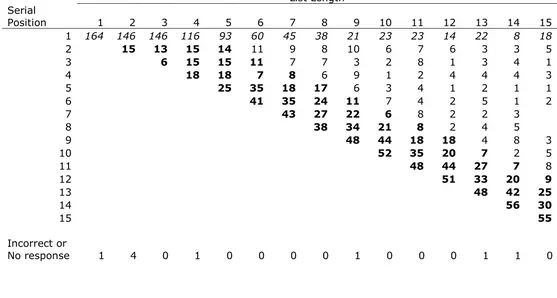
Second, we examined which words from a list were the first to be recalled on each
trial (for related analyses, see Hogan, 1975; Howard & Kahana, 1999; Laming, 1999). Table
1 shows that at short lists, participants tended to initiate their recall with the first words in
the list (those presented at serial position 1), but as the list length increases, so there is a
tendency to initiate recall with one of the last 4 words in the list.
---
--Table 1 about here--
---
Figure 2 clearly illustrates participants’ tendency to initiate free recall with the first
list item for shorter lists. As the list length increases, so there is an increasing tendency to
initiate free recall with one of the last four list items for longer lists. The proportion of trials
in which recall started with serial position 1 decreased with increasing list length, F (14,
756) = 127.5, MSE = .048, p <.001. For each participant, we calculated the slope of the
function relating how the proportion of trials in which recall started with serial position 1
decreased with increasing list length, across sets of list lengths 1-3, 4-6, 7-9, 10-12, and
13-15. The mean slopes across these five sets differed significantly from each other, F (4, 216)
= 10.12, MSE = .021, p <.001, and were -0.05, -0.17, -0.07, -0.03, and -0.01, respectively,
and confirmed that the function declines most steeply across list lengths 4-6, where the
addition of each extra list item reduced the proportion of trials starting with serial position 1
by on average 17%.
---
--Figure 2 about here--
---
We then examined the effect of first recall on the resultant serial position curves.
recalled was from serial position 1 plotted using ISR scoring. Figure 3B shows the serial
position curves for those same trials plotted using free recall scoring. Finally, Figure 3C
shows the serial position curves for the free recall trials in which the first word recalled was
from one of the last four serial positions plotted using free recall scoring. The shapes of the
serial position curves in Figure 3A, 3B, and 3C are strikingly different.
For illustrative purposes, consider performance at list length 6. Thirty-five
participants initiated recall on one or more trials with serial position 1 at this list length.
Using ISR scoring, the mean recalls across the six serial positions in Figure 3A, are 1.00,
.63, .42, .33, .17, and .13, and discounting serial position 1 (whose mean by definition is
1.00), serial positions 2-6 differed significantly, F (4, 136) = 16.47, MSE = .074, p < .001;
pairwise comparisons confirming significant extended primacy effects with ISR scoring.
The corresponding mean recalls across the same trials using free recall scoring
(Figure 3B) are 1.00, .67, .59, .59, .46, and .53. Discounting serial position 1, serial positions
2-6 did not differ significantly, F (4, 136) = 1.15, MSE = .185, p > .05, but remain at a
relatively elevated level of recall.
Finally, consider performance by the 43 participants who initiated recall on one or
more trials with one of the last four serial positions. Figure 3C shows that the mean recalls
across these six serial positions are .48, .32, .44, .54, .79, and .88; means which differed
significantly, F (5, 168) = 16.61, MSE = .120, p < .001; pairwise comparisons confirming
1-item primacy, and significant extended recency effects.
---
--Figure 3 about here--
---
Finally, we examined the extent to which the output orders showed evidence of
1996; Howard & Kahana, 1999) for each list length. The x-axis plots the lag between
successive pairs of words recalled, which is calculated by subtracting the serial position of
the first word of each pair from the serial position of the second word of each pair. Smaller
lag values therefore represent recall transitions between words from more similar serial
positions; whereas larger lag values represent recall transitions between words from less
similar serial positions. Similarly, positive lag values represent recall transitions proceeding
in a forwards direction; negative lag values represent recall transitions proceeding in a
backwards direction. Of critical interest is the frequency of recall transitions with lag of +1,
the lag at which the output order of successively recalled pairs is the same as the input order.
The y-axis plots the conditionalized response probability (CRP), which is calculated by
taking the number of transitions actually made of a given lag during output and dividing this
total by the number of opportunities that a participant might reasonably be expected to have
had to make such a lag transition. The CRP-values control for the reduced opportunities to
make transitions at extreme lags (and the increased opportunities to make transitions at
small lags), and also assume that it is unreasonable for a participant to recall an item has
already been recalled. Figure 4 indicates that there is evidence for what is known as the
asymmetric lag recency effect (see Howard & Kahana, 1999; Kahana, 1996): there is a
preference for transitions to be nearer neighbours than remote neighbours, and there is a
greater tendency for transitions to proceed in a forwards rather than a backwards order. A
close inspection also suggests that there are also high CRP-values at extreme positive and
negative lag values.
In order to examine these observations statistically, the lags (and opportunities to
output items at different lags) were categorised into 8 different lag values: extreme negative
lags (the lowest possible lag value at each list length, equivalent to 1-list length), remote
length-2) and extreme positive lags (the highest possible lag value at each list length,
equivalent to lag list length-1). Fifty participants had CRP values for all eight categories,
and their mean CRPs for the eight respective categories were .21, .06, .13, .19, .50, .16, .09,
and .08, which differed significantly, F (7, 343) = 105.9, MSE = .009, p <.001. Pairwise
comparisons showed that there was a clear tendency for recall to follow the order at study,
as demonstrated by higher CRP-values for lag +1 than all other lags, including lag -1,
demonstrating significant asymmetry. There were also significant lag recency effects, the
CRP values for lag -1 were greater than those for lag -2, which in turn were greater than the
values for the remote negative lags, and the CRP values for lag +1 were greater than those
for lag +2, which in turn were greater than the values for the remote positive lags. However,
the extreme negative lag CRP-values were also significantly higher than all but the closest
transitions (see Farrell & Lewandowsky, 2008), indicating a high tendency to transition
between the last to the first list item.
---
--Figure 4 about here--
---
An inspection of Figure 4 also shows that the CRP-values for lag +1 decrease with
increasing list length, a finding shown more clearly in Figure 5. Fifty-one participants had
valid lag+1 CRP values at all 14 list lengths (list lengths 2 to 15), and these values differed
significantly from each other, F (13, 650) = 46.12, MSE = .017, p <.001. At shorter lists, the
majority of transitions between successive words output are in the same order as that in
which the words were presented (lag +1), even though the participants were free to recall in
any order. The lag +1 value decreases with increasing list length, but does not reduce to near
chance levels (approximately the recipricol of the list length -1) but stays at a relatively high
---
--Figure 5 about here--
---
Discussion
When participants were presented with short lists of up to 3 words for free recall,
they started their recall with the first word in the list and continued in forward serial order;
that is, their free recall resembled ISR. As the list length was increased from lengths of 4
through to 9 words, so there was an increased tendency to initiate recall with one of the last
four words (as is more typical in immediate free recall).
In addition, the first word recalled helped determine the shape of the serial position
curve: heightened early list performance and reduced recency effects were observed when
the first word recalled was from serial position 1, and more extended recency effects and
reduced primacy effects were observed when the first word recalled was from one of the last
four serial positions. In all recall, there was a clear tendency to recall in a forwards direction,
but this tendency was greater for shorter lists.
It appears therefore that at least some of the apparent differences between the output
orders and serial position curves observed in free recall and ISR might indeed reflect the
typical differences in the list lengths that are used in the two tasks - when free recall was
performed with long lists typically used in free recall, participants recalled the last items
first and there was enhanced recency and reduced primacy; but when free recall was
performed with shorter lists typically used in ISR, then ISR-like findings were observed,
with an increased tendency to recall spontaneously from the start of the list leading to
enhanced early list performance on these trials.
Experiment 1 provided initial evidence supporting the call for greater theoretical
integration between free recall and ISR: some “ISR-like” features of recall were observed
when free recall was performed with shorter, “ISR-like” list lengths. In Experiment 2, we
attempted to replicate these findings and extend them to examine whether a variant of ISR
might additionally show some “free recall-like” features of recall when that variant of ISR
was performed under “free recall-like” list lengths.
An immediate concern with such an endeavour was to consider the best way to
examine ISR at such a wide range of list lengths. Our solution in Experiment 2 was to use a
variant of the ISR task used by Tan and Ward (2007, see also Crowder, 1969) that we will
refer to here as the “ISR-free” task. In the ISR-free task, participants are presented with a list
of words one at a time, and at the end of the list, they are required to recall the list items in
the correct serial position by writing the list items in the appropriate position in a lined
response grid. In Experiment 2, this paper response grid always consisted of two columns of
15 rows, the first column contained the numbers 1 to 15 in increasing order, and the second
column was empty. Thus, the participants were required to write down the words from the
list in the rows corresponding to each items’ serial positions, such that the first word in the
list should be written in the first row of the grid, the second word should be written in the
second row, and so on. Unlike standard ISR, participants in the ISR-free task were free to
write their spatially-ordered responses in the response grids in any temporal order that they
like. For example, they were free to start their recall by writing the last three words from the
list in the corresponding rows before returning to the top of the grid to continue recall with
earlier list items.
In Experiment 2, one group of participants performed free recall, a second group
performed ISR-free and all were presented with a total of 66 lists of between 1 and 15
session, list lengths 9, 11, 13 and 14 were excluded, such that participants undertook 6 trials
each of 11 different list lengths (lists of 1, 2, 3, 4, 5, 6, 8, 10, 12, and 15 words). As in
Experiment 1, the words were presented visually at a reasonably fast rate of 1 word per
second. Unlike Experiment 1, the participants were required to read each word aloud as the
words were presented. At test, an empty response grid appeared on the screen that had the
exact number of rows (between 1 and 15) appropriate for that trial, so that participants could
see the number of items that had been presented and so knew which of the 15 rows on their
paper response grid they should complete. In the free recall condition, participants were free
to recall the words in any order – they simply wrote down the words from the top to the
bottom of their response grids. In the ISR-free condition, the participants wrote the words in
the positions in the grid corresponding to each word’s serial position, but they were free to
write down the words in any temporal order that they liked. In both conditions, the
participants spoke out loud the words that they were writing down and their responses were
recorded using a tape recorder to code the output order of the items.
As in Experiment 1, we were interested in the order in which words participants
would initiate their recall at different list lengths, and the extent to which these initial recalls
affected the resultant serial position curves. Our hypothesis was that if the dissimilarities
between free recall and ISR are due primarily to differences in list length, then when the list
length in ISR-free was increased to list lengths typically associated with free recall, then the
output orders and serial position curves found in both free recall and ISR-free might both be
affected similarly by increasing list length. To the extent that participants switched from
initiating recall with the first word to initiating recall with one of the last list items on both
tasks with increasing list length, so we would find evidence for increased similarities
Method
Participants. Forty volunteers participated in this experiment from the University of
Essex. None had participated in Experiment 1.
Materials and Apparatus. The materials for each participant consisted of 438
words randomly selected from a set of 480 words taken from the Toronto Word Pool
(Friendly, Franklin, Hoffman & Rubin, 1982). The materials were presented in 52-point
Times New Roman font in the centre of a computer monitor.
Design. The experiment used a mixed design. The type of task was manipulated
between subjects. There were two within-subjects independent variables: list length, with
eleven levels (1, 2, 3, 4, 5, 6, 7, 8, 10, 12, and 15) and serial position (SP) with up to 15
levels. The dependent variable for free recall was the proportion of words recalled (in any
order) and the dependent variable for ISR-free was the proportion of words recalled (in the
correct serial position).
Procedure. Participants were presented with a total of 66 trials consisting of 2
blocks of free recall trials, or two blocks of trials using the ISR-free task. In each block there
was 33 experimental trials, which consisted of three trials of each of the eleven different list
lengths. The order of the list lengths within each block was randomised. Participants were
tested individually, and the first block was preceded by task-specific instructions and a
practice list on that task of list length 7.
Each trial started with a warning tone, followed after 3s by a sequence of between 1
and 15 words presented one at a time in the centre of the screen. The presentation rate was 1
word every second, with each word displayed for 0.75s with an additional 0.25s
inter-stimulus interval in which the inter-stimulus field was blank. Participants were instructed to read
empty grid was displayed on the screen that contained the same number of rows as there
were number of words on the current trial.
The participants wrote down as many words as they could remember in their lined
response grids whilst saying out loud what they were writing down. In free recall, the
participants were free to write the words down in any order that they wished, and filled up
their response grids from the top of the grid. In ISR-free, the participants were free to write
down the words in any temporal order that they wished but they were instructed to write
down the words in the position in the response grid that corresponded to each word’s serial
position.
Results
The data for the two tasks were analysed separately, as each task used a different
dependent variable.
Free Recall. Figure 6A shows the proportion of words recalled at each of the 11
different list lengths. Consistent with list length effects in free recall, the mean proportion of
words recalled decreased monotonically, from .98 (list length 1) to .30 (list length 15), F
(10, 190) = 387.2, MSE = .004, p <.001, and the mean number of words recalled increased
from .98 (list length 1) to 4.52 (list length 15), F (10, 190) = 37.32, MSE = .848, p <.001.
---
--Figure 6 about here--
---
At short lists, such as list length 4, the proportion of words recalled was consistently
at a high level (M = .94), with no significant effect of serial position, F (3, 57) = 2.26, p >
.05. At longer lists, such as at list length 8, there was a significant effect of serial position, F
effects, but there was significantly greater recall of the recency items than the primacy
items.
Figure 7A shows that the first word recalled tended to be from serial position 1 when
the list was short, but as the list length increased, there was an increased tendency that it
would be one of the last four serial positions. The proportion of trials on which recall started
with the first list item decreased with list length, F (10, 190) = 100.8, MSE = .028, p <.001.
The mean slopes across list lengths 1-3, 4-7, and 8-15 differed significantly from each other,
F (2, 38) = 34.35, MSE = .005, p <.001, and were -0.02, -0.17, and -0.03, respectively, and
confirmed that the function declines most steeply across list lengths 4-7, where the addition
of each extra list item reduced the proportion of trials starting with serial position 1 by on
average 17%.
---
--Figure 7 about here--
---
We then examined the effect of first recall on the resultant serial position curves.
Figure 8A shows the serial position curves for the free recall trials in which the first word
recalled was from serial position 1 plotted using ISR scoring. Figure 8B shows the serial
position curves for those same trials plotted using free recall scoring. Finally, Figure 8C
shows the serial position curves for the free recall trials in which the first word recalled was
from one of the last four serial positions plotted using free recall scoring. Replicating the
findings of Experiment 1, the shapes of the serial position curves in Figure 8A, 8B, and 8C
are strikingly different.
We again limit our analyses to performance at a representative list length, list length
6. Nineteen participants initiated recall on one or more trials with serial position 1 at this list
1.00, .44, .26, .19, .12, and .08, and discounting serial position 1 (whose mean by definition
is 1.00), serial positions 2-6 differed significantly, F (4, 72) = 9.51, MSE = .040, p < .001;
pairwise comparisons confirming that there is significant extended primacy effects with ISR
scoring.
The corresponding mean recalls across the same trials using free recall scoring
(Figure 8B) are 1.00, .59, .61, .55, .63, and .72. Discounting serial position 1, serial positions
2-6 did not differ significantly, F (4, 72) = 0.79, MSE = .096, p > .05, but remain at a
relatively elevated level of recall.
Finally, consider performance by the 17 participants who initiated recall on one or
more trials with one of the last four serial positions. Figure 8C shows that the mean recalls
across these six serial positions are .48, .16, .67, .71, .84, and .86; means which differed
significantly, F (5, 80) = 11.15, MSE = .104, p < .001; pairwise comparisons confirming
1-item primacy, and significant extended recency effects.
---
--Figure 8 about here--
---
ISR. Figure 6B shows the proportion of words recalled at each of the 11 different list
lengths. The mean proportion of words recalled decreased monotonically from .99 (list
length 1) to .18 (list length 15), F (10, 190) = 389.9, MSE = .006, p <.001, but the mean
number of words recalled first increased from .99 (list length 1) to 3.58 (list length 4) and
then declined to 2.52 (list length 15).
At short lists, such as list length 4, the proportion of words recalled was at a high
level (M = .89), but there was nonetheless a significant effect of serial position, F (3, 57) =
3.51, p < .05, reflecting a significant difference between serial positions 1 and 3. At longer
24.45, MSE = .051, p <.001, reflecting significant primacy and extended recency effects, but
there was significantly greater recall of the recency items than the primacy items.
Figure 7B shows that the first recall data in the ISR task resembles that from the free
recall task. In ISR, the first word recalled also tended to be from serial position 1 when the
list was short, but as the list length increased, so there was an increased tendency that it
would be one of the last four serial positions. The proportion of trials on which recall started
with the first list item decreased with list length, F (10, 190) = 101.1, MSE = .029, p <.001.
The mean slopes across list lengths 1-3, 4-7, and 8-15 differed significantly from each other,
F (2, 38) = 37.35, MSE = .005, p <.001, and were -0.02, -0.18, and -0.02, respectively, and
confirmed that the function declines most steeply across list lengths 4-7, where the addition
of each extra list item reduced the proportion of trials starting with serial position 1 by on
average 18%.
Figure 8D shows the serial position curves for the ISR-free trials in which the first
word recalled was from serial position 1, Figure 8E shows the same data scored by free
recall, and Figure 8F shows the serial position curves for the ISR trials in which the first
word recalled was from one of the last four serial positions (using ISR scoring). The shapes
of the serial position curves in Figure 8D, 8E, and 8F are again very different.
Figure 8D shows that there is extended primacy with reduced recency when the first
word is recalled first using the ISR scoring. Considering a representative list length, list
length 6, the means were .96, .57, .40, .23, .25, and .55, across the six serial positions (note
that the value at serial position 1 need not be exactly 1.00 in this analysis, since although the
first word was always output first, it need not always be placed in the correct serial
position). A within-subjects ANOVA on the 17 participants who started one or more trials
= .082, p < .001, pairwise comparisons confirmed that there were significant extended
primacy effects and 1-item recency.
Figure 8E shows that there is consistently elevated recall of early list items when
these same ISR-free data are re-scored using free recall scoring. The means at list length 6
were 1.00, .61, .57, .43, .52, and .67, means of serial positions 2-6 did not differ significantly
F (4, 64) = 1.19, MSE = .123, p > .05.
Figure 8F shows that when recall was initiated with one of the last four words, the
ISR-free data show extended recency with reduced primacy using the ISR scoring. For
example, at list length 6, the means across the six serial positions were .21, .20, .30, .42, .70,
and .90, and the presence of extended recency effects were confirmed by a within-subjects
ANOVA (and subsequent pairwise comparisons) on the 18 participants who started one or
more trials with one of the last four serial positions, F (5, 80) = 23.99, MSE = .062, p < .001.
Lag analyses
Finally, we examined the extent to which the output orders showed evidence of
forward ordered recall. Figure 9 plots the CRP for lag +1 responses as a function of list
length for free recall and ISR-free. Note that neither task requires participants to output
successive items in the same order as at input. The CRP-values for lag+1 responses were
analysed by a 2 (task: free recall and ISR-free) x 10 (List length: 2, 3, 4, 5, 6, 7, 8, 10, 12,
15) mixed ANOVA, which revealed a non-significant main effect of task, F (1, 38) = 0.61,
MSE = .069, p > .05, a significant main effect of list length, F (9, 342) = 121.5, MSE = .021,
p < .001, and a significant interaction, F (9, 342) = 2.04, MSE = .021, p < .05. An
exploration of the interaction revealed that there non-significant differences between the two
tasks for nine of the list lengths, but a significant difference at a single list length in favour
tendency for forward ordered recall to decrease with increasing list length for both tasks,
with a similar degree of forwards order on both tasks, with the exception of list length 12
where there is a slightly greater tendency for forwards recall in the free recall conditions.
Note that even at the longer list lengths there remains considerable forwards order recall
(CRP values for lag +1 remain greater than .30) for both tasks, even though there is no
formal requirement to output in forwards order in the two tasks.
---
--Figure 9 about here--
---Discussion
Experiment 2 provided further evidence for the need for greater theoretical
integration between free recall and ISR. Replicating the main findings of Experiment 1,
Experiment 2 found “ISR-like” features in free recall when it was performed with shorter
“ISR-like” list lengths. In addition, Experiment 2 found some “free recall-like” features in
serial recall when ISR-free was performed under “free recall-like” list lengths.
Specifically, in both tasks, participants started their recalls with the first word on the
list when the list was short, but as the list length increased so there was an increased
tendency to start recall with one of the last four words. Moreover, in both tasks, the initial
response had a large effect on the subsequent serial position curves: heightened recall of
early list positions occurred with limited recency when recall began with serial position 1,
but extended recency with limited primacy was observed when recall began with one of the
last four items. Furthermore, in both tasks the output order reflected the input order: there
was a high probability of Lag +1 transitions in both tasks, especially for shorter list lengths.
Experiment 2 compared free recall performance with performance on ISR-free, a
variant of ISR. An advantage of using ISR-free is that we can see which words participants
would choose to output first in a serial recall test. It therefore speaks to which words are
most accessible at the time of test during ISR (see Tan & Ward, 2007). However, it remains
to be seen whether the list length effects observed on the output orders and serial position
curves using ISR-free would also be found when the participants were instructed to perform
a more standard ISR task.
In Experiment 3, the effects of list length on the output orders and serial position
curves were examined using a between-subjects design that examined a standard ISR task
and the ISR-free task (used by Tan & Ward, 2007; and Experiment 2). A total of forty
participants were presented with 66 lists of words for serial recall. Half the participants were
instructed using the ISR-free instructions, and the other half were instructed using more
standard ISR instructions. Specifically, we adopted the instructions used by Golomb, Peelle,
Addis, Kahana, and Wingfield (2008) who examined serial recall of 10-word lists. Golomb
et al encouraged participants to begin recall with the first list item; however, because of the
supraspan list length, they instructed participants that if they were unable to retrieve the first
item, they should begin their recall with the earliest item that they could remember.
Method
Participants. Forty volunteers participated in this experiment from the University of
Essex. None had participated in any of the earlier two experiments.
Materials and Apparatus. The materials were the same as those used in
Experiment 2.
Design. The experiment used a mixed design. The type of task was manipulated
between subjects with two levels: standard ISR and ISR-free. There were also two
and 15) and serial position (SP) with up to 15 levels. The dependent variable was the
proportion of words recalled in the correct serial position.
Procedure. The procedures were identical to those used in Experiment 2, with the
exception that half the participants received two blocks of the ISR-free task and the other
half received two blocks of the standard ISR task. Participants in the ISR-free task spoke
their responses out loud, so that their output order could be recorded; participants in the
standard ISR task wrote down their responses in forwards serial order and they did not speak
their responses out loud.
Results
Figure 10 shows the proportion of words recalled in the correct serial position for the
standard ISR task (Figure 10A) and the ISR-free task (Figure 10B) at each of the 11
different list lengths. A 2 (task) x 11 (list length) mixed ANOVA was performed on the
mean ISR scores for the two groups at each list length. This revealed a significant main
effect of list length, F (10, 380) = 666.5, MSE = .016, p <.001, a non-significant main effect
of task, F (1, 38) = 2.80, MSE = .033, p >.05, and a significant 2-way interaction, F (10,
380) = 666.5, MSE = .016, p <.001. The two way interaction occurred because at list lengths
2 to 4 there were small but non-significant advantages for participants performing standard
ISR compared with ISR-free, but the pattern was reversed at list lengths greater than 4, and
at list lengths of 10 and greater, there was a small but significant increase in performance in
ISR-free relative to standard ISR.
---
--Figure 10 about here--
---
We examined serial position curves on the two tasks at three representative list
non-significant main effect of task, F (1, 38) = 0.94, MSE = .047, p > .05, a significant main
effect of serial position, F (3, 114) = 7.15, MSE = .019, p > .05, and a non-significant
interaction, F (3, 114) = 0.88, MSE = .019, p > .05. For both tasks there was significant
primacy and recency effects at list length 4, and there was little difference in the shapes of
the serial position curves of the two tasks.
A 2 (task) x 8 (serial position) mixed ANOVA revealed a non-significant main effect
of task, F (1, 38) = 0.83, MSE = .082, p > .05, a significant main effect of serial position, F
(7, 266) = 65.81, MSE = .041, p < .001, and a significant interaction, F ((7, 266) = 3.60,
MSE = .041, p < .01. There were significant primacy and recency effects in both tasks, with
greater recency than primacy. However, there were small but non-significant recall
advantages at serial positions 1-4 in favour of the standard ISR task, there were small but
non-significant recall advantages at serial positions 5-7 in favour of the ISR-free task, and
there was a significant recall advantage for the ISR-free task at serial position 8.
A 2 (task) x 15 (serial position) mixed ANOVA revealed a significant main effect of
task, F (1, 38) = 8.14, MSE = .065, p < .01, a significant main effect of serial position, F (14,
532) = 128.97, MSE = .022, p < .001, and a non-significant interaction, F (14, 532) = 1.42,
MSE = .022, p > .05. There were significant primacy and recency effects in both tasks, with
greater recency than primacy, and greater recall performance overall with ISR-free than
standard ISR.
Second, we examined which words from a list were the first to be recalled on each
trial. Figure 11A (standard ISR) and Figure 11B (ISR-free) show that in the vast majority of
all trials with short list lengths, recall started with the first word in the list, but as the list
length increases so this tendency decreases for both tasks, but more rapidly with ISR-free
than standard ISR. This pattern was confirmed in a 2 (task: ISR-free and standard ISR) x 10
with serial position 1. This revealed a significant main effect of task F (1, 38) = 26.25, MSE
= .123, p < .001, a significant main effect of list length, F (9, 342) = 214.7, MSE = .025, p <
.001, and a significant interaction, F (9, 342) = 6.09, MSE = .025, p < .001.
Figures 11A and 11B also show that at longer list lengths there is an increased
tendency to initiate recall with words from one of the last four serial positions, and that this
tendency increases more rapidly with ISR-free than standard ISR. This pattern was also
confirmed in a 2 (task: ISR-free and standard ISR) x 10 (list lengths: 2-8, 10, 12, 15) mixed
ANOVA performed on the proportion of trials starting with one of the last four serial
positions. This revealed a significant main effect of task F (1, 38) = 36.48, MSE = .189, p <
.001, a significant main effect of list length, F (9, 342) = 124.2, MSE = .026, p < .001, and a
significant interaction, F (9, 342) = 14.1, MSE = .026, p < .001.
---
--Figure 11 about here--
---
We split the serial position curve data by whether participants initiated recall with
the first word or one of the last 4 words. Figure 12A shows the serial position curves for the
standard ISR trials in which the first word recalled was from serial position 1, Figure 12B
shows the same data plotted by free recall scoring, and Figure 12C shows the serial position
curves for the standard ISR trials in which the first word recalled was from one of the last
four serial positions. As in earlier studies, the shapes of the serial position curves in Figure
12A, 12B, and 12C are different: there is an increased tendency for heightened primacy with
reduced recency when the first word is recalled first in Figure 12A, elevated levels of recall
on early items I Figure 12B, but extended recency with reduced primacy in Figure 12C
Figures 12D, 12E and 12F show the equivalent data split for the ISR-free task.
Replicating the ISR-free data of Experiment 2 (Figures 8D, 8E, and 8F), there is an
increased tendency for heightened primacy with reduced recency when the first word is
recalled first in Figure 12D, elevated recall in Figure 12E but extended recency with reduced
primacy in Figure 12E when one of the last 4 words is first recalled.
One striking feature of these data is the similarity between the two tasks when the
first response is controlled for. The data at list length 6 was examined across the two tasks
using ISR-scoring on the data in Figures 12A and 12D in which recall initiated with serial
position 1. A total of 17 participants from the ISR-free task and all 20 participants from the
standard ISR task contributed to this analysis. This revealed a non-significant main effect of
task, F (1, 35) = 0.13, MSE = .116, p > .05, a significant main effect of serial position, F (5,
175) = 37.03, MSE = .070, p < .001, and a non-significant interaction, F (5, 175) = 0.13,
MSE = .070 p > .05. Thus, once equated for starting with serial position 1, there was similar
performance on both tasks. Pair-wise comparisons revealed that there were extended
primacy and 1-item recency.
When the same list length 6 data were compared using free recall scoring (Figures
12B and 12E) over serial positions 2 to 6, there were highly similar findings. The ANOVA
revealed that there was no significant main effect of task, F (1, 35) = 0.07, MSE = .111, p >
.05, a significant main effect of serial position, F (4, 140) = 6.85, MSE = .097, p < .001, and
a non-significant interaction, F (5, 175) = 0.92, MSE = .097 p > .05. Pairwise comparisons
revealed significant primacy and recency.
---
--Figure 12 about here--
Finally, when the list length 6 data were compared using ISR scoring (Figures 12C
and 12F) over serial positions 1 to 6, was a significant main effect of task, F (1, 30) = 5.22,
MSE = .180, p < .05, a significant main effect of serial position, F (5, 150) = 40.94, MSE =
.074, p < .001, and a non-significant interaction, F (5, 150) = 1.28, MSE = .074 p > .05. Both
tasks showed significant extended recency effects, but ISR was superior overall for
ISR-free,
Lag analyses
Finally, we examined the extent to which the output orders showed evidence of
forward ordered recall. Figure 13 plots the CRP for lag +1 responses as a function of list
length for standard ISR and ISR-free. The CRP-values for lag+1 responses were analysed
by a 2 (task: standard ISR and ISR-free) x 10 (List length: 2, 3, 4, 5, 6, 7, 8, 10, 12, 15)
mixed ANOVA, which revealed a non-significant main effect of task, F (1, 37) = 0.09, MSE
= .088, p > .05, a significant main effect of list length, F (9, 333) = 66.24, MSE = .020, p <
.001, and a non-significant interaction, F (9, 333) = 1.50, MSE = .020, p > .05. Thus there is
a similar tendency for forward ordered recall to decrease with increasing list length for both
tasks, with a similar degree of forwards order on both tasks. Note that even at the longer list
lengths there remains considerable forwards order recall (CRP values for lag +1 remain
greater than .50) for both tasks, even though there is no formal requirement to output in
forwards order in ISR-free.
---
--Figure 13 about here--
---
Experiment 3 essentially replicated the main findings using ISR-free that were
observed in Experiment 2. When the list was short, it was common to begin ISR-free with
the first list item in short lists (even though they did not have to), but as the list length was
increased so there was an increased tendency for ISR-free to begin with one of the last four
list items. A similar albeit reduced tendency was also observed in the standard ISR task. The
main differences between the tasks were that participants in the standard ISR task started
their recall more often with the first item in the standard ISR condition (as they were
instructed) than in the ISR-free task, and when they could not recall the first item in the
standard ISR task, they started with an earlier item (often scored as an “other” serial position
at longer list lengths) more often in the standard ISR task than in the ISR-free task. These
data are consistent with the standard ISR task instructions, but show that when participants
are free to output in any order, their initial recalls resemble standard ISR for shorter lists but
at longer list length the tendency to output one of the last four words in the list becomes
more exaggerated.
Interestingly, the effects of start position on serial position curves are very similar:
greater primacy is found in both tasks when recall starts with the first word in the list, but
greater recency is found when recall was from one of the last four words.
EXPERIMENT 4
Experiment 3 compared ISR with ISR-free and showed that in both tasks there was a
reduction in initiating recall with the first list item as the length of the list increased.
Experiment 4 examined whether a similar pattern of data could be observed using different
variants of the reconstruction of order task. In reconstruction of order tasks, participants are
presented with sequences of words for immediate recall as in the previous experiments, but
word into the correct serial position.
One advantage of the task is that it relies more heavily on order information (the
items themselves are re-presented at test). A second advantage is that it is well suited for
examining the effects of list length and output order. In Experiment 4, we examined
performance at the standard version of the reconstruction of order task, in which the that
participants must allocate the represented words into the grid starting with the word that is to
be allocated to serial position 1 and then proceeding in a strict forwards order. We compared
performance on this condition, with free reconstruction of order (see Lewandowsky, Brown
& Thomas, 2009), in which participants are free to allocate the re-presented words into their
positions in the grid in whatever order that they like. Through the positioning and order of
responses, the task allows the recording of both serial position and output order without the
need to ask participants to speak out loud during one or both conditions.
Method
Participants. Thirty volunteers participated in this experiment from the University
of Essex. None had participated in any of the earlier three experiments.
Materials and Apparatus. The materials were the same as those used in
Experiment 3.
Design. The experiment used a mixed design. The type of task was manipulated
between subjects with two levels: standard Reconstruction of order and free Reconstruction
of order. There were also two within-subjects independent variables: list length, with eleven
levels (1, 2, 3, 4, 5, 6, 7, 8, 10, 12, and 15) and serial position (SP) with up to 15 levels. The
dependent variable was the proportion of words recalled in the correct serial position.
Procedure. The method of presentation of the stimuli during study was identical to
that used in Experiments 2 and 3. However, the method of testing differed. After the last
new random order in a column on the left of the screen, and a response grid of the same type
as presented in Experiments 1 to 3, with 2 columns and as many rows as words on the list.
In the first column of the response grid in ascending value were the numbers 1 to list length.
The second column of the response grid was left blank. The participants were required to fill
the response grid by first clicking on the word to be entered (from the column on the left)
and then clicking on the location in the response grid corresponding to that word’s list
position on the right.
The computer programme in the standard Reconstruction of order task only allowed
participants to fill the response grid from top to bottom, that is, in strict serial order. By
contrast, participants in the free Reconstruction of order task could click on any word and
click on any location. It was not possible to change the responses once they had been
entered. When the response grid was completed, participants pressed a computer button on
the screen to continue.
Results
Figure 14 shows the proportion of words recalled in the correct serial position for the
standard Reconstruction of order task (Figure 14A) and the free Reconstruction of order task
(Figure 14B) at each of the 11 different list lengths. The graphs exclude the data from a
small minority of trials (21 trials out of a total of 2244, less than 1%) in which due to
computer software failure, participants were allowed to make inappropriate responses
(responding with the same item in two locations). A 2 (task) x 11 (list length) mixed
ANOVA was performed on the mean reconstruction of order scores for the two groups at
each list length. This revealed a significant main effect of task, F (1, 32) = 18.61, MSE =
.042, p <.001, a significant main effect of list length, F (10, 320) = 381.6, MSE = .008, p
<.001, and a significant 2-way interaction, F (10, 320) = 7.17, MSE = .008, p <.001. The
differences in levels of recall for the two tasks, but at list lengths above five there were
significant reconstruction of order advantages for the free conditions over the standard
conditions.
---
--Figure 14 about here--
---
A 2 (task) x 4 (serial position) mixed ANOVA on the serial position curve at list
length 4 revealed a non-significant main effect of task, F (1, 32) = 0.51, MSE = .039, p >
.05, a significant main effect of serial position, F (3, 96) = 4.52, MSE = .007, p < .01, and a
non-significant interaction, F (3, 96) = 0.32, MSE = .007, p > .05. For both tasks there was
significant primacy and recency effects at list length 4, and there was little difference in the
shapes of the serial position curves of the two tasks.
A 2 (task) x 8 (serial position) mixed ANOVA revealed a significant main effect of
task, F (1, 32) = 14.31, MSE = .151, p < .001, a significant main effect of serial position, F
(7, 224) = 25.93, MSE = .032, p < .001, and a significant interaction, F ((7, 224) = 5.84,
MSE = .032, p < .01. There were significant primacy and recency effects with both tasks.
However, although there was near equivalent performance on serial positions 1 to 3 on the
two tasks, there were significant recall advantages at serial positions 4, 6, 7 and 8 for the
free Reconstruction of Order task relative to the standard Reconstruction of Order task.
A 2 (task) x 15 (serial position) mixed ANOVA revealed a significant main effect of
task, F (1, 32) = 15.40, MSE = .132, p < .001, a significant main effect of serial position, F
(14, 448) = 29.88, MSE = .030, p < .001, and a significant interaction, F (14, 448) = 14.07,
MSE = .030, p < .001. There were significant primacy and recency effects on both tasks, but
whereas there were similar levels of primacy for the two tasks, there was significantly
Second, we examined which words from a list were the first to be recalled on each
trial. Figure 15A (Standard Reconstruction of Order) and Figure 15B (Free Reconstruction
of Order) show that in the vast majority of all trials with short list lengths, recall started with
the first word in the list, but as the list length increases so this tendency decreased for both
tasks, but more rapidly with Free Reconstruction of Order than with Standard
Reconstruction of Order). This pattern was confirmed in a 2 (task: Standard Reconstruction
of Order and Free Reconstruction of Order) x 10 (list lengths: 2-8, 10, 12, 15) mixed
ANOVA performed on the proportion of trials starting with serial position 1. This revealed a
significant main effect of task F (1, 32) = 25.37, MSE = .176, p < .001, a significant main
effect of list length, F (9, 288) = 77.21, MSE = .032, p < .001, and a significant interaction,
F (9, 288) = 5.81, MSE = .032, p < .001. There was no significant difference in the
proportion of trials starting with serial position 1 at list lengths 2 t o 4, but from list length 5
there was a significant decrease in the proportion of trials starting with serial position 1
relative to the Standard reconstruction of order task.
Figures 15A and 15B also show that at longer list lengths there is an increased
tendency to initiate recall with words from one of the last four serial positions (especially for
the free reconstruction of order task) and from other serial positions (especially for the
standard reconstruction of order task).
---
--Figure 15 about here--
---
Figure 16A shows the serial position curves for the free Reconstruction of order
trials in which the first word recalled was from serial position 1, and Figure 16B shows the
serial position curves for the free Reconstruction of order trials in which the first word
serial position curves in Figures 16A and 16B are rather different: there is an increased
tendency for heightened primacy when the first word is recalled first in Figure 16A, but
more extended recency with reduced primacy in Figure 16B when one of the other words is
first recalled.
For list length 6, the means for 17 participants in the free reconstruction of order task
who initiated at least one trial with serial position 1 were .96, .77, .66, .48, .60, and .81 (ISR
scoring), means which differed significantly, F (5, 80) =7.68, MSE = .064, p <.001. Pairwise
comparisons revealed extended primacy and 1-item recency. The means for 15 participants
in the free reconstruction of order task who initiated at least one trial with one of the last
four serial positions were .55, .60, .37, .50, .73, and .98 (ISR scoring), means which differed
significantly, F (5, 70) =7.70, MSE = .089, p <.001. Pairwise comparisons revealed
significant recency effects and non-significant primacy effects.
---
--Figure 16 about here--
---
Lag analyses
Finally, we examined the extent to which the output orders showed evidence of
forward ordered recall. Figure 17 plots the CRP for lag +1 responses as a function of list
length for standard Reconstruction of order and free Reconstruction of order. The
CRP-values for lag+1 responses were analysed by a 2 (task: standard Reconstruction of order and
free Reconstruction of order) x 10 (List length: 2, 3, 4, 5, 6, 7, 8, 10, 12, 15) mixed
ANOVA, which revealed a significant main effect of task, F (1, 32) = 19.08, MSE = .054, p
< .001, a significant main effect of list length, F (9, 288) = 236.2, MSE = .014, p < .001, and
a significant interaction, F (9, 288) = 3.85, MSE = .014, p < .001. An analyses of the
between the two tasks at list lengths 2 to 5, but there was significantly heightened forwards
ordered reconstruction in the free Reconstruction of order task for list lengths 6 and greater.
Thus there is reduced forwards output with increasing list lengths for both tasks, but the
reduction is steeper in the standard reconstruction of order task at longer list lengths.
---
--Figure 17 about here--
---
Discussion
Experiment 4 showed similar findings to Experiment 3, but used reconstruction of
order tasks rather than serial recall tasks. At short list lengths participants tended to initiate
recall with the first word in the list in both the standard reconstruction of order task and the
free reconstruction of order task and this tendency decreased as the list length increased. As
the list length increased, participants tended to start their reconstructions with one of the last
4 list items in the free reconstruction of order task, but in the standard reconstruction of
order task, participants started with other list items.
We note that was less of a tendency to start with one of the last 4 conditions with
increasing list length in the standard reconstruction of order task compared to the standard
ISR task of Experiment 3, but this is likely to reflect participants’ opportunity to omit early
serial positions in the recall task of Experiment 3, whereas they were compelled to select
items for all earlier serial positions before the last serial positions in the standard
reconstruction of order task.
General Discussion
In all four experiments, participants were presented with lists of between 1 and 15
recall with the first word in the list for short lists, but as the list length was increased so there
was a decreased tendency to start with the first list item. This tendency was found in the
standard ISR task (Experiment 3) and the Standard Reconstruction of Order tasks
(Experiment 4) where participants are instructed to start their recall with the first item.
Critically, this tendency was also shown in the immediate free recall task (Experiments 1-2),
the ISR-free task (Experiments 2-3), and the free reconstruction of order task (Experiment
4), even though these tasks do not require that the first word in the list should be output first.
As the list length increased so there was an increased tendency to start with one of
the last serial positions when the participants were free to do so. Thus, in immediate free
recall (Experiments 1-2), ISR-free (Experiments 2-3), and free reconstruction of order
(Experiment 4), participants increasingly tended to recall one of the most recent four words
first at increasing list lengths. This tendency was also observed (to a lesser extent) in
standard ISR (Experiment 3), but although possible, such outputs necessarily resulted in all
the early and middle list items being omitted. Such a strategy is not possible in the standard
reconstruction of order task (Experiment 4), where participants are compelled to select the
word corresponding to serial position 1 first.
In all tasks, the list length and the start position strongly influenced the shape of the
resultant serial position curves: when recall started at serial position 1, there were elevated
recall of early list items; when recall started towards the end of the list, there were extended
recency effects. There was also a high tendency to recall in forwards serial order in all tasks,
a tendency that decreased with increasing list length.
The similarities in these findings across the different tasks suggest that at least some
of the differences observed between free recall and ISR result from the differences in the list
lengths that are typically used in the two tasks. Thus, although free recall is typically