City, University of London Institutional Repository
Citation:
Endress, A. and Hauser, M. D. (2009). Syntax-induced pattern deafness.
Proceedings of the National Academy of Sciences of the United States of America, 106(49),
pp. 21001-21006. doi: 10.1073/pnas.0908963106
This is the accepted version of the paper.
This version of the publication may differ from the final published
version.
Permanent repository link:
http://openaccess.city.ac.uk/5543/
Link to published version:
http://dx.doi.org/10.1073/pnas.0908963106
Copyright and reuse: City Research Online aims to make research
outputs of City, University of London available to a wider audience.
Copyright and Moral Rights remain with the author(s) and/or copyright
holders. URLs from City Research Online may be freely distributed and
linked to.
City Research Online:
http://openaccess.city.ac.uk/
[email protected]
Syntax-induced pattern deafness
Ansgar D. Endress∗ and Marc D. Hauser∗
∗Harvard University, Cambridge, MA
Submitted to Proceedings of the National Academy of Sciences of the United States of America
Perceptual systems often force systematically biased interpreta-tions upon sensory input. These interpretainterpreta-tions are obligatory, inaccessible to conscious control, and prevent observers from perceiving alternative percepts. Here we report a new, but simi-larly impenetrable phenomenon in the domain of language, where the syntactic system prevents listeners from detecting a sim-ple perceptual pattern. Healthy human adults listened to three-word sequences conforming to patterns readily learned even by honey-bees, rats and sleeping human neonates. Specifically, se-quences either started or ended with two words from the same syntactic category (e.g., noun-noun-verb or verb-verb-noun). Al-though participants readily processed the categories and learned repetition-patterns over non-syntactic categories (e.g., animal-animal-clothes), they failed to learn the repetition-pattern over syntactic categories, even when explicitly instructed to look for it. Further experiments revealed that participants successfully learned the repetition-patterns only when they were consistent with syntactically possible structures, irrespective of whether these structures were attested in English or in other languages unknown to the participants. When the repetition-patterns did not match such syntactically possible structures, participants failed to learn them. Our results suggest that when human adults hear a string of nouns and verbs, their syntactic system obligatorily attempts an interpretation (e.g., in terms of subjects, objects and predicates). As a result, subjects fail to perceive the simpler pat-tern of repetitions — a form of syntax-induced patpat-tern deafness that is reminiscent of how other perceptual systems force specific interpretations upon sensory input.
Perception | Syntax | Illusions | Modularity | Language Acquisition
Abbreviations: A, adjective; N, noun; V, verb
O
ne of the hallmarks of perceptual systems is to force a lim-ited number of possible percepts upon an observer. For example, observers obligatorily see illusory contours such as Kanizsa triangles even in tasks where perceiving them impairs performance [1]. Such percepts reflect statistically predictable regularities about the likely sources of the percepts in the en-vironment [2], and help observers to reconstruct these sources from ambiguous sensory input.On a more abstract level, language acquisition presents a problem similar to reconstructing the likely sources of sensory input. While expressed languages differ from one another in many ways, there appears to be a finite number of possible un-derlying grammars that constrain the form of the expressed languages [3, 4]. If particular aspects of the language faculty operate in ways that are similar to perceptual systems such as vision or audition [5, 6, 7], learners might perceive the struc-tures of “sentences” only in certain ways that match one of these possible grammars.
Here, we test the hypothesis that our syntactic system obligatorily operates as soon as listeners hear word-sequences, and attempts to force specific interpretations on the sequences to create meaningful structures. Specifically, we ask whether adult native speakers of American English could learn ex-tremely simple rules involving repetitions of syntactic cate-gories (i.e., nouns and verbs) that do not fit syntactic tem-plates. By syntactic templates, we mean syntactic patterns that might be grammatical in some natural language (al-though not necessarily in the participants’ native language). We used repetition-based structures because they are simple
enough to be learned by bees, rats, human infants and even sleeping human neonates [8, 9, 10, 11], and yet are uncommon in natural language.
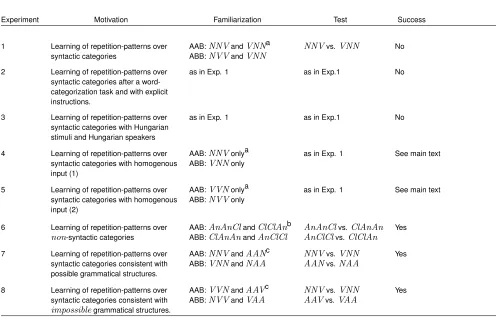
In all experiments, participants were told that they would listen to three-word sequences (triplets), and were instructed to memorize them (see Table 1 for a list of all experiments). Then 40 example triplets were played, all conforming to the same repetition-pattern. Half of the participants were famil-iarized with AAB sequences, where the first two categories were identical, and half withABBsequences, where the last two categories were identical. Following this familiarization, participants were informed that the triplets had conformed to a common structure. They were presented with pairs of new triplets made of new words, one conforming to anAAB -pattern, and one to anABB-pattern. Participants were asked to indicate which of the two triplets was like the familiariza-tion triplets.
Results and discussion
In Experiment 1, participants had to learn a repetition-pattern over the syntactic categories of nouns (N) and verbs (V); we only selected unambiguous examples of these cate-gories, such that no noun could be interpreted as a verb (e.g., “run” as in “a run” and “to run”) and vice versa. We famil-iarized half of the participants withAABtriplets (i.e., either
NNVsequences such as “window-napkin-annoy”, orVVN se-quences such as “scavenge-listen-camel”); the remaining par-ticipants were familiarized with ABB triplets (i.e., VNN or
NVV). Then they were tested on new triplets with new words that either matched or mismatched the pattern presented dur-ing familiarization. In half of the test trials, they had to choose between aNNVtriplet (AAB) and aVNNtriplet (ABB); in the remaining trials, they had to choose between aVVNtriplet (AAB) and aNVVtriplet (ABB).
As shown in Figure 1a, participants in Experiment 1 failed to learn the repetition-patterns (percentage correct: M = 53.0%, SD = 10.7%),t(19) = 1.26, p >.05. There was no difference in performance for AAB as opposed toABB; this was also the case for all of the other experiments. Further experiments showed that participants also failed to learn the pattern when using exclusively very high-frequency monosyl-labic or bisylmonosyl-labic words (see Experiments C1 and C2 in the Appendix).
As nouns and verbs are not necessarily salient categories, in Experiment 2, we primed participants on nouns and verbs to facilitate the learning of the repetition-pattern. Specifically,
Experiment 2 was identical to Experiment 1, except that, be-fore listening to the familiarization triplets, participants were presented with 10 words (5 nouns and 5 verbs), and had to decide whether these words were nouns or verbs. Following this, they were informed that they would listen to triplets that conformed to an extremely simple pattern involving nouns and verbs, and were instructed to find the relevant pattern. Then, the experiment proceeded as in Experiment 1. At the end of the experiment, participants were informed about the struc-ture of the familiarization triplets, and were asked whether they had noticed this structure.
As shown in Figure 1b, participants were near-perfect in their classification of words (M = 98.0%,SD= 5.2%),t(19) = 41.03, p < .00001, Cohen’s d = 9.2. However, while they successfully learned the repetition-pattern at the group level (M = 67.5%, SD = 22.4%, Figure 1a), t(19) = 3.49, p <
0.01, Cohen’sd = 0.78, Figure 1c reveals that the group per-formance was carried by five participants who performed at 100% correct; after removing these participants, the group performance did not differ significantly from chance (M = 56.7%,SD = 13.5%),t(14) = 1.92,p >.05. Moreover, even when including the five successful participants, 60% of the participants reported that they had not noticed the repetition-pattern — although they were explicitly informed about a pattern before starting the experiment.
It is possible that subjects had difficulty learning the repetition-patterns because, as mentioned above, nouns and verbs are ambiguous in English. Although we used nouns and verbs in Experiments 1 and 2 that we believed lacked such ambiguities, Experiment 3 addressed this possibility head on. Specifically, we replicated the design of Experiment 1, but tested native speakers of Hungarian in Hungarian; we thank
´
A.M. Kov´acs for running this experiment. Unlike in English, nouns are unambiguously nouns, and verbs are unambiguously verbs in Hungarian. Nonetheless, as shown in Figure 1a, Hun-garian participants failed to learn the repetition-pattern with Hungarian stimuli (M = 56.8%,SD = 16.5%),t(19) = 1.83,
p>.05.
Although it is clear from Experiment 2 (and, we believe, from everyday experience) that participants can classify nouns and verbs when presented in isolation, perhaps this capacity is suppressed when words are presented in the context of other words, making participants incapable of learning repetition-patterns involving these syntactic categories. Experiments 4 and 5 tested this idea by presenting participants with simpli-fied familiarizations. Specifically, in Experiments 1 to 3,AAB
sequences were heterogeneous, comprised of both NNV and
VVN sequences, whereas ABB sequences consisted of both
VNNand NVVsequences. In Experiments 4 and 5, in con-trast, all triplets were homogeneous, with the same structure. In Experiment 4, participants were presented with eitherNNV
sequences (for AAB), or withVNN sequences (forABB). In Experiment 5, the sequence structures were eitherVVN(for
AAB) orNVV(forABB).
Figure 1d shows the results of Experiment 4. While par-ticipants failed to learn the repetition-pattern in Experiment 4 (M = 48.8, SD = 9.0%),t(19) = 0.6, p > .05, their per-formance on the two trial types differed significantly,t(19) = 3.96, p < .001, Cohen’s d = 0.89. When choosing between
NNVand VNNtriplets, participants performed significantly above chance (M = 68.0%,SD = 24.2%),t(19) = 3.33,p <
.01, Cohen’s d = 0.74. When choosing between VVN and
NVVtriplets, in contrast, they performed significantlybelow
chance (M = 29.5, SD = 22.8%), t(19) = 4.02, p < .001, selecting the triplets conforming to the repetition-pattern op-posite to that heard during familiarization. Likewise, in
Ex-periment 5, participants failed to learn the repetition-pattern (M = 50.5%, SD = 10.2%), t(19) = 0.2, p >.05, but per-formed differently on the two test trial types,t(19) = 3.27,p<
.01, Cohen’sd = 0.73. In contrast to Experiment 6, partic-ipant performed above chance for trials pittingVVNtriplets againstNVVtriplets (M = 66.5%,SD = 23.9%),t(19) = 3.1,
p < .01, Cohen’s d = 0.69, but below chance for trials pit-tingNNVagainstVNNtriplets (M = 34.5%,SD = 24.4%),
t(24) = 2.8,p = .01, Cohen’sd = 0.69.
Surprisingly, participants not only failed to learn the repetition-patterns, but, for some test trials, they even chose the triplets with the incorrect repetition-pattern. These re-sults suggest that participants were able to extract the syn-tactic categories of verb and noun, and their placement in the first or last position, but were incapable of detecting the repetitions of these categories. For example, following famil-iarization with NNVtriplets, participants should (correctly) choose NNV over VNN triplets. However, they should also (incorrectly) chooseNVVtriplets overVVNtriplets because, despite having the opposite repetition-pattern, theNVVtest items and theNNVfamiliarization items start and end with the same categories. Similarly, when familiarized withVVN
triplets, participants should (correctly) choose VVNtriplets overNVVtriplets; however, as both VVNtriplets andVNN
triplets start with a verb and end with a noun (even though they have different repetition-patterns), they should (incor-rectly) chooseVNNtriplets overNNVtriplets. Hence, if par-ticipants only track the first and the last category in triplets, they should exhibit the differential performance on the test trial types found in Experiments 4 and 5.
A possible explanation that might account for all of the failures reported thus far is that participants are unable to detect repetition-patterns that operate over open-ended cat-egories (including syntactic catcat-egories). To assess this pos-sibility, we replicated Experiment 1, but with non-syntactic open-ended categories, specifically, animals and clothes. Thus, in Experiment 6, AABtriplets had the form animal-animal-clothing (e.g., “dog-swan-shirt”) or clothing-clothing-animal
(e.g., “hat-blouse-hawk”) whileABBsentences had the form
clothing-animal-animal (e.g., “shirt-dog-swan”) or animal-clothing-clothing (e.g., “hawk-hat-blouse”). Except for the choice of the categories, the experiment proceeded as in Ex-periment 1.
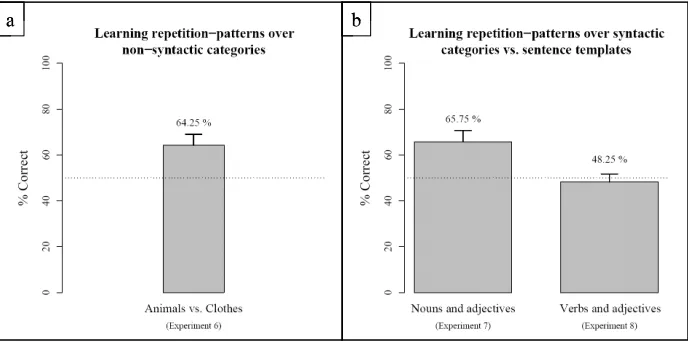
Figure 2a reveals that participants successfully learned the repetition-patterns (M = 64.3%,SD = 21.2%),t(19) = 3.0,
p< .01, Cohen’s d = 0.67, suggesting that the prior fail-ures cannot be explained by a general inability to extract repetition-patterns over open-ended categories. Moreover, ad-ditional experiments show that human adults can also learn repetition-patterns over other linguistic categories (e.g., ab-stract phonological categories, such as different pronunciations of the same syllable by different speakers; see Experiment C10 in the Appendix). The difficulty to learn repetition-patterns over categories thus seems to be specific to syntactic cate-gories.
The results presented so far suggest that participants have severe difficulties learning repetition-patterns over syn-tactic categories although all of the requisite processes would seem to be in place: repetition-patterns are simple enough to be learned by a wide variety of other animals, participants can classify words perfectly, they access such categories, and they can learn repetition-patterns over open-ended categories. Repetition-patterns of syntactic categories thus seem to be blocked by some other computational processes.
One possible explanation of these results is that partic-ipants might automatically try to make sense of any word-sequence they are presented with. This, however, requires
them to assign some rudimentary syntactic structure to the word-sequences, matching them to some sentence template even if it does not fit the word order of their native language, and even if the resulting “sentence” is semantically nonsensi-cal. That is, just as it is possible to make “syntactic sense” of Chomsky’s famous sentence “colorless green ideas sleep furi-ously” [12], participants might automatically try to force the triplets into some syntactic-like sentence template. If such templates are in place, however, it becomes clear why partic-ipants cannot learn the repetition-patterns: NNV andVVN
sequences have the same repetition-pattern, but a template with two nouns is necessarily different from a template with two verbs. Participants exposed toNNVandVVNsequences would need to learn twodistinctsentence templates, which, in turn, might prevent them from noticing that both templates conform to a singleAABrepetition-pattern.
Experiments 7 and 8 tested this possibility. In Experi-ment 7, we presented participants with sequences where the repetition-patterns were consistent with the syntactic tem-plates of the sequences. Specifically, participants in the
AABgroup were presented withNNVsequences (e.g., “baby-water-juggle”) or adjective (A)-adjective-noun (e.g., “clever-fragile-water”) sequences. In the ABB group, participants heard VNN (e.g., “juggle-baby-water”) sequences and NAA
sequences (e.g., “water-clever-fragile”). Note that, while these sequences are grammatical in some natural languages, most are not grammatical in English. For example, while AAN
sequences are grammatical in English, NAA sequences are not. Still, even for English speakers, it might be possible to make “syntactic sense” out of NAA sequences, because such sequences are grammatical in some languages (e.g., in French); as a result, such sequences might match a universally available syntactic sentence template.
Following this familiarization, participants had to choose betweenAAB and ABBsequences. As shown in Figure 2b, they successfully selected the test items conforming to the repetition-pattern (M = 65.8%, SD = 21.8%), t(19) = 3.2,
p <.01, Cohen’sd = 0.72. Importantly, and as in the other experiments presented here, the participants’ performance did not differ depending on whether they were familiarized with
AAB or ABB sequences, t(19) = 0.7, p > .05; given that
AANsequences are grammatical in English but notNAA se-quences, these results suggest that participants did not simply match the triplets to the syntax of their native language, but rather that they could make “syntactic sense” of the triplets even when they did not conform to the word order of their native language. The results of Experiment 7 thus support the hypothesis that, when the syntactic sentence templates are consistent with the repetition-pattern, participants read-ily learn the repetition-pattern.
However, instead of learning the syntactic templates, par-ticipants may have only noticed the first and the last cate-gories in the sequences. Further, our use of three different syntactic categories (nouns, verbs and adjectives) may have facilitated the task compared to the other experiments, where only two categories were used. Experiment 8 controlled for these possibilities.
Experiment 8 was similar to Experiment 7 except that nouns were replaced with verbs; that is, AAB participants heard VVN or AAV sequences, whereas ABB participants heardNVVandVAAsequences. These sequences were chosen because it is not clear what kind of syntactic structure could be assigned toVVNsequences such as “scavenge-listen-baby,” or to AAV sequences such as “fragile-eager-furnish.” There-fore, it should be much harder to make “syntactic sense” of these sequences. In contrast, if participants just noticed
ini-tial or final categories, or if the use of three categories made the learning task easier, we would expect successful general-ization in Experiment 8.
In contrast to Experiment 7, and as shown in Figure 2b, participants in Experiment 8 failed to learn the repetition-pattern (M = 48.3%, SD = 15.2%), t(19) = .5, p > .05. Participants performed better in Experiment 7 than in Ex-periment 8,F(1,38) = 8.7,p<.01,η2 = .186. These results further support the hypothesis that participants attempt to force word-sequences into a syntactic template in order to learn their structure.
Together, our results (see also Appendix) suggest that peo-ple can learn structures over syntactic categories only to the extent that they match available syntactic templates. These templates need not be available in their native language, but they must be within the range of natural grammars. Though the detection of repetitions appears to be an evolutionarily ancient capacity, computed even by honey-bees and sleeping neonates, healthy human adults are deaf to patterns of repe-tition if they perceive items that fall naturally into syntactic categories. This syntax-induced pattern deafness arises even when subjects are primed to look for the pattern, a form of im-munity that is reminiscent of how many perceptual processes force specific interpretations upon sensory input [13, 14, 15]. Our results thus give credence to the proposal that language is akin to perceptual systems such as vision and audition [5, 6, 7], and that syntactic processes are just as modular and impen-etrable as other perceptual processes.
Materials and Methods
Participants. Twenty native speakers of English participated in all experiments
except Experiment 3, where 20 native speakers of Hungarian were recruited. In total, we tested 160 participants (85 females, mean age 21.4, range 18-40). English-speaking participants were recruited through the Harvard University Study Pool and received course credit or monetary payment in exchange for their participation. Hungarian participants were recruited at the Hungarian Academy of Science. Half of the participants were assigned to theAABcondition, and half to theABBcondition (see below).
Apparatus. Stimuli were presented over headphones using Psyscope X
(http://psy.ck.sissa.it). Responses were collected from pre-marked keys on the keyboard.
Stimuli. Words were recorded using a Sennheiser ME67 directional microphone
connected to a PC running Audacity (http://audacity.sourceforge.net/), and saved in the aiff file format (44.1 kHz, 16 bit, mono). English words were recorded from different female native speakers of American English, while Hungarian words were recorded from a male native speaker of Hungarian. Depending on the difficulty the speaker experienced producing words without list prosody, words were either recorded in isolation or embedded in short sentences, and then ex-cised from these sentences. All words are given in Table S1 in the Supporting Information.
Procedure.
Categorization phase (Experiment 2). In Experiment 2, participants were
first informed that they would hear words, and were instructed to decide whether they were nouns or verbs. Then, they were presented with 5 nouns and 5 verbs. Words were presented in random order, with the constraint that no more than three nouns or verbs could occur in a row. Following this, participants proceeded to the familiarization phase.
Familiarization phase (except Experiment 2). Participants were informed
Familiarization phase (Experiment 2). In Experiment 2, participants were told that they would listen to sequences conforming to a very simple pattern of nouns and verbs, and were instructed to find the relevant pattern. Then the familiarization proceeded as in the other experiments.
Test phase. Before participating in the test phase, participants were informed
that the triplets they had listened to conformed to some regularity. They were informed that they would listen to pairs of new triplets, and that, in each pair, one of the triplets conformed to the regularity of the familiarization triplets. Then they were presented with 20 test pairs. The test pair types are shown in Table S4 in the Supporting Information. For each test pair type, the correct choice occurred equally often first and second in a test pair.
In Experiment 2, participants were informed about the nature of the regular-ity after they had completed the test phase, and were asked whether they had noticed it.
Appendix: Main control experiments
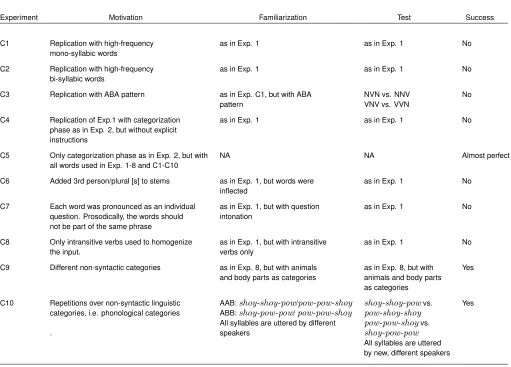
Our most important control conditions, and their motivations, are listed in Table 2. Experiments C1 and C2 were replica-tions of Experiment 1 with different words. We reasoned that participants might find it easier to generalize the repetition-patterns with more homogenous input; in Experiments C1 and C2, we thus used exclusively extremely high-frequency mono-syllabic and bimono-syllabic words, respectively. In Experiment C2, an equal number of nouns and verbs had a strong-weak and a weak-strong stress pattern, respectively. Experiment C3 was another replication of Experiment 1, where we used anABA
pattern instead of the AAB and ABB patterns used in the other experiments.
Experiment C4 implemented a more subtle form of prim-ing than in Experiment 2. Specifically, participants first had to categorize 10 words as nouns or verbs (as in Experiment 2). Then, however, they were not explicitly informed about the presence of the pattern; rather the experiment contin-ued as in Experiment 1. Results showed that participants did not benefit from the priming, and failed to generalize the repetition-pattern.
The goal of Experiment C5 was to make sure that par-ticipants correctly perceived our stimuli as nouns or verbs. Participants were presented with all 72 words used in Experi-ments 1-8 and C1-C10, and had to decide whether they were nouns or verbs. As in the categorization phase of Experiment 2, participants’ categorization performance was near perfect, suggesting that they correctly perceived words as nouns or verbs.
In half of the familiarization trials of Experiment C6, we added third person and plural endings to the words (e.g., guzzles-annoys-churches, churches-windows-brings); by adding inflectional markers, we hoped to make the category membership more salient. Results indicate that these
inflec-tional markers did not help participants identify the repeti-tions.
In Experiment C7, each word in a triplet was pronounced as an individual question. If participants tried to interpret the word triplets as sentences, prosodically marking each word as a question might have helped participants to consider each word in isolation, and thus to detect the repetition pattern. Results suggest that this prosodic information failed to help our participants, presumably because they ignored it after the first few familiarization triplets.
In Experiment C8, we attempted to facilitate learning of the repetition pattern by making the familiarization phase more homogenous. Specifically, while the other experiments used both transitive and intransitive verbs, Experiment C8 presented a repetition-pattern over nouns and verbs using in-transitive verbs only. None of these manipulations facilitated learning the repetition pattern.
Experiment C9 was a replication of Experiment 6 with different non-syntactic categories. In this experiment, par-ticipants had to lean a repetition-pattern over animals and body parts as non-syntactic categories. As in Experiment 6, participants successfully learned the repetition-pattern over non-syntactic categories.
The goal of Experiment C10 was to show that partici-pants can learn repetition-patterns over linguistic categories. Specifically, all triplets were composed of the same syllables. Participants familiarized toAABtriplets heard the sequences
shoy-shoy-powandpow-pow-shoy, while participants familiar-ized to ABBtriplets heard the sequences show-pow-powand
pow-shoy-shoy triplets. Importantly, however, each syllable was uttered by a different speaker. Following this familiar-ization, participants had to choose between AAB and ABB
triplets implemented with the same syllables, uttered by fur-ther different speakers. This experiment parallels Experiment 1 in important ways, as both involve repetition-patterns over linguistic categories. In Experiment 1, the categories are syn-tactic (i.e., nouns and verbs); in Experiment C10, the cate-gories are the abstract, speaker-independent phonological rep-resentations of the syllables. In both cases, these categories had different realizations in the triplets. In Experiment 1, we used different words as exemplars of nouns and verbs; in Ex-periment C10, we used different pronunciations as exemplars of the phonological categories. Despite the similarity between these experiments, participants successfully learned the pat-tern in Experiment C10 but not in Experiment 1.
ACKNOWLEDGMENTS.We are indebted to Á. M. Kovács for running Experiment
3. For comments on an earlier draft of the manuscript, we thank N. Chomsky, Á. M. Kovács and J. Saffran. Funding for this work was provided by grants from the Mind, Brain and Behavior Initiative to MDH and ADE, as well as additional funds to MDH from the Wenner-Gren Foundation, and gifts from J. Epstein and S. Shuman.
1. Davis, G & Driver, J. (1998) Kanizsa subjective figures can act as occluding sur-faces at parallel stages of visual search.J Exp Psychol Hum Percept Perform 24:169–184.
2. Sigman, M, Cecchi, G, Gilbert, C, & Magnasco, M. (2001) On a common circle: Natural scenes and Gestalt rules.Proc Natl Acad Sci USA98:1935–1940. 3. Chomsky, N. (1980)Rules and Representations. (Basil Blackwell, Oxford). 4. Moro, A. (2008)The Boundaries of Babel:The Brain and the Enigma of Impossible
Languages. (MIT Press, Cambridge, MA).
5. Chomsky, N. (1965)Aspects of the theory of syntax. (MIT Press, Cambridge, Massachusetts).
6. Lenneberg, E. H. (1967)Biological Foundations of Language. (John Wiley and Sons, New York).
7. Fodor, J. A. (1983)The Modularity of Mind. (MIT Press, Cambridge, MA). 8. Giurfa, M, Zhang, S, Jenett, A, Menzel, R, & Srinivasan, M. V. (2001) The concepts
of ‘sameness’ and ‘difference’ in an insect.Nature410:930–933.
9. Murphy, R. A, Mondragon, E, & Murphy, V. A. (2008) Rule learning by rats.Science 319:1849–1851.
10. Marcus, G. F, Vijayan, S, Rao, S. B, & Vishton, P. (1999) Rule learning by seven-month-old infants.Science283:77–80.
11. Gervain, J, Macagno, F, Cogoi, S, Peña, M, & Mehler, J. (2008) The neonate brain detects speech structure.Proc Natl Acad Sci USA105:14222–14227.
12. Chomsky, N. (1957)Syntactic structures. (Mouton, The Hague).
13. Hoffman, D. D. (1998)Visual intelligence: How we create what we see. (W. W. Norton & Co, New York, NY).
14. Liberman, A. M, Harris, K, Hoffman, H, & B.C., G. (1957) The discrimination of
speech sounds within and across phoneme boundaries.J Exp Psychol54:358–
68.
15. Berlin, B & Kay, P. (1969)Basic color terms: Their universality and evolution. (University of California Press, Berkeley, CA).
a b
c d
a b
[image:6.612.22.365.161.503.2]c d
Fig. 1.(a,b,d) Bars represent sample-averages, and error-bars standard-errors from the
average. (a) When exposed to three-word sequences following a repetition-pattern of syntactic categories, participants fail to learn this pattern (Experiment 1). Most fail to learn it after being asked to classify words as nouns or verbs, and after being explicitly informed about the existence of a pattern involving nouns and verbs (Experiment 2, see also (c)). Also Hungarian speakers tested on Hungarian stimuli (where nouns and verbs are unambiguously marked) fail to learn the pattern (Experiment 3). (b) Participants are near-perfect at classifying words as nouns and verbs in the classification phase of Experiment 2. (c) Dots represent averages of individual participants, the diamond the sample-average, and the bar the proportion of participants having noticed the repetition-pattern over categories. After being primed on syntactic categories and after being explicitly informed about the existence of a pattern involving nouns and verbs, most participants failed to learn the pattern. Moreover, only 40% of the participants claimed to have noticed the pattern (Experiment 2). (d) In Experiment 4, participants performed above chance when choosing betweenNNVandVNNtriplets, but below chance when choosing between
VVNandNVVtriplets. In Experiment 5, participants performed above chance when choosing betweenVVNandNVVtriplets, but below chance when choosing between
a b
[image:7.612.20.364.290.461.2]a b
Fig. 2. (a) When exposed to three-word sequences conforming to a repetition-pattern of
non-syntactic categories (i.e., animals and clothes), participants successfully learned this pattern (Experiment 6). (b) In Experiment 7, participants were familiarized with three-word sequences of which they could make “syntactic sense.” Specifically, they were exposed either toNNVandAANtriplets, or toVNNandNAAtriplets. Participants successfully learned the structure of these triplets. In Experiment 8, it was harder to make “syntactic sense” of the triplets. Specifically, participants were exposed either toVVNandAAV
triplets, or toNVVandVAAtriplets. They failed to learn their structure.
Table 1. Overview of the experiments
Experiment Motivation Familiarization Test Success
1 Learning of repetition-patterns over AAB:NNVandVNNa NNVvs.VNN No syntactic categories ABB:NVVandVNN
2 Learning of repetition-patterns over as in Exp. 1 as in Exp.1 No syntactic categories after a
word-categorization task and with explicit instructions.
3 Learning of repetition-patterns over as in Exp. 1 as in Exp.1 No syntactic categories with Hungarian
stimuli and Hungarian speakers
4 Learning of repetition-patterns over AAB:NNVonlya as in Exp. 1 See main text syntactic categories with homogenous ABB:VNNonly
input (1)
5 Learning of repetition-patterns over AAB:VVNonlya as in Exp. 1 See main text syntactic categories with homogenous ABB:NVVonly
input (2)
6 Learning of repetition-patterns over AAB:AnAnClandClClAnb AnAnClvs.ClAnAn Yes
non-syntactic categories ABB:ClAnAnandAnClCl AnClClvs.ClClAn
7 Learning of repetition-patterns over AAB:NNVandAANc NNVvs.VNN Yes syntactic categories consistent with ABB:VNNandNAA AANvs.NAA
possible grammatical structures.
8 Learning of repetition-patterns over AAB:VVNandAAVc NNVvs.VNN Yes syntactic categories consistent with ABB:NVVandVAA AAVvs.VAA
impossiblegrammatical structures.
Table 2. Main control experiments
Experiment Motivation Familiarization Test Success
C1 Replication with high-frequency as in Exp. 1 as in Exp. 1 No
mono-syllabic words
C2 Replication with high-frequency as in Exp. 1 as in Exp. 1 No
bi-syllabic words
C3 Replication with ABA pattern as in Exp. C1, but with ABA NVN vs. NNV No
pattern VNV vs. VVN
C4 Replication of Exp.1 with categorization as in Exp. 1 as in Exp. 1 No
phase as in Exp. 2, but without explicit instructions
C5 Only categorization phase as in Exp. 2, but with NA NA Almost perfect
all words used in Exp. 1-8 and C1-C10
C6 Added 3rd person/plural [s] to stems as in Exp. 1, but words were as in Exp. 1 No inflected
C7 Each word was pronounced as an individual as in Exp. 1, but with question as in Exp. 1 No question. Prosodically, the words should intonation
not be part of the same phrase
C8 Only intransitive verbs used to homogenize as in Exp. 1, but with intransitive as in Exp. 1 No
the input. verbs only
C9 Different non-syntactic categories as in Exp. 8, but with animals as in Exp. 8, but with Yes and body parts as categories animals and body parts
as categories
C10 Repetitions over non-syntactic linguistic AAB:shoy-shoy-pow/pow-pow-shoy shoy-shoy-powvs. Yes categories, i.e. phonological categories ABB:shoy-pow-pow/pow-pow-shoy pow-shoy-shoy
All syllables are uttered by different pow-pow-shoyvs.
. speakers shoy-pow-pow
All syllables are uttered by new, different speakers