ELIMINATION OF PRODUCT SHORTAGE AT DISPATCH LINE IN
MANUFACTURING INDUSTRY BY USING LEAN TOOL
This report is submitted in accordance with requirement of the Universiti Teknikal Malaysia Melaka (UTeM) for Bachelor Degree of Manufacturing Engineering
(Manufacturing Management) (Hons.)
by
NOR AZATUL FASYA BINTI AZMAN B051410078
931025-03-6006
Disahkan oleh:
_____________________________ ______________________________ Alamat Tetap: Cop Rasmi:
Lot 1303, Kampung Permatang Rambai, 16800 Pasir Puteh,
Kelantan.
Tarikh: _______________________ Tarikh: _______________________
*Jika Laporan PSM ini SULIT atau TERHAD, sila lampirkan surat daripada pihak berkuasa/organisasi berkenaan dengan menyatakan sekali sebab dan tempoh laporan PSM ini perlu dikelaskan sebagai SULIT atau TERHAD.
UNIVERSITI TEKNIKAL MALAYSIA MELAKA
BORANG PENGESAHAN STATUS LAPORAN PROJEK SARJANA MUDA
Tajuk: ELIMINATION OF PRODUCT SHORTAGE AT DISPATCH LINE IN MANUFACTURING INDUSTRY BY USING LEAN TOOL
Sesi Pengajian: 2016/2017 Semester 2
Saya NOR AZATUL FASYA BINTI AZMAN (931025-03-6006)
mengaku membenarkan Laporan Projek Sarjana Muda (PSM) ini disimpan di Perpustakaan Universiti Teknikal Malaysia Melaka (UTeM) dengan syarat-syarat kegunaan seperti berikut:
1. Laporan PSM adalah hak milik Universiti Teknikal Malaysia Melaka dan penulis. 2. Perpustakaan Universiti Teknikal Malaysia Melaka dibenarkan membuat salinan
untuk tujuan pengajian sahaja dengan izin penulis.
3. Perpustakaan dibenarkan membuat salinan laporan PSM ini sebagai bahan pertukaran antara institusi pengajian tinggi.
4. *Sila tandakan (√)
(Mengandungi maklumat yang berdarjah keselamatan atau kepentingan Malaysiasebagaimana yang termaktub dalam AKTA RAHSIA RASMI 1972)
(Mengandungi maklumat TERHAD yang telah ditentukan oleh organisasi/ badan di mana penyelidikan dijalankan)
SULIT
TERHAD
DECLARATION
I hereby, declared this report entitled “Elimination of Product Shortage at Dispatch Line in Manufacturing Industry by using Lean Tool” is the result of my own research except as
cited in references.
Signature : ………
APPROVAL
This report is submitted to the Faculty of Manufacturing Engineering of Universiti Teknikal Malaysia Melaka as a partial fulfilment of the requirement for Degree of Manufacturing Engineering (Manufacturing Management) (Hons). The member of the
supervisory committee are as follow:
i
ABSTRAK
ii
ABSTRACT
iii
DEDICATION
This project is dedicated to my beloved father, Azman bin Ahmad and my appreciated mother, Siliyani binti Kassim for motivated me during completing this project, who always stay beside
iv
ACKNOWLEDGEMENT
In the name of ALLAH, the most gracious, the most merciful, with the highest praise to Allah that I manage to complete this final year project successfully without difficulty.
First and foremost, I would like to thank to my supervisor Dr. Effendi bin Mohamad for the guidance through completing my project. The supervision and support that has been given has truly helped in the progression and smoothness of completing this project. His patience, motivation and the cooperation are much indeed appreciated. I also thank to Mr. Goh for assisting me in doing my project in the company, the help and cooperation have greatly contributed to the result of the project.
Here, I would like to convey my sincere gratitude to my family for their support and encouragement. Their undivided love and support are the beacons that have continued to motivate me through the harshest of situations.
Furthermore, I sincerely grant my highest gratitude to my teammates for this handful one year we have been together through thick and thin. Not to forget my housemates for our random events and memories that always seem to put a hold in every pressure we had.
v
TABLE OF CONTENT
Abstrak i
Abstract ii
Dedication iii
Acknowledgement iv
Table of Contents v
List of Tables ix
List of Figures xi
List of Abbreviations xii
CHAPTER 1: INTRODUCTION
1.1. Introduction 1
1.2. Background 1
1.3. Problem Statement 2
1.4. Objectives 4
1.5. Scopes 5
1.6. Structure of Report 5
CHAPTER 2: LITERATURE REVIEW
2.1 Introduction 6
2.2 Customer Satisfaction 6
2.2.1 Customer Satisfaction in Manufacturing Industry 8
2.3 Lean Manufacturing (LM) 10
2.3.1 Waste 11
vi
2.3.3 LM Tools and Techniques 13
i. Cellular Manufacturing (CM) 16
ii. Continuous Improvement (CI) 17
iii. Just in Time (JIT) 17
iv. Production Smoothing 19
v. Standardization of Work 19
vi. Total Productive Maintenance 19
vii. Other Waste Reduction Techniques 20
2.4 Concept of Kaizen 21
2.4.1 Kaizen Philosophy 23
2.4.2 Application of Kaizen 24
2.4.3 Significance of Kaizen Implementation 26
2.4.4 Kaizen Approach 27
2.5 Qualitative and Quantitative Method 28
2.5.1 Observation 28
2.5.2 Interview 29
2.5.3 Discussion and Brainstorming 30
2.6 Spaghetti Diagram 31
2.7 Standard Work 32
2.8 Summary 33
CHAPTER 3: METHODOLOGY
3.1 Introduction 34
3.2 Methodology of the Study 34
3.2.1 Flowchart of the Study 35
3.3 Relationship between Objectives and Methodology 36
3.3.1 Study the Product Shortage 37
i. Company Visit 37
ii. Document Review 38
vii
iv. Unstructured Interview 39
v. Discussion 40
3.3.2 Root Cause Analysis 40
i. Root Cause Identification 40
ii. Root Cause Analysis 41
i. Naturalistic Observation 41
ii. Unstructured Interview 42
iii. Brainstorming 42
iv. Cause and Effect Diagram (CAED) 43
3.3.3 Implementation and Propose Solution 43
i. FMEA 43
ii. Kaizen Implementation 44
a) Standard Work 44
b) Improvement Proposal 45
3.4Summary 45
CHAPTER 4: RESULT AND DISCUSSION
4.1Introduction of Company Background 46
4.1.1 Factory 2 (F2) 46
4.2Study the Product Shortage Issue 47
4.2.1 Product Shortage Data 48
4.2.2 Process Flow at Dispatch Line 49
4.2.3 Result of Interview Session 51
4.3Root Causes Analysis Data 52
4.3.1 Observation and Interview 52
4.3.2 Brainstorming 53
i. Manpower 54
ii. Method 55
4.3.3 Cause and Effect Diagram 56
viii
4.4.1 Failure Mode and Effect Analysis (FMEA) Technique 57
4.4.2 Data evaluation 59
1) Suggested Solution of Product Shortage Problem 59
2) Implementation of New Standard Work 60
4.5After Implemented Kaizen 64
4.5.1 Product Shortage Data 64
4.5.2 Comparison Data between Before Implement and After
Implement 65
4.6Improvement Proposal 66
CHAPTER 5: CONCLUSION AND RECOMMENDATION
5.1Conclusion 67
5.2Sustainability 68
5.3Recommendation 69
REFERENCES 70
APPENDICES
A Gantt Chart of FYP 1 81
B Gantt Chart of FYP 2 82
C Work Instruction 83
ix
LIST OF TABLES
1.1 Types of Shipping Process 3
2.1 Correlation between Market Share versus Customer Satisfaction 7 2.2 Comparison the Issue of Customer Satisfaction in Manufacturing
Industry 9
2.3 Principles of LM 12
2.4 Types of Kanban 18
2.5 Three Key Components of TPM 20
2.6 Case Study on Concept of Kaizen 22
2.7 Case Studies of Kaizen Philosophy 24
2.8 Applications of Kaizen in Manufacturing Fields 25
2.9 Significance of Kaizen Implementation 26
2.10 Comparison of Kaizen Approach 27
2.11 Comparison between Qualitative and Quantitative Method 28 2.12 Differences between Qualitative and Quantitative Method 28
2.13 Comparison between Types of Observation 29
2.14 Types of Interview Method 29
2.15 Types of Brainstorming Method 31
3.1 Relationship between Objectives and Methodology 36
3.2 Schedule for Factory Visit 38
3.3 Interview Question 39
3.4 Participant and Tittle of Discussion 40
3.5 Interview Question 42
x
4.1 Data of Product Shortage for Five Month Period 48
4.2 Process Flow of Palletizing Process 51
4.3 Interview Result 51
4.4 Interview Result for Root Cause Analysis 53
4.5 Factors of Manpower 55
4.6 Factors of Method 55
4.7 FMEA 58
4.8 Suggested Solution 59
4.9 WI Process 61
4.10 Customer Complaint after Implementing Kaizen 64
4.11 Comparison of Customer Complaint after Implementing Kaizen 65
xi
LIST OF FIGURES
1.1 Rack for Different Product of Customer in Dispatch Warehouse 2
1.2 Number of Cases Recorded for IC and others 3
1.3 Customer Complaint about the Shortage Issue 4
2.1 Theoretical Model of Lean Tools and Principles 14
2.2 The Umbrella of Kaizen Tool 22
2.3 Example of Spaghetti Diagram at Hospital 31
3.1 Flowchart for Methodology 35
3.2 Flowchart of Product Shortage Study 37
3.3 Flowchart of Root Causes Analysis 41
4.1 Dispatch Department Location 47
4.2 The Customer Complaint of Product Shortage for Five Month Period 48
4.3 Process Flow at Dispatch Warehouse 49
4.4 Spaghetti Diagram at Dispatch Warehouse 50
4.5 Palletizing Process 50
4.6 Example of the Product Shortage Cause 52
4.7 Brainstorming of Product Shortage Problem at Dispatch Area 54
4.8 CAED of Product Shortage Problem 56
4.9 WI Process 61
4.10 Customer Complaint after Implementing Kaizen 64
xii
LIST OF ABBREVIATIONS
CAED - Cause and Effect Diagram
CI - Continuous Improvement
CM Cellular Manufacturing
CS - Customer Satisfaction
D Detection
DMAIC - Define, Measure, Analyze, Improvement, Control
DZ - Dozen
FMEA Failure Mode and Effect Analysis
IC - Inter-Company
JI - Job Instruction
JIT - Just-in-Time
LM - Lean Manufacturing
O Occurrence
PDCA - Plan, Do, Check, Act
QFD - Quality Function Development
RFID Radio Frequency Identification
RPN Risk Priority Number
RTLS Real Time Location System
S Severity
SMED - Single Minute Exchange of Dies
SOP - Standard Operating Procedure
TPM - Total Productive Maintenance
USA United States of America
xiii
VSM - Value Stream Mapping
WI Work Instruction
1
CHAPTER 1
INTRODUCTION
1.1Introduction
This chapter mainly discusses on the background of study, problem statement, objectives and scopes of this study.
1.2Background
According to Eckert (2007), inventory management plays an important role in creating customer’s satisfaction. In the past, stock administration has concentrated on not coming up short on wrapped up the merchandise. This made manufacturers stockpile a lot of crude materials, work in process and completed products. Manufacturers streamline their store network, minimize extensive inventories and cut holding cost on stock.
Cacioappo (2000) stated that steadfast clients are six times more possible to repurchase or prescribe the buy of the item or administration to another person. Researchers have demonstrated that by and large, four percent of the clients will be disappointed or complaint about the item. The disappointed client is probably going to tell nine other individuals while a fulfilled client will tell five individuals about the great treatment.
2
work near ‘perfect order’ measurements, there must be powerful stock administration, rebuilding inventory network operations and redesigning principles of the ideal standard. At the point when overhauling the measurements, this would incorporate the cases transported versus the requests on-time conveyance, information synchronization, harms and usable items, days in supply, the requesting time cycle and retire level of administration (Red Prairie, 2005).
1.2Problem Statement
The problem in achieving customer’s satisfaction also occurs in ABC Company where this study is conducted. ABC Company is a metal manufacturing company based in Malacca Malaysia. This problem started at the dispatch department, which is the department that completes the customer order by doing the palletizing and shipment process. The problem of this issue due to the not providing a standard work for palletizing process that will effect to the training of manpower will be difficult, inconsistent and ineffective and also will make a work flows at dispatch line cannot be smooth but the most critical effect is have been complaining by customers about the shortage of product when the products were delivered to them.
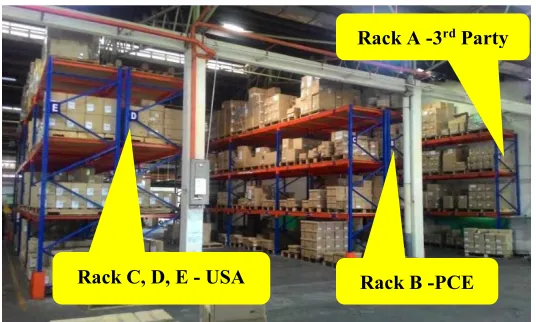
The dispatch warehouse in ABC Company consists of three different racks labelled for three different customers, i.e. USA, PCE and 3rd Party as shown in Figure 1.1. The products will be
[image:19.612.180.448.525.686.2]stored according to the type of customer and part number.
Figure 1.1: Rack for Different Customers in Dispatch Warehouse
Rack B -PCE
Rack A -3rd Party
3
[image:20.612.82.547.164.234.2]There are two types of shipment, by air and by sea. The shipment types will follow the customer’s request through email. The differences between the two types of shipment are shown in Table 1.1.
Table 1.1: Types of Shipping Process
By air By sea
If the product requires urgently.
Used cargo
Height of pallet is 150cm
If the product is not required urgently.
Used container
Height of pallet is 250cm.
Customers are anticipating that producers should deliver them with perfect order deliveries. The dispatch department will organize the distribution of good services to the customer in order to make sure that the product is delivered to customers on time and following the desired amount.
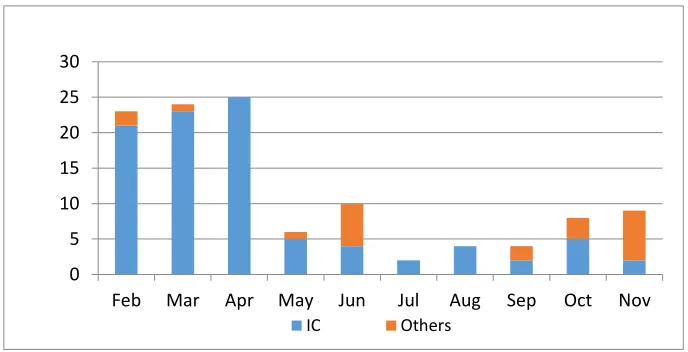
The problem of ABC Company is the delivery issue which is caused by shortage of product at dispatch warehouse. This is a critical issue at the company because of increasing complaints from customer especially USA customers. The issue will affect the customer satisfaction level. The information and data about the complaints have been recorded from February until November 2016 as shown in Figure 1.2. The data have been recorded based on the Voice of Customer (VoC).
Figure 1.2: Number of Cases Recorded for IC and others *IC = Inter-company (example: USA, PCE)
0 5 10 15 20 25 30
Feb Mar Apr May Jun Jul Aug Sep Oct Nov
[image:20.612.141.485.499.675.2]4
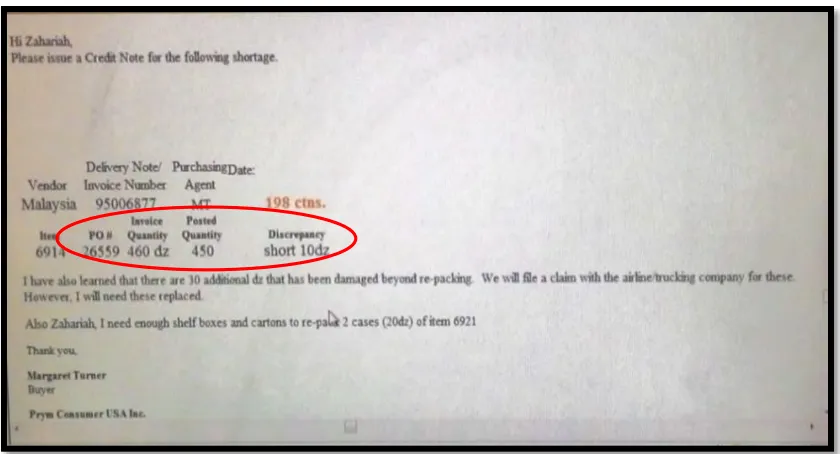
[image:21.612.102.522.174.401.2]The example of USA customer complaint about the shortage of product by 10dz. DZ refers to the unit of product which is dozen. Figure 1.3 shows the example of customer complaints. Therefore, the objective of this study is to analyze the shortage of product at the dispatch warehouse of ABC Company and its effect on customer’s satisfaction.
Figure 1.3: Customer Complaint about the Shortage Issue
1.3Objectives
The objectives of this study are:
1. To study the current issue of product shortage at dispatch line based on Voice of Customer (VoC).
2. To analyze the root causes of product shortage using brainstorming and cause and effect diagram.
5
1.4Scopes
This study mainly focuses on:
Dispatch area – a respective department to complete the customer order.
All types of product at the dispatch warehouse
USA customer - due to the highest complaints.
1.5Structure of Report
6
CHAPTER 2
LITERATURE REVIEW
2.1Introduction
In this chapter mainly discussed about the customer satisfaction, lean manufacturing (LM) and Kaizen philosophy.
2.2Customer Satisfaction
Customer satisfaction is how much clients see that they got items and administrations that are worth more than the value they paid (Tracey, 1996). Then, there are an arrangement of factors that impact consumer loyalty including quality, conveyance speed, conveyance constancy, cost, adaptability and development (White’s, 1996; Zhang et al., 2003). Customer satisfaction means the customer feedback to the complaint of satisfaction and customer judgement of the fulfilled state (Oliver, 1997). There are many benefits for a company when have a high customer satisfactions level. It elevates client reliability and anticipates client need, brings down clients’ cost affectability, lessens working expenses because of client number increments, improves the capability of promoting and upgrades business reputation (Fornell, 1992). The principle consider of determining customer satisfaction which is the customers’ view about the quality of management (Kim et al., 2004).
7
the online business perspective, satisfaction is characterized as the happiness of the purchaser with regard to his/her past buy encounters with a web based business firm (Chen, 2012). Customer satisfaction is viewed as a feeling based reaction which is dictated by whether the desires of customers for the item/benefit before buy are steady with the genuine item/benefit got taking after buy (Oliver, 1981). Meanwhile, Churchill and Surprenant (1982) stated that customer satisfaction is gotten from the consequences of customers acquiring and utilizing items. Fornell (1992) also proposed that fulfillment is a general feeling that can be specifically assessed, customers contrast an item or benefit and their optimal models. Low et al. (2013) proposed that there are two types of satisfaction which are:
i. Economic satisfaction – gotten from unmistakable items. ii. Social satisfaction – given by administration experiences.
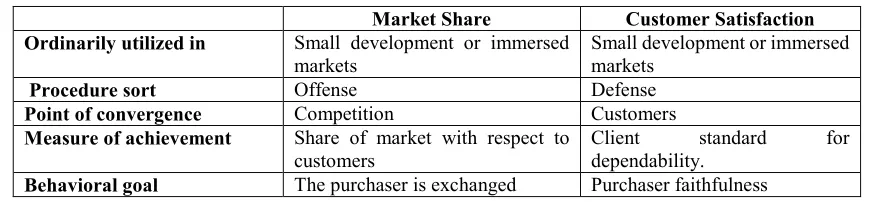
[image:24.612.111.548.500.601.2]According to the Innis and La Londe (1994), customer satisfaction is some of the main objectives of marketing actions and might lead to improved procurements by customers and increased profits for the firm. The simple knowledge is the possibility of satisfied customer to repurchase, important to improve the sales and market share of the company. Anderson (2014) has identified the correlation between market share and customer satisfaction in the company. The correlation of these two is shows in Table 2.1.
Table 2.1: Correlation between Market Share and Customer Satisfaction
Market Share Customer Satisfaction
Ordinarily utilized in Small development or immersed
markets Small development or immersed markets
Procedure sort Offense Defense
Point of convergence Competition Customers
Measure of achievement Share of market with respect to
customers Client dependability. standard for