Government Equalities Office 9th Floor
Eland House Bressenden Place London SW1E 5DU
Tel: 030 3444 0000
Email: [email protected] www.equalities.gov.uk
© Crown copyright 2010
JN 400030
Flexible working:
perceptions of
working parents
Survey wave 2
Executive summary
4
1. Introduction
6
2. Awareness of the right to request flexible working
9
3. Interest in working flexibly
11
4. Perceived barriers to requesting flexible working
13
5. Sources of information about the right to request
flexible working
15
6. Changes in awareness over the last 6 months
16
7. Conclusions
17
List of boxes and figures
Box 1: Summary of changes in the right to request flexible working 7 Figure 1: Self-reported awareness of flexible working legislation 9 Figure 2: Self-reported awareness of flexible working legislation
by occupation group 10
Figure 3: Whether made a flexible working request 11 Figure 4: Likelihood of making a flexible working request in next
12 months 12
Executive summary
This report documents the results from the second wave of research to assess the awareness and experiences of flexible working among working parents. The first wave of the research was conducted in March 2009. An online survey was conducted between 14 and 21 October 2009 with a representative sample of 1,004 working parents of children aged 0–16 in Great Britain, who use the internet.
Awareness of the right to request flexible working
• Just under two-thirds of working parents (65%) reported that they were aware that (in April 2003) the Government had put in place legislation which entitled certain groups of workers to request flexible working from their employer.
• Around a quarter (26%) of working parents claimed that they were aware that the right had been extended (in April 2009). However, only 12% of working parents were able to identify that the right to request flexible working had been extended to all parents of children aged 0–16.
Interest in working flexibly
• Three in ten (30%) working parents have made a request to work flexibly and eight in ten (81%) of those requests have been granted. • One in ten (10%) parents who work full-time have made a request to
work flexibly in the last 6 months.
• Just over a third (34%) of parents who work full-time reported that they were likely to make a request to work flexibly in the next 12 months.
Perceived barriers to requesting flexible working
• Working parents perceive that requesting to work flexibly could have negative consequences for themselves. A third were concerned it would mark them out as ‘uncommitted to their job’.
• There has been a reduction in the proportion of working parents who felt that they were not entitled to make flexible working requests (18% in March 2009 compared with 10% in October 2009).
• A higher proportion of full-time working fathers, compared with working mothers, reported being concerned about being marked as uncommitted to their job if they made a flexible working request. This contrasts with the findings from March 2009, where a higher proportion of full-time working mothers highlighted this concern compared with full-time working fathers.
Sources of information about the right to request flexible working
• Around one in six (15%) working parents have heard about flexible working in the media in the last 6 months. Of those parents who have heard about flexible working in the media, half of them mentioned they had seen about flexible working on the television.
Changes in awareness
1. Introduction
The Government believes that flexible working is good for families and good for business. Flexible working can help people to have a better quality of family life, in particular by allowing them to spend more time with their children. For some people working flexibly is the only way they can balance caring responsibilities with employment; without the ability to work flexibly they would leave the workforce altogether. It also helps to create dynamic workplaces that strengthen our economy now and in the future, by enabling businesses to draw on the talents of the best people, not just those who can work nine-to-five.
Background
‘Flexible working’ is a phrase that describes any working pattern adapted to suit a person’s needs. Common types of flexible working are:
• part time: working less than the normal hours, perhaps by working fewer days per week;
• flexitime: choosing when to work (there’s usually a core period during which people have to work);
• annualised hours: hours are worked out over a year (often set shifts with the employee deciding when to work the other hours);
• compressed hours: working agreed hours over fewer days; • staggered hours: different starting, break and finishing times for
employees in the same workplace;
• job sharing: sharing a job designed for one person with someone else; and
• homeworking: working from home. (adapted from Directgov website).
Box 1: Summary of changes in the right to request flexible working
• April 2003 – The Government introduced the right for employees with disabled children or children under six to request flexible working;
• April 2007 – The Government extended this right to request flexible working to carers of adults;
• April 2009 – The Government extended the right to parents of children aged 16 or under, meaning 10 million employees now have the right to ask;
More details about the right to request flexible, including interactive tools can be found on the Directgov website at:
http://www.direct.gov.uk/en/Employment/Employees/ WorkingHoursAndTimeOff/DG_10029491
Aims of the research
The aim of this research is to explore awareness of the extension of the right to request flexible working to parents of children aged 16 or under, which was introduced in April 2009. This represents the second wave of research to assess the awareness and experiences of flexible working among working parents. The research also investigates whether working parents perceive any barriers to flexible working.
Methods
This report sets out the results from BMRB Omnibus online survey with a representative sample of 1,004 working parents of children aged 0–16 in Great Britain, who use the internet. The fieldwork was conducted in mid-October 2009. The questionnaire covered:
• awareness of the right to request flexible working; • interest in working flexibly;
• perceived barriers to requesting flexible working;
The questions and top-line results by gender are contained in the Appendix. An earlier wave was conducted in March 2009 and, where appropriate, comparisons will be drawn with that wave. The original findings can be found at:
http://sta.geo.useconnect.co.uk/PDF/294951_GEO_flexible_working_acc.pdf
Interpreting the data
The figures are quoted in percentages, but the percentages are not always based on the total sample. The base sizes vary depending on the focus of the charts. For example, some reflect parents who work full time only; some reflect all working parents. Please note caution should be used when comparing small base sizes. The percentages may not add up to 100% due to multiple responses, rounding or the exclusion of ‘not stated/don’t know’ responses.
All the differences presented are statistically significant unless otherwise specified.
Limitations
The research has the following limitations:
• The survey was conducted among a sample of the working population. The results are therefore subject to sampling tolerances and some differences between sub-groups may not be statistically significant. • The survey was conducted online so the results are representative
of the views of the online population but exclude those of people without access to the internet. Ethnic minorities are also slightly under-represented in the sample, which means it is not possible to conduct analysis of these results by ethnicity.
• Caution should be used when using results from small base sizes. • Real awareness of the right to request flexible working may be
Survey respondents were told that in 2003 the Government put into place legislation which entitles certain groups of workers the right to request flexible working.
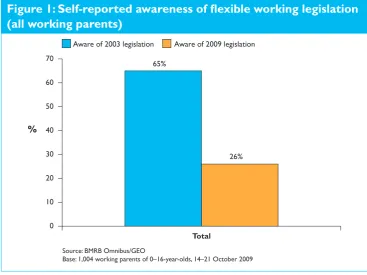
[image:10.595.155.523.356.631.2]Nearly two-thirds (65%) of working parents reported that they are aware of the 2003 legislation on flexible working (Figure 1). Awareness is highest among the 45–64-year-old age group, with 70% of them reporting being aware of the legislation. Awareness is also high among working mothers who are social grade ABC1 compared with working mothers who are social grade C2DE, with 71% of this group reporting that they are aware compared with 60% of C2DE working mothers.1
Figure 1: Self-reported awareness of flexible working legislation (all working parents)
%
Source: BMRB Omnibus/GEO
Base: 1,004 working parents of 0–16-year-olds, 14–21 October 2009
Aware of 2003 legislation Aware of 2009 legislation
0 10 20 30 40 50 60 70
65%
26%
Total
On a regional basis, awareness is highest in the South (69%), particularly in London (71%), and lowest in Scotland (51%) and East Anglia (51%).
Around a quarter (26%) of working parents reported that they were aware of the extension to this right in April 2009. However, only 12% of working parents correctly knew that the right had been extended to cover parents of children aged 0–16.
1 Social grading is based on the occupational details of the chief income earner. The
Awareness of the extension of the right to request flexible working to parents of children aged 16 or under was fairly consistent across all demographic groups (gender, age, social grade, region, marital status, ethnicity). Mothers who work full time were more likely to be correctly aware of the extension than mothers working part time (15% and 9%, respectively).
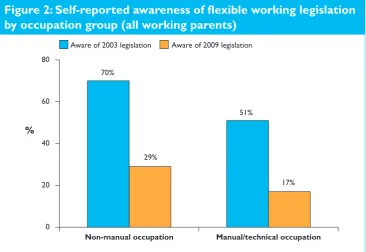
[image:11.595.186.553.385.637.2]Awareness of the right to request flexible working and of the extension of this right to parents of children aged 16 or under was generally lower among manual/technical workers than non-manual occupations, as shown in Figure 2. As awareness is higher among non-manual occupations it may result in a higher proportion of flexible working requests coming from workers in these occupations.
Figure 2: Self-reported awareness of flexible working legislation by occupation group (all working parents)
%
Source: BMRB Omnibus/GEO
Base: 1,004 working parents of 0–16-year-olds (700 parents in non-manual occupations, 280 parents in manual/technical occupations), 14–21 October 2009
0 20 40 60 80
29% 70%
51%
17%
Manual/technical occupation Non-manual occupation
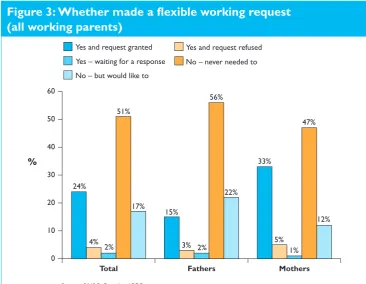
Nearly one in three working parents (30%) report that they have made a request to work flexibly. Just over four in five (81%) parents who made a request for flexible working arrangements reported that their request had been granted. Almost one fifth (17%) of working parents reported that they would be interested in making a request but have not yet done so.
[image:12.595.155.522.398.682.2]Figure 3 shows that working mothers are almost twice as likely as working fathers to have made such a request. However, over a fifth (22%) of working fathers have not made a request to work flexibly but reported that they would like to do so. More than half (56%) of these fathers are concerned that making such as request would mark them out as being uncommitted to their job, and a further two in five (40%) are worried that such a request might negatively affect their chances of promotion.
Figure 3: Whether made a flexible working request (all working parents)
0 10 20 24% 4% 2% 51% 17% 15% 3% 2% 56% 22% 33% 5% 1% 47% 12% 30 40 50 60 % Mothers Fathers Total
No – but would like to
No – never needed to Yes – waiting for a response
Yes and request refused Yes and request granted
Source: BMRB Omnibus/GEO
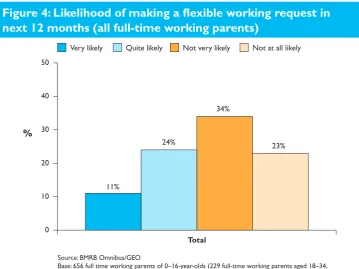
Working parents with younger children are more likely to have put in a request to work flexibly than working parents with older children (39% compared with 20%, respectively). Nearly two-fifths (38%) of working parents with children aged 0–3 years have made a flexible working request compared to just one-fifth of working parents with children aged 11–16. Similar levels of these requests were granted irrespective of the ages of the children. Eight in ten (80%) flexible working requests were granted to parents of children aged 0–3 years compared with around nine in ten (88%) requests made by parents of children aged 11–16 years. One in ten (10%) full-time working parents reported putting in a request for flexible working in the last 6 months. Approximately a third (34%) of parents who work full time indicated that they were likely to put in a request over the next 12 months (Figure 4). Interest is particularly high among younger parents who work full time. This is not surprising as this group are most likely to have younger children.
Figure 4: Likelihood of making a flexible working request in next 12 months (all full-time working parents)
%
0 10 20 30 40 50
11%
24%
34%
23% Not at all likely Not very likely
Quite likely Very likely
Total
Source: BMRB Omnibus/GEO
In the earlier survey, in March 2009, two-thirds (66%) of working parents expressed a concern regarding making a request to work flexibly. The results from this survey show that there has been no significant change in the proportion of parents who are concerned about making a flexible working request since March 2009.
As with the first wave, working parents were mostly concerned that making a request to work flexibly could mark them out as ‘not being committed to their job’. The proportion of working parents who felt that they were not entitled to make flexible working requests has reduced since March 2009. In March 2009, 18% of working parents felt they were not entitled to work flexibly; in the October survey, 10% of working parents reported that they were not so entitled. This suggests that awareness of the right to work flexibly has increased since March 2009 with more working parents understanding they have the right to make such a request.
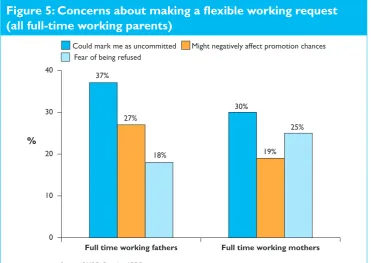
In October 2009, a higher proportion of full-time working fathers than working mothers reported being concerned about being marked as uncommitted to their job or concerned about their promotion chances if they made a flexible working request. Nearly four in ten (37%) of full-time working fathers said they were concerned that if they made a flexible working request that it would mark them out as uncommitted to their job, compared with three in ten (28%) of full-time working mothers. This is a reversal from the survey in March 2009 when 37% of full-time working mothers mentioned this concern compared with 31% of full-time working fathers. Full-time working fathers were also more concerned that making a flexible working request might negatively affect their promotion chances than full-time working mothers (Figure 5).
Figure 5: Concerns about making a flexible working request (all full-time working parents)
%
Might negatively affect promotion chances Could mark me as uncommitted
0 10 20 30 40
37%
27%
18%
30%
19% 25% Fear of being refused
Full time working mothers Full time working fathers
Source: BMRB Omnibus/GEO
Base: 656 full-time working parents of 0–16-year-olds (447 full-time working fathers, 209 full-time working mothers), 14–21 October 2009
Compared with the results from March 2009, the data from October 2009 shows that there was also an increase in the proportion of working fathers who indicated that they had concerns about being marked as uncommitted to their job if they made a flexible working
request. In March 2009, 31% of working fathers reported that they were concerned about being marked out as uncommitted compared with 37% in October 2009.
Fifteen per cent of working parents said they had seen or heard about flexible working in the media in the previous 6 months. Awareness of flexible working from media sources (such as the television, newspapers or radio) was highest among working parents aged 45–64 (20%) and people from the ABC1 social grade (18%). Of those who had seen something on flexible working in the media in the last 6 months, the majority were full-time workers (71%).
As with general awareness of the right to request flexible working, routine or semi-routine manual workers were the occupation groups least likely to report hearing or seeing anything about flexible working in the media. Just under a fifth (18%) of parents working in non-manual occupations had seen or heard about flexible working in the media in the previous 6 months compared with just 8% of parents working in routine manual/semi-routine manual and service occupations. By extension, workers in these non-manual occupations may be less likely than workers in non-manual occupations to request flexible working arrangements if they lack the necessary awareness and knowledge of this right.
6. Changes in awareness over
the last 6 months
Just over a fifth (22%) of working parents reported that they knew more about flexible working than they did 6 months ago. It is possible that this increase in self-reported awareness may lead to an increase in requests for flexible working.
Respondents living in the South, and in particular in London, were more likely to say they know more about flexible working now than they did 6 months ago compared with respondents living in other regions. Just over a quarter (26%) of working parents in the South and three in ten (30%) in London said they knew more about flexible working than 6 months ago. Respondents living in East Anglia (13%), Wales (13%), Scotland (15%) and the South West (16%) were less likely to say they knew more about flexible working compared with 6 months ago.
Awareness of the concept of flexible working is relatively high, with nearly two-thirds (65%) of working parents being aware of this right. However, working parents seem unsure of the details. Just 12% of working parents knew that the right had been extended in April 2009 to include all working parents with children aged 0–16.
Thirty per cent of working parents have already made a request to work flexibly and in the majority of cases (81%) these requests have been granted by employers.
However, concerns still persist about making a request, and on the whole remain consistent with the first wave of research. Perhaps the change in legislation has had some impact, as in this wave (October 2009) only one in ten (10%) parents said they were concerned that they were not entitled to make such a request, compared with 18% in March.
Around a third of working parents say they are likely to make a request in the next 12 months. This is consistent across all occupation groups.
Reported media awareness is relatively low, with only 15% of working parents saying they had seen or heard anything in the media about flexible working in the last 6 months. Nevertheless, around a fifth of working parents reported feeling more knowledgeable about flexible working now than they did 6 months ago. Perhaps the information is filtering down to working parents from other sources, such as employers, as opposed to through the media.
About the project/methodology
The Government Equalities Office (GEO) commissioned BMRB Omnibus to undertake an online survey among working parents to measure their awareness of the right to request flexible working. The research also examined perceived barriers to flexible working.
BMRB Omnibus conducted an online survey with a representative quota sample of 1,004 working parents of children aged 0–16 in Great Britain, who use the internet. The survey was conducted online between 14 and 21 October 2009.
Appendix: Questions and top-line
results by gender (all working parents)
• BMRB conducted the survey with a representative quota sample of1,004 working parents of children aged 0–16 in Great Britain, who use the internet.
• The survey was conducted online between 14 and 21 October 2009. • The percentages may not add up to 100% due to multiple responses,
rounding or the exclusion of not stated/don’t know responses. • Unless otherwise stated, results are based on all respondents.
Q1. In April 2003 the Government put in place legislation which entitled certain groups of workers the right to request flexible working from their employer. Are you aware of this right?
All Fathers Mothers
Unweighted base 1,004 484 520 Weighted base 1,004 512 492
Yes 65% 63% 66%
No 30% 33% 27%
Don’t know 5% 4% 6%
Q2. In April 2009 the Government passed a law to extend this right to request flexible working to new groups of workers. Are you aware of this?
All Fathers Mothers
Unweighted base 1,004 484 520 Weighted base 1,004 512 492
Yes 26% 27% 24%
Q3. Who has been given the new right to request flexible working by the changes in legislation in April 2009?
All Fathers Mothers
Unweighted base 1,004 484 520 Weighted base 1,004 512 492
All parents of children aged 6 or under 7% 8% 6% All parents of children aged 16 or under 12% 13% 11% All parents of children aged 18 or under 4% 3% 4%
Not aware of the change in legislation 74% 73% 76% None of the above 0% – 0%
Don’t know 3% 4% 2%
Q4. Have you ever made a request for flexible working to your employer?
All Fathers Mothers
Unweighted base 1,004 484 520
Weighted base 1,004 512 492
Yes – the request was granted 24% 15% 33% Yes – the request was refused 4% 3% 5%
Yes – waiting for a response 2% 2% 1% No – never needed to do this 51% 56% 47% No – would have liked to but haven’t 17% 22% 12%
YES 30% 20% 39%
NO 68% 77% 59%
Q5. When did you make this request?
All Fathers Mothers
Unweighted base 1,004 484 520
Weighted base 1,004 512 492
In the last 6 months 10% 8% 12%
Over 6 months ago but in the last 9 months 2% 2% 2% Over 9 months ago but in the last year 2% 1% 3% Over a year ago but in the last 2 years 5% 4% 7% Over 2 years ago but in the last 5 years 7% 4% 11%
More than 5 years ago 3% 2% 4%
Don’t know 0% – 0%
Have not made a request 70% 80% 61%
Q6. How likely are you to make a request to your employer to work flexibly (or more flexibly) in the next 12 months?
All Fathers Mothers
Unweighted base 1,004 484 520
Weighted base 1,004 512 492
Very likely 11% 10% 13%
Quite likely 23% 23% 22%
Not very likely 32% 33% 32% Not at all likely 25% 25% 26%
LIKELY 34% 33% 35%
Q7. Thinking about asking your employer if you can work flexibly (or more flexibly if you currently do so), which of the following might stop you from asking?
All Fathers Mothers
Unweighted base 1,004 484 520
Weighted base 1,004 512 492
Could mark me as not being committed to
the job 33% 37% 28%
Might negatively affect my chances of promotion 20% 26% 15% Fear of being refused 20% 18% 21% Not knowing whether it is available at my
workplace 18% 20% 16%
Worried about reaction from colleagues 15% 15% 15%
It’s not the right time to ask 13% 15% 12% I’m not entitled to work flexibly 10% 10% 10%
None of the above 35% 34% 36%
Q8. Have you seen or heard anything about flexible working in the media in the last 6 months?
All Fathers Mothers
Unweighted base 1,004 484 520
Weighted base 1,004 512 492
Yes 15% 17% 13%
No 80% 79% 80%
Q9. Where did you see or hear about flexible working?
All Fathers Mothers
Unweighted base 141 76 65
Weighted base 149 85 64
TV 50% 48% 54%
National newspaper 46% 51% 40%
Radio 22% 27% 17%
Word of mouth/friends or family 20% 19% 20%
Local newspaper 7% 7% 8%
Magazine 5% 3% 8%
Other 5% 3% 8%
Don’t know 1% 1% –
Q10. Has your awareness of flexible working changed over the last 6 months?
All Fathers Mothers
Unweighted base 1,004 484 520
Weighted base 1,004 512 492
I know a lot more about it 4% 4% 5% I know a little more about it 18% 19% 18%
I know the same now as I did 6 months ago 53% 50% 55% I am not aware of flexible working at all 19% 21% 17%
© Crown copyright 2010
JN 400030
March 2010