Phong B.H. Le1, Timon Rabczuk2Nam Mai-Duy1and Thanh Tran-Cong1
Abstract: A novel approximation method using integrated radial basis function networks (IRBFN) coupled with moving least square (MLS) approximants, namely moving integrated radial basis
function networks (MIRBFN), is proposed in this work. In this method, the computational
do-main Ωis divided into finite sub-domains ΩI which satisfy point-wise overlap condition. The
local function interpolation is constructed by using IRBFN supported by all nodes in subdomain
ΩI. The global function is then constructed by using Partition of Unity Method (PUM), where
MLS functions play the role of partition of unity. As a result, the proposed method is locally
supported and yields sparse and banded interpolation matrices. The computational efficiency are
excellently improved in comparison with that of the original global IRBFN method. In addition,
the present method possesses the Kronecker-δ property, which makes it easy to impose the
essen-tial boundary conditions. The proposed method is applicable to randomly distributed datasets and
arbitrary domains. In this work, the MIRBFN method is implemented in the collocation of a first-order system formulation [Le, Mai-Duy, Tran-Cong, and Baker (2010)] to solve PDEs governing
various problems including heat transfer, elasticity of both compressible and incompressible
ma-terials, and linear static crack problems. The numerical results show that the present method offers high order of convergence and accuracy.
Keywords: RBF, Local IRBF, Moving IRBF, meshless, collocation method, elasticity, first order system, locking, crack.
1 Introduction
Meshless methods have been increasingly used since they provide solutions more continuous than
the piece-wise continuous ones obtained by the finite element methods (FEM). Several meshless methods have been developed, for example, meshless collocation methods [Atluri, Liu, and Han
1CESRC, University of Southern Queensland, Toowoomba, QLD 4350, Australia.
(2006); Libre, Emdadi, Kansa, Rahimian, and Shekarchi (2008)], global weak form meshless
methods [Belytschko, Lu, and Gu (1994)], and local weak form meshless method [Atluri and
Shen (2002); Han and Atluri (2003); Li, Shen, Han, and Atluri (2003)]. In recent years, RBF-based meshless methods have received increasing interest from the research community since the
associated discretisation of the governing PDEs is very simple for random point distribution and
arbitrary domain. Furthermore, global RBFN/IRBFN enjoys spectral accuracy and exponential convergence [Madych (1992); Cheng, Golberg, Kansa, and Zamitto (2003)]. However, the main
drawback of the globally supported RBFN/IRBFN is that the resultant interpolation matrix is dense and highly ill-conditioned due to the nature of global approximation. For example, the condition
number of such a matrix is about 6×10¹⁹with only 20×20 collocation points [Fasshauer (1997)].
Therefore, globally supported RBFN/IRBFN methods are less effective in large-scale computation and in problems concerning with small-scale features such as cracks/strain localization. Attempts
to deal with this deficiency include domain decomposition method [Ling and Kansa (2004)], block
partitioning and multizone methods [Kansa and Hon (2000)], and preconditioned methods [Baxter (2002); Brown, Ling, Kansa, and Levesley (2005)].
Recently, local RBFN methods have been developed as an alternative approach. Compactly sup-ported RBF truncated from polynomials can improve the condition number, yet a large support
is required to obtain a reasonable accuracy [Wendland (1995)]. It is thus considered not a robust
method against non-uniform datasets [Tobor, Reuter, and Schlick (2004)]. Moreover, some new lo-cal methods that exchange spectral accuracy for a sparse and better-conditioned system, have been
proposed, including explicit local RBF [Šaler and Vertnik (2006)], finite difference based local RBF [Wright and Fornberg (2006); Liu, Zhang, Li, Lam, and Kee (2006)], differential quadrature
based local RBF [Shu, Ding, and Yeo (2003); Shu and Wu (2007)], and radial point interpolation
method [Liu, Liu, and Tai (2005); Liu, Zhang, and Gu (2005)].
Another approach to local RBF is one based on the partition of unity (PU) method. The PU concept
was first introduced by Sherpard and known as Sherpard’s method. However, Sherpard’s method is not widely applied since it is only of constant precision. Since the works of Babuška and Melenk
(1997), this method has received more attention and may be considered an underlying concept
for many other methods such as, PUFEM [Melenk and Babuška (1996)], XFEM [Moës, Dolbow, and Belytschko (1999); Bordas, Duflot, and Le (2008)], GFEM [Strouboulis, Babuška, and Copps
RBF based on the PU concept was first introduced in data fitting by Wendland (2002) and has
been further expanded by several researchers [Tobor, Reuter, and Schlick (2004, 2006); Ohtake,
Belyaev, and Seidel (2006)]. In recent times, the idea of local RBF based on the PU concept was extended by Chen, Hu, and Hu (2008) for solving PDEs. In their method, the reproducing kernel
function is employed as PU function to achieve a higher precision than that of Sherpard method.
Motivated by the former works, this paper proposes a new locally supported MIRBFN method,
in which the standard globally supported IRBFN is coupled with the moving least square (MLS) approximants via the PU concept to formulate a locally supported MIRBFN interpolation method.
Moreover, the present interpolation method is implemented in the collocation of a first-order
sys-tem formulation, resulting in an integration-free meshless method for solving PDEs. The proposed method is verified by various numerical examples, including heat transfer, elasticity of
compress-ible and incompresscompress-ible materials, and linear static crack problems. The remaining of this paper is
organized as follows. The construction of the present MIRBFN is presented in section 2 followed by the first-order system formulation in section 3. Section 4 reports the numerical experiments
and section 5 draws some conclusions.
2 Construction of Moving IRBFN
2.1 The global IRBFN approximation
In the IRBFN method [Mai-Duy and Cong (2001, 2005); Mai-Duy, Khennane, and Tran-Cong (2007); Le, Mai-Duy, Tran-Tran-Cong, and Baker (2007, 2008); Mai-Duy and Tran-Tran-Cong (2009)],
the formulation of the problem starts with the decomposition of the highest order derivatives under
consideration into RBFs. The derivative expressions obtained are then integrated to yield expres-sions for lower order derivatives and finally for the original function itself. The present work is
illustrated with the approximation of a function and its derivatives of order up to 2, the formulation
can be thus described as follows.
u,j j(x) = m
∑
i=1
w(i)g(i)(x), (1)
u,j(x) =
Z m
∑
i=1
w(i)g(i)(x)dxj+C1(xl;l6=j) = m+p1
∑
i=1
w(i)H[x(i)j](x), (2)
u(x) =
Z m+p1
∑
i=1
w(i)H(i)(x)dxj+C2(xl;l6=j) = m+p2
∑
i=1
or in compact form
u,j j(x) =G(x)w[xj], (4)
u,j(x) =H[xj](x)w[xj], (5)
u(x) =H[xj](x)w[xj], (6)
where, the comma denotes partial differentiation, m is the number of RBFs,{g(i)(x)}m
i=1is the set
of RBFs, {w(i)}m+p2
i=1 is the set of corresponding network weights to be found, {H(i)(x)}mi=1 and
{H¯(i)(x)}m
i=1 are new basis functions obtained by integrating the radial basis function g(i)(x), p1
and p2 are the number of centers used to represent integration constants in the first and second
derivatives, (2) and (3), respectively (p2=2p1). For the multiquadric function
g(i)(x) =qx−c(i)2+ a(i)2, (7)
where c(i)is the RBF center and a(i)is the RBF width, the width of the ithRBF can be determined
according to the following simple relation
a(i)=βd(i), (8)
whereβ is a factor,β >0, and d(i)is the distance from the ith center to its nearest neighbour.
Now, the “constants” of integration C1(xl;l6=j)and C2(xl;l6=j)on the right hand side of (2) and (3)
can also be interpolated using the IRBFN method as follows.
C′′1(xl; l6=j) = M
∑
i=1
¯
w(i)g(i)(xl; l6=j), (9)
C1′(xl; l6=j) = M
∑
i=1
¯
w(i)H(i)(xl; l6= j) +Cb1, (10)
C1(xl; l6=j) = M
∑
i=1
¯
w(i)H¯(i)(xl; l6= j) +Cb1xk;k6=j+Cb2, (11)
where{w¯(i)}Mi=1are the corresponding weights; M is the number of distinct centers. The unknowns
to be found are the sets of weights in (1) and (9), which can be determined by the SVD (singular
Following Mai-Duy and Tran-Cong (2005), we perform a prior conversion of the unknowns from
network weights, i.e. {w(i)}m+p2
i=1 , to nodal function value u in order to form a square system of
equations of smaller size as follows.
The set of network weights are expressed in terms of nodal function value as
w[x]=
H[x]
−1
u, (12)
w[y]=H[y]−
1
u, (13)
and the substitution of (12) and (13) into the system (4)-(6) yields
u,xx(x) =G(x)H[x]
−1
u, (14)
u,x(x) =H[x](x)
H[x]−1u, (15)
u(x) =H[x](x)H[x]−1u, (16)
u,yy(x) =G(x)H[y]
−1
u, (17)
u,y(x) =H[y](x)
H[y]−1u, (18)
u(x) =H[y](x)H[y]−1u, (19)
where I is the identity matrix. It can be seen from (14)-(19) that the function and its derivatives
are all expressed in terms of the function values rather than network weights. Consequently, the system of equations obtained is normally square and the unknowns to be solved for are the nodal
function values instead of the network weights.
2.2 Moving least-square approximants
The moving least-square (MLS) procedure presented in Belytschko, Lu, and Gu (1994) is briefly
reproduced in this section as follows. The interpolant uh(x)of the function u(x)is defined in the
domainΩby
uh(x) =
M
∑
j=1
aj(x)pj(x)≡pT(x)a(x), (20)
a(x)is obtained at any point x by minimizing the following weighted, discrete L2norm
J=
n
∑
I=1
w(x−xI)[pT(xI)a(x)−uI]2, (21)
where n is the number of points in the neighbourhood of x for which the weight function w(x−
xI)6=0, and uI is the nodal value of u at x=xI.
The minimization of J in (21) with respect to a(x)leads to the following linear relation between
a(x)and the vector of local nodal values u
A(x)a(x) =B(x)u, (22)
or
a(x) =A−1(x)B(x)u, (23)
where A(x)and B(x)are defined by
A(x) =
n
∑
I=1
w(x−xI)p(xI)pT(xI) (24)
B(x) =
w(x−x1)
1 x1 y1
,w(x−x2)
1 x2 y2
, . . . ,w(x−xn)
1 xn yn (25)
uT= [u1,u2, . . . ,un]. (26)
Substitution of (23) into (20) yields
uh(x) =
n
∑
I=1 M∑
j=1pj(x)(A−1(x)B(x))jIuI ≡ n
∑
I=1
ϕI(x)uI, (27)
where the shape functionϕI(x)is defined by
ϕI(x) = M
∑
j=1
or in compact form
ϕI(x) =cT(x)w(x−xI)p(xI), (29)
where A(x)c(x) =p(x)defines vector c(x).
c(x) can efficiently be computed by the LU factorization of A(x) with backward substitution
[Belytschko, Krongauz, Fleming, Organ, and Liu (1996); Nguyen, Rabczuk, Bordas, and Duflot
(2008)] as follows.
LUc(x) =p(x), Uc(x) =L−1p(x), c(x) =U−1L−1p(x). (30)
The partial derivatives ofϕI(x)can be obtained by
ϕI,i(x) =cT,i(x)w(x−xI)p(xI) +cT(x)w,i(x−xI)p(xI), (31)
where(.),i= ∂∂(.)xi and
c,i(x) =A−,i1(x)p(x) +A−1(x)p,i(x), (32)
with
A,i(x) = n
∑
I=1
w,i(x−xI)p(xI)pT(xI). (33)
It is noted that the following circular kernel function [Schilling, Caroll, and Al-Ajlouni (2001)] is used to compute the present MLS shape function
w(r) =
(
[1+cos(π r
Rs)]/2rα, r
Rs ≤1, α even,
0, r
Rs >1,
(34)
where Rs is the radius of the support domain of the weight function w(r), r=kx−xIkand k.k
2.3 Moving IRBFN interpolation
We propose a locally supported IRBFN, constructed by using the partition of unity concept
[Me-lenk and Babuška (1996); Babuška and Me[Me-lenk (1997)] as follows.
Let the open and bounded domain of interestΩ⊆Rdbe discretised by a set of N pointsX
X ={x1,x2, . . . ,xN}, xI∈Ω, I=1,2, . . . ,N, (35)
X is used to define an open cover of Ω, i.e. {ΩI}such thatΩ⊆SNI=1ΩI and {ΩI}satisfies a
point-wise overlap condition
∀x∈Ω ∃k∈N : card{I|x∈ΩI} ≤k. (36)
We choose a family of compactly supported, non-negative, continuous functionsψI supported on
the closure ofΩI, such that at every point x we have the following property
N
∑
I=1
ψI(x) =1, ∀x∈Ω, (37)
where{ψI}is called a partition of unity subordinate to the cover{ΩI}.
For every subdomainΩI, a local approximation uI is constructed by using IRBFN supported by
all nodes inΩI as presented in section 2.1, i.e.
uhI(x)∈VI, VI=span{H (1) I (x),H
(2)
I (x), . . . ,H (M)
I (x)}, (38)
where{VI}are referred to as the local approximation spaces.
The global approximation of u(x), uh(x)is obtained via
uh(x) =
N
∑
I=1
ψI(x)uhI(x), uh(x)∈V, (39)
whereψI(x)and uhI(x) are associated with the subdomainΩI, and V is called PU method space
and defined by
V :=
N
∑
I=1
In the present work, the partition of unity functionψI is chosen to be identical to the MLS shape
functionϕIin (27), the subdomainΩIis centered at xIas shown in Figure 1.
ReplacingψIwith MLS shape functionϕI, (39) can be rewritten as follows.
uh(x) =
N
∑
I=1
ϕI(x)uhI(x), (41)
and the associated derivatives of uh(x)are given by
uh,x(x) =
N
∑
I=1
h
ϕI,x(x)uhI(x) +ϕI(x)uhI,x(x)
i
, (42)
uh,y(x) =
N
∑
I=1
h
ϕI,y(x)uhI(x) +ϕI(x)uhI,y(x)
i
, (43)
where uhI,x(x)and uhI,y(x), are derived in (15) and (18).
uh(x)and its derivatives can be rewritten in a compact form as
uh(x) =
N
∑
I=1
ϕI(x)uhI(x) =ΦT(x)u, (44)
uh,x(x) =ΦTx(x)u, (45)
uh,y(x) =ΦTy(x)u, (46)
where u={u1,u2, . . . ,uN},Φ(x)is the vector of shape functions.
It is noted thatΦI(xJ) =δIJ as shown in Figures 3. Consequently, this MIRBFN method
pos-sesses the Kronecker-δ property which makes it easy to impose the essential boundary conditions.
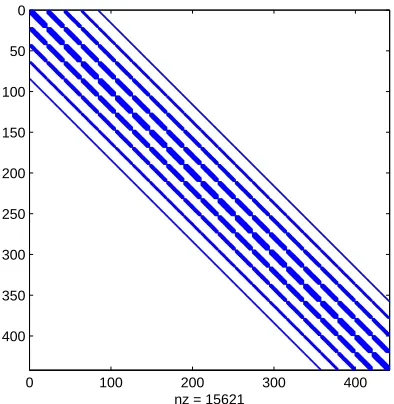
Owing to the locally supported property, MIRBFN yields symmetric, sparse and banded
interpo-lation matrices as shown in Figure 2. This feature makes the method very efficient in storage and computation.
2.4 Selection of RBF centers and support radius
In the present MIRBFN method, the selection of local RBF centers{ci}I is very flexible.
Gener-ally, they can be different from the set of local data points{xi}I associated with subdomain ΩI.
For example, if a two-dimensional IRBFN is used, the size of the matrices to be inverted H[x]and
mI the number of RBF centers {ci}I and p2I the number of centers used to represent integration
constants in the second derivatives. Therefore, the number of columns of the matrices will be p2I
larger than the number of rows when{ci}I is the same as{xi}I. To obtain square matrices, we
choose the number of centers to be less than the number of data points (mI <nI) and p2I to be
appropriately small.
On the other hand, the selection of support radius for each subdomainΩIalso affects the numerical
results significantly. The larger support radius is, the higher accuracy and convergence rate are. However, the higher cost of storage and computation, and the deterioration of the condition number
of the matrices are consequential trade-offs. Hence, to make the method more local and efficient,
smaller values of support radius are preferred in this work.
3 First-order system formulation
For the sake of completeness, the first-order system formulation, which was proposed in a previous
work of the authors [Le, Mai-Duy, Tran-Cong, and Baker (2010)], is reproduced briefly as follows. It is noticed that in general higher-order differential equations can be transformed into a system of
first-order differential equations by introducing some new dual variables, which is the procedure
followed here. Both primary and dual variables are then independently interpolated and have the shape functions of the same order. The resultant first-order system of governing equations can be
written as follows.
Lu=f, in Ω (47)
Bu=g, on Γ (48)
whereΩis a bounded domain inRd, d=1,2,3, Γthe boundary ofΩ, L is a first-order linear
differential operator
Lu=L0u+ d
∑
i=1
Li∂u
∂xi
, (49)
in which uT = [u1,u2, ...,um]is a vector of m unknown functions (including primary and dual
variables) of xT = [x1,x2, ...,xd], Li the coefficient matrices which characterize the differential
operator L, f a given function in the domain, B a boundary algebraic operator, and g a given
Substituting a discrete approximation of u and its first-order derivatives as given, respectively, in
(41) and (42)-(43) into (47) and (48), and using the collocation method at all the nodes ofΩand
Γ, one obtains a linear algebraic system as presented below.
Let NΩ denote the number of interior nodes, ND the number of nodes on the Dirichlet
bound-ary, NN the number of nodes on the Neumann boundary, mp the number of primary unknowns
and md the number of dual unknowns associated with a node, the number of nodal unknowns
is generally (NΩ+ND+NN)(mp+md). The governing equation (47) is collocated at all the
in-terior and boundary nodes, yielding (NΩ+ND+NN)(mp+md) equations. The boundary
con-ditions are imposed by collocating (48) at all the boundary nodes, i.e. the obtained system has
(NΩ+ND+NN)(mp+md)+NDkD+NNkNequations, where kDand kNare the number of equations
from the boundary conditions per node on the Dirichlet and Neumann boundaries, respectively.
The final system is obtained by removing NDkD+NNkN appropriate equations corresponding to
the governing equations collocated at the boundary nodes. Consequently, the number of equations of the resultant system is equal to the number of nodal unknowns and it can be rewritten in a
compact form as
Au=¯f. (50)
3.1 Two-dimensional Poisson equation
Consider the following two-dimensional Poisson equation
∂2φ(x,y) ∂x2 +
∂2φ(x,y)
∂y2 = f(x,y) in Ω, (51a)
φ(x,y) =g(x,y) on ΓD, (51b)
∂φ(x,y)
∂n =h(x,y) on ΓN, (51c)
whereΩis a bounded domain inR2, Γ
Dand ΓN the boundary ofΩon which the Dirichlet and
Neumann boundary conditions are imposed, respectively, n= (nx,ny)T the outward unit normal
A first-order formulation is obtained by introducing the dual variables in (51) as follows.
∂φ(x,y)
∂x −ξ(x,y) =0 in Ω and on ΓD
[
ΓN, (52a)
∂φ(x,y)
∂y −η(x,y) =0 in Ω and on ΓD
[
ΓN, (52b)
∂ξ(x,y) ∂x +
∂η(x,y)
∂y = f(x,y) in Ω and on ΓD
[
ΓN, (52c)
φ(x,y) =g(x,y) on ΓD, (52d)
nxξ+nyη=h(x,y) on ΓN. (52e)
3.2 Linear elasticity problems
Consider the following two-dimensional problem on a domainΩbounded byΓ=ΓuSΓt
∇·σ=b in Ω, (53a)
u=¯u on Γu, (53b)
σ·n=¯t on Γt, (53c)
in whichσ is the stress tensor, which corresponds to the displacement field u and b is the body
force, n the outward unit normal toΓt. The superposed bar denotes prescribed value on the
bound-ary.
The governing equations (53) are closed when a constitutive relation is specified forσ. Here the
linear Hooke’s law is used to describe theσ−u relation. By choosing displacement u as primary
for plane stress case as follows.
∂u
∂x− 1 Eσx+
µ
Eσy=0, (54a)
∂v
∂y+
µ
Eσx− 1
Eσy=0, (54b)
∂u
∂y+
∂v
∂x−
2(1+µ)
E τxy=0, (54c)
∂σx
∂x +
∂τxy
∂y =bx, (54d)
∂τxy
∂x +
∂σy
∂y =by, (54e)
u=¯u on Γu, (54f)
σ·n=¯t on Γt, (54g)
whereµ is the Poisson ratio and E the Young’s modulus. By introducing the dimensionless stress
tensor s=σ/E, the above first-order system can be rewritten as follows.
∂u
∂x−sx+µsy=0, (55a)
∂v
∂y+µsx−sy=0, (55b)
∂u
∂y+
∂v
∂x−2(1+µ)sxy=0, (55c)
∂sx
∂x +
∂sxy
∂y =bx, (55d)
∂sxy
∂x +
∂sy
∂y =by, (55e)
u=¯u on Γu, (55f)
4 Numerical examples
For an error estimation and convergence study, the discrete relative L2 norm of errors of primary
and dual variables are defined as
Lφ2 =
r
∑N i=1
φ(i) e −φ(i)
2 r ∑N i=1 φ(i) e
2 , (56)
Lξη2 =
s
∑N i=1
ξ(i) e −ξ(i)
2
+ηe(i)−η(i)
2 s ∑N i=1 ξ(i) e 2
+ηe(i)
2
, (57)
for Poisson equation and
Lu2=
r
∑N i=1
(ux)(i)e −(ux)(i)
2
(uy)(i)e −(uy)(i)
2
s
∑N i=1
(ux)(i)e
2
+(uy)(i)e
2
, (58)
Lσ2 =
s
∑N i=1
(sx)(i)e −s(i)x
2
+(sy)(i)e −s(i)y
2
+(sxy)(i)e −s(i)xy
2
s
∑N i=1
(sx)(i)e
2
+(sy)(i)e
2
+(sxy)(i)e
2
, (59)
for elasticity problems, where N is the number of unknown nodal values and the subscript “e" denotes the exact solution. The convergence order of the solution with respect to the refinement
of spatial discretization is assumed to be in the form of
L2(h)≈ζhλ=O(hλ), (60)
where h is the maximum nodal spacing, ζ and λ are the parameters of the exponential model,
which are found by general linear least square formula in this work.
GB of RAM and two Intel(R) Xeon(R) CPUs of 3.0 GHz each. The code is written in MATLABr
language.
4.1 Poisson equation
4.1.1 Poisson equation in a regular domain
Consider the following Poisson equation
∂2φ(x,y) ∂x2 +
∂2φ(x,y)
∂y2 =−2π
2cos(πx)cos(πy), (61)
defined inΩ= [0,1]×[0,1], subjected to the Dirichlet boundary condition
φ(0,y) =cos(πy), on x=0, (62)
and the following Neumann boundary conditions
∂φ(1,y)
∂x =0, on x=1, (63a)
∂φ(x,0)
∂y =0, on y=0, (63b)
∂φ(x,1)
∂y =0, on y=1. (63c)
(63d)
The corresponding exact solution is given by
φ(x,y) =cos(πx)cos(πy). (64)
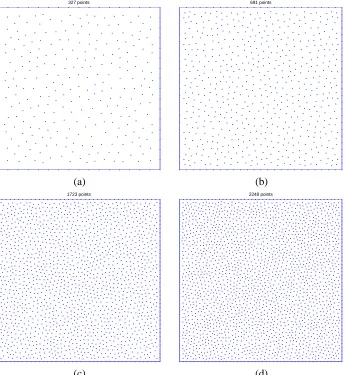
Two discretisations are considered for this problem: uniform and nonuniform distributions of
nodes/collocation points (CPs) as shown in Figures 4 and 8, respectively. For both cases, the
radius of support domains is set atRsh =2.1, where h is the maximum spacing between two nearest
nodes in x or y direction. The maximum number of uniformly distributed RBF centers mI in each
subdomain is 5 as shown in Figure 4. The numbers of centers to represent the integration constants
p1I and p2I are 3 and 6, respectively. The values ofβ in (8) for both cases are listed in Tables 1
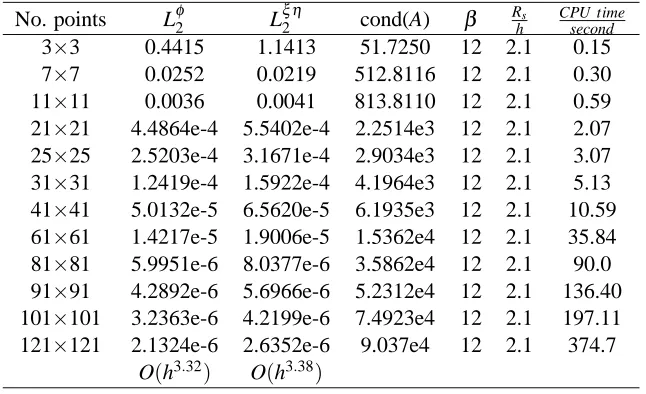
Table 1: Poisson equation in a regular domain: uniform discretisations with MIRBFN
No. points Lφ2 Lξη2 cond(A) β Rsh CPU timesecond
3×3 0.4415 1.1413 51.7250 12 2.1 0.15
7×7 0.0252 0.0219 512.8116 12 2.1 0.30
11×11 0.0036 0.0041 813.8110 12 2.1 0.59
21×21 4.4864e-4 5.5402e-4 2.2514e3 12 2.1 2.07
25×25 2.5203e-4 3.1671e-4 2.9034e3 12 2.1 3.07
31×31 1.2419e-4 1.5922e-4 4.1964e3 12 2.1 5.13
41×41 5.0132e-5 6.5620e-5 6.1935e3 12 2.1 10.59
61×61 1.4217e-5 1.9006e-5 1.5362e4 12 2.1 35.84
81×81 5.9951e-6 8.0377e-6 3.5862e4 12 2.1 90.0
91×91 4.2892e-6 5.6966e-6 5.2312e4 12 2.1 136.40
101×101 3.2363e-6 4.2199e-6 7.4923e4 12 2.1 197.11
121×121 2.1324e-6 2.6352e-6 9.037e4 12 2.1 374.7
O(h3.32) O(h3.38)
Table 2: Poisson equation in a regular domain: uniform discretisations with global IRBFN
No. points Lφ2 Lξη2 cond(A) β CPU timesecond
7×7 0.0245 0.0273 1.6043e4 1 0.161
11×11 0.0038 0.0048 2.5617e4 1 0.179
21×21 7.4562e-5 1.5070e-4 5.8907e4 1 2.462
31×31 1.2924e-5 2.3775e-5 1.2225e5 1 30.064
41×41 4.3906e-6 7.9095e-6 2.0292e5 1 149.319
51×51 2.1210e-6 3.7691e-6 3.0404e5 1 535.049
61×61 1.3851e-6 2.1592e-6 7.0649e4 1 1674.980
[image:16.595.124.447.234.431.2]O(h4.71) O(h4.52)
Table 3: Poisson equation in a regular domain: unstructured nodes with MIRBFN
No. points Lφ2 Lξη2 cond(A) β Rsh h CPU timesecond
88 0.2833 0.1438 1.6887e5 10 2.1 0.1250 0.73
108 0.0402 0.0613 4.5345e5 10 2.1 0.1200 0.80
327 0.0077 0.0057 6.2091e7 10 2.1 0.0685 2.23
691 0.0018 0.0019 4.5704e8 10 2.1 0.0507 5.65
1723 7.2107e-4 5.7631e-4 1.3461e8 10 2.1 0.0308 22.12
2248 3.3681e-4 2.5718e-4 1.2765e8 12 2.1 0.0272 35.58
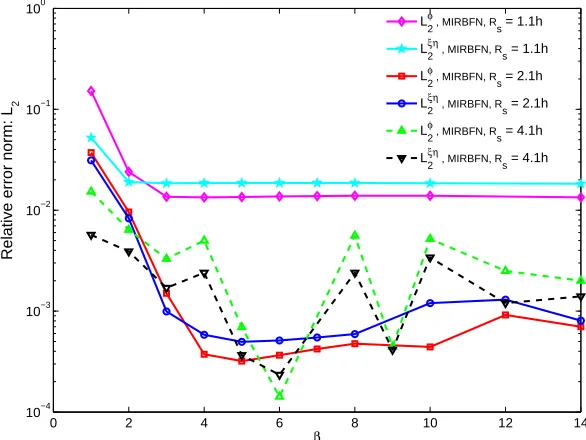
The influences of local support radius Rsh and β on the accuracy of the solution are numerically
studied in this example. Figure 5 shows the relative error norms (Lφ2 and Lξη2 ) obtained by the
present MIRBFN method with different values of Rsh while β is fixed. On the other hand, the
results with different values ofβ and fixed local support radius are displayed in Figure 6. It can
be seen that the values around 2 for Rsh are not only able to capture well the solution but also keep
the matrix small, as long asβ is large enough.
To study the convergence of the method, a number of discretization refinements and the relative
L2 error norms for function values Lφ2 and its derivatives L
ξη
2 are reported in Tables 1 and 3 for
uniform and unstructured cases, respectively. As shown in these tables and Figures 7 and 9, very
good accuracy and stability are obtained. The convergence rates forφ(x,y)and (ξ(x,y),η(x,y)) are O(h3.32)and O(h3.38), respectively, for uniform distribution, and, O(h3.78)and O(h3.82), re-spectively, for unstructured nodes. It can be seen that the condition numbers in the case of uniform
distribution are relatively smaller than those in the case of random distribution (Table 3) since there is a relatively larger number of nodes in each subdomain in the case of random distribution.
The results in Tables 1-2 and Figure 7 indicate that the global IRBFN gives higher orders of
convergence. Nonetheless, the condition numbers by the MIRBFN method are slightly better in
comparison with those by the global IRBFN method, as listed in Tables 1 and 2, althoughβ is set
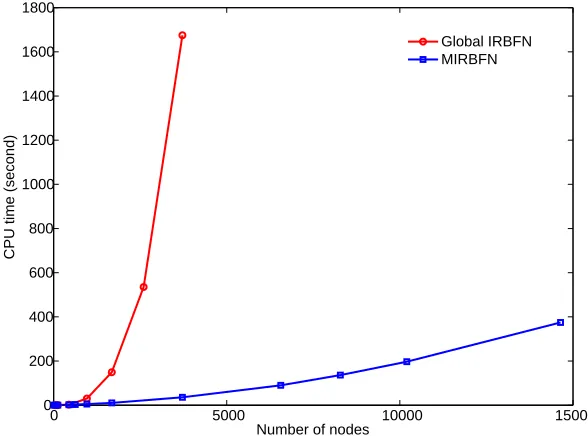
quite large for the MIRBFN method. Furthermore, the MIRBFN method is much more efficient
than the global IRBFN method as can be seen in Figure 10.
4.1.2 Poisson equation in an irregular domain
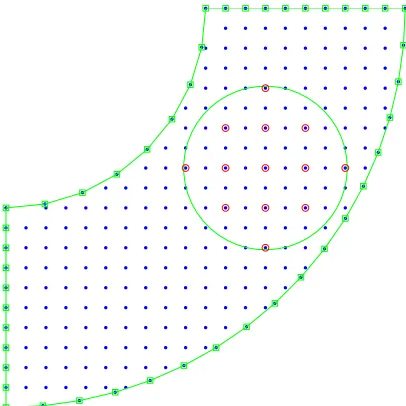
The Poisson equation in example 4.1.1 is examined in a complicated irregular domain as shown
in Figure 11. The Dirichlet boundary conditions on the upper edge and the left edge are given as
below
φ(0,y) =cos(πy), on x=0, (65a)
Table 4: Poisson equation in an irregular domain: structured dicerizations with MIRBFN
No. points Lφ2 Lξη2 cond(A) β Rsh h CPU timesecond
51 3.4762e-1 5.4441e-1 3.1001e5 9 4.1 0.25 0.83
87 2.8487e-2 5.2716e-2 1.9944e6 9 4.1 0.181 1.31
266 1.4620e-3 3.8399e-3 2.0634e7 9 4.1 0.0095 3.86
595 5.0421e-4 8.7207e-4 6.4519e8 9 4.1 0.0065 11.55
1029 1.7279e-4 4.0659e-4 6.2724e8 9 4.1 0.0048 23.05
1574 8.5957e-5 2.4792e-4 4.1291e8 9 4.1 0.039 43.17
2266 3.6035e-5 8.0371e-5 6.5102e9 9 4.1 0.039 84.48
3413 3.0210e-5 5.0281e-5 1.9016e8 9 4.1 0.033 172.53
O(h4.06) O(h3.96)
Table 5: Poisson equation in an irregular domain: unstructured discretisation with MIRBFN
No. points Lφ2 Lξη2 cond(A) β Rsh h CPU timesecond
51 1.9465e-1 1.9142e-1 7.5387e4 14 3.1 2.7337e-1 4.775
338 2.4059e-3 6.7564e-3 4.4212e6 14 3.1 1.1182e-1 22.017
1046 7.1240e-4 1.7302e-3 9.0038e6 12 3.1 5.9731e-2 89.633
1486 4.2708e-4 8.4299e-4 7.5913e7 12 3.1 5.3098e-2 203.883
1711 1.4251e-4 2.1264e-4 1.4224e8 8 3.1 4.8722e-2
O(h3.80) O(h3.50)
The Neumann boundary conditions on the inner arc and the outer arc are, respectively
nx
∂φ(x,y) ∂x +ny
∂φ(x,y)
∂y =q(x,y), on x
2+y2=1, (66a)
nx∂φ( x,y) ∂x +ny
∂φ(x,y)
∂y =q(x,y), on x
2+y2=4, (66b)
where q(x,y) =−nxπsin(πx)cos(πy)−nyπcos(πx)sin(πy).
The complexity is increased with the Neumann boundary conditions on two curved boundaries.
The structured domain discretisation is described as follows. A uniformed grid covering the
do-main is generated, then the points outside the dodo-main and on the curves are removed. Finally, the points on the inner and outer arcs are generated uniformly.
In the case of structured discretisation (Figure 11), the local support radius Rsh is set at 4.1,β is 9,
the maximum number of centers in each subdomain is 13. The relative L2error norms Lφ2 and L
ξη
2
can be observed that high orders of convergence are obtained with a large support radius, namely
O(h4.06) and O(h3.96) for the function and its derivatives, respectively. However, the condition numbers are much larger than those in the previous example. For unstructured node distributions (Figure 12), the corresponding parameters and obtained results are presented in Table 5 and Figure
14. The results indicate that the solution by the proposed method apparently converges at the rates
of (O3.80) and (O3.50), using Lφ2 and Lξη2 , respectively.
4.2 Linear elasticity problems
4.2.1 Cantilever Beam
A cantilever beam subjected to a parabolic shear load at the end x=0 as shown in Figure 15 is
considered in this example.
Table 6: Cantilever beam: uniform discretizations with MIRBFN (µ =0.3).
No. points Lu2 Lσ2 cond(A) β Rsh h CPU timesecond
20×5 1.9598e-1 3.3652e-1 4.1516e6 8 2.1 0.240 0.60
36×9 1.4986e-2 2.5489e-2 1.4193e8 10 2.1 0.133 1.84
68×17 1.2182e-3 2.1326e-3 3.0383e6 14 2.1 0.070 6.98
124×31 5.8434e-4 5.7764e-4 4.0336e6 14 2.1 0.039 43.78
164×41 2.2892e-4 2.3983e-4 8.3453e6 14 2.1 0.029 109.42
204×51 1.1069e-4 1.2366e-4 14 2.1 0.024 230.01
244×61 5.9462e-5 7.2455e-5 14 2.1 0.020 438.98
O(h3.04) O(h3.26)
The following parameters are used for the problem: L=4.8 and D=1.2. The beam has a unit
thickness. Young’s modulus is E =3×10⁶ , Poisson’s ratio µ =0.3 (also µ =0.5) and the
integrated parabolic shear force P=100. Plane stress condition is assumed and there is no body
force.
The exact solution to this problem was given by Timoshenko and Goodier (1970) as
σxx(x,y) = − Pxy
I , (67a)
σyy(x,y) =0, (67b)
τxy(x,y) =− P 2I
D2
4 −y
2
Table 7: Cantilever beam: uniform discretizations with MIRBFN (µ =0.5).
No. points Lu2 Lσ2 cond(A) β Rsh h CPU timesecond
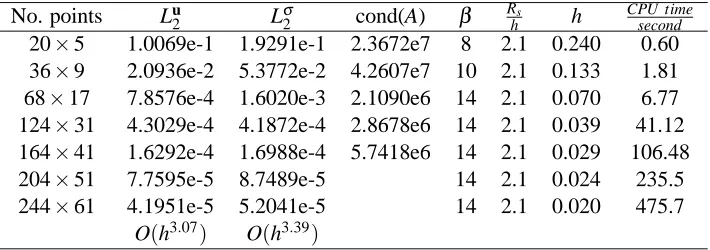
20×5 1.0069e-1 1.9291e-1 2.3672e7 8 2.1 0.240 0.60
36×9 2.0936e-2 5.3772e-2 4.2607e7 10 2.1 0.133 1.81
68×17 7.8576e-4 1.6020e-3 2.1090e6 14 2.1 0.070 6.77
124×31 4.3029e-4 4.1872e-4 2.8678e6 14 2.1 0.039 41.12
164×41 1.6292e-4 1.6988e-4 5.7418e6 14 2.1 0.029 106.48
204×51 7.7595e-5 8.7489e-5 14 2.1 0.024 235.5
244×61 4.1951e-5 5.2041e-5 14 2.1 0.020 475.7
O(h3.07) O(h3.39)
Table 8: Cantilever beam: uniform discretizations with global IRBFN (µ =0.3).
No. points Lu2 Lσ2 cond(A) β h CPU timesecond
20×5 4.5356e-2 2.5571e-1 1.7953e6 1 0.2400 0.408
36×9 5.2822e-3 4.0279e-2 5.2505e6 1 0.1333 2.068
68×17 1.5706e-3 2.6022e-3 6.5476e7 1 0.0706 68.088
124×31 3.8901e-4 4.3698e-4 3.1351e8 1 0.0387 2351.78
164×41 2.1295e-4 2.2075e-4 1 0.0293 51201.338
O(h3.06) O(h3.39)
Table 9: Cantilever beam: unstructured nodes with MIRBFN (µ =0.3).
No. points Lu2 Lσ2 cond(A) β Rsh h CPU timesecond
43 6.5385e-1 6.9895e-1 2.6549e6 10 2.1 4.6860e-1 0.715
170 2.7461e-2 5.5154e-2 3.9549e7 10 2.1 2.4000e-1 2.079
616 7.2999e-3 3.1141e-2 7.4558e7 10 2.1 1.2507e-1 7.888
1112 4.9025e-4 3.0318e-3 1.0345e9 10 2.1 1.0454e-1 20.190
[image:20.595.108.463.228.353.2]O(h4.21) O(h3.07)
Table 10: Cantilever beam: structured FEM mesh with four-node quadrilateral element (Q4) (µ=
0.3).
No. elements Lu2 h CPU timesecond
16×4 1.3991e-1 0.40 0.1806
32×8 3.8516e-2 0.1714 0.4395
40×10 2.5191e-2 0.1333 1.7111
80×20 6.9048e-3 0.0631 8.4087
160×40 1.6994e-3 0.0307 21.5620
240×60 9.1261e-4 0.0203 47.9957
320×80 6.1308e-4 0.0152 307.579
The displacements are given by
ux=− Px2y
2EI −
µPy3
6EI +
Py3
6IG+y
PL2
2EI−
PD2 8IG
, (68)
uy=µ Pxy2
2EI +
Px3
6EI−
PL2x
2EI +
PL3
3EI, (69)
where I=D3/12 is the moment of inertia of the cross section of the beam, G=E/(2(1+µ))the
modulus of elasticity in shear. The exact displacement (68) and (69) are imposed on x=L while
the shear load is applied on x=0 and the upper and lower edges are traction free.
Both regular and irregular distributions of nodes used for this problem are displayed in Figures 16
and 18, respectively. The local support radius is Rsh =2.1. The values ofβ are listed in Tables 6,
7 and 9. The scheme for selection of RBF centers for both regular and irregular node distributions is similar to that in example 4.1.1. In addition, the effect of incompressibility, i.e. µ=0.5, is also
studied here.
Figure 19 shows the shear stress sxyforµ=0.3 at x=2.4686 obtained by the present method with
36×9 nodes. A very good agreement between the obtained result and the exact solution can be
observed in this figure.
To study the convergence of the method, a number of different uniform node distributions is used
for computation as presented in the Tables 6 and 7. Forµ =0.3, the relative L2error norms for
displacement and stress are shown in Table 6 and Figure 20, the convergence rates of displacement
and stress are O(h3.04) and O(h3.26), respectively. In the case of incompressible materials (µ =
0.5), the relative L2error norms for displacement and stress are presented in Table 7 and Figure 20.
Very good orders of convergence are achieved, namely O(h3.07)and O(h3.39)for displacement and stress, respectively. Furthermore, the results shown in Figure 20 indicate that the present method
does not suffer from any volumetric locking.
The behaviour of the MIRBFN method in the case of irregular discretisation is also examined with
four nodal configurations as shown in Figure 18. The obtained results with the MIRBFN method
andµ=0.3 are shown in Table 9 and Figure 21. The orders of convergence of the present method
are O(h4.21)and O(h3.07)for displacement and stress, respectively.
In comparison with the global IRBFN method, the MIRBFN method achieves similar accuracy
and convergence rates as can be observed in Tables 6 and 8, and in Figure 20 as well. The present
The obtained results are also compared with those by FEM using four-node quadrilateral element
(Table 10). Figure 20 shows that both accuracy and order of convergence of the MIRBFN method
are superior to those of FEM, e.g. using Lu2, the convergence rates are O(h3.04)and O(h1.84) for the MIRBFN method and the FEM, respectively. The computing cost of the MIRBFN method
is higher than that of the FEM for the same number of nodes. However, the MIRBFN method is
more efficient than the FEM for the same accuracy, for example, it takes the MIRBFN method 6.98 seconds for Lu2=1.2182×10⁻³while the FEM needs 21.56 seconds to achieve Lu2=1.6994×10⁻³
as exhibited in Figure 22, Table 6 and Table 10.
4.2.2 Infinite plate with a circular hole
In this example, an infinite plate with a circular hole subjected to unidirectional tensile load of 1.0 in the x direction is analyzed as shown in Figure 23. The radius of hole is taken as 1 unit. Owing
to symmetry, only the upper right quadrant[0,3]×[0,3]of the plate is modeled as shown in Figure
24.
In this problem, plane stress conditions are assumed with elastic isotropic properties E =103,
µ =0.3 (alsoµ=0.5). The exact solution to this problem was given by Timoshenko and Goodier
(1970) as follows
σx(x,y) =σ
1−a
2
r2
3
2cos(2θ) +cos(4θ)
+3a 4
2r4 cos(4θ)
, (70a)
σy(x,y) =−σ
a2 r2
1
2cos(2θ)−cos(4θ)
+3a 4
2r4 cos(4θ)
, (70b)
τxy(x,y) =−σ
a2 r2
1
2sin(2θ) +sin(4θ)
−3a 4
2r4sin(4θ)
, (70c)
where(r,θ)are the polar coordinates, a the radius of the hole.
The corresponding displacements are given by
ux(x,y) =σ
(1+µ)
E
1
1+µr cos(θ) +
2
1+µ
a2
r cos(θ) + 1 2
a2
r cos(3θ)− 1 2
a4
r3cos(3θ)
(71a)
uy(x,y) =σ
(1+µ)
E
−µ
1+µr sin(θ) +
1−µ
1+µ
a2
r sin(θ) + 1 2
a2
r sin(3θ)− 1 2
a4
r3sin(3θ)
(71b)
cor-Table 11: Infinite plate with a circular hole: structured discretisation with MIRBFN (µ =0.3).
No. points Lu
2 Lσ2 cond(A) β
Rs
h h
CPU time second
50 3.0520e-1 2.6147e-1 6.7532e4 4 2.1 0.50 0.54
119 9.2110e-2 8.1240e-2 8.3533e6 4 2.1 0.30 1.03
409 1.0837e-2 1.2229e-2 6.1059e4 4 2.1 0.15 3.25
1129 8.7872e-4 2.6677e-3 2.0085e5 4 2.1 0.088 10.56
3085 1.8647e-4 4.2703e-4 4.4334e5 4 2.1 0.052 44.36
O(h3.61) O(h3.02)
Table 12: Infinite plate with a circular hole: structured discretisation with MIRBFN (µ =0.5).
No. points Lu2 Lσ2 cond(A) β Rsh h CPU timesecond
50 7.8208e-1 5.7769e-1 1.1433e5 4 2.1 0.50 0.54
119 1.0186e-1 8.2598e-2 5.0328e6 4 2.1 0.30 1.01
409 1.3343e-2 1.4314e-2 5.5146e4 4 2.1 0.15 3.20
1129 9.5928e-4 2.7873e-3 2.0372e5 4 2.1 0.088 10.48
3085 4.0203e-4 4.6366e-4 6.0161e5 4 2.1 0.052 43.06
O(h3.68) O(h3.27)
Table 13: Infinite plate with a circular hole: structured discretisation with global IRBFN (µ=0.3).
No. points Lu2 Lσ2 cond(A) β h CPU timesecond
119 1.3243e-1 1.1085e-1 7.0056e5 1 0.2727 0.413
409 2.3900e-2 1.5925e-2 1.4568e6 1 0.1429 2.222
886 4.8966e-3 3.3027e-3 3.3118e6 1 0.0968 21.323
3085 2.5075e-4 7.2314e-4 4.3415e6 1 0.0517 977.988
O(h3.78) O(h3.08)
responding to the exact solution for the infinite plate are applied on the top and right edges, the symmetric conditions are applied on the left and bottom edges, and the curved edge is traction
free.
To solve the problem, the computational domain is discretized in the same manner as in example
4.1.2. The support radius is Rsh =2.1, the value ofβ varies between 3 and 4 as in Tables 11, 12
and 14, and the RBF centers are identical to the nodes in each subdomain.
A comparison between the stress sx along x=0 obtained by the MIRBFN with a structured
dis-cretisation of 409 nodes and the exact solution are presented in Figure 26. The result indicates that
Table 14: Infinite plate with a circular hole: unstructured node distribution with MIRBFN (µ =
0.3).
No. points Lu2 Lσ2 cond(A) β Rsh h CPU timesecond
68 7.5923e-1 8.0880e-1 4.9714e4 4 2.1 5.0000e-1 1.383
156 2.3616e-1 3.4100e-1 2.9975e5 4 2.1 3.0888e-1 2.911
479 1.0531e-2 4.0582e-2 2.7228e6 4 2.1 1.6343e-1 8.729
1024 5.0684e-3 2.2821e-2 6.2775e6 3 2.1 1.1346e-1 23.620
2439 9.9303e-4 8.2974e-3 1.2450e8 3 2.1 7.5139e-2 81.186
O(h3.60) O(h2.50)
The convergence of the present method in the case of structured node distribution (Figure 24)
is reported in Table 11 and Figure 27 for µ =0.3, and in Table 12 and Figure 27 for the case
of incompressible materials. The present method appears to converge at the rates of O(h3.61)for
displacement and O(h3.02)for stress in the case ofµ=0.3. In the case of incompressible materials, the orders of convergence are O(h3.68)and O(h3.27)for displacement and stress, respectively. The performance of the MIRBFN method is also tested with irregular node distributions as shown in Figure 25. The obtained results are presented in Table 14 and Figure 28, which show that the
convergence rates are O(h3.60)and O(h2.50)for displacement and stress, respectively.
Again, the MIRBFN method achieves similar accuracy and convergence rates in comparison with
those of the global IRBFN method as shown in Table 11 and 13, and in Figure 27. Clearly, the
efficiency of the present method is superior to that of the global IRBFN (Figure 29).
4.2.3 Mode I crack problem
Consider an infinite plate containing a straight crack of length 2a and loaded by a remote uniform
stress field σ as shown in Figure 30. Along ABCD the closed form solution in terms of polar
coordinates in a reference frame(r,θ)centered at the crack tip is given by
σx= KI √ rcos θ 2
1−sinθ
2sin 3
θ
2
, (72a)
σy= KI √ rcos θ 2
1+sinθ
2sin 3
θ
2
, (72b)
τy= KI √ rsin θ 2cos θ
2cos 3
θ
Table 15: Center crack problem: uniform discretisations with MIRBFN (µ =0.3).
No. points Lu
2 Lσ2 cond(A) β
Rs
h h
CPU time second
10×10 0.2017 1.3794 2.7726e5 0.01 1.1 1.0 0.53
14×14 0.13882 0.6583 6.7641e5 0.01 1.1 0.714 0.94
16×16 0.0909 0.5043 4.7002e5 0.01 1.1 0.625 1.22
20×20 0.0374 0.2327 5.1297e5 0.01 1.1 0.50 1.85
24×24 0.0269 0.1887 1.6910e6 0.01 1.1 0.416 2.68
O(h2.47) O(h2.38)
for stress and
ux=
2(1+µ) √
2π KI
E
√
r cosθ 2
2−2µ−cos2θ 2
, (73a)
uy=
2(1+µ) √
2π KI
E
√
r sinθ 2
2−2µ−cos2θ 2
, (73b)
for displacement, where KI=σ√πa is the stress intensity factor,µ Poisson’s ratio and E Young
modulus, ABCD a square of 10×10 mm2, a=100 mm, E=107N/mm2,µ =0.3 (alsoµ=0.5),
σ=104N/mm2. Plane strain condition is assumed and the body force is zero.
The computational domain ABCD is shown in Figure 30. Owing to symmetry, only upper half of ABCD, namely CDEFG as shown in Figure 31, is analyzed. The segment of crack denoted by EF
has a length of b=5 mm. The boundary condition of the problem is as follows. The traction free
boundary condition is applied on the crack while the displacement field given in (73) is imposed on the remaining boundaries.
It is known that stress tends to infinity when r tends to 0. Thus, to alleviate the oscillation due
to the effect of singularity, the support radius Rsand β are selected as small as possible. For this
example, Rsh and β are set at 1.1 and 0.01, respectively, and the RBF centers are chosen to be
identical to the nodes in each subdomain.
The performance of the present method in this singular problem is examined by employing a number of uniform data point distributions as displayed in the Tables 15 and 16. The results
with 24×24 nodes (µ =0.3) are plotted in Figures 32-34 as follows. Figures 32 and 33 exhibit
displacement uxand uy, respectively, in comparison with those of an analytical solution. Figures 34
(a) and (b) depict stress sxand syby MIRBFN method, respectively, and the corresponding exact
Table 16: Center crack problem: uniform discretizations with MIRBFN (µ=0.5).
No. points Lu
2 Lσ2 cond(A) β Rsh h
CPU time second
10×10 0.1087 0.9622 1.4859e5 0.01 1.1 1.0 0.53
14×14 0.1064 0.6401 2.9922e5 0.01 1.1 0.714 0.94
16×16 0.0477 0.3233 2.8071e5 0.01 1.1 0.625 1.22
20×20 0.0366 0.2627 5.3818e5 0.01 1.1 0.50 1.85
24×24 0.0379 0.2613 4.9657e5 0.01 1.1 0.416 2.73
O(h1.44) O(h1.64)
continuity of displacement and C∞ property of IRBFNs. This oscillation is known as the Gibbs
phenomenon in RBF-based methods [Jung (2007)] where numerical oscillations occur around a jump discontinuity because of high order approximation by RBF. Nevertheless, the obtained
results are in good agreement with the analytical ones and the present MIRBFN method is able to
capture highly steep gradients.
The convergence of the method can be seen in Tables 15 and 16, and in Figure 35. In the case of
µ=0.3, high convergence rates of O(h2.47)and O(h2.38)for displacement and stress, respectively, are obtained. It is apparent that accuracy of the stress field is considerably reduced in
compari-son with that of displacement due to the presence of singularity (Figure 35,). For incompressible
materials, the convergence rates reduce to O(h1.44)and O(h1.64)for displacement and stress, re-spectively.
5 Concluding remarks
In this work, we propose a locally supported RBF interpolation method, namely MIRBFN, with
the main features as follows.
• The proposed method is a locally supported approximation method. As a result, the resultant
interpolation matrices are sparse and banded, resulting in improved efficiency in comparison
with those of standard RBF methods.
• The shape functions of the MIRBFN method possesses the Kronecker-δ property that
facil-itates the imposition of the essential boundary conditions.
• The present method offers high orders of convergence and is applicable to scattered node
Moreover, the proposed interpolation method is implemented in the collocation of a first-order
sys-tem formulation resulting in an integration-free meshless method which enjoys high convergence
rate and very good accuracy.
Acknowledgement: This work is supported by the Australian Research Council. This support is gratefully acknowledged.
References
Atluri, S.; Shen, S. (2002): The meshless local Petrov-Galerkin (MLPG) method:A simple & less-costly alternative to the finite element and the boundary element methods. CMES: Computer Modeling in Engineering & Sciences, vol. 3, pp. 11–51.
Atluri, S. N.; Liu, H. T.; Han, Z. D. (2006): Meshless local Petrov-Galerkin (MLPG) mixed
col-location method for elasticity problems. CMES: Computer Modeling in Engineering & Sciences, vol. 14, no. 3, pp. 141–152.
Babuška, I.; Melenk, I. (1997): The partition of unity method. International Journal for Numerical Methods in Engineering, vol. 40, no. 4, pp. 727–758.
Baxter, B. (2002): Preconditioned conjugate gradient, radial basis functions, and toeplitz
matri-ces. Compu. Math. Appl., vol. 43, pp. 305–318.
Belytschko, T.; Krongauz, Y.; Fleming, M.; Organ, D.; Liu, W. (1996): Smoothing and accelerated computations in the element-free Galerkin method. J. Comput. Appl. Math, vol. 74, pp. 111–126.
Belytschko, T.; Lu, Y. Y.; Gu, L. (1994): Element-free Galerkin methods. International Journal
for Numerical Methods in Engineering, vol. 37, pp. 229–256.
Bordas, S.; Duflot, M.; Le, P. (2008): A simple error estimator for extended finite elements. Communications In Numerical Methods In Engineering, vol. 24, pp. 961–971.
Brown, D.; Ling, L.; Kansa, E.; Levesley, J. (2005): On approximate cardinal
precondition-ing methods for solvprecondition-ing pdes with radial basis functions. Engineering Analysis with Boundary
Elements, vol. 29, pp. 343–353.
Chen, J.; Hu, W.; Hu, H. (2008): Reproducing kernel enhanced local radial basis collocation method. International Journal for Numerical Methods in Engineering, vol. 75, pp. 600–627.
Fasshauer, G. (1997): Solving partial differential equations by collocation with radial basis functions. In Méhauté, A. L.; Rabut, C.; Schumaker, L.(Eds): Surface Fitting and Multiresolution Methods, pp. 131–138. Vanderbilt University Press.
Han, Z. D.; Atluri, S. N. (2003): Truly meshless local petrov-galerkin (MLPG) solutions of traction & displacement BIEs. CMES: Computer Modeling in Engineering & Sciences, vol. 4, no. 6, pp. 665–678.
Jung, J. H. (2007): A note on the Gibbs phenomenon with multiquadratic radial basis functions.
Applied Numerical Mathematics, vol. 57, pp. 213–229.
Kansa, E.; Hon, Y. (2000): circumventing the ill-conditioning problem with multiquadric radial
basis functions: application to elliptic partial differential equations. Compu. Math. Appl., vol. 39, pp. 123–137.
Le, P.; Mai-Duy, N.; Tran-Cong, T.; Baker, G. (2007): A numerical study of strain localization
in elasto-therno-viscoplastic materials using radial basis function networks. CMC: Computers,
Materials & Continua, vol. 5, pp. 129–150.
Le, P.; Mai-Duy, N.; Tran-Cong, T.; Baker, G. (2008): A meshless modeling of dynamic strain
localization in quasi-britle materials using radial basis function networks. CMES: Computer
Modeling in Engineering & Sciences, vol. 25, no. 1, pp. 43–66.
Le, P.; Mai-Duy, N.; Tran-Cong, T.; Baker, G. (2010): A Cartesian-grid Collocation Technique
with Integrated Radial Basis Functions for mixed boundary value problems. International Journal for Numerical Methods in Engineering, vol. 82, pp. 435–463.
Li, Q.; Shen, S.; Han, Z. D.; Atluri, S. N. (2003): Application of meshless local Petrov-Galerkin (MLPG) to problems with singularities, and material discontinuities, in 3-D elasticity. CMES: Computer Modeling in Engineering & Sciences, vol. 4, no. 5, pp. 571–585.
Libre, N. A.; Emdadi, A.; Kansa, E. J.; Rahimian, M.; Shekarchi, M. (2008): A
stabi-lized RBF collocation scheme for Neumann type boundary value problems. CMES: Computer
Modeling in Engineering & Sciences, vol. 24, pp. 63–82.
Ling, L.; Kansa, E. (2004): Preconditioning for radial basis functions with domain
decomposi-tion methods. Mathematical and Computer Modelling, vol. 40, pp. 1413–1427.
Liu, G.; Zhang, G.; Gu, Y. (2005): A meshfree radial point interpolation method (RPIM) for three-dimensional solids. Computational Mechanics, vol. 36, no. 6, pp. 421–430.
Liu, G.; Zhang, J.; Li, H.; Lam, K.; Kee, B. (2006): Radial point interpolation based finite
difference method for mechanics problems. International Journal for Numerical Methods in
Liu, X.; Liu, G.; Tai, K. (2005): Radial point interpolation collocation method (RPICM) for partial differential equations. Computers & Mathematics With Applications, vol. 50, no. 8–9, pp. 1425–1442.
Madych, W. (1992): Miscellaneous error bounds for multiquadric and related interpolators. Compu. Math. Appl., vol. 24, pp. 121–138.
Mai-Duy, N.; Khennane, A.; Tran-Cong, T. (2007): Computation of laminated composite
plates using indirect radial basis function networks. CMC: Computers, Materials & Continua,
vol. 5, pp. 63–77.
Mai-Duy, N.; Tran-Cong, T. (2001): Numerical solution of differential equations using multi-quadric radial basic function networks. Neural Networks, vol. 14, pp. 185–199.
Mai-Duy, N.; Tran-Cong, T. (2005): An efficient indirect RBFN-based method for numerical solution of PDEs. Numerical Methods for Partial Differetial Equations, vol. 21, pp. 770–790.
Mai-Duy, N.; Tran-Cong, T. (2009): A Cartesian-Grid discretisation scheme based on local integrated IRBFNs for two-dimensional elliptic problems. CMES: Computer Modeling in Engi-neering & Sciences, vol. 51, pp. 213–238.
Melenk, J. M.; Babuška, I. (1996): The partition of unity finite element method: Basic theory and applications. Computer Methods in Applied Mechanics and Engineering, vol. 139, pp. 289– 314.
Moës, N.; Dolbow, J.; Belytschko, T. (1999): A finite element method for crack growth without
remeshing. International Journal for Numerical Methods in Engineering, vol. 46, pp. 131–150.
Nguyen, V.; Rabczuk, T.; Bordas, S.; Duflot, M. (2008): Meshfree method: A review and computer implementation aspects. Mathematics and Computers in Simulation, vol. 79, pp. 763– 813.
Ohtake, Y.; Belyaev, A.; Seidel, H. (2006): Sparse surface reconstruction with adaptive partition
of unity and radial basis functions. Graphical Models, vol. 68, pp. 15–24.
Rabczuk, T.; Areias, P.; Belytschko, T. (2007): A meshfree thin shell method for non-linear dynamic fracture. International Journal for Numerical Methods in Engineering, vol. 72, no. 5, pp. 524–548.
Schilling, R. J.; Caroll, J. J.; Al-Ajlouni, A. F. (2001): Approximation of nonlinear system with radial basis function neural networks. IEEE Transaction on Neural Networks, vol. 12, pp. 1–15.
Shu, C.; Ding, H.; Yeo, K. (2003): Local radial basis functions based differential quadra-ture method and its application to solve two-dimensional incompressible Navier-Stoke equations. Computer Methods in Applied Mechanics and Engineering, vol. 192, pp. 941–954.
Shu, C.; Wu, Y. (2007): Integrated radial basis functions based differential quadrature method and its perfomance. International Journal for Numerical Methods in Fluids, vol. 53, pp. 969–984.
Strouboulis, T.; Babuška, I.; Copps, K. (2000): The design and analysis of the generalized finite element method. Computer Methods in Applied Mechanics and Engineering, vol. 181, pp. 43–71.
Strouboulis, T.; Copps, K.; Babuška, I. (2000): The generalized finite element method: an
example of its implementation and illustration of its performance. International Journal for
Numerical Methods in Engineering, vol. 47, no. 8, pp. 1401–1417.
Timoshenko, S.; Goodier, J. (1970): Theory of elasticity. McGraw-Hill, New York, USA, 3rd edition.
Tobor, I.; Reuter, P.; Schlick, C. (2004): Efficient reconstruction of large scattered geometric datasets using the partition of unity and radial basis functions. Journal of WSCG, vol. 12, no. 1–3. ISSN-1213-6972.
Tobor, I.; Reuter, P.; Schlick, C. (2006): Reconstructing multi-scale variational partition of unity implicit surfaces with attributes. Graphical Models, vol. 68, pp. 25–41.
Šaler, B.; Vertnik, R. (2006): Meshfree local radial basis function collocation for diffusion problems. Compu. Math. Appl., vol. 51, pp. 1269–1282.
Wendland, H. (1995): Piecewise polynomial, positive definite and compactly supported radial basis functions of minimal degree. Advances in Computational Mathematics, vol. 4, pp. 389–396.
Wendland, H. (2002): Fast evaluation of radial basis functions: Method based on partition of unity. In Chui, C.; Schumaker, L.; Stöckler, J.(Eds): Approximation theory X: Abstract and classical Analysis, pp. 473–483. Vanderbilt University Press.
Figure 1: Schematic representation of a moving IRBFN: Ωis the domain of interest which is
subdivided into N overlapping subdomainsΩIcentered at xI.
0 100 200 300 400
0
50
100
150
200
250
300
350
400
nz = 15621
0 0.1 0.2 0.3 0.4 0.5 0.6 0.7 0.8 0.9 1 −0.4
−0.2 0 0.2 0.4 0.6 0.8 1 1.2
x
φ
(x)
(a) (b)
Figure 3: Example of MIRBFN shape functions: (a)ΦI(x) in one dimension and (b)ΦI(x,y) in
two dimensions.
(a) (b)
Figure 4: Poisson equation in a regular domain: discretisation with uniform distribution of (a)
11×11 nodes, (b) 21×21 nodes. The small circles are RBF centers and the big one is subdomain
1 2 3 4 5 6 7 10−4 10−3 10−2 10−1 100
Relative error norm: L
2
Local support radius
L2φ , MIRBFN, β = 1 L
2
ξη , MIRBFN, β = 1 L2φ , MIRBFN, β = 4 L
2
ξη , MIRBFN, β = 4 L
2
[image:33.595.137.431.212.441.2]φ , MIRBFN, β = 9 L2ξη , MIRBFN, β = 9
Figure 5: Poisson equation in a regular domain with uniform distribution of 21 × 21 nodes:
influence of the local support radius on the accuracy of the solution.
0 2 4 6 8 10 12 14
10−4 10−3 10−2 10−1 100
Relative error norm: L
2
β
L
2
φ , MIRBFN, R
s = 1.1h
L2ξη , MIRBFN, R
s = 1.1h
L
2
φ , MIRBFN, R
s = 2.1h
L
2
ξη , MIRBFN, R
s = 2.1h
L
2
φ , MIRBFN, R
s = 4.1h
L
2
ξη , MIRBFN, R
s = 4.1h
Figure 6: Poisson equation in a regular domain with uniform distribution of 21 × 21 nodes:
[image:33.595.137.430.492.712.2]10−3 10−2 10−1 100 10−6
10−5 10−4 10−3 10−2 10−1 100 101
Relative error norm: L
2
h L
2
φ , MIRBFN, rate =3.3261
L
2
ξη, MIRBFN, rate =3.3824
L2φ , global IRBFN, rate =4.7096 L
2
[image:34.595.116.452.341.587.2]ξη, global IRBFN rate =4.5172
327 points 691 points
(a) (b)
1723 points 2248 points
[image:35.595.114.460.279.654.2](c) (d)
10−2 10−1 100 10−4
10−3 10−2 10−1 100
Relative error norm: L
2
h L2φ , MIRBFN, rate =3.7813 L
2
[image:36.595.141.431.226.452.2]ξη, MIRBFN, rate =3.827
Figure 9: Poisson equation in a regular domain: relative error norms Lφ2 and Lξη2 , and associated
convergence rates obtained by MIRBFN method with unstructured nodes.
0 5000 10000 15000
0 200 400 600 800 1000 1200 1400 1600 1800
Number of nodes
CPU time (second)
Global IRBFN MIRBFN
[image:36.595.136.430.498.716.2]51 points 338 points
(a) (b)
1046 points 1711 points
[image:38.595.111.460.279.654.2](c) (d)