0022-538X/06/$08.00⫹0 doi:10.1128/JVI.01743-06
Copyright © 2006, American Society for Microbiology. All Rights Reserved.
Mutation of YMYL in the Nipah Virus Matrix Protein Abrogates
Budding and Alters Subcellular Localization
䌤
Michael J. Ciancanelli and Christopher F. Basler*
Department of Microbiology, Mount Sinai School of Medicine, New York, New York 10029
Received 11 August 2006/Accepted 19 September 2006
Matrix (M) proteins reportedly direct the budding of paramyxoviruses from infected cells. In order to begin to characterize the assembly process for the highly lethal, emerging paramyxovirus Nipah virus (NiV), we have examined the budding of NiV M. We demonstrated that expression of the NiV M protein is sufficient to produce budding virus-like particles (VLPs) that are physically and morphologically similar to NiV. We identified in NiV M a sequence, YMYL, with similarity to the YPDL late domain found in the equine infectious anemia virus Gag protein. When the YMYL within NiV M was mutated, VLP release was abolished and M was relocalized to the nucleus, but the mutant M proteins retained oligomerization activity. When YMYL was fused to a late-domain mutant of the Ebola virus VP40 matrix protein, VP40 budding was restored. These results suggest that the YMYL sequence may act as a trafficking signal and a late domain for NiV M.
Since its identification in 1998 to 1999, Nipah virus (NiV), a member of the family Paramyxoviridae, has been associated with several outbreaks of fatal viral encephalitis in humans in Southeast Asia (9). The first and largest NiV outbreak oc-curred in Malaysia, where a mortality rate of approximately 40% was reported. Greater than 70% of cases of Nipah virus encephalitis in India in 2001 and Bangladesh from 2001 to 2004 were fatal, and spread of the virus from human to human was suspected (8, 21, 25). In the Malaysian outbreak, pigs appeared to be an intermediate host between the flying fox, the natural reservoir of NiV (10), and humans, but in the Bangladesh and India outbreaks, no pig intermediary was found. Because of its lethality in humans and its ability to infect pigs and other domesticated animals, including cats and dogs (9, 15), NiV is a threat to both agriculture and public health.
Although much of its biology remains underexplored, im-portant inroads to understanding of this virus have been made. Two cellular receptors, ephrins B2 and B3, that mediate viral entry have been identified (6, 40, 41), and a number of groups are making progress in identifying the requirements for viral and host cell membrane fusion (1, 7, 14, 45). In addition, the viral replication complex has been analyzed (20), and NiV-encoded inhibitors of host interferon responses have been identified and characterized (47, 51, 52, 59, 60). However, details regarding the mechanisms of NiV assembly and egress are relatively poorly understood.
Paramyxoviruses replicate in the cytoplasm of infected cells, and newly produced virions are released from the plasma membrane (31). The viral matrix protein (M) is considered to play a critical role in paramyxovirus assembly and appears to be the driving force for virion budding (reviewed in reference 65). In general, paramyxovirus matrix proteins are nonintegral, membrane-associated proteins which interact with the
nucleo-capsid and the cytoplasmic tails of the integral membrane proteins G and F (55, 63).
One feature common to many enveloped viruses is the pres-ence of a viral late assembly domain. Late domains were de-scribed first for the Gag proteins of the retroviruses human immunodeficiency virus type 1 (HIV-1) and Rous sarcoma virus (RSV) (19, 26, 69, 71) and later for negative-strand RNA viruses including vesicular stomatitis virus (VSV) and Ebola virus (EBOV) (13, 22, 23, 37). They are regions within viral proteins that interact with cellular factors, allowing the virus to utilize host cell machinery to facilitate the final “pinch-ing-off” step of viral budding (reviewed in references 17 and 39). Several late domains have now been defined. These in-clude the HIV-1 and RSV late domains, which conform to the consensus P(T/S)AP and PPxY, respectively (26, 71); the ret-rovirus equine infectious anemia virus (EIAV) late domain, consisting of the sequence YPDL; and the first paramyxovirus late domain to be defined, FPIV, which is found in the para-influenza virus 5 (SV5) matrix protein (56). Although different late domains mediate interactions with different cellular pro-teins, the interaction between late domain and host cell factor appears to allow the viral protein to usurp the functions of the cellular multivesicular body (MVB) machinery to facilitate vi-ral egress (reviewed in references 17 and 39).
We present in this report evidence that the matrix protein of Nipah virus can bud from transfected cells in the absence of other viral proteins, yielding virus-like particles (VLPs). Based upon similarity to the YPDL late domain of EIAV, we mutated the NiV matrix protein sequence62YMYL65and assessed the
impact of these mutations on M protein-driven VLP budding. These mutations were found to abolish budding and to alter the intracellular distribution of the matrix protein without de-tectably affecting the ability of the matrix protein to interact with itself, suggesting a role for this sequence in matrix protein intracellular trafficking and/or virus budding. When the YMYL sequence was appended to the carboxy-terminal end of a mu-tant Ebola virus VP40 protein lacking a functional late domain, budding of the VP40 mutant was restored, whereas a mutant version of this sequence (AMYA) similarly fused to the mutant * Corresponding author: Mailing address: Department of
Microbi-ology, Box 1124, Mount Sinai School of Medicine, 1 Gustave L. Levy Place, New York, NY 10029. Phone: (212) 241-4847. Fax: (212) 534-1684. E-mail: [email protected].
䌤Published ahead of print on 27 September 2006.
12070
on November 8, 2019 by guest
http://jvi.asm.org/
VP40 failed to complement the budding defect. These data suggest that the YMYL sequence may act as a late domain for NiV M.
MATERIALS AND METHODS
Cells and expression plasmids.HEK 293T and MDCK-II cells were main-tained in Dulbecco’s modified Eagle medium (Gibco) supplemented with fetal bovine serum at 10% and 4%, respectively.
The Nipah virus M cDNA was constructed by PCR using overlapping deoxy-oligonucleotides corresponding to GenBank accession number NC_002728. NiV M was then hemagglutinin or FLAG tagged at the amino terminus and sub-cloned into the pCAGGS mammalian expression plasmid. The YMYL mutants were generated using the QuikChange II site-directed mutagenesis kit (Strat-agene, La Jolla, CA). Site-directed mutagenesis was used to delete the nucleo-tides corresponding to the PTAPPEY sequence in EBOV Zaire (Mayinga strain) VP40. The PTAPPEY and YMYL sequences were fused directly to the carboxy terminus of EBOV VP40⌬PT/PY by PCR. Subsequently, all constructs were subcloned into the pCAGGS expression plasmid.
VLP budding assay.HEK 293T cells were transfected with 3g of expression plasmid by using Lipofectamine 2000 (Invitrogen, Carlsbad, CA) as outlined in the manufacturer’s protocol. At 48 hours posttransfection, the transfected cell culture medium was harvested and clarified by centrifugation at 200⫻gfor 5 min. The culture supernatant was passed through a 20% sucrose cushion in NTE buffer (100 mM NaCl, 10 mM Tris [pH 7.5], 1 mM EDTA [pH 8.0]) via centrif-ugation in a Beckman SW-41 rotor at 160,000⫻gfor 2 h at 4°C. After centrif-ugation, the supernatant was aspirated and the pelleted VLPs were resuspended in NTE buffer. Transfected cells were washed briefly with phosphate-buffered saline and lysed in radioimmunoprecipitation assay buffer (50 mM Tris [pH 7.4], 150 mM NaCl, 0.1% sodium dodecyl sulfate [SDS], 0.5% deoxycholate, 1% NP-40) supplemented with protease inhibitor cocktail (Complete; Roche, Mann-heim, Germany). VLPs, and lysates were analyzed by SDS-polyacrylamide gel electrophoresis (SDS-PAGE) and visualized by Western blotting with anti-green fluorescent protein (anti-GFP) (Clontech, Mountain View, CA), anti-HA (Sig-ma-Aldrich, St. Louis, MO), or anti-VP40 antibodies. (Anti-VP40 monoclonal antibody was kindly provided by Ronald Harty, University of Pennsylvania.)
Protease protection assay.Tosylsulfonyl phenylalanyl chloromethyl ketone (TPCK)-treated trypsin (Sigma-Aldrich) was added at a final concentration of 2 g/ml to HA-tagged NiV M VLPs and at 0.1 mg/ml to EBOV VP40 VLPs (as previously described [29]) in the absence or presence of Triton X-100 detergent (1% final concentration). The samples were then incubated at 37°C for 1 h and analyzed by SDS-PAGE and Western blotting with anti-HA or anti-VP40 mono-clonal antibodies.
Electron microscopy.NiV or EBOV VLPs were added to 300-mesh copper grids coated with carbon film (Electron Microscopy Sciences, Hatfield, PA) at room temperature and negatively stained with 1% phosphotungstic acid, pH 7.0. Electron microscopy studies were performed on a Hitachi H7000 transmission electron microscope.
Immunofluorescence microscopy.MDCK-II cells were transfected in suspen-sion with the indicated HA-tagged NiV M expressuspen-sion plasmid by using Effectene transfection reagent (QIAGEN, Valencia, CA) as outlined in the manufacturer’s protocol and were grown on glass coverslips coated with 0.01% polyLlysine (Sigma-Aldrich). At 24 hours posttransfection, the cells were fixed with 4% paraformaldehyde. They were stained with Hoechst nuclear dye 33342 (0.1 g/ml; Molecular Probes, Eugene, OR) and probed with anti-HA antibody. After incubation with an AlexaFluor-568-conjugated secondary antibody (Mo-lecular Probes, Invitrogen), they were mounted on slides with VectaShield mounting medium (VectorLabs, Burlingame, CA). Images were acquired with a Zeiss AxioPhot2 microscope. Quantification of NiV M localization in MDCK cells was performed by choosing a random field of transfected cells and scoring protein expression as nuclear, cytoplasmic, or both.
Immunoprecipitation.293T cells were transfected with the indicated plasmids by using Lipofectamine 2000. At 24 hours posttransfection, transfected cells were lysed in immunoprecipitation lysis buffer (50 mM Tris [pH 7.5], 150 mM NaCl, 0.5% NP-40, 1 mM EDTA [pH 8.0]) supplemented with 1 mM dithiothreitol, 5 mM sodium orthovanadate, and protease inhibitor cocktail (Complete; Roche). Lysates were incubated with anti-FLAG beads (Sigma-Aldrich) at 4°C for 2 h with gentle agitation. After washing, the precipitated proteins were resolved by SDS-PAGE and analyzed with anti-HA antibody. Whole-cell extracts were also analyzed by Western blotting with anti-HA and anti-FLAG antibodies.
RESULTS
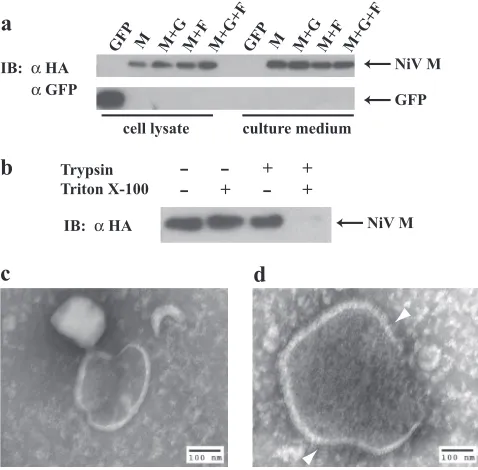
Nipah virus M is sufficient to form budding virus-like par-ticles.The matrix proteins of Ebola virus, human parainflu-enza virus type 1, Sendai virus, and other viruses can form budding VLPs following their transient expression (12, 54, 64, 67). In order to determine whether Nipah virus matrix protein can also bud in the absence of other viral proteins, HEK 293T cells were transfected with expression plasmids encoding GFP-or HA-tagged NiV M protein alone GFP-or in combination with NiV G and F plasmids. The culture medium was collected at 48 hours posttransfection, and putative VLPs were then purified by being pelleted through a sucrose cushion by ultracentrifu-gation. Western blotting revealed the presence of NiV M, at roughly 40 kDa, in particles isolated in this manner (Fig. 1a). This suggested that NiV M can bud from the cell surface in the presence as well as the absence of other Nipah virus structural proteins.
[image:2.585.301.540.69.304.2]To determine whether the M protein in the purified culture medium was within a membrane-bound particle, the VLPs from M-transfected cells were treated with trypsin in the pres-ence or abspres-ence of Triton X-100 detergent (Fig. 1b). The detergent will dissolve lipid membranes that may protect the M FIG. 1. NiV M can bud from transfected cells and form virus-like particles. (a) HEK 293T cells were transfected as indicated with an expression plasmid encoding GFP (2g), HA NiV M (2g), NiV G (0.5g), or NiV F (1g). At 48 hours posttransfection, the culture medium was harvested and centrifuged through a 20% sucrose cushion to pellet VLPs, and the transfected cells were lysed in radioimmuno-precipitation assay buffer. Western blotting (IB) of lysates and the purified culture medium was performed with anti-GFP and anti-HA antibodies. (b) Purified HA NiV M VLPs were treated with TPCK-trypsin in the presence or absence of 1% Triton X-100 for 1 h at 37°C. They were then visualized by Western blotting with an HA anti-body. (c and d) Representative transmission electron micrographs of NiV VLPs produced by transfection of M alone (c) or M, G, and F (d), stained with 1% phosphotungstic acid, pH 7.0. Arrowheads indicate the studded appearance of NiV glycoproteins, G and/or F, at the VLP surface.
on November 8, 2019 by guest
http://jvi.asm.org/
protein within the VLPs from protease digestion (70). In the samples treated with trypsin alone, significant digestion of M was not detected. In contrast, when VLPs were treated with both trypsin and Triton X-100, M was completely degraded. As a control, Triton X-100 treatment alone did not affect the amount of M protein in the VLPs. These data strongly suggest that the NiV M within the VLPs is enclosed by a lipid mem-brane that protects it from protease digestion.
Finally, the VLPs were analyzed by transmission electron microscopy to determine if their morphology was similar to that of NiV (Fig. 1c and d). VLPs were generated by transfec-tion of HA-tagged NiV M alone or with the two glycoproteins, G and F. That G and F are expressed from these plasmids is supported by our observation that cotransfection of these G and F plasmids is sufficient to mediate cell-cell fusion (data not shown) and by the presence of spikes on the surface of the VLPs, as detected in electron micrographs of the VLPs (Fig. 1d). The electron micrographs show representative VLPs con-sisting of NiV M (Fig. 1c) and NiV M with G and/or F spikes (Fig. 1d). Nipah virus is a pleiomorphic virus ranging in size from 50 nm to greater than 600 nm in diameter (27), and our purified VLPs ranged in size from 100 to 600 nm. The surface of the NiV M VLPs was smooth, while the VLPs produced by coexpression of NiV M, G, and F have spikes on their surface that presumably consist of surface glycoproteins. Their appear-ance is very similar to previously published images of NiV (27), indicating that these budding particles are an appropriate model for the analysis of NiV budding.
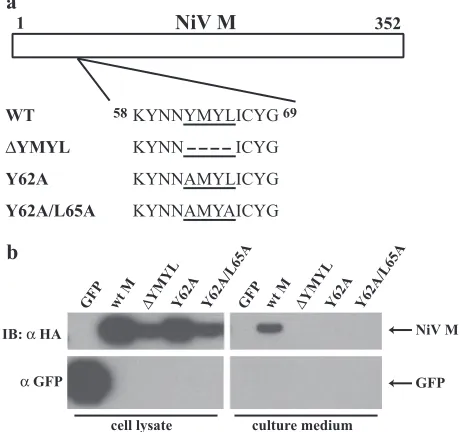
Budding of Nipah virus M is dependent on an YxxL se-quence.Analysis of the amino acid sequence of NiV M reveals that there is a tyrosine-based sequence,62YMYL65, similar to
the YPDL late domain (consensus, YxxL) described for EIAV Gag (49). To address the importance of this putative late domain in NiV budding, three HA-tagged NiV M mutants were generated based on mutations made to EIAV Gag: one with a deletion of the YMYL tetrapeptide (⌬YMYL) and two point mutants, Y62A and Y62A/L65A (Fig. 2a). 293T cells were transfected with each of the three mutants, and the bud-ding assay described above was performed. The wild-type HA NiV M was included as a positive control for budding, and GFP was included as a negative control. The Y62A mutant was expressed as well as the wild type, whereas ⌬YMYL and Y62A/L65A were present in cell lysates at somewhat lower levels than the wild type or Y62A (Fig. 2b). Interestingly, all three mutants, regardless of expression level, were completely deficient in terms of budding, with no M protein detectable in the purified supernatant (Fig. 2b). This suggests a role for the YMYL sequence in the budding process of the matrix protein.
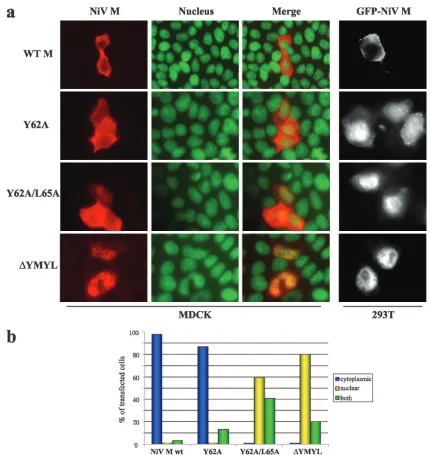
The NiV M YMYL mutants display aberrant subcellular localization.The localization of the M mutants was next ana-lyzed in an attempt to explain the budding deficiency of the YMYL mutants. Representative data from MDCK cells fected with HA-tagged NiV M constructs and 293T cells trans-fected with GFP-NiV M fusion constructs are shown in Fig. 3a. Note that the GFP–wild-type M fusion also buds efficiently from transfected cells (data not shown). In the MDCK cells, where anti-HA antibody was used to detect NiV M, wild-type NiV M expression was cytoplasmic with predominance at the plasma membrane (top row). Surprisingly, the⌬YMYL mu-tant (bottom row) localized almost exclusively in the nucleus,
with very little protein, if any, in the cytoplasm. NiV M Y62A (second row from top) was expressed mostly in the cytoplasm like wild-type M, but some protein did localize to the nucleus. NiV M Y62A/L65A (third row from top) localized in both the nucleus and the cytoplasm. We quantified NiV M’s localization in the MDCK cells by counting 100 M-expressing cells for each construct and scoring each cell as having only nuclear, only cytoplasmic, or a combination of nuclear and cytoplasmic M staining (Fig. 3b). A similar picture was seen for the 293T cells, where the GFP signal was used as a marker of GFP-M local-ization (Fig. 3a, right column). The wild-type M sequence yielded a largely plasma membrane localization, and the
⌬YMYL mutant was completely nuclear. In contrast, the Y62A and Y62A/L65A mutants displayed a combination of cytoplasmic and nuclear GFP (Fig. 3a). It would thus appear that there is a spectrum of relocalization, from completely cytoplasmic (wild type) to completely nuclear (⌬YMYL), while Y62A and Y62A/L65A display an intermediate phenotype with expression in both subcellular compartments. The exclusive nuclear localization of the⌬YMYL mutant can explain the absence of budding by this mutant. However, the Y62A mutant retains substantial cytoplasmic localization, arguing that this mutant fails to bud for alternate reasons. These data also suggest a role for the YMYL sequence in the intracellular trafficking of NiV M to the plasma membrane.
[image:3.585.306.536.71.287.2]NiV M and the YMYL mutants form oligomers.Matrix pro-teins are often membrane associated (55, 63) and also form oligomers as the virus buds from the cell (44, 53, 58, 66). One trivial explanation for the abolished budding of the NiV M mutants would be an inability to oligomerize, allowing a rela-tively small monomeric M to diffuse through the nuclear pore. FIG. 2. Budding of NiV VLPs is dependent on the presence YMYL. (a) Illustration of NiV M YMYL mutant constructs. WT, wild type. (b) HEK 293T cells were transfected with the indicated expres-sion plasmids, and at 48 hours posttransfection, VLPs were purified as described in the legend to Fig. 1. Western blotting (IB) was performed with anti-GFP and anti-HA antibodies. Two sections of the same blot after the same exposure time are shown.
on November 8, 2019 by guest
http://jvi.asm.org/
We therefore assessed, by coimmunoprecipitation, the self-association of wild-type and mutant M proteins. FLAG- and HA-tagged cDNA constructs of the wild-type and the mutant M genes were generated and transfected into 293T cells (Fig. 4). FLAG NiV M was immunoprecipitated with anti-FLAG antibody, and Western blotting was performed with anti-HA antibody. The HA-tagged constructs coimmunoprecipitate with those that are FLAG tagged, indicating that each of the mutants retains the ability to interact with itself (Fig. 4). Ad-ditionally, FLAG–wild-type M was cotransfected with each of the HA-tagged YMYL mutants, immunoprecipitations were
performed, and the pellets were blotted with HA anti-body. By this method, it was found that each mutant efficiently coprecipitated with wild-type M (data not shown). These data provide evidence that wild-type and mutant M proteins oli-gomerize, as would be expected of a matrix protein, and that the YMYL mutants’ nuclear localization is not due to their failure to oligomerize.
[image:4.585.75.505.63.518.2]YMYL can complement the budding defect of an Ebola virus VP40 protein late-domain mutant.Because of its resemblance to the EIAV late domain and because of the budding defects of the YMYL mutants described above, we investigated FIG. 3. Localization of wild-type and YMYL mutant NiV M proteins in transfected cells. (a) MDCK and 293T cells were transfected with plasmids expressing the indicated wild-type (WT) or mutant NiV M proteins tagged at the amino terminus with HA epitope (for the MDCK cells) or with GFP (for the 293T cells). At 24 hours posttransfection, the transfected MDCK cells were fixed and stained for immunofluorescence microscopy with anti-HA monoclonal antibody (red), and the cell nuclei were stained with Hoechst nuclear dye (green). The 293T cells were fixed at 24 hours posttransfection and imaged for GFP. (b) Quantification of the localization of wild-type and mutant NiV M in MDCK cells (100 fixed, anti-HA antibody-stained cells positive for NiV M were counted per transfection).
on November 8, 2019 by guest
http://jvi.asm.org/
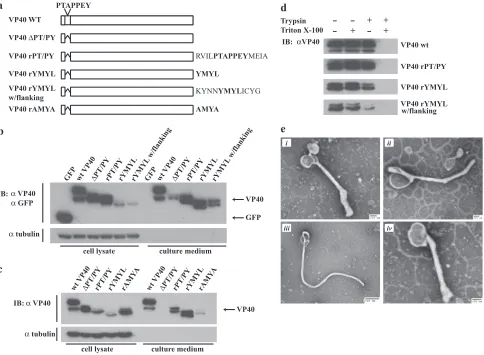
whether the YMYL sequence of NiV M could replace the late-domain function of another matrix protein, EBOV VP40. We generated a previously described budding-deficient mutant of VP40 in which its two overlapping late domains (PTAPPEY) were deleted (⌬PT/PY) (32) (Fig. 5a). Others have demonstrated that late domains can function in a posi-tion-independent manner and that transfer of the Ebola virus VP40 late domains to the carboxy terminus of the ⌬PT/PY mutant can restore its budding (28, 32). We therefore fused the VP40 late-domain sequence PTAPPEY and its flanking amino acids to the carboxy terminus of the VP40⌬PT/PY mutant (rPT/PY), or we fused the NiV M YMYL alone or with flank-ing sequences to the mutant VP40 (rYMYL and rYMYL with flanking sequences) (Fig. 5a). When assayed for expression in cell lysates, each of the constructs was expressed, although the constructs with NiV M sequences (rYMYL and rAMYA) ac-cumulated in the lysates to lower levels than did the constructs containing only VP40 sequences (Fig. 5b and 5c). In the West-ern blots, VP40 appears as a doublet, as has been described previously (22, 29). It was also noted that those constructs in which additions were made to the carboxy terminus of VP40 FIG. 4. NiV M wild-type (WT) and YMYL mutant proteins
self-associate. 293T cells were transfected as indicated with FLAG- or HA-tagged versions of the constructs shown in Fig. 2a. Immuno-precipitation (IP) of all lysates was done with anti-FLAG beads, followed by Western blotting (IB) with anti-HA antibody. FLAG and HA blots of whole-cell extract (WCE) are shown in the bottom panel.
FIG. 5. The YMYL sequence from NiV M can restore budding of late-domain mutant EBOV VP40. (a) Illustration of the chimeric EBOV VP40 constructs. WT, wild type. (b and c) 293T cells were transfected with the indicated plasmids for 48 hours, and the budding assay was performed as described in the legend to Fig. 1. (d) The indicated VLPs were treated with TPCK-trypsin (0.1 mg/ml) in the presence or absence of Triton X-100 as described for Fig. 1. (e) Transmission electron micrographs of budded VP40 VLPs stained with 1% phosphotungstic acid, pH 7.0. Panels: i, VP40 wild-type; ii, VP40 rPT/PY; iii, VP40 rYMYL; iv, VP40 rYMYL with flanking sequences.
on November 8, 2019 by guest
http://jvi.asm.org/
[image:5.585.52.536.324.679.2](constructs rPT/PY, rYMYL, rYMYL w/flanking, and rAMYA) consistently migrated faster than did the VP40 de-letion mutants (Fig. 5b and c). The⌬PT/PY mutant of VP40 budded with greatly reduced efficiency, as expected, and the fusion at the carboxy terminus of the VP40 late domain along with flanking sequences restored budding of VP40 to levels equal to or higher than that of the wild type (Fig. 5b). Budding was also restored when the NiV M YMYL sequence alone or the tetrapeptide plus its flanking amino acids were fused at the carboxy terminus of⌬PT/PY VP40 (Fig. 5b). A mutant version of YMYL (AMYA), which when introduced into NiV M abol-ished its budding (Fig. 2), was then appended to the carboxy terminus of⌬PT/PY VP40 (VP40 rAMYA). In this context, the VP40 budding defect was retained (Fig. 5c). Interestingly, the sequence AMYL, which also abolished budding by NiV M (Fig. 2), was able to restore budding of the mutant VP40 (data not shown). We speculate that the functional difference be-tween the AMYL mutant NiV M protein and the ⌬PT/PY VP40 rAMYL protein may reflect the presence in NiV M of competing nuclear localization and budding signals. In the case of VP40, for which nuclear localization has not been described, the absence of the second signal may allow a weakened bud-ding motif to still function.
To further authenticate the budded material as VLPs, we analyzed the ability of the protein within the VLPs to be protected from protease digestion. In the absence of Triton X-100, VP40 in the VLPs is largely resistant to trypsin treat-ment (Fig. 5d). However, when trypsin and Triton X-100 were added together, VP40 was digested completely, indicating that these were membrane-bound particles (Fig. 5d). Further, VLPs were analyzed by electron microscopy (Fig. 5e). Wild-type VP40 displayed the classic filamentous morphology of Ebola virus particles, as did all of the budding chimeric pro-teins (Fig. 5e). Based on these cumulative data, not only does the NiV M sequence YMYL appear to influence the subcel-lular localization of NiV M, but it may also function as a late domain.
DISCUSSION
Our data demonstrate that expression of NiV M is sufficient to yield budding VLPs, and the addition of expression plasmids encoding the viral glycoproteins G and F did not detectably alter release of VLPs. Following standard criteria for VLP isolation, the particles could be pelleted through a sucrose cushion, consisted primarily of membrane-bound M protein as deduced by trypsin digestion of M in the presence but not the absence of detergent, and displayed NiV-like morphology by electron microscopy. The ability of NiV M protein to bud in the absence of other viral proteins is a property shared with some but not all paramyxoviruses. For example, expression of the matrix protein alone results in the budding of VLPs for Sendai virus (54, 64) and human parainfluenza virus type I (12). NiV M also shares this property with the matrix proteins of the nonsegmented negative-strand RNA viruses Ebola virus (67) and VSV and with the Gag proteins of the retroviruses RSV (3, 70) and HIV-1 (18, 61). In contrast, other paramyxo-virus M proteins, such as that of SV5, do not efficiently bud on their own and require additional proteins (for example, the
nucleocapsid in addition to the matrix protein) to form bud-ding particles (57).
In an effort to understand the requirements for NiV M budding, we mutated the sequence62YMYL65in NiV M
pro-tein because it resembles the YxxL sequence previously de-fined as a late domain in equine infectious anemia virus (49, 50). Mutation of this sequence resulted in two dramatic phe-notypes. First, the Y62A and Y62A/L65A mutations, or dele-tion of the entire motif, completely abrogated NiV M budding (Fig. 2). Although the absolute level of expression of each mutant varied, each was expressed at levels comparable to those of the wild type, and in fact, the Y62A mutant was expressed to levels equal to those of wild-type M. Thus, loss of budding activity does not simply reflect altered levels of ex-pression. Although the NiV YMYL was initially mutated based upon its resemblance to the EIAV late domain, the complete loss of detectable M budding is somewhat unique. For exam-ple, among the matrix proteins of nonsegmented negative-strand RNA viruses, disruption of late domains has been re-ported to have a profound but not an absolute impact on budding. Ebola virus VP40 matrix proteins with mutated late domains are compromised in their ability to bud and have reported VLP budding efficiencies reduced to as little as 1% of the wild-type level but are not absolutely “dead” (32). Simi-larly, VSV M mutants lacking late domains budded at 30% of wild-type M levels (23), and mutations that disrupted the late domain of SV5 M decreased VLP release to 5% of wild-type levels (56). Interestingly, such mutations when built into the context of a complete virus suggest that late-domain function is important but is not essential for virus growth. For example, Ebola virus mutants lacking late domains were only modestly attenuated in cell culture, reaching maximum titers approxi-mately 10-fold lower than those of wild-type virus (42). Late-domain mutant VSV recombinants displayed similar growth defects (28, 30). In contrast, a mutant SV5 with a proline-to-alanine mutation in its FPIV late domain replicated very poorly and readily gave rise to second-site revertants that re-stored budding function (56).
The second dramatic phenotype, the relocalization of NiV M mutants away from the plasma membrane and into the nucleus, may contribute to the mutants’ complete loss of bud-ding. The ability of the mutants to accumulate in the nucleus, which was most dramatically seen with the⌬YMYL mutant, suggests the presence of competing trafficking signals within NiV M. Alternatively, mutation of YMYL could unmask a latent nuclear localization signal. One can postulate that in the absence of a strong signal directing M protein to the budding machinery, the second signal (e.g., a nuclear localization sig-nal) further impairs NiV M release. Mutation of late domains has not, to our knowledge, been previously noted to redirect localization of viral proteins to the nucleus. This was true even of a VSV M late-domain mutant (with a proline-to-alanine mutation), which remained concentrated at the plasma mem-brane despite the fact that VSV M is known to enter the nucleus (35). The YMYL tetrapeptide does resemble a ty-rosine-based Yxx⌽basolateral targeting signal (where⌽refers to any bulky, hydrophobic residue) such as those which have been characterized in many transmembrane proteins, including HIV-1 Env (5, 33, 34, 43). Interestingly, a Yxx⌽ within the cytoplasmic tail of the Hendra virus F protein mediates
on November 8, 2019 by guest
http://jvi.asm.org/
cytosis of this protein and is required for proper proteolytic processing of this protein (38). Given the presence of a similar Yxx⌽within the cytoplasmic tail of NiV F protein, it will be interesting to determine if these signals facilitate the basolat-eral localization of the M and F proteins and therefore the site of their putative interaction during viral assembly.
Whether wild-type NiV M protein shuttles in and out of the nucleus remains unclear. Paramyxoviruses replicate in the cy-toplasm of infected cells, and thus the role of a transiently nuclear M protein is not obvious. It is notable that the M protein of the paramyxovirus Newcastle disease virus localizes to the nucleus following expression of M alone or following virus infection; however, a function for nuclear Newcastle dis-ease virus M has not been established (11, 16, 48). The VSV matrix protein also is present, in part, in the nucleus (35) and can inhibit host cell transcription and host cell nuclear trans-port functions (2, 4, 24, 68). Whether wild-type or mutant NiV M can influence host cell nuclear functions remains to be addressed.
Our hypothesis that NiV M protein’s YMYL sequence might function as a late domain is supported not only by the budding defect displayed by mutated M proteins but also by the ability of the YMYL sequence to complement the budding defect of an Ebola virus VP40 late-domain mutant (Fig. 5). Our VP40 complementation assay takes advantage of reports illustrating that late domains are interchangeable and can function independently of their position within the protein (28, 46); thus, we can demonstrate late-domain function of YMYL by fusing it to the C terminus of EBOV VP40⌬PT/PY. As noted above, late domains mediate interaction between viral proteins and host proteins involved in vacuolar protein sorting and cellular MVB function. Thus, the EIAV Gag protein has been reported to interact in a YxxL-dependent manner both with AP-2, a component of the clathrin-associated adapter complex, and with AIP-1/ALIX, which functions in MVB ves-icle formation (36, 49, 50). Similarly, several viral proteins possess P(T/S)AP late-domain motifs that recruit ESCRT complexes to the site of budding through interaction with Tsg101. These include the HIV-1 Gag p6 domain (37), the Ebola virus matrix protein VP40 (22, 32, 37), the VSV matrix protein (13, 23), and the Z (RING) proteins of lymphocytic choriomeningitis virus and Lassa virus (62). A second proline-rich late-domain motif, PPxY, first discovered in RSV Gag p2b domain but also present in the Ebola virus VP40, interacts with the Nedd4-like ubiquitin ligase, which also influences MVB function (22, 46). Finally, the only paramyxovirus virus late domain identified thus far has been the FPIV sequence within the SV5 M (56). Although a specific cellular interaction part-ner remains undefined, a dominant-negative form of Vps4A, expression of which is known to disrupt MVB formation, in-hibited SV5 budding (56). The ability of the YMYL sequence within NiV M to mediate interactions with cellular MVB ponents will be an important follow-up to its ability to com-plement the VP40 late-domain defect.
Analysis of the matrix protein sequences of other paramyxo-viruses shows that measles virus, Sendai virus, and J virus matrix proteins all have sequences similar to YMYL at their amino termini. Such sequence conservation between viruses suggests functional importance. Of note, Hendra virus, the closest known relative to Nipah virus, has the sequence
YMYM at this position, but this sequence has not been as-sayed for functions like those attributable to YMYL. The in-tracellular trafficking of M and the signals that control this will undoubtedly be important to our understanding of NiV patho-genesis, and the identification of sequences essential for viral release may suggest novel strategies for antiviral therapeutics.
ACKNOWLEDGMENTS
This work was supported by grants from the NIH to C.F.B., includ-ing AI057158 (Northeast Biodefense Center—Lipkin). M.J.C is a pre-doctoral trainee and was supported in part by a U.S. Public Health Service Institutional Research Training Award (AI 07647). Immuno-fluorescence microscopy and electron microscopy were performed at the MSSM-Shared Research Facility, which is supported with funding from NIH-NCI shared resources grant 5R24 CA095823-04, NSF Ma-jor Research Instrumentation grant DBI-9724504, and NIH shared instrumentation grant 1 S10 RR0 9145-01.
We thank Lawrence Leung and Osvaldo Martinez for invaluable assistance, discussion, and critical readings of the manuscript. The anti-VP40 monoclonal antibody was a generous gift from Ronald Harty (University of Pennsylvania). The VP40 cDNA was kindly pro-vided by Viktor Volchkov (Claude Bernard University, Lyon, France).
REFERENCES
1.Aguilar, H. C., K. A. Matreyek, C. M. Filone, S. T. Hashimi, E. L. Levroney, O. A. Negrete, A. Bertolotti-Ciarlet, D. Y. Choi, I. McHardy, J. A. Fulcher, S. V. Su, M. C. Wolf, L. Kohatsu, L. G. Baum, and B. Lee.2006. N-glycans on Nipah virus fusion protein protect against neutralization but reduce membrane fusion and viral entry. J. Virol.80:4878–4889.
2.Ahmed, M., and D. S. Lyles.1998. Effect of vesicular stomatitis virus matrix protein on transcription directed by host RNA polymerases I, II, and III. J. Virol.72:8413–8419.
3.Bennett, R. P., S. Rhee, R. C. Craven, E. Hunter, and J. W. Wills.1991. Amino acids encoded downstream of Gag are not required by Rous sarcoma virus protease during Gag-mediated assembly. J. Virol.65:272–280. 4.Black, B., and D. Lyles. 1992. Vesicular stomatitis virus matrix protein
inhibits host cell-directed transcription of target genes in vivo. J. Virol. 66:4058–4064.
5.Boge, M., S. Wyss, J. S. Bonifacino, and M. Thali. 1998. A membrane-proximal tyrosine-based signal mediates internalization of the HIV-1 enve-lope glycoprotein via interaction with the AP-2 clathrin adaptor. J. Biol. Chem.273:15773–15778.
6.Bonaparte, M. I., A. S. Dimitrov, K. N. Bossart, G. Crameri, B. A. Mungall, K. A. Bishop, V. Choudhry, D. S. Dimitrov, L.-F. Wang, B. T. Eaton, and C. C. Broder.2005. Ephrin-B2 ligand is a functional receptor for Hendra virus and Nipah virus. Proc. Natl. Acad. Sci. USA102:10652–10657. 7.Bossart, K., B. Mungall, G. Crameri, L.-F. Wang, B. Eaton, and C. Broder.
2005. Inhibition of Henipavirus fusion and infection by heptad-derived pep-tides of the Nipah virus fusion glycoprotein. Virol. J.2:57.
8.Chadha, M. S., J. A. Comer, L. Lowe, P. A. Rota, P. E. Rollin, W. J. Bellini, T. G. Ksiazek, and A. C. Mishra.2006. Nipah virus-associated encephalitis outbreak, Siliguri, India. Emerg. Infect. Dis.12:235.
9.Chua, K. B., W. J. Bellini, P. A. Rota, B. H. Harcourt, A. Tamin, S. K. Lam, T. G. Ksiazek, P. E. Rollin, S. R. Zaki, W.-J. Shieh, C. S. Goldsmith, D. J. Gubler, J. T. Roehrig, B. Eaton, A. R. Gould, J. Olson, H. Field, P. Daniels, A. E. Ling, C. J. Peters, L. J. Anderson, and B. W. N. J. Mahy.2000. Nipah virus: a recently emergent deadly paramyxovirus. Science288:1432–1435. 10.Chua, K. B., C. Lek Koh, P. S. Hooi, K. F. Wee, J. H. Khong, B. H. Chua,
Y. P. Chan, M. E. Lim, and S. K. Lam.2002. Isolation of Nipah virus from Malaysian Island flying-foxes. Microbes Infect.4:145–151.
11.Coleman, N. A., and M. E. Peeples.1993. The matrix protein of Newcastle disease virus localizes to the nucleus via a bipartite nuclear localization signal. Virology195:596–607.
12.Coronel, E. C., K. G. Murti, T. Takimoto, and A. Portner.1999. Human parainfluenza virus type 1 matrix and nucleoprotein genes transiently ex-pressed in mammalian cells induce the release of virus-like particles con-taining nucleocapsid-like structures. J. Virol.73:7035–7038.
13.Craven, R. C., R. N. Harty, J. Paragas, P. Palese, and J. W. Wills.1999. Late domain function identified in the vesicular stomatitis virus M protein by use of rhabdovirus-retrovirus chimeras. J. Virol.73:3359–3365.
14.Diederich, S., M. Moll, H.-D. Klenk, and A. Maisner.2005. The Nipah virus fusion protein is cleaved within the endosomal compartment. J. Biol. Chem. 280:29899–29903.
15.Epstein, J., S. Rahman, J. Zambriski, K. Halpin, G. Meehan, A. Jamaluddin, S. Hassan, H. Field, A. Hyatt, and P. Daszak.2006. Feral cats and risk for Nipah virus transmission. Emerg. Infect. Dis.12:1178–1179.
on November 8, 2019 by guest
http://jvi.asm.org/
16.Faaberg, K., and M. E. Peeples.1988. Strain variation and nuclear associa-tion of Newcastle disease virus matrix protein. J. Virol.62:586–593. 17.Freed, E. O.2002. Viral late domains. J. Virol.76:4679–4687.
18.Gheysen, D., E. Jacobs, F. de Foresta, C. Thiriart, M. Francotte, D. Thines, and M. De Wilde.1989. Assembly and release of HIV-1 precursor Pr55gag virus-like particles from recombinant baculovirus-infected insect cells. Cell 59:103–112.
19.Gottlinger, H. G., T. Dorfman, J. G. Sodroski, and W. A. Haseltine.1991. Effect of mutations affecting the p6 gag protein on human immunodeficiency virus particle release. Proc. Natl. Acad. Sci. USA88:3195–3199.
20.Halpin, K., B. Bankamp, B. H. Harcourt, W. J. Bellini, and P. A. Rota.2004. Nipah virus conforms to the rule of six in a minigenome replication assay. J. Gen. Virol.85:701–707.
21.Harcourt, B., L. Lowe, A. Tamin, X. Liu, B. Bankamp, N. Bowden, P. Rollin, J. Comer, T. Ksiazek, M. Hossain, E. Gurley, R. Breiman, W. Bellini, and P. Rota. 2005. Genetic characterization of Nipah virus, Bangladesh, 2004. Emerg. Infect. Dis.11:1594–1597.
22.Harty, R. N., M. E. Brown, G. Wang, J. Huibregtse, and F. P. Hayes.2000. A PPxY motif within the VP40 protein of Ebola virus interacts physically and functionally with a ubiquitin ligase: implications for filovirus budding. Proc. Natl. Acad. Sci. USA97:13871–13876.
23.Harty, R. N., J. Paragas, M. Sudol, and P. Palese.1999. A proline-rich motif within the matrix protein of vesicular stomatitis virus and rabies virus inter-acts with WW domains of cellular proteins: implications for viral budding. J. Virol.73:2921–2929.
24.Her, L.-S., E. Lund, and J. E. Dahlberg.1997. Inhibition of Ran guanosine triphosphatase-dependent nuclear transport by the matrix protein of vesic-ular stomatitis virus. Science276:1845–1848.
25.Hsu, V. P., M. Hossain, U. D. Parashar, M. M. Ali, T. Ksiazek, I. Kuzmin, M. Niezgoda, C. Rupprecht, J. Bresee, and R. Breiman.2004. Nipah virus encephalitis reemergence, Bangladesh. Emerg. Infect. Dis.10:2082–2087. 26.Huang, M., J. M. Orenstein, M. A. Martin, and E. O. Freed.1995. p6Gag is
required for particle production from full-length human immunodeficiency virus type 1 molecular clones expressing protease. J. Virol.69:6810–6818. 27.Hyatt, A. D., S. R. Zaki, C. S. Goldsmith, T. G. Wise, and S. G. Hengstberger.
2001. Ultrastructure of Hendra virus and Nipah virus within cultured cells and host animals. Microbes Infect.3:297–306.
28.Irie, T., J. M. Licata, and R. N. Harty.2005. Functional characterization of Ebola virus L-domains using VSV recombinants. Virology336:291–298. 29.Jasenosky, L. D., G. Neumann, I. Lukashevich, and Y. Kawaoka.2001. Ebola
virus VP40-induced particle formation and association with the lipid bilayer. J. Virol.75:5205–5214.
30.Jayakar, H. R., K. G. Murti, and M. A. Whitt.2000. Mutations in the PPPY motif of vesicular stomatitis virus matrix protein reduce virus budding by inhibiting a late step in virion release. J. Virol.74:9818–9827.
31.Lamb, R. A., and D. Kolakofsky.2001. Paramyxoviridae: the viruses and their replication, p. 1305–1340. In D. M. Knipe, P. M. Howley, D. E. Griffin, R. A. Lamb, M. A. Martin, B. Roizman, and S. E. Straus (ed.), Fields virology, 4th ed. Lippincott Williams & Wilkins, Philadelphia, Pa.
32.Licata, J. M., M. Simpson-Holley, N. T. Wright, Z. Han, J. Paragas, and R. N. Harty.2003. Overlapping motifs (PTAP and PPEY) within the Ebola virus VP40 protein function independently as late budding domains: involve-ment of host proteins TSG101 and VPS-4. J. Virol.77:1812–1819. 33.Lodge, R., H. Gottlinger, D. Gabuzda, E. A. Cohen, and G. Lemay.1994. The
intracytoplasmic domain of gp41 mediates polarized budding of human im-munodeficiency virus type 1 in MDCK cells. J. Virol.68:4857–4861. 34.Lodge, R., J.-P. Lalonde, G. Lemay, and E. A. Cohen.1997. The
membrane-proximal intracytoplasmic tyrosine residue of HIV-1 envelope glycoprotein is critical for basolateral targeting of viral budding in MDCK cells. EMBO J. 16:695–705.
35.Lyles, D., L. Puddington, and J. McCreedy, BJ.1988. Vesicular stomatitis virus M protein in the nuclei of infected cells. J. Virol.62:4387–4392. 36.Martin-Serrano, J., A. Yarovoy, D. Perez-Caballero, and P. D. Bieniasz.
2003. Divergent retroviral late-budding domains recruit vacuolar protein sorting factors by using alternative adaptor proteins. Proc. Natl. Acad. Sci. USA100:12414–12419.
37.Martin-Serrano, J., T. Zang, and P. D. Bieniasz.2001. HIV-1 and Ebola virus encode small peptide motifs that recruit Tsg101 to sites of particle assembly to facilitate egress. Nat. Med.7:1313–1319.
38.Meulendyke, K. A., M. A. Wurth, R. O. McCann, and R. E. Dutch.2005. Endocytosis plays a critical role in proteolytic processing of the Hendra virus fusion protein. J. Virol.79:12643–12649.
39.Morita, E., and W. I. Sundquist.2004. Retrovirus budding. Annu. Rev. Cell Dev. Biol.20:395–425.
40.Negrete, O. A., E. L. Levroney, H. C. Aguilar, A. Bertolotti-Ciarlet, R. Nazarian, S. Tajyar, and B. Lee.2005. EphrinB2 is the entry receptor for Nipah virus, an emergent deadly paramyxovirus. Nature436:401. 41.Negrete, O. A., M. C. Wolf, H. C. Aguilar, S. Enterlein, W. Wang, E.
Muhl-berger, S. V. Su, A. Bertolotti-Ciarlet, R. Flick, and B. Lee.2006. Two key residues in ephrinB3 are critical for its use as an alternative receptor for Nipah virus. PLoS Pathog.2:e7.
42.Neumann, G., H. Ebihara, A. Takada, T. Noda, D. Kobasa, L. D. Jasenosky,
S. Watanabe, J. H. Kim, H. Feldmann, and Y. Kawaoka.2005. Ebola virus VP40 late domains are not essential for viral replication in cell culture. J. Virol.79:10300–10307.
43.Ohno, H., R. C. Aguilar, M.-C. Fournier, S. Hennecke, P. Cosson, and J. S. Bonifacino.1997. Interaction of endocytic signals from the HIV-1 envelope glycoprotein complex with members of the adaptor medium chain family. Virology238:305–315.
44.Ono, A., J. M. Orenstein, and E. O. Freed.2000. Role of the Gag matrix domain in targeting human immunodeficiency virus type 1 assembly. J. Virol. 74:2855–2866.
45.Pager, C. T., J. W. W. Craft, J. Patch, and R. E. Dutch.2006. A mature and fusogenic form of the Nipah virus fusion protein requires proteolytic pro-cessing by cathepsin L. Virology346:251–257.
46.Parent, L. J., R. P. Bennett, R. C. Craven, T. D. Nelle, N. K. Krishna, J. B. Bowzard, C. B. Wilson, B. A. Puffer, R. C. Montelaro, and J. W. Wills.1995. Positionally independent and exchangeable late budding functions of the Rous sarcoma virus and human immunodeficiency virus Gag proteins. J. Vi-rol.69:5455–5460.
47.Park, M.-S., M. L. Shaw, J. Munoz-Jordan, J. F. Cros, T. Nakaya, N. Bouvier, P. Palese, A. Garcia-Sastre, and C. F. Basler.2003. Newcastle disease virus (NDV)-based assay demonstrates interferon-antagonist activity for the NDV V protein and the Nipah virus V, W, and C proteins. J. Virol. 77:1501–1511.
48.Peeples, M. E., C. Wang, K. Gupta, and N. Coleman.1992. Nuclear entry and nucleolar localization of the Newcastle disease virus (NDV) matrix protein occur early in infection and do not require other NDV proteins. J. Virol. 66:3263–3269.
49.Puffer, B. A., L. J. Parent, J. W. Wills, and R. C. Montelaro.1997. Equine infectious anemia virus utilizes a YXXL motif within the late assembly domain of the Gag p9 protein. J. Virol.71:6541–6546.
50.Puffer, B. A., S. C. Watkins, and R. C. Montelaro.1998. Equine infectious anemia virus Gag polyprotein late domain specifically recruits cellular AP-2 adapter protein complexes during virion assembly. J. Virol.72:10218–10221. 51.Rodriguez, J. J., C. D. Cruz, and C. M. Horvath.2004. Identification of the nuclear export signal and STAT-binding domains of the Nipah virus V protein reveals mechanisms underlying interferon evasion. J. Virol.78:5358–5367. 52.Rodriguez, J. J., J.-P. Parisien, and C. M. Horvath.2002. Nipah virus V
protein evades alpha and gamma interferons by preventing STAT1 and STAT2 activation and nuclear accumulation. J. Virol.76:11476–11483. 53.Rodriguez, L., I. Cuesta, A. Asenjo, and N. Villanueva.2004. Human
respi-ratory syncytial virus matrix protein is an RNA-binding protein: binding properties, location and identity of the RNA contact residues. J. Gen. Virol. 85:709–719.
54.Sakaguchi, T., T. Uchiyama, Y. Fujii, K. Kiyotani, A. Kato, Y. Nagai, A. Kawai, and T. Yoshida.1999. Double-layered membrane vesicles released from mammalian cells infected with Sendai virus expressing the matrix pro-tein of vesicular stomatitis virus. Virology263:230–243.
55.Sanderson, C. M., H. H. Wu, and D. P. Nayak.1994. Sendai virus M protein binds independently to either the F or the HN glycoprotein in vivo. J. Virol. 68:69–76.
56.Schmitt, A. P., G. P. Leser, E. Morita, W. I. Sundquist, and R. A. Lamb. 2005. Evidence for a new viral late-domain core sequence, FPIV, necessary for budding of a paramyxovirus. J. Virol.79:2988–2997.
57.Schmitt, A. P., G. P. Leser, D. L. Waning, and R. A. Lamb.2002. Require-ments for budding of paramyxovirus simian virus 5 virus-like particles. J. Vi-rol.76:3952–3964.
58.Scianimanico, S., G. Schoehn, J. Timmins, R. W. H. Ruigrok, H.-D. Klenk, and W. Weissenhorn.2000. Membrane association induces a conformational change in the Ebola virus matrix protein. EMBO J.19:6732–6741. 59.Shaw, M. L., W. B. Cardenas, D. Zamarin, P. Palese, and C. F. Basler.2005.
Nuclear localization of the Nipah virus W protein allows for inhibition of both virus- and Toll-like receptor 3-triggered signaling pathways. J. Virol. 79:6078–6088.
60.Shaw, M. L., A. Garcia-Sastre, P. Palese, and C. F. Basler.2004. Nipah virus V and W proteins have a common STAT1-binding domain yet inhibit STAT1 activation from the cytoplasmic and nuclear compartments, respectively. J. Virol.78:5633–5641.
61.Smith, A. J., M. I. Cho, M. L. Hammarskjold, and D. Rekosh.1990. Human immunodeficiency virus type 1 Pr55gag and Pr160gag-pol expressed from a simian virus 40 late replacement vector are efficiently processed and assem-bled into viruslike particles. J. Virol.64:2743–2750.
62.Strecker, T., R. Eichler, J. ten Meulen, W. Weissenhorn, H. Dieter Klenk, W. Garten, and O. Lenz.2003. Lassa virus Z protein is a matrix protein sufficient for the release of virus-like particles. J. Virol.77:10700–10705.
63.Stricker, R., G. Mottet, and L. Roux.1994. The Sendai virus matrix protein appears to be recruited in the cytoplasm by the viral nucleocapsid to function in viral assembly and budding. J. Gen. Virol.75:1031–1042.
64.Takimoto, T., K. G. Murti, T. Bousse, R. A. Scroggs, and A. Portner.2001. Role of matrix and fusion proteins in budding of Sendai virus. J. Virol. 75:11384–11391.
65.Takimoto, T., and A. Portner.2004. Molecular mechanism of paramyxovirus budding. Virus Res.106:133–145.
on November 8, 2019 by guest
http://jvi.asm.org/
66.Timmins, J., G. Schoehn, C. Kohlhaas, H.-D. Klenk, R. W. H. Ruigrok, and W. Weissenhorn.2003. Oligomerization and polymerization of the filovirus matrix protein VP40. Virology312:359–368.
67.Timmins, J., S. Scianimanico, G. Schoehn, and W. Weissenhorn.2001. Vesicular release of Ebola virus matrix protein VP40. Virology283:1–6. 68.von Kobbe, C., J. M. A. van Deursen, J. P. Rodrigues, D. Sitterlin, A. Bachi,
X. Wu, M. Wilm, M. Carmo-Fonseca, and E. Izaurralde.2000. Vesicular stomatitis virus matrix protein inhibits host cell gene expression by targeting the nucleoporin Nup98. Mol. Cell6:1243–1252.
69.Wills, J. W., C. E. Cameron, C. B. Wilson, Y. Xiang, R. P. Bennett, and J. Leis.1994. An assembly domain of the Rous sarcoma virus Gag protein required late in budding. J. Virol.68:6605–6618.
70.Wills, J. W., R. C. Craven, and J. A. Achacoso.1989. Creation and expression of myristylated forms of Rous sarcoma virus Gag protein in mammalian cells. J. Virol.63:4331–4343.
71.Xiang, Y., C. E. Cameron, J. W. Wills, and J. Leis.1996. Fine mapping and characterization of the Rous sarcoma virus Pr76gag late assembly domain. J. Virol.70:5695–5700.